"...the main purpose of criticism...is not to make its readers agree, nice as that is, but to make them, by whatever orthodox or unorthodox method, think." - John Simon

"The great enemy of clear language is insincerity." - George Orwell

Friday, June 22, 2012

Simple Men

"When you're approached by a studio, they say 'We want you to make your own films' – and then they describe how the project will get financed. These are well-intentioned people; they're not stupid. But the amount of money they want to get, and the way they want to get it, prohibits me from making my kind of film. That's why most big movies today are so homogeneous."– Hal Hartley


It is this sentiment, coming from independent filmmaker Hal Hartley, which may explain the decidedly un-Hollywood kind of films that make up his eclectic body of work. He emerged on the scene in the late 1980s with films that explored the banality of suburban life mixed with the bizarre, often with hilariously ironic results. The stories and their settings that he explored were realistic enough (i.e. the boy-meets-girl tale of The Unbelievable Truth) but they were then contrasted by stylized dialogue delivered in a deadpan style reminiscent of the great stone-face Buster Keaton. His characters often talk in philosophical terms but in very mundane situations that challenge the audience. The way the dialogue is delivered by his actors appears to be awkward but this is done to illustrate the irony of the context that is spoken in.

This is evident in Simple Men (1992), which marked Hartley’s most expensive feature at that time with a meager (by Hollywood standards) $2 million budget. The film concerns two brothers on a quest to find their eccentric father and saw the filmmaker exploring the theme of desire: surviving it, suppressing it, and understanding it. As one character remarks, “there’s only trouble and desire, but the funny thing is, when you desire something you immediately get into trouble. And when you get into trouble, you don’t desire anything at all.” This is just a small sample of the weighty philosophical musings contained in this film as the characters discuss the primary themes of life: trust, truth, love, guilt, and human existence in general but never in a dry, boring way – always with an amusingly quirky spin but with poignant resonance. It’s a tricky balancing act that Hartley gets just right with Simple Men.

Bill McCabe (Robert John Burke) is a professional thief betrayed by his girlfriend (and partner-in-crime) for the other guy in their crew in what has to be one of the most laid-back break-ups among criminals put on film in recent memory. Hartley said of this sequence, “Yeah, well anyone can film a stick-up. I just wondered what happened afterwards, if the guy obviously had no intention of ever shooting anyone.” Bill is bitter and upset but he doesn’t do anything about it. Meanwhile, his younger, more contemplative brother Dennis (Bill Sage) is trying to track down their father (John MacKay), the legendary Dodgers shortstop who allegedly threw a bomb in the front door of the Pentagon 23 years ago killing seven people. As a result, he became a fugitive and was finally caught by the authorities after suffering a stroke.

Dennis finds Bill and when they go to visit their dad in the hospital a nurse tells them that he’s escaped. Their mother gives them a phone number but it’s disconnected. The area code is Long Island and so they go there looking for clues as to his whereabouts. Along the way, Bill gets involved with Kate (Karen Sillas), the beautiful owner of a diner, and cross paths with the mysterious Elina (Elina Lowensohn) who may know where their father is hiding out.

Hartley populates Simple Men with troubled people, like Ned Rifle (Jeffrey Howard) who can’t get his motorcycle to work (“There’s nothing like a machine to make a man feel insignificant.”) or Bill who suffers from a broken heart. There’s Kate, whose ex-husband was in jail but is due back any day now, and Martin (Martin Donovan), a bitter fisherman who has a thing for Kate but she won’t give him the time of day. Hartley proceeds to bounce these oddballs off each other in absurd set pieces, like one that starts off with Bill and Ned engaging in snappy banter and ends with a nun and a police officer fighting on the street while Ned dazedly repeats, “There’s nothing but trouble and desire,” which could easily be the subtitle of this film.
Robert John Burke and Bill Sage do a good job of playing slightly estranged brothers whose friction comes from their broken home thanks to their fugitive father. It is Hartley regular Martin Donovan that comes off the best because he knows exactly how to deliver the filmmaker’s stylized dialogue, playing an angry man due to unrequited love. He had previously been in Trust (1990) and Surviving Desire (1991) and was, in some respects, Hartley’s cinematic alter ego, but in Simple Men he plays a very different character than in those previous efforts and it demonstrates his impressive range as an actor. Yet for all of the deadpan acting, the end of the film, when Bill and Dennis finally come to terms with their estranged father, is surprisingly moving, as is the relationship that develops between Bill and Kate. This is due in large part to the palpable chemistry between Burke and Karen Sillas. Initially, Bill remains cool and aloof towards Kate but soon finds himself irresistibly drawn to her earthy charisma. The looks they exchange throughout the film convey their growing attraction towards each other.

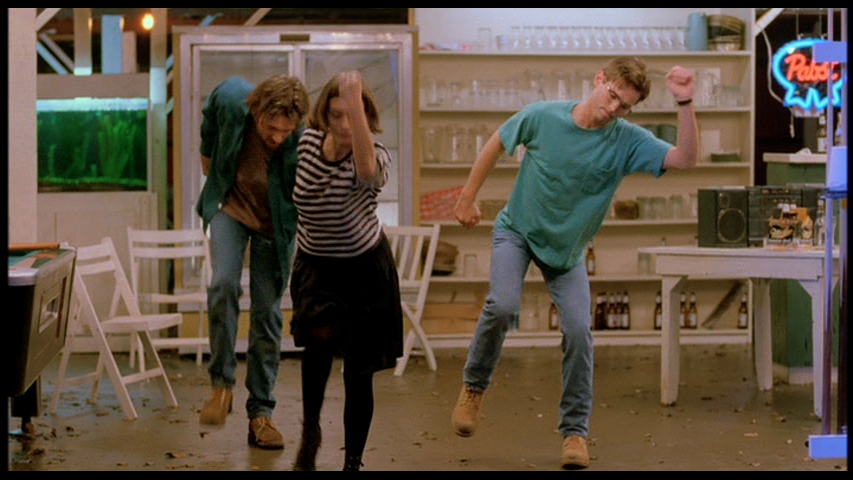
Hartley adopts a simple style consisting mostly of static shots and long takes befitting of a dialogue-driven film such as this one. I’m sure this was done more out of budgetary limitations and lack of experience than an aesthetic choice but it is not distracting because the characters are so interesting and their dialogue is so well-written. The film’s show-stopping sequence comes when several of the characters break into an impromptu dance routine scored to “Kool Thing” by Sonic Youth. It comes out of left field and is completely at odds with the rest of the film and yet strangely works because of that reason. It’s the moment where the film temporarily breaks free of its rigid aesthetic and has a little fun. Hartley had tried a musical sequence previously for a short film he made for PBS but the one in Simple Men is more ambitious because it is being inserted into a feature-length film. It worked and is probably the one scene that most people remember from the film.

Hartley wrote the screenplay for Simple Men shortly after he left college and before he made Trust. The $2 million dollar budget was the biggest one he had worked with up to that point – a considerable leap from the $70,000 budget of his feature-length debut The Unbelievable Truth (1989). It successfully screened at the 1992 Cannes Film Festival but I think it’s fair to say that Simple Men was not well-received among mainstream critics. Roger Ebert led the charge, giving the film two out of four stars and felt that, “The problem with postmodern movies like Simple Men is that they seem to consider us fools for watching them and, on the basis of the evidence on the screen, it's hard to disagree.” In his review for The New York Times, Vincent Canby wrote, “The people in Simple Men are functions of a long shaggy-dog story, composed of purposely flat dialogue that, from time to time, leads to a purposely flat punch line.” USA Today also gave the film two out of four stars and Mike Clark wrote, “Writer-director Hal Hartley may be the most self-consciously monotonic U.S. filmmaker since the late Jack Webb, his verbal rhythms as numbingly droll as Webb's were numbingly staccato.” The Washington Post’s Rita Kempley wrote, “Simple Men has plenty of plot, but no design. There's a forced serendipity to the tale, amplified by the zombielike performances of the actors.” Entertainment Weekly gave it a B- and Lawrence O’Toole wrote, “But self-consciousness is the style of Simple Men, and soon the unwavering tone of playful existentialism wears very thin. For all his talent, Hartley talks a better movie than he makes, proving once again that the gift of gab is no guarantee of a good film experience.” In one of the rare positive notices, the Globe and Mail’s Christopher Harris wrote, “Like Hartley's other films, Simple Men is an engaging, amusing and faintly baffling tale. Hartley is a master of indirect storytelling, of revealing things on the edges more than at the centre.”

At times, the dialogue in Simple Men veers dangerously close to film school posturing but what saves it from being nothing more than pretentious twaddle is the way the actors deliver it – often as natural as possible or in an ironic way that is funny, like the burnt out existential local cop, or the gas station attendant who plays guitar and is learning French to, y’know, impress girls. If his characters often speak in aphorisms it is because Hartley wants them to “say what they mean. Exactly what they mean, which rarely happens in life.” Simple Men is a quintessential Hartley film and one that is arguably the best example of his particular aesthetic and worldview more than any other film. It may also be his most accessible populated by several actors who have gone on to distinguished careers, most notably Martin Donovan (The Opposite of Sex) and Robert John Burke (Rescue Me). Hartley continues to make films, adopting digital camera technology in 1999, and hasn’t looked back since. He remains fiercely independent, refusing to sell out in Hollywood in favor of making his own, deeply personal films.


Also, check out Sean Gill's excellent take over at his blog.


SOURCES

Pall, Ellen. “This Director’s Wish List Doesn’t Include Hollywood.” The New York Times. October 11, 1992.


Peachment, Chris. “Young, Gipped and Frugal.” The Independent. November 1, 1992.

Tuesday, June 19, 2012

Blu-Ray of the Week: Harold and Maude: Criterion Collection

When Harold and Maude was released in 1971 it was not a hit. It came between the end of the 1960s and the dawning of the 1970s, marking a transition between these two decades with Harold representing the cynicism of the latter decade and Maude representing the love is everywhere idealism of the former. The film was despised by critics and largely ignored by mainstream movie-going audiences, offended by its sweet romance between a young man in his early twenties and an 80-year-old woman. However, the people who did react positively to its hopeful message really loved it and the film developed a cult following over the years. It was director Hal Ashby’s second film and built on the promise he showed with his debut The Landlord (1970). Bolstered by Colin Higgins’ brilliantly written screenplay and Cat Stevens’ insanely catchy songs, Harold and Maude is a classic romantic comedy.


Harold (Bud Cort) is a deeply unhappy young man whose rich mother (Vivian Pickles) repeatedly tries to set him up with prospective women. In retaliation, he repeatedly fakes his own death in one darkly absurd set piece after another. So, she takes him to see a psychiatrist, a priest and an Army officer all in the hopes that they will give Harold a sense of purpose and/or direction in life. It’s interesting to note that each one of these authority figures is presented either as pompous or crazy.

In his spare time, Harold likes to attend funerals and at one of them he meets Maude (Ruth Gordon) who also frequents these ceremonies. When they first meet she offers him some candy, asks him if he sings and dances, and then drives off with a priest’s car. The next time they meet she almost drives off with his car – a hearse no less – and they get to talking. She lives in the moment always eager to experience new things much to his bemusement. They become friends and she gradually pulls him out of his shell with her irrepressible charm. As their relationship develops, they fall in love in one of the most unlikely romances.

Harold and Maude is anchored by the undeniable chemistry between Bud Cort and Ruth Gordon. They play a most unusual couple and yet it works because of how well they play off each other. Cort does an excellent job of conveying Harold’s gradual transition from a depressed introvert to a romantic, done mostly through his big, expressive eyes. He captures Harold’s initial awkwardness around the impulsive Maude, a free spirit full of life and a flower child trapped inside the body of an 80-year-old woman. Harold feels trapped by life thanks to his mother’s frequent attempts to set him up on dates with women, none of whom he’s remotely interested in. Gordon is simply delightful as the fun-loving Maude and yet her performance isn’t a one-note caricature but full of nuances, even hinting at an introspective side. It is hard not to fall in love with Maude much like Harold does because she is just so fun and full of a joy of life.

Harold and Maude is a folk film of sorts, a gentle love story about two lonely people at odds with the rest of the world. It is a sincerely earnest film that wears its heart on its sleeve. It could have so easily come across as silly but the film embodies the ideals of Maude as a brave, free-spirited story full of hope. Its love story shows that superficial details don’t matter so long as you love and care about one another – ultimately, that’s all that matters. Maude teaches Harold that when life knocks you down you have to pick yourself back up. Harold and Maude is a brave film in many respects. First and foremost, it is about a love affair between an early twentysomething and an 80-year-old woman. Its earnest idealism flew in the face of the prevailing cynicism brought on by incidents like the Rolling Stones’ infamous Altamont concert and the assassinations of hopeful political figures like John F. Kennedy, Martin Luther King Jr., Robert Kennedy, and Malcolm X, which ended the ‘60s on a dark note.

Harold and Maude survived its initial disastrous reception to become a beloved cult film with notable admirers like Wes Anderson and Paul Thomas Anderson whose respective films, Rushmore (1998) and Punch-Drunk Love (2002) are very much in the spirit of Ashby’s film. Harold and Maude was part of a great run of films for the director in the ‘70s that included the likes of The Last Detail (1973), Shampoo (1975), Coming Home (1978), and Being There (1979). Unfortunately, he fell on hard times both professionally and personally in the 1980s but he left behind an impressive cinematic legacy by any standard.

Special Features:

You can finally get rid of the bare bone Paramount DVD as the Criterion Collection Blu-Ray features an excellent transfer that preserves the grain of the film stock while also delivering a pristine print, which is particularly evident in the dimly-lit scenes. Cat Stevens’ songs sound particular good on the sound side of things.

There is an audio commentary by Hal Ashby biographer Nick Dawson and one of the film’s producers Charles B. Mulvehill. Dawson takes us through the genesis of the project, including Colin Higgins’ screenplay and Ashby going from his first film to Harold and Maude. Mulvehill recalls all kinds of filming anecdotes including casting and its disastrous reception. Dawson analyzes the film’s themes in depth with some excellent insights on this very informative track.

Disappointingly, the film’s trailer is not included despite being referenced in detail on the commentary as containing deleted footage.

There are audio excerpts from AFI seminars with Ashby and Higgins in ’72 and ’79 respectively. Ashby talks about how he got his start as an editor. Naturally, he talks about how he got the job to direct Harold and Maude while also discussing the challenge of casting the role of Harold. Higgins talks about the genesis of the script and the inspiration for Maude. Both are very engaging and informative.

Finally, there is an interview with Yusuf/Cat Stevens. He talks about how he got interested in making music as a way to express himself. Of course, he talks about how he got involved with Harold and Maude. Ashby was a big fan and used some of Stevens’ songs during filming. The director even invited the musician to the set to see how he wanted to use his music.

Friday, June 15, 2012

Prometheus


Early on his career Ridley Scott proclaimed, “The time is ripe for a John Ford of science fiction films to emerge. And I’m determined to be that director.” And he was well on his way with the one-two punch of Alien (1979) and Blade Runner (1982) – cinematic game changers that presented incredibly detailed future worlds. And then he attempted to adapt Frank Herbert’s science fiction epic Dune but the project slipped through his fingers. As if that wasn’t enough, his big budget fantasy film Legend (1985) was a box office flop and received a critical mauling. Understandably frustrated, Scott turned his back on the science fiction and fantasy genres and spent the next few decades tackling a host of other ones, from the cop thriller (Black Rain) to the historical epic (Gladiator) to the war movie (Black Hawk Down) to varying degrees of success. However, fans of his early work had always held out hope that he would return to the genres that established him a cinematic force to be reckoned with.

Not only does Prometheus (2012) mark Scott’s triumphant return to science fiction but it also sees him revisiting a franchise he helped start – Alien. Touted as a prequel of sorts, the veteran filmmaker has been rather coy in admitting this new film’s link to the original, stating that it contains “strands of Alien’s DNA.” However, the impetus to make this film came from Scott’s curiosity as to the origins of the extraterrestrial being, nicknamed the “space jockey” by fans, that piloted the derelict spaceship discovered by the crew of the original film and which contained the series’ alien antagonists. Prometheus has come along at a good time to breath new life into the Alien franchise, which had hit an all-time low with Aliens vs. Predator: Requiem (2007). While the film was financially successful many felt it was creatively bankrupt and there was a desire to return the franchise to its roots and who better to do that than the director of the first one?

It is 2089 and in Scotland, Elizabeth Shaw (Noomi Rapace) uncovers ancient hieroglyphs that are actually a star map, which may provide the location to an alien home world whose residents may have visited Earth several thousands of years ago. She believes that these aliens will have the key to the origins of humanity. Four years later and Shaw heads up an expedition into outer space with a crew of 17 including an android named David (Michael Fassbender) and Meredith Vickers (Charlize Theron), an executive from Weyland Corporation, the company that funded the mission.

Shaw and Charlie Holloway (Logan Marshall-Green), her lover and fellow archaeologist, believe that the planet their spacecraft, the Prometheus, arrives at, deep in space, may have inhabitants that created humanity. Vickers is not too crazy about Shaw’s mission, a pet passion project of her father’s, Peter Weyland (Guy Pearce), and quickly exerts control, which sets up an intriguing antagonistic relationship between the idealistic scientist Shaw and the hard-nosed pragmatist Vickers.

Shaw and an away team make landfall and investigate a massive structure, one of several, in a canyon, which reinforces Ridley Scott’s mastery of establishing a specific mood and atmosphere through incredibly detailed set design and gorgeous cinematography. This results in evocative settings like the pristine sterility of the sleek futuristic Prometheus ship to the dark, dank cavernous interior of the alien structure, which takes what we glimpsed briefly in Alien and elevates it to another level. As with all of his films, the production design is of the highest quality and rich in detail, creating a fully realized and believable world. He also knows how to create a mood of foreboding mystery as our protagonists explore the alien landscape and we wait for something bad that we know is going to happen to these unfortunate people.

As with previous films in the Alien franchise, the Weyland Company doesn’t care about the crew, aside from David, just on how they can make money off whatever Shaw and co. discover. Not surprisingly, David, much like Ash in Alien, has its own agenda and is not entirely trustworthy. If you’ve seen any of the Alien films then you pretty much know how things are going to go down – the humans mess around with something they don’t understand and run afoul of a xenomorph that is hostile.

The seemingly ubiquitous Michael Fassbender is a real standout in Prometheus as the logic-based android with a hidden agenda. The actor is quite believable as an artificial person complete with slightly stiff expressions and gestures that look real enough and yet only have the illusion of humanity. It is a tightly controlled performance complete with precise speech patterns that is fascinating to watch. Noomi Rapace is excellent as the inquisitive scientist whose ambition proves to be her undoing. Over the course of the film she conveys a wide range of emotions as her character is put through the wringer and this is evident in a scene where Shaw is forced to deal with an alien that has invaded her body. It’s an intensely harrowing sequence that comes the closest to recapturing its famous equivalent in Alien. Shaw struggles with notions of faith versus science and is the heart and soul of the film.

On the opposite end of the spectrum, Charlize Theron plays an icy corporate executive at odds with Rapace’s Shaw and yet she is given a scene or two to show, perhaps not a softer side, but that there is more to her than being strictly a business type. With the exception of the always excellent Idris Elba, the rest of the cast is just fine but largely unremarkable but only because they play disposable characters. Like any skilled character actor, Elba makes the most of his limited screen-time, playing the grizzled captain of the ship.

While an easy target for helping engineer the prolonged tease that was the popular television show Lost, screenwriter Damon Lindelof and Ridley Scott should be commended for creating and then getting a major Hollywood studio to release a serious-minded science fiction film during the summer blockbuster season – a time when multiplexes are populated by dumb action films loaded up with car chases and loud explosions or mindless comedies rife with dick and fart jokes. Prometheus wrestles with weighty themes and the big picture (i.e. who created us and why are we here?) while fulfilling one of the oldest tropes of the genre by presenting a story that acts as a warning – don’t meddle with things you don’t understand.

Whether the filmmakers were successful or not in conveying these important themes in a thoughtful and engaging way is certainly open to debate but at least they tried. The film’s third act is certainly problematic as it basically loses its mind and devolves into a pretty conventional action film with a weak climactic battle. This is too bad because the first two-third of Prometheus is so strong and thought provoking. A well-intentioned film loaded with ambition like this one should be championed despite its flaws (weak characterization, plot holes, etc.). The end result is easily the best Alien film in the franchise since James Cameron took over the reigns with Aliens (1986).


Check out The Film Connoisseur's fantastic take on this film and also the Sci-Fanatic's in-depth post, comparing it to Alien.

Friday, June 8, 2012

Power

The rise of media consultants in the 1970s and 1980s changed the way political campaigns were run and how politicians were sold to the public. Make no mistake; this is an expensive practice with costs to run a successful campaign increasing every year. It is the job of the media consultant to create the most attractive image of their client to present to potential voters while creating a negative image of their opponent. This is nothing new, but back in 1986 when Sidney Lumet directed Power from a screenplay by David Himmelstein, the notion of a media consultant wielding influence was a novel concept. So novel that the film received mixed reviews by critics and was virtually ignored by audiences (it failed to recoup its modest $16 million budget). With hindsight one can see that the film was ahead of its time with a slick, charismatic protagonist that anticipated real-life counterparts like James Carville. Power asks some fascinating questions about the nature of power and influence and its effects. It also remains one of Lumet’s sorely under-appreciated films.


The consultant’s job is to create a positive image of the client and this is evident in the film’s opening scene where a South American political leader is making a speech to hundreds of people in a crowded town square. A bomb goes off and the man springs into action, rushing to the aid of a woman injured in the blast. He cradles her head in his arms, making him look like an instant hero until we see a camera crew documenting the entire event. Successful media consultant Pete St. John (Richard Gere) coaches the leader once he hustles him into a waiting van, telling him to wear his now bloody shirt for the rest of the campaign. Pete proceeds to tell the man what to say, how to act, and so on. We’re left wondering if the whole thing was staged or did he brilliantly capitalize on the moment?

Pete arrives back at his offices in the United States and they are a sleek, sterile chrome and metal affair with artificial lighting everywhere. He’s briefed on his upcoming meetings by Sydney Betterman (Kate Capshaw), his assistant and lover. We see Pete at work, juggling several clients at once. In New Mexico, he tries to coax a good performance out of a man by the name of Wallace Furman (Fritz Weaver) who’s running for governor. The clearly nervous man comes across as weak and hesitant on camera and so Pete gives him a brutally honest pep talk, laying it all out: “No offense but right now you look too soft to change a tire much less a state.” He tells Furman, “You’ve got align the perception with the reality.” Pete then proceeds to tell the man to go on a diet, start working out, change how he dresses, and get a tan.

This shocks the wealthy businessman who complains that Pete seems to be running his entire life, to which the consultant replies, “That means framing the overall strategy as well as deciding all the specifics.” And this includes the look of the campaign, what the bumper stickers will be, creating advertisements for print, radio and television, and analyzing polling numbers. Furman weakly counters that he wants to address some of his long-term plans, which Pete interrupts and tells him, “They’re not important. My job is to get you in. Once you’re there you do whatever your conscience tells you.” Richard Gere delivers this last line with a mischievous twinkle in his eye as this scene tells us everything we need to know about his character. Pete exudes the charisma and confidence of a man at the top of his profession and Gere nails it with a polished delivery that is one part used car salesman and one part gregarious con man.

Meanwhile, an unidentified Middle Eastern businessman is impressed with Pete’s work with the South American politician and how it undid a lot of work that his boss spent significant money on. He asks Arnold Billing (Denzel Washington), a rival public relations expert, to hire Pete for a job. He wants him to manage the campaign of a rich but little-known Ohio businessman Jerome Cade (J.T. Walsh) so that he’ll win a Senate seat. However, it is a spot that has been vacated by Pete’s friend Sam Hastings (E.G. Marshall) due to an unidentified illness so there is a possible conflict on interest. However, we’re never sure why Pete is so close to Hastings and why his decision to drop out affects him so much. Was he Pete’s mentor? Are they related? Pete seems to respect Hastings integrity but this seems rather odd for a man who is loyal only to money. We learn that Hastings may not be ill at all so why is he dropping out all of the sudden? It seems like Billing might have had something to do with it. He’s a young, up and comer who clearly has set his sights on taking down Pete.

And why not? Pete is one of those guys that travels in his own private jet. He wears expensive suits, has sex with his attractive assistant and has a roster of only the wealthiest clients. He’s arrogant and confident but Hastings is his lone weak spot, which Billing seeks to exploit. Pete also crosses paths with his boozy ex-mentor Wilfred Buckley (Gene Hackman) who has a memorable scene embarrassing himself with a drunken tirade on an airport runway. Yet he still shows glimmers of brilliance in a nice scene where he tells a grassroots underdog candidate (Matt Salinger) what he needs to do to make a difference.

J.T. Walsh is at his reptilian best as an ambitious wannabe politician with money to burn and ruthless ambition to spare. He seems like an ideal client for Pete – he’s filthy rich – however something doesn’t feel right. Billing works for him but in some kind of vague capacity. Cade appears to be simpatico with Hastings’ policies except for one: his pet project, which was solar energy. Is that the real reason the senator suddenly vacated his seat? When Pete attempts to dig deeper into Cade’s past, Billing comes after him, setting up an intriguing game of cat and mouse. Denzel Washington is impressive in an early role as an icy, amoral media consultant. With limited screen-time, he creates an imposing figure because Billing is such an enigma with a secret agenda. In some scenes, Washington sports a dead-eye look that is quite unnerving and in others he is all smiles but it isn’t meant to be reassuring, just creepy.

Power is a little long and a subplot involving Pete’s ex-wife (Julie Christie) feels like unnecessary padding and could have easily been removed. The film also skirts the edges of cutesy idealism, especially when a character at the film’s climax delivers an inspirational speech a la Network (1976), but fortunately Lumet pulls back to show that the political landscape hasn’t changed all that much.

In the 1980s, Gere was an A-list sex symbol thanks to An Officer and a Gentleman (1982) but he parlayed that clout to tackle a diverse roster of roles in films like American Gigolo (1980), Breathless (1983) and, of course, Power, which may be the best of the bunch. He plays a slick media spin-doctor that begins to grow a conscience and how one ruthless competitor starts to chip away at his confidence. Gere is able to get under Pete’s skin, past the surface details to reveal someone that questions what he’s doing. Over the course of the film Pete finds that he no longer delights in crushing his opponents. If anything, he experiences a crisis in confidence and Gere is quite excellent at conveying this dilemma. The actor is also good at turning his trademark boyish charm on and off while conveying just what a master manipulator Pete is. Yet, it is his relationship with Hastings that humanizes the character. Interestingly, Gere was not Lumet’s first choice to play Pete St. John. In fact, he had been unimpressed with the actor’s performances at the time. However, the two men met and talked over two days. Lumet said, “He was so intelligent, with such a strong sense of self, and he showed such a real desire to act again—to get back to real acting.”

They say knowledge is power and that is certainly true when it comes politics. Insider knowledge and the ability to get it and then use it is everything. That is what makes Pete so successful. However, when someone else can get it faster and use it just as ruthlessly then this creates a conflict. Power takes a fascinating look at media manipulation, like how a goofed take for a political ad can be tweaked in editing to actually make the subject look good. It’s all about perception and in that sense it is a lot like filmmaking. The film is more than just being about politics. Lumet also gradually incorporates elements of a thriller as Pete’s dealings with Billing and Cade begin to affect his personal and professional life.

Power originated from newspaper reporter David Himmelstein. He had previously worked as a speechwriter for former Senator Edward Brooke of Massachusetts. He got the idea while attending Harvard as a Neiman Fellow. During election night in 1982, he saw a continuous loop of T.V. spots from candidates across the United States that a fellow student had assembled. Himmelstein found it fascinating because it made him realize that “the candidates were all basically interchangeable.” Furthermore, he realized that “the guys who had put together the spots were at least as significant, if not more significant, in the process.”

As early as 1984, Himmelstein began dabbling in screenwriting and when one of his scripts won a prize, he was noticed by Hollywood. His second script, entitled Power, was picked by Lumet as his next directing project but only after it underwent five rewrites. The veteran filmmaker was drawn to the project because he saw it as a commentary on “the mechanization of our lives, the loss of contact,” and how it was about our “terminally compromised political process.” He felt that “a candidate doesn’t talk to us anymore. They talk to us through someone else. These people are not corrupt. It’s much more frightening than that because we are not talking about evil people, we are talking about a system that is slowly evolving.”

Roger Ebert gave the film two-and-a-half stars out four and wrote, “But the movie itself seems to sense that it's going nowhere. The climax is a pointless, frustrating montage of images. It's a good montage, but it belongs somewhere in the middle of the movie; it states the problem, but not the solution or even the lack of a solution.” In his review for The New York Times, Vincent Canby wrote, Power is a well-meaning, witless, insufferably smug movie that – if it does anything at all, and I'm not sure it does – anesthetizes legitimate outrage at some of the things going on in our society.” The Toronto Star’s Ron Base wrote, “When everyone is in place, and such matters as conflict and plot begin to emerge, the movie groans into the sort of tiresome, preachy dialectic that Lumet is always being accused of making. This time his accusers are right.” In his review for the Washington Post, Paul Attanasio wrote, “What's genuinely odd about Power is how stale it gets whenever it tries to get at an emotion – everything human is alien to it. The movie only works when it's immersed in the very world it professes to despise.”

The Los Angeles Times’ Sheila Benson criticized Himmelstein’s script: “In writing his didactic melodrama of manipulation and image-making on a global scale, Himmelstein apparently felt his news—that today's political candidates are created not only equal but interchangeable—could stand on its own, without the need to beguile us with characterization or suspense.” The Globe and Mail’s Jay Scott criticized the casting of Richard Gere: “Casting Gere as a callow but clever media consultant was a stroke of inspiration, but when Gere is required to find integrity and sincerity, the performance falls apart – integrity and sincerity from Richard Gere are like sweetness and light from Joan Collins.” The rare positive notice came from the Chicago Tribune’s Gene Siskel, who gave it three out of four stars, and wrote, “Holding everything together is that the film accurately fixes on our collective guilt about the superficial basis upon which most of us vote. There’s also Richard Gere’s taut portrayal of Pete St. John, a slick imagemaker who shapes his clients into just so much silly political putty … Gere is at his best in this sort of oily role.”

Looked at now, Power was incredibly prescient. At the time, the public knew little about political and media consultants but thanks to the highly acclaimed documentary The War Room (1993) and popular satirical comedy Wag the Dog (1997), people have a better idea of what these people do. In fact, the two successful media consultants that helped get Bill Clinton elected as president, as documented in The War Room, went on to become media darlings in their own right, appearing in T.V. and films. This kind of consultation has become a staple of political campaigning and is big business. With the right kind of spin and a media savvy candidate, the sky’s the limit. Lumet’s film shows the darker side, like how campaigning is all about image and very little about substance. Elections have been reduced to popularity contests. Complicated issues have been reduced to simplistic soundbites. In Power, politics are a dirty business (with an emphasis on business) and it shows in captivating detail just how dirty by taking us behind the scenes to show us the inner workings and the image creators. Lumet’s film is ripe for re-discovering as much of what it examines has not dated at all, making it more relevant than ever before.


SOURCES

Cunningham, Frank R. Sidney Lumet: Film and Literary Vision. University Press of Kentucky. 2001.

Frederick, Arthur. “From Reporter to Screenwriting Success.” United Press International. January 24, 1986.


Friendly, David T. “Selling Power: Trying to Come Closer.” Los Angeles Times. January 26, 1986.

Friday, June 1, 2012

The Transformers: The Movie

Before Michael Bay decided to piss all over our nostalgic memories of The Transformers cartoon with his live-action monstrosities, there was a feature-length animated film that for all of its clunky animation and cheesy, dated soundtrack is better than the entirety of Bay’s trilogy. For those of us who grew up watching The Transformers cartoon every day after school in the early 1980s, the movie came as quite a shock. Most of us, at that early, impressionable age, were unprepared for the much darker tone and the increased level of violence, including some of the show’s most popular and beloved characters getting quickly killed off in the first few opening scenes. The Transformers: The Movie (1986) was a commercial and critical failure but went on to develop a strong cult following among fans.


It is 20 years into the future (making it, at the time, 2005!) and the war between the Autobots (a race of good transformable robots) and the Decepticons (their evil counterparts) continues to rage. The Decepticons have taken control of the transformers’ home world of Cybertron. The Autobots are planning to retake the planet but need to get more energy from Earth in order to do so. Unfortunately, the Decepticons learn of these plans and their leader Megatron (voiced by Frank Welker) intercepts the ship headed for Earth with the intention of launching a sneak attack on the Autobot’s base. Unbeknownst to the Autobots and the Decepticons, a planet-sized transformer named Unicron (Orson Welles) is devouring entire planets to feed its insatiable desire for energy. Only the Matrix of Leadership, housed in Optimus Prime (Peter Cullen), leader of the Autobots, can stop him.

The dark tone of the movie is set right from the prologue, which features Unicron mercilessly destroying an entire planet of transformers. No one is spared. We even see one escape pod almost make it before getting sucked into Unicron’s massive, gaping maw. For kids used to the relatively tame television series this sequence came as quite a surprise. This was nothing compared to what came next as soon afterwards the Decepticons ambush a ship carrying several Autobots that are quickly and casually killed off! It was one thing to see anonymous characters with nothing invested in them be destroyed but it was something else entirely to see characters we had grown to like on the series dispatched so suddenly and coldly. These deaths do raise the stakes considerably as if the filmmakers were making a statement that all bets are off with this film – any character, no matter how beloved, is fair game.

Clearly the powers that be (i.e. the toy company) meant to clear the decks for a new generation a.k.a. a new line of toys for kids to buy but I think they underestimated just how profound an effect all these deaths would have on their audience. This culminated with the death of Optimus Prime – the most popular transformer. Not since Darth Vader cut down Obi-Wan Kenobi in Star Wars (1977) had the death of a heroic character been so traumatic for its fanbase. At least Prime got to go out in style with an epic one-on-one slugfest with his nemesis Megatron. For kids at the time, it was an emotional moment because we cared about Prime. His death scene, in particular, had gravitas and meant something to the fans of the show. This is something that the Bay movies never were able to replicate with their multi-million dollar budgets.

Another memorable aspect of the movie is the scope and scale. Where the T.V. show’s action was largely confined to Earth, the movie opens things up by introducing other worlds and races (even if they are all transformers). And so we are presented with the Planet of Junk, one of the more fascinating additions to The Transformers universe. It is inhabited by the Junkions and their leader Wreck-Gar who speaks in T.V. clichés mainly derived from advertisements. In an inspired bit of casting, he is voiced by Monty Python alumni Eric Idle. Their world is a metallic compost heap masquerading as a planet and rather fittingly their theme song is performed by none other than Weird Al Yankovic. This race of robots provides a much-needed moment of levity in what up to that point had been a very dark film.

The battles are also bigger and more intense as Unicron transforms into an enormous robot that attacks Cybertron but this almost pales in comparison to the intensity of the epic battle between Optimus Prime and Megatron that left many fans shocked by its outcome. No one was prepared for what went down and the film never quite recovers from this moment. Speaking of gravitas, who better to play a transformer the size of a planet than Orson Welles, the brilliant filmmaker who made Citizen Kane (1941)? His digitally augmented voice has the dramatic weight befitting the scale and power of Unicron. The filmmakers needed a formidable actor to play a formidable character and they found their ideal candidate in Welles. This gig would be his last and he died five days after completing his work from a heart attack.

One of the things that dates The Transformers film the most is its soundtrack of awesomely bad generic 1980s hair metal, complete with the show’s cool theme song redone by Lion. Most memorably is Stan Bush’s “The Touch,” which went on to be hilariously immortalized in Paul Thomas Anderson’s Boogie Nights (1997). The one song that acts as a crazy counterpoint to this bloated arena rock is Weird Al Yankovic’s theme for the Junkions, “Dare to Be Stupid.” His goofy, non-sensical lyrics (anticipating Beck by a few years and actually goofing on Devo) are perfect for this absurdist, almost Dada-esque race of transformers.

After the first two seasons of the television show, toy company Hasbro wanted to eliminate many of the characters and introduce a new line. Season three would feature several new characters and the feature film would make that transition. Toy lines are discontinued for new ones and so the dilemma facing the screenwriters of the movie was how to make this transition seamlessly. According to story consultant Flint Dille, “So, we had this one scene where the Autobots basically had to run through a gauntlet of Decepticons. Which basically wiped out the entire ’84 product line in one massive charge of the light brigade. So whoever wasn’t discontinued, stumbled to the end.” The scene didn’t quite play out that way but over the first third of the film, several of seasons one and two characters were killed off. Not surprisingly, it was Hasbro that dictated the story of the film, “using characters that could best be merchandised for the movie. Only with that consideration could I have the freedom to change the storyline,” said director Nelson Shin in an interview.

Not surprisingly, The Transformers: The Movie was savaged by critics at the time. In her review for The New York Times, Caryn James wrote, “Unlike most movie stars, though, the Transformers have offscreen lives and personalities that their fans will carry with them to the theater. Children have an advantage here, for they can project their playtime scenarios on the old friends and heroes in action on the screen, while parents may just wonder what the fuss is about.” The Globe and Mail’s Salem Alaton wrote, “There is so much action in the animated feature, The Transformers: The Movie, that you can't wait to get back into one of those Chrysler products whose vocabulary is limited to ‘A door is ajar,’ and ‘Thank you.’” The Los Angeles Times’ Charles Solomon wrote, “Not even the best actor can create a character out of nothing. Not one of the robots has a reason for doing what he does. The Transformers are good because they're good, and the Decepticons are bad because they're bad.”

The Transformers: The Movie’s pacing is fast and furious with never a dull moment – perfect for kids with short attention spans and actually works in its favor as any narrative fat is trimmed, packing a lot of action into its running time (again something the live-action films failed to realize with their bloated lengths). While I don’t know if the movie exactly lives up to its poster’s tag line, “Beyond good. Beyond evil. Beyond your wildest imagination.” It was a pretty mind-blowing experience for this impressionable youth back in the day. So, I come at this movie now with nostalgic baggage in tow, unable to really look at it objectively. I can only imagine what kids of today think of it now. Sadly, they probably don’t even know/care of its existence having been bombarded by the Michael Bay movies, which is too bad because they lack the imagination, the ambition (which are largely earthbound while the animated film takes place mostly in outer space) and the substance that makes The Transformers: The Movie by far superior. Plus, I’d take the likes of Stan Bush and Lion over the bland nu metal stylings of Linkin Park any day.


Also check out Roderick Heath's wonderful take over at his This Island Rod blog.

Flights, Tights and Movie Nights Highlights My Blog Today!

I had my first ever interview with super nice guy and blogger Bubbawheat over at his blog Flights, Tights & Movie Nights where today he spotlights my blog! It was a lot of fun and his website is chock full of excellent reviews with an emphasis on superhero movies. Check it out.