"...the main purpose of criticism...is not to make its readers agree, nice as that is, but to make them, by whatever orthodox or unorthodox method, think." - John Simon

"The great enemy of clear language is insincerity." - George Orwell

Friday, June 21, 2013

Man of Steel

Superman IV: The Quest for Peace (1987) was a poorly-executed and poorly-received movie that effectively mothballed the Superman franchise for years while Warner Brothers spun its wheels and spent all kinds of money trying to figure out a way to reboot the potentially lucrative series, most infamously with Tim Burton directing and Nicolas Cage set to star as the son of Jor-El. Fortunately, that version never got past the planning stages. Finally, Bryan Singer got a shot with Superman Returns (2006) and instead of restarting the franchise, created a cinematic love letter to Richard Donner’s 1978 movie and pretended that Superman III (1983) and the aforementioned IV never existed. While Singer’s movie performed decently at the box office, it was hardly the blockbuster the studio had hoped for (in relation to its very large budget). In addition, Superman Returns was criticized for not having enough action.

So, the studio went back to the drawing board, this time enlisting the braintrust from the recent Batman movies with Christopher Nolan producing and David S. Goyer tackling the screenplay. To direct, they hired Zack Snyder, fresh from the critical and commercial failure of Sucker Punch (2011), but with comic book credentials thanks to his adaptation of Watchmen (2009). By bringing in these three men, the studio made their intentions pretty clear – to start fresh and that this would not be another bright and shiny Superman movie, but something darker and edgier, that would reflect the times in which it was made.

Right from the get-go, Goyer and Nolan tweak the Superman mythos by expanding the Krypton prologue so that not only is the planet self-destructing, its society is engulfed in a civil war with the insurrectionists led by General Zod (Michael Shannon). Right off, Snyder sets a massive, epic look and tone with frenetic battles and chases as Jor-El (Russell Crowe) evades Zod and races to send his son Kal-El off to Earth. Russell Crowe plays the role that Marlon Brando did so memorably in the ’78 version and brings just the right amount of gravitas to the part. He also brings an emotional weight to offset the overwhelming visual spectacle of Krypton’s destruction, which is an impressive CGI workout as you’ll see in any movie in recent memory.

We are introduced to Kal-El a.k.a. Clark Kent (Henry Cavill) in a striking sequence where he saves a crew on a burning oil rig that is gritty and visceral in its depiction as Snyder places us right in the middle of action so that we can almost feel the heat of the burning flames and get a sense of the dangerous situation. For the first half of Man of Steel, Snyder cuts back in forth from Clark as an adult, drifting from job to job, and showing key moments in Clark’s childhood where he came to terms with and first learned how to use and harness his superpowers as a young boy.


Meanwhile, intrepid reporter Lois Lane (Amy Adams) is investigating a rather large object lodged in ice that’s been buried deep for thousands of years. She meets Clark who is also investigating it (under the auspices as a hired hand for the company that is doing all the grunt work) and they uncover an alien craft that Jor-El had launched many years ago. From it, Clark learns all about where he came from. Eventually, Zod and his cronies arrive on Earth, decked out in outfits that look like they came from the H.R. Giger collection, and call out Clark, threatening to destroy the Earth unless he surrenders to the general. As you would expect, much epic carnage ensues.

Henry Cavill is very good as Kent/Superman. He has a quietly confident presence that allows him to slip into this iconic role rather seamlessly and make it his own. He doesn’t try to play Clark as a bumbling nerd a la Christopher Reeve or earnestly like Brandon Routh, but delivers a more muscular, passionate performance as a young man trying to figure out who he is and his place in the world, which is the predominant theme of the movie. He also does a nice job of conveying the internal conflict that exists within Clark – should he reveal his true nature to the world and risk the lives of those he loves? Clark enjoys a satisfying arc as he learns the importance of sacrifice and doing what is right.

Michael Shannon conveys the right amount of anger and bluster as Zod, a military man with a personal vendetta against Jor-El and, by extension, his son, pursuing the child to Earth. Goyer provides Zod with a very clear and definite motivation. He wants to preserve his race and sees Clark as the key to doing that. Zod is willing to raze the Earth to achieve his goal and believes what he is doing is right. Shannon does a decent job of conveying this conviction with absolute certainty even if his performance involves mostly shouting dramatic speeches and threats.

Do we need yet another origins story, especially for a character as well known as Superman? I think so, but only if it is significantly different from previous efforts, which Man of Steel succeeds in accomplishing. Let’s not forget that we haven’t had a cinematic depiction of Superman’s origins since 1978. I think enough time has passed for a retelling. This new movie expands the depiction of the destruction of Krypton significantly and puts more emphasis on the civil war that is led by Zod, which is interesting as it provides strong motivation for what he does later on.

Kevin Costner and Diane Lane bring a wonderful, earthy, natural quality as Clark’s Earth-bound parents, Jonathan and Martha Kent. Costner, in particular, is very good as he imparts to his son values that will serve him later in life, teaching him not to use his powers for personal gain. Early on, Clark is not ready to reveal his powers to the world and is still finding himself as he drifts from job to job. This is a nice touch as it shows how he accrues life experiences. This first half of the movie is the strongest part, especially a heartfelt moment where Ma Kent is called to school because young Clark’s X-ray vision has kicked in (quite an analogy for puberty) for the first time and he’s understandably freaked out. She is able to get him to calm down through the soothing sound of her voice. This scene shows the bond between Clark and his Earth-bound parents and how, over time, he gets used to his powers, which is something that figures significantly in the climactic battle between Superman and Zod. The second half, especially once Zod and his crew start trashing Smallville, gets a bit more problematic, especially some of the choices Superman makes that seem to only make sense in that it allows Snyder and the special effects department to flex their CGI muscles. Furthermore, the battle of Metropolis drags on a little too long. One can only take so much CGI carnage before you get numb to it and it goes from being visually dazzling to so much white noise. That being said, I am willing to overlook these kinds of lapses because Man of Steel is so strong overall.


For those tired of Snyder’s overuse of his trademark ramp-up/ramp-down action sequences, which reached their apex in Sucker Punch, they will be happy to know that he has eschewed that for a more grounded, naturalistic approach while still conveying the epic scale of destruction. For the larger-than-life action sequences, Snyder opts for jittery, hand-held camerawork that creates a grittier vibe than what has been depicted in previous Superman movies, which helps ground the fantastical by placing us right in the thick of the action. The advances in CGI have made the display of Superman’s powers the most believable of any of the movies, especially the sequence where he first learns to fly, which is breathtaking in how it conveys the speed and intensity of what he can do, like when he breaks the sound barrier, depicted in a way that evokes Philip Kaufman’s The Right Stuff (1983) – something that was sorely lacking from Superman Returns, which featured some dated and dodgy looking flying effects.

The fight sequences are appropriately loud and flashy as we get super-beings beating on each other, smashing through buildings and vehicles, which could so easily have been just another special effects workout scored to Hans Zimmer’s gloriously epic music. While they do drag on for too long, we are emotionally invested in Clark and those close to him because of the groundwork laid down during the first half of the movie as we grew to care about him and his world. It makes one wonder if Nolan’s presence as producer kept Snyder’s tendency to excessive style in check. I have enjoyed parts of Snyder’s past movies, but he always struck me as a talented director in need of the right script and someone to rein him in. This is the first movie of his that I’ve enjoyed all the way through and it is by far the best thing he’s done to date.


Snyder and co. clearly learned from the mistakes that Singer made with Superman Returns and made sure that Man of Steel was distinctly different in look, tone and pretty much everything else. Goyer and Nolan wisely reboots the franchise and amps up the action and the visual spectacle to impressive levels while also managing to get us invested in the characters so that we care about what happens to Superman amidst all the noisy CGI carnage. While it may seem like faint praise considering their quality, this is the best Superman movie since Superman II (1980). After the fanboy love letter that was Singer’s movie, we needed one that finally got away from the Christopher Reeve era and struck out on its own, which Man of Steel does quite impressively. This is no more apparent than the now controversial ending where Superman is faced with a dire moral dilemma. The choice he makes is what has stirred up those that feel Goyer and Nolan have betrayed one of the basic underpinnings of the character, but I think that it gives the movie a bit of complexity, much as was done with Batman in The Dark Knight (2008). It should be interesting to see where the filmmakers take Superman from here with the inevitable sequel.

Friday, June 14, 2013

Serenity

In 2002, Joss Whedon was enjoying considerable success writing and directing episodes for three television shows that he created: Buffy the Vampire Slayer, Angel and Firefly. The latter was his new show and pet project – a funky hybrid of the science fiction and western genres. It concerned the misadventures of a small, rag-tag group of mercenaries operating on the fringes of the galaxy 500 years into the future. In other words, what if Han Solo decided not to join the Rebellion? It was a fantastic blend of Whedon’s trademark dry humor, moving drama and exciting action. Firefly lasted less than half a season before the network pulled the plug, Buffy ran its course and Angel was cancelled after a decent run. Fortunately, Firefly had accumulated a small, but dedicated following, much like the crew of the Serenity itself, which campaigned tirelessly to save the show. Whedon returned the favor by shopping it around to other studios and Universal agreed to resurrect the show in the form of a feature film called Serenity (2005).

Malcolm “Mal” Reynolds (Nathan Fillion) is an ex-soldier and captain of the Serenity, a small spacecraft with a handful of crew members who scavenge, smuggle and steal for profit. Along the way, they picked up a brother and sister, Simon (Sean Maher) and River Tam (Summer Glau). He is a doctor and she is some kind of secret weapon, a deadly sleeper assassin a la Laurence Harvey in The Manchurian Candidate (1962). She was created by the all-powerful Alliance that rules the galaxy with a benign façade to cover their ruthless methods. They want her back and send a deadly and very methodical assassin known only as the Operative (Chiwetel Ejiofor) to retrieve her and eliminate anybody who gets in the way.

In the first minute or so, Whedon briefly establishes the universe in which this film takes place via voiceover narration and then cleverly twists the dialogue by revealing that it is being spoken by a teacher who works at an Alliance-run school. As long-time viewers of Firefly know, she is distorting history so that the Alliance is painted as the good guys while the “savage, outer planets” are portrayed as unenlightened. Worst of all, she’s feeding this propaganda to impressionable children – all except a young River Tam who questions authority and then a sudden slam cut to many years later when Simon helps her escape from an Alliance laboratory where she’s been poked and prodded like a lab rat.


It is then revealed that their escape is actually footage being watched by the Operative, a man with no rank or name, “who does not exist,” as he tells some Alliance flunky before killing him for letting River escape and unwittingly divulging secrets to her. As he tells the man, “secrets are not my concern. Keeping them is.” We are then introduced to the crew of the Serenity in a beautifully executed in one long, uninterrupted take as the camera follows Mal through the ship, interacting with its various inhabitants. We are now in the present as he takes a landing party to pull off a payroll heist on a planet. In the first 15 minutes of the film, Whedon brilliantly sets up the universe, the main characters that inhabit it, including the protagonists and the dysfunctional relationships between some of them, and the antagonist and his goal. This opening sets up that our heroes don’t fit the stereotypical definition as epitomized by the Han Solo-esque Mal, who appears to be out for himself, but cares for his crew and if push comes to shove would do anything for them.

Inspired by the dirty, grungy look of Alien (1979), Serenity also features a spacecraft that actually looks like our heroes live in it as opposed to the glossy, immaculate Enterprise of the Star Trek films. It is messy and always seems on the verge of breaking down, much like the Millennium Falcon. This is a great looking film shot by Clint Eastwood’s long-time cinematographer, Jack Green. He helps Whedon give the film a more cinematic look. Like he did with the series, Whedon bucks the typical trend of having sound in space — explosions, lasers blasting and spacecraft engines roaring — for a more realistic take by opting for a nicely understated score by David Newman.

Whedon has always been an excellent director of actors and reuniting his cast from the defunct show brings out the best in everyone concerned as this was a labor of love for all involved. It is like the show had never been cancelled as everyone slips effortlessly back into their respective roles. Nathan Fillion does a fantastic job as Mal, a character who is clearly cut from the same cloth as Han Solo, a selfish rogue who has lost his faith. He has all the charisma and charm of a young Harrison Ford only with more depth. With Serenity, the actor is really given a chance to strut his stuff. He does his usual snappy repartee with fellow crew members, chief among them Wash (Alan Tudyk), the ship’s pilot, and the lovably gruff, gun-toting strong man Jayne (Adam Baldwin). Fillion is also given a chance to show a dramatic side to Mal, like his conflicted feelings over keeping Simon and River – two wanted fugitives – on Serenity. He knows that they will continue to bring him trouble, but they have become a part of his tight-knit crew. Mal wrestles with this dilemma and talks to ex-crew member Shepherd Book (Ron Glass) about it. Book tells Mal that he has to look within himself, believe in himself. Whedon also continues Mal and Inara’s (Morena Baccarin) little dance around their romantic feelings for each other and how they refuse to act on it or publically acknowledge them. Lastly, Fillion demonstrates rather solid action chops in several action sequences, most impressively, his final showdown with the Operative.


As for the rest of the cast, Summer Glau elicits our sympathies as a young woman tormented by nightmares of the horrible experimentation that she was subjected to in the past. Sean Maher plays River’s concerned brother, torn between his promising career as a doctor and the devotion to his sibling. Adam Baldwin’s Jayne is the greedy, self-serving side of Han Solo as well as the ship’s muscle. The always watchable Alan Tudyk’s Wash is a stealth scene-stealer with his inexhaustible supply of one-liners and funny asides. Gina Torres plays Wash’s wife who was an ex-soldier that fought alongside Mal in the wars. Finally, Jewel Staite plays Kaylee, the ship’s mechanic and the heart and soul of the crew. She wears her emotions on her sleeve, which is a nice contrast to the stern Mal who tries to keep everything bottled up inside. One of the primary joys of Serenity is watching how all of these characters interact with each other as we laugh at their petty squabbling and feel sorrow when one of them is struck down.

It is a credit to Whedon’s skill as a writer that he is able to make you care about these characters even if you have not seen the show. He takes the time to show the dynamic between them and their motivations, which pays off later on when they are thrown into life-threatening situations because we have invested so much in them that it makes what happens so effective emotionally. There is a distinctive ebb and flow quality to the overall structure of the film. It never feels forced; rather there is a sense of urgency as early on he sets up what is at stake and then executes some genuine, white knuckle moments where you do not know what is going to happen next. There is even a moment late in the film where it seems like the entire crew of the Serenity is going to be killed off and this is rather refreshing because most films are so predictable that you know exactly who is going to be killed and who will not (i.e. the big name stars).

Whedon pulled off an impressive feat with Serenity. He made it accessible enough for people who have never seen the show and included all kinds of references and revelations for the fans, like finally showing and delving into the origins of the much-feared Reavers, a nasty band of cannibalistic humans who wander the galaxy, attacking anyone in their path and eating their victims alive. Devotees of Whedon will also notice several of his trademarks, like the ass-kicking female character. Following in the footsteps of Buffy Summers in Buffy the Vampire Slayer, River, when triggered, becomes a one-woman wrecking machine, single-handedly beating up a cantina of ne’er do-wells. Like Buffy, she looks like a demure, wisp of a person who wouldn’t hurt a fly, but possesses incredible fighting skills, which Summer Glau demonstrates with the grace and dexterity of a ballet dancer.

The Operative is another in a long line of confident, cool and collected villains that populated Buffy the Vampire Slayer and continued on in The Avengers (2012) with Loki. The Operative is a fascinating character. He acts without emotion and believes totally in his cause. Chiwetel Ejiofor is an excellent actor and has the gravitas to convincingly play an ultra confident man who knows that he has deadly fighting skills, intelligence and unlimited resources to back him up. The Operative is also intriguingly self aware as he tells Mal at one point, “I’m a monster. What I do is evil. I have no illusions about it.” He strives for a world without sin and sees River, Mal, et al as obstacles that must be removed.


With a quarter of the budget of the last Star Wars movie, Whedon beats George Lucas at his own game by crafting a science fiction film that has the perfect balance of character development and plot, effortlessly blending science fiction with a horror edge. Serenity is a stronger, more cohesive work than the Star Wars prequel trilogy. Whedon’s plotting and structure is better, not being encumbered by a dense backstory and historical details that threaten to overwhelm the Lucas’ films. Serenity is superior in that it manages to introduce newcomers into the fold while simultaneously offering all kinds of character details, plot twists, and so on to satisfy hardcore fans. This is not an easy thing to do and Whedon pulls it off quite seamlessly. Serenity fuses the grungy aesthetic of Star Wars (1977) with the space western approach of the original Star Trek T.V. series and manages to make its own unique thing. Serenity is everything a space opera should be and proof that a smart, engaging popcorn movie is possible.

Friday, June 7, 2013

Remo Williams: The Adventure Begins

For years, I’ve been a big fan of character actor extraordinaire Fred Ward. Back in the day, he was known for playing gruff, tough guys in films like Southern Comfort (1981) and Uncommon Valor (1983). He carved out quite a career for himself, appearing in diverse films like the Space Race epic The Right Stuff (1983) and monster movie homage/spoof Tremors (1990). It was always a treat to see him in prominent roles, like the cult fave Miami Blues (1990) and his one shot at playing a potential franchise action hero with Remo Williams: The Adventure Begins (1985). Ah, what an unfortunate title, automatically jinxing it – the fates punishing the filmmakers for such an act of hubris.

Based on the popular, long-running series of pulp paperback novels known as The Destroyer by Warren Murphy and Richard Sapir, the movie was intended to kickstart a franchise and, despite heavy promotion, promptly tanked at the box office, not even making back half of its budget. While far from being a great movie, Remo Williams is a fun romp with a muscular performance by Ward who looks like he’s having a blast with the role.

Sam Makin (Fred Ward) is a tough New York City police officer. One night, he pursues and stops two guys beating on another man. All three proceed to take on Sam, but he manages to subdue them. Battered and bruised, Sam gets in his vehicle to catch his breath and is rear-ended by an armored car, knocking him into the East River. That night, Sam Makin died. When he awakens, the cop has been given a new face and renamed Remo Williams. He’s been recruited by a secret government organization known as CURE that cuts through the corruption and bureaucracy. As his contact MacCleary (J.A. Preston) tells him rather cheekily, “You’re going to be the 11th Commandment: ‘Thou shall not get away with it.’”

This initial meeting sets the playful, slightly satirical tone as the understandably wary Remo is trained to become a deadly operative. But first, he meets his second handler – Harold Smith (Wilford Brimley), who tells him that their organization only answers to the President of the United States. This scene is a lot of fun to watch as the smartass Remo bounces off the no-nonsense Smith. It’s great to see veteran actors like Ward and Wilford Brimley play off each other.

The bulk of Remo’s training is supervised by an old Korean martial arts master named Chiun (an unrecognizable Joel Grey) who schools him in the ways of Sinanju. They first meet when Remo is told to kill him, unaware who he really is. It’s a test, obviously, which Remo fails in hilarious fashion as Chiun dodges his bullets and then proceeds to avoid Remo’s clumsy attacks, sending him hurtling into furniture. It’s an excellent exercise in physical comedy on Ward’s part and dry wit on Joel Grey’s part.


MacCleary sets the tone for Remo’s training by telling him, “All I can promise you is terror for breakfast, pressure for lunch and aggravation for sleep. Your vacations will be two minutes when you’re not looking over your shoulder and if you live to draw a pension it will be a miracle.” The training sessions are basically a series of humiliating exercises as Chiun insults Remo (“You move like a pregnant yak.”) while repeatedly besting him physically. Initially, Remo is skeptical as he says to Chiun, “Is this gonna be the kind of training where we sit around for ten years and you tell me I’m big enough to break a brick with my big toe?” The ancient martial arts master replies by paralyzing Remo’s left arm with a slight touch. He walks around espousing his philosophy while all Remo can do is writhe around in pain.

A good chunk of Remo Williams is an origins story involving the protagonist’s death and rebirth as a blue collar James Bond. The rest of the movie involves a powerful businessman named George Grove (Charles Cioffi) who is manufacturing a very expensive assault rifle for the U.S. government that has some lethal flaws. The ambitious Major Fleming (Kate Mulgrew) is investigating Grove and his rifle, unaware that he’s in bed with her superior General Scott Watson (George Coe).

Fred Ward has always been a very physical, expressive kind of actor and Remo Williams may be the best example of this as we see him do most of his own stunts. He also shows fantastic comic timing, especially in his scenes with Grey. Ward doesn’t get to show off his comedic chops enough for my tastes and so when he does, in films like Miami Blues and Tremors, it’s a real treat. He does a nice job of showing Remo’s transformation from blunt, two-fisted cop to super efficient secret operative. He plays well off Grey as the relationship between their characters is initially full of friction with Remo refusing to let go of certain old habits while Chiun is the unrelenting disciplinarian.

It’s great to see Ward getting a chance to carry a movie and he commits fully to the role with his rugged charisma and character’s smartass take on life. It’s a lot of fun to watch Remo stumble through the early stages of his training as he grumbles about Chiun’s methods and then see him improve over time. There’s a credible learning curve that many movies of this type tend to gloss over in a montage. It’s a shame that Remo Williams didn’t do better as I would have loved to have seen Ward in a few more installments.

Joel Grey is virtually unrecognizable under all kinds of make-up as he portrays Chiun like a kind of benevolent Yoda Zen master who watches soap operas when he’s not training a.k.a. tormenting Remo. It’s certainly a novel casting choice, but a role that Grey, to his credit, immerses himself in completely. He plays it straight, which makes the way he treats Remo that much funnier. Kate Mulgrew is okay as Remo’s foil, but the role feels underwritten and an attempt to recreate a kind of screwball comedy/sexual tension thing between their characters doesn’t quite work despite the chemistry between the two actors. Mulgrew is an actress I’ve never given much thought about; at times, she gives off a Katherine Hepburn-type vibe and she gamely plays along as Remo’s sidekick in the movie’s third act. That being said, she’s at her most appealing here and I would’ve loved to have seen her and Ward in another, different kind of film – maybe a romantic comedy where they played veteran reporters that fall in love despite their competitive nature. Oh well, they’ll always have Remo Williams.


Guy Hamilton directs Remo Williams with his trademark no-nonsense direction. Clearly, he was brought in to give the movie some of the same panache and pedigree he gave Goldfinger (1964), but he only really cuts loose on the thrilling action sequence where three construction workers confront Remo high atop the Statue of Liberty, that was, at the time, encased in scaffolding as it was undergoing extensive restoration. There’s something inherently thrilling seeing an actual guy performing all these death-defying stunts sans CGI. As a result, there is an intensity and sense of danger to the vertiginous fight that is missing from a lot of contemporary action movies where you know most of it was probably done with a green screen on a soundstage somewhere (with the notable exception of something like the Jason Bourne films or Mission: Impossible: Ghost Protocol).

Orion Pictures executives were interested in creating a blue collar James Bond series of movies and felt that The Destroyer books could be the basis for a potential franchise. At the time, there were more than 62 novels with over 30 million readers, which could result in a very profitable series of movies. Producer Larry Spiegel spent four years getting the rights and developing it for the big screen. To aid in their desire to create an American James Bond, the producers hired Christopher Wood (The Spy Who Loved Me) to write the screenplay and Guy Hamilton (Goldfinger) to direct. Hamilton wasn’t interested in making a Bond rip-off and wanted Remo Williams to have “its own ideas, its own interest, its own characters and its own style.”

Fred Ward read the script and then met with director Guy Hamilton and the producers. They felt his personality suited the character of Remo. The actor was drawn to the character because of how he changes over the course of the film: “He starts as one person and he has a physical plus an emotional change.” Even though they saw him first and Hamilton wanted Ward for the role, the studio wasn’t convinced. And retrospect, it’s not hard to see why. While an excellent actor, Ward was hardly a box office draw or had traditional leading man looks and charisma. At the studio’s request, the filmmakers saw a couple hundred actors, but eventually came around to Ward. Before he agreed to sign on as Chiun, Joel Grey was told that more than three hours a day would be spent applying make-up to transform him into the old man. As result, the actor wasn’t sure if he could play the role because it depended on make-up. After doing several tests, he felt he could act through it. However, he described the actual process like “undergoing surgery. You watch in the mirror as your face disappears and a new one takes its place. At first, it’s unnerving.”

The production spent five weeks shooting on the streets of New York City, including the Coney Island Wonder Wheel and the Statue of Liberty. When filming moved to the soundstages in Mexico, the Statue of Liberty was recreated from the torso up using wood and fiberglass, standing 85 feet tall. In addition, the production used the Itxal Popo Volcano National Park as a stand-in for the logging camp that Remo infiltrates. Ward impressed the cast and crew by performing many of his own stunts as the production and its insurance brokers would allow, including clinging to a swaying beam atop the real Statue of Liberty over several weeks and performing a dangerous stunt in a car submerged underwater.

Remo Williams received mostly negative reviews from critics. In his review for The New York Times, Vincent Canby felt that the movie was “a far cry from even the worst of the Bond movies. It recalls, instead, the now defunct Matt Helm movies, the cheesy James Bond spinoffs that starred Dean Martin.” The Washington Post’s Rita Kempley wrote, “The adventure fails mostly because Ward never achieves super-hero status. He never quite lives up to the name RE-MO. Sluggo maybe.” In his review for the Globe and Mail, John Haslett Cuff wrote, “Considering the collective experience of the filmmakers, Remo Williams should have been much more tightly crafted.” However, the Los Angeles Times’ Kevin Thomas called it, “a slam-bang action-adventure loaded with surprises,” and that it had “some of the funniest, brightest dialogue heard on screen all year.”


Remo Williams is never able to top the thrilling Statue of Liberty sequence, which really should have been at the climax and the movie suffers as a result. I felt myself tuning out as Remo goes after Grove and his cronies. Although, how he dispatches them is kinda cool in an A-Team kinda way. Enough time has passed that it is the right time for a remake/reboot of this franchise. There are certainly enough books to choose from and in the hands of the right people, maybe with some kinetic Jason Bourne style action sequences, you’d have a hit on your hands. In the meantime, we’ll always have this well-intentioned attempt that mixed Bond-type action with a quirky sense of humor that didn’t connect with audiences at the time. They weren’t ready for an everyman special operative until The Bourne Identity (2002), which features a similar action hero that underwent a rebirth of sorts and was well-versed in unarmed combat. That’s not to say Remo Williams was a movie ahead of its time, per se, just not as well-executed or, let’s face it, as good.


SOURCES

Murray, Will. “Fred Ward: It’s Hard to be a Hero.” Starlog. December 1985.

Murray, Will. “Remo & Chiun – The Odd Couple, Assassination Style.” Starlog. January 1986.


Remo Williams: The Adventure Begins Production Notes. 1985.

Friday, May 31, 2013

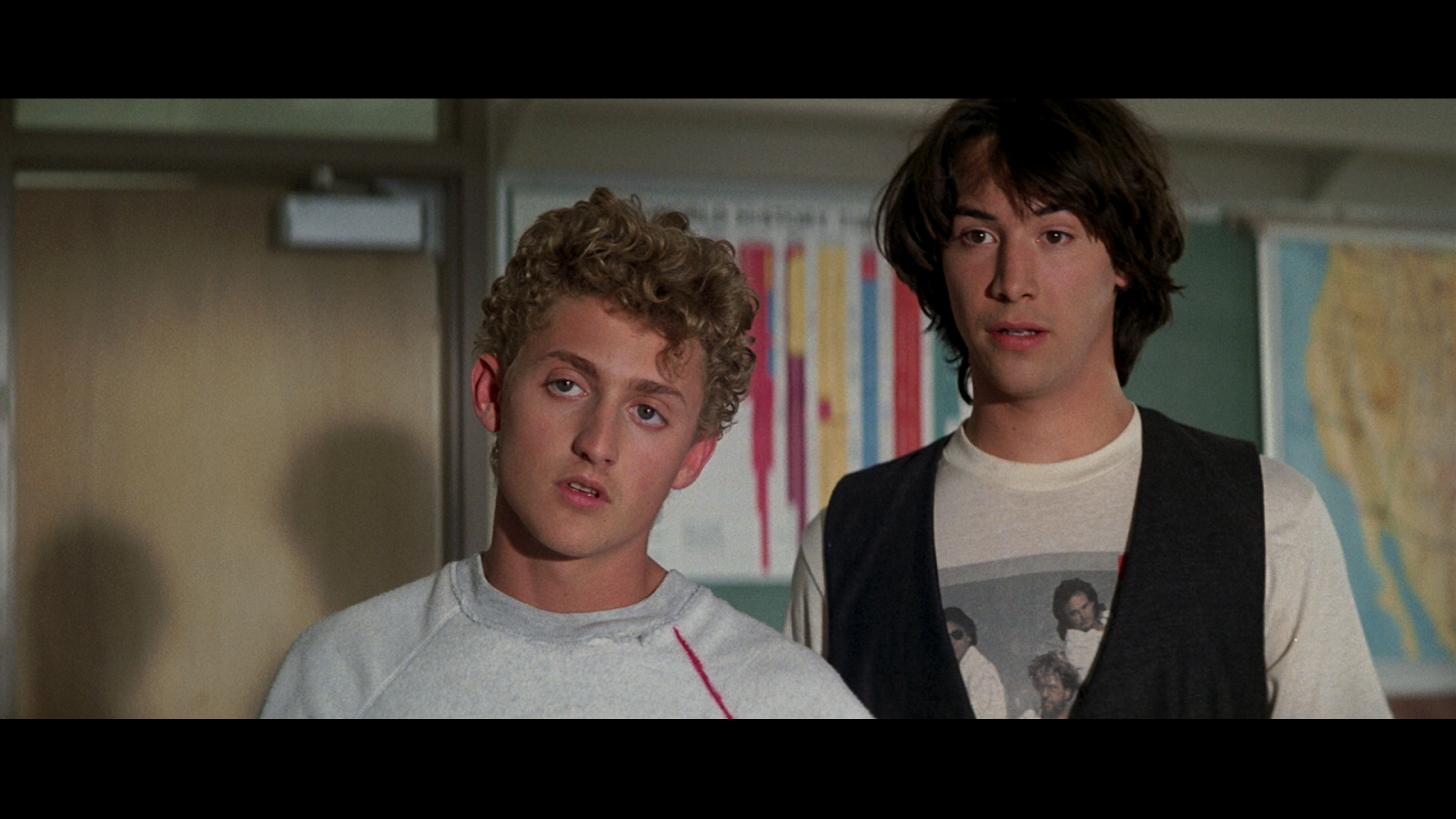
Bill & Ted's Excellent Adventure

Before The Matrix movies transformed Keanu Reeves into an international movie star, his biggest contribution to the popular culture zeitgeist was Bill &Ted’s Excellent Adventure (1989). It is a charming little movie about two metalheads that travel through time in order to pass their history class. Reeves nailed the role so well and the movie was so popular that it took him years to shake the notion that he’s as dumb as the character he played (even today it is still invoked by his detractors), even after a carefully cultivated and diverse body of work (from My Own Private Idaho to Bram Stoker’s Dracula).

Bill S. Preston, Esq. (Alex Winter) and Ted “Theodore” Logan (Keanu Reeves) are two clueless, but well-meaning teenagers that live in San Dimas, California. They dream of making it as rock stars with their band The Wild Stallyns. Sadly, they suck as musicians, but dream of one day getting Eddie Van Halen to play in their band. This sparks an amusing argument (if you can call it that as it is so good-natured) about making a “triumphant” music video in order to get Eddie’s attention.

As a result of spending so much time on their band, Bill and Ted have neglected their studies and are flunking their history class. For example, Bill refers to Napoleon as “a short, dead dude,” and Ted believes that Joan of Arc is Noah’s wife. Unless they get an A+ on tomorrow’s oral presentation they will flunk the class “most heinously” and this will split up the band as Ted’s father (Hal Landon, Jr.) will send his son off to military school in Alaska (?!). Fortunately, Rufus (George Carlin), a man from a future where Bill and Ted have had a profound influence on society, arrives to help the boys out by letting them use a time machine disguised as a phone booth (a sly reference to Doctor Who) so that they can bounce around various periods of history collecting (a.k.a. kidnapping) famous historical figures (like Billy the Kid, Socrates and Abraham Lincoln) for their presentation.

Capitalizing on the success of Back to the Future (1985), Bill & Ted’s Excellent Adventure takes that film’s basic premise and runs with it. Hardly an original concept/story, the movie fuses the horny, dim-witted teens from Weird Science (1985) and sends them back in time a la Back to the Future all in the service of trying to avoid flunking out of high school, much like the protagonists in My Science Project (1985), but does so in an entertaining and engaging fashion.

Most of the movie’s humor is derived from these two metalheads interacting with famous historical figures in their time period and then flips it so that we see these people deal with the culture shock of being in San Dimas, 1988. And so, we have Sigmund Freud (Rod Loomis) and Abraham Lincoln (Robert V. Barron) helping Bill out with his chores around the house or Ludwig van Beethoven (Clifford David) hanging out in the San Dimas Mall. Some notable character actors play a few of the historical figures, like Dan Shor (Tron) as Billy the Kid and John Carpenter’s long-time stuntman Al Leong as Genghis Khan. More than a few musicians pop up in supporting roles as well with the Go-Go’s Jane Wiedlin playing Joan of Arc and future elders played by the late-great E-Street Band saxophonist Clarence Clemons, The Tubes’ Fee Waybill and The Motels’ Martha Davis in brief, uncredited roles.


One of the more memorable pit stops in time is 15th Century England where Bill and Ted meet a pair of cute princesses (“Those are historical babes,” says a clearly smitten Ted) and features a memorable exchange used extensively in the trailers for the movie. When Bill and Ted are captured by the King’s men, they are sentenced to the iron maiden, which sounds pretty cool to these heavy metal loving fans as they exclaim, “excellent!” But instead of meeting the band, the King responds, “Execute them.” Bummed at the news, our heroes reply, “Bogus.”

Bill & Ted’s Excellent Adventure works as well as it does because of the chemistry between Keanu Reeves and Alex Winter. They play well off each other – Reeves is the goofy one while Winter is the ... not as goofy one. You have to give these actors credit – they commit fully to their roles and look like they’re having a lot of fun playing clueless teens. Their characters may be idiots, but when it counts they get it together and actually demonstrate a modicum of intelligence. There’s a goofy, good-natured charm to this movie that evokes a more innocent time.

Veteran comedian George Carlin gamely plays along as Bill and Ted’s bemused adviser, helping them achieve their goal. The scene where Rufus and the boys meet for the first time is a hoot, especially when Bill and Ted meet themselves from the future. After witnessing this, Ted is understandably wary about going with Rufus through time to which Bill replies, “Ted, you and I have witnessed many things, but nothing as bodacious as what just happened.” Carlin doesn’t have much to do – he basically bookends the movie and pops up at one point, but does so with his trademark cool, laidback persona.

The time travel special effects are pretty snazzy with Bill and Ted going through the “circuits of history,” which was kinda trippy for 1989. It’s all silly fun and the movie comes across as an entertaining snapshot of the time in which it was made – that is to say, it has a very late 1980s vibe to it. The movie, like Bill and Ted, has a goofy logic all its own. For example, after Ted’s brother (Frazier Bain) loses Napoleon (Terry Camilleri), he and Bill have to figure out where one of the greatest leaders of Europe would go – why a water park, of course!

The idea for Bill & Ted’s Excellent Adventure came out of an improvisational exercise between screenwriters Chris Matheson and Ed Solomon while working with an improv group in Los Angeles. They had met at UCLA in 1983 when the former directed a one-act play that the latter had written. They came up with the notion of 15-year-old boys talking about world affairs. Matheson said, “We had them talking about the world trouble spots and trade problems, but their only impression of anything going on in the world was that it was ‘bogus’!” They spent hours fleshing out the characters, but soon parted ways with Matheson going off to grad school in San Diego, while Solomon worked as an executive story editor on the It’s Garry Shandling’s Show. During this time, they wrote letters to each other as Bill and Ted and talked about the characters over the phone, imagining that they had gone back in time and “through sheer bumbling, were responsible for everything bad that ever happened to mankind.”


Originally, Matheson and Solomon envisioned writing a sketch comedy movie in the vein of The Kentucky Fried Movie (1977) with Bill and Ted as one of the skits, but Chris’ father, legendary writer Richard Matheson, told them that the skit could be a whole movie. They began writing the screenplay in 1984 as a “lark,” according to Solomon and finished it in seven days at Lake Tahoe. With help from Chris’ father, they got the script in the hands of Warner Brothers and spent a year developing it, tailoring it to the studio’s demands. It was at this time that director Stephen Herek came on board. After directing the science fiction/horror comedy Critters (1986), he started getting more offers from several studios to direct films like that one. The only script that he responded favorably to was the one for Bill & Ted’s Excellent Adventure. Warner Brothers felt that with his background, the movie could be done cheaply.

Herek worked with Matheson and Solomon, helping them develop their script. Some of the details changed, like the time travel device, which was originally a ’69 Chevy van, but Herek felt it was a little too close to the device in Back to the Future. He suggested changing it to a phone booth. Ultimately, the director and the studio disagreed over the size of the movie’s budget. He felt that it needed a medium budget, the studio wanted it lower and, along with their feeling that the teen comedy genre was dead, put the project in turnaround. By the end of the year, Dino De Laurentiis’ company picked up the option and it soon went into pre-production.

For the two lead roles, the filmmakers saw hundreds of actors and narrowed it down to 24 finalists. Then, they spent a day mixing and matching couples to see if any had chemistry together. When the producers saw Keanu Reeves and Alex Winter together, they knew that the two actors were their Bill and Ted. Filming began in March 1987 in and around Phoenix, Arizona and lasted ten weeks with two of them spent in Italy for the historical sequences. Unfortunately, De Laurentiis’ company collapsed financially and Bill & Ted’s Excellent Adventure was without a distributor. Fortunately, a co-deal was struck between Orion and Nelson Entertainment.

Bill & Ted’s Excellent Adventure was absolutely savaged by critics when it was first released. In his review for The New York Times, Vincent Canby called it, “a painfully inept comedy.” USA Today gave it one out of four stars and Mike Clark wrote, “Bill might have worked as a Saturday Night Live skit, but a whole brain-dead movie is depressing beyond imagination.” The Washington Post’s Hal Hinson wrote, “If the director, Stephen Herek, has any talent for comedy, it’s not visible here. More than anything, the picture looks paltry and undernourished.” However, in his review for the Globe and Mail, Rick Groen gave it a grudging thumbs up: “Destined to flunk most egregiously, this flick squeaks right through our critical defences. Most excellent surprise.”


Bill & Ted’s Excellent Adventure turned a tidy profit and spawned a sequel, an animated television series, and a live-action show. Not bad for what is essentially a cult film. It has certainly left its mark on the cultural zeitgeist, inspiring movies like Dude, Where’s My Car? (2000) and Harold and Kumar Go To White Castle (2004). Maybe it’s looking at the movie through the rosy-colored glasses of nostalgia, but Bill & Ted’s Excellent Adventure seems much more innocent and ... well, smarter many of the ones it inspired, which are more preoccupied with being raunchy than anything else. Plus, there is something fun about watching Keanu Reeves early on in his career during simpler times.


SOURCES

“Bill & Ted’s Unexpected Blockbuster.” San Jose Mercury News. April 16, 1989.

Biodrowski, Steve. “Bill & Ted’s Excellent Adventure.” Cinefantastique. August 1991.

Johnson, Kim Howard. “Bill & Ted’s Excellent Adventure.” Starlog. May 1988.


Jones. Alan. “An Excellent Interview with Stephen Herek.” Starburst #141.