"...the main purpose of criticism...is not to make its readers agree, nice as that is, but to make them, by whatever orthodox or unorthodox method, think." - John Simon

"The great enemy of clear language is insincerity." - George Orwell

Tuesday, May 11, 2010

Frank Frazetta 1928-2010

One of THE best illustrators ever died recently and the tributes are pouring in. The best of the bunch (so far) comes from the Los Angeles Times and features the likes of John Milius, Guillermo del Toro and Neal Adams paying their respects along with some great samples of Frazetta's artwork.

Also see:

The New York Times

The Beat

The Unofficial Fantasy Art Gallery (loads of great stuff, here!)

More from the L.A. Times

And here's his iconic artwork for the Mad Max poster. Awesome!

Monday, May 10, 2010

Little Big Man

Many film critics consider the last "golden age" of American cinema to be the 1970's. They cite a steady decline in the quality of studio films during the 1980’s and 1990’s, and the emergence of the American independent film scene as the most important indicators of this deterioration. And to a certain degree this may be true. The '70s saw a wonderful trend of studios taking chances on risky films that often featured controversial subject matter or a departure from standard Hollywood stereotypes (i.e. opting for a downbeat ending as opposed to a happy one). A great example of a film from this decade that embodies a willingness to push the envelope of convention is Arthur Penn's Little Big Man (1970), an endlessly fascinating and entertaining film that contrasts the harshness and violent nature of the frontier where a man defines himself through violence, by inserting a protagonist who instead defines himself through predominantly non-violent actions. Herein lies the brilliance of Little Big Man, a film that takes an existing genre like the western and consistently subverts our expectations at every turn.
           
The film begins with an intriguing opening: it is present time and a snobby scholarly type is trying to interview a very elderly man (Dustin Hoffman) who claims to be the only white man to have survived the infamous Battle of Little Big Horn, also known as Custer's Last Stand. The film then proceeds to recount Jack Crabb's colorful past in a series of flashbacks. Right from the first one we are acutely aware that this is not going to be the usual western. Penn's camera does a slow pan over a beautiful, scenic grassy field. This idyllic scene is quickly shattered as the camera continues its pan and we are struck by a rather primitive, horrific sight: a dead man spread eagle, covered in blood. This is soon followed by more bodies and burnt out carriages, the remains of a settler encampment massacred by Native American Indians. This rather unromantic portrayal of the Old West is only the beginning of a scathingly critical look at the conventions and the mythology of the western.
           
Jack Crabb and his sister Caroline are the only survivors of this skirmish and are soon found by a Cheyenne Indian who takes the two back to his people. After Jack's sister escapes, he is soon adopted by the Cheyenne who don't turn out to be brutal savages but actually quite the opposite. They are a thoughtful, noble people that are finding their way of life being rapidly wiped out by the white man. In an interesting turn, the Cheyenne refer to themselves as "human beings" and their humanity becomes readily apparent in their quick acceptance of Jack and the willingness to teach him their ways and customs. Ironically, they don't view white men as "human beings" and this becomes evident in the white man’s harsh treatment of not only Native American Indians but themselves as well.

The film follows Jack through the various stages of his life where he not only learns valuable lessons about life and the world but also meets an intriguing assortment of characters that appear and reappear at crucial moments in his life. The first three phases of Jack's life reveal the tried and true stereotypes inherent in the western. These archetypes are parodied in order to expose how hollow and outdated they are.

Jack's first phase, a religious one, sees him under the dubious tutelage of Mrs. Pendrake (Faye Dunaway), a God-loving woman who, as it turns out, is into more "sinful" pursuits than her virginal attire would suggest. This revelation exposes Jack to the double standards and hypocrisy of religion – that many people rarely practice what they preach as Mrs. Pendrake so adequately demonstrates. This rather amusing episode also marks the final eradication of naiveté that might have existed in Jack.
           
From there, he hooks up with Allardyce T. Merriweather (Martin Balsam), a sleazy salesman who "tended to lose parts of himself" in retribution for his shady dealings. A left hand here, a left ear there ... more parts gradually disappear as the years pass, transforming Merriweather into a ridiculous figure who still tries to con anyone who will listen. This is Jack's con man phase as Merriweather shows him that the world has no moral order. Merriweather embodies the dark side of the capitalist dream at its most garish and lays it all out for Jack when he tells him, "Those stars twinkle in a void dear boy and the two-legged creature schemes and dreams beneath them all in vain ... The two-legged creature will believe anything. And the more preposterous the better." Merriweather preys on people and they in turn prey on him – hence his rapidly diminishing body parts.
           
Jack's next period in life sees him reuniting with his sister who rescues him from a lynch mob and ends up teaching him how to be an ace shot with a gun. So, he decides to become a professional gunslinger, complete with an all black outfit and spurs. But he ends up being a hilarious parody of a killer with his often clumsy gestures and the general way in which he carries himself. Jack is all talk and no action. He even ends up meeting the legendary gunslinger Wild Bill Hickok (Jeff Corey) who points out, "you don't have the look of murder in your eye." As if to prove his point, Wild Bill coolly guns down a man who tries to kill him. Jack realizes that Wild Bill is a real killer, while he is merely a poseur. It is a rather ironic moment as we realize that Jack has become an expert in quick draw and shooting with a gun, and yet he is unable to kill people with it.
           
Little Big Man was a film that had been a long time in the making. MGM originally wanted to make it as a multi-million dollar epic based on Thomas Berger's best-selling novel. The deal fell through and a smaller studio, Cinema Center Films, agreed to finance the film in June of 1969. Jack Richardson had originally started writing the screenplay for MGM and was subsequently replaced by Calder Willingham who took over and produced a wonderfully rich script that covered an important period of American history and one man's interaction with many of the pivotal figures of this time.

The film was budgeted at $5 million dollars with Dustin Hoffman in the lead role and Arthur Penn directing. Penn's involvement also led to the film's break with convention. He was in large part responsible for ushering in an era of ultra-violent and blood-soaked action films with his stylish feature, Bonnie and Clyde (1967) which divided critics and audiences alike but is still regarded as a landmark film for the way in which it took an existing legend and reworked it for modern sensibility. This is exactly what he did with Little Big Man. As Penn commented in an interview, one of the aims of his film "was to say, 'Wait a minute, folks, the American Indian has been portrayed in movies in the most unpleasant way possible' – I mean, pure, naked racism – 'so let's examine how we have told our own history, such as Custer's last stand.' I mean, you go out there to this day and they feed you a lot of bullshit about the great, brave Custer, but the books don't bear that out at all. He was a pompous, self-aggrandizing man." To this end, Penn's film goes a long way to imparting a real sense of humanity to the Indians while showing the white man's greed and pomposity as embodied by the vain General Custer (Richard Mulligan). The film also includes numerous scenes of Indian villages being systematically wiped out by the United States army. No one is spared in these genocidal acts: not women, not children. These scenes and the fact that the film was made during the height of the Vietnam War give the material additional meaning. Little Big Man may not only be commenting on the brutal treatment of Native Americans but also the involvement in other cultures throughout the world. One could argue that Penn's film is not only a critique of past American history but also of contemporary events as well.

Little Big Man received generally favorable reviews from critics back in the day. Roger Ebert gave it four out of four stars and wrote, “Most movie Indians have had to express themselves with an "um" at the end of every other word: ‘Swap-um wampum plenty soon,’ etc. The Indians in Little Big Man have dialogue reflecting the idiomatic richness of Indian tongues; when Old Lodge Skins simply refers to Cheyennes as ‘the Human Beings,’ the phrase is literal and meaningful and we don't laugh.” In his review for The New York Times, Vincent Canby wrote, “All of these things are true, and yet Little Big Man—both in spite of and because of these failings—is an important movie by one of our most interesting directors.” Finally, Time magazine wrote, “it also accomplishes that rarest achievement, the breathing of life into an ossified art form. The '70s has its first great epic. Blood brother to the 1903 one-reeler, The Great Train Robbery, Little Big Man is the new western to begin all westerns.”
           
Little Big Man is a film that could only be made in the '70s. No major studio nowadays would be willing to back such a critical film without a big name star to attract a mass audience. At best, the film would probably have to be done on a low budget with independent backing and a cast of unknowns. One only has to look at a "revisionist Western" like Dances With Wolves (1990) to see how radical a film like Little Big Man still is. Kevin Costner's film has the same goals and intentions as Penn's film, however, where Dances With Wolves was satisfied to water down its message into a palatable, politically correct pill for all to swallow, Little Big Man refuses to compromise or sentimentalize its message or its subject. Penn's film avoids the trap of reducing Native American Indians to quaint stereotypes or romanticizing its story and its surroundings. It is this unyielding attitude that makes Little Big Man a daring, original film whose power and impact has yet to be dated by time.

Thursday, May 6, 2010

DVD of the Week: Crazy Heart

In 2010, Jeff Bridges finally received an Academy Award for acting after several previous nominations over the years and a long, illustrious career chock full of diverse roles in films as varied as the murder mystery Cutter’s Way (1981), big-budget science fiction with Tron (1982), playing a gifted musician alongside his real-life brother Beau in The Fabulous Baker Boys (1989), a cult film stoner comedy with The Big Lebowski (1998), and even playing the President of the United States in The Contender (2000). Bridges’ best films are character-driven ones where he is allowed to fully immerse himself in a role. Crazy Heart (2009) is that kind of a film. Made independently for little money, it almost did not come out in time for end of the year awards consideration but once word got around of Bridges’ gritty, heartfelt performance, the accolades (and awards) came flooding in and deservedly so for the veteran actor.


Bad Blake (Jeff Bridges) is a burnt-out country and western musician who travels endless stretches of highway all over the United States just so he can play a bowling alley in some dead-end part of a town in New Mexico. In between gigs, he lives his life in a bottle of alcohol, the only thing that seems to keep him going and what is also destroying his world-weary body. It’s safe to say that Blake has definitely seen better days.


While doing a gig in Santa Fe, he agrees to be interviewed by Jean Craddock (Maggie Gyllenhaal), the niece of a local musician he’s playing with and a writer for a small newspaper. There’s something about her that catches his eye and makes her stand out from the countless women he’s had flings with – maybe it’s her knack for initially resisting his sweaty, boozy charms. They begin a relationship and he starts to think about finding a way out of the self-destructive grind that is his life.


Jeff Bridges does a fantastic job transforming himself into the grizzled, bloated mess that is Blake. He’s one of those rare actors not afraid to look awful if the role calls for it. You can see the toll that Blake’s hard-drinking, hard-living life has taken on him etched all over Bridges’ face. The actor brings his customary authenticity to the role, including singing and playing Blake’s music.


He’s ably supported by the likes of Maggie Gyllenhaal as the woman in his life who decides to take a chance on him even though she knows what a trainwreck he is, Robert Duvall as an old friend of Blake’s who helps him get sober, and an uncredited Colin Farrell as his more successful protégé and who tries to help out his old mentor. They are all very good in this film, especially Farrell who also did his own singing and playing.


With Crazy Heart, writer/director Scott Cooper juxtaposes old school country with the slick sound of new country as represented by Tommy Sweet (Colin Farrell), who has gone on to sell out arenas while Blake is still playing two-bit dives. The kind of music Blake plays is no longer popular anymore even though in a perfect world it should be. Ultimately, the film adheres to the tried and true conventions of the redemption story as we wonder if Blake has what it takes to clean himself up and get his life in order. What elevates Cooper’s film from others of its kind is the excellent performances of the entire cast led by Bridges’ fearless turn as a self-destructive man.


Special Features:


There are six deleted scenes clocking in at a total of ten minutes. We see more of Blake on the road performing live, which is a nice addition if only to see Bridges’ musical chops on display. We also see a bit more of Tommy living the good life on tour. Naturally, there is more footage of Blake and Jean’s relationship.


Finally, there is a theatrical trailer.


Monday, May 3, 2010

Deep Cover

While movie star-studded prestige films like Traffic (2000) tackle the war on drugs on an ambitious scale, sometimes it takes a slick B-movie like Deep Cover (1992) to get right to the heart of the issue. Directed by veteran character actor and filmmaker Bill Duke, the film attempted to capitalize on the success of edgy urban films like New Jack City (1991) and shed light on how drug addiction and drug dealing was destroying African American neighborhoods in major cities throughout the United States. Deep Cover dares to be different by showing how flawed and corrupt law enforcement is in dealing with the drug problem, following the paper trail all the way up the ladder to the upper echelons of our government, all the while delivering the requisite thrills of the police thriller. The end result is a B-movie with a brain.

The film’s set-up is an old chestnut: Russell Stevens, Jr. (Laurence Fishburne) is a Cincinnati police officer recruited by a smug bureaucrat named Carver (Charles Martin Smith) to go undercover and stay under for a prolonged period of time, becoming a drug dealer in order to set up and bust other dealers. The key is that Russell must deeply immerse himself in the role in order to survive because other officers failed when they tried to go back to their regular lives and blew their cover on the street. Carver sells the gig to Russell by telling him, “all your faults will become virtues.” Russell won’t blow his cover because he exhibits antisocial tendencies and has no family. When he was a child, Russell saw his father (Glynn Turman) die before his very eyes, gunned down after robbing a liquor store. Duke captures this flashback in rather lurid fashion as the gunshot that ends the father’s life splashes his blood all over the passenger window of the car his boy watches helplessly from. To further hammer the point home, Duke includes a shot of the dying father giving his son blood-soaked money.

Russell is sent to Los Angeles and tasked with the mission to knock out the big drug network. Via Carver, the film lays out the drug hierarchy in the U.S. in fascinating detail. Russell’s target is Felix Barbosa (Gregory Sierra), the guy who supplies the street level dealers. Above him is Anton Gallegos, the top importer on the west coast, responsible for 40% of the drugs in L.A. He is able to do so because of his uncle, Hector Guzman, a Latin-American politician and “a self-promoting duplicitous greaseball,” according to Carver. Russell starts off as a small-time dealer and soon finds a way in to Barbosa through a man named Eddie (played with wonderful twitchy desperation by Roger Guenveur Smith), a “crazy, good-natured, desperate asshole with a life expectancy of about a half an hour.” Through Eddie, Russell meets and befriends David Jason (Jeff Goldblum), an uptight upper class attorney that moonlights as a dealer and gets his drugs directly from Barbosa but dreams of bankrolling his own designer drug. Russell also crosses paths with an upstanding veteran cop by the name of Taft (Clarence Williams III), a righteous man that makes it his life’s mission to take the drug dealer down.
Deep Cover started as a collaboration between producer-writer Henry Bean and producer Pierre David. They had worked together previously on the police corruption thriller Internal Affairs (1990). The two men envisioned the project as a fairly standard crime thriller about an undercover cop. However, former Paramount Pictures production executive Gary Lucchesi suggested that they revise their protagonist to be African-American because, at the time, the studio was impressed with the success of Spike Lee’s films. Bean liked the idea and felt that the “details of blackness gave the character a particularity and resonance that it otherwise didn’t have.”

Screenwriter Michael Tolkin was brought in to do the first draft with Bean taking over subsequent revisions. However, Bean ran into problems when it came to writing dialogue reflecting how African-Americans felt about “somebody like the Goldblum character with his assumptions of middle-class privilege.” Once Duke and the actors came on board, they helped with these aspects of the screenplay. When the revised script was delivered to Paramount in the winter of 1990, the studio passed and placed the project in turnaround.

Bean and David took the script to every major studio and were turned down by them all. Some executives suggested that the lead role be re-written with a white person in mind. Then, New Jack City (1991) had a strong opening in March 1991 and New Line Cinema, who has also passed on Deep Cover, reconsidered. The studio felt that if the project were also given a modestly low budget (below $8 million), there would be relatively little risk and the potential for high returns. Then, John Singleton’s Boyz N the Hood (1991) came out and was successful enough that New Line saw the same kind of crossover potential for Deep Cover.

Deep Cover was filmed in the fall of 1991 in order to capitalize on the success of Boyz N the Hood which was made for $6 million and went on to gross approximately $58 million. It also helped other African-American filmmakers get their films made, like Matty Rich’s Straight Out of Brooklyn (1991), Ernest Dickerson’s Juice (1992), and Mario Van Peeble’s New Jack City. At the time, Bill Duke said that he was not interested in making “’black’ movies. I’m interested in making movies that reflect reality as I perceive it.” He got his start acting in popular films like Commando (1985) and Predator (1987) and cut his teeth directing episodes of television programs as diverse as Cagney & Lacey, Hill Street Blues and Miami Vice. He was one of the first directors considered and he liked the script and its protagonist. Duke and Bean wanted the film to appeal to a mainstream audience and cast as multiracial as possible despite resistance from the studio who pushed for African-American actors.

The lead role was first offered to Denzel Washington, who turned it down, and then to Wesley Snipes and Laurence Fishburne. The latter had just come off Boyz N the Hood and was the veteran of more than 20 films. Duke liked the actor and felt that he could play “somebody who the audience could not only identify with but also believe in.” Fishburne saw his character in the tradition of Al Pacino in Serpico (1973) or Andy Garcia in Internal Affairs and was attracted to the notion that it “offered me wider psychological possibilities to play than a lot of the parts that I’ve been offered in the past.” He also saw the film as one that “offers what I hope can be a role model for black youth who have been bombarded with negative images for so long.” To research for the role and to bond with co-star Jeff Goldblum, Fishburne rode around in a Los Angeles Police Department squad car that was unexpectedly called to a homicide.

Russell narrates his own story with that great, deep-sounding melodical voice of Laurence Fishburne’s, delivered without emotion. At times, it’s almost like he’s rapping the voiceover narration which begins, “So gather round as I run it down and unravel my pedigree.” Another gem: “The great thing about life on the street is you know how it’s going to be. It’s always the same. It’s always getting worse.” Deep Cover re-imagines hard-boiled noir narration as a rap. Naturally, Russell breaks the golden rule of drug dealing as established in Scarface (1983): don’t get high on your own supply. He starts to take bigger and bigger risks including interfering in an important drug bust. Fishburne does an excellent job of showing his character losing himself in his drug dealing persona. Once he kills a rival dealer, it’s a short journey to doing drugs. Russell soon becomes seduced by the lifestyle and does what he we swore he would never do: be like his father. Russell’s epiphany comes when he realizes that everything he’s doing, all the undercover work, has been for nothing. His disillusionment provokes an indulgence in all the vices he swore he would never do. However, Russell never loses control completely. He’s too smart for that. Fishburne is a gifted actor and has no problem conveying his character’s intelligence.

Jeff Goldblum has built a career on playing quirky characters in films as diverse as The Adventures of Buckaroo Banzai (1984) and Into the Night (1985). With Deep Cover, he showed some serious dramatic chops. David starts off as one of the actor’s freewheeling characters who are always with a quip at the ready but he takes a dramatic turn in a scene where Barbosa puts him in his place. Afterwards, at home, he tells his wife that Barbosa doesn’t respect him and his eyes seem on the verge of welling up with tears. His wife tells him that he has a loving family and what more does he want. Duke cuts to a shot of an eerily malevolent-looking David staring off into space and he responds, “I want my cake and eat it, too.” Gone is the slick, cocky lawyer and all that’s left is an emotionless psychopath which Goldblum conveys with a lifeless look in his eyes. It’s impressive to see the transformation in his character once he goes off the deep end.

Gregory Sierra brings a considerable amount of intensity to his role as evident in the scene where he disciplines Eddie. The more nervous Eddie gets, the calmer Barbosa is, but there’s the undeniable menace in Sierra’s eyes. When the explosion of violence does come it’s brutal and ugly. Duke makes sure we see the reactions of horror in both David and Russell’s eyes. Duke gives Deep Cover occasional stylistic flourishes, like employing old school wipes to transition from scene to scene, or a shot of Russell walking the streets of L.A. with a series of staccato jump cuts that also move the camera closer in on him, all timed to atmospheric hip hop music. These stylistic touches give the film an energy and vitality that is exciting to watch.

Deep Cover received generally positive reviews from critics. Roger Ebert gave it three-and-a-half stars out of four and praised the voice-over narration as "poetic and colorful. That's part of the process elevating the story from the mundane to the mythic.” In her review for The New York Times, Janet Maslin praised the "quietly commanding Larry Fishburne and the wry Jeff Goldblum, who make an interestingly offbeat team.” The Chicago Reader’s Jonathan Rosenbaum wrote, "What emerges is a powerhouse thriller full of surprises, original touches, and rare political lucidity.” Entertainment Weekly gave the film a “B-“ rating and Owen Gleiberman wrote, "The movie peels away every layer of hope, revealing a red-hot core of nihilistic despair. Fishburne, with his hair-trigger line readings and deadly reptilian gaze, conveys the controlled desperation of someone watching his own faith unravel. And Goldblum reveals a new dimension of comic rottishness.” However, the Washington Post’s Desson Howe wrote, “with Boyz N the Hood, Fishburne broke through to the big time. Here, his acting career takes a step backwards.”

If Deep Cover has one glaring flaw, it’s the wish fulfillment ending that wraps things up a little too neatly as Russell sticks it to The Man. It’s as if the filmmakers want their cake and eat it, too, to quote Goldblum’s character in the film. However, Duke’s film is not afraid to name names in the sense that it exposes the corruption that exists within our government. On the one hand, it wages an expensive and never-ending war on drugs and yet it develops relationships with politicians in other countries that can be the source for the drugs that are brought into the U.S. It’s a complicated relationship but one that Deep Cover attempts to make understandable by filtering it through the prism of a B-movie crime aesthetic.


SOURCES

Diamond, Jamie. “Getting in Deep.” Entertainment Weekly. April 22, 1992.

Diamond, Jamie. “Collaboration on the set of Deep Cover.” Entertainment Weekly. April 24, 1992.


Pacheco, Patrick. “Fighting the ‘John Singleton’ Thing.” Los Angeles Times. April 12, 1992.

Monday, April 26, 2010

The Hitcher

It was the film no one wanted to make. It became the film no one wanted to see. When The Hitcher came out in 1986, it barely made a dent in the box office and what few critics did see the film, hated it for the unrelenting sadism and brutality that occurred with seemingly no rhyme or reason. The film was quickly relegated to home video hell and doomed to obscurity. And then a curious thing happened. The Hitcher gradually began to take on a second life through word of mouth, spawned by the riveting performance of Rutger Hauer, the actor who played the frightening yet charismatic antagonist. The film, much like its villain, is a nasty piece of work that doesn’t care if you like it or not – it just wants to scare the living hell out of you and I would argue that it does so with a refreshing simplicity. The Hitcher doesn’t beg to be psychoanalyzed – it is something to experience in all of its white-knuckled intensity. The film has gone to inspire films like Jeepers Creepers (2001) and The Forsaken (2001) and spawn a vastly inferior sequel and remake.

Jim Halsey (C. Thomas Howell) is driving a car for someone else across the country en route to San Diego. We meet him traveling along a deserted stretch of highway out in the middle of barren desolate terrain buffeted by mountains somewhere in Texas. As night gradually becomes very early morning, Jim struggles to stay awake. At one point, he actually drifts off and nearly drives headlong into a truck. It begins to rain heavily and he spots a lone figure on the side of the road. Ignoring the advice his mother once told him, Jim stops for the hitchhiker – a decision he will come to regret.

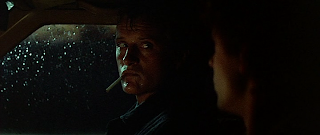
The man introduces himself as John Ryder (Rutger Hauer) and right from the get-go something doesn’t seem right about him. He doesn’t tell Jim where he’s going and when they pass a car on the side of the road, Ryder grabs Jim’s leg startling him so that they don’t stop. When Jim tells Ryder to get out, he ignores him and instead tells the young man that the car they just passed belonged to a man who also gave him a ride but he didn’t get far. Ryder says with a laugh that makes us and Jim uneasy, “I cut off his legs and his arms and his head, and I’m going to do the same to you.” Ryder says this last bit with an almost bored indifference as if he were reciting a shopping list.
Ryder proceeds to hold Jim at knifepoint and plays excruciating head games with the young man, including forcing him to say the words, “I want to die.” Fortunately, Jim manages to push Ryder out of the car and drive off. He thinks that he’s free and clear, that he’ll never see this creepy psychopath again. However, this isn’t the last time Jim will see Ryder – it’s only the beginning of a nightmarish journey. Ryder proceeds to stalk Jim, making his life a living hell as he torments the young man in all sorts of sadistic ways, like ramming his car with a pickup truck or framing him for several murders that he in fact committed or nasty little things like putting a severed finger in his food at a diner.

Jim is forced to literally fight for his life as he tries desperately to escape this madman. Along the way, he enlists the help of Nash (Jennifer Jason Leigh), a beautiful young waitress at a diner, and the local cops but to no avail. Ryder is like a force of nature that will not be denied and it’s up to Jim to stop him. Most of the film plays out like a cruel game of cat and mouse as Ryder pushes Jim to the brink of madness.

C. Thomas Howell is good as a young man trapped in a terrifying situation. He is able to convey just the right amount of sweaty desperation as his character tries to figure out a way of this state of affairs. With younger-than-he-looks features and that reedy voice, Howell is well-cast as a naive twentysomething who is forced to grow up real fast and do things he would never have dreamed of doing before. Up to that point in his career, Howell was known mostly as a Teen Beat poster boy with sympathetic roles in films like The Outsiders (1983) and director Robert Harmon uses this image to make Howell instantly sympathetic so that we care about what happens to his character. As the film progresses, Jim gradually comes apart at the seams while Ryder gets calmer and calmer – not at all the stereotypical psycho and his victim. Both actors get to play against type which makes them so interesting to watch.
Along with Wulfgar in Nighthawks (1980) and Roy Batty in Blade Runner (1982), John Ryder is one of Hauer’s signature roles. He has such a fascinating screen presence and infuses his character with a casual menace that is something to behold. He exudes an almost Zen-like calmness that is strangely unsettling. He has one of those dangerous smiles that on the surface seems inviting but is actually quite threatening. Hauer plays Ryder as an enigmatic force of nature. We are never told his backstory or find out why he’s doing this to Jim. These things aren’t important because the film exists entirely in the present. Even though Hauer doesn’t have all that much screen time, his presence dominates the film because when he does appear, he is so charismatic that you can’t take your eyes off him. Throughout it all, the actor gives Ryder a genial grin but it’s those eyes of his that tell a different story, one of madness. Unbeknownst to Hauer, during filming, Howell found him “frightening, intimidating, and that he was in a constant state of fear, almost as if he really was Jim Halsey and I really was John Ryder.” It certainly translates on the screen and makes the film better for it.

I always wondered if most of the film is a nightmare that Jim experiences and that his dream state starts when he nods off at the beginning of the film with Ryder as a grinning boogeyman, the 1980s answer to Robert Mitchum’s evil preacher in The Night of the Hunter (1955). Ryder seems to magically appear just when Jim begins to feel a tiny bit safe. Interestingly, Jim also dreams while holed up in a jail cell and when he awakes it feels like he’s still dreaming, that none of what is happening is real. In retrospect, Hauer has said of his character, “To me he doesn’t exist. He’s just a ghost that comes out of the desert.” Another theory that has been put out there is that Jim is schizophrenic and that Ryder is actually a split personality with Jim, in reality, doing all of the killing. This is one of the things that elevates The Hitcher above your typical hack-and-slash horror film from the 1980s – it is open to interpretation because it refuses to provide in easy answers.

Director Robert Harmon certainly knows how to ratchet up the tension when required, like in the scene where Jim wakes up in a seemingly empty police station only to find everyone in it dead. The opening scene between Jim and Ryder also crackles with intensity as the psycho nonchalantly threatens the young man. Eric Red wrote the screenplay and this was the follow-up to the one he wrote for Near Dark (1987). Both films are set in desolate Texas landscapes with protagonists thrust into nightmarish worlds that they must try and escape from. Red has a real knack for exploring extreme behavior that offers glimpses into the darkest parts of our souls. For a film that has such a notorious reputation, people tend to forget that The Hitcher isn’t all that gory. Even its most shocking set piece largely happens off-screen but, much like with the original The Texas Chain Saw Massacre (1974), the use of sound and our imagination fills in everything else to horrifying effect.
When he was 20-years-old, New York City-based writer Eric Red made a short film entitled, “Gunman’s Blues” in the hopes of getting the opportunity to direct a feature-length film. When no offers came, he moved from New York to Austin, Texas in 1983, taking a drive-away car cross-country (just like Jim in the film). During the journey, Red had a lot of time to think and became inspired by The Doors song, “Riders on the Storm.” He found that the “elements of the song – a killer on the road in a storm plus the cinematic feel of the music – would make a terrific opening for a film.” According to Hauer, Red had Rolling Stones guitarist Keith Richards in mind when he wrote the part of John Ryder. Interestingly, the screenwriter also felt that the character should have an electronic voice box. For seven months, he drove a cab and wrote the screenplay for The Hitcher.

After it was completed, Red sent a letter to several Hollywood producers asking if he could send them a copy of his script for The Hitcher. His letter concluded: “It (the story) grabs you by the guts and does not let up and it does not let go. When you read it, you will not sleep for a week. When the movie is made, the country will not sleep for a week.” Script development executive David Bombyk received a copy of Red’s letter and was intrigued by the description of the film. Red sent him a script that ran approximately 190 pages in length (one page traditionally equals one minute of screen time). By all accounts, the original script was not for the faint of heart: an entire family was slaughtered in their station wagon; an eyeball was discovered inside a hamburger; a woman was tied to a truck and a pole and then torn in half; there was a decapitation, as well as several slashings, shootings and car crashes. A big fan of horror films, Red has said that his favorite scene in the script is when the woman is torn apart.

In its original form, Bombyk found the script to be “extremely brutal and extremely gory,” but he and personal manager Kip Ohman (who later became co-producers of the film) also saw in it “a level of challenge, intensity and poetry.” In addition, Ohman described the script as “a suspense Hitchcockian-type thriller.” Bombyk and Ohman were worried about getting it in good enough shape to show their bosses in order to prove to them that it was more than an exploitation film. Bombyk worked with Red via several long distance phone calls to Texas and eventually the writer moved to Los Angeles. Red agreed to work with Ohman on the script until it was ready to be shown to the powers that be. The two men spent six months reworking the script, removing most of what Ohman felt was repetitive violence.

Bombyk brought a revised, toned down version of the script to his boss, producer Eric Feldman and his partner Charles Meeker. Feldman had cut his teeth in the movie biz shepherding a diverse collection of films like Six Pack (1982), Hot Dog... the Movie (1984), Witness (1985), and Explorers (1985). They liked the script but wondered, “how could we manage to translate it to the screen without making a slasher movie?” Meeker said. Feldman and Meeker decided to come on board as executive producers. At this time, Bombyk had also given a copy of the revised script to David Madden, a production executive for 20th Century Fox. Within a few days, Madden called back and told them that the script was “terrific.” However, the studio wasn’t comfortable with the subject matter, but they felt that the writing was unique and interesting enough to give the producers a letter-of-intent to distribute The Hitcher. This would allow them to get financing and then once filming was completed, the studio would reimburse them for the budget.
The producers went looking for an inexpensive director. Still photographer-turned-cameraman Robert Harmon was given a copy of the script by his agent but thought it was just another script – that is, until he listened to a series of messages left by his agent on his answering machine encouraging him to read it. Harmon read the script and early the next morning called his agent and told him that he wanted to do it. In February 1984, the director met with the producers to talk about the project. He recalled, “Even the exact actions that remained in the script were described in much bloodier and gorier detail.” The producers were impressed with Harmon and the fact that he also envisioned the film as a Hitchcockian thriller. However, he objected to the eyeball in the hamburger scene and never planned to show the poor girl getting ripped in half.

Fox ultimately rejected the project over the size of the budget and saw it as a “straight-out horror movie.” Madden also admitted that he would have “argued to soften the movie. There were some people at the studio who thought it was pretty gross.” Feldman and Meeker optioned the film themselves, paying Red $25,000. Major studios like Universal Pictures and Warner Brothers passed on it, as did smaller ones like Orion Pictures and New World Pictures. Reportedly, many executives liked the script but balked at the girl being ripped in half scene. At least two studios were willing to consider making The Hitcher but only if Harmon was replaced. However, to their credit, the producers had faith in the director and stuck by him.

Independent producer Donna Dubrow had heard about The Hitcher while working on another film and to her it sounded like “Duel with a person.” When she went on to work for Silver Screen Partners/Home Box Office, she contacted Feldman, a former employer, and asked for a copy of Red’s script. She submitted it to her boss, HBO senior vice-president Maurice Singer. He liked it and sent it back to New York to be read by Michael Fuchs, HBO chairman and chief operating officer. They needed his approval to get the film made. It would not be easy to convince him because it was not the kind of material that he liked. Sure enough, he passed on the project. However, Dubrow had to go back to New York on other business and met with Fuchs. She mentioned The Hitcher script and pitched the Hitchcockian thriller angle. He listened politely to her and that was that.

When Dubrow returned to L.A., Singer told her that Fuchs agreed to make the film but with the stipulation that the girl would not be torn apart and the violence would be reduced. Over the next few months, the filmmakers negotiated two key scenes in the script with studio executives: the girl getting ripped apart and the eyeball in the hamburger. For the latter scene, Harmon just changed the body part to a finger. As for the former, everyone at HBO/Silver Screen, except Dubrow, wanted it changed. Fuchs did not want the girl to die but Dubrow argued that this would change the story significantly. There were arguments about how she should die and Dubrow remembers, “they were trying to make her death not horrible, when – by the nature of the script – it had to be.” The studio even suggested softening her death by having a funeral. The filmmakers refused to back down and executives finally relented at the last minute.
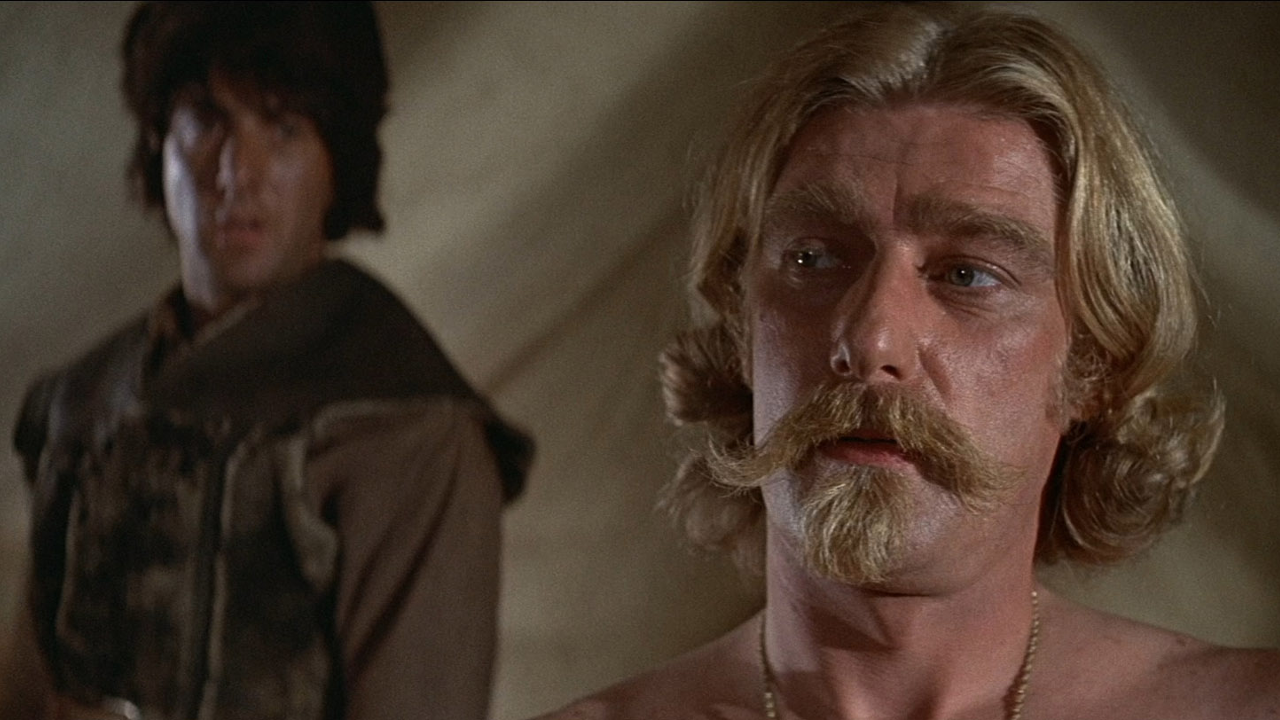
While these discussions were going on, the producers began the casting process. In early drafts, John Ryder had been described as skeletal in nature and so actors like David Bowie, Sting, Sam Shepard, Harry Dean Stanton, and Terence Stamp were mentioned. Harmon was set on casting Stamp and even carried around his picture to pitch meetings. The actor received a copy of the script but he turned down the role. Sam Elliott was offered the role but an agreement could not be reached on his salary. Singer mentioned Dutch actor Rutger Hauer. While in L.A. for a short visit, he read the script. Even though he was looking for non-villainous roles, the script “really got ahold of me ... I thought, ‘If I do one more villain, I should do this.’ I couldn’t refuse it.” The one reservation he had was with the scene of the girl being ripped apart and Feldman told him, “You are the bad guy and you’ll be the baddest bad guy there ever was!”

For the role of Jim Halsey, the producers mentioned Matthew Modine, Tom Cruise and Emilio Estevez (who, reportedly, was interested). They agreed on C. Thomas Howell and liked his look. At the time, the actor was being more selective with the roles he took and heard that the script was a generic thriller. Harmon personally gave Howell a copy of the script. The actor couldn’t put it down and “couldn’t believe the things that happened to my character in the first 12 pages. I knew I wanted to do it.” Howell also wanted to work with Hauer, fresh from a career-defining performance in Blade Runner. Jennifer Jason Leigh agreed to do the film because she also wanted to work with Hauer again (they co-starred in Flesh + Blood) and loved the character of Nash because “there was a real person there.”

The budget was set at $5.8 million and contractually, Tri-Star was obligated to distribute any film by HBO/Silver Screen. They saw an early screening and Tri-Star president David Matalon said, “It’s the best film that we have for 1986.” The Hitcher opened in 800 theaters and it performed poorly at the box office. To add insult to injury, it was also savaged by critics at the time. Roger Ebert gave the film no stars and wrote, “But on its own terms, this movie is diseased and corrupt.” In her review for The New York Times, Janet Maslin wrote, “It's very clear what sort of spine-tingling suspense Mr. Harmon is after, and just as clear that neither his direction nor Eric Red's screenplay can generate that kind of intensity.” The Chicago Tribune’s Gene Siskel wrote, “This is the kind of movie that may satisfy the mentally deficient, but it is more likely to drive away from moviegoing every unsuspecting adult who stumbles into it hoping for a decent thrill or two.” In his review for the Los Angeles Times, Michael Wilmington wrote, "In the end, the only thing that does scare you about The Hitcher is its emptiness: not the emptiness of a desert road or a fear-soaked night, but a shriveling void in the people who made it." The one lone positive review came from Newsweek magazine’s Jack Kroll who called it “an odyssey of horror and suspense that’s as tightly wound as a garrote and as beautifully designed as a guillotine.”

In attempt at damage control, one of the film’s producers claimed that its commercial failure was because there wasn’t enough violence and that Nash’s death should have been shown: “There’s other gore in the movie, other killings, but this is the main one. It’s the motivation for the hero. You can’t show all the killings we showed and then not the main one. It’s cheating the audience.” He claimed that this hurt word-of-mouth and resulted in its dismal box office results.

In keeping with the current trend of remaking classic horror films that don’t need to be remade (The Texas Chain Saw Massacre and Friday the 13th), Michael Bay decided to give The Hitcher (2007) a go with music video director Dave Meyers behind the camera and television actress Sophia Bush in the C. Thomas Howell role along with fellow T.V. thespian Zachery Knighton in the Jennifer Jason Leigh role (sort of).
In this version, two college kids – Grace (Sophia Bush) and Jim (Zachery Knighton) – are traveling through New Mexico on the way to Spring Break. Along the way they pick up a mysterious hitchhiker who calls himself John Ryder (Sean Bean) and this remake proceeds to follow the original’s plot quite faithfully. This new version hits a false note right from the opening shot as a cute bunny rabbit is unnecessarily run over by a car in a feeble attempt to quickly establish the film’s badass credibility. Instead, it comes across as a lame attempt that does not bode well for the rest of the film. From there, it quickly trots out the stereotypes, including the slack-jawed yokel cliché complete with lazy eye no less.

Sean Bean is fine as the psychotic killer but he lacks the casual menace of Rutger Hauer who could go from genial to intensely frightening at the drop of a dime. Bean’s take on Ryder is rather generic – he is just another monster that has to be destroyed. With Hauer’s performance, there was a certain twinkle in his eyes, a sly look and shark-like grin as if to suggest that Ryder was actually getting off on all of the carnage he was causing. It’s damn near impossible to improve on an iconic character such as this one and Bean doesn’t quite do it but certainly gets an A for effort. Sophia Bush and Zachery Knighton don’t fare nearly as well as the good-looking young couple but to be honest their characters could be played by anyone. It doesn’t help that they lack any kind of on-screen chemistry. They don’t do anything to make themselves distinctive and certainly don’t hold a candle to their original counterparts, C. Thomas Howell and Jennifer Jason Leigh.

To his credit, first-time feature film director Dave Meyers shoots the hell out of the film. It looks good and almost distracts you from the weak script and generic performances. Sadly, much of the ingenuity he demonstrates in some of his music video work is absent here except for a car chase that is scored to “Closer” by Nine Inch Nails. The same holds true for the scare tactics as Meyers eschews the original’s unrelenting terror for cheap jolts that we’ve seen in countless other, better movies.

This film proves yet again that producer Michael Bay has no understanding of the horror genre, merely offering up a clone of the original film. The Hitcher was a nasty little horror film that had no ambitions other than to scare the crap out of you and succeeded due in large part to Rutger Hauer’s creepy turn as a charismatic and seemingly unstoppable hitchhiker cum killer. The film was an exercise in white knuckle primal fear, charting a young man’s journey on the road trip from hell. What makes The Hitcher so scary is that it takes the plausible set-up of picking up a hitchhiker and then proceeds to take it to all kinds of unexpected places. The film plays on some pretty basic fears only to then heighten them to almost absurd levels as represented by the nearly superhuman Ryder who seems capable of anything. The original film’s stature has improved over the years, helped along by the unnecessary sequel and the instantly forgettable remake. All they do is remind one just how superior the original is – a timeless horror film featuring the ultimate boogeyman.

For more on The Hitcher, check out Sean Gill's fantastic review of the film over at his blog, Junta Juleil's Culture Shock where, last week, he dedicated entirely to Rutger Hauer!

Friday, April 23, 2010

DVD of the Week: The Missing Person

With an Academy Award nomination for his scene-stealing role in Revolutionary Road (2008), Michael Shannon’s career was given a considerable boost. For years, he’s plugged away in small roles in big films like Pearl Harbor (2001) and more substantial parts in independent films like Grand Theft Parsons (2003). He’s one of those character actors that can bring an extra special something to the table with his unconventional looks and quirky acting style, much like Steve Buscemi did in the 1990s. So, when Shannon gets the chance to headline a film, as he does with The Missing Person (2009), it is definitely worth a look.

“I coulda lied there forever, but the phone rang.” And with that bit of hard-boiled narration we are introduced to the world of private investigator John Rosow (Michael Shannon), a rumpled burn out cut from the same cloth as Elliott Gould’s gumshoe in The Long Goodbye (1973). Rosow is hired by an attorney over the phone to tail a man (Frank Wood) from Chicago to Los Angeles by train. Rosow may come across as a burn out but when it’s called for, he displays the necessary private eye skills: paying off a taxi cab driver to tail his target, pulling a fast one on the hotel clerk where the man is staying at, and listening in on the man’s room.
Rosow eventually finds out that there is much more to this mystery man than meets the eye and that there is much more to the job than he was initially led to believe. Halfway through the film, the story veers off in an unexpected direction that gives the film noir genre an interesting spin as we gain significant insight into both Rosow and the man he is following. Without giving too much away, we begin to realize that the film’s title applies not only to Rosow’s target but to the private eye himself.

Writer/director Noah Buschel makes good use of Michael Shannon’s world-weary face. Rosow seems to sport a permanent grimace as if every action were a painful chore. It doesn’t help that he appears to be a barely functioning alcoholic. Over the course of the film, it becomes apparent that he is haunted by memories of his past that come to him in his dreams. Through several flashbacks, Buschel hints at a happier time for Rosow when he was involved with a beautiful woman that was probably his wife. Shannon doesn’t overplay his character’s affectations but does make one aware of them by the way he carries himself and through body language.

Buschel has a good ear for snappy film noir dialogue, like when Rosow trades barbs with two FBI agents that are tailing him. It evokes a bygone era which juxtaposes rather nicely with the contemporary setting. For example, Rosow is approached by a dishy, femme fatale (Margaret Colin) type and asks her, “You’re not one of those gals that uses sex as a weapon, are ya?” to which she replies, “No. I don’t like violence.”
While Chicago is photographed by cinematographer Ryan Samul to look drab and drained of color, L.A. is sunny and vibrant so that Rosow, with his plain brown suit, looks out of place. Like Gould’s P.I. in The Long Goodbye, Rosow is a man out of time. He listens to music from the 1950s and dresses like a gumshoe from the 1940s which is rather fitting seeing as how Shannon looks like an actor who could’ve had a pretty good career appearing in film noirs from that era. Shannon is fascinating to watch and is an actor that makes interesting choices when it comes to a given scene. The world weary private eye genre has been done to death but Shannon, along with Buschel’s excellent writing, keeps us engaged for the entire running time of The Missing Person.

Special Features:

None.

Wednesday, April 21, 2010

The One You Might Have Saved Blogathon: Mulberry Street

More than two years ago, Arbogast over at his wonderful blog, Arbogast on Film, started a floating blog-a-thon entitled, “The One You Might Have Saved,” in which he asked bloggers to come forward with those doomed characters from horror movies whose plight or personality so moved the writer that he or she wished they had the power to breach the fourth wall of cinema and save that person from his or her tragic fate.” Well, he’s issued another call for some more contributions and I thought I’d offer my contribution to the cause.
One character that comes to mind is Casey (Kim Blair) from Mulberry Street (2006), a horror film about the spread of a deadly infection that occurs in New York City thanks to some funky mutated rats chomping on people, turning them into nasty, killer rat-like mutants. Casey is an Iraq War veteran that has finally come home after a tour of duty emotionally and physically scarred. I like how the film introduces her – she’s on a train heading home. She is sitting across from a woman who immediately takes one look at the scar on her face and judges her. Noticing the woman’s reaction, Casey self-consciously takes several locks of her hair and brushes them over her scar. This brief scene makes us instantly empathize with Casey and from there on in we are invested in her story. It is a credit to actress Kim Blair that we identify with her character so quickly and stay with her for the entire film. Unfortunately, she’s only done one other film since Mulberry Street which is too bad because I found her very interesting to watch.
Unfortunately, Casey’s happy reunion with her father, Clutch (Nick Damici), is cut short because of those pesky rat-people and pretty soon they are fighting for their very lives, not just on the streets of Manhattan, but finally at the tenement building on Mulberry Street where he lives. One of the tragedies of the film is that after everything Casey goes through, including seeing her father bitten by a rat-person and then kill himself by jumping to his death, she manages to survive the night along with a teenage boy named Otto (Javier Picayo) on the rooftop of the building only to be killed a la Ben in Night of the Living Dead (1968) when a squad of hazmat suit-clad soldiers (evoking Romero’s The Crazies) mistake her for an infected rat-person and kill her. As if that wasn’t soul-crushing enough, the final image of the film implies that her father wasn’t dead yet and actually saw that his daughter had been killed as evident from a tear streaming down his face.
Whenever I watch this film I put myself in Otto’s place. Why didn’t the kid say something to these soldiers before they took poor Casey out? The girl was obviously too exhausted emotionally and physically to say something. If I had been him, I would have put myself in between her and the soldiers and told them that we weren’t infected. But no, the kid doesn’t say anything, she winds up dead and we are left with a very 1970s, nihilistic bummer of an ending.