So, this is the last day of John Carpenter Week and I just wanted to thank everyone who contributed something. I am humbled and extremely pleased with everything that was submitted and you all made this week a success! I would also like to thank everyone who stopped by and commented and for everyone who supported this blogathon on their own blogs. I couldn't have done this without any of you!
Here is the latest round of contributions from around the blogosphere.
"We spend the majority of the film getting to know these characters, learning about their relationships to Antonio Bay and to each other. Each of their stories is intercut, and each character gains new insights into the mystery that they must slowly piece together with the others’ help. It’s kind of like a small-town horror version of Nashville."
- There's something in the fog! - Pussy Goes Grrr
"I'd be lying if I said John Carpenter's 1995 remake fared as well. In an effort to update the threat to appeal to the audience of the time, I think it loses some of the original's grace and simplicity. That being said, Carpenter can still wring out a tense sequence with the best of them and also knows that, like Howard Hawks, if something worked the first time, best not to mess with it."
- War Within the Mind: Two Looks at the Climax of Village of the Damned - Celluloid Moon
"As silly or weird as this sounds, John Carpenter is the one who inadvertently caused me to go on this path I'm trying to take into becoming a Film Archivist and working in film preservation. It started with coveting the job of the main character in Cigarette Burns, his entry to the first season of Showtime's Masters of Horror."
- Cigarette Burns changed my life - Hold onto yr genre
"Birack puts together a team of students specialising in a variety of scientific areas and in a way can be seen to be splitting the almost Sherlockian genius of Quatermass into a number of characters. And here we're back to my dad's Dolph Lundgren comment above. These characters aren't action heroes, they're academics - a point no more obvious than in the fact that they spend a good majority of the third Act knocking down a wall (Lundgren would've kicked through it)."
- Traces of Quatermass in Prince of Darkness... - Writer by Night
"Here's one second worth of frames from John Carpenter's The Thing (1982)."
- 24 Frames: The Thing - Colonel Mortimer Will Have His Revenge
"Carpenter's films in particular couple an admirable reverence for horror film conventions with an extraordinary knack for narrative economy. Below, I've taken the first 7 shots of his 1987 film maudit, Prince of Darkness, and tried to get at some sense of what makes each of them work."
- Seven Ways to Go to Hell: The First Seven Shots of John Carpenter's Prince of Darkness - Expressive Esoterica
"This is a terrific album. And I say that with a straight face. I know that you can't see my face from there, but the expression upon it is unreservedly earnest. I probably listen to at least one track from this album every day. My girlfriend wishes that was an exaggeration."
- Music Review: WAITING OUT THE EIGHTIES: PART 1 - Junta Juleil's Culture Shock
" I saw my first John Carpenter film at an impressionable age sometime in the early eighties. It was a copy of ‘Assault On Precinct 13’ taped from the late night premiere on ITV. As your typical latchkey kid, home from school to an empty house, I was lured the brand new top loading video recorder that just begged me to turn it on."
- Growing up with John Carpenter Part 1 - The Haunted Cinema
Check out Part 2, 3, 4, and 5
"...the main purpose of criticism...is not to make its readers agree, nice as that is, but to make them, by whatever orthodox or unorthodox method, think." - John Simon
"The great enemy of clear language is insincerity." - George Orwell
Showing posts with label Carpenter blogathon. Show all posts
Saturday, October 9, 2010
Friday, October 8, 2010
John Carpenter Week: Vampires
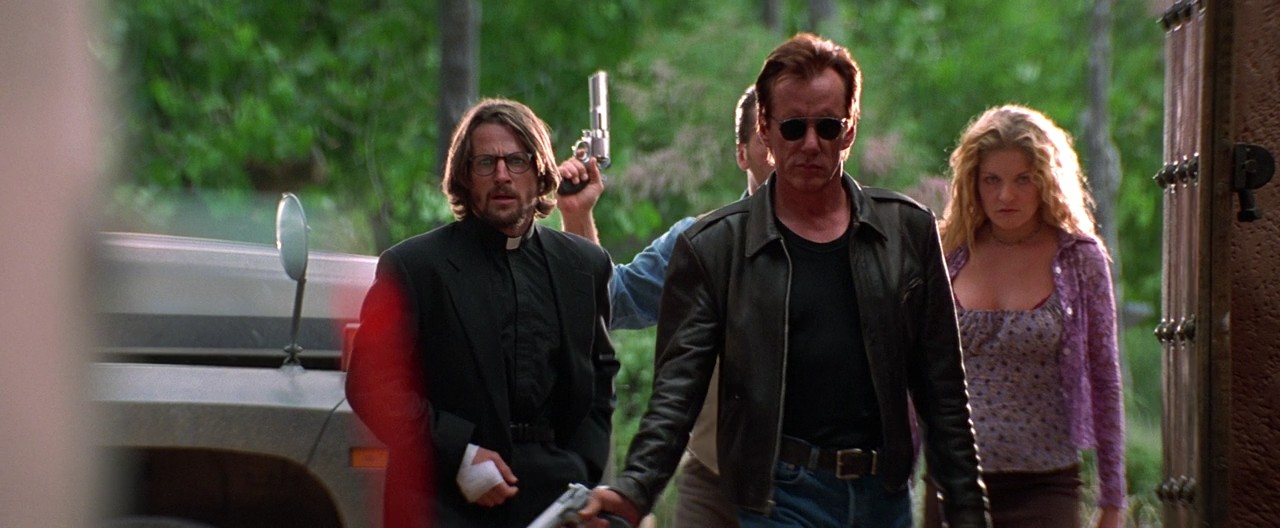
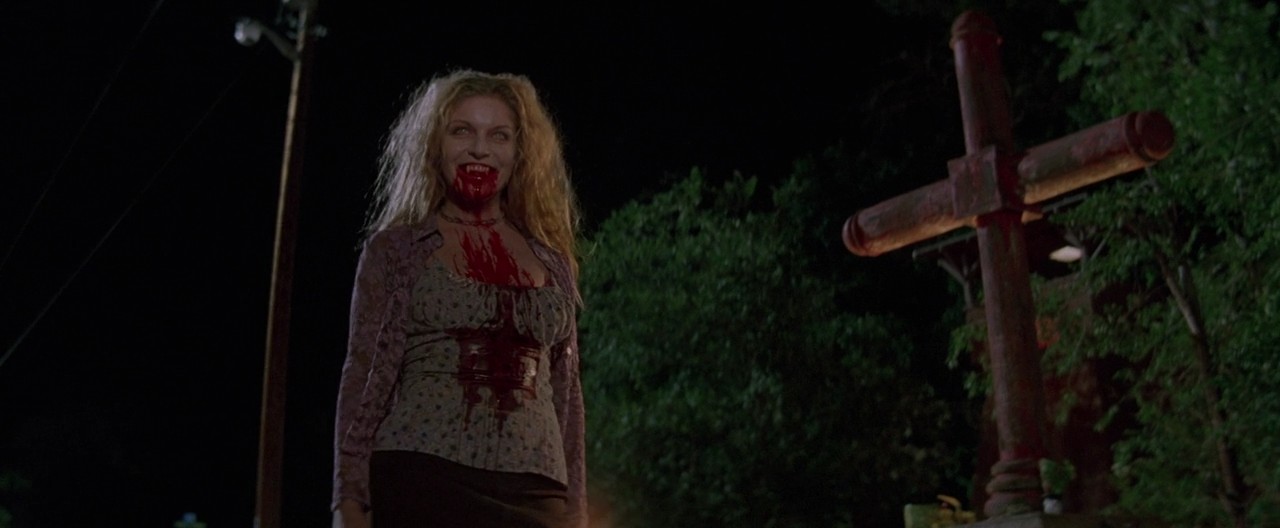
With his self-professed love for westerns and his reputation for making legendary horror films during the 1970s and 1980s, anticipation was high when it was announced that John Carpenter would be directing a western-flavored vampire film. Based loosely on John Steakley’s novel of the same name, Vampires (1998) tears down and stomps all over the brooding gothic bloodsucker cliché in order to portray them as vicious killers hunted by men who aren’t that much better. Even though the film takes place in a contemporary setting – the American southwest – it looks and feels like a western right down to James Woods as a no-nonsense gunslinger-type vampire hunter. Vampires turned out to be one of Carpenter’s most commercially successful films in years despite the mixed critical reaction. To be fair, the film has its flaws, as a lot of later of his work does, but Woods’ ferocious performance, unapologetic politically incorrectness and the use of vampirism to expose the hypocrisy of organized religion, makes Vampires an entertaining horror film.
The film starts off promisingly as Carpenter’s brooding score plays over a montage of desolate New Mexico landscapes before the camera swoops over an abandoned farmhouse. Observing it from afar is Jack Crow (James Woods) and his right-hand man Montoya (Daniel Baldwin). They assess the situation and deduce that the house is a nest for vampires. Carpenter’s heavy, twangy spaghetti western-flavored score kicks in as Jack and his group of badass vampire hunters move in. The director sets just the right no-nonsense tone as we see this heavily armed motley crew get ready to wipe out a nest of bloodsuckers like an exterminator would take out a hive of troublesome insects.
The build up and then actual extermination of said nest has a The Wild Bunch (1969) by way of Walter Hill vibe to it as Carpenter shows professional men of action plying their trade. This scene not only establishes Jack and his team’s tough guy credentials but also presents the vampires as very strong, almost feral creatures. There is nothing elegant or romantic about these bloodsuckers. More importantly, we also see the efficient way Team Crow works: one by one the vampires are dragged out into sunlight where they burst into flames. In the end, nine vamps, or goons, as they are referred to by Jack, are destroyed but they don’t find the master, the leader who always protects its nest.
Team Crow not only works hard but they also play hard, taking over a motel loaded up with alcohol and hookers. Yet the lack of a master still gnaws away at Jack, that is, until a beautiful prostitute named Katrina (Sheryl Lee) distracts him with an invitation for sex. While he gets her a beer she waits for him in his room. However, a master vampire is already waiting in what is probably the film’s most striking visual as the camera pans up to show the bloodsucker hovering at the height of the ceiling, unbeknownst to Katrina. He quickly seduces and bites her on the inner thigh in a very sexually-charged scene. The master then proceeds to crash the party and kill Jack’s entire team. His assault starts off promisingly as he brutally splits one hapless vampire hunter (Mark Boone Jr.) in half! But then Carpenter makes the unconventional choice of depicting the hotel room massacre through a series of dissolves, which robs the sequence of its visceral impact. We are supposed to be awed by this master’s power as he easily dispatches Team Crow but much more of an impact could have come from quick edits and hand-held camerawork to convey the chaos of the scene, not a montage of dissolves which lessens the shock of the vampire’s attack.
Fortunately, Carpenter recovers in the next scene as Jack and Montoya with Katrina in tow make a break for it in a pick-up truck. Despite flooring the accelerator, the master vampire amazingly catches up to them with scary ferocity. However, they manage to distract him, by shooting him in the face, long enough to get away. Jack decides to keep Katrina around because now that she’s been bitten by a master she will develop a telepathic link with him which will allow them to find him. More troubling, however, is that the vampire knew who Jack was. Someone must’ve set them up, but who?
Backed by the Vatican no less, Jack meets with his superior, Cardinal Alba (Maximilian Schell) who assigns him church archivist Father Adam Guiteau (Tim Guinee), a well-intentioned if not hopelessly inexperienced priest. Father Adam tells Jack that the master who wiped out Team Crow is named Valek (Thomas Ian Griffith), a 600-year-old vampire – the first and most powerful, accidentally created by the Catholic Church.
Jack grudgingly takes Father Adam along and quickly lays down the law with the young priest as he gives him a crash course in vampires: “First of all, they’re not romantic. It’s not like they’re a bunch of fags hopping around in rented formal wear and seducing everybody in sight with cheesy Euro-trash accents. Forget whatever you’ve seen in movies.” This doesn’t just apply to Father Adam but to the audience as well. Carpenter is saying that the bloodsuckers in Vampires aren’t going to be the angst-ridden vampires we see in films like Interview with a Vampire (1994) or Bram Stoker’s Dracula (1992). Woods delivers this monologue with the consummate skill of a pro but with the enthusiasm of an actor having fun with the role as he can’t resist adding a little zinger in the end which causes Father Adam to get flustered. Being a fan of both Woods and Carpenter for years, this is a dream pairing and it is great to see the actor playing a man of action. Woods is known for playing pragmatic protagonists and his portrayal of Jack Crow is a great addition to Carpenter’s roster of uncompromising heroes.
James Woods plays Jack Crow as a tough-as-nails vampire hunter not above beheading and burying his slaughtered teammates and the hookers that were unlucky enough to get caught in the crossfire. Carpenter uses the dissolve montage technique here again only much more effectively. And to show what a tough guy Jack truly is, he torches the motel for good measure and Woods looks cool as he fulfills and tried and true action film cliché of walking away from a gigantic explosion. Woods displays intense steely-eyed determination, especially after his team is killed as he makes it his mission to find out why it happened and track down the vampire responsible.
Carpenter also sets up the mercurial Howard Hawksian relationship between Jack and Montoya who doesn’t approve of his boss burying the team on his own. You can see Carpenter trying to set up the same kind volatile thing that we saw in previous male-dominated films like The Thing (1982) and They Live (1988) but he’s just not as successful here because in those films you really felt that those guys were a legitimate threat to each other. In Vampires, you never get the impression that Montoya would really truly challenge Jack and so their friction, at times, feels forced, or in one scene where they are actually about to get into it, Carpenter pulls things back. Daniel Baldwin brings a beefy physicality to the role of Montoya and acts a decent foil to Woods’ hard-nosed head vampire slayer. He has the look and demeanor of a classic Hollywood tough guy.
Tim Guinee is also well cast as the by-the-book Father Adam who attempts (not too successfully) to keep Jack in line. He has a good scene with Woods in a hotel bathroom where Jack forces Father Adam to reveal Valek’s true intentions. He is looking for an ancient relic known as the Cross of Berziers that will allow him, through a ritual, to live in the daylight. Carpenter is so good at filming scenes with expositional dialogue and this is because of good writing and the right actor saying the words (think of Donald Pleasence in Halloween or Dennis Dun in Big Trouble in Little China). Guinee does a wonderful job imparting this crucial information in an engaging way that takes us deeper into the film’s mythos.
Carpenter is less successful at depicting the relationship that develops between Montoya and Katrina. It starts off very antagonistic as he views her as nothing more than a tool, an end towards a means, but I just don’t buy how, over time, he begins to care for her. This aspect of the film is one of the things that makes it unapologetically politically incorrect. Katrina is thrown around by Jack and Montoya like a rag doll. When Montoya and her take refuge in a hotel, he bounds and gags her naked to a bed. I understand the restraints – so she doesn’t escape – but naked? I certainly don’t have a problem with Sheryl Lee’s gorgeous body but it doesn’t make much sense. The actress doesn’t have much to do initially as she gets slapped around by Woods and Baldwin, but once Katrina develops a telepathic link with Valek she becomes an important conduit of information. However, it’s not until the climactic showdown when Katrina finally becomes a vampire that Lee gets to cut loose and have some fun with the role.
Nine days after John Steakley submitted his book Vampire$ to his publisher, the film rights were sold in January 1990. Several directors were attached to the project over the years where it languished John Carpenter was approached. He had just finished making Escape from L.A. (1996) and was contemplating quitting the movie business for a while because “it stopped being fun.” However, Largo Entertainment offered him with the project. They had two screenplays, one written by Don Jakoby and the other by Dan Mazur. Carpenter took the book, the two scripts and read them. Afterwards, he thought, “it’s going to be set in the American Southwest and it’s a Western – Howard Hawks.” For years, he had thought about vampire films but never wanted to make one because he didn’t think there was a new way to do it: “They’re just such generic creatures, and they’ve been done so many times.” He was drawn to the western elements in Steakley’s novel: “I’ve always loved westerns and one of the reasons I’m doing this movie is that this is the closest I’ve come to being able to do a western.” He ended up combining the two scripts, utilizing elements from both, a little bit from the book, and some of his own stuff.
In casting Team Crow, producer Sandy King “tried to cast men who have a certain kind of charisma.” Actor James Woods concurred: “These are really dangerous vampires, and you like to know that they’re hiring real men for the parts – not the sort of ‘Hollywood’ version of men out hunting vampires.” He was drawn to the film because it gave him the opportunity to play an action hero. When the actor accepted the role, he told Carpenter, “I want to make this hero the baddest guy ever.” Woods has a reputation for being difficult to work with but Carpenter had an agreement with him that he could improvise a take if he did another one as it was written in the script. Carpenter had not seen Daniel Baldwin’s television work (he had been on Homicide: Life on the Street) but when they met, he “loved his whole nature and personality.” The director cast Sheryl Lee based on her work on Twin Peaks while Thomas Ian Griffith was chosen based on several action films he had done, including one called Excessive Force (1993).
The production shot on location in New Mexico over eight weeks and utilized authentic pueblos, a 200-year-old mission and a small western town where the filmmakers took over a square city block to build an old adobe prison. Production designer Tomas Walsh and his team built the interiors of the farmhouse, jail, hotel, motel, and the jail elevator shaft on soundstages at Garson Studios in Santa Fe.
Carpenter’s keen visual sense is still as strong as ever in Vampires. There’s a great shot of Valek and seven master vampires coming out of the ground, like zombies, at dusk. The lighting and Carpenter’s minimalist score create just the right atmosphere of dread. For this scene, the actors were buried under about a foot of sand and had to wait until they were called to rise from their graves. Stunt coordinator Jeff Imada devised a breathing system whereby each actor used a small box placed over their mouth to provide a short supply of air as they waited to be called to rise from the ground.
Not surprisingly, Vampires was not well-received by critics – par for the course for a Carpenter film. In his review for The New York Times, Lawrence Van Gelder wrote, “ridiculous without being awful enough to be hilarious, Vampires is chock full of exhausted lines.” USA Today gave the film one-and-a-half stars and wrote, “making a cowboy yarn should mean more than just setting the carnage amid adobe buildings.” In his review for the Washington Post, Michael O’Sullivan wrote, “the story itself can’t seem to decide whether it’s Rio Bravo or The Rocky Horror Picture Show.” Roger Ebert gave the film two out of four stars and wrote, “The movie is not scary, and the plot is just one gory showdown after another.” Sight and Sound magazine’s Kim Newman addressed the film’s treatment of women: “The treatment of women – we only see whores and vampires, and the ‘heroine’ gets to be both – is especially reprehensible.” Entertainment Weekly gave the film a “C-“ rating and Lisa Schwarzbaum wrote, “After a promising opening … this gummy mix of fake-Catholic mumbo jumbo and teeth-in-neck horror goes limp.” The lone dissenting voice came from the Globe and Mail’s Liam Lacey who gave it three out of four stars. He said it was, “deliciously twisted throughout, adding some fresh kinks to a well-worn old movie fetish.”
Vampires expertly cruises towards the inevitable showdown between Jack and Valek where we find out just how culpable and complicit the Church is in all of this. Towards the end it feels almost like Carpenter ran out of steam or money or both as the finale is strangely anticlimactic. He leaves the antagonistic relationship between Jack and Montoya tantalizingly unresolved in a tribute to Howard Hawks’ Red River (1948), begging for a sequel that was eventually made but without Carpenter’s direct involvement and with it the film’s stars as well. Vampires is certainly not without its flaws and not up to par with his classic films from the ‘70s and ‘80s, but the film does have its merits. Over the years I enjoy it more with every subsequent viewing.
Chrissinger, Craig W. “To Play and Slay.” Fangoria. November 1998.
The film starts off promisingly as Carpenter’s brooding score plays over a montage of desolate New Mexico landscapes before the camera swoops over an abandoned farmhouse. Observing it from afar is Jack Crow (James Woods) and his right-hand man Montoya (Daniel Baldwin). They assess the situation and deduce that the house is a nest for vampires. Carpenter’s heavy, twangy spaghetti western-flavored score kicks in as Jack and his group of badass vampire hunters move in. The director sets just the right no-nonsense tone as we see this heavily armed motley crew get ready to wipe out a nest of bloodsuckers like an exterminator would take out a hive of troublesome insects.
The build up and then actual extermination of said nest has a The Wild Bunch (1969) by way of Walter Hill vibe to it as Carpenter shows professional men of action plying their trade. This scene not only establishes Jack and his team’s tough guy credentials but also presents the vampires as very strong, almost feral creatures. There is nothing elegant or romantic about these bloodsuckers. More importantly, we also see the efficient way Team Crow works: one by one the vampires are dragged out into sunlight where they burst into flames. In the end, nine vamps, or goons, as they are referred to by Jack, are destroyed but they don’t find the master, the leader who always protects its nest.
Team Crow not only works hard but they also play hard, taking over a motel loaded up with alcohol and hookers. Yet the lack of a master still gnaws away at Jack, that is, until a beautiful prostitute named Katrina (Sheryl Lee) distracts him with an invitation for sex. While he gets her a beer she waits for him in his room. However, a master vampire is already waiting in what is probably the film’s most striking visual as the camera pans up to show the bloodsucker hovering at the height of the ceiling, unbeknownst to Katrina. He quickly seduces and bites her on the inner thigh in a very sexually-charged scene. The master then proceeds to crash the party and kill Jack’s entire team. His assault starts off promisingly as he brutally splits one hapless vampire hunter (Mark Boone Jr.) in half! But then Carpenter makes the unconventional choice of depicting the hotel room massacre through a series of dissolves, which robs the sequence of its visceral impact. We are supposed to be awed by this master’s power as he easily dispatches Team Crow but much more of an impact could have come from quick edits and hand-held camerawork to convey the chaos of the scene, not a montage of dissolves which lessens the shock of the vampire’s attack.
Backed by the Vatican no less, Jack meets with his superior, Cardinal Alba (Maximilian Schell) who assigns him church archivist Father Adam Guiteau (Tim Guinee), a well-intentioned if not hopelessly inexperienced priest. Father Adam tells Jack that the master who wiped out Team Crow is named Valek (Thomas Ian Griffith), a 600-year-old vampire – the first and most powerful, accidentally created by the Catholic Church.
Jack grudgingly takes Father Adam along and quickly lays down the law with the young priest as he gives him a crash course in vampires: “First of all, they’re not romantic. It’s not like they’re a bunch of fags hopping around in rented formal wear and seducing everybody in sight with cheesy Euro-trash accents. Forget whatever you’ve seen in movies.” This doesn’t just apply to Father Adam but to the audience as well. Carpenter is saying that the bloodsuckers in Vampires aren’t going to be the angst-ridden vampires we see in films like Interview with a Vampire (1994) or Bram Stoker’s Dracula (1992). Woods delivers this monologue with the consummate skill of a pro but with the enthusiasm of an actor having fun with the role as he can’t resist adding a little zinger in the end which causes Father Adam to get flustered. Being a fan of both Woods and Carpenter for years, this is a dream pairing and it is great to see the actor playing a man of action. Woods is known for playing pragmatic protagonists and his portrayal of Jack Crow is a great addition to Carpenter’s roster of uncompromising heroes.
James Woods plays Jack Crow as a tough-as-nails vampire hunter not above beheading and burying his slaughtered teammates and the hookers that were unlucky enough to get caught in the crossfire. Carpenter uses the dissolve montage technique here again only much more effectively. And to show what a tough guy Jack truly is, he torches the motel for good measure and Woods looks cool as he fulfills and tried and true action film cliché of walking away from a gigantic explosion. Woods displays intense steely-eyed determination, especially after his team is killed as he makes it his mission to find out why it happened and track down the vampire responsible.
Carpenter also sets up the mercurial Howard Hawksian relationship between Jack and Montoya who doesn’t approve of his boss burying the team on his own. You can see Carpenter trying to set up the same kind volatile thing that we saw in previous male-dominated films like The Thing (1982) and They Live (1988) but he’s just not as successful here because in those films you really felt that those guys were a legitimate threat to each other. In Vampires, you never get the impression that Montoya would really truly challenge Jack and so their friction, at times, feels forced, or in one scene where they are actually about to get into it, Carpenter pulls things back. Daniel Baldwin brings a beefy physicality to the role of Montoya and acts a decent foil to Woods’ hard-nosed head vampire slayer. He has the look and demeanor of a classic Hollywood tough guy.
Carpenter is less successful at depicting the relationship that develops between Montoya and Katrina. It starts off very antagonistic as he views her as nothing more than a tool, an end towards a means, but I just don’t buy how, over time, he begins to care for her. This aspect of the film is one of the things that makes it unapologetically politically incorrect. Katrina is thrown around by Jack and Montoya like a rag doll. When Montoya and her take refuge in a hotel, he bounds and gags her naked to a bed. I understand the restraints – so she doesn’t escape – but naked? I certainly don’t have a problem with Sheryl Lee’s gorgeous body but it doesn’t make much sense. The actress doesn’t have much to do initially as she gets slapped around by Woods and Baldwin, but once Katrina develops a telepathic link with Valek she becomes an important conduit of information. However, it’s not until the climactic showdown when Katrina finally becomes a vampire that Lee gets to cut loose and have some fun with the role.
Nine days after John Steakley submitted his book Vampire$ to his publisher, the film rights were sold in January 1990. Several directors were attached to the project over the years where it languished John Carpenter was approached. He had just finished making Escape from L.A. (1996) and was contemplating quitting the movie business for a while because “it stopped being fun.” However, Largo Entertainment offered him with the project. They had two screenplays, one written by Don Jakoby and the other by Dan Mazur. Carpenter took the book, the two scripts and read them. Afterwards, he thought, “it’s going to be set in the American Southwest and it’s a Western – Howard Hawks.” For years, he had thought about vampire films but never wanted to make one because he didn’t think there was a new way to do it: “They’re just such generic creatures, and they’ve been done so many times.” He was drawn to the western elements in Steakley’s novel: “I’ve always loved westerns and one of the reasons I’m doing this movie is that this is the closest I’ve come to being able to do a western.” He ended up combining the two scripts, utilizing elements from both, a little bit from the book, and some of his own stuff.
In casting Team Crow, producer Sandy King “tried to cast men who have a certain kind of charisma.” Actor James Woods concurred: “These are really dangerous vampires, and you like to know that they’re hiring real men for the parts – not the sort of ‘Hollywood’ version of men out hunting vampires.” He was drawn to the film because it gave him the opportunity to play an action hero. When the actor accepted the role, he told Carpenter, “I want to make this hero the baddest guy ever.” Woods has a reputation for being difficult to work with but Carpenter had an agreement with him that he could improvise a take if he did another one as it was written in the script. Carpenter had not seen Daniel Baldwin’s television work (he had been on Homicide: Life on the Street) but when they met, he “loved his whole nature and personality.” The director cast Sheryl Lee based on her work on Twin Peaks while Thomas Ian Griffith was chosen based on several action films he had done, including one called Excessive Force (1993).
The production shot on location in New Mexico over eight weeks and utilized authentic pueblos, a 200-year-old mission and a small western town where the filmmakers took over a square city block to build an old adobe prison. Production designer Tomas Walsh and his team built the interiors of the farmhouse, jail, hotel, motel, and the jail elevator shaft on soundstages at Garson Studios in Santa Fe.
Carpenter’s keen visual sense is still as strong as ever in Vampires. There’s a great shot of Valek and seven master vampires coming out of the ground, like zombies, at dusk. The lighting and Carpenter’s minimalist score create just the right atmosphere of dread. For this scene, the actors were buried under about a foot of sand and had to wait until they were called to rise from their graves. Stunt coordinator Jeff Imada devised a breathing system whereby each actor used a small box placed over their mouth to provide a short supply of air as they waited to be called to rise from the ground.
Not surprisingly, Vampires was not well-received by critics – par for the course for a Carpenter film. In his review for The New York Times, Lawrence Van Gelder wrote, “ridiculous without being awful enough to be hilarious, Vampires is chock full of exhausted lines.” USA Today gave the film one-and-a-half stars and wrote, “making a cowboy yarn should mean more than just setting the carnage amid adobe buildings.” In his review for the Washington Post, Michael O’Sullivan wrote, “the story itself can’t seem to decide whether it’s Rio Bravo or The Rocky Horror Picture Show.” Roger Ebert gave the film two out of four stars and wrote, “The movie is not scary, and the plot is just one gory showdown after another.” Sight and Sound magazine’s Kim Newman addressed the film’s treatment of women: “The treatment of women – we only see whores and vampires, and the ‘heroine’ gets to be both – is especially reprehensible.” Entertainment Weekly gave the film a “C-“ rating and Lisa Schwarzbaum wrote, “After a promising opening … this gummy mix of fake-Catholic mumbo jumbo and teeth-in-neck horror goes limp.” The lone dissenting voice came from the Globe and Mail’s Liam Lacey who gave it three out of four stars. He said it was, “deliciously twisted throughout, adding some fresh kinks to a well-worn old movie fetish.”
Vampires expertly cruises towards the inevitable showdown between Jack and Valek where we find out just how culpable and complicit the Church is in all of this. Towards the end it feels almost like Carpenter ran out of steam or money or both as the finale is strangely anticlimactic. He leaves the antagonistic relationship between Jack and Montoya tantalizingly unresolved in a tribute to Howard Hawks’ Red River (1948), begging for a sequel that was eventually made but without Carpenter’s direct involvement and with it the film’s stars as well. Vampires is certainly not without its flaws and not up to par with his classic films from the ‘70s and ‘80s, but the film does have its merits. Over the years I enjoy it more with every subsequent viewing.
SOURCES
Carver, Benedict & Dan
Cox. “Sony Has Stake in Vampires.” Variety. May 6, 1998.
Chrissinger, Craig W. “To Play and Slay.” Fangoria. November 1998.
Ferrante, Anthony C. “Carpenter
King.” Dreamwatch magazine. November 1997.
Hobson, Louis B. “Biting
into Love of Fear.” Calgary Sun. October 25, 1998.
Hunt, Dennis. “Carpenter
Goes for the Throat in Vampires.” San
Diego Union-Tribune. October 25, 1998.
Layton, Eric. “Prince of
Darkness.” Entertainment Today. October 30-November 5, 1998.
Romano, Will. “John
Carpenter – Modern Horror’s Renaissance Man.” Gallery magazine. March
1998.
Spelling, Ian. “James Wood
is a Vampire Slayer with a Bad Guy’s Heart.” Calgary-Herald. October 24,
1998.
Thonen, John. “James Woods
Stars as Vampire Hunter.” Cinefantastique. May 1998.
Vampires
Production Notes. Sony Pictures. 1998.
John Carpenter Week: Contributions - Friday, October 8
Here is the latest round of contributions from around the blogosphere. This page will be updated throughout the day so check back often.
"What is surprising is the level of earnest philosophizing that finds its way into the script. There's a heightened, poetic quality to much of the dialogue - which Wong and Pleasence naturally prove especially adept at delivering - and the younger characters in this film (who may be college students but are still unusually mature both in age and temperament by '80s horror standards) are not just tested physically by their ordeal, but as they fight on through day and night, their accepted concepts of good and evil, of science, and of reality itself, are all proven to be wrong in a darkly-told case of finding themselves 'Through the Looking-Glass.'"
- Hello Darkness, My Old Friend - Dinner with Max Jenke
"Though studios and producers have a lot of say in selecting the artwork for distribution and publicity, John Carpenter's films have received some stunning graphics to help promote his work through the decades. Here, then, are some of my favorites among the various poster artwork developed (by talented graphic designers) for the man's films."
- Works of Art - John Carpenter Film Posters - Lazy Thoughts from a Boomer
"So sorry, 14 year old me...you were probably never going to like PRINCE OF DARKNESS. 37 year old me, though? Loves it and (finally) recognizes it for what it is - one of Carpenter's boldest, far reaching ideas that manages to connect on a number of different levels, and does it on a fraction of the budget his previous film (the awesome for completely different reasons BIG TROUBLE IN LITTLE CHINA) had."
- Prince of Darkness - Celluloid Moon
"Outside of Grauman's Chinese theater, all was quiet. The stillness was quite remarkable given the sheer amount number of raucous Cap'n Ron fans in attendance, John Carpenter thought as he thrust his hands deeply in his pockets. He paced back and forth, quite aimlessly. He'd survived a sufficient number of premieres to shed any real, crippling anxieties, yet his legs were still restless. He turned toward the theater again. It was draped with four enormous one-sheets, symmetrically arranged."
- John Carpenter Fanfiction: CARPY & THE CAP'N- PART 3: Season of the Witch - Junta Juleil's Culture Shock
"The pre-CG fog, a dry ice aficionado’s paradise, which Cundy backlights to appropriate eerie results, is another impressive feat that for the, what, 8,781,051st time proves the superiority of practical effects over their digital counterparts. Unfortunately, I have not yet seen the 2005 remake for a direct comparison, but actually considering the word of mouth on that one, let’s make that fortunately. On the subject of effects, The Fog features early work from Rob Bottin, whose make-up on the pirate zombie/ghosts are shown just enough to startle, but always in shadows, allowing the viewer’s imagination to add specific details."
- The Fog - Colonel Mortimer Will Have His Revenge
"If one purpose of film is to transport the audience to a new world, one unimagined and unreal (but nonetheless believable), then Escape from New York succeeds wildly, landing us in a future that might have been, but thankfully wasn't. It's a great dark, dystopian fantasy."
- Cult Movie Review: Escape from New York - John Kenneth Muir's Reflections on Film/TV
"With a simple, ominous synthesizer score, Carpenter makes an empty beach in daytime into something genuinely eerie. A row of fog horns bellow with menace along the coastline and the protagonists are hip enough, for the most part, to know when to run rather than say stupid things like: "You stay here, I'm going to go check out that noise." They don't have to say anything about how this stuff 'can't be happening'-- in short, they're smart. They just accept the weirdness as a given, it was the 1970s after all, and Northern California has a spooky life all its own."
- "Are You Weird?" The Fog - Acidemic- Film
"But even this is surprisingly underwhelming. Aside from the suitably OTT finale; which features a bulldozer duel, and a sequence in which the Car drives around while on fire (something impossible not to make look badass and metal as hell) most of the crash sequences are strangely underwhelming. For a movie that features cars running into things the stalk sequences are surprisingly “low impact” (sorry I was possessed by the ghost of Peter Travers). Most of the time, people run screaming from the car, the car corners them, and we cut away. Death Proof this is not."
- 31 Days of Horror: Day 8: Christine - Things That Don't Suck
"What is surprising is the level of earnest philosophizing that finds its way into the script. There's a heightened, poetic quality to much of the dialogue - which Wong and Pleasence naturally prove especially adept at delivering - and the younger characters in this film (who may be college students but are still unusually mature both in age and temperament by '80s horror standards) are not just tested physically by their ordeal, but as they fight on through day and night, their accepted concepts of good and evil, of science, and of reality itself, are all proven to be wrong in a darkly-told case of finding themselves 'Through the Looking-Glass.'"
- Hello Darkness, My Old Friend - Dinner with Max Jenke
"Though studios and producers have a lot of say in selecting the artwork for distribution and publicity, John Carpenter's films have received some stunning graphics to help promote his work through the decades. Here, then, are some of my favorites among the various poster artwork developed (by talented graphic designers) for the man's films."
- Works of Art - John Carpenter Film Posters - Lazy Thoughts from a Boomer
"So sorry, 14 year old me...you were probably never going to like PRINCE OF DARKNESS. 37 year old me, though? Loves it and (finally) recognizes it for what it is - one of Carpenter's boldest, far reaching ideas that manages to connect on a number of different levels, and does it on a fraction of the budget his previous film (the awesome for completely different reasons BIG TROUBLE IN LITTLE CHINA) had."
- Prince of Darkness - Celluloid Moon
"Outside of Grauman's Chinese theater, all was quiet. The stillness was quite remarkable given the sheer amount number of raucous Cap'n Ron fans in attendance, John Carpenter thought as he thrust his hands deeply in his pockets. He paced back and forth, quite aimlessly. He'd survived a sufficient number of premieres to shed any real, crippling anxieties, yet his legs were still restless. He turned toward the theater again. It was draped with four enormous one-sheets, symmetrically arranged."
- John Carpenter Fanfiction: CARPY & THE CAP'N- PART 3: Season of the Witch - Junta Juleil's Culture Shock
"The pre-CG fog, a dry ice aficionado’s paradise, which Cundy backlights to appropriate eerie results, is another impressive feat that for the, what, 8,781,051st time proves the superiority of practical effects over their digital counterparts. Unfortunately, I have not yet seen the 2005 remake for a direct comparison, but actually considering the word of mouth on that one, let’s make that fortunately. On the subject of effects, The Fog features early work from Rob Bottin, whose make-up on the pirate zombie/ghosts are shown just enough to startle, but always in shadows, allowing the viewer’s imagination to add specific details."
- The Fog - Colonel Mortimer Will Have His Revenge
"If one purpose of film is to transport the audience to a new world, one unimagined and unreal (but nonetheless believable), then Escape from New York succeeds wildly, landing us in a future that might have been, but thankfully wasn't. It's a great dark, dystopian fantasy."
- Cult Movie Review: Escape from New York - John Kenneth Muir's Reflections on Film/TV
"With a simple, ominous synthesizer score, Carpenter makes an empty beach in daytime into something genuinely eerie. A row of fog horns bellow with menace along the coastline and the protagonists are hip enough, for the most part, to know when to run rather than say stupid things like: "You stay here, I'm going to go check out that noise." They don't have to say anything about how this stuff 'can't be happening'-- in short, they're smart. They just accept the weirdness as a given, it was the 1970s after all, and Northern California has a spooky life all its own."
- "Are You Weird?" The Fog - Acidemic- Film
"But even this is surprisingly underwhelming. Aside from the suitably OTT finale; which features a bulldozer duel, and a sequence in which the Car drives around while on fire (something impossible not to make look badass and metal as hell) most of the crash sequences are strangely underwhelming. For a movie that features cars running into things the stalk sequences are surprisingly “low impact” (sorry I was possessed by the ghost of Peter Travers). Most of the time, people run screaming from the car, the car corners them, and we cut away. Death Proof this is not."
- 31 Days of Horror: Day 8: Christine - Things That Don't Suck
Thursday, October 7, 2010
John Carpenter Week: Contributions - Thursday, October 7
Here is the latest round of contributions from around the blogosphere. This page will be updated throughout the day so check back often.
"No matter how justifiably praised Rob Bottin’s designs on the creature are I still don’t think you can quite over estimated just how unique they are. Probably the only creature design in the last thirty years not completely beholden to HR Giger’s work in Alien. There is such a malevolent logic to Bottin’s work, and such a life to its practical side, that when I say I consider it the apex of practical effects, I’m not exaggerating."
- 31 Days of Horror: Day 7: The Thing - Things That Don't Suck
"here is a tribute in stills to one of Carpenter's most legendary films (which I saw in the theaters at the ripe age of nine back in the day)."
- Operation Screenshot (Films of the Eighties): John Carpenter's Escape from New York - Moon in the Gutter
"Bridges creates an incredibly believable, alien creature that has taken up residence within the vessel of a human figure. His movements, facial ticks, twitches are like that of a squirrel or gecko to give the impression of something entirely alien. Bridges was nominated for an Academy Award for his performance for a reason, one of the best foreign, fish-out-of-water roles that I can recall."
- Starman - Musings of a Sci-Fi Fanatic
"That's Hawksian mythology clashing with a modern orientation, living through movies clashing with living through life. Carpenter is clear here; Hawks wins, and a serial killer, a cop and a sexy secretary can fight off hordes of homicidal teenagers. Four years later he would come to a very different conclusion, as Kehr pointed out, but here, just once, everything went right."
- Only Men Who Follow Orders - The Shock of Glimpsing
"No matter how justifiably praised Rob Bottin’s designs on the creature are I still don’t think you can quite over estimated just how unique they are. Probably the only creature design in the last thirty years not completely beholden to HR Giger’s work in Alien. There is such a malevolent logic to Bottin’s work, and such a life to its practical side, that when I say I consider it the apex of practical effects, I’m not exaggerating."
- 31 Days of Horror: Day 7: The Thing - Things That Don't Suck
"here is a tribute in stills to one of Carpenter's most legendary films (which I saw in the theaters at the ripe age of nine back in the day)."
- Operation Screenshot (Films of the Eighties): John Carpenter's Escape from New York - Moon in the Gutter
"Bridges creates an incredibly believable, alien creature that has taken up residence within the vessel of a human figure. His movements, facial ticks, twitches are like that of a squirrel or gecko to give the impression of something entirely alien. Bridges was nominated for an Academy Award for his performance for a reason, one of the best foreign, fish-out-of-water roles that I can recall."
- Starman - Musings of a Sci-Fi Fanatic
"That's Hawksian mythology clashing with a modern orientation, living through movies clashing with living through life. Carpenter is clear here; Hawks wins, and a serial killer, a cop and a sexy secretary can fight off hordes of homicidal teenagers. Four years later he would come to a very different conclusion, as Kehr pointed out, but here, just once, everything went right."
- Only Men Who Follow Orders - The Shock of Glimpsing
Wednesday, October 6, 2010
John Carpenter Week: Escape from New York: the Board Game?!
With the proliferation of the Internet and the rise in popularity of eBay, little curiosities like this are much more accessible. Back in the day, a board game was released for Escape from New York! Looking at the rules the gameplay seems pretty basic and I don't know how much fun it would be to play it but still, for any obsessive collector this is a must have item. Here is a description of the game followed by some pictures of it.
"'Snake, I thought you were dead!' This modest board game, based on the John Carpenter movie, casts each player as Snake Plissken, an ex-con sent on a rescue mission into a giant prison once known as New York City. Players begin with weapons and equipment cards used to help fight enemies and find clues. Cards can be lost in fights or gained at landmark spaces. Turn in matching clue cards at the corresponding location to rescue the president or his important tape. To escape, you still need to find a glider or a map to the mine fields.
Fans of the movie will enjoy the chance to encounter Slag, Brain, Cabbie, Maggie, the Duke, and Romero with the opporutnity to gain them as allies during the game. Players win by obtaining the Tape first and foremost, failing that - the President himself. The game is very faithful to the movie and players will find that they can mirror many scenes of the movie in the game."
"'Snake, I thought you were dead!' This modest board game, based on the John Carpenter movie, casts each player as Snake Plissken, an ex-con sent on a rescue mission into a giant prison once known as New York City. Players begin with weapons and equipment cards used to help fight enemies and find clues. Cards can be lost in fights or gained at landmark spaces. Turn in matching clue cards at the corresponding location to rescue the president or his important tape. To escape, you still need to find a glider or a map to the mine fields.
Fans of the movie will enjoy the chance to encounter Slag, Brain, Cabbie, Maggie, the Duke, and Romero with the opporutnity to gain them as allies during the game. Players win by obtaining the Tape first and foremost, failing that - the President himself. The game is very faithful to the movie and players will find that they can mirror many scenes of the movie in the game."
Subscribe to:
Posts (Atom)