J.J. Abrams picked the wrong
time to be a filmmaker. With his love of genres like horror and science
fiction, he would’ve thrived in the 1980s alongside the likes of Joe Dante,
John Carpenter, David Cronenberg, and Steven Spielberg. Instead, he emerged at
a time when Hollywood is only interested in remakes, reboots, sequels, and
building up existing franchises. As a result, his directorial debut was a
sequel (Mission: Impossible III) and
then he went on to reboot two existing franchises – Star Trek and Star Wars
with massive commercial success. He did manage, however, to make an original
film amidst all of this franchise work.
Super 8 (2011) saw Abrams team up with one of his cinematic heroes and
mentor, Spielberg. His presence, along with the film’s story about a group of
kids getting involved with an extra-terrestrial, led many to claim that the
former was merely paying homage to the latter. While this is true to a certain
degree, it is only a superficial reading of the film as Abrams draws on other cinematic
influences while also incorporating his own sensibilities to make a film that
is his personal and best one to date.
Set in an American steel town
called Lillian in 1979, we meet Joe Lamb (Joel Courtney), a young boy that has
just lost his mother in an accident at the plant, leaving him alone with his
father Jackson (Kyle Chandler), a police deputy who has no idea how to raise
his son. Cut to a few months later and school is out, which gives Joe plenty of
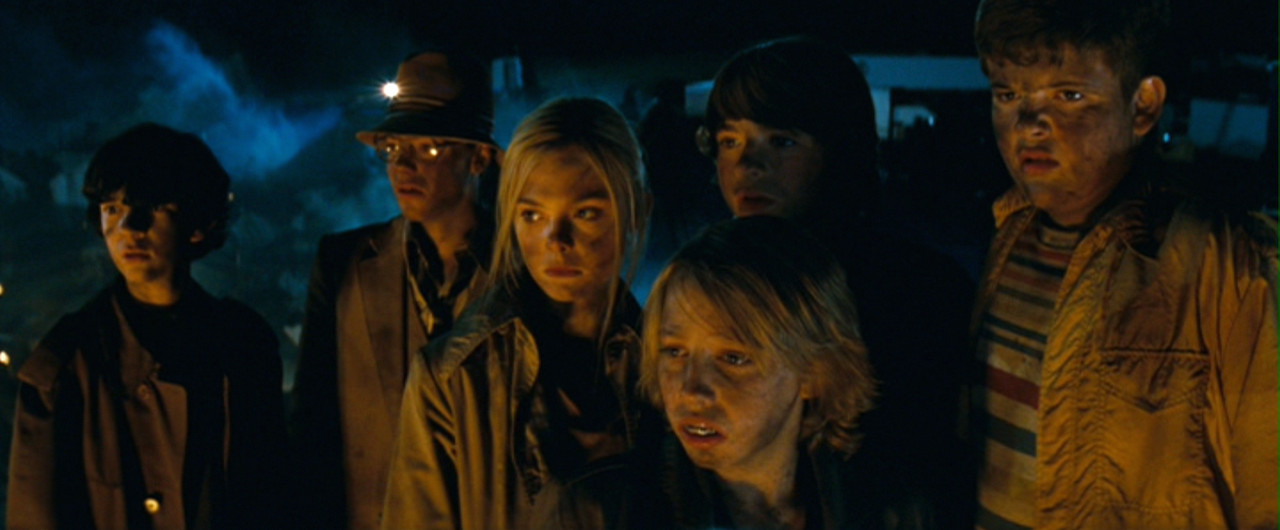
time to hang out with his friends, Charles (Riley Griffiths), Cary (Ryan Lee),
Preston (Zach Mills), and Martin (Gabriel Basso), as they work on a zombie
movie. Charles is their enthusiastic director that needs a female lead and asks
Alice (Elle Fanning), one of their classmates, and she agrees much to Joe’s
delight as he crushes on her from afar.

One night, they all sneak out
to shoot a scene at the local train station and, as luck would have it, a train
goes by while they’re filming. Charles decides to incorporate it into the scene
(“Production values!”), however, Joe notices a truck driving onto the tracks
and it crashes head on with the train, derailing it in an impressively
orchestrated scene that our heroes narrowly survive. Something emerges from the
wreckage, something not of this world, that goes on to terrorize the town,
crossing paths with Joe and his friends.
One of the most striking
things about Super 8 is Abrams’ deft
touch with the young actors in the cast. They have to carry most of the film as
they are in almost every scene and so casting is crucial. This is where the
film excels as evident early on when Joe applies makeup on Alice before she
films a scene for Charles’ movie at the train station. It is a marvel of
understated acting from these two young people. It isn’t what’s said during this
moment but what isn’t as they exchange looks – too shy to say what they’re
really thinking. Instead, Abrams has them convey it through the looks they
exchange.
After Alice mentions that her
dad (Ron Eldard) works at the mill, this triggers painful memories for Joe. He
wants to say something but it is still too painful and the look she gives him
suggests that she understands. Then, when Alice rehearses a scene with her
co-star Martin she delivers an emotional monologue, her expressive eyes on the
verge of tears. Alice captivates not just us but the other characters as well.
It is an incredible bit of acting from Elle Fanning and it announced her as a
young actress to watch. She has an enchanting screen presence and a knack for a
light touch as evident in the scene where Joe teaches her how to act like a
zombie. He’s clearly smitten with her and we are too.

Joel Courtney plays Joe as a
sensitive boy coping with the death of his mother whom he was very close to and
fills that void by hanging out with his friends and making a movie. Like
Fanning, Courtney has very expressive eyes and uses them effectively to convey
his character’s feelings. They also share the film’s strongest scenes together,
giving Super 8 its heart. Both
deliver emotional, heartfelt performances, playing damaged characters as a
result of absent mothers. Hers left an abusive situation, his died in an
accident that shouldn’t have happened. They elevate the film above its genre
trappings, giving us something to care about as we become invested in their
lives.
The always reliable Kyle
Chandler is well-cast as the savvy deputy that quickly figures out there’s more
to the train wreck than meets the eye and doesn’t buy the military’s official
stance. He’s also believable as a man too busy being a cop to be a proper
father until forced to when his wife dies. There is a Gary Cooper-esque quality
to the actor, playing a stand-up guy that gets tired of the military lying to
him and decides to do something about it. Chandler does an excellent job
conveying his character’s dilemma: he has the whole town looking to him to keep
them safe while also trying to be a good father to Joe. There’s a scene halfway
through the film where Jack forbids Joe to see Alice and the latter finally
confronts the former about how little he knows about him. Courtney is so good
in this scene as Joe’s hurt feelings come to the surface.
While Joe and his friends
live in Spielbergian suburbia complete with dysfunctional families and kids
that dream of becoming filmmakers, Alice lives on the wrong side of the tracks
with a screw-up for a father, which echoes the character of Darren in Joe
Dante’s Explorers (1985), who also
lives in the poor side of town with terrible parents. Abrams, however, has
different cultural touchstones than Spielberg as evident with a soundtrack that
features the likes of The Knack’s “My Sharona” and ELO’s “Don’t Bring Me Down.”
The kids are making a zombie movie, which is an obvious reference to George
Romero and Charles even has a poster of Dawn
of the Dead (1979) hanging up in his room as well as John Carpenter’s Halloween (1978).

The original idea for Super 8 was, according to Abrams, to
make a film about “that time in my life and my friends’ lives making these
Super 8 films.” To that end, he incorporated aspects of himself in the kids. He
made moves like Charles, but “felt like I experienced the world through the
eyes of Joe,” while he also took apart firecrackers and blew up models like
Cary. Over time, Abrams incorporated the monster movie genre into the film.
Growing up, he had friends whose parents were getting divorced and was afraid
that could happen to him. While working on Super
8 he came up with the idea of what if “the mother is suddenly gone and this
boy didn’t have the greatest relationship with his dad, what is that
relationship once she’s gone?”
While Abrams was clearly
inspired by Spielberg and his early Amblin films, he didn’t want to have any
overt references to his films even though posters for them would most
definitely be hanging on the kids’ walls. Instead, he made Charles a Carpenter
and Romero fan. The Carpenter influence extended to the structure of Super 8 itself as Abrams wanted to
combine “the sweetness of the autobiographical stuff with the horror of the
John Carpenter-type of conditional terror, the premise of something monstrous
out there.”
Super 8 is a coming-of-age story as the lives of Joe and his friends are
changed forever. They see not just their town, but the world in a different
light as their lives are put in real danger and are forced to grow up. A father
and son relationship lies at the heart of the film, surrounded by genre
trappings. Much like he did with Cloverfield
(2008), Abrams wisely waits as long as he can to reveal the alien, building
suspense by expertly staging a few attacks on random people by an unseen force.
The last third of the film delivers the kind of expectations that are intrinsic
with this kind of big budget genre film as the alien presence becomes more
overt.

Where Super 8 falls apart somewhat is the last third as Abrams relies on
the traditional tropes of the blockbuster action movie as Joe and his friends
engage the alien. It is here where Abrams tries to fuse Cloverfield with Close Encounters
of the Third Kind (1977) and stumbles. For most of the film we are meant to
fear the alien as its motives are unclear. By the end of the film it is
revealed that the alien had been captured by the United States government and
tortured for years, which certainly justifies the swath of destruction it
leaves in its wake.
The moment, however, where
Joe gives up his mother’s pendant so that the alien can complete its spacecraft
and go home rings false. Through the whole film Abrams makes a point of showing
how important this object is to Joe. It is the last, significant tangible link
to his mother. Why he would give that up doesn’t make sense. Is Abrams trying
to tell us that symbolically it means that Joe is finally letting go of the
hurt and pain he feels for the loss of his mother? It hasn’t been that long and
why does the alien need that particular piece of metal? There is plenty around
for it to use. Abrams should have removed that bit and instead played up the
fact that Joe and Alice finally connect with their respective fathers who, in
turn, have settled their differences between each other. Instead, we have a
decidedly bittersweet ending, which is more Abrams than Spielberg.
The commercial and critical
success of Super 8 should have paved
the way for more original films from Abrams but instead he went back to Star Trek and has directed two Star Wars movies, which should give him
the kind of creative control that Christopher Nolan enjoys. Perhaps Abrams
simply hasn’t found something personal enough to motivate him into making
another original film, or perhaps the flaws in Super 8 demonstrated that he was still learning, trying to figure
things out and going back to franchise movie work allowed him to not only
increase his industry clout but also gave him a chance to practice with the big
toys and budgets that studios provide while working out things for when he
decides to do something original.

SOURCES
Billington, Alex. “Interview:
Bad Robot’s J.J. Abrams – Writer and Director of Super 8.” Firstshowing.net. June 10, 2011.
Knolle, Sharon “J.J. Abrams
on Why Super 8 Is His Most Personal
Project Yet.” Moviefone. June 9, 2011.
Ordana, Michael. “J.J. Abrams
Combines Childhood’s Wonders, Horrors.” San Francisco Chronicle. June 3,
2011.
Sciretta, Peter. “JJ Abrams
Talks Super 8, Bad Robot, Lens
Flares, LOST, Spielberg and the
Mystery Box.” /Film. June 10, 2011.


