After the critical and
commercial success of M*A*S*H (1970),
Robert Altman used the buzz garnered from it to push an experimental film
called Brewster McCloud (1970)
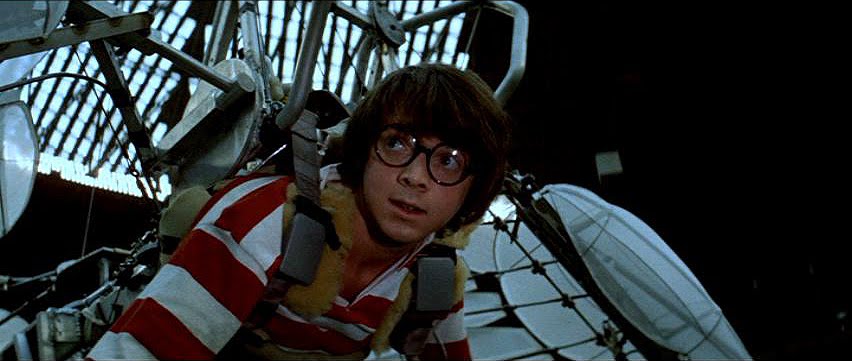
through the studio system. It is ostensibly about a young man constructing a
pair of wings so he can fly while also weaving in a storyline about a series of
murders involving victims that have been strangled to death. It is, at times, a
film about dreamers that also slyly references the films of Federico Fellini, Bullitt (1968) and The Wizard of Oz (1939). The end result is a fiercely idiosyncratic
film even by Altman’s standards, which may explain why it is not as widely
championed like some of his other work.
Right from the get-go Altman
eschews a traditional opening by having a lecturer (Rene Auberjonois) talking
over the MGM logo as he addresses the audience about the relationships between
birds and man’s desire to fly. Then, the opening credits play over a woman
(Margaret Hamilton) singing the “Star Spangled-Banner” off-key in the Houston
Astrodome with a marching band. She stops and chastises them for being in the
wrong key. She makes them start over and so do the opening credits.
The reclusive Brewster
McCloud (Bud Cort) lives under the stadium working on a pair of wings in the
hopes that someday he may be able to take flight like a bird. During the day,
he drives a cranky, wheelchair-bound old man (Stacy Keach), taking him on
errands where he hurls verbal abuse at everyone he encounters. Meanwhile, Houston
is plagued by a series of murders with each one of the victims strangled to
death. Prominent citizen Haskell Weeks (William Windom) uses his clout to get
the local police to bring in “legendary super cop” Frank Shaft (Michael Murphy)
from San Francisco to investigate.

Brewster crosses paths and
befriends Suzanne (Shelley Duvall), a Superdome tour guide, while trying to
steal her car, which she doesn’t seem to concern her all that much. Watching
protectively over Brewster is Louise (Sally Kellerman), a beautiful and
mysterious guardian angel of sorts that takes care of him.
Having given Bud Cort is
feature film debut in M*A*S*H, Altman
cast this distinctive actor to play the enigmatic titular character and he
makes his way through the film with his own agenda while only briefly
interacting with others. Cort’s soft-spoken nature contrasts nicely with
Shelley Duvall’s chirpy optimism. They both have unique acting styles and
thrived under Altman’s direction. It is a lot of fun to watch their quirky
acting styles bounce off each other, like the scene where Suzanne recounts how
she acquired her muscle car. Duvall, with her large than life eyelashes, is
absolutely adorable, especially when Suzanne good-naturedly tries to seduce
Brewster in a sweet scene.
Decked out in a turtleneck
sweater, slacks and shoulder holster, Shaft cheekily resembles Steve McQueen’s
titular character from Bullitt with a
voiceover reporter narrating solemnly, “If keeping your cool and being totally
composed makes for a better detective then this Shaft is one whale of a cop.”
There’s something amusing about seeing Murphy – normally known for playing
square, authoritarian types – playing a cool, no-nonsense cop. It helps that
he’s playing a subtle parody of Bullitt but does so with a straight face right
down to his all-business attitude as he tells the beat cop (John Schuck)
assigned to him, “Now there’s a killer loose in the city, Johnson. Are we gonna
get him or are we going to go downtown and play politics?”

In typical Altman fashion,
he juggles a large cast of characters and multiple storylines, effortlessly
moving them in and out of the foreground without ever losing sight that the
film is ultimately about Brewster and his desire to fly like a bird. This is
captured beautifully in a sequence that sees him dreaming of flying above the
clouds to the soulful song “White Feather Wings” sung by Merry Clayton.
The screenplay, originally
entitled, Brewster McCloud’s (Sexy)
Flying Machine, had been written by Doran William Cannon (who had written
the script for Otto Preminger’s Skidoo)
in 1967 and it was, according to its author, “probably the most famous
unproduced script in the country.” It had also been optioned several times by
Hollywood studios but never filmed because Cannon refused to sell the rights
unless he was allowed to also direct.
Music producer Lou Adler
wanted to start making movies and optioned Cannon’s script – who must’ve had a
change of heart about directing – offering it to Robert Altman after M*A*S*H. The director moved fast, nixing
MGM’s desire to shoot in New York, where the script had originally set the
story in the TWA Terminal at JFK airport, for Houston, which he found more
stimulating. He did, however, hit some roadblocks along the way – firing
then-up-and-coming cinematographer Jordan Cronenweth for relative unknown Lamar Boren, and, during filming, being hospitalized with a hernia.

Altman also rewrote the
script, revising it heavily without notifying Cannon, making it “very farcical
and broad.” According to Adler, the original script was “much more of a
sexcapade” with Brewster having sex with each of the three women in the film.
Altman changed it so that Brewster only had sex with Shelley Duvall’s
character. The role of Frank Shaft was created entirely by Altman for Michael
Murphy simply because he was one of the director’s favorite actors. Altman also
downplayed the violence so that all of the murders occurred off-screen.
Fresh from making M*A*S*H, Altman cast several actors from
that production, including Bud Cort, Rene Auberjonois, and John Schuck. Cort
had auditioned for and didn’t get a role in a play in New York and was thinking
of doing some episodic television. Altman told him not to because he was a
movie star. Cort remembers the filmmaker telling about his role in their next
film together: “You’re going to play a mass murderer and it’s going to be a
whole reaction to how sick society is right now.” Altman also cast new, raw
talent. Assistant director Tommy Thompson and fellow crew member Brian McKay
met Shelley Duvall at a party when she tried to sell them her boyfriend’s
paintings and told Altman that he had to meet her. He thought she was putting
on an act but when he did a screen-test with her, realized that she was an
“untrained, truthful person. She was very raw in Brewster but quite magic.” Three days after he cast her, principal
photography began.
Filming Brewster McCloud was the typical Altman experience – location
shooting away from the studio, watching dailies at the end of the day with cast
and crew, and parties with lots of marijuana, hashish, cocaine, and opium.
Adler remembers that Altman “would stand up and make a speech, pretty much the
same speech every night. ‘No one in this room knows what this movie is about
except me.’ Then he would retire to his room and write the next day’s pages.”

In classic Altman fashion,
entire scenes were created and improvised on the spot when something struck his
fancy or he became fascinated by some of the Astrodome’s architecture. Other
scenes were written by Altman at night and then presented to the actors the
next day. For example, Shaft’s sudden suicide came up at dinner between the
director and Murphy the night before. Cannon even showed up to the set for a
visit and was given an icy reception. He was bitter at not having been
consulted on the script changes while Altman said it was “a piece of crap.”
That being said, Cannon had a clause in his contract that guaranteed sole
screenwriting credit despite all the work Altman had done.
Not surprisingly, MGM did not
understand Brewster McCloud and the
new studio head did not like it or Altman (the feeling was mutual). They gave
the film a perfunctory release and yanked it from theaters after it grossed
less than $1 million prompting Adler to describe studio executives as “a bunch
of bag salesmen who’ve been put in their jobs like a bunch of pawns.” Murphy
said of the film: “I think it was kind of a look at the insanity of all that
period in time, you know? Guys were really breaking loose and doing their
‘dream films’ and doing nutty stuff.”
To further illustrate how
little the studio cared about the film, the premiere at the Astrodome (attended
by a whopping 24,000 people) was plagued by technical problems regarding the
sound so that, as one critic commented, it was “a bit like viewing a movie in
the world’s largest drive-in while locked out of your car.”

Brewster McCloud received mixed to
negative reviews although Roger Ebert gave it
three-and-a-half out of four stars and wrote, “One of the things about MASH was that people wanted to see it a
second time. That’s typical of the recent Robert Altman style, Brewster McCloud is just as densely
packed with words and action, and you keep thinking you’re missing things. You
probably are. It’s that quality that’s so attractive about these two Altman
films.” In his review for The New York
Times, Vincent Canby felt that the film attempted, “to be a kind of
all-American, slapstick Orpheus Ascending, a timeless myth about innocence and
corruption told in the sort of outrageous and vulgar terms that Brian De Palma
and Robert Downey do much better.”
Altman twists genre
conventions on their head, bending them to conform to his vision and so the
strangulation murders are preceded by bird shit dropping on the victim’s face
moments before they are killed. The crime scenes are chaos as a veteran police
detective (G. Wood) clashes with Shaft and his superiors who all appear to have
no idea who is committing these murders. The irony is that despite his
reputation for being a skilled cop Shaft is ultimately ineffectual in catching
the killer.
Even the climactic car chase
– a staple of the thriller genre – is given an Altman twist as Suzanne leads
the cops on a wild chase with some wonderful reaction shots of her clearly
enjoying the evasive moves she pulls to foil her pursuers with Louise providing
well-timed interventions along the way. At one point, Altman even employs
easy-listening music during the chase. The filmmaker constantly subverts our
expectations at every turn. Brewster isn’t the innocent dreamer he was first
made out to be and it brings into question his desire to fly. Was it genuine or
an act of hubris?

Brewster McCloud is not an easy film to love. It defies traditional narrative
storytelling by irreverent thumbing its nose at the conventions. The
protagonist is an enigma that we never get to know or identify with and this is
all the way Altman wants it. It’s a film that I admire but don’t watch all that
much, which is a matter of personal taste as opposed to one of quality. I
prefer the laid-back, easygoing charms of films like The Long Goodbye (1973) and California
Split (1974). That’s the beauty of Altman’s films – you can approach them
on your own terms and I’m sure he wouldn’t have wanted it any other way.
SOURCES
McGilligan, Patrick. Robert Altman: Jumping Off the Cliff.
St. Martin’s Press. 1989.
Reed, Rex. “Houston’s
Not-So-Gala Premiere.” Chicago Tribune. December 20, 1970.
Thomson, David. Editor. Altman on Altman. Faber & Faber.
2005.
Zuckoff, Mitchell. Robert Altman: The Oral Biography.
Alfred A. Knopf. 2009.


