"...the main purpose of criticism...is not to make its readers agree, nice as that is, but to make them, by whatever orthodox or unorthodox method, think." - John Simon

"The great enemy of clear language is insincerity." - George Orwell
Showing posts with label Matt Damon. Show all posts

Friday, November 25, 2016

Jason Bourne

After the critical and commercial success of The Bourne Ultimatum (2007), its star, Matt Damon, and its director, Paul Greengrass, declined to make a follow-up, feeling that they had taken the character of a psychogenic amnesiac CIA assassin Jason Bourne as far as he could go. To be fair, the film felt like a fitting conclusion but Hollywood studios are not known to stop cranking out installments for lucrative franchises and Universal Pictures gave the series’ screenwriter Tony Gilroy a shot at writing and directing his own entry in the series. The Bourne Legacy (2012) saw Jeremy Renner take over the lead as another CIA operative on the run from the United States government when his black ops program is shutdown. The film performed well enough but the general feeling was that most people wanted to see Damon reprise his role as Bourne.

Enough time had finally passed for Damon and Greengrass and they came up with a new Jason Bourne story, inspired partly by the effects of Edward Snowden’s leaking of classified information from the National Security Agency on espionage and surveillance all over the world. How would it affect the Bourne world and bring him out of self-imposed exile? Not surprisingly, the unimaginatively titled Jason Bourne (2016) was a financial success as audiences were more than happy to see the actor reprise one of his most beloved characters while leaving many critics underwhelmed.

Still haunted by all the people he killed for the CIA, Bourne (Damon) is living off the grid in Greece as a bare-knuckle brawler. Meanwhile, ex-CIA operative Nicky Parsons (Julia Stiles) is in Iceland hacking classified agency databases for more information on Bourne before he had his brains scrambled by Operation Treadstone. This gets the attention of CIA Cyber Ops chief Heather Lee (Alicia Vikander) and knowledge of the breach is quickly reported to the current director Robert Dewey (Tommy Lee Jones).

The rather ambitious Lee pushes to be put in charge of the operation to find and bring in Nicky and, if possible, Bourne while Dewey hedges his bets and brings in the Asset (Vincent Cassel), an Operation Blackbriar assassin, to take out Bourne. The rest of the film plays out in tried and true Bourne fashion with him on the run from the CIA, which takes him to various places all over the world, trying to piece together more of his past until the inevitable confrontation with a rival assassin.

Bourne and Nicky’s initial meet and greet is amidst turbulent demonstrations and civil unrest on the streets of Athens. Greengrass does an excellent job orchestrating and immersing us in this chaos as we see Bourne use it to his advantage. The director ratchets up the tension as CIA operatives close in on Bourne and Nicky, demonstrating why he’s still one of the best action directors around.

The Bourne films have always had memorable fight scenes and this one is no different as Bourne and the Asset have a bloody, knock down, drag-out fight that is a more stripped down encounter then in previous films. Jason Bourne also has a memorable chase sequence as Bourne pursues the Asset, driving an armored SWAT truck, through the streets of Las Vegas in an exciting, intense sequence.

For most of the film, Matt Damon plays the Bourne we are familiar with from the previous installments but this is bookended by the introductory scene, which gives us a self-destructive man with no direction, and a climactic scene towards the end where he confronts Dewey and you can see Bourne trying to figure out who he is and what he wants to do next. The most frustrating aspect of Jason Bourne is that Damon and Greengrass don’t delve into Bourne’s questioning side enough as they fall back on the requisite action set pieces of mayhem that is the staple of the franchise.

Tommy Lee Jones brings his trademark, no-nonsense gruffness as he plays yet another government bureaucrat frustrated by Bourne’s actions. Alicia Vikander plays a thankless role that requires very little emotion on her part, as her icy operative remains enigmatic and morally elusive. The always-reliable Vincent Cassel plays the first of Bourne’s rival assassins to have significant screen-time and something of a backstory that gives the character a personal stake in his mission to stop Bourne.

After The Bourne Ultimatum, Paul Greengrass and Matt Damon were done with the franchise with the former saying, “I discovered in my heart I didn’t have another one in me,” and the latter quoted as saying, “For me, I kind of feel the story that we set out to tell has now been told.” Over the years, the latter, motivated by fans of the films, felt it was time to revisit the character. After the commercial and critical success of Captain Phillips (2013), Greengrass was in no hurry to revisit the franchise.

In 2013, Universal Pictures executives met with Damon in the hopes that the actor would be open to another Bourne film. He was, but what clinched it was while making Elysium (2013) in Vancouver, he accidentally came across the production offices for The Bourne Legacy: “I thought I was completely at peace with the three movies…but when I saw their production offices, it hurt me in a way that surprised me.”

Damon met with Greengrass in Los Angeles and told him how much people wanted to see another Bourne film. This got the director thinking about ideas for a new one along with his longtime creative partner (and editor on several of his films) Christopher Rouse who said, “At heart, Bourne is a patriot who’s been betrayed by the institutions he believed in. Those are very identifiable feelings for people today.”

Greengrass wanted to make the new film relevant to what was going on in the world – like the others in the series – and began writing the screenplay at the end of 2014 with Rouse and input from Damon, incorporating narrative threads from Ultimatum with aspects of online privacy, including a Julian Assange-type character and a Facebook-type company set in a post-Edward Snowden world. Unlike the previous Bourne films, Greengrass had worked on they had a completed script before principal photography began.

The tricky thing about sequels is that if you deviate too far from what made the previous film(s) successful you risk alienating fans who want more of what they loved. If you stick too close to the formula you’re criticized for playing it safe. Either way, filmmakers are screwed but the best sequels build on what came before in a meaningful and satisfying way. Jason Bourne is somewhat successful in doing so.

What separates Jason Bourne from the other films in the series and makes it relevant for what is happening in the world today? For starters, cyber warfare features prominently with Heather Lee representing a new kind of foot soldier – the hacker that knows how to manipulate data in new ways that makes it tougher for people like Bourne to evade detection and achieve his goals. Social media is featured prominently as Aaron Kalloor (Riz Ahmed), the CEO and founder of Deep Dream, a Google+-type website, is in bed with the CIA, which raises all sorts of questions about privacy on the Internet. If electronic data exists online it is accessible to anyone with the skills to retrieve it.

I enjoyed slipping back into the familiar rhythms of Greengrass’ Bourne films – the rapid-fire editing, the kinetic, hand-held camerawork, and the intriguing critique of CIA surveillance techniques masquerading as an action thriller. It is this finger on the pulse of contemporary geopolitics and how it intersects with cutting edge technology that has made the Bourne films distinctive from the James Bond and Mission: Impossible franchises. I also like the personal nature of the Bourne films. He isn’t interested in saving the world from some power-hungry villain. He just wants to find out more about who he is and why he became a CIA operative, and if he puts a spanner in the works of a few of their programs then so be it.

Watching Jason Bourne makes The Bourne Legacy that much more of an unnecessary installment within the franchise both tonally and visually. Despite being written by Gilroy it never felt like it existed in the Bourne world despite the connective narrative tissue. It didn’t feel like a Bourne film but rather a simulacrum of one. Jason Bourne takes us back to this world in a way that is entertaining and is relevant to what is happening in the world today.


SOURCES

Anthony, Andrew. “Matt Damon and Paul Greengrass: ‘We’ll never say never again’” The Guardian. July 17, 2016.

Leigh, Danny. “Paul Greengrass on Matt Damon and Making it Big in Hollywood.” FT Magazine. July 21, 2016.


Manly, Lorne. “Why Matt Damon and Paul Greengrass Couldn’t Quit Jason Bourne.” The New York Times. July 12, 2016.

Friday, September 25, 2015

The Talented Mr. Ripley

By J.D. Lafrance and Lady Fitzsimmons

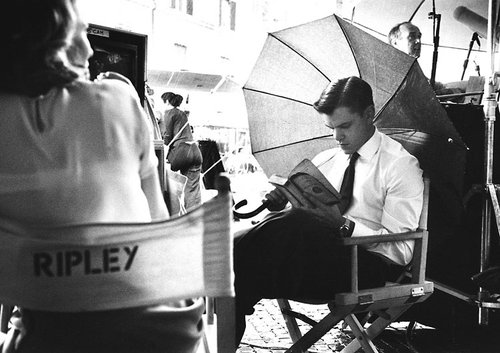
Fresh from the commercial and critical success of phenom The English Patient (1996), filmmaker Anthony Minghella dove back into the literary world for his next film – The Talented Mr. Ripley (1999), based on the 1955 Patricia Highsmith novel of the same name. Adapted previously as Purple Noon (1960) starring Alain Delon, Minghella cast Matt Damon, still hot property from Good Will Hunting (1997) in the title role, and surrounded him with a new class of actors in ascension: Jude Law, Gwyneth Paltrow, Cate Blanchett, and Philip Seymour Hoffman. The end result was a lavish adaptation full of rich period detail and a fascinatingly complex performance by Damon as a social-climbing sociopath.

“If I could just go back. If I could rub everything out. Starting with myself. Starting with borrowing a jacket.”

Thus begins our story with voiceover narration by protagonist Tom Ripley (Damon). We meet him at a party hosted by the Greenleaf family in 1950s New York City, where Tom makes quite the impression on wealthy shipbuilder Herbert Greenleaf (James Rebhorn).  After the soiree, Tom shed ‘his’ Princeton blazer, revealing his for con of the film – posting as a Tiger for someone else. It pays off; the next day Herbert asks him to go to Italy and persuade his son Dickie (Law) to come back home for $1,000, which, by 1955 standards, is a tidy sum. Herbert is not happy with his son’s behavior overseas – “That’s my son’s talent,” he tells Tom, “spending his allowance.”

Tom, whose current employ is playing a piano at a cocktail bar, jumps at the chance to make some serious money – and rub elbows with the upper crust in Europe. Ever the astute social chameleon, we see Tom studying up on popular jazz songs and artists because it is a passion of Dickie’s and, more importantly, a way to immediately ingratiate himself. With one foot barely off the boat, Tom is already changing identities, telling fellow traveler Meredith Logue (Blanchett) that he is Dickie Greenleaf.


Tom orchestrates a chance encounter between himself, Dickie, and his girlfriend Marge Sherwood (Paltrow) on the beach in an amusing scene: Tom is all kinds of awkward as he sports lime green bathing trunks, which “compliment” his pasty white skin. I love how Dickie points this out (“Have you ever seen someone so white? Grey actually.”) and how quickly Tom makes fun of himself (“It’s just an undercoat.”). Tom is intensely serious in his plan to take on the character of a student on holiday, the way a rich playboy takes on a lover.

The seduction begins.

Tom impresses Dickie with an uncanny impression of his father and a mutual love of jazz. They become fast friends and are soon singing jazz in broken Italian at a hipster nightclub that Minghella captures in all of its dark, sweaty glory, masterfully capturing the energy of the moment. Tom agrees to help Dickie perpetuate a ruse – they will string his father along so that Dickie can continue to spend his money.

Tom is a student of human behavior, observing people for only a short while before being able to do an impression of them. For example, he studies the way Dickie signs his name and files it away for later use. Minghella shows Tom rehearsing in front of a mirror like an actor (where he creepily imitates a conversation between Marge and Dickie with eerie exactness). Like many great thespians, Tom is a blank slate, which allows him to become fully immersed in the “roles” he plays. During lunch he reveals his talents to Dickie and Marge – “Forging signatures, telling lies, impersonating practically anybody” – and his “purpose” for being there. Every single movement – we realize now – has, from the beginning, been surgically planned and impeccably executed, a black widow weaving the web or perhaps, more appropriately, the funnel spider, launching the fatal attack from a place unexpected, at a time unthinkable.


The web is completed a mere 24 minutes and 30 seconds into the film as we watch the spider plot his “attack.” This section, this leg of Tom’s trip, is the film’s transition to a psycho-drama; Tom is becoming Dickie, and Dickie is coming closer to the edge of the cliff. It’s also worth mentioning the subtle homoerotic nuances of Damon’s facial movements, the lingering looks fostered by the sensuality.

Matt Damon does a fantastic job of presenting Tom as a socially awkward nerd, disarming Dickie and Marge who “realize” that he’s not threat to them. This allows them to act both good-naturedly and condescending towards him – they don’t see him as an equal. Dickie and Marge are all about social niceties; these will end up being used against them. Damon is all tentative gestures and aw shucks self-deprecation…but in private, he offers glimmers of Tom’s true self – something that is gradually revealed over the course of The Talented Mr. Ripley. Taking this role was a shrewd move on Damon’s part. He capitalized on the buzz from Good Will Hunting by then taking a chance on a different and difficult role instead of taking the easy route, and doing a romantic comedy or something safely within his wheelhouse.

The mesmirizingly handsome Jude Law is well-cast as spoiled playboy Dickie, a young man that spends most of his time traveling all over Italy, spending his father’s money. Dickie is the kind of person who’s into whatever is fashionable at the moment, like Charlie Parker-era jazz, and befriends people like Tom until he loses interest in/becomes bored with them. He’s a flake that thinks loving such things makes him a deep person and Law conveys this extraordinarily well. Dickie’s short attention span and spoiled-brat attitude of instant gratification anticipates the prevailing attitude of what society has become today. Marge sums him up best when she confides in Tom:


“The thing with Dickie … It is like the sun shines on you and it’s glorious … and then he forgets you and it’s very very cold,” to which he replies, “…so I’m learning…” She says, “When you have his attention you feel like the only person in the world. That’s why everybody loves him.”

Gwyneth Paltrow plays the perfect WASP socialite, tired of the “whole Park Avenue crowd,” and fled to Paris to work on her novel. She has problems of the idle rich and initially appears to be Dickie’s superficial equal. It’s Marge, however, that is the first person to suspect Tom’s real agenda but because she’s a woman – and it’s the ‘50s – she’s dismissed as being distraught. Fresh from the phenomenal success of Shakespeare in Love (1998), Paltrow was at the height of her mainstream popularity; getting her was a real casting coup for Minghella. She definitely looks the part and conveys an air of entitlement. Ultimately, Marge is a sympathetic, even tragic character as evidenced in a nice scene between her and Tom. She explains Dickie’s shifting attention from him to Freddie, hinting that she is aware of her boyfriend’s affairs with other women. Marge seems resigned to her lot in life with an air of sadness that humanizes her.

Philip Seymour Hoffman plays Dickie’s friend Freddie Miles and makes a dramatic entrance, befitting his larger than life persona, arriving in a sporty convertible that sends scores of pigeons scattering. He hops out and says with a mischievous grin, “I wish I could fuck every woman just once.” Hoffman makes an immediate impression – a high society accent and phony laugh intact – as he grabbily steals Dickie away from Tom. Freddie is a bully that delights in putting Tom in his place by reminding him of his lower-class status. It’s easy to see why Freddie and Dickie are friends – they are nasty people that treat others badly with little or no remorse for their actions. We don’t feel all that bad about their ultimate destinations.


Tom loves Dickie so much that he wants to be him. Throughout the first half of The Talented Mr. Ripley, Minghella offers several moments that show Tom’s fixation on Dickie. He studies Dickie’s mannerisms because Tom wants to be him: eventually, he adopts the young man’s identity. The second half of the film is a fascinating study of how Tom attempts to maintain two identities without anyone catching on to his deception. At times, it’s a tricky juggling act that Tom works hard to maintain as he manages to narrowly avoid being discovered. Minghella gradually increases the tension as Tom’s ruse gets harder to maintain, especially with the Italian police breathing down his neck.

It would be easy to say that Tom suffers from multiple personality disorder but he does not. He is one man, with one mind, given to flights of fancy that lead to human degradation of the basest kind. He daydreams, he kills. The first third of The Talented Mr. Ripley resembles a Technicolor classic Hollywood movie like Roman Holiday (1953), then shifts gears into a psychological thriller a la Roman Polanski, and finally segues into a crime thriller as Tom tries to cover his tracks – and we wonder if he’s going to get away with it. The film gets darker and darker as the humanity is being drained from it every time Tom takes a life. It shows the absolute depravity that someone is capable of as Tom paints himself into a corner with the blood of his victims.

The look of The Talented Mr. Ripley mirrors its protagonist. It starts off with warm, sun-kissed colors, courtesy of John Seale’s cinematography, and gradually darkens as Tom gets deeper and deeper in trouble. The seaside color palette of the Italy in the film is worlds away from the regular day-to-day color palette of the New York City where we first meet Tom. However, when it comes to both clothing and architecture, vacationing by the seaside, houses are generally not your everyday bricks and mortar – they are light blue, coral and pink stucco. The same can be said about vacationing wardrobes. Gone are the grey flannel suits and navy blazers of the Upper East Side and in are shirttails out with white pants and Docksiders. Women’s hair is in ponytails, worn with bathing suits and pleated shorts. Gone are reading glasses, only to be replaced by designer sunglasses. It is the graceful ease of seaside living, for the rich, that is. As we near the third act of the movie, it is like summer vacation is over and we’re back to our mainland wardrobe – darker hues and heavier materials – a prime example of this is Tom wandering the decks of the ship wearing a poor boy’s black coat. Ripley is a visually gorgeous film…but beyond that, it is also rife with rich symbolism. For example, there are several times throughout where islands of rock are either passed in boats or in the background as part of the landscape. They are reminders of the magnificent L’Avventura (1960), Michelangelo Antonioni’s haunting masterpiece involving whimsical young adulthood, idyllic scenery, and dark philosophical mystery.


Patricia Highsmith wrote The Talented Mr. Ripley in 1955 while moving from Massachusetts to Santa Fe before going to Europe, where she lived most of her adult life. A child of divorce, she made a living early on writing for action comic books. Tom Ripley would become her favorite character and after the first novel, she wrote four more featuring him. She said of Tom, “He could be called psychotic but I would not call him insane because his actions are rational … I consider him a rather civilized person who kills when he absolutely has to.”

Producer William Horberg had read Highsmith’s novel in the mid-1980s and was immediately intrigued by the story. He left Paramount Pictures in 1992 to become a producer with Sydney Pollack’s company, Mirage Enterprises. He gave Pollack a first-edition hardcover copy of The Talented Mr. Ripley as a gift in the hopes that he’d be interested in making it into a film.

When Horberg made inquiries about the film rights to Ripley, he found that French producer Robert Hakim, who made the 1960 adaptation Purple Noon, still controlled the property. Horberg said, “Over the years I had heard many stories about filmmakers who pursued the property only to run into problems with him.” Producer Tom Sternberg knew the Hakim family and was also an admirer of Highsmith’s novel. After Robert died, his family asked Sternberg to set up Ripley as a film project in the United States.


Through his lawyer, Sternberg heard that Horberg and Pollack were also interested adapting the book. As it turned out, Hakim’s widow was a big fan of The Firm (1993), which Pollack directed. She and her daughters met with the filmmaker and agreed to sell the rights to his company. Paramount agreed to finance the project and helped in its development.

Horberg and Pollack were big fans of Anthony Minghella and sent him a copy of the book. He had first read the novel in 1980 and felt an affinity for its protagonist but “not in terms of what he did, but why he did it, and what he did that was at the heart of it, which was a sort of self-loathing, a sense of inadequacy, of being an outsider, a sense of yearning, to love and be loved.” He was the son of working class Italian parents and grew up on the Isle of Wight, where he felt that “every English person was a Dickie Greenleaf.” He was drawn to the material because he felt it had “one extraordinary idea in it, which is the idea of a man who commits murder but is never caught. I thought that was an audacious subject for an American movie particularly, which is so used to moral closure.”

He was about to make The English Patient but had to wait until his leading man – Ralph Fiennes – was finished his Broadway run of Hamlet. He finished the first draft of the screenplay as The English Patient started rehearsals in Rome and found the material so compelling that he wanted to direct Ripley as well. He asked the studio to wait until he finished his film and they did.


When it came to casting the role of Tom Ripley, Minghella saw Good Will Hunting and was impressed with Matt Damon’s performance, as well as his turn in Courage Under Fire (1996). The two men met and found that they were on the same page on how to depict Tom. To prepare for the role, Damon lost 25 pounds in order to appear pale and skinny, and spent a month learning how to play the piano, finding that his playing posture informed the way Tom sat and walked.

For the role of Dickie Greenleaf, Minghella met with many American actors but found that they couldn’t evoke the character’s “class snobbery” and he thought of Jude Law for the role. Initially, the actor was not keen on playing Dickie but Minghella won him over. Law was drawn to the part due to being “fascinated by the challenge of trying to make nasty characters likeable.” Minghella wrote the role of Marge Sherwood with Gwyneth Paltrow in mind and she was the first person he cast. Initially, she didn’t understand how interesting the character was but during the rehearsal process, she discovered “how full and complicated the role is.”

To prepare for making Ripley, Minghella rewatched Alfred Hitchcock’s Vertigo (1958) and I Vitelloni (1953), as well as reading the memoirs of Paul Goodman and Paul Monette in order to get a handle on the cultural touchstones of the young American characters in Ripley. He also read Calvin Trillin’s “Remembering Denny,” about the writer’s Yale 1957 classmate Denny Hansen, a closeted gay varsity athlete who went to Europe as a Rhodes scholar.


The Talented Mr. Ripley received mostly positive to mixed reviews. Roger Ebert gave the film four out of four stars and wrote, “The movie is an intelligent thriller as you’ll see this year.” In her review for The New York Times, Janet Maslin praised Jude Law’s “star-making role for the preternaturally talented English actor Jude Law. Beyond being devastatingly good-looking, Mr. Law gives Dickie the manic, teasing powers of manipulation that make him ardently courted by every man or woman he knows.” Entertainment Weekly gave the film an “A-“ rating and Lisa Schwarzbaum wrote, “Damon is at once an obvious choice for the part and a hard sell to audiences soothed by his amiable boyishness … But the façade works surprisingly well when Damon holds that gleaming smile just a few seconds too long, his Eagle Scout eyes fixed just a blink more than the calm gaze of any non-murdering young man. And in that opacity we see horror.”

The New York Observer’s Andrew Sarris wrote, “The Talented Mr. Ripley, as a case in point, is an often brilliant but ultimately confused murder melodrama in which there is no mystery to be solved, and no characters sympathetic enough to generate suspense about their fate in the patented Hitchcock manner.” However, in her review for the Village Voice, Amy Taubin criticized Minghella for turning, “The Talented Mr. Ripley into a splashy tourist trap of a movie. The effect is rather like reading The National Inquirer in a café overlooking the Adriatic.” The Guardian’s Peter Bradshaw wrote, “It ends up a dismayingly unthrilling thriller and bafflingly unconvincing character study. Ripley says he’d rather be a fake somebody than a real nobody – but a fake nobody is all we’re offered…”

“I always thought it’s better to be a fake somebody then a real nobody,” Tom says towards the closing of the film. The last shot – his reflection in a closet mirror as he replays the latest murder in his mind. Tom’s mirror image is a repeating motif throughout The Talented Mr. Ripley; one imagines his life as a hall of mirrors. Which one is the real Tom Ripley? Are we seeing the “real” Tom before the closet door closes into darkness and the film ends? Its final shot brilliantly, visually sums up what Tom is: a sociopath unable to truly love because when he gets too close to the object of his affection, his impulse is to destroy, lest he reveal too much of his real self.


SOURCES

“Cinderella Minghella.” The Guardian. February 16, 2000.

Luscombe, Belinda. “Matt Damon Acts Out.” Time. March 6, 2000.

Rich, Frank. “American Pseudo.” The New York Times. December 12, 1999.

Simon, Alex. “The Talented Mr. Minghella.” Venice Magazine. February 2000.

“The Talented Mr. Ripley: Part 1. Empire.

“The Talented Mr. Ripley: Part 2. Empire.


The Talented Mr. Ripley Production Notes. Miramax Pictures. 1999.

Friday, November 21, 2014

The Bourne Ultimatum

After two films with Jason Bourne (Matt Damon) on the defensive and on the run, The Bourne Ultimatum (2007) sees our hero going on the offensive and taking the fight to his handlers. Coming full circle not only thematically, but also on a production level – the film was born out of chaos as principal photography began without a completed screenplay – it managed to come out the other side with a coherent final product that endeared itself to both audiences and critics. Ultimatum not only avoids the dreaded third installment of a trilogy jinx (they are notoriously the weakest), but ends up being the strongest one of the series as Bourne gets some definitive answers to who he is and his past.

Ultimatum picks up right where The Bourne Supremacy (2004) left off with Bourne on the run in Moscow after being seriously injured in an exciting car chase with a fellow Treadstone assassin. Meanwhile, Simon Ross (Paddy Considine), an investigative reporter with The Guardian, a British newspaper, is working on a story about Bourne and a top-secret CIA operation known as Blackbriar. Naturally, the agency finds out and puts Ross under surveillance in the hopes that Bourne will contact him, which he does, at a busy London train station.

Bourne’s rendezvous with Ross amidst the hustle and bustle of the train station is a nice homage to the opening of Francis Ford Coppola’s The Conversation (1974) as the two men are heavily scrutinized by all kinds of CIA surveillance. There is a lot of fun to be had watching Bourne masterfully evade all their manpower and hi-tech equipment in a wonderfully intense and insanely choreographed sequence that successfully ratchets up the tension as the CIA closes in. However, before Bourne can get Ross to reveal his source, an extremely efficient Blackbriar assassin (Edgar Ramirez) kills the journalist and disappears like a ghost.


Fortunately, Bourne takes Ross’ notes and figures out that the source is located in Madrid. During the course of his investigation, Bourne is reunited with Nicky Parsons (Julia Stiles), a CIA operative sympathetic to his plight. Within the agency, the man in charge of Blackbriar, CIA Deputy Director Noah Vosen (David Strathairn) wants Bourne dead because he sees him as a dangerous liability while another agent, Pamela Landy (Joan Allen), wants to take him alive because she doesn’t agree with Vosen’s methods. This results in some wonderfully testy bickering between the two actors as they argue over what to do about Bourne. The rest of Ultimatum plays out as a brilliantly staged cat and mouse game with Bourne turning the tables on his handlers.

This time around, David Strathairn is the veteran character actor enlisted to play the CIA honcho tasked to find and eliminate Bourne. Like Chris Cooper (The Bourne Identity) and Brian Cox (The Bourne Supremacy) before him, he has the gravitas to play a take-charge authority figure and part of the enjoyment of this film is watching Bourne constantly thwart Vosen’s plans. In Ultimatum, Landy is a more sympathetic figure as she wants to capture Bourne alive (unlike Vosen). As the film progresses and she learns more about what the United States government did to Bourne and others in Treadstone, she realizes that she can no longer be complicit in the CIA’s illegal activities. Nicky Parsons also undergoes significant development as she ends up helping Bourne and turns out to be a key figure in his past.

Paul Greengrass, who also directed Supremacy, is back behind the camera bringing his trademark, no-nonsense pacing and visceral, hand-held camerawork to Ultimatum. The film’s action sequences are the epitome of edgy intensity as the fight scenes are quick and as brutal as a PG-13 rating will allow. They are realistically depicted – after all, guys as well trained as Bourne don’t waste any time and know exactly how to bring someone down as quickly and as efficiently as possible.


Like with the other Bourne films, Ultimatum also has exciting chases, including the police pursuing Bourne over rooftops in Tangiers while he’s chasing an assassin going after Nicky, and a crazy car chase through the busy streets of New York City. Greengrass and his stunt people upped the ante on the chases, most notably the sequence in Tangiers, which starts off with scooters in the busy streets and then after a car bomb goes off, along rooftops on foot. Greengrass’ kinetic camerawork is taken to the next level as we literally follow Bourne leaping through the air from one building to another.

The lo-tech versus hi-tech dichotomy is beautifully realized in all three Bourne films as symbolized in the way he kills the highly trained assassins sent to kill him. In The Bourne Identity (2002), it’s with a pen, in Supremacy it’s with a rolled up magazine and in Ultimatum it’s with a book. The films never make a big deal about it and even show how well Bourne can manipulate technology, but his best chance at survival is to MacGyver it and stay off the grid.

With the phenomenal success of The Bourne Supremacy, Universal Pictures persuaded screenwriter Tony Gilroy to write the first draft of The Bourne Ultimatum for a significant amount of money, but only under the conditions that he could leave after its completion and that he wouldn’t have to speak with director Paul Greengrass, who was also returning, and did not get along with the writer. According to Damon, “It’s really the studio’s fault for putting themselves in that position. I don’t blame Tony for taking a boatload of money and handing in what he handed in. It’s just that it was unreadable. This is a career-ender.”


After Gilroy left the project and a release date looming, Greengrass brought in four other writers including George Nolfi, Scott Z. Burns, and Tom Stoppard, the latter who said of his input: “Some of the themes are still mine—but I don’t think there’s a single word of mine in the film.” Amazingly, before the film’s release date, Gilroy arbitrated and lost to get sole credit. As a result, the filmmakers were writing the script as they were making the film over three continents in 140 shooting days. According to Damon, “There wasn’t a single day where we didn’t have new pages! The main issue was that a question was never answered: Why was Bourne here? … What Paul settled on was that it has to be a story about meeting his maker.”

The exciting chase through the streets of Tangiers was an homage to Gillo Pontecorvo’s Battle of Algiers (1966). It took 14 days to shoot with Bourne’s rooftop leap done by a stuntman jumping right behind Bourne while carrying a small, lightweight camera. According to second unit director and stunt coordinator Dan Bradley, he often allowed the stunt people to hold the cameras because “they’re not too freaked out about getting hit or sliding under something while holding a camera. Some of the best shots in Supremacy and Ultimatum are because the stunt guys were operating.” Once again, Greengrass applied an independent film aesthetic to a big studio movie budget or, as he put it, “one of the ways you do it is to try your luck and set the action in places where you can’t behave like a big movie … You’re forced to sort of be a bit like a student film and make it up as you go along, live on the land and shoot when people are around.”

The Bourne Ultimatum received mostly positive reviews from mainstream critics. Roger Ebert gave the film three-and-a-half out of four stars and praised Greengrass’ direction: “He not only creates (or seems to create) amazingly long takes but does it without calling attention to them. Whether they actually are unbroken stretches of film or are spliced together by invisible wipes, what counts is that they present such mind-blowing action that I forgot to keep track.” In her review for The New York Times, Manohla Dargis wrote, “Bourne is now very much a man alone, existentially and otherwise. Mr. Damon makes him haunted, brooding and dark. The light seems to have gone out in his eyes, and the skin stretches so tightly across his cantilevered cheekbones that you can see the outline of his skull, its macabre silhouette. He looks like death in more ways than one.” Entertainment Weekly gave the film an “A-“ rating and Owen Gleiberman wrote, “The Bourne Ultimatum is a spectacular windup toy of a thriller – a contraption made by an artist.” In her review for the Los Angeles Times, Carina Chocano wrote, “Damon lends an air of conscious integrity to the part, a quality of reflective introspection that acts as an amazingly effective ballast against the complete implausibility of his continued survival.”

However, Time magazine’s Richard Corliss wrote, “Greengrass cuts each action scene into agitated bits; but he can’t let fast enough alone. Could he please explain why, in the chat scenes, the camera is afflicted with Parkinson’s? The film frame trembles, obscures the speaker with the listener’s shoulder, annoys viewers and distracts them from the content of the scene.” The Washington Post’s Stephen Hunter wrote, “It’s not a movie; it’s a trip through a gun barrel at the head of a cloud of exploding gas, and you end up splattered against a wall, then sliding into the dust with the sound of the drums ringing in your head for hours.”


If Identity was about our hero escaping from his CIA handlers and Supremacy was about him figuring out why they are still after him, then Ultimatum is all about getting revenge on those responsible for messing up his life in the first place and figuring out, once and for all, his identity. What elevates Ultimatum (and the rest of the series) above, say, the Mission: Impossible movies, is that it is more than just an exciting thriller (although, it does work on that level). It is also has a sharp, political component in the form of a scathing critique of the CIA’s dirty little secrets. The series ultimately asks, what happens when a highly-trained and conditioned government operative questions what he does and why? How does he undo the programming that made him what he is and come to grips with what he’s done? This film answers these questions to a satisfying degree while also being very entertaining conclusion to the series.


SOURCES

Carnevale, Rob. “The Bourne Ultimatum – Paul Greengrass Interview.” indieLONDON. 2007.

Crabtree, Sheigh. “When He Calls ‘Action,’ He Means It.” Los Angeles Times. August 5, 2007.

Max, D.T. “Twister.” The New Yorker. March 16, 2009.

Nashawaty, Chris. “The Strong Violent Type.” Entertainment Weekly. August 6, 2007.

Rapkin, Mickey. “Tom Stoppard.” Time Out New York. October 18, 2007.

Thompson, Anne. “Greengrass Brings Auds Into Picture.” Variety. August 3, 2007.


Wallace, Amy. “Wicked Smaht.” GQ. January 2012.