"...the main purpose of criticism...is not to make its readers agree, nice as that is, but to make them, by whatever orthodox or unorthodox method, think." - John Simon

"The great enemy of clear language is insincerity." - George Orwell
Showing posts with label Mel Gibson. Show all posts

Saturday, March 19, 2022

Tequila Sunrise


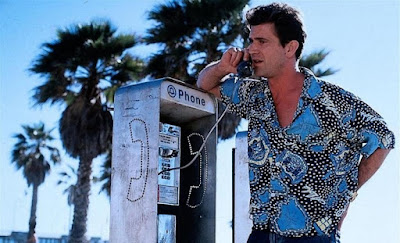
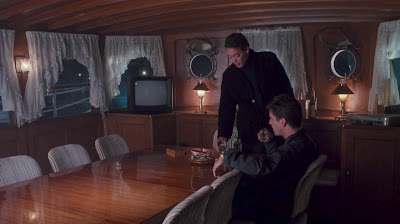
Robert Towne needed a box office hit. By 1987, the legendary Hollywood screenwriter, who rose to fame in the 1970s with the likes of The Last Detail (1973) and Chinatown (1974), was in director’s jail after his debut, Personal Best (1982), flopped at the box office and he went through a messy legal battle against studio executive David Geffen. He was trying to get his second directorial effort, Tequila Sunrise (1988), off the ground and knew he’d need bankable movie stars in the lead roles. He managed to secure Mel Gibson, Michelle Pfeiffer and Kurt Russell who were all coming off successful high-profile hits with Lethal Weapon (1987), The Witches of Eastwick (1987) and Overboard (1987), respectively. They jumped at the opportunity to work with someone such as Towne, drawn to his well-written screenplay. The end result is a gorgeously shot neo-noir with a love triangle that tests the friendship between two long-time friends on opposite sides of the law.
 
Dale “Mac” McKussic (Gibson) is a high-end drug dealer that is supposedly retired even though Nick Frescia (Russell), head of narcotics for Los Angeles County, runs into him at a drug deal. They are friends from way back and so Nick lets him go before the bust goes down, however, Mac knew it was coming and got rid of the drugs. One gets the feeling from the casual way they interact with each other that they’ve crossed paths many times before this incident. Mac escapes and just makes his late reservation at his favorite posh restaurant run by Jo Ann Vallenari (Pfeiffer), who catches the eye of both him and Nick. The rest of the film plays out a twisty cat and mouse game as Nick is torn between busting his friend and trying to save him while Mac is torn between doing one last drug deal and his love for Jo Ann – the person that puts their friendship to the test. As the film progresses, various characters’ true motivations come into focus and we see if Mac is smart enough to stay one step ahead of the Columbian drug cartel he works for, the DEA and hold on to Jo Ann.

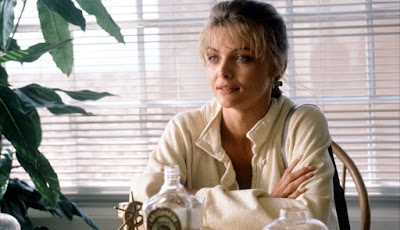
All three lead actors exude sex appeal like crazy and part of the thrill of watching Tequila Sunrise is how these three movie stars interact with one another, breathing life into Towne’s wonderful prose. Michelle Pfeiffer’s Jo Ann is no damsel in distress. She’s a strong woman who easily holds up to questioning early on from federal agents who grossly underestimate her fortitude as evident in a beautifully acted and written scene where Jo Ann expertly turns the tables on the Feds to Nick’s bemusement. She’s suave and knows how to deal with her classy clientele but isn’t snobby either. With her beautiful smile, Pfeiffer makes Jo Ann very charismatic and sexy. It is easy to see why Mac and Nick find her so alluring. In turn, she is drawn to Nick’s charisma and Mac’s vulnerability.

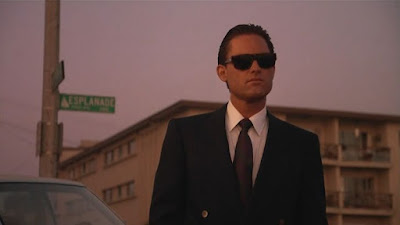
With his slick, Pat Riley hairdo and shark grin, Kurt Russell’s Nick is a super confident lawman that is great at his job as he is very perceptive and savvy, which comes from years of experience and knowing what goes on in his own backyard. The actor gives his character just the right amount of cockiness so that he doesn’t come across as arrogant. This plays well off J.T. Walsh’s humorless federal agent intent on busting Mac regardless of Nick’s friendship with him. Russell has a wonderful scene with Pfeiffer where Nick comes clean and explains why he got romantically involved with Jo Ann and the cocky façade comes down to reveal a brutally honest person not afraid to be vulnerable in front of her. He didn’t just get close to her to get close to Mac. He genuinely loves her and is willing to put all his cards on the table. Russell shows an impressive range in this scene but, like Jo Ann, you’re still not quite sure if he is 100% genuine and not playing an angle.
 
Mel Gibson’s laidback drug dealer is an excellent counterpoint to Russell’s gregarious lawman. Mac plays things close to the vest and Gibson gives little away which keeps us guessing as to how his character is going to evade the cops and not get killed by his South American counterparts. His performance may not be as flashy but it has a brooding intensity that is fascinating to watch. He can go back and forth between showing Mac’s day-to-day routine (work at his legit job and hang out with his son) and the aspects of his drug dealing trade and show how they inform his character.
 
The always reliable Arliss Howard is excellent as one of Mac’s drug contacts who is constantly trying to get him to do another drug buy but he’s savvy enough to know that this guy is bad news. Howard’s character comes across as amiable enough but it isn’t too hard to figure out his character is probably an informant trying to set up Mac. He’s a little too eager to do business and this ultimately tips his hand.

The great Raul Julia shows up partway through as the DEA’s Mexican counterpart but with a secret agenda of his own. The actor looks like he’s have all kinds of fun with his role, breaking out into song on two separate occasions for no reason at all, taking over the scene for a few seconds. He really gets to sink his teeth into the role once his character’s true identity is revealed.

Character actor extraordinaire, J.T. Walsh is excellent as a slimy DEA agent that immediately butts heads with Nick who is much smarter and has no problem rubbing the man’s nose in it. Walsh is a master of simmering rage, glowering constantly as his character is constantly outsmarted and proven wrong.
 
Tequila Sunrise is beautifully shot by the great cinematographer Conrad Hall (Butch Cassidy and the Sundance Kid) as evident from the stunning sunset featured in the background of a scene where Nick and Mac are captured in silhouette talking on the beach. It’s an excellent scene as the two men sniff each other out to figure out what the other knows and to tell each other to back off in so many words. We get a real indication of what’s at stake and it’s not just their friendship but potentially Mac’s life if he doesn’t play his cards exactly right as he’ll either get busted or killed.

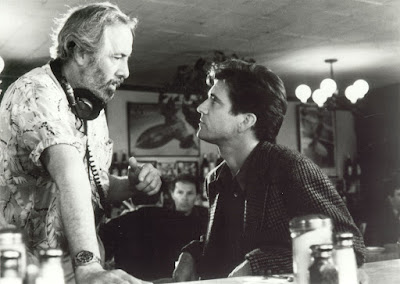
Robert Towne based the Tequila Sunrise screenplay on the courtship of his wife. In the mid-1980s, he frequented chef Piero Selvaggio’s Valentino restaurant in Santa Monica. He would arrive late and talk with Selvaggio’s wife Luisa. She would end up leaving her husband for Towne. At one point, he moved to Paris to help Roman Polanski on the script for Frantic (1988) and met producer Thom Mount. He told him about his script for Tequila Sunrise and after reading it took it to Warner Bros. The studio agreed to do it if Mount could attract a movie star. Mount and Towne approached Harrison Ford while he was making Frantic with Polanski and he agreed to do it but as they got closer to principal photography he pulled out as he didn’t think he could play Mac.
 
Towne liked Mel Gibson in Lethal Weapon and approached him about playing Mac. He flew to Australia to meet with the actor who asked him, “How do you feel about actors watching dailies?” to which Towne replied, “Fine,” and he agreed to do it. Mac was based after “one fellow in particular who was in that line of work, and who was experiencing the same painful difficulty of extricating himself from it,” Towne recalled. He wrote the role of Nick with Kurt Russell in mind and on then-L.A. Lakers head coach, and close friend, Pat Riley, while also being inspired by a close friend who was an undercover narcotics cop for the L.A. County Sheriff’s Department. He initially wanted Riley to play the part because of the way he “very carefully holds himself together – his necktie tight, his hair slicked back – so that he looks like he’ll never come unglued, he never seems stressed.” Riley turned it down and Alec Baldwin was considered before Towne decided to go with Kurt Russell who he introduced to Riley and proceeded to adopt his look. Towne saw Michelle Pfeiffer in Alan Alda’s Sweet Liberty (1986) and liked the “disparity between public and private behavior” in the role and cast her as Jo Ann.
 
Tequila Sunrise was financed independently by Mount with a negative pick-up for Warner Bros. It was only Towne’s second directorial effort, the first being Personal Best, which was a notoriously difficult shoot that resulted in the filmmaker liberating the negative of the picture while David Geffen said he stole it. The studio had to step in and make peace between the two men. As a result, Mount wanted to surround Towne with seasoned crew members and hired Richard Sylbert to design Tequila Sunrise. He had worked with Towne previously on Chinatown and Shampoo (1975) and they were good friends. Sylbert had also worked as a studio executive and, according to Mount, “understood the process from top to bottom. So you were hiring, not a production designer, not even a co-producer, you were hiring like this Renaissance maniac who was your partner in the movie, in every way.”

To save money on the $38 million budget, Sylbert found a large, old empty warehouse, instead of a soundstage, in Santa Monica to house the production offices and build sets. For the look of the film, Sylbert chose the colors of the Tequila Sunrise drink and the Los Angeles sunset – gold, orange and red. According to Mount, “Richard understood that the drink was the color key from the very beginning.” Sylbert based Jo Ann’s restaurant on Valentino’s and Matteo’s, an Italian restaurant in West L.A. It was built in the warehouse over eight weeks. He also helped design the menu and chose the cuisine. Towne even brought in Giuseppe Pasqualato, a former chef at Valentino’s to cook on set, which also had a functioning bar.
 
Filming began in February 1988 in the South Bay section of L.A. and lasted 68 days. Ten days in, cinematographer Jost Vacano was fired as his gritty, realistic style was not the tone Towne was after – rather a more romantic vibe. He called Conrad Hall, his first choice that was nixed by the producer, and within 24 hours was on the set.
 
Tequila Sunrise received mixed to negative reviews from critics at the time. Roger Ebert gave the film two-and-a-half out of four stars and wrote, "Tequila Sunrise is an intriguing movie with interesting characters, but it might have worked better if it had found a cleaner narrative line from beginning to end. It’s hard to surrender yourself to a film that seems to be toying with you." In his review for The New York Times, Vincent Canby wrote, "Here the problem seems to be the fatal collaboration of a good writer with a director who wasn't strong or overbearing enough to pull him up short. The movie has the fuzzy focus of someone who has stared too long at a light bulb." The Los Angeles Times' Sheila Benson wrote, " It’s enough to send you out of the theater thirsty. Unfortunately, it sends you out hungry too, for a whole movie to offset this upscale grazing." In his review for the Washington Post's Hal Hinson wrote, "In Tequila, the divisions between business and pleasure, love and friendship break down, and the breakers...do it beautifully, with sweet talk, tough talk and hot kissing."

Tequila Sunrise was the box office success Towne needed but he didn’t direct another film for ten years – Without Limits (1998). He kept busy, though, thanks to a lucrative partnership with Tom Cruise, contributing several screenplays for the movie star in the 1990s, including Days of Thunder (1990), The Firm (1993), and Mission: Impossible (1996). Tequila Sunrise is a fascinating battle of wills. We have three highly intelligent people trying to figure out each other’s motives. It becomes complicated when mixed with emotions as a love triangle develops and clouds judgement. As one character says late in the film, “Friendship is all we have! We chose each other!” This is a film about friendship and loyalty. This is what motivates the three lead characters. Nick tries to save Mac from getting killed or busted as the drug dealer is his friend. Mac finds a way out of the drug dealing business as he loves Jo Ann. She loves Mac and doesn’t want him to get hurt. For a neo-noir it is lacking that fatalistic streak that runs through many of them. Towne is a little too enamored with the romantic aspects of his script to convey a convincing doomed protagonist that is a hallmark of the genre. Gibson’s Mac is a little too slick, a little too sure himself for anything really bad to happen to him and that is perhaps the film’s only glaring flaw in an otherwise wonderful, sun-drenched cinematic cocktail.
 
 
SOURCES
 
Lazar, Jerry. “Towne’s Country.” Chicago Tribune. December 4, 1988.
Mount, Thom. Audio Commentary. Tequila Sunrise DVD. 1988.
 
Sylbert, Richard & Sylvia Townsend. Designing Movies: Portrait of a Hollywood Artist. Frager. 2006
 
Turan, Kenneth. “Robert Towne’s Hollywood Without Heroes.” The New York Times. November 27, 1988.

Friday, July 16, 2021

Air America


There are so many ways a film can go wrong. They can be bungled upon their release, either by poor timing or by a misguided marketing campaign. They can be ruined in post-production by the studio taking it away from the filmmaker and hacking it to pieces. They can be undone during principal photography via circumstances beyond the filmmaker’s control or because they have too much control. Some films can be unmade before they’re even made. This is what happened to Air America (1990). What started as a hard-hitting look at the secretly CIA-run airline that brought in weapons and supplies to anti-communist forces in Indochina during the Vietnam War and was to star Sean Connery and Kevin Costner and directed by Richard Rush, eventually became a feel-good buddy comedy starring Mel Gibson and Robert Downey, Jr. that was more Good Morning, Vietnam (1987) than Platoon (1986), only wackier. Where did it all go wrong?

Like with Good Morning, Vietnam, Air America starts off presenting a misfit group of servicemen, this time pilots, flying secret missions in Laos, often aiding and abetting local General Vang Pao (Burt Kwouk) and his lucrative opium drug trade. Billy Covington (Downey) is the audience surrogate, a maverick civilian pilot who's having trouble holding down a regular gig stateside and is convinced by a recruiter that Air America is his only option left.

The opening sequence of the movie sets the serio-comic tone and demonstrates the wildly mismatched sides at war with each other as we see a large cargo plane get shot down by a peasant with a rifle from extremely long range. It’s an absurd image that is soon offset by a shot of the plane wreckage and the dead pilot lying on the tarmac. The movie then swings back to comedy when CIA agent Rob Diehl (David Marshall Grant) asks veteran pilot Gene Ryack (Gibson) if the man is dead to which he deadpans, “Well, Rob, if he’s not dead, he’s very, very calm.” It is this painfully unfunny dialogue so early on that does not bode well for the rest of the movie.

Fortunately, the movie improves considerably when Billy arrives in country and is introduced to his fellow pilots. He quickly finds out that, as he puts it, "I was always the weirdest guy in the room. Here I'm not in the running." We meet the most interesting part of Air America: the wonderful supporting cast, populated by genre vets like Art LaFleur (The Blob), Ned Eisenberg (The Burning), David Bowe (U.H.F.), and the great Tim Thomerson (Trancers) who all look like they're having a blast playing oddball pilots and all-around degenerates. It is LaFleur that steps up and sells “crazy” dialogue such as, “I’m coming from the dark side of the moon and I’m going back there, too, soon,” because of the way he carries himself in the scene that convincingly puts Billy on edge. It’s a shame that it doesn’t go on longer so that we can meet the rest of these burn-outs.


Instead, the first half of the movie is all set-up, establishing these rag-tag pilots and their eccentric way of doing things, their flying missions (which seems to involve a lot of crashing), and how Major Donald Lemond (Scrubs' Ken Jenkins) and his second-in-command Rob are in cahoots with General Pang while a cavalcade of 1960s hits (except for an atrocious cover of The Doors' "Love Me Two Times" by Aerosmith) plays endlessly on the soundtrack.

Air America is at its best when we see these guys carousing and cutting loose, which sadly, isn't often. We must make due with little bits of business like seeing Babo (Thomerson) as the third wheel on Billy’s orientation flight, or a scene that shows their off-hours antics, drinking and playing mini-golf. Once again, LaFleur takes center stage as Jack gets in Billy’s face and ends up shooting another pilot’s ball in mid-putt. The two almost get into it and we get a glimpse of how cracked these guys are and that they’ve been at this for way too long. Of all the character actors the filmmakers cast as the pilots they must’ve really been impressed with LaFleur and what he was doing daily as he gets most of the screen-time of any of them including a memorable mission Jack flies with Billy where they are shot down during a supply run. There are some decent intense exchanges between the two men as they realize that they’re also transporting a whackload of the General’s opium and must fend for themselves when he arrives to rescue his merchandise and not them. These scenes are so entertaining and fun to watch that it makes you want to see a movie that focuses just on these guys with Billy and Gene as supporting characters instead.

Rob and the Major provide a rare glimpse of the darker movie that could have been when he tells Billy over drinks, “A secret war is the way to go. No reporters, no T.V. You black out the war like a pro football game.” His superior appears and clears things up just in case what he was saying wasn’t obvious enough, that they treat what they do as a business and a war with no difference between them.


It must be said that Downey and Gibson have some nice moments together and it’s not the kooky pilot shtick but a down moment where Gene tells Billy what’s he all about as he tells him, “We’re all a bunch of trouble junkies. We’ve been mainlining danger and adrenaline for so long nothing else gets us off. It’s kind of sick.” He lays all his cards on the table and tells his young friend how things are in a refreshingly honest and direct way that is well-acted by Gibson. This scene also plants the seeds for Gene’s eventual redemption as Billy’s youthful rebel begins to remind him of when he was that age.

For years, Air America was a passion project for filmmaker Richard Rush who was set to make it for Carolco Pictures in 1985 on a $15 million budget based on the book of the same name by Christopher Robbins. His vision had a main character who was a Vietnamese spy that had infiltrated Air America. He had put a lot of work into the screenplay and considered it his finest, even better than the one he wrote for The Stunt Man (1980), which he held in high regard. Rush was interested in casting Sean Connery and the actor came over to the house twice a week for an hour or two reading the script together. They got along quite well and when Rush was fired from the project, Connery immediately quit.

Rush scouted locations in Southeast Asia and began casting for his film. His first choice for Connery’s co-star was Bill Murray but after extended talks he was briefly replaced by Jim Belushi before Kevin Costner showed interest in the project. Rush claims the actor was very interested but he took too long to decide and Good Morning, Vietnam came out and stole their thunder (and the box office). It didn’t help that his asking price had increased and Carolco did not want to pony up the rumored $15 million for both actors. In September 1987, independent film producer Dan Melnick sold his production company to Carolco and took over Air America. It was at this point that the project changed from a gritty expose that Rush has envisioned into a studio blockbuster that Melnick envisioned. He fired Rush and the two leads quickly departed as well. Melnick remembers, “They hadn’t been able to get a good script on it. It couldn’t attract stars. It was just lumbering along.” Rush asked for his script back and Melnick refused, giving the filmmaker back $1 million of his $1.5 million pay-or-play deal. Rush said he felt like the “victim of a hostile takeover.”


Melnick hired screenwriter John Eskow and director Bob Rafelson to take over and they all went to Malaysia and Thailand to scout locations. Malaysia was ruled out, deemed “a repressive society” by Melnick and the team opted for Thailand. When they returned from their trip, a Writer’s Guild strike delayed rewrites on the project. The budget and scope of the movie increased and this necessitated an international movie star. They couldn’t get anyone to commit unless a script was available. Some aspects of Rush’s script survived, such as the dropping of counterfeit money over Laos to destroy the economy and the dropping of oversized condoms as a form of psychological warfare.

To further complicate matters, shooting in Thailand had to take place during the country’s dry season, approximately October through April. Melnick and Rafelson went off to Africa to make Mountains of the Moon (1990) while Eskow returned to work on the script as the strike had ended. Rafelson never came back and he was replaced by Roger Spittiswoode (Under Fire). For the role of Gene, Melnick had originally wanted a veteran actor like Sean Connery or Paul Newman with Mel Gibson eyed to play Billy. Thanks to the success of Lethal Weapon (1987), Gibson was hot at the box office and used his clout to play Gene. A few adjustments to the script were made and Robert Downey, Jr. was cast as Billy.

By several accounts, the production was a challenging one with 15 cameras, three units and 49 separate locations used during the 14 weeks of principal photography in rough conditions on location in Northern Thailand where 200 toilets were installed. At one point, 20 members of the crew were stricken with an unknown flu. The production rented 26 airplanes and helicopters from the Thai military and in one month encountered four serious in-flight emergencies that, in one case, almost resulted in casualties.

The original version was going to be made by Rush and starring Connery and Murray. Can you imagine what that would've been like? Alas, their version was probably too dark and too critical of United States foreign policy to be unleashed on an unsuspecting mainstream moviegoing audience. Once Gibson and Downey, Jr. came on board as the leads, it softened all the edges and you get what was finally released: an easygoing, feature-length sitcom that washes over you.


Almost. The last third of the movie tries to stick to the Good Morning, Vietnam playbook by having Gibson's cynical pilot develop a conscience with the help of Downey and show what the General's drug trade is doing to the local population. Gibson and Downey even get stranded in the dense jungle and must make it back to base just like Robin Williams does in Good Morning, Vietnam! Also, Rob and the Major are antagonists to our heroes much as Bruno Kirby and J.T. Walsh’s characters were in Barry Levinson’s film. You know in a movie like this nothing really bad is going to happen to Gene or Billy and they get to literally fly off into the sunset while a tacked-on epilogue tries to temper things by explaining that the two corrupt U.S. government officials managed to emerge from Laos unscathed, protected from on high to go on being evil S.O.B.s. Air America isn’t an example of a good movie inside of a bad one, trying to get out, but rather a good idea that was tinkered with and a mediocre movie was the end result.


SOURCES

Clarkson, Wensley. Mel Gibson: Man on a Mission. 2015.

Anson, Robert Sam. “Fly the Friendly Skies.” Premiere. September 1990.

Rowlands, Paul. “An Interview with Richard Rush.” Money into Light. November 2017.

Wilson, John M. “The Fine Art of Making the Deal.” Los Angeles Times. May 27, 1990.

Friday, July 22, 2016

Lethal Weapon

Thanks to the success of 48 Hrs. (1982), the Buddy Action Movie became arguably the most popular genre in the 1980s and it seemed, for a short time, that studios were handing them out to any dramatic actor-comedian combo that wanted one. This resulted in the best of times (Beverly Hills Cop) and the worst of times (City Heat). By the late ‘80s, the formula had gotten stale and in need of an injection of new blood. Along came aspiring screenwriter Shane Black who had written an urban western inspired by Dirty Harry (1971). With Lethal Weapon (1987), he took the Buddy Action Movie to darker places than it had been before by teaming up a veteran cop in the twilight of his career with his new partner, an unhinged, suicidal loose cannon. Needless to say, the end result was explosive and the movie was a massive commercial success, spawning three increasingly inferior sequels and a television show.

Veteran Los Angeles police detective Roger Murtaugh (Danny Glover) is assigned a case involving a coked-up, pill-popping prostitute that took a swan dive off her high-rise apartment building. He becomes personally involved when the dead girl’s father (Tom Atkins) turns out to be an old Vietnam War buddy who tells him that she was murdered and desperately implores his friend to find those responsible and kill them. If that wasn’t hard enough news to take, he’s also been assigned a new partner – Martin Riggs (Mel Gibson) – who may or may not have a crazy death wish.

They soon run afoul of retired General Peter McAllister (Mitchell Ryan) who is running a heroin-smuggling operation and employs a team of mercenaries including his fiercesome right-hand man Mr. Joshua (Gary Busey), an impeccably dressed individual that pulls a G. Gordon Liddy with an underling’s lighter to show what a badass he is. It’s a nice scene that shows what a serious threat these guys are to our heroes. I like how the film gradually reveals the kind of threat Murtaugh and Riggs are up against and they are people that use deadly force, which tempers the comedy that is sprinkled liberally throughout. Black’s script gets the mix just right – something that subsequent Black-less sequels did not with their increasingly lazy sitcom elements typified by the addition of Joe Pesci’s annoying mugging.

Director Richard Donner immediately shows the contrasting lifestyles of Murtaugh and Riggs with the former a loving family man that lives in the suburbs while the latter starts the day with a cigarette and beer in a trailer with his dog by the beach. Not surprisingly, they also have contrasting approaches to police work and this is memorably illustrated when we see Riggs at work, going undercover to bust a trio of drug dealers at a Christmas tree lot and proceeds to throw them off guard by going all Three Stooges on them in a moment that is hilarious but quickly turns deadly on a dime when one of them pulls a gun. After dispatching a few of them, one of the crooks grabs Riggs and puts a gun to his head. Instead of freaking out or begging for his life, he repeatedly taunts the guy to shoot him, which unnerves the crook so much that Riggs is able to disarm him.

The scene where Murtaugh and Riggs first meet is a memorable one as the former spots the latter taking out his gun, assumes he’s a criminal and charges him only to be taken down very quickly by his new partner. This starts the beginning of a contentious partnership as Riggs tells Murtaugh early on, “Let’s just cut the shit. We both know why I was transferred. Everybody thinks I’m suicidal in which I’m fucked ‘cos nobody wants to work with me. Or, they think I’m faking it, draw a psycho pension in which case I’m fucked and nobody wants to work with me. Basically, I’m fucked.” Not surprisingly, Murtaugh isn’t thrilled to be working with Riggs either and tells him, “God hates me, that’s what it is,” to which his partner replies, “Hate him back. Works for me.”

I like that the film takes the time to establish the volatile relationship between these two men, showing their contrasting styles of police work as evident in a scene where they deal with a guy threatening to jump off a building. Riggs’ solution is certainly a novel if not completely batshit crazy one. This leads to an excellent scene where they have it out and Riggs tells Murtaugh about his suicidal tendencies, which features intense acting from both men. It gives Lethal Weapon an edge as Murtaugh (and us) don’t know what Riggs is going to do next even as the movie goes through the usual Buddy Action Movie beats.

Chemistry is everything with this genre and Gibson and Glover certainly have it and not just in the action scenes but the crucial downtime in-between, like when Murtaugh takes Riggs home to meet his family and afterwards they hash out the case up to that point, which shows them gelling as a team. It is a nice moment between these guys as we get to know them and care about what happens to them. Black’s script tempers this quiet, bonding moment with Riggs’ parting shot before he heads home: “When I was 19, I did a guy in Laos from a thousand yards out. It was a rifle shot in high wind. Maybe eight or even ten guys in the world could’ve made that shot. It’s the only thing I was ever good at.” Gibson delivers this dialogue with just enough matter-of-fact edginess as to give off a chilling vibe.

Riggs is haunted by the death of his wife and in a powerful scene puts a loaded gun in his mouth. The utter sadness and despair Gibson conveys in this scene is powerful and gives his character an added dimension beyond being simply a wild and crazy cop. It also gives us insight into what motivates him. Murtaugh is a police detective celebrating his 50th birthday when we first meet him and is really starting to feel his age thanks to his oldest daughter who has started dating boys, much to his chagrin. Glover does a nice job of juggling his role as beleaguered family man and someone who is becoming increasingly exasperated by the dangerous antics of his new partner.

Lethal Weapon would establish Black’s tried and true motifs that he’s used in most of his movies: a mystery is kickstarted by the death of a prostitute or stripper, which establishes a favorite recurring thematic pre-occupation of innocence lost. In order to solve the murder, an older, burnt-out character partners with a younger, zanier one going up against a villain who is an older, richer white character that employs an impeccably dressed, unfailingly polite sadistic henchman with the story usually taking place during Christmas in Los Angeles.

Ever the consummate professional, Donner’s crisp direction keeps things chugging along with a slick, glossy look that was synonymous with most ‘80s action movies. The action sequences are coherent, we always know where everyone is and they aren’t edited within an inch of their lives. Best of all, he makes sure to spend enough time letting us get to know Murtaugh and Riggs, showing how their partnership develops over time as they learn to trust each other by surviving death-defying situations. The film also isn’t afraid to forego logic and indulge in its Alpha Male reptilian brain at the climax when, despite being surrounded by cops, Riggs decides to have it out with Mr. Joshua for a knock-down, drag-out fight where the cop is finally allowed to let his inner caveman out. And everyone lets these guys do it! It makes no common sense but the film has been building up to this point and we want to see these two guys go at it to see who is the bigger badass.

The commercial success of Lethal Weapon propelled the young Shane Black into the stratosphere and for a short while he became the highest paid screenwriter in Hollywood. Donner, Gibson and Glover did pretty well for themselves, reteaming for three more sequels – the second of which (1989) was the only one that was any good. None of them have been able to touch the lightning in a bottle that Donner, et al were able to catch with the first movie and for a brief moment it seemed like the Buddy Action Movie was going to be given a new lease on life. After all, Midnight Run came out the next year and was also a breath of fresh air but sadly these two movies were the exception and not the rule for some time to come.

Friday, June 24, 2016

Mad Max 2: The Road Warrior

With his low-budget revenge movie, Mad Max (1979), Australian filmmaker George Miller created one of the most kinetic action spectacles by choreographing car chases in a way that was unique. They were depicted viscerally, putting you right in the action. The film was a massive success, launching the careers of both Miller and its young star, Mel Gibson. The filmmaker briefly pursued another, unrelated project while turning down several offers from Hollywood before deciding to make sequel only with much more money that would allow him to push his brand of visual storytelling to a new level. The end result was Mad Max 2 (1981) a.k.a. The Road Warrior, an unrelenting journey into a post-apocalyptic world that would prove to be hugely influential, spawning numerous imitations and two sequels that Miller would helm.

After briefly recapping the events depicted in Mad Max, we meet Max (Gibson), a hardened scavenger eking out a desolate existence in the wasteland. Miller wastes no time launching into the film’s first action sequence as Max is pursued by three vehicles populated by leather-clad marauders armed to the teeth and whom he handily bests. This sequence sets the tone for the rest of the film and serves as an introduction to its style. Like any good action director, Miller understands how an action sequence is edited is just as important as how it is choreographed. There is a wonderful economy of style as he conveys the speed and ferocity of violence in this world. He also demonstrates a confidence in his ability to tell a story visually with the first ten minutes devoid of any dialogue save for the voiceover narration that briefly establishes the backstory of this world.

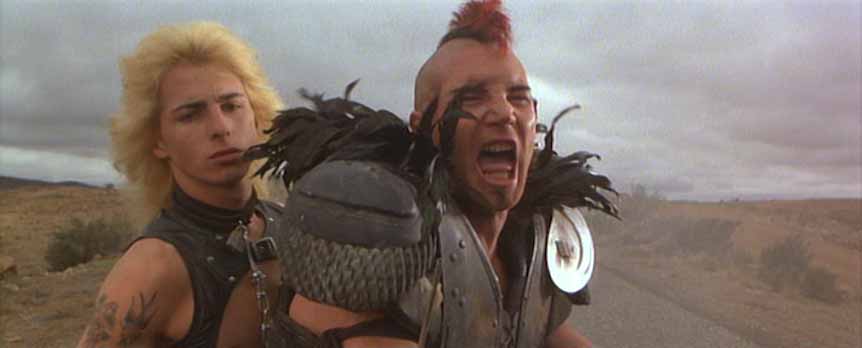
The first bit of dialogue comes from a fellow scavenger known as the Gyro Captain (Bruce Spence) that Max encounters. He’s the complete opposite of Max – chatty and high-strung. Max bests the Gyro Captain and he tells him of a fortified oil refinery a few miles away. The settlers that populate it are under constant siege by a large group of marauders led by the muscle-bound Lord Humungus (Kjell Nilsson). Max’s run-in at the beginning of the film was with members of this gang – one of whom survived and goes by the name of Wez (Vernon Wells). The two men will mix it up repeatedly over the course of the film.

Miller makes a point of showing just how ruthless these marauders are when a bunch of them intercept two settlers trying to escape in a vehicle. They are captured and after gravely wounding the man, rape the woman, killing her afterwards. This scene is important because it shows how the marauders differ from Max. He’s not like them. He may be an opportunist out for himself but there is still a shred of the good man he was in Mad Max.

Max bargains his way into the settler’s camp and visually Miller sets them apart from the marauders with their white tunics and body armor, which is in sharp contrast to Humungus and his black leather-clad bikers. We soon get a proper introduction to the nasty marauders with a darkly comic scene that sees Humungus announced as the “Ayatollah of Rock-and-Rollah” by one of his hapless subordinates (Max Phipps) who foolishly tries to catch a sharp, metal boomerang only to have several of his fingers lopped off. This scene also provides intriguing insight into the tumultuous relationship between Humungus and Wez, an impulsive mohawked biker, and his best enforcer. Miller does a fantastic job of conveying the dynamic of this gang by the way they act and how their attitude is embodied by Wez. It’s a fascinating albeit brief window into how they work, leaving us wanting more because they are such a colorful, outrageous bunch, much like the biker gang that terrorized Max in the first film.

The settlers are led by a man known as Pappagallo (Michael Preston) who dreams of escaping their compound with a tanker of gas to the ocean and he strikes a deal with Max to find a rig that will haul it. Of course, it’s never that easy as the film hurtles towards the inevitable confrontation between the marauders and the settlers. Along the way, Max is befriended by the Feral Kid (Emil Minty), a wild child whose only form of communication is grunts and growls, and who is the owner of the aforementioned boomerang. He, more than any of the other settlers, is responsible for awakening Max’s humanity, giving him something to care about once again. Despite his best attempts, the setters’ plight affects Max and, coupled with no other option left to him, decides to help them.

Mel Gibson delivers a deceptively complex performance as we see Max go from a man that cares only about himself to a man that helps others. It is a tough journey as he initially rebuffs the settlers despite Pappagallo nailing what makes Max tick: “You happy out there, are ya? Wandering, one-day blurring into another. You’re a scavenger, Max. You’re a maggot. You’re living off the corpse of the old world.” These words and prodding into his tragic past get to Max and he finally reacts emotionally – the first real time he’s done so since the film began. It’s a pivotal scene because it is the beginning of Max caring about something other than himself. Alas, it is going to take hitting rock bottom for him to finally come around. Gibson does a good job of showing the inner conflict playing out over Max’s face in this scene.

Bruce Spence’s gregarious Gyro Captain provides the film with welcome comic relief and he plays well off Gibson’s stoic Max. He, along with the Feral Kid, help humanize Max. The Gyro Captain talks a good game but is a bit of a scammer only to find a purpose among the settlers. Wez is Max’s opposite, a wild animal that has to be kept on a leash, literally, to curb his wilder impulses only to be cut loose when his primal instincts are needed. Miller sets up the conflict between them right from the start, having the two men cross paths repeatedly until the exciting climax where they finally settle things once and for all. Vernon Wells delivers a larger than life, muscular performance, playing a memorable baddie that is exciting and scary because Wez is such an unpredictable character.

Mad Max 2 culminates in a much-lauded extended chase sequence as Max drives a tanker truck through the marauders. The action is beautiful orchestrated vehicular mayhem as cars and people go flying through the air, metal is twisted and mangled – all in the pursuit of the precious gasoline. The end result is one of the best chase sequences ever committed to film. Everything has been building up to this point and we’ve become invested in not just Max’s story but also that of the settlers. We want to see them survive.

After Mad Max grossed $100 million at the box office, Warner Bros.’ international marketing division encouraged director George Miller and producer Byron Kennedy to make a sequel. For the latter, the impetus to make it came from liking “traditional Hollywood American film, and I want to make those sorts of movies.” Mad Max 2 was an opportunity for Miller to work with a larger budget of $4 million – ten times the amount of the first one, which was made for $400,000 – which allowed him to have better equipment. This enabled him to stage more elaborate stunts and shoot in a more remote location with a bigger, more professional crew. One of his frustrations making Mad Max was that he made it with a television crew that were used to doing things a specific way. His new crew, including cinematographer Dean Semler, was more adept and willing to “give anything a go – it’s crazy but give it a go, we’ll back you all the way.”

Miller started off with a basic story and a premise:

“That, suddenly, there would be no energy. No electricity. So, people would rush down to their supermarkets and take whatever was left in the refrigerators. They would find other people already there. There would be fights. We would have no gas for our vehicles. Very quickly, things would reach a Darwinian stage where human beings would have to survive as best they could. Some would, undoubtably, choose a brutal lifestyle, consuming whatever was left, since no more goods would be manufactured. But there would be pockets of people who would try to make a new beginning…”

For the marauders that terrorize the settlers, Miller imagined them as warriors:

“He would, therefore, need a bike for mobility, and also because it uses less fuel than a car. He would need to be protected, so he would need weaponry. If he can get a gun, he can’t find bullets, so he would fashion a kind of crossbow, which he would wear on his arm. That way, it’s also easier to fire when he’s riding a bike.”

Mad Max 2 was shot in the desert, in and around Broken Hill, a mining town 800 miles west of Sydney during the Australian winter of 1981 over 12 weeks with 120 crew members, 40 actors and over 80 vehicles.

Mad Max 2 received mostly positive reviews from critics. Roger Ebert gave it three-and-a-half out of four stars and wrote, “The filmmakers have imagined a fictional world. It operates according to its special rules and values, and we experience it. The experience is frightening, sometimes disgusting, and (if the truth be told) exhilarating.” In his review for The New York Times, Vincent Canby wrote, “It has no pretensions to do anything except entertain in the primitive, occasionally jolting fashion of the first nickelodeon movies, whose audiences flinched as streetcars lumbered silently toward the camera.” The Village Voice’s Andrew Sarris felt it was like “experiencing a motorized Stagecoach.” However, Pauline Kael wrote, “There are perhaps 10 minutes of spectacular imagery, and if you think of George Miller as one of the kinetic moviemakers, such as John Carpenter and George A. Romero, he’s a giant, but he’s pushing for more and he apparently doesn’t see the limitations of the kind of material he’s working with.”

While it’s true that Mad Max 2 spawned many imitators – a cottage industry of post-apocalyptic movies – no one has been able to top it, not even Miller with its sequel, Mad Max Beyond Thunderdome (1985), but he came close recently with the masterful Mad Max: Fury Road (2015), which proved without a shadow of a doubt that he is still an action movie maestro par excellence.

Mad Max 2 is essentially a western masquerading as a post-apocalyptic story with cars and motorcycles instead of horses. Max is a hired gun who comes in to help a group of settlers defend their land from an army of vicious marauders. He is reminiscent of Clint Eastwood’s Man with No Name characters in the spaghetti westerns he made with Sergio Leone. Both characters are men of few words who prefer to let their actions speak for themselves. For all of its gritty action, Mad Max 2 is ultimately a mythic tale with Max as its iconic hero who we last see battered but not beaten, refusing to go with the settlers because he doesn’t belong in their world. He’s the classic uncivilized outsider, much like John Wayne’s character in The Searchers (1956), still out there, somewhere, surviving, as the voiceover narration intones with those classic last lines, “And the Road Warrior? That was the last we ever saw of him. He lives now…only in my memories.”


SOURCES

“Australian Screen: George Miller.” 2006.

Barter, Paul. “Still Crazy After All These Years.” Hotdog. February 2005.

Lofficier, Randy & Jean-Marc. “George Miller on Mad Max and The Road Warrior.” Starlog. September 1985.


Van Hise. James. “The Road Warrior.” Starlog. August 1982.

Friday, February 24, 2012

The Year of Living Dangerously

Based on Christopher Koch’s 1978 novel of the same name, The Year of Living Dangerously (1983) was among a small group of films that came out in the early 1980’s depicting the struggles of Western journalists to document the plight of Third World nations – Under Fire (1983) in Nicaragua; The Killing Fields (1984) was set in Cambodia; and a few years later Salvador (1986) came out with an unflinching portrayal of the volatile conditions in El Salvador. The Year of Living Dangerously is set in Indonesia during the attempted coup of President Sukarno by the 30 September Movement Communist party in 1965 and follows a group of foreign correspondents in Jakarta covering the increasing unrest.

The film’s title is a quote that refers to a famous Italian phrase used by Sukarno – vivere pericolosamente, meaning “living dangerously.” He borrowed the line for the title of his Indonesian Independence Day speech of 1964. Sukarno was a hero for leading his country’s independence from the Netherlands. He became the first President of Indonesia and during his reign he gave each year a name. In his 1964 speech he named the upcoming year “the year of living dangerously,” as if anticipating the increasing friction between two radical political forces: the Communists and the Muslims, both of whom were trying to overthrow his government. Sukarno also planned to cut his country’s ties with the West.

We meet Australian journalist Guy Hamilton (Mel Gibson) as he arrives in Jakarta on his first foreign correspondent assignment to find that his predecessor has already left without briefing him. He leaves the airport and we are immediately assaulted with the sights and sounds of the chaotic city – streets congested with cars, people and livestock – but he quickly moves through it to an air-conditioned hotel where all the western journalists hang out. It is there that he meets Billy Kwan (Linda Hunt), a freelance photographer that did a lot of work for Guy’s predecessor. He takes Guy on a guided tour of the slums of Jakarta to show him how most of the country lives and to gain his confidence. Billy also does this so that Guy doesn’t see the country like other journalists, namely Pete Curtis (Michael Murphy), a correspondent for the Washington Post.

The next day, Guy tries to get an interview with Sukarno and is easily rebuffed by the President’s staff. Later on, Billy proposes a deal: he’ll use his personal contacts to get Guy an interview with the leader of the Indonesian Communist Party if he can be his exclusive photographer. Guy’s interview with the Communist Party leader earns grudging respect from his fellow journalists and an initial flush of jealousy from Curtis who had been trying to get the same interview for months. The Post journalist doesn’t like the Indonesian people. They are there just for his amusement. Jakarta is just another assignment for him and Michael Murphy is not afraid to play up the unlikable aspects (of which there are many) of Curtis.

Director Peter Weir is careful to make the distinction between Guy and Curtis (and the other seasoned journalists) and how the former looks at the way the latter delights in the humiliation of the locals with disgust. Guy is young enough not be jaded like Curtis and Billy recognizes this, which is why he latches onto Guy. Billy believes that he can influence Guy to write articles that tell the real story of the Indonesian people and perhaps make a difference. For example, there’s an intensely visceral scene where Billy and Guy cover a protest outside the American embassy by the Communist Party. What starts off as a peaceful march quickly turns ugly as the protestors throw rocks with Billy and Guy stuck in the middle of the angry mob. Once their car gets surrounded, you really start to fear for their lives as the danger they’re in is palpable. Weir does a good job conveying their peril by showing the chaotic masses swirling around their car.

Billy introduces Guy to Jill Bryant (Sigourney Weaver), the assistant to the British military attaché, and who plans to leave for London in three weeks. Her introduction provides occasional moments of levity, like when she, Billy and Guy attend a house party and everyone dances to Jerry Lee Lewis’ “Whole Lotta Shakin’ Goin On.” We see the initial attraction between Jill and Guy emerges through the looks they occasionally give each other. The next day, she drops by his office looking for Billy and he offers to drive her to the photographer’s place and wait for him. Jill is very much Guy’s intellectual equal, good-naturedly criticizing one of his articles as being too melodramatic. She ends up accompanying him on an assignment and at one point they end up getting caught in the rain. He charms her with his willingness to look silly and make her laugh. They share a brief, meaningful look that shows how their attraction towards one another is growing. There is a loose, improvisational feel to this scene as it really seems like the actors are in the moment, which only enhances the chemistry between their characters.

Weir never lets the love story overshadow the political one as Guy finds out from Jill that the Communists are planning to overthrow Sukarno’s government and he tries to figure out how they’re going to get weapons into the country. She told him in confidence and he plans to use it in his article, which, of course, puts a strain on their relationship. Even though I know how the film ends, every time I watch it I still get caught up in the tension of Guy’s race to escape the country as it descends into chaos. Weir ratchets up the pressure so that it is almost tangible and you really fear for Guy’s life.

The carved images that appear over the film’s opening credits depict mythical Indonesian figures: Prince Arjuna, the hero who is “fickle and selfish”; the “noble and proud, yet headstrong” Princess Srikandi; and Semar, the dwarf who serves the prince. These figures nicely foreshadow the film’s three main characters: Guy is the fickle and selfish hero, Jill is the noble yet headstrong princess and Billy is the dwarf that serves the prince.

Made early on in his career, Mel Gibson is well-cast as Guy Hamilton, a young journalist on his first big assignment. The actor manages to portray someone who is smart but inexperienced – a basically decent guy that makes mistakes but tries to do the right thing. Over the course of the film we watch as Guy learns on the job and also falls in love with someone probably for the first time. Gibson wisely doesn’t play his character as a wide-eyed innocent – just someone who hasn’t seen much of the world. He isn’t afraid to play a flawed character and still find admirable qualities within him – perhaps even a hint of redemption.

Sigourney Weaver probably wouldn’t be your first choice to play a British woman but she quickly makes you forget that and focus on her behavior and how she carries herself. Weaver is one of those rare actresses that can convey intelligence while being an undeniable beauty. Jill knows that what she’s doing probably won’t last but is compelled by her emotions to get involved with Guy anyway. Weaver is also able to effortlessly convey a complex range of emotions simply through facial expressions, like when Jill wanders through a marketplace in the rain and it looks like she’s contemplating her relationship with Guy and we see how it impacts her, motivating what she does in the next scene. Jill has a complicated relationship with Guy that is brought together by political conflict and is also threatened by it.

The chemistry between Gibson and Weaver is incredible as they do a fantastic job of depicting a brief, yet intense love affair amidst a volatile situation. Weir develops Jill and Guy’s relationship gradually and realistically. They don’t automatically fall in love but get to know each other by hanging out. It’s a classic scenario of a doomed relationship that can’t last but they go for it anyway because the attraction between them is undeniable. You feel the want and desire between them in the way they look at each other and through their body language. The country’s volatility can create a kind of vulnerability between two people and this is the case with Jill and Guy. They are brought together by the volatility of the situation. The two of them know that they have very little time to be together but can’t deny their intense attraction to each other.

Linda Hunt is simply astonishing as Billy Kwan, the savvy photographer who cares deeply for his fellow countrymen. He believes in helping whomever he can, even if it is a toy for a sick child or a bit of money for someone who is starving. Through his voiceover narration, we find out that he is quite a good writer, documenting the plight of his people as well as Guy’s story. Hunt disappears completely into the role. She plays Billy as a tragic figure, a romantic who wears his heart on his sleeve. Perhaps he cares too much, or, rather not enough people around him care as passionately about making a difference as he does. The scene where Billy loses it after being betrayed by Guy is powerful and painful as we sense all the hurt and frustration bubbling up to the surface as the photographer commits a final, desperate act. Your heart really goes out to Billy and Hunt is so good at conveying her character’s last attempt to make a difference.

A friend of director Peter Weir’s recommended he read Christopher Koch’s novel The Year of Living Dangerously but its political content held no interest form him and he delayed reading it for months. Weir finally did read it and was so taken with what Koch had written that he immediately bought the film rights. Weir was particularly impressed with the character of Billy Kwan and felt that he was the heart of the novel, “the figure around whom the novel is constructed.” The director was already intrigued by Indonesia as his favorite vacation spot was Bali: “I had in my mind all the smells and sounds of an Indonesian street or market, the mysteries there had always appealed to me.”

Weir co-wrote the screenplay with Koch and David Williamson, an acclaimed Australian playwright who had worked with the director previously on Gallipoli (1981). While working on it, Weir began to appreciate the story’s politics for the first time: “I began to see how the political atmosphere is acting upon the characters, and how the larger politics and the politics of the personal are inextricably locked together.” He was also careful to achieve a balance and it took many drafts to achieve it. Weir admitted to having a “bumpy” relationship with Koch because he told the author he was going to “attempt to make this into a good film. He took that for doubt or uncertainty on my part, whereas it was really just being honest.”

The Year of Living Dangerously was in development when Weir got the offer to make Gallipoli and so the project was put aside while he did that one. While making Gallipoli with Mel Gibson, Weir knew that he wanted to cast him in his next film. After they made a deal for The Year of Living Dangerously, Mad Max (1979) came out and Gibson became an international movie star. After casting Sigourney Weaver, it took months for Weir to find someone to play the pivotal role of Billy Kwan.

Three weeks before principal photography was to begin, he had still not found the right actor. He was shown a photograph of Linda Hunt and was struck by her face which he thought looked like an “elf or a goblin.” Weir agreed to meet her and after doing a screen test of her in Eurasian makeup and men’s clothes, he decided to cast her in the role: “My feeling was that it was worth the gamble.” She was “scared to death” at the notion of playing a man but found herself drawn to the character and his relationship to the people of Indonesia and “to his passion about injustice.” Her initial worry was that she could not do it and no one would believe it. Hunt even admitted that during filming she was terrified 95% of the time. To transform herself into the role, her tropical shirts were padded slightly across the shoulders to give her a wider back and she always had something in the breast pocket.

Gibson and Weaver had very different working methods but they didn’t break the ice until the rain scene in the car. For the sequence, they were drenched by fire hoses with the car portion shot in Sydney on a very cold night. Gibson said about his romantic scenes with Weaver, “That kind of thing is always a touchy area with actors, I would think. Or maybe it’s just me. But I think we managed to get a few sparks going.” Weir was more worried about these scenes then the violent crowd scenes that employed thousands of extras. Gibson remembered, “We unloaded truckloads of rocks and things and told those young blokes, ‘Hurl these rocks through the windows. We’ll be down here with the cameras.’ You could yell, ‘Cut! Cut!’ but it didn’t stop the fight.”

Due to the controversial politics of the film, Weir did not consider filming in Indonesia and instead picked the Philippines. However, the production ran into trouble there. Four weeks into a scheduled six weeks of filming in the spring of 1982, the cast and crew began receiving written and telephoned death threats from Muslim extremists that feared the film would be anti-Muslim. Airing on the side of caution, the production left the country and finished filming in Sydney, Australia. At the time, Gibson downplayed these threats: "It wasn't really that bad. We got a lot of death threats to be sure, but I just assumed that when there are so many, it must mean nothing is really going to happen. I mean, if they meant to kill us, why send a note?"

The Year of Living Dangerously received mixed reviews from critics. Roger Ebert gave it four out of four stars and called it, “a wonderfully complex film about personalities more than events, and we really share the feeling of living in that place, at that time.” In his review for The New York Times, Vincent Canby praised Linda Hunt’s performance: “Not exactly dominating these performances, but providing the film with its dramatic center, is Miss Hunt's haunted Billy Kwan, who keeps detailed files on everyone he loves, weeps at the purity of the voice of Kiri Te Kanawa and, when the chips are down, is capable of the film's single grand gesture.” However, the Washington Post’s Gary Arnold wrote, “It's unlikely that anyone who sees The Year of Living Dangerously will ever forget Hunt's performance or Weir's orchestration of a foreboding atmosphere. Still, there's no particular reason why these marvelous aspects couldn't be coordinated with the story in an organic way, so that Billy's character, the characters of the lovers and the ominous intimations all paid off in coherent dramatic terms.” Newsweek found the film to be “an annoying failure because it fritters away so many rich opportunities.”

Along with The Road Warrior (1981), The Year of Living Dangerously helped launch Gibson’s international career and it wasn’t long before Hollywood came calling. It also showed that he had some serious dramatic acting chops and wasn’t just some hunky pretty boy. Weaver’s career also got a big boost and it was the beginning of a great run during the ‘80s that saw her move effortlessly from comedies like Ghostbusters (1984) to dramatic fare like Gorillas in the Mist (1988). The Year of Living Dangerously also helped launch Weir’s career and like Gibson he soon started making films in Hollywood but managed to make them on his own terms with thought-provoking efforts like The Mosquito Coast (1986) and Fearless (1993).

At one point in The Year of Living Dangerously, Billy says, “What then must we do?” This is also the question that the film asks not only of its protagonist but also of its audience. Don’t waste the rest of your life asking this question – do something. It’s all fine and good to become interested in important causes but will you step up and take an active role in something you believe in? Weir avoids delivering a preachy, statement-driven film by expertly balancing a love story with political unrest in a foreign land and how they become intertwined. He makes the politics personal by showing how they impact the characters. It all comes back to Billy’s rather poignant question – “What then must we do?”


SOURCES

Bennetts, Leslie. “East and West Meet Amid Mystery in Peter Weir’s New Film.” The New York Times. January 16, 1983.

Bennetts, Leslie. “Breakthrough Season Arrives for Linda Hunt.” The New York Times. February 12, 1983.

Hanrahan, John. Mel Gibson. Little Hills. 1986.

Moore, Peter S. "The Year of Living Dangerously." Moviegoer. February 1983.

Wadler, Joyce. “When Seeing is Believing.” Washington Post. February 18, 1983.