
Chinatown (1974) is a rare example of a collection of artists at the height
of their powers coming together to produce a masterpiece born out of conflict
and strife. Fresh from his success on The
Last Detail (1973), screenwriter Robert Towne wrote a mystery inspired by
the California Water Wars that took place in Southern California at the
beginning of the 20th century and involved a series of disputes over
water with Los Angeles interests securing water rights in the Owens Valley.
Studio chief and producer Robert Evans bankrolled the project and Towne wrote
the screenplay with his good friend Jack Nicholson in mind. The actor was
coming off the critically-acclaimed The
Last Detail asked Roman Polanski to direct. The two men had been looking
for a project to work together on and chose this one. The end result is a
wonderfully complex and nuanced tale of greed and corruption whose deeper
meanings and rich attention to detail reveal themselves upon subsequent viewings.
Jerry Goldsmith’s somber
score, complete with mournful trumpet, sets a melancholic tone over the opening
credits, evoking a bygone era. Polanski offsets this with the playful opening
scene that sees private investigator J.J. Gittes (Nicholson) showing a client
(Burt Young) photographs of his cheating wife. Looking visibly upset, Burt
Young offsets this with exaggerated whimpers and distressed histrionics, which
provokes Gittes to tell him, “Alright Curly, enough is enough. You can’t eat
the venetian blinds. I just had ‘em installed on Wednesday.” Gittes dresses
nice and has an expensive-looking office but he plies his trade in the seedy
underbelly of society with a specialty in infidelity.
He meets a woman calling
herself Evelyn Mulwray (Diane Ladd) and she hires him to uncover evidence that
her husband Hollis Mulwray (Darrell Zwerling), the chief engineer of Water and
Power for the city, is cheating on her. At a hearing that Gittes attends,
Mulwray receives considerable flack from local farmers accusing him of stealing
water that is ruining their livelihood, but refuses to approve the building of
a dam because of the danger it poses. Gittes and his associates follow Mulwray
around for a couple of days until they find him cheating on his wife, which naturally
makes a big stink in the press.

The real Evelyn Mulwray (Faye Dunaway) shows up with her lawyer and threatens legal action, which prompts
Gittes to dig deeper. Why would someone pose as Hollis Mulwray’s wife and set
him up? To complicate matters, Hollis Mulwray winds up dead, found drowned in a
dried waterbed. Evelyn hires Gittes to find out what happened, which sees him
cross paths with the powerful Noah Cross (John Huston), her father and former
business partner of her late husband.
By the time Jack Nicholson
made Chinatown he was on quite the
roll with films like Easy Rider
(1969), Five Easy Pieces (1970), and
the aforementioned The Last Detail,
among others, under his belt. As a result, he brings a relaxed confidence to
his performance, effortlessly inhabiting the role of J.J. Gittes. He starts off
playing the character as a man comfortable with his lot in life and is good at
what he does. Over the course of the film, this confidence gradually erodes as
Gittes gets deeper into the Mulwray murder. I like how Towne’s script pokes
holes in Gittes’ character, showing his flaws despite a desire to appear
classy, like when he tells his office cohorts an off-color joke unaware that
Evelyn Mulwray is listening to the whole thing behind him. Nicholson’s glee in
telling the joke is palpable and then he brilliantly turns on a dime when
Gittes realizes that Mulwray heard what he said. Nicholson does a fantastic job
of maintaining a tricky balancing act of playing a man brimming with confidence
only to have it chipped away, bit by bit, as he finds himself embroiled in
affairs much larger than himself.
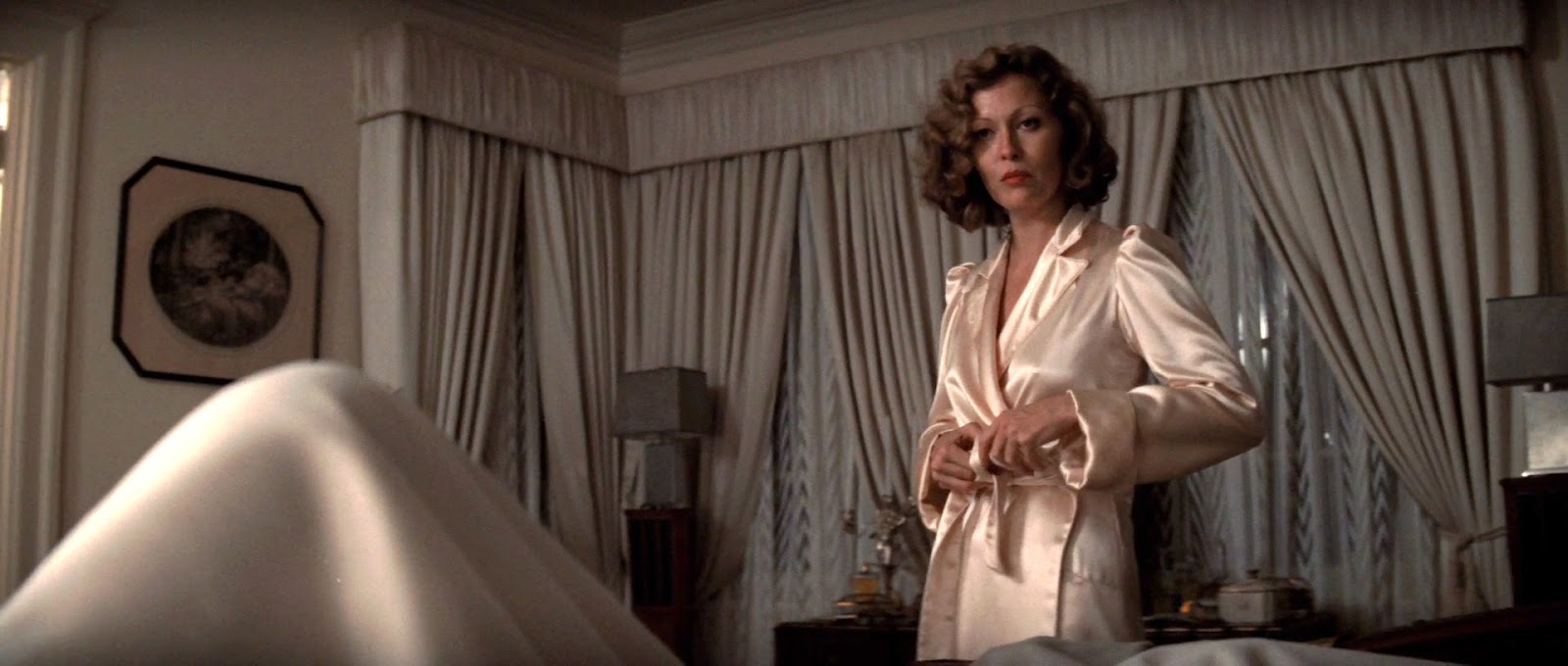
Faye Dunaway is well-cast as
the icy femme fatale Evelyn Mulwray. The actress maintains a frosty exterior as
she portrays a woman harboring a dark secret. Evelyn forms an uneasy alliance
with Gittes and the scenes between Dunaway and Nicholson crackle with an
intriguing tension, which apparently mirrored their off-screen relationship as
well. As the film progresses, Gittes melts some of Evelyn’s icy exterior and
yet Dunaway still manages to hint at further depths to her character that are
eventually revealed towards the end.

Polanski sprinkles playful
moments throughout the film to offset the pervasive pessimistic mood. This is
evident in a scene where Gittes runs afoul of two henchmen, one whom is played
by the director. Polanski’s first line is said off-camera – “Hey there, kitty
cat,” and he proceeds to slice open Gittes’ nose with a switchblade. For a good
portion of the film, Nicholson sports a large bandage on his face, which
subversively messes with the leading man’s good looks. A move like that would
never fly with studio executives today who are scared to death of messing with
any formula that could cost them money and this is just one of the chances Chinatown takes.
Another fantastic scene is
Gittes’ lunch with Noah Cross where we get to see the legendary John Huston
play off against Nicholson. The former exudes the confidence of a powerful man
like Cross and the actor is clearly having fun with the role, like how he
repeatedly mispronounces Gittes’ name as a way of subtly exerting control over
the private investigator. Cross expertly dances around Gittes’ questions but
the latter doesn’t back down either. The scene is a fascinating battle of wills
as Gittes begins to realize what he’s up against.
Polanski brings an assured
touch to the direction, masterfully utilizing the widescreen aspect ratio with
the help of cinematographer John A. Alonzo. They manage to simultaneously evoke
classic Hollywood cinema with the retro-noir period trappings while also
bringing a European sensibility, mostly through the psychological underpinnings
of the story. These visuals and the atmosphere that is created is greatly
enhanced by Jerry Goldsmith’s score, which not only evokes a more elegant time
but also expertly services a given scene, like being suspenseful when necessary
and so on.

Thanks to all the political
assassinations that occurred in the 1960s and then the Watergate scandal in the
1970s, government corruption was very much on peoples’ minds at the time Chinatown was released and this is
reflected in the story that sees Gittes mired in corruption. Like most private
investigator/mystery stories, much of the pleasure comes from the colorful
characters Gittes encounters and how he unravels the various layers of the
complicated plot.
While walking in the
foothills of the Santa Monica Mountains, screenwriter Robert Towne came up with
the idea for a detective story about the corruption of the land by developers.
While filming Drive, He Said (1971)
in Eugene, Oregon in the spring of 1970, he checked out a book from the local
library by Carey McWIlliams about the history of oil and water exploitation in
Southern California. It inspired him to base one of the crucial characters on
William Mulholland, a pioneering Los Angeles water-supply engineer.
For the retro-vibe that he
wanted to evoke, Towne read a photo essay entitled “Raymond Chandler’s L.A.” in
New West magazine and drove around
the city while also looking at old postcards that reminded him of “the sights
and sounds of childhood.” He also read plenty of hardboiled fiction by Chandler
and Dashiell Hammett, especially the former for his descriptions of L.A.

Towne first worked on the
characters of Noah Cross and the incestuous relationship with his daughter
Evelyn Mulwray. Then, he switched his focus to the detective-hero, which he
named J.J. Gittes after a mutual friend of his and Jack Nicholson’s, Harry
Gittes. Towne and Nicholson had been good friends for some time and the former
tailored the role of Gittes specifically for the latter. While writing the
script, the scope and density of the script was daunting for Towne as he found
himself trying “one way and another casually to reveal mountains of information
about dams, orange groves, incest, elevator operators, etc.”
Initially, Towne envisioned
himself directing, “figuring no matter how bad I was as a director, if I could
tell a decent story they would watch it.” However, he was broke at the time and
need money to finish the script. Paramount Studios executive and producer
Robert Evans originally approached Towne to adapt F. Scott Fitzgerald’s novel The Great Gatsby for a sizable paycheck
but he passed on the assignment to focus on Chinatown
instead and made a deal that gave the studio a 30-day option on it.
Nicholson had wanted to work
with film director Roman Polanski for some time. They were friends socially and
Nicholson called and asked him to direct Chinatown.
The director was happily living in Rome, recovering from making What? (1972) and was not keen on returning
to the United States, a place where his wife Sharon Tate had been brutally
murdered by members of the Manson Family in 1969. Originally, Evans wanted
Peter Bogdanovich to direct but when he passed the producer persuaded Polanski
to fly to L.A. and meet with Towne. Aside from the chance to work with the
likes of Nicholson and Towne, Polanski was low on funds and his bills were
accumulating. He needed money.

Polanski read Towne’s initial
draft and felt it was “brimming with ideas, great dialogue, and masterful
characterization,” but that it “suffered from an excessively convoluted plot
that veered off in all directions.” Towne wasn’t thrilled with Polanski’s
criticisms but was convinced by the powers that be to do some rewrites on the
script. Polanski found the revised draft even more difficult to follow and didn’t
like the ambiguity of the film’s title, insisting that at least one scene take
place in that location. Towne had gotten the title from a Hungarian vice cop
who told him he had worked vice in Chinatown in L.A. When the writer asked him
what he did there, the cop replied, “As little as possible.”
Polanski felt that Towne was
prone to procrastination and so he created a routine consisting of eight-hour
work days and partying away the night. The writer remembers, “The mood at night
was—it was the 1970s. We had a good
time.” The rewriting consisted of Towne re-sequencing scenes and clarifying the
complicated plot while Polanski worked on the dialogue and changing the focus
so that the entire film is from Gittes’ point-of-view. Within eight weeks they
had created a shooting script. Towne has said that he fought with Polanski
every day and Evans said the final product was the result of “a lot of
arguments, fights. There was warfare throughout the picture, but that’s
healthy.” After the dust settled, Polanski and Towne were no longer speaking to
each other.
When it came to casting,
Evans picked then-wife Ali MacGraw to play Evelyn Mulwray but when she ran off
to marry actor Steve McQueen, he offered the part to Jane Fonda who turned it
down. Polanski suggested Faye Dunaway who he knew socially and liked her “retro”
look but Evans didn’t like the idea and considered the actress to be trouble.

Polanski’s approach to
filming Chinatown was not as a
classic black and white movie “but as a film about the Thirties seen through
the camera eye of the Seventies.” He insisted on shooting in color and
Panavision. He originally hired legendary cinematographer Stanley Cortez (The Magnificent Ambersons) but when he
didn’t work out, Polanski skewed younger with John Alonzo (Harold and Maude) instead.
When filming began in the
fall of 1973, Polanski and Dunaway did not get along. According to him, she
fretted over her appearance, didn’t always know her lines, and bothered him to
rewrite them. When he did she would then go back to the original dialogue. She
would ask him for her character’s motivation and he screamed at her that the
salary she was being paid was all the motivation she needed. It got so bad
between them that Evans arranged a meeting with Dunaway, her agent and
Polanski. Evans decided to keep Dunaway off the set for three weeks to let
things cool down and when she returned the actress no longer spoke to Polanski
and was all business when it came to direction. The actress recalled, “I
thought Roman was thwarting me and not supporting me.”
Nicholson wasn’t crazy about
Polanski’s habit for multiple takes and being given line readings – two things
he hated as an actor. Nicholson recognized that Polanski was a brilliant
filmmaker who liked to argue and adjusted accordingly. During filming, Polanski
made two significant changes to Towne’s script with Evans’ approval, much to
the writer’s chagrin and who subsequently felt betrayed. The most notable one
was changing the ending, which he made much more nihilistic than Towne
intended, prompting the writer to call it, “the literal and ghoulishly bleak
climax.” Years later and with the benefit of hindsight, Towne agrees that
Polanski was right to change the ending.
When it came to
post-production, Polanski hired classical composer Philip Lambro to score Chinatown. Seven weeks before the film’s
premiere it was previewed in San Luis Obispo. It was a disaster according to
Evans who recalled, “By the time the lights came up, half the audience had
walked out, scratching their heads.” He felt that Lambro’s “dissonant, weird,
scratchy” music was to blame. Evans delayed the film’s premiere and brought in
Jerry Goldsmith to create a new score, which he did in a staggering ten days!
According to Evans, seeing the film with Goldsmith’s music was like seeing a
completely different film.
Not
surprisingly, Chinatown received
mixed reviews from the major critics back in the day. Roger Ebert gave the film
four out of four stars and praised Polanski’s work: “He’s made a perceptive,
loving comment on a kind of movie and a time in the nation’s history that are
both long past. Chinatown is almost a
lesson on how to experience this kind of movie.” In his review for The New York Times, Vincent Canby wrote,
“Mr. Polanski and Mr. Towne have attempted nothing so witty and entertaining,
being content instead to make a competently stylish, more or less thirties-ish
movie that continually made me wish I were back seeing The Maltese Falcon or The Big
Sleep. Others may not be as finicky.” The New Yorker’s Pauline Kael wrote, “The film holds you, in a suffocating way. Polanski never lets the story tell itself. It’s all over-deliberate, mauve, nightmarish; everyone is yellow-lacquered, and evil runs rampant. You don’t care who is hurt, since everything is blighted. And yet the nastiness has a look, and a fascination.” Finally, in his review for the Village Voice, Andrew Sarris wrote, “It is Polanski’s decision alone to tilt Chinatown toward tragedy that ultimately redeems the enormous contributions of the others. Yet even Polanski’s intense feeling for tragedy could never have been realized without the vision of tragedy expressed in Nicholson’s star-crossed eyes.” Finally, in his review for the Village Voice, Andrew Sarris wrote, “It is Polanski’s decision alone to tilt Chinatown toward tragedy that ultimately redeems the enormous contributions of the others. Yet even Polanski’s intense feeling for tragedy could never have been realized without the vision of tragedy expressed in Nicholson’s star-crossed eyes.” Chinatown
was nominated for 11 Academy
Awards, including ones for Best Picture, Actor, Actress, Director, and Original
Screenplay, winning for the latter.
Chinatown sheds light on one of the many dirty secrets of L.A. and shows how
the expansion of the city didn’t come easily – a lot of wheels were greased in
the process and lives were ruined because of all the money that was at stake.
It was something that people in the ‘70s could relate to and this translated
into commercial and critical success. Its legacy is an impressive one with
flawed neo-noirs like Mulholland Falls
(1996) and masterful ones like L.A.
Confidential (1997) influenced by it. Towne and Nicholson even revisited
the character of Gittes with The Two
Jakes (1990) but without Polanski and it wasn’t as well-received, proving
that the alchemy of Chinatown, with
everything coming together like it did, was impossible to replicate. As of
Gittes’ associates tells him at the end of the film, “Forget it Jake, it’s
Chinatown.”

SOURCES
Dunaway, Faye with Betsy
Sharkey. Looking for Gatsby: My Life.
Simon & Schuster. 1995.
Evans, Robert. The Kid Stays in the Picture. Hachette
Books. 1994.
Iorio, Paul. “Sleuthing Chinatown.” Los Angeles Times.
July 8, 1999.
King, Susan. “A Vintage L.A.
Story.” Los Angeles Times. November 15, 2004
McGilligan, Patrick. Jack’s Life: A Biography of Jack Nicholson.
W.W. Norton & Company. 1995.
Meikle, Denis. Roman Polanski: Odd Man Out. Reynolds
& Hearn Ltd. 2006.


