"...the main purpose of criticism...is not to make its readers agree, nice as that is, but to make them, by whatever orthodox or unorthodox method, think." - John Simon

"The great enemy of clear language is insincerity." - George Orwell
Showing posts with label war. Show all posts

Friday, January 21, 2022

The Razor's Edge


After starring in several successful comedies in the late 1970s and early 1980s, Bill Murray wanted to try something different. He wanted to flex his acting chops and do something more dramatic. He wanted to make a passion project of his, an adaptation of W. Somerset Maugham’s 1944 novel The Razor’s Edge, the spiritual journey of its protagonist Larry Darrell. The book had already been adapted into a well-respected film in 1946, starring Tyrone Power and Gene Tierney. Not surprisingly, no Hollywood studio was interested in making the modestly budgeted film until Murray’s former Saturday Night Live cast member, Dan Aykroyd, cut a deal with Columbia Pictures. They would bankroll The Razor’s Edge (1984) if Murray would star in their summer blockbuster Ghostbusters (1984) alongside Aykroyd and Harold Ramis. Murray agreed and got to make his film, but the big question – would anyone want to see it was quickly answered upon its theatrical release. It received mixed to negative reviews and flopped at the box office, only making half of its $12 million budget while Ghostbusters was a massive success.
 
It is the early days of World War I and the United States has yet to throw their hat in the ring but gear and supplies are being donated to aid their future allies. Best friends Gray Mautrin (James Keach) and Larry Darrell (Murray) have volunteered to accompany an ambulance overseas and help the cause. When we meet Larry he’s the sarcastic wisecracker we’ve come to expect from Murray as he dabbles in bits of physical comedy, flirting with longtime sweetheart Isabel Bradley (Catherine Hicks) and close friend Sophie MacDonald (Theresa Russell) – two women that will feature prominently in his life.
 
There is a feeling of hopeful idealism in these scenes as we see the idyllic home he’s leaving behind for the grim, meat hook reality of the war. The tone of the film changes immediately once Gray and Larry arrive at the battlefront and meet their no-nonsense commanding officer Piedmont (Brian Doyle-Murray). They are told that their squad has been depleted and are given sidearms even though they are neutral participants in the war. Murray doesn’t say anything – no witty, snarky comments a la Stripes (1981) – just a worried expression on his face that seems to say, what the hell did I sign up for?
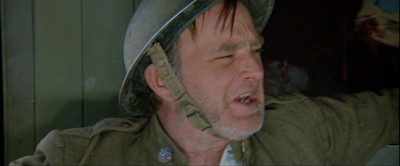
He says very little for most of the WWI sequences as we see Larry take everything in and get the lay of the land thanks to Piedmont’s tough love approach. He also experiences the horrifying effects, transporting the wounded and the dying from the battlefield to a nearby first aid station. Gone is the wisecracking Murray as Larry does everything he can just to survive. The actor does an excellent job of conveying the utter despair Larry feels after what he’s seen.
 
The war sequences are among the strongest in The Razor’s Edge, especially the last one where Larry and his squad are caught out in the battlefield and find themselves facing insurmountable odds. Larry is wounded and Piedmont is killed saving his life. After the danger has passed, Larry delivers a stirring anti-eulogy for his fallen comrade that is the one Murray gave his SNL castmate John Belushi when he died. It is a powerful and moving moment as it is something real and authentic captured on film.
 
Larry returns home from the war and finds himself adrift in life after being deeply affected by his experiences overseas. He spends the rest of the film finding himself by shedding his trappings of wealth, by working menial jobs and living in modest accommodations in Paris. This comes at a cost as his friends and family reject his new bohemian lifestyle, including Isabel who cannot understand why he is willing giving up his wealthy life of privilege. He tells her, “I got a second chance at life. I am not going to waste it on a big house, a new car every year and a bunch of friends who want a big house and new car every year!” She returns to the States and marries Gray while Larry continues his spiritual journey, gaining life experiences such as working in a coal mine where he meets a man that extols the virtues of India, which becomes Larry’s ultimate destination and the source of the spiritual enlightenment he seeks.
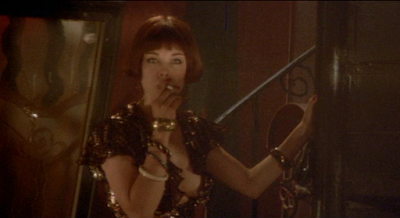
The always reliable Theresa Russell is excellent as one of Larry’s closest friends that goes on her own harrowing journey. There is a scene where a grief-stricken Sophie tearfully tells Isabel about her husband and son dying in an automobile accident that is raw as she chastises the nuns at the hospital in an understandable outpouring of grief. How does she find the will to live after such a horrible event? As a result, she numbs the pain that comes from a catastrophic loss by losing herself in alcohol and prostitution. Russell and Murray have wonderful chemistry together and her impressive dramatic chops forces him to up his game in their scenes together. The sequence where Larry gets Isabel to quit drinking and prostitution are well done as Murray uses his easy-going charm to incredible effect. This is the film at its most romantic as we see these two characters falling in love in Paris. Larry brings her back from the brink in a way that is quite moving.
 
One must give Murray credit, he gives the role everything he has in what was obviously a labor of love but he wasn’t a good enough actor back then to know when to tone down his comedic shtick and this results in an uneven performance. At times, he can’t quite cut loose of the broad physical comedy that made him a star, such as a scene where Larry runs from a gaggle of poor children begging for money on the streets of India. It must’ve been hard to let go of comedic tendencies that came so naturally to him. It would be years before he’d try it again and was more successful as the scary mob boss in Mad Dog and Glory (1993), but it wasn’t until he made Rushmore (1998) with Wes Anderson that he was experienced enough as an actor to modulate his performance to accommodate the tone of a given scene.
 
Filmmaker John Byrum met Bill Murray in New York City in 1974. The two men hit it off and wanted to work together but the opportunity wouldn’t arise until almost 10 years later. Byrum was interested in adapting W. Somerset Maugham’s The Razor’s Edge but assumed that 20th Century Fox, the studio that released the 1946 adaptation, still had the rights. When he approached the studio, they wouldn’t even take a meeting with him and after doing more digging found out that the rights had reverted to the Maugham estate. Unfortunately, recording industry executive Bob Marcucci had already acquired them. Byrum struck a deal – he would write the screenplay for no fee, for a 50-50 partnership and the right to direct. Marcucci agreed and in 1982, Murray joined the project after Byrum gave him a copy of the book. He wanted to make the film after reading 50 pages, drawn to the project as he was getting offered the same kind of scripts repeatedly and wanted to try something new.
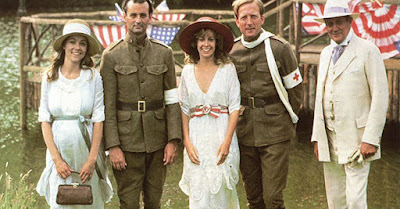
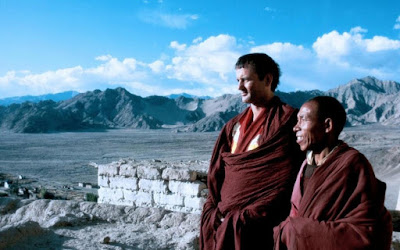
Byrum asked Murray to write the script with him and the two men worked on it for a year-and-a-half. Murray suggested writing in bars and restaurants as he believed “that good things come from difficult conditions, and I thought that no matter how badly we did, at least we’d have the experience of trying to concentrate on one thing while being distracted all the time.” To this end, they went to all kinds of places in Manhattan, New Jersey and upstate, southern New York. They wrote in spas near San Francisco and even a monastery in Ladakh, India during a religious war!
 
Byrum and Murray approached several studios but none were interested as they felt that no one wanted to see the comedian in a serious role. Dan Aykroyd was working on a script for an ambitious comedy called Ghostbusters that was generating a lot of interest around Hollywood and Columbia Pictures made a deal to bankroll The Razor’s Edge if Murray also starred in Ghostbusters. Murray agreed and started filming the former soon after.
 
It was a tough shoot lasting five months. The production fell behind schedule while shooting the war sequences. As Byrum said at the time, “To set up an explosion takes time. Then the wind might shift and destroy the shot, and you have to rewire all the explosives and organize the extras.” They shot for a month in Paris and then three hard weeks in India. At one point, a crew member attempted suicide and another developed such a crippling drinking problem they had to be sent home. Many got food poisoning with Byrum himself losing 12 pounds. While all of this was going on, the studio kept asking when they would be finished as they were eager for Murray to start shooting Ghostbusters.

As soon as principal photography was finished, Murray flew to London where he saw a rough cut of the film and then got on the Concord where he flew to New York City. He got off the plane, went straight to Madison Avenue and 62nd Street, and donned his Ghostbusters outfit. “A week before I had worked with yellow-hat lamas in the Himalayas,” he remarked in an interview.
 
Most film critics at the time were not kind to The Razor’s Edge. Roger Ebert gave it two-and-a-half stars out of four and wrote, “I didn't feel that the hero's attention had been quite focused during his quest for the meaning of life. He didn't seem to be a searcher, but more of a bystander, shoulders thrown back, deadpan expression in place, waiting to see if life could make him care.” In her review for The New York Times, Janet Maslin called it, “slow, overlong and ridiculously overproduced.” The Washington Post’s Paul Attanasio wrote, “Murray's style into the '20s is jarringly bizarre. Murray puts his comedy together with riffs drawn from contemporary popular culture, in the way a modernist sculptor welds fragments found in a junkyard. Much of the humor of The Razor's Edge simply isn't intelligible within the context of the period; he's a Connecticut hipster in President Hoover's court.” Finally, in his review for the Chicago Tribune, Gene Siskel gave the film three out of four stars and wrote, "If Murray's young Ghostbusters fans do go to see The Razor's Edge, they will receive a pleasant, thought-provoking surprise, a film that gently asks us to consider lifestyles other than the one into which we were born."
 
The Razor’s Edge is an impressively staged and beautifully shot period film directed by John Byrum (Heart Beat) and shot by Peter Hannan (Withnail and I) that gives a real sense of place. The film juxtaposes the opulent wealth of Larry’s friends back home with the physical limits he pushes himself for spiritual enlightenment. He makes an arduous journey through punishing environments, constantly pushing himself, testing his limits.

While hardly the cinematic disaster that it has been regard as over the years, it isn't that successful either. Chalk this up as a noble failure. Murray's heart was in the right place but he miscast himself in the lead role of Larry Darrell, a man who finds himself thrust from the upper crust of society to the battlefields of WWI where he is forever changed by the horrors he witnesses, motivating him to find personal enlightenment in India. Timing is everything and at the time of its release mainstream moviegoing audiences did not want to see Murray in a serious role. As a result, The Razor’s Edge tanked at the box office the same year that the crowd-pleasing Ghostbusters was a huge hit. To be fair, Murray hadn’t developed the dramatic acting chops to pull off a role like Larry Darrell. He delivers an uneven performance in an uneven film. Understandably, disappointed with its reception and disenchanted with making movies, Murray took his family to Paris and except for a cameo in Little Shop of Horrors (1986), didn’t act for four years.
 

SOURCES
 
Crouse, Timothy. “Bill Murray: The Rolling Stone Interview.” Rolling Stone. August 16, 1984.
 
Pollock, Dale. “Bill Murray on The Razor’s Edge After Ghostbusters.” The Victoria Advocate. October 29, 1984.
 
Weinstein, Wendy. “John Byrum Traverses The Razor’s Edge.” The Film Journal. September 1984.

Friday, August 28, 2015

Beach Red

In his book of collected film criticism, Ghosts in the Machine, Michael Atkinson makes a convincing argument that actor/director Cornel Wilde is more of a maverick filmmaker than the much more celebrated Sam Fuller. To be fair, Wilde has far fewer directorial efforts than Fuller – only nine – but each one attempts to push the boundaries of genre and audience expectations. This is certainly true of Beach Red (1967), an adaptation of Peter Bowman’s 1945 novella of the same name, which is a visceral, unsentimental look a group of United States Marines that land on an unnamed Japanese fortified island in the Pacific during World War II. The film features the occasional surreal imagery that anticipates Apocalypse Now (1979), harrowing battle scenes that likely inspired the ones in Saving Private Ryan (1998), and voiceover narration of various soldiers’ thoughts coupled with flashbacks of their lives back home done years before Terrence Malick would do the same in The Thin Red Line (1998).

To wit, the film’s first image is that of a jungle a split second before it is blown up – one that Francis Ford Coppola would steal outright and use for even more dramatic effect in the aforementioned Apocalypse Now. The opening credits play over paintings of battle scenes depicting Japanese and American pastoral settings while Jean Wallace (Wilde's wife) sings the mournful title song, establishing the anti-war stance this film takes.

In an audacious move, the last painting morphs into the first scene as we meet the tough-talking Marines en route to a Japanese island. They gripe amongst each other while Captain MacDonald (Cornel Wilde) looks over his men and shares his thoughts about war via voiceover narration, anticipating a similar technique employed by Malick in his own World War II epic. However, Wilde is not the thoughtful philosopher Malick is and MacDonald’s musings definitely skew closer to the no-nonsense prose of Sam Fuller. We also get the inner thoughts of soldiers scared of dying, which is quite effective as they sit in a boat headed for the island and an uncertain fate.


The beach landing is rendered in brutal fashion as men are shot and killed before they reach the beach. Wilde does an excellent job of giving a sense of scale with long shots of hundreds of men wading through the water while explosions go off around them and bullets whiz by dangerously. He doesn’t shy away from the horrors as soldiers wade past severed limbs and a young man, paralyzed by fear, gets an arm blown off by mortar fire in a scene later recycled in Saving Private Ryan. There is a refreshing lack of sentimentality as Wilde grimly depicts the brutality of war and arbitrary nature of death. Why do some men die while others are spared? Beach Red suggests that is random and many survive by sheer luck.

While Wilde and co-star Rip Torn get significant screen-time, no one character is fully developed – the filmmaker has bigger fish to fry. He’s more interested in depicting the horrors of war in unflinching detail. The refusal to focus on one or two characters puts the viewer off balance because they don’t know who to identify with and this adds to the unpredictable nature of Beach Red.

Wilde also gives significant screen-time to the Japanese, showing one of its commanders thinking about his wife and life at home. He also shows some of their devious tactics, like putting a decoy up in a tree for the Marines to shoot at and then kill them, or Japanese soldiers dressing up like American ones in order to get close enough to kill them. He also attempts to humanize the Japanese by presenting a scene where we see foot soldiers getting ready for the advancing Marines and they joke and talk amongst themselves – one guy even sketches a flower to the pass the time. This prevents them from being rendered as merely anonymous monsters.


Wilde employs all sorts of ballsy techniques for the time, like briefly adopting a first person point-of-view of a Marine making his way through tall grass en route to stopping a Japanese machine gun nest. The filmmaker also uses freeze frames to capture a soldier’s fear of stabbing himself with his own bayonet in jarringly effective fashion. In another scene, MacDonald’s flashback about his wife back home is rendered via a montage of still images while she laughs about something, which is followed by footage of her embracing him as she gets upset that he is going to war. These broad strokes succinctly show what’s at stake for him. Wilde doesn’t telegraph these techniques but rather crudely inserts them for maximum effect. The unconventional way he uses these techniques keeps us constantly on edge and adds to the unpredictable nature of the film.

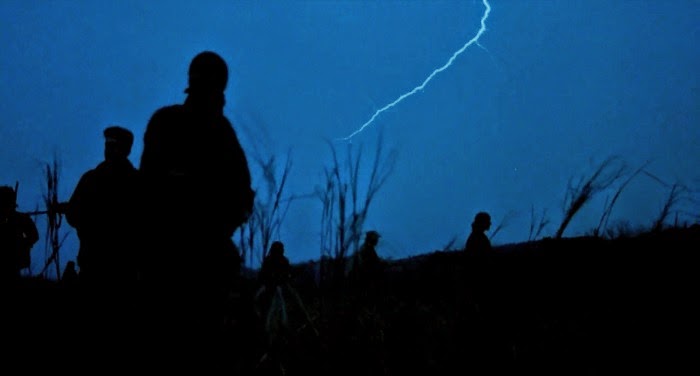
It is interesting to note that Beach Red came out when the United States’ involvement in the Vietnam War was heating up and one can’t help but wonder if Wilde meant his film to be a warning, of sorts, about the brutality of such conflict. This is particularly apparent when the Marines make their way through dense jungle not unlike the ones in ‘Nam.


For a film made in the late 1960s, the depiction of violence is surprisingly graphic, anticipating Sam Peckinpah’s orgy of carnage in The Wild Bunch (1969). Beach Red certainly lives up to its name as men have limbs blown off, are shot in the neck, are brutally stabbed, and have arms broken with sickening snaps. Wilde’s lack of polish as a filmmaker actually works in the film’s favor as it reinforces the visceral depiction of war in a way that more sophisticated films do not. He manages to eschew the two-fisted heroics of some of Fuller’s war films in favor of gritty realism mixed with experimental techniques. Beach Red doesn’t really say anything new about war but does find new ways of depicting its hellish nature.

Friday, February 20, 2015

Platoon

Oliver Stone’s Platoon (1986) was not the first film about the Vietnam War. It was, however, the first one to be made by a man who had served as a foot soldier (with the 25th Infantry Division) in the conflict. Before it was the rah-rah propaganda of The Green Berets (1968). The melancholic drama of The Deer Hunter (1978). The surrealism of Apocalypse Now (1979). Although, in good company with many outstanding films about one of the most combative periods in our country’s history, both stateside and overseas, they lacked the gritty realism of Platoon. Stone’s film not only captured the sights and sounds of what it was to be a soldier in those impenetrable jungles, but also got the little yet crucially important details – their lingo, the tight brotherhood in each squad and the way they carried themselves as well as how they carried their equipment. Through every vein of the film runs an authenticity that only a filmmaker like Stone could give it.

If the aforementioned films had been released too close to the war, Platoon came along at just the right moment when enough time had passed so that the American public was more receptive to revisiting a war that tore this country apart, from decorated officers coming home to college students who had never touched a gun in their lives. It struck a chord with people in a way that previous films had not. Stone’s film was a commercial and critical success, catapulting him and his young cast of up and coming actors into the spotlight while also kickstarting a cottage industry of Vietnam War-themed films (Full Metal Jacket; Hamburger Hill), television shows (China Beach; Tour of Duty), novels (Chickenhawk; Going After Cacciato), and even comic books (The ‘Nam).

Platoon focuses on the 25th Infantry, Bravo Company in September 1967 with new recruit Chris Taylor (Charlie Sheen) as the audience surrogate and our introduction to this world. We see the war through his eyes, from that first blast of bright light as he walks off the plane with other new recruits and they see a collection of body bags. They are then taunted by a group of battle-hardened veterans heading home. That will be them some day... if they live long enough.


Stone cuts to the jungle with a beautiful establishing shot from a helicopter to show how impenetrable it is before dropping us in the middle of dense foliage that makes it hard to see more than a few feet in front of you. Robert Richardson’s cinematography conveys the dense landscape and how difficult it must’ve been to navigate, especially for a new recruit like Chris whose inexperience is glaringly obvious as he brings too much gear, becomes dehydrated and is eaten alive by red ants.

Stone spends the first ten minutes immersing us in the jungle with the sounds of birds and other exotic animals and the oppressive heat that you can see on the sweaty, tired faces of the soldiers. We observe how they interact with each other adopting lingo that is a mixture of Vietnamese and military jargon before Chris’ voiceover narration kicks in and he gives us initial observations after a week of being there.

The film’s rich atmosphere is evident in the first set piece where the platoon sets up to ambush the enemy in the middle of night during the pouring rain. Stone ratchets up the tension as Chris wakes up after falling asleep to see the man who relieved him on watch now asleep and several silhouetted figures emerging from the shadows. Chris is frozen by fear and indecision – does he go for his rifle or the explosives that were set up for the ambush? Stone shows how hard it is to fight in the jungle with a night-time ambush that goes bad. Everything happens so fast and is so chaotic that it is hard to follow what is going on until it’s all over.


Thirty minutes in and Stone establishes a platoon divided into two factions: the “heads,” dope smoking guys who listen to rock ‘n’ roll music, just want to survive the war and go home, and the “juicers,” beer-drinking lifers that listen to country music and who actually like it there or, at the very least, believe that what they are doing is right. The leaders of these two groups, Sergeant Elias (Willem Dafoe) and Sergeant Barnes (Tom Berenger), are polar opposites that Chris gravitates towards and must ultimately choose between. Stone makes it pretty clear which side he prefers by having Chris initiated by the heads and bonds with them over Motown music and pot.

Stone shows how the deaths of three of their own angers and frustrates the platoon and they direct their wrath on a nearby village with Barnes focusing their rage through him. It is an ugly sequence as the soldiers kill animals and villagers, in particular, a harrowing scene where Kevin Dillon’s psycho redneck brutally kills a handicapped young man. Things go from bad to worse when Barnes interrogates the village chief and when he doesn’t get the answers he wants kills the man’s wife and then puts a gun to his young daughter’s head until Elias intervenes.

The village sequence is important in that it is the catalyst that causes a serious fracture within the platoon, one that has serious repercussions later on. It also symbolizes America’s might makes right mentality, underlining how out of control things got over there as the line between the enemy and innocent villagers became so blurred that for some there was no difference. This sequence also shows how the frustration and madness of the situation could get out of hand with horrible results.


Stone does a good job of getting the pulse of both sides of the platoon, letting us know where Barnes and Elias are coming from. For the former, he believes Elias is like the politicians in Washington, D.C., “trying to fight this war with one hand tied around their balls,” while the latter admits to Chris that he’s disillusioned with fighting this war, sagely predicting, “What happened today is just the beginning. We’re gonna lose this war. We’ve been kicking other people’s asses for so long I figure it’s time we got ours kicked.” It’s a nice, quiet moment between Chris and Elias that Willem Dafoe handles wonderfully with a world-weary subtlety much as Tom Berenger approaches his scene with a less-is-more attitude. His intense, thoughtful stare says it all and one rightly assumes that these moments are the calm before the storm.

At that point in his career, Willem Dafoe was known for playing bad guy roles in films like Streets of Fire (1984) and To Live and Die in L.A. (1985) and so casting him as a good guy in Platoon must’ve seemed like a gamble. Dafoe is excellent as a dedicated soldier who takes the time to teach Chris a few things in order for him to survive. It’s a very soulful performance as he acts as the platoon’s conscience. Elias cares about his men and wants to see them all go home alive.

In contrast, Tom Berenger had been known for playing lightweight, good guy roles but caught Stone’s eye with his layered performance in The Big Chill (1983). He gives an absolutely ferocious performance as an intense, imposing figure, a malevolent force of nature with a penetrating stare and a twisted scar down one side of his face. Barnes rules his men with an iron fist. He’s a tough man who leads by example, strict and unwavering in his beliefs. He is concerned only with maintaining his functioning war machine and when he spots a spanner in the works, as he does with Elias, he sees it as a malfunctioning part that must be removed and replaced.


Late in Platoon, Berenger delivers a fantastic monologue when Barnes confronts the heads, sharing his worldview with them. He even calls them out, telling them to kill him in almost pleading fashion that is unpredictable, only adding to the tension of the scene. It’s a speech that runs the gamut and the actor works the scene, moving around the space, and interacting with everyone around him in a way that is impressive to watch. Berenger hadn’t really done anything before this film to suggest such intensity and his performance was a revelation and is still his best to date.

Stone assembled an impressive cast of young actors that included Johnny Depp, Keith David, Kevin Dillon, Forest Whitaker, and John C. McGinley who appear with varying amounts of screen time. McGinley, for example, makes the most of his moments as the cocky sycophant O’Neill and Dillon is particularly memorable as a racist murderer while Depp and Whitaker hardly get any time to make an impact.

The battle scenes have a visceral, you-are-there feel to them as Stone wisely opts to eschew a manipulative score for the jarring sounds of battle as orders are barely understood amidst the sounds of explosions and gunfire. Soldiers are killed from inexperience and ineptitude as much as for being in the wrong place at the wrong time. The Deer Hunter and Apocalypse Now presented very stylized representations of combat in Vietnam while Platoon is much more realistic, presenting it as noisy and chaotic.


Platoon packs in a lot of stuff during its running time: botched ambushes, the destruction of a village, discovery of an underground bunker, and a climactic, large scale battle that probably wouldn’t have all gone down in such a limited time frame, but Stone isn’t interested in making a documentary. His film is a dramatization of a composite of several events that gives the audience some idea of what it was like there and what these guys went through. Chris’ voiceover narration gets a bit pretentious at times but that’s the point as he comes from an educated background of privilege, fancying himself a literary chronicler of his platoon’s exploits. The images of what he experiences are so powerful that they render his sometimes cliché musings ineffectual.

After dropping out of Yale University and a stint with the Merchant Marines, Oliver Stone enlisted the United States Army, arriving in Vietnam on September 15, 1967 as a member of the second platoon of Bravo Company, third battalion, 25th Infantry Division. He was wounded twice and awarded the Bronze Star for combat gallantry and a Purple Heart with Oak Leaf Cluster. He was later transferred to the First Calvary Division and finally returned to the U.S. after more than 15 months in 1968.

By mid-1976, Stone’s marriage had broken up, he was struggling financially and his screenwriting career had yet to take off. Ever since he had returned from Vietnam in November 1968, he had wanted to write about his experiences in the war: “I realized I had forgotten a lot in eight years. I thought, ‘If I don’t do it now, I’m gonna forget.’ It’s part of our history nobody understands—what it was like over there.” Stone decided that he would write about his experiences as truthfully as possible, making only slight adjustments, changing some names and combining a few characters. “It took me eight years to get to that screenplay, because I couldn’t deal with it before. I needed the distance.”


Stone finished the script in a few weeks, finding it challenging in getting the tone right and also the character of Elias, which he envisioned as a “free spirit, a Jim Morrison in the bush.” With only one B-horror movie (Seizure) to his credit, Stone couldn’t find anyone willing to buy his script until Sidney Lumet showed some interest and toyed with the idea of directing with Al Pacino starring. After the scripts for Midnight Express (1978) and Scarface (1983) were made into wildly successful films, filmmaker Michael Cimino, whom Stone co-wrote the script for his film Year of the Dragon (1985), encouraged him to get Platoon going again with him in a producer capacity. In 1984, Stone cast it and went to the Philippines to scout locations. Dino de Laurentiis, who agreed to back it, pulled out. He was willing to cover the $6 million budget but could not find a distributor willing to take a chance on the commercially risky project.

Stone took the project’s collapse hard and felt that his career was over. In addition, De Laurentiis refused to give Stone back his script until he paid for the cost of the Philippines location scout. This experience, and witnessing how his script for 8 Million Ways to Die (1985) was completely rewritten, made Stone wary of making Platoon for a Hollywood studio. In 1985, he successful wrestled the rights for his film away from De Laurentiis and gave the script to producer Gerald Green. He sent it to John Daly over at Hemdale, a small British independent production house. Both Daly and Green loved the script and wanted to make it with Stone as director and Orion Pictures as distributor. Producer Arnold Kopelson, a lawyer turned movie producer, read the script and felt it was a game changer. He contacted Green and told him that he would raise the money for Platoon.

After making Salvador (1986), Stone launched right into Platoon in February 1986, two weeks before the former was released in theaters. The filmmaker was locked into a tight nine-week shooting schedule and used the same crew that worked on his previous film. In addition, he hired retired Marine Corps captain and Vietnam War veteran Dale Dye as technical advisor. It would be the beginning of a long-standing collaboration between the two men over many films.


When it came to casting, Stone saw Tom Berenger in The Big Chill and was impressed by his performance: “I felt like there was a redneck side to Tom, an ugly side that could really be seething, and I used it.” When it came to Willem Dafoe, Stone saw him in films like Streets of Fire and To Live and Die in L.A., “playing ugly roles and I thought there was something spiritually heightened because of the ugliness. So I went the other way.” Dafoe had met Stone when he first tried to make Platoon and then he almost got John Savage’s role in Salvador. Charlie Sheen auditioned for the role of Chris in 1983, but Stone felt he was “gawky and underweight,” according to the actor, and offered the role to his brother Emilio Estevez with Michael Pare cast as Barnes (both Mickey Rourke and Kevin Costner were considered for the part). When the film was restarted, Stone considered Keanu Reeves, Kyle MacLachlan and Johnny Depp for Chris. Sheen had made a couple of films and auditioned again, this time Stone cast him in the part.

The cast was scheduled to arrive in the Philippines in February 1986 shortly after the presidential election, but when it went sour people died and revolution erupted into civil war! President Ferdinand Marcos fled on February 25 and Corazon Aquino took over. Dafoe had flown in early and went to sleep in a Manila hotel only to wake up to the sounds of tanks in the streets. The rest of the cast flew in nine days later. Stone contemplated moving the production to Thailand, but it would have been a logistical nightmare. He held out and made new deals with the new regime, including renting all the military equipment from the government. Stone said, “I remember the helicopters were pretty dangerous because they weren’t maintained well.”

Once the cast assembled in the Philippines, Dye proceeded to put them through a grueling 14-day boot camp in order to get them in the foot soldier mindset: “Oliver said, ‘I want you to take them to the bush, beat them up, make them understand what it was like for you and me in Vietnam.’” Used to staying in hotels and being pampered, the actors underwent culture shock as they were constantly in the bush with no beds, bathrooms, hot showers or any of the creature comforts they were used to. Dye had them dig their own foxholes to sleep in, set ambushes, learn how to use various weapons, and go on ten-mile patrols with full gear and weapons. As Sheen later remarked, “This was a cram course in an infantryman’s life. And it was rough.”


At dusk on the first night, Dye asked the special effects people to stage a mortar “attack” without the exhausted actors knowing what was going on, yelling at them to return fire. Dye said, “It was utter chaos and they were shaking by the time it was dark.” The actors learned military lingo, listened to period music and had to refer to each other by the character’s names. After two weeks of this, they bonded and were ready to start filming. The cast went from training straight into principal photography. Dye remembers, “They were just flat exhausted and that was exactly the look that Oliver wanted.”

The production was not without its problems as the cast and crew endured fights, injuries, a near-fatal viper bite, insects, monsoon rains, and the firing of 4-5 production people. There were also several close calls with the helicopters, including cinematographer Bob Richardson almost getting clipped by the rotor of one. In another incident, Dye, Richardson and Stone were in a helicopter that almost hit a ravine! Stone remembers, “We scraped it by that much. We were so low, and these Filipino pilots are good, but they’re crazy.” With the start of the rainy season looming rapidly and running out of money, Stone compromised the last few shots in order to make the deadline and did it with a day to spare.

Platoon received mostly positive reviews from critics at the time. Roger Ebert gave the film four out of four stars and wrote, “There are no false heroics in this movie, and no standard heroes; the narrator is quickly at the point of physical collapse, bedeviled by long marches, no sleep, ants, snakes, cuts, bruises and constant, gnawing fear.” In his review for The New York Times, Vincent Canby wrote of Stone’s direction: “He doesn’t telegraph emotions, nor does he stomp on them. The movie is a succession of found moments. It’s less like a work that’s been written than one that has been discovered … This one is a major piece of work, as full of passion as it is of redeeming, scary irony.”


The Los Angeles Times’ Sheila Benson wrote, “This is movie-making with a zealot’s fervor … [Stone] clearly wants us to understand what fighting in that war was like. He succeeds with an immediacy that is frightening. War movies of the past, even the greatest ones, seem like crane shots by comparison; Platoon is at ground zero.” In her review for the Washington Post, Rita Kempley praised Berenger and Dafoe’s performances: “They are explosive, mythic Titans in a terrible struggle for the soldier’s souls.” Finally, Gene Siskel gave it four out of four stars and wrote, “Platoon is filled with one fine performance after another, and one can only wish that every person who saw the cartoonish war fantasy that was Rambo would buy a ticket to Platoon and bear witness to something closer to the truth.”

Platoon presents the Vietnam War as a moral quagmire, an impossible situation that the United States had no chance of winning because they were so out of their depth. All the average soldier could hope to do was survive. Stone’s film shows what it was like for them to be there with startling detail and authenticity, from the camaraderie to the madness. For Stone and a lot of veterans I imagine the experience of making the film and seeing it was therapeutic. After years of being looked down on by an uncaring public that saw the war as an embarrassment, Platoon was an opportunity for veterans to get some much deserved and long overdue respect.


SOURCES

Nashawaty, Chris. “Oliver Stone Talks Platoon and Charlie Sheen on the Vietnam film’s 25th Anniversary.” Entertainment Weekly. May 24, 2011.

Norman, Michael. “Platoon Grapples with Vietnam.” The New York Times. December 21, 1986.

Riordan, James. Stone: A Biography of Oliver Stone. Hyperion. 1995.

Willistein, Paul. “Platoon: The Vietnam Odyssey of Oliver Stone.” The Morning Call. February 1, 1987.

Friday, December 12, 2014

Brothers

So far, most films about the current war in the Middle East have not fared well at the box office with efforts like Home of the Brave (2006), In the Valley of Elah (2007) and Stop-Loss (2008) getting limited distribution or underperforming at the box office (or both), often garnering little interest with mainstream audiences. People don't want to be reminded of the problems we face over there or the effects of it here at home when our soldiers return. To counter this attitude with his film Brothers (2009), director Jim Sheridan cannily cast marquee names like Natalie Portman, Tobey Maguire and Jake Gyllenhaal in an attempt to appeal to a mainstream audience. A remake of Susanna Bier's 2004 Danish film Brodre, Brothers performed modestly well at the box office, but was largely unseen and remains an absorbing look at just not what soldiers go through, but how their loved ones deal with them once they get home. It also features powerful performances from the three aforementioned lead actors.

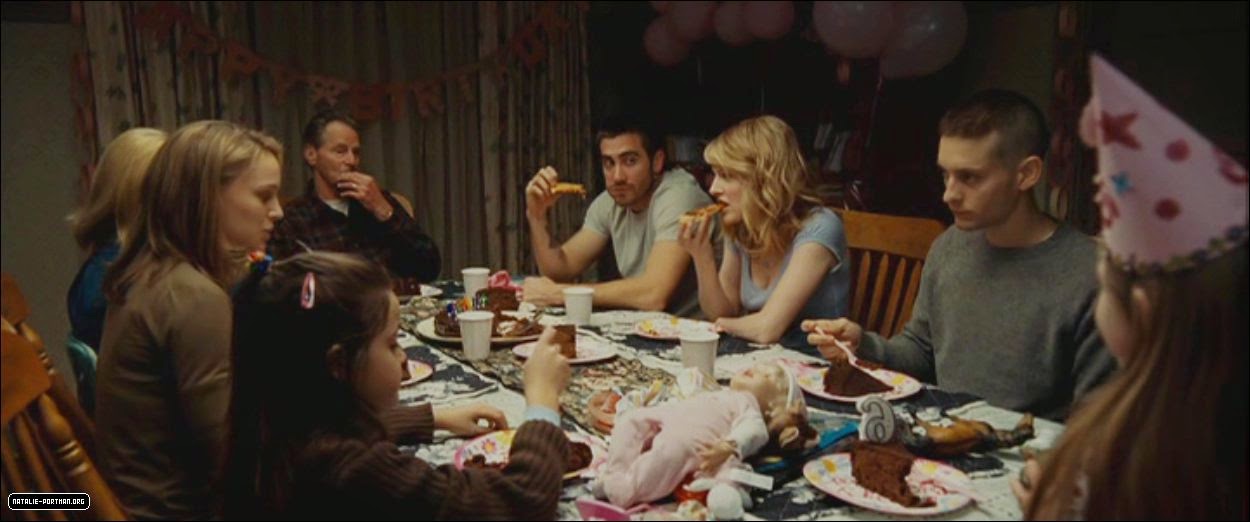
Captain Sam Cahill (Tobey Maguire) is a United States Marine heading back to Afghanistan for another tour of duty. He’s a loving family man with a beautiful wife named Grace (Natalie Portman) and two adorable daughters, Isabelle (Bailee Madison) and Maggie (Taylor Geare). Tobey Maguire and Natalie Portman are instantly believable as a married couple that clearly loves each other. There is a familiarity that couples have and even though they don’t have much screen-time to convey it before Sam ships off, they pull it off in the way their characters look and interact with each other. In contrast, his brother Tommy (Jake Gyllenhaal) has just been released from prison after serving time for armed robbery. He’s the black sheep of the family and Grace doesn’t think too highly of her husband’s brother, but is nice to him in person. While Sam and Tommy get along fine there is tangible tension between their father (Sam Shepard) and latter. This is evident in an uncomfortable family dinner where their father makes it known that he sees Sam as a hero for serving his country and Tommy as a disappointment, causing the latter to make a scene. You can cut the tension with a knife during this scene until Tommy’s controlled outburst brings long simmering resentments to the surface.

While on a mission over hostile territory, Sam’s helicopter is shot down and he’s presumed dead. Sheridan makes the right choice when depicting the standard scene of the wife being told that her husband has been killed by showing Grace coming to the door and breaking down once she sees the military officers. No words need to be said and the scene ends there because Portman’s reaction says enough. Instead, Sheridan shows Grace’s full-blown emotional breakdown when Tommy stops by later that night to return Sam’s truck. Rather than console her, he erupts in anger and storms off. It’s an odd reaction, but in character as Tommy is clearly someone with a lot rage inside of him.


Tommy starts spending more time with his brother’s family, helping around the house and the rest of the film plays out the growing attraction between him and Grace. Meanwhile, Sam survives the attack on his helicopter and is being held prisoner and tortured.

Natalie Portman turns in a wonderfully nuanced performance as a woman trying to process the unbelievable grief she is experiencing. There are scenes where you can see Grace putting on a brave face for those around her, especially her children, but every so often she lets it slip and reveals the hurt that exists under the surface. For example, there is a scene where everyone throws a surprise birthday party for Grace and as she’s about to blow out the candles on her cake. There is a moment where she has a distant, haunted look before catching herself and regaining her pleasant façade. It’s a nice bit of acting from Portman and throughout the film she conveys a complex range of emotions as the actress shows how Grace processes the grief of her husband’s death and her emerging, conflicted feelings for Tommy.

Brothers is a slow burn, slice-of-life film as Sheridan dives deep into this family, examining the dynamic between Tommy and his father, a veteran of the Vietnam War. There are hints that his strict, perhaps even abusive style of parenting pushed Tommy to the kind of life he leads – an aimless ne’er’-do-well with a past full of regrets. The more time he spends with Grace and her daughters, the more of an influence they have on him. They provide a stabilizing effect by giving him a sense of purpose. Jake Gyllenhaal does a nice job of conveying Tommy’s inner turmoil, which he carries around with him. Initially, he gets to play the brooding, moody brother, but over the course of the film he transforms into someone who is more open and responsible. It’s a natural progression that the actor conveys expertly.


Tobey Maguire’s character also undergoes a transformation from genial family man to paranoid soldier suffering from severe post-traumatic stress disorder after spending several months as a prisoner of war. The actor goes through an impressive physical transformation as Sam is beaten and deprived of sleep so that he becomes a shadow of his former self. He does what he has to do in order to survive. If Brothers has a flaw it is that too much time is spent in Afghanistan showing how Sam’s humanity is stripped away by his captors. I understand the purpose of these scenes – they explain his behavior later on when he finally returns home, but as they continue and Sam’s situation gets bleaker, the balance that Sheridan has maintained up to this point is threatened. The Afghanistan scenes could have been left up to our imagination and conveyed through well-written expositional dialogue delivered by the talented Maguire.

As he demonstrated with In America (2002), Sheridan has a real affinity for getting naturalistic performances out of child actors and Brothers is no different, especially from Bailee Madison who plays the slightly older of the two daughters. Isabelle is more aware of what is going on and that something isn’t right with her father. This realization, as it plays briefly over her face in one scene, is absolutely heartbreaking. As a result, she is more emotional than her happy-go-lucky sibling. Madison really stands out during a tense dinner scene towards the end of the film when Isabelle intentionally baits her father. She is acting out, like a petulant child, but is also the only one in the family who has the courage to address the big elephant in the room – Sam’s increasingly erratic behavior.

Originally, Jim Sheridan was writing a story about two brothers growing up in Ireland but couldn’t get the financing for it. He ended up watching Susanna Bier's 2004 Danish film Brodre and liked it so much he thought it could be remade for North American audiences, changing the emphasis from an illicit love triangle to that of the family. Jake Gyllenhaal was the first actor to sign on, followed by Tobey Maguire and Natalie Portman. 


At the time she signed on to do Brothers, Portman made a conscious decision to pick more mature roles: “I’m trying to find roles that demand more adulthood from me because you can get stuck in a very awful cute cycle as a woman in film – especially being such a small person.” To prepare for the part, the actress met with Army wives in order to understand how they managed their lives. She also bonded with the young actresses playing her daughters by having them over for baking parties and hanging out with them between takes. She and Maguire were able to play husband and wife so well because they had known each other for 14 years prior. She said, “Just knowing someone for that long is great history to have when you’re walking on set and playing husband and wife.” In addition, she had also known co-star Gyllenhaal for ten years.

During rehearsals and on set, Sheridan played a live version of Bruce Springsteen’s “The River” to get Gyllenhaal in the mood of a scene where Tommy and Grace share a quiet moment together. For Gyllenhaal, the song reminded him of the connection to his family, in particular his father. In working with the child actors, Sheridan had his own specific method: “what I do is present a scene to them as a problem, a kind of puzzle, and then ask them questions, what they think the character is thinking, or wants to do.”

Brothers received mixed reviews from critics. Roger Ebert gave it three-and-a-half out of four stars and praised Maguire’s performance: “This becomes Tobey Maguire’s film to dominate, and I’ve never seen these dark depths in him before. Actors possess a great gift to surprise us, if they find the right material in their hands.” In his review for The New York Times, A.O. Scott wrote, “And Brothers itself – a smart, well-meaning project – never quite pulls itself together. It has a vague, half-finished feeling, as if it had not figured out what it was trying to do. Which may amount to a kind of realism – an accurate reflection of where we are in Afghanistan.” Entertainment Weekly gave the film a “C+” rating and Owen Gleiberman wrote, “Brothers isn’t badly acted, but as directed by the increasingly impersonal Jim Sheridan, it’s lumbering and heavy-handed, a film that piles on overwrought dramatic twists until it begins to creak under the weight of its presumed significance.”


USA Today gave the film three out of four stars and Claudia Puig wrote, “Bailee Madison and Taylor Geare are excellent as Sam and Grace’s young daughters, derailed by their dad’s scary bouts of anger and his newfound coldness. The youthful portrayals recall the indelible roles of the young daughters in Sheridan’s wonderful 2003 film, In America.” The Los Angeles Times’ Betsey Sharkey wrote, “There will be echoes of that passion and poignancy in Brothers. But unlike the clear voice of those earlier films, Sheridan seems as conflicted as the Cahills about their virtues and failings.” Finally, in his review for the Washington Post, Michael O’Sullivan wrote, “Brothers is depressing as hell. And, like most war movies these days, it ends on a note that’s far from hopeful. But it’s good, and wise, and it feels true. Meaning, it hurts.”

Brothers is a fusion of Sheridan’s fascination with people put under extraordinary duress, like In the Name of the Father (1993), and families dealing with hardships, like In America. At times, Brothers feels like one of the films from the 1980s that dealt with families struggling to understand loved ones that had served time in the Vietnam War – In Country (1989) and Jacknife (1989) are two that come immediately to mind as spiritual antecedents to Brothers. In Sheridan’s capable hands, this film is a nicely observed character study that tries to show the trauma a soldier experience during war and what their family goes through at home, perhaps lingering a little too long on the hardships Sam endures in Afghanistan.

Brothers is a good film about an uncomfortable topic. It doesn’t offer any easy answers – how can it while we are still mired in this war? This will only come with time, but it exists as a document of where we are now. The war in the Middle East may be an unpopular one, but it is important that the stories of the people that fought it over there and continue to do so back home are told. By telling their stories maybe we can process how the war has affected us as a country.


SOURCES

Ditzian, Eric. “Brothers’ Star Tobey Maguire, Natalie Portman Talk ‘Growing Up Together.’” MTV.com. December 2, 2009.

Farquharson, Vanessa. “Jim Sheridan Reflects on the Betrayals at Brothers’ Core.” The Financial Post. December 4, 2009.

Freydkin, Donna. “Natalie Portman Transitions into Adult Role in Brothers.” USA Today. December 4, 2009.

“Springsteen’s The River Brings Gyllenhaal to Tears on Set.” WENN Entertainment News Wire Service. December 3, 2009.

Thompson, Bob. “When Irish Eyes are Filming.” Vancouver Sun. December 4, 2009.


Vaughan, R.M. “You leave it to the actors, really, to the acting.” Globe & Mail. December 4, 2009.

Friday, September 26, 2014

Pearl Harbor

“Like I see these people on the Internet saying, ‘Oh, it’s a travesty that Michael Bay is doing this story.’ ‘Oh, why’s he doing it?’ ‘Oh, he’s going to wreck it.’ It’s like shame on those people, you know? Shame on them!” – Michael Bay

I have this sick fascination with the Michael Bay movie Pearl Harbor (2001). It is just so awful, but kind of mesmerizing in its awfulness. The movie was his attempt to shift gears and show the world that he could do something other than mindless action movies. With this movie, Bay, armed with Randall Wallace’s subpar John Milius-esque screenplay, thought he could replicate the formula of James Cameron’s Titanic (1997) complete with Earth-shattering box returns. It was almost as if Bay expected the Academy to park a truck up to his front door and dump a bunch of awards on his doorstep because he was making an IMPORTANT MOVIE. One can almost imagine him thinking to himself, “This will be the movie they’ll remember me for,” with the same kind of hubris not seen since Charles Foster Kane thought he could make the news he was supposed to be covering.

Only that didn’t happen. Pearl Harbor didn’t make Titanic-sized numbers at the box office (although, $449 million worldwide ain’t bad), the critics hated it (let’s face it, by this point his movies had become critic-proof as the film’s producer Jerry Bruckheimer put it, “We made it for people, not critics.”) and it was nominated for more Golden Raspberry Awards than Academy Awards. Although, to be fair, it did win an Oscar for Best Sound Editing – hardly the dominance that Cameron’s movie demonstrated the year it walked away with 11 Oscars. The failure of Pearl Harbor was some kind of reality check for Bay and he retreated back to familiar turf with Bad Boys II (2003) and is now the caretaker of the Transformers franchise.

Bay lays it on thick right from the get-go as we watch two young boys play make believe they’re shooting down German planes in their father’s old biplane, the sequence awash in the golden hue of nostalgia as a crop duster flies overhead in slow motion while Hans Zimmer’s wistful score swells. It’s Tennessee 1923 and Bay then flashes forward to the best friends as aspiring hotshot fighter pilots in 1940, challenging each other like some sort of prototypical Top Gun (1986). One guy even says admiringly, “Those are some smooth aces,” and manages to do so with a straight face. This is only the first of many howlers courtesy of Wallace’s script.


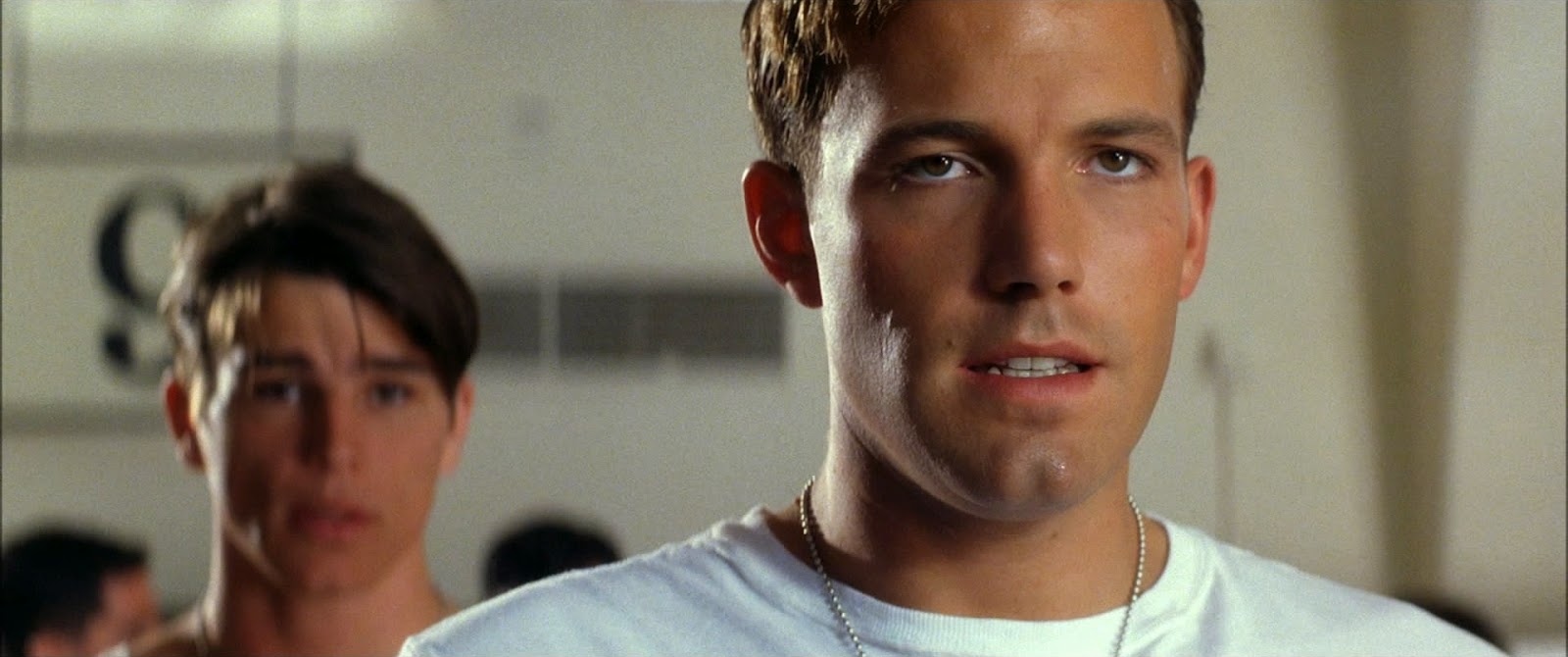
Cut to Rafe McCawley (Ben Affleck) being chewed out by his superior, Major Jimmy Doolittle (Alec Baldwin) for his screwball antics. Rafe is assigned to duty in England where World War II is raging, much to the dismay of his best friend Danny Walker (Josh Hartnett) who confronts him about it thus setting up the true romance of Pearl Harbor. No, it’s not the Hallmark Movie on steroids love affair between Ben Affleck and Kate Beckinsale, but Affleck and Josh Hartnett’s bromance. The scene depicting their tiff over Rafe leaving is the first indication that these guys were cast for their looks and not their acting, especially Hartnett who is borderline unwatchable at times. It’s not what he says per se, but how he says it – so wooden – that is so bad. The dialogue they’re forced to utter does them no favors.

The introduction of the beautiful nurses that Rafe and his fellow pilots are destined to meet reminds one that aside from choreographing explosions, Bay really knows how to photograph women, bathing the likes of Beckinsale, Jennifer Garner and Sara Rue, among others, in warm, inviting light as they gush about the hunky pilots they screened days ago. For whatever it’s worth they are all well cast and look like they came from that time period.

Rafe and Evelyn’s (Kate Beckinsale) meet-cute is largely played for laughs, both intentionally (he acts like a clumsy fool) and unintentionally (the dialogue is howlingly bad). As the scene dragged on I started to feel sorry for Affleck who not only has to try and sell this clunky dialogue, but do it with a bandage on his nose and acting like a child that needs to be taken care of, which is intended to be romantic, but comes across as laughable and insulting. And this is supposed to be the most romantic thing that has ever happened to Evelyn?! Dear Lord…


At first glance, the attention to period detail looks convincing, but a significant portion of the film’s Wikipedia page is spent pointing out the many historical inaccuracies, which is surprising with a production that had that kind of budget you’d think they’d have hired some decent technical advisors, but I can see Bay waving them aside in favor of his version of this time period, historical accuracy be damned! It’s Michael Bay’s version of the 1940s. Did he learn nothing from Steven Spielberg’s 1941 (1979), another notorious WWII big budget fiasco? At least Spielberg was trying to make a comedy; Bay has no such excuse with the unintentional hilarity that ensues between explosive action sequences.

Bay is on stronger ground with his depiction of the plane battles where Rafe engages with German planes over England. They are exciting and Bay does a nice job conveying the chaos of aerial battle as planes dive and roll amidst machine gun fire. However, things get complicated when Rafe apparently dies in battle and Danny and Evelyn wait months to get cozy as they console each other. Danny is a little less awkward in flirting with Evelyn than Rafe and Hartnett looks most comfortable in these scenes as he lets his hunky good looks do all the heavy lifting.

Big surprise, Rafe isn’t dead after all and shows up after Danny and Evelyn have consummated their relationship in typical Bay fashion – slow motion amidst virginal white parachutes. Awkward! Oh yeah, she’s pregnant with Danny’s baby. We have to endure this mind-numbingly dull soap opera for over an hour intercut with teases of the Japanese preparing for war while Dan Aykroyd’s Captain Thurman tries to convince the military brass that Pearl Harbor would be a probable target because it would devastate the Pacific fleet. Naturally, Danny and Rafe settle their differences by kickstarting a bar brawl. Fortunately, the Japanese sneak attack allows them to settle their differences fighting side-by-side.


“It’s like, people die all over the world in earthquakes, whatever, you know, in much huger numbers than at Pearl Harbor. But there was something; there’s something. You wonder, What is it? You think, Okay, only three thousand people died, but there’s something, you know?” – Michael Bay

About 86 minutes in and what we’ve been waiting to see, or, as Martin Lawrence puts it in Bad Boys II, “This shit just got real,” as Bay presents a chilling shot of low-flying Japanese fighter planes zooming by two boys standing on a grassy field. He intercuts tons of planes advancing while most of our heroes are asleep, blissfully unaware of what’s about to happen. Not surprisingly, the best part of Pearl Harbor is the actual attack on the place because it allows Bay to do what he does best – blow shit up. Bay tries to replicate the shock and awe of the first 25 minutes of Saving Private Ryan (1998) with a visceral depiction of the attack on Pearl Harbor. He’s able to use CGI to follow a Japanese bomb as it is launched from a plane and drops into a battleship, which ends up taking you out of the picture as you marvel at the stylish technique.

This sequence gives Bay a chance to indulge in explosive mayhem (or Bayhem) and man, does he ever cut loose. He makes sure we are thrown right into the middle of the action. There are some truly unsettling shots, like an ominous one of a Japanese torpedo traveling underwater and we can see the legs of countless men treading water above. That being said, it’s hard not get caught up in the carnage as we see scores of innocent sailors get blown and shot up. Not to mention, as badly as they are written, we care a little bit about what happens to Rafe and Evelyn and their friends. And yet, Bay can’t resist sticking blatant jingoistic images like the shot of American flag submerged underwater alongside men trying to stay alive.

He also can’t resist shooting the aftermath of the attack stylishly, smudging the lens with a Vaseline effect, distorting it so as to avoid an R rating with all the bloody casualties. There is the occasional odd shot, like a group of shambling burn victims framed like something out of George Romero zombie movie. Rafe and Danny help rescue men trapped in damaged ships and Bay frames Hartnett in a glamour shot, his hair stylishly mussed up, which feels sneakily exploitative and cheapens the pain and suffering around him.


Historical figures like President Roosevelt (Jon Voight) are reduced to caricatures and in what is meant to be a dramatic moment, but comes off as unintentionally ridiculous, he rises out of his wheelchair to make a point about the resilience of the human spirit. This gesture instead invokes a similar moment, although played for laughs, in Stanley Kubrick’s Dr. Strangelove or: How I Learned to Stop Worrying and Love the Bomb (1964). The last third of the movie features Alec Baldwin at his most Baldwin-iest as he barks out orders and makes inspirational speeches almost recalling his arrogant motivator of men from Glengarry Glen Ross (1992). The actor does his best to make his cliché-ridden, rah-rah dialogue sound half-decent through sheer force of will, but it isn’t easy.

Pearl Harbor might have been a passable movie if it had ended after the attack but no, we’ve got to end things on a feel-good high and so there is the tacked on Doolittle Raid, which transforms Pearl Harbor into a revenge movie. You can almost imagine Bay or Jerry Bruckheimer brainstorming ideas – how can we give Pearl Harbor a happy ending? The Doolittle Raid also seems to be included as a way to punish Danny for stepping out with Evelyn behind his best friend’s back. And so Danny gets to die a noble death while Rafe ends up with Evelyn to raise the dead man’s child.

Pearl Harbor attracted a large number of young actors into its vortex with the likes of Jennifer Garner, Sara Rue, Jaime King, and Michael Shannon who I’m sure their agents all told them to do the movie as it would be a big boost to their careers. There’s also a few dependable veteran character actors, most notably Tom Sizemore, who brings a much-needed gritty charisma that fresh-faced pretty boys like Affleck and Hartnett can’t.


When my wife and I saw Pearl Harbor in a theater – like many we are suckered by the rather solemn, impressive-looking trailers – three-quarters of the way through she felt a rat brush by her foot. We realized that maybe we weren’t the key demographic for this movie and the presence of rats was a sign. We beat a hasty retreat and upon leaving the theater demanded our money back. We met an usher on a butt break who asked us what we thought of the movie. We told him of our woes and asked him how it ended and he bemusedly recounted the Doolittle Raid and the fates of Rafe and Danny. He did a better job of telling the story than Bay!


Pearl Harbor may feature the most harrowing depiction of the battle on film, but surrounds it on both sides with instantly forgettable filler. It has an odd place in Bay’s wrongraphy. It is the director at his most restrained with some shots lasting at least a couple of seconds before an edit (that’s a snail’s pace for him). It’s not that Bay made a movie about Pearl Harbor, but that he did a bad one. Shame on him! Instead of becoming a chapter of history like Pearl Harbor or 9/11 that we will always remember, Bay’s movie belongs to a chapter of cinematic history we’d like to forget. One good thing came out of this recent experience of watching Pearl Harbor – it finally sated my curious, morbid fascination with it. I don’t feel the need to every watch it again.


SOURCES

Jones, Kent. "Bay Watch." Film Comment. July/August 2001.

Laskas, Jeanne Marie. "The Life of Michael Bay." Esquire. July 2001.