"...the main purpose of criticism...is not to make its readers agree, nice as that is, but to make them, by whatever orthodox or unorthodox method, think." - John Simon

"The great enemy of clear language is insincerity." - George Orwell

Friday, June 18, 2010

Frantic

By the time he had made Frantic (1988), filmmaker Roman Polanski was in need of a commercial hit at the box office. His previous film Pirates (1986) bombed spectacularly both with audiences and critics. In a canny move, he cast Harrison Ford as the lead actor in his new film. As luck would have it, Ford was in a very interesting place, career-wise. Thanks to the massive success of the Star Wars and Indiana Jones films, he had the clout and the confidence to try riskier films that played around with the public’s perception of him. With Blade Runner (1982), Ford played an emotionally distant cop hunting down replicants in a future dystopia. In Witness (1985), he played a gruff Philadelphia cop who hides out in Amish country when he uncovers corruption in his department. Mosquito Coast (1986) may have been his most challenging role as an inventor who moves his entire family to the jungles of South America and gradually loses his mind.

Finally, he took a stab at comedy with Working Girl (1988) playing a no-nonsense business executive helping a plucky young secretary masquerading as a financial executive broker an ambitious merger deal. Throw in Frantic and you have a pretty diverse collection of films that saw Ford unafraid to play abrasive even sometimes unlikable characters. With Polanski’s film, Ford would be on the director’s turf, thrust in a world of moral ambiguity with a dash of paranoia. It made for a fascinating clash of styles and results in an excellent thriller and something of an under-appreciated work in both men’s filmography.

“Do you know where you are?” These are the first words spoken in Frantic and they foreshadow the feelings of displacement that the film’s protagonist will experience. Sondra Walker (Betty Buckley) says these words to her husband Dr. Richard Walker (Harrison Ford) as they drive from the airport to their Paris hotel in a taxi cab. He’s there to attend a convention and en route their taxi develops a flat tire. The driver is unable to fix it which is not a good start to the Walkers’ trip so far and a bad omen for what is to come.

Polanski establishes the dynamic between Richard and Sondra in a relatively short time as they get settled in their hotel room. Harrison Ford and Betty Buckley do an excellent job portraying a couple that have clearly been married for some time. This is evident in the familiar shorthand between them, like how they act towards each other, the playful needling Sondra gives her husband about the swanky luncheon he’s supposed to have with the chairman of the convention at the Eiffel Tower. This early scene also establishes how out of his element Richard is as she points out that he doesn’t speak French and doesn’t even know how to use the hotel room phone. We see how easily they can get on each other’s nerves and how they quickly reconcile like any couple who has been in love for a long period of time.

They soon discover that Sondra grabbed the wrong suitcase at the airport and has someone else’s luggage. Richard takes a shower and in those few minutes his wife disappears. Polanski places the camera in the shower with Richard so that we see and hear what he does. The camera slowly pushes in in an ever-so slightly way – it’s subtle but does make you wonder what’s happening in the other room. Initially, Richard most likely assumes that Sondra went out to buy some clothes or is in another part of the hotel. However, enough time passes that he becomes understandably concerned and decides to search the hotel lobby. Polanski’s camera follows Richard from a distance so that he looks slightly diminished and out of sorts in this strange and disorienting place.

When the hotel staff is unable to help him, Richard hits the streets. We quickly see how disadvantaged he is as he wanders into a flower shop and tries to explain to the two people who work there about his wife. They don’t speak English and assume that he wants to buy her flowers. He has slightly better luck at a nearby bar when a scruffy-looking, bearded barfly (played by Jean-Pierre Jeunet regular Dominique Pinon) claims that a couple of his friends saw Sondra being forcibly pushed into a car. When he asks the man to take him to the spot where it happened he finds her bracelet on the ground.

Richard goes to the local cops and then the American Embassy but neither are much help, mired as they are in bureaucracy and paperwork. Understandably frustrated, he decides to conduct his own investigation, one that takes him through a Paris you won’t see in any tourism ads. Along the way, he tries some cocaine (?!), discovers a dead body and meets Michelle (Emmanuelle Seigner), a mysterious and beautiful young woman who picked up Sondra’s suitcase. With Michelle’s help, he begins to figure out what happened to his wife.

Harrison Ford is quite good as a man clearly out of his element, the classic stranger in a strange land. He plays a normal guy thrust into extraordinary circumstances. As the film progresses, Richard becomes more savvy and uses his intelligence to piece things together. This is not your typical man-of-action role that we normally associate with Ford. For example, there’s a nice scene where Richard takes a break from searching for his wife and calls home just so he can hear the reassuring sound of his daughter’s voice. Ford does a nice job of showing his character on the verge of tears, trying to keep it together as he chit chats with one of his children who is oblivious as to what is happening to her parents in Paris. Polanski lets the scene play out in one long, uninterrupted take, the camera gradually pushing in on Ford and focusing on his visibly upset face. He conveys a touching vulnerability in this scene and watching this film again is a sobering reminder of what an excellent actor he can be.

Of note, the always reliable character actor John Mahoney has a minor role as an ineffectual American bureaucrat who does little to help Richard and proves to be more of an annoyance than anything else. And what kind of influence did Grace Jones have on Polanski to get her song “I’ve Seen That Face Before (Libertango)” played so often and prominently in the film? The lyrics to the song are certainly appropriate to what Richard is going through in a kind of New Wave meets film noir way as Jones describes the dark side of the nightlife in Paris.

After the failure of Pirates, Polanski began work in Paris on an adaptation of the Belgian comic strip character Tin-Tin with screenwriter Melissa Mathison, Ford’s then-wife. The actor flew in to visit her just as Warner Brothers asked Polanski if he had a project. The director remembers, “I said yes, of course; it was so good to be asked, because my last film, Pirates, was such a flop, so painful in every way, I was in the deepest depression.” However, he had to come up with an idea and thought of a thriller set in Paris. Polanski talked to his writing partner for 25 years, Parisian screenwriter Gerard Brach about a story and then he told Ford who agreed to do the film. The studio agreed to finance and distribute it with a budget under $20 million. With Frantic, Polanski wanted to show the Paris he knew, “the one with garbage collectors, not the one in Irma La Douce.”

The rest of the cast fell into place with Polanski being impressed by the maturity of Betty Buckley in her audition tape, and 21-year-old ex-model Emmanuelle Seigner who the director had been living with for three years. On set, Polanski has a reputation for being a very hands-on director in order to get exactly what he wants out of an actor. For the scene where Ford’s character almost falls off a steep roof, he and Polanski actually climbed out on it to work out the shots. Either one of them could have been killed had they slipped. Buckley remembers that during the climactic shoot-out, “I knelt beside a woman who’d been shot, as Harrison checked out her wounds, Roman directed me to see a horrible injury that wasn’t actually there.” Unhappy with her reaction after multiple takes, Polanski secretly told his makeup man to create extremely gory wounds. On the next take, Buckley remembers, “it was so ugly I wanted to vomit. I totally lost it on camera, which was not my choice. But Roman got exactly what he wanted.”

Most critics heralded Frantic as a return to form for Polanski after the disappointing Pirates. Roger Ebert gave the film three out of four stars and wrote, “even with its excesses, Frantic is a reminder of how absorbing a good thriller can be.” In her review for The New York Times, Janet Maslin praised Ford’s performance: “He's able to convey great determination, as well as a restraint that barely masks the character's mounting rage, and he makes a compelling if rather uncomplicated hero.” The Washington Post’s Hal Hinson wrote, “What Frantic signals is a return to form for the turbulent Pole. It’s not great, but it’s good enough to be excited about, both for itself and the promise it holds out for the future.” In his review for the Globe and Mail, Jay Scott wrote, “The humor, much of it built into Harrison Ford’s phenomenal characterization of a reasonable man drowning in irrationality, is deft and sly.” Finally, Newsweek magazine’s Jack Kroll felt that “Frantic is Polanski’s best movie since the 1974 Chinatown.”

Frantic’s premise is pure Hitchcock albeit with Polanski’s trademark perversity. The screenplay only doles out information as Richard uncovers it which helps us identify with him – we only know what he does. The director doesn’t skimp on the thriller aspects of the film either. There’s a tension-filled scene where Richard scrambles across a very precarious rooftop with the piece of luggage that everyone seems to be after. There’s also a car chase through the streets of Paris as Richard pursues the men who have his wife. Unlike most thrillers made nowadays that are all frenetic action and spastic editing, Polanski lets his story breath. He takes the time to establish the main characters and allows us to empathize with Richard’s situation, one in which is eerily relevant to today’s political climate and feeds on the anxiety Americans have with traveling abroad. Polanski still fulfills genre conventions at the film’s climax with an exciting shoot-out but delivers a bittersweet ending reminiscent of his 1970s output and this must’ve been jarring to audiences at the time expecting an uplifting ending more typical of Ford’s mainstream work in the 1980s.

Check out Movie City News which did a really nice appreciation of Polanski's film.


SOURCES

McBride, Stewart. "Roman Empire." The Advertiser. March 12, 1988.

Scott, Jay. "Polanski Has Transformed Loss into Artistic Gain." Globe and Mail. February 28, 1988.

Friday, June 11, 2010

The Doors

Anticipation was high when it was announced that Oliver Stone would be filming a biopic about the popular rock band the Doors. With Platoon (1986) and Born on the Fourth of July (1989), he was gaining a reputation for being the premiere chronicler of America in the 1960s so it made sense that he would tackle that decade’s most famous (and infamous) musical acts. The question remained, what kind of approach would Stone take on the material? Many books had been written by journalists, people that knew him and even by members of the band itself, all with their own perspective and opinion on what the Doors meant to them and to popular culture. The world found out what Stone’s take was on March 1, 1991 when The Doors was released to wildly mixed reviews and strong box office. While many critics felt that Val Kilmer delivered an excellent performance as the band’s lead singer Jim Morrison, they felt that the film dwelled too much on his darker aspects and excesses and that Stone played fast and loose with the facts.


One should look at The Doors much like Stone’s subsequent film JFK (1992), as a mythical take on historical figures and events and not as documentary-like authenticity. I find The Doors to be a big, bloated, fascinating mess of a film that reflects the tumultuous times of the ‘60s. Despite the miscasting of a few roles and the rather one-sided view we get of Morrison, Stone’s film is a beautifully-shot acid trip through the ‘60s with some of the best choreographed live concert sequences every recreated on film. Best of all, it brought the Doors’ music back into the mainstream, reminded everyone what a brilliant band they were, and how much they influenced and reflected their times.

The film starts off with Morrison (Val Kilmer) recording An American Prayer and reciting lines that rather nicely apply to the beginning of this biopic. Then, Stone takes us back to New Mexico, 1949 when the singer was just a boy. As Robert Richardson’s camera floats over desolate, sun-drenched desert, the first atmospheric strains of “Riders on the Storm” plays over the soundtrack. Right from the get-go, Stone establishes the mythical approach he plans to adopt for the film by recreating a popular story told by Morrison that as a young boy his family passed by a car accident involving an elderly Native American Indian. As the story goes, at the moment when he died, his spirit left his body and went into the young Morrison. The story was meant to explain Morrison’s fascination with shamanism and mysticism.

We quickly jump to Venice Beach, 1965 where Morrison is attending film school at UCLA along with Ray Manzarek (Kyle MacLachlan). He also meets Pamela Courson (Meg Ryan), who would go on to become the great love of his life, and they quickly become romantically involved. The appearance of these two people exposes early on one of the film’s flaws – the miscasting of Kyle MacLachlan as Manzarek and Meg Ryan as Pamela. Whereas from his first appearance on-screen, you instantly accept Val Kilmer as Morrison, MacLachlan comes across as too stiff and the dialogue doesn’t sound natural coming out of his mouth. Not to mention, his wig is a distraction. With Ryan, it is her identification with romantic comedies like When Harry Met Sally... (1989) and Joe Versus the Volcano (1990) that makes it so hard to believe her as a free-spirited flower child that eventually transforms into a promiscuous drug user. In scenes where Pamela is supposed to come across as naive, Ryan conveys a clueless vacancy. It’s too bad because she would go on to demonstrate an ability to tap into a darker side with Prelude to a Kiss (1992) and more significantly with the little-seen Flesh and Bone (1993). However, with The Doors, she is clearly out of her comfort zone and it is glaringly obvious.

From there we go to that fateful day when Morrison sang some of the lyrics to “Moonlight Drive” to Manzarek and they proposed starting a band, coming up with the name, the Doors. Stone jumps to the band now with drummer John Densmore (Kevin Dillon) and guitarist Robby Krieger (Frank Whaley) rehearsing “Break on Through (To the Other Side).” This is a really strong scene as it shows the genesis for their biggest song, “Light My Fire” and Stone makes a point of showing that Morrison didn’t write all of their songs. Stone also shows how they all contributed to the song’s evolution that resulted in the classic it became. I also like how we see the Doors starting out, playing a small dive on the Sunset Strip called London Fog. Morrison is still so shy on stage that he can’t face the audience. This is the film at its best, showing the band creating music and in action, performing live.

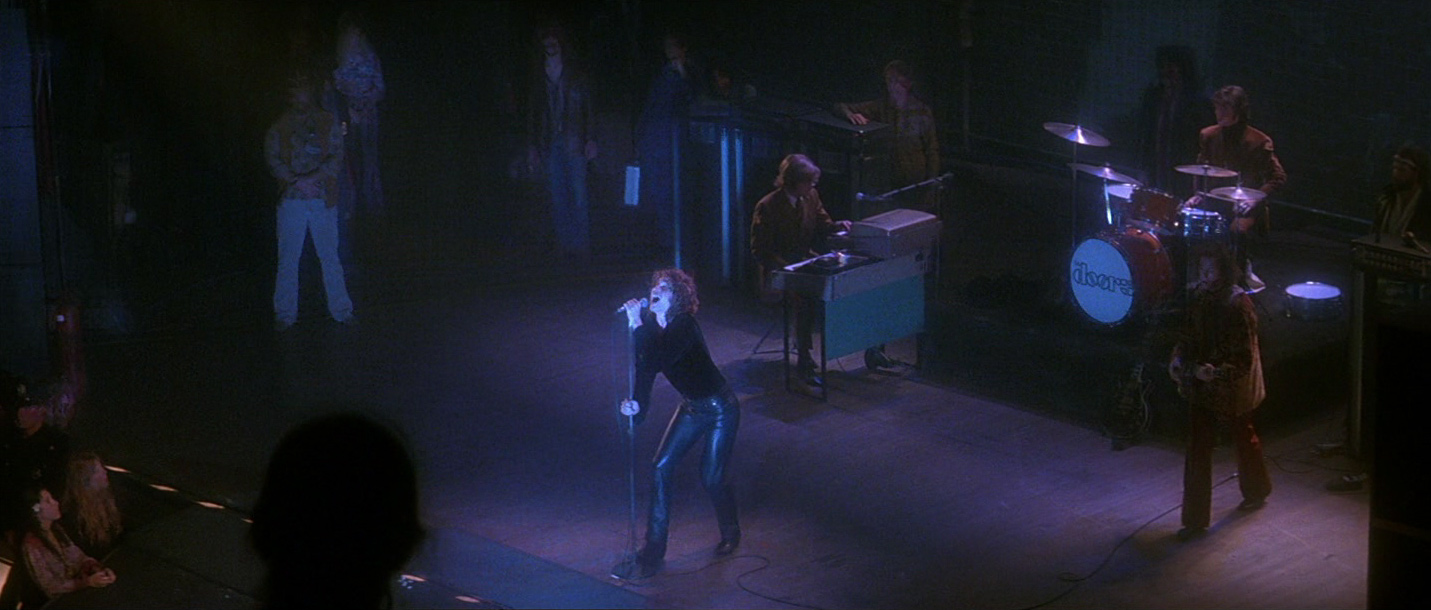
It goes without saying that The Doors truly comes to life during the concert scenes as all the theatrical stage lighting and dynamic camera movements showcases Richardson’s skill as one of the best cinematographers ever to get behind the camera. The warm colors he uses in the London Fog scenes conveys an intimacy representative of the small venue and symbolizes a band still learning their chops, both musically and how they perform in a live setting. Richardson really gets a chance to cut loose in the sequence where the band go out into the desert and take peyote. He employs all sorts of trippy effects and also creates some stunningly beautiful shots, like that of a blue sky populated by all kinds of fragmented clouds or a pan across a rocky formation with shadows creeping upwards, animated via time lapse photography.

Stone then segues to the Doors playing at the Whisky a Go Go in 1966 – the next step to the big time. We see them perform “The End,” an epic Oedipal nightmare. It’s a hypnotic song that shows how far the band had come. Morrison is no longer shy and commands the stage like no other before him. Kilmer is mesmerizing in this scene and you can see how fully committed he is to the role. It’s not just the ability to recreate Morrison’s signature moves but he has an uncanny knack to immerse himself in the singer’s headspace. In these concert scenes it is incredible to see the actor throw himself completely into them just as Morrison would.

In the spot-on casting department, it was an absolute delight to see Michael Wincott freed from the shackles of playing clichéd heavies and make an appearance as legendary music producer Paul Rothchild who worked on many of the Doors’ albums. He has a fantastic scene later on when he tries to get through to a drunken Morrison during an awful recording session and delivers an impassioned speech even though the singer tunes him out.

Stone’s film starts to lose its mind when the Doors arrive in New York City in 1967 and the way he presents the hysteria of their arrival is like the Second Coming of the Beatles. There are moments of amusing levity as Stone shows the obvious culture clash between the square staff at The Ed Sullivan Show when the producers try to be hip by talking to the band in their own “lingo” using words like “groovy” and “dig it” that sound forced and fabricated. The Doors are told to change a lyric in “Light My Fire” so as to satisfy standards and practices. Stone has a bit of fun with their televised appearance, fudging how Morrison defied the censors.

Stone shows the skyrocketing of Morrison’s ego and how he began to believe his own hype. He also suggests that Morrison really started to lose control when he and his bandmates attended a party at Andy Warhol’s The Factory. All sorts of pretentious weirdoes vie for Morrison’s attention. Manzarek sums it up best when he tells Morrison, “These people are vampires.” However, it’s when the rest of the band departs the party leaving Morrison to fend for himself that Stone suggests the moment when the first schism between them was created. The look of distrust on the singer’s face as his bandmates depart says it all. There is no one to keep his indulgent behavior in check. We are subjected to an unfortunate fey caricature of Warhol thanks to the usually reliable Crispin Glover. Hanging out with Nico and Warhol’s regulars brings out Morrison’s worst excesses which Richardson shoots like some kind of monstrous nightmare, a bad trip that we want desperately to end. This sequence starts Stone’s escalation of depicting Morrison’s self-destructive journey.

And so we get a scene where Morrison does cocaine with a self-professed witch (played by a vampy Kathleen Quinlan) and participates in a silly, over-the-top ceremony whose inclusion stops the narrative cold. Stone is playing with the mythic figure that we know as Jim Morrison. The Doors tries to show both sides: the mythic persona and the real man drowning in fame, drugs and alcohol. Stone hints at this transformation when Morrison does the famous photo shoot that has been immortalized in posters and in the pages of glossy rock magazines like Rolling Stone. Morrison is drunk on alcohol and one might argue his own fame. He begins to believe in his own image and the photographer (Mimi Rogers) only coaxes him on when she says, “Forget the Doors. You’re the one they want. You are the Doors.” It is at this point in the film that Morrison is no longer an artist or a poet, but a commodity to be used up by everyone: the media and the masses. On Morrison’s rise to the top, everyone wants a piece of him, to capture a little bit of the exhilarating ride. Morrison’s mistake was that he obliged and thought that he could handle it.

We see how drugs and alcohol fuel Morrison’s irrational behavior and he becomes verbally and physically abusive towards Pamela. Anything that was good about Morrison depicted in the film is now gone and all we’re treated to is a series of scenes showing what an asshole he had become and how he had been consumed by his own fame. His bad behavior reaches new heights of ridiculousness during a scene where he and Pamela host a dinner party for their friends and hanger-ons. Stoned out of his mind (and probably drunk), Morrison provokes Pamela who starts throwing food around hysterically and then tries to stab him with a carving knife while he taunts her. Stone sledgehammers the point home by playing “Love Me Two Times” on the soundtrack as if to reinforce Morrison repeatedly cheating on Pamela with other women. If there is anything good that comes from this wildly over-the-top scene it is that it shows how estranged Morrison has become from the rest of his bandmates.

Fortunately, the film has amazingly choreographed concert sequences that repeatedly bring it back from the brink of its own excesses. The New Haven ’68 concert depicts Morrison’s run-in with the law when he was maced in the face backstage by a cop. It’s no longer about the music but the abuse of his power as a lead singer with a microphone to air his grievances. The best concert sequence in the film is the San Francisco ’68 one. Bathed in hellish red light, Morrison whips the crowd into a frenzy. His increasingly desperate performance is juxtaposed with his out of control personal life as he almost traps Pamela in their bedroom closet and proceeds to burn it down, gets in a car accident and is involved in a Wiccan marriage ceremony. We see Morrison in a wonderfully hallucinatory moment channel his Native American Indian spirit as he loses himself in the music. The last shot of this powerful sequence shows Morrison drunk on his own power and fame as much as he’s drunk on alcohol. The expression on Kilmer’s face says it all.

Over the years, directors like Brian De Palma, Martin Scorsese and William Friedkin flirted with directing a Doors biopic. In 1985, Columbia Pictures acquired the rights from the Doors and the Morrison estate to make a film. Producer Sasha Harari wanted Oliver Stone to write the screenplay but never heard back from the filmmaker’s agent. After two unsatisfactory scripts were produced, Imagine Films replaced Columbia. Harari tried contacting Stone again and the director met with the surviving band members. He told them that he wanted to keep a particularly wild scene from one of the early drafts. The group was offended and exercised their right of approval over the director and rejected Stone. By 1989, Mario Kassar and Andy Vajna, who owned Carolco Pictures, acquired the rights to the project and wanted Stone to direct. The Doors had seen Platoon (1986) and were impressed with what Stone had done.

Stone agreed to make The Doors after his next project, Evita (1996). After spending years on it and courting Madonna and later Meryl Streep to play the lead role, the film fell apart over salary negotiations with Streep. Stone quickly moved on to The Doors and went right into pre-production. Guitarist Robby Krieger had always opposed a Doors film until Stone signed on to direct. Stone first heard the Doors when he was a 21-year-old soldier serving in Vietnam. Historically, keyboardist Ray Manzarek had been the biggest advocate of immortalizing the band on film but opposed Stone’s involvement. According to Krieger, “When the Doors broke up Ray had his idea of how the band should be portrayed and John and I had ours.” Manzarek was not happy with the direction Stone wanted to take and refused to give his approval to the film. According to Kyle MacLachlan, “I know that he and Oliver weren’t speaking. I think it was hard for Ray, he being the keeper of the Doors myth for so long.” Manzarek claims that he was not even asked to consult on the film and if he had his way wanted it to be about four members equally rather than the focus being on Morrison. Stone claims that he repeatedly tried to get the keyboardist involved, but “all he did was rave and shout. He went on for three hours about his point of view ... I didn’t want Ray to be dominant, but Ray thought he knew better than anybody else.”

While researching the film, Stone read through transcripts of interviews with over 100 people. The cast was expected to get educated about 1960s culture and literature. Stone wrote his own script in the summer of 1989. He said, “The Doors script was always problematic. Even when we shot, but the music helped fuse it together.” He picked the songs he wanted to use and then wrote “each piece of the movie as a mood to fit that song.” Before filming, Stone and his producers had to negotiate with the three surviving band members, their label Elektra Records, and the parents of Morrison and Pamela Courson. Morrison’s parents would only allow themselves to be depicted in a dream-like flashback sequence at the beginning of the film. The Coursons wanted there to be no suggestion in any way that their daughter caused Morrison’s death. Stone found her parents to be the most difficult to deal with because they wanted Pamela to be “portrayed as an angel.” The Coursons tried to slow the production down by refusing to allow any of Morrison’s later poetry to be used in the film. After he died, Pamela got the rights to his poetry and when she died, her parents got the rights. Legendary concert promoter Bill Graham, who promoted Doors concerts in San Francisco and New York in the ‘60s, played a key role in negotiations.

When Stone began talking about the project as far back as 1986, he had Kilmer in mind to play Morrison, impressed by his work in the Ron Howard fantasy film Willow (1988). However, during this time actors ranging from John Travolta to Richard Gere to Tom Cruise and the lead singers from INXS and U2 were considered for the part. Stone auditioned nearly 200 actors to play Morrison in 1989. In his favor, Kilmer had the same kind of singing voice as Morrison and to convince Stone that he was right for the role he spent thousands of dollars of his own money to make his own eight-minute video, singing and looking like the Lizard King at various stages of his life. When the Doors heard Kilmer singing they couldn’t tell if it was him or Morrison’s voice. Once he got the part, he lost weight and spent six months rehearsing Doors songs every day. Kilmer learned 50 songs, 15 of which are actively performing in the film. He also spent hundreds of hours with record producer Paul Rothchild who told him, “anecdotes, stories, tragic moments, humorous moments, how Jim thought, what were my interpretation of Jim’s lyrics,” he said. He also took Kilmer into the studio and helped him with “some pronunciations, idiomatic things that Jim would do that made the song sound like Jim.” The actor also met with Krieger and Densmore but Manzarek refused to talk to him.

Stone auditioned approximately 60 actresses for the role of Pamela Courson. The part required nudity and the script featured some wild sex scenes which generated a fair amount of controversy. Casting director Risa Bramon Garcia felt that Patricia Arquette auditioned very well and should have gotten the part. However, Meg Ryan was cast and to prepare for the role, she talked to the Coursons and people that knew Pamela and encountered several conflicting views of her. Before doing the film, Ryan was not at all familiar with Morrison and “liked a few songs.” She had trouble relating to the culture of the ‘60s and said, “I had to reexamine all my beliefs about it in order to do this movie.”

Stone originally hired Paula Abdul to choreograph the film’s concert scenes but dropped out because she did not understand Morrison’s on-stage actions and was not familiar with the time period. She recommended Bill and Jacqui Landrum. They watched hours of concert footage before working with Kilmer. They got him to loosen up his upper body with dance exercises and jumping routines to develop his stamina for the demanding concert scenes. During them, he did the actual singing and Stone used the Doors’ master tapes without Morrison’s lead vocals to avoid lip-synching. Kilmer’s endurance was put to the test during these sequences, with each one often taking several days to film. Stone said, “his voice would start to deteriorate after two or three takes. We had to take that into consideration.” One sequence, filmed inside the Whisky a Go Go was harder than the others due to all the smoke and the sweat, a result of the body heat and intense camera lights. For five days Kilmer performed “The End” and after the 24th take, Stone got what he wanted and the actor was left totally exhausted.

With a budget of $32 million, The Doors was filmed over 13 weeks predominantly in and around Los Angeles. Krieger acted as a technical adviser on the film and this mainly involved showing his cinematic alter ego Frank Whaley where to put his fingers on the fretboard. Densmore also acted as a consultant, tutoring Kevin Dillon who played him in the film. Controversy arose during principal photography when a memo linked to Kilmer circulated to cast and crew members listing rules of how the actor was to be treated for the duration of filming. These included people being forbidden to approach him on the set without good reason, not to address him by his own name while he was in character, and no one could “stare” at him on the set. Understandably upset, Stone contacted Kilmer’s agent and the actor claimed it was all a huge misunderstanding and that the memo was for his own people and not the film crew.

Not surprisingly, The Doors received mixed to negative reviews from critics. Roger Ebert gave the film two-and-a-half stars out of four and wrote, “The experience of watching The Doors is not always very pleasant. There are the songs, of course, and some electrifying concert moments, but mostly there is the mournful, self-pitying descent of this young man into selfish and boring stupor … The last hour of the film, in particular, is a dirge of wretched excess, of drunken would-be orgies and obnoxious behavior.” In her review for The New York Times, Caryn James wrote, “At its best, the film's haunted Doors music and visceral look creates the sense of being in some hypnotic trance. But by the end, audiences may feel they have been beaten over the head with a stick for two hours.” Time magazine’s Richard Corliss wrote, “His movies make people edgy, and that's a good thing. But this time Stone is a symptom of the disease he would chart … Maybe it was fun to bathe in decadence back then. But this is no time to wallow in that mire.” In his review for the Washington Post, Hal Hinson wrote, “Amid all this trippy incoherence, the performances are almost irrelevant. Kilmer does a noteworthy impersonation of the singer, especially onstage, where he gets Morrison's self-absorption. He gets his coiled explosiveness too, but the element of danger in Morrison is missing.”

The Chicago Reader’s Jonathan Rosenbaum wrote, “Some of the effects are arresting, and apart from some unfortunate attempts to ‘re-create’ Ed Sullivan, Andy Warhol, and Nico, the movie does a pretty good job with period ambience. But it's a long haul waiting for the hero to keel over.” Famous conservative pundit George Will not only attacked Morrison, calling him, “not particularly interesting” and that he “left some embarrassing poetry and a few mediocre rock albums,” but also the film: “for today’s audiences, Stone’s loving re-creation of San Francisco’s Haight-Ashbury district is just a low-rent Williamsburg, an interesting artifact but no place for a pilgrimage.” However, Entertainment Weekly gave the film a “B” rating and Owen Gleiberman wrote, “As Morrison, Val Kilmer gives a star-making performance. Lolling around in his love beads and black-leather pants, his thick dark mane falling over features that are at once baby-sweet and preternaturally dangerous, Kilmer captures, to an astonishing degree, the hooded, pantherish charisma that made Morrison the most erotically charged pop performer since the early days of Elvis.”

So how did the actual Doors feel about the film? Robby Krieger was impressed with Kilmer’s portrayal of Morrison: “It was really weird. I even called him ‘Jim’ a few times without meaning to.” In his memoirs, John Densmore wrote, “For what it is, I do think Oliver Stone’s vision of Jim Morrison has integrity; however, it is a film about the myth of Jim Morrison.” Ray Manzarek said of the film, “The movie misses out – Oliver Stone blew it ... The movie looks good, sure, but the basic heart is stone cold.”

Stone also uses several film techniques like special lighting to create a red hue over everything and a swaying, chaotic camera to create an off-kilter hallucinogenic world that he would later perfect in Natural Born Killers (1994). This effect gives the film the overall effect of a peyote experience without actually taking drugs. The Doors also captures the madness and paranoia of the era with quick edits of the horrors of Vietnam, and the Robert F. Kenney assassination juxtaposed with the belligerent cops at every concert, and the rampant drug use associated with this scene. One band member says during the film that he took drugs to expand his mind not to escape as Morrison did. As the scenes of Morrison’s excessive behavior pile up, a feeling of exhaustion sets in as it begins to be all too much which, I guess, is kind of how Morrison felt towards the end. A feeling of burn out takes over and the end of the film can’t come soon enough. The experience of watching The Doors leaves one drained and you really feel like you’ve been somewhere and experienced something.

The Doors is a potent reminder of the self-destructive power of rock stars that the media manipulates and thrives on. At one point in the film during a press conference, Morrison says, “I believe in excess,” and in doing so underlines the whole thesis of the film. The Doors is a film about excess on many levels: on a individual level with Morrison himself, on a national level with thousands of fans going crazy at the mere sight of the singer, and on a personal level with Stone’s own preoccupations permeating throughout. The Doors also examines the seductive power of the cult of personality, the god-like status to which people like Morrison or someone like Kurt Cobain are elevated to and the inevitable crash that follows when they can’t handle the responsibility. Morrison represents a generation trying to escape the pain of a crazy world. Like Cobain, Morrison wanted to ultimately be seen as an artist, but was treated in life and after his death like a commodity (Morrison was once referred to as the “ultimate Barbie doll.”). Both men were consumed by the very thing that created them: the media. They also ended their own lives, Cobain via suicide and Morrison through alcohol abuse. The Doors is a powerful study of excesses of every kind: sex, drugs, alcohol, and fame on an individual and on a society.


SOURCES

Broeske, P. “Stormy Rider.” Sunday Herald. March 10, 1991.

Green, Tom. “Kilmer’s Uncanny Portrait of Morrison Opens Career Doors.” USA Today. March 4, 1991.

Hall, Carla. “Val Kilmer, Lighting the Fire.” Washington Post. March 3, 1991.

Kilday, Gregg. “Love Me Two Times.” Entertainment Weekly. March 1, 1991.

MacInnis, Craig. “The Myth is Huge, But the Truth is the Lure of the Eternal.” Toronto Star. March 2, 1991.

McDonnell, D. “Legendary Rocker Lives Again On.” Herald Sun. March 2, 1991.

McDonnell, D. “Rider on the Storm.” Courier-Mail. March 16, 191.

Mitchell, Justin. “Opening Up A Closed Door.” St. Petersburg Times. December 28, 1990.

“Oliver Stone and The Doors.” The Economist. March 16, 1991.

Riordan, James. Stone: A Biography of Oliver Stone. Hyperion. 1995.

Thomas, Karen. “Helping Stage The Doors.” USA Today. March 12, 1991.


Thomas, Karen. “Ex-Doors Member Slams Stone, Film.” USA Today. April 4, 1991.

Tuesday, June 8, 2010

DVD of the Week: Mystery Train: Criterion Collection

Jim Jarmusch is a filmmaker who has always been interested in outsiders, people who live on the fringes of mainstream society. His first three films took a look at America through the eyes of a foreigner. With Stranger than Paradise (1984), a young Hungarian woman visits her hipster cousin in New York City. Down by Law (1986) follows the misadventures of three men who escape a Louisiana prison, one of whom is an Italian tourist that hardly speaks English. Finally, there is Mystery Train (1989), three different stories that take place simultaneously in the same in the run-down hotel in Memphis. Each story prominently features people from other countries like Japan, Italy and England, and how they react to a city steeped in rich, musical history with the ghost of the King, Elvis Presley himself, present in one form or another.


In the first story, “Far from Yokohama,” see two teenager Japanese tourists (Masatoshi Nagase and Youki Kudoh) visit Memphis to take a tour of Graceland and the legendary Sun Studios where Elvis, Jerry Lee Lewis and so many others recorded numerous hit records. She is a big fan of the King but he digs Carl Perkins. The key to this segment is miscommunication. The couple don’t get much out of the Sun Studio tour because their guide talks too fast and they don’t understand English all that well, but they do care about each other and in the end that’s enough. There are all kinds of atmospheric tracking shots of the Japanese couple walking through the empty streets of Memphis. They decide to stay in a slightly run-down hotel operated by man played by none other than Screamin’ Jay Hawkins. Once the couple gets situated, there’s a funny bit where the girl goes through a scrapbook filled with famous people and landmarks that resemble Elvis.

The next story, entitled “A Ghost,” concerns a woman (Nicoletta Braschi) from Italy who has arrived in Memphis to take her deceased husband back home. There is a problem with her flight and she has to stay the night. After being hit on by a creepy guy (Tom Noonan) in a restaurant, she takes refuge in the nearby hotel where she meets a woman (Elizabeth Bracco) unable to afford a night there. The two women decide to share a room. In a memorable scene after retiring for the evening, the Italian woman is visited by the spirit of Elvis in what is a touchingly poignant and yet also whimsical moment.

Finally, “Lost in Space” features a trio of inept knuckleheads in the film’s funniest story. Johnny (Joe Strummer) is a cranky Englishman recently fired from his job. After drunkenly waving a gun around in a bar, his friend Will (Rick Aviles) and his brother-in-law Charlie (Steve Buscemi) arrive to diffuse the situation. After Johnny robs a liquor store, he and his friends hide out in the hotel. Charlie and Will try to calm down the mercurial Johnny and keep him under control but it’s not easy. There’s a lot of fun to be had watching Joe Strummer and Steve Buscemi bounce off the walls of the small hotel room they hold up in.

Mystery Train is a fascinating snapshot of Memphis through the eyes of foreigners and the disenfranchised. The stories in this film run the gamut from romantic to touching to amusing but all with a humanistic streak running through them. Jarmusch would follow this film with Night on Earth (1991) which would adhere to the same structure but on a much more ambitious level.

Special Features:

There is a “Q&A with Jim.” As he has done for past Criterion editions of his films, Jarmusch answers questions submitted by fans in lieu of an audio commentary. They are by no means restricted to the film but the bulk of them do pertain to it. Jarmusch confirms that Tom Waits’ D.J. heard in the film is in fact the same character he played in Down by Law. He talks about how he worked with the Japanese actors and the origins of their segment title. He also talks about his favourite Elvis era and addresses the barren and bleak look of Memphis in the film.

“I Put a Spell on Me” features excerpts from a 2001 documentary on Screamin’ Jay Hawkins. Jarmusch is interviewed and talks about when he first heard Jay’s signature song, “I Put a Spell on You,” how he used it in Stranger than Paradise and then cast him in Mystery Train. Jay talks about working on the film and shares some amusing anecdotes on this fantastic extra.

“Memphis Tour” revisits many of the locations used in the film. We get a brief history of each location and what happened to it since filming. The restaurant used is the oldest in the city. Unfortunately, the hotel featured so prominently in the film was torn down a year after it was made. This is a fascinating extra that takes a look at how these locales have changed over the years.

“Polaroids” features snapshots taken on location during filming.

Finally, there is a gallery of behind-the-scenes images from a photo book published at the time of the film’s release.


Friday, June 4, 2010

The Mummy (1999)

Many cinephiles view director Stephen Sommers as the cinematic equivalent of Satan, and with everything that has gone horribly wrong with Hollywood blockbuster films. And, to be fair, with films like Van Helsing (2004) and G.I. Joe: The Rise of Cobra (2009) on a not-too impressive resume (in fact, looking over his filmography, there’s only one film of his I like), he’s hardly a filmmaker one equates with quality but I will admit to being quite fond of The Mummy (1999). As far as Indiana Jones rip-offs go, it is not that bad. If that sounds like faint praise, I don’t mean it to be as Sommers’ film is actually a lot of fun and entertaining as hell. It is the very popular re-imagining of the old Boris Karloff classic and would go on to spawn two inferior sequels and transform Brendan Fraser into a bonafide leading man. Up to that point he had a reputation for starring in forgettable comedies like Encino Man (1992), The Scout (1994) and Airheads (1994). With The Mummy, he demonstrated some serious action film chops with a hint of romantic leading man qualities that were complimented by his knack for comedy, thankfully doled out in relative moderation this time. The end result is a satisfying popcorn movie with no other agenda than to entertain.

It’s 1923 and the French Foreign Legion engage the Medjai, descendents of Pharaoh Seti I, in battle at the legendary Hamunaptra, the City of the Dead. When his superior officer deserts, Rick O’Connell (Brendan Fraser) finds himself in charge, much to his chagrin. It certainly is an exciting way to introduce our leading man as he and his fellow soldiers attempt to stand their ground on the city walls as the Medjai attack in wave after wave. Brendan Fraser shows some decent action film skills as his character valiantly tries to stay alive despite being overwhelmed by superior numbers and abandoned by his cowardly sidekick (and comic relief) Beni (Kevin J. O’Connor). Rick narrowly escapes and runs off into the desert where the Medjai leave him to die.

Three years later in Cairo we meet bookish librarian Evelyn Carnahan (Rachel Weisz) at the Museum of Antiquities as she single-handedly manages to topple over a room full of towering bookcases like dominoes when she attempts to shelve a book. It’s a cute bit of slapstick that establishes Evelyn as one of the most not-so graceful people on the planet. With her hair tied up and sporting a thick-rimmed pair of glasses, the film’s greatest special effect may be trying to convince us that the gorgeous Rachel Weisz is a socially awkward bookworm (yeah, right). Evelyn’s application to bigger and better things has been rejected yet again because she doesn’t have enough field experience. Along comes her older ne’er-do-well brother Jonathan (John Hannah) who has discovered a trinket at an archaeological dig in Thebes. Inside it contains a map to the mythic Hamunaptra, the place where the earliest Pharaohs are said to have hidden the wealth of Egypt. No one has ever found it and naturally Evelyn’s boss scoffs at the notion of its very existence.

It turns out that Jonathan actually stole the map from Rick who is rotting away in prison. Jonathan and Evelyn pay him a visit and he agrees to tell them where the City of the Dead is located but only if they free him. They do (and just in the nick of time) and set out for the site with a rival expedition of American fortune hunters also looking for it. As luck would have it, they are led by Beni, setting up a personal rivalry between him and Rick. Both groups arrive at the City of the Dead and split up, each looking for treasure. However, the American fortune seekers uncover a curse that condemns their party to death. Meanwhile, Rick and Evelyn uncover the coffin of Imhotep (Arnold Vosloo), the ruler of Hamunaptra and who carried on a forbidden affair with Seti I’s wife Princess Anck-su-namun (Patrica Velasquez). He was buried alive for his indiscretions while she killed herself. Evelyn unlocks the legendary Book of the Dead and reads from it, unwittingly resurrecting Imhotep who proceeds to kidnap Evelyn with the intention of sacrificing her so that his lover will also come back to life. It’s up to Rick, Jonathan and Ardeth Bey (Oded Fehr), the enigmatic leader of the Medjai, to stop Imhotep.

One of the things that makes The Mummy work is the chemistry between Brendan Fraser and Rachel Weisz. At first, Evelyn sees Rick as an uncouth mercenary and he sees her as a naive stuffed shirt. But the more time they spend together, especially in death-defying situations, the more they grow to admire and respect one another. The two actors handle this development quite well and certainly make for an attractive couple with Fraser’s matinee idol good looks and Weisz’s beautiful appearance – a little something for everyone. They manage to transcend the predictable screenplay and often clichéd dialogue through the sheer force of their natural charisma. This is readily apparent in the campfire scene where one night Rick teaches Evelyn a bit about hand-to-hand combat even though she’s had a little too much to drink. She ends up passing out just before they kiss, much to his bemusement. There’s a bit of an old school Hollywood vibe to this scene and to how these actors approach their respective roles that works.

As far as Indiana Jones clones go, Rick doesn’t quite bring the slight air of danger that Harrison Ford brought to Raiders of the Lost Ark (1981), the most obvious influence on The Mummy. Not to mention, Fraser has more hulking boyish good looks as opposed to Ford’s roguish charm. Also, Fraser relies more on comedy than Ford but as far as action-oriented treasure hunters go, you could do worse than Rick O’Connell. Fraser hasn’t really been able to capitalize on the success of this film, appearing in several generic children’s adventure films – although, he showed some promise co-starring with Michael Caine in an adaptation of The Quiet American (2002).

While Evelyn is certainly not as feisty and as capable as Marion in Raiders, she has more of an arc as she goes from sheltered academic to damsel in distress to experienced adventurer. At the time, Weisz was known for appearing in small, independent films and the success of The Mummy would launch her into the A-list stratosphere. She has fared the best of the cast, appearing in delightful romantic comedies like About A Boy (2002) and Definitely, Maybe (2008), and winning an Academy Award for her excellent work in The Constant Gardener (2005).

John Hannah provides much of the film’s humor as Evelyn’s slightly shifty but ultimately harmless grifter brother while Oded Fehr is quite good as the righteous guardian of the City of the Dead. For an underwritten role, he does his best to make a fantastic impression with what screen-time he is given.

Sommers handles the action sequences with refreshing simplicity (something that would be absent from his subsequent films). We always know what’s going on and where everyone is. He clearly took notes while watching Raiders and manages to capture its flair for 1930 cliffhanger serials. The Medjai siege on the boat to Hamunaptra early on in the film is particularly exciting and well-staged, evoking a real Indy Jones vibe.

As with so many big budget tent-pole films for Hollywood studios, The Mummy was a project that gestated for years and went through many hands before it wound up with Sommers. This new version’s origins lie with producer James Jacks who decided in 1992 to update the original film for the 1990s. He struck a deal with Universal Pictures who agreed to back it but only on a budget around $10 million. Jacks remembered that the studio “essentially wanted a low-budget horror franchise.” To this end, he hired filmmaker/writer Clive Barker whose version was about the head of a contemporary art museum built like a pyramid. The man was actually a cultist trying to reanimate mummies. Jacks described it as “dark, sexual and filled mysticism.” Sadly, after several meetings, Barker and Universal lost interest in the project and parted ways.

Once Barker was off the project, George Romero was brought in and he wanted to make a zombie-style horror film along the lines of his legendary feature film debut, Night of the Living Dead (1968). However, Jacks and the studio wanted to make a mainstream film and felt that Romero’s vision was too scary. Next up was Joe Dante with a contemporary reincarnation tale with elements of a love story starring Daniel-Day Lewis as a brooding Mummy. John Sayles even co-wrote the script but Universal was only willing to spend $15 million on his vision. Jacks then offered the project to Mick Garris and also Wes Craven, both of whom passed.

In 1997, Stephen Sommers contacted Jacks with his take on The Mummy “as a kind of Indiana Jones or Jason and the Argonauts with the mummy as the creature giving the hero a hard time.” He saw the original film when he was only 8-years-old and with his version wanted to recreate the things he liked about it only on a bigger scale. He had wanted in on the project since 1993 but other writers or directors were always involved. Seizing a window of opportunity, he prepared an 18-page pitch to Universal. As luck would have it (for Sommers, that is), the studio had taken a bath on Babe: Pig in the City (1998) and in response, decided to revisit its successful franchises from the 1930s. Executives were so thrilled with Sommers’ concept for The Mummy that they increased the budget from $15 million to a staggering $80 million. Once he got the gig, he spent six months researching the film and then eight weeks writing the screenplay.

When it came time to cast Rick O’Connell, Jacks offered the role to Tom Cruise, Brad Pitt, Matt Damon, and Ben Affleck but they were either not interested or too busy. Jacks and Sommers were impressed with the box office receipts from George of the Jungle (1997) and cast Brendan Fraser as a result. The actor was drawn to the project because he was looking for an action film and liked the idea that Universal was reinventing one of its properties from the 1930s. For the character, he drew inspiration from the likes of Robin Hood, Buck Rogers and Sinbad. Most importantly, he understood that Rick was the kind of character who didn’t “take himself too seriously, otherwise the audience can’t go on that journey with him.”

The Mummy was shot over three months in Morocco and not in Egypt because of the unstable political conditions there. They also had the official support of the Moroccan army. In a reassuring touch, the cast had kidnapping insurance taken out on them. In addition, the cast and crew had to deal with blinding sandstorms and bad-tempered camels. The production had wranglers on set to catch snakes, scorpions and spiders at the end of every shooting day. This still didn’t prevent many crew members from being airlifted out after being bitten. Everyone also had to worry about dehydration when filming moved to the Sahara desert. The production’s medical team ended up creating a beverage that the cast and crew had to drink every two hours.

Predictably, The Mummy received mixed reviews from critics. Roger Ebert wrote, “There is hardly a thing I can say in its favor, except that I was cheered by nearly every minute of it. I cannot argue for the script, the direction, the acting or even the mummy, but I can say that I was not bored and sometimes I was unreasonably pleased.” Entertainment Weekly gave the film a “B-“ rating and Owen Gleiberman wrote, “The Mummy would like to make you shudder, but it tries to do so without ever letting go of its jocular inconsequentiality.”

However, the knives came out in The New York Times review as Stephen Holden wrote, “This version of The Mummy has no pretenses to be anything other than a gaudy comic video game splashed onto the screen. Think Raiders of the Lost Ark with cartoon characters, no coherent story line and lavish but cheesy special effects. Think Night of the Living Dead stripped of genuine horror and restaged as an Egyptian-theme Halloween pageant.” USA Today gave the film two out of four stars and felt that it was "not free of stereotypes,” and that “If someone complains of a foul odor, you can be sure an Arab stooge is about to enter a scene. Fraser, equally quick with weapon, fist or quip, may save the day, but even he can't save the picture.”

Looking back, whatever good will Sommers garnered with The Mummy, he has subsequently pissed it all away with The Mummy Returns (2001) which reduced the number of quiet moments that developed the characters and told the story in the first film in favor of wall-to-wall frenetic action and the addition of a bratty child (Rick and Evelyn’s offspring, natch) into the mix. Sommers didn’t return for the third and most disappointing installment (neither did Weisz) which is just as well. The damage had already been done with The Mummy Returns but the first film is still a rousing, entertaining ride.


SOURCES


Argent, Daniel . "Unwrapping The Mummy: An Interview with Stephen Sommers." Creative Screenwriting. 1999.

Bonin, Liane. "That's a Wrap.” Entertainment Weekly.  May 5, 1999.

Chase, Donald. "What Have They Unearthed?" Los Angeles Times. May 3, 1999.

Hobson, Louis B. "Universal rolls out new, improved Mummy.” Calgary Sun. May 1, 1999.

"The Mummy That Wasn't." Cinescape. May 3, 1999.

Slotek, Jim. "Unwrapping The Mummy.” Toronto Sun. May 2, 1999.

Snead, Elizabeth. "Updating A Well-Preserved Villain." USA Today. May 7, 1999.