"...the main purpose of criticism...is not to make its readers agree, nice as that is, but to make them, by whatever orthodox or unorthodox method, think." - John Simon

"The great enemy of clear language is insincerity." - George Orwell
Showing posts with label Frank Whaley. Show all posts

Friday, September 21, 2018

Born on the Fourth of July


“When people say if you don’t love America, then get the hell out. Well, I love America, but when it comes to the government, it stops right there.” – Ron Kovic

Oliver Stone’s filmic prescience is widely regarded by critics, students and the public at large. It hit is apex with 1989’s Born on the Fourth of July, a cinematic crystal ball, which anticipated the rise of Donald Trump’s divisive “Make America Great Again” nationalism. Stone’s biopic traces the life of Ron Kovic (Tom Cruise), from his beginnings as the quintessential all-American boy proud eager to serve the country he loves and respects in the Vietnam War, to being a disillusioned veteran, paralyzed in battle and how it led to his anti-war activism. This film asks particularly difficult questions about what it means to be American and has become even more relevant today than the year it was released to critical and commercial success.

Ron Kovic’s voiceover narration establishes a picturesque childhood, he and his best friends play soldiers with other neighborhood kids. He grows up in the Norman Rockwell-esque small town America of the 1950s. Born on the Fourth of July is propaganda – but all is not what it appears; Stone cleverly subverts it, showing us little cracks in the idyllic façade. As a child, Ron idolizes the soldiers he sees with his family in a parade early on in the film. This is tempered when one soldier visibly winces at the sound of firecrackers and another is shown, arms lost in battle, a grim look on his face.

Stone’s multi-layered patriotic imagery during the opening credits sequence is bathed in a sun-kissed glow, courtesy of Robert Richardson’s stunning cinematography. Ron’s mother (Caroline Kava) even calls him her “little Yankee Doodle Boy.” This is the land of 4th of July fireworks, parades populated by beautiful cheerleaders and where Ron is an exceptional athlete, hitting an in-the-park home run as a boy. He lives in suburbia with a family that embodies the American Dream.

As a teenager, he excels in wrestling, being pushed to his limits by a coach whom has all the zeal of an army drill sergeant. It is in these early scenes that we see the Tom Cruise we all know – the ambitious go-getter, but Stone tempers this by showing Ron lose an important match in front of his classmates, friends, and family. His anguished expression – as boos ring out around him –foreshadows more painful defeats to come.

Ron’s hero worship of the military continues when he attends a presentation (a.k.a. a recruitment pitch) by the United States Marines at his school. There is delicious irony as Ron looks adoringly at the Marine speaking (played by none other than Tom Berenger) as if the actor’s demonic soldier from Platoon (1986) somehow survived, returning stateside to recruit young men to fight in the Vietnam War.

Ron buys into it, eager to serve his country as his father (Raymond J. Barry) did before him in World War II. He wants to go and fight in Vietnam and is even willing to die there (“I want to go to Vietnam – and I’ll die there if I have to). His life is playing out like a stereotypical Hollywood movie. He even rushes to the prom, in the rain, to declare his love for girl-next-door-eseque Donna (Kyra Sedgwick) as “Moon River” plays over the gymnasium speakers.

Ron’s idyllic youth comes to a violent end once we see him in ‘Nam, his platoon accidentally slaughtering an entire village. To make matters worse, he inadvertently shoots and kills one of his own soldiers. He tries to own up to it but his superior (John Getz) dismisses him. Where everything stateside was simple to understand – Ron always took for granted that he knew what was expected of him. Vietnam is chaotic and confusing, the enemy difficult to identify. As he did with Platoon, Stone immerses us in the sights and sounds of battle, albeit in a more stylized depiction. Here, he employs more slow-motion, filters, and skewed camera angles to show the disorienting effect of combat through Ron’s eyes.

He is wounded in battle and is shipped back to the Bronx Veterans Hospital where he finds out that he’s been paralyzed from the chest down. Despite the absolutely appalling conditions (rats scurrying between beds, interns shooting up in closets and Ron starring at his own vomit for hours), he still believes in the American Dream and is critical of the anti-war protestors he sees on television. He aggressively attacks physical therapy, refusing to accept the doctor’s diagnosis that he’ll never regain the use of his legs.

Cruise is particularly effective in these scenes as he conveys Ron’s gradual disillusionment with the system. He is slowly becoming dehumanized by the system that cares little about him. Government cutbacks result in poor conditions and treatment that Stone depicts in unflinching detail. Is this how our country honors those that put everything on the line to serve their country?

Ron’s homecoming is a heart-wrenchingly bittersweet one. On the surface, his family is happy to see him – the heartbreaking emotions swell under the surface, conveyed in his mother’s eyes when she embraces him, giving a brief, sad look that he is unable to see. While his father goes on about the changes he’s made to the bathroom to make it more accessible for his son, Ron only half-listens as he looks around his old bedroom, lingering on a photograph of himself during his wrestling days at high school. Stone shows Ron’s image reflected in the glass of the picture frame, visually giving us a before and after of this man’s life.

Ron quickly picks up on how differently people in the town look at him: “Sometimes I think people know you’re back from Vietnam and their face changes, their eyes, the voice, the way they look at you.” A family dinner breaks up when Ron’s brother (Josh Evans) leaves the table, unable to stomach his brother’s patriotic rant. He participates in a parade, much like the one he saw as a child and flinches at the sound of a firecracker, like the veterans he once saw, and this time is faced with angry protestors and other townsfolk; he begins to realize this is not his father’s war.

At the rally afterwards, Ron falters while making a patriotic speech as he experiences a flashback to ‘Nam. Confused, he is “rescued” by childhood friend and fellow veteran Timmy Burns (Frank Whaley). The relief that washes over him at the sight of a familiar face is palpable. The scene between the two men afterwards is quietly affecting as they share stories of their experiences on the battlefield. Timmy tells Ron about the headaches he has – “I don’t feel like me anymore” – and his frustration that the doctors don’t know how to help him. Cruise conveys incredible vulnerability as Ron regrets the mistakes he made in Vietnam, how he feels like a failure, and how badly he wants to regain the ability to walk. This scene features some particularly strong acting from both men, defining moments for both actors and the characters.

I like how Stone spends time showing the moments and events that happen to change Ron’s views of the war. It wasn’t just one incident but a series of them, most significantly an anti-war rally where we can see the change of his way of thinking play over his face. Without warning, cops move in and he watches, helplessly, as they beat protestors. At last, Ron breaks down in his parents’ home, getting into a shouting match with his mother as he finally lets out all of the anger and anguish built up inside him about the war. He’s approaching rock bottom and Cruise conveys Ron’s hurt in a raw and powerful way that is riveting to watch.

It isn’t until he goes to Mexico – in a dust-up with a group of veterans in a bordello – that Ron has an epiphany out in the desert with Charlie (Willem Dafoe), a fellow Vietnam vet. They get into a heated argument about how many babies they killed over there. Afterwards, exhausted, Ron says, “Do you remember things that made sense? Things you could count on before it all got so lost? What am I gonna do, Charlie?” This conversation, combined with visiting the graveside and confessing to the parents of the American soldier he accidentally killed (in a painful, gut-wrenching scene that Cruise gives everything he has), are the pivotal moments that transform him into being an anti-war activist.

When Ron emerges on the floor of the 1972 Republican National Convention in Miami Beach, speaking out against the war and President Nixon administration, Ron has a cathartic moment, finally finding a way to channel his anger and frustration. Once removed from the convention, he’s almost arrested and roughed up, the police giving no consideration for his physical condition. Undaunted, he uses his military training to organize the protestors and continue on in a battle of a different kind.

One month after Ron Kovic gave a speech at the 1976 Democratic Convention, his book about his experiences before, during and after the Vietnam War was reviewed in The New York Times. It drew the attention of movie producer Martin Bregman who bought the rights to the book. He quickly realized that it didn’t have good commercial prospects as the subjects of Vietnam and life as a paraplegic being its focal points. Kovic then served as a consultant on a film about the same subject – Hal Ashby’s Coming Home (1978), starring Jon Voight, who won the Academy Award for his performance. Universal Studios – who were going to finance Born on the Fourth of July – pulled their money and support. No other studio was interested and no one wanted to direct it. All Bregman had was a screenplay written by a young Oliver Stone, who clearly identified with Kovic’s experiences: “My story and that of other vets is subsumed in Ron’s. We experience one war over there then came home and slammed our heads into another war of indifference…and we all came to feel we had made a terrible mistake.”

Bregman found German investors willing to put up money for pre-production, hired Dan Petrie (A Raison in the Sun) to direct, cast Al Pacino as Kovic, with Orion Pictures distributing the film. A few weeks before rehearsals were to begin, the foreign financing fell through and the rights reverted back to Universal. Pacino had second thoughts and left to make …And Justice For All (1979), leaving Bregman $1 million in the hole and Stone depressed, his script without a home. The latter promised Kovic that one day they’d make this film together and became a filmmaker in his own right.

While Stone wrote the script for Wall Street (1987), Tom Pollock, then-president of Universal, took a look at the filmmaker’s script for Born on the Fourth of July and realized, “it was one of the great unmade screenplays of the past 15 years.” He told Stone that the studio would make it for $14 million and a major movie star as Kovic. After making Platoon, Stone considered rewriting a script from 1971 based loosely on his own experiences returning home from Vietnam but put it aside in favor of Kovic’s story, which he felt had broader appeal.

Stone and Kovic considered Sean Penn, Charlie Sheen, Nicolas Cage, and ultimately went with Tom Cruise. Stone met with him and told the actor he needed a movie star to play Kovic and had a small budget to make it. Cruise, who had wanted to work with Stone, accepted the challenge. He was drawn to the film as he felt it was a personal passion project for Stone: “I thought it was almost his life story, too, his Coming Home.”

The young actor identified with Kovic’s working class ethic and his drive to become the best: “I grew up hearing ‘no’s and can’ts’, but I pushed myself forward, always looking ahead so I wouldn’t get stuck.” Stone was drawn to Cruise’s all-American boy image: “I thought it was an interesting proposition: What would happen to Tom Cruise if something goes wrong?” Furthermore, “I sensed with Tom a crack in his background, some kind of unhappiness, that he had seen some kind of trouble. And I thought that trouble could be helpful to him in dealing with the second part of Ron’s life.”

Bregman felt that Cruise was a safe choice and not strong enough an actor for the tough material. Initially, Kovic agreed until he met Cruise: “I felt an instant rapport with him that I never experienced with Pacino.” The two men talked for hours and Kovic got very emotional. He remembered, “I felt like a burden was lifted, that I was passing all this on to Tom. I knew he was about to go to Vietnam, to the dark side, in his own way.” The actor remembers meeting the man he would play on film and how he “really opened up to me.” Cruise knew this would be a daunting role and felt ready after making The Color of Money (1986) with Martin Scorsese and Rain Man (1988) with Barry Levinson. “I made it work one day at a time. If I looked at the mountain, it was just too high.”

Stone wasn’t immediately convinced: “Tom was cocky, sure he could handle everything. But I wasn’t so sure…He was shaky at first, but we shot in continuity as much as possible to show how, step by step, he began to understand.” To prepare for the role, Kovic took Cruise to veterans’ hospitals where he spent days talking and working with paraplegics. He hung out with Kovic in a wheelchair until it became second nature. Cruise also read many books about the war, including Kovic’s diary. Stone brought in his trusted military adviser Dale Dye to work with Cruise and the cast on two separate week-long training missions. Dye remembered that he “treated him no differently than I treated anybody else…A big part of it was, of course, helping Tom Cruise get the mentality he needed for the film.” They had to dig their own foxholes and live in them as well as learn to handle a variety of weapons. Stone also brought in Abbie Hoffman to talk to the cast about the peace movement in the 1960s. The legendary activist even has a cameo in the film.

Principal photography was a grueling 65-day shoot with 15,000 extras and 160 speaking roles. Dallas doubled for both Long Island and Mexico. The production shot 10-12 hours a day in 100-degree heat. At one point, Cruise got sinusitis. Several crew members fainted in the extreme climate. At one point, Stone became quite sick. Focused on the film, he ignored the symptoms until they got in the way of his work. He went to a local hospital in Dallas, underwent a panel of tests and was given medicine. His condition, however, only worsened. The film’s production coordinator called a local physician who had treated other crew members. He recognized Stone’s symptoms as an allergic reaction to a particular kind of pollen common in Dallas at that time of year.

Stone challenged his crew to duplicate Long Island in Dallas on a small budget. Several blocks of houses were given new looks and landscaped to recreate Massapequa, 1957. Principal photography began in October 1988 with the successful transformation of a southeast section of the city into a Long Island neighborhood. Born on the Fourth of July also saw Stone, for the first time, experiment with several different kinds of film stocks: 16mm, Super 16 and 35mm. He combined footage shot for the film with grainy, archival footage that was originally shot for network news in ’72 to recreate the veterans demonstrating at the Republican National Convention in Miami Beach. This certainly wouldn’t be the last time as he continued to do so with The Doors (1991), JFK (1991), Natural Born Killers (1994), Nixon (1995), and U Turn (1997).

Filming went on hiatus for the Christmas holidays, giving Stone an opportunity to edit sections of the film. He realized that his vision for Born on the Fourth of July had expanded and he would need to shoot more footage than budgeted. Stone went to Pollock and told him he needed an additional $3.8 million. The studio executive was hesitant but after the director showed him some edited sequences, he was given the money and allowed to go ten minutes over the running time that was in his contract.

Cruise had a particularly tough time with the scene where a sexually impotent Kovic pays to be with a Mexican prostitute. Stone remembers the actor’s shyness:

“We just kept shooting, working up to the place where Tom cries, thinking about everything he’ll miss – certainly not from the joy of sex. On one take, something happened inside him. Those tears came from someplace in Tom.”

Cruise remembered, “I went to Oliver and I said, ‘I’m just not there. It’s just not working.’ I remember feeling a lot of anxiety actually.” Stone told him to just do the scene and not think about it. The actor did it and, in the process, learned to let go. The two men clashed occasionally: “Tom is macho, aggressive, male and he wants the best. Perfection is his goal and if he doesn’t achieve it, his frustration is high.” Stone also clashed with the studio, nervous about the film’s commercial prospects so he and Cruise gave up their salaries for a percentage of the profits – a gamble that paid off exponentially.

Kovic was so impressed by Cruise’s performance that on the last day of filming he gave the actor his Bronze Star that he won in Vietnam. For Stone, he wanted the film to “show America, and Tom, and through Tom, Ron being put in a wheelchair, losing their potency. We wanted to show America being forced to redefine its concept of heroism.”

More conflicts arose between Stone and the studio during post-production. When it came to editing the film, Stone felt that the ending needed to be reshot and he also wanted John Williams to score the film. Cruise and Pollock agreed about reshooting the ending but the executive did not want to spend the extra money required to get Williams. In addition, he wanted to move up the release date to Veterans Day instead of Christmas. This enraged Stone and he went to Mike Ovitz, then-head of Creative Artists Agency, who wielded great power in Hollywood, and got him involved. After a meeting with Pollock, Stone agreed to shoot a new ending and Pollock agreed to both keep the original release date and pay to have Williams create the score. Stone remembers, “It left a lot of bad blood. I didn’t continue to work with Universal.”

Born on the Fourth of July received mixed to positive reviews at the time. Roger Ebert gave the film four out of four stars and wrote, “It is not a movie about battle or wounds or recovery, but a movie about an American who changes his mind about the war…This is a film about ideology, played out in the personal experiences of a young man who paid dearly for what he learned.” Pauline Kael was much more dismissive: “Born on the Fourth of July is like one of those commemorative issues of Life – this one covers 1956 to 1976. Stone plays bumper cars with the camera and uses cutting to jam you into the action, and you can’t even enjoy his uncouthness, because it’s put at the service of sanctimony.” In his review for The New York Times, Vincent Canby wrote, “It’s the most ambitious non-documentary film yet made about the entire Vietnam experience. More effectively than Hal Ashby’s Coming Home and even Michael Cimino’s Deer Hunter, it connects the war of arms abroad with the war of conscience at home.”

Entertainment Weekly’s Owen Gleiberman gave the film a “C+” rating and wrote, “Tom Cruise tries hard, yet he’s fatally miscast: He simply doesn’t have the emotional range to play a character wallowing in grubby desperation.” In his review for the Washington Post, Hal Hinson wrote, “Born on the Fourth of July is nettlesome work. Stone has gifts as a filmmaker, but subtlety is not one of them. In essence, he’s a propagandist, and, as it turns out, the least effective representative for his point of view.” Finally, Rolling Stone’s Peter Travers wrote, “Stone has found in Cruise the ideal actor to anchor the movie with simplicity and strength. Together they do more than show what happened to Kovic. Their fervent, consistently gripping film shows why it still urgently matters.”

There are people that are patriotic and those that are nationalistic fused with fascism, twisted into something so ugly that it doesn’t resemble what would be called patriotism, to spawn the bastardization of what passes for democracy today. This film wrestles with the definition of patriotism. The power of constitutional rights – most pointedly, the right to assemble and freedom of speech – are both key to our understanding about what it means to be American. It is not un-American to be critical of the country when it has become an unjust place, when the landscape has become an inhospitable place no longer nurturing the ideals upon which it was founded.

Within the fabric of Born on the Fourth of July lies hope. We hope that Kovic is not representing the lone man but the everyman. Hopefully, we will all wake up to what is really happening, pick ourselves up and enact change. This film is a rallying cry that needs to be sounded again, repeatedly, unrelenting in its echo.


SOURCES

Chutkow, Paul. “The Private War of Tom Cruise.” The New York Times. December 17, 1989.

Dutka, Elaine. “The Latest Exorcism of Oliver Stone.” Los Angeles Times. December 17, 1989.

Gabriel, Trip. “Cruise at the Crossroads.” Rolling Stone. January 11, 1990.

O’Riordan, James. Stone: A Biography of Oliver Stone. Aurum Press. 1996.

Ressner, Jeffrey. “Breaking Conventions.” DGA Quarterly. Fall 2012.

Friday, June 11, 2010

The Doors

Anticipation was high when it was announced that Oliver Stone would be filming a biopic about the popular rock band the Doors. With Platoon (1986) and Born on the Fourth of July (1989), he was gaining a reputation for being the premiere chronicler of America in the 1960s so it made sense that he would tackle that decade’s most famous (and infamous) musical acts. The question remained, what kind of approach would Stone take on the material? Many books had been written by journalists, people that knew him and even by members of the band itself, all with their own perspective and opinion on what the Doors meant to them and to popular culture. The world found out what Stone’s take was on March 1, 1991 when The Doors was released to wildly mixed reviews and strong box office. While many critics felt that Val Kilmer delivered an excellent performance as the band’s lead singer Jim Morrison, they felt that the film dwelled too much on his darker aspects and excesses and that Stone played fast and loose with the facts.


One should look at The Doors much like Stone’s subsequent film JFK (1992), as a mythical take on historical figures and events and not as documentary-like authenticity. I find The Doors to be a big, bloated, fascinating mess of a film that reflects the tumultuous times of the ‘60s. Despite the miscasting of a few roles and the rather one-sided view we get of Morrison, Stone’s film is a beautifully-shot acid trip through the ‘60s with some of the best choreographed live concert sequences every recreated on film. Best of all, it brought the Doors’ music back into the mainstream, reminded everyone what a brilliant band they were, and how much they influenced and reflected their times.

The film starts off with Morrison (Val Kilmer) recording An American Prayer and reciting lines that rather nicely apply to the beginning of this biopic. Then, Stone takes us back to New Mexico, 1949 when the singer was just a boy. As Robert Richardson’s camera floats over desolate, sun-drenched desert, the first atmospheric strains of “Riders on the Storm” plays over the soundtrack. Right from the get-go, Stone establishes the mythical approach he plans to adopt for the film by recreating a popular story told by Morrison that as a young boy his family passed by a car accident involving an elderly Native American Indian. As the story goes, at the moment when he died, his spirit left his body and went into the young Morrison. The story was meant to explain Morrison’s fascination with shamanism and mysticism.

We quickly jump to Venice Beach, 1965 where Morrison is attending film school at UCLA along with Ray Manzarek (Kyle MacLachlan). He also meets Pamela Courson (Meg Ryan), who would go on to become the great love of his life, and they quickly become romantically involved. The appearance of these two people exposes early on one of the film’s flaws – the miscasting of Kyle MacLachlan as Manzarek and Meg Ryan as Pamela. Whereas from his first appearance on-screen, you instantly accept Val Kilmer as Morrison, MacLachlan comes across as too stiff and the dialogue doesn’t sound natural coming out of his mouth. Not to mention, his wig is a distraction. With Ryan, it is her identification with romantic comedies like When Harry Met Sally... (1989) and Joe Versus the Volcano (1990) that makes it so hard to believe her as a free-spirited flower child that eventually transforms into a promiscuous drug user. In scenes where Pamela is supposed to come across as naive, Ryan conveys a clueless vacancy. It’s too bad because she would go on to demonstrate an ability to tap into a darker side with Prelude to a Kiss (1992) and more significantly with the little-seen Flesh and Bone (1993). However, with The Doors, she is clearly out of her comfort zone and it is glaringly obvious.

From there we go to that fateful day when Morrison sang some of the lyrics to “Moonlight Drive” to Manzarek and they proposed starting a band, coming up with the name, the Doors. Stone jumps to the band now with drummer John Densmore (Kevin Dillon) and guitarist Robby Krieger (Frank Whaley) rehearsing “Break on Through (To the Other Side).” This is a really strong scene as it shows the genesis for their biggest song, “Light My Fire” and Stone makes a point of showing that Morrison didn’t write all of their songs. Stone also shows how they all contributed to the song’s evolution that resulted in the classic it became. I also like how we see the Doors starting out, playing a small dive on the Sunset Strip called London Fog. Morrison is still so shy on stage that he can’t face the audience. This is the film at its best, showing the band creating music and in action, performing live.

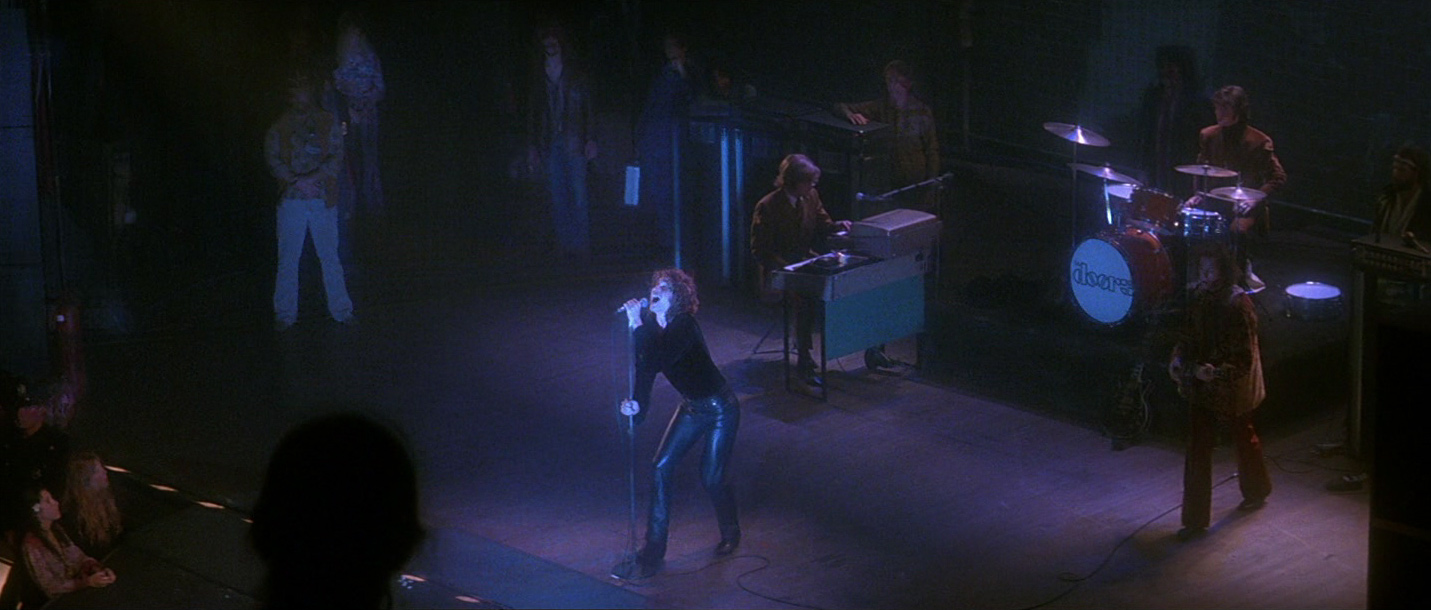
It goes without saying that The Doors truly comes to life during the concert scenes as all the theatrical stage lighting and dynamic camera movements showcases Richardson’s skill as one of the best cinematographers ever to get behind the camera. The warm colors he uses in the London Fog scenes conveys an intimacy representative of the small venue and symbolizes a band still learning their chops, both musically and how they perform in a live setting. Richardson really gets a chance to cut loose in the sequence where the band go out into the desert and take peyote. He employs all sorts of trippy effects and also creates some stunningly beautiful shots, like that of a blue sky populated by all kinds of fragmented clouds or a pan across a rocky formation with shadows creeping upwards, animated via time lapse photography.

Stone then segues to the Doors playing at the Whisky a Go Go in 1966 – the next step to the big time. We see them perform “The End,” an epic Oedipal nightmare. It’s a hypnotic song that shows how far the band had come. Morrison is no longer shy and commands the stage like no other before him. Kilmer is mesmerizing in this scene and you can see how fully committed he is to the role. It’s not just the ability to recreate Morrison’s signature moves but he has an uncanny knack to immerse himself in the singer’s headspace. In these concert scenes it is incredible to see the actor throw himself completely into them just as Morrison would.

In the spot-on casting department, it was an absolute delight to see Michael Wincott freed from the shackles of playing clichéd heavies and make an appearance as legendary music producer Paul Rothchild who worked on many of the Doors’ albums. He has a fantastic scene later on when he tries to get through to a drunken Morrison during an awful recording session and delivers an impassioned speech even though the singer tunes him out.

Stone’s film starts to lose its mind when the Doors arrive in New York City in 1967 and the way he presents the hysteria of their arrival is like the Second Coming of the Beatles. There are moments of amusing levity as Stone shows the obvious culture clash between the square staff at The Ed Sullivan Show when the producers try to be hip by talking to the band in their own “lingo” using words like “groovy” and “dig it” that sound forced and fabricated. The Doors are told to change a lyric in “Light My Fire” so as to satisfy standards and practices. Stone has a bit of fun with their televised appearance, fudging how Morrison defied the censors.

Stone shows the skyrocketing of Morrison’s ego and how he began to believe his own hype. He also suggests that Morrison really started to lose control when he and his bandmates attended a party at Andy Warhol’s The Factory. All sorts of pretentious weirdoes vie for Morrison’s attention. Manzarek sums it up best when he tells Morrison, “These people are vampires.” However, it’s when the rest of the band departs the party leaving Morrison to fend for himself that Stone suggests the moment when the first schism between them was created. The look of distrust on the singer’s face as his bandmates depart says it all. There is no one to keep his indulgent behavior in check. We are subjected to an unfortunate fey caricature of Warhol thanks to the usually reliable Crispin Glover. Hanging out with Nico and Warhol’s regulars brings out Morrison’s worst excesses which Richardson shoots like some kind of monstrous nightmare, a bad trip that we want desperately to end. This sequence starts Stone’s escalation of depicting Morrison’s self-destructive journey.

And so we get a scene where Morrison does cocaine with a self-professed witch (played by a vampy Kathleen Quinlan) and participates in a silly, over-the-top ceremony whose inclusion stops the narrative cold. Stone is playing with the mythic figure that we know as Jim Morrison. The Doors tries to show both sides: the mythic persona and the real man drowning in fame, drugs and alcohol. Stone hints at this transformation when Morrison does the famous photo shoot that has been immortalized in posters and in the pages of glossy rock magazines like Rolling Stone. Morrison is drunk on alcohol and one might argue his own fame. He begins to believe in his own image and the photographer (Mimi Rogers) only coaxes him on when she says, “Forget the Doors. You’re the one they want. You are the Doors.” It is at this point in the film that Morrison is no longer an artist or a poet, but a commodity to be used up by everyone: the media and the masses. On Morrison’s rise to the top, everyone wants a piece of him, to capture a little bit of the exhilarating ride. Morrison’s mistake was that he obliged and thought that he could handle it.

We see how drugs and alcohol fuel Morrison’s irrational behavior and he becomes verbally and physically abusive towards Pamela. Anything that was good about Morrison depicted in the film is now gone and all we’re treated to is a series of scenes showing what an asshole he had become and how he had been consumed by his own fame. His bad behavior reaches new heights of ridiculousness during a scene where he and Pamela host a dinner party for their friends and hanger-ons. Stoned out of his mind (and probably drunk), Morrison provokes Pamela who starts throwing food around hysterically and then tries to stab him with a carving knife while he taunts her. Stone sledgehammers the point home by playing “Love Me Two Times” on the soundtrack as if to reinforce Morrison repeatedly cheating on Pamela with other women. If there is anything good that comes from this wildly over-the-top scene it is that it shows how estranged Morrison has become from the rest of his bandmates.

Fortunately, the film has amazingly choreographed concert sequences that repeatedly bring it back from the brink of its own excesses. The New Haven ’68 concert depicts Morrison’s run-in with the law when he was maced in the face backstage by a cop. It’s no longer about the music but the abuse of his power as a lead singer with a microphone to air his grievances. The best concert sequence in the film is the San Francisco ’68 one. Bathed in hellish red light, Morrison whips the crowd into a frenzy. His increasingly desperate performance is juxtaposed with his out of control personal life as he almost traps Pamela in their bedroom closet and proceeds to burn it down, gets in a car accident and is involved in a Wiccan marriage ceremony. We see Morrison in a wonderfully hallucinatory moment channel his Native American Indian spirit as he loses himself in the music. The last shot of this powerful sequence shows Morrison drunk on his own power and fame as much as he’s drunk on alcohol. The expression on Kilmer’s face says it all.

Over the years, directors like Brian De Palma, Martin Scorsese and William Friedkin flirted with directing a Doors biopic. In 1985, Columbia Pictures acquired the rights from the Doors and the Morrison estate to make a film. Producer Sasha Harari wanted Oliver Stone to write the screenplay but never heard back from the filmmaker’s agent. After two unsatisfactory scripts were produced, Imagine Films replaced Columbia. Harari tried contacting Stone again and the director met with the surviving band members. He told them that he wanted to keep a particularly wild scene from one of the early drafts. The group was offended and exercised their right of approval over the director and rejected Stone. By 1989, Mario Kassar and Andy Vajna, who owned Carolco Pictures, acquired the rights to the project and wanted Stone to direct. The Doors had seen Platoon (1986) and were impressed with what Stone had done.

Stone agreed to make The Doors after his next project, Evita (1996). After spending years on it and courting Madonna and later Meryl Streep to play the lead role, the film fell apart over salary negotiations with Streep. Stone quickly moved on to The Doors and went right into pre-production. Guitarist Robby Krieger had always opposed a Doors film until Stone signed on to direct. Stone first heard the Doors when he was a 21-year-old soldier serving in Vietnam. Historically, keyboardist Ray Manzarek had been the biggest advocate of immortalizing the band on film but opposed Stone’s involvement. According to Krieger, “When the Doors broke up Ray had his idea of how the band should be portrayed and John and I had ours.” Manzarek was not happy with the direction Stone wanted to take and refused to give his approval to the film. According to Kyle MacLachlan, “I know that he and Oliver weren’t speaking. I think it was hard for Ray, he being the keeper of the Doors myth for so long.” Manzarek claims that he was not even asked to consult on the film and if he had his way wanted it to be about four members equally rather than the focus being on Morrison. Stone claims that he repeatedly tried to get the keyboardist involved, but “all he did was rave and shout. He went on for three hours about his point of view ... I didn’t want Ray to be dominant, but Ray thought he knew better than anybody else.”

While researching the film, Stone read through transcripts of interviews with over 100 people. The cast was expected to get educated about 1960s culture and literature. Stone wrote his own script in the summer of 1989. He said, “The Doors script was always problematic. Even when we shot, but the music helped fuse it together.” He picked the songs he wanted to use and then wrote “each piece of the movie as a mood to fit that song.” Before filming, Stone and his producers had to negotiate with the three surviving band members, their label Elektra Records, and the parents of Morrison and Pamela Courson. Morrison’s parents would only allow themselves to be depicted in a dream-like flashback sequence at the beginning of the film. The Coursons wanted there to be no suggestion in any way that their daughter caused Morrison’s death. Stone found her parents to be the most difficult to deal with because they wanted Pamela to be “portrayed as an angel.” The Coursons tried to slow the production down by refusing to allow any of Morrison’s later poetry to be used in the film. After he died, Pamela got the rights to his poetry and when she died, her parents got the rights. Legendary concert promoter Bill Graham, who promoted Doors concerts in San Francisco and New York in the ‘60s, played a key role in negotiations.

When Stone began talking about the project as far back as 1986, he had Kilmer in mind to play Morrison, impressed by his work in the Ron Howard fantasy film Willow (1988). However, during this time actors ranging from John Travolta to Richard Gere to Tom Cruise and the lead singers from INXS and U2 were considered for the part. Stone auditioned nearly 200 actors to play Morrison in 1989. In his favor, Kilmer had the same kind of singing voice as Morrison and to convince Stone that he was right for the role he spent thousands of dollars of his own money to make his own eight-minute video, singing and looking like the Lizard King at various stages of his life. When the Doors heard Kilmer singing they couldn’t tell if it was him or Morrison’s voice. Once he got the part, he lost weight and spent six months rehearsing Doors songs every day. Kilmer learned 50 songs, 15 of which are actively performing in the film. He also spent hundreds of hours with record producer Paul Rothchild who told him, “anecdotes, stories, tragic moments, humorous moments, how Jim thought, what were my interpretation of Jim’s lyrics,” he said. He also took Kilmer into the studio and helped him with “some pronunciations, idiomatic things that Jim would do that made the song sound like Jim.” The actor also met with Krieger and Densmore but Manzarek refused to talk to him.

Stone auditioned approximately 60 actresses for the role of Pamela Courson. The part required nudity and the script featured some wild sex scenes which generated a fair amount of controversy. Casting director Risa Bramon Garcia felt that Patricia Arquette auditioned very well and should have gotten the part. However, Meg Ryan was cast and to prepare for the role, she talked to the Coursons and people that knew Pamela and encountered several conflicting views of her. Before doing the film, Ryan was not at all familiar with Morrison and “liked a few songs.” She had trouble relating to the culture of the ‘60s and said, “I had to reexamine all my beliefs about it in order to do this movie.”

Stone originally hired Paula Abdul to choreograph the film’s concert scenes but dropped out because she did not understand Morrison’s on-stage actions and was not familiar with the time period. She recommended Bill and Jacqui Landrum. They watched hours of concert footage before working with Kilmer. They got him to loosen up his upper body with dance exercises and jumping routines to develop his stamina for the demanding concert scenes. During them, he did the actual singing and Stone used the Doors’ master tapes without Morrison’s lead vocals to avoid lip-synching. Kilmer’s endurance was put to the test during these sequences, with each one often taking several days to film. Stone said, “his voice would start to deteriorate after two or three takes. We had to take that into consideration.” One sequence, filmed inside the Whisky a Go Go was harder than the others due to all the smoke and the sweat, a result of the body heat and intense camera lights. For five days Kilmer performed “The End” and after the 24th take, Stone got what he wanted and the actor was left totally exhausted.

With a budget of $32 million, The Doors was filmed over 13 weeks predominantly in and around Los Angeles. Krieger acted as a technical adviser on the film and this mainly involved showing his cinematic alter ego Frank Whaley where to put his fingers on the fretboard. Densmore also acted as a consultant, tutoring Kevin Dillon who played him in the film. Controversy arose during principal photography when a memo linked to Kilmer circulated to cast and crew members listing rules of how the actor was to be treated for the duration of filming. These included people being forbidden to approach him on the set without good reason, not to address him by his own name while he was in character, and no one could “stare” at him on the set. Understandably upset, Stone contacted Kilmer’s agent and the actor claimed it was all a huge misunderstanding and that the memo was for his own people and not the film crew.

Not surprisingly, The Doors received mixed to negative reviews from critics. Roger Ebert gave the film two-and-a-half stars out of four and wrote, “The experience of watching The Doors is not always very pleasant. There are the songs, of course, and some electrifying concert moments, but mostly there is the mournful, self-pitying descent of this young man into selfish and boring stupor … The last hour of the film, in particular, is a dirge of wretched excess, of drunken would-be orgies and obnoxious behavior.” In her review for The New York Times, Caryn James wrote, “At its best, the film's haunted Doors music and visceral look creates the sense of being in some hypnotic trance. But by the end, audiences may feel they have been beaten over the head with a stick for two hours.” Time magazine’s Richard Corliss wrote, “His movies make people edgy, and that's a good thing. But this time Stone is a symptom of the disease he would chart … Maybe it was fun to bathe in decadence back then. But this is no time to wallow in that mire.” In his review for the Washington Post, Hal Hinson wrote, “Amid all this trippy incoherence, the performances are almost irrelevant. Kilmer does a noteworthy impersonation of the singer, especially onstage, where he gets Morrison's self-absorption. He gets his coiled explosiveness too, but the element of danger in Morrison is missing.”

The Chicago Reader’s Jonathan Rosenbaum wrote, “Some of the effects are arresting, and apart from some unfortunate attempts to ‘re-create’ Ed Sullivan, Andy Warhol, and Nico, the movie does a pretty good job with period ambience. But it's a long haul waiting for the hero to keel over.” Famous conservative pundit George Will not only attacked Morrison, calling him, “not particularly interesting” and that he “left some embarrassing poetry and a few mediocre rock albums,” but also the film: “for today’s audiences, Stone’s loving re-creation of San Francisco’s Haight-Ashbury district is just a low-rent Williamsburg, an interesting artifact but no place for a pilgrimage.” However, Entertainment Weekly gave the film a “B” rating and Owen Gleiberman wrote, “As Morrison, Val Kilmer gives a star-making performance. Lolling around in his love beads and black-leather pants, his thick dark mane falling over features that are at once baby-sweet and preternaturally dangerous, Kilmer captures, to an astonishing degree, the hooded, pantherish charisma that made Morrison the most erotically charged pop performer since the early days of Elvis.”

So how did the actual Doors feel about the film? Robby Krieger was impressed with Kilmer’s portrayal of Morrison: “It was really weird. I even called him ‘Jim’ a few times without meaning to.” In his memoirs, John Densmore wrote, “For what it is, I do think Oliver Stone’s vision of Jim Morrison has integrity; however, it is a film about the myth of Jim Morrison.” Ray Manzarek said of the film, “The movie misses out – Oliver Stone blew it ... The movie looks good, sure, but the basic heart is stone cold.”

Stone also uses several film techniques like special lighting to create a red hue over everything and a swaying, chaotic camera to create an off-kilter hallucinogenic world that he would later perfect in Natural Born Killers (1994). This effect gives the film the overall effect of a peyote experience without actually taking drugs. The Doors also captures the madness and paranoia of the era with quick edits of the horrors of Vietnam, and the Robert F. Kenney assassination juxtaposed with the belligerent cops at every concert, and the rampant drug use associated with this scene. One band member says during the film that he took drugs to expand his mind not to escape as Morrison did. As the scenes of Morrison’s excessive behavior pile up, a feeling of exhaustion sets in as it begins to be all too much which, I guess, is kind of how Morrison felt towards the end. A feeling of burn out takes over and the end of the film can’t come soon enough. The experience of watching The Doors leaves one drained and you really feel like you’ve been somewhere and experienced something.

The Doors is a potent reminder of the self-destructive power of rock stars that the media manipulates and thrives on. At one point in the film during a press conference, Morrison says, “I believe in excess,” and in doing so underlines the whole thesis of the film. The Doors is a film about excess on many levels: on a individual level with Morrison himself, on a national level with thousands of fans going crazy at the mere sight of the singer, and on a personal level with Stone’s own preoccupations permeating throughout. The Doors also examines the seductive power of the cult of personality, the god-like status to which people like Morrison or someone like Kurt Cobain are elevated to and the inevitable crash that follows when they can’t handle the responsibility. Morrison represents a generation trying to escape the pain of a crazy world. Like Cobain, Morrison wanted to ultimately be seen as an artist, but was treated in life and after his death like a commodity (Morrison was once referred to as the “ultimate Barbie doll.”). Both men were consumed by the very thing that created them: the media. They also ended their own lives, Cobain via suicide and Morrison through alcohol abuse. The Doors is a powerful study of excesses of every kind: sex, drugs, alcohol, and fame on an individual and on a society.


SOURCES

Broeske, P. “Stormy Rider.” Sunday Herald. March 10, 1991.

Green, Tom. “Kilmer’s Uncanny Portrait of Morrison Opens Career Doors.” USA Today. March 4, 1991.

Hall, Carla. “Val Kilmer, Lighting the Fire.” Washington Post. March 3, 1991.

Kilday, Gregg. “Love Me Two Times.” Entertainment Weekly. March 1, 1991.

MacInnis, Craig. “The Myth is Huge, But the Truth is the Lure of the Eternal.” Toronto Star. March 2, 1991.

McDonnell, D. “Legendary Rocker Lives Again On.” Herald Sun. March 2, 1991.

McDonnell, D. “Rider on the Storm.” Courier-Mail. March 16, 191.

Mitchell, Justin. “Opening Up A Closed Door.” St. Petersburg Times. December 28, 1990.

“Oliver Stone and The Doors.” The Economist. March 16, 1991.

Riordan, James. Stone: A Biography of Oliver Stone. Hyperion. 1995.

Thomas, Karen. “Helping Stage The Doors.” USA Today. March 12, 1991.


Thomas, Karen. “Ex-Doors Member Slams Stone, Film.” USA Today. April 4, 1991.