"...the main purpose of criticism...is not to make its readers agree, nice as that is, but to make them, by whatever orthodox or unorthodox method, think." - John Simon

"The great enemy of clear language is insincerity." - George Orwell

Friday, September 8, 2017

Shaw Brothers September: The 36th Chamber of Shaolin

Produced by the legendary Shaw Brothers Studio, The 36th Chamber of Shaolin was released in 1978. Its protagonist was based on an actual historical figure – a legendary Shaolin monk – that existed during the Manchu Dynasty during the early 18th century, but his life was highly fictionalized for the movie.

The Manchu government is a tyrannical regime that reigns across the country and is embodied by General Tien Ta (Lo Lieh), an impressive combatant that easily bests an insurgent armed with a battle-axe in a fight sequence that starts off the movie. Chong Wen College and its teacher Mr. Ho plot with a group of students against the oppressive government.

In response to the rebellion, several students accused of being spies are rounded up, tortured for information and eventually killed by Lord Tang, one of General Tien’s enforcers. He even kills the father of one of the college’s star pupils, Liu Yude (Gordon Liu).

Gravely wounded by Lord Tang, Yude flees to the nearby Shaolin Temple to learn kung fu so that he can eventually get revenge on the Manchu government. The monks take him in and nurse him back to health, renaming him San Te. He starts briefly at the top chamber and quickly realizes that he’s not ready for it.

And so begins one of the greatest training montages ever put on film as he begins at the bottom, working on the fundamentals – balance, power and speed. From there, he moves onto building up arm strength, weapons training and so on. These are grueling tests of strength, endurance and dexterity. San Te is a quick learner and soon excels at every test he faces.

What is so striking about The 36th Chamber of Shaolin is how political a movie it is with the Manchu government being extreme repressive. It exploits and keeps the populace down with an iron fist. Anybody who resists in the slightest is tortured and killed. Yude barely escapes with his life having lost everything and takes refuge with the Shaolin monks where he reinvents himself and yet never forgets where he came from or what happened.

What’s interesting about The 36th Chamber of Shaolin is that once our hero enters the Temple, the tone of the film takes on a decidedly more philosophical one as the monks practice a sound mind as well as a sound body, dropping such pearls of wisdom like, “Being at one is eternal,” and “A pure body is light, steps stable, stance is firm.” Initially, Yude is dense and useless, which results in being schooled repeatedly by his elders. He is rash and impulsive but persistent, refusing to give up as he has nowhere else to go.

Yude undergoes a series of punishing exercises that build up his physical abilities. It is only after he’s mastered the basics that he’s allowed to begin kung fu training. The 36th Chamber of Shaolin is one of the best training sequence movies ever made as it shows the commitment needed to become more than mere proficient, but a master. It also shows how much Yude fails as he succeeds, putting in the hard work needed to advance through the Shaolin chambers.

Gordon Liu is an exemplary martial arts actor, more than capable of conveying his character’s physical prowess but he also has a very expressive face that he uses to convincingly convey the emotions Yude experiences in a given situation. He also does an excellent job of portraying his character’s coming of age, from a naïve student to a Shaolin monk in tune with not only himself but also the world around him.

Once San Te leaves the temple, he actually puts into practice what he learned into his fighting technique and we see just how far he has come. The climactic scene comes when we watch as San Te systematically dismantles the Manchu government’s forces and it is an impressive sight to behold, but is only a warm-up for the even more exciting confrontation he has with the evil general.


--> The 36th Chamber of Shaolin was so successful it spawned two sequels, Return to the 36th Chamber (1980) and Disciples of the 36th Chamber (1985). It also inspired several albums by legendary rap band, the Wu-Tang Clan. For those of you that only know Gordon Liu from his appearances in the Kill Bill films, this is the movie that really showcases his considerable talents and a must-see for any fan of the kung fu genre.

Friday, September 1, 2017

Shaw Brothers September: King Boxer


BLOGGER'S NOTE: Every week this month I plan on taking a look at different kung fu movie from the legendary Shaw Brothers studio that helped pioneer the genre in the 1970s.

During the 1970s, the Shaw Brothers produced some of the very best kung fu movies, or wuxia as it was called in China, ever made. Their first big success actually came out in the 1960s – One-Armed Swordsman (1967), which made $1 million in Hong Kong, but it wasn’t until a few years later that they made in-roads all over the world with King Boxer (a.k.a. Five Fingers of Death, 1972). It was the first of its kind to be picked up by Warner Bros. and distributed in the United States. It helped kick start the kung fu movie craze of that decade.

The movie gets right into it as an old martial arts teacher is attacked by a group of thugs armed with knives. Despite his advanced age, he is able to hold them off, jumping through the air like a man half his age. Fortunately, one of his best students, Chao Chih-Hao (Lieh Lo) arrives just in time to scare them off. The teacher realizes he can no longer teach his pupil anything new and sends him off to study under a superior master, Shen Chin-Pei (Fang Mian).

Meanwhile, local martial arts despot Ming Dung-Shun (Tien Feng) controls the five northern provinces and maintains dominance by befriending and then enlisting martial arts experts like Chen Lang, an man with an exceptionally hard forehead that he uses to best a local strong man (Bolo Yeung) by headbutting him into submission!

Chao shows up at Master Shen’s school and is easily bested by one of his students only to be relegated to the kitchen. He toils away there but is tested regularly and randomly until he is soon dodging spears and breaking branches with his bare hands. He is then deemed worthy enough to be a student.

There is an upcoming national tournament among the various martial arts schools and Master Ming sends Chen Lang to trash Master Shen’s school. He makes quite an entrance by taking the school’s sign and breaking it in half with his head. He then proceeds to thrash the students, sending one through the ceiling and another through a wall. Chen Lang confronts Master Shen and bests him through cowardly tactics.

Chao decides to confront Chen Lang and amazingly is able to defeat him. He is rewarded by Master Shen with being bestowed knowledge of the Iron Palm technique that causes his hands to glow red as he channels his inner chi to deadly effect. He plans to compete in the tournament. Being a dishonorable man, Master Ming brings in ringers from Japan to ruin Master Shen’s school’s chances.

By making Master Ming’s brutal hired guns Japanese, the Shaw Brothers cannily appealed to Chinese national pride. No wonder King Boxer did so well in Hong Kong! They fight dirty, are remorseless killers, and punish Chao so severely that we want to see him get better and exact well-deserved vengeance on the bad guys. Ming even uses his own son, Meng Tien-Hsiung, as an enforcer. You can tell that his son his a bad guy by the sly, arrogantly evil expression permanently affixed to his face and the long cigarette holder he uses while perpetually fondling two ballbearings as his goons do the dirty work for him.

Director Chang-Hwa Jeong employs sudden zoom in and outs and even the occasional freeze frame during many of the movie’s dynamic fight scenes. This is a beautifully shot movie with expert use of the 2.35:1 widescreen aspect ratio (Shawscope!) and superb compositions of every frame. The use of shadows for dramatic effect in one scene and a brief fight that takes place at sunset resembling something right out of 1950s Technicolor era, is part of the reason why King Boxer is so revered among kung fu movie fans.

The kinetic fight scenes are exciting to watch and, at times, surprisingly brutal with plenty of blood, eye gouging and even a decapitation! They are expertly choreographed, gradually build up in intensity and in terms of style to the final showdown between Chao and Tien-Hsiung at the competition where, of course, the Iron Palm technique is used, but this sequence is merely a warm-up to the penultimate fight at the end as Chao takes down all the bad guys, one by one, in an extremely satisfying conclusion.

Korean director Chang-Hwa Jeong was hired by the Shaw Brothers because he was capable of making a modern action movie. He received the screenplay written by Kong Yeung but felt that the story was “ordinary.” He took the core of it and then changed the content himself, creating things like the Iron Palm technique, the hired enforcers from Japan, and the character of Chen Lang. He wasn’t able to hire martial arts choreographers as they were working with Chinese directors and so he hired their assistants instead. At the time, wire work was the norm for fight sequences but he found it too slow and not realistic enough. He used trampolines, which he found conveyed fast, powerful action.

King Boxer follows a traditional hero’s journey as he must overcome insurmountable odds and personal hardships to beat the bad guys while maintaining his honor and that of his school. It tells a simple yet effective tale full of betrayal, torture, revenge and even some heroic style redemption thrown in for good measure – all heightened to melodramatic levels making for a very entertaining ride. Our hero has to deal with a devastating injury and his own self-doubts before he can face the bad guys and use the Iron Palm technique to save the day. You soon find yourself rooting for Chao to win the competition and make himself worthy of the cute woman he loves as well.

When King Boxer debuted in the U.S. under the title, Five Fingers of Death, it was a big hit, paving the way for Bruce Lee’s subsequent success and launching the kung fu craze of the ‘70s. In the 1980s, it inspired filmmaker John Carpenter to make Big Trouble in Little China (1986) and, more recently, was a huge influence on Quentin Tarantino’s Kill Bill films where he paid direct homage to King Boxer. It is a movie that still holds up and remains one of the best examples of its kind from the ‘70s.


SOURCES


-->
“Interview with Director Chang-Hwa Jeong.” King Boxer DVD. Dragon Dynasty. 2007.

Friday, August 25, 2017

Nightflyers

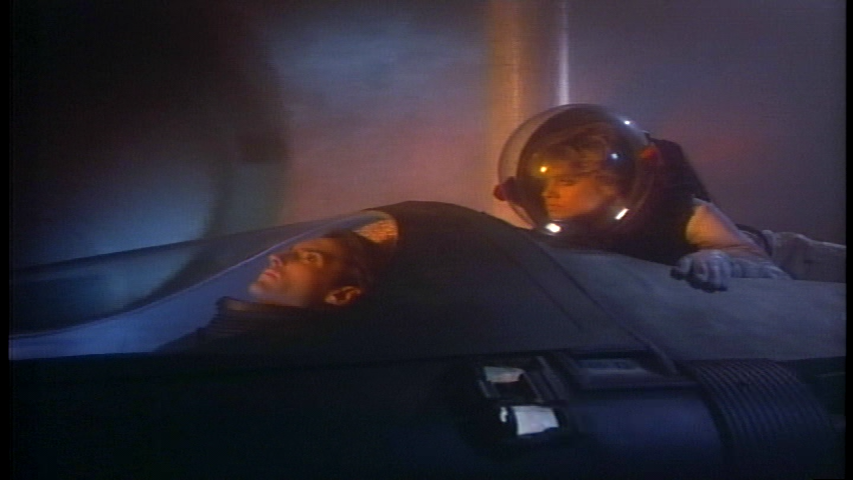
Before Game of Thrones catapulted author George R.R. Martin into fame and fortune, he was better known as a prolific science fiction writer. In 1980, he published a novella entitled Nightflyers about a group of scientists on a quest through deep space to find a mysterious alien life form when things go wrong on the spaceship. I remember Starlog putting the movie adaptation on the cover of one of its issues and it getting my attention as it starred Catherine Mary Stewart whom I developed a cinematic crush on thanks to her memorable roles in Night of the Comet (1984) and The Last Starfighter (1984). Nightflyers (1987) never did reach my town and I never did get to see it and forgot about it over the years until recently when it was announced that the SyFy Channel was developing a television series based on the movie.

Michael D’Brannin (John Standing) heads up a deep space expedition in search of an alien life form. He has already assembled a team of scientists when Miranda Dorlac (Stewart) joins as the project coordinator. They don’t have much of a budget or much support but D’Brannin believes in what he’s doing. They board the ship – an old freighter called The Nightflyer – and get a vibe that something isn’t right. It has all the comforts of home but with an “emptiness to it,” as Miranda observes, “like an ancient temple or tomb.” These words will prove to be prophetic. They are soon joined by Jon Winderman (Michael Des Barres), a telepath, and his empath Eliza (Annabel Brooks) – backups in case technology fails to establish contact with the aliens.

The ship’s captain – Royd Eris (Michael Praed) – is an enigmatic fellow that first appears to the rest of the crew as a hologram. Apparently, he’s their first human crew and his own origins are something of a mystery, even to telepath Jon. Miranda finds herself drawn to Royd, sketching him in her spare time, and they talk as he feels comfortable enough with her to reveal his secrets.

The ship’s computer, however, isn’t too crazy that they are bonding and pulls a HAL 9000 (it even has a single red eye), actively trying to kill the crew who are already on edge due to the nature of their mission. They have to find a way to shut it down, but of course it won’t be that easy.

Michael Des Barres has a memorable scene where Jon is driven mad by the ship’s computer and he slips seamlessly from his New Age-y telepath to gone-bonkers puppet of big bad mama computer. He rounds out a cast of memorable characters – Lisa Blount (Prince of Darkness), Glenn Withrow (Rumble Fish), and James Avery (Fletch) – who are given very little memorable to do. Even the movie’s supposed star, Catherine Mary Stewart, is given surprisingly little to do. Like the others, there is no depth to her character and this gives us little to become emotionally invested in and so we care little about what happens to her and the rest of the crew.

The visual effects of Nightflyers are certainly well done – a mix of model work and matte paintings – with a look that evokes Blade Runner (1982) – complete with a Vangelis-esque score – and Max Headroom with its smoke and shadows coupled with 1980s futuristic fashion (Stewart even rocks some awesome mirrorshades). The sets are detailed and expansive, conveying a vast ship for a decidedly small crew.

Jon’s telepathic scenes reek of ‘80s music video stank – Des Barres’ presence probably doesn’t help – but they do introduce a horror movie element into Nightflyers with a kinky twist as the ship’s artificial intelligence has a warped maternal complex, lashing out at the crew as it thinks they will take Royd away. It will do anything to prevent that from happening. In this respect, Nightflyers anticipates Event Horizon (1997) by several years and one wonders if it was influenced by this movie.

According to George R.R. Martin, Nightflyers came out of an experiment: “I was fooling around with the idea of hybrid stories that were both science fiction and horror, simultaneously.” In 1984, producer/writer Robert Jaffe saw a story by Martin in an issue of Omni magazine that he wanted the film rights to but had been optioned by someone else. Martin told Jaffe he had another story, which was Nightflyers.

Jaffe adapted the story that originally appeared in Analog magazine. It was not as long as the novella, which gave the secondary characters names and so he made up his own. Jaffe also changed the name (because it sounded liked “cough medicine” to something that people could pronounce) and race of the protagonist, casting Catherine Mary Stewart who was white and smaller than the character as written. He wrote eight drafts over three years, changing what he felt was a depressing ending.

Stewart took the role of Miranda as she had become frustrated at being typecast as a teenager and this part was “totally different than anything I’ve done and shows me in a completely different light – of authority, and intelligence.” She claimed that the filmmakers approached her because they could afford her salary and could benefit from her genre fanbase that would hopefully be drawn to the movie.

Prior to Nightflyers, Stewart had shot a movie on location mostly at night and was looking forward to shooting in a studio until filming began on a set filled with smoke while wearing thick spacesuits with helmets that had no ventilation. Actor Michael Praed was not thrilled working with all kinds of special effects or with Stewart who left to do another movie by the time it came to shoot his scenes with her character: “I was acting – literally – to a cross on the wall and some appalling continuity girl reading Stewart’s lines!”

Nightflyers received negative reviews from critics. In her review for The New York Times, Caryn James wrote, “But the whole film looks murky – the ship resembles a big blob of chocolate pudding – and the special effects are heavy on lasers; that is, they are ordinary.” The Washington Post’s Richard Harrington wrote, “Nightflyers moves with the speed and grace of a space buffalo. This is a movie that needs a jump start.” In his review for the Los Angeles Times, Michael Wilmington wrote, “Nightflyers, unfortunately, is too smart to be camp and too shallow to be good. It flounders along, drowned in its own cathedral lighting, its mission to discover intelligence in deep space exploding in its face.”

Three years after it was released, Martin was asked what he thought of the movie and he said, “I think it was about 75% faithful, but unfortunately the 25% that they changed had a kind of a ripple effect and made the 75% that wasn’t changed not make as much sense as it might have.”

With some movies their commercial failure is the result of lousy timing or studio meddling, or it was misunderstood and ahead of its time. Sometimes, like in the case of Nightflyers, it just isn’t very good. It’s not that the movie is particularly awful – it is very well shot, directed and acted – it just isn’t all that memorable. The main problem lies with the generic characters that we could care less whether they live or die and this robs the movie or any dramatic tension. Perhaps a T.V. series adaptation that will allow time to develop the characters and their relationships with each other will finally do justice to Martin’s original novella.


SOURCES

Alrey, Jean and Laurie Haldeman. “Michael Praed: Legends of the Hooded Man.” Starlog. January 1988.

Dedman, Stephen. “An Eidolon Interview with George R.R. Martin.” Eidolon. April 1990.

Dickholtz, David. “George R.R. Martin: Nightflyers High, Aces Wild.” Starlog. May 1987.

Lowry, Brian. “Catherine Mary Stewart: Spacebound Once Again.” Starlog. April 1987.


Shaprio, Marc. “Haunted Days, Starless Nights.” Starlog. November 1987.


Friday, August 18, 2017

The Woman Chaser

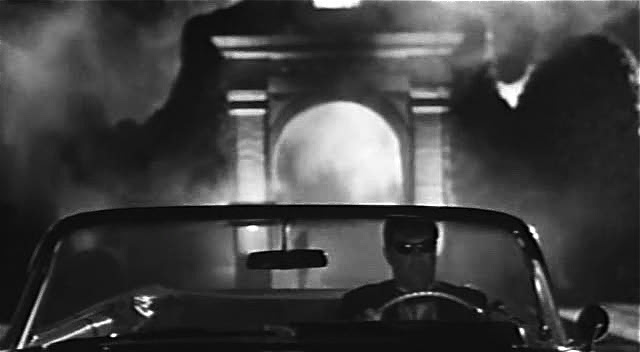
Based on the classic pulp novel of the same name by Charles Willeford, The Woman Chaser (1999) debuted at the New York Film Festival where it went on to play on the festival circuit before doing rounds at art houses around the United States. The film was anchored by the unlikely casting of sitcom stalwart Patrick Warburton playing 1950s used car salesman that tries his hand at filmmaking. Unfortunately, the low-budget independent film ran afoul or ownership issues, which resulted in a lack of a home video presence and it disappeared, surfacing occasionally on the Sundance Channel. A few years ago, it resurfaced on digital platforms like Netflix and iTunes but with a lot of its source music (featuring the likes of Les Baxter) replaced but at least this fascinating neo-noir can finally be seen.

Richard Hudson (Warburton) is an ambitious, enigmatic individual that comes off the street and convinces the owner of a used car lot to give him control of it and in turn he sets up an efficient system to sell them. He does an excellent job and makes decent money but he feels restless and unfulfilled. Richard idolizes his mother (Lynette Bennett), a former ballerina, perhaps a little too much, and goes to the movies with his father-in-law Leo (Paul Malevich), a washed-up filmmaker.

One day, Richard gets a tearful epiphany: “Our lives were so short. So little time for creativeness. And yet we wasted it. Letting it slip through our fingers like goddamn sand!” He decides that he must do something creative. “I knew the time for fooling around was over. The time had come for me to create something. One creative accomplishment that would wipe away the useless days, tie up in a single package my reason for being here.” He decides that the creative outlet will be writing and directing his own movie entitled, The Man Who Got Away, about an average American truck driver. The rest of The Woman Chaser follows him on this crazy journey.

Known mainly for his sitcom work on Seinfeld and Rules of Engagement, Patrick Warburton finally got a juicy role to sink his teeth into and he goes for it as evident in a the scene where Richard passionately pitches his movie to Leo. Director Robinson Devor alternates between Richard addressing the roaming camera and Leo’s reaction. The actor is so convincing that we want to see this movie. I’ve always felt that Warburton looks like he came from another era and the film exploits this notion so that he fits right into the 1950s era film noir setting.

The actor is game and not afraid to look silly, like the montage of Richard frolicking on a beach with Laura (Emily Newman), his secretary. They do the usual things you see in these kinds of sequences, like running on the beach, laughing, and playing in the water only for Devor to cut to her hiking a football for him to throw her a pass so hard that she drops it, which playfully subverts our expectations. The director also expertly harnesses Warburton’s trademark deadpan sense of humor to maximum effect while also getting him to dig deep and show the tortured artist behind the used car salesman.

Traditionally, excessive voiceover narration is a bad idea – a crutch for lazy filmmakers (unless you’re Martin Scorsese), but here it works because Devor is simultaneously paying tribute to and playfully satirizing classic film noir. It also provides us with valuable insight into Richard’s mindset and worldview. Much of the film’s humor comes from the juxtaposition of Richard’s hard-boiled dialogue and the sometimes absurd imagery that plays with it, like when Richard joins his mother in an impromptu interpretative dance sequence that Warburton, with his hulking frame prancing about, plays completely straight and this is what makes the scene so funny.

The Woman Chaser features atmospheric black and white cinematography with a soundtrack populated by several choice cuts of Les Baxter lounge music, which only adds to the film noir vibe. In fact, it feels and looks like a long lost film from the era and would make for an entertaining double bill with Tim Burton’s Ed Wood (1994), it too a humorous black and white ode to filmmaking. Both Richard and Ed are passionate filmmakers that will do anything to get their films made, even if, in the former’s case, it means having sex with his lead actress in order to get the line reading he wants.

In 1996, filmmaker Robinson Devor picked up a copy of Charles Willeford’s novel The Woman Chaser in a mystery bookstore in Redondo Beach. He was so taken with it that he bought the rights, adapted it into a screenplay, and then shopped it around Hollywood with little success. It wasn’t that people didn’t like it, but that it wasn’t seen to have much commercial potential. Finally, Devor decided that he couldn’t wait any longer and would make it himself on a low budget.

He had to find someone that would be perfect for the leading role and also big enough of a name to get financing. He spent a year-and-a-half trying to get Jason Patric but when that didn’t pan out he sent the script to Patrick Warburton. Eager to get away from his memorable recurring character on Seinfeld, he came in and read for the part in the style of John Wayne. Devor thought it was funny but not right for the part. The actor came back several times and the director realized that “we would never get anyone closer with physique and comic delivery than this guy, but it did take us awhile to wipe away all the mannerisms.” To bulk up for the role, Warburton ate a lot of burgers and ice cream while also smoking unfiltered cigarettes. He gained so much weight that Devor was worried that his leading man might not fit into his period wardrobe.

The film was shot on 35mm color (printed in black and white) for $800,000 in and around Los Angeles in 38 days over a four-month period dictated by Warburton’s guest spots on the NewsRadio sitcom. Much of it was shot on weekends while Devor continued to work as an advertising copywriter during the week. This resulted in a challenging, guerrilla-style film shoot, marked by stealing shots where they could, long hours and no money. “We had to steal locations. I remember getting kicked out of a few locations,” Warburton said in an interview. With little money, Devor had to find locations that didn’t need anything added or taken away. “The secret was to spend a little money on locations that had flavor of the period.” He also used a lot of close-ups so that much of the set wasn’t visible. The black and white look also lent to the period feel.

The Woman Chaser imagines the film director as noir protagonist, applying the genre’s moody aesthetics to the tale of a man making a movie. For all of its absurd humor, it does say something poignant about the creative process. Where does the creative spark come from and how do we tap into it? Richard has a burning desire to tell a story and is willing to risk everything to realize his vision. It is his way or nothing. Artists should be free of convention and be allowed to think outside of the box. Convention stifles creativity and one has to admire Richard’s commitment to his artistic vision even if some of his methods are questionable. His uncompromising nature transforms him into a doomed noir protagonist as he sees his world unravel. This pushes The Woman Chaser beyond simple satire into something else – a hard-boiled ode to pursuing one’s artistic vision, consequences be damned.


SOURCES

Cullum, Paul. “The Man Who Got Away.” L.A. Weekly. July 19, 2000.

Dargis, Manohla. “The Movie Chasers.” L.A. Weekly. September 3-9, 1999.

Johnson, G. Allen. “The Woman Chaser: Brilliant Film Bombed; It’s Back.” San Francisco Gate. February 24, 2011.


Lybarger, Dan. “The Woman Chaser: Interview with Robinson Devor.” Nitrate Online.com. August 4, 2000.

Friday, August 11, 2017

Peeper

Not many people like the movie Peeper (1975). Not its director Peter Hyams who was unemployable for three years after its release. Not its two lead actors Michael Caine and Natalie Wood. And certainly not the studio 20th Century Fox who let it sit on the shelf for a year under the original title Fat Chance, only to recut and rename it to the aforementioned Peeper. Well, I like it. While it may not be in the same league as other hard-boiled detective spoofs to come out of the 1970s, like Woody Allen’s Play It Again, Sam (1972), Robert Altman’s The Long Goodbye (1973), or Neil Simon’s The Cheap Detective (1978), it remains a fascinating cinema oddity. I realize that I’m probably in the minority on this and that’s okay, too.

In a clever, self-reflexive bit, the movie opens with a Humphrey Bogart as Sam Spade wannabe walking down a dirty, deserted city alleyway late at night. He proceeds to say the opening credits in an imitation of Bogart’s distinctive voice. I don’t think I’ve ever seen an opening credits sequence like that before or since. Sadly, the rest of Peeper isn’t as clever…or good.

Los Angeles, 1947. Leslie C. Tucker (Caine) is a British private detective trying to make a go of it in America but judging by the pile of bills he spends a night going through things aren’t going too well. One night, he’s visited by a man named Anglich (Michael Constantine) who wants Tucker to find his daughter Anya who he abandoned 29 years ago at an orphanage. The problem is that he’s being hunted by two hitmen from Tampa, Florida where he’s been living for some time. Intrigued, Tucker takes the case.

His first lead is something of a dead end but he does catch a tantalizing glimpse of Ellen Prendergast (Wood), who may or may not be Anya, and flashes him with her silk robe (and not much else underneath). He gets fleeting glimpses of her on the sprawling family estate. Her sister (Kitty Winn) tells him, “If you want her inside she’ll probably rape you,” to which he deadpans, “There’s no rush.” They soon meet properly and their exchange oddly lacks the sexual tension that W.D. Richter’s screenplay is obviously going for but instead it’s like Michael Caine and Natalie Wood are reciting dialogue from their own respective movies and not the one they’re actually in. It all feels a little flat and I don’t know if it’s the writing or the editing but it’s not a good way to start things.

What’s more surprising about the sometimes flat dialogue is that it’s written by Richter who would go on to pen such hilarious, insanely quotable films like Big Trouble in Little China (1986) and Home for the Holidays (1995). I can’t decide if it’s the script’s shortcomings or that Caine and Wood just aren’t delivering their lines correctly. A stylized film noir comedy is not easy to pull off with Dead Men Don’t Wear Plaid (1982) being the gold standard.

Tucker has a suspicion that either Ellen or her sister is Anya but can’t be sure. As luck would have it, he runs into the former looking for the same man and instead they find his corpse! Tucker and Ellen also run afoul of two thugs, one of whom is played with imposing idiosyncrasy by none other than eccentric character actor Timothy Carey. While Tucker wrestles with one thug, Ellen smashes a bottle over the head of the other and the perplexed expression she gives afterwards – that was too easy – is priceless.

Caine and Wood play along gamely and their chemistry improves as the movie progresses. He tries to be the tough guy to her femme fatale but they are neither and that’s one of the things being parodied with the cliché archetypes turned on their head. The script, however, doesn’t go far enough with this conceit. Their snappy banter could have had a slightly faster, crisper rhythm to it. Caine starts off playing Tucker a bit like he’s anticipating the neurotic mess he would eventually play in Hannah and Her Sisters (1986) but once his life is in jeopardy the actor veers closer to Get Carter (1971) territory, barking orders and threatening people. Tonally, his performance is a little all over the place. He should have maintained the light touch evident early on throughout the movie.

Filmed in an endless series of gorgeous soft focus shots, Wood looks stunning as always and seems to be having fun playing a sexually suggestive femme fatale with something of an enigmatic air about her. The actress seems to struggle a bit early on with some of the dialogue but her performance gets stronger as the movie progresses and her character’s true motivations are gradually revealed.

It also feels like director Peter Hyams is never allowed to cut loose like he does in Busting (1974), for example. Sure, there are the occasional flourishes, like the prowling Steadicam employed effectively during a chase sequence when Tucker and Ellen are pursued by the two thugs from Tampa. He does try to keep things interesting, like staging a car chase in a traffic jam, but one wonders if the workman-like direction is due more to studio meddling that resulted in the year of it being relegated to limbo.

Producer Irwin Winkler had helped Hyams get his start as a director and offered him a project called Fat Chance, a spoof of Raymond Chandler-type private detective movies. Hyams was a fan of the writer and agreed to do it. Natalie Wood just had a child and turned down lucrative offers to appear in The Towering Inferno (1974) and The Great Gatsby (1974) in favor of Peeper in 1974. She had wanted to work with Caine, one of her favorite actors, and many of her scenes would be shot on the former estate of silent film actor Harold Lloyd, only ten minutes away from her own home, convenient as she was taking care of two children. Having just had a child, Wood went on a strict diet, losing 50 pounds for the role. Director of photography Earl Rath, Jr. remembered, “She was getting a little older, so I used a little softer lens, just to enhance the quality of her face. Every shot, I’d glamorize I’d make her look beautiful, which was not hard to do.”

According to Hyams, Peeper did not preview well and the studio didn’t think it would do well commercially. They sat on it for a year, recut it and changed the title.

If it seems like I’m down on Peeper I don’t mean to be. It does have its own undeniable, low-key charm that I’m sometimes in the mood for late at night when there’s nothing else on. Perhaps I’m more receptive to its uneven rhythms. It’s one of those movies I keep coming back to as I feel like there’s a good movie in there somewhere trying to get out but we’ll probably never see the version Hyams intended as there isn’t enough interest on the studio end who could care less and maybe that’s the way it should be. That way those of us that see the movie it could be can continue to imagine their own version.


SOURCES

“A Conversation with Peter Hyams.” Peeper DVD. 20th Century Fox. 2006.

Finstad, Suzanne. Natasha: The Biography of Natalie Wood. Three Rivers Press. 2002.


-->
Harris, Warren G. Natalie and R.J.: The Star-Crossed Love Affair with Natalie Wood and Robert Wagner. Doubleday. 1988.

Friday, August 4, 2017

Baby Driver

For years, Edgar Wright has been a cult filmmaker looking for a crowd-pleasing successful movie and he’s finally found it with Baby Driver (2017). He’s a film buff turned filmmaker, directing the kinds of movies that he’d like to see. This has resulted in a filmography that celebrates genre movies, from the zombie movie (Shaun of the Dead) to the buddy action movie (Hot Fuzz) to science fiction (The World’s End).

His movies were always well received critically but he was unable to break through into American multiplexes. Wright made a bid for mainstream exposure by agreeing to direct the adaptation of the Marvel Comics superhero Ant-Man but when he realized that his creative freedom would be compromised, dropped out and returned back to writing and directing his own material with Baby Driver, which was a critical darling, but also a surprise financial success. He finally cracked the coveted multiplexes that had always eluded him.

Baby (Ansel Elgort) is a young getaway driver that works for Doc (Kevin Spacey), a criminal mastermind that plans heists for crews that he never works with twice with the exception of Baby who is working off a debt he owes and is a couple of jobs away from paying it off. He meets and falls in love with a beautiful young waitress named Debora (Lily James) who has started working at a diner he frequents. In keeping with the tradition of most crime movies, Baby finds himself unable to break free of Doc’s control and this jeopardizes his relationship with Debora.

Wright expertly sets the movie’s tone right from the exciting prologue as he scores the initial heist and subsequent getaway to “Bellbottoms” by The Jon Spencer Blues Explosion. The editing rhythms of this sequence are expertly matched with that of the song to exhilarating effect. It also establishes his intensions for this movie – to create a musical under the guise of a crime movie. Baby Driver contains wall-to-wall music that isn’t there merely for effect but it gives us insight into Baby’s headspace as music is one of the most important things in his life. It helps him cope with his severe tinnitus while also acting as a way to express himself and provides a crucial link to his deceased mother.

The soundtrack is populated by a diverse collection of songs, ranging from “Harlem Shuffle” by Bob and Earl to “Neat Neat Neat” by The Damned to “Debra” by Beck. This isn’t some crass gimmick to sell songs on iTunes. Each song is important because they all mean something to Baby. They are the soundtrack to his life and Wright has a lot of fun scoring everything from chase sequences to a simple walk down the street to get coffee to a meet-cute between Baby and Debora in a Laundromat to music. It is a potent reminder of the power of music and how a specific song can capture just the right mood at just the right moment.

One of the criticisms of Baby Driver is that Baby himself is something a cipher as a character and this is reinforced by Ansel Elgort’s non-descript performance, however, I believe this is by design as Wright pays homage to equally enigmatic getaway drivers in Walter Hill’s The Driver (1978) and Nicolas Winding Refn’s Drive (2011). As the movie progresses, however, Wright gradually peels back the layers to the character as we learn his backstory and what motivates him.

There are two important people in his life that humanize Baby. There’s Joseph (C.J. Jones), his deaf foster father whom the young man looks after. Their scenes together early on in the movie are the first indications that there’s more to Baby than being a getaway driver. Debora helps humanize Baby and brings him out of his shell. Their initial courting scenes have a welcome warmth to them as Wright shift gears into romantic comedy territory while never letting us forget the crime world that Baby also exists in and the inevitable conflict comes when his burgeoning relationship with Debora clashes with his getaway driver gig.

Initially, Baby Driver seems a little too proud of itself as Wright shows off a myriad of flashy camera techniques while also setting up a too-cutesy for its own good romance between Baby and Debora. Fortunately, he gradually introduces a real element of danger into the movie that threatens our hero. It helps that this genuine threat comes from veteran actors like Kevin Spacey and Jamie Foxx. They bring a distinctive gravitas to their respective roles. The former exudes calm menace with the latter is all sociopathic swagger.


Much has been made of the movie’s dazzling style and the flashy visual storytelling with some complaining that it distracts from what is ultimately a shallow movie, but so what? Baby Driver doesn’t pretend to be a deep film and has little else on its mind other than to tell an entertaining tale, which it does. It’s not hard to like this charming crowd-pleaser. There’s a lot to like about Baby Driver but it does lack the personal touch of his Three Flavours Cornetto film trilogy, co-written with Simon Pegg, which felt very much like an extension of Wright’s personal worldview whereas Baby Driver feels more like a bid for mainstream acceptance than anything else. This is a minor quibble at best and hardly takes away from the enjoyment of watching this entertaining piece of cinematic storytelling.

Friday, July 28, 2017

The Larry Sanders Show


BLOGGERS NOTE: This post originally appeared on the Wonders in the Dark blog for their Top 80 Greatest Television Shows.

In the 1980s and 1990s, late night talk shows ruled the airwaves with the likes of Johnny Carson, David Letterman and Jay Leno making America laugh before bedtime. These shows would come on after the 11 o’clock news and start with the host delivering a monologue poking fun at the popular news topics of the day followed by a couple of celebrities pushing their movie or television show and ending with a musical act or a stand-up comedian. It’s a format that continues to this day as a new generation of talk show hosts vie for eyeballs in our increasingly fragmented popular culture.

The Larry Sanders Show took a look behind-the-scenes at a fictional late night talk show featuring its vain, neurotic eponymous host (Garry Shandling), his weasely sidekick Hank Kingsley (Jeffrey Tambor), the gruff, ass-kissing producer Arthur (Rip Torn), and the other long-suffering staff members that cater to his selfish needs as they try to get a show on the air. Larry lives in constant fear, either worrying about if he’s funny every night or if the show’s getting good enough ratings to justify its existence, and do almost anything to achieve both.

The show was notable for being one of the first sitcoms to push the envelope in terms of truly uncomfortable moments mixed with laughs. Of course, this practice is commonplace now with shows like Curb Your Enthusiasm and the short-lived Starved. These uncomfortable moments, like snide asides between Hank and guests in between commercial breaks, have a ring of honesty to them and make one wonder if that’s what it’s really like on these shows. Garry Shandling used to guest host for Johnny Carson, had appeared on all of the major late night talk shows, and must’ve had plenty of experiences to draw from and it shows as there is a real insider authenticity to how a show like this operates.

And there are certainly several classics, like “Everybody Loves Larry” where Larry is afraid that the network is going to replace him with Jon Stewart and fends off what he thinks is romantic advances from David Duchovny. This episode playfully toys with the notion of whether he is gay or not, which drives Larry crazy, of course. There is a funny bit where Larry asks Hank’s assistant (Scott Thompson) if he thinks Duchovny is gay. The final scene that they have together is priceless as Duchovny keeps poor Larry constantly guessing and on edge.

In “Another List,” network executives give Larry some ideas on how he could improve the show, like a more energetic opening like Jay Leno, a new part in his hair and a new theme song – all of which he duly ignores in favor of trying to date Winona Ryder. Of course, by the end of the episode, he has incorporated some of these ideas because at the end of the day, self-preservation is Larry’s strongest instinct.

“The Interview” starts off with Hank insulting guest star Vince Vaughn when he fails to pick up on the actor simply messing with him. This episode poses the question, how does a celebrity do damage control? Larry cries during an interview for Extra! and Artie tries to get the interviewer to edit it out with little success. This episode underlines the often-vain nature of celebrities. Their image lives or dies by how they are covered by the fickle media.

The Larry Sanders Show demonstrates what a fearless performer Garry Shandling was as he wasn’t afraid to play a thoroughly unlikable character. Larry is a vain coward that only loves himself and that’s on a good day. Shandling is also not afraid to use comedy to bring out the uncomfortable truths about Larry.

Jeffrey Tambor matches Shandling beat-for-beat with his portrayal of Hank, which is, at times, almost too painful to watch as he is such a pathetic, sad sack character. We never feel one iota of sympathy for him because he is his own worst enemy. He is obviously patterned after another famous show biz sidekick, Ed McMahon, swimming in Larry’s wake. Hank is petty and always trying to get out from under Larry’s shadow. During the course of the show, Tambor explores what it takes to play someone who is the sidekick. What kind of person is able to do that and how does it affect their personality over time?

Artie’s job is to build up Larry’s confidence. He’s an expert at catering to people’s egos, making them feel good about themselves. Larry and Artie have a funny, cantankerous relationship that sees the producer simultaneously appease and bust Larry’s balls. In many respects, Artie keeps Larry grounded and is one of the few people he can be honest with. They bicker like an old married couple but one senses that they truly are friends.

The Larry Sanders Show is a brilliant snapshot of what late night talk shows were like during the ‘80s and ‘90s when Leno and Letterman ruled the airwaves. It takes us behind the curtain to show that Larry is a selfish narcissist, Hank is a pathetic loser, and Artie has mastered the art of kissing ass while savaging people behind their backs.

The Larry Sanders Show was ahead of its time, pushing the envelope in mining comedy out of awkward and uncomfortable situations, anticipating shows like The Office by many years. It showed the messiness of life intruding on a bunch of show biz types trying to put on a T.V. show. It makes you wonder if this is what it actually takes to do one of these shows and if so it is amazing that new episodes air as often as they do.