"...the main purpose of criticism...is not to make its readers agree, nice as that is, but to make them, by whatever orthodox or unorthodox method, think." - John Simon

"The great enemy of clear language is insincerity." - George Orwell
Showing posts with label John Milius. Show all posts

Friday, April 10, 2015

Clear and Present Danger

No stranger to movie franchises, it came as no surprise when Harrison Ford replaced Alec Baldwin as Jack Ryan in the popular adaptations of Tom Clancy’s best-selling novels with Patriot Games (1992), the follow-up to The Hunt for Red October (1990). Ford slipped effortlessly into the role and made it his own. The result was a critical and commercial success despite Clancy’s disdain for how much the film diluted his novel. The actor reprised the role again two years later with Clear and Present Danger (1994), which was the most ambitious Ryan film at that time, expanding the scale and scope significantly while also immersing the character in morally murky waters as he became embroiled in the United States’ covert war on Colombian drug lords. The end result is an intriguing political thriller that takes a fascinatingly complex look at geopolitics while still including the slam-bang action heroics we’ve come to expect from these kinds of films.

When a close friend and his family of the President of the United States (Donald Moffat) is killed by drug traffickers because of his ties to a drug cartel, CIA analyst Jack Ryan (Harrison Ford) is assigned to investigate. The President, clearly frustrated by the rise of the cartels in Latin America, indirectly gives his National Security Advisor James Cutter (Harris Yulin) unofficial permission to kill the men responsible.

Meanwhile, Ernesto Escobedo (Miguel Sandoval), leader of the Cali cartel, and the man who ordered the hit on the President’s friend, is advised by his trusted counsel Felix Cortez (Joaquim de Almeida) to calm down and be careful as the U.S. might retaliate. I like that Escobedo is a shrewd drug lord ruled by his emotions but smart enough to surround himself with intelligent people like Cortez who knows when to speak up and say things his boss might not want to hear and when to keep quiet, but only when it serves his own agenda. Joaquim de Almeida plays him with a cunning intelligence and in several scenes you can see his character thinking – either processing something he has just seen or learned or contemplating a future action much like an excellent chess player.


After his superior, Vice Admiral Jim Greer (James Earl Jones), is diagnosed with pancreatic cancer, Ryan is appointed Deputy Director of Intelligence. This doesn’t sit well with Bob Ritter (Henry Czerny), CIA Director of Operations and Cutter’s enforcer. The two men view Ryan as a “boy scout” and decide to intentionally leave him out of the loop in regards to the covert actions they plan to take against the cartels. Harris Yulin and Henry Czerny are excellent in these early scenes, exuding icy menace as men orchestrating very secretive operations on a need-to-know basis and this does not include Ryan. Czerny, in particular, excels at a no-nonsense look, going toe-to-toe with and holding his own with Ford in a confrontation that crackles with intensity. Other filmmakers in Hollywood must’ve noticed Czerny’s considerable gravitas as he would go on to give Tom Cruise a hard time in Mission: Impossible (1996).

Ritter begins to put things in motion, assembling a black-operations team led by John Clark (Willem Dafoe) that inserts itself in Colombia on search-and-destroy missions. Ryan’s life becomes complicated when the President sends him to Bogota, Colombia to find a concrete connection between his friend and the drug cartels. At Greer’s suggestion, Ryan meets with Clark in a nice little scene as Willem Dafoe presents a smiling façade but it is clear that he’s feeling Ryan out, getting a sense of how much he knows (or doesn’t). He plays a rather enigmatic character initially – we’re not sure which side he’s on and this isn’t clear until the film’s last act. For fans of acting, there is a certain thrill seeing Ford and Dafoe team-up later on. They have very different acting styles and so it is interesting to see them play off each other as the fish-out-of-water Ryan is schooled by the veteran field op Clark. Watching Dafoe in this film it’s almost as if his sergeant character from Platoon (1986) somehow managed to survive certain death and become a black-op for the U.S. government as a way of dealing with his disillusionment over the Vietnam War.

Harrison Ford turns in another solid, dependable performance playing what appears to be the last honest man in Washington, D.C. His storyline is an engrossing whodunit only that we know the answer and the enjoyment comes from watching Ryan gradually figure things out. Once he does, Ryan finds himself stuck in a moral quagmire that puts his black and white view of right and wrong to the test. Once Ford lets his moral outrage flag fly free, he ups the intensity factor exponentially, starting with a fiery confrontation with Czerny’s smug bureaucrat and ending with an even more bombastic confrontation with the President. I remember at the time the film came out that only Ford could get away with chewing out the President and then a few years later he played him in Air Force One (1997).


As he did with Patriot Games, director Phillip Noyce shows a deft hand with the action sequences as evident in the way he gradually ramps up our anticipation of a motorcade ambush with Ryan and other U.S. government officials. Noyce masterfully orchestrates the build-up and then immerses us in the chaos of the attack as explosions surround Ryan’s vehicle forcing him to take charge. There is a real sense of danger and one feels Ryan’s life is in serious danger as people around him die, including a colleague close to him, which makes it personal.

Tom Clancy was never completely thrilled with the adaptations of his novels, conceding that with The Hunt for Red October, “they didn’t screw it up too much,” and badmouthing Patriot Games in the press, which included saying that Harrison Ford was too old to play Jack Ryan. While that film performed well at the box office, it didn’t do as well as Red October domestically. It did well enough, however, for Paramount Pictures to put Clear and Present Danger in production. After making Games, director Phillip Noyce vowed never to do another Ryan film, but relented after reading Clancy’s novel.

John Milius, a right-wing friend of Clancy’s, was brought in to write the screenplay while Games was being made. By his account, Clancy approved of his draft because “I was very faithful to his book,” and that was the problem. In the book, Ryan hardly appears in the first half of the story and spends most of his time in an office while a squad of soldiers takes care of most of the action.


In March 1992, Paramount hired Red October and Games co-screenwriter Donald Stewart to re-write Milius’ script so that Ryan was front and center. This convinced Ford to sign on to the project. Not surprisingly, Clancy was not happy with Stewart’s work, telling the Washington Post that he thought it was “really awful.” He then faxed a series of memos to the production team with major and minor criticisms. He wrote, “Clear and Present Danger was the No. 1 best-selling novel of the 1980s. One might conclude that the novel’s basic story line had some quality to it. Why, then, has nearly every aspect of the book been tossed away?” Ford countered, “You do things when you’re typing that you would never do if you had to fucking stand there and deliver [the lines].”

That being said, Ford and Noyce were still not satisfied with Stewart’s work and brought in Steven Zaillian, who co-wrote Games, to make the script more faithful to the book while giving Ryan more screen-time, which makes about as much sense as it sounds. Ford also wanted the final scene changed, making it less ambiguous than it was in the book. The actor said, “It’s hard to make an ambiguous ending to a two-hour movie. The audience is not normally satisfied [with that].” Clancy and Milius were not thrilled with this change. The latter, however, did make a special deal with the producers to advise the film’s action sequences, in particular, the ambush of Ryan’s convoy in Bogota.

Once principal photography began, the production ran into several problems. Initially, the CIA and the Pentagon refused the production access to their equipment, which was important to the story, citing issues with the script. The filmmakers made the necessary alterations, which resulted in the military and the Pentagon granting full cooperation. They also received cooperation from the DEA, the FBI and the State Department. Some of the Washington, D.C. footage that was sent back to Los Angeles was damaged in an earthquake. When the production moved to Mexico, they arrived days before rebels started a revolt in the southern state of Chiapas. As a result, the government was hesitant to issue permits for the guns an explosives needed until two days before filming started.


The ambush sequence took eight weeks to prepare and the filmmakers used a specially fabricated street that ran the length of two football fields. While Ford downplayed the amount of stunts he did in the film, during this sequence he actually drove the “escape vehicle” backwards at 100 mph. Scheduled for five days, the production went over when it took eight days. A persistent fog plagued the final shooting location causing delays all the while Ford and Noyce argued over various aspects of the script, which was being rewritten on a daily basis. On top of all that, Ford was still recovering from a knee injury he sustained while filming The Fugitive (1993), which pushed all of the action sequences to the end of the shoot when everyone was tired. Finally, the scripted finale that involved an elaborate chase on the town’s rooftops that ended with a fight between Cortez and Ryan on top of a church was truncated to a helicopter rescue because they were so over schedule. Noyce said, “Certainly compared with Patriot Games, it was more stressful. It was harder to reach agreement on things.”

Clear and Present Danger was well received by critics at the time. In her review for The New York Times, Janet Maslin praised Henry Czerny’s performance: “Fidgety, intense, loaded with menace, he becomes the worthiest and most sinister of Ryan’s many adversaries in this story.” The Washington Post’s Rita Kempley called it “absorbing, if overlong … More cerebral dilemma than an action-packed adventure, the film explodes from time to time, but mostly takes place in offices.” In his review for the San Francisco Chronicle, Mick LaSalle wrote, “the film is an examination of an America committed to power, not principle, and how that moral failing translates into individual failings at the very heights of government.” Entertainment Weekly, however, gave the film a “C+” rating and Lisa Schwarzbaum wrote, “In its way, the clear and present danger of this pop production is that we are given permission to feel good about feeling cynical about government, and we are so grateful for the sermon that we forget we don’t quite buy how this movie got to this punchline in the first place.”

The first third of Clear and Present Danger is a top-notch political thriller as Noyce expertly introduces all the major players while juggling the two significant storylines: Ritter’s black-op and Ryan’s investigation into the murder of the President’s friend. It is interesting to see how the complexity of a mainstream film like Clear and Present Danger compares to the ones made in recent years. Even the very well made Jason Bourne films are relatively straightforward in comparison.


Noyce’s film takes the time to flesh out the motivations of both the U.S. government and the drug cartel, showing how deception on each side undermines their respective goals. While Cutter and Ritter wage their own secret war, unbeknownst to Ryan, Cortez responds in kind, framing Escobedo without his knowledge and our protagonist is caught in the middle. This tricky juggling act is pulled off expertly by a powerhouse team of screenwriters that include Steve Zaillian, John Milius and Donald E. Stewart. Clear and Present Danger has just the right mix of political intrigue complete with double crosses and action sequences full of white-knuckle intensity. It’s a thinking person’s political thriller chock full of moral complexity – something that was largely absent from future Jack Ryan films and most mainstream Hollywood movies of this kind.


SOURCES

Fretts, Bruce. “Harrison Ford Takes on Tom Clancy…Again.” Entertainment Weekly. August 19, 1994.


Pfeiffer, Lee and Michael Lewis. The Films of Harrison Ford. Citadel Press. 2002.

Friday, September 20, 2013

Conan the Barbarian

BLOGGER'S NOTE: This post is part of The Sword and Sandal Blogathon over at the Moon in Gemini blog.

Created by Robert E. Howard, the character of Conan the Barbarian first appeared in a series of sword and sorcery stories published in pulp magazines, like Weird Tales in 1932. The success of these early stories inspired Howard to complete 21 stories before he committed suicide in 1936. These tales were set during the fictional “Hyborian Age,” which occurred after the fall of Atlantis. Conan was often described as a muscular yet agile man known for his tactical abilities as much as his brawn. Throughout the stories, he wandered the world, getting into adventures under a variety of guises: thief, outlaw, mercenary, and pirate.

It wasn’t until 1970s that plans for a cinematic adaptation began with a young Oliver Stone hired to write the screenplay. The film’s development hit a rocky period until the late ‘70s when John Milius was hired as director and Arnold Schwarzenegger was cast as the titular character. The result was Conan the Barbarian (1982), a violent action/adventure film that was embodied the spirit of Howard’s stories as much at its director’s own thematic preoccupations. It was a box office success and helped launch Schwarzenegger’s international career.

“Let me tell you of the days of high adventure,” intones the grizzled voiceover of the film’s narrator (Mako) before Basil Poledouris’ rousing, muscular score kicks in, playing over the opening credits, which sees Conan’s father (William Smith) crafting a mighty impressive sword. Conan and his family are Cimmerians who believe in the god Crom. In a nice scene, Conan’s father tells his son of Crom and instills in the boy the belief that you can trust no one in this life, only the steel of your sword.

A band of warriors known as the Vanir attack Conan’s village and slaughter its inhabitants. Conan’s father fights bravely, but is felled by overwhelming numbers. Conan’s mother (Nadiuska) is killed defending her son by Thulsa Doom (James Earl Jones), leader of the Vanir and head of the snake-worshipping cult Set. Conan is taken and chained to something called the Wheel of Pain (which basically involves pushing a large object around in a circle) for fifteen long years with other children until only he remains having grown into a very strong man. Conan is then taken from there and forced to become a pit fighter where he becomes adept at hand-to-hand combat and proficient in all kinds of weapons.


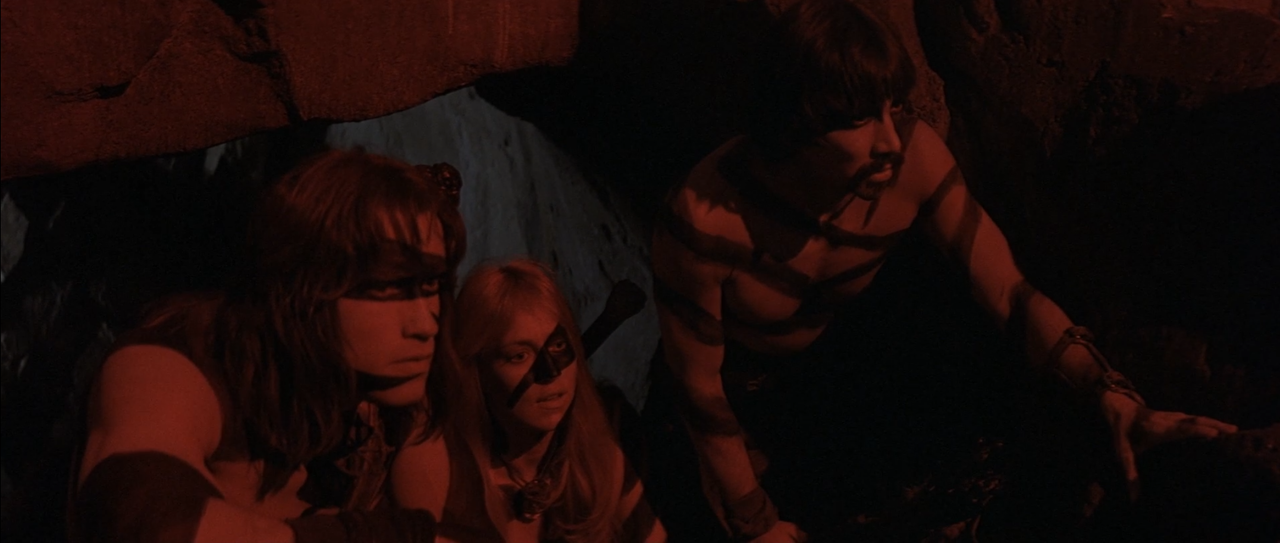
Conan (Arnold Schwarzenegger) is educated in philosophy so that when asked, “What is best in life?” he responds with the immortal line, “To crush your enemies, see them driven before you and to hear the lamentations of their women.” For Conan these are words to live by and when he is eventually and inexplicably set free, the Cimmerian does just that. With the first half hour of the film, Milius does an excellent job of introducing Conan and his world – a harsh and unforgiving place where only the strong survive. It is a world wrought with danger and populated with colorful characters most of whom are not to be trusted, like the witch that seduces Conan only to transform into a wild creature during sex. I like that Milius takes the time to show how Conan becomes a skilled fighter and builds himself up from nothing. In doing so, we get to know the character and empathize with him.

Conan sets out to find Thulsa Doom and kill him, thereby avenging his parents’ deaths. Along the way, he meets and befriends Subotai, the Mongol (Gerry Lopez) and an archer, and Valeria (Sandahl Bergman), a beautiful master thief. Like any good quest story, the journey is not an easy one and Conan is plagued by both external and internal dangers. He is pushed to the very limits of his physical endurance. Only when he can conquer his own fears can he complete his goal.

Unlike a lot of contemporary fantasy films that are augmented significantly by CGI, the world in Conan the Barbarian is tangible and real. As a result, it is more believable and Milius makes sure to immerse us in it with all kinds of sights and sounds, like the noisy marketplace that Conan, Subotai and Valeria wander through, that creates a world that you feel actually existed. This extends to the supernatural elements as well, which are done with practical effects and this gives them a texture that still holds up. This is evident in the sequence where Conan and his allies infiltrate a Set temple to steal a valuable gem, which awakens a giant snake that the barbarian must fight. Milius intercuts this with a Set ritual, which gives us some insight into their practices. More importantly, this sequence demonstrates what adept thieves Subotai and Valeria are and the unique skills they bring to the table. The snake is an impressive sight and one really gets a sense that Conan is in peril and I like how he doesn’t mess around with the creature, killing it outright when he gets the chance.

Milius wisely limits then-relative newcomer Arnold Schwarzenegger to the amount of dialogue he has to say and utilizes his considerable physical abilities to tremendous effect. The actor uses his body language to convey Conan’s feelings, which, admittedly, are pretty limited. That being said, Schwarzenegger certainly looks the part, which is obviously a crucial component of the role, but it is also how the actor carries himself throughout the film, in the way he walks or fights. He is committed fully to the part and takes it seriously. As a result, we believe that he is the character. This is why no one has inhabited the role as well since this film (including Schwarzenegger in the watered-down sequel). He also provides the occasional moment of levity (some of intentional, some not) in an otherwise serious film. For example, there’s a bit where Conan tries to infiltrate the Set cult as one of its priests and this is pretty amusing because he looks so out of place with his hulking frame. This seems a bit out of character from how Conan is portrayed in Howard’s stories, but Milius does try to justify this by showing that the barbarian has gotten foolishly over-confident with success and blinded by his desire to kill Doom. These moments of comedy would be a brief taste of what Schwarzenegger would be capable of in later films, from cheesy one-liners in action films, like Commando (1985) and Predator (1987), to flat out comedies like Twins (1988).


Sandahl Bergman is Schwarzenegger’s ideal foil, playing a fierce warrior woman that ends up falling in love with Conan. He does so because of her impressive fighting skills and cunning thieving abilities. And yet, the actress doesn’t play Valeria as an uncaring killing machine. Her relationship with Conan humanizes the character and Bergman conveys just the right mix of toughness and vulnerability – something that was sorely missing from the sequel and the remake. It doesn’t hurt that Bergman is a stunning beauty as well, which only adds to the appeal of Valeria.

Despite being outfitted with ridiculous-looking long hair, James Earl Jones is a suitably imposing Thulsa Doom. His famous deep, booming voice also enhances the actor’s performance, which is very theatrical in nature. This is evident in the monologue Doom gives when lecturing Conan on the nature of strength and power.

In the mid-1970s, film producer Ed Pressman was shown some of Frank Frazetta's paintings of Conan the Barbarian – the illustrator that helped revitalize interest in the character during the 1960s. Pressman thought that Conan might be right for a film adaptation. After meeting and being impressed by bodybuilder turned actor Arnold Schwarzenegger at a rough screening of Pumping Iron (1977), he envisioned the Austrian as Conan. However, it took from 1975 to 1977 for the legal issues to be untangled so that the film rights could be secured.

In 1977, Marvel Comics editor Roy Thomas was hired to write the screenplay and artist John Buscema worked on pre-production drawings. Both men had worked on hundreds of Conan comic books during the ‘70s. Pressman finally convinced Schwarzenegger to star in the film and a tentative budget was set at $2.5 million. At this point, Paramount Pictures offered to provide the money, but wanted a new script written by Oliver Stone, fresh from winning an Academy Award for writing Midnight Express (1978). He based his script on Conan stories, “Black Colossus,” and “A Witch Shall Be Born,” but deviated significantly from Howard’s mythos by setting the story in a post-apocalyptic future world. However, this approach escalated the estimated budget to $40 million. In addition, the search for a director was taking longer than expected with John Frankenheimer, Alan Parker and Ralph Bakshi considered. At one point, Ridley Scott was set to direct and then was dropped when John Milius agreed to direct.


At some point, Paramount was no longer involved and Milius was hired. He rewrote Stone’s script, secured financing from Dino De Laurentiis, and began pre-production work. Milius read Stone’s script and did not like it, but loved the character and the concept. According to Milius, he felt kinship with Howard’s worldview: “Howard and I have the same view of civilization. A skeptical one.” He felt that what Stone wrote had a lot of spirit and liked the freedom of its images. While working on the script, Milius drew inspiration from several Conan stories, including “The Thing in the Crypt”, “Tower of the Elephant”, and “Queen of the Black Coast.” He incorporated a few elements from them into the script and “tried constantly to work little pieces of the stories in whenever possible.” For example, he based the character of Valeria on Belit from “Queen of the Black Coast,” but the name came from the “Red Nails” story. He was also determined to deliver an R-rated sword and sorcery epic with plenty of bloody violence, including beheadings, dismemberments, and stabbings. Milius began writing the script in 1978 and spent nine months working on it.

To prepare for the film, Milius commissioned research papers on medieval snake and assassination cults, studied Mongol history and checked out ancient warfare and weaponry. He recruited collaborators that brought unique talents to the table. Chief among them was cartoonist and commercial illustrator Ron Cobb who had cut his teeth doing design work on genre films like John Carpenter’s Dark Star (1974), George Lucas’ Star Wars (1977), and Ridley Scott’s Alien (1979).

For Conan the Barbarian, he was made production designer and ended up creating over 57 interior and exterior sets, and converted two warehouses and an aircraft hangar into soundstages. During filming, he also supervised special effects and second unit direction. His main task was to create the fictional Hyborian Age on film, which included designing all of the architecture, most notably the Tower of Set. He designed the giant serpent and its tunnel lair in proportion to Schwarzenegger. The snake itself was an impressive 34 feet in length and approximately a foot-and-a-half across. Special effects supervisor Nick Allder constructed a cantilevered skeleton with a control platform that operated through the snake body to avoid visible outside wires. The result was a big and strong enough contraption that could actually push Schwarzenegger around while also paying tribute to Frank Frazetta’s iconic Conan paintings, which were used as inspiration for this sequence.

When it came to casting, early on Raquel Welch and Sean Connery were considered for the roles of Valeria and Thulsa Doom, respectively. In addition to Schwarzenegger, Milius cast Sandahl Bergman (recommended by none other than Bob Fosse!) and Gerry Lopez because they were physically adept with backgrounds in dance, and surfing, respectively. According to the director, “ordinarily actors wouldn’t have done those things because of their preconceived ideas going in.” Furthermore, the three lead actors “seemed better in the roles than anyone else, but there was always that doubt. I cast people who seemed to be the characters in the script.” Milius wanted the swordplay to look authentic and for the actors to do most of their own stunt work. To his end, he had the cast train for six months in broadsword fighting, kendo, horseback riding, and stunt work.


Principal photography was originally scheduled to begin in Yugoslavia in 1980, but the production had to pull out due to political and practical reasons. Eventually, Spain was chosen because of its excellent production facilities, diverse landscapes, and very experienced film crews. In addition, Milius had previously shot The Wind and the Lion (1975) there and was familiar with the country. Filming began in Spain on January 7, 1981 and lasted 19 weeks. To cut costs, the filmmakers staged all of the sorcery live and on location, which meant utilizing very few blue screens and no animation with many elaborate sets actually built, sometimes in conjunction with models and miniatures.

According to Cobb, Milius often directed from a motorcycle and worked fast, averaging two or three takes per shot and pushing for 15-20 camera set-ups a day. By many accounts, the shoot was an eventful one with several dicey moments, For example, in the scene where Conan emerges from a cave brandishing a newly found sword, he was to be confronted by a pack of hungry wolves. They were actually dogs and one of the larger ones jumped his cue and broke from the pack, hitting Schwarzenegger in the chest, which sent them both tumbling over a ten-foot cliff! The actor escaped seriously injury, but this incident, early on in filming, set the tone for the rest of principal photography. Never one to hold back, the director had a sometimes contentious relationship with De Laurentiis, comparing working for the mogul to “the foreign legion … His methods are … unsound. Dino’s just like bad weather, he’ll pass, but meanwhile you contend with it.” This may explain why Milius did not direct the sequel, Conan the Destroyer (1984).

Predictably, Conan the Barbarian was trashed by most mainstream critics with the notable exception of Roger Ebert who gave the film three out of four stars and felt that it was “a very nearly perfect visualization of the Conan legend,” and “a triumph of production design, set decoration, special effects and makeup.” However, in his review for The New York Times, Vincent Canby wrote, “As Conan, Mr. Schwarzenegger looks overdressed even when he is undressed, but then there is no way he can unzip that overdeveloped physique and slip into something more comfortable.” Newsweek magazine’s Jack Kroll wrote, “The sad thing is that there’s so little fun to Conan, its violence is so cheerless and styleless. Its action sequences seem edited defensively, to make sure there’s not too much blood, not too many decapitations, rather than for physical exhilaration and electric energy.” In his review for the Globe and Mail, Jay Scott wrote, “Anything that can be said against it can be said for it: the picture is an excessively brutal adventure comic book. An excessively brutal adventure comic book is exactly what is has set out to be – a medieval Heavy Metal.” Finally, the Washington Post’s Gary Arnold wrote, “The image of awesome, hyperbolic muscularity imposed by Frazetta is also meant to dominate the movie version, where it’s transformed into unintentional nonsense, thanks to the unfailing cloddishness of director John Milius.”

Milius’ direction is refreshingly straight-forward and doesn’t distract with unnecessary stylistic flourishes. Everything he does is in service of the story and the characters. That being said, the action sequences are well-staged – exciting and visceral with attention paid to what is going on and where everyone is so that we are never confused unlike a lot of action films today, which are edited within an inch of their lives. The action depicted on-screen is further enhanced by Basil Poledouris’ score, which is epic when it needs to be and intimate during the more reflective moments. It is a crucial component as to why Conan the Barbarian works as a rousing action/adventure film.


With Conan the Barbarian, Milius has created a film that doesn’t water down the violence or any of the other unabashedly pulpy elements that make it one of the best fantasy films ever made. Despite its success, Milius did not return for the sequel, Conan the Destroyer, which diluted the violence for a younger audience, but it was also missing that special something that Milius brought to his film. He managed to capture the spirit of Conan in a way that no one has done since, including the rather bland remake. A crucial ingredient that makes Conan the Barbarian superior to other films is that we care about what happens to Conan as well as Valeria, which makes his quest that much more personal. He is going after the bad guys to avenge loved ones and it is this personal element that resonates. Credit must go to Milius for getting us involved in these characters’ lives. He takes the time to have them reflect on what they’ve done and what they’ve lost. It’s not all wall-to-wall action, but also features moments that give us important insight into the characters, like Conan who is depicted as more than just a brutal killing machine.


Further reading: Check out Roderick Heath's fantastic take over at the Ferdy on Films blog.


SOURCES

Bruzenak, Ken. “The Making of an Adventure Epic – Conan the Barbarian.” Prevue #46.

Honeycutt, Kirk. “Milius the Barbarian.” American Film. May 1982.

Sammon, Paul M. “Conan the Barbarian – Filming Robert E. Howard’s Sword and Sorcery Epic.” Cinefantastique. April 1982.

Sammon, Paul M. “Milius the Director.” Cinefantastique. April 1982.


Steranko, Jim. “Milius.” Prevue #48.

Friday, March 23, 2012

Extreme Prejudice


Film director Walter Hill has had, at times, a frustratingly and wildly uneven career that features stone cold classics (The Warriors) alongside baffling misfires (Crossroads). His main stock and trade is old school tough guy action films and they don’t come anymore badass than the criminally underrated Extreme Prejudice (1987). Based on a story co-written by John Milius (Apocalypse Now) and starring Nick Nolte and Powers Boothe, it was Hill’s two-fisted homage to the films of Sam Peckinpah who he had worked for early on his career as the screenwriter for The Getaway (1972). Like many of Hill’s own action films, Extreme Prejudice is a modern western featuring two uncompromising men at odds with one another.

Six mysterious men show up in El Paso, Texas. Officially listed as dead by the United States government, they are part of an elite top-secret military unit led by the no-nonsense Paul Hackett (Michael Ironside), a D.E.A. agent. We soon meet Texas Ranger Jack Benteen (Nick Nolte), a lawman with the cojones to go into a crowded Mexican bar with a loaded rifle looking for a suspect only to coolly gun him down when the guy pulls a pistol. He teams up with local county sheriff Hank Pearson (Rip Torn), the man who taught him how to be a lawman. It turns out that the suspect was a “poor dirt farmer” running dope for Cash Bailey (Powers Boothe) in order to make ends meet. Cash is the local drug kingpin and a man so tough he lets a scorpion crawl along his hand before crushing it. He and Jack were best friends in high school but now they are on opposite sides of the law. Unbeknownst to Jack, Hackett and his men are intent on busting Cash as well.

Nick Nolte plays one of Hill’s trademark laconic men of action and of few words, like the enigmatic getaway driver in The Driver (1978), Swan in The Warriors (1979) and Tom Cody in Streets of Fire (1984). Jack and Cash are throwbacks to a bygone era. 100 years ago they’d have been gunslingers in the Wild West. Nolte has got the steely determination thing down cold and an innate understanding of Hill’s worldview, embodying it with ease. Like many of the director’s protagonists, Jack doesn’t like to talk about his feelings, not even to his long-suffering girlfriend (Maria Conchita Alonso). He’d rather do something than talk about it. It’s great to see him reunited with Hill after their initial collaboration on 48 Hrs. (1982). In an ideal world, they would be making all kinds of films together with Nolte the De Niro to Hill’s Scorsese, both bringing out the best in each other.

For the role of Jack, Hill wanted someone who was “representative of the tradition of the American West – taciturn, stoical, enduring,” and had Nolte watch a lot of films starring Gary Cooper, Randolph Scott and John Wayne. Nolte wanted to recapture “the demeanor of how those ‘40s characters carried themselves – how they dressed and carried their guns.” In order to play a credible Texas Ranger, the actor asked writer friend Peter Gent (North Dallas Forty) to recommend someone to act as a model for his character. Gent suggested real-life Ranger Joaquin Jackson. He and Nolte went over the screenplay and incorporated more of the type of language Rangers use and their relationship with other law enforcement agencies.

In a precursor to his grinning baddie in Tombstone (1993), Powers Boothe plays a genial antagonist in Extreme Prejudice while also sporting a dapper white suit. Cash sees the drug trade as simply giving the people what they want. Early on, Boothe has a nice scene with Nolte where their two characters meet and Jack warns Cash that if he crosses the border into the U.S. he will bust him and his operation. Unfazed and as cool as they come, Cash says to his old friend, “I got a feeling the next time we run into each other we’re gonna have a killing. Just a feeling.” Think of this scene as the pulpy precursor to the legendary diner scene in Heat (1995) between Robert De Niro and Al Pacino only with two legendary character actors instead. The message in both scenes is the same: the next time Cash and Jack meet, one of them is not going to survive the encounter. For any fan of these two actors, this scene (and their final one at the end of the film) is a lot of fun to watch as these forces of nature square off against each other with Cash being gregarious yet still threatening and Jack all stoic determination. With his portrayal, Boothe has said that he wanted Cash to be “multi-faceted, a fully-rounded human being.” I don’t know if he achieves that exactly, but Cash is certainly more than a mere stock villainous character.

The cast of Extreme Prejudice is populated with an embarrassment of character acting riches. William Forsythe (The Devil’s Rejects) plays a grinning good ol’ boy troublemaker; Michael Ironside (Scanners) is the all-business leader of a group of soldiers; Clancy Brown (Highlander) is one of his reliable henchmen; and Rip Torn plays Jack’s mentor who recognizes what Cash represents: “How it comes around. Right way’s the hardest. Wrong way’s the easiest. Rule of nature, like water seeks the path of least resistance so you get crooked rivers and crooked men.” Well said, sir!

Hill not only indulges in his Peckinpah admiration with some of the film’s themes but more explicitly in how he stages and edits the exciting action sequences complete with slow motion carnage that culminates in the climactic bloodbath between Jack, Hackett and his men and Cash and his private army that evokes the penultimate showdown in The Wild Bunch (1969). This is also evident Hill’s storytelling method as Extreme Prejudice is trimmed of any unnecessary narrative fat. Every scene services the story with refreshing efficiency by someone who knows how to tell a story and tell it well.

At the time, Extreme Prejudice was viewed as Hill’s take on the drug wars and the U.S. government’s handling of it with Jack as his mouthpiece when he tells Hackett at one point, “Bunch of bureaucratic fat asses fluffing their duff. They been sitting on my request for drug information for over a year but it’s classified. They’re afraid somebody or some country’s gonna get their feelings hurt.” Hill clearly sees the government as an impediment rather than a resource to men like Jack who are fighting the war in the trenches, dealing with it on a daily basis. The director said in an interview that he saw the film as a critique of “machismo politics” and of “American military involvement beyond our borders, beyond constitutional means.”

Extreme Prejudice is highly critical of the drug wars but refuses to be preachy about it as is the tendency of films like Traffic (2000). Hill is more interested in depicting the struggles of foot soldiers like Jack and how it affects him personally. It also suggests that the government regards people like Hackett and his men as “just numbers on a bureaucratic desk,” as one character puts it. Jack and Cash are above all that because they don’t care about the system. They work within it when they have to but have their own personal code of honor, which they follow. This highly critical viewpoint may explain why it took 10 years for the film to get made, going through several studios and directors because of its “political ramifications” as Boothe said in an interview.

Extreme Prejudice received a perfunctory theatrical release and was not a commercial success. It received mostly positive reviews from critics. Roger Ebert gave the film three out of four stars and wrote, “What makes the film good are Hill’s style and the acting.” In her review for The New York Times, Janet Maslin wrote, “If Mr. Hill, whose best films have a genuinely hard-boiled glamour, never intends this as parody, neither is he ever more than a hair away.” The Chicago Tribune’s Dave Kehr wrote, “If characters are caught in a shrinking world that leaves no room for notions as grand as ‘good’ and ‘evil,’ but only a sordid, creeping malignancy that levels everything in its path.” In his review for the Los Angeles Times, Kevin Thomas wrote, “Sensational rather than serious, it is an exploitation picture but one with class: it has style, a point to make that happens to be highly topical and, thankfully, a dry, saving sense of humor.” However, the Washington Post’s Richard Harrington felt that “there are simply too many problems, starting with Hill’s clumsy exposition and clumsier development.” Newsweek magazine’s David Ansen was also critical of “Hill’s calcified, comic-book notion of movie machismo.” Extreme Prejudice has largely been forgotten, even by fans of Hill’s films, but deserves to be rediscovered and recognized as one of his very best efforts.

NOTE: This post was inspired by Sean Gill's own highly entertaining review over at his blog.


SOURCES

Lovell, Glenn. “Nick Nolte Far From Down, Out.” Orlando Sentinel. April 29, 1987.

“Names in the News.” Associated Press. April 25, 1987.


Scott, Vernon. “The Rev. Jim Jones Haunts Actor.” United Press International. May 27, 1987.