"...the main purpose of criticism...is not to make its readers agree, nice as that is, but to make them, by whatever orthodox or unorthodox method, think." - John Simon

"The great enemy of clear language is insincerity." - George Orwell
Showing posts with label al pacino. Show all posts

Saturday, April 28, 2018

Carlito's Way


-->

“When I went to Berlin and I was watching it in Berlin after it opened and did okay in the United States, I remember watching in Berlin and said, ‘I can’t make – I can’t make a better picture than this.’” – Brian De Palma

He said these words with a heavy heart while recounting a story of seeing Carlito’s Way (1993) at the Berlin Film Festival, realizing he had poured his heart and soul into a film that received mixed reviews from critics and did well but not great at the box office. The start of the 1990s had not been good to Brian De Palma with the high-profile and costly failure that was The Bonfire of the Vanities (1990). It shook his filmmaking mojo so much that he second-guessed the narrative structure of Raising Cain (1992), a return to more familiar territory with the psychological thriller, which took a personal toll on the man.

He was in need of a hit to appease the studios and moved on to what he hoped would be a commercial hit by reteaming with Al Pacino in an effort to recreate the magic of Scarface (1983). If fans were expecting the same over-the-top bombast with Carlito’s Way they would be sorely disappointed as it took a more melancholic, introspective approach while still featuring De Palma’s virtuoso camerawork and masterful action set pieces, crafting a tragedy about how a criminal tries to go straight but is ultimately doomed from the get-go.

Carlito’s Way features one of the oldest chestnuts in the world. Narrating his story during the last moments of his life, Carlito Brigante (Pacino), a veteran criminal, has recently been released from prison, intent on leading a normal, law-abiding life. Of course it isn’t going to be that easy – when he returns to his old neighborhood, his reputation precedes him. Local gangster Benny Blanco from the Bronx (John Leguizamo), a cocky, up-and-comer, sets his sights on Carlito after being shamed by him in public. Carlito, however, barely notices him as he’s torn between reuniting with an old flame and a struggling Broadway dancer, Gail (Penelope Ann Miller), and keeping his lawyer and friend, David Kleinfeld (Sean Penn), out of trouble.


As a personal favor to David, Carlito runs a nightclub for the latter to raise enough money to move to the Bahamas and start his own business renting cars in a tropical paradise with Gail. However, Carlito’s loyalty to David will be his undoing – his friend has become so corrupt during the time that Carlito was in prison that he’s not only wanted by law enforcement but the mafia as well.

Carlito’s Way begins at the end (even though we don’t know it yet) with Carlito being shot and rushed to the hospital. While lying on the stretcher going through the train station, he flashes back to how he got there. De Palma lets it all play out over the opening credits, in dreamy slow motion, with somber classical music playing over it all. The entire sequence is shot in black and white save for a billboard that says, “Escape to Paradise,” with inviting tropical imagery symbolizing Carlito’s desire to escape a life of crime for a better one.

It is 1975 and Carlito has been released from prison after a five-year stint, reinvigorated and reborn. At his hearing he sticks it to the judge (a cameo by Paul Mazursky no less!) and the District Attorney (James Rebhorn) in classic Pacino style, delivering a speech like he’s accepting an Academy Award. It’s as close to Scarface as Pacino gets and, in a bit of irony, Carlito is actually sincere about going straight. Unlike Tony Montana, he doesn’t want to rise to the top of the criminal underworld – he wants to get out. He even tells both the local crime boss and David that he’s retired but they don’t believe him. An ex-con career criminal going straight? No way.

Sure enough, he gets roped into an “errand” with his young cousin (John Ortiz) that turns into a bloody shoot-out. As always, De Palma injects the film with his trademark bravura action sequences. One look at the set-up and, like Carlito, we know that something is not right. Pacino shows how his character survived for so long as he expertly sizes up the situation and takes stock of the room: how many guys and where they are in relation to each other and him. Carlito is calm, unruffled, while his eyes convey a readiness for anything.

De Palma thrives at orchestrating these kinds of set pieces, masterfully using editing to build anticipation and suspense as we wait for the inevitable explosion of violence, gradually building the tension as we feel Carlito’s apprehension. Despite his desire to go legit, he gets drawn back into a life of crime; he can’t escape.

Carlito is a role tailor-made for Al Pacino, allowing him to essay another larger-than-life character. Carlito is a smart guy who cannot escape what he is no matter how hard he tries and the actor conveys the melancholy that lurks behind the bravado of his character. For all of his street smarts, Carlito makes the fatal mistake of underestimating local small-time tough guy Benny Blanco (a perfectly cast motor-mouthed Leguizamo) who keeps trying to get an audience with the veteran crook only to be rebuffed every time.


Carlito also pines for Gail and goes up to the top of a neighboring building in the rain to watch her in a dance class. He is still in love with her and envisions being reunited with her as part of his dream of escaping a life of crime. Like James Caan’s safecracker in Thief (1981), Carlito is making up for lost time and wants to start his new life right now, but his old one won’t let him go.

The real scene-stealer, however, is Sean Penn’s sleazy, coked-up lawyer. The actor reportedly did the film to help finance his directorial debut, The Crossing Guard (1995). For a paycheck role, Penn does a great job immersing himself in the part, complete with a frizzy Afro and receding hairline. It’s as though Pacino’s presence inspired Penn to step up his game, making Penn’s memorable turn so much fun to watch. Even though David dresses in expensive clothes and smokes fancy cigarettes, he’s a cokehead that runs with a dangerous crowd who thinks he’s untouchable. His hubris is his undoing.

The rest of the cast is filled out by solid character actors like John Leguizamo, who plays Benny as a pushy little runt not to be underestimated, and the always-reliable Luis Guzman as Carlito’s right-hand man. There’s also Viggo Mortensen in a small role as a former contemporary of Carlito who has been let out of prison to get the dirt on his friend. Wheelchair-bound and wearing cheap, stained clothes, the actor isn’t afraid to portray a pathetic snitch, a shadow of his former self. He plays a sad figure that really gets under Carlito’s skin. It also shows how far the D.A. is willing to go to send him back to prison.

The only miscasting is Penelope Ann Miller as Pacino’s love interest. She looks out of place and just doesn’t have the acting chops to hold her own against Pacino. She does have a good scene with Pacino when, much to Carlito’s surprise, he discovers that Gail moonlights as a stripper to make ends meet. It is a continuation of his disillusionment in the sense that despite all of her talk of trying to make it as an actress, Gail gets naked for other men. Like Carlito, there is her dream and there is her reality. They have an interesting conversation as he awkwardly disapproves of her dancing for men, to which she unashamedly counters, “You ever kill anybody, Charlie?” Carlito realizes that he has no right to judge her as he’s done far worse for money.

Loyalty is both Carlito’s greatest attribute and vice. It is his loyalty to David that gets him in trouble with Benny Blanco and the Italian mobsters that go after in him in the film’s exciting climax. He has a personal code that he adheres to no matter what happens. However, it is the internal conflict that rages within him that ultimately clouds his judgment. It is his natural instinct to be the ruthless criminal he was versus the legit businessman he wants to be, which results in the sparing of Benny’s life when the smart play was to kill him, as he’ll be a problem later on.

Carlito knows that David is out of control and taking unnecessary risks, like ripping off a wiseguy for $1 million, but helps him break said crook out of Riker’s Prison out of friendship, a debt he feels he owes him. Ultimately, he can’t change who he is. The two men finally have it out and Carlito realizes what a true friend David is as the lawyer lays it out for him, tells him that he looks out for himself, while Carlito lives by an antiquated code. That’s all Carlito needs to hear and ends their friendship, leaving him at the mercy of a mob assassin.


New York State Supreme Court judge Edwin Torres wrote Carlito’s Way in 1975 and its sequel After Hours in 1979, both chronicling the rise and fall of Puerto Rico drug kingpin Carlito Brigante. Al Pacino came to producer Martin Bregman with these two novels and said that they could be made into a film. Screenwriter David Koepp was already working for Bregman when he was given the two novels and told to adapt them into a screenplay. He liked them but taking 800 pages and making them into a film was a daunting task. Koepp was also unfamiliar with Spanish Harlem in the 1970s. When it came to adapting the novels, he ended up using more of After Hours as it featured an older Carlito that Pacino could play.

Bregman felt that Brian De Palma was the best person to direct but he wasn’t interested in making another gangster film. At the time of making Carlito’s Way, De Palma’s personal life was in turmoil. He said, “In the space of two years, I got married; I had a child; and I got divorced!” He elaborated further: “I wasn’t able to reconcile my private life and my professional life.” Like Carlito loses Gail, De Palma lost his second wife, movie producer Gale Ann Hurd. To this end, De Palma was drawn to Koepp’s script as he recognized his own crisis in Carlito’s:

“A guy who just got assassinated and who thinks, ‘Shit, I’m dead! How did I end up here?’ And he reviews his life to understand the chain of events and to accept what has happened to him. That was my situation at the time. To make this film that conveyed what I was feeling, I had to lay myself bare.”


When De Palma called Sean Penn about Carlito’s Way he hadn’t acted in four years and needed money as his wife at the time, Robin Wright, was pregnant again. The actor said, “I certainly was interested in working with Al Pacino. And I’d had a very good relationship with Brian on Casualties of War.” When he initially talked to the director, Penn got the impression that the film was going to be very raw and his research uncovered a very gritty setting. When he arrived on the night club set during filming to find a very expensive-looking set with many extras and complex moving shots that took a long time to set up, which did not allow for multiple takes. Penn felt “a little duped. And that created tension.”

Torres gave Pacino and Penn a personal tour of the criminal justice system and Puerto Rican New York, taking them to the South Bronx, the barrio and to various clubs and bars. To prepare for the role he took Pacino to salsa clubs in Spanish Harlem. The actor said, “It was the Disney tour of the barrio: ‘So-and-so got shot here. So-and-so got shot right over there.’” According to De Palma, Pacino patterned his character’s cadences and speech patterns after Torres. The judge also arranged for Penn to watch Bruce Cutler sum up the Thomas Gambino racketeering case. The actor also talked to Albert J. Krieger who defended John Gotti. Penn looked through period articles on lawyers and came across a still photograph in Life magazine of a young law student that he based the look of David on.

There are several colorful anecdotes about the filming of Carlito’s Way. De Palma and Penn clashed over the scene in which David asks Carlito to break a mobster out of Riker’s. Penn had done ten takes with the director – happy with take three – but the actor wanted to do another 15 takes until he was happy with his performance. Incredulous, De Palma wanted to do Pacino’s side of the scene. After 25 takes, he insisted on shooting Pacino and Penn got upset as a result. Afterwards, Penn disrespectfully chewed out De Palma over the course of the rest of the day.

De Palma started filming the final chase sequence in the winter – and finished it in the middle of summer. They shot the train-to-train scene over and over again (in the blistering New York heat) with Pacino running up and down the train in a long, black leather coat and De Palma in another running parallel filming it. It was a complicated shot that took many hours. An exhausted Pacino finally had enough and took the train home at four in the morning without telling De Palma. The director recalls, his assistant director telling him, “Al took the train home. And he thinks you’re crazy. He doesn’t know what you’re doing.” When the studio first saw the pool scene they felt it was too long. De Palma interpreted that to mean it wasn’t long enough! He added more footage, setting up the action and building more suspense. Bizarrely, the studio saw the new version – and congratulated him on making it shorter.

Carlito’s Way received decidedly mixed reviews from critics. In her review for The New York Times, Janet Maslin wrote, “Carlito’s Way is best watched as lively, colorful posturing and as a fine demonstration of this director’s bravura visual style.” Rolling Stone magazine’s Peter Travers gave it four stars and wrote, “The drug wars have raised brutality and betrayal to levels we see reflected on Pacino’s eloquently ravaged face. It’s that face that holds us even when Pacino’s ‘Rican’ accent slips into his Southern drawl from Scent of a Woman. It’s that face that cuts through De Palma’s erratic pacing and derivative shootouts.”

There were critics who wrote decidedly negative words about the film. Entertainment Weekly’s Owen Gleiberman gave it a “B” rating and wrote, “Watching Carlito’s Way, I never really believed that a heroin dealer and coolly pragmatic killer could be such a simple, romantic guy.” In his review for the Washington Post, Hal Hinson wrote, “De Palma’s direction is alert but dispirited, and certainly for us there is a sense of drudgery in having to observe this gifted filmmaker run through his tired bag of tricks.” Finally, the Los Angeles Times’ Kenneth Turan criticized Miller’s character: “Miller works hard to make the part believable, but finally the role fits too snugly into the traditional ‘exotic dancer with a heart of gold’ category to allow for much genuine impact.”


Despite the clichéd premise, Carlito’s Way works well because of the caliber of actors, David Koepp’s screenplay with memorable dialogue (“You think you’re big time?! You’re gonna fucking die big time!”), and De Palma’s stylish direction. The last 20 minutes plays out in an exciting chase as the director pulls out all the stops, like the impressively choreographed tracking shot, as Carlito tries to evade mobsters and make it in time to meet Gail at the train station; he is literally racing for his life. What makes the film’s ending so heartbreaking is that Carlito got so close to realizing his dream only for it to be cruelly ripped away at the last minute by someone he could’ve dealt with earlier on but chose not to, and therefore pays for this lapse in judgment dearly.

While De Palma did not originate this project, he certainly made it his own. He found something in Koepp’s script that he connected with on a personal level and transformed what could have easily been a paycheck gig into an artistic expression for what he was going through in his own life. This might explain why he seems crestfallen in the De Palma documentary when recounting watching Carlito’s Way at the Berlin Film Festival years ago. The film was a personal expression and its mixed critical reaction and decent but unremarkable box office was likely a bitter pill for De Palma to swallow at the time. His desire to stay in the game and enjoy the resources that a major studio could provide, coupled with his hunger for a commercial hit, drove him to team-up with Tom Cruise and direct the first movie in the Mission: Impossible franchise, which allowed him to fulfill this goal.

Roger Ebert gave the film three-and-a-half out of four stars and wrote, “Carlito’s Way, like Scarface, is first and last a character study, a portrait of a man who wants to be better than he is.” Much like Carlito, De Palma was also struggling to become a better man in his own life, not wanting to look back. Unlike, his cinematic alter ego, the director overcame his personal demons and triumphed in the end, thereby proving that he was able become a better filmmaker than he had been before, delivering a powerful, personal film that stands as one of the strongest efforts in his filmography.


SOURCES

De Palma. Dir. Noah Baumbach and Jake Paltrow. Empire Ward Pictures. 2015.

Feeney, Sheila Anne. “So New York…Yet So Hollywood.” Los Angeles Times. November 4, 1993.

Grimes, William. “His Honor Himself is Counselor to Pacino.” The New York Times. July 27, 1993.

Keesey, Douglas. Brian De Palma’s Split-Screen: A Life in Film. University Press of Mississippi. 2015.

Kelly, Richard T. Sean Penn: His Life and Times. Canongate U.S. 2004.

“The Making of Carlito’s Way.” Carlito’s Way Blu-Ray. Universal Pictures. 2010.

Friday, February 22, 2013

Dick Tracy


After the massive commercial success of Batman (1989), rival Hollywood movie studios attempted to cash in by adapting other classic comic strips from the 1930s and 1940s with the likes of Dick Tracy (1990), The Shadow (1994), and The Phantom (1996) being released in the early to mid-1990s. With the exception of Dick Tracy, all of them were box office flops. Mainstream audiences were just not interested in retro action/adventure movies that paid tribute to classic Hollywood cinema. So, why did Dick Tracy succeed where these other movies failed?

Dick Tracy was an adaptation of the popular comic strip created by Chester Gould in the 1930s and featured the titular square-jawed police detective as he tangled with a colorful assortment of villains. He solved crimes using the latest gadgetry and advances in forensic sciences. Gould’s creation proved to be very popular and continues to be published to this day despite Gould’s retirement in 1977.

The film version was produced, directed and starred Warren Beatty in the title role, while also including his then-girlfriend Madonna, as well as Al Pacino, Dustin Hoffman, and James Caan among many other notable character actors. With that kind of star power, how could the film not garner advanced hype? It also helped that Touchstone Pictures took a page out of the marketing techniques employed on Batman and aggressively promoted Dick Tracy with a video game, a novelization and Madonna herself advertising it on her Blond Ambition World Tour.

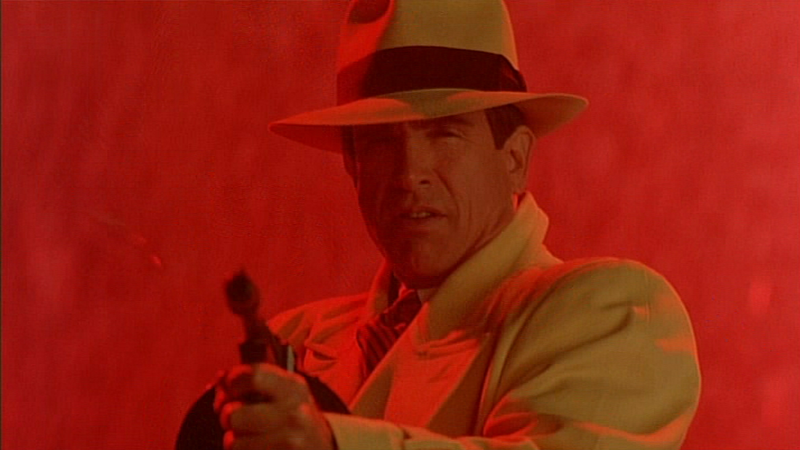
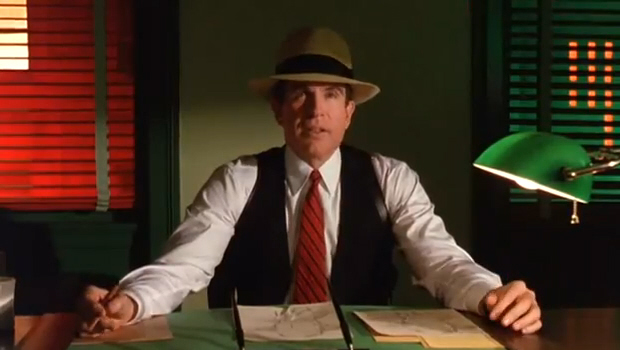
A lot was riding on this film, not just for the studio, who invested millions of dollars, but also Beatty, still stinging from the high-profile failure of Ishtar (1987) and who hadn’t directed a film since the highly acclaimed Reds (1981). The gamble paid off and Dick Tracy performed very well at the box office, but fell short of the kind of figures Batman registered. While the story was pretty standard stuff, Dick Tracy was visually stunning as Beatty and his cinematographer Vittorio Storaro (Apocalypse Now) adopted the source material’s primary color scheme, making it quite unlike any comic book adaptation before or since.

Dick Tracy (Warren Beatty) investigates a gangland slaying. He knows who’s behind it – mob boss “Big Boy” Caprice (Al Pacino) – but can’t prove it, much to his consternation. With the help of his right-hand man, the vicious Flattop (William Forsythe), Big Boy eliminates rival boss Lips Manlis (Paul Sorvino) and takes over his territory, which includes his girlfriend, nightclub singer Breathless Mahoney (Madonna).

Meanwhile, Tracy’s girlfriend Tess Trueheart (Glenne Headly) wants him to accept a desk job so that he’ll stay out of trouble – something that he’s not crazy about or do any time soon, at least not as long as Big Boy is at large. If that wasn’t enough, Tracy and Tess are temporary guardians of The Kid (Charlie Korsmo), a scrappy boy who witnessed the Manlis execution and is rescued from his abusive father by Tracy.

Warren Beatty does just fine as the upstanding Dick Tracy. He certainly looks the part and does his best to flesh out the character by developing a bit of a love triangle between Tess, Tracy and Breathless. The Kid also shows a slightly vulnerable side to Tracy and thankfully Beatty doesn’t fall into the trap of making the boy too cutesy or annoying. A lot of people criticized Madonna’s performance and when she’s paired up with the likes of veteran actors like Beatty and Al Pacino, she looks out of her depth. For two people romantically involved in real life, Beatty and Madonna have little chemistry together on film. Throughout, Breathless tries to seduce Tracy with sexual double entrendes and provocatively revealing outfits (including a see-through black negligee number that somehow got past the PG rating). Madonna makes up for these moments in the song and dance routines where, naturally, she is on more comfortable ground. Beatty does have slightly more chemistry with Glenne Headly who plays Tracy’s girlfriend – a thankless role that the talented actress does her best with, especially early on when Tess and Tracy take care of The Kid in a charming montage that humanizes the lawman a little bit.

Beatty must’ve pulled a lot of favors that he accumulated over the years as so many of his contemporaries and people he worked with back in the day play minor roles with most of them buried under all kinds of prosthetic make-up. Al Pacino barks out most of his dialogue in a scenery-chewing performance that would set the tone for many of his portrayals in the ‘90s but Big Boy actually requires him to play it over-the-top on purpose, which he does with typical gusto. The veteran actor looks like he’s having a blast in the scenes where Big Boy bosses around Breathless and her chorus line. One wonders if the little slaps he administers to the sultry singer were improvised. Hell, in one scene alone you get to see Pacino berate a room full of gangsters played by people like James Caan, Henry Silva and R.G. Armstrong among others. Meanwhile, one of Tracy’s deputies is played by Seymour Cassel and the police chief is portrayed by none other than the late great Charles Durning. Beatty even cast two of his Bonnie and Clyde (1967) castmates, Michael J. Pollard and Estelle Parsons in supporting roles.

Beatty also stacked the deck behind the camera with the great Italian cinematographer Vittorio Storaro and award-winning production designer Richard Sylbert (Chinatown) contributing to the film’s distinctive look. Not since Streets of Fire (1984), had there been such a stylized self-contained retro-world where everything is heightened in a way that remained faithful to its source material. Even the outfits that characters wear are color-coded. For example, Tracy wears a yellow trenchcoat and hat while Tess wears a red outfit. This also extends to the setting of a given scene. In the diner that Tracy, Tess and the Kid frequent the seats are all red, the walls are all white and outside the windows are saturated with green light. The end result is a visual treat on the eyes and it’s all achieved through excellent cinematography, production design, art direction, and old school visual effects like matte paintings.

For the music, Beatty got Batman’s composer Danny Elfman to work his magic and he delivers a suitably robust score even if it sounds like he basically recreated the music he did for Tim Burton’s film. For the five period authentic songs that Breathless Mahoney sings, Beatty enlisted none other than the legendary songwriter Stephen Sondheim to write them and had Mandy Patinkin and Madonna bring them to life in the film.

A common complaint among critics was that Dick Tracy’s story was a little on the simple side, but the comic strip was never that complex to begin with and so keeping things simple stayed true to Gould’s creation. The one minor quibble I have in this area is the over-abundance of bad guys, but Beatty has said that he wanted to put as many of them in the film as possible in case he didn’t get a chance to do a sequel, which, as it turns out, was probably a wise move as another film seems highly unlikely.

Warren Beatty had contemplated making Dick Tracy as far back as 1975. He had fond memories of reading the popular comic strip as a child. Producer Michael Laughlin owned the rights at the time, but gave up his option when he couldn’t drum up any interest among Hollywood studios. In 1977, director Floyd Mutrux and producer Art Linson bought the rights and got Paramount Pictures involved. Over the years, many directors circled the project, including Martin Scorsese, John Landis, and Richard Benjamin. At one point, Clint Eastwood expressed an interest in playing Tracy, but Beatty had the right to accept or reject the role before anyone else. However, even he took convincing because the movie star didn’t think he looked like the character. Beatty eventually realized that “nobody did. When I realized that I thought, ‘Well, maybe I can play this as well as the next guy.’”

Initially, Beatty had difficulty finding a studio interested in bankrolling his project because they were concerned with its commercial appeal and the movie star’s reputation as a “control freak,” but he had gotten Chester Gould’s family’s blessing, which was a good start. He almost made Dick Tracy with Walter Hill when the director was in-demand during most of the 1980s, but they differed on the approach to the material – Hill wanted to go the gritty, realistic route, while Beatty envisioned a stylized look based on the comic strip. Beatty bought the rights himself in 1985 and was soon armed with a screenplay by Jim Cash and Jack Epps Jr. However, Beatty and Bo Goldman (One Flew Over the Cuckoo's Nest) rewrote much of the dialogue. In 1988, he got backing from Disney, but had to work with a $25 million budget.
  
Once Beatty got the go-ahead, he had to figure out how to adapt Gould’s two-dimensional comic strip into a live-action film. He felt that “it could be fun to go into another world – if that world were carefully planned and carefully created.” With Dick Tracy, Beatty wanted to “look at a picture through a child’s eyes, to get back to the feeling I had when I first read Dick Tracy as a kid.” By employing such a dazzling color scheme, Beatty figured that “If I could make Dick Tracy the centerpiece of a swirl of color and plot, then maybe I could keep him from being terminally dull, which a straightforward character like that is in danger of being.”

To this end, Beatty hired three key collaborators to help him create this world: cinematographer Vittorio Storaro, production designer Richard Sylbert and costume designer Milena Canonero (A Clockwork Orange) and they all met at Beatty’s home during the summer of ‘88. Storaro wanted to go with a standard aspect ratio in an attempt to mimic the comic strip panel. Beatty told Storaro that the look of the film would be influenced by the late 1930s when Gould started Dick Tracy and asked him to study the Bertolt Brecht opera, Rise and Fall of the City of Mahogonny. Storaro found that German expressionist artists like George Grosz and Otto Dix best defined the art of the ‘30s and inspired Gould’s drawings.

Sylbert drew inspiration from ‘30s era Chicago and adhered to the source material’s generic look with homes devoid of anything but permanent fixtures and costumes kept basic and repetitive. The idea was to reduce the sets to their most basic iconography. Such a stylized world required filming the entire picture on the Universal Studios back-lot where the filmmakers could create their world from scratch, hiring visual effects artists Michael Lloyd (The Lord of the Rings trilogy) and Harrison Ellenshaw (Tron) to create 57 matte paintings on glass that were then optically merged with the live-action.

Canonero was the one who proposed that the film stick to a primary color palette. Another important element was the make-up effects. To create the elaborate make-up of the various gangster Tracy battles in the film, the make-up artists created drawings of the characters and then hired sculptors to make models of each character. The actors portraying each one of these characters had a cast made of their face so that the right make-up and prosthetics could be created.

Dick Tracy enjoyed mostly positive reviews from mainstream critics. Roger Ebert gave it four out of four stars and felt it was “one of the most original and visionary fantasies I’ve seen on a screen.” In his review for The New York Times, Vincent Canby wrote, “Unlike Batman, though, Dick Tracy is more than imaginative decor and the sort of clever makeup that transforms ordinary actors into characters named Pruneface, Flattop, the Brow and Little Face. The movie is a gentle whirlwind of benign mayhem swirling about the staunch figure of Mr. Beatty's Tracy. As both the director and the star of the movie, Mr. Beatty is remarkably generous.” The Globe and Mail’s Jay Scott wrote, “Unlike the pretentious Batman, Dick Tracy doesn't attempt to find depth in the heroic machinations of a two-dimensional figure: it seeks simply to turn the famous cut-out into an iridescent icon.” USA Today gave it three-and-a-half out of four stars and Mike Clark wrote, “Beatty, though, has taken Dick Tracy to the next level: a Sunday strip. This means color, additional artifice, and the further suspension of disbelief. And even though Batman's Tim Burton is a better filmmaker than Beatty will ever be, Dick Tracy is the movie – of all screen attempts – that most convinces me I'm watching a live-action cartoon.”

However, Entertainment Weekly gave the film a “B-“ rating and Owen Gleiberman wrote, “Dick Tracy is an honest effort but finally a bit of a folly. It could have used a little less color and a little more flesh and blood.” In her review for the Washington Post, Rita Kempley wrote, “Dick Tracy is an ambitiously vainglorious effort, expensive, beautifully appointed, but at its core empty as a spent bullet. It asks us to read these comics without a grain of salt or a pinch of irony. Popping around in that floppy designer trench coat, Beatty looks more like the fashion police than a gangbuster. For that matter, he is the director as haberdasher in this color-coded clotheshorse of a movie.”

Along with Sin City (2005), Dick Tracy is one of the most visually stunning comic book adaptations ever committed to film and one that anticipated similarly hermetically-sealed cinematic fantasy worlds like the one the Wachowski brothers created for Speed Racer (2008). If the goal of movies, like this, is to take us away to a fantasy world, then Dick Tracy succeeds admirably. It has a look and atmosphere all its own. Sadly, a sequel has not happened as Beatty spent years in court with the company that own Gould’s strip who tried to wrest back the film rights. Beatty recently retained them and has expressed an interest in doing a sequel, but isn’t he too old to play Tracy now? Only time will tell.


SOURCES

Ansen, David. “Tracymania.” Newsweek. June 24, 1990.

Emerson, Jim. “Beatty Breaks the Rules in Dick Tracy.” Orange County Register. June 10, 1990. Pg. L08.

Guthmann, Edward. “Warren Beatty Speaks.” San Francisco Chronicle. June 10, 1990. Pg. P20.

Koltnow, Barry. “Back with a Simple Vision.” Orange County Register. June 10, 1990. Pg. L06.

Lowing, Rob. “Beatty’s Last Chance.” Sun Herald. June 3, 1990. Pg. 6.

Staff. “Strip Show: The Comic Book Look of Dick Tracy.” Entertainment Weekly. June 15, 1990.

Friday, March 2, 2012

Glengarry Glen Ross

One of the dangers in adapting a stage play into a film is that you won’t be able to break out of the theatricality inherent with so many plays. Fortunately, film director James Foley seemed to be acutely aware of this when he decided to take on Glengarry Glen Ross (1992), an adaptation of David Mamet’s Pulitzer Prize-winning play of the same name with the screenplay written by the man himself.

Right from the start, Foley keeps things visually interesting by bathing the film in Giallo-esque lighting that would make Dario Argento proud. Cinematographer Juan Ruiz Anchia photographs two salesmen talking in adjoining telephone booths, bathing them in white and blue light respectively with contrasting red in the background. Not only are these colors of the American flag and thereby making a subtle allusion to the notion that this story is a damning indictment of Capitalism, one of the principles that made the United States what it is today. The two men bitch and gripe to each other about the potential clients they have to cold call and then turn on the charm once they get them on the phone. Welcome to Mamet’s cutthroat world of real estate sales populated by desperate, often cruel men that are driven to make as much money as they can, consequences be damned.

One night, an office of down-on-their-luck salesmen are given the pep talk from hell by a ruthless man named Blake (Alec Baldwin), an executive sent by their bosses Mitch and Murray, on a “mission of mercy” as he sarcastically puts it. He starts off by telling them that they’re all fired. They have a week to get their jobs back by selling as much property as they can. He gives them an additional incentive: first prize is a new Cadillac El Dorado, second prize is a set of steak knives and third prize is, as he puts it, “you’re fired.” If the salesmen do well they will get the new Glengarry leads and the promise of better clients and good money.

Blake delivers an absolutely punishing speech as he belittles them (“You call yourself a salesman, you son of a bitch?”), is downright insulting (“You can’t close shit, you are shit! Hit the bricks, pal and beat it because you are going out!”), and demoralizing by even questioning their manhood. He throws in all sorts of “encouraging” words, like “Get them to sign on the line which is dotted,” and “Always be closing.” Alec Baldwin delivers a blistering performance as Blake. His character was not in the original stage play, Mamet wrote him specifically for the film. In his brief amount of screen time, Baldwin dominates the screen against the likes of Ed Harris and Jack Lemmon as he delivers a devastating monologue with ferocious intensity. At one point, Dave Moss (Ed Harris) asks him, “What's your name?” to which Blake replies, “Fuck you! That's my name. You know why, mister? 'Cause you drove a Hyundai to get here tonight. I drove an $80,000 BMW. That's my name.” Blake is an icy motivational speaker that only motivates the salesmen out of fear of being unemployed, making this scene eerily relevant to our times as that is also the prime motivator for most people trying to hold down a job in our current economic climate.

If there was ever a film that deserved an Academy Award for best ensemble cast then this is it. Glengarry Glen Ross features a dream collection of acting heavyweights: Jack Lemmon, Al Pacino, Kevin Spacey, Ed Harris, and Alan Arkin. Pacino plays the slickest salesman of the bunch – Ricky Roma, a smooth-talking, well-dressed bullshit artist of the highest order. This is evident in the scenes where Roma spins an incredibly long and convoluted story, seducing a mild-mannered middle-aged man named James Lingk (Jonathan Pryce). It’s a marvel of acting as we watch Pacino do a spectacular verbal tap dance around the actual pitch until the last possible moment when he’s got the guy’s complete and utter confidence – even then he presents the land he’s pushing as an opportunity as opposed to a purchase, preying on Lingk’s insecurity. It’s a brilliant bit of acting as Pacino commands the scene with his mesmerizing presence. Jonathan Pryce is also excellent as he portrays a weak-willed man susceptible to Roma’s polished charms.

Harris plays Moss as an angry man pissed off at the lousy leads (i.e. clients) and is plotting to defect to a rival, Jerry Graff. George Aaronow (Alan Arkin) is a nervous guy unable to close a sit (pitching a client in person) and seems keen on Moss’ plan to steal the new Glengarry leads and sell them to the competition. John Williamson (Kevin Spacey) is the office manager, a pencil pusher that shows little remorse in what happens to his staff. He’s a smug son-of-a-bitch who takes a particular interest in Shelley "The Machine" Levene’s (Jack Lemmon) plight. Levene is an older salesman trying to make enough money to pay off mounting medical bills for his sick daughter, which colors everything he does.

Levene is a pathetic character desperate to keep his job and still capable of a slick sales pitch (in a nice touch, he often refers to an imaginary secretary named Grace while calling a potential client on the phone), it’s just his judgment that’s off as he finds out with devastating consequences later on in the film. Jack Lemmon somehow manages to make him sympathetic. We see both sides of Levene in a scene where he tries to sell property to a man (Bruce Altman) in his home. The man is not interested and despite Levene's desperate attempts, asks him to leave. It is an increasingly uncomfortable scene that is hard to watch as the man finally and firmly rebuffs Levene. Your heart really goes out to Lemmon's character as he dejectedly walks back out into the pouring rain, looking very much like a drowned rat. It is to Lemmon’s incredible skill as an actor that he makes you care about such a pitiful man

Director Foley successfully transfers Mamet's play to the big screen by creating atmospheric visuals. There is a somber mood that permeates almost every scene. The first half of the film takes place at night during an oppressive rainstorm. Anchia's rich, textured cinematography is the key ingredient in giving Mamet's play a cinematic look. He relied on low lighting and shadows with blues, greens and reds for the first part of the film. The second part adhered to a monochromatic blue-grey color scheme. All the locations are given their own distinctive color scheme, in particular, the hellish red/navy blue of the Chinese restaurant that the salesmen frequent. The overall atmosphere is dark, like that of a film noir.

And then there is Mamet's trademark hard-boiled dialogue or “Mamet speak” as it is known. It has a sharp, staccato quality to it that cuts right to the point with characters often interrupting each other or their dialogue overlapping as evident in the scene where Moss tells Aaronow of his plans to rob their office. One thing that is evident in Glengarry Glen Ross is just how good Mamet is at writing amusing dialogue. For example, at one point, Williamson asks where Roma is to which Moss replies, “Well, I'm not a leash so I don't know, do I?” Mamet’s characters talk like they are thinking about what they are going to say next as they are saying it — much like in real life.

David Mamet’s play was first performed in 1983 at the National Theater of London and won the Pulitzer Prize in 1984. That same year it made its United States debut in the playwright’s hometown of Chicago before moving to Broadway. Shortly thereafter, producer Jerry Tokofsky (Dreamscape) read the play on a trip to New York City in 1985 at the suggestion of director Irvin Kershner who wanted to make it into a film. Tokofsky then saw it on Broadway and contacted Mamet. The playwright wanted $500,000 for the film rights and another $500,000 to write the screenplay to which the producer agreed. Washington, D.C.-based B-movie producer Stanley R. Zupnik was looking for A-list material and co-produced two previous Tokofsky films. Zupnik had seen Glengarry Glen Ross on Broadway and found the plot confusing. He also knew of its reputation in Hollywood as being a commercially difficult project but figured that he and Tokofsky could cut a deal with a cable company.

During this time, Al Pacino and Alec Baldwin became interested in Glengarry Glen Ross but without any concrete financing both Kershner and the actors dropped out for various reasons. Pacino had originally wanted to do the play on Broadway but was doing another Mamet production, American Buffalo, in London at the time. Director James Foley read the script in early 1991 and was hired to direct only to leave the project soon afterwards. By March 1991, Tokofsky contacted Baldwin and practically begged him to reconsider doing the film. The producer remembers, “Alec said: ‘I’ve read 25 scripts and nothing is as good as this. O.K. If you make it, I’ll do it.’” This prompted Foley and Pacino to get back on board with Jack Lemmon agreeing to do it as well. Foley and Pacino arranged an informal reading with Lemmon in Los Angeles. From this point, Foley and Pacino had subsequent readings with several other actors. Lemmon remembers, “Some of the best damn actors you’re ever going to see came in and read and I’m talking about names.” Alan Arkin originally wasn’t interested in doing the film because he didn’t like the character he was asked to portray but fortunately his wife, manager and agent pushed him to do it. Tokofsky’s lawyer called a meeting at the Creative Artists’ Agency, who represented many of the actors involved, and asked for their help. CAA showed little interest but two of their clients – Ed Harris and Kevin Spacey – soon joined the cast.

Due to the uncompromising subject matter and abrasive language, no major studio wanted to finance Glengarry Glen Ross even with actors like Pacino and Lemmon attached. Financing ended up coming from cable and video companies, a German television station, an Australian movie theater chain, several banks, and, finally, New Line Cinema over the course of four years. Because of the film’s modest budget of $12.5 million, many of the actors took significant pay cuts do it. For example, Pacino cut his per-movie price from $6 million to $1.5 million. This didn’t stop other actors, like Robert De Niro, Bruce Willis, Joe Mantegna, and Richard Gere from expressing an interest in the film.

Once the cast was assembled, they spent three weeks in rehearsals. The budget was set at $12.5 million with filming beginning in August 1991 at the Kaufman Astoria soundstage in Queens, New York and on location in Sheepshead Bay, Brooklyn over 39 days. Ed Harris remembers, “There were five and six-page scenes we would shoot all at once. It was more like doing a play at times [when] you’d get the continuity going.” Arkin said of the script, “What made it [challenging] was the language and the rhythms, which are enormously difficult to absorb.” During principal photography, Tokofsky and his producing partner Zupnik had a falling out over credit for the film. Upon the film’s release, Tokofsky sued to strip Zupnik of his producer’s credit and share of the producer’s fee. Zupnik claimed that he personally put up $2 million of the film’s budget and countersued, claiming that Tokofsky was fired for embezzlement, which seems rather ironic considering the subject matter of the film. To date neither one of them has gone on to produce another film with the lone exception of The Grass Harp in 1995 by Tokofsky.

Glengarry Glen Ross received very positive reviews from most mainstream critics. Roger Ebert gave it three out of four stars and wrote, “There is a duet between Harris and Arkin that is one of the best things Mamet has written. They speculate about the near-legendary ‘good leads’ that Spacey allegedly has locked in his office. What if someone broke into the office and stole the leads? Harris and Arkin discuss it, neither one quite saying out loud what's on his mind.” In his review for The New York Times, Vincent Canby wrote, “Mr. Mamet has the vision of a moralist outside of time. He never nudges the audience toward what it's supposed to think. He also has an evil angel's gift for a spoken language that sounds realistic, but is a kind of shorthand for psychic desperation.” Time magazine’s Richard Corliss wrote, “A peerless ensemble of actors fills Glengarry Glen Ross with audible glares and shudders. The play was a zippy black comedy about predators in twilight; the film is a photo-essay, shot in morgue closeup, about the difficulty most people have convincing themselves that what they do matters.” Entertainment Weekly gave the film an “A” rating and Owen Gleiberman praised Lemmon’s performance: “And Jack Lemmon, an actor I've seldom been able to watch without squirming myself, is a revelation. Lemmon hasn't abandoned his familiar mannerisms — the hammy, ingratiating whine, the tugging-at-the-collar nervousness. This time, though, he trots out his stale actor's gimmicks knowingly, making them a satirical extension of the character's own weariness.” Newsweek magazine’s David Ansen wrote, “Glengarry is a compelling look at one of the closed-out items in the catalog of American dreams.”

In his review for the Chicago Reader, Jonathan Rosenbaum praised Foley’s direction: “Foley's mise en scene is so energetic and purposeful (he's especially adept in using semicircular pans) that the unexpected use of a 'Scope format seems fully justified, even in a drama where lives are resurrected and destroyed according to the value of offscreen pieces of paper.” However, in his review for the Washington Post, Desson Howe was not thrilled with Foley’s contributions: “But director James Foley's attempts to ‘open up’ the play to the outside world are dismal. The play takes place in the salesmen's office and a Chinese restaurant. Foley doesn't add much more than the street between. If his intention is to create a sense of claustrophobia, he also creates the (presumably) unwanted effect of a soundstage. There is no evidence of life outside the immediate world of the movie.”

It takes a certain kind of personality to sell something that people don't need but convincing them that they do. There is a whiff of pathetic desperation to Mamet’s salesmen. It seems like their best days are behind them. It’s a vicious circle of sorts – they can’t get access to new, potentially good clients unless they close some of their old ones and they are all deadbeats. These salesmen will say and do anything to keep their job, which begs the question: is that what it takes to be a good salesperson? Ed Harris believes that the film is “about the evils of the free enterprise system. You’ve got these guys selling bogus real estate and they’re upset because they can’t sell it.” The film is a rather timely one as it addresses tough economic times, something that we are experiencing now. One of the reasons Mamet’s characters have such a hard time selling these properties is because nobody has any money and what they do have they’re holding onto it. First performed on stage in the “Greed is good” 1980s, Glengarry Glen Ross was a scathing indictment of the free enterprise system. The film was made in the early 1990s when the economy was doing well and now it has become relevant once again in the lean and mean post-9/11 New Millennium.


SOURCES

Blanchard, Jayne M. "Glengarry Hits the Screen with the Joys of Male Angst." Washington Times. September 27, 1992.

"Glengarry Glen Ross Production Notes". New Line Cinema Press Kit. 1992.

Hartl, John. "Director is Happy to put Big Stars in Film Version of Mamet Play." Seattle Times. September 28, 1992.

Powers, William F. "Pacino, Mamet and . . . Zupnik; Who? The Local Real Estate Mogul Behind Glengarry." The Washington Post. October 4, 1992.


Weinraub, Bernard. "The Glengarry Math: Add Money and Stars, then Subtract Ego." The New York Times. October 12, 1992.

Thursday, March 17, 2011

Ocean's Thirteen

Despite its impressive box office returns, Ocean’s Twelve (2004) was considered something of a disappointment by its director Steven Soderbergh who felt that the plot was too complicated. While not quite as fun as Ocean’s Eleven (2001), it was a fine film in its own right – one that had a more satisfying emotional pay-off and doesn’t deserve the lousy reputation that it seems to have. Ocean’s Thirteen (2007) was seen as a return to the fun, breezy vibe of the first film by bringing it back to Las Vegas with style. The result was a very satisfying conclusion to the Ocean’s films.

As the revenge picture cliché goes, this time it’s personal. When Reuben Tishkoff (Elliott Gould) is muscled out of a business deal by slick businessman Willy Bank (Al Pacino), resulting in a heart attack, Danny Ocean (George Clooney) and his crew reunite for one last job: to ruin the opening night of Bank’s casino, The Bank, by making sure he loses a huge amount of money, which involves rigging all the games and slot machines. Bank wants the Five Diamond Award – the top accolade for hotels and will do anything to get it. Danny and the boys use this as a way to get at Bank. To this end, they devise an elaborate plan with the help of their arch-nemesis Terry Benedict (Andy Garcia) who bankrolls the operation. They also bring in Roman Nagel (Eddie Izzard) from Ocean’s Twelve to crack a state-of-the-art artificial intelligence security system.

Soderbergh kicks things off rather stylishly as we get a beautiful shot of Rusty Ryan (Brad Pitt) walking across a runaway tarmac to an awaiting plane at dusk with the sky an impossibly deep dark blue that, accompanied by David Holmes’ groovy score, is absolutely breathtaking. Once again, the director shoots the hell out of the film by employing all sorts of zoom ins and outs, pans and split-screens that, along with a saturated color scheme, keeps things visually interesting.

This time out, Matt Damon gets a juicy subplot where he goes undercover as Lenny Pepperidge, the assistant to a Mr. Weng (Shaobo Qin as The Amazing Yen, also undercover), a very high roller, in order to get close to Bank’s lovely assistant, Abigail Sponder (Ellen Barkin). Part of his disguise involves wearing a ridiculous fake long nose – a sly fuck you to Harvey Weinstein who wouldn’t let Damon wear said nose for his character in Terry Gilliam’s The Brother’s Grimm (2005) because he felt it would obscure the actor’s good looks and hurt the film’s box office potential. Well, it didn’t hurt Ocean’s Thirteen box office as the film went on to gross a very respectable $311 million worldwide.

It is also a lot of fun to see Ellen Barkin reunited with her Sea of Love (1989) co-star Al Pacino. She appears to be having a good time playing a confident businesswoman succumbing to Damon’s “seductive” charms. It is also fun to see Pacino go off autopilot for a change and sink his teeth into a juicy bad guy role. Who else could Soderbergh get to pose as a credible threat to the likes of George Clooney and Brad Pitt but someone of the legendary star caliber like Pacino? He plays Bank like the offspring of his take on Ricky Roma from Glengarry Glen Ross (1992) and Gordon Gekko from Wall Street (1987) – a smooth-talking unscrupulous bastard. In another nice bit of casting, the inventor of the artificial intelligence security system is played by none other than Julian Sands, an actor whose big break through came in A Room with A View (1985) but whose career settled into mostly direct-to-home video fare so it was a pleasant surprise to see him appear in a big mainstream film like Ocean’s Thirteen.

Another amusing subplot involves Virgil Malloy (Casey Affleck, sporting a ridiculous-looking mustache) organizing a revolution/strike among the workers at a dice-making factory in Mexico. He goes from complaining about a lack of air conditioning to tossing Molotov cocktails on the strike lines. At one point, he and his fellow co-workers drown their sorrows at a local bar and Virgil asks them, “Have all of you forgotten Zapata?” He goes on to offer inspirational words that fire them up. How this whole subplot plays out is quite funny. In another nice twist, Terry Benedict is helping Danny out albeit with all kinds of conditions. After all, he resents Bank’s lack of taste and the competition he represents. There can only be on top dog in Vegas and Benedict clearly feels that he is the one. Andy Garcia looks like he relished the opportunity to be in on the joke instead of being the target as he was in the last two films.

While working on Ocean’s Twelve, Steven Soderbergh began thinking about Ocean’s Thirteen. He thought about how fun it would be to set it back in Las Vegas. The motivation to make the film was a desire to work with everyone again but all eleven cast members had to want to do it. Producer Jerry Weintraub contacted them 18 months before hand and told them filming would take place during the summer of 2006 and to clear their schedules. He was able to find a way to juggle all these movie stars’ busy lives and add Al Pacino and Ellen Barkin into the mix.

For the film’s story, Soderbergh felt that Danny and his crew weren’t driven entirely by money and that they would reunite for friendship and revenge. The director came up with the notion of Reuben being betrayed and his friends helping him out. Weintraub hired Brian Koppelman and David Levien to write the screenplay. They had written the script for Rounders (1998) and created the gambling television cable show Tilt, and so they were familiar with the world of con men and gamblers. Soderbergh and Weintraub were both big admirers of Rounders and the director met with the screenwriters in New York City over lunch. They talked about great con movies, the nature of heists, and how the characters had evolved since Ocean’s Eleven. Within minutes, Soderbergh knew they were who he wanted to write the script and were working on it within minutes: “There was not a long list of people that we thought could step into this specific universe and pick up the language and the sense of humor.”

Koppelman and Levien had spent years exploring Vegas culture and the gambling lifestyle. They had every book they could find about con artists and thieves. Early on, Soderbergh told them that he wanted the film’s focus to be on the friendship between Danny and his crew. They understood that getting revenge on Willy Bank was what drove the entire story of Ocean’s Thirteen. They also wanted to “’flip’ the casino so that the patrons would win every time, which would spell disaster for Bank.” Soderbergh also told them that the bad guy should be a casino owner and they imagined Al Pacino and wrote Bank with him in mind. George Clooney also offered some ideas, mostly things to do with the revenge scheme that reunited the crew.

Some exterior scenes were shot in Las Vegas, but the casino interiors were mostly shot on one of the largest soundstages on the Warner Bros. lot in Los Angeles because it would have taken too long to film in actual casinos as they had done with Ocean’s Eleven. Soderbergh said, “In order to get the shots that I wanted, I needed to completely control the environment.” He instructed production designer Philip Messina to build a hotel and casino that would reflect Bank and his huge ego. Messina decided to go with a quasi-Asian theme and make it visually overwhelming. He purposely broke the rules in Vegas by designing a multi-level gaming floor because the production didn’t have a lot of horizontal space to work with.

Much like with Ocean’s Twelve, Ocean’s Thirteen received mixed reviews from critics. In her review for The New York Times, Manohla Dargis praised Soderbergh’s direction: “Playing inside the box and out, he has learned to go against the grain while also going with the flow. In Ocean’s Thirteen he proves that in spades by using color like Kandinsky and hanging a funny mustache on Mr. Clooney’s luscious mug, having become a genius of the system he so often resists.” USA Today gave the film three out of four stars and Claudia Puig wrote, “As escapist entertainments go, Thirteen is far from unlucky: It's breezy, clever fun and ridiculously easy on the eyes.” The Chicago Reader’s Jonathan Rosenbaum wrote, “Predictably adolescent and smarmy, with the mix of sentimentality and cynical flippancy that's becoming Steven Soderbergh's specialty (even when he's pretending to make art films), this is chewing gum for the eyes and ears, and not bad as such.” In his review for the Los Angeles Times, Kenneth Turn felt that it was better than Ocean’s Twelve but not as good as Eleven: “Though it's certainly serviceable as the second sequel to a remake, it lacks the brio and élan that made the 2001 film such a treat.”

On the other hand, Roger Ebert gave the film two-and-a-half stars out of four and wrote, “Ocean's Thirteen proceeds with insouciant dialogue, studied casualness, and a lotta stuff happening, none of which I cared much about because the movie doesn't pause to develop the characters, who are forced to make do with their movie-star personas.” In his review for The New York Observer, Andrew Sarris wrote, “for long stretches of the proceedings, Mr. Soderbergh seems to be trying to distract us from the suspenseless inevitability of the plot with semi-abstract rainbowish splashes of color.” Finally, the Washington Post’s Stephen Hunter wrote, “It's maybe halfway between okay and not bad. If being about average were a sin, it'd be headed straight to Hell on a bobsled.”

Like Ocean’s Eleven, Ocean’s Thirteen pays tribute to the classic era of Vegas as Danny and co. restore Reuben’s honor. He’s an old school player who still believes in following a code and prides himself in being part of a select group of insiders that got to shake Frank Sinatra’s hand back in the day. Like Benedict, Bank represents the current corporate mentality of making money over the personal touch that the Mob-run casinos used to provide. If the first two films were about Danny and Rusty’s respective relationships with the loves of their lives, then Ocean’s Thirteen is about their friendship with Reuben. He mentored them when they were just starting out and taught them about respecting history as well as those who came before them. Like with the previous films, going after the bad guy is a matter of personal honor and hitting them where it hurts – in Bank’s case it’s his monster ego. Ocean’s Thirteen ends much like Ocean’s Eleven did thus bringing the trilogy full circle and with a truly satisfying conclusion as the bad guy gets what’s coming to him and Reuben’s honor is restored. Likewise, the film did very well at the box office and garnered fairly positive reviews going out on a well-deserved high note. It serves as an example of a star-studded big budget Hollywood film that entertains without insulting your intelligence.


SOURCES


Ocean’s 13 Production Notes. 2007.