"...the main purpose of criticism...is not to make its readers agree, nice as that is, but to make them, by whatever orthodox or unorthodox method, think." - John Simon

"The great enemy of clear language is insincerity." - George Orwell
Showing posts with label docudrama. Show all posts

Sunday, April 7, 2024

Medium Cool


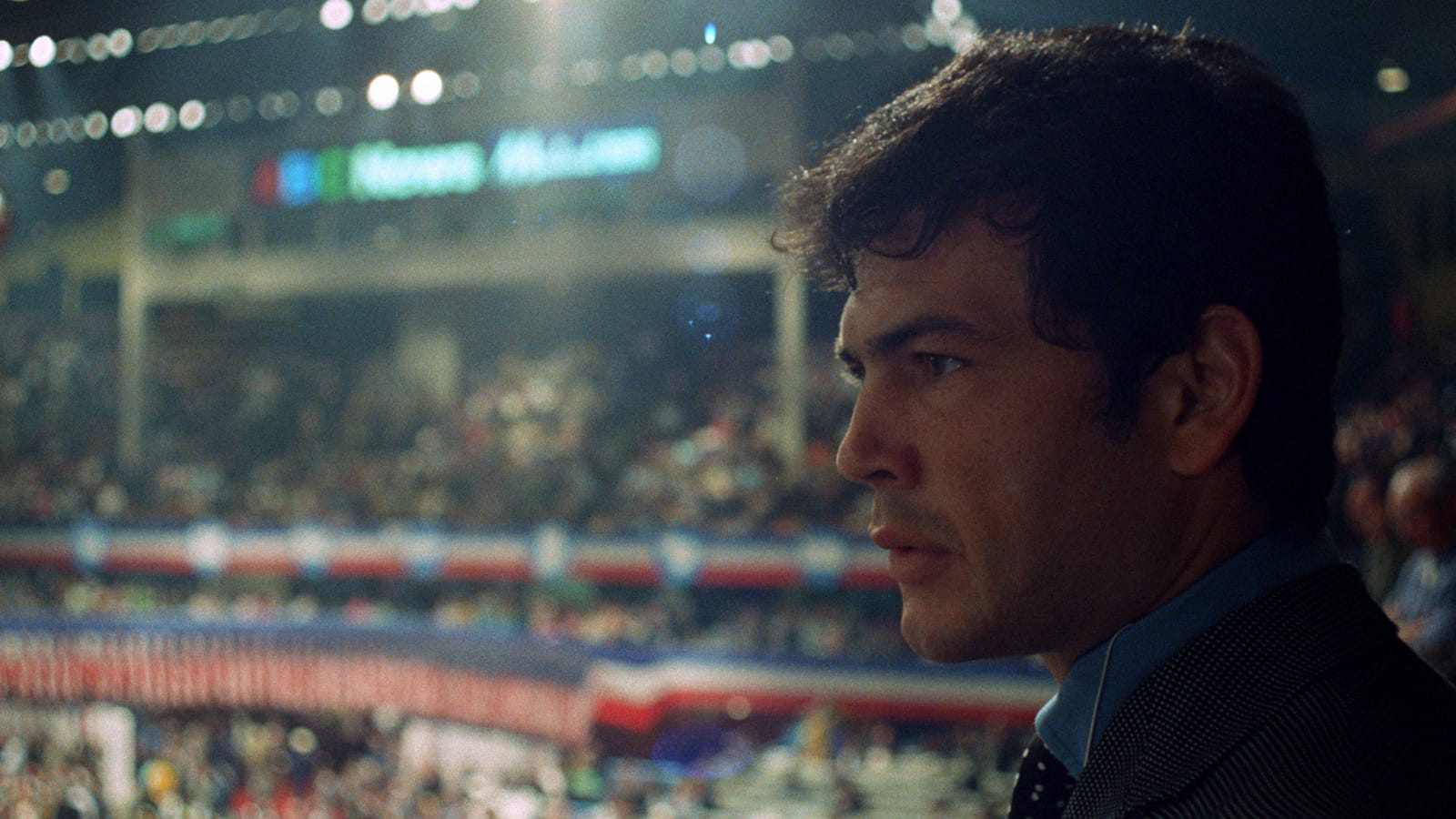
In 1968, the United States was in turmoil. The country was mired in the Vietnam War. President Lyndon Johnson announced his resignation. Both Martin Luther King, Jr. and Robert F. Kennedy – two beacons of hope for civil rights and an end to the war – were assassinated. Angry and frustrated, people took to the streets in protest, most significantly at the Democratic National Convention in Chicago. Cinematographer Haskell Wexler was there filming his directorial debut, Medium Cool (1969), a prime example of cinema verité with its brilliant fusion of documentary and narrative filmmaking creating an immediacy and authenticity, with a loosely-scripted narrative set in and among the chaos of the Convention.
 
Inspired by the socio-political chaos that was going on at the time, he shot the film in Chicago, hoping that something would transpire at the Convention. Incredibly, he was filming as protests turned violent when word got out that the Democrats failed to take a stand against the war. His cast and crew mixed it up with actual protestors and police. The result mirrored what Wexler was trying to say – what is real and what isn’t – by intentionally blurring the line between fact and fiction.
 
Medium Cool opens with an example of the famous journalism creed – if it bleeds, it leads – as John (Robert Forster) and his partner Gus (Peter Bonerz) film the aftermath of a car accident, an injured person still in the car, only to dispassionately call for an ambulance after they get the footage they need. They then drive off instead of helping or staying with the victim, immediately testing our instinct to empathize with these characters. The opening credits play over a motorcyclist carrying the accident footage through the streets of Chicago at dawn coupled with Mike Bloomfield’s twangy, western score, setting the tone and establishing the city as a character unto itself.

The next scene takes place at a swanky party as a group of people – that includes John and Gus – discuss journalistic ethics. One man says:
 
“I’ve made film on all kinds of social problems and the big bombs were the ones where we went into detail and showed why something happened. Nobody wants to take the time. They’d rather see 30 seconds of somebody getting his skull cracked, turn off the T.V., and say, ‘Let me have another beer.’”
 
These words are eerily prophetic as journalistic standards have lowered significantly since then, generation after generation having been weaned on sensationalistic new footage with very little substance.

Wexler adopts the hand-held camera style of Jean-Luc Godard, accompanying a raw, improvisational approach to acting reminiscent of John Cassavetes. This creates an air of authenticity, encouraging us to wonder what is real and what is staged. It feels real and immediate – be it a violent roller derby match that John and Gus attend, or the scene where two little kids free a pigeon on a subway platform and play on the train ride home, in what feels like an unguarded moment. Other times, he keeps the camera mostly stationary with very little movement, simply observing his subjects, such as the scene where we watch the daily activities of Eileen (Verna Bloom), a mother, and her son Harold (Harold Blankenship).
 
A young Robert Forster anchors the film as an amoral journalist that doesn’t seem to care about anything but his job. He refuses to get involved with the stories he covers, a good thing, objectively speaking, until it is a matter of life or death. The actor brings a rugged charisma to the role and is quite believable as a veteran cameraman. His humanity begins to develop when he gets fired from his job and meets Harold trying to steal his hubcaps, taking him back to Eileen where he befriends the two of them. We see John and Harold bond watching a bunch of birds released into the wild, shot like something out of a Terrence Malick film with its stunning sunset. It is a rare moment where Wexler uses conventional shooting methods.
 
Wexler does a fine job portraying the different classes in Chicago, using John as a conduit to the more affluent citizens who pontificate on things about which they have little to no actual knowledge. He shows us the rough, economically-depressed neighborhood where Eileen and her son live in abject poverty. John also takes us to a black neighborhood where he follows up on a story about a man who returned $10,000 and gets into it with some of his friends and family, who question his motives as one of them says:

“When you come and say you’ve come to do something of human interest it makes a person wonder whether you’re going to do something of interest to other humans or whether you consider the person human in whom you’re interested.”
 
His friends give the two journalists a hard time because they are fed up with their perspective being marginalized on T.V. and the media in general.
 
John eventually gets a gig filming the Democratic National Convention, setting the stage for the film’s climactic scene. Eileen is there, too, looking for Harold, who has run away. What transpires is several actors mingling with a myriad of actual protestors and police officers as things turn ugly and violent for real. Even if you didn’t know that what was unfolding was real, you have to marvel at how Wexler ratchets up the tension between the cops and the protestors. You can sense that a clash between the two sides is inevitable.

Sure enough, violence erupts and we hear the iconic line, “Look out Haskell, it’s real!” juxtaposed with the delegates in the Convention Center who are completely oblivious to what is happening. Wexler cuts back to a montage of shots of protestors injured and bleeding. The cops start randomly beating people and it is absolute chaos.
 
In 1967, Haskell Wexler started writing a screenplay after reading Division Street America by Studs Terkel. He had been moved by the trials and tribulations of the denizens of the Appalachian ghetto in Chicago. In 1968, Paramount Pictures hired him to adapt the novel, The Concrete Wilderness by Jack Couffer, which focused on a young boy who loves animals. He merged ideas from both novels with what was going on politically in the United States, “because I was engaged with what was happening in the country that was not being reported in the regular media.” He was an active member in the anti-war movement and knew that the Democratic National Convention was going to have concentrated protests so he “junked most of the book’s plot and wrote a script about a cameraman and his experiences in the city that summer.” He wrote scenes of protest in his script: “For my film I had planned to hire extras and dress them up as Chicago Policemen, but in the end Mayor Richard Daley provided us with all the extras we needed.”
 
Wexler decided to shoot the film in his hometown of Chicago, making a deal with the studio that he would fund the production, but they had to buy the finished film, even though it no longer resembled its source material. During pre-production, he had oral historian Studs Terkel work as a “fixer,” introducing the filmmaker to Appalachian transplants, artists and musicians who portrayed Black militants in one scene, and actual journalists that appear at a cocktail party, arguing about the ethics of showing violence on-screen. Wexler had been away from Chicago for several years and needed someone who knew the lay of the land. The two men were friends in high school, and when they were reunited back in Chicago, spent a lot of time together with Terkel taking Wexler “on an adventure into my own city that many Chicagoans didn’t see being insulated by communities and money and suburbs.”

When it came to casting, Wexler chose Harold Blankenship as the runaway boy that Forster’s character meets – the only vestige left from the novel – and was actually a child from the hill country. His best friend in the film was played by his real-life brother, Robert. The filmmaker felt that the Appalachian residents were “somewhat of a forgotten people” and wanted them represented in his film. While shooting documentaries in the South during the civil rights movement, he had worked with them in Monteagle, Tennessee. To this end, he shot in the Appalachian ghetto of Chicago’s upper north side where mountain people from Tennessee, Kentucky and West Virginia had settled.
 
With the assassinations of King and Kennedy, Wexler anticipated trouble at the Democratic Convention and that drew him to the city: “I knew there would be demonstrations and that the police would suppress them, but I didn’t build the story or the script around that. It just sort of unfolded before me.” Wexler talked to Mayor Daley who approved police officers on the first day of filming but Wexler quickly realized that with them present, “nobody in the street would come out and talk to us. From then on, I said, ‘Look, I don’t want cops around when I’m shooting.” Wexler came to regret that while filming the riots in Grant Park where he and his crew were tear-gassed for their troubles. The famous line uttered during this scene, “Look out, Haskell; it’s real!” was actually added in post-production. During filming they didn’t have a sound man present and his assistant, Jonathan Haze, said something resembling those words when the Nation Guard shot tear gas at Wexler.
 
Wexler sensed that there would be trouble at the Convention, thanks to a leaflet the police had put out a month prior that had a list of new crowd-control weapons.

Paramount had no idea what to do with the finished film, sitting on it for months, telling Wexler that he’d have to get releases from all the people in the park sequences. They also objected to the casual carnage and nudity. When Medium Cool was released, the MPAA gave it an “X” rating, which Wexler felt was politically motivated: What no one had the nerve to say was that it was a political ‘X’.”
 
Medium Cool ends as it began – with a car accident, only instead of John reporting on the incident, he is the incident. A car full of people pass by and much like what he did in the opening scene, they take a picture and drive on, leaving it for someone else to do something. He is treated with the same indifference he showed to the accident victim early in the film. This rather nihilistic, downbeat ending comes as a surprise and is Wexler’s most cinematic flourish, taking the ending of Easy Rider (1969) and giving it a meta spin when the camera turns on him filming footage of the end. He faces the camera as if to say, it’s only a movie.
 
 
SOURCES
 
Cronin, Paul. “Mid-Summer Mavericks.” Sight and Sound. September, 2001.
 
“Haskell Wexler on the Criterion Collection Release of Medium Cool.” Time Out. May 22, 2013.
 
French, Piper. “High Visibility: Reexamining Medium Cool on Its 50th Anniversary.” Los Angeles Review of Books. August 23, 2019.
 
Lightman, Herb A. “The Filming of Medium Cool.” American Cinematographer. January, 1970.

Friday, August 19, 2022

White Squall


For a filmmaker as prolific as Ridley Scott he’s bound to have a lot of hits and misses. For every Gladiator (2000), there’s a few Someone to Watch Over Me’s (1987). It is some of the fascinating yet flawed outliers in his filmography that are the most interesting. Case in point: White Squall (1996), a dramatic recreation of the doomed school sailing trip lead by Dr. Christopher B. Sheldon on the brigantine Albatross, which sank on May 2, 1961, allegedly due to a white squall, killing six people. Adapted from Charles Gieg’s book The Last Voyage of the Albatross, the film received mixed reviews and, despite its cast, featuring a bevy of young, up-and-coming actors, performed poorly at the box office.
 
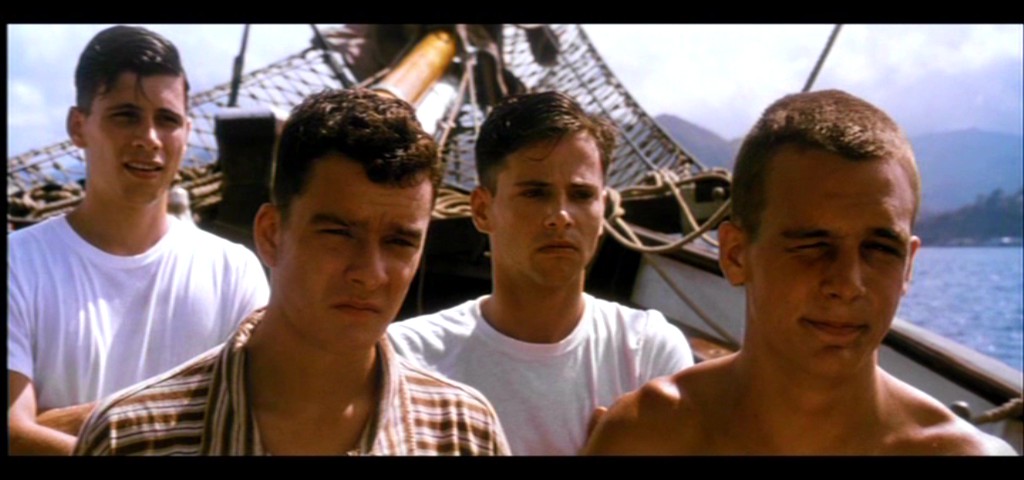
The film follows Chuck Gieg (Scott Wolf) as it opens with the young man giving up his last year of high school to sail on the Albatross. His brother got into an Ivy League school on a scholarship and it is hinted that he doesn’t have the grades to do the same. The rest of the boys are loosely sketched and it’s up to the talented young cast to breathe life into their respective characters. You’ve got Dean Preston (Eric Michael Cole), the bully who thinks he’s cooler than everyone else; Gil Martin (Ryan Phillippe), the meek one; Frank Beaumont (Jeremy Sisto), the spoiled rich kid who doesn’t want to be there, and so on.
 
We meet most of these boys as they are prepared to board the Albatross for a year-long voyage at sea where they’ll learn everything they need to know about operating a boat while also keeping up with their academic studies. They are immediately greeted by McCrea (John Savage), the grizzled English teacher who quotes Shakespeare’s The Tempest to them. They go below decks and are greeted by boys already there. True to Social Darwinism, a pecking order is quickly established but as they will find out, everyone answers to Captain Christopher Sheldon (Jeff Bridges) a.k.a. The Skipper who sets the ground rules when he addresses them for the first time: “The ship beneath you is not a toy and sailing’s not a game.” In this scene, Jeff Bridges tempers his innate likability and charisma by playing the Skipper as a no-nonsense disciplinarian who demands his students follow the rules. This is further reinforced in the next scene when he finds out that Gil is afraid of heights and browbeats the young man to climb up the rigging and in the process not only traumatizes him but humiliates him in front of the other boys.

Scott shows us what it takes to get a boat such as the Albatross ready for sea, how everyone works together, and how a rookie mistake almost costs Chuck his life when he hangs himself on the rigging only for the Skipper to rescue him. Early on, the boat hits a rough patch of water, a foreboding taste of what’s to come, and we see everyone act as a team to rescue one of boys who is tossed overboard. To make up for the deficiencies in the lack of character development in Todd Robinson’s screenplay, Scott includes several scenes showing the boys bonding, whether its’s Gil’s tearful recollection of how his brother died or Dean admitting he’s a poor student that doesn’t know to spell. We slowly begin to care about what happens to these boys, which is crucial later when they are put in peril with the storm.
 
Everything has been building to the film’s climactic set piece – a massive white squall that threatens to sink the Albatross. Scott and his crew create a harrowing scene that rivals the nautical disasters depicted in Titanic (1997) and The Perfect Storm (2000), only he did it with practical effects while those other films leaned on CGI to do most of the heavily lifting. This gives the sequence a visceral impact as it looks and sounds real. This isn’t some CGI creation but an actual thing that Scott captures in vivid detail. It’s a powerful visual reminder of the true power of nature and that we are insignificant compared to it. Every so often we are reminded of this fact.
 
Chuck provides the film’s voiceover narration, taken from the journal he kept during the journey. He is the wide-eyed idealist that is the calming influence on the rest of the boys and takes to the Skipper’s tough love style of leadership without losing his humanity. Scott Wolf channels a young Tom Cruise as he delivers a strong performance as the audience surrogate. After the survivors are taken back to land he breaks down in a moving scene, and then Chuck attempts to clear the Skipper’s name in the ensuing tribunal, Wolf delivering a passionate speech expertly. Chuck is the film’s social conscience as he struggles to do the right thing. He stands up for the Skipper when it looks like he will be blamed for what happened.

It is easy to see why the name actors in the cast such as Ethan Embry, Ryan Phillippe, Jeremy Sisto, and Wolf went on to notable careers. They are most successful at making their characters memorable but there is also Eric Michael Cole who plays the bully in the group. Channeling a young Matt Dillon his character is full of swagger and we eventually discover what’s behind the bravado as delivers an impressive performance that should have garnered him more high-profile roles.
 
White Squall, however, falters in its depiction of the Skipper. At one point his wife, Alice (Caroline Goodall), says to him, “You know, Sheldon, sometimes, not often, you act almost half human.” Therein lies the problem with this character – there’s nothing human about him, just some glowering Ahab that not even Bridges’ ample charisma can make a dent in. We get zero insight into what motivates him beyond running a tight ship. The actor tries his best but he’s not give much to work with, such as a scene where Frank inexplicably harpoons a dolphin. To punish him, the Skipper tells him to finish off the poor animal and when he refuses, does it for him. It’s an unnecessarily, ugly scene that provides no insight into either character.
 
This being a Ridley Scott film everything looks beautiful from the Albatross docked at dusk silhouetted against the sky to the slow-motion glamor shot of Dean diving off the highest point of the ship with the skill and grace of an Olympic athlete. We get a seemingly endless number of exquisite shots of the boat at sea with the sunlight hitting it at just the right angle.

Screenwriter Todd Robinson met Chuck Gieg while on vacation in Hawaii and the latter told him the true story of the Albatross. Inspired by it and the book Gieg had co-written about surviving the incident, Robinson wrote the screenplay with his close involvement, to ensure it stayed true to the actual events, and took it to producers Rocky Lang and Mimi Polk Gitlin. They shopped it around to various directors but they all wanted to change it to fit their vision. The producers finally brought it to Ridley Scott who bought it before Christmas 1994. At the time, he was considering directing Mulholland Falls (1996) but after reading Robinson’s script in 90 minutes he immediately wanted to do it. He was drawn to the lack of sentimentality and the coming-of-age aspect of the script.
 
As was his custom with films based on real-life incidents, Scott strove for authenticity and brought Gieg and the real Captain Sheldon on as technical advisors. For the ship, the production used Eye of the World, a 110-foot topsail schooner from Germany. He did not want to shoot the sea sequences in a giant water tank, common at the time, as he felt that the waves never looked large enough or realistic. He studied documentary footage and water patterns to see how they moved and reacted. He and director of photography Hugh Johnson shot mostly with hand-held cameras to get the raw look they wanted. To this end, they filmed four months on the seas, starting in the Cape of Good Hope in South Africa, where on the first day got 30-foot seas, “because the crew was so well-versed by then in terms of leaping around this boat and getting camera positions, we dealt with it pretty easily actually,” Scott said. From there they spent most of the time in the Caribbean with shooting the land scenes on the islands of St. Lucia, St. Vincent and Grenada.
 
Scott eventually had to concede using water tanks for the climactic storm sequence that sinks the Albatross. He waited to film this sequence until the end of principal photography as he was dreading it “like a big monster. I didn’t want it to be a 9-minute, crash-wallop-bang and everybody’s in the water. I wanted to experience the whole process of what it means to be shot out of the blue like that, to be trapped, to see people that you got to know quite closely just taken away from you.” He used two water tanks in Malta – one that held six million gallons of water and was 40 feet deep and the other held three million gallons of water and was eight feet deep. Initially, wave machines were used but they did not produce strong enough wind effects for Scott so he brought in two jet engines to do the job. As he said they “basically blew the shit out of the set – 600 mile-an-hour winds.” The storm sequences took five days to film with the production constantly having to worry about the cameras getting wet.

Filming the sequence wasn’t without its peril as Jeff Bridges recalled, “I’ve had some real-life close calls when I’ve been surfing, and I know that feeling of fighting for your life in the water. During the storm scene there were some long takes where we were being hit with wind and waves and being knocked underwater. You don’t worry so much about acting then--you just want to survive the take.” Scott remembered one day of filming: “We got the water pretty churned up and I saw Jeff sticking his arm rigidly in the air with his fist clenched. I thought he might be screaming, ‘Right on,’ but it turned out he was screaming, ‘Stop, I’m going under.’”
 
White Squall received mixed to negative reviews from critics. Roger Ebert gave the film three out of four stars and wrote, "The movie could have been smarter and more particular in the way it establishes its characters. Its underlying values are better the less you think about them. And the last scene not only ties the message together but puts about three ribbons on it." In her review for The New York Times, Janet Maslin wrote, "Written by Todd Robinson and photographed against beautiful blue skies by Hugh Johnson, White Squall improves when it takes on the daunting job of replicating the title storm. Mr. Scott manages to capture pure, terrifying chaos for a while, and this slow-moving film finally achieves a style of its own." The Washington Post's Richard Leiby wrote, "It's disappointing that a director with the vision of Ridley "Blade Runner" Scott and an actor with the depth of Jeff "Fearless" Bridges conspired to produce such a sodden venture, but Hollywood never seems to tire of flushing multimillions down the bilge pipes." In his review for the Los Angeles Times, Jack Mathews wrote, "The 20 or so minutes we spend with the Albatross in the squall is high adventure, to be sure. Everything else is ballast." Entertainment Weekly's Lisa Schwarzbaum wrote, "White Squall is lovely to look at, but frustrating to behold. These boys are fine specimens of American manhood. But they’re unreachable, like ships in a bottle."
 
White Squall takes more than a few pages out of Dead Poets Society (1989) playbook – a coming-of-age story populated with a cast of young, aspiring actors, most of whom would go on to memorable careers. Scott’s film falters when it tries to replicate the heartfelt, emotional ending of Peter Weir’s film but instead feels forced as the soulless Frank suddenly redeems himself and all the surviving boys rally around the Skipper. It feels false as the film has done nothing to achieve this moment unlike in Dead Poets where its satisfying conclusion was the culmination of everything that came before. Also, the Skipper is such an unlikable character throughout the film it is hard to see why the boys admire him enough to rally to his defense at the end unlike Robin Williams' teacher in Dead Poets who gradually gains his students trust and admiration. Sometimes there is a good reason why a particular film is an outlier in a director’s filmography – it’s not very good. Such is the case of White Squall, a beautifully mounted film, pretty to look at but ultimately with an empty core.
 

SOURCES
 
Clarke, James. Virgin Film: Ridley Scott. Virgin Books. 2010.
 
Crisafulli, Chuck. “Stirring Up a See-Worthy Squall.” Los Angeles Times. January 28, 1996.
 
LoBrutto, Vincent. Ridley Scott: A Biography. University Press of Kentucky. 2019.
 
Williams, David E. “An Interview with Ridley Scott.” Film Threat. April 26, 2000.
 
Wilmington, Michael. “White Squall Director a Visionary without Visual Strategy.” Chicago Tribune. March 15, 1996.

Friday, May 24, 2019

First Man


Ever since I can remember I have been fascinated by space travel. The seeds were planted in science fiction movies like Star Wars (1977) but my interest intensified in the early 1980s with the United States Space Shuttle program. If kids in the 1960s and 1970s had the space race between the Americans and the Russians, my generation had the Shuttles – incredible spacecraft that would hurtle into outer space to launch telescopes or rendezvous with space stations. The tragic Space Shuttle Challenger mission in 1986 where it exploded 73 seconds into its flight was a sobering reminder of the danger of these endeavors.

My interest in the Space Shuttles dovetailed with the release of The Right Stuff (1983), a historical biopic about the Mercury Seven astronauts that playfully exposed their flaws and celebrated these brave men. Over the years, my interest in the subject continued with films like Apollo 13 (1995) and so when it was announced that a biopic chronicling Neil Armstrong’s historic landing on the Moon was being made I was all in.

First Man (2018) is Damien Chazelle’s follow-up to La La Land (2016) and reunited him with his leading man Ryan Gosling playing Armstrong. As a result, anticipation for the film was high and then it failed to perform at the box office despite mostly glowing reviews. Some have speculated that the frivolous controversy over the omission of the planting of the American flag on the Moon as being unpatriotic may have turned off mainstream audiences, it was more likely Gosling’s historically accurate, reserved take on Armstrong, coupled with a somewhat detached point-of-view that probably turned off filmgoers. Who cares? First Man is a thoughtful, moving film that takes a visceral approach to the challenges of traveling into outer space.

Much like The Right Stuff, First Man starts off by putting its protagonist in peril. Armstrong (Gosling) is testing the X-15 rocket-powered plane by pushing it and him to the absolute limits as he escapes the Earth’s atmosphere. It is a gripping, visceral experience punctuated by a brief break of serene beauty as he takes a moment to admire the view of our planet from such a great distance. This soon gives way to sweaty, white knuckled panic as he has trouble re-entering the atmosphere. Chazelle makes sure we experience it right along with Armstrong and it sets the tone for the rest of the film.

It’s 1961 and Armstrong and his wife Janet (Claire Foy) are dealing with the death of their young daughter Karen. The taciturn Armstrong internalizes his feelings in front of everyone, only grieving by himself in private. He processes her death and goes immediately back to work but the powers that be ground him. While dealing with paperwork he notices a pamphlet for Project Gemini, whose focus will be on space exploration. In 1962, he applies for and is accepted into the program. The rest of First Man chronicles his journey and some of the challenges he faced on the way to achieving his goal: landing on the Moon.

Unlike The Right Stuff, First Man plays the astronaut training scenes straight-faced with the physical exercises depicted as grueling affairs that best the most determined men, like Armstrong, and the most confident, like Ed White (Jason Clarke), who are all pushed to their physical and mental limits. He spends little screen-time on this aspect of the program as it has already been depicted numerous times before.

Chazelle makes interesting choices on how he depicts certain events, like how Ed tells Neil about their friend and fellow astronaut Elliot See (Patrick Fugit) dying in a jet crash. Instead of going for the obvious close-ups on anguished faces, he shoots both men silhouetted in the frame of Armstrong’s front door. They accept the news with no emotion having been trained to be cool under pressure but when Armstrong comes back into the kitchen with his wife and son, Gosling conveys the inner turmoil through his expressive eyes and how every facial muscle clenches as Armstrong fights to keep in the emotions he’s feeling about the death of one of his closest friends.

Most of the film is experienced through Armstrong’s perspective. When he goes up in the Gemini 8, Chazelle depicts it through his P.O.V., quite often showing us what he sees – a seemingly endless array of dials and switches and then cutting to close-ups of Armstrong’s face as he reacts to this extraordinary experience. Once the rocket launches, Chazelle bombards us with a cacophony of sights and sounds as the noisy rocket shakes and vibrates violently, escaping the Earth’s atmosphere in an incredibly intense sequence.

Chazelle ratchets up the tension even more when Armstrong’s spacecraft suddenly loses control and plummets via a violent continuous left roll towards the Earth. The G-forces cause his co-pilot to pass out and within seconds of passing out himself, Armstrong manages to gain control, which is conveyed in jarring close-ups and kinetic editing as Chazelle cuts from Armstrong’s panicked eyes to the various switches and mechanisms he utilizes to keep alive. Chazelle juxtaposes these intense moments of Neil at work with his downtime at home presented in elegiac fragments reminiscent of the family scenes in Terrence Malick’s The Tree of Life (2011). They aren’t traditional scenes with a beginning, middle and ending, but rather snapshots of the Armstrong family dynamic.

Gosling is excellent, delivering a complex portrait of Neil Armstrong. He digs deep and shows the man’s private side, how he doesn’t show emotion to anyone, even, at times, his wife, preferring to express it alone. His generation saw emotion as a sign of weakness. Any private reservations he has he keeps to himself. This lack of communication comes to a head, however, on the eve of his mission to the Moon. Janet finally has had it and confronts him, forcing her husband to talk to their children about the danger of the mission. It might be the last time they see him and she wants Armstrong to let their children know that. He is not afraid of many things but having an open and honest conversation with his family terrifies him. Gosling is incredible in this scene as he conveys how uncomfortable Armstrong feels in this situation, answering his children’s questions like a press briefing as he doesn’t know any other way. Gosling conveys the emotions brimming under the surface in his eyes while his body language gives nothing else away. It is this unflappable nature that makes Armstrong a brilliant astronaut but not the greatest husband and father.

For all his stoicism, Chazelle shows a lighter side to Armstrong when he and his wife recount how he wrote lyrics in the vein of Gilbert and Sullivan to the faux disbelief of their friends as they all break up into laughter. This is an important scene as it humanizes Armstrong. This portrait of the man feels authentic but it isn’t very audience-friendly. He isn’t an easy person to relate to or like and Gosling’s natural charisma tempers this somewhat but he doesn’t try to go for the easy route nor does the film and make you like him. It forces the audience to meet him on his own terms, which probably hurt its commercial appeal.

Jason Clarke turns in another wonderfully solid performance as Ed White, Armstrong’s best friend and one of the few people able to penetrate the man’s stoic exterior. He’s an astronaut, too, so he knows what Armstrong is going through but even he can’t relate to the part of him that is still dealing with the death of a child. He is aware of his inscrutable nature and allows White in further than anyone else. After the death of See, Armstrong doesn’t want to let anyone else get too close as he knows how dangerous their job is and doesn’t want to mourn yet another person close to him. When one of their own dies on a mission they all think that could have been them. That’s the reality of their existence: there is always a high probability that they won’t come back and First Man shows how it affects Armstrong and his family.

The actual mission to the Moon is masterfully recreated with Chazelle capturing all the technical details while also allowing for a bit of artistic license that feels right and remains true to the spirit of Armstrong’s character as he finally gets closure on his daughter’s death. While there is a certain amount of tension conveyed in the actual landing on the Moon (they almost run out of fuel), Chazelle tempers this with the wonderment of being there in a way that has not been done before in a fictional film. Everything Armstrong has done in his life has prepared him for this moment and instead of underlining how momentous landing on the Moon was for the United States and for the world, the director opts for showing what it means to Armstrong.

In 2014, Damien Chazelle was approached by the producers Marty Bowen and Wyck Godfrey with the book, First Man: The Life of Neil A. Armstrong by James R. Hansen they’d optioned for Universal Pictures. Initially, he had little interest in Armstrong or the space program and was unsure about doing an adaptation as well as something based on real life. Everything he had done before had been made up and personal. The more he read about the man, though, the more he was intrigued about the very private person that had experienced multiple tragedies, which included the loss of his home in a fire and the death of his daughter at age three. Chazelle was also able to find a personal connection – he could identify with the hard work it took to achieve something and realize a dream. He pitched First Man to Ryan Gosling but they started talking about La La Land instead and made that first. The director felt that both Gosling and Armstrong shared similar qualities: introverted, cool-under-pressure and men of few words. Working with the actor on La La Land and getting to know him personally confirmed that Gosling was right for the role.

Chazelle began looking for a screenwriter that could do the research needed and then transform it into a narrative. He met Josh Singer in 2015 and liked his passion for the project. While Chazelle was shooting La La Land, Singer worked on the script. For research, they visited NASA and met a few of the surviving astronauts like Buzz Aldrin and Michael Collins as well as spending time with Neil’s wife, Janet.

As he began assembling his crew for the film, he sought out Nathan Crowley, the production designer on Christopher Nolan’s Interstellar (2014), as he admired his practical approach: in-camera effects, miniatures, full-scale replicas, and lived-in sets. The look of the film was inspired by the archival materials that were uncovered during research and this included photographs the astronauts took in space, the LIFE magazine photos of the family, old home movies, photos the astronaut families shared, and seeing actual capsules. He also eschewed obvious themed films like 2001: A Space Odyssey (1968) and Apollo 13 in favor of films like Battle of Algiers (1966) and The French Connection (1971) that opted for gritty realism. He ended up compiling a 300-page dossier of images that the crew nicknamed “The Notebook” (in reference to the Gosling film of the same name) that he could refer to during the 58-day shoot.

Chazelle worked hard to separate the man from the mythology and wanted to show his range of emotions. He was interested looking at Armstrong on the family level with his wife and children. He also wanted to depict lesser known aspects of Armstrong’s life, like how he almost died in the Lunar Landing Research Vehicle while training for the Moon landing. Chazelle also wanted to remind people “how dangerous that first era of space travel really was,” and “make it as scary and uncertain as it really was.”

During filming, Chazelle told his cinematographer Linus Sandgren, “imagine we’re a fly on the wall, carrying a camera, running and gunning with these astronauts.” He wanted to do as much “in camera” as possible and for the actors to see what the audience would see, so if they saw the Earth out a window it was on a 35-foot-tall, 65-foot-wide LED screen. To film the space flight sequences, visual effects supervisor Paul Lambert used the screen to project 90 minutes of digital imagery created for the film. A replica spacecraft was built and mounted on a gimbal and synchronized to move in sync with footage on the screen. This allowed the astronauts’ surroundings to be filmed in real time. The footage consisted of 20 cans of 70mm NASA footage that was discovered at the Marshall Space Center in Alabama that had not been viewed in decades as the equipment to project it no longer existed. The filmmakers digitally processed and cleaned up the footage and used it in the finished film. Other footage, like the Saturn V rocket falling away was done with models built at varying scales. No blue-screen or green-screen was used in any shot. Only 726 effects shots were added in post-production.

To stand in for the Moon, Chazelle and his team found the Vulcan Rock Quarry south of Atlanta. Crowley and his team sculpted five acres of it to replicate the Sea of Tranquility. Shooting on location, however, proved to be challenging. On the first day it snowed and the schedule was pushed back a week. The specially built lamp that was 15 feet long, 200,000 watts – the most powerful movie light ever built to simulate the sun – exploded and caught fire 30 minutes into shooting due to the freezing temperatures.

First Man received mostly positive critical notices. In his review for The New York Times, A. O. Scott felt that the film was "strangely underwhelming. It reminds you of an extraordinary feat and acquaints you with an interesting, enigmatic man. But there is a further leap beyond technical accomplishment – into meaning, history, metaphysics or the wilder zones of the imagination – that the film is too careful, too earthbound, to attempt." Entertainment Weekly gave the film "A-" and Chris Nashawaty wrote, "Where the film really comes alive, though, is when it leaves the ground and soars into the heavens with all of its terror, beauty, unpredictability, and majesty. You’ve never seen a movie that captures space flight with this degree of authenticity." The New Yorker's Anthony Lane wrote, "Instead, the movie seeks to remold its protagonist in the image of our own era; it tells us more about us than it does about him." In his review for The Guardian, Peter Bradshaw wrote, "It is a movie packed with wonderful vehemence and rapture: it has a yearning to do justice to this existential adventure and to the head-spinning experience of looking back on Earth from another planet. There is a great shot of Armstrong looking down, stupefied, at the sight of his first boot-print on the moon dust, realising what that represents."

It is the emphasis on the intimate in favor of the epic that helps First Man stand out from other films of its ilk. We know the actual event’s place in history and Chazelle opts for telling a more personal story about the man, never losing sight of that right down to the understated yet moving conclusion as Janet meets her husband after he returns from the Moon. Hopefully, it will find a new life on home video and rekindle interest in space exploration, something that people used to dream about and has become forgotten over the years as we’ve become mired in a multitude of earthbound problems.


SOURCES

Davids, Brian. “How Damien Chazelle’s First Man Took a Page Out of Christopher Nolan’s Playbook.” The Hollywood Reporter. October 12, 2018.

Galloway, Stephen. “Damien Chazelle Shoots the Moon: Oscar’s Youngest Best Director Grows Up with First Man.” The Hollywood Reporter. August 22, 2018.

Rottenberg, Josh. “How First Man Director Damien Chazelle and His Visual Effects Team Took Moviegoers to the Moon.” Los Angeles Times. October 16, 2018.
Friday, March 27, 2015

Live from Baghdad

For many Generation Xers, one of the most enduring images from the early 1990s are ones of bombs falling on Baghdad captured via eerie night vision that rendered the experience through an unsettling monochromatic filter. This footage not only signaled the United States’ invasion of Iraq but it also put CNN on the map. Prior to 1990, they were a struggling 24-hour news network looking for a big story. They didn’t have the resources of the big three networks – ABC, CBS and NBC – but what they did have was plenty of ambition to burn. The HBO film Live from Baghdad (2002) chronicles the small but dedicated team of journalists that risked life and limb to get an exclusive scoop on one of the biggest news stories of the decade.

On August 2, 1990, Iraqi tanks rolled into Kuwait City and it seemed like the U.S. would retaliate immediately with Baghdad the likely target. Veteran CNN producer Robert Wiener (Michael Keaton) is hungry and looking for a story that will give the network a much-needed boost. He’s a bit of a maverick that had his car stoned on a previous assignment in Jerusalem. He meets with new network president Tom Johnson (Michael Murphy) and lays it all out: “People aren’t going to wait ‘til seven o’clock at night to find out whether we’re at war or not. They’re going to tune into CNN.” Another executive (Clark Gregg) argues that Wiener lacks the finesse for such a volatile situation.

Wiener’s got his work cut out for him – ABC and CBS are already in Baghdad and CNN has to own the story. Soon, he and his team are flying into Iraq: fellow producer Ingrid Formanek (Helena Bonham Carter), correspondent Tom Murphy (Michael Cudlitz), cameraman Mark Biello (Joshua Leonard) and sound technician Judy Parker (Lili Taylor). Director Mick Jackson drops us right into the city for a full-on assault on the senses as we are bombarded with the noises and chaos of the place. The CNN team barely gets their bearings when they arrive at their hotel and see ABC and CBS leaving.


I like how Michael Keaton shows the savvy way Wiener knows how to grease the wheels when he bullshits and bribes his way into five rooms at a swanky hotel where he had no reservations and then has the balls to hire a young woman as their translator right on the spot all thanks to a nice fat bankroll of cash. Keaton handles the scene with the nonchalant, no-nonsense ease of someone who’s done this many times. The actor has held a long-time fascination with journalism, briefly flirting with the notion of pursuing it in college and being avid daily newspaper reader. This is also reflected in some of the acting choices he’s made over the years, playing a newspaper editor in Ron Howard’s The Paper (1994) and a speechwriter who mixes it up with journalists in Speechless (1994), and so it comes no surprise he would be drawn to a role like Wiener in Live from Baghdad.

Jackson does a nice job in these early scenes showing the dynamic of the CNN team while gradually ratcheting up the tension as he drops constant reminders that they are in a hostile environment. They work under trying conditions, soon discovering that they are under constant surveillance and have to work with primitive technological equipment as demonstrated rather amusingly in a scene where Wiener runs frantically from his technicians to CNN HQ on the phone in order to get their news story beamed on the air. Afterwards, the emotionally and physically exhausted Wiener and Formanek share a quiet drink at the hotel bar only to realize that they have to do it all over again the next day. Helena Bonham Carter portrays Formanek as a tough producer who can hold her own with the likes of Wiener but is also supportive, being there for him when an American oil worker they interviewed is reported missing, kidnapped soon after it airs on CNN. She keeps Wiener grounded and reminds him of why they are there.

One of Wiener’s early goals is to get a much-coveted interview with President Saddam Hussein and he uses every ounce of perseverance and tenacity at his disposal to see Naji Al-Hadithi (David Suchet), the Minister of Information. He’s a very intelligent man who sees through Wiener’s charms as they engage in a battle of wills that Keaton and David Suchet expertly pull off. These intellectual sparring sessions crackle with an intensity that sees Keaton externalize Wiener’s emotions while Suchet internalizes and underplays. These two men clearly respect each other with a friendship developing between them, but they are also at odds with one another.


Once Jackson takes us out of Baghdad to show Wiener and his crew covering a story in Kuwait, we get a better idea of the scope and scale of what’s happening. They touch down and see soldiers hauling away ill-gotten luxury items. They travel along a desolate stretch of road and pass burnt out car wrecks and jeeps still smoking with dead bodies littering the landscape. They soon become part of the story instead of reporting it and are even scooped by the BBC, which makes them look foolish.

Live from Baghdad shows clips of some of the most memorable moments leading up to the Persian Gulf War, like Hussein patting the head of a clearly scared little boy, a woman crying and claiming that Iraqi soldiers took babies out of incubators to die, and, of course, CNN’s interview with Hussein. Jackson wisely alleviates the often-unrelenting tension of these people in a country on the verge of war by showing them in brief moments of downtime, which allows them to be reflective and blow off steam. These scenes humanize Wiener and his crew so that we care about what happens to them when things really get hairy.

Live from Baghdad was mostly well-received by critics at the time. In his review for The New York Times, Ron Wertheimer wrote, “the interesting relationship here is between Wiener and Hadithi. Mr. Suchet offers a performance of steely restraint, managing to convey the humanity in a man who must be one tough customer to have reached this vital position.” The Los Angeles Times’ Howard Rosenberg wrote, “Although it tells its narrow story well, in a sense Live from Baghdad buries the lead. HBO’s movie about the heady 1991 success of its AOL Time Warner sister company ends at a point – just after the initial bombing – when the war’s bigger media story was just beginning.” In his review for Entertainment Weekly, Marc Bernardin wrote, “Not only does Live from Baghdad offer a masterful look at professionals trying to keep it together in a nation that’s falling apart, but it also manages a rare feat indeed: conveying the energizing fear that the correspondents, doing what they were born to do, must have felt as Iraq began to explode outside their hotel window.”


As Iraq heads towards the January 15, 1991 deadline that the United Nations gave for them to withdraw from Kuwait or face military action, the CNN brings in veteran reporters Peter Arnett (Bruce McGill), John Holliman (John Carroll Lynch) and Bernard Shaw (Robert Wisdom) to interview Hussein and get word out that the U.S. are going to commence bombing imminently. While the other major networks, and most sane people, prepare to leave, Wiener decides to stay as does much of his crew. It’s not a decision that any of them take lightly and Jackson makes a point of showing them really considering their options.

However, the U.S. has other ideas and before anyone can leave, the bombardment of Baghdad begins and the sky is lit up as those iconic images people of my generation remember so well are recreated. CNN’s coverage during the Persian Gulf War was a game changer and showed that they could compete with the big boys and beat them at their own game. Wiener and his team put their lives on the line to record an important moment in history as it happened.


SOURCES


Tapley, Kristopher. “Michael Keaton’s Love of Journalism: The Paper, Live from Baghdad, Spotlight.” HitFix. January 27, 2015.

Friday, March 20, 2015

Quiz Show

In a 1985 interview Robert Redford said of his film Downhill Racer (1969): “it represented what was happening in this country—the slow realization that you’ve been given a false legacy growing up as a kid. Namely, it wasn’t whether you won or lost but how you played the game. But that just wasn’t true. It was whether you won. People don’t remember who finished second. And you could get away with anything so long as you were winning.” As a profile on the man in Film Comment observed, Redford has been fascinated with “the American obsession with winning and capitalism’s inevitable exploitation of the winner.” This time, working behind the camera as director, he examined these ideas with Quiz Show (1994), an engrossing look at the television quiz show scandals of the 1950s.

Redford focuses on one show in particular, Twenty-One, and the rigged loss of the popular program’s reigning champion in favor of a more attractive and media-friendly contestant to help boost ratings of the NBC network and sales of the corporate sponsor Geritol. When rumors of the show being rigged surface, an investigation is launched and Redford tracks the ensuing fallout. In a rather ironic twist, charges in the press claimed that Quiz Show played fast and loose with the facts and this may have contributed to a lack of interest from mainstream moviegoers. More probably, audiences didn’t find the subject matter that interesting and did not want to watch a film that explored the darker side of America. It failed to make back its $28 million budget despite receiving numerous critical accolades and being nominated for several major awards. Quiz Show is a smart film that looks back at the past and anticipates the glut of reality shows that has since risen to prominence, often focusing on beautiful, wealthy “winners,” but in fact is just as fake as their fictional counterparts.

Redford spends the first six minutes of the film cutting between people all over America scrambling to get to their T.V.s and watch this week’s episode of Twenty-One, and a peek behind-the-scenes at how the show comes together just before it airs. In doing so, he establishes how popular the show was at the time and how the medium of television dominated people’s everyday lives. Herbert Stempel (John Turturro) is the returning champ, but the powers that be aren’t happy: the ratings are starting to slip because, despite his everyman quality, he’s not the most attractive guy and acts awkwardly in front of the cameras. Word comes down from on high that Stempel is finished and the show’s producer Dan Enright (David Paymer) is ordered to orchestrate his exit from the program.


His ideal replacement comes in the form of Columbia University instructor Charles Van Doren (Ralph Fiennes) who is the perfect package: handsome, wealthy and, oh yeah, smart. He comes from a privileged background being the son of famous poet and intellectual Mark Van Doren (Paul Scofield) and novelist Dorothy Van Doren (Elizabeth Wilson). Redford foreshadows this fateful decision by cutting back and forth between the decision to get rid of Stempel with Van Doren watching the show and marveling at how well the champ does on it while his father dismisses it offhandedly. At the coaxing of his friends, Van Doren decides to try out for one of NBC’s game shows and is asked to go on Twenty-One where Enright pitches a scenario where they would give him the answers. This makes Van Doren uncomfortable and he agrees to be a competitor but only if it’s on the up and up.

Enright goes to Stempel and tells him to throw the next game, implying that he got as far as he did because it was rigged. He agrees and loses on a ridiculously easy question while Van Doren is given a question that had already been asked in Enright’s office. I like that Redford shows both men struggle with their respective dilemmas – Stempel is told to throw the game on a softball question because his approval rating has declined and Van Doren is given a question he was already told and answered and has to decide if he wants to remain honest or go for the money. The rest of Quiz Show plays out the ramifications of their respective decisions, which is further complicated when aspiring Congressional lawyer Richard Goodwin (Rob Morrow) investigates the rumors that quiz shows are fixed.

John Turturro demonstrates a refreshing lack of vanity by portraying Stempel as not terribly attractive – he has bad teeth, he sweats profusely on camera and has hints of a weasely voice – but he’s trying to support his family. Unfortunately, he’s doing it dishonestly by playing a game that is fixed. Turturro manages to make the abrasive Stempel sympathetic and unlikable. He’s a complex character that the actor brings vividly to life.


Fresh from his memorable role in Schindler’s List (1993), Ralph Fiennes shifts gears to play a very different person – an intellectual born with a silver spoon in his mouth. He initially wants to be honest, but is quickly seduced by fame and money. One suspects Charles is motivated by living up to his family’s lofty reputation. His parents are successful writers that exist in their own rarified atmosphere of intellectuals while he is a struggling writer and merely an instructor, not even a professor. Fiennes has a nice scene between Van Doren and his father. One can see the internal struggle play across his eyes as he comes close to telling his father what he’s doing but cannot and instead reminisces about simpler times. Charles wants to tell him and the secret is eating him up inside but he still can’t because he’s in too deep. It’s a quietly heartbreaking scene that Fiennes performs so well as does Paul Scofield who drops his character’s intellectual pretensions when he senses something is wrong with his son.

Rob Morrow is quite good as the lawyer that doggedly pounds the pavement and does the legwork, like seeking out former contestants, to uncover the truth behind NBC’s quiz shows. He is not just seeking the truth but also fulfilling an ambition to improve his lot in life, something he shares with Charles and Stempel. The actor has a nice scene where Goodwin confronts the head of Geritol (a nice cameo by filmmaker Martin Scorsese) and the businessman lays it out for the lawyer when he tells him, “The public has a very short memory but corporations, they never forget.” This nicely-written scene sums up rather well the corporate point-of-view and how it manages to steer clear of scandals that could ruin them. Morrow does a nice job of conveying Goodwin’s conflict of wanting to spare Van Doren the public embarrassment of testifying to a grand jury because he admires and even looks up to the man.

At their peak more than 50 million viewers watched quiz shows in the United States. Twenty-One was conceived and created by producer Dan Enright. It involved two contestants competing against each other in dual isolation booths. The goal was for each contestant to get 21 points by correctly answering questions that ranged from one to eleven points in value. Herbert Stempel first squared off against Charles Van Doren on November 28, 1956, and after three weeks of tie games, the latter defeated the former. Van Doren, in return, was defeated by Vivienne Nearing on March 11, 1957. In 1959, a grand jury investigation into quiz show fraud was completed in New York City but the findings were sealed prompting Richard Goodwin to conduct his own investigation for a congressional committee on legislative oversight.


In 1988, Goodwin published his book Remembering America: A Voice from the Sixties and one of the chapters focused on the quiz show scandals of the ‘50s. It drew interest from actor Richard Dreyfuss and his partner Judith James who approached Barry Levinson to direct. Paul Attanasio was brought on board to write the screenplay based on the chapter with the focus on the Twenty-One show. The script was then given to Robert Redford who had starred in Levinson’s film The Natural (1984). He had gotten his start in New York with early roles on T.V. during the late ‘50s and early 1960s and connected with the subject matter. He was even a quiz show contestant in 1959 on a show called Play Your Hunch.

When it came to casting Quiz Show, John Turturro was chosen early on. He had met Redford at the Sundance Institute and was the first choice to play Herb Stempel. The actor gained 22 pounds and had his hair cut like the man but was not interested in “doing a mimic of the character, but finding the overall qualities instead.” To prepare for the role, Rob Morrow met with Richard Goodwin and his wife at their home in Massachusetts. The actor said of the man, “He comes from a time when there was a general sense of hope that government could change the world for the better.”

Redford heard about Ralph Fiennes working with Steven Spielberg on Schindler’s List and agreed to meet during filming to discuss the role of Charles Van Doren. Fiennes agreed to play the man but was unable to meet with Van Doren as he had become somewhat reclusive after the quiz show scandals. The actor studied kinescopes of the man’s appearances on Twenty-One. He found Van Doren to be a “very gifted actor. He had a quality of being slightly diffident yet charming.” The actor went straight from making Spielberg’s film into Quiz Show and he was thankful because it “rescued me from waiting until Schindler’s List came out, and everyone thinking ‘Uh-oh this is the actor who played that Nazi.’”


Quiz Show was in theaters for a few months before being pulled by the studio due to its poor performance. Once it received Oscar nominations, the film was placed back in theaters with a new T.V. campaign and print advertisements. At the time, some industry insiders suggested that the film didn’t do well because it was a period picture with no sex or that Fiennes was not enough of a box office draw or that the rather enigmatic poster Redford designed didn’t work.

Redford was upset by several articles that came out when Quiz Show was released claiming it distorted history. One of the more extreme examples came from the Los Angeles Daily News who quoted retired New York judge Joseph Stone, the man that led investigations into the scandal. He said, “This movie is filled with fabrications and distortions from beginning to end.” He argued that most of the film was complete fiction.

When asked how accurate his film was, Redford said that he used “dramatic license, to make either a moral point or an ethical point and move too far out of what could possibly have happened.” He did admit to compacting three years of quiz show scandals into one year and gave Goodwin a more important role in the film than he had in breaking the actual case. Furthermore, he said of the film’s failure to connect with an audience: “Either we don’t want to face our loss of innocence, because it’s asking us to admit we’ve lost one of our virtues. Or we don’t want to face it because we’re as shallow as people accuse us of being, and as spoiled.” Paul Attanasio said, “What we attempted to do was criticize the culture, and that’s never going to be terribly popular.” ABC correspondent and news analyst Jeff Greenfield summed it up best: “To tell today’s audience that powerful institutions and people lie is not compelling. It isn’t that we fear confronting our loss of innocence. It’s that it bores us.”


Quiz Show enjoyed positive notices from most of the major critics at the time. Roger Ebert gave the film three-and-a-half out of four stars and wrote, “The screenplay, by former Washington Post film critic Paul Attanasio, is smart, subtle and ruthless. And it is careful to place blame where it belongs.” In her review for The New York Times, Janet Maslin wrote, “Mr. Redford, always a fine director of actors, elicits knowing, meticulous performances. One hallmark of this film’s high caliber is that its smaller performances are impeccable.” Entertainment Weekly gave the film an “A” rating and Owen Gleiberman wrote, “As Charles Van Doren, the sleek Columbia English professor who succeeded Stempel as champion, Ralph Fiennes is an ambiguous light charmer, fascinating in his very opaqueness.” Jonathan Rosenbaum praised the film as Redford’s “best and richest directorial effort.” The Los Angeles Times’ Kenneth Turan wrote, “So it is an especial triumph that Quiz Show, directed by Robert Redford and written by Paul Attanasio, turns that footnote of television history into a thoughtful, absorbing drama about moral ambiguity and the affability of evil.” Finally, in his review for the Washington Post, Hal Hinson wrote, “Though Quiz Show is insightful in its larger, social observations, it doesn’t allow its cultural statements to dwarf its human dimensions. As dazzling as its staging of the congressional hearings and the show itself may be, the movie is at its best in its more intimate moments.”

Herb Stempel said of the film: “There was some poetic licence here and there, but I don’t begrudge the filmmakers for that … I think John Turturro was a little too hyper. I do sometimes get a little frenetic, but he was really, really frenetic.” Charles Van Doren also saw the film and said of it, “I understand that movies need to compress and conflate, but what bothered me most was the epilogue stating that I never taught again. I didn’t stop teaching, although it was a long time before I taught again in a college.”

Redford does a nice job of showing the very different worlds that Van Doren and Stempel come from – the former eats at the nicest restaurants, buys himself an expensive sports car and visits his folks at their expansive home out in the country while the latter lives in the blue collar neighborhood of Queens trying hard to make ends meet. Redford makes a point of showing how important Stempel’s reign on Twenty-One is to his neighborhood where he’s treated like a big shot, but at home his wife (Johann Carlo) is not so thrilled with her husband’s newfound celebrity, unconvinced that they can get out from under her mother’s shadow (she supports them financially) and this causes considerable tension between them.


As Quiz Show begins, Stempel is a winner but this quickly changes when he is told to lose because he doesn’t fit the attractive public image that NBC wants to project to their viewers. Van Doren looks the part and is soon groomed for success while Stempel is relegated to the outside looking in. Van Doren may have a more attractive façade than Stempel but he is just as dishonest. Meanwhile, the public is fed a lie and accepts it because they have no reason not to believe it. While Van Doren and Stempel are hardly unwitting dupes in the scandal, Redford makes a point of highlighting its architects – NBC executives and the corporate sponsor who are only interested in making money.

Quiz Show’s commercial failure, despite being critically-acclaimed, anticipated a similar trajectory by Michael Mann’s The Insider (1999), which also criticized a powerful corporation – big tobacco – and was met with a media backlash that questioned its accuracy. Whether this impacted the public’s perception of both films is a matter of some debate, but one should remember that these films are not documentaries. Critics worried that people would see these films and perceive them as historical fact. However, in most cases, the film should only be the starting point for one to dig deeper and find out for themselves what actually happened. Fictional films take significant liberties and dramatic license to make something that will entertain and inform. In this respect, Quiz Show is a resounding success thanks to Attanasio’s insightful script and Redford’s assured direction that allows his talented cast of actors to breathe life into their fascinating characters and thereby painting a fascinating portrait of a time when the American Dream turned sour.


SOURCES

Auletta, Ken. “The $64,000 Question.” The New Yorker. September 14, 1994.

De Turenne, Veronique. “Inaccuracies In Redford’s Quiz Show Called Scandalous.” Los Angeles Daily News. October 9, 1994.

Needham, Dick. “Redford.” Ski. April 1985.

Quiz Show Production Notes. Hollywood Pictures. 1994.

“The Enigma of Quiz Show: No Crowds.” The New York Times. February 12, 1995.

Van Doren, Charles. “All the Answers.” The New Yorker. July 28, 2008.


Walker, Beverly. “Declaration of Independence.” Film Comment. March/April 2015.