"...the main purpose of criticism...is not to make its readers agree, nice as that is, but to make them, by whatever orthodox or unorthodox method, think." - John Simon

"The great enemy of clear language is insincerity." - George Orwell
Showing posts with label John Turturro. Show all posts

Friday, March 20, 2015

Quiz Show

In a 1985 interview Robert Redford said of his film Downhill Racer (1969): “it represented what was happening in this country—the slow realization that you’ve been given a false legacy growing up as a kid. Namely, it wasn’t whether you won or lost but how you played the game. But that just wasn’t true. It was whether you won. People don’t remember who finished second. And you could get away with anything so long as you were winning.” As a profile on the man in Film Comment observed, Redford has been fascinated with “the American obsession with winning and capitalism’s inevitable exploitation of the winner.” This time, working behind the camera as director, he examined these ideas with Quiz Show (1994), an engrossing look at the television quiz show scandals of the 1950s.

Redford focuses on one show in particular, Twenty-One, and the rigged loss of the popular program’s reigning champion in favor of a more attractive and media-friendly contestant to help boost ratings of the NBC network and sales of the corporate sponsor Geritol. When rumors of the show being rigged surface, an investigation is launched and Redford tracks the ensuing fallout. In a rather ironic twist, charges in the press claimed that Quiz Show played fast and loose with the facts and this may have contributed to a lack of interest from mainstream moviegoers. More probably, audiences didn’t find the subject matter that interesting and did not want to watch a film that explored the darker side of America. It failed to make back its $28 million budget despite receiving numerous critical accolades and being nominated for several major awards. Quiz Show is a smart film that looks back at the past and anticipates the glut of reality shows that has since risen to prominence, often focusing on beautiful, wealthy “winners,” but in fact is just as fake as their fictional counterparts.

Redford spends the first six minutes of the film cutting between people all over America scrambling to get to their T.V.s and watch this week’s episode of Twenty-One, and a peek behind-the-scenes at how the show comes together just before it airs. In doing so, he establishes how popular the show was at the time and how the medium of television dominated people’s everyday lives. Herbert Stempel (John Turturro) is the returning champ, but the powers that be aren’t happy: the ratings are starting to slip because, despite his everyman quality, he’s not the most attractive guy and acts awkwardly in front of the cameras. Word comes down from on high that Stempel is finished and the show’s producer Dan Enright (David Paymer) is ordered to orchestrate his exit from the program.


His ideal replacement comes in the form of Columbia University instructor Charles Van Doren (Ralph Fiennes) who is the perfect package: handsome, wealthy and, oh yeah, smart. He comes from a privileged background being the son of famous poet and intellectual Mark Van Doren (Paul Scofield) and novelist Dorothy Van Doren (Elizabeth Wilson). Redford foreshadows this fateful decision by cutting back and forth between the decision to get rid of Stempel with Van Doren watching the show and marveling at how well the champ does on it while his father dismisses it offhandedly. At the coaxing of his friends, Van Doren decides to try out for one of NBC’s game shows and is asked to go on Twenty-One where Enright pitches a scenario where they would give him the answers. This makes Van Doren uncomfortable and he agrees to be a competitor but only if it’s on the up and up.

Enright goes to Stempel and tells him to throw the next game, implying that he got as far as he did because it was rigged. He agrees and loses on a ridiculously easy question while Van Doren is given a question that had already been asked in Enright’s office. I like that Redford shows both men struggle with their respective dilemmas – Stempel is told to throw the game on a softball question because his approval rating has declined and Van Doren is given a question he was already told and answered and has to decide if he wants to remain honest or go for the money. The rest of Quiz Show plays out the ramifications of their respective decisions, which is further complicated when aspiring Congressional lawyer Richard Goodwin (Rob Morrow) investigates the rumors that quiz shows are fixed.

John Turturro demonstrates a refreshing lack of vanity by portraying Stempel as not terribly attractive – he has bad teeth, he sweats profusely on camera and has hints of a weasely voice – but he’s trying to support his family. Unfortunately, he’s doing it dishonestly by playing a game that is fixed. Turturro manages to make the abrasive Stempel sympathetic and unlikable. He’s a complex character that the actor brings vividly to life.


Fresh from his memorable role in Schindler’s List (1993), Ralph Fiennes shifts gears to play a very different person – an intellectual born with a silver spoon in his mouth. He initially wants to be honest, but is quickly seduced by fame and money. One suspects Charles is motivated by living up to his family’s lofty reputation. His parents are successful writers that exist in their own rarified atmosphere of intellectuals while he is a struggling writer and merely an instructor, not even a professor. Fiennes has a nice scene between Van Doren and his father. One can see the internal struggle play across his eyes as he comes close to telling his father what he’s doing but cannot and instead reminisces about simpler times. Charles wants to tell him and the secret is eating him up inside but he still can’t because he’s in too deep. It’s a quietly heartbreaking scene that Fiennes performs so well as does Paul Scofield who drops his character’s intellectual pretensions when he senses something is wrong with his son.

Rob Morrow is quite good as the lawyer that doggedly pounds the pavement and does the legwork, like seeking out former contestants, to uncover the truth behind NBC’s quiz shows. He is not just seeking the truth but also fulfilling an ambition to improve his lot in life, something he shares with Charles and Stempel. The actor has a nice scene where Goodwin confronts the head of Geritol (a nice cameo by filmmaker Martin Scorsese) and the businessman lays it out for the lawyer when he tells him, “The public has a very short memory but corporations, they never forget.” This nicely-written scene sums up rather well the corporate point-of-view and how it manages to steer clear of scandals that could ruin them. Morrow does a nice job of conveying Goodwin’s conflict of wanting to spare Van Doren the public embarrassment of testifying to a grand jury because he admires and even looks up to the man.

At their peak more than 50 million viewers watched quiz shows in the United States. Twenty-One was conceived and created by producer Dan Enright. It involved two contestants competing against each other in dual isolation booths. The goal was for each contestant to get 21 points by correctly answering questions that ranged from one to eleven points in value. Herbert Stempel first squared off against Charles Van Doren on November 28, 1956, and after three weeks of tie games, the latter defeated the former. Van Doren, in return, was defeated by Vivienne Nearing on March 11, 1957. In 1959, a grand jury investigation into quiz show fraud was completed in New York City but the findings were sealed prompting Richard Goodwin to conduct his own investigation for a congressional committee on legislative oversight.


In 1988, Goodwin published his book Remembering America: A Voice from the Sixties and one of the chapters focused on the quiz show scandals of the ‘50s. It drew interest from actor Richard Dreyfuss and his partner Judith James who approached Barry Levinson to direct. Paul Attanasio was brought on board to write the screenplay based on the chapter with the focus on the Twenty-One show. The script was then given to Robert Redford who had starred in Levinson’s film The Natural (1984). He had gotten his start in New York with early roles on T.V. during the late ‘50s and early 1960s and connected with the subject matter. He was even a quiz show contestant in 1959 on a show called Play Your Hunch.

When it came to casting Quiz Show, John Turturro was chosen early on. He had met Redford at the Sundance Institute and was the first choice to play Herb Stempel. The actor gained 22 pounds and had his hair cut like the man but was not interested in “doing a mimic of the character, but finding the overall qualities instead.” To prepare for the role, Rob Morrow met with Richard Goodwin and his wife at their home in Massachusetts. The actor said of the man, “He comes from a time when there was a general sense of hope that government could change the world for the better.”

Redford heard about Ralph Fiennes working with Steven Spielberg on Schindler’s List and agreed to meet during filming to discuss the role of Charles Van Doren. Fiennes agreed to play the man but was unable to meet with Van Doren as he had become somewhat reclusive after the quiz show scandals. The actor studied kinescopes of the man’s appearances on Twenty-One. He found Van Doren to be a “very gifted actor. He had a quality of being slightly diffident yet charming.” The actor went straight from making Spielberg’s film into Quiz Show and he was thankful because it “rescued me from waiting until Schindler’s List came out, and everyone thinking ‘Uh-oh this is the actor who played that Nazi.’”


Quiz Show was in theaters for a few months before being pulled by the studio due to its poor performance. Once it received Oscar nominations, the film was placed back in theaters with a new T.V. campaign and print advertisements. At the time, some industry insiders suggested that the film didn’t do well because it was a period picture with no sex or that Fiennes was not enough of a box office draw or that the rather enigmatic poster Redford designed didn’t work.

Redford was upset by several articles that came out when Quiz Show was released claiming it distorted history. One of the more extreme examples came from the Los Angeles Daily News who quoted retired New York judge Joseph Stone, the man that led investigations into the scandal. He said, “This movie is filled with fabrications and distortions from beginning to end.” He argued that most of the film was complete fiction.

When asked how accurate his film was, Redford said that he used “dramatic license, to make either a moral point or an ethical point and move too far out of what could possibly have happened.” He did admit to compacting three years of quiz show scandals into one year and gave Goodwin a more important role in the film than he had in breaking the actual case. Furthermore, he said of the film’s failure to connect with an audience: “Either we don’t want to face our loss of innocence, because it’s asking us to admit we’ve lost one of our virtues. Or we don’t want to face it because we’re as shallow as people accuse us of being, and as spoiled.” Paul Attanasio said, “What we attempted to do was criticize the culture, and that’s never going to be terribly popular.” ABC correspondent and news analyst Jeff Greenfield summed it up best: “To tell today’s audience that powerful institutions and people lie is not compelling. It isn’t that we fear confronting our loss of innocence. It’s that it bores us.”


Quiz Show enjoyed positive notices from most of the major critics at the time. Roger Ebert gave the film three-and-a-half out of four stars and wrote, “The screenplay, by former Washington Post film critic Paul Attanasio, is smart, subtle and ruthless. And it is careful to place blame where it belongs.” In her review for The New York Times, Janet Maslin wrote, “Mr. Redford, always a fine director of actors, elicits knowing, meticulous performances. One hallmark of this film’s high caliber is that its smaller performances are impeccable.” Entertainment Weekly gave the film an “A” rating and Owen Gleiberman wrote, “As Charles Van Doren, the sleek Columbia English professor who succeeded Stempel as champion, Ralph Fiennes is an ambiguous light charmer, fascinating in his very opaqueness.” Jonathan Rosenbaum praised the film as Redford’s “best and richest directorial effort.” The Los Angeles Times’ Kenneth Turan wrote, “So it is an especial triumph that Quiz Show, directed by Robert Redford and written by Paul Attanasio, turns that footnote of television history into a thoughtful, absorbing drama about moral ambiguity and the affability of evil.” Finally, in his review for the Washington Post, Hal Hinson wrote, “Though Quiz Show is insightful in its larger, social observations, it doesn’t allow its cultural statements to dwarf its human dimensions. As dazzling as its staging of the congressional hearings and the show itself may be, the movie is at its best in its more intimate moments.”

Herb Stempel said of the film: “There was some poetic licence here and there, but I don’t begrudge the filmmakers for that … I think John Turturro was a little too hyper. I do sometimes get a little frenetic, but he was really, really frenetic.” Charles Van Doren also saw the film and said of it, “I understand that movies need to compress and conflate, but what bothered me most was the epilogue stating that I never taught again. I didn’t stop teaching, although it was a long time before I taught again in a college.”

Redford does a nice job of showing the very different worlds that Van Doren and Stempel come from – the former eats at the nicest restaurants, buys himself an expensive sports car and visits his folks at their expansive home out in the country while the latter lives in the blue collar neighborhood of Queens trying hard to make ends meet. Redford makes a point of showing how important Stempel’s reign on Twenty-One is to his neighborhood where he’s treated like a big shot, but at home his wife (Johann Carlo) is not so thrilled with her husband’s newfound celebrity, unconvinced that they can get out from under her mother’s shadow (she supports them financially) and this causes considerable tension between them.


As Quiz Show begins, Stempel is a winner but this quickly changes when he is told to lose because he doesn’t fit the attractive public image that NBC wants to project to their viewers. Van Doren looks the part and is soon groomed for success while Stempel is relegated to the outside looking in. Van Doren may have a more attractive façade than Stempel but he is just as dishonest. Meanwhile, the public is fed a lie and accepts it because they have no reason not to believe it. While Van Doren and Stempel are hardly unwitting dupes in the scandal, Redford makes a point of highlighting its architects – NBC executives and the corporate sponsor who are only interested in making money.

Quiz Show’s commercial failure, despite being critically-acclaimed, anticipated a similar trajectory by Michael Mann’s The Insider (1999), which also criticized a powerful corporation – big tobacco – and was met with a media backlash that questioned its accuracy. Whether this impacted the public’s perception of both films is a matter of some debate, but one should remember that these films are not documentaries. Critics worried that people would see these films and perceive them as historical fact. However, in most cases, the film should only be the starting point for one to dig deeper and find out for themselves what actually happened. Fictional films take significant liberties and dramatic license to make something that will entertain and inform. In this respect, Quiz Show is a resounding success thanks to Attanasio’s insightful script and Redford’s assured direction that allows his talented cast of actors to breathe life into their fascinating characters and thereby painting a fascinating portrait of a time when the American Dream turned sour.


SOURCES

Auletta, Ken. “The $64,000 Question.” The New Yorker. September 14, 1994.

De Turenne, Veronique. “Inaccuracies In Redford’s Quiz Show Called Scandalous.” Los Angeles Daily News. October 9, 1994.

Needham, Dick. “Redford.” Ski. April 1985.

Quiz Show Production Notes. Hollywood Pictures. 1994.

“The Enigma of Quiz Show: No Crowds.” The New York Times. February 12, 1995.

Van Doren, Charles. “All the Answers.” The New Yorker. July 28, 2008.


Walker, Beverly. “Declaration of Independence.” Film Comment. March/April 2015.

Friday, April 5, 2013

Miller's Crossing


Despite opening the New York Film Festival in 1990, Miller’s Crossing was buried by a tidal wave of other gangster films that year, including GoodFellas, King of New York, Dick Tracy and The Godfather Part III. They all drew some kind of buzz or hype, whether it was through controversy, awards or a massive marketing blitzkrieg. The Coen brothers’ film was a modestly budgeted film that did not contain a recognizable movie star like Robert De Niro or Al Pacino for audiences to latch onto and, coupled with a detached, distanced approach to the characters and a densely textured plot with several implicit and explicit events occurring concurrently, Miller’s Crossing became something of a cinematic oddity, a critical darling that was ignored by mainstream audiences.

Set during the Prohibition era in an unnamed northeastern city, Miller’s Crossing weaves a complex web as two warring gangs face off against each other. Leo O’Bannon (Albert Finney), a headstrong Irishman, is the gangster who controls the town, but his power is in danger of being usurped by a rival gang headed by the ambitiously violent Italian, Johnny Caspar (Jon Polito) and his silent but malevolently evil henchman, Eddie Dane (J.E. Freeman). Caught between the two sides is Tom Reagan (Gabriel Byrne), a brooding thinker and right-hand man to Leo. Tom’s only hope for survival rests in his ability to play off both men until only one side emerges victoriously.

Miller’s Crossing begins with a riff on the opening of The Godfather (1972) except that instead of a man asking for a favor and having it granted from the head of a powerful mob family, as happens in Francis Ford Coppola’s film, the man – Johnny Caspar – is rebuffed and admits that he’s not really asking, “I’m telling you as a courtesy, I need to do this thing so it’s going to get done.” This “thing” is Johnny killing small-time grifter Bernie Bernbaum (John Turturro) for letting word out on a fixed boxing match that the mob boss set up. Besides losing money, Johnny sees this as a betrayal of the highest order as evident from the monologue he delivers about ethics, which is his way of pitching permission to whack Bernie.

All Leo has to do to avoid trouble with Johnny is give up Bernie, but he refuses out of his love for Verna (Marcia Gay Harden), his girlfriend and Bernie’s sister. This decision sets everything in motion. Jon Polito acts the hell out of this scene as Johnny starts off all genial and then he comes on a bit stronger, getting indignant when Leo refuses him and then outraged when Leo tells him, “So take your flunky and dangle.” Johnny is tired of getting the “high hat” from Leo. It’s a fantastic introduction to the three main characters while also setting the story in motion.


The opening credits play over a stately tracking shot looking up through a forest of trees where the film derives its title from while Carter Burwell’s elegant music plays. Finally, a black hat comes to rest in a forest clearing, and then a gust of wind lifts it into the air sending it flying down an avenue of trees. It was the first image the Coen brothers conceived and an image that best describes the evocative, visual style of Miller’s Crossing. Aside from establishing the atmosphere for the film, the opening credits also set up a repeating visual motif of hats.

Tom Reagan is a fixer, someone who can see all the angles and spends the entire film trying to figure out how to play them for his advantage. If he has any weak spot it is an inability to kill someone when he needs to. For someone who, on the surface, shows little emotion, he has strong feelings for those close to him, namely Leo and Verna. Gabriel Byrne plays Tom as an intelligent guy who is always thinking. The actor does a great job of maintaining Tom’s poker-faced façade and uses his eyes to convey the emotions that exist underneath. Over the course of the film, Byrne shows Tom’s internal conflict of logic vs. feeling and how he resolves it to chilling effect.

Miller’s Crossing would introduce two important actors to the Coen brothers’ stable of regulars. Steve Buscemi has a small, but memorable role as Mink, a fast-talking grifter in league with Bernie, but who is also “friendly” with Eddie Dane. He would go on to have memorable cameos in the Coens’ next two films before being given a meaty role in Fargo (1996). John Turturro plays Bernie, Verna’s scheming brother and Tom’s doppelganger. He thinks he has all the angles covered, like Tom does. On the surface, Bernie is all emotion, cracking jokes and, at one point, shamelessly begging for his life, but underneath he is cold and calculated. Tom is generally a good judge of character; able to figure out someone’s strengths and weaknesses. Some people, like Leo and Johnny, are easier to read than others, while some people are more difficult, like Bernie because he’s so similar to Tom, which is why he takes the longest to figure out.

Despite playing an untrustworthy character, Turturro’s charisma gives Bernie a certain charm that is fascinating to watch, especially in the film’s signature scene where Bernie pleads pathetically for his life as Tom has been ordered to kill him out in the forest. Turturro goes to hysterical extremes so that you’re almost hoping Tom will whack Bernie if only to shut him up and silence his incessant pleading. The actor would go on to star in the Coens’ next film Barton Fink (1991) and appear in many more of theirs, always delivering memorable performances.

Marcia Gay Harden is excellent in an early role as a tough-talking dame who loves Tom despite how poorly he treats her at times. As she tells him at one point, “I’ve never met anyone who made being a son of a bitch such a point of pride.” Yet, for all of her bravado, Harden also conveys Verna’s vulnerable side when things go sour and she tries to kill Tom. J.E. Freeman has played his share of tough guys and heavies (most memorably in Wild at Heart) and cuts quite an imposing presence as the much-feared Eddie Dane. He knows that Tom is no good for his boss and can’t wait to kill him. Freeman gets his moment when the Dane takes Tom out to the forest to kill him. It really looks like Tom has finally gotten the angles wrong and Freeman’s Dane really makes you fear for the protagonist’s life.


As with all of the Coen brothers’ films, the attention to dialogue, in this case period gangster-speak, is fantastic as characters greet each other with a, “What’s the rumpus?” and throw around racial epithets like, “schmatte.” There’s the snappy back and forth banter between Tom and Verna, Bernie’s smartass pitches to Tom, and Johnny’s gangster philosophizing about ethics. The plotting is also a marvel to behold. The Coens had such a time trying to put it all together that they developed writer’s block while writing the screenplay and wrote Barton Fink before returning back to Miller’s Crossing. In addition to the escalating war between Johnny and Leo, the Coens also devised three love triangles between various characters. There’s the obvious one between Leo, Tom and Verna, however, two others are hinted at: that between Tom, Verna and Bernie, and the one between Mink, Eddie Dane and Bernie. These last two only become readily apparent upon subsequent viewings. If that weren’t enough, there are all kinds of colorful flourishes that the Coens sprinkle throughout, like the tough guy (Mike Starr) who takes off his coat and rolls up his sleeves before laying a beat down on Tom (whose reaction is priceless), or the polite henchman who roughs up Tom for owing money to his boss, only to leave him battered and bruised with kind rejoinder, “Take care now.”

That being said, the Coens did not forsake the visual pizazz of their first two films as evident in bravura scene where a team of rival gangsters tries to kill Leo in his home at night. It’s a wonderful bit of virtuoso filmmaking as Leo dispatches his killers to the strains of “Danny Boy.” For such an exciting action sequence, the rather somber rendition of “Danny Boy” gives it a decidedly melancholic vibe, perhaps hinting at the gradual crumbling of Leo’s empire. This would be the last film Barry Sonnenfeld would shoot for the Coens. He would go on to his own successful directing career. The Coens never broke stride, hiring Roger Deakins to shoot Barton Fink and he’s been there go-to cinematographer ever since.

Originally called The Bighead (a nickname for Tom), Joel and Ethan soon got lost in the intricate plottings of the story and went to stay with their good friend William Preston Robertson in St. Paul, Minnesota, hoping that a change of scenery might help. One night, they went and saw Baby Boom (1987), returned to New York City and wrote Barton Fink in three weeks before returning to the Miller's Crossing screenplay. The first image they conceived was that of a black hat coming to rest in a forest clearing, then, a gust of wind lifts it into the air. Ethan said, "I mean, the whole hat thing, the fact that it's all hats, is good, because even if it doesn't mean anything, it adds a little thread running through the whole thing that's the same little thread." Furthermore, he has said that "the hat doesn't 'represent' anything, it's just a hat blown by the wind." Joel continued, "It's an image that came to us, that we liked, and it just implanted itself." The Coens were interested in making “a film with people who were dressed in a certain manner, hats, long coats, and put them in an unusual context like a forest.”

Interestingly, the Coen brothers weren’t inspired by classic gangster films, but rather fiction of the period. After the cartoonish slapstick comedy that was Raising Arizona (1987), they shifted gears with Miller’s Crossing, a love letter to the works of Dashiell Hammett, a famous pulp writer of the 1930s. The film mixed aspects of crime and corrupt politics involved in running a city from the author’s novel, Red Harvest, with several triangular relationships and sadistic, often homoerotic undertones found in another of his books, The Glass Key. In regards to Red Harvest, Joel said, “It gave us the idea of making a movie where everybody is a gangster … Also typical of Hammett is the enigmatic central character.” The Coens first thought of gangsters in a small town and not a big city. They were also interested in putting an emphasis on ethnicity: “The more established Irish, the recently arrived Italians and the sort of outsider Jews all struggling for a piece of the pie.”


In addition to the literary influences on Miller’s Crossing, the Coens referenced several films. For example, the opening sequence with Johnny Caspar and Leo evokes the beginning of The Godfather. The climactic forest scene references Bernardo Bertolucci's The Conformist (1970). The film's final scene partially quotes the ending of The Third Man (1949) and The Long Goodbye (1973).

After the success of Raising Arizona, the Coens stayed with the same production company, which gave them between a $10-14 million budget. They decided to make Miller’s Crossing in New Orleans because they were attracted to the look of the city, as Ethan commented in an interview: “There are whole neighborhoods here of nothing but 1929 architecture. New Orleans is sort of a depressed city; it hasn’t been gentrified. There’s a lot of architecture that hasn’t been touched, store-front windows that haven’t been replaced in the last sixty years.”

Gabriel Byrne was a fan of Raising Arizona and eager to work with the Coen brothers. A casting director recommended him to the filmmakers and he was one of many actors that read for the role of Tom Reagan. The Coens originally envisioned the character to be an American, but Byrne decided to use his natural Irish accent and they liked it. The actor found Tom to be a rather enigmatic character and to keep the audience interested in him he sought to convey a vulnerable side. This was achieved in the scenes spent in his bedroom. “That’s when Tom did his thinking; that’s when Tom did his worrying; that’s when he did his plotting and his strategy.”

The Coen brothers knew John Turturro through Frances McDormand (who was married to Joel) and they had seen him in several plays. As a result, they wrote the part of Bernie specifically for him. The role of Johnny Caspar was originally written for a 55-year-old man and the Coens felt that Jon Polito was too young. They wanted him in to play the character of Eddie Dane, but he would only come in and read for Johnny. Trey Wilson, who played Nathan Arizona in Raising Arizona, was supposed to play Leo, but two days before the first day of principal photography he tragically died from a brain hemorrhage. The Coen brothers called Albert Finney in London and asked him to take on the role of Leo on two days notice. Much to their surprise, he accepted.

Miller’s Crossing received mostly positive reviews from critics. Roger Ebert gave it three out of four stars and wrote, “The pleasures of the film are largely technical. It is likely to be most appreciated by movie lovers who will enjoy its resonance with films of the past.” USA Today gave it four out of four stars and Mike Clark wrote, “Often accused of employing jazzy film school ‘tricks,’ the Coens have now gone the other way – all the way. Cold and cut to the bone, the film is a primer in screen virtuosity.” Entertainment Weekly gave the film a “B+” rating and Owen Gleiberman wrote, “Miller’s Crossing is most fun when the actors bite into their roles. Polito is superb as the gravel-voiced vulgarian Johnny. John Turturro plays Bernie with a giggly hysteria that recalls some of Richard Widmark’s desperate weasels.” The Globe and Mail’s Jay Scott hailed it as “a masterpiece, but of a unique kind. It’s a gangster movie so morally and ethically bleak, it evokes the dead-end world of the ultimate twentieth-century playwright, Samuel Beckett: lower or higher than this, you cannot go.”


In her review for the Washington Post, Rita Kempley wrote, “And Miller’s Crossing is very much a story of honor among thieves. In its hard heart of hearts, it is a masterfully written and visually unsettling study in manly love.” However, The New York Times’ Vincent Canby called it, “a movie of random effects and little accumulative impact.” Finally, the Chicago Reader’s Jonathan Rosenbaum wrote, “the double crosses are so intricate and the cynicism so enveloping that it becomes increasingly difficult to care about the characters.”

A brilliant gangster melodrama, Miller’s Crossing is arguably one of their best efforts, if not the best, with complex characters and an attention to detail that makes it one of the most atmospheric films to come along in some time. As Richard T. Jameson said in an issue of Film Comment, “It has always been one of the special pleasures of movies that they dream worlds and map them at the same time.” This is exactly what the Coen brothers do with their film by creating a living, breathing world with authentic period costumes and gangster language of the time. But like their other films, they are clearly aware of the conventions of the genre that Miller’s Crossing is set in and pay to homage to it and parody its elements simultaneously.


SOURCES

Bergan, Ronald, The Coen Brothers, Thunder’s Mouth Press: New York, 2000

Coursodon, Jean-Pierre, "A Hat Blown By The Wind," Joel and Ethan Coen: Blood Siblings, edited by Paul A. Woods, Plexus: London, 2000, pp. 91

Dudar, Helen. “Gabriel Byrne, Bound for Miller’s Crossing.” The New York Times. September 16, 1990. Pg. 19.

Goodman, Joan. “The Coen Brothers Return to the Screen with Miller’s Crossing.” The Globe and Mail. October 5, 1990.

Jameson, Richard T., “Chasing the Hat.” Film Comment. October 1990.

Levine, Josh, The Coen Brothers: The Story of Two American Filmmakers, ECW Press: Toronto, 2000.

Levy, Steven, "Shot By Shot," Joel and Ethan Coen: Blood Siblings, edited by Paul A. Woods, Plexus: London, 2000.

Friday, January 27, 2012

The Color of Money

The 1970’s saw the rise of the Movie Brats, a collection of filmmakers that had grown up watching and studying films. They made challenging films that reflected the times in which they were made and were revered by cineastes as much as some of the actors appearing in them. Directors like William Friedkin, Francis Ford Coppola, Hal Ashby and Martin Scorsese made intensely personal films that blended a European sensibility with American genre films. However, the one-two punch of Jaws (1975) and Star Wars (1977) and the failure of expensive passion projects like New York, New York (1977) and Heaven’s Gate (1980) ended these directors’ influence and saw the rise of producers like Joel Silver, Don Simpson and Jerry Bruckheimer, and movie star-driven blockbusters in the 1980’s and beyond. It got harder and harder for the Movie Brats to get their personal projects made. Most of them went the independent route, making films for smaller companies like Orion and doing the occasional paycheck gig with a Hollywood studio.


For years, Scorsese had been trying to fund a personal project of his own – an adaptation of The Last Temptation of Christ. It was a tough sell and he ended up making After Hours (1985) and The Color of Money (1986) as a way of keeping busy while he tried to get Last Temptation made. At the time of The Color of Money much was made of it being Scorsese’s first movie star-driven film and some critics and fans of the director felt that he was selling out. It would not only be promoted as a film starring Paul Newman and Tom Cruise (and not as a Martin Scorsese film), but was a sequel (something that the director was never fond of doing) of sorts. Newman had been interested in reprising his famous role of "Fast" Eddie Felson from The Hustler (1961) for some time but he had never met the right person for the job – that is, until he met Scorsese.

The Color of Money begins twenty-five years after the events depicted in The Hustler and we find that Eddie (Paul Newman) is enjoying a comfortable existence as a savvy liquor salesman with his bar owner girlfriend Janelle (Helen Shaver) and occasionally fronting a pool hustler. His current investment, a cocaine addict named Julian (played with just the right amount of sleazy arrogance by John Turturro), is getting roundly beaten by a young turk named Vincent (Tom Cruise) who catches Eddie’s attention with his “sledgehammer break.” He becomes fascinated watching Vincent play and his cocky behavior between shots, like how he works the table. Eddie also watches the dynamic between Vincent and his girlfriend Carmen (Mary Elizabeth Mastrantonio). What really catches his attention is not just Vincent’s raw talent but also his passion for the game. He’s even willing to play Julian after he’s won all of the guy’s money because he just wants his “best game.”

There’s a nice bit where Eddie tests Carmen’s skill as Vincent’s manager, exposing her lack of experience and schooling her on the basics of pool hustling in a beautifully written monologue by Richard Price that Newman nails with the ease of a seasoned pro. We get another healthy dose of Price’s authentic streetwise dialogue in the next scene where Eddie takes Vincent and Carmen out for dinner and continues to school his potential protégés: “If you got an area of excellence, you’re good at something, you’re the best at something, anything, then rich can be arranged. I mean rich can come fairly easy.” The scene is also nicely acted as Tom Cruise plays the cocky upstart with just the right amount of arrogant naiveté without being a typical goofball. As Eddie puts it, “You are a natural character. You’re an incredible flake,” but tells him that he can use that to hustle other players. The ex-pool player lays it all out for the young man: “Pool excellence is not about excellent pool. It’s about becoming something … You gotta be a student of human moves.” And in a nice bit he proves it by making a bet with them that he’ll leave with a woman at the bar. Of course, he knows her but it certainly proves his point. This is a wonderful scene that begins to flesh out Vincent and establish how much he and Carmen have to learn and how much Eddie has since The Hustler.

The young man is a real piece of work – brash, directionless but with raw talent. It is clear that Eddie sees much of his younger self in Vincent and decides to take the young man under his wing and teach him "pool excellence" by taking him and Carmen on the road. It’s an opportunity to make some money while also getting back Eddie’s passion for playing pool. The Color of Money proceeds to show the three of them on the road for six weeks, getting ready for an upcoming nine-ball tournament in Atlantic City. Of course, there are the predictable bumps in the road as Vincent’s impulsive knack for showing off costs them money and Eddie feels like the young man’s not listening to him. It’s a formula we’ve seen used in countless films but Scorsese does everything he can visually to keep things interesting, especially in the dynamic way he depicts the numerous games of pool, the use of music (for example, one game is scored to “Werewolves of London” by Warren Zevon) and the actors that play some of the opponents along the way, like a young Forest Whitaker as a skilled player that manages to hustle and beat Eddie at pool.

However, it is the camerawork by veteran cinematographer Michael Ballhaus that impresses the most. He and Scorsese depict each game differently, employing a variety of techniques, like quick snap zooms in and out, and floating the camera gracefully over the pool table or gliding around it. He even has the camera right on the pool table following the balls around. The camera movement and editing rhythm of each game is dictated by the mood and intensity of each match, like the grandiose techniques employed when Vincent shows off during a game of pool. As he revels in his own showboating moves, the camera spins around him as if intoxicated by his bravado. However, much like the chaotic pool hall brawl in Mean Streets (1973), the camera movement goes nowhere symbolizing the futility of Vincent’s actions. Sure, he beat the top guy at that pool hall but in doing so scared off an older player that had much more money.

While The Color of Money was made fairly early on in Tom Cruise’s career, his relative inexperience actually suits his character. His youthful energy mirrors Vincent’s. It is his job to come across as an arrogant flake of a human being, which he does quite well (too well for some who were unimpressed with his performance). Cruise has always been an actor that performs better surrounded by more talented and experienced people and with the likes of Paul Newman acting opposite him and Scorsese directing, it forces the young actor to raise his game. One imagines he learned a lot on the job much like Vincent does in the film. Scorsese knew exactly what he was doing when he cast Cruise and got a solid performance out of him. In the late ‘80s, Mary Elizabeth Mastrantonio acted in a series of high profile roles like The Abyss (1989), The January Man (1989) and this film. She’s given the thankless job of the girlfriend role but manages to make the most of it. One gets the feeling that Carmen is a fast learner and smarter than Vincent. She is much like Eddie in understanding the business side of pool hustling.

Naturally, Newman owns the film, slipping effortlessly back into Eddie’s skin after more than 20 years and it’s like he never left. The scenes between him and Cruise are excellent as the headstrong Vincent bounces off of the world-weary Eddie. Over the course of the film something happens to the elder pool player. As he tells Vincent at one point, “I’m hungry again and you bled that back into me.” We see that youthful spark fire up in Eddie again after so many years dormant and Newman does a fantastic job conveying that. While many felt that his Academy Award for the performance he gives in The Color of Money was really a consolation prize for a career of brilliant performances, this does a disservice to just how good he is in this film and how enjoyable it is to watch him get to work with someone like Cruise and Scorsese, watching how their contrasting philosophies towards acting and filmmaking co-exist in this film. There is an energy and vitality that Cruise brings and Newman feeds off of it and Scorsese captures it like lightning in a bottle.

When Paul Newman read Walter Tevis’ sequel to The Hustler it made him wonder what “Fast” Eddie Felson would be doing now and wanted to revisit the character. He had seen Raging Bull (1980) and was so impressed by it that he wrote a letter to Scorsese complimenting him on such a fine piece of work. The director was just coming off of After Hours and was attached to several projects, including Dick Tracy, with Warren Beatty, a fantasy film entitled Winter’s Tale, Gershwin, with a screenplay written by Paul Schrader, and Wise Guy, a book about the New York mafia written by Nicholas Pileggi. However, they all took a backseat when Newman invited him to direct a sequel to The Hustler. The actor had been working on it for a year with a writer. Scorsese was interested but didn’t like the script Newman showed him because it was “a literal sequel. It was based on at least some familiarity with the original.” Scorsese felt like he couldn’t be involved with the project if he didn’t have some input on the original idea of the script.

Scorsese wanted to go in a different direction and brought in a new screenwriter, novelist Richard Price who had written The Wanderers and also a script for the director based on the film Night and the City (1950). Scorsese liked the script because it had “very good street sense and wonderful dialogue.” For The Color of Money, Price and Scorsese’s concept was basically what became the film, exploring the director's preoccupation with redemption but with what Newman saw as "recapturing excellence, having been absent from it, and then witnessing it in somebody else." Newman liked it and Price and Scorsese came up with an outline and began rewriting the script. Price studied pool players and wrote 80 pages of a script. They took it to Newman and got his input. By the end of nine months, Price and Scorsese decided to make the film with Newman.

For Scorsese this was the first time he had ever worked with a star of Newman's magnitude. "I would go in and I'd see a thousand different movies in his face, images I had seen on that big screen when I was twelve years old. It makes an impression.” As a result, Scorsese and Price made the mistake of writing for themselves when they should have tailored the script to suit Newman and his image, or as Scorsese later said, "we were making a star vehicle movie." The actor wanted to explore aging and the fear of losing his “pool excellence.” He also wanted the character of Minnesota Fats, played so memorably by Jackie Gleason in The Hustler, to return but Price couldn’t get the character to fit into the script. He and Scorsese even presented a version of the script with Fats in it to Gleason but he “felt it was an afterthought,” said Scorsese.

It was Newman that suggested Cruise for the role of Vincent to Scorsese. The young actor had met Newman before when auditioning to play his son in Harry & Son (1984). Scorsese cast Cruise before Top Gun (1986) had come out but he was a rising movie star thanks to Risky Business (1983). He had seen the young actor in All the Right Moves (1983) and liked him. The project was initially at 20th Century Fox but they didn’t like Price’s script and didn’t want to make it even with Cruise and Newman attached. Eventually, it went to Touchstone Pictures.

Newman was not fond of improvising on the set and suggested two weeks of rehearsals before filming. Scorsese wasn’t crazy about this and found them “aggravating. You are afraid that you are going to say ridiculous things, and the actors feel that way too.” However, he agreed to it and brought in Price so that he could make changes to the script. Fortunately, everyone felt secure in character and with each other. Price and Scorsese didn’t have the film’s ending resolved and felt that they had written themselves into a corner. The studio wanted them to shoot the film in Toronto but Scorsese felt that it was too clean and chose Chicago instead. Both Cruise and Newman did all their own pool playing with the former being taught how to do specific shots that he played in the film with the exception of one, which would have taken two additional days to learn and Scorsese didn’t want to spend the time. Cruise had dedicated himself to learning how to play pool: “All I had in my apartment was a bed and a pool table.” He worked with his trainer and the film’s pool consultant Mike Sigel for months before shooting started.

In his review for The New York Times, Vincent Canby wrote, “The Color of Money isn't Mean Streets or Raging Bull. It is, however, a stunning vehicle – a white Cadillac among the other mainstream American movies of the season.” Time magazine’s Richard Schickel wrote, “There is a ferocity in Cruise's flakiness that he has not previously had a chance to tap. That, in turn, gives Newman something to grapple with. There is a sort of contained rage in his work that he has never found before, and it carries him beyond the bounds of image, the movie beyond the bounds of genre.” The Globe and Mail’s Jay Scott wrote, “It may be true that in gambling money won is twice as sweet as money earned, but in art, only the earned has savor; The Color of Money earns enough of it to turn most other movies persimmon with esthetic envy.” In his review for the Washington Post, Paul Attanasio wrote, “But in the final third of the movie, the real drama takes place within Fast Eddie himself, as his dissatisfaction with what he's become almost imperceptibly grows, and he tries to decide, in middle age, who he wants to be. That involves a shift in the movie's focus to Newman alone; and if what's lost is the excitement that Newman and Cruise had generated together, what's gained is a kind of depth another, simpler story wouldn't have had.” However, Roger Ebert gave the film two-and-a-half stars out of four and wrote, “Maybe the problems started with the story, when Newman or somebody decided that there had to be a young man in the picture; the introduction of the Cruise character opens the door for all of the preordained teacher-pupil clichés, when perhaps they should have just stayed with Newman and let him be at the center of the story.”

Some Scorsese fans marginalize The Color of Money as one of his paycheck films – the first he did for the money – and while it may not have the personal feel of a film like Taxi Driver (1976), it still has its merits, a strong picture that fits well into the man's body of work. I would argue that it is one of his strongest films stylistically with some truly beautiful, often breathtaking camerawork capturing all the nuances of playing pool: the energy and vitality of the game is there without sacrificing any of the story or the characters. This film also shows how a director like Scorsese can take a hired gun project and make it his own. It looks, sounds and, most importantly, feels like one of his films and not a commercial studio picture. Others must have agreed as the film not only became Scorsese's most financially successful film at the time but a critical hit as well. The director proved to the studios that he could deliver the goods at the box office while to himself he was still able to invest the film with some of his own personal touches. Ultimately, The Color of Money is about Eddie’s redemption and rekindling the spark he had in The Hustler before the screws were put to him. As with many sports movies, the story builds towards the climactic big game or, in the case of this film, the big tournament but Price’s script offers a slight twist in that Eddie’s victory is a hollow one and the real one is at the very end when his love for playing pool has finally come back completely. He is reinvigorated and excited about where his life and game will go from here and this is summed up beautiful in the film’s last line – “I’m back.”


SOURCES

Ansen, David. “The Big Hustle.” Newsweek. October 13, 1986.

Forsberg, Myra. “Three Men and a Sequel.” The New York Times. October 19, 1986.


Thompson, David & Ian Christie. Scorsese on Scorsese. Faber & Faber. 1996.

Friday, January 13, 2012

The Big Lebowski

I’ve always wondered if The Big Lebowski (1998) was an attempt by the Coen brothers to address their critics, chief among them J. Hoberman and Jonathan Rosenbaum, who accuse the filmmaking duo of anti-semiticism in films like Miller’s Crossing (1990) and Barton Fink (1991). This is a rather odd charge considering that Joel and Ethan Coen are in fact Jewish. Keeping this in mind, one has to wonder what to make of Walter Sobchak (John Goodman), a character in The Big Lebowski who is proudly Jewish and even married and converted to Judaism for his wife. Then, when they were divorced, remained Jewish, defiantly so.


Clearly, the Coens were playfully thumbing their noses at Hoberman and Rosenbaum and this is further reinforced in the faux scholarly introduction to the film’s screenplay, which claims that it won the 1998 Kochba Award, “honouring achievement in the arts that defy racial and religious stereotyping and promote appreciation for the multiplicity of man.” Yeah … right. Furthermore, the unidentified writer (probably the Coens) goes on to explain the nature of humor with a hilariously in-depth analysis of what makes The Three Stooges funny and thereby making the point that if you have to explain why something is funny to someone else then they’ll never get it. So, are the Coens saying that critics like Hoberman and Rosenbaum don’t “get” their films?

Set in Los Angeles during the first Persian Gulf War, the Coens weave a decidedly unconventional tale about a man known as The Dude. Jeff "The Dude" Lebowski (Jeff Bridges) is a laid-back kinda guy, an aging Hippie who spends his days drinking White Russians, smoking pot, and bowling with his buddies — Walter, a bitter Viet Nam veteran, and Donny (Steve Buscemi), a not too-bright surfer. One night, two thugs invade the Dude’s home, rough him up, and urinate on his rug. It seems that they have him confused with another Lebowski, a rich millionaire (David Huddleston) whose young trophy wife Bunny (Tara Reid) owes money all over town. Bummed at having his prized rug ruined, The Dude decides to contact the other Lebowski and in doing so becomes immersed in a very strange, convoluted plot that involves nihilists, a kidnapping, Busby Berkeley dream sequences, British performance artists, and, of course, bowling.

I’m not going to write my usual in-depth article with production information, as that has already been done and better than I ever could. Rather, here are 24 of my favorite moments:

1. The Two Dumbest Flunkies. You’ve got one who pees on The Dude’s rug and the other who’s apparently never seen a bowling ball before. I love the one’s reaction when he realizes that The Dude’s humble abode does not resemble that of the wealthy millionaire they’re looking for.


2. The introduction of Donny, Walter and The Dude is awesome in how it shows the dynamic between these friends, like how The Dude and Walter bicker like an old married couple while Donny is the conversation cheerleader, occasionally commenting on what’s being said, like “a child who wanders in the middle of a movie,” as Walter puts it.

“Forget it, Donny. You’re out of your element.”
 3. I love the scene where The Dude first confronts the other Lebowski and after schooling him on how he prefers to be addressed is then chastised by the blustery rich man – “The bum’s lost!” This sets up a class struggle between haves like Lebowski and the have-nots as represented by The Dude.

“…or El Duderino if you’re not into the whole brevity thing.”
 4. “I’m just gonna find a cash machine.” Bunny Lebowski’s offer of oral sex comes at a high cost and Brandt’s (Philip Seymour Hoffman) reaction is hilarious (“That’s marvelous.”). Hoffman is so funny as the terminally uptight toady Brandt.

"That's marvellous."
 5. “If you will it, it is no dream.” This is the first declaration of Walter’s Jewish pride as he quotes Theodore Herzel but this is unfortunately quickly forgotten when he freaks out all over Smokey’s (Jimmie Dale Gilmore) breaking of the rules of bowling. After all, this isn’t ‘Nam. This is bowling. There are rules. Fortunately, Smokey narrowly avoids entering a world of pain.


6. The Dude’s easygoing nature deflates the other Lebowski’s theatrics as he tells of Bunny being kidnapped by the nihilists. Jeff Bridges’ reaction shot at one point as he takes a drag off a joint and says, “Fuckin’ A,” is hilarious. Hoffman is also excellent in this scene as Brandt acts all upset over the news but as soon as he’s required to spring into action drops the act.

“This is a bummer, man.”

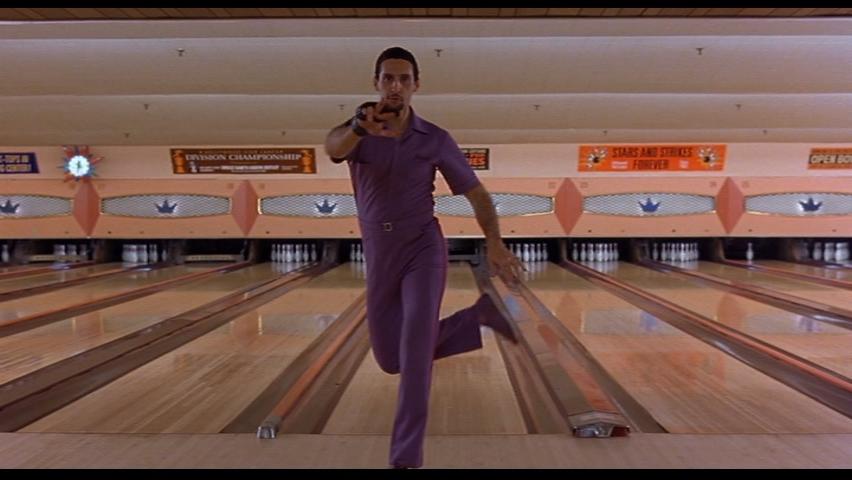
7. One of the greatest introductions of a character that has absolutely nothing to do with the plot ever. John Turturro makes the most of this scene as one of The Dude’s bowling opponents, from the licking of his ball to the little dance moves he pulls off after bowling a strike. The long pinky nail (for cocaine) and hairnet are nice touches as is the music that accompanies his intro – a cover of “Hotel California” by the Gipsy Kings. I also love The Dude’s laidback retort to Jesus’ bowling taunt: “Yeah well, that’s just, ya know, like, your opinion, man.” We even get a brief insight into Jesus’ life as a convicted pederast. Eight year-olds, dude. It is these little details that make this film so enjoyable to watch as even minor supporting characters are given a rich backstory.

“Nobody fucks with the Jesus!”
 8. After The Dude’s team advances to the next round in the bowling tournament (amazing considering that Walter pulled a gun on a fellow bowler), Walter loses his shit when Donny tells him that their next game is scheduled for Saturday, the Jewish day of rest thereby forbidding him from bowling on that day.

“Shomer shabbas”
 9. Logjammin’. Maude Lebowski (Julianne Moore), a feminist performance artist/painter, shows The Dude a cheapo porno film that Bunny starred in with her nihilist boyfriend Karl Hungus (Peter Stormare) in which he plays a cable T.V. technician who arrives to “fix” her cable. When she scoffs at its predictable plot and how it will end, The Dude deadpans, “He fixes the cable?”


10. The Dude is suddenly manhandled by the other Lebowski’s burly limousine driver causing him to spill a glass of one of his beloved White Russians.

“Hey, careful, man. There’s a beverage here!”
 11. The nihilists bust into The Dude’s place (“Hey, this is a private residence, man.”) and interrupt his relaxing bath by throwing a ferret into his bath water, thereby blowing his high and then threatening castration. Peter Stormare and Flea’s Eurotrash German accents sound like they came straight from the Saturday Night Live skit Sprockets!

“We believe in nothing!”
 12. Ah, Sam Elliott as the film’s narrator known as the Stranger and who makes an appearance in full western garb to give The Dude some sage advice and comment on his usage of cuss words. With his awesome mustache and deep voice, Elliott is ideally cast as a mysterious cowboy cum Greek chorus.

“I like your style, Dude.”
 13. And just what the hell is David Thewlis doing in this film as video artist Knox Harrington, armed with an annoying high pitched laugh and shaved head? Nothing really except yet another oddball that The Dude meets along the way. Knox and Maude seem to be sharing a private joke in their scene together, much to The Dude’s chagrin.

“Who the fuck are you, man?”
 14. “Lookin’ Out My Back Door” I love the use of this fantastic Creedance Clearwater Revival song in the scene where The Dude tries to evade a mysterious car that is following him. The little yelp that Bridges lets out when his character drops a lit joint in his lap while driving is priceless.

15. Goodman’s best scene in the film is when Walter and The Dude visit an insolent high school kid they believe stole his car and a million dollar ransom that was intended to free the kidnapped Bunny. The scene becomes funnier the more frustrated Walter and The Dude get as the kid refuses to buckle under their “intense” questioning culminating in Walter’s memorable insult, “This is what happens when you fuck a stranger in the ass!” over and over while trashing a sports car he thinks the kid bought with the ransom money.

“This is what happens…”
 16. Ben Gazzara as Hugh Hefner. The John Cassavetes film veteran turns up late in the game as a classy smut peddler Jackie Treehorn who drugs The Dude. I love the way Gazzara says, “feelings,” when he tells Bridges how the porn biz has changed over the years. This scene is also notable for showing The Dude doing some actual detective work. Too bad it amounts to nothing.


17. Gutterballs. While there are two dream sequences in the film, this is by far the best as a drugged Dude dreams of teaching Maude how to bowl while a chorus line of beautiful women engage in a Busby Berkeley style dance sequence all scored to “Just Dropped In (To See What Condition My Condition Was In)” by Kenny Rogers during his psychedelic period. Oh yeah, and Saddam Hussein gives The Dude bowling shoes and the dream ends with him being chased by the nihilists wielding huge scissors in a sequence that Freud would have a field day with.


18. The Dude hates the Eagles. Man, I’m so with him on this one.

19. I love the moment between Jeffrey and Maude where they bond after having sex. It’s a nice, quiet and amusing scene as we take a break from all the crazy people The Dude encounters and learn that he was briefly a roadie for Metallica (“Bunch of assholes.”). He was also a member of the anti-war group the Seattle Seven and helped write the original Port Huron Statement – not the compromised second draft. The chemistry between Bridges and Julianne Moore is excellent and The Dude’s reaction to Maude’s true intentions for their sexual rendezvous is funny. Plus, she helps him free up his uptight thinking about the mystery he’s embroiled in.


“Jeffrey, love me.”


20. Long-time Coen brothers collaborator Jon Polito pops up as a “brother shamus,” a private snoop trailing The Dude in order to find Bunny who has run away from home in Minnesota. The Dude tells him to back off from his “lady friend” (a.k.a. Maude) and alas that’s the last we see of Polito for the rest of the film.

“Like an Irish monk?”
 21. “3,000 years of beautiful tradition, from Moses to Sandy Koufax…” We get Walter’s full-on justification for why he still practices Judaism despite being divorced. There’s something admirable about his devotion to this religion.

22. Why’d they have to kill Donny? Poor Donny didn’t hurt anybody and is taken out when he suffers a heart attack as the nihilists confront him, The Dude and Walter outside of their beloved bowling alley, which leads us to…


23. Donny’s Eulogy. Walter delivers a heartfelt if not misguided eulogy to Donny. Due to their modest means, Walter and The Dude transport their friend’s ashes in a Folgers coffee tin to a cliff where they plan to scatter his remains. However, the wind blows some of them back into The Dude’s goatee. Fortunately, not even Walter’s ineptitude ruins this poignant moment.


24. Despite Donny’s death, The Dude and Walter advance to the next round in the bowling tournament and our hero is visited by the Stranger once again. As The Dude departs to bowl another round, he offers the parting words of wisdom, “The Dude abides,” and the Stranger wraps things up and brings the film full circle to the soulful strains of “Dead Flowers” by Townes Van Zandt.

“The Dude abides.”
 The Big Lebowski is my favorite Coen brothers film. For me, it is the perfect mix of their flashy style, eccentric characters, and distinctive dialogue. It is a rare comedy that can be watched over and over and never gets old. They have created a richly detailed world that is so inviting and entertaining that you want to revisit it again and again.

So, what are some of your favorite moments/scenes/lines of dialogue from this film?


NOTE: Screencaps from this film came from THE best Coen bros. site - You Know, For Kids!