"...the main purpose of criticism...is not to make its readers agree, nice as that is, but to make them, by whatever orthodox or unorthodox method, think." - John Simon

"The great enemy of clear language is insincerity." - George Orwell
Showing posts with label 2000s. Show all posts

Friday, October 22, 2021

Halloween II


Rob Zombie’s remake of John Carpenter’s Halloween in 2007 was a financial success prompting the studio to greenlight the inevitable sequel. Enough time had passed after the making of that movie that he had forgotten what a difficult experience it and was willing to go again but this time he would no longer be constrained with having to remake another person’s movie thus allowing him to follow his creative bliss, making a follow-up that was more brutal and refreshingly stranger than the previous movie. The result was Halloween II (2009).
 
After a brief flashback to Michael as a child, recounting a dream he had to his mother (Sheri Moon Zombie), we are brought back to the present with a bloody and battered Laurie Strode (Scout Taylor-Compton) walking down the middle of the road in a shell-shocked daze after having just fought off and killed Michael Myers (Tyler Mane). Sheriff Brackett (Brad Dourif) catches up to and tries to calm her down. Slam cut to a close-up of her screaming face as she’s wheeled along a hospital corridor on a gurney.
 
Back at the site of the climactic showdown, an unconscious Dr. Sam Loomis (Malcolm McDowell) is also sent off in an ambulance while Michael’s body is carried away as well but when the two inept coroners driving the truck crash into a cow (?!), Michael rises and disappears into the night. At the same moment, Laurie rises from her hospital bed to see her friend Annie (Danielle Harris), another survivor from the encounter with Michael, and Zombie makes a point of lingering on these two young women, their bodies damaged by what happened to them, but those wounds will eventually heal. It is the psychological damage that Zombie is interested in exploring with this movie.

He does pay tribute to the original Halloween II (1981) in the first 20 minutes or so as Michael stalks Laurie through the corridors of the hospital and manages to avoid the obvious error or having a nearly empty building for the two to engage in a prolonged cat-and-mouse game that always rang false by having her quickly escape out into the pouring rain, but oh wait, it was a nightmare and a year has passed since the events depicted in Halloween. It feels like Zombie’s fuck you to the original sequel as if to say don’t we all wish that movie was a nightmare we could forget?
 
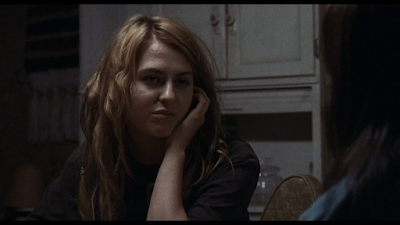
Laurie takes pills for pain, anxiety, you name it, still traumatized and living with Brackett and his daughter Annie. It’s a well-played scene as we see these people trying to get on with their lives as best they can considering what they’ve been through. Laurie, especially, is lost in the world. Her parents are dead and Michael’s body was never found, which leaves her frustratingly without closure.
 
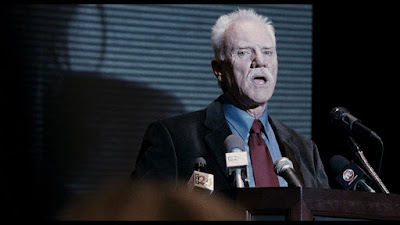
Meanwhile, Loomis has bounced back as a flashy television personality, cashing in on what happened a year ago and Zombie re-introduces his character via a super slick tracking show that would make Michael Mann proud, combined with a very Aaron Sorkin-esque walk-and-talk sequence. He’s become a petulant primadonna, which Malcolm McDowell has fun playing to the hilt. The “good” doctor happily cashes in on the fascination with Michael Myers but when someone brings up the possibility of the killer still being alive he loses it and we see the cracks in the façade. He is not above doing an interview in front of the now-abandoned Strode house as he tells his long-suffering assistant, “Bad taste is the petrol that drives the American Dream.”

Halloween II is a more visually interesting movie when we finally see what Michael has been up to all this time, living in an abandoned barn out in the middle of nowhere, killing and eating animals to survive, and having visions of his mother. Initially, it is of her dressed all in white next to a white horse but soon they become more involved. His mother was the only good thing in Michael’s life and once she was gone so were the last vestiges of being human. These visions are beautifully surreal sequences, bizarre tableaus that anticipate what he would delve into to a greater degree with The Lords of Salem (2012), which eschewed gore and violence for atmospheric dread.
 
The movie has the requisite kills that fans have come to expect from the franchise but here it feels as if Zombie is getting them out of the way as he’s more interested in tracking the shattered lives of the main characters than goosing the body count for cheap thrills. We get considerate character beats, such as Sheriff Brackett extolling the virtues of Lee Marvin in Cat Ballou (1965) to Laurie and his daughter who have no idea what he’s talking about. They provide brief moments of levity in an otherwise extremely grim movie.
 
A child of the 1970s, Zombie populates his movie with a bevy of character actors who were stars during that time and so we have Dr. Johnny Fever himself, Howard Hessman as the owner of a cool independent record store that Laurie works in and Margot Kidder as Laurie’s therapist. Despite working for a studio, Zombie still manages to find room for his troupe of favorite actors, such as Richard Brake, Jeff Daniel Phillips and Daniel Roebuck, many of whom get the honor of being brutally dispatched by Michael.


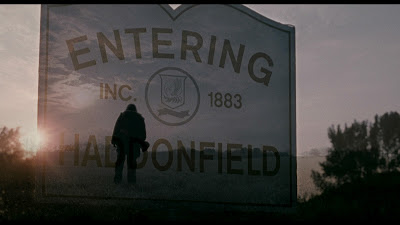
This being a Rob Zombie movie and his perchance for all things white trash, he trades in the suburbs of Haddonfield, that we normally associate with the Halloween franchise, for his preferred locales – indie record stores, deserted barns and sleazy strip clubs. He employs a desaturated color palette for this grim movie, saving key moments for splashes of color, such as the aforementioned strip club and the Halloween party Laurie attends – both awash in garish reds.
 
With Loomis’ endless press interviews and book signing gigs, Zombie is showing how infamous crime cases are commodified and exploited by people like Loomis without caring about the damage that has been done and continues with this careless exploitation. It brings out kooky fans and grief-stricken parents of kids killed by Michael that want to vent their anguish and anger on the doctor who has nothing but contempt and indifference for his audience. Laurie continues to unravel, permanently scarred both physically and psychologically by Michael and Loomis’ book only reopens these old wounds.
 
With both of his Halloween movies, Zombie is not interested in making a gimmicky Scream meta slasher movie or an over-the-top kill-happy Friday the 13th movie but instead grounding the franchise mythos in something approximating realism by showing the toll Michael’s bloody rampage takes on Laurie and those close to her. It’s not funny but sad, leaving one drained by the end of the movie, much like Laurie. Characters live with trauma and try to carry on with their lives but Michael won’t let them. People are killed in horrible, painful ways and those that survive are haunted, their lives shattered beyond repair.


Thursday, December 31, 2020

Me and Orson Welles


They say you shouldn’t meet your heroes as you’re liable to discover they have clay feet, rarely living up to one’s expectations. Me and Orson Welles (2008) explores the good and bad aspects of hero worship. Based on Robert Kaplow's novel of the same name, the Richard Linklater-directed film chronicles the eventful week in a life of teenager Richard Samuels (Zac Efron) who finds himself cast in a minor role in Orson Welles’ (Christian McKay) legendary stage adaptation of William Shakespeare’s Julius Caesar in 1937. The aspiring, 22-year-old wunderkind set the play in modern times as a bare-stage production with comparisons to the rise of Fascism in Italy and Nazi Germany.
 
We meet the 17-year-old Richard when he arrives in New York City with dreams of becoming a working actor. In typical Linklater fashion, he meets Gretta Adler (Zoe Kazan) in a record store and they break the ice over a mutual admiration they have for Richard Rodgers as “There’s a Small Hotel” plays in the store. The young woman says, “They’re like lullabies, aren’t they?” She’s in the city trying to make it as a playwright, hoping that one of her stories is published in The New Yorker.
 
The scene is a sweet, unassuming meet-cute that is vintage Linklater. “What I want is for one person on this earth to read something I wrote and say, ‘You’re terrific,’” Gretta says wistfully in a moment that echoes Jesse and Celine at the beginning of Before Sunrise (1995). Like that couple, Richard and Gretta are two young people that meet by chance and connect instantly over their respective aspirations. This opening scene could be a self-contained film unto itself and one almost wants to follow these two-young people getting to know each other in the Big Apple.
 

By chance, Richard stumbles across Welles attempting to put on a production of Julius Caesar and impresses him with his drumming and singing (a jingle for Wheaties no less). He appeals to his vanity while also showing his knowledge of theater. Richard soon finds himself immersed in the sights and sounds of the Mercury Theater with Sonja Jones (Claire Danes) putting him to work immediately, answering phones. He finds himself drawn to her only to find out that every man in the company is pursuing her with little success. Claire Danes is fine in the role and Sonja is nice enough but the actor does little to suggest why all the men in the Mercury Theater lust after her.
 
Welles casts Richard as Lucius but soon finds that “the principal occupation of the Mercury Theater is waiting for Orson,” as fellow actor Norman Lloyd (Leo Bill) puts it. Me and Orson Welles goes on to chronicle the tumultuous production of Caesar, from the rough rehearsals to the problematic previews to its eventual triumph juxtaposed with Richard’s coming-of-age story.

Zac Efron captures Richard’s earnest romanticism that comes with youth and a lack of worldly experience. This lack of knowledge gives him the courage to approach Welles in the first place as he has nothing to lose. He’s hardly an innocent, though, as he goes in on a bet with two other actors to see who can bed Sonja first and, later, sets off the theater sprinkler system, sabotaging the play and then refusing to admit he did it when Welles confronts him. Richard is a rebellious teenager that doesn’t know any better.
 

His wholesome aspects come out in Gretta’s presence. Zoe Kazan’s natural charisma and her character’s playful zest for life are infinitely more interesting than Sonja’s seen-it-all attitude. It is obvious right away that Richard and she don’t have the same kind of easy-going connection that he has with Gretta. While Richard is physically attracted to Sonja, it is with Gretta that he connects with on a more meaningful level.
 
Christian McKay and Eddie Marsan are perfectly cast as the arrogant Welles and his long-suffering business partner John Houseman respectively. The former plays Welles as a pompous ass who doubles as a genius. He does an excellent job approximating the man’s distinctive voice and affectations. The latter matches him as the one person in the group willing to stand up to the him as he tries to keep the lights on while Welles follows his muse. McKay’s layered performance goes deeper than mere impersonation with moments that show his humanity, the strain of carrying the entire production on his back, and his ability to take credit for every aspect of the production in one moment and make someone feel like they are the most important person in the company in the next.
 
Linklater immerses us in Welles lore, such as how he would take an ambulance from the theater to his radio gigs so he could run red lights and make better time. We also see his famous affinity for magic and he even reads from The Magnificent Ambersons, a book that he would adapt into a one-hour radio play in 1939 and a film in 1942. The filmmaker also presents several examples of fascinating behind-the-scenes drama, such as one actor (Ben Chaplin) experiencing paralyzing stage fright minutes before going on stage until Welles talks him down through sheer force of will. We see the fragile egos of some actors and others that brim with confidence. They may have all sorts of weaknesses and inadequacies as people do but when they are on stage, radio or film they are brilliant artists that make art come vividly to life. The reward is the adulation from the audience, which is a unique high that some actors chase their entire career.
 

Me and Orson Welles
started out as a young-adult novel by Robert Kaplow. He had been inspired of a photograph he had seen of 15-year-old Arthur Anderson playing a lute, cast as Lucius in Welles’ production of Julius Caesar. Kaplow sought out Anderson, found out that he was still alive and living New York City, and based much of the novel on the man’s recollections from that time. Richard Linklater was so taken with Kaplow’s book that he paid for the rights and made it independently. Linklater identified with Welles as a fellow indie filmmaker: “He was doing in the 40s and 50s what everyone else was doing in the 80s and 90s.”
 
Linklater was faced with the daunting task of casting someone to play the iconic Welles. Kaplow told him about a one-man show entitled, Rosebud: The Lives of Orson Welles, written by Mark Jenkins and starring Christian McKay, that was arriving in New York City for Off Broadway run after rave reviews at the Edinburgh Festival Fringe. He saw the play and was so impressed by the actor’s portrayal of Welles, from a young genius to an old man filled with regrets, that he cast him in the role. To prepare for the part, McKay listened to hundreds of hours of interviews and recalled his own arrogant youth. Linklater worked with the actor for months on portraying Welles.
 
Principal photography began in the Isle of Man in February 2008, shooting the Mercury Theater scenes in an old theater before moving on to Pinewood Studios in England where the exterior scenes of 1930s New York City were shot. According to Linklater, “We built one little street in Pinewood with a greenscreen at the end and every single exterior was shot on it, from different angles, dressed a different way.” The film crew went to New York City to shoot some photographs and a small amount of footage for digital effects.


“You know, sometimes you remember a week for the rest of your life,” Richard says partway through the film. In his brief tenure with the Mercury Theater, he does a lot of growing up, learning important lessons in life courtesy of Welles. Some of Richard’s mistakes can be attributed to his young age and his lack of life experiences as well as immaturity. He’s a hormonal teenager ruled by his libido. It is Gretta that keeps him grounded and the film ends on a wonderfully optimistic note as she and Richard are reunited. What will happen to them? Who knows but as she tells him, “It’s all ahead of us.”
 
 
SOURCES
Brooks, Xan. “Richard Linklater: ‘I’m not like Orson Welles. I’m a quiet director.’’ The Guardian. November 30, 2009.

Byrnes, Paul. “Me and Orson Welles.” The Sydney Morning Herald. July 31, 2010.

Dawtrey, Adam. “Director P.O.V.: Richard Linklater.” Variety. October 16, 2008.
 
Express. “Very Wellesian: Richard Linklater Discusses His New Film, Me and Orson Welles.” Washington Post. December 9, 2009.

Lim, Dennis. “Citizen Welles as Myth in the Making.” The New York Times. November 20, 2009.

Richards, Olly. “Claire Danes, Me and Orson Welles. Empire. February 1, 2008.

Friday, April 17, 2020

Open Range


Kevin Costner was already an acclaimed and popular actor when he starred in and directed Dances with Wolves (1990). The film was a critical and commercial success but he soon became too ambitious for his own good with the disastrous, high-profile one-two punch of Waterworld (1995) and The Postman (1997). The critics turned on him and they failed to connect with a mainstream audience like Dances had, prompting him to focus more on acting and be choosier with his directing gigs.

Open Range (2003) saw Costner not only return to the western genre but also to the director’s chair after six years. As he did with Dances, the filmmaker put up his own money to help make the film and adjusted his ambitions by making a straight-up crowd-pleasing story that married the entertaining thrills of a western like Tombstone (1993) with the no frills meditation on violence of Unforgiven (1992).

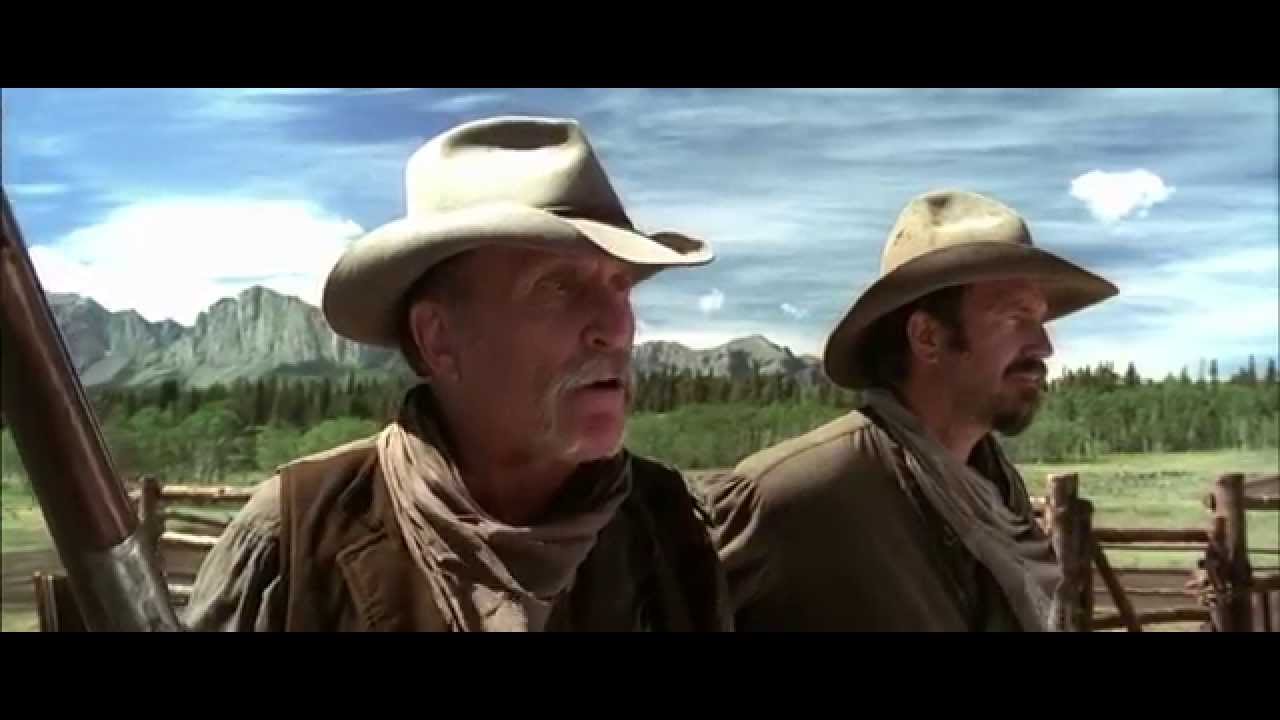
Four men are driving a herd of cattle through an open range in Montana, 1882. Boss Spearman (Robert Duvall) and Charley Waite (Costner) are the two veteran cowboys aided by two inexperienced young men Mose Harrison (Abraham Benrubi) and Button (Diego Luna). The film quickly establishes the dynamic between these men as they wait out an intense thunderstorm by playing cards. After the storm passes, Costner shows the men performing daily chores with little bits of business like how Charley approaches a skittish horse. Every man pulls his own weight as Mose says to Button and we see them work together to get their wagon out of the mud from the storm. Driving cattle is hard work and Costner doesn’t let us forget it. He also indulges in the romance of it with a montage of lovingly crafted shots of cattle being herded over the countryside.

On the surface, Boss is the grizzled cantankerous veteran, Charley is the ex-gunslinger with a dark past while Mose and Button are like brothers. It’s a testament to the skill of these four actors that after only spending ten minutes with their characters we are right there with them due to their camaraderie. We are invested in their story. When these men work and live off the land together like they have, a permanent bond develops between them. When this dynamic is threatened we want to see those responsible get their comeuppance.

When Mose fails to return from a supply run at a nearby town, Charley and Boss go investigate. They find out that he’s in jail after mixing it up with some local cattlemen. It sounds out of character for Mose and a conversation with Marshal Poole (James Russo) confirms that something isn’t right. Sure enough, local cattle baron Denton Baxter (Michael Gambon) chimes in. He doesn’t like free grazers like Boss and Charley because he doesn’t want the competition. He threatens them and they take the badly beaten Mose to Doc Barlow (Dean McDermott) and his beautiful assistant Sue (Annette Bening). Of course, Baxter won’t let things go and sends four masked men to intimidate them. The inevitable confrontation results in tragic consequences and the rest of Open Range plays out Charley and Boss getting revenge on Baxter and his men.

Costner expertly uses the widescreen aspect ratio right out of the gate as the title card appears over a wide vista with a cattle drive dwarfed by ominous storm clouds off in the distance. It not only gives a sense of place but also sets the mood. It is this kind of iconography that makes westerns distinctive from other genres.

One of the great pleasures of Open Range is seeing Kevin Costner and Robert Duvall share the screen together. They play well off each other with a believable short hand between their characters conveying years spent together working off the land. They get on each other’s nerves once in awhile, but they also have a great respect for one another. Over the course of the film they get moments where the two men tell each other things about themselves that they didn’t know. It gives us valuable insights into their respective characters.

Duvall’s Boss is a man who has a way with words, telling the townsfolk what Baxter and his men did to Mose and Button, or talking reassuringly to an unconscious Button. Costner’s Charley, on the other hand, is a man of few words but when he does speak he means every one of them. He’s a man who has lived a violent past and is trying to lead a better one but Baxter forces him to get in touch with his violent nature once again.

It is also refreshing to see Costner avoid casting some young, up-and-coming actor to play his romantic interest and opt instead for someone his age like Annette Bening who can more than hold her own. She doesn’t play a damsel in distress (until later) but someone who is capable of using her medical expertise to help Mose and Button after they’ve had run-ins with Baxter’s men. She’s lived life and is not afraid of Charley’s violent past because she’s seen the honorable man he is now.

Costner is a generous actor, giving Duvall and Bening plenty of screen-time and meaty speeches to show off their chops. That’s not to say he marginalizes his role in the film. Initially, Charley seems to be a man of few words but it is only because it takes him awhile to warm up to people. Around Mose, Button and especially Boss he’s not afraid to speak up and tell them what’s on his mind. It’s as if Costner is coming at the film like a fan and wanted to see a veteran actor like Duvall in another western.

Based on Lauran Paine’s 1990 novel, The Open Range Men, Open Range marked Kevin Costner’s return to the directing chair since The Postman and the first western he appeared in since Wyatt Earp (1994). At the time, it was considered a risky move for the filmmaker, which he was very much aware: “The western is a very scary thing for Hollywood, and I’m sure they’re saying, ‘Gee, if Kevin really needs a hit, what in the hell is he doing making a western?’” He and his fellow producers, Jake Eberts and David Valdes, were so committed to the project that they each put in a lot of their own money into it, much as he had done on Dances with Wolves.

They began scouting locations on March 15, 2002 in Canada when they realized it wasn’t feasible to shoot in the United States. They spent months searching the prairies until finding Nicoll Ranch at Jumping Pound Creek, the Turner Ranch and the Hughes Ranch for the cattle driving and range camp scenes. Looking for a place where the fictional frontier town would be located proved to be difficult until they finally discovered the Stoney Nakoda First Nations Reserve west of Calgary but it had no access road. Before the town could be constructed, a one-and-a-half mile dirt road had to be built across the reserve. The filmmakers spent four weeks conducting research and design in Los Angeles. The art directors and designers worked from history books and pictures by pioneer photographers like Silas Melander and Evelyn Cameron.

Putting in a significant amount of his own money allowed Costner to achieve the authenticity he desired, which included spending $2 million building a fully-functioning frontier town. Construction of the town took nine weeks with great care taken to recreate period detail. All the lumber was milled to historical period sizes and weathered for the exterior of buildings. The window glass for the town was hand blown and imported. Even the color palette that was used reflected paint sample charts from 1880. All of this attention to detail allowed Costner to film both exterior and interior shots on location.

The production encountered a few challenges. Nine weeks before principal photography began, Robert Duvall broke his ribs in a horseback-riding accident. Filming began on June 17, 2002 with a budget of $23 million. During the first few weeks, Costner’s appendix ruptured but went undiagnosed until he was rushed to the emergency room two months after the production finished.

Open Range received mixed to positive reviews from critics. Roger Ebert gave the film three-and-a-half out of four stars and wrote, “Kevin Costner's Open Range, an imperfect but deeply involving and beautifully made Western, works primarily because it expresses the personal values of a cowboy named Boss and his employee of 10 years, Charley.” In his review for The New York Times, A.O. Scott wrote, “Mr. Duvall knows the difference between underacting and overacting, and knows when each is called for. He plays his part, a thin fantasy of crusty frontier benevolence, as if it were a mediocre poker hand, bluffing Boss into someone bigger and more exciting than he has any right to be.” The Washington Post’s Desson Howe wrote, “There's a lot in this movie, simple, big, small and exciting. It's the year's first serious contender for big prizes. What's not to like about this picture?”

Entertainment Weekly’s Owen Gleiberman gave the film a “B” rating and wrote, “Duvall and Costner play together like a seasoned team: They’re wary, unsentimental colleagues whose opposing rhythms — Boss is spiky and righteous, the mellow Charley is slower to anger — never undercut their silent allegiance.” In his review for the Los Angeles Times, Kenneth Turan wrote, “Though his choice of roles has not always been wise, Costner is very much a movie star, and his reversion to an Unforgiven dark side is in many ways more believable than his fumbling courtship of the forthright Ms. Barlow.”

Costner doesn’t want to reinvent the western with Open Range. He simply wants to tell an entertaining story about hard-working men that stand up for their rights to live life on their own terms. The two-hour running time may seem indulgent to some but the film never feels too long. He lets things breathe and allows us to spend time with these characters and get to know them so we care what happens when things go south.

There’s something to be said for telling an entertaining story well. So often these days story is sacrificed for spectacle. In this respect, Open Range is a refreshing call back to classic westerns like Red River (1948) but with aspects of revisionist westerns like Unforgiven. This film is not afraid to tell a simple story where the good guys beat the bad guys and it works in part because it’s done in a sincere way.


SOURCES

Giammarco, David. “Costner’s Last Stand.” The Globe and Mail. August 9, 2003.

Kaufman, Sarah. “After Several Flops, Costner Defends Open Range as a Movie with Heart.” Washington Post. August 15, 2003.

Open Range Production Notes. Touchstone Pictures. 2003.

Friday, January 17, 2020

Spider-Man


In 1997, Batman & Robin nearly killed off the comic book superhero movie. It was famously reviled by critics and underperformed at the box office. Blade (1998), however, came out the next year and proved that there was still interest in the genre. It wasn’t until the phenomenal success of X-Men (2000) and Spider-Man (2002), which managed to tap into the pop culture zeitgeist in a significant way, that the genre returned to prominence. Both movies were made by directors who grew up with these comic books and were fans. More importantly, they understood what made these iconic characters work and strongly identified with them.

Sam Raimi, in particular, was an inspired choice to direct Spider-Man. In many respects, his 1990 film Darkman was a comic book superhero movie not actually based on an existing title. It demonstrated that he had the innate storytelling instincts for the genre and the stylistic chops to transport the famous webslinger from page to screen. The end result was a loving homage to his humble beginnings at the hands of Stan Lee and Steve Ditko while still feeling contemporary.

Raimi immediately established Peter Parker (Tobey Maguire) as a pasty-faced dweeb that admires his high school crush Mary Jane Watson (Kirsten Dunst) from afar. It’s not like he’s invisible as the movie makes a point of having her stick up for him while others ridicule him. He is an outcast and is friends with another outsider, Harry Osborn (James Franco), a rich kid that flunked out of private school and is tired of living in the shadow of his brilliant scientist father, Norman Osborn (Willem Dafoe). David Koepp’s screenplay efficiently introduces all the significant people in Peter’s life and establishes the relationships between each other. Raimi has fun introducing the core supporting characters in Spider-Man’s world, like the Daily Bugle’s publisher J. Jonah Jameson played with perfect bluster by J.K. Simmons who captures the essence of the notoriously cheap yellow journalist while also taking an instant dislike to the webslinger.

The movie soon establishes a parallel between Peter and Norman as they undergo physical enhancement that also affects them mentally. With Peter it happened accidentally but Norman made the choice to do it, which drives him insane. Initially, Peter’s newfound powers make him cocky and selfish as he uses them for profit. It is only when this behavior results in the death of his beloved Uncle Ben (Cliff Robertson) that he learns to use his powers for the greater good.

Maguire has a memorable scene with Cliff Robertson when Uncle Ben has a heart-to-heart with Peter, telling him, “These are the years when a man changes into the man he’s gonna become for the rest of his life. Just be careful who you change into.” He then utters the movie’s most famous line, “With great power comes great responsibility.” Instead of listening, Peter foolishly chastises Ben for telling him what to do and to stop pretending to be his father, which visibly wounds the elder man. Robertson is excellent in this scene as he makes you care about him so that you feel bad when Peter dismisses him so callously. Maguire is quite strong in this scene as well, showing how Peter has become drunk with his newfound powers, believing that no one can relate to what he’s experiencing. He is also quite affecting in the aftermath of Ben’s death. Peter is in his room quietly crying, devastated by what happened and with the knowledge that it was his fault. He could have prevented it.

Kirsten Dunst brings a fresh-faced girl-next-door vibe to the role of M.J. She’s obviously beautiful but the actor isn’t afraid to act disarmingly goofy when posing for Peter’s pictures during their school field trip. She isn’t bored by the science stuff and actually looks interested in the tour guide’s spiel. The movie wisely has the relationship between her and Peter as its heart, establishing their friendship in scenes like when they tell each other their aspirations after they graduate from high school – she wants to be an actor and he wants to be a photographer, working his way through college. It a wonderful character building moment as Peter encourages M.J. to follow her dreams.

The two actors have fantastic chemistry together. We want to see Peter and M.J. get together yet it is always tantalizingly just out of reach. The scene where he saves her from would-be muggers as Spider-Man and she rewards him with a passionate kiss is a moment of intimacy that is missing from a lot of the current crop of comic book superhero movies, which are strangely asexual. What, superheroes don’t get to have love lives? The potential romance between Peter and M.J. is one of the best things about Spider-Man.

Willem Dafoe does a great job conveying Norman’s gradual transition to the dark side and the emergence of a split personality. It allows the actor to play two separate characters – Osborn, the victim, and the Green Goblin who wants to punish those that wronged him. The movie takes the time to show what motivated a decent man like Norman to go bad, transforming himself into the Goblin. He’s not a simple, world dominating baddie but a tortured soul driven mad by self-imposed pressures and corporate machinations. It was a quite a coup getting someone of Dafoe’s caliber to play the villain. He gives the role his own distinctive spin, like the Thanksgiving dinner he attends at Peter and Harry’s place. It looks like Norman but the way Dafoe plays it you can tell that the Goblin persona has taken over in the way he leers suggestively at M.J. and threateningly at Aunt May (Rosemary Harris) when she slaps his hand for touching the food before saying Grace.

As he demonstrated with Darkman, Raimi has a knack for kinetic camerawork and editing tailor-made for a comic book superhero movie, which he demonstrates during the Green Goblin’s attack on the Oscorp Unity Day Festival in downtown New York City. While trading blows with him, Spider-Man saves several innocent bystanders caught in the crossfire, most notably M.J. The CGI in this sequence is impressive, seamlessly showing off both combatants’ abilities. Technology had finally caught up to what the comic books had been doing all along and brought Spider-Man’s webslinging powers vividly to life.

At the end of Spider-Man, Peter sums up his lot in life best when he says, “No matter what I do no matter how hard I try, the ones I love will always be the ones that pay.” This movie shows the sacrifices a hero must make in order to keep the ones he loves safe. Spider-Man is about what it takes to become a hero and what it means to be one. All it takes is one fateful moment to change your life forever. For Peter it was refusing to stop and armed robber who goes on to kill Uncle Ben. At that moment Peter realizes that his actions have real consequences and that he must use his powers responsibly. Thus, Spider-Man is born. It is this moment that sets him on the path to becoming a superhero.

Friday, February 17, 2017

Moonlight Mile

Brad Silberling got his start directing television shows like Doogie Howser, M.D. and NYPD Blue before making the jump to feature movies with studio fare like Casper (1995) and City of Angels (1998). It wasn’t until Moonlight Mile (2002), however, that he finally had something personal to say. The film was loosely inspired by the grieving period he went through after his then-fiancée, actress Rebecca Schaeffer was murdered by an obsessed fan in 1989. It featured then-up-and-coming actors Jake Gyllenhaal and Ellen Pompeo alongside veteran actors Dustin Hoffman and Susan Sarandon delivering thoughtful performances in this moving story.

It's in 1973 and Joe Nast (Gyllenhaal) is staying with Ben (Hoffman) and Jojo Floss (Sarandon) after the death of his fiancée and their daughter. Ben copes by keeping busy, micromanaging the funeral and the reception afterwards while Jojo suffers from writer’s block. Joe sticks around because he doesn’t know what else to do, feeling like he’s the last link to their daughter, even staying in her room. While trying to retrieve wedding invitations from the local post office, he meets Bertie Knox (Pompeo), who helps him out. They gradually become attracted to one another but they both harbor painful secrets that hold them back.

Dustin Hoffman and Susan Sarandon are believable as a married couple from the short hand they have between each other, like how Jojo frequently reminds Ben to lower his shoulders. It is these little, personal touches that provide valuable insight into their relationship. It is also interesting to see how they cope with the grief of their child’s death in their respective ways. Ben is all nervous energy and tries to keep busy, pushing the grief down deep so that he doesn’t have to deal with it. Jojo, however, channels her pain through anger and bounces it off Ben in little ways that are familiar to anybody’s who’s been married for a decent amount of time. Sarandon excels at playing this no bullshit kind of character and it juxtaposes well against Hoffman’s internalized bundle of energy.

Jake Gyllenhaal is decent as the bewildered fiancé trying to make sense of it all – his feelings for his fiancée, his responsibility towards her parents and what he’s supposed to do next – and Bertie comes along and shakes it all up. Joe is wracked with guilt over a secret he’s keeping from Ben and Jojo and it’s tearing him up inside. Gyllenhaal does an excellent job conveying this internal conflict. He delivers an impressively nuanced performance and at such a young age.

The lovely, pre-Grey’s Anatomy Ellen Pompeo plays Joe’s alluring potential love interest that is harboring deep, personal feelings of loss herself. Like Joe, she’s damaged and adrift in life and this draws them together. The actress conveys a fragile vulnerability under a tomboy façade that is intriguing to watch.

In 1989, Brad Silberling was a film graduate with a promising career directing T.V. he was engaged to 21-year-old actress Rebecca Schaeffer. One day, she was shot and killed by a crazed fan. Silberling remembered, “The moment this happened, there was a voice in my head saying, ‘I don’t know what I’m going to do.’” He moved into her parents’ house in Oregon, staying there for several months while he tried to figure out what to do next and comfort them during this dark time.

Four years later, he channeled this experience into the screenplay for what would become Moonlight Mile (originally entitled, Babies in Black). Silberling said, “Like the girl in the film, Rebecca was an only child with parents who were vital and interesting. I didn’t know them very well and, suddenly, we were thrust into a unique type of intimacy in which the boundaries were unclear and the expectations hazy.”

He didn’t have an easy time of getting it made. Even after back-to-back hits with Casper and City of Angels, it took years for Moonlight Mile to get made. Four studios passed on it, including DreamWorks who felt it was too close to American Beauty (1999). Studio executives didn’t know how to market it as Silberling said, “They’re stumped by stories that are character-driven and don’t box themselves up neatly.” It wasn’t until Susan Sarandon and then Dustin Hoffman agreed to do it that financing came through. Initially, Hoffman turned it down in 1998 but changed his mind two years later when the filmmaker pitched to him again. The actor said, “Hearing Brad talk about it – I detected a yearning in him. He wanted to make this movie to figure something out.” Silberling’s agent contacted Disney’s studio chief and gave him 24 hours to decide on the $20 million film. He agreed to bankroll it in the fall of 2000 with principal photography taking place in the spring of 2001.

Moonlight Mile received mixed reactions from critics. Roger Ebert gave the film four out of four stars and wrote, “Moonlight Mile gives itself the freedom to feel contradictory things. It is sentimental but feels free to offend, is analytical and then surrenders to the illogic of its characters, is about grief and yet permits laughter.” In his review for The New York Times, A.O. Scott wrote, “Yet somehow the director has put together a collage of period music without succumbing to the usual classic rock clichés, and he has a good instinct for the ways people use pop music to communicate and to express emotions they can’t quite articulate. In fact, if they articulated them a little bit less, Moonlight Mile would be a stronger movie.” The Los Angeles Times’ Kenneth Turan wrote, “Silberling has crafted a good number of strong, memorable moments—a barroom dance set to the Rolling Stones title song is particularly nice—but finally the presence of real feelings underlines what’s missing when they’re not there.” Finally, Entertainment Weekly gave it a “C+” and Owen Gleiberman wrote, “Joe’s cleaving to his replacement parents, letting himself replace the child whose loss they have yet to confront, is a sticky, fraught situation that Silberling reduces to a pileup of TV episodes.”

I’ve always been a sucker for small-town American slices of life stories and Moonlight Mile is one that stayed with me for days. Even though it’s set in ’73, Silberling doesn’t hit you over the head with period details, letting the soundtrack, populated by Sly and the Family Stone, T-Rex, Van Morrison, and others do that instead. He focuses on the characters and their dilemmas, which are compelling in their own right. The music compliments them and so we get a touching moment when Joe and Bertie slow dance to “Moonlight Mile” by the Rolling Stones or when they drive off to an uncertain future to the strains of Van Morrison’s “Sweet Thing.”

What makes this film distinctive from others of its ilk is how personal it feels, from the song choices to the specific behavior of the characters. This doesn’t feel like some generic studio movie – it is a personal statement from someone that had to make it. It’s a film that features characters dealing with grief and guilt and trying to communicate these feelings with others. It also explores the real need for personal connection and how that can help people open up and be vulnerable, which helps deal with their personal traumas. How does one go on with their life after the death of someone close to them? Everyone has their own way of dealing and Moonlight Mile shows several coping methods – none of them are easy. This film was a highmark for Silberling and after its commercial failure (it was the victim of a studio regime change), he went back to standard studio fare and directing T.V. It’s a shame he hasn’t found anything as personal and moving as this film but it remains a poignant tribute to Rebecca Schaeffer’s memory and that part of his life.


SOURCES

Diaconescu, Sorina. “All the Way Back.” Los Angeles Times. September 22, 2002.

Ojumu, Akin. “The family that grieves together…” The Guardian. February 15, 2003.


Waxman, Sharon. “A Director’s Longest Mile.” Washington Post. September 29, 2002.

Friday, December 9, 2016

Speed Racer

In retrospect, the Wachowski brothers (at the time, Larry and Andy) peaked critically and commercially with The Matrix trilogy. The good will they endeared with the first film gradually dissipated until the full-on backlash came with the third installment from which they’ve never recovered. They continue to make ambitious, expensive sci-fi epics like Cloud Atlas (2012) and Jupiter Ascending (2015) to routinely negative reviews and lackluster box office returns.

It started with Speed Racer (2008), the Wachowskis’ attempt to reach a broader audience by making a family film based on the popular Japanese anime and manga of the same name. The film was high-profile flop, getting savaged by critics and failing to come close to recouping its pricey $120 million budget. In recent years, the film has begun to undergo something of a critical re-evaluation and I’ve always been struck by its strong visual sense and its touching ode to the familial bond as well as its thinly-veiled critique of the destructive effect of corporate greed on the purity of sports.

The young Speed Racer we first meet is a hyperactive dreamer that fantasizes about racing fast cars just like his older brother Rex (Scott Porter) whom he idolizes. He would rather spend all of his time at the racetrack hanging out with his brother than in school. Rex teaches his younger brother everything he knows, like how to use his instincts and his senses to race. It’s a wonderful scene that provides crucial insight into what motivates Speed to race – the love of the sport and of his brother who died tragically in a race.

The Wachowskis also use this scene to establish the film’s striking visual sense – a hyper-stylized, vibrant color scheme that hasn’t been seen to this degree since Warren Beatty’s bold take on Dick Tracy (1990). Speaking of Beatty’s opus, Cruncher Block (John Benfield) and his cartoonish goons (including one with the most glorious set of mutton chops I’ve ever seen) with their tommy guns seem like a nod to that film, albeit with a modern twist. Establishing the world of Speed Racer right from the get-go is an important decision because it let’s us know that this is a fantasy world with its own look, much like Sky Captain and the World of Tomorrow (2004) or Sin City (2005). The Wachowskis also introduce their innovative take on car racing and car chases, employing the immersive, time-bending aesthetic of the fight sequences in The Matrix films to Speed Racer, dubbed, appropriately enough, “car-fu.”

The flashbacks not only establish the emotional bond between Speed and Rex over racing but shows the cut-throat tactics rival racing teams will employ when a bomb is delivered to Speed’s home, only to be quickly dealt with by his brother. It is ominous foreshadowing of the lengths rival teams will go to in order to stop Speed.

The dilemma Speed (Emile Hirsch) faces comes in the form of E.P. Arnold Royalton (Roger Allam), the smug, super rich owner of Royalton Industries, and who courts the young driver to race for his team, enticing him with a lavish lifestyle and unlimited resources. The Wachowskis make a point of contrasting Royalton’s calculated corporate culture with its obedient, uniformed employees, automated car factory and rigorously physically trained racers with the Racer team that still works out of Pops (John Goodman) garage where he and Sparky (Kick Gurry) spend weeks building a car with their own hands. They are supported by a small team of people that consist of Speed’s mom (Susan Sarandon), his little brother Spritle (Paulie Litt), and Speed’s girlfriend Trixie (Christina Ricci).

After rebuffing Royalton’s advances, Speed loses his next race, which leaves him disillusioned. It takes his mom to remind him what is important in life when she tells him, “When I watch you do some of the things you do I feel like I’m watching someone paint or make music. I go to the races to watch you make art and it’s beautiful and inspiring and everything art should be.” This passionate speech is the heart of the film and perfectly encapsulates its central theme. The rest of the film depicts Speed’s mission to expose Royalton’s corrupt practices with the help of the mysterious Racer X (Matthew Fox).

Emile Hirsch brings his trademark intensity to the role and it is interesting to see an actor who mostly plies his trade in challenging independent cinema bring that approach to a big budget Hollywood blockbuster. He manages to not get lost amidst all the eye-popping visual effects and has decent chemistry with Christina Ricci, whose big eyes and exuberant take on Trixie, resembles a live-action anime character.

John Goodman gets to engage in a couple of action sequences and, more importantly, a meaningful scene where Pops has a heart-to-heart talk with Speed. Veteran character actors like Goodman and Susan Sarandon tend to get lost in big budget blockbusters like this one – relegated to the margins in favor of CGI set pieces but the Wachowskis make sure that they are given moments to actually act and emote. Both of their moments occur at pivotal moments in the film where their characters give their son important advice about life.

Whole essays could be written about Speed Racer’s bold, visual aesthetic. For example, as Racer X’s attack on Cruncher Block’s mobile hang-out is chock-a-block with saturated reds and midnight blues that is pure visual catnip. The film’s style is its substance as the Wachowskis pay homage to the original anime while also making it uniquely their own and in doing so create a very personal movie within the studio system. One can see racing as a metaphor for filmmaking and the Wachowskis seeing themselves as Speed. Like, their principled protagonist, they do not want to lose their personal touch by being seduced with the lavish riches the studios can provide. Like Speed, they must remain true to themselves and the love for their art.

This is evident early on in a scene where Speed tells Royalton why he can’t be a part of his team by recounting a story of when he was young, staying up late one night with his father watching a vintage car race and how that rekindled his love for racing after his brother died. They got caught up in the race as if they were watching it for the first time – “But for Pops it isn’t just as a sport. It’s way more important than that. It’s like a religion.” One gets the feeling that is exactly how the Wachowskis feel about cinema. Naturally, Royalton mistakes Speed’s passion for naiveté and ridicules him, his glad-handing façade disappearing as he shows his true colors. He gives Speed a history lesson, claiming that competitive car racing is fueled by corporate greed and races like the iconic Grand Prix are fixed. He even goes so far as to threaten Speed, telling him that he won’t finish the next race and he’ll ruin Pop’s business.

The film’s innovative style extends to the flashback techniques the Wachowskis employ, complete with stylish scene transitions that succinctly provide crucial motivation for key drivers in an impending race. The eye-popping visuals are unleashed in the Casa Cristo 5000, a deadly off-road race that killed Rex. All bets are off in this race as many drivers employ a myriad of dirty tricks, like shooting green goop at a rival, blades coming out of hubcaps, a sledgehammer launched from underneath a car, and one vehicle that catapult launches a nest of angry bees onto a rival’s car. The action is fast and furious as the Wachowskis are not bound by the traditional rules of physics and this allows them to embody the dynamics of a live-action cartoon in a way that is audacious and inventive as well as pure visual eye candy. This race lays the groundwork for the final one, which comes across as trippy fusion of Rollerball (1975) and Tron (1982) as all the other racers try to take out Speed – it’s the honest racer against a rigged system.

In fact, Rex gives up everything in order to protect his family. He turns his back on them, becomes a dirty racer and ultimately sacrifices his life. The Wachowskis make a point of showing the impact it has on his family. Once Speed becomes a professional racer he constantly lives in the shadow of Rex, honoring his memory and his accomplishments by refusing to beat his records, even though he could. For Speed, it is more than beating records and winning races – it’s about making his parents proud and racing for the sheer love of the sport.

The original 1960s Speed Racer cartoon was the Wachowskis’ introduction to Japanese animation or anime and the impetus for making the film was that “they wanted to do something their nephews and nieces could watch,” said producer Joel Silver in an interview. He had been trying to make a film adaptation since the early 1990s with Vince Vaughn, at one point, campaigning to play Racer X and the various others, like Johnny Depp and music video director Hype Williams, circling the project. Silver acquired the rights in 1996 and hired eight different screenwriters to crack adapting the property but none of them satisfied the demanding producer. While working with the Wachowskis on V for Vendetta (2005), he asked them if they’d be interested in making it. They were hesitant at first but agreed if they could bring something unique to the material.

For the look of the film, production designer Owen Paterson wanted something “quite timeless, retro and midcentury, but set some time in the future,” creating “a parallel world, an exaggeration of color and action and images.” According to visual effects supervisor John Gaeta, they set out to “create something that’s much more fantastical than what we saw in The Matrix films.” They took the idea that in animation there is no matching perspective between the background and foreground and applied photographic techniques so that they had a live-action film built out of flat layers of photos.

To that end, locations scouts and photographers took approximately 10 million 360-degree, high-definition photographs of settings in Greece, Morocco, Italy, France, Germany, Death Valley, and sections of the California coast using ultrahigh-definition cameras. According to Gaeta, they applied an enhancement to these photos or, “sometimes a matte painting over the locations, ahead of the live-action photography. So then, in the movie, out of the window of a Moroccan palace you see the Italian Alps. We have these bizarre combinations that don’t necessarily make sense but they create these very stunning images.” They were then used in scenes utilizing green screen technology on the sets of Studio Babelsberg near Berlin.

Roughly 75-85% of the film was shot on green screens with the rest done on vibrantly painted sets to match the look of the world the Wachowskis were creating. While more than 100 cars were modeled and created digitally, two of them – Speed’s Mach 5 and Racer X’s Shooting Star – were given full-sized replicas with the actors sitting in replica cockpits that were mounted on a hydraulic gimbal platform linked to racing software programmed to pre-conceived sequences.

When Speed Racer was released the critical brickbats came out in force with The New York Times’ A.O. Scott leading the charge: “Mobsters, detectives, sportscasters and ruthless rival racers all parade across the screen, but none of them generate the sparks of humor, danger, energy or nobility that would ignite a sense of pop magic. Speed Racer goes nowhere, and you’d be amazed how long the trip can take.” Entertainment Weekly gave it a “D” rating and Lisa Schwarzbaum wrote, “This newest iteration is about a demon on wheels who’s chasin’ after someone for 135 minutes – which makes for an awful lot of wheel spinning.” The New Yorker’s Anthony Lane wrote, “You could call it entertainment, and use it to wow your children for a couple of hours. To me, it felt like Pop fascism, and I would keep them well away.” The rare positive review came from Time magazine’s Richard Corliss who wrote, “You can tell that everyone had liberated fun making the film; it feels like the group effort of Mensa kids let loose in the paint store.”

I’m ashamed to say that I was swayed by the negative reviews at the time and did not see Speed Racer on the big screen – something I regret deeply since. It was fellow blogger Dennis Cozzalio over at the Sergio Leone and the Infield Fly Rule blog whose passionate defense of the film inspired me to check it out. He wrote, “Far from finding Speed Racer incoherent, I instead discovered it to be a whooshing marvel which challenged me to see a simple story with fresh, often incredulous eyes, one that doesn’t exploit easy nostalgia but instead takes an elastic approach to the familiar tropes of the cartoon, creating an experience of film merged with digital effects that folds back on itself in exhilarating new ways.”

Not surprisingly, Speed Racer proved to be too idiosyncratic for the masses but, by and large, the Wachowskis have managed to make the films they want to make despite repeated commercial and critical failures. Undoubtedly, the film is a complete failure, commercially speaking (it’s running time is too long for kids to sit through), but on artistic terms it is a triumph – a fascinating allegory for remaining true to one’s self as an artist. Speed Racer is a phantasmagoria of CGI imagery guaranteed to melt your eyeballs and a rare studio film unafraid to bite the corporate hand that fed it, all wrapped up in a brightly colored pop art bow.

SOURCES

Bowles, Scott. “First Look: Speed Racer’s Demon on Wheels.” USA Today. May 30, 2007.

Dunlop, Renee. “The Wachowski Brothers Bring Live Action Anime, Color and Movement to New Levels in Speed Racer.” CGSociety. May 16, 2008.

Hobart, Christy. “The Speed Racer Time Warp.” Los Angeles Times. May 8, 2008.

Kit, Borys. “Speed Hits Live-Action High Gear.” The Hollywood Reporter. November 1, 2006.

Lawrence, Will. “Speed Racer: Fast-Moving World of the Wachowski brothers.” The Telegraph. April 25, 2008.

McCarthy, Erin. “Speed Racer’s Breakthrough CGI Road Rally: Anatomy of a Scene.” Popular Mechanics. October 30, 2009.


“Wachowskis Are Good to Go Speed Racer.” Los Angeles Times. November 1, 2006.