Debra Winger is a great
actor that has had a good career when she should have had a much better one.
While she has certainly worked with some impressive filmmakers over the years,
such as Richard Attenborough, Bob Rafelson, Alan Rudolph, Costa-Gavras,
Bernardo Bertolucci, and Jonathan Demme to name a few, most of them are
considered minor works at best, and her reputation for being difficult while
making movies, including clashing with her co-stars and directors as well as
refusing to promote pictures she didn’t like making, may have also hurt her
career. The director that understood her the best was James Bridges who
directed her in Urban Cowboy (1980), her breakthrough film, and Mike’s
Murder (1984). He wasn’t afraid to be challenged by her: “When you work with a nice person, what you get on screen is 'nice'
and nothing more. When you work with fire, there's smoke on the screen.”
The latter film, in
particular, features Winger’s best performance to date, a layered depiction of
a woman who discovers that a man she had a brief but passionate affair with
wasn’t the man he appeared to be, drawing her into the Los Angeles drug underworld.
Bridges adopted a challenging narrative structure that test audiences rejected,
which prompted him to recut into a more conventional film where it proceeded to
tank at the box office. Mike’s Murder is a haunting character study
about a specific time and place that transcends its conventional thriller
trappings.
Betty Parrish (Winger)
has a brief but intense relationship with Mike Chuhutsky (Mark Keyloun), a
tennis instructor. Six months later, she runs into him and he admits to being
in trouble as he has started dealing drugs to pay the rent. She talks to him
again on the phone three months later. They cross paths a couple more times
with him wanting to hook up again but each time flakes out. There is something
about him that she can’t stop thinking about to the point that she zones out in
the middle of conversations with family and friends. Once she learns of his
death – from a drug deal gone bad – she speaks to some of his friends and
associates to find out what happened and to learn more about him. In the
process, she comes to terms with the conflicted feelings she has for Mike.

Bridges expertly
juxtaposes the mundanity of Betty’s life – she works as a bank teller who takes
tennis lessons on the weekend – with the increasingly dangerous life of Mike
who rips off high-end drug dealers thereby putting himself in peril. The film
starts off with a brief montage of Betty and Mike as we see them laugh and
flirt while playing tennis and then cut to them making love in tender slow
motion in the shadows that is very film noir-esque. After the opening credits,
the tone of the film shifts as we see the Mike narrowly escape retribution for
intruding on an established dealer’s turf.
The first enigmatic
nine minutes of Mike’s Murder show us a lot without telling us much and
in doing so pose all kinds of questions. Who are these two people that seem in
love and why is one of them in so much trouble? The first question is answered
rather quickly while the second question is gradually answered over the course
of the film. The questions of why he was killed and who did it aren’t really
what makes this film so interesting. It is Betty’s reaction and how she deals
with it over time as she tries to figure out what Mike meant to her.
Debra Winger is a
fascinating actor to watch and director Bridges must’ve thought so, too,
building this entire film around her, spending many scenes focused on her
character, like when Mike calls Betty up after disappearing for three months.
While they are chatting, we see the entire conversation from her side as the
camera observes her looking at herself in a mirror. It is an unguarded moment
as she is by herself with Mike’s disembodied voice in her ear.
.png)
Winger delivers a
powerful, yet understated, lived-in performance doing an excellent job playing
a normal person – not a movie star or a larger-than-life character, but a
regular person just getting by like most of us are, day by day. Betty doesn’t
have much going on in her life: she has her job and occasionally goes out with
one of her co-workers. The actor does an excellent job of conveying a range of
emotions with only her face as we see Betty deal with Mike’s death in stages.
We see these feelings play across her eyes and it is fascinating to watch. This
is particularly evident in the scene where Betty goes to Mike’s apartment to
see where he was murdered and the horror that plays over her face is palpable.
Part of her didn’t want to know the grisly details but another part of her had
to know to get closure. Betty manages to keep it together for most of the day
until she gets home and finally breaks down, letting all those pent-up emotions
out.
Admittedly, Mike’s drug
dealing escapades is standard fare seen in countless other movies of its ilk
but Bridges handles it well by using very little dialogue in the scene where Mike
and his partner-in-crime Pete (Darrell Larson) decide to rip off a high-end
dealer, creating an intense scene. Darrell Larson does a fantastic job showing
how his character gradually unravels with paranoia thanks to the cocaine he
regularly takes and constantly evading the drug dealers he helped rip off. His
storyline dovetails with Betty’s in an intense scene where he shows up at her
house at night trying to explain himself. Larson delivers his dialogue in an
emotional monologue that is insistent and pathetic simultaneously, delivered
with sweaty desperation. This frightening encounter gives Betty a taste of
Mike’s secret life and the dangerous people that inhabited it.
Of the people Betty
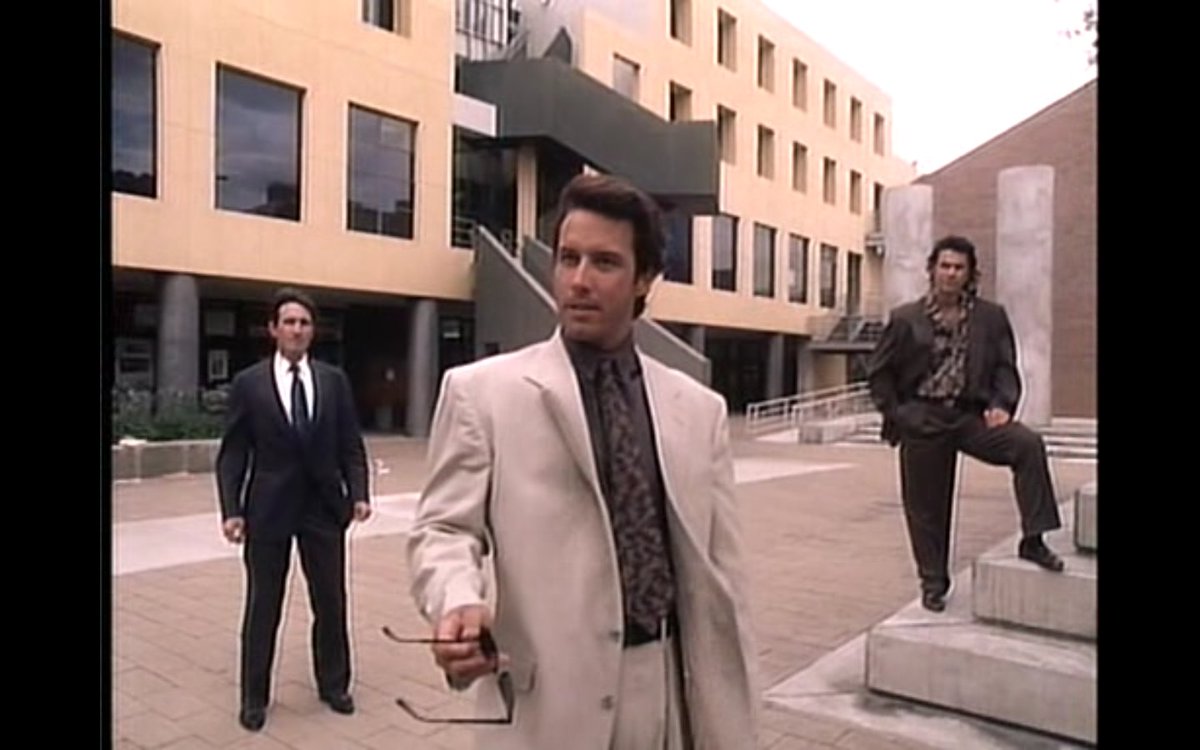
crosses paths with during her informal investigation, the most notable is
Philip Green (Paul Winfield), a record producer who Mike did work for at his
home. He’s stand off-ish, at first, only to be somewhat anguished when talking
about Mike’s death and then reflective about how they met. It is a wonderfully
layered performance by Paul Winfield who makes the most out of his brief screen
time.
.JPG)
As the saying goes,
truth is stranger than fiction and this certainly applies to the inspiration
behind Mike’s Murder. Bridges and producer Jack Larson knew actor Paul
Winfield as he had appeared in plays that both men had done. Through the actor
they got to know a friend of his by the name of Mark Bernalack. The character
of Mike was based heavily on Mark – both stayed with Winfield, were tennis
pros, and ran afoul of local drug dealers resulting in their deaths. Larson
said, “Jim was very haunted by it. It was because of how Mark was called a drug
dealer in the newspapers. That was very sad to him. The papers portrayed Mark’s
murder as if it was a good thing because he was a drug dealer.” It was a
personal story for Bridges who had known people killed for dealing drugs in
L.A. and it profoundly affected him. With this film he wanted to avoid the
usual suspense thriller cliches and portray the city as “a disjointed society
by using close-ups to imitate the view from a car.”
In early 1982, Bridges
originally went to The Ladd Company to pitch another project – Jane Goodall in
Africa – and while there he told Alan Ladd, Jr. about his idea for Mike’s
Murder. The executive liked it and the title, agreeing to finance the
project with a $5 million budget.
He wrote the film for
Winger and insisted she do it. She remembers, “I had made one of my first left
turns out of show business. He wrote this specifically for me to bring me back
in and show me how this new ‘independent’ approach was the wave of the future.”
She had moved to Cleveland and was in the process of giving up acting. Bridges
recognized that it was a challenging role: “It wasn’t filled with a lot of
things for an actress to grab on to. I needed someone who had that rare
relationship with a camera that allows an audience to see her think.”

When it came to
casting, Bridges and Larson had trouble finding the right actor to play Mike.
They considered Kevin Costner but he was deemed “too old.” Larson’s agent told
him about Mark Keyloun. He had done some television and theater work, but when
they saw him in a film by long-time friend Paul Morrissey entitled, Forty
Deuce (1982), and, after making sure he had chemistry with Winger, he was
cast. To keep the costs down and preserve the production’s independence, the
cast and crew took a 30% reduction in salary.
The Ladd Company liked
the film but Warner Brothers not so much. They wanted another Urban Cowboy.
The first test previews in Larkspur and Walnut Creek, California in February
1983 were disastrous as Larson remembers, “One guy in the audience stood up in
the middle of the film and screamed, ‘This is the worst fucking movie I’ve ever
seen!’ It was a wild and chaotic preview. People were very upset by the film,
and it is an upsetting film.” Bridges recut the phone sex scene between Betty
and Mike that originally showed the latter masturbating while talking to the
former. Not surprisingly, this made test audiences uncomfortable and they
reacted negatively to it.
According to Larson,
Bridges re-edited “the ghastly murder sequence of Mike in the film and how
Debra imagines that she sees them together in his apartment after he’s been
murdered. Originally, Debra imagined them nude together in his apartment.” The
film was restructured from the original version that was subjective in nature,
focused on Betty’s point-of-view, to a more objective, chronological story. In
addition, Bridges was allowed to film more scenes with Pete who was originally
a “peripheral” character. In restructuring the film, Bridges removed
singer-songwriter Joe Jackson’s score and replaced it with a more traditional
one by John Barry. Some of Jackson’s songs are still in the film. The second
preview in Seattle was much more successful with a stronger audience reaction.
Mike’s Murder had a brief theatrical
run in March 1984 due to The Ladd Company and Warner Bros ending their
partnership in April. What film critics that did see the film were mixed about
it. Variety wrote, "As usual, Winger is wonderful to watch at all
times, but her character is something of a cipher, and lack of any
psychological angle holds down the film’s ultimate achievement." The
New York Times’ Vincent Canby wrote, "Mr. Bridges, who gave Miss
Winger her big break in Urban Cowboy, leaves her high and dry in this
one. Though she receives top billing, she has no role to play." In his
review, Roger Ebert wrote, "Winger’s magnificently responsive performance
creating a character who’s ecstatic when reminded of her onetime lover, then
melancholy and obsessed after his death." Finally, Pauline Kael praised
Winger’s performance: “It’s a performance that suggests what Antonioni seemed
to be trying to get from Jeanne Moreau in La Notte, only it really works
with Winger—maybe because there’s nothing sullen or closed about her. We feel
the play of the girl’s intelligence, and her openness and curiosity are part of
her earthiness, her sanity.”

Mike’s Murder is part murder mystery
and part character study with the latter being stronger and more interesting
than the former. Bridges juxtaposes noir tropes with a thoughtful meditation on
what it means to know someone and the brief time they are in our lives. While
he was alive Mike’s allure had an initially strong gravitational pull on Betty,
but over time his inconsistent, unreliable behavior took the bloom off their
brief but intense romance. She didn’t realize how much he affected her until
she started examining his life and in doing so examined her own. Like Mike’s
untimely demise, fans of this film will always wonder what could have been with
Bridges’ original version of the film. Can we let it go or be forever haunted
by its brief existence?
SOURCES
BAM, April 20, 1984.
Bozung, Justin.
“Producer Jack Larson on 1984 Warner Brothers’ Maudit, Mike’s Murder.” TV
Store Online. February 23, 2021.
Farber, Stephen.
“Where’s There’s Smoke, There’s a Fiery Actress Named Debra Winger.” The New
York Times. July 6, 1986.
The Hollywood Reporter. May 4, 1982.
Kael, Pauline. Hooked.
E.P. Dutton. 1989.
Tonguette, Peter. The
Films of James Bridges. McFarland Press. 2011.

.png)
.JPG)