"...the main purpose of criticism...is not to make its readers agree, nice as that is, but to make them, by whatever orthodox or unorthodox method, think." - John Simon

"The great enemy of clear language is insincerity." - George Orwell
Showing posts with label 2020s. Show all posts

Saturday, April 23, 2022

Licorice Pizza


Filmmaker Paul Thomas Anderson was born, raised and continues to live in the San Fernando Valley in California. It has and continues to provide a source of inspiration for some of his most personal films, including Boogie Nights (1997), Magnolia (1999), Punch-Drunk Love (2002), and Licorice Pizza (2021). He even shot parts of his adaptation of the Thomas Pynchon novel Inherent Vice (2014) in the Valley. Why does PTA return to this place repeatedly? Beyond the convenience of shooting close to home, he is fascinated by the towns and the people that inhabit them as evident most significantly with Licorice Pizza, a nostalgic look back at the area, focusing on the burgeoning romance between two young people in 1973.
 
This is a largely plotless film that follows the misadventures of Gary Valentine (Cooper Hoffman), a 15-year-old high school student, and Alana Kane (Alana Haim), a 25-year-old woman. He’s an aspiring actor with several projects already on his resume and she works for a photographer. They meet at his school during class photo day and immediately starts hitting on her. Initially, she’s repulsed by him but gradually he wears down her resistance through sheer force of will and she finds herself intrigued by his tenacity.
 
Gary is bursting with youthful confidence, ready to take on the world and launch his next entrepreneurial scheme, whether it’s selling waterbeds or opening a pinball emporium. Alana already seems resigned to her lot in life when she tells him, “I’m going to be here taking photos of kids for their yearbooks when I’m 30. You’re never going to remember me.” This is such a sad admission for someone so young.

At the end of their initial encounter and after repeatedly insulting Gary, rebuffing his advances, Alana walks away, giving a little smile and a shake of her head that is handled beautifully by Alana Haim. It’s a wonderful, little moment in a film full of them as we see how Garry has gotten to her and she’s smitten. The film examines the push-pull of their courtship. He’s a hopeless romantic and she’s a jaded cynic. She knows that this can’t go anywhere because of their age difference, but is intrigued enough by his impressible attitude that she wants to see how it all plays out.
 
Soon, Alana finds herself caught up in Gary’s infectious optimism and the rest of Licorice Pizza follows these two and their wild misadventures as they navigate the will they or won’t they fall in love journey we’ve seen before albeit through PTA’s unique filter. Much has been made about the age gap between the two lead characters and PTA seems acutely aware of this, deftly handling their romance in a way that is sweet while eschewing anything overtly sexual.
 
After the initial meet-cute between Gary and Alana, the film stumbles and loses its way for a moment with a baffling scene where we see Gary’s mother (Mary Elizabeth Ellis) handle public relations for a local Japanese restaurant owned by an American (John Michael Higgins) and his Asian wife (Yumi Mizui). He speaks normally to Gary’s mom but to his wife in a cartoonish Asian accent that comes off as offensive. This scene is jarring in tone and content compared to the rest of the film. What is the point of it other than showing us what Gary’s mom does for a living? What are we supposed to take away from this scene? People were racist back in the ‘70s? It serves no real purpose and temporarily breaks the enchanting spell of the film. The same could be said about a weird, random moment later when Gary is suddenly and literally yanked from a scene by the police who mistakenly arrest him for murder. No reason is given and it is never addressed again.

Like he did with Punch-Drunk Love, PTA casts unconventional actors for his leads. Cooper Hoffman and Alana Haim aren’t your typical handsome Hollywood actors – hell, they aren’t even actors at all, but rather normal-looking people that could’ve come out of the 1970s. For two people whose first time it is acting in a film Hoffman and Haim have wonderful chemistry together and are believable in their respective roles as they aren’t saddled with actorly affectations that can happen to professionally-trained actors at that age.
 
Gary talks a good game but doesn’t really know what he wants to do as evident with all the endeavors he starts but doesn’t stick with – acting, waterbed salesman, pinball emporium manager – but that’s okay, that’s what you’re supposed to do. You are supposed to try all kinds of things and have all kinds of experiences. That’s called growing up. Alana is self-aware and acknowledges how weird it is that she’s hanging out with Gary and his 15-year-old friends. She may not have it all figured but she’s trying and this journey she takes is one of the most fascinating aspects of Licorice Pizza.
 
PTA deftly chronicles the ups and downs of their relationship, from getting to know each other only to back off when faced with obstacles such as jealousy and rivals for their respective affections. They are both young and still figuring out how to communicate with each other and sometimes mixed messages are conveyed such as Alana overcompensating for her attraction to the younger Gary by getting briefly involved with a much older man, Jack Holden (Sean Penn channeling William Holden), an actor in the twilight of his career. This segues into a memorable vignette involving a veteran filmmaker (played by Tom Waits no less) who coaxes Jack into performing a wild stunt. He may be much older than Gary but he’s just as immature as Sean Penn illustrates masterfully with a deliciously eccentric performance.

Another memorable sequence comes when Garry and his friends deliver a waterbed to the house of famous hairdresser turned movie producer Jon Peters (a hilariously arrogant Bradley Cooper) who proceeds to go on about his very famous girlfriend Barbra Streisand and threatens them if they mess up assembling his waterbed. Bradley Cooper’s take on Peters is equal parts comical and frightening – a Hollywood mogul high on his own supply and with a raging ego to match it.

Hoffman does an excellent job conveying the awkwardness of being a teenager because he is one. He also exudes the arrogant confidence of youth. Gary hasn’t been beaten down by life yet and has no fear of failure. Haim’s performance epitomizes that weird zone of being in your mid-twenties where she’s out of school but hasn’t settled on a profession. Alana is no longer a child but doesn’t quite feel like an adult either. Her relationship with him only complicates things.
 
Licorice Pizza
perfectly captures what it means to be young with your whole life in front of you and not knowing what you want to do with it as evident in the montage of Gary’s burgeoning waterbed business set to “Peace Frog” by the Doors where we see his growing attraction towards Alana and vice versa. PTA remembers the age when you thought 30-years-old and over was ancient and a lifetime away. He also captures the awkwardness of youth, saying the wrong thing at the wrong moment, succumbing to petty jealousy and feeling insecure about yourself. Licorice Pizza is PTA’s most unabashed romantic film since Punch-Drunk Love and a love letter to the place he’s lived his entire life. Much like Quentin Tarantino’s Once Upon a Time in Hollywood (2019), PTA has crafted an affectionate hang-out movie bathed in the warm, comforting glow of nostalgia for the ‘70s.


Tuesday, March 30, 2021

Zack Snyder's Justice League


When Zack Snyder was hired to launch the DC Extended Universe with Man of Steel (2013), his mandate was clear: to create a fully-realized world that would eventually be populated by a roster of superheroes starting with their most famous, Superman (Henry Cavill). The filmmaker would provide the stylistic template for other directors to follow and with Batman v Superman: Dawn of Justice (2016), he introduced Batman (Ben Affleck) and Wonder Woman (Gal Gadot) (along with brief cameos by the Flash, Aquaman, and Cyborg) into the DCEU and one could sense he was building to something even bigger, not just a larger threat for our heroes to face but a bigger response.

Justice League (2017) would see Batman recruit the Flash (Ezra Miller), Cyborg (Ray Fisher), Aquaman (Jason Momoa), and Wonder Woman to stop an alien threat of unimaginable danger. Anticipation was high for the movie and then towards the end of production Snyder was confronted with terrible tragedy that forced him off the project. Without missing a beat, the studio brought in Joss Whedon to do significant work and complete it in time for its intended release date. This version pleased few and was savaged by critics, underperforming at the box office.

That should have been it. Rumors, however, persisted among Snyder’s dedicated fanbase that a cut of his version existed and support for it began to gradually gather traction over time until the studio finally took notice. They were launching a new streaming app and not only needed content but a big and splashy title that would garner a lot attention and, more importantly, subscribers. Negotiations began with Snyder and he was given enough time and money to complete his version of Justice League (2021), a massive, four-hour epic that concludes his DCEU trilogy.


The movie begins with an ending: Superman’s death that we saw at the climax of Batman v Superman only now seeing how the literal aftershocks of his demise are felt all over the world by other mighty beings such as himself. Fearing that Doomsday, the villain of that movie, was only the beginning, Bruce Wayne seeks out other powerful titans with little success, initially. People like Aquaman are content to protect their own pockets of the world until, that is, a portal appears in Themyscira, and hordes of aliens led by Steppenwolf (Ciaran Hinds) appear seeking the Mother Box, an “indestructible living machine,” as Wonder Woman later puts it, that when united with two others, can manipulate great power.

This is only the tip of the iceberg for if Steppenwolf can unite the Mother Boxes and summon his master, Darkseid (Ray Porter), this will unleash a destructive power that universe has never seen. Only when it becomes personal do the heroes feel compelled to band together and stop this overwhelming threat.

After the Frankenstein-like pastiche that was Justice League, this new version feels and looks much more consistent with Snyder’s other DCEU movies, in particular, Batman v Superman. Given the creative freedom he was reportedly given, he really cuts loose as evident in the sequence were Wonder Woman recounts a story about how Darkseid and his minions arrived on Earth thousands of years ago to conquer it only to be repelled by an alliance of Gods, Amazons, Atlanteans, humans, and a Green Lantern. This allows Snyder to do what he does best – show powerful beings smiting each other in slow motion only on a much grander scale than he has ever done before. Imagine the epic battle scenes from Peter Jackson’s The Lord of the Rings films with Snyder’s own 300 (2007). This battle is Zack Snyder at his most Zack Snyder-ist with almighty gods having it out with ancient aliens on a massive scale all to the strains of a vaguely operatic score.


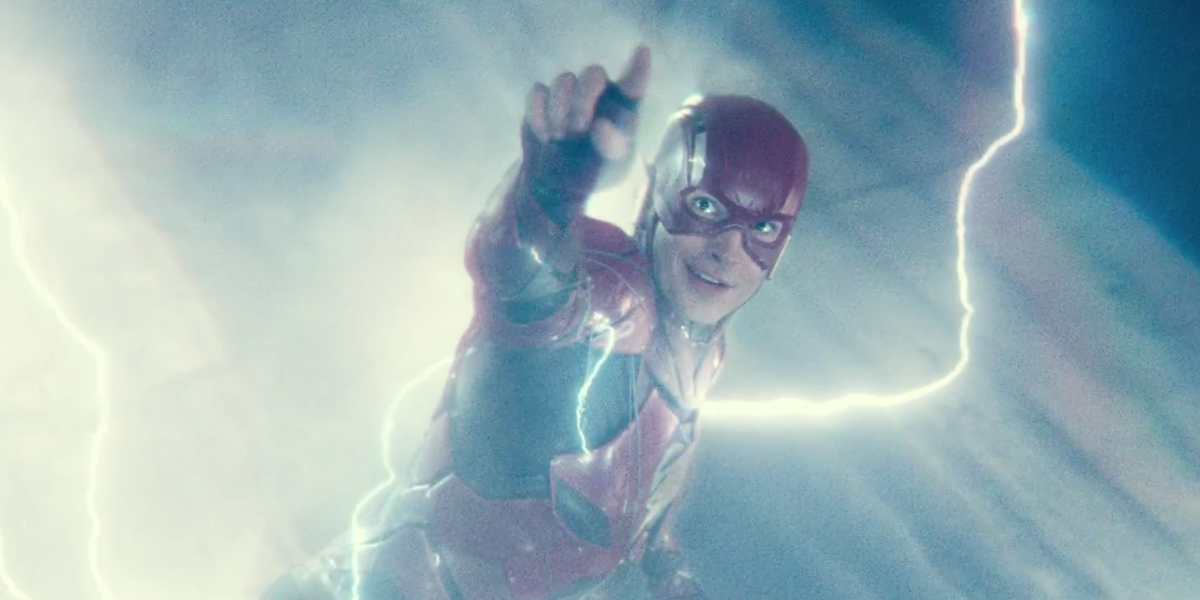
Snyder certainly has a knack for staging action set pieces and where his trademark slow motion/speed up technique is used most effectively is the introduction of Barry Allen a.k.a. the Flash when he applies for a job only to save a woman from a deadly car accident that he locked eyes with moments before all to the strains “Songs of the Siren” (hauntingly covered by Rose Betts) that is hypnotically and as visually arresting a sequence as anything in the filmmaker’s canon.

Of course, having this kind of creative freedom allows Snyder to indulge in his some of his more indulgent tendencies that feel a tad out of place in a movie like this, such as moments of ultraviolence when Wonder Woman takes out a group of terrorists in a museum in London, England. She doesn’t just dispatch the baddies, Snyder makes sure we hear them slam hard against walls with a sickening thud and accompanying blood splatters. Wonder Woman straight up murders these guys, literally exploding the ringleader at the end and then, without missing a beat, turning around to a little girl and giving her some aspirational pearl of wisdom. It’s not like she hasn’t killed people before in other movies but it is the way they are depicted in Justice League, which is so disturbing.

Like a lot of contemporary CGI villains, both Steppenwolf and Darkseid lack personality and whose motives are the same old tired clichés we’ve seen a million times before. Marvel broke the mold with Thanos in the Avengers movies, coming the closest to almost making us forget he was a completely digital creation. The baddies in Justice League look exactly like they are and, as a result, we don’t really feel that tangible threat or sense of danger as we know these are purely digital beings. That being said, they aren’t really that important to the story beyond being a catalyst to get the heroes together.


The most significant change from the theatrical version is how Snyder’s version acts as a backdoor origin story for Cyborg, placing him and his relationship with his father (Joe Morton) at the movie’s emotional core. In Whedon’s version, his character was relegated to almost an afterthought. In fact, he plays a pivotal role in the movie’s climactic moment.

Snyder is an impressive visual stylist and before Justice League his movies often felt hampered by miscasting in pivotal roles and uneven screenplays with clunky dialogue that sometimes failed to understand their source material. This obscured his distinctive directorial vision. The script for Justice League, written by Chris Terrio, is the first one since James Gunn’s work on the 2004 Dawn of the Dead remake, that matches Snyder’s visual prowess. With Justice League, he wanted to make something grandiose and mythic – after all he’s dealing with both ancient gods and contemporary beings with god-like powers – and with the help of Terrio’s script he successfully achieved that goal.

DC didn’t want to copy the look of Marvel Cinematic Universe movies and hiring Snyder made sense as he brought an epic, operatic feel to his entries in the DCEU. His movies are decidedly darker in tone and look, which divided comic book fans, especially those of Superman who felt that Snyder went too far in reinventing the character. Where the superheroes of the MCU are relatable to one degree or another, Snyder’s superheroes are god-like Übermensches wrestling with living among mortals and having to assume alter egos so that they aren’t persecuted by a public at large that either doesn’t understand or fears them.


The central thesis of Snyder’s DC movies has focused on the power that superheroes like Superman wield: how they choose to use it as opposed to how they use it to help the greatest number of people. In Justice League, Batman makes the decision to activate the remaining Mother Box, attempting to resurrect Superman thereby putting the entire planet at risk as it will bring Steppenwolf and his army to them. Fortunately, the gamble pays off but this strategy contains more than a whiff of Objectivism, Ayn Rand’s philosophical system where the most significant moral purpose of human life is to pursue happiness over everything else, even if it means disregarding the needs of others. Batman takes it upon himself to assume that he knows what is best for everyone and executes that plan consequences be damned.

If Batman v Superman posed the question, should these super-powered being be held accountable for their actions then Justice League was a resounding no. They are going to do whatever they think is right whether that aligns with the greater good or not. It certainly provides a fascinating spin on the superhero mythos and is one of the many things that makes Snyder’s DC movies stand out from others in the genre. If Justice League is to be his swan song for the studio and for the genre he certainly has done so in spectacular fashion.

Saturday, September 12, 2020

Tenet

Christopher Nolan is an ambitious filmmaker that with every movie he makes sets out to challenge himself, whether its an unconventional narrative with Memento (2000) or making a non-franchise movie like Inception (2010) at a time when studios rarely greenlight projects not already based on an established property. He is a rare Hollywood studio filmmaker capable of making original big-budgeted movies that make hundreds of millions of dollars. This has given him the clout to make his boldest movie yet – Tenet (2020), a sprawling spy thriller that explores the manipulation of time.

This movie is a testament to the kind of juice Nolan has within the industry. He is able to command a budget over $200 million starring John David Washington, whose casting as the movie’s lead must have raised eyebrows with studio executives as he has no experience with a project of this magnitude or the kind of drawing power of someone like Leonardo DiCaprio or Matthew McConnaughy – actors who helped sell Nolan’s previous ambitious fare. Even the casting of Robert Pattinson as Washington’s co-star was something of a risk as he is no longer the bankable Twilight heartthrob he once was having rejected Hollywood for the most part to appear in foreign and independent films.

Nolan is also employing a deliberately demanding narrative at a time when Hollywood wants to spoon-feed audiences that have been conditioned over decades to expect formulaic product. This may explain why his name factors so prominently in the movie’s marketing as with the absence of a big name movie star he has become the star. Is this something the ambitious filmmaker wanted all along – to be a distinctive brand name like George Lucas or Steven Spielberg? Or, has he bitten off more than he can chew and will Tenet finally end his streak of profitable popcorn movies with more on their minds than car chases and explosions?

The movie begins with an impressively orchestrated sting operation at the National Opera House in Kiev with an unnamed CIA operative known only as the Protagonist (Washington) liberating an exposed spy and obtaining a mysterious device. He’s caught and tortured by Russian agents but manages to take a cyanide pill before divulging any information and dies. Or does he? He wakes up in a hospital bed from a medically-induce coma. Officially declared dead, thus taking him off everyone’s radar, he’s given an assignment by his boss (Martin Donovan): prevent World War III from happening. This is tagged with a bit of advice: “All I have for you is a gesture with a combination with a word: tenet. Use it carefully. It’ll open the right doors but some of the wrong ones, too.” This last line is particularly relevant to understanding what happens later on in the movie.

With the help of a fellow operative named Neil (Pattinson), the Protagonist discovers that the man responsible for triggering World War III is a powerful Russian oligarch by the name of Andrei Sator (Kenneth Branagh). To get close to him, he befriends his unhappy wife (Elizabeth Debicki) by appealing to her interest in fine art. The rest of the movie plays out the Protagonist’s mission to get to Sator and discover how he’s going to bring about the end of the world and stop it from happening.

Some have complained that Tenet is too complicated and the plot too hard to follow. Is it maybe that we’ve had our senses dulled by an endless stream of mostly mindless big budget blockbusters that do little to challenge us? Nolan provides plenty of exposition rest stops along the way to explain what’s going on, such as the scientist (Clemence Poesy) the protagonist meets early on that gives us a taste of movie’s central conceit: a technology known as “inversion” that sees objects and people traveling backwards in time by reversing their entropy. Or, as she puts it at a gun range where the bullet travels back into the gun instead of hitting its target, “You’re not shooting the bullet, you’re catching it.” He gradually fleshes this concept out over the course of the movie until the last third where, admittedly, things do get a little tough to follow but not enough to ruin the enjoyment of the exciting climax.

Tenet features some of Nolan’s best choreographed action set pieces, from the opening sting in Kiev to the stealing and crashing of a jumbo jet liner into a building that is as impressive as anything in Inception. The opera house sting, in particular, is right out of the Michael Mann playbook in the way it is staged and the use of dense tech lingo as Nolan drops us right into the middle of the action with little to no explanation, reminiscent of the opening sequence in Miami Vice (2006).

John David Washington is excellent as the no-nonsense protagonist who tells someone early on, “I’m not the man they send into negotiate. Or the man they send in to make deals, but I am the man people talk to.” The actor deftly juggles action sequences with dialogue-heavy ones effortlessly. He plays a rather enigmatic fellow with little to no backstory thus forcing us to get know him through his actions in the movie.

He plays well off of Robert Pattinson’s quirky operative. It’s the juicier role and the actor has fun providing much-needed levity at just the right moments in this otherwise po-faced movie, much as Tom Hardy did in Inception. For example, when he and the Protagonist are talking about stealing and crashing a jumbo jet liner, the latter asks, “How big of a plane?” to which the former says sheepishly, “That part is a little dramatic.” The way Pattinson delivers this line is a wonderful bit of subtle comic timing.

Kenneth Branagh plays a vicious Russian billionaire with malevolent intensity. Nolan wisely prolongs his introduction for as long as he can so that the character’s reputation precedes him and our anticipation of his first appearance increases. Sator is a power hungry bully with a crucial edge – he communes with the future for a very specific reason that isn’t the usual mad man villain stuff we’ve come to expect from these kinds of movies.

Ludwig Göransson replaces Nolan’s long-time go-to composer Hans Zimmer and the movie is better for it. With a few exceptions, he eschews Zimmer’s sledgehammer orchestrations for pulsating electronics that provide the movie’s moody backbone and enhance Hoyte van Hoytema’s cinematography, which adopts a grounded, realistic look reminiscent of Inception.

It’s no secret that one of Nolan’s burning ambitions is to make a Bond movie. He doesn’t need to anymore. With Inception and now Tenet he’s made two spy movies jacked-up on science fiction steroids and done it his way with the kind of creative freedom the Bond producers would never allow. With this movie it feels like he has pushed the techno spy thriller as far as it can go by introducing grand science fiction concepts that turn the genre on its head.

What is Nolan’s ultimate end game? He has reached the point in his career where he has the creative freedom to control every aspect of his movies and so everything in it – the muffled dialogue, the overpowering music and sound effects – is intentional. Nolan wants to be regarded as a serious filmmaker such as Stanley Kubrick or Terrence Malick – two of his cinematic idols – are considered serious auteurs. He lacks that special something that those filmmakers have, transcending genre trappings to create films that are groundbreaking and unique in ways other than on a technical level.

Nolan is at his best when making cerebral spy thrillers like Inception or gritty comic book movies like The Dark Knight trilogy. He doesn’t do touchy-feely sentiment very well, which is why the emotions expressed in Interstellar (2014) felt forced. He’s not a warm filmmaker like Spielberg but more of a puppet-master like Kubrick. Nolan’s movies work best when he uses emotion like a garnish, sprinkling it sparsely over his story. Tenet is a strong, bold effort that invites repeated viewings, not to get past its aggressive sound mix, but to unravel the timelines of the three main characters who are complicated through the plot machinations of the movie.