"...the main purpose of criticism...is not to make its readers agree, nice as that is, but to make them, by whatever orthodox or unorthodox method, think." - John Simon

"The great enemy of clear language is insincerity." - George Orwell
Showing posts with label gambling. Show all posts

Friday, May 1, 2015

The Big Town

Most actors have what I refer to as “paycheck movies” somewhere in their filmography. They are movies that are done for the money or the desire to work that month. They are movies that are usually not all that memorable and done purely for mercenary reasons but they are still part of an actor’s body of work. One such movie is The Big Town (1987), made after Diane Lane took three years off from the business and saw her reunited with Matt Dillon, her on-screen love interest in The Outsiders (1983) and Rumble Fish (1983). Like Lane, he had hit a speed bump in his career after the box office hit The Flamingo Kid (1984). I’m sure appearing together was a large part of the appeal of doing The Big Town for both actors. While their on-screen chemistry continued, the final product was something of a mixed bag.

J.C. Cullen (Matt Dillon) is a small-time crapshooter who aspires to make it in the big city. He is a very skilled/lucky dice thrower with the gambling instincts of his deceased father, much to the chagrin of his mother. He’s young and too restless for life in small-town America circa 1957. He soon arrives in Chicago and the movie does a nice job of immediately immersing us in the sights and sounds of the period era thanks to a soundtrack of classic songs from the likes of Johnny Cash, Bo Diddley, and Big Joe Turner among others.

He soon goes to work for Mr. and Mrs. Edwards (Bruce Dern and Lee Grant) who set him up with a place, a bankroll and establish the ground rules. They’re all business and don’t have much expectations as young men like him come off the bus every week. They team him up with Sonny Binkley (David Marshall Grant), a veteran gambler who shows him the ropes. Cullen takes to big city life like a fish to water, making consistent money for the Edwards.


One day, Cullen meets a sweet single mom named Aggie Donaldson (Suzy Amis) at a local record store. She loves all kinds of music and dreams of being a disc jockey one day. Always looking for action, Cullen is told about the Gem Club, a strip joint with high stakes and a very exclusive crap game. It is also the only place in town where gamblers can play with their own money and not give any of it to their handlers. Naturally, the odds are stacked heavily in favor of the house, which is run by the no-nonsense owner George Cole (Tommy Lee Jones).

The first night playing Cullen wins big ($14,000!) and in the process pisses off Cole by not only beating the house badly, but doing it in front of his regulars. After subsequently being set-up by Cole, in retribution, Cullen starts a torrid affair with his gorgeous wife Lorry Dane (Diane Lane), the Gem Club’s star stripper. However, he also finds himself increasingly attracted to the more wholesome Aggie and starts a romance with her. Eventually, Cullen has to make a choice while steering clear of the dangerous Cole – if he can.

Matt Dillon’s cocky gambler evokes Paul Newman’s iconic turn in The Hustler (1961) as both of their characters push their respective luck to the limit. For Cullen, he is very smart when it comes to shooting craps (he expertly figures out when Cole swaps dice for a loaded pair) but exhibits poor judgment when it comes to women, seeing two at the same time. Aggie represents his small-town, Midwestern roots while Lorry represents his flashy big city life. Dillon has the retro looks from a bygone era and has no problem portraying a gambler from the 1950s.


Much like Dillon, Diane Lane looks like she came from another time. Her retro stripper look resembles her mother Colleen Leigh Farrington, herself a nightclub singer and Playboy Centerfold (Miss October 1957) and one wonders if her performance in The Big Town was a tribute to her mother. Lane even pulls off a very sexy fan dance at one point, showing off the research and hard work she put into the role. Lorry is more than a stereotypical bad girl. She is a woman trapped in a situation with a dangerous man that is also her husband. And yet, we are never quite sure if she can be trusted even while Cullen falls head over heels for her. Lane does what she can with an underwritten role that often relegates her to very attractive eye candy.

Dillon and Lane had undeniable chemistry in The Outsiders and Rumble Fish and continue it with The Big Town. As sweet as Suzy Amis’ Aggie is, one can’t see Dillon’s slick gambler settling down with the single mother and her daughter. Cullen and Lorry are much more suited for each other with their similar outlooks on life. It doesn’t hurt that the two actors radiate genuine on-screen heat. And while Dillon does have some nice chemistry with Amis, it pales in comparison to Lane.

Tommy Lee Jones turns in a typically effortless performance as the movie’s heavy, opting for a less is more approach as he conveys danger with an ominous look or a slight edge in his voice. The always-watchable Bruce Dern plays a blind fixer by the name of Mr. Edwards who bankrolls up and coming gamblers like Cullen. He has a nice scene with Dillon where his character tells Cullen how he lost his sight in a well-delivered monologue. He used to be a hotshot dice roller like Cullen but losing his sight ended his career and he’s been searching for the man who robbed him of his vision ever since.
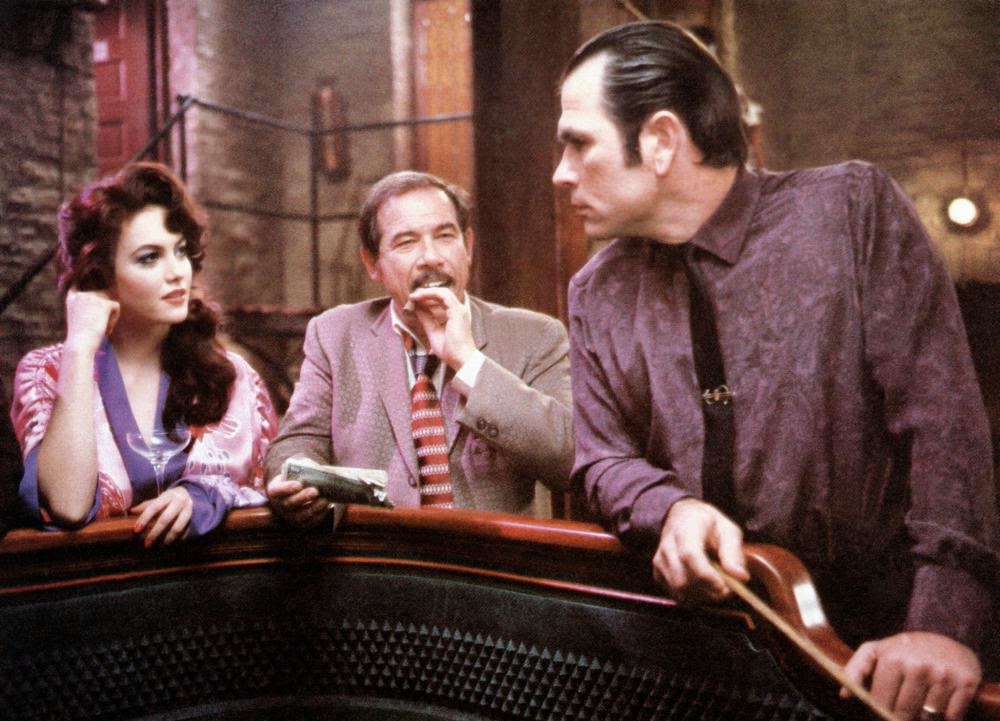

The Big Town sprinkles snazzy period dialogue and colorful gambler slang throughout, courtesy of Robert Roy Pool’s screenplay – itself an adaptation of Clark Howard’s novel The Arm. There is a nice shot partway through the movie of Cullen and Lorry walking down a deserted Chicago street late at night, which is soon followed by them kissing passionately under elevated train tracks much like a similar scene also with Lane in Streets of Fire (1984) albeit without the rain. Ralf D. Bode’s cinematography, coupled with Ben Bolt’s direction results in a movie that looks like it could easily exist in a corner of the world of period television series Crime Story, but as a prequel of sorts (since that show took place in the 1960s).

In late summer of 1986, director Harold Becker was set to adapt Clark Howard’s novel The Arm, about a crapshooter, and approached noted gambling expert Edwin Silberstang to be a technical advisor on the movie. He read the screenplay and agreed to do it. Silberstang taught Matt Dillon the rules of the game, the difference between a basic street game and playing at a casino, and some of the street slang. They spent time betting at casinos in Las Vegas. After ten days, they flew to Toronto where the interior gambling scenes were to be filmed and ‘50s era Chicago was recreated for financial reasons.

Silberstang helped design a special craps table that allowed the audience to follow the action easier and could be broken in half for special shots. However, two weeks into principal photography, Becker was replaced when he clashed with producer Martin Ransohoff over creative differences. Columbia Pictures chairman and CEO David Puttnam brought in one of his friends, Ben Bolt, son of Lawrence of Arabia (1962) screenwriter Robert Bolt, to direct. Puttnam was not fond of Ransohoff’s three-picture deal at the studio and wanted to help out a friend, but it rankled some within the industry who wondered why an unproven Brit was hired to direct a period piece set in Chicago.


The Big Town received mixed reviews from critics. Roger Ebert gave the film three-and-a-half out of four stars and praised Dillon’s performance: “Dillon has some kind of spontaneous rapport with the camera. He never seems aware of it, never seems aware that he’s playing a character. His acting is graceful and fluid, and his scenes always seem to start before their first shot so that we seem him in the middle of a motion.” The Los Angeles Times’ Kevin Thomas felt that it was “so entertaining, so true to its period that it’s easy to peg it as another ‘50s nostalgia piece when it actually possesses the kind of complexity usually associated with less commercial, less starry productions.”

In her review for The New York Times, Caryn James wrote, “More to the point, this huge cliché of a movie isn’t even a distant relation of films like The Color of Money, which can actually make you root for hustlers. The Big Town only proves we’ve gone back to the 1950’s one time too many.” The Chicago Tribune’s Joanna Steinmetz wrote, “But director Ben Bolt, whose previous experience is in British and American television, is not about to let style carry this show. Unfortunately, he’s not about to let substance carry it, either.” Finally, the Philadelphia Inquirer’s Ben Yagoda wrote, “Then, somewhere around reel three, the chips, so to speak, are cashed in … So the stageyness becomes stagier, the improbabilities more improbable and the lunacy loonier.”

In retrospect, The Big Town can be seen as a stepping-stone towards bigger and better things for Dillon and Lane (and Jones as well). Shortly after this movie he would attract much critical acclaim for his role as a junkie in Drugstore Cowboy (1989) and she would be nominated for an Emmy for her excellent work on the T.V. miniseries Lonesome Dove (which would also feature Jones). The Big Town didn’t exactly set the box office on fire – barely registering, in fact, but it wasn’t meant to with its small budget and limited distribution. The movie tells a story we’ve seen a million times before: a young man from a small-town that tries to make it in the big city only to learn a painful lesson. While it is hardly an original idea, the movie does have its entertaining moments with engaging performances from Dillon and Lane, which should appeal to fans of both actors.


SOURCES

Comer, Brooke. “Big Trouble in The Big Town.” American Cinematographer. September 1987.

Silberstang, Edwin. Winning Casino Craps. Random House. 2007.


Stadiem, William. Moneywood: Hollywood in Its Last Age of Excess. St. Martin’s Press. 2013.

Friday, January 27, 2012

The Color of Money

The 1970’s saw the rise of the Movie Brats, a collection of filmmakers that had grown up watching and studying films. They made challenging films that reflected the times in which they were made and were revered by cineastes as much as some of the actors appearing in them. Directors like William Friedkin, Francis Ford Coppola, Hal Ashby and Martin Scorsese made intensely personal films that blended a European sensibility with American genre films. However, the one-two punch of Jaws (1975) and Star Wars (1977) and the failure of expensive passion projects like New York, New York (1977) and Heaven’s Gate (1980) ended these directors’ influence and saw the rise of producers like Joel Silver, Don Simpson and Jerry Bruckheimer, and movie star-driven blockbusters in the 1980’s and beyond. It got harder and harder for the Movie Brats to get their personal projects made. Most of them went the independent route, making films for smaller companies like Orion and doing the occasional paycheck gig with a Hollywood studio.


For years, Scorsese had been trying to fund a personal project of his own – an adaptation of The Last Temptation of Christ. It was a tough sell and he ended up making After Hours (1985) and The Color of Money (1986) as a way of keeping busy while he tried to get Last Temptation made. At the time of The Color of Money much was made of it being Scorsese’s first movie star-driven film and some critics and fans of the director felt that he was selling out. It would not only be promoted as a film starring Paul Newman and Tom Cruise (and not as a Martin Scorsese film), but was a sequel (something that the director was never fond of doing) of sorts. Newman had been interested in reprising his famous role of "Fast" Eddie Felson from The Hustler (1961) for some time but he had never met the right person for the job – that is, until he met Scorsese.

The Color of Money begins twenty-five years after the events depicted in The Hustler and we find that Eddie (Paul Newman) is enjoying a comfortable existence as a savvy liquor salesman with his bar owner girlfriend Janelle (Helen Shaver) and occasionally fronting a pool hustler. His current investment, a cocaine addict named Julian (played with just the right amount of sleazy arrogance by John Turturro), is getting roundly beaten by a young turk named Vincent (Tom Cruise) who catches Eddie’s attention with his “sledgehammer break.” He becomes fascinated watching Vincent play and his cocky behavior between shots, like how he works the table. Eddie also watches the dynamic between Vincent and his girlfriend Carmen (Mary Elizabeth Mastrantonio). What really catches his attention is not just Vincent’s raw talent but also his passion for the game. He’s even willing to play Julian after he’s won all of the guy’s money because he just wants his “best game.”

There’s a nice bit where Eddie tests Carmen’s skill as Vincent’s manager, exposing her lack of experience and schooling her on the basics of pool hustling in a beautifully written monologue by Richard Price that Newman nails with the ease of a seasoned pro. We get another healthy dose of Price’s authentic streetwise dialogue in the next scene where Eddie takes Vincent and Carmen out for dinner and continues to school his potential protégés: “If you got an area of excellence, you’re good at something, you’re the best at something, anything, then rich can be arranged. I mean rich can come fairly easy.” The scene is also nicely acted as Tom Cruise plays the cocky upstart with just the right amount of arrogant naiveté without being a typical goofball. As Eddie puts it, “You are a natural character. You’re an incredible flake,” but tells him that he can use that to hustle other players. The ex-pool player lays it all out for the young man: “Pool excellence is not about excellent pool. It’s about becoming something … You gotta be a student of human moves.” And in a nice bit he proves it by making a bet with them that he’ll leave with a woman at the bar. Of course, he knows her but it certainly proves his point. This is a wonderful scene that begins to flesh out Vincent and establish how much he and Carmen have to learn and how much Eddie has since The Hustler.

The young man is a real piece of work – brash, directionless but with raw talent. It is clear that Eddie sees much of his younger self in Vincent and decides to take the young man under his wing and teach him "pool excellence" by taking him and Carmen on the road. It’s an opportunity to make some money while also getting back Eddie’s passion for playing pool. The Color of Money proceeds to show the three of them on the road for six weeks, getting ready for an upcoming nine-ball tournament in Atlantic City. Of course, there are the predictable bumps in the road as Vincent’s impulsive knack for showing off costs them money and Eddie feels like the young man’s not listening to him. It’s a formula we’ve seen used in countless films but Scorsese does everything he can visually to keep things interesting, especially in the dynamic way he depicts the numerous games of pool, the use of music (for example, one game is scored to “Werewolves of London” by Warren Zevon) and the actors that play some of the opponents along the way, like a young Forest Whitaker as a skilled player that manages to hustle and beat Eddie at pool.

However, it is the camerawork by veteran cinematographer Michael Ballhaus that impresses the most. He and Scorsese depict each game differently, employing a variety of techniques, like quick snap zooms in and out, and floating the camera gracefully over the pool table or gliding around it. He even has the camera right on the pool table following the balls around. The camera movement and editing rhythm of each game is dictated by the mood and intensity of each match, like the grandiose techniques employed when Vincent shows off during a game of pool. As he revels in his own showboating moves, the camera spins around him as if intoxicated by his bravado. However, much like the chaotic pool hall brawl in Mean Streets (1973), the camera movement goes nowhere symbolizing the futility of Vincent’s actions. Sure, he beat the top guy at that pool hall but in doing so scared off an older player that had much more money.

While The Color of Money was made fairly early on in Tom Cruise’s career, his relative inexperience actually suits his character. His youthful energy mirrors Vincent’s. It is his job to come across as an arrogant flake of a human being, which he does quite well (too well for some who were unimpressed with his performance). Cruise has always been an actor that performs better surrounded by more talented and experienced people and with the likes of Paul Newman acting opposite him and Scorsese directing, it forces the young actor to raise his game. One imagines he learned a lot on the job much like Vincent does in the film. Scorsese knew exactly what he was doing when he cast Cruise and got a solid performance out of him. In the late ‘80s, Mary Elizabeth Mastrantonio acted in a series of high profile roles like The Abyss (1989), The January Man (1989) and this film. She’s given the thankless job of the girlfriend role but manages to make the most of it. One gets the feeling that Carmen is a fast learner and smarter than Vincent. She is much like Eddie in understanding the business side of pool hustling.

Naturally, Newman owns the film, slipping effortlessly back into Eddie’s skin after more than 20 years and it’s like he never left. The scenes between him and Cruise are excellent as the headstrong Vincent bounces off of the world-weary Eddie. Over the course of the film something happens to the elder pool player. As he tells Vincent at one point, “I’m hungry again and you bled that back into me.” We see that youthful spark fire up in Eddie again after so many years dormant and Newman does a fantastic job conveying that. While many felt that his Academy Award for the performance he gives in The Color of Money was really a consolation prize for a career of brilliant performances, this does a disservice to just how good he is in this film and how enjoyable it is to watch him get to work with someone like Cruise and Scorsese, watching how their contrasting philosophies towards acting and filmmaking co-exist in this film. There is an energy and vitality that Cruise brings and Newman feeds off of it and Scorsese captures it like lightning in a bottle.

When Paul Newman read Walter Tevis’ sequel to The Hustler it made him wonder what “Fast” Eddie Felson would be doing now and wanted to revisit the character. He had seen Raging Bull (1980) and was so impressed by it that he wrote a letter to Scorsese complimenting him on such a fine piece of work. The director was just coming off of After Hours and was attached to several projects, including Dick Tracy, with Warren Beatty, a fantasy film entitled Winter’s Tale, Gershwin, with a screenplay written by Paul Schrader, and Wise Guy, a book about the New York mafia written by Nicholas Pileggi. However, they all took a backseat when Newman invited him to direct a sequel to The Hustler. The actor had been working on it for a year with a writer. Scorsese was interested but didn’t like the script Newman showed him because it was “a literal sequel. It was based on at least some familiarity with the original.” Scorsese felt like he couldn’t be involved with the project if he didn’t have some input on the original idea of the script.

Scorsese wanted to go in a different direction and brought in a new screenwriter, novelist Richard Price who had written The Wanderers and also a script for the director based on the film Night and the City (1950). Scorsese liked the script because it had “very good street sense and wonderful dialogue.” For The Color of Money, Price and Scorsese’s concept was basically what became the film, exploring the director's preoccupation with redemption but with what Newman saw as "recapturing excellence, having been absent from it, and then witnessing it in somebody else." Newman liked it and Price and Scorsese came up with an outline and began rewriting the script. Price studied pool players and wrote 80 pages of a script. They took it to Newman and got his input. By the end of nine months, Price and Scorsese decided to make the film with Newman.

For Scorsese this was the first time he had ever worked with a star of Newman's magnitude. "I would go in and I'd see a thousand different movies in his face, images I had seen on that big screen when I was twelve years old. It makes an impression.” As a result, Scorsese and Price made the mistake of writing for themselves when they should have tailored the script to suit Newman and his image, or as Scorsese later said, "we were making a star vehicle movie." The actor wanted to explore aging and the fear of losing his “pool excellence.” He also wanted the character of Minnesota Fats, played so memorably by Jackie Gleason in The Hustler, to return but Price couldn’t get the character to fit into the script. He and Scorsese even presented a version of the script with Fats in it to Gleason but he “felt it was an afterthought,” said Scorsese.

It was Newman that suggested Cruise for the role of Vincent to Scorsese. The young actor had met Newman before when auditioning to play his son in Harry & Son (1984). Scorsese cast Cruise before Top Gun (1986) had come out but he was a rising movie star thanks to Risky Business (1983). He had seen the young actor in All the Right Moves (1983) and liked him. The project was initially at 20th Century Fox but they didn’t like Price’s script and didn’t want to make it even with Cruise and Newman attached. Eventually, it went to Touchstone Pictures.

Newman was not fond of improvising on the set and suggested two weeks of rehearsals before filming. Scorsese wasn’t crazy about this and found them “aggravating. You are afraid that you are going to say ridiculous things, and the actors feel that way too.” However, he agreed to it and brought in Price so that he could make changes to the script. Fortunately, everyone felt secure in character and with each other. Price and Scorsese didn’t have the film’s ending resolved and felt that they had written themselves into a corner. The studio wanted them to shoot the film in Toronto but Scorsese felt that it was too clean and chose Chicago instead. Both Cruise and Newman did all their own pool playing with the former being taught how to do specific shots that he played in the film with the exception of one, which would have taken two additional days to learn and Scorsese didn’t want to spend the time. Cruise had dedicated himself to learning how to play pool: “All I had in my apartment was a bed and a pool table.” He worked with his trainer and the film’s pool consultant Mike Sigel for months before shooting started.

In his review for The New York Times, Vincent Canby wrote, “The Color of Money isn't Mean Streets or Raging Bull. It is, however, a stunning vehicle – a white Cadillac among the other mainstream American movies of the season.” Time magazine’s Richard Schickel wrote, “There is a ferocity in Cruise's flakiness that he has not previously had a chance to tap. That, in turn, gives Newman something to grapple with. There is a sort of contained rage in his work that he has never found before, and it carries him beyond the bounds of image, the movie beyond the bounds of genre.” The Globe and Mail’s Jay Scott wrote, “It may be true that in gambling money won is twice as sweet as money earned, but in art, only the earned has savor; The Color of Money earns enough of it to turn most other movies persimmon with esthetic envy.” In his review for the Washington Post, Paul Attanasio wrote, “But in the final third of the movie, the real drama takes place within Fast Eddie himself, as his dissatisfaction with what he's become almost imperceptibly grows, and he tries to decide, in middle age, who he wants to be. That involves a shift in the movie's focus to Newman alone; and if what's lost is the excitement that Newman and Cruise had generated together, what's gained is a kind of depth another, simpler story wouldn't have had.” However, Roger Ebert gave the film two-and-a-half stars out of four and wrote, “Maybe the problems started with the story, when Newman or somebody decided that there had to be a young man in the picture; the introduction of the Cruise character opens the door for all of the preordained teacher-pupil clichés, when perhaps they should have just stayed with Newman and let him be at the center of the story.”

Some Scorsese fans marginalize The Color of Money as one of his paycheck films – the first he did for the money – and while it may not have the personal feel of a film like Taxi Driver (1976), it still has its merits, a strong picture that fits well into the man's body of work. I would argue that it is one of his strongest films stylistically with some truly beautiful, often breathtaking camerawork capturing all the nuances of playing pool: the energy and vitality of the game is there without sacrificing any of the story or the characters. This film also shows how a director like Scorsese can take a hired gun project and make it his own. It looks, sounds and, most importantly, feels like one of his films and not a commercial studio picture. Others must have agreed as the film not only became Scorsese's most financially successful film at the time but a critical hit as well. The director proved to the studios that he could deliver the goods at the box office while to himself he was still able to invest the film with some of his own personal touches. Ultimately, The Color of Money is about Eddie’s redemption and rekindling the spark he had in The Hustler before the screws were put to him. As with many sports movies, the story builds towards the climactic big game or, in the case of this film, the big tournament but Price’s script offers a slight twist in that Eddie’s victory is a hollow one and the real one is at the very end when his love for playing pool has finally come back completely. He is reinvigorated and excited about where his life and game will go from here and this is summed up beautiful in the film’s last line – “I’m back.”


SOURCES

Ansen, David. “The Big Hustle.” Newsweek. October 13, 1986.

Forsberg, Myra. “Three Men and a Sequel.” The New York Times. October 19, 1986.


Thompson, David & Ian Christie. Scorsese on Scorsese. Faber & Faber. 1996.

Monday, January 4, 2010

The Hustler

The Hustler (1961) is a crucial film in Paul Newman’s career. It launched him into the Hollywood stratosphere and marked the beginning of an incredible run in the 1960s, with movies like Hud (1963), Cool Hand Luke (1967) and Butch Cassidy and the Sundance Kid (1969). Newman became a movie star but acted like a character actor, creating one memorable character after another. Arguably, The Hustler is where he really came into his own, delivering a powerful performance as small-time pool hustler Fast Eddie Felson. The film takes place in dingy pool halls, lonely bus terminals and low-rent apartments. It’s a world populated by confident grifters, streetwise bartenders and small-time gamblers. In other words, The Hustler is about people living on the margins, refusing to live the humdrum, 9-to-5 lives that most of us lead.

The Hustler is not so much about the game of straight pool as it is about the meteoric rise and fall of Fast Eddie. The prologue introduces him and his partner Charlie (Myron McCormick) as they hustle a bar populated by a handful of customers (including a young Vincent Gardenia as the bartender). Eddie knows how to act like he’s an erratic pool player even feigning being drunk. But when it counts and when other people’s money is on the line, he makes the crucial shot to win it all. What strikes you right away is that none of the supporting actors or extras look like movie stars. They look and act like the kind of people you’d actually find in a pool hall. Each of their faces tells a story. Director Robert Rossen cast actors from New York-based theater and television and this add to the film’s authenticity.

Fast Eddie’s goal is to play and beat the best pool player there is: Minnesota Fats (Jackie Gleason). Eddie enters Ames Billiards, the pool hall that Fats frequents. He is young, cocky and eager to beat the champ. Eddie is confident and arrogant enough to think that he can beat Fats, a man no one has bested in 15 years. Eddie jokingly calls Ames, “The Church of the Good Hustler,” but Charlie has a much more apt analogy when he says, “looks more like a morgue to me. Those tables are the slabs they lay the stiffs on.” Eddie confidently replies, “I’ll be alive when I get out.” While that may be true, literally, spiritually and emotionally he’ll be dead by the time he leaves Ames.
Fast Eddie is fascinated watching Fats play and we are too. “Look at the way he moves,” Eddie says at one point. “Like a dancer ... And that stroke. It’s like he’s, um – like he’s playin’ a violin or something.” Fats moves around the pool table, sinking balls with deadly precision. At a crucial point in the marathon match, and after observing Eddie play, Bert Gordon (George C. Scott), Fats’ manager, tells him, “Stay with this kid. He’s a loser.” Bert does this right in front of Eddie and this breaks the young man’s spirit. Despite being up $18,000, he is systematically dismantled by Fats in every way. It’s a fascinating example of how losing the psychological edge can affect your physical game. You can’t have one without the other.

For all of his bluster and skill, Fast Eddie lets Fats beat him over 36 grueling hours straight of pool, defeating him financially. Eddie is left with $200 which he pathetically tries to use to play one more game against Fats but the big man refuses. Thoroughly defeated, Eddie pleads and then passes out. For a movie star of Newman’s stature, it was pretty ballsy for him to be willing to show his character so low and acting so desperate. The scene is almost too painful to watch.

Fast Eddie’s salvation, in a weird sort of way, lies with a woman he meets at a bus terminal. Like Eddie, Sarah Packard (Piper Laurie) has been chewed up and spit out by life. She’s an alcoholic but seems to have more deep-routed problems and Piper Laurie subtly hints at them. She plays Sarah like a classy barfly, although, she says that she’s an ex-actress turned college student. Sarah and Eddie are drawn to each other because they are both lonely souls. They don’t have much in common – she’s intelligent while he’s street-smart but they both like to drink. Initially, there is an off-kilter rhythm to their relationship as they get to know each other. When he kisses her for the first time it is forceful and long. She breaks it off, telling him desperately, “Please! You’re too hungry,” like he’s a vampire or a junky, trying to possess her.

Fast Eddie and Sarah soon get involved and he moves in with her. He takes a break from pool, playing the occasional game for small change and still dreams of playing and beating Fats. During this down-time we get some intriguing insights into Eddie’s character. He can be a real cold son of bitch, like when he finally breaks things off with Charlie, humiliating him in front of Sarah in an another ugly, uncomfortable scene. Piper Laurie’s reaction – upset and teary-eyed – says it all as we see just how cruel Eddie can be. Sarah has no allusions about her relationship with Eddie. At one point, she asks him, “what happens when the liquor and the money run out, Eddie?” She shows just how cold and cruel she can be.

Fast Eddie runs into Bert again and the experienced grifter lays it all out for the young pool shark, telling him exactly why he lost to Fats and what he needs to do in order to beat him. He tells Eddie that he lacks character and is a born loser. He proposes to help Eddie get the money to beat Fats in return for the bulk of his winnings. He imparts important words of wisdom on Eddie: “When you hustle you keep score real simple. End of the game, you count your money. That’s how you find out who’s best.” It seems pretty obvious but in a nutshell describes professional sports rather succinctly. Bert speaks frankly and gets right down to the point with Eddie, telling him how things work.

Jackie Gleason plays Minnesota Fats from the less is more school. He speaks little because he doesn’t have to. His reputation precedes him, both in real life because Gleason was very famous for The Honeymooners sitcom and in the film because Fats is regarded as the best pool player in the country. He moves with the quiet confidence of someone who knows that they are at the top of their game and has the experience to back it up. Gleason comes across as a graceful guy despite his bulk and even though he only appears in the beginning and end of the film, the actor makes his screen-time count.

Paul Newman is an excellent contrast with his youthful exuberance. Fast Eddie is young, good-looking and plays a mean game of pool. There’s a scene where he delivers a monologue to Piper Laurie’s character, conveying his passion for pool and how it makes him feel when he’s on top of his game. “The pool cue’s part of me ... You feel the roll of those balls. You don’t have to look. You just know. You make those shots that nobody’s ever made before. And you play that game the way nobody’s ever played it before.” Newman delivers these words with such passion and conviction that it’s hard not to get caught up in Eddie’s enthusiasm for pool. He’s got the world by the tail, that is, until Fats beats him and he then stupidly (and arrogantly) hustles the wrong guys, getting his thumbs broken in the process. Over a short amount of time Eddie ages emotionally, changing into a bitter, angry man. Newman does a great job of conveying this transformation as Eddie begins to resemble one of the world-weary characters in Jack Kerouac’s Beat novels.
With his slicked-back black hair, sunglasses and finely-cut suit, George C. Scott looks like a shark – the kind that preys on humans, plays with them for awhile before devouring them. He doesn’t tear people down physically – it’s all psychological, like when he first sees Eddie play pool against Fats. Piper Laurie delivers a fierce performance and is not afraid to look unattractive when her character is a drunk. She conveys a sharp intelligence and is more than a match for Newman’s mercurial Eddie. He and Sarah are two damaged people drawn to each other.

In 1959, director Rossen came across Walter Tevis’ novel about a small-time pool hustler, bought the rights and convinced 20th Century Fox to make it. When casting the film, Rossen consulted pool champion Willie Mosconi who recommended Frank Sinatra to play Fast Eddie because they were friends and thought that he would be good for the part. Newman was shooting a film in France and was set to do Two for the Seesaw (1962) but it fell apart. Rossen then sent him the screenplay while the actor was still in Paris. Halfway through reading the script Newman called his agent and told him that he wanted to do The Hustler. Before doing the film, he had never held a pool cue. When he got back to New York City, he began to do research for the role by hanging out at a local pool hall where he was almost hustled by a pool shark. Mosconi trained with Newman for three days a week for two or three weeks. He also taught Newman how to hold a pool cue and look like a pool player.

Piper Laurie was doing a play off-Broadway when Rossen approached her backstage and gave her a copy of the script. She didn’t read it right away because she had been given many weak scripts in the past. Laurie finally read it and ten pages in she knew that this was something she wanted to do. Like Newman, she did a lot of research, including hanging out at the Greyhound bus terminal in New York City at night. She also spent a lot of time talking to Rossen about her character. The cast read through the script together over two days. According to Newman, Rossen let the actors experiment with scenes and “feel our way through them” but knew when to guide the cast if they were going off in the wrong direction.

The film was shot in and around New York City, using many practical locations, like Ames Billiard Academy for the pool matches as per Rossen’s preference. Both Newman and Jackie Gleason did most of their own pool playing for the film and you can see it in the long shots but Mosconi did many of the close-ups. Off-camera, Newman and Gleason actually played four games of straight pool with Newman beating Gleason twice and Gleason winning twice – the last time for $200. Gleason had been hustling Newman.
The Hustler premiered in Washington, D.C. in September 1961 and the studio was worried that the film would not be successful because Rossen’s previous effort was not a hit. Studio executives also did not understand how the game of pool worked. Regardless, the film went on to become a critical and commercial hit. Time magazine felt that the film was too long but felt that the “pool-shooting scenes are magnificently staged” and praised the cast: “Newman is better than usual; Gleason, as the slit-mouthed, beady-eyed Minnesota Fats, darts among the shabby little pool sharks like an improbably agile and natty whale; and Gambler Scott looks as though he could sell hot-air heat to the devil.” In his review for The New York Times, Bosley Crowther wrote, “Under Robert Rossen's strong direction, its ruthless and odorous account of one young hustler's eventual emancipation is positive and alive. It crackles with credible passions. It comes briskly and brusquely to sharp points.” Roger Ebert later ranked the film among his pantheon of Great Movies and felt that it “is one of those films where scenes have such psychic weight that they grow in our memories.” The Hustler was nominated for nine Academy Awards and won for its rich, atmospheric black and white cinematography and art direction. Its success also revitalized interest in pool and sparked a craze that lasted a decade. Many years later, Newman would revisit this character in The Color of Money (1986) co-starring Tom Cruise and directed by Martin Scorsese.

The Hustler flies in the face of traditional 9-to-5 suburban living by presenting characters who live on the fringes and who refuse to conform. They are deeply flawed and this is what makes them so compelling to watch. They are capable of being so cruel to each other and the film explores the origins of this behavior. Rossen wisely refuses to judge the characters, instead leaving that up to the audience. Ultimately, the film is about winning and losing in America and the toll it takes on an individual. Eddie learns that talent is not enough to win at pool. You also have to have the will and determination to beat your opponent. You also need character and this lesson he learns the hard way.

Monday, March 17, 2008

California Split


“I’ve had a couple of good wins, but they don’t compare to the losses. People only remember the wins.” – Robert Altman

In the 1970s, Elliott Gould and Robert Altman were an unbeatable team. They first worked together on M*A*S*H (1970), a savage satire of the military, then again on a radical, contemporary reworking of Raymond Chandler’s novel, The Long Goodbye (1973), and finally completed the hat trick with California Split (1974), an ode to obsessive gamblers. For years, this film has been relegated to obscurity, showing up occasionally on television and tied up in legal issues over the music which delayed its release on DVD.

A nice, self-reflexive moment kicks things off: gambler and card shark, Charlie Waters (Elliott Gould) is killing time before a poker match by watching an instructional video on the game. The voiceover narration intones, “It has been said that everyone in America understands poker or wants to. It is one of America’s most popular games and since you’ve shown an obvious interest in coming here we have prepared a short film to teach you the fundamentals.” This voiceover could easily be talking to the audience watching this film as Altman introduces us to this world and the characters that inhabit it.

While this video is playing, Altman’s camera sweeps across the game room, setting the scene and introducing the film’s other main character, Bill Denny (George Segal). The video is also functional, providing a crash course on a couple of actual poker hands and the house rules. The opening poker game does a good job of showing the dynamics of professional poker playing and is also very funny as Charlie fleeces an irate player who then punches Bill, thinking that they are in league with each other. In a nice bit of business, a dazed Bill has enough sense to pick up his poker chips while all hell is breaking loose. For this scene, the poker club was built in a dance hall. Altman set up a few gambling situations and filmed them happening. None of the actual poker players’ dialogue was scripted.

Fed up with the unrealistic dialogue he and other actors were forced to say on a regular basis, struggling actor Joseph Walsh wrote a screenplay about his own gambling addiction in 1971. Steven Spielberg, fresh from directing the made-for-TV film Duel (1971), was originally supposed to direct. He and Walsh worked on the script every day for nine months. The director was fascinated by the characters and would react to Walsh’s script, offering suggestions. At the time, the screenplay was called Slide and the two men had a deal to make it at MGM with Walsh as producer and Steve McQueen in the starring role. The whole story was going to be set at Circus Circus in Las Vegas because the studio owned the casino.

A month before filming started, the studio experienced a shake-up at the executive level and with it came a new set of changes. MGM wanted the story to be a Mafia-related “sting” concept with Dean Martin as one of the two main characters. Walsh would no longer be the producer. He and Spielberg left MGM because he realized that they did not understand the point of the film: “I wanted the picture to be almost a celebration of the gambling, the joy of it, going along with it, and then, at the end, you could see where the trap comes in.” Spielberg and Walsh took the script to Universal Pictures where they had an agreement with executives Richard Zanuck and David Brown. However, Spielberg decided to work on another project called Lucky Lady (1975) leaving Walsh and his film stranded.

The writer’s agent, Guy McElwaine, contacted Altman’s agent George Lito, and the director was given the script, read it and loved it. For years, he had wanted to do a gambling film with “the ambience of gambling, and then point out it had nothing to do with money.” He was drawn to Walsh’s script because he liked to gamble himself, his father was a gambler, and the director knew a lot of gamblers. David Begelman, the new studio chief of Columbia Pictures, was a former agent who knew Altman’s agent and greenlighted the screenplay to be made into a film. Walsh was a novice and unaware of Altman’s reputation for taking liberties with the scripts of for his films. However, Walsh was very protective of his script and argued with Altman numerous times over certain details. The only serious revisions to the script that the director made before filming were to background scenes. The writer had seen other Altman films and wasn’t always satisfied with how these scenes played out. He told the director that they could be changed but that he would rewrite them. Walsh wrote a full script for the background scenes, three to four page scenes for good actors to play.

George Segal was cast early on and Altman mentioned Gould but Walsh, even though he was childhood friends with the actor, held back. Altman and Walsh saw other actors, like Peter Falk and Robert De Niro, but kept coming back to Gould. Finally, the actor called Walsh and convinced him that he was right for the role. According to Walsh, on the set, Gould was full of confidence while Segal was insecure. The writer remembers that on the first day of shooting Gould “was there as that character . . . After seven days, George Segal came to me and said, ‘This guy’s [Gould] unbelievable. He’s an octopus. He is absolutely strangling me to death. I don’t even know what to do.’” Walsh told Segal Gould had lived the life of his character and said, “don’t try to act with him, don’t try to outdeal him . . . be off-base – just what you’re feeling – and it’s all working.”

Altman employed members of Synanon, the rehab organization of former convicts and addicts, as extras. The organization received a flat sum and delivered as many as needed each day. California Split marked the first time Altman experimented with the use of the eight-track sound system that allowed eight separate audio channels to be recorded and helped develop Altman’s trademark of overlapping dialogue. To this end, he gave the supporting actors and extras significant emphasis on the soundtrack. On the first day of shooting, the effort to keep eight separate channels clean and distinct made everyone very anxious. Haskell Wexler had originally been approached to shoot the film but Altman opted to go with relative newcomer Paul Lohmann who would go on to shoot Nashville (1975) and Buffalo Bill and the Indians (1976).

California Split is one of Altman’s trademark character-driven films. It is less concerned with plot than behavior as we watch the friendship between Bill and Charlie develop over a mutual love of gambling. Charlie is a wisecracking joker and experienced gambler constantly looking for the next score. Initially, Bill isn’t as committed a gambler (he works at a magazine during the day) but he’s well on his way and hanging out with Charlie doesn’t help. As the film progresses and the two men hang out more, Bill starts to become more addicted to the gambling lifestyle. He blows off work early to meet Charlie at the track and sells his possessions for money. Bill and Charlie are gambling addicts who ride the high arcs and the low valleys, never passing up a bet. At a boxing match they put money on the outcome of the fight with a fellow spectator.

Those who know Elliott Gould and George Segal only from their contemporary sitcom appearances (Friends and Just Shoot Me, respectively), should see California Split if only to see these guys in their prime and working with a master filmmaker at the top of his game. Gould and Segal have never been better and play well of each other. There is good chemistry between them as Gould plays the more experienced gambler in contrast to Segal’s more naïve one.

The film reportedly grossed over five million dollars at the box office despite the studio pulling it early from theaters. It was well-received by critics, making it on The New York Times annual Ten Best list of that year. Roger Ebert in his review for the Chicago Sun-Times wrote, "At the end of California Split we realize that Altman has made a lot more than a comedy about gambling; he's taken us into an American nightmare, and all the people we met along the way felt genuine and looked real," and praised it as "a great movie and it's a great experience, too." Vincent Canby, in the New York Times, praised the film for being "dense with fine, idiosyncratic detail, a lot of which is supplied by Mr. Gould and Mr. Segal as well as by members of the excellent supporting cast.” In addition, Walsh received a Writers Guild of America nomination.

California Split is not afraid to show the ugly side of gambling. Bill sells his car and his possessions for a big poker game in Reno. Charlie exacts a rough, bloody revenge on the guy who mugged him at the beginning of the film. These are not always likeable guys and to Altman’s credit he doesn’t try to romanticize or judge them, leaving that up to the audience. Altman wanted to convey the empty feeling that winning from gambling gives these guys as he told Film Heritage magazine, “the mistaken feeling that winning . . . you can’t spend that money; you don’t go out and pay the milk bill with it unless you’re about to go to jail. It just means that you can play that much longer . . . In other words, it’s passes. It’s more tickets to the amusement park – that’s all it is.” California Split is arguably Altman’s loosest film in terms of plot and one of the richest in terms of character and observing their behavior.


SOURCES

Macklin, F.A. “The Artist and the Multitude Are Natural Enemies.” Film Heritage. Winter 1976/77.

McGilligan, Patrick. Robert Altman: Jumping Off the Cliff. St. Martin's Press. 1989.

Reid, Max. "The Making of California Split: An Interview with Robert Altman". Filmmakers Newsletter. October 1974.