"...the main purpose of criticism...is not to make its readers agree, nice as that is, but to make them, by whatever orthodox or unorthodox method, think." - John Simon

"The great enemy of clear language is insincerity." - George Orwell
Showing posts with label neo-noir. Show all posts

Thursday, October 30, 2025

Angel Heart


In 1987, the stars aligned for Alan Parker’s horror noir adaptation of William Hjortsberg’s 1978 novel, Fallen Angel, into the film Angel Heart. It was part of a trend in the mid to late 1980s of movies featuring supernatural elements tied to Caribbean or South American magic with Santería and brujería in The Believers (1987), and Voodoo magic in Child’s Play (1988) and The Serpent and the Rainbow (1988) being notable examples.
 
Several attempts had been made to adapt Hjortsberg’s book since its publication, but it wasn’t until Parker signed on to the project that it got serious traction. It didn’t hurt that he cast Mickey Rourke as his lead actor, red hot from the notoriety of 9 ½ Weeks (1986), and opposite him, Lisa Bonet, one of the breakout stars of the very popular television sitcom, The Cosby Show, which raised eyebrows at the time as she was known for playing a squeaky clean character in a wholesome show to starring as a femme fatale in a sexually explicit film.
 
Despite this, and the controversial, steamy sex scene between Bonet and Rourke’s characters, which forced Parker to cut 10 seconds to avoid an X rating, Angel Heart failed to make back its $18 million budget and received a mixed critical reaction. It has, however, gone on to influence filmmakers like Christopher Nolan and enjoyed a re-evaluation over the years as an atmospheric neo-noir fused with unsettling elements of supernatural horror.

New York City, 1955. Parker immediately immerses us in the snow-bound city with shadowy alleyways and great attention to period details with era-specific cars and clothes that set a noirish tone. Harold Angel (Rourke) is a slightly seedy private investigator approached by a mysterious client named Louis Cyphre (Robert De Niro) for a job. They meet at a church in Harlem and right from the get-go something is off. It could be the woman outside on the verge of passing out, surrounded by family and friends, or it could be the room where a woman is scrubbing gruesome blood-spattered stains off a wall from an apparent suicide by a parishioner who blew his brains out.
 
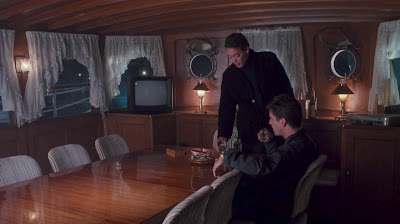
The initial meeting between two of the greatest actors of their respective generations is as wonderful as one would hope as they face off against each other. Robert De Niro plays it low-key yet ominous with the occasional sidelong glances at his no-nonsense attorney (played by Law & Order’s Dann Florek) and exuding a cultured air while also a malevolence in his piercing stare. In contrast, Rourke playfully mispronounces Cyphre’s name and acts nervous, laughing uncomfortably as Harry is clearly intimidated by his future employer. Their scenes together, particularly their first and last one, are some of the film’s best moments if only to see De Niro’s bemused malice square off against Rourke’s smartass bravado.
 
Cyphre wants Harry to track down a well-known singer by the name of Johnny Favorite from back in the day who failed to honor a contract. Johnny came back from World War II suffering from shellshock and extensive facial injuries involving intensive reconstruction. He wants to know if the man is still alive but, of course, it isn’t that easy as Harry quickly realizes.

Rourke is perfectly cast as a low-rent P.I. in way over his head. He excels at playing these types of characters and delivers a memorable performance as a cocky gumshoe whose whole life gradually unravels. Harry is literally a tortured soul but not particular smart as it becomes apparent early on as he fails to pick up on the clues to the nature of his character. The film’s most significant moment of horror comes with his big revelation – something that was readily apparent to everyone else. Rourke gives it his all in the scene, conveying a truly tormented soul with raw intensity.

Much was made at the time of Bonet’s highly sexualized performance and how different it was from her family-friendly character on The Cosby Show. She shows off plenty of skin and is fine as a voodoo priestess with a secret, but comes off a little stiff, at times, in the scenes she shares with Rourke, a much superior actor. Fortunately, the camera loves her and she photographs very well, providing an alluring screen presence.
 
Parker’s screenplay tells us too much of what we are already seeing. On several occasions, Harry tells Epiphany Proudfoot (Bonet) how beautiful she is, which is unnecessary. We have eyes, we see her beauty by the way she is photographed. Harry also repeatedly says how much he hates chickens, which seems too on-the-nose, and that he’s from Brooklyn, which we quickly discern from his accent.

What Parker the screenwriter lacks in subtlety (Louis Cyphre = Lucifer – really?) Parker the director more than makes up for it with excellent direction and gorgeous cinematography courtesy of frequent collaborator Michael Seresin, aided by the incredible, period-rich production design by Brian Morris and art direction of 1950s era New York by Armin Ganz and Kristi Zea that envelopes you in this world with its evocative imagery of slow spinning fans and gated elevators going down, even if the latter image is rather heavy-handed (I wonder where it is going to?).

Visually, Parker contrasts the cold darkness of New York with the bright, sun-drenched heat of New Orleans. The source novel takes place entirely in NYC, but I can see what drew Parker to N.O. It is a visually stunning place with its own unique look and vibe. Parker plays up its hot house atmosphere, complete with sensual heat generated by Bonet and Rourke.
 
Alan Parker was sent the book when it was published in 1978 where it had immediately acquired a reputation for being tough to adapt as it was told in the first person “since so much of it happens inside the person’s head,” said the filmmaker. Paramount Pictures optioned the rights with the book’s author William Hjortsberg writing the screenplay. Robert Evans was being lined up to produce with John Frankenheimer directing. Not long afterwards Dick Richards replaced Frankenheimer with Dustin Hoffman starring as Harry Angel.

Parker was then re-introduced to the book when producer Elliot Kastner gave it to him in 1985. He hadn’t written a screenplay in a while, instead mostly rewriting other people’s work. He was also intrigued about the fusing of the supernatural with the detective story. In adapting the novel, Parker changed the story form being set entirely in New York City to half there and the other half in New Orleans for “very selfish reasons,” and “a lot of the leads within the novel itself went down to New Orleans, and I thought it was a way for me to open it up and give it a different look.” He also felt that New York was an “overly filmed city,” but was drawn to Harlem as he felt that not enough films had been shot there. He did research at the Harlem Library, looking into “bizarre religious movements of the 1930s and 1940s, born of economic isolation, and perhaps spiritual desperation.” He wrote most of the script there and “once I’d broken the back of the story” wrote the rest in New Orleans where he had wanted to move some of the action. It was there that he wrote, “sitting at corner tables in remote bars in the city’s shadowy back streets.”
 
In search of financial backing, Parker met with Andrew Vajna and Mario Kassar at the Cannes Film Festival after a screening of Birdy (1984). The independent movie producers had made millions of dollars with the lucrative Rambo and Terminator franchises and were willing to take risks on films like Angel Heart, agreeing to finance it.
 
For the casting Harry Angel, Parker met with Jack Nicholson but he didn’t show much interest. He then met with Mickey Rourke for lunch and, according to Parker, “told me quite emphatically that he was the only one to play Harry Angel and so I should ‘stop talking to the other guys.’”

Parker courted Robert De Niro for months, meeting a few times, and went over the script, “every single line and everyone single idea that he had from the point-of-view of the character,” the filmmaker remembered. Two weeks away from filming and Parker still hadn’t gotten De Niro to commit to the film. Originally, he had been approached to play Harry Angel but told the director that he wanted to play Cyphre. Parker didn’t want to pressure the actor in case he said no as there wasn’t an alternative choice for the part.
 
Parker had not seen Bonet on The Cosby Show. She came and was the second person to audition for the part. Parker was impressed with her: “She was very young, she had an innate intelligence beyond her years.”
 
Not surprisingly, De Niro committed fully to the transformation into his character: “All I know is when we were working we always knew when he was on the set because suddenly we all felt kind of strange. He became very creepy…You’d feel his presence. Somebody would say, ‘Bob must be here,’ and you’d turn around and there he was,” Parker remembered. For De Niro and Rourke’s first scene Parker used two cameras simultaneously in opposite directions, “this way, should the two of them begin to improvise or go off at a tangent, provoking in the other an action or reaction, a moment’s magic that one inspired in the other would be captured on film.” Observing their acting styles, Parker said, “Bob was cool, meticulous, charming and generous, but had everything under control. Mickey was disarming and ingenuous, but at all times gave as good as he took.”

Angel Heart was originally given an X rating by the Motion Picture Association of America for the sex scene between Bonet and Rourke’s characters. Parker said at the time, “They have not told me what it is specifically they objected to. I am not really sure what is acceptable and what is not…It’s like carving up a body. You get down to where there’s only a foot left and they say, ‘Ah, that’s it.’” The Director’s Guild of America then-president Gilbert Cates leant his support: “We’re against any kind of censoring of material.” Parker appealed the X rating twice before cutting 10 seconds from the scene to obtain an R rating on February 26, 1987. Parker said of the experience, “The film will play uncut almost everywhere in Europe. In most countries, sex is not something that gives you a problem. Violence is. It’s almost the reverse of the way it is here, where you can blow 10 people’s heads off in two minutes and it’s OK.”
 
Angel Heart received a mixed to negative critical reaction. Roger Ebert gave the film three-and-a-half stars and wrote, “Angel Heart is a thriller and a horror movie, but most of all it's an exuberant exercise in style, in which Parker and his actors have fun taking it to the limit.” In his review for The New York Times, Vincent Canby wrote, “Affection of any sort is totally lacking in this film adaptation. The only wit is supplied by Mr. De Niro, who delivers his lines, some of which are genuinely funny, with a comic daintiness that gives firm style to the otherwise murky, pointless narrative “ The Washington Post’s Rita Kempley wrote, “While it has a sinister elegance, the movie is over-stylized, and we're over-stimulated when the soundtrack goes berserk, from a few thumpity-thumps to a visceral, ventricles a-pumping score.” In her review for The New Yorker, Pauline Kael wrote, “This is a lavishly sombre piece of hokum-funereal and loony.”
 
For all of its heavy-handedness, Angel Heart is ultimately a triumph of style over substance. I like how Parker gradually introduces the horror genre elements as Harry dives deeper into the voodoo culture that Johnny was a participant. He ratchets it up when more people Harry encounters wind up dead in all kinds of horrible ways. Horror noirs drenched in atmosphere are cinematic catnip for me and on this level the film certainly delivers. Parker has made a neo-noir as a waking nightmare with Harry trying to desperately to wake up, but unable to much like he is unable to escape his true nature.

Angel Heart would make for an excellent double bill with another horror noir, Roman Polanski’s The Ninth Gate (1999) also with a slight script offset by plenty of style to spare and featuring a damned protagonist to anchor the occult lunacy that threatens to overwhelm the film. Whereas Polanski’s film playfully pokes fun at genre conventions, Parker’s effort treats them with deadly seriousness, which exposes the script’s deficiencies. It could have used a bit more levity other than the occasional flourishes by Rourke. As a result, at times, we are laughing at Angel Heart rather than with it in the case of The Ninth Gate.
 
 
SOURCES
 
Daily Variety. April 28, 1986.
 
Gallagher, John A. Perfect Movies. February 17, 1987.
 
Parker, Alan. Angel Heart: The Making of the Film – Beat for Beat. Tri-Star Pictures. 1987.
 
Publishers Weekly. August 21, 1978.

Friday, May 12, 2023

Miami Blues

 
"The Sunshine State is a paradise of scandals teeming with drifters, deadbeats, and misfits drawn here by some dark primordial calling like demented trout.” – Carl Hiaasen

 
Author Charles Willeford has been called “the progenitor of modern South Florida crime novel” with his last four novels chronicling Miami’s shift from vacation paradise destination for retirees to “the nation’s capital of glamor, drugs, and weird crime,” inspiring writers such as Carl Hiaasen and James W. Hall, and filmmakers like Quentin Tarantino. It was his 1984 novel Miami Blues that started it all, featuring the first appearance of grizzled police detective Hoke Moseley who would go on to appear in three subsequent novels. Their commercial success eventually roused interest in Hollywood and Miami Blues was adapted in 1990, part of a fantastic crop of neo-noirs that also included The Grifters, The Hot Spot, and After Dark, My Sweet. A passion project for both its writer/director George Armitage and producer/star Fred Ward, it sadly did not do well at the box office, was coolly received by critics, and has become largely forgotten, despite its profane dialogue and sudden, often violence that anticipated the films of Tarantino two years later.
 
Frederick J. Frenger Jr. a.k.a. Junior (Baldwin) is an ex-convict flying into Miami from California, armed with someone else’s driver’s license, and ready to wage a one-man crime spree on the city. He gets off to a roaring start right out of the gate – literally, when he tries to steal another passenger’s luggage but misses the opportunity. Undaunted, seconds later, he bribes a small child and makes off with another piece of unattended luggage and for an encore, breaks the finger of a Hari-Krishna follower who subsequently dies from shock.

We meet homicide detective Hoke Moseley (Ward) negotiating money with a blind informant, which is the kind of colorful introduction that tells us a lot about his character. He and his partner (Charles Napier) investigate the Krishna murder and the scene illustrates the short-hand between these two men who have obviously been partners for a long time, while showcasing the film’s black humor: “Your turn to notify next of kin,” Hoke says to his partner who replies, “No way! I did the fat lady that sat on a kid. That’s good for two.” It’s great fun to see these two veteran actors share a scene together, lobbing dialogue back and forth. One almost wishes a prequel had been done about these two characters.
 
Junior checks into a hotel and quickly arranges for a hooker and meets Susie (Jennifer Jason Leigh). He doesn’t want to have sex, but instead sells her clothes out of his stolen luggage. He takes an immediate shine to her. He hasn’t been with a woman in a long time – and initially it looks like he’s going to be rough with her – but instead is very tender.
 
Miami Blues is a battle of wills, fused with a cat-and-mouse game, as Hoke pursues Junior. He questions him early on at Susie’s over a dinner in a fantastic scene that’s crackling with subtle tension simmering under the surface, as the cop knows the crook is lying about the dead Hari Krishna, but puts on airs for Susie’s benefit. It is a wonderfully acted and staged scene as she is oblivious to what is going on while Hoke and Junior sniff each other out.

Junior is a career criminal who sees the world as a playground. If he wants something he takes it. Someone gets in his way he removes them. He is all about taking short cuts. The first third of the film mostly focuses on Junior’s exploits as we see him spotting a two-man pickpocket team and follows the guy with the loot into a public bathroom, beats him up, and takes the money. He’s a ballsy crook, buying a realistic looking water gun and then robbing a bunch of guys on the street. Baldwin looks like he’s having a blast playing Junior as a legend in his own mind as he sits in his hotel room at one point with a bunch of money, pretending he’s Al Pacino in Scarface (1983). He is excellent as a clever crook whose fault is that he never plans his crimes ahead of time. He’s spontaneous and this works for awhile but eventually catches up to him.
 
Jennifer Jason Leigh plays Susie as a naïve innocent who falls in love with Junior but is blind to his true nature. The actor conveys an earnest vulnerability. Susie sees Junior as a way to a better life – the house, the white picket fence, kids, and so on. Juniors taps into this when he tells her, “Let’s go straight to the ‘happily ever after’ part, okay?” She is the one ray of hope and optimism in his otherwise cynical world.
 
Ward’s Hoke is a broken-down detective on the outskirts of retirement but he’s smart and a student of human behavior, sussing Junior right away, correctly figuring out he’s an ex-con by the way he protects his food while eating dinner. He’s also pissed that Junior is running around with his badge impersonating him and makes it his mission to take the guy down. It’s a fantastic role that showcases Ward’s considerable talents and rare opportunity to headline a film. It’s a shame that Miami Blues wasn’t a bigger hit as it would’ve been great to see him reprise the role again in another adaptation.

Associate producer William Horberg gave Miami Blues to Fred Ward soon after it was published. After reading it, he thought it would make for a great film. “It has a certain irony about it, a certain dark comedy that I like. It’s a little absurd. There’s a random violence in it that I thought was very real,” Ward said in an interview. He optioned the book rights for a two-year deal with $4,000 that the actor paid out of his own picket. He brought it to friend and filmmaker Jonathan Demme, with whom he had worked with on Swing Shift (1984), in the hopes that he’d direct. Demme, just having shot Married to the Mob in Miami (1988), demurred but suggest another friend of Ward’s – George Armitage – to direct instead. Demme knew Armitage from when they were starting out, making films for Roger Corman. He read the book and loved it, going on to write a spec screenplay and agreed to helm it with Demme producing along with Gary Goetzman. Ward had pitched the project to Orion Pictures on two occasions and was turned down both times until he showed them Armitage’s script. They agreed but only if a young actor was cast in one of the lead roles.
 
Originally, Ward wanted to play Junior with Gene Hackman playing Hoke. The two men met and Hackman was interested but when Alec Baldwin came in to read for the part of Junior, he was so good they cast him in the role, and Ward decided to play Hoke. Early on, Leigh Taylor-Young (Jagged Edge) was originally cast as Susie but dropped out for unknown reasons. Jennifer Jason Leigh was later cast in the role and to prepare, she cut her hair short and isolated herself from the rest of the crew to replicate the loneliness of her character. She also went to Okeechobee, Florida, attended her first football game, and hung out with local high school girls to learn the dialect, their attitudes and aspirations.
 
Miami Blues received mixed reviews from critics. Roger Ebert gave it two out of four stars and wrote, “The movie wants to be an off-center comedy, a lopsided cops-and-robbers movie where everybody has a few screws loose. But so much love is devoted to creating the wacko loonies in the cast that we're left with a set of personality profiles, not characters.” In her review for The New York Times, Janet Maslin wrote, “Miami Blues is best appreciated for the performances of its stars and for the kinds of funny, scene-stealing peripheral touches that keep it lively even when it's less than fully convincing.” The Washington Post’s Rita Kempley wrote, “Armitage, a Demme pal, has been struggling to escape B-moviedom for the past decade. But Miami Blues, panicky and sleek as a fire engine, is more than a snappy comeback. It's a centered lament, a screwball thriller about making ends meet, about how even an armed robber can't afford the American Dream.”

In his review for Entertainment Weekly, Owen Gleiberman wrote, “By the time Miami Blues winds into its crushingly bloody, absurdist finale, the only question of any urgency is, Which actor has become harder to watch: Baldwin with his histrionics or Fred Ward flashing those naked gums?” The Los Angeles Times’ Peter Rainer wrote, “This is the problem with the action-filmmaker’s anything-for-a-jolt ethos: Whatever doesn’t jump-start the story is skimped. In fact, in Miami Blues, the story is all jump-starts. I realize that this may be all that most people require from a glorified programmer like Miami Blues, but the film has so much finesse, and its best moments are so freakishly dippy, that you regret the devaluation.”
 
Miami Blues presents a heightened reality of a city where danger lurks behind every corner, where a veteran police detective is assaulted in his own home, and where an opportunistic crook can wage a one-man crime wave posing as a cop. As Hiassen has said, the film presents “a paradise of scandals teeming with drifters, deadbeats, and misfits drawn here by some dark primordial calling like demented trout.”
 
 
SOURCES
 
Fisher, Marshal Jon. “The Unlikely Father of Miami Crime Fiction.” The Atlantic. May 2000.
 
Leung, Rebecca. “Florida: ‘A Paradise of Scandals’.” 60 Minutes. April 17, 2005.
 
Mitchell, Sean. “Exploring the Dark Side.” Los Angeles Times. April 15, 1990.

Pinkerton, Nick. “Interview: George Armitage.” Film Comment. April 28, 2015.

Van Gelder, Lawrence. “Miami Splice.” The New York Times. September 30, 1988.

Van Gelder, Lawrence. “Fred Ward’s Blues.” The New York Times. April 20, 1990.
 
Weinstein. Steve. “The Transformation of Jennifer Jason Leigh.” Los Angeles Times. April 29, 1990.

Saturday, May 28, 2022

Gotham


Made during her bombshell period, Virginia Madsen is perfectly cast as an elusive femme fatale in Gotham (1988), a made-for-television movie for the Showtime Channel and that was part of a run of sexy roles in the late 1980s that also included Slam Dance (1987), and into 1990s with The Hot Spot (1990) and forgettable erotic thrillers such as Caroline at Midnight (1994) and Blue Tiger (1994). Fortunately, this one stars Tommy Lee Jones and whose angle is a neo-noir fused with a ghost story.

“You ever find yourself walking down a dark street, you think you hear footsteps coming up slowly, somebody just out of sight?” This question kickstarts the story as Charles Rand (Colin Bruce) asks down-on-his-luck private investigator Eddie Mallard (Jones) to find his wife Rachel (Madsen) and tell her to leave him alone. The only problem: she’s been dead for over ten years. Rand offers Mallard a lot of money to take the case, which he accepts even though, as he confesses to his friend Tim (Kevin Jarre) later on, he fears that he’s feeding into this man’s delusions.

Eddie humors his client and his odd ramblings about his wife (“She lusts for daylight. She wants power in the daylight.”). The man is truly haunted by her death and apparent resurrection and this intrigues Eddie – that and the hefty paycheck. One day, Charles spots Rachel across the street and asks Eddie to go over and talk to her. With her long white gloves, vintage hat tilted at just the right angle and retro black dress, Rachel looks like she stepped right out of a 1940s film noir. Of course, she denies knowing Charles and humors Eddie by going out for a drink with him where she explains that she is a woman of expensive tastes.

Rachel shows up at Eddie’s office and apologizes for coming on so strong the other day and takes him out for a bite to eat as a way of apologizing. She comes across as a slightly sad, lonely wealthy lady. He’s intrigued by her stunning looks and enigmatic past. Their paths cross again as she wanders out of the smoke on a deserted city street one night. The deeper he goes into the case the more he realizes it’s not as simple as it seems and like most noirs he finds himself drawn into an increasingly complex web with Rachel at its center. Is she really the deceased wife or is this merely the delusions of a crazy man?
 
The movie has odd beats that occasionally disrupt its traditional narrative, such as a scene where Eddie and Rachel are serenaded in an alleyway by a dirty bum with an immaculate acoustic guitar and a beautiful voice. It’s a poignant moment as the camera stays on Madsen’s face as Rachel reacts to “Danny Boy,” her eyes gradually welling up and a tear runs down her face. With the help of his very talented crew that includes the likes of David Cronenberg’s longtime production designer Carol Spier, legendary cinematographer Michael Chapman (Raging Bull) and composer George S. Clinton (Austin Powers), writer/director Lloyd Fonvielle creates a suitable neo-noir mood and atmosphere with a touch of the supernatural, such as a spooky shot of Rachel submerged in murky water, a gloved hand reaching out to Eddie.
 
With her old school looks, Virginia Madsen could have been a Classic Hollywood movie star and is perfectly cast as an elusive femme fatale cum woman out of time. She does an excellent job of coming across as this sweet, alluring presence and then transforms into a vulgar, vengeful creature. The actor is more than believable as a woman that could seduce men into doing her bidding and destroying their lives in the process.

Tommy Lee Jones is well cast as a world-weary gumshoe who thinks he knows all the angles until he takes on this case and becomes entangled in Rachel’s web. Like Rachel, Eddie undergoes his own transformation and Jones does an excellent job of conveying a man who has seen it all to one obsessed with a woman that tears his life apart.
 
The critics of the time weren’t too kind to Gotham. The Washington Post's Tom Shales wrote, "Madsen is a sensuously spooky Rachel. She is also quite naked in two or three scenes, popping up, literally, in the bathtub, and falling out of a refrigerator. Madsen holds Jones and the camera captive. Maybe it doesn't matter that the whole thing is senseless." In her review for the Los Angeles Times, Lynne Heffley wrote, "What viewers fall victim to is a flawed vision. Suspense fizzles into steamy homage to Madsen’s beauty, clad and unclad; New York City locales are unbelievably underpopulated; a street bum sings “Danny Boy"-all of it-and Madsen’s exquisite lips are either framing romance novel banalities or a favorite obscenity." The New York Times’ Walter Goodman described it as “a lugubrious telling of a story that at its best is incomprehensible.”
 
“It may be a dream but it’s one of those dreams you can’t wake up from,” Eddie says at one point and it is the narrow line Gotham treads between what is real and what we perceive as real. And isn’t that all down to perception anyway? One person’s reality could be another’s dream. Since this movie is a neo-noir typically things don’t go well for the protagonist but Fonvielle twists this convention so that his main character is spared while another character is doomed. He does an excellent job of grounding the movie in its own reality so we’re never sure what is real and what is a dream except for little details that he uses as signposts along the way. It’s a tricky balancing acting between the ridiculous and the sublime but then again, isn’t all a matter of perception?


Saturday, March 19, 2022

Tequila Sunrise


Robert Towne needed a box office hit. By 1987, the legendary Hollywood screenwriter, who rose to fame in the 1970s with the likes of The Last Detail (1973) and Chinatown (1974), was in director’s jail after his debut, Personal Best (1982), flopped at the box office and he went through a messy legal battle against studio executive David Geffen. He was trying to get his second directorial effort, Tequila Sunrise (1988), off the ground and knew he’d need bankable movie stars in the lead roles. He managed to secure Mel Gibson, Michelle Pfeiffer and Kurt Russell who were all coming off successful high-profile hits with Lethal Weapon (1987), The Witches of Eastwick (1987) and Overboard (1987), respectively. They jumped at the opportunity to work with someone such as Towne, drawn to his well-written screenplay. The end result is a gorgeously shot neo-noir with a love triangle that tests the friendship between two long-time friends on opposite sides of the law.
 
Dale “Mac” McKussic (Gibson) is a high-end drug dealer that is supposedly retired even though Nick Frescia (Russell), head of narcotics for Los Angeles County, runs into him at a drug deal. They are friends from way back and so Nick lets him go before the bust goes down, however, Mac knew it was coming and got rid of the drugs. One gets the feeling from the casual way they interact with each other that they’ve crossed paths many times before this incident. Mac escapes and just makes his late reservation at his favorite posh restaurant run by Jo Ann Vallenari (Pfeiffer), who catches the eye of both him and Nick. The rest of the film plays out a twisty cat and mouse game as Nick is torn between busting his friend and trying to save him while Mac is torn between doing one last drug deal and his love for Jo Ann – the person that puts their friendship to the test. As the film progresses, various characters’ true motivations come into focus and we see if Mac is smart enough to stay one step ahead of the Columbian drug cartel he works for, the DEA and hold on to Jo Ann.

All three lead actors exude sex appeal like crazy and part of the thrill of watching Tequila Sunrise is how these three movie stars interact with one another, breathing life into Towne’s wonderful prose. Michelle Pfeiffer’s Jo Ann is no damsel in distress. She’s a strong woman who easily holds up to questioning early on from federal agents who grossly underestimate her fortitude as evident in a beautifully acted and written scene where Jo Ann expertly turns the tables on the Feds to Nick’s bemusement. She’s suave and knows how to deal with her classy clientele but isn’t snobby either. With her beautiful smile, Pfeiffer makes Jo Ann very charismatic and sexy. It is easy to see why Mac and Nick find her so alluring. In turn, she is drawn to Nick’s charisma and Mac’s vulnerability.

With his slick, Pat Riley hairdo and shark grin, Kurt Russell’s Nick is a super confident lawman that is great at his job as he is very perceptive and savvy, which comes from years of experience and knowing what goes on in his own backyard. The actor gives his character just the right amount of cockiness so that he doesn’t come across as arrogant. This plays well off J.T. Walsh’s humorless federal agent intent on busting Mac regardless of Nick’s friendship with him. Russell has a wonderful scene with Pfeiffer where Nick comes clean and explains why he got romantically involved with Jo Ann and the cocky façade comes down to reveal a brutally honest person not afraid to be vulnerable in front of her. He didn’t just get close to her to get close to Mac. He genuinely loves her and is willing to put all his cards on the table. Russell shows an impressive range in this scene but, like Jo Ann, you’re still not quite sure if he is 100% genuine and not playing an angle.
 
Mel Gibson’s laidback drug dealer is an excellent counterpoint to Russell’s gregarious lawman. Mac plays things close to the vest and Gibson gives little away which keeps us guessing as to how his character is going to evade the cops and not get killed by his South American counterparts. His performance may not be as flashy but it has a brooding intensity that is fascinating to watch. He can go back and forth between showing Mac’s day-to-day routine (work at his legit job and hang out with his son) and the aspects of his drug dealing trade and show how they inform his character.
 
The always reliable Arliss Howard is excellent as one of Mac’s drug contacts who is constantly trying to get him to do another drug buy but he’s savvy enough to know that this guy is bad news. Howard’s character comes across as amiable enough but it isn’t too hard to figure out his character is probably an informant trying to set up Mac. He’s a little too eager to do business and this ultimately tips his hand.

The great Raul Julia shows up partway through as the DEA’s Mexican counterpart but with a secret agenda of his own. The actor looks like he’s have all kinds of fun with his role, breaking out into song on two separate occasions for no reason at all, taking over the scene for a few seconds. He really gets to sink his teeth into the role once his character’s true identity is revealed.

Character actor extraordinaire, J.T. Walsh is excellent as a slimy DEA agent that immediately butts heads with Nick who is much smarter and has no problem rubbing the man’s nose in it. Walsh is a master of simmering rage, glowering constantly as his character is constantly outsmarted and proven wrong.
 
Tequila Sunrise is beautifully shot by the great cinematographer Conrad Hall (Butch Cassidy and the Sundance Kid) as evident from the stunning sunset featured in the background of a scene where Nick and Mac are captured in silhouette talking on the beach. It’s an excellent scene as the two men sniff each other out to figure out what the other knows and to tell each other to back off in so many words. We get a real indication of what’s at stake and it’s not just their friendship but potentially Mac’s life if he doesn’t play his cards exactly right as he’ll either get busted or killed.

Robert Towne based the Tequila Sunrise screenplay on the courtship of his wife. In the mid-1980s, he frequented chef Piero Selvaggio’s Valentino restaurant in Santa Monica. He would arrive late and talk with Selvaggio’s wife Luisa. She would end up leaving her husband for Towne. At one point, he moved to Paris to help Roman Polanski on the script for Frantic (1988) and met producer Thom Mount. He told him about his script for Tequila Sunrise and after reading it took it to Warner Bros. The studio agreed to do it if Mount could attract a movie star. Mount and Towne approached Harrison Ford while he was making Frantic with Polanski and he agreed to do it but as they got closer to principal photography he pulled out as he didn’t think he could play Mac.
 
Towne liked Mel Gibson in Lethal Weapon and approached him about playing Mac. He flew to Australia to meet with the actor who asked him, “How do you feel about actors watching dailies?” to which Towne replied, “Fine,” and he agreed to do it. Mac was based after “one fellow in particular who was in that line of work, and who was experiencing the same painful difficulty of extricating himself from it,” Towne recalled. He wrote the role of Nick with Kurt Russell in mind and on then-L.A. Lakers head coach, and close friend, Pat Riley, while also being inspired by a close friend who was an undercover narcotics cop for the L.A. County Sheriff’s Department. He initially wanted Riley to play the part because of the way he “very carefully holds himself together – his necktie tight, his hair slicked back – so that he looks like he’ll never come unglued, he never seems stressed.” Riley turned it down and Alec Baldwin was considered before Towne decided to go with Kurt Russell who he introduced to Riley and proceeded to adopt his look. Towne saw Michelle Pfeiffer in Alan Alda’s Sweet Liberty (1986) and liked the “disparity between public and private behavior” in the role and cast her as Jo Ann.
 
Tequila Sunrise was financed independently by Mount with a negative pick-up for Warner Bros. It was only Towne’s second directorial effort, the first being Personal Best, which was a notoriously difficult shoot that resulted in the filmmaker liberating the negative of the picture while David Geffen said he stole it. The studio had to step in and make peace between the two men. As a result, Mount wanted to surround Towne with seasoned crew members and hired Richard Sylbert to design Tequila Sunrise. He had worked with Towne previously on Chinatown and Shampoo (1975) and they were good friends. Sylbert had also worked as a studio executive and, according to Mount, “understood the process from top to bottom. So you were hiring, not a production designer, not even a co-producer, you were hiring like this Renaissance maniac who was your partner in the movie, in every way.”

To save money on the $38 million budget, Sylbert found a large, old empty warehouse, instead of a soundstage, in Santa Monica to house the production offices and build sets. For the look of the film, Sylbert chose the colors of the Tequila Sunrise drink and the Los Angeles sunset – gold, orange and red. According to Mount, “Richard understood that the drink was the color key from the very beginning.” Sylbert based Jo Ann’s restaurant on Valentino’s and Matteo’s, an Italian restaurant in West L.A. It was built in the warehouse over eight weeks. He also helped design the menu and chose the cuisine. Towne even brought in Giuseppe Pasqualato, a former chef at Valentino’s to cook on set, which also had a functioning bar.
 
Filming began in February 1988 in the South Bay section of L.A. and lasted 68 days. Ten days in, cinematographer Jost Vacano was fired as his gritty, realistic style was not the tone Towne was after – rather a more romantic vibe. He called Conrad Hall, his first choice that was nixed by the producer, and within 24 hours was on the set.
 
Tequila Sunrise received mixed to negative reviews from critics at the time. Roger Ebert gave the film two-and-a-half out of four stars and wrote, "Tequila Sunrise is an intriguing movie with interesting characters, but it might have worked better if it had found a cleaner narrative line from beginning to end. It’s hard to surrender yourself to a film that seems to be toying with you." In his review for The New York Times, Vincent Canby wrote, "Here the problem seems to be the fatal collaboration of a good writer with a director who wasn't strong or overbearing enough to pull him up short. The movie has the fuzzy focus of someone who has stared too long at a light bulb." The Los Angeles Times' Sheila Benson wrote, " It’s enough to send you out of the theater thirsty. Unfortunately, it sends you out hungry too, for a whole movie to offset this upscale grazing." In his review for the Washington Post's Hal Hinson wrote, "In Tequila, the divisions between business and pleasure, love and friendship break down, and the breakers...do it beautifully, with sweet talk, tough talk and hot kissing."

Tequila Sunrise was the box office success Towne needed but he didn’t direct another film for ten years – Without Limits (1998). He kept busy, though, thanks to a lucrative partnership with Tom Cruise, contributing several screenplays for the movie star in the 1990s, including Days of Thunder (1990), The Firm (1993), and Mission: Impossible (1996). Tequila Sunrise is a fascinating battle of wills. We have three highly intelligent people trying to figure out each other’s motives. It becomes complicated when mixed with emotions as a love triangle develops and clouds judgement. As one character says late in the film, “Friendship is all we have! We chose each other!” This is a film about friendship and loyalty. This is what motivates the three lead characters. Nick tries to save Mac from getting killed or busted as the drug dealer is his friend. Mac finds a way out of the drug dealing business as he loves Jo Ann. She loves Mac and doesn’t want him to get hurt. For a neo-noir it is lacking that fatalistic streak that runs through many of them. Towne is a little too enamored with the romantic aspects of his script to convey a convincing doomed protagonist that is a hallmark of the genre. Gibson’s Mac is a little too slick, a little too sure himself for anything really bad to happen to him and that is perhaps the film’s only glaring flaw in an otherwise wonderful, sun-drenched cinematic cocktail.
 
 
SOURCES
 
Lazar, Jerry. “Towne’s Country.” Chicago Tribune. December 4, 1988.
Mount, Thom. Audio Commentary. Tequila Sunrise DVD. 1988.
 
Sylbert, Richard & Sylvia Townsend. Designing Movies: Portrait of a Hollywood Artist. Frager. 2006
 
Turan, Kenneth. “Robert Towne’s Hollywood Without Heroes.” The New York Times. November 27, 1988.

Saturday, November 28, 2020

The Grifters


“They probably had grifter parents and grifter grandparents and someday they’ll each spawn little grifter kids.” – Miller’s Crossing (1990)


This quote always makes me think of The Grifters (1990), a film that presents a world of confidence artists – people who gain the trust of their targets only to then fleece them of something valuable. Essentially there are two kinds of people in this world: the grifters and the people they con. The film takes it one step further and has the grifters con each other but muddies the waters with notions of family and love. Who can you trust? The answer is simple and yet hard-earned: no one.
 
Roy Dillon (John Cusack) is a small-time operator working the short con, scamming bartenders and hapless patrons out of chump change. His estranged mother Lilly (Anjelica Huston) is a mid-level grifter, working for a powerful mobster (Pat Hingle) at race tracks, betting on certain horses to lower the odds. Roy’s girlfriend Myra (Annette Bening) is a high-end grifter who works the long con – ambitious schemes that swindle wealthy marks. All three have their established methods that work for them except when they don’t as evident when Roy tries to scam a savvy bartender who proceeds to hit him so hard with a club that he suffers serious internal injuries.

When Myra can’t get what she wants from a local jeweler (Steve Tobolowsky) she attempts to use her feminine wiles with no success. When Lilly fails to lower the odds more than she should have, her boss punishes her by stubbing out a lit cigar on her hand in an ugly display of power. Their lives all get complicated when Lilly decides to visit her son while on business in Los Angeles. There’s visible tension between them that goes way back. When Myra finds out that Lilly is a fellow grifter she sets her sights on the elder Dillon unbeknownst to Roy who is unaware that his girlfriend is in the game.
 

For years John Cusack had done a series of successful teen comedies and by 1988 was looking for more mature roles in films made by auteurs like Roland Joffe (Fat Man and Little Boy), John Sayles (Eight Men Out) and with The Grifters, British director Stephen Frears. Back then there was an innate likability to Cusack that audiences identified with but on this film, he dials it back in a much more controlled performance as a grifter that thinks he’s in control and can walk away from the life whenever he wants only to find out it’s not that easy.
 
Annette Bening plays Myra like a vivacious sex kitten who knows how to use her body to get what she wants but under the façade is a ruthless professional con artist. The flashback scene where we see her in action with her ex-partner (a superbly cast J.T. Walsh) as they play their target (Charles Napier) is a wonder to behold as they expertly massage their mark to pull off a sizable payday.
 
It is Anjelica Huston that is the film’s M.V.P. as the veteran grifter that has been in the game long enough to know her limitations. Lilly spots Myra right away and the scenes between Huston and Bening crackle with playful intensity as they trade verbal barbs. Huston also shows why Lilly has survived for this long, whether it’s how she deals with her ruthless boss or a creep hitting on her at a diner. Yet for all her cold logic, she shows a vulnerable side when it comes to Roy as her long-buried maternal instincts surface and she finds herself wanting to reconnect with him. Huston does an excellent job of showing both sides of Lilly and how, ultimately, she’ll do anything to survive.


Director Stephen Frears gives the film a timeless look. Even though it is set in 1990, it could easily be the 1940s as all three main characters do not wear any trendy clothing that would date them instantly. Even the dialogue treads the line between classic grifter lingo and contemporary speak courtesy of legendary crime writer Donald E. Westlake (The Hunter), who does a brilliant job of adapting Jim Thompson’s 1963 novel. He populates the film with snappy dialogue, such as Lilly and Myra’s first meeting when the latter says, “I’m Roy’s friend,” to which the former responds, “Yes, I imagine you’re lots of people’s friends.” He immediately establishes an antagonistic relationship between the two characters that starts off as playful verbal sparring but escalates when Myra finds out that Lilly is also a grifter.
 
The entire film has a low-key classic feel to it with wonderful bits of detail, like the old school switchboard in Ray’s building. This also applies to the minor yet colorful characters that are sprinkled throughout The Grifters, such as the annoying older man (Henry Jones) who works the front desk of Roy’s apartment building. Every time someone comes in we are subjected to his personal philosophy on women, how to properly fold a towel and so on. There’s also the scene where we get Roy’s backstory on how he became a con artist when he meets a veteran grifter (the wonderfully cast Eddie Jones) who teaches him the nuts and bolts of the business: “But to take another pro, even your partner, who knows you and has his eye on you, that’s a score.” This key line of dialogue could be the film’s thesis.
 
Filmmaker Martin Scorsese wanted to know what was the best crime novel that had not been made into a film and was told it was The Grifters by Jim Thompson. He and executive producer Barbara De Fina were given a spec screenplay by Robert A. Harris and another man. Scorsese was too busy and called British filmmaker Stephen Frears in 1987. He asked if he had heard of the novel. Scorsese was a fan of the latter’s My Beautiful Laundrette (1985) and felt that Frears was the right person to direct The Grifters as he felt that he had an affinity for unusual characters. Frears read the novel and agreed to direct.
 

The screenplay was initially developed at Disney where Scorsese had a deal and Donald E. Westlake went to work adapting the novel but the studio eventually decided not to back it. Originally, Westlake didn’t want the job but Frears told him the think about it terms of Lilly’s story as opposed to Roy’s and the writer agreed to do it. Cineplex Odeon agreed to finance the film but over the course of the production the budget gradually shrunk as the backers were going bankrupt.
 
Originally, Melanie Griffith was cast as Lilly, Geena Davis as Myra and Cusack as Roy, who had read the novel in 1985 and was so taken with it that he had wanted to make it into a film himself. Frears had also briefly considered Robert Downey Jr. and Tim Robbins for Roy but when Cusack heard that Scorsese and Frears were attached to the project, he active pursued the role and got it. Anjelica Huston was cast towards the end of pre-production, just beating out Sissy Spacek. She had been contacted by Frears in 1989 while making Crimes and Misdemeanors (1989) but after reading the script she was unsure about the part, shocked by the scene where Lilly is beaten by her boss. Ricky Jay was hired as a consultant and helped Cusack prepare for his role by arranging for the actor to meet actual con artists. Cusack saw Roy as “a wonderfully twisted role to dive into.”
 
The Grifters received glowing reviews from most mainstream critics. Roger Ebert gave the film four out four stars and wrote, "One of the strengths of The Grifters is how everything adds up, and it all points toward the conclusion of the film, when all secrets will be revealed and all debts collected." In his review for The New York Times, Vincent Canby praised Anjelica Huston's performance: "Miss Huston is again spectacular. Not since The Dead has she had a role of such eerie complexity, nor given a performance that was so haunting. Though Lily is a sly, unpleasant woman, out always for the main chance, Miss Huston discovers the sadness within that comes close to true tragedy." Entertainment Weekly's Owen Gleiberman gave it a "A" rating and wrote, "It’s Anjelica Huston who gives the film its emotional gravity. There’s almost nothing likable about Lilly. She’s callused over; she perseveres, period. But Huston, looking weirdly like a drag queen in her puffy, bleached-blond hair, plays her with such indomitable negative charisma that in the end the character doesn’t win your affection so much as your respect."
 
In his review for the Washington Post, Hal Hinson wrote, "The line Westlake and Frears walk skirts the edge of parody; it's the most puckish of film noirs. Their characters are scoundrels, but they have a hipster's arrogance; they play the sucker for nobody, and the sneaky thrill here comes from watching them work the angles for the upper hand." Finally, Newsweek's David Ansen wrote, "Huston dominates the film, but Bening, an effervescent sex kitten with the soul of a snake, and Cusack, with his brittle self-protectiveness, are spectacular in their own ways. These doomed grifters deserve instant admission into the film noir pantheon."
 

When The Grifters concludes, we are left with a world of con artists that aren’t all that attractive. It can be a brutal and ugly world where people go insane, get killed on a deal gone bad, or go on the run, always looking over their shoulder. There’s a reason why Lilly has survived for this long. Years of experience of making mistakes and learning from them has toughened her up as evident from the final scene where she accidentally (or was it?) causes the demise of another character that ends the film on a decidedly dark note. The Grifters isn’t a cute, we-all-got-away-with-it ending like Steven Soderbergh’s Ocean’s movies, just people surviving any way they can even if it means killing in order to do it.
 
 
SOURCES
 
“Seduction, Betrayal, Murder: The Making of The Grifters.” The Grifters Blu-Ray. 441 Films and 101 Films. May 21, 2018.
 
Sharkey, Betsy. “Anjelica Huston Seeks the Soul of a Con Artist.” The New York Times. December 2, 1990.
 
“The Making of The Grifters.” The Grifters DVD. Miramax. September 24, 2002.

Van Gelder, Lawrence. “At the Movies.” The New York Times. August 31, 1990.

Friday, February 22, 2019

Red Rock West


Direct-to-video no longer has the stigma it once did. Back in the heyday of home video for a film to bypass a theatrical release and go straight to video was reserved for the likes of cheesy erotic thrillers and B-movies starring washed-up actors. Like time, stigma is a funny thing. The scarlet letters of yesteryear are a distant memory due in large part to streaming services like Amazon and Netflix, which have begun to change this perception by releasing high profile movies like Bird Box (2018) on home video as opposed to giving them a wide theatrical release.

Back in 1993, however, Red Rock West (1993), a modest neo-noir starring Nicolas Cage, Dennis Hopper and Lara Flynn Boyle, was unjustly sold to cable television when it wasn’t considered easily marketable by the studio that owned it. Fortunately, it was shown at the Toronto International Film Festival where a San Francisco-based theater owner rescued it from obscurity. While it still didn’t make back its modest budget at least it was given a second chance before being relegated to home video.

Michael (Cage) is a down-on-his-luck war veteran living out of his car and looking for work. A knee injury rules him out of jobs such as an oil drilling gig he shows up for in Wyoming. We learn some important things about him in this opening scene. He’s honest. He could’ve lied on his application about his injury but didn’t. He has integrity. After failing to get the job his buddy told him about he offers Michael a few bucks to which he refuses, telling him, “Don’t worry about me.” This scene is important as it establishes what kind of a person he is – he’ll make his own through life. This is especially crucial later on when we begin wondering who we can trust.

Michael soon finds himself in the sleep little town of Red Rock, arriving like a gunslinger when he goes into a bar looking for leads on any work in the area. Wayne (J.T. Walsh), the owner, mistakes him for a hitman from Dallas he hired to kill his wife Suzanne (Lara Flynn Boyle). Michael goes along with the ruse long enough to take half the money, warn the wife, take her money to kill Wayne, and skip out of town, letting this clearly dysfunctional couple settle their own issues. Of course, this being a noir story it is never that simple and Michael runs into the real hitman, Lyle from Dallas (Dennis Hopper), and finds it increasingly difficult to get out of Red Rock. Part of the fun of watching Red Rock West is seeing poor Michael get deeper and deeper in trouble as his attempts to leave town are thwarted.

Coming off the modest hit that was Honeymoon in Vegas (1992), Nicolas Cage brought an affable everyman quality to Michael as he tones down his trademark Cageisms, which may explain why it isn’t one of his more celebrated performances. Some might consider this to be one of the actor’s tamer performances but so what? You can’t have crazy all the time as that too becomes predictable and stale. I like that Cage plays Michael as a reluctant protagonist that seems to always make the wrong decisions. There are scenes where we see Michael weighing his options over in his mind or berating himself after a particular one goes badly.

Hot off her role as good-girl-next-door Donna in Twin Peaks, Lara Flynn Boyle plays a duplicitous femme fatale. With her flinty gaze and emotionless demeanor, Suzanne is clearly not to be trusted but for some foolish reason (perhaps sex with her clouded his judgment), Michael does and this unnecessarily complicates his life. With the exception of the first season of Twin Peaks, I’ve found Boyle to have a cold presence, which may explain why her most believable role is as an alien in Men in Black II (2002). Dahl finds a way to use her iciness to effect as a scheming woman that manipulates Michael to do her bidding.

When Dennis Hopper shows up he gives the film a jolt of unpredictable energy as Lyle from Dallas, the real hitman. He’s a genial, good ol’ boy until he has to do his job and then Hopper brings his trademark scary intensity that we all know and love. The great J.T. Walsh plays the tightly wound bar owner/sheriff of the town that also harbors a secret. The role doesn’t require the actor to show much range but it does allow him to do what he does best – play an uptight authority figure that makes the protagonist’s life hell.

The first two thirds of Red Rock West is a slow burn as director John Dahl establishes all the characters and their relationships to one another. The last third is particularly enjoyable as we get too see the likes of Cage, Hopper and Walsh share the screen together as they head towards an inevitable confrontation.

Director John Dahl establishes an atmospheric tone right from the opening shot of an empty highway out in the middle of nowhere with ominous storm clouds overhead foreshadowing trouble. The opening credits play over a sunny version of this desolate stretch of road as we see Michael get ready for his job interview and it gives us some crucial insight into his character in economical fashion with no dialogue, instead conveyed visually. With its wide open vistas and twangy, country music-esque score, complete with frontier-type town, Red Rock West feels like a modern western fused with a neo-noir.

In 1992, Red Rock West was made in Arizona on a $7.5 million budget, financed with a negative pick-up deal selling off the cable T.V., video and overseas rights with Columbia TriStar Home Video covering $3.5 million of the production costs. They made a deal with HBO to recoup some of their money.

The film didn’t test well with audiences and fell between the cracks as it wasn’t deemed commercial enough for a strong advertising campaign or artistic enough to go out on the film festival circuit. As a result, there was little incentive for someone to buy the theatrical rights. This didn’t stop Red Rock West from opening well in Europe in 1993, which caught the attention of Piers Handling, director of the Toronto International Film Festival. He decided to show it at the festival that year.

It was well received, but none of the usual art house movie distributors were interested despite the pedigree of the cast and it aired several times on HBO. Bill Banning, owner of the Roxie Theater in San Francisco, saw it at the film festival and wanted to book the film and couldn’t believe it didn’t have a distributor. It wasn’t until January 1994 that he was able to find out who owned the rights. Once it began screening at the Roxie it broke the house record in its fourth week due in large part to positive reviews in the local press and strong word-of-mouth.

Red Rock West received strong critical notices. Roger Ebert gave the film three-and-a-half out of four stars and wrote, “It’s the kind of movie made by people who love movies, have had some good times at them, and want to celebrate the very texture of old genres like the western and the film noir.” The New York Times’ Caryn James wrote, “The director and co-writer, John Dahl, keeps up this perfect swift timing throughout the film, playfully loading on every suspense-genre trick he can imagine. Red Rock West is a terrifically enjoyable, smartly acted, over-the-top thriller.” In his review for the Los Angeles Times, Kevin Thomas wrote, “Cage’s naturalness as a nice guy in a big jam lends the film considerable substance while Hopper’s wily foil, Boyle’s tough dame and Walsh’s minor-league baddie provide much amusement.” Entertainment Weekly gave it a “B-“ rating and Owen Gleiberman described it as “a tongue-in-cheek film noir gothic…a likably scruffy knockoff of the Coen brothers’ Blood Simple.”

While Red Rock West doesn’t have the acclaim of The Last Seduction (1994) or the cult appeal of Rounders (1998), I still find it to be Dahl’s most engaging and entertaining film. It didn’t deserve its initial fate. Some films get all the breaks in the world, seemingly destined for greatness. Some films get no breaks and are forgotten. Some films take on a life of their own. Time erases stigmas. No one cares if a film was released direct-to-video. Truly good art survives. It can now show up on Amazon or Netflix, waiting for someone to discover it without any pre-conceived notions.


SOURCES

Bearden, Keith. “John Dahl.” MovieMaker. August 2, 1994.

Galbraith, Jane. “Following the Long, Strange Trip of Red Rock.” Los Angeles Times. April 8, 1994.

Hornaday, Ann. “Film Noir, ‘Tweener or Flub’?” The New York Times. April 3, 1994.