"...the main purpose of criticism...is not to make its readers agree, nice as that is, but to make them, by whatever orthodox or unorthodox method, think." - John Simon

"The great enemy of clear language is insincerity." - George Orwell
Showing posts with label Franka Potente. Show all posts

Friday, June 12, 2015

The Princess and the Warrior

After the breakout success of Run Lola Run (1998) established his international reputation, Tom Tykwer reteamed with his leading lady Franka Potente for a follow-up film entitled, The Princess and the Warrior (2000). He wisely opted not to repeat the frenetic pacing of the thrill-a-minute Lola, instead slowing things down with Princess, which depicts an unconventional romance between two very different people. He tells a touching, sometimes tragic tale that not only demonstrated his versatility as a filmmaker but also that of his cinematic muse Potente who plays a very different character from the one she portrayed in Lola. While Princess wasn’t as big a hit as Lola it was a much richer experience emotionally as we watch two people try to connect with each other amidst the chaos of the world around them.

Sissi (Franka Potente) is a beautiful nurse that works at a psychiatric hospital. Tykwer immediately draws us in with an intimate scene in which she works with a young blind man (Melchior Beslon) on his tactile senses. It’s a scene that gives us some insight into Sissi – she’s kind and understanding. Meanwhile, we meet Bodo (Benno Furmann), an ex-soldier, leaning over an overpass, his arms outstretched as if pretending he can fly. When he’s not getting fired from a job (for crying while digging a grave), he’s a small-time crook helping his brother Walter (Joachim Krol) plot a heist at a bank in which he’s employed.

In a nod to Run Lola Run, the next day Bodo is running away from two men whose gas station he robbed and in the ensuing foot chase he temporarily hitches a ride on a truck, distracting the driver who doesn’t see Sissi crossing the road up ahead until the last second. She is hit and trapped under the vehicle unable to breath. By chance, Bodo comes back and notices her under the truck. He saves her life by performing a makeshift tracheotomy. As he’s helping her, Sissi notices Bodo crying, an involuntary action that happens on occasion. During this moment she thinks of the oddest things, like how his sweat tastes or that her behind itches. They are separated at the hospital and all she has to remember him by is a button off his jacket.


After she’s released from the hospital, Sissi finds herself haunted by this man who saved her life. Working at the psychiatric hospital isn’t the same anymore. She becomes obsessed with finding him. She eventually tracks Bodo down and a tentative relationship begins to develop as she attempts to convey her gratitude for him saving her life while he tries to push her away feeling that he doesn’t deserve her attention.

Franka Potente has had a fascinating career, from mainstream fare like Blow (2001) and The Bourne Identity (2002) to Creep (2004) and Romulus, My Father (2007), but The Princess and the Warrior may feature her most affecting performance to date. She initially portrays Sissi as this beautiful, virginal character – an innocent that doesn’t understand the ways of the world. She is a sweet, empathetic person that puts other people’s needs before her own – it’s the nature of her job and it is what makes her such a good nurse. However, by living and working at the hospital, Sissi has physically locked herself away from the world while Bodo has locked himself away emotionally, which allows him to go out in the world. Together, maybe they can help each other escape from their self-imposed prisons. They need to escape their respective worlds – hers of sterility and routine and his of darkness and pain, heading down a new road together.

Benno Furmann plays Bodo as a person suffering from profound internal pain and the actor conveys it through his expressive, shell-shocked eyes. He carries around guilt and regret that threatens to crush him. He copes by internalizing it and not letting anyone get close. Furmann delivers a wonderfully sensitive performance of a tormented soul and the scenes where Bodo relives past traumas are heartbreaking. The actor has a riveting presence and you cannot take your eyes off him because he is so interesting to watch. Bodo is the polar opposite of Sissi as he has seen too much, knowing only too well how cruel the world can be. Tykwer also shows their contrasts visually with Sissi being soft, pretty with white skin and blonde hair while Bodo has dark hair and is angular and athletic with tanned skin.


Furmann and Potente have fantastic chemistry together and the scenes they share crackle with intensity. It is interesting to note that we learn about Sissi through her actions and her interactions with other characters while with Bodo it is mainly through expositional dialogue that fleshes out his backstory.

The Princess and the Warrior is a sensual film much like the cinema of Krzysztof Kieslowski in the way it engages your tactile senses as much as the medium is able. Tykwer does this by inserting close-up shots of Sissi rubbing an ice cube on her skin or in another scene holding a seashell up to her ear. He has created an intimate story about two people but with epic emotions, like the life and death experience they share with the truck accident. This is evident in the moment where she’s being gurneyed away in the hospital after the accident and Sissi tries to hold Bodo’s hand until he finally lets go.

Like Run Lola Run, the inspiration for The Princess and the Warrior came from a single image that filmmaker Tom Tykwer thought of: “The moment of a woman – which I knew immediately was Franka – waking up from unconsciousness and realizing she’s under a car. She doesn’t really understand what it means, but realizes she must have been hit by that car and then she understands that she is actually dying.” After thinking up the initial idea, he developed it after spending four weeks vacationing on a remote island off the coast of West Africa with then-girlfriend and actress Franka Potente. Tykwer has said that the film was influenced greatly by dreams: “This film is constantly walking through this dream and reality and this fairytale feeling and a hell-like reality.”


Potente worked with him on developing her character. She first imagined Sissi with big shoes because they kept her “feet on the ground.” Then, she saw Sissi wearing baggy nurse’s outfits because she was unaware of her sexuality. Potente changed her hair color to light blond and wore white clothing to convey Sissi’s angel-like sense. The actress figured out Sissi’s body language: “We were sure that she was a character that hadn’t really experienced her sexuality and doesn’t know anything really about her body as a woman.” The actress worked on how Sissi walked and the way she talked – “very quiet, not so self-confident, searching, but forward and curious.” For research, she worked in a psychiatric ward for a week but it didn’t work out well. “I didn’t know what to do. All your communication patterns, anything you know doesn’t work there. These people don’t match any patterns.” Tykwer also spent time in a ward and felt that “few films represent the normality of that. People live there and use rituals, like any family has its rituals … There’s a low-key high tension, and you have no idea what’s going to happen next.” Sissi ended up being one of Potente’s most difficult roles to perform because it was the farthest away from herself.

The Princess and the Warrior received mostly positive reviews from mainstream critics. Roger Ebert gave the film three-and-a-half out of four stars and wrote, “Tykwer uses the elements of genre in his film, but evades generic simplicities. He is using the conventions of a bank heist movie, not to make a bank heist movie, but to lay down a narrative map so that we can clearly see how the characters wander off of it—lose their way in the tangle of their lives and emotions.” In his review for The New York Times, Stephen Holden wrote, “Ms. Potente and Mr. Furmann make a sullenly attractive couple. When the camera isn’t scouring their faces as if searching for an entry into their souls, it is circling around them voyeuristically.” Entertainment Weekly gave the film a “B” rating and Lisa Schwarzbaum wrote, “Ponderous when indulging in the mysteries of chance and destiny, the movie is also arresting when absorbed in the details of Sissi’s unorthodox living and working environment among unstable patients.”

In his review for the Los Angeles Times, Kevin Thomas wrote, “This film demands much more acting than sprinting from Potente than Run Lola Run did, and she is more than up to the challenge, creating a compelling portrait of a young woman who beneath a demure surface is as coolly daring as a comic book heroine.” The Washington Post’s Desson Howe wrote, “And it’s engaging to sit through a movie that deconstructs action elements – in this case, a bank robbery – and casts them in an entirely different light. Unlike Hollywood’s heavy-hitting movies of the summer, you don’t have any idea what’s going to happen next.” However, the USA Today’s Mark Clark gave it two-and-a-half stars and wrote, “At 133 minutes, however, the movie keeps putting a paceless point on what would seem to be an obvious homily. Crawl, Lola, crawl.”


Tykwer’s film explores different kinds of love and provokes questions about the nature of it. There’s love between friends, love between brothers, love between caregiver and patient, romantic love and even subtextually with love between director and leading lady. There is a tradition in cinema of directors being involved with their leading ladies – James Cameron and Linda Hamilton, Sam Mendes and Kate Winslet and at the time they made this film, Tykwer and Potente. Does the director have to be in love with his leading lady to capture her inner beauty and her external luminescence on camera? If so, he succeeded with both Lola and Princess. Interestingly, they never did another film together after this one and broke up a few years later. He has also never managed to equal the brilliance of Princess since.

The Princess and the Warrior reminds us to notice the world around us, the lushness of life and to enjoy the textures of things. This film is full of little moments that have meaning and contribute to the textured world Tykwer has created. Princess is all about the unpredictable directions life takes and how one chance encounter can change everything. It sounds like a cliché, but Tykwer’s approach is anything but that. He has crafted what feels like a very personal film about two very different people that find each other and in doing so provide what the other needs. For her it is to break free from a world she’s only known and for him it is dealing with a past trauma. This is a powerful film that takes you on a journey with these characters and by the end they have changed significantly from when we first me them. It addresses weighty themes like life, death and morality in a thoughtful way.


SOURCES

Axmaker, Sean. “Tykwer Slows Down After Lola.” Seattle Post-Intelligencer. July 2, 2001.

Blackwelder, Rob. “Life Beyond Lola.” SPLICEDwire. April 20, 2001.

Fuchs, Cynthia. “Interview with Tom Tykwer and Franka Potente.” PopMatters. 2001.


Munoz, Lorenza. “Dreamers and Destiny.” Los Angeles Times. June 21, 2001.

Friday, November 7, 2014

The Bourne Identity

When The Bourne Identity (2002) debuted in theaters, audiences were hungry for a new kind of spy film. The James Bond movies adhered to a tried and true formula and it had gotten old. Mission: Impossible II (2000) collapsed under John Woo’s stylistic excesses and a boring love story with no chemistry between Tom Cruise and his love interest played by Thandie Newton. The world had changed dramatically since the events of 9/11 and a new international espionage action thriller would have to acknowledge this new reality. Along came The Bourne Identity, a very loose adaptation of Robert Ludlum’s novel of the same name and it connected with audiences even if most critics hated it.

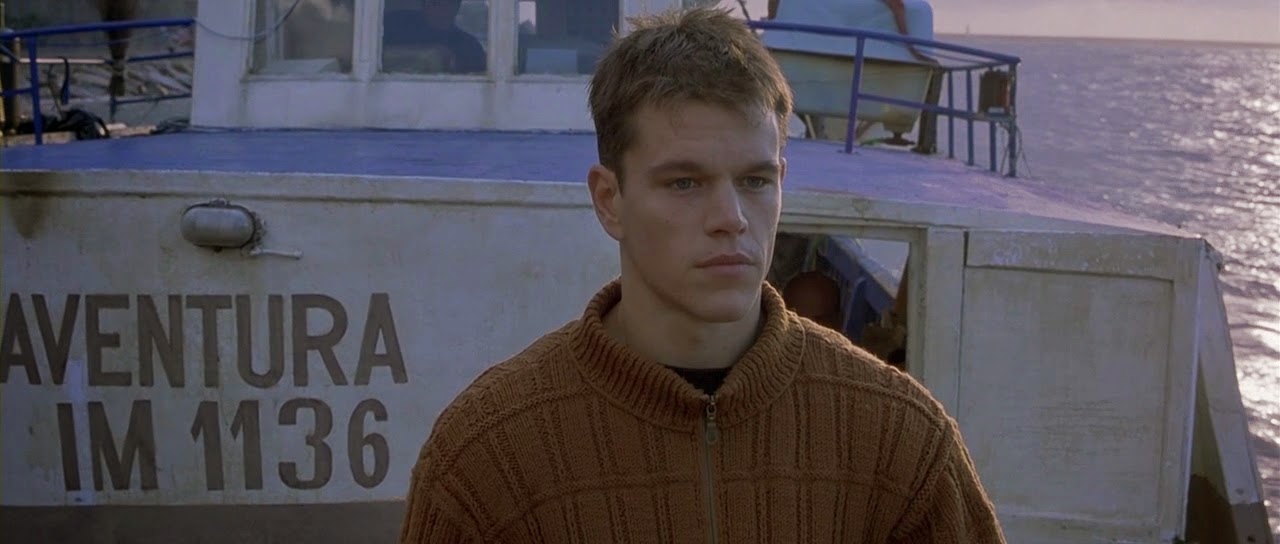
A mysterious, unconscious body is found floating out at sea by a boatload of fishermen. Two bullets in his back and a device that stores a Swiss bank account are found embedded in his hip. He wakes up with amnesia and one of the men onboard fixes him up. It isn’t until almost five minutes in that the first bit of understandable dialogue is uttered. Up to that point director Doug Liman drops us into this strange world without any set up so that we are disoriented, much like the film’s protagonist and therefore we identify and empathize with him almost instantly. These first few scenes establish the film’s style – constantly moving camerawork often with jarring, jerky movements that mimic our hero’s disorientation.

After two weeks at sea, he makes his way to land and begins a quest to uncover his identity. Over time, he discovers skills he didn’t know he had but that come out instinctively, like the ability to disable two armed police officers with his bare hands in Switzerland. He checks out his Swiss bank account and discovers that his name is Jason Bourne (Matt Damon). The safety deposit box contains money, passports for several different countries, and a gun. It becomes obvious that Bourne assembled this stash of supplies in case of a situation like the one he’s currently experiencing.


After a daring escape from the United States embassy, Bourne pays a young German woman named Marie (Franka Potente) to drive him to Paris where he apparently lives. It turns out that he’s some kind of lethal, CIA-trained assassin who has something to do with a top-secret operation known as Treadstone and he should be dead. It seems that the United States government is trying to silence an exiled Nigerian dictator by the name of Nykwana Wombosi (Adewale Akinnuoye-Aghaje) now living in Paris. He wants the CIA to put him back in power in six months or he’ll blow the whistle on their attempt to assassinate him. The man in charge of Treadstone – Alexander Conklin (Chris Cooper) – wants to make sure Bourne is dead because he was supposed to kill Wombosi when something went wrong. He sends three other assassins after Bourne and Marie.

Because Bourne suffers from amnesia and is being hunted by a secret branch of the CIA, we sympathize with his plight. It doesn’t hurt that he’s portrayed by Matt Damon who comes across as instantly likable and empathetic. Before The Bourne Identity, he was not regarded as an action star and so his capacity for sudden bursts of ruthlessly efficient violence and the ability to escape from several dangerous situations was a revelation. Damon pulls it off and more importantly is convincing as a deadly assassin with no memory. He is nothing short of a revelation as Bourne and the actor does an excellent job of not only gaining our sympathy early on, but also maintaining it throughout as we root for Bourne to figure out who he is.

When Bourne breaks out his martial arts for the first time in the film we are as surprised as he is and not just because it’s the first time we’ve seen him do so, but at the time Damon had never done a film like this before and it was his debut as a man of action. To his credit, he looks very adept and comfortable in the fight scenes and doing the stunts. The first substantial fight sequence where Bourne is attacked by a fellow Treadstone assassin is a visceral set piece as he uses every day objects like a pen to defend himself. This is not the clean, polished style of Bond movies, but down and dirty fighting that looks bloody and painful. It has a personal vibe to it as the fight takes place up close and personal in an apartment. I like that the film shows Marie’s reaction to what has just happened. She is genuinely shocked and upset at the sudden outburst of violence she witnessed. As she and Bourne flee the scene she even throws up as a reaction to being in real danger.


The casting of Franka Potente as Bourne’s love interest is an intriguing choice. She doesn’t have the supermodel looks associated with the Bond girls. She’s beautiful with a nice smile and an easy-going charm. She’s relatable and grounded – part of the film’s realistic aesthetic. Marie is an every day person thrust into extraordinary circumstances once she encounters Bourne. Potente also brings a certain amount of international cinema cache thanks to her breakout performance in Run Lola Run (1998). As a result, she doesn’t come across as some damsel in distress, but a proactive foil for Bourne. They quickly develop an easy rapport as he finds her constant, nervous talking comforting. Damon and Potente play well off each other in these early scenes as her character humanizes Bourne so that he’s not just some inhuman killing machine.

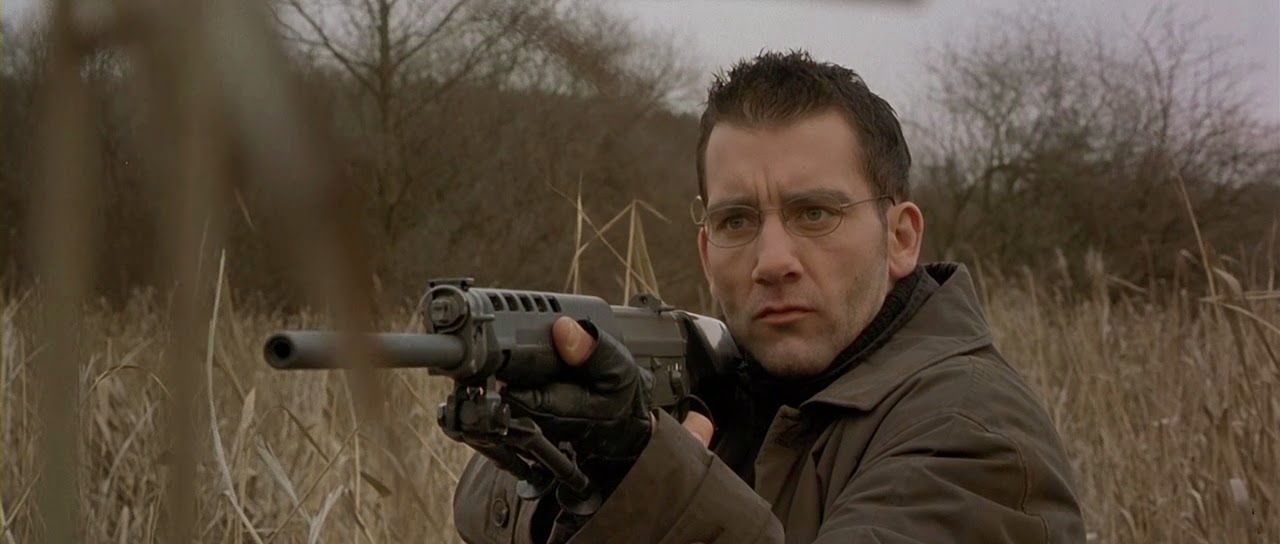
Chris Cooper is ideally cast as the no-nonsense bureaucrat Conklin who knows more than Bourne and yet is always one step behind in finding and catching the elusive assassin. He isn’t given much to do, but makes the most of his limited screen-time as he orchestrates the search for Bourne with considerable technological resources at his disposal. Cooper exudes just the right amount of uptight malevolence that we’ve come to expect from a Republican-controlled government. A young Clive Owen shows up as a Treadstone assassin who methodically tracks and then kills his targets. His showdown with Bourne in a field of tall grass is a tension-filled sequence as our hero uses misdirection to get the drop on the assassin, neutralizing him, but not before he imparts crucial information about Bourne’s past.

One of the reasons that The Bourne Identity was such a game changer for the spy movie genre came as a result of taking the hi-tech surveillance used in movies like Enemy of the State (1998) and updated it on a global scale as Conklin and his room full of I.T. specialists (including character actor extraordinaire Walton Goggins in a small role) track Bourne’s movements in Europe. Everyone leaves electronic footprints be it through credit card use or being picked up on security cameras and this was even more prevalent after 9/11. This heightened sense of surveillance has become a part of our daily lives. There is a certain delicious irony at work as Liman crosscuts between Conklin and his staff using sophisticated technology to find two people who are doing their best to stay off the grid, which results in them taking refuge in a house in the French countryside.


I like that Liman shows Bourne and Marie actually trying figure out his identity by doing the legwork involved as they call potential leads on the phone, visit key locations and talk to people as they try to put together the jigsaw puzzle that is his past. There’s a nice sequence where Bourne walks Marie through a task that he needs her to do for him. As she makes her way through a hotel lobby his words play through her head and we hear them over the soundtrack in voiceover narration.

At the time of its release, much was made of the chaotic production that pitted indie director Doug Liman and against Universal Pictures. Their dirty laundry was aired in the mainstream press and there was speculation that The Bourne Identity was going to be a box office failure. After the critical and commercial success of Go (1999), Liman decided to pursue his passion project – an adaptation of Robert Ludlum’s The Bourne Identity, a book he loved while growing up. It had been published in 1980 and featured an ex-foreign-service officer on the CIA’s hit list. Liman read it again while making Swingers (1996) and found that the characters still engaged him. He inquired about the film rights and found that Warner Bros. controlled them. Over time, the rights expired and Liman met Ludlum at his home in Montana, securing the rights. In 2000, Liman asked screenwriter Tony Gilroy if he would rewrite the screenplay he had for The Bourne Identity. After the success of The Devil’s Advocate (1997), Gilroy had gotten a reputation for saving damaged scripts.

Gilroy was not thrilled with the source material: “Those works were never meant to be filmed. They weren’t about human behavior. They were about running to airports.” Liman persuaded Gilroy to read the script, which he realized was “awful,” but they met and the latter asked the former why he wanted to make this film. Gilroy declined Liman’s offer, but when pressed gave him a suggestion: toss the novel and keep the idea of an assassin with amnesia. “You only have one way to find out … What do I know how to do? I guess your movie should be about a guy who finds the only thing he knows how to do is kill people.”


Liman eventually wore Gilroy down and he agreed to work on the script. While the first five minutes of the film comes from Ludlum’s book everything after Bourne gets off the boat was created by Gilroy. At the time, Matt Damon wanted to “try an action movie … exactly the way I’d love to do it, with someone who was thinking outside the box. Doug being Doug, this would be an interesting movie.” He agreed to do the film after meeting Liman and reading Gilroy’s script.

Liman took the project to Universal Pictures in the first place because “it was just as important to them as it was to me to make this a character-driven movie and not just a generic action movie.” By his own admission, the director was mistrustful of studio decisions like their suggestion that he shoot in Montreal instead of Paris to keep costs down. He argued that the Canadian city didn’t look like the City of Lights and the studio relented. Liman applied his often chaotic, unpredictable style of filmmaking to a big budget studio film with mixed results, often angering the producers. For example, once in Paris, he hired a crew that didn’t speak English (so he could practice his French).

When Damon arrived he didn’t like the changes made to the script after the one that made him sign on in the first place. Liman had brought in David Self (Thirteen Days) to fix what he felt was a problematic third act when Gilroy left to write Proof of Life (2000). Some of the character-driven material had been removed in favor of bigger action sequences. According to Damon, Self “went to the book and did a page-one rewrite. Every few pages, something blew up … It was not the movie I agreed to do.” Editor Saar Klein remembers, “We went into production with a script that was just a mess.” Liman agreed and Gilroy came back after finishing Proof of Life to write new scenes and fax them from New York City to Paris.


Producer Richard Gladstein left the production because his wife was going through a difficult pregnancy. Universal did not want Liman filming unsupervised in Europe and brought in veteran producer Frank Marshall who had known the director since he was a child. The studio felt that Liman’s approach was unorganized and unnecessarily costly. He responded by saying, “I like to keep my options open. I’m known for changing my mind.” The studio also felt that he lacked maturity. For example, one night Liman paid the crew overtime to light a forest for him to play paintball. Liman claimed that the studio hated him and they tried to shut him down: “The producers were the bad guys.”

It got so bad between Liman and the studio that they rejected anything he said. The director ended up using Damon as his surrogate, but this only worked for a short time. One day, Liman realized he’d missed a shot and asked the producers if he could redo the scene. They said no and so he loaded four minutes of film in a camera and reshot the scene himself, which infuriated the producers. This resulted in a giant screaming match on the set. At one point, Liman even toyed with auctioning off his director’s credit on eBay. Despite all the friction between Liman and the studio the end result speaks for itself. The Bourne Identity was a commercial hit, but the studio had not surprisingly soured on Liman and banned him from directing the sequels. “I lost my baby,” he said.

The Bourne Identity was shown to a test audience who liked it, but wanted more action at the end. After much debate with the studio, Liman and Gilroy devised a new action sequence. The screenwriter did not enjoy the experience of working with Liman finding that the director “didn’t have any sense of story, or cause and effect.” Liman found Gilroy “arrogant” and at one point attempted to hire a new screenwriter until Damon threatened to quit if his script wasn’t used. Gilroy saw a rough cut during post-production and was worried that the film wasn’t going to be good. It had come out a year late and went through four rounds of reshoots. He tried to take his credit off the film and arbitrated against himself. He wanted to share credit (and blame) with someone else. After all the dust had settled the film went over budget by $8 million and two weeks over schedule. This forced Universal to move the original release date of September 2001 to February 2002 only to push it back again to May 31 and finally settling on June 14.


The Bourne Identity received mostly negative to mixed reviews from mainstream critics. Entertainment Weekly gave the film a “C+” rating and Owen Gleiberman wrote, “Liman and Damon, with his whiz kid’s avid brashness, would seem to be a perfect match, but The Bourne Identity, which plays like John Le Carre with a couple of burnt-out cylinders, is far more routine than they apparently think it is.” The Washington Post’s Stephen Hunter wrote, “Like the indestructible Timex watch, it keeps grinding along, oblivious to its own stupidity and to the giant holes in its plot or even the general staleness of its central conceit.”

In his review for The New York Times, A.O. Scott wrote, “Mr. Damon at first seems too moody and cerebral to be an action hero, but he grasps Bourne’s predicament perfectly, and takes it seriously enough to make the film’s improbably conceit seem more interesting than it might otherwise have been.” Roger Ebert gave the film three out of four stars and called it, “a skillful action movie about a plot that exists only to support a skillful action movie.” USA Today gave the film three-and-a-half out of four stars and Mike Clark wrote, “What’s more, the locales – or what reviewers always used to call ‘scenic values’ – make the difference between a decent espionage outing and a very good one.”

What separates The Bourne Identity from the Bond films at the time is that it took the international espionage thriller and personalized it. For the most part, the adventures that Bond had in his movies never affected him personally (the notable exception being License to Kill and now the Daniel Craig films) while in The Bourne Identity it is very personal, but without sacrificing all the things we’ve come to expect from a spy movie: exotic locales, exciting car chases, lethal bad guys, and intense fight scenes. What made the film such a breath of fresh air was how it tweaked these tried and true conventions.


At its heart, The Bourne Identity is a mystery as Bourne tries to figure out who he is and why there are people trying to kill him. This gives Liman the opportunity to ratchet up the tension as Bourne is constantly looking over his shoulder, never able to rest for too long and unable to trust anyone except for Marie. Known previously for character-driven independent films Swingers and Go, Liman showed his adeptness at working in multiple genres by bringing his trademark loose, almost improvisational approach that breathed new life into the spy genre. It had become safe and predictable and it took an outsider like Liman and casting against type with Damon to shake things up. Without The Bourne Identity, Casino Royale (2006) would have been a very different film and the subsequent Daniel Craig Bond films wouldn’t be as gritty and substantial as they are.


SOURCES

Ascher-Walsh, Rebecca. “Behind the Scenes of The Bourne Identity.” Entertainment Weekly. June 21, 2002.

The Bourne Identity Production Notes. Universal Pictures. 2002.

Fishman, Steve. “The Liman Identity.” New York magazine. January 13, 2008.

Hanrahan, Denise. “Doug Liman: The Bourne Identity.” BBC. September 5, 2002.

King, Tom. “Bourne to Be Wild.” The Wall Street Journal. March 12, 2007.

Max, D.T. “Twister.” The New Yorker. March 16, 2009.

Wallace, Amy. “Wicked Smaht.” GQ. January 2012.