"...the main purpose of criticism...is not to make its readers agree, nice as that is, but to make them, by whatever orthodox or unorthodox method, think." - John Simon

"The great enemy of clear language is insincerity." - George Orwell
Showing posts with label Jamie Foxx. Show all posts

Friday, August 4, 2017

Baby Driver

For years, Edgar Wright has been a cult filmmaker looking for a crowd-pleasing successful movie and he’s finally found it with Baby Driver (2017). He’s a film buff turned filmmaker, directing the kinds of movies that he’d like to see. This has resulted in a filmography that celebrates genre movies, from the zombie movie (Shaun of the Dead) to the buddy action movie (Hot Fuzz) to science fiction (The World’s End).

His movies were always well received critically but he was unable to break through into American multiplexes. Wright made a bid for mainstream exposure by agreeing to direct the adaptation of the Marvel Comics superhero Ant-Man but when he realized that his creative freedom would be compromised, dropped out and returned back to writing and directing his own material with Baby Driver, which was a critical darling, but also a surprise financial success. He finally cracked the coveted multiplexes that had always eluded him.

Baby (Ansel Elgort) is a young getaway driver that works for Doc (Kevin Spacey), a criminal mastermind that plans heists for crews that he never works with twice with the exception of Baby who is working off a debt he owes and is a couple of jobs away from paying it off. He meets and falls in love with a beautiful young waitress named Debora (Lily James) who has started working at a diner he frequents. In keeping with the tradition of most crime movies, Baby finds himself unable to break free of Doc’s control and this jeopardizes his relationship with Debora.

Wright expertly sets the movie’s tone right from the exciting prologue as he scores the initial heist and subsequent getaway to “Bellbottoms” by The Jon Spencer Blues Explosion. The editing rhythms of this sequence are expertly matched with that of the song to exhilarating effect. It also establishes his intensions for this movie – to create a musical under the guise of a crime movie. Baby Driver contains wall-to-wall music that isn’t there merely for effect but it gives us insight into Baby’s headspace as music is one of the most important things in his life. It helps him cope with his severe tinnitus while also acting as a way to express himself and provides a crucial link to his deceased mother.

The soundtrack is populated by a diverse collection of songs, ranging from “Harlem Shuffle” by Bob and Earl to “Neat Neat Neat” by The Damned to “Debra” by Beck. This isn’t some crass gimmick to sell songs on iTunes. Each song is important because they all mean something to Baby. They are the soundtrack to his life and Wright has a lot of fun scoring everything from chase sequences to a simple walk down the street to get coffee to a meet-cute between Baby and Debora in a Laundromat to music. It is a potent reminder of the power of music and how a specific song can capture just the right mood at just the right moment.

One of the criticisms of Baby Driver is that Baby himself is something a cipher as a character and this is reinforced by Ansel Elgort’s non-descript performance, however, I believe this is by design as Wright pays homage to equally enigmatic getaway drivers in Walter Hill’s The Driver (1978) and Nicolas Winding Refn’s Drive (2011). As the movie progresses, however, Wright gradually peels back the layers to the character as we learn his backstory and what motivates him.

There are two important people in his life that humanize Baby. There’s Joseph (C.J. Jones), his deaf foster father whom the young man looks after. Their scenes together early on in the movie are the first indications that there’s more to Baby than being a getaway driver. Debora helps humanize Baby and brings him out of his shell. Their initial courting scenes have a welcome warmth to them as Wright shift gears into romantic comedy territory while never letting us forget the crime world that Baby also exists in and the inevitable conflict comes when his burgeoning relationship with Debora clashes with his getaway driver gig.

Initially, Baby Driver seems a little too proud of itself as Wright shows off a myriad of flashy camera techniques while also setting up a too-cutesy for its own good romance between Baby and Debora. Fortunately, he gradually introduces a real element of danger into the movie that threatens our hero. It helps that this genuine threat comes from veteran actors like Kevin Spacey and Jamie Foxx. They bring a distinctive gravitas to their respective roles. The former exudes calm menace with the latter is all sociopathic swagger.


Much has been made of the movie’s dazzling style and the flashy visual storytelling with some complaining that it distracts from what is ultimately a shallow movie, but so what? Baby Driver doesn’t pretend to be a deep film and has little else on its mind other than to tell an entertaining tale, which it does. It’s not hard to like this charming crowd-pleaser. There’s a lot to like about Baby Driver but it does lack the personal touch of his Three Flavours Cornetto film trilogy, co-written with Simon Pegg, which felt very much like an extension of Wright’s personal worldview whereas Baby Driver feels more like a bid for mainstream acceptance than anything else. This is a minor quibble at best and hardly takes away from the enjoyment of watching this entertaining piece of cinematic storytelling.

Tuesday, January 12, 2010

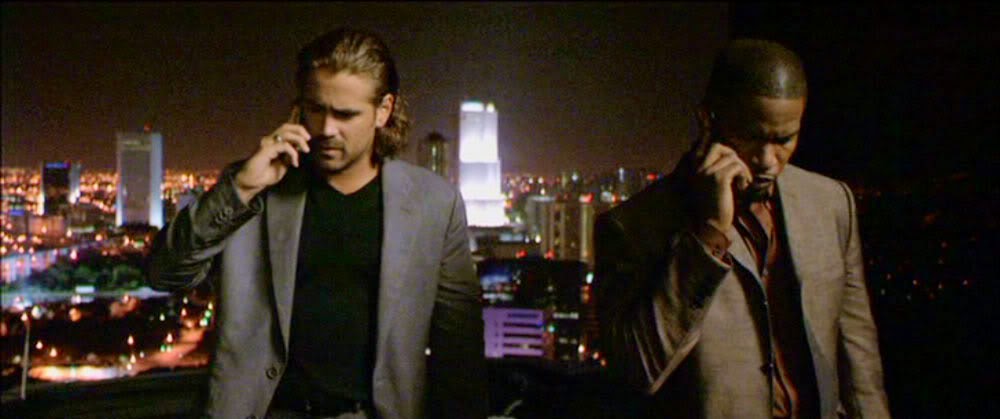
Miami Vice

It had been 17 years since Miami Vice ended its successful run on television. It became a cultural phenomenon and has since become one of the iconic shows of the 1980s. Michael Mann executive produced and acted as its guiding force in terms of tone and style for the first two seasons, helping define the show’s distinctive cinematic look. In 2006, he decided to visit Vice again, this time on the big screen in a much darker version. Although, people forget that, for its time, the show was fairly gritty in its own right (within the confines of network T.V.) and featured many downbeat endings where the bad guys got away or the protagonists won but at a terrible, personal cost.

Miami Vice was plagued by a series of production problems – nothing new for a Mann film as he faced all kinds of obstacles while making The Keep (1983) and The Last of the Mohicans (1992) – but none as well-publicized as with this project. Vice went over-schedule and over-budget with the studio claiming it to be $135 million while rumors suggested it to be in the neighborhood of $150 million. Why was this film under so much media scrutiny? Could it have been the presence of big name movie stars like Colin Farrell and Jamie Foxx, both known for their extra-curricular behavior off the set? Or was it the fact that Mann decided to remake a popular T.V. show from the ‘80s?

As he did with Los Angeles in Collateral (2004), Mann presents a contemporary version of Miami that is a foreboding and dangerous place. This isn’t the neon and pastels of the T.V. show. Sonny Crockett (Colin Farrell) and Ricardo Tubbs (Jamie Foxx) are two police officers that specialize in going deep undercover to identify and bring down drug dealers and their operations. As with all of Mann’s films we are dropped right into the middle of the action as Crockett and Tubbs are tracking a suspect in a crowded nightclub with the kind of efficiency that is customary of all Mann protagonists.

The first thing that strikes you about this scene is how it is an incredible assault on the senses with pulsating electronica on the soundtrack while Crockett and Tubbs make their way through the crush of bodies in a sweaty, claustrophobic atmosphere. In some respects, it is reminiscent of the nightclub scene in Collateral albeit with a lot less bloodshed. In the middle of all this Crockett gets an urgent call from one of his informants. He and Tubbs rush to meet him (played with sweaty desperation by John Hawkes) and find out that his family has been killed by white supremacist gang bangers. These are serious guys with heavy duty assault rifles that they use to ruthlessly kill three undercover cops without hesitation on a drug transaction gone bad.

Crockett and Tubbs soon find themselves assigned to the case with the mandate of finding out how this gang was able to discover these undercover agents and make contact with the source of their drugs – a Cuban named José Yero (John Ortiz) that operates in Central America and beyond. So, Crockett and Tubbs steal a shipment of Yero’s drugs and proceed to sell them back to him posing as experienced drug dealers. They go to South America and meet Yero in a typical Mann scene filled with tough guy speak that is sparse and all business. It’s a tense scene as the two undercover cops sell their fake reputations to Yero and try to convince the suspicious drug dealer to go into business with them. At this meeting, Crockett encounters Isabella (Gong Li), an aloof businesswoman who works for Yero and is the girlfriend to Arcángel de Jesús Montoya (Luis Tosar), the coolly confident mastermind behind the entire operation. Isabella has an air of mystery that intrigues Crockett and this grows into an intense attraction between the two of them.

Even though Mann has made it a point to distance the film from the T.V. show, the essential ingredients to the drug operation storyline are based loosely on an episode from season one entitled, “Smuggler’s Blues.” Mann even uses a few similar key lines from that episode in his film. Miami Vice goes to great lengths in showing how the international drug smuggling trade works. The director has a real eye for detail, showing in his trademark, meticulous fashion, how a massive drug transaction, done out in the ocean at night on several boats with incredible efficiency, is accomplished. These big time drug dealers have seemingly unlimited resources and Mann shows how they use sophisticated technology and weapons, that rival if not surpass anything the United States government has, to conduct and protect their extremely lucrative business.

Mann also expertly captures the way these guys speak – the sometimes cryptic lingo of both the cops and the criminals – is really like a foreign language unto itself. Mann explained in a Miami Herald article that, “Normally, if you have two undercover cops who are scamming an antagonist, you locate the audience inside the intent of the two cops. This story doesn’t let you into that inside conversation. You may be a little confused, until you get to the scene where everything clicks.” Crockett and Tubbs are dealing with the kinds of guys that would have hired someone like Vincent in Collateral with Yero as a mid-level drug dealer much like Javier Bardem’s Felix in that film.

Not much is revealed about Crockett or Tubbs’ personal lives or their backstories except that they have a very tight partnership and this is conveyed in a few minutes through looks and a verbal shorthand. We do learn that Tubbs is in a long-term relationship with fellow undercover police officer Trudy Joplin (Naomie Harris) while Crockett is a loner, only existing for the work and more than willing to fully immerse himself in his role. Their undercover work allows Mann to once again show the blurring between the law and crime as Crockett and Tubbs perform illegal tasks as their undercover alter egos. Like Neil McCauley and Vincent Hanna in Heat (1995), there is a thin line separating the two sides of the law and Crockett and Tubbs cross it repeatedly. The danger lies in losing themselves; forgetting who they are and why they are doing this work. However, they are consummate professionals and there is little doubt that this will happen. Tubbs is never once tempted and as much as Crockett loves Isabella, he knows that it will never last because of who he is and what he has to do. This does drain a little tension from the film as there is no danger that Crockett and Tubbs will really break their professional code unlike the protagonists in other Mann films.

Colin Farrell is good as Sonny Crockett in what is easily one of his strongest performances to date thanks to the excellent material he was to work with and a veteran director like Mann to guide him. He does a good job of playing a risk taker like Crockett who has nothing in his life because he is his work. Of course, meeting Isabella changes this and he ends up breaking his personal code much like Neil does when he gets romantically involved with Eady in Heat, although, not to the same life-threatening degree. Farrell is able to convey the conflict that Crockett faces as he mixes business and pleasure. Mann uses the actor’s expressive eyes to convey this internal struggle. He finally has a meaty role to sink his teeth into and does it so well, immersing himself in the character much as Crockett does in his undercover persona.

Jamie Foxx is good as Crockett’s reliable partner and moral compass. Tubbs is always there to back him up and remind him who he really is when it seems that he has forgotten. Foxx sheds his usual shtick, much like he did in Collateral (and Ali for that matter), to deliver a strong, unmannered performance. Mann regular Barry Shabaka Henley is also along for the ride as Lt. Martin Castillo and brings his customary gravitas as Crockett and Tubbs’ superior. Also of note is Tom Towles (Henry: Portrait of a Serial Killer) who plays the leader of the white supremacists with scary intensity. He’s played a host of nasty bad guys in the past and is very effective in this role. His character is the film’s wild card, like Waingro in Heat.

Mann has been accused of writing weak female characters in his films (although, both Jesse in Thief and Justine in Heat are notable exceptions) but Isabella and, to a lesser degree, Trudy are very strong and distinctive. Isabella is particularly significant in that she is an independent businesswoman who operates in a world dominated by men. Even when she becomes romantically involved with Crockett she does not lose her identity. She is obviously drawn to him and the beautiful Gong Li conveys this so well in the looks she gives Farrell and the intimacy they share in their scenes together. Both Crockett and Isabella are professionals and in another context could have had a life together but because of who they are and what they do, it is not meant to be.

In a surprising move, Miami Vice is Mann’s most sexually-charged film with several sensual yet artfully shot sex scenes between Tubbs and Trudy and also Crockett and Isabella. It is all tastefully done with close-ups and hand-held camerawork that reduce these scenes almost to abstraction and conveys the intensity of their passions – especially that of Crockett and Isabella. They know that it won’t last because of the nature of their profession and this makes their relationship that much more immediate and intense. Like Hanna in Heat, Crockett has no allusions about his personal life. He knows that he can’t have any attachments because his life is filled with constant danger that would put anyone close to him in jeopardy as well.

The digital camerawork gives Miami Vice a grainy, gritty look and a raw, rough around the edges texture that is perfectly suited for a film about extreme characters stuck in equally extreme situations. The digital cameras also allow Mann some incredible depth of field during the night scenes so that we can see exactly what is going on during night time raids or drug runs where it would have been a murky mess with film stock. He also captures the haunting quality of the storms rumbling in the background of scenes (they shot this film during Hurricane Katrina) that provide an eerily foreshadowing of the impending violent climax to the film.

Mann also continues to demonstrate a capacity for capturing stunning landscapes, like the shots of Crockett and Tubbs flying their small plane through vast blue skies populated with expansive, billowy clouds that dwarf the jet, or another shot of a series of waterfalls surrounded by dense jungles. He also presents the beautifully lush jungles of Colombia as exotic and alluring. Mann immerses us in the sights and sounds of Central and South America and Miami, populated by crowded market places and noisy nightclubs, showing off the local color of these exotic locations.

With Heat and Collateral, Mann has repeated shown his capacity for orchestrating elaborately staged action sequences. The shoot-out in a trailer park is particularly effective in its realism and ruthless economy (as he did with Collateral). In many respects, it is so unlike the hyper-active, hyper-kinetic action one is accustomed to in mainstream Hollywood films by the likes of Michael Bay or McG because Mann drains these sequences of any slick polish and subverts our expectations by building up incredible tension and then inserting a sudden, jarring moment of violence, even ending the sequence with an unpredictable moment of tragedy that is very gripping stuff. Mann then proceeds to top this sequence with an even more impressively staged one for the film’s climax.

The origins for this film date back to 1981 when Mann read the screenplay for the pilot episode of what would become Miami Vice. While working on the show he came to a realization: “I basically tried to substitute other folks for myself on Miami Vice. I said to myself: ‘I’m here trying to help folks making these little movies – why aren’t I directing?’” So, he went off and made Manhunter (1986) but did not get serious about making a Vice film until 20 years later when, during the filming of Ali (2001) at a birthday party of Muhammad Ali, Foxx asked Mann about updating Vice and making it into a film. Mann remembers that the actor “did 20 minutes on why I should do it, doing the sound effects and the cars and everything. Then he worked on me for about two years and I finally succumbed.” The director was resistant, at first, but then, “I sort of seduced myself with it as I was writing it. It became a personal script,” he said in a Miami Herald article. He started writing the screenplay in 2004. Foxx remembers, “one day he told me he had written 90 pages and I immediately put my bid in to play Tubbs.”

According to Mann, the appeal to the material was a fascination with “the whole phenomenon and process of being undercover. It’s a very dramatic projection for an individual, to put yourself into that world and become in some ways who you really are, because that’s what undercover work really is: turning up the volume on your impulses and throttling back on your inhibitions until it becomes your favorite identity.” He wasn’t satisfied with the show’s examination of police undercover work and how it affected someone. It was not only an interest in undercover work that Mann wanted to explore in the movie but, as he told the Daily Telegraph, “Crime is the booming branch of our time and internationally operating cartels are led at least as innovatively as legal corporations. These people maintain unbelievable networks and can deliver any merchandise to any destination on Earth with perfectly planned strategies ... our world is a supermarket of illegal goods.”

Fans of the show hoping that this new film would be a nostalgia trip were disappointed as Mann was not interested in simply rehashing the series. “I couldn’t have invested a year and a half into re-invoking a sense of the 1980s. That just wasn’t a period I was interested in. I’d be bored shooting it, and most people would be bored watching it.” The appeal of the show to him was “an attitude toward how you tell these stories about being undercover – stories that are extremely emotionally active, very passionate, somewhat serious and don’t always have happy endings.” He was also interested in revisiting the city of Miami which, physically, “especially at night, has completely changed.”
When Mann showed Universal his screenplay, they weren’t too excited about a dark, violent, audience-limiting R rated film that bore no resemblance to the show. However, after Foxx won the Academy Award for Ray (2004) and was nominated for another one for Collateral, Mann underwent prolonged discussions with then Universal president Stacey Snider who greenlighted the project at $120 million and was scheduled to start production in April 2005.

The first thing Mann did was extensive research on undercover work and what it meant to go deep undercover. He and the cast spent five months before filming in Miami training and working with undercover agents from government organizations like the DEA, FBI, ATF and SWAT running all kinds of simulated scenarios. Mann also conducted extensive research with cinematographer Dion Beebe over the course of four and half months testing digital cameras in Miami. While not reducing the costs of the film, shooting digitally allowed the image to be manipulated right on the set. It also offered a greater depth of field, especially at night when most of the film takes place.

As part of his research for the role, Colin Farrell spent some time with undercover cops including a week of running scenarios that had been set up. One day, the cops he’d been working with set up a buy for 40 kilos of cocaine from some Colombians. Because the actor had gotten on so well with the cops they invited him to the meeting assuring him that nothing would happen. However, as Farrell remembers, “the shit hit the fan – guns were pulled and I nearly had an accident in my pants because I was scared.” He thought it was real and found out the next day that it was all a set-up.
During pre-production, Farrell pushed himself through intensive weight training with months spent doing morning workouts, afternoons on the shooting range using live ammunition and nights spent on mock drug runs five miles off the coast of Miami. The actor had been experiencing serious pains in his chest, shoulders and back. He saw a doctor and had an MRI done which revealed a rib that had broken away from his sternum and two herniated discs in his back – all brought on by his intense weightlifting sessions. Farrell’s injury resulted in over six weeks of delays that pushed the production start date back to June and right in the middle of one of the worst hurricane seasons in recent memory.

As with The Insider (1999), Mann faced a battle in the media that attempted to distract from the film itself by focusing instead on the troubled production. The most damning article was written by Kim Masters for Slate that criticized Jamie Foxx and Mann via anonymous sources. Part of the film was shot in the Dominican Republic in a square in Santo Domingo that even local police avoided. Mann hired gang members to work as security. When the production moved to a more upscale, tourist-heavy Colonial District area, a local police officer approached the set and got into an argument with one of the guards (supplied by the Dominican military). The cop reportedly pulled a gun and was shot and wounded. The cast and crew heard six gunshots. Farrell remembers, “I knew straight away there were gunshots. I’m thinking that there’s 20 people down there to kidnap us and I’m going to be in a basement somewhere with a hood over my head, eating porridge and water for the next week.” Cast and crew scrambled for cover and safety until their security team dealt with the situation and order was restored. Mann tried to clarify the incident in an interview with Entertainment Weekly, saying that the man who had been shot “was inebriated. When they told him, ‘You can’t get on the set,’ the guy pulled his weapon and started firing. So they fired back. It coulda happened on Sunset here in L.A.”

While Miami was recovering from devastating hurricanes, the production set up camp in the Triborder Region where Paraguay, Brazil and Argentina meet in the notoriously corrupt city of Ciudad del Este. Stephen Donehoo, the man responsible for getting the production in and out of the area safely, described it as a place “known for corruption, contraband, and tax avoidance. And there’s a huge Lebanese community, some of which apparently provides financial support to Hamas and Hezbollah. Some say they’re doing training for al-Qaeda, but I don’t think that’s true.” Negotiating entry into Ciudad del Este in Paraguay took almost a year with Donehoo and Mann meeting face-to-face top government officials, local gangsters, black-market businessmen, and a high-ranking customs official. The plan was to shoot for a few days in a local mall and three weeks in an abandoned building outside town where the film’s climatic gun battle was to take place – the scale of which was to rival the famous shoot-out in Heat. However, as Donehoo was getting all the equipment into Paraguay, the shoot-out in Santo Domingo happened.

Afterwards, Foxx refused to work outside of the United States which forced Mann to rewrite the ending so that it took place in Miami instead of Paraguay. Fortunately, he had written an ending set in Miami. The director claimed in the Slate article that, “the Miami ending worked out to be the better ending. It brought all the conflicting characters together in one arena.” Universal wanted the production to move back to the States and was happy when it did even though Farrell says that he would have rather stuck to the original schedule. Ironically, the day they got back and were shooting in a shipyard, they heard gunshots nearby and Mann says, “Five real undercover Miami-Dade narcs had gotten into a shootout in a trailer park five blocks away. We had to stop everything because it wasn’t safe.”

The Slate article went on to cite anonymous sources in the Miami Vice production team that Foxx exhibited diva-like behavior by showing up with an entourage and an attitude. While hardly scandalous news, the article went on to say that Foxx did not want to fly commercial to Miami to begin work on the film and that Universal Studios finally gave him access to their private jet. The Entertainment Weekly article also stated that Tubbs was supposed to be an excellent pilot but Foxx was afraid to fly. The actor also complained that he was getting paid less than co-star Farrell even though their salaries had been established before his Oscar win. In the end, Foxx got a big raise while Farrell took a small cut. To make matters worse, expensive HD digital cameras broke down with the change in barometric pressure and Gong Li had difficulty learning English and Spanish.

Apparently, Mann went through dozens of script changes while making the film which caused many headaches for frustrated crew members. The production ended up filming in Miami during hurricane season and some crew members felt that they continued to work in unsafe conditions, which Mann strenuously denied. During one squall that originated with Tropical Storm Dennis, windows were blown out of a tall building and glass rained down on a Ferrari with the convertible top down being driven by Farrell and Foxx nearly missing them and damaging the car. Hurricane Wilma struck the production just before the final showdown in Miami was to be filmed, heavily damaging the production office. Fortunately, Mann’s meticulous planning and preparation allowed the crew to re-group in a week and re-stage the finale.

By the end of the 105-day shoot, more than 100 crew members had resigned and twelve hours after wrapping the film, Farrell checked into rehab for exhaustion and a dependency on prescription medication stemming from an injury he sustained while making Alexander (2004) with Oliver Stone. Regular Mann collaborator, Barry Shabaka Henley told Entertainment Weekly, “Michael is brilliant, but [people started to] view him as Kurtz from Apocalypse Now, out there in Miami with severed heads on stakes. I couldn’t believe the stories I heard when I got back to Los Angeles. Mann had shot someone. The AD had shot someone. Foxx had crashed a plane.”

Why did the film cost so much? Extensive location shooting that involved taking a large cast and film crew all over the world. Miami Vice is estimated to have cost $235 million to make and market, making it the biggest risk for Universal Pictures in 2006. The film was projected to gross $100 million domestically and fell well short of that. Chairman Marc Shmuger said, “The studio underestimated the inherent challenges of translating Miami Vice to the big screen. As a commercial proposition, it had a familiar title but not a really deeply appealing connection to the larger audience.” Mann reportedly made $6 million plus a percentage of the box office receipts before Universal made any money.

Not surprisingly, Miami Vice divided critics. In his review for Time magazine, Richard Schickel praised Mann’s use of HD cameras: “In terms of cinematography, Mann may embody the future of large-scale commercial movies.” Newsweek magazine’s David Ansen praised Gong Li’s performance: “The great Chinese star hasn’t seemed comfortable in Hollywood fare, but Mann locates the lusty vulnerability under her snarl. There’s enough real passion between Farrell and Gong for the movie to get some emotional traction.” In his review for The Guardian, Peter Bradshaw wrote, “It is one of the most laconic pieces of work imaginable: radically reticent, in fact ... Miami Vice is a bold, powerful and irresistibly thrilling movie.” New York magazine’s David Edelstein wrote, “Early reviewers have labeled Miami Vice a disaster, but I couldn’t take my eyes off the screen. It’s a sensational trip – gorgeous gaga.”
In his review for the New York Observer, Andrew Sarris wrote, “admittedly, the ‘content’ in Mr. Mann’s new version of Miami Vice is hardly Tolstoyan in its texture, but I would argue once more, as I have so often in the past, that in cinema, at least, so-called ‘form’ can constitute ‘content’ at the highest level.” In his review for The New York Times, A.O. Scott wrote, “Miami Vice is an action picture for people who dig experimental art films, and vice versa ... Some of the most captivating sequences have an abstract quality, as if Mr. Mann were paying homage to the avant-garde, anti-narrative of Stan Brakhage in the midst of a big studio production.” However, in his review for the New Yorker, David Denby wrote, “the picture turns dealing into a kind of expensive, high-speed scavenger hunt. Sometimes the geography is so confusing that we wonder how the film crew managed to show up at the right location.” Entertainment Weekly gave the film a “B” rating and Owen Gleiberman wrote, “I got the feeling that Mann remains embarrassed by the '80s-cheese, fashion-plate showiness of his beloved series, and that he was determined not to fall back into it. His movie, as entertaining as some of it is, is so cool that it's almost too cool. It takes the sin, and much of the juice, out of vice.”

Ultimately, Miami Vice is not a kitschy parody or celebration of its television source material a la Starsky & Hutch (2004) or The Dukes of Hazzard (2005) but a serious meditation of the dangers of deep, intensive undercover work and the complex drug cartels it tries to expose and ultimately break up. Kudos to Universal for daring to release a dark, very mature action thriller in the middle of summer blockbuster season in an attempt at counter-programming. Mann has created another masterfully crafted exploration into the nature of professionalism and the inevitable clash between it and the personal lives of his protagonists. This film is arguably one his darkest explorations of these themes as he strips down our notions of character development and plot to the bare essentials while showcasing his knack for visual storytelling.

Also, check out Joe Valdez's excellent look at this film over at his blog, This Distracted Globe. Jake has a fantastic look at this film over at Not Just Movies, which is definitely worth checking out.

Friday, July 3, 2009

Michael Mann Week: Collateral

After the commercial failure and mixed critical reaction to the vastly underrated Ali (2001), Michael Mann returned to familiar territory — the urban crime thriller — with Collateral (2004). Coming off three grandiose epics in a row, the veteran filmmaker shifted gears with this lean, no-nonsense film that harkens back to early films in his career like Thief (1981). One has to wonder if the pressure was on Mann to make a more audience-friendly film after his last two failed to produce at the box office. Like the late Stanley Kubrick (of whom he is sometimes compared to), Mann has tried repeatedly to breakthrough to a mainstream audience. It would make sense then that he would cast Hollywood megastar Tom Cruise as one of the main protagonists. If there were any actor on the planet that could guarantee a sure-fire hit at the box office it would be Cruise (although, it didn’t work out for Kubrick when he cast the actor in Eyes Wide Shut). However, Mann throws a potential spanner in the works by casting the actor as an amoral hit man. Would this scare off a mainstream audience?

Collateral is about three lonely professionals who are brought together over the course of one night. Max (Jamie Foxx) has been a cab driver in Los Angeles for twelve years. He is anal-retentive about his cab as evident by the way he meticulously cleans the inside and out of it. Mann shows the fragmented details of the noisy garage full of hustle and bustle where Max is working on his cab: people fixing car engines and cabbies arguing. The director also includes close-ups of engines, license plates, a steering wheel, a front bumper and a tail light. As soon as Max closes the door of the cab all the cacophony of the garage is gone. He is alone with his thoughts just like Jeffrey Wigand at the beginning of The Insider (1999). They are both in their own soundless bubbles, however, for Wigand it is a prison while for Max it is his own private oasis as signified by the postcard of a tropical island that he affixes to the visor in his car. Like Frank in Thief, this postcard represents his dreams. Max looks at his postcard while a couple argues in the back of his cab. It is his escape from the pressures of the day.

His first fare is a beautiful assistant District Attorney by the name of Annie Farrell (Jada Pinkett Smith). She gives him directions but he has a better route and they make a bet: if her way is shorter then the fare is free. She is bemused by his wager and as they drive through the city, Mann includes shots of the freeway at night bathed in warm light with classic soul music playing on the soundtrack, creating a warm and inviting mood as they get to know each other. The dialogue between these two people flows naturally as they talk about their respective jobs. Max charms her by figuring out what she does and talking about his dream of opening his own limousine service: “Island Limos. It’s gonna be like an island on wheels. A cool groove like a club experience. When you get to the airport you’re not gonna wanna get out of my limo.” Max guesses that Annie is a lawyer by what she is wearing. She opens up and tells him about her insecurities with her high-pressure profession.

We find out that Max is a good judge of character and that Annie likes what she does but has her reservations, fears, doubts and feels comfortable enough to tell him. He says that she needs a vacation and gives her his postcard so that she has somewhere to escape to when things get too hectic. She gives him her business card opening up the possibility and the hint of romance. They have made a connection. Despite a premise that is steeped in the crime genre, Mann manages to keep things fresh and interesting by starting things off with an intimate conversation between two lonely souls who have met by chance.

After dropping off Annie, Max picks up his next customer and the tone of the film changes. Vincent (Cruise) is all business and tells the cabby that he is a salesman in town to visit with five clients. When Max tells him it will only take seven minutes to get to his destination, Vincent is willing to time him but the cabby is not going to offer him a free ride like he did with Annie. Vincent talks about how he hates L.A. and how it is “sprawled out, disconnected.” He recounts a story about how a man died on the subway and his body rode on it for six hours with nobody noticing. Their small talk is reminiscent of the conversation Max had with Annie and they even talk about some of the same things, like Max’s proposed limo service but he does not go into the same kind of detail with Vincent because he does not feel as comfortable with him.

When they arrive at Vincent’s stop, he offers Max $600 to drive him to five other destinations around the city. It seems too good to be true and this scene plays out in the cab bathed in eerie green light, forewarning danger as Max will regret his decision to accept Vincent’s proposal in a few minutes. During the first stop a man crashes onto the roof of Max’s cab. The charade is over and Vincent is forced to play his hand. He is actually a hit man hired to kill five key witnesses in an indictment against a Latin American drug cartel. He proceeds to intimidate and force the shocked cabby at gunpoint into helping him.

One of the hits later on in Collateral is also the film’s most impressive action set piece – a memorably choreographed shoot-out at a night club. Vincent demonstrates just how efficient a killing machine he really is, shooting, knifing and breaking bones of anyone who gets in the way of his intended target. This sequence was shot in a Korean nightclub called Fever with 700 extras over nine days. Mann amplifies every deafening gunshot and every snap of bone for jarring, realistic effect. It is a fantastically orchestrated chaos on par with Mann’s other great action sequence, the famous bank heist in Heat (1995) as everyone converges on the club: the FBI investigating Felix, representatives from the cartel, the L.A. police department, the target’s bodyguards, and, of course, Max and Vincent.

Tom Cruise expertly transforms himself into one of Mann’s quintessential protagonists. Like Frank in Thief and Neil McCauley in Heat, Vincent is a consummate professional with an economical use of words. Cruise portrays Vincent as a cold-hearted killer who has no problem justifying what he does — after all it is part of the job — nothing more, nothing less. As the actor remarked in an interview, “He is an iconic killer, and he knows for himself that what he’s doing is correct, and wants to approach this in a professional manner—but then there’s things that he doesn’t even realize are happening to him, subtly.” Cruise treads a fine line between calculated menace and slick charm. Every so often he hints at something else going on behind Vincent’s eyes — a whole inner life that we only catch glimpses of. This is something he has done to a limited degree in Interview with a Vampire (1994) and Magnolia (1999) but not quite with the same intensity or in such detail as with this role.

The risk in casting someone like Cruise is that he carries a lot of baggage with him. His face and voice are so recognizable that it is hard for him to disappear into a role. Mann was conscious of this when he cast Cruise: “Tom is one of the most recognizable people on the planet. And so you have to make him Vincent. I use everything—the bones, the colors, the patterns, the rhythms of the character to end up with what you see. Everything goes into the performance. And then the clothes just fit. It all becomes seamless.” It does not take Cruise long to shed his megastar persona and become Vincent. By the time he kills two thugs trying to rob Max with ruthless efficiency, there is no question that Cruise has become this character. The choice of the non-descript grey suit was an important aspect of Vincent’s character. Mann said in an interview: “It’s not really a disguise, but it’s anonymous. If somebody actually witnesses him and the police ask for a description, what are people going to say? A middle-aged, middle-height guy wearing a middle grey suit and white shirt. It describes anybody and nobody in terms of Vincent’s trade craft.”

In contrast, Jamie Foxx provides the humanistic counterbalance to Cruise’s amoral existentialist. He is obviously the audience surrogate but Mann does not hit the audience over the head with this fact. Max cares about what happens to the people Vincent kills and is horrified by his actions. Known more as a comedian, Foxx has shown in recent years, with Any Given Sunday (1999) and Ali, that he has the capacity for dramatic roles. His performance in Collateral is his most natural one to date. He abandons all of his usual shtick and creates a full-realized character that avoids the usual tired cabby clichés. Inactivity is perhaps Max’s defining trait. He keeps telling anyone that will listen of his desire to open his own business and yet he has made little progress in the twelve years he’s driven a taxi. This comes to the surface when he and Vincent visit Max’s mother in the hospital. This is a pivotal scene where the presence of Vincent acts as a catalyst that transforms Max into a proactive character.

Yet, there is emptiness to the lives of Annie, Max and Vincent. Mann constantly captures them in the vast empty spaces of deserted streets, back alleys and subway cars with his expansive widescreen aspect ratio. As Vincent constantly reminds Max, “Nobody notices.” These characters are alienated by a cold and uncaring city. With the exception of Max’s mother, none of these characters have any significant friends or family. What they do for a living is what defines them.

The idea for Collateral came to screenwriter Stuart Beattie during a cab ride from Kingsford Smith Airport to his home in suburban Sydney, Australia. During the ride he remembers thinking, “I could be a homicidal maniac. You never get in a car with a stranger, never pick up a hitcher, but a cab driver defies those rules. Taxis are mini-islands floating around the city with two people in a confined space. It was rife for drama.” Beattie studied at Oregon State University and wrote the first draft of The Last Domino. It “sat in a drawer” for years while he went on to write Pirates of the Caribbean (2003). His script made the rounds in Hollywood before he gave it to producer Julie Richardson. She liked the screenplay and tried to develop it at HBO with Frank Darabont in 1999. They eventually passed on it and later that year, DreamWorks executive Marc Haimes renamed the script Collateral and brought the project to Walter Parkes, co-head of the studio with Russell Crowe interested in playing the role of Vincent. Beattie remembers that Crowe “really got the heat on it. After three years of the script going around Hollywood, once Russell got involved, it was alive again.” Other directors, like Mimi Leder and Janusz Kaminski, expressed an interest in making the movie.

After Ali, Mann spent two years developing The Aviator (2004) but ultimately decided not to direct instead taking on the role of producer because he wanted to do a “story that took place in L.A., at night.” He soon agreed to direct Collateral but Crowe had to drop out due to a scheduling conflict. The director was attracted to the compressed time frame in the script, much like the structure of Kubrick’s Dr. Strangelove, the film that made him want to be a filmmaker in the first place. “I was making an entire motion picture out of only the third act. This is the denouement: the finale is at the beginning of the movie and that’s it. Dr. Strangelove’s the same, in that it begins with the ending. Sterling Hayden launches, that’s it, they’re gone. Two acts probably built it up to that.”

When Mann came aboard he contributed an uncredited rewrite changing the offscreen bad guys to a narco cartel based in Latin America who is trying to avoid indictment by a federal grand jury. He also changed the setting from New York City to Los Angeles. Mann said that he “changed the culture, the locale, the characters’ back stories and what they talk about, but I didn’t change the narrative structure or the engineering under the surface.” Parkes remembers, “Michael talked about wanting to shoot in Los Angeles in ways that it’s never been shot before—a multilingual, multiethnic city at night, a very particular evocation.”

Actor Tom Cruise had wanted to work with Mann ever since he first saw Thief. Cruise said, “I have seen all of Mann’s movies. It’s something you want to look at and study, because he designs his pictures from the ground up and really has tremendous command of the medium and the story telling.” When Mann sent Cruise the script, the actor remembers, “he sent different stills, almost an art motif of things he was thinking about, and what he wanted to explore.” When they first met, the director offered the role of Max to the actor but it was Cruise who suggested that he play Vincent. He was attracted to the role of Vincent because it was so different from anything else he had done. He was drawn to the character as “how someone becomes an antisocial person.” However, Cruise was not entirely convinced that he could play a villain but Mann remembers telling him “that Al Pacino, De Niro, McQueen had all done it and it was his turn now. He’s 42, so if he didn’t do it now, when would he?” Mann was interested in working Cruise because he wanted to see the actor try a role he had not played before. He elaborated in an interview: “There’s dimensions to Tom that I hadn’t seen on the screen. It became an exploration to bring some of that out, some of the steel that’s in there. Some of the toughness, the certainty and the very good kind of avid, proactive vibe towards a goal, and darker resonances within that.”

Collateral gave Mann another chance to shoot in Los Angeles. He was attracted to its “industrial landscape. I like the feelings of ennui and alienation the vacant landscape suggests.” The director has lived in L.A. since 1971. He once remarked in an interview, “There’s a certain romance of the city at night that I confess I’m completely vulnerable to.” Right away, Mann establishes a multi-ethnic Los Angeles that is rarely seen in Hollywood movies, even his own Heat. In the first ten minutes alone, several different languages are spoken. Mann takes us on a tour of many different neighborhoods, from the high-rise corporate culture of the downtown core to the exotic culture clash of trendy Koreatown. He discovered the multi-ethnic, multi-class aspect of the city while riding around with a detective in an unmarked police car researching for Heat. In many respects, the city itself is a character and Mann constantly reminds us of this with several establishing overhead shots that show off the topography of L.A. Mann takes every opportunity to immerse us completely in the sights and sounds of the city that he knows all too well. Not since Blade Runner (1982) has such an ethnically and economically diverse vision of this city been depicted on film.

Over 80% of Collateral was shot utilizing the state-of-the-art Viper FilmStream digital camera. Mann was the first director to road-test the Viper, the first cinema camera to store images as data directly to a hard drive. In an interview, Mann said that, “with digital, we were able to do seventeen to eighteen 20-minute takes—three-to-four page scenes done en masse.” It allowed Mann to film longer takes because his camera could store 55 minutes on a tape. The entire shoot only took 65 days. A sharp contrast to Heat’s epic 107 day shoot. The look of Mann’s film should be familiar to anyone who saw his short-lived (and little seen) television series, Robbery Homicide Division, which was also shot on digital video. As L.A. Takedown was a dry run, stylistically, for Heat, so too was RHD for Collateral. With this new camera, Mann is able to bring out all kinds of depth and color during night-time scenes that wasn’t possible before. Mann has said in an interview: “It enabled me to be very painterly with building the scene. It’s counterintuitive to photography in every conceivable way. Throw a light meter away, I don’t need it. It’s right there on a high def monitor. But it required knowing exactly what you want because what’s available is a much broader spectrum than a motion picture film.” However, there were certain scenes, like the disco shoot-out that were shot on film because “we were on a big interior set that had to be lit and we could move around more freely with the camera on our shoulder shooting 35mm than we could using digital.”

Collateral was Mann’s most critically well-received film since The Insider and the most commercially profitable since Heat. Jonathan Rosenbaum in the Chicago Reader praised Mann’s storytelling abilities. “Mann’s success with well-worn genre tropes goes hand in hand with his actor – and character-driven approach to storytelling, which provides a solid grounding for the picaresque detours and digressions of Collateral’s plot.” Manohla Dargis in The New York Times described the movie as “very much the product of a distinct vision, one as eager to push technological limits ... as to upend the usual studio white-hero/black-villain formula.” Mark Olsen in Sight and Sound lauded Mann’s use of DV and compared him to Kubrick. “If Kubrick could prefigure the colours and framing of the still-emerging digital aesthetic, Mann is perhaps the perfect filmmaker to take the technology forward.”

In his review for Time magazine, Richard Schickel wrote, “But at his best, Mann wears his hipness easily. It works particularly well in Collateral, which has a nice minimalist quality about it – just these two increasingly edgy guys, their car and the people they encounter.” Michael Atkinson provided one of the rare, dissenting voices with his review for The Village Voice: “Several yowling soundtrack singles are more obtrusive than emphatic, and he is susceptible to the Industry’s de rigueur editing hyperactivity ... Collateral is a slim drink of thin beer, remarkable only as evidence that Mann might have a modern masterpiece in him if he were cut loose and allowed to roam around in his own obsessions.”

Collateral is a fitting addition to Michael Mann’s distinctive filmography. It continues his thematic pre-occupations of isolated protagonists who have little time for personal relationships. It is also deals with another Mann obsession: transformation. In order to have any chance of surviving the night with Vincent, Max must change from being a passive character to one that takes an active role in determining his own fate. It is the exploration of such weighty themes, coupled with Mann’s distinctive style that elevates Collateral from its generic conventions.

Sunday, June 28, 2009

Michael Mann Week: Ali

This post originally appeared at the Film for the Soul blog as part of The Year 2001 project.
Ever since Ali was released in 2001, I have felt that it has been one of Michael Mann’s most under-appreciated films. It received decidedly mixed reviews and underperformed at the box office. While Will Smith was praised for his impressive physical transformation into legendary boxer Muhammed Ali, the film itself was criticized for revealing nothing new about the man. Herein lies the problem that Mann faced: how do you shed new light on one of the most documented historical figures of the 20th century? His angle on the material was to look inwards.

Proposals for an Ali biopic had been around since the early 1990s when producer and one-time business partner of the boxer, Paul Ardaji, pitched the idea to the man on his 50th birthday. Ali gave the project his blessing and financing quickly fell into place. A number of scripts were written by the likes of Gregory Allen Howard (Remember the Titans) and Stephen J. Rivele and Christopher Wilkinson (Nixon), but they all failed to please the powers that be. The project bounced around various studios for years as executives tried to decide who should make it, who should star in it, and would it even make a profit? In 1991, Oliver Stone met with Ali about making a film about his life but the collaboration ended when the director refused to share creative control. In 1992, Ali’s best friend and personal photographer Howard Bingham and Ali’s wife Lonnie got together with Ardaji. Gregory Allen Howard’s take on Ali was delivered in 1996. His angle was that the key to the boxer’s life was his relationship with his father, who ignored him.

When Will Smith met Ali in 1997, the boxer asked the actor to play him in the film. Smith was flattered but said no. He was not ready and too intimidated for such a demanding role. The actor almost did it when Barry Sonnenfeld agreed to direct. Both men had worked together on the Men in Black films and Wild Wild West (1999). Thankfully, their version never saw the light of day. After he turned 30, Smith realized that he had to make the decision about playing Ali. However, when no one could settle on a script, Sonnenfeld dropped out. There were several more rewrites and directors, including Curtis Hanson who expressed interest. Smith was ready to give up on the project.

It then came down to Spike Lee or Michael Mann to fill the director's chair left empty by Sonnenfeld. Sony Pictures, the studio bankrolling the film, was faced with a $100+ million budget and went with Mann who had just received several Academy Award nominations and all kinds of critical praise for The Insider (1999). Upset, Lee voiced his anger through a friend in The New York Post: "only a black man could do justice to the Cassius Clay story," he was reported as saying. Mann responded that he "wanted the film to come from the point of view of the main character, Muhammed Ali. I'm not interested in showing a white man's idea of how someone suffered racism. The perspective of the film has to be African-American." When asked why he did not pick a black director Ali said that he wanted the best qualified person regardless of color, and his wife said, “Muhammad didn’t want it to be a movie just for black audiences. He wanted it to be a movie for all cultures and all people.”

When Mann was approached to direct he wasn’t even sure if he wanted to tackle such challenging subject matter but was sure of one thing; he did not want to make a docudrama or idealize Ali's life. After meeting with Ali and his wife, they told him that they did not want “a teary Hallmark-greeting version of Muhammad Ali ... What they didn’t want I didn’t want,” Mann remembers. The director liked Rivele and Wilkinson’s screenplay but rejected their flashback structure and their use of Ali’s 1978 fight, the “Thrilla in Manila,” as the present frame of the story. Mann felt that Ali’s 1974 fight in Zaire was more significant. He was also not interested in spelling things out for the audience: “I wanted to insert you into the stream of this man’s life, orient you without doing it in a blatant way with exposition.” Ironically, this is what would scare off a lot of people.

Smith's agent arranged a meeting with Mann that changed his attitude towards the film. According to the actor, it was "the clear picture he had of the road from Will Smith to Muhammed Ali. He explained it in a way that made it seem, in my mind at least, not so utterly impossible, just marginally improbable." Smith and Mann agreed that the film’s focus should be on ten turbulent years of Ali's life, from 1964 to 1974. The director set the film during these years because "that formation of everything by '74 is the beginning of what is now culturally in the United States." Mann identified Ali with the spirit of change that occurred in the 1960s. "He consistently defied the establishment and its conventions, and we loved him for it." Ali led such a colorful, eventful life that a focused story was crucial to the film. Mann said in an interview, “It would be catastrophic to divert into every interesting story. Everything this guy does is fascinating. I could have made an entire movie about Ali's relation to women. Music, Cadillac convertibles and women. It would have been great.”

By February 23, 2000, Mann signed on to the film and went to work transforming Will Smith into Ali. Smith remembers that Mann created the "Muhammad Ali Course Syllabus” that began with a study of the boxer’s physical attributes: “learning to run how he ran, to eat the food he ate, spar the way he sparred. Essentially creating the physical life and physical appearance of Muhammad Ali.” From there, Smith moved on to the mental and emotional aspects and finally the man’s spirituality. Boxer trainer-choreographer Darrell Foster spent a year training Smith. Foster was Sugar Ray Leonard's conditioning coach when the boxer turned pro. According to Foster, the key to becoming Ali was "looking for specific movements. Hand speed, ring generalship, how he made guys miss. Will had to become Ali, because you can't demonstrate those moves through choreography." Foster created a high-carb, high-protein diet for Smith and had him run in combat boots through snow in the thin air of Aspen, Colorado for ten months before the start of filming. His training schedule consisted of five miles of roadwork starting at 5:30 am, in the gym at 11:30 am, six days a week for three hours of ring work and weight training, watching fight films at 3 pm, and weight training in the evening. Smith put on 35 pounds of pure muscle in four months and went from bench-pressing 175 pounds to being able to press a very impressive 365 pounds. The finishing touch was being fitted with a hairpiece and a prosthetic nose.

For the fights, Foster started Smith on the basics: balance, footwork and defense. Then, he worked with the actor on the offensive aspects: a mix of overhand rights, hooks and upper cuts. Foster remembers that Smith "thought he knew how to fight because he had some street fights. But really, he couldn't fight at all." Smith worked on his hand and eye reflexes in order to perform eleven of Ali's signature moves. Smith spent days studying film of Ali, including early footage shot when he was an Olympic boxing champion to interviews with Howard Cosell. Much of the material, unseen for years, was supplied by Leon Gast, a documentary filmmaker who made When We Were Kings (1996), a celebrated and acclaimed documentary about Ali’s championship bout with George Foreman. Smith also took classes in Islamic studies at the University of California.

The focus on the years 1964 to 1974 are arguably the most fascinating ones of Ali’s life because they are so rife with dramatic possibilities. It was during this period that Ali became the World Boxing Champion after beating Sonny Liston, then lost it when he refused to serve as a foot soldier in the Vietnam War, and finally reclaimed the Championship Title after beating the odds-on favorite, George Foreman in Zaire. It was also a time of great social and political upheaval in the United States with the assassinations of Malcolm X and Martin Luther King, Jr. Finally, Ali also shows the man’s private side: his numerous wives and failed marriages, and his friendships with Malcolm X and Howard Cosell.

Mann immediately immerses the audience in the time period with a montage of footage that features Sam Cooke performing in front of a live audience juxtaposed with Ali jogging alone at night and being harassed briefly by the police. Mann then goes into a montage of Ali training and two boxers fighting with Ali watching. Mann fractures time by also intercutting footage of Ali as a child witnessing the brutality of racism and its effects as he sees a newspaper article about the vicious beating of Emmet Till. The film then cuts back to a mature Ali sitting in on a lecture by Malcolm X. The entire montage is masterfully edited to the beats of a medley of Sam Cooke songs. This opening sequence establishes the Impressionistic take that Mann is to going to have on Ali’s life. It is also one of his most complex, layered opening credits sequence because he shifts time frames and presents us with all of these apparently unconnected images without explaining them. This is done on purpose in order to establish a mood, give an impression of the look and feel of the film and to set up that we are seeing the world through Ali’s eyes.

The fight scenes are covered from every conceivable angle as Mann cuts back and forth from shots outside and inside the ring. The first shot we get of the ring is a close-up of the red ropes and in Mann’s films this color signifies danger. There is the potential for Ali to not just lose the fight but possibly his life. This is a risk every time a boxer steps into the ring. In the Liston fight, Mann alternates between camerawork inside the ring, with tight and close point-of-view angles so that we are right in the ring with the boxers, and shots just outside of the ring but still close to the fighters. This gives the fight scenes a real visceral impact and immediacy that has not been seen since Martin Scorsese’s Raging Bull (1980). The Liston fight also shows how Ali could work a crowd of boxing fans just as well and in just the same way as the crowd of journalists before the fight.

Unlike most boxing films, Mann wanted to get inside the ring in order "to bring you inside the strategy and tactics, to bring you into the round as far as I could." To this end, Mann would often be in the ring with the fighters with a very small digital camera. To achieve the most realistic fight scenes possible, Mann really had Smith and the other boxers hit each other. The director recalled one such incident: “When James Toney as Joe Frazier knocks Will down, we did three takes of that — every single one of those left hooks he connected. When Will stands up on the one that's in the film, that wobble is not acting — you can tell how shaky he is.”

Mann also uses a cool, blue color to suggest intimacy and does so in the scene where Ali and Sonji (Jada Pinkett Smith), who would become his first wife, dance in a nightclub. They are close together, flirting with each other as Mann drenches the scene in blue much like he did with Neil McCauley entering his house in Heat (1995) and Will and Molly making love in Manhunter (1986). Ali is temporarily in an area of safety and love but this will change very soon.

After an interview with legendary broadcaster Howard Cosell (Jon Voight), Ali’s life takes a turn for the worse as he refuses to be inducted in the Army and is arrested. He then denounces the war in an interview and is subsequently labeled as being unpatriotic. He is stripped of his boxing title as Heavyweight Champion of the World, his boxing license and his passport. Like Jeffrey Wigand in The Insider, Ali is threatened by the powers that be for telling the truth and being his own man. It becomes obvious that this is a war of attrition in an effort to bleed Ali dry financially and threaten him with five years in jail. Then, as if to add insult to injury, the Temple of Islam suspends him just like they did to Malcolm X.

Cosell and Ali meet up and the veteran broadcaster, conscious of how bad off his friend is but not acknowledging it publicly, puts him on television despite network pressure. Cosell allows Ali to speak his peace about his ban and dazzles everyone again with his showmanship. It really is a testimony to Cosell that he did this. When everyone else had abandoned Ali, the T.V. personality stuck by him and used his considerable clout to put him back in the public eye. This interview is the turning point for Ali who wins a fight. Only then does Herbert and the Temple of Islam come back to him but Ali makes it clear that they do not own him. His eyes have been opened and he now knows just how much he can trust them.

Ali culminates with the legendary Rumble in the Jungle where Ali fought George Foreman in Zaire. Ali was not the favorite going in as Foreman was younger, stronger and the Champ. Mann, again, hints at the potential danger of this opponent when we see Foreman training, pounding a punching bag with powerful hits all with a greenish filter, a sign of peril in a Mann film. Sure enough, during this period Ali drives away his second wife (Nona Gaye) who does not like his relationship with the Temple of Islam because she feels that they are exploiting him. While still married to her, Ali becomes interested in a female journalist (Michael Michele) from Los Angeles who is in Zaire doing a profile on the boxer. This relationship effectively ruins his second marriage and Mann does not gloss over this showing that Ali was clearly in the wrong.

This portion of the film was shot in Johannesburg, South Africa and from there, an hour journey to Maputo, Mozambique because Mann liked the architecture in Maputo. In 1974, the legendary "Rumble in the Jungle" bout between Ali and George Foreman took place in Kinshasa, Zaire which had since become the Democratic Republic of Congo, but there was too much political unrest for Mann to shoot there in 2000. Associate producer Gusmano Gesaretti remembers that Mann fell in love with the architecture in Maputo. It was predominantly built by the Portuguese during the middle to later part of the century with buildings done in Art Deco-style curves and arches alongside others with straight lines in the block style of the 1960s. All were very aged and weather-beaten and looked very much the way Kinshasa was in the 1970s.

The "Rumble in the Jungle" was filmed over five weeks in Machava Stadium, five kilometers northwest of Maputo. The stadium was used to host large international soccer tournaments but had fallen into disrepair — there wasn't even any electricity. The production spent $100,000 repairing and upgrading the 64,000-seat capacity stadium. They structurally engineered and replicated a ring and canopy that was 40 feet high, 82 feet wide and weighed over 40 tons. Over 10,000 extras were needed for the scene where Ali makes his entrance into the stadium. Fliers were distributed in Maputo inviting people to watch the filming. The production also cast 2,000 extras that would be costumed and fill seats on the floor around the ring. On the night of the scene, over 30,000 people showed up.

Known mostly for mindless, yet entertaining action films like Bad Boys (1995) and Independence Day (1996), Will Smith was not exactly most people’s first choice to play Muhammad Ali. However, Smith shows that he has the capacity for more substantial work with Six Degrees of Separation (1993) but he had never attempted anything as challenging as this project. Smith captures Ali’s distinctive speech patterns, especially his flamboyant, larger-than-life public persona. Like Anthony Hopkins before him in Nixon (1995), Smith does not look exactly like the actual person he is playing. Instead, he manages to capture the essence and the spirit of the man. He also does a good job of conveying Ali’s conflict between his loyalty to Islam and to his family and friends. Smith peels back the layers to show that there was so much more than Ali’s flashy public side. For example, most people only saw Ali and Cosell as antagonists, but this was only for show. In fact, they were good friends and the sportscaster was willing to help him out in any way possible.

Did Mann meet with much studio interference? "Oh, I’m sure the studio would have wanted a different movie altogether. They'd have wanted it PG-13 as opposed to R-rated, which means you can't say 'motherfucker.' That would have added another $20m to the box office." Mann did have to worry about an escalating budget. Originally set at $100 million, it had risen into the neighborhood of $109 million. It made Sony so nervous that they shut down the production for a week in the autumn of 2000 until Mann and Smith agreed to trim some of the production costs and assume partial financial responsibility for budget overruns. The studio also brought in foreign investors who would distribute the film overseas.

Ali received decidedly mixed reviews. Time magazine’s Richard Schickel wrote, “It does not brutally impose itself on the audience as so many big, riskily expensive films do ... A thoughtful epic is both a rarity and an oxymoron. But that’s what Ali is, and you can’t help being drawn sympathetically into its hero’s struggle for mastery of himself and his era.” In his review for The New York Times, Elvis Mitchell wrote, “The script has been developed to give Mr. Smith the opportunity to burrow inside Ali ... Mr. Smith captures Ali’s musicality, pausing in midsyllable while ranting and exhaling to punch things up and turn even a joke into something operatic.” In his review for the Daily News, Jack Mathews wrote, “More problematic is the tonal switch from public to private Ali. Smith lowers his voice to an occasionally inaudible level, and while attempting to show Ali drawing inside himself, the actor virtually disappears.”

Rick Groen, in his review for the Globe and Mail, wrote, “The fights scenes look as realistic as any ever staged for the camera, equal to and at times even better than Scorsese’s celebrated work in Raging Bull.” In his review for the Toronto Star, Geoff Pevere wrote, “Mann offers this defining decade in Ali’s life as series of almost musically composed fleeting impressions.” Entertainment Weekly gave the film a “B” rating and Owen Gleiberman wrote, “Yet for everything it gets right, Ali, following its superb first hour, begins to lose the vision, clarity, and structure necessary to bring its hero into full focus. Mann never quite comes to terms with the contradiction at the heart of Muhammad Ali – this regal narcissist who revels in his victories, his beauty, and his appetites yet who worships at the shrine of a religious sect that demands puritanical fealty.”

While Will Smith was praised for his impressive physical transformation into legendary boxer Muhammed Ali, the film itself was criticized for revealing nothing new about the man. Herein lies the problem that Mann and company faced: how do you shed new light on one of the most documented historical figures of the 20th Century? Ali eschews the traditional docudrama for a more impressionistic take on the man and life. Mann’s film may not say anything new about the famous boxer, but it does depict an exciting ten years of his life in a masterful and richly evocative fashion. It’s a surprisingly soulful take on Ali and an excellent addition to Mann’s impressive body of work.