"...the main purpose of criticism...is not to make its readers agree, nice as that is, but to make them, by whatever orthodox or unorthodox method, think." - John Simon

"The great enemy of clear language is insincerity." - George Orwell
Showing posts with label Joseph Gordon-Levitt. Show all posts

Friday, December 23, 2016

Snowden

At first glance, Edward Snowden’s life would make for an excellent political thriller. Here is someone who enlisted in the United States Army Reserve to fight in the Iraq War because he wanted to make a difference. When that didn’t pan out, he got a job in the CIA and distinguished himself thanks to his computer skills. From there, he worked for Dell and was soon assigned to the NSA. It was there that he became disillusioned with the global surveillance programs the U.S. government used in cooperation with telecommunications companies and European governments. He copied and then leaked classified information while hiding out in Hong Kong.

This kind of story would seem an ideal fit for a politically minded filmmaker like Oliver Stone who championed fiercely committed protagonists that buck the system in films like Salvador (1986), Born on the Fourth of July (1989), and JFK (1991). Since that unprecedented run of films in the 1980s and 1990s, the director has slowed down somewhat. Sure, there was the ambitious historical epic Alexander (2004), but also the surprisingly toothless W. (2008), and the ultimately disappointing Wall Street: Money Never Sleeps (2010). With Snowden (2016), there was the hope among his fans that the material would reinvigorate Stone and mark a return to form.

The film begins in June 2013 when Snowden (Joseph Gordon-Levitt) meets documentary filmmaker Laura Poitras (Melissa Leo) and journalist Glenn Greenwald (Zachary Quinto) in Hong Kong. They go to his hotel room where he tells them his life story for a documentary she’s filming and an article he’s writing. Stone proceeds to employ flashbacks to tell Snowden’s story.

Much like Ron Kovic in Born on the Fourth of July, he joins the army out of a sense of duty and patriotism but a freak accident quickly derails his military career. Fortunately, Snowden has impressive computer skills and gets a job at the CIA where he becomes a different kind of soldier, armed with a P.C. He excels by demonstrating an uncanny ability to think outside the box, which impresses his instructor (Rhys Ifans).

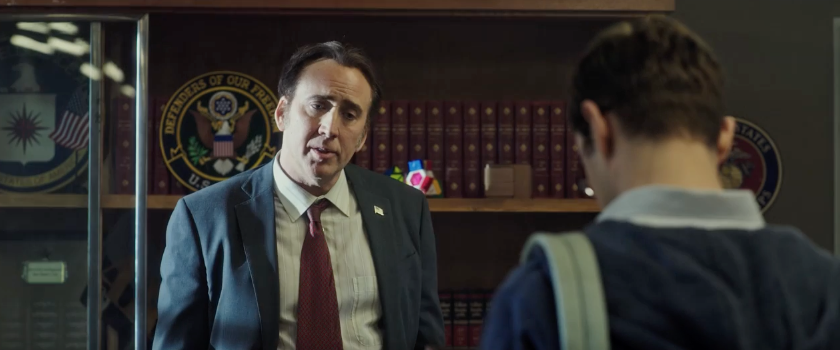
The strongest scenes during his CIA training aren’t the actual training exercises but the quiet moments he has with senior analyst and teacher Hank Forrester (Nicolas Cage) as they bond over the latter’s collection of vintage encryption and code-breaking devices. Nicolas Cage plays the man as a wise mentor and exudes an easy-going charisma as he tells Snowden how things work. It was a smart move on Stone’s part to have a skilled actor like Cage deliver exposition dialogue in a way that is engrossing. His chemistry with Gordon-Levitt is so enjoyable to watch that I’d love to see a film with just Forrester and Snowden.

Stone attempts to humanize Snowden through his interactions with girlfriend Lindsay Mills (Shailene Woodley) in a meet-cute in Washington, D.C. as his conservative patriotism playfully clashes with her leftist ideals. Their initial scenes foreshadow Snowden’s political awakening. Fortunately, Stone keeps Mills throughout the film thereby making her a crucial part of Snowden’s life and preventing her character from being reduced to the stock girlfriend role. It doesn’t hurt that he cast a strong actress in the part with Shailene Woodley.
Stone shows how Snowden’s belief in the U.S. government is gradually eroded when he is shown surveillance programs that can search anyone’s private email, chats, and hijack the camera on someone’s laptop for anything and this disturbs him. It is all fascinating and frightening at the same time because of its insidious nature. Stone gradually ratchets up the tension as Snowden and the journalists try to figure out what to do with the massive amount of information he’s given them and the implications of it.

Not surprisingly, the most compelling scenes in Snowden are the ones with him holed up in his hotel room with the Poitras, Greenwald and Scottish journalist Ewen MacAskill (Tom Wilkinson) telling them what he knows. It is these scenes where Joseph Gordon-Levitt really excels by eerily channeling Snowden, right down to his distinctive voice and subtly mimicking his physical mannerisms.

Stone wisely doesn’t fall into the same trap as other films about computer hackers and try to portray what they do in a sexy, stylish way in order to keep our attention. Instead, he portrays it matter-of-factly as just another component of the film. Stylistically, Stone has left the full-throttled, multi-layered approach of films like JFK and Natural Born Killers (1994) behind long ago in favor of a more straightforward look with an emphasis on character and story. Unlike a lot of other films in the genre, Snowden not only puts a human face on it but also explores its moral and political implications in a thought-provoking way. Sadly, like Michael Mann’s Blackhat (2015), mainstream audiences weren’t interested in films about computer hacking no matter how compelling and Snowden failed to recoup its modest budget, which is a shame because his life is such a gripping story.


Snowden isn’t some fast-paced Jason Bourne spy movie. It is about a real person that decided to take an extreme risk to do what he thought was right. Like the protagonists in some of Stone’s other films, Snowden had to make a crucial decision that impacted the rest of his life but does it because he is compelled to do so through a strong sense of what he believes is right. Whether you agree or disagree with what he did, the film raises some troubling questions about our basic freedoms and rights in an age where we are under constant digital surveillance.

Friday, September 5, 2014

Sin City: A Dame to Kill For

In 2005, Robert Rodriguez adapted the comic book Sin City into a film with help from its creator Frank Miller who co-directed it. Convincing the veteran comic book writer/artist to come on board was a smart move on the filmmaker’s part as it assured that Miller’s luridly violent noir tales would be faithfully translated. This was achieved through a then-groundbreaking green screen environment that allowed Rodriguez to place his actors in Miller’s stylish world with a striking look comprised of black and white with strategic splashes of color. This innovative approach attracted a star-studded cast that included Bruce Willis, Mickey Rourke, Clive Owen and Benicio Del Toro among others. The final result dazzled audiences and was a commercial success.

A sequel seemed inevitable, but instead Rodriguez went on to team up with Quentin Tarantino on the box office misfire that was the Grindhouse double bill (2007) while Miller applied the Sin City aesthetic to a disastrous adaptation of Will Eisner’s comic book The Spirit (2008). Over the years, talk of a sequel surfaced occasionally with the likes of Johnny Depp and Angelina Jolie being mentioned in potential leading roles. Nine long years later and the stars (and money) aligned for Rodriguez and Miller to reunite with Sin City: A Dame to Kill For (2014). The film promptly tanked at the box office and received mixed to negative reviews. What happened? Did Miller and Rodriguez wait too long? A green screen-heavy film is no longer a novelty. Two cast members with characters in the film had passed away and some roles have been recast. The general consensus seems to be that they waited too long to make a sequel and interest in the film had waned.

Some might complain that A Dame to Kill For is just more of the same. As a big fan of the first film this is not necessarily a bad thing. After seeing Sin City, I wanted to see more of Miller’s stories brought to life. In addition to adapting A Dame to Kill For and the short story “Just Another Saturday Night” from the Booze, Broads, & Bullets collection, Miller created two new stories specifically for the film – “The Long Bad Night” and “Nancy’s Last Dance.” By doing this, he has given the fans a real treat by offering two stories where the outcome is not known and introducing new characters into this universe.


In “Just Another Saturday Night,” Marv (Mickey Rourke) wakes up amidst a car accident unable to remember how he got there. He proceeds to recall what happened via flashback on a snowy Saturday night. This segment is a nice way to reacquaint us to the brutal yet darkly humorous world of Sin City.

“The Long Bad Night” introduces us to Johnny (Joseph Gordon-Levitt), a confident gambler who decides to take on Senator Roark (Powers Boothe), the most powerful man in the city, in a high-stakes poker game and gets more than he bargained for. It’s a lot of fun to see Joseph Gordon-Levitt square off against Powers Boothe, the former playing a young upstart and the latter an evil, influential man.

The centerpiece of the film is “A Dame to Kill For”, which features Dwight McCarthy (Josh Brolin) as a private investigator taking photographs of a businessman (Ray Liotta) cheating on his wife with a hooker (Juno Temple). When the man tries to kill her, Dwight intervenes. He has a tortured past, which involves keeping his homicidal impulses in check.

Afterwards, Dwight gets a call from an ex-lover by the name of Ava Lord (Eva Green), a beautiful woman married to a very rich man. She’s in some kind of trouble and he finds himself drawn into her tangled web yet again. He soon runs afoul of her imposing bodyguard Manute (Dennis Haysbert) who proceeds to work him over. Realizing that he’s out of his depth and bent on rescuing Ava, Dwight enlists Marv’s help, which only complicates things in typical noir fashion.


In “Nancy’s Last Dance,” Nancy Callahan (Jessica Alba) is an exotic dancer still haunted by the death of her lover John Hartigan (Bruce Willis) and is obsessed with avenging his death by killing Roark, the man responsible for it. Over time, she’s counseled/haunted by Hartigan’s ghost, which drives her increasingly crazy.

Actors Josh Brolin, Joseph Gordon-Levitt and Eva Green slip seamlessly into the Sin City world. It helps that they have that old school noir look, especially Brolin with his chiseled tough guy features and gravelly voice – perfect for his character’s voiceover narration. In no time the actor makes you forget that he plays a character once portrayed by Clive Owen. Gordon-Levitt is excellent as the young newcomer with a secret and manages to elicit sympathy for his ultimately doomed character. Green plays Sin City’s reigning femme fatale. The stunning actress has an alluring, exotic look and can turn a vulnerability on and off at will all the while playing a cold-hearted manipulator of men. Green gives key line deliveries the right venomous spin that makes Ava Lord a fearsome figure in this world.

It’s great to see Mickey Rourke return to the role of Marv, a character he inhabits so well. He brings a world-weary charm and a much-needed dose of dark humor to the film. Powers Boothe, who only had a minor role in the first film, gets a much meatier part in A Dame to Kill For and it’s a lot of fun to see him sink his teeth into such a deliciously evil character. Unfortunately, Jessica Alba is once again miscast as Nancy, the stripper with a heart of gold. While she looks the part, the actress doesn’t have the chops to pull of the tricky evolution of character that goes from sweet girl traumatized by the death of loved one to a revenge-obsessed vigilante. Miller’s stylized dialogue needs to be delivered a certain way. Some actors can pull it off and others can’t. Alba falls into the latter category and it becomes painfully obvious in her segment. Even her dancing is unconvincing.


While it no longer has the technological novelty factor as an incentive (shooting it in 3D really didn’t help either), there is certainly no other film out there that looks like Sin City. There have been a few imitators since, most notably The Spirit and Max Payne (2008), but the look of the film is so specific to its universe that few have dared to emulate it. Rodriguez has said that with the first Sin City he held back somewhat stylistically for fear that it would be too much for audiences. Emboldened by its commercial success, he took the look further and made it even more faithful to Miller’s comic book. So, there are things like Ava being rendered in black and white accentuated with red lips and green eyes, and visual flourishes like Marv recounting past exploits while a tiny car chase revolves around him, or the moody storm clouds that hang heavy in the cemetery where Nancy visits Hartigan’s grave. And why not? It’s not like the characters or the world they inhabit are based on any kind of reality. They exist in a hyper-stylized neo-noir universe drenched in atmosphere.


The dialogue in A Dame to Kill For is riddled with clichés and the characters are drawn from archaic stereotypes, but that’s the point. Miller is paying homage to the Mickey Spillane crimes stories he clearly idolizes. The film immerses itself in noir clichés and wears them proudly like a badge of honor, refusing to make any excuses for trading in them. There’s really nothing more to it than that, which may make the film seem instantly forgettable, but Rodriguez’s film never aspires to be art as it is unrepentedly sexual and violent with very few if any redeeming characters. The first Sin City film came out at the right time and tapped into popular culture zeitgeist. A Dame to Kill For is not so lucky, but you have to give Miller and Rodriguez credit for sticking to their guns and delivering another faithful adaptation of the comic book which may only appeal to fans and probably won’t convert the uninitiated.

Thursday, July 29, 2010

JGL Blog-a-thon: The Lookout

BLOGGER'S NOTE: This post is part of the Joseph Gordon Levitt Blog-a-thon over at the Detailed Criticisms blog. This is also a reprint of a DVD review I did for this film a few years ago.

With his adaptation of Elmore Leonard’s novel, Out of Sight, Scott Frank demonstrated a knack for crime thrillers with plenty of plot twists and double crosses. Now, he’s finally gotten the chance to direct his own movie and the result is The Lookout (2007), a neo-noir that evokes other crime movies like Charley Varrick (1973) and Fargo (1996).


Chris Pratt (Joseph Gordon-Levitt) is a young hockey player with a promising career that is snuffed out in an instant thanks to a car accident that he caused. Four years later, he’s working as a night janitor at a local Midwestern bank located out in the middle of nowhere and dealing with a head injury from the accident. He has to write down everything that he does to get ready every day. His old life is gone and his new one is one mundane day after another. Chris now lives with Lewis (Jeff Daniels), his blind roommate who helps the young man out with things around their apartment.

Chris meets Gary (Matthew Goode) at a bar one night. He’s a genial guy who befriends the young man over beers. Chris also meets a beautiful young woman named Luvlee (Isla Fisher) who is friends with Gary. They quickly go to work on Chris, Gary appealing to his brain and Luvlee to his heart. They make him feel like he belongs which is important to him because his family doesn’t know how to relate to him anymore. Pretty soon Gary tells Chris about a bank heist he plans to pull with his buddies. The bank that they are targeting just happens to be the one that Chris works at. Gary dangles the proverbial carrot in front of Chris with the promise of money and the power that comes with it. He is very persuasive and knows exactly which buttons to push. Like most heist films, things do not go according to plan and the rest of the film deals with the aftershocks.

Joseph Gordon-Levitt continues his knack for offbeat roles. He does a great job portraying someone with neurological damage and the frustration that comes from not being able to do simple things like opening a can of food or remembering someone’s name. He also conveys the guilt his character feels over the car accident that cost two of his friends their lives and robbed him of a promising future. We see how he tries to hide his disorder and the frustration of not being able to do basic things. It’s a performance grounded in realism that is in contrast to this stylized noir world. It doesn’t hurt that he is surrounded by cold, detached characters, and this makes him very sympathetic as well.

Jeff Daniels steals pretty much every scene he’s in as Chris’ genial roommate. The actor displays a dry sense of humor that is very funny to see in action. He and Gordon-Levitt’s character make for very unlikely roommates to say the least but the two actors make it work thanks to the excellent chemistry they have together. Along with The Squid in the Whale (2005) and Good Night, and Good Luck (2005), Daniels is turning out to be quite an excellent character actor appearing in several well-made independent films.

Scott Frank has a keen visual sense, adopting a predominantly dark color scheme in keeping with the neo-noir tradition. With The Lookout, he has crafted a clever little thriller with a fascinating protagonist at its center. What could have easily been a forgettable film is anchored by yet another riveting performance by Gordon-Levitt.

Special Features:

“Behind the Mind of Christ Pratt” features an interview with the film’s star, Joseph Gordon-Levitt. He was drawn to the complexity of the character and ended up living with the role for almost a year. He talks about how he portrayed Chris and speaks intelligently about his take on the material.

“Sequencing The Lookout” takes a look at various aspects of the movie: the script, casting, the look, and so on in an interesting way. Frank says that he was influenced by European thrillers that emphasized character. He talks about the origins of the story as well.

Finally, there is an audio commentary by writer/director Scott Frank and his director of photography Alar Kivilo. They talk about the challenge of shooting in the wilds of Canada. It was spring when they started but the temperature was very cold. Frank isn’t afraid to point out the mistakes he made as a first-time director. With Kivilo, their comments tend to be about filmmaking techniques like the cameras they used, the type of shots for a given scene and locations used. This could come across as kind of dull if you’re not into the technical aspects of film.


Tuesday, July 20, 2010

Inception

This review first appeared on Edward Copeland's blog earlier today. I've given it a few tweaks and a polish here and there.

Ten years in the making, Inception (2010) is the culmination of Christopher Nolan’s career to date. It mixes the ingenious plot twists of his independent film darling Memento (2000) with the epic scale of his Hollywood blockbuster The Dark Knight (2008). His new film takes the heist genre to the next level by fusing it with the science fiction genre as a group of corporate raiders steal ideas by entering the dreams of their targets – think Dreamscape (1984) meets The Matrix (1999) as if made by Michael Mann. While Nolan and his films certainly wear their respective influences on their sleeve – and this one is no different (2001: A Space Odyssey, Blade Runner, Heat, The Matrix) – there is still enough of his own thematic preoccupations to make Inception distinctly his own. This film continues Nolan’s fascination with the blurring of artifice with reality. With Inception, we are constantly questioning what is real right down to the last enigmatic image.


Dom Cobb (Leonardo DiCaprio) and his team extract thoughts of value from people as they dream. However, during his jobs, he is visited by his deceased wife Mal (Marion Cotillard), a beautiful femme fatale character that serves as an increasingly dangerous distraction from the task at hand. The film’s opening sequence does an excellent job establishing how Cobb and his team extract information from the dream of Saito (Ken Watanabe), a Japanese businessman, in a visually arresting sequence. He catches up with Cobb in the real world and offers him a new deal: plant an idea in Robert Fischer’s (Cillian Murphy) mind that will help break-up his father’s vast empire before it becomes too powerful, and do it in a way so that it seems like Fischer thought of it for it to work. This is something that has only been done once before and Cobb was the person that pulled it off but can he do it again? In exchange for completing the job, Saito will make the necessary arrangements so that Cobb can return home to the United States where his children live but where he is also wanted by the authorities in connection with his wife’s death. So, Cobb recruits a literal dream team of experts to help him pull off the most challenging job of his career.

Inception delves into all kinds of aspects of dreams as evident in a scene early on where Cobb explains how they work, how to design and then navigate them. While there is a lot of exposition dialogue to absorb during these scenes, Nolan also keeps things visually interesting at the same time. This is arguably the most cerebral part of the film as he explores all sorts of intriguing concepts and sets up the rules for what we’ll experience later on – pretty heady stuff for a Hollywood blockbuster. And when he isn’t examining fascinating ideas, he’s orchestrating exciting and intense action sequences. There’s an incredible sequence where Nolan juggles three different action sequences operating on three different levels of dreams that are all impressively staged while also a marvel of cross-cutting editing. He anchors Inception with the character of Cobb and his desire to return home to his children while also dealing with the death of his wife. It gives the film an emotional weight so that we care about what happens to him. It also raises the stakes on the Fischer job.

Cobb continues Nolan’s interest in tortured protagonists. With Memento, Leonard Shelby tries to figure out who murdered his wife while operating with no short-term memory. Insomnia (2002) featured a cop with a checkered past trying to solve a murder on very little sleep. The Batman films focus on a costumed vigilante that wages war on criminals as a way of dealing with the guilt of witnessing his parents being murdered when he was a child. With The Prestige (2006), magician Robert Angier is tormented by the death of his wife and an all-consuming passion to outdo a rival illusionist. Inception’s Cobb also has a checkered past and is haunted by the death of loved one. Leonardo DiCaprio delivers what may be his finest performance to date, playing a complex, and layered character with a rich emotional life. Cobb must come to terms with what happened to his wife and his culpability in what happened to her. DiCaprio conveys an emotional range that he has not tapped into to this degree before. There’s a captivating tragic dimension to Cobb that the actor does an excellent job of expressing so that we become invested in the dramatic arc of his character.

Nolan populates Inception with a stellar cast to support DiCaprio. The indie film world is represented by the likes of Joseph Gordon-Levitt and Tom Hardy while also drawing from international cinema with Ken Watanabe and Cillian Murphy. Gordon-Levitt and Hardy, in particular, are stand-outs and their banter provides several moments of enjoyable levity during the course of this intense, engrossing film. And it wouldn’t be a Nolan film without his good luck charm, Michael Caine, making an appearance. As he has done in the past, Nolan plucks a once dominant actor from the 1980s, now languishing in relative obscurity – think Rutger Hauer in Batman Begins (2005) or Eric Roberts in The Dark Knight – and gives them a high-profile role. Inception gives Tom Berenger some well-deserved mainstream exposure after languishing in direct-to-video hell, reminding everyone what a good actor he can be with the right material.

Regardless if whether you like Inception or not, you’ve got to admire Nolan for making a film that is not a remake, a reboot, a sequel or an adaptation of an existing work. It is an ideal blend of art house sensibilities, with its weighty themes, and commercial conventions, like exciting action sequences. Capitalizing on the massive success of The Dark Knight, Nolan has wisely used his clout to push through his most personal and ambitious film to date. With Inception, he has created a world on a scale that he’s never attempted before and been able to realize some truly astonishing visuals, like gravity-defying fight scenes and having characters encounter a location straight out of the mind of M.C. Escher. It has been said that the power of cinema is the ability to transport you to another world and to dream with our eyes open. Inception does this. Nolan has created a cinematic anomaly: a summer blockbuster film with a brain.

Devin Faraci over at CHUD offers some great analysis and one of the best theories on what the film means. Over at Cinema Blend is a great visual guide that breaks down the various dream levels in the film. New York magazine has a fantastic interview with one of the film's stars and he offers some fascinating insights into the meanings of the film. Sam Adams, over at Salon.com has a great, in-depth look at the film that lays it all out in incredible detail. Finally, Kristin Thompson and David Bordwell offer a fantastic, in-depth analysis of how Inception works stylistically on their blog Observations on film art.
 
Feel free to offer your observations, opinions, insights and theories on Inception in the comments section below.