"...the main purpose of criticism...is not to make its readers agree, nice as that is, but to make them, by whatever orthodox or unorthodox method, think." - John Simon

"The great enemy of clear language is insincerity." - George Orwell
Showing posts with label Powers Boothe. Show all posts

Friday, July 7, 2017

Guyana Tragedy: The Story of Jim Jones

The first time I ever heard of Jim Jones and the tragic events of Jonestown was from the absolutely gripping episode of In Search Of…, a television series that investigated controversial and memorable historical figures, and paranormal phenomena, hosted by Leonard Nimoy from the late 1970s to the early 1980s. The eyewitness accounts and actual news footage taken before and after the mass murder of 909 people on November 18, 1978 at the direction of and orders from their leader, Jones, was disturbing, even more so because it actually happened.

It didn’t take long for a fictionalized account of what went down to be made, entitled, Guyana: Crime of the Century (1979), a Mexican exploitation movie starring Stuart Whitman, Gene Barry and Joseph Cotton. The next year, a classier, more fact-based docudrama was made. Guyana Tragedy: The Story of Jim Jones was a T.V. miniseries based on Charles A. Krause’s book, Guyana Massacre: The Eyewitness Account and starred Powers Boothe as Jones. It chronicled the man’s journey from devoutly religious child growing up in Indiana to fanatical cult leader in Guyana.

The story begins with Jones (Boothe) testing his followers’ loyalty while Congressman Leo J. Ryan (Ned Beatty) plans to fly down to Guyana and investigate reports that some of his followers are being mistreated and others being held against their will. Jones is told of Ryan’s impending arrival and flashes back to his childhood. This miniseries attempts to dig deep and show his early adoption of The Bible as a way to live his life. It also provides salvation from a dysfunctional household where his strict father (Ed Lauter) abused his mother (Diane Ladd) until she took her son and left.

Jones grows up to be a preacher, standing up to a racist barber that refuses to cut the hair of a little African-American boy. He espouses that everyone is equal in the eyes of God. He is soon put in charge of a struggling congregation consisting mostly of a few elderly parishioners and literally going door-to-door asking people to come to his church. It works and Jones has a racially integrated congregation at a time and in a place where that was vehemently objected to by some.

He eventually forms the Peoples Temple, a venue where he can preach his progressive views. Boothe is excellent in these early scenes as a straight arrow that faithfully believes in religion and its ability to bring everyone together regardless of color. He’s also a great salesman, using his charisma to not only attract people to his church but also get them to contribute financially or donate items. Jones genuinely cares about people, feeding and educating them as well as the community at large.

Jones meets with Father Divine (James Earl Jones), a spiritual leader that believed he was God, and who is doing what he’s doing only much more successful at it. Their brief meeting is a revelation for Jones and shows him a way to build up his congregation: he must develop a bigger personality and be so charismatic that people are willing to do anything and give everything for him. It is the beginning of the Jim Jones cult of personality.

Guyana Tragedy takes the time to show why so many people believed so devoutly in Jones. Initially, he honestly wanted to and did help people but the bigger his congregation got, the tougher it became to do everything he wanted to do. He began to rely on drugs to keep his energy up but he also staged fake faith healings and cheated on his wife (Veronica Cartwright) only to rationalize away these things by saying that he was close to a “vision of life everlasting,” claiming that he was “The Chosen One.”

Anybody who knows anything about Jones’ story knows that everything that happens before Jonestown is prologue, anticipating the centerpiece of the miniseries when Jones and his people move to Guyana and make a go of it, building an agrarian society. It is a disturbing testimony to Jones’ hold on that many people that he was able to convince them to start a new life with him in a foreign country.

The last hour shows how things go from bad to worse in Jonestown. His followers work long, grueling hours while Jones tells them the “news” from around the world over a loudspeaker. The attractive young women are drugged and have sex with him. He then dissolves all marriages among his followers and pairs them up himself. Jones believes he has created a utopia but it’s actually hell on earth.

Powers Boothe excels at Jones’ fiery preaching style, delivering the man’s sermons with a conviction and intensity that is something to behold. During these sermons, the actor adopts a kind of seductive purr in his voice as he woos his congregation and then brings a powerful intensity when Jones gets worked up with his fire and brimstone rhetoric. It is fascinating to see how he works a room in such a dynamic fashion. The actor does a masterful job of showing Jones’ gradual shift in ideology, from idealistic symbol of change to an increasingly paranoid man with a messiah complex. He is absolutely riveting in his depiction of Jones’ descent into paranoid delusions, convinced that the CIA is plotting against and spying on him.

The cast is an embarrassment of riches featuring the likes of Brad Dourif as a junkie that is taken in by Jones and Diana Scarwid as his desperate wife that find salvation with the Peoples Temple. Veronica Cartwright plays Jones’ long-suffering wife that is first to recognize and call him on his changes in attitude and behavior but ultimately remains loyal to him. Meg Foster and Randy Quaid show up in minor roles as loyal employees of Jones’ day-to-day operations that have a change of heart when he keeps their child from them, claiming the boy to be his own. These talented actors enter and exit Boothe’s orbit throughout the show, playing well off of him, helping paint a portrait of a complex man.

Originally, director William A. Graham approached Tommy Lee Jones to play Jim Jones but he was busy filming Coal Miner’s Daughter (1980) and was unable to do it. Someone recommended then-relatively unknown actor Powers Boothe who got the part. To research the role, the actor interviewed former Peoples Temple members and watched any footage of Jones that was available. He asked former followers, mostly women, why Jones attracted so many people to his cause: “The answer I heard most was that Jones had more sex appeal than any man they’d ever seen.” Boothe has said that he approached the role as if he was playing King Lear and with his portrayal, set out to avoid the cliché vision of Jones as “a maniacal ogre. Wrong. He was charming, sweet and a fabulous speaker. If someone chooses to take that power, he can lead a lot of lambs to slaughter.”

There was an infamous sign displayed prominently in Jonestown that said, “Those who do not remember the past are condemned to repeat it.” It is an important reminder that we cannot let mad men like Jones run rampant. One of the lessons to be learned from Jonestown is that we must be vigilant against cults that are harmful under the guise of helping people in the name of God.

The last few minutes of Jonestown are as harrowing as you’d expect, but ultimately nothing is as horrific as the real thing and that is the problem that all dramatizations of Jonestown face. No matter how faithful a recreation it will always pale to what actually happened as the chilling newsreel footage and photographs of what went down there in that In Search Of… episode powerfully demonstrate. Like any good historical biopic should do, it is a good jumping off point for one to do their own research and dig deeper into the subject if they are so inclined. That being said, this does nothing to diminish Boothe’s powerhouse performance as Jones. He commits completely to the role and brings the man vividly to life.


SOURCES

Patches, Matt. “Q&A: Powers Boothe on Sin City: A Dame to Kill For, Deadwood, and His Heavy Career.” Grantland. August 22, 2014.

Scott, Vernon. “The Rev. Jim Jones Haunts Actor.” The Hollywood Reporter. May 27, 1987.


Sheff, David. “An Unknown Actor Re-Creates the Horror of Jonestown and Makes His Name: Powers Boothe.” People. April 20, 1980.

Friday, August 7, 2015

Southern Comfort

Walter Hill’s best films are gritty, no frills explorations of the violent conflict between men, be it the lone gang that has to run a dangerous gauntlet through New York City in The Warriors (1979) or a veteran cop’s relentless pursuit of a ruthless escaped convict in 48 Hrs. (1982). He is also interested in how people forge close bonds under extreme circumstances and this is certainly true of Southern Comfort (1981), a little-seen action film about a squad of National Guardsmen that become lost in the rural bayou country of Louisiana and run afoul of the local Cajun people.

It’s 1973 and the National Guard are out on maneuvers. In his typical economic fashion, Hill introduces a squad of nine men and immediately establishes conflict between some of them, like Staff Sergeant Poole (Peter Coyote) warning recent transfer Corporal Hardin (Powers Boothe) that he won’t tolerate any kind of insubordination. PFC Spencer (Keith Carradine) is a racist and PFC Stuckey (Lewis Smith) is an arrogant prick that gleefully fires his weapon at one of his fellow soldiers (the gun has blanks). They talk tough but as Spencer confides to Hardin, they’re basically a good group of guys.

The squad’s arrogance proves to be their undoing. First, they take three boats that don’t belong to them. Then, when they spot a few Cajun men on the shore, they show nothing but contempt with Stuckey opening fire with his gun full of blanks as a joke. The Cajuns respond by killing their squad leader and all hell breaks loose. This squad of National Guardsmen now have to navigate treacherous terrain against well-armed locals that know it way better than they do. The rest of Southern Comfort plays out as a battle for survival in classic Hill fashion.


Hill establishes the squad a dysfunctional group from the get-go and it only gets worse once they are stuck in the bayou as the men bicker amongst each other. There is even genuine distrust, like when Reece (Fred Ward) refuses to share the box of live ammunition he squirreled away before they set out on their mission. Southern Comfort takes a fascinating look at a group dynamic and how it breaks down under extreme circumstances as one-by-one the Guardsmen are picked off by frighteningly enigmatic antagonists. As the film progresses, they become tired, scared and frustrated by their predicament while some of them crack under the pressure.

Powers Boothe plays one of Hill’s trademark protagonists – a man of few words and who prefers to let his actions speak for themselves. Hardin is an anti-authoritarian type, preferring to go his own way but when it comes down to it his instinct is to survive and help those around him. He’s smart and wisely respects his opponents.

Keith Carradine’s Spencer starts off as something of a crass opportunist but as their situation gets more serious he steps up and becomes one of the few rational voices along with Hardin. He and Boothe make a great team with the former being the chattier of the two and so they play well off each other in their initially contentious relationship that evolves into grudging mutual respect – a common trait among many of Hill’s films.


In a film like this, where the characters are at the mercy of an inhospitable environment, the setting becomes another character – one that we become immersed in as Hill sets a wonderfully atmospheric mood with the opening credits playing over beautiful yet foreboding footage of the bayou while Ry Cooder’s evocative score plays on the soundtrack. The squad constantly slogs through swampy water and danger lurks behind every tree. What makes this environment even more daunting is that it is seemingly never-ending as these men become increasingly lost and disoriented.

Walter Hill made Hard Times (1975) and it had a Cajun sequence in it. Writer David Giler said to the director, “You know, those Cajuns strike me as interesting, tough guys.” The director agreed and Giler suggested that they make an adventure story incorporating them. Hill wanted to do a survival story and had already made Hard Times in Louisiana. Michael Kane was hired to write a draft, but the studio didn’t like it. The project was put into turnaround. Giler and Hill did some more rewriting of their own and found independent financing. The two men had a deal with 20th Century Fox to acquire and develop “interesting, commercial scripts that could be produced cheaply,” as Hill said in an interview. The studio ended up distributing the film.

During the two-day cast rehearsal prior to principal photography, Hill told his actors, “A lot of people will perceive this to be a metaphor for Vietnam. I don’t like to make movies about metaphors … Let’s just go make a movie about guys caught in a situation.” Hill shot Southern Comfort in the swamps in the Castle Lake area outside of Shreveport six days a week for nine grueling weeks. He said, “And just to get out there took this enormous drive, we had to get up four in the morning to be ready to shoot at the crack of dawn.” He remembered that the cast didn’t complain much during filming because they knew what they were all getting into and were in good physical shape. Hill recalled that it was “as tough a movie as I’ve ever done … So often you would get a camera position, you had to get a shot in a couple of minutes before the soft bottom sunk.”


Southern Comfort didn’t cost much but the studio also didn’t spend much promoting it because the subject matter wasn’t deemed all-that commercial. Roger Ebert gave the film three out of four stars and wrote, “The strength of the movie is in its look, in its superb use of its locations, and in Hill’s mastery of action sequences that could have been repetitive.” However, in his review for The New York Times, Vincent Canby wrote, “Mr. Hill chooses to photograph his material so self-consciously and so prettily, with lots of slow-motion stuff and superimpositions, that you automatically reach for a bottle of aspirin.”

Unlike many other backwoods movies where the locals are portrayed as dumb hillbillies, Southern Comfort presents the Cajuns as proud people with their own vibrant culture and thriving life nestled away from modern society. Hill doesn’t judge them and does a nice job of immersing us in their culture towards the end of the film so that they are no longer some faceless enemy in the bayou. If anything, it is the arrogant, aggressive Guardsmen that are at fault here and responsible for their own fate. After all, they took what wasn’t theirs and provoked the locals on their own turf.

The cruel irony of Southern Comfort is that infighting and the unforgiving terrain does more to decimate the squad than the local Cajun hunters. At the time, the film was seen as a commentary on the United States’ involvement in the Vietnam War – something that Hill has not denied but downplayed. Like the U.S. Army, this squad of National Guardsmen are completely out of their depth and at the mercy of an environment they aren’t equipped to deal with and facing an opponent they don’t understand. Today, we are still mired in war with our troops at the mercy of an equally imposing environment, making Southern Comfort as timely today as it was back in 1981.


SOURCES

Markowitz, Robert. “Visual History with Walter Hill.” DGA.

Rizov, Vadim. “Tough Little Stories: Director Walter Hill at 92Y Tribeca.” Filmmaker. January 29, 2013.


Zelazny, Jon. “Kicking Ass with Walter Hill.” Hollywood Interview. December 8, 2012.

Friday, September 5, 2014

Sin City: A Dame to Kill For

In 2005, Robert Rodriguez adapted the comic book Sin City into a film with help from its creator Frank Miller who co-directed it. Convincing the veteran comic book writer/artist to come on board was a smart move on the filmmaker’s part as it assured that Miller’s luridly violent noir tales would be faithfully translated. This was achieved through a then-groundbreaking green screen environment that allowed Rodriguez to place his actors in Miller’s stylish world with a striking look comprised of black and white with strategic splashes of color. This innovative approach attracted a star-studded cast that included Bruce Willis, Mickey Rourke, Clive Owen and Benicio Del Toro among others. The final result dazzled audiences and was a commercial success.

A sequel seemed inevitable, but instead Rodriguez went on to team up with Quentin Tarantino on the box office misfire that was the Grindhouse double bill (2007) while Miller applied the Sin City aesthetic to a disastrous adaptation of Will Eisner’s comic book The Spirit (2008). Over the years, talk of a sequel surfaced occasionally with the likes of Johnny Depp and Angelina Jolie being mentioned in potential leading roles. Nine long years later and the stars (and money) aligned for Rodriguez and Miller to reunite with Sin City: A Dame to Kill For (2014). The film promptly tanked at the box office and received mixed to negative reviews. What happened? Did Miller and Rodriguez wait too long? A green screen-heavy film is no longer a novelty. Two cast members with characters in the film had passed away and some roles have been recast. The general consensus seems to be that they waited too long to make a sequel and interest in the film had waned.

Some might complain that A Dame to Kill For is just more of the same. As a big fan of the first film this is not necessarily a bad thing. After seeing Sin City, I wanted to see more of Miller’s stories brought to life. In addition to adapting A Dame to Kill For and the short story “Just Another Saturday Night” from the Booze, Broads, & Bullets collection, Miller created two new stories specifically for the film – “The Long Bad Night” and “Nancy’s Last Dance.” By doing this, he has given the fans a real treat by offering two stories where the outcome is not known and introducing new characters into this universe.


In “Just Another Saturday Night,” Marv (Mickey Rourke) wakes up amidst a car accident unable to remember how he got there. He proceeds to recall what happened via flashback on a snowy Saturday night. This segment is a nice way to reacquaint us to the brutal yet darkly humorous world of Sin City.

“The Long Bad Night” introduces us to Johnny (Joseph Gordon-Levitt), a confident gambler who decides to take on Senator Roark (Powers Boothe), the most powerful man in the city, in a high-stakes poker game and gets more than he bargained for. It’s a lot of fun to see Joseph Gordon-Levitt square off against Powers Boothe, the former playing a young upstart and the latter an evil, influential man.

The centerpiece of the film is “A Dame to Kill For”, which features Dwight McCarthy (Josh Brolin) as a private investigator taking photographs of a businessman (Ray Liotta) cheating on his wife with a hooker (Juno Temple). When the man tries to kill her, Dwight intervenes. He has a tortured past, which involves keeping his homicidal impulses in check.

Afterwards, Dwight gets a call from an ex-lover by the name of Ava Lord (Eva Green), a beautiful woman married to a very rich man. She’s in some kind of trouble and he finds himself drawn into her tangled web yet again. He soon runs afoul of her imposing bodyguard Manute (Dennis Haysbert) who proceeds to work him over. Realizing that he’s out of his depth and bent on rescuing Ava, Dwight enlists Marv’s help, which only complicates things in typical noir fashion.


In “Nancy’s Last Dance,” Nancy Callahan (Jessica Alba) is an exotic dancer still haunted by the death of her lover John Hartigan (Bruce Willis) and is obsessed with avenging his death by killing Roark, the man responsible for it. Over time, she’s counseled/haunted by Hartigan’s ghost, which drives her increasingly crazy.

Actors Josh Brolin, Joseph Gordon-Levitt and Eva Green slip seamlessly into the Sin City world. It helps that they have that old school noir look, especially Brolin with his chiseled tough guy features and gravelly voice – perfect for his character’s voiceover narration. In no time the actor makes you forget that he plays a character once portrayed by Clive Owen. Gordon-Levitt is excellent as the young newcomer with a secret and manages to elicit sympathy for his ultimately doomed character. Green plays Sin City’s reigning femme fatale. The stunning actress has an alluring, exotic look and can turn a vulnerability on and off at will all the while playing a cold-hearted manipulator of men. Green gives key line deliveries the right venomous spin that makes Ava Lord a fearsome figure in this world.

It’s great to see Mickey Rourke return to the role of Marv, a character he inhabits so well. He brings a world-weary charm and a much-needed dose of dark humor to the film. Powers Boothe, who only had a minor role in the first film, gets a much meatier part in A Dame to Kill For and it’s a lot of fun to see him sink his teeth into such a deliciously evil character. Unfortunately, Jessica Alba is once again miscast as Nancy, the stripper with a heart of gold. While she looks the part, the actress doesn’t have the chops to pull of the tricky evolution of character that goes from sweet girl traumatized by the death of loved one to a revenge-obsessed vigilante. Miller’s stylized dialogue needs to be delivered a certain way. Some actors can pull it off and others can’t. Alba falls into the latter category and it becomes painfully obvious in her segment. Even her dancing is unconvincing.


While it no longer has the technological novelty factor as an incentive (shooting it in 3D really didn’t help either), there is certainly no other film out there that looks like Sin City. There have been a few imitators since, most notably The Spirit and Max Payne (2008), but the look of the film is so specific to its universe that few have dared to emulate it. Rodriguez has said that with the first Sin City he held back somewhat stylistically for fear that it would be too much for audiences. Emboldened by its commercial success, he took the look further and made it even more faithful to Miller’s comic book. So, there are things like Ava being rendered in black and white accentuated with red lips and green eyes, and visual flourishes like Marv recounting past exploits while a tiny car chase revolves around him, or the moody storm clouds that hang heavy in the cemetery where Nancy visits Hartigan’s grave. And why not? It’s not like the characters or the world they inhabit are based on any kind of reality. They exist in a hyper-stylized neo-noir universe drenched in atmosphere.


The dialogue in A Dame to Kill For is riddled with clichés and the characters are drawn from archaic stereotypes, but that’s the point. Miller is paying homage to the Mickey Spillane crimes stories he clearly idolizes. The film immerses itself in noir clichés and wears them proudly like a badge of honor, refusing to make any excuses for trading in them. There’s really nothing more to it than that, which may make the film seem instantly forgettable, but Rodriguez’s film never aspires to be art as it is unrepentedly sexual and violent with very few if any redeeming characters. The first Sin City film came out at the right time and tapped into popular culture zeitgeist. A Dame to Kill For is not so lucky, but you have to give Miller and Rodriguez credit for sticking to their guns and delivering another faithful adaptation of the comic book which may only appeal to fans and probably won’t convert the uninitiated.

Friday, March 23, 2012

Extreme Prejudice


Film director Walter Hill has had, at times, a frustratingly and wildly uneven career that features stone cold classics (The Warriors) alongside baffling misfires (Crossroads). His main stock and trade is old school tough guy action films and they don’t come anymore badass than the criminally underrated Extreme Prejudice (1987). Based on a story co-written by John Milius (Apocalypse Now) and starring Nick Nolte and Powers Boothe, it was Hill’s two-fisted homage to the films of Sam Peckinpah who he had worked for early on his career as the screenwriter for The Getaway (1972). Like many of Hill’s own action films, Extreme Prejudice is a modern western featuring two uncompromising men at odds with one another.

Six mysterious men show up in El Paso, Texas. Officially listed as dead by the United States government, they are part of an elite top-secret military unit led by the no-nonsense Paul Hackett (Michael Ironside), a D.E.A. agent. We soon meet Texas Ranger Jack Benteen (Nick Nolte), a lawman with the cojones to go into a crowded Mexican bar with a loaded rifle looking for a suspect only to coolly gun him down when the guy pulls a pistol. He teams up with local county sheriff Hank Pearson (Rip Torn), the man who taught him how to be a lawman. It turns out that the suspect was a “poor dirt farmer” running dope for Cash Bailey (Powers Boothe) in order to make ends meet. Cash is the local drug kingpin and a man so tough he lets a scorpion crawl along his hand before crushing it. He and Jack were best friends in high school but now they are on opposite sides of the law. Unbeknownst to Jack, Hackett and his men are intent on busting Cash as well.

Nick Nolte plays one of Hill’s trademark laconic men of action and of few words, like the enigmatic getaway driver in The Driver (1978), Swan in The Warriors (1979) and Tom Cody in Streets of Fire (1984). Jack and Cash are throwbacks to a bygone era. 100 years ago they’d have been gunslingers in the Wild West. Nolte has got the steely determination thing down cold and an innate understanding of Hill’s worldview, embodying it with ease. Like many of the director’s protagonists, Jack doesn’t like to talk about his feelings, not even to his long-suffering girlfriend (Maria Conchita Alonso). He’d rather do something than talk about it. It’s great to see him reunited with Hill after their initial collaboration on 48 Hrs. (1982). In an ideal world, they would be making all kinds of films together with Nolte the De Niro to Hill’s Scorsese, both bringing out the best in each other.

For the role of Jack, Hill wanted someone who was “representative of the tradition of the American West – taciturn, stoical, enduring,” and had Nolte watch a lot of films starring Gary Cooper, Randolph Scott and John Wayne. Nolte wanted to recapture “the demeanor of how those ‘40s characters carried themselves – how they dressed and carried their guns.” In order to play a credible Texas Ranger, the actor asked writer friend Peter Gent (North Dallas Forty) to recommend someone to act as a model for his character. Gent suggested real-life Ranger Joaquin Jackson. He and Nolte went over the screenplay and incorporated more of the type of language Rangers use and their relationship with other law enforcement agencies.

In a precursor to his grinning baddie in Tombstone (1993), Powers Boothe plays a genial antagonist in Extreme Prejudice while also sporting a dapper white suit. Cash sees the drug trade as simply giving the people what they want. Early on, Boothe has a nice scene with Nolte where their two characters meet and Jack warns Cash that if he crosses the border into the U.S. he will bust him and his operation. Unfazed and as cool as they come, Cash says to his old friend, “I got a feeling the next time we run into each other we’re gonna have a killing. Just a feeling.” Think of this scene as the pulpy precursor to the legendary diner scene in Heat (1995) between Robert De Niro and Al Pacino only with two legendary character actors instead. The message in both scenes is the same: the next time Cash and Jack meet, one of them is not going to survive the encounter. For any fan of these two actors, this scene (and their final one at the end of the film) is a lot of fun to watch as these forces of nature square off against each other with Cash being gregarious yet still threatening and Jack all stoic determination. With his portrayal, Boothe has said that he wanted Cash to be “multi-faceted, a fully-rounded human being.” I don’t know if he achieves that exactly, but Cash is certainly more than a mere stock villainous character.

The cast of Extreme Prejudice is populated with an embarrassment of character acting riches. William Forsythe (The Devil’s Rejects) plays a grinning good ol’ boy troublemaker; Michael Ironside (Scanners) is the all-business leader of a group of soldiers; Clancy Brown (Highlander) is one of his reliable henchmen; and Rip Torn plays Jack’s mentor who recognizes what Cash represents: “How it comes around. Right way’s the hardest. Wrong way’s the easiest. Rule of nature, like water seeks the path of least resistance so you get crooked rivers and crooked men.” Well said, sir!

Hill not only indulges in his Peckinpah admiration with some of the film’s themes but more explicitly in how he stages and edits the exciting action sequences complete with slow motion carnage that culminates in the climactic bloodbath between Jack, Hackett and his men and Cash and his private army that evokes the penultimate showdown in The Wild Bunch (1969). This is also evident Hill’s storytelling method as Extreme Prejudice is trimmed of any unnecessary narrative fat. Every scene services the story with refreshing efficiency by someone who knows how to tell a story and tell it well.

At the time, Extreme Prejudice was viewed as Hill’s take on the drug wars and the U.S. government’s handling of it with Jack as his mouthpiece when he tells Hackett at one point, “Bunch of bureaucratic fat asses fluffing their duff. They been sitting on my request for drug information for over a year but it’s classified. They’re afraid somebody or some country’s gonna get their feelings hurt.” Hill clearly sees the government as an impediment rather than a resource to men like Jack who are fighting the war in the trenches, dealing with it on a daily basis. The director said in an interview that he saw the film as a critique of “machismo politics” and of “American military involvement beyond our borders, beyond constitutional means.”

Extreme Prejudice is highly critical of the drug wars but refuses to be preachy about it as is the tendency of films like Traffic (2000). Hill is more interested in depicting the struggles of foot soldiers like Jack and how it affects him personally. It also suggests that the government regards people like Hackett and his men as “just numbers on a bureaucratic desk,” as one character puts it. Jack and Cash are above all that because they don’t care about the system. They work within it when they have to but have their own personal code of honor, which they follow. This highly critical viewpoint may explain why it took 10 years for the film to get made, going through several studios and directors because of its “political ramifications” as Boothe said in an interview.

Extreme Prejudice received a perfunctory theatrical release and was not a commercial success. It received mostly positive reviews from critics. Roger Ebert gave the film three out of four stars and wrote, “What makes the film good are Hill’s style and the acting.” In her review for The New York Times, Janet Maslin wrote, “If Mr. Hill, whose best films have a genuinely hard-boiled glamour, never intends this as parody, neither is he ever more than a hair away.” The Chicago Tribune’s Dave Kehr wrote, “If characters are caught in a shrinking world that leaves no room for notions as grand as ‘good’ and ‘evil,’ but only a sordid, creeping malignancy that levels everything in its path.” In his review for the Los Angeles Times, Kevin Thomas wrote, “Sensational rather than serious, it is an exploitation picture but one with class: it has style, a point to make that happens to be highly topical and, thankfully, a dry, saving sense of humor.” However, the Washington Post’s Richard Harrington felt that “there are simply too many problems, starting with Hill’s clumsy exposition and clumsier development.” Newsweek magazine’s David Ansen was also critical of “Hill’s calcified, comic-book notion of movie machismo.” Extreme Prejudice has largely been forgotten, even by fans of Hill’s films, but deserves to be rediscovered and recognized as one of his very best efforts.

NOTE: This post was inspired by Sean Gill's own highly entertaining review over at his blog.


SOURCES

Lovell, Glenn. “Nick Nolte Far From Down, Out.” Orlando Sentinel. April 29, 1987.

“Names in the News.” Associated Press. April 25, 1987.


Scott, Vernon. “The Rev. Jim Jones Haunts Actor.” United Press International. May 27, 1987.

Friday, June 25, 2010

Tombstone

“A lot of people, a lot of studios, wished Tombstone would just die. Kevin Costner was gearing up his film Wyatt Earp at the same time, and it would have been easier if we’d just gone away. But Tombstone had a lot of things going for it. First and foremost it had me.” – Kurt Russell

Almost every year there seems to invariably be two similarly-themed films duking it out for box office supremacy. One does better than the other because it comes out first or has a bigger movie star in it or is just better in quality. In 1989, The Abyss out performed two other underwater alien films, Leviathan and Deepstar Six. A few years later, Robin Hood: Prince of Thieves (1991) outperformed Robin Hood (1991) thanks to the movie star power of Kevin Costner. In the late 1990s, you had the competing asteroid disaster films with Armageddon (1998) vs. Deep Impact (1998) and the rival erupting volcano thrillers, Dante’s Peak (1997) and Volcano (1997).

In the mid-‘90s, Hollywood was at it again with competing Wyatt Earp biopics: Tombstone (1993) and Wyatt Earp (1994). Despite the former having an earlier release date, the latter featured Costner in the title role of the legendary lawman and with respected screenwriter Lawrence Kasdan behind the camera. In addition, Tombstone was plagued with publicized production problems as its director was fired early during principal photography only to be replaced by another with almost no prep time. Amazingly, against the odds, Tombstone was not only made, but won the box office showdown over the much longer, slower-paced Wyatt Earp. Audiences preferred the more entertaining, action-packed Tombstone with its fantastic cast of character actors led by none other than Kurt Russell. His film delivered the goods, plain and simple. Despite the absolute critical drubbing it received upon its theatrical release, it should be regarded among the best westerns of the ‘90s alongside the likes of Unforgiven (1992) and Dead Man (1995).

Based loosely on historical events that took place in the American west during 1881-1882, Tombstone opens with a bang as a group of outlaws known as the Cowboys, by the red sashes they wear, ride into a small town and slaughter a large number of men because they killed two of their own. The Cowboys are led by a man named Curly Bill (Powers Boothe). He’s such a badass that he kills a groom on his wedding day and then laughs when his right-hand man Johnny Ringo (Michael Biehn) guns down the priest who performed the ceremony. These are clearly bad men not to be messed with.

Meanwhile, Wyatt Earp (Russell), his two brothers, Virgil (Sam Elliott) and Morgan (Bill Paxton), and their wives arrive in Tombstone. They are retired lawmen looking to settle down and make some money in this boomtown. We are soon introduced to Wyatt’s friend, Doc Holliday (Val Kilmer), a sickly-looking gambler suffering from tuberculosis but still possessing a deadly sense of humor and an even deadlier way with guns. The Earps quickly learn the lay of the land: there’s plenty of money to be made, just don’t cross the Cowboys. Wyatt stakes his claim early on when he takes over a hard luck gambling joint and like that the Earps are in business with Doc soon joining them.

It doesn’t take long for Curly Bill to cross paths with Wyatt, and Johnny Rico to have words with Doc – in Latin to be exact. It becomes readily apparent that these two are each other’s opposites. Rico shows off his incredibly fast and dexterous gunhandling skills to which Doc counters by mimicking Rico’s demonstration only in mocking fashion with the mug he drinks alcohol from. A local actress named Josephine Marcus (Dana Delany) catches Wyatt’s eye. He’s not only captivated by her beauty, but intrigued by her assertive nature and zest for life. Wyatt’s opium-addicted shrew of a wife Mattie Blaylock (Dana Wheeler-Nicholson) doesn’t stand a chance against this free spirit.

Trouble arises when Curly Bill, high as a kite on opium, shoots and kills the town’s kindly old marshal (Harry Carey, Jr.) forcing Wyatt to knock the outlaw out. He throws him in jail but not before making enemies with the rest of his buddies. The town’s mayor (Terry O’Quinn) puts pressure on the Earps to become lawmen once again by appealing to their innate moral sense of right and wrong. Pretty soon Virgil becomes the new marshal and Morgan his deputy, much to Wyatt’s chagrin. He doesn’t want to get involved, he’s just interested in making money and keeping a low profile. It doesn’t take a rocket scientist to figure out that there’s going to be a showdown between the Earps and the Cowboys.

Once Wyatt dusts off his Peacemaker revolver, you just know that the killings are gonna start soon. This culminates in the famous shoot-out at the OK Corral. There’s a fantastic shot, courtesy of the late-great cinematographer William A. Fraker, of the Earps and Doc walking down mainstreet with a burning building behind them as they confront some Cowboys. This gunfight is hardly a glorious one and afterwards Wyatt and Morgan deeply regret what happened. They never wanted things to go this far.

Naturally, retribution for what the Earps have done comes on a dark and stormy night (there’s one thing you can say about this film is that it’s not subtle). By the end of it, one Earp is dead and one seriously wounded, all at the hands of the Cowboys. As the cliché goes, “this time its personal,” and the once reserved Wyatt becomes a vessel of vengeance with those immortal words, “You called down the thunder, well now you got it!” With Doc by his side and a few ex-Cowboys backing them up, Wyatt systematically decimates the outlaws’ ranks, working his way up to the food chain to the inevitable showdown with Curly Bill and Johnny Rico.

Russell was drawn to this film because it took a look at what happened to Earp after the gunfight at the O.K. Corral and showed a darker side of the man. Russell was fascinated in exploring the aftermath of this famous fight: “Wyatt Earp went on a serious binge of killing. There is no way to determine now how many people he actually did kill, but it was a lot. He was a man who tilted over the edge. He went nuts. Something inside him finally broke.”

How great is Val Kilmer as Doc Holliday? He plays the man as a genteel southern gentleman armed with dry wit and a lightning fast quick draw. He gets the lion’s share of the film’s most memorable lines and they are often little asides, like when he beats a clearly frustrated man at poker and says upon revealing his cards, “Isn’t that a daisy?” And then, when the man insults him, Doc, in a mock-hurt tone, wonders if they’re still friends and says, “You know Ed, if I thought you weren’t my friend, I just don’t think I could bear it.” It’s the way Kilmer says these words that makes the scene so much fun to watch. You can just tell that he’s having a blast with this role as evident by how deeply immersed he is in Doc on every level, like the way he carries himself in a given scene, his languid body language, his sickly pallor, and his cultured accent. The combination of all these elements results in one of the most memorable takes on Doc Holliday ever committed to film.

Faced with playing off such a flamboyant character, Kurt Russell wisely plays straight man to Kilmer. Initially, he plays Wyatt as a genial enough fellow, interested in making money and avoiding any trouble that might lead to him putting on a lawman’s badge again. However, that doesn’t mean he’s a pushover either as evident in the scene where he bitch slaps an arrogant gambler (an obnoxious Billy Bob Thornton) at a down-on-its-luck saloon and then browbeats him: “You gonna do something or just stand there and bleed?” Russell has that fantastic no-nonsense stare that lets you know right away that Wyatt means business. However, as he gets dragged into a feud with the Cowboys his demeanor changes and he becomes a more stoic figure until going into full killing mode, transforming into a frightening force of nature. It is refreshing to see that Russell is not afraid to show the darker aspects of Wyatt and was able to do so thanks to the success of Clint Eastwood’s dark, complicated western, Unforgiven.

It’s something of an understatement to say that Tombstone’s cast is an embarrassment of riches and a treasure trove for fans of character actors. Where else do you get to see Stephen (Manhunter) Lang threaten Sam (The Big Lebowski) Elliott? Or see Jason Priestley swoon over Billy (Titanic) Zane? Or have Michael (Aliens) Biehn sparring verbally in Latin with Val (Heat) Kilmer? Powers Boothe, one of the great, under-appreciated character actors, plays Curly Bill with gusto and bravado, which is in sharp contrast to Biehn’s quiet intensity as Johnny Rico who is no crazed, one-dimensional baddie – he quotes from the Bible and speaks Spanish and Latin fluently.
The screenplay by Kevin Jarre pushes all the right buttons as we quickly identify with the Earps and want to see the Cowboys get their much-deserved comeuppance. It is also full of colorful period lingo: “Skin that smoke wagon and see what happens,” or “I’m getting tired of your gas. Now jerk that pistol and go to work.” The dialogue absolutely crackles with energy and it has the perfect cast to bring it vividly to life so that it leaps off the page. Tombstone is one of those rare films where you can see the actors enjoying their roles because they finally have juicy parts that they can sink their teeth into.

In 1989, first-time writer/director Kevin Jarre was going to make Tombstone with Kevin Costner but then the actor decided that he wanted to do a film about Wyatt Earp and not Tombstone. Producer James Jacks championed Jarre’s screenplay for the production company he formed in partnership with Sean Daniel, former production chief at Universal Pictures. Jacks originally approached Universal but they deemed the project too risky and rejected it. In January 1992, Jarre’s script about Earp was on verge of being made into a film but it was almost shelved when Costner announced his own Earp film to be written and directed by Lawrence Kasdan for Warner Brothers. At the time, Jarre claimed that Costner’s move was “an attempt to crush my picture.” Perhaps not so coincidentally, Brad Pitt, who was excited about starring in Tombstone, backed off once Costner’s project was announced.

Jarre’s script was ready to shoot, all he needed was a cast. However, Michael Ovitz’s powerful Creative Artists Agency was backing Costner and Tombstone’s producers, Jacks and Daniel, could not attract a movie star big enough to get a Hollywood studio interested in backing the film. Pitt was represented by Ovitz’s agency and at the time Jacks said, “CAA is telling people our movie won’t happen.” Fortunately, they caught a break when Kurt Russell’s old agent at William Morris slipped a copy of the script to the actor who was now at CAA. He agreed to play Earp and this attracted the likes of Val Kilmer, Sam Elliott, Michael Biehn, and Powers Boothe. Russell then took the project to financier Andrew Vajna’s Cinergi Productions, which had a distribution deal with Disney. Vajna agreed to make the film for $25 million. Originally, Jarre and Russell wanted Willem Dafoe to play Doc Holliday but Disney refused to release it with him in the role because of portrayal of Jesus Christ in the controversial Martin Scorsese film, The Last Temptation of Christ (1988), and told the film’s producers to cast Kilmer instead.

Filming began in May 1992 on location in Mescal, Arizona. First-time director Jarre got into trouble early on. Reportedly, he wouldn’t think visually and refused advice from the film’s veteran cinematographer and six-time Academy Award nominee William Fraker. Sam Elliott remembers, “I knew from the third day Kevin couldn’t direct. He wasn’t getting the shots he needed.” According to Jacks, Jarre was “shooting in an unconventional old-fashioned, John Ford style, with very few close-ups.” Some cast and crew-members felt that the tight shooting schedule didn’t help, especially for an inexperienced director like Jarre. Jacks realized that Jarre wasn’t very well-prepared when the filmmaker would disappear for hours to ride his horse. This left the cast and crew feeling abandoned. In retrospect, Jacks regretted not insisting that Jarre direct a couple of smaller films before “attempting something as demanding and complicated as a big western.”

Actor Michael Rooker felt that “from the beginning they allotted too little time to do this movie.” In August 1992, after four weeks and with Russell and Fraker ready to quit, Vajna fired Jarre. Still committed to the film, the cast and crew stuck together and were determined to finish what they started. Russell called Sylvester Stallone (they had worked together on Tango and Cash) and told him he needed a director to come in on short notice. Stallone recommended George P. Cosmatos who he had worked with on Rambo: First Blood, Part 2 (1985). Cosmatos arrived on location with only three days of preparation and Russell told him, “I’m going to give you a shot list every night, and that’s what’s going to be.” Russell and Val Kilmer met with Cosmatos and came to an understanding: Cosmatos would focus on finishing the film on schedule while Russell trimmed the unwieldy script and oversee the 85 cast members.

Russell and Jacks cut down the script’s scenes on a daily basis, eliminating 30 pages so that the focus was on the relationship between Earp and Doc Holliday. From the beginning, Russell realized that these pages needed to be taken out but Jarre failed to do this and when he was fired Russell was the only one left who knew the script. In an attempt to gain the trust of the cast, Russell reduced his part in the script. Cosmatos agreed with these changes but some cast-mates weren’t too happy with having their parts reduced. Elliott said, “Initially, the screenplay was one of the best I’ve ever read. If I was given the screenplay as it is now, I’d have to pass on it.” He felt that Russell and Jacks, “eliminated the connective tissue, took the character development out.” According to Kilmer, Jarre’s original script had a subplot and a story told for every main character and none of them made it into the final film.

Cosmatos ended up reshooting almost the entire film with only 15 bits and pieces shot by Jarre making it into the final cut. The veteran journeyman director brightened the film’s color palette and added an opening Mexican wedding/massacre sequence as well as two action montages in the last half hour. His working methods resulted in two script supervisors and half the art department leaving for other jobs, quitting or being fired. According to production designer Catherine Hardwicke, “He was demanding. Some people freaked out.” In frustration, Fraker quit three times. At one point, he got into a screaming match with Cosmatos and Jacks intervened, persuading the cinematographer to stay.

Principal photography finished on August 29, 1992 after 88 days. After the dust settled, the film had gone $2-3 million over budget. The filmmakers had to rush through post-production in order to make the Christmas Day opening mandated by Disney. Russell said, “I don’t know if Kevin would have been able to realize the film he had in his mind. We might still be shooting his movie. I helped him by making sure we got the movie made.”

Tombstone received overwhelmingly negative reviews from critics. The New York Times’ Stephen Holden wrote, “Tombstone is, finally, a movie that wants to have it both ways. It wants to be at once traditional and morally ambiguous. The two visions don't quite harmonize.” In his review for the Washington Post, Richard Harrington wrote, “A major problem throughout the film is the opting for style over substance, whether in terms of dark visuals or stark dialogue ... But too much of Tombstone rings hollow. In retrospect, not much happens and little that does seems warranted.” Entertainment Weekly gave the film a “C-“ rating and Owen Gleiberman wrote, “A preposterously inflated 135 minutes long, Tombstone plays like a three-hour rough cut that's been trimmed down to a slightly shorter rough cut.” USA Today gave the film one and a half stars and wrote, “Director George Cosmatos brings nothing new to this Wyatt Earp saga except leftover bullets from previous films Cobra and Rambo: First Blood Part II.” In his review for the Globe and Mail, Geoff Pevere wrote, “Forget shifting zeitgeists or the decline of American idealism. What's really killing westerns are bloated, free-range turkeys like Tombstone.”

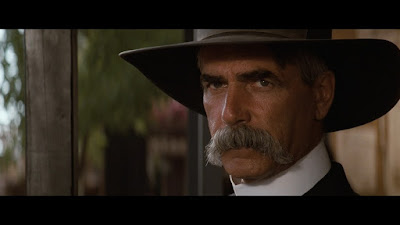
Critics need to lighten up and enjoy Tombstone for what it is: a fun, popcorn movie that is all about mustaches: the Earps all sport big bushy ones that threaten to consume their faces, while the bad guys all sport thinner ones with goatees or beards. The wild card in all of this is Doc who sports a thin mustache suggesting that he’s a bad guy as he does cheat at cards, but he’s also Wyatt’s friend and is very loyal to him and his brothers, even willing to back them up at the OK Corral gunfight. Ultimately, Tombstone is about male friendship, in particular the intense and unusual bond between Doc and Wyatt. Early on, it takes on a playful tone as Doc has some fun with Wyatt’s obvious attraction to Josephine. Even though they aren’t related by blood they might as well be brothers as they’re willing to die for each other. They don’t verbalize it but it’s all in the eyes and this is nicely realized by Kilmer and Russell. It’s hard not to be moved by the final scene between their two characters.

When all was said and done, Kevin Costner’s Wyatt Earp cost $60 million and was unable to recoup it as Tombstone came out first and stole its thunder, grossing a respectable $55 million. To add insult to injury, Disney released Tombstone on home video right before Wyatt Earp’s theatrical release and it did strong rental business. Tombstone is an epic western that has all the right ingredients: stoic lawmen, dastardly outlaws, rousing montages, beautiful women, angry proclamations, emotional death bed speeches, and, of course, exciting shoot-outs. George P. Cosmatos’ direction is no frills – strictly meat and potatoes, which is just right for this straightforward tale. While the gun battles are noisy and chaotic, you always know where everyone is and what’s going on. It may not be a brooding meditation on violence like Unforgiven or push the boundaries of the genre like Dead Man, but Tombstone is an unabashed crowd pleaser in the classic western tradition.


SOURCES

Arnold, Gary. “Tombstone Point-Blank.” Washington Times. December 19, 1993.

Beck, Henry Cabot. “The ‘Western’ Godfather.” True West. October 1, 2006.

EW Staff. “Shoot First (Ask Questions Later).” Entertainment Weekly. December 24, 1993.

Grimes, William. “How to Fix a Film at the Very Last Minute (Or Even Later).” The New York Times. May 15, 1994.

Gristwood, Sarah. “To Hire and to Fire.” The Guardian. January 18, 1994.

Portman, Jamie. “Wyatt Earp’s Tombstone Gets Revisionist Engraving.” Toronto Star. December 20, 1993.

Thompson, Anne. “Dueling Deals.” Entertainment Weekly. January 8, 1993.

Thompson, Anne. “Quiet Earp.” Entertainment Weekly. July 15, 1994.