"...the main purpose of criticism...is not to make its readers agree, nice as that is, but to make them, by whatever orthodox or unorthodox method, think." - John Simon

"The great enemy of clear language is insincerity." - George Orwell
Showing posts with label Robert Rodriguez. Show all posts

Friday, February 18, 2022

Desperado

In 1992, independent filmmaker Robert Rodriguez made his feature film debut with El Mariachi, a $7,000 action movie that showed a stylistic flare beyond its meager budget. It made the rounds at several film festivals with a lot of media attention on the self-assured young man and the incredible story of how he made a movie for so little money. Naturally, Hollywood came calling and initially Rodriguez resisted, making Roadracers (1994) for the Showtime cable television channel after his deal with Sony Columbia Pictures was put on the back burner due to scandal. He eventually made Desperado (1995), a sequel to Mariachi that not only saw him working with a significantly larger budget of $7 million, but with movie star Antonio Banderas.


The film begins almost as if we are in a Quentin Tarantino film with a grungy gringo (Steve Buscemi) walking into a Mexican bar. He proceeds to tell a story about how he witnessed a massacre in a similar bar by a mysterious man. Rodriguez cuts back and forth between the storyteller and what happened at the bar to the strains of “Jack the Ripper” by Link Wray.
 
What is immediately clear from this opening scene is how far Rodriguez has progressed as a filmmaker. The screenplay is well-written as Steve Buscemi delivers his hilarious monologue with gusto. The director’s technique has also gotten better as the opening gunfight is stylishly choreographed with the El Mariachi (Banderas) dispatching bad guys like something out of a 1980s action movie as a shotgun blast sends a goon hurtling through the air.

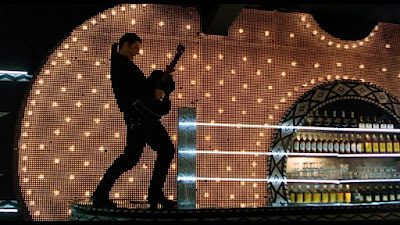
It is interesting to note that Rodriguez not only plays up the mythic quality of El Mariachi, introducing him walking into a bar in slow motion in the shadows so you never get a good look at his face, but also has fun with the character as well, showing him playing with his band in a nightclub over the opening credits. El Mariachi even has time to stop a bar fight by striking a patron with his guitar without missing a beat. Rodriguez reveals that this sequence is a dream as we see the villain from El Mariachi appear in the nightclub and we flashback to the end of that film.
 
Another façade is stripped away when it is revealed that the story Buscemi’s character told was exaggerated for effect – he’s El Mariachi’s hype man. Armed with a guitar case full of weapons, the musician cum killer is working his way through the Mexican criminal underworld to find and kill Bucho (Joaquim de Almeida), the man responsible for his wife’s death. Not surprisingly, the crime lord is surrounded by an army of flunkies, chief among them Navajas (Danny Trejo), a man armed with a seemingly endless supply of throwing knives. El Mariachi is aided in his quest for revenge by Carolina (Salma Hayek), the beautiful local bookstore owner who patches him up whenever he’s wounded (which is often).
 
In the film’s second action sequence, Rodriguez really cuts loose as he transforms Banderas into a two-gun-toting action hero in the tradition of John Woo’s heroic bloodshed films. Apart from doves flying in slow motion, it features many of Woo’s trademark action flourishes but with a cheeky sense of humor as El Mariachi and the last man left search frantically for a weapon that has bullets before he eventually breaks the man’s neck to the strains of “Strange Face of Love” by Tito & Tarantula. It is a beautifully choreographed action sequence that demonstrates his skill as not just a director but as an editor as he times the cuts to the rhythm of the action. When it comes to action editing is everything and Rodriguez understands this intuitively.

Rodriguez cast Antonio Banderas at just the right time in their respective careers. The former needed to cast a movie star and the latter was looking for a change of pace having just come off the big budget adaptation of Interview with the Vampire (1994). Banderas not only has the charisma to carry the film, he also demonstrates an ability to go from dramatic moments to comedic ones with ease. He also showed his ability to handle action, transforming himself into a credible action star. The actor also has wonderful chemistry with Salma Hayek as their characters develop a romantic relationship over the course of the film.
 
Desperado was Hayek’s first mainstream, Hollywood role, cast by Rodriguez against the wishes of the studio. The impossibly beautiful actor holds her own against the likes of Banderas as she demonstrates a light, comic touch and dramatic chops when Carolina explains why she is complicit with Bucho’s dealings with the town, aiding and abetting his drug operation in order to survive. She forces El Mariachi to realize that his desire for revenge is not the only reason to take out Bucho – it would also free the town of his tyrannical hold on it. He is a tragic hero and she gives him a reason to keep on going after he fulfills his goal.
 
Desperado would mark the beginning of a long-running collaboration with several actors, including Banderas, Hayek, Cheech Marin, Danny Trejo, and Quintin Tarantino, who he met on the film festival circuit while promoting El Mariachi. He made Tarantino the lead on his next film, From Dusk Till Dawn and has often featured him in cameos where he delivers a monologue and is then killed off in gruesome fashion. Marin and Trejo make quite an impression with the former playing a grinning bartender that meets his fate at the hands of the El Mariachi and the latter in a silent role as a deadly assassin brought in to take out the film’s hero but in an unexpected twist is taken out prematurely through a comic case of mistaken identity.

 
After the success of El Mariachi, Rodriguez was eager to make a sequel and capitalize on his new deal with Sony Columbia but the studio put on the brakes while they dealt with the Heidi Fleiss scandal that broke in early summer of 1993. She was a high-end madam that facilitated call girls to several of Hollywood’s elite and a list of her clients, which included at least two studio executives, appeared in the press. At the time, producers Carlos Gallardo (who starred in El Mariachi), Elizabeth Avellan, and line producer Bill Borden had already begun pre-production and realized that the film was on hold until the scandal blew over. Never one to be idle, Rodriguez shifted gears and accepted another gig making Roadracers that he shot in less than two weeks in January 1994 for $1 million. It was his first Hollywood production and working with a union crew. He was struck by how wasteful and slow studio productions were as he was used to collaborating with a small, hand-picked crew that worked fast. It would give him a taste of what he would be in store for when working for Sony.
 
By the summer of 1994, Rodriguez finally got the greenlight to make his Mariachi sequel, then known as The Return of El Mariachi but soon changed to Pistolero during production and eventually became Desperado. Ironically, this was due in large part to his future employer – Bob and Harvey Weinstein – who approached Sony executive Stephanie Allain at the Cannes Film Festival telling her what a fan they were of El Mariachi and how they would be more than happy to make the sequel with Rodriguez.
 
The studio wanted a name actor cast in the lead role and Allain suggested Antonio Banderas but Rodriguez was hesitant to cast a non-Mexican in the part. Undeterred, Allain showed Banderas El Mariachi and he loved it. He said, “I thought, ‘This guy has incredible energy.’ It reminds me of the first films I did with (Pedro) Almodovar. Not in his style, of course. But it’s like, you know, the same thing, when you don’t have any money and you’re working outside the studio, with no trailer, no nothing, just waiting on the corner to do your shot. And I thought, ‘Wow! That’s the kind of cinema I would like to do again.’” She told Rodriguez this and he agreed to meet with the actor.

Rodriguez and Avellan saw a rerun of Salma Hayek on comedian Paul Rodriguez’s talk show from 1992 where she talked about changing Hollywood’s refusal to cast Latina actresses. The next day, Avellan called her and asked her to audition for the female lead in Desperado. In addition to competing with many other Latina actresses, auditioning many times and performing several screen tests, she was up against the likes of Cameron Diaz who the studio liked as, according to Hayek, “her last name was Diaz, so they said she can be Mexican.” Originally Raul Julia had been cast as Bucho and Rodriguez had scheduled principal photography around his availability but when he suffered a stroke that preceded his death, he was replaced by Argentine actor Joaquim de Almeida.
 
On Desperado, Rodriguez was working with a significantly larger budget of $7 million and returned to Acuna, Mexico to use the same locations he had on his first film. It was a challenging shoot with cast and crew members staying on both sides of the border and filming equipment shipped in from both Mexico and the United States. During the first week of shooting the studio was not happy and threatened to fire people until Rodriguez showed them dailies and cut together a couple of trailers to give them a taste of what he was doing.
 
In addition, the studio insisted on using department heads and imposed a more traditional studio structure, which Rodriguez balked at having been used to working with a small crew and doing a lot of the different jobs himself. Gary Martin, head of physical production at Sony, was being told exaggerated stories that the filmmaker was “throwing a lot of tantrums and kicking cameras” on location with key crew members, such as director of photography Guillermo Navarro, ready to quit. Avellan claims that Borden was the source for a lot of disinformation and discord, creating problems on the set. Borden even played Gallardo, Avellan and Rodriguez against each other. When Allain called Avellan and asked her about these rumors she responded that everything was fine and defended Rodriguez. Avellan told Rodriguez about Borden and they decided to keep a close eye on him.

Hayek remembers that the film’s steamy sex scene her character has with El Mariachi was not in the screenplay and was added after a screen test. To try and make her as comfortable as possible, Rodriguez filmed it on a closed set with just him, Avellan and Banderas but Hayek found it a difficult experience nonetheless.

Martin met with Avellan and told her that Rodriguez would not be editing the film himself as he had done on El Mariachi and told her, “Honey, just like when you go to a beauty parlor and somebody does your nails because they specialize in that and somebody does your color because they specialize in that, it’s the same in the movie business.” Insulted, Avellan said nothing in order to keep the peace between Rodriguez and the studio but inside she was fuming. Post-production began in November 1994 in Los Angeles with the studio finally allowing Rodriguez to edit his own film but only if he did it there where they could keep an eye on him. Rodriguez said:
 
“They just didn’t want me to have that much control, but they let me do it. That was a big mistake because it sets another precedent. If my next movie hadn’t been Desperado, if I had done one of the really big budget movies they were offering me, I would have lost that control.”
 
His studio experience on Desperado soured the filmmaker on ever working in Hollywood and convinced him to put down permanent roots in Austin. With his deal done with Sony, he made his next film, From Dusk Till Dawn (1996), for indie film darlings Miramax who gave the kind of creative freedom he craved.

Desperado garnered mixed to negative reviews from critics. Roger Ebert gave it two out of four stars and wrote, "Rodriguez has a lively color sense, a good feel for composition and a willingness to put the camera anywhere it can possibly go. What happens looks terrific. Now if he can harness that technical facility to a screenplay that's more story than setup, he might really have something." In her review for The New York Times, Janet Maslin wrote, "Overdependence on violence also marginalizes Desperado as a gun-slinging novelty item, instead of the broader effort toward which this talented young director might have aspired. It's still clear that Mr. Rodriguez has a talent for fancy directorial footwork and that his movie has its fiery moments. But not even a Mariachi in Mr. Banderas's league can get by on looks alone."
 
In his review for the Los Angeles Times, Kenneth Turan wrote, "if you’re not a fan of huge explosions, oversized weapons and people getting sliced and diced in all kinds of ways, Desperado doesn’t have a lot more to offer." The Washington Post's Desson Howe wrote about Rodriguez's jump from indie film to his big budget remake/sequel: "the commercial transition has been remarkably successful. This is primarily thanks to Rodriguez, who not only retains the original movie's kinetic flair, but takes it further. Finally, Entertainment Weekly's Owen Gleiberman gave it a "B" rating and wrote, "The dawdling pace has us lingering a little too much over Desperado‘s primitive human dimensions. Still, when Rodriguez unleashes a scene with Banderas leaping backwards from one building to the next, or with a couple of mariachis launching rockets from their guitar cases, he’s a true corker. The action, in all its demonically outlandish wit, is its own show."
 
At the time, Desperado was a breath of fresh air in the action genre by starring a Latino actor with a predominantly Latino cast that also had universal appeal. In many respects it is a modern western with El Mariachi as a lone gunslinger that walks into town and rids it of the bad guys. Much like one of his cinematic heroes, director George Miller, Rodriguez draws inspiration from Joseph Campbell’s The Hero with a Thousand Faces with El Mariachi as this mythic figure that makes the hero’s journey to redemption. In this respect, Desperado is part Mad Max myth-making and part John Woo action melodrama. Rodriguez gives this template a novel spin by having his film showcase Latino culture and present a hero that can be celebrated, which was largely absent in the mainstream at the time. It can’t be stated enough how significant an achievement that was back then or even now for that matter. Like, Evil Dead 2, Desperado is the rare successful remake/sequel hybrid that manages to not alienate fans of the first film while appealing to people who haven’t seen it. The film demonstrated that Rodriguez could work with bigger budgets and movie stars, paving the way for a fantastic career that he made his way.


SOURCES
 
Frederick, Candice. “’The Studio Wanted Cameron Diaz’: Salma Hayek on the Role that Changed Her Life.” Elle. October 15, 2020.

Leydon, Joe. “Cranking up the Volume.” Los Angeles Times. November 27, 1994.
 
Macor, Allison. Chainsaws, Slackers and Spy Kids: 30 Years of Filmmaking in Austin, Texas. University of Texas Press. 2010.
 
Martinez, Jose and Christian Divine. “Hispanic Blood: An Interview with Robert Rodriguez.” Creative Screenwriting. December 21, 2015

Friday, June 26, 2015

Roadracers

Still hot off his feature film debut with El Mariachi (1992), Roadracers (1994) marked Robert Rodriguez’s first foray into the Hollywood studio system and it was not a smooth transition. Accustomed to shooting fast and loose and with complete creative control, he met resistance from a crew that were used to working a certain way and at a certain pace and they resented this young upstart coming in and changing the way things were done. However, this experience prepared him for his next project, which would also be done with a studio.

Roadracers was part of a series of made-for-television movies entitled Rebel Highway for the Showtime channel that aired in 1994. The concept was a series of 1950s B-movies remade “with a ‘90s edge,” spearheaded by Lou Arkoff, son of legendary movie producer Samuel Z. Arkoff, and Debra Hill (Halloween). The two producers invited directors like John Milius, Joe Dante and William Friedkin to pick a title from one of Arkoff’s movies, hire their own writer, select their own director of photography and editor, and have final cut. They were only given $1.3 million and 12 days to shoot their film with a cast of young, up and coming actors and actresses. Used to shooting fast and cheap, this set-up must’ve appealed to Rodriguez who created the most entertaining installment and remained truest to the spirit of those ‘50s B-movies.

The film starts off in typical energetic Rodriguez fashion as local juvenile delinquent Dude Delaney (David Arquette) outwits the local cops in his hot rod while his girlfriend Donna (Salma Hayek) cools her heels to the blistering rockabilly stylings of Johnny Reno. The music and Rodriguez’s rhythmic editing perfectly compliment the Dude’s wild driving and wild behavior as he arrives at the nightclub, manages to charm his disgruntled girlfriend, and whoop it up to Reno’s music.


Dude’s best friend Nixer (John Hawkes) hitches a ride, much to Donna’s chagrin, and babbles on about his latest obsession – Invasion of the Body Snatchers (1956). They soon cross paths with Teddy Leather (Jason Wiles), the local tough kid, and his friends, challenging them to a drag race all to the distinct strains of Link Wray’s music. Rodriguez has a lot of fun with this scene as Nixer insults Teddy’s girlfriend (“I got a boner the size of your head!”) and Dude casually flicks his lit cigarette on her hair (so obviously a wig), which ignites it at the crucial moment in the race.

These opening scenes do an excellent job of capturing the silly fun of goofing off with your friends when you’re young and have your whole life ahead of you. Rodriguez himself was just starting out and brings an energy and vitality that is exciting to watch as it translates on-screen in the way he shoots and edits every scene. It is like the frame can barely contain the action in it.

After the drag race, Teddy swears revenge on Dude as does his father Sarge (William Sadler), who just so happens to be the head cop in this small Texas town. He has been looking for any excuse to bust the young punk.


With his slicked-back pompadour, unshaven look and mischievous smirk permanently affixed to his face, David Arquette certainly looks the part of a ‘50s juvenile delinquent – the kind that wakes up in bed with his electric guitar and lives from one goof to the next, epitomized by the tried and true cliché of live fast and die young. Arquette has always been something of an eccentric performer that Hollywood never quite figured out what to do with – the notable exception being the Scream movies, which allowed him to indulge in his trademark quirkiness. Rodriguez gives him license to have fun with the role, knowing what a plumb part it is for a young actor – playing a cool delinquent that aspires to be a rock ‘n’ roll musician like his hero Link Wray. Dude is a restless soul with unbridled energy that this small-town just can’t contain and Arquette conveys this in his enthusiastic performance.

William Sadler appears to be having a blast as the film’s antagonist – the authoritative cop. Rodriguez allows the actor to stretch out in what amounts to a fairly standard role by giving him substantial moments like early on when Sarge goes into detail about how good the pigs in blankets his mother makes for him are to his new partner. Just watch how Sadler savors the admittedly tasty-looking snack like it was the best food on earth. It’s all a bit ridiculous but that’s kinda the point and it gives us some insight into his character. As a result, Sarge is more than just a faceless authority figure.

In an early role, John Hawkes plays Dude’s best friend and movie fanatic, convinced that Invasion of the Body Snatchers is real. The actor gets to dish out some of the funniest insults as his character gleefully pokes fun of Teddy and his gang. Hawkes plays well off of Arquette and their scenes together are a lot of fun to watch as they react to each other’s antics. For example, there’s a scene where Nixer watches in awe as Dude applies a massive amount of hair gel to his hair providing the sequence’s perfectly timed punchline, “Little dab’ll do ya.” This is a set-up for an even more impressive scene where Dude uses said gel to slick down a roller rink so that Teddy and his boys take a spill all to the vintage rockabilly music of Hasil Adkins.


In what was her American acting debut, Mexican bombshell Salma Hayek is just fine as Dude’s girlfriend. Admittedly, she doesn’t have much to do except look beautiful and act exasperated at her boyfriend’s antics. Rodriguez tries to give her something to work with by showing the racism Donna encounters from her white classmates. He uses the allegory of conformity in Body Snatchers for the small-mindedness of the town that treats her like a second-class citizen because of her ethnicity.

When Wes Craven dropped out at the last minute to make another A Nightmare on Elm Street movie, the producers of Showtime’s Rebel Highway series of made-for-T.V. movies asked Robert Rodriguez to fill in because he had proven with El Mariachi that he could make one fast and cheap: “So I had the least amount of money out of everyone else in the whole slate of pictures. They figured they would make up the difference on mine, and that’s why I got in on it.” He was given a budget of $700,000 (El Mariachi was made for only $7,000!), wrote the screenplay in two weeks and was given 13 days to shoot Roadracers, one less than he did on El Mariachi.

Rodriguez meant with resistance from the get-go as he clashed with the producers over the film’s composer. They had already hired one and he told them to give the man half the money and let him use the other half to bring in Texan musician Johnny Reno whom Rodriguez knew from elementary school. The filmmaker saw Roadracers as an opportunity to work on a larger film before making Desperado (1995), the sequel to El Mariachi with Antonio Banderas. It also gave him a chance to show that Salma Hayek could act in English so he could cast her in Desperado.


For Rodriguez, it was a film of several firsts – it was first time shooting on 35mm and the first time he worked with professional actors and crew, the latter of which proved to be a challenge for the young filmmaker. A lot of the movies in the series were going over budget and over schedule in terms of hours (18-20 hour days) and Rodriguez inherited a crew that was burnt out. He ended up shooting most of the film himself. “I was just this little punk, so they looked at me and were questioning everything that I was doing because I was shooting really fast and I was shooting my edits. I wasn’t shooting full shots.”

In addition, his preferred method was to work fast: “The actors didn’t have much time to overthink what they were doing, and I didn’t either as a filmmaker. I just went by complete instinct and let my subconscious take over.” John Hawkes, who played Dude’s best friend Nixer, remembers that Rodriguez “was kind of frustrated, because even though it was a small project by Hollywood standards, I think he felt like it was over-crewed, that there were just too many people around … He was very much a do-it-yourself guy. About a couple of days into the shoot, he was pretty much shooting it himself.”

Roadracers received mostly positive notices from critics. In his review for The New York Times, John J. O’Connor wrote, “From square parents to ominous rumbles, Roadracers doesn’t miss a cliché in the depiction of rebels without a cause. Skillfully done, though.” The Los Angeles Times’ Chris Willman wrote, “Roadracers, too, looks and feels as if it were done on the fly, with adrenaline dripping into the editing bay.” In his review for the Austin Chronicle, Lewis Black wrote, “Arquette and Hayek are good as the leads, Arquette’s goofiness confusing enough to serve the story, with ex-Austinite Hawkes turning in an inspired turn as Arquette’s kind-of-geeky friend.” Entertainment Weekly gave it a “B-“ rating and Mike D’Angelo wrote, “Buoyed by winning performances from David Arquette and Salma Hayek and ferociously kinetic editing by Rodriguez, it makes for a fun pastiche…at least until it turns needlessly violent and ‘realistic.’” Finally, New York Magazine’s John Leonard called it, “surprisingly entertaining.” In retrospect, Rodriguez said of this film: “You look back and go, ‘I don’t even direct or shoot or edit like that anymore.’ You wish you could get back to that.”


Rodriguez inherently understands what ‘50s iconography is cool – hot rods, rock ‘n’ roll music, black leather jackets, and beautiful women – and fills Roadracers with them. If there is a particular emphasis on period music it’s because he’s a musician himself and applies the energy and rhythm of ‘50s rockabilly to the pacing of his film so that it is the cinematic equivalent of this music. This explains why Rodriguez revels in Dude’s musical epiphany – when he messes up his amp but as a result gets an awesomely loud and distorted sound reminiscent of the thunderous sound of his hero Link Wray. Rodriguez proceeds to contrast this with the safe, sell-out sound of Reno’s other band that turns out to be nothing but a façade as Nixer finds out they’re miming to a record player, which is the ultimately betrayal as far as Dude’s concerned. It drives Dude a little mad and the film along with until it builds in intensity to a nightmarish climax. What Roadracers lacks in substance it more than makes up for in style and let’s face it, Rodriguez has never been pre-occupied with substance. His films’ primary goals are to entertain and have some fun and this one delivers on both counts.


SOURCES

Brennan, Patricia. “Fast Cars, Fast Girls and Raging Hormones.” Washington Post. July 17, 1994.

Corliss, Richard. “I was a Teenage Teenager.” Time. August 15, 1994.

Gallagher, Brian. “John Hawkes Talks Roadracers.” MovieWeb. April 20, 2012.

Huver, Scott. “Robert Rodriguez Looks Back at Roadracers, Ahead to Machete Kills and Sin City 2.” Popcorn Biz. April 24, 2012.

Nicholson, Max. “Rodriguez Reflects on Roadracers.” IGN. April 20, 2012.

Rosenbaum, Jonathan. “The Way We Weren’t.” Chicago Reader. November 18, 1994.


Sullivan, Kevin P. “Robert Rodriguez Reminisces about his Early Film Roadracers.” MTV. April 24, 2012.

Friday, September 5, 2014

Sin City: A Dame to Kill For

In 2005, Robert Rodriguez adapted the comic book Sin City into a film with help from its creator Frank Miller who co-directed it. Convincing the veteran comic book writer/artist to come on board was a smart move on the filmmaker’s part as it assured that Miller’s luridly violent noir tales would be faithfully translated. This was achieved through a then-groundbreaking green screen environment that allowed Rodriguez to place his actors in Miller’s stylish world with a striking look comprised of black and white with strategic splashes of color. This innovative approach attracted a star-studded cast that included Bruce Willis, Mickey Rourke, Clive Owen and Benicio Del Toro among others. The final result dazzled audiences and was a commercial success.

A sequel seemed inevitable, but instead Rodriguez went on to team up with Quentin Tarantino on the box office misfire that was the Grindhouse double bill (2007) while Miller applied the Sin City aesthetic to a disastrous adaptation of Will Eisner’s comic book The Spirit (2008). Over the years, talk of a sequel surfaced occasionally with the likes of Johnny Depp and Angelina Jolie being mentioned in potential leading roles. Nine long years later and the stars (and money) aligned for Rodriguez and Miller to reunite with Sin City: A Dame to Kill For (2014). The film promptly tanked at the box office and received mixed to negative reviews. What happened? Did Miller and Rodriguez wait too long? A green screen-heavy film is no longer a novelty. Two cast members with characters in the film had passed away and some roles have been recast. The general consensus seems to be that they waited too long to make a sequel and interest in the film had waned.

Some might complain that A Dame to Kill For is just more of the same. As a big fan of the first film this is not necessarily a bad thing. After seeing Sin City, I wanted to see more of Miller’s stories brought to life. In addition to adapting A Dame to Kill For and the short story “Just Another Saturday Night” from the Booze, Broads, & Bullets collection, Miller created two new stories specifically for the film – “The Long Bad Night” and “Nancy’s Last Dance.” By doing this, he has given the fans a real treat by offering two stories where the outcome is not known and introducing new characters into this universe.


In “Just Another Saturday Night,” Marv (Mickey Rourke) wakes up amidst a car accident unable to remember how he got there. He proceeds to recall what happened via flashback on a snowy Saturday night. This segment is a nice way to reacquaint us to the brutal yet darkly humorous world of Sin City.

“The Long Bad Night” introduces us to Johnny (Joseph Gordon-Levitt), a confident gambler who decides to take on Senator Roark (Powers Boothe), the most powerful man in the city, in a high-stakes poker game and gets more than he bargained for. It’s a lot of fun to see Joseph Gordon-Levitt square off against Powers Boothe, the former playing a young upstart and the latter an evil, influential man.

The centerpiece of the film is “A Dame to Kill For”, which features Dwight McCarthy (Josh Brolin) as a private investigator taking photographs of a businessman (Ray Liotta) cheating on his wife with a hooker (Juno Temple). When the man tries to kill her, Dwight intervenes. He has a tortured past, which involves keeping his homicidal impulses in check.

Afterwards, Dwight gets a call from an ex-lover by the name of Ava Lord (Eva Green), a beautiful woman married to a very rich man. She’s in some kind of trouble and he finds himself drawn into her tangled web yet again. He soon runs afoul of her imposing bodyguard Manute (Dennis Haysbert) who proceeds to work him over. Realizing that he’s out of his depth and bent on rescuing Ava, Dwight enlists Marv’s help, which only complicates things in typical noir fashion.


In “Nancy’s Last Dance,” Nancy Callahan (Jessica Alba) is an exotic dancer still haunted by the death of her lover John Hartigan (Bruce Willis) and is obsessed with avenging his death by killing Roark, the man responsible for it. Over time, she’s counseled/haunted by Hartigan’s ghost, which drives her increasingly crazy.

Actors Josh Brolin, Joseph Gordon-Levitt and Eva Green slip seamlessly into the Sin City world. It helps that they have that old school noir look, especially Brolin with his chiseled tough guy features and gravelly voice – perfect for his character’s voiceover narration. In no time the actor makes you forget that he plays a character once portrayed by Clive Owen. Gordon-Levitt is excellent as the young newcomer with a secret and manages to elicit sympathy for his ultimately doomed character. Green plays Sin City’s reigning femme fatale. The stunning actress has an alluring, exotic look and can turn a vulnerability on and off at will all the while playing a cold-hearted manipulator of men. Green gives key line deliveries the right venomous spin that makes Ava Lord a fearsome figure in this world.

It’s great to see Mickey Rourke return to the role of Marv, a character he inhabits so well. He brings a world-weary charm and a much-needed dose of dark humor to the film. Powers Boothe, who only had a minor role in the first film, gets a much meatier part in A Dame to Kill For and it’s a lot of fun to see him sink his teeth into such a deliciously evil character. Unfortunately, Jessica Alba is once again miscast as Nancy, the stripper with a heart of gold. While she looks the part, the actress doesn’t have the chops to pull of the tricky evolution of character that goes from sweet girl traumatized by the death of loved one to a revenge-obsessed vigilante. Miller’s stylized dialogue needs to be delivered a certain way. Some actors can pull it off and others can’t. Alba falls into the latter category and it becomes painfully obvious in her segment. Even her dancing is unconvincing.


While it no longer has the technological novelty factor as an incentive (shooting it in 3D really didn’t help either), there is certainly no other film out there that looks like Sin City. There have been a few imitators since, most notably The Spirit and Max Payne (2008), but the look of the film is so specific to its universe that few have dared to emulate it. Rodriguez has said that with the first Sin City he held back somewhat stylistically for fear that it would be too much for audiences. Emboldened by its commercial success, he took the look further and made it even more faithful to Miller’s comic book. So, there are things like Ava being rendered in black and white accentuated with red lips and green eyes, and visual flourishes like Marv recounting past exploits while a tiny car chase revolves around him, or the moody storm clouds that hang heavy in the cemetery where Nancy visits Hartigan’s grave. And why not? It’s not like the characters or the world they inhabit are based on any kind of reality. They exist in a hyper-stylized neo-noir universe drenched in atmosphere.


The dialogue in A Dame to Kill For is riddled with clichés and the characters are drawn from archaic stereotypes, but that’s the point. Miller is paying homage to the Mickey Spillane crimes stories he clearly idolizes. The film immerses itself in noir clichés and wears them proudly like a badge of honor, refusing to make any excuses for trading in them. There’s really nothing more to it than that, which may make the film seem instantly forgettable, but Rodriguez’s film never aspires to be art as it is unrepentedly sexual and violent with very few if any redeeming characters. The first Sin City film came out at the right time and tapped into popular culture zeitgeist. A Dame to Kill For is not so lucky, but you have to give Miller and Rodriguez credit for sticking to their guns and delivering another faithful adaptation of the comic book which may only appeal to fans and probably won’t convert the uninitiated.

Friday, September 10, 2010

Machete

BLOGGER'S NOTE: This post originally appeared on Edward Copeland's snazzy blog, Edward Copeland on Film. He and a very impressive collection of writers post daily ruminations on film, T.V. and loads of other cool stuff.

When he made his half of the Grindhouse double bill (2007), Robert Rodriguez also put together a trailer for a film he would like to see. And so, Machete (2010) was born – a Mexploitation action film about an ex-federale who is set-up, double-crossed and left for dead. However, the origins for this project go back even further to 1995 when Rodriguez made Desperado, the second film in his Mariachi trilogy. It would be the first time (but certainly not the last) he worked with veteran character actor and professional badass Danny Trejo. He’s someone you’ve probably not heard of but have definitely seen. If you need a tough-looking tattooed henchman, he’s your man. While working on Desperado, Rodriguez envisioned Trejo starring in a series of action films as Machete but at that time the director did not have the clout to get someone to bankroll a Latino action film that didn’t feature someone with movie star looks like Antonio Banderas.


Rodriguez never forgot about his pet project and over the years cast Trejo in several of his films. Even though the Grindhouse films were a commercial failure, audiences loved the faux trailer for Machete. Rodriguez managed to convince a Hollywood studio to finance it with a modest budget and used his connections to assemble an impressive cast that included the likes of Robert De Niro, Jessica Alba, Steven Seagal, and “introducing” Don Johnson. However, what worked as a movie trailer be too much of a good thing as a feature film?

The prologue sets up everything we need to know about Machete (Danny Trejo) – he’s a badass Mexican federale set-up by his corrupt superior and left for dead by local druglord Torrez (Steven Seagal). It also sets just the right tone as we see Machete hacking and slashing his way through a house of bad guys with bloody abandon. Meanwhile, in the United States, a corrupt, ultra-conservative Texan senator named John McLaughlin (Robert De Niro), campaigns on a platform of preventing illegal immigrants from crossing the border. He even employs a border vigilante group, led by the brutal Von Jackson (Don Johnson), to enforce his policies.

Sartana Rivera (Jessica Alba) is an upstanding Immigrations enforcement officer investigating the problem through legal channels and ends up crossing paths with Luz (Michelle Rodriguez), a no-nonsense taco stand operator who moonlights as a revolutionary operating an underground railroad of sorts for her Mexican brothers and sisters. Machete, now a day laborer (or, at least that’s his cover), is hired by Michael Booth (Jeff Fahey), a local businessman, to kill the Senator for $150,000. Machete is set up, shot and forced to go into hiding. With the help of Rivera and Luz, he plots revenge on the men that betrayed him.

It’s awesome to see Danny Trejo finally get to carry a film for once and play a character that doesn’t get killed off. He brings his customary intensity as the strong, silent man of action and in many respects the film is Rodriguez’s present to the actor as he has him take down tons of bad guys, look cool doing it, and hook up with many of the film’s lovely ladies, including Michelle Rodriguez, Jessica Alba and Lindsay Lohan! Robert De Niro is a lot of fun to watch playing a John McCain meets George W. Bush-esque xenophobic politician. It’s also great to see Steven Seagal as a powerful criminal and Machete’s arch-nemesis, not to mention appearing in a mainstream film that didn’t go straight-to-home video.

Michelle Rodriguez adds another tough chick role to her resume as she portrays the female Mexican equivalent of Che Guevara but with a dash of Snake Plissken from Escape from New York (1981). Another fun bit of casting is Lindsay Lohan playing the messed up celebutante child of Booth. She and Rodriguez have some fun riffing on her public persona and kudos to the director for not bowing to peer and public pressure about her party girl reputation and showing that regardless, she still has the acting chops. Rodriguez regulars Tom Savini and Cheech Marin show up in memorable bit parts as a deadly assassin and Machete’s ex-federale now-priest brother.

It’s no secret that Rodriguez is a filmmaker that wears his influences on his sleeve. For examples, Desperado was a homage to the Hong Kong action films of John Woo and From Dusk Till Dawn (1996) and Planet Terror (2007) evoked the films of John Carpenter and George Romero. Growing up in the 1980s, Machete is Rodriguez’s love letter to the films produced by Cannon Films during that decade. They were responsible for cranking out an endless stream of generic action films starring the likes of Charles Bronson, Chuck Norris and Michael Dudikoff. In these films, the action stars were often a one-man army capable of wiping out the fighting force of a small country seemingly single-handedly. The same goes for Machete who is an unstoppable killing machine bent on revenge.

Machete is full of outrageous, over-the-top violence and inventively staged action sequences, like one scene where Machete bungee-jumps from one floor of a hospital to another with the aid of an evil henchman’s large intestine. In this respect, the film has the same gonzo, go-for-broke action that Rodriguez orchestrated in the underrated Once Upon a Time in Mexico (2003). Living up to his namesake, Machete finds all sorts of ways to kill the bad guys with a vast assortment of sharp weapons. Machete is a lot of fun and never outstays its welcome as Rodriguez knows how to keep things moving so that things never get boring.

Machete not only features all kinds of wild action sequences but also has something on its mind, commenting on the rampant immigration problems that continue to plague the states along the United States/Mexico border. Along the way, Rodriguez plays up and makes fun of Latino stereotypes (they are all day laborers and love tricked out cars) only to twist them into a rallying cry, a call for revolution that takes full bloom by the film’s exciting conclusion in a way that has to be seen to be believed. Best of all, Rodriguez has created yet another awesome Latino action hero. Forget Sylvester Stallone’s The Expendables (2010), Machete is the real deal and a no-holds-barred love letter to ‘80s action films. As great as it was to see many of the beloved action stars from the ‘80s and 1990s, I felt that Stallone’s film never went far enough. Rodriguez’s film doesn’t have that problem as it gleefully goes all the way with its cartoonish violence. Let’s hope that he and Trejo get the chance to do more Machete films but the next one should be direct-to-video if they really want to get in the spirit of the kinds of film they are championing.
Monday, October 5, 2009

From Dusk Till Dawn

Bob and Harvey Weinstein must have been salivating at the prospect of teaming up Quentin Tarantino, red hot from Pulp Fiction (1994), and George Clooney, red hot from the television show ER, on a film. What they got wasn’t exactly a mainstream crowd-pleaser but rather a down ‘n’ dirty grindhouse movie called From Dusk Till Dawn (1996) that was several years before Tarantino and his filmmaking brother-in-arms Robert Rodriguez would make it official with the double bill of Planet Terror and Death Proof in 2007. The screenplay for Dusk Till Dawn had been kicking around for years, before Tarantino exploded on the scene with Reservoir Dogs (1992) and Rodriguez with El Mariachi (1993). The two filmmakers used their new found clout to push this pet project through the system: a drive-in movie on a studio-sized budget and with recognizable stars like Clooney, Harvey Keitel, and Juliette Lewis.

From Dusk Till Dawn starts off in familiar Tarantino territory with the Gecko brothers: Seth (George Clooney) and Richie (Tarantino), stone cold killers on the run from the law. It seems that Richie broke Seth out of prison and to celebrate the two have gone on a crime spree that has resulted in a bank heist and many dead lawmen. They are introduced in an exciting prologue that could be a mini-movie unto itself. A Texas Ranger (the always watchable Michael Parks) enters a liquor store in a tense yet chatty scene where he talks it up with the greasy-haired register jockey (John Hawkes). In Tarantino’s world, having the gift of the gab is essential to one’s survival and when a character runs out of things to say they tend to die. Pretty soon the Gecko brothers are walking out of an exploding store thanks to a well-aimed flaming roll of toilet paper.

They take refuge at a roadside motel with a female bank teller they took hostage from the bank robbery that is never shown (just like the heist we never see in Reservoir Dogs). Ritchie and Seth plan to make a break for Mexico and find safe haven in a place called El Rey (a reference to a similar place of salvation in Sam Peckinpah’s The Getaway). All they have to do is cross the border and meet their contact Carlos (Cheech Marin) at a biker bar called the Titty Twister. To escape the ever-increasing manhunt, the Geckos decide to hijack a Winnebago with a preached named Jacob (Harvey Keitel), his daughter (Juliette Lewis), and his adopted son (Ernest Liu).

The Titty Twister turns out to be a really raunchy, biker bar/strip club where if you even look at someone funny you run the risk of dismemberment. But this is the least of their problems. It soon becomes apparent that this is no ordinary low life scumpit, but an ancient home to a rather large army of vampires. It is at this point that From Dusk Till Dawn mutates into a full-on, balls-to-the-wall horror film. The Gecko brothers and Jacob and his family are forced to defend themselves against hordes of the undead in a siege situation straight out of John Carpenter’s Assault on Precinct 13 (1976) with a healthy dose of George Romero’s zombie films.

Robert Kurtzman of KNB Effects Group, a special effects company, had a treatment called From Dusk Till Dawn and was looking for someone to turn it into a screenplay. Writer Scott Spiegel (of The Evil Dead fame) had met and befriended a then-unknown Quentin Tarantino through a mutual friend. He recommended Tarantino to Kurtzman based on the strength of his Natural Born Killers screenplay. Kurtzman read and liked it and agreed to pay Tarantino $1,500 to write a draft of Dusk Till Dawn. While filming Desperado (1995) in Acuna, Mexico, Tarantino asked Rodriguez if he would consider directing his Dusk Till Dawn script that he had shown him briefly in 1992. The director agreed to helm the project with the only stipulation being that Tarantino would rewrite the script. He agreed and the project was a go, but only after the two filmmakers finished shooting their respective vignettes for the anthology, Four Rooms (1995), which featured two other up-and-coming indie filmmakers, Allison Anders (Gas Food Lodging) and Alexandre Rockwell (In the Soup). Without giving a chance for the buzz surrounding Four Rooms to die down, Rodriguez and Tarantino moved on to Dusk Till Dawn.

From the start, the two men established the agenda that their film would adhere to. As Tarantino stated in an interview, "The thing that's kind of cool is we're basically making this head-banging horror film buff drive-in movie with this really big-budget – and we're not pulling back. We're going for it." It is this kind of take-no-prisoners attitude that propels the hyperactive (and hyperviolent) narrative of From Dusk Till Dawn. The film marked Rodriguez's biggest budget yet at $18 million, but still small potatoes compared to a Sylvester Stallone film where $20 million of the budget goes towards the actor's salary. Like he did with El Mariachi and Desperado, Rodriguez uses all of his resources to make the film look better than it costs and gives the material his own unique spin despite the presence of Tarantino's obsessions which often threaten to overwhelm the film.

Rodriguez's influence lay in the origins of the vampires which were rather vague in nature in the script. The director decided to use his working knowledge of Mexican history and base the creatures' genesis on ancient Aztec and Mayan culture. "There were actual vampire Goddess statues and things during Aztec times ... So the idea is that this den of vampires in an old Aztec temple has, over the years, been turned into a sleazy bar in Mexico to continue to attract victims." It is this playful attitude towards his own heritage and the film's story, coupled with Tarantino’s strong script, which keeps From Dusk Till Dawn from slipping into self-parody.

This was the first film that demonstrated George Clooney’s ability to make the jump from the small screen to the big one. With the character of Seth Gecko, he isn’t afraid to portray an amoral criminal and yet Clooney’s natural charisma makes you like him. The actor is able to turn on the charm and also show a more intense side when someone crosses him, like the opening shoot-out in the liquor store. Unfortunately, this is one of the films that Tarantino acts in and demonstrates why it is better he stay behind the camera. He looks like someone trying to play a twisted criminal instead of becoming the character like everyone else. Tarantino even sports a ridiculous looking Burt Reynolds-circa-Deliverance (1972) haircut. His character’s death doesn’t come soon enough. It’s a credit to Rodriguez’s skill as a filmmaker and the strength of the material that the film isn’t ruined by Tarantino’s lousy acting.

It doesn’t hurt that there are plenty of distractions, like a showstopping scene where a scantily-clad Salma Hayek dances seductively with a rather large snake. Of course, she turns out to be the queen vampire at the Titty Twister. There are all kinds of inside jokes and references for genre fans, like a bit where make-up legends Greg Nicotero (who also worked on the film) and Tom Savini play rival bikers who have a disagreement. That is, until Savini shows off his crotch gun (first seen in Rodriguez’s Desperado). Another genre veteran Fred “The Hammer” Williamson also has a memorable turn as a biker who gets to deliver a monologue about the Vietnam War a la Bill Duke in Predator (1987).

Harvey Keitel gives From Dusk Till Dawn some much-needed gravitas as a preacher who has lost his way after his wife’s death and must find God again if his family and the others are to survive the vampire attacks until dawn. Keitel does a nice job of showing Jacob’s transformation from a faithless preacher to, as Seth puts it, a “mean motherfuckin’ servant of God.” In addition, several Rodriguez regulars show-up in supporting roles, like Danny Trejo as the Titty Twister bartender and Cheech Marin in an impressive three different roles.

Not surprisingly, this film divided critics. Roger Ebert gave it three out of four stars and described it as “a skillful meat-and-potatoes action extravaganza with some added neat touches.” In her review for The New York Times, Janet Maslin wrote, “The latter part of From Dusk Till Dawn is so relentless that it's as if a spigot has been turned on and then broken. Though some of the tricks are entertainingly staged, the film loses its clever edge when its action heats up so gruesomely and exploitatively that there's no time for talk.” Entertainment Weekly gave the film a “B” rating and Owen Gleiberman wrote, “Rodriguez and Tarantino have taken the let-'em-eat-trash cynicism of modern corporate moviemaking and repackaged it as junk-conscious ‘attitude.' In From Dusk Till Dawn, they put on such a show of cooking up popcorn that they make pandering to the audience seem hip.” However, in his review for the Washington Post, Desson Howe wrote, “The movie, which treats you with contempt for even watching it, is a monument to its own lack of imagination. It's a triumph of vile over content; mindless nihilism posing as hipness.” The San Francisco Chronicle’s Mick LaSalle called the film, “an ugly, unpleasant criminals-on-the-lam film that midway turns into a boring and completely repellent vampire ‘comedy.’ If it's not one of the worst films of 1996 it will have been one miserable year.” Cinefantastique magazine’s Steve Biodrowski wrote, “Whereas one might reasonably have expected that the combo of Quentin Tarantino and Robert Rodriguez would yield a critical mass of nuclear proportions, instead of an atomic fireball’s worth of entertainment, we get a long fuse, quite a bit of fizzle, and a rather minor blast.”

At its heart, From Dusk Till Dawn carries on in the proud tradition of other low-budget, gonzo horror films like Sam Raimi's Evil Dead trilogy and Stuart Gordon's Re-Animator (1985), while paying homage to classic horror films like George Romero's Dawn of the Dead (1979). Rodriguez admires these "lower budget, edgier kind of horror films, the ones where you didn't know what the filmmaker would do next. Because they didn't have any money, they would just try and grab you any way they could." Rodriguez and Tarantino now had the money to play with, but still maintained the low-budget aesthetic that they admired so much.

If the first half of From Dusk Till Dawn feels like a Tarantino film reminiscent of True Romance (1993) and Natural Born Killers (1994), which feature amoral outlaws on the run from the law, then the second half is all Rodriguez as he lets his John Carpenter-esque freak flag fly for a blood-drenched finale with all sorts of creative deaths involving balloons filled with holy water, a crossbow and a disco ball. As with most of his films, Dusk Till Dawn is a fun ride with everything you could want from something like this: gun-totting criminals, tough bikers, cool action sequences, memorable dialogue, lots of inventive gore, and half-naked vampire strippers. What more could you ask for?

Monday, October 6, 2008

Planet Terror

Robert Rodriguez and Quentin Tarantino are hardcore film buffs that grew up to become very successful filmmakers and friends who have collaborated on several projects over the years. Recently, they decided to indulge their love of Grindhouse movies from the 1970s (low budget exploitation films that pushed the boundaries of good taste) by each making their own motion picture and then releasing them together on a double bill just like the original films back in the day. The Weinstein brothers, god bless ‘em, went for the idea but made the critical mistake of releasing them on Easter weekend (cheeky counter-programming that backfired) and failed to emphasize that people were going to see two films for the price of one. As a result, attendance was poor and those who did go, some left after the first film. The Weinsteins freaked and when it came to distributing the double bill outside of North America, they split them up. Thus ended an interesting experiment and the first financial flops for both Rodriguez and Tarantino (although, both of these films should easily make their money back on DVD).

Rodriguez’s film, Planet Terror (2007), introduces Cherry Darling (Rose McGowan), a beautiful go-go dancer who dreams of becoming a stand-up comedian even though nobody finds her particularly funny. Meanwhile, at a nearby military base, a deal between Lt. Muldoon (Bruce Willis), a no-nonsense officer, and Abby (Naveen Andrews), a shady scientist, goes bad and some nasty, toxic fumes are released into the atmosphere. Back in the town, Dr. William Block (Josh Brolin) and his wife Dr. Dakota (Marley Shelton) deal with a patient (Nicky Katt) suffering from a nasty looking bite wound. Pretty soon, more and more people show up with similar kinds of wounds. Cherry crosses paths with her ex-boyfriend, a tow truck driver by the name of El Wray (Freddy Rodriguez). They get involved in a car accident and she loses her leg to some diseased and infected zombies with gross, puss-filled wounds. Before you know it, infected townsfolk turned zombies start over-running the town, forcing Cherry, El Wray, Dakota and others to team-up and start kicking ass.

Two of the most significant cinematic influences on Rodriguez’s films are genre filmmakers George Romero and John Carpenter. After all, The Faculty (1998) was Rodriguez’s nod to Carpenter’s remake of The Thing (1982) while From Dusk Till Dawn (1996) had the same kind of siege mentality as Romero’s Dawn of the Dead (1979) and Carpenter’s Assault on Precinct 13 (1976) and featured long-time Romero collaborator Tom Savini. Much of Planet Terror’s soundtrack features an atmospheric Carpenter-esque electronic score with a dash the Goblins’ menacing soundtrack work from Dawn of the Dead.

With Planet Terror, Rodriguez gets to make his own zombie movie with a Carpenter-esque badass protagonist. Rose McGowan and Freddy Rodriguez make for an ideal, no-nonsense couple right out of a Carpenter film. El Wray harkens back to tough guy protagonists like Snake Plissken from Escape from New York (1981) or Nada from They Live (1988) complete with his own recurring credo, “I never miss” that is reminiscent of Jack Burton’s “It’s all in the reflexes,” from Big Trouble in Little China (1986). Like them, Wray has a mysterious past, is a man of few words, and lives for the next 60 seconds, while Cherry starts off as a homage to the beautiful and jaded go-go dancers in Russ Meyer’s Faster Pussycat, Kill! Kill! (1965) during Planet Terror’s opening credits as McGowan bumps and grinds her way through an appropriately sleazy tune. Over the course of the film, Cherry is transformed into a machine gun-toting babe . . . it just so happens that the gun is strapped to her stump. McGowan is definitely not the most skilled thespian but her limitations are perfect for this tribute to schlock. And like Carpenter, Rodriguez knows exactly how to make his heroes look cool, like in the scene where Wray stabs and slashes his way through a hospital of infected zombies.

Rodriguez pays homage to 1980 and 1990s genre character actors with the casting of Michael Biehn as the town sheriff (The Terminator, Aliens), Jeff Fahey as a grizzled chef (Body Parts), and make-up effects legend Tom Savini as an incompetent deputy who meets his demise in a sequence reminiscent of one of his most spectacular gore gags from Day of the Dead (1985). These guys have suffered through quite a few lean years filled with forgettable direct-to-video fare and it’s great to see them getting juicy, prominent roles to remind everyone how great they were and can still be given the right material. Fahey, especially, is excellent as J.T., owner of the local diner and who keeps his delicious BBQ sauce a secret from everyone. He starts off as a source of comedy, the grizzled chef stereotype (“Now that’s rump roast,” he says as hew watches the curvaceous Fergie drive away) but towards the end of the film he gets a rather poignant scene as he’s reunited with his brother. Fahey really sells the scene with his sad eyes and he has great chemistry with Biehn – someone should really pair these guys together in a buddy action flick. Biehn, who had such a great run in the ‘80s as James Cameron’s go-to guy, gets to do what he does best by playing a gruff, intense man of action. His antagonistic relationship with Rodriguez’s El Wray is established early on and plays well over the course of the film until they finally develop a grudging respect for each other.

In comparison to the energetic Planet Terror, Tarantino’s Death Proof feels bloated and stagnant. The three girls we meet at the beginning of the film are all wrong. Girls that age don’t talk like that. They don’t name-check Vanishing Point (1971) and they don’t listen to the kind of music that they do in the film – songs by the likes of Joe Tex and The Coasters?! Maybe one of the girls but not all of them. The dialogue they spout sounds like girls trying to impress a director like Tarantino. I expected to be disappointed by this film but it was even worse than I had feared. If the mandate set forth by Rodriguez and QT was to pay homage to the Grindhouse films of the 1960s and 1970s, than the former succeeded where the later failed. QT created a talkie instead of a Grindhouse film. What is the prevailing motif in Death Proof, boring dialogue? The only Grindhouse-esque touch is QT’s foot fetish with lots of lingering close-up shots of young women’s feet. That’s not really my thing, but hey, whatever floats your boat, I suppose. Is Death Proof actually Steel Magnolias (1989) for the Fergie set? It is hard to make Kurt Russell look bad in a film but he hasn’t looked this bad since Captain Ron (1992).

To further the homage to the Grindhouse aesthetic, Rodriguez digitally altered the transfer so that it resembles a crappy, worn-out print that you would see back in the day, complete with bad splices, lines through the image, fading colors, and even a missing reel. It’s ironic that he is using cutting edge technology to make an old school, low-tech film. Rodriguez is clearly having a blast with the genre as he gleefully throws in all sorts of over-the-top gore, sex, random large explosions, and wildly inventive action sequences as you would come to expect from one of his films. He is also not afraid to kill of animals, women, and the ultimate Hollywood taboo – children. Would Planet Terror ever have appealed to a mainstream audience? Probably not. It was destined to develop a cult following which home video will no doubt help develop. All I know is, if I was a teenager, Planet Terror probably would have been my favorite film of all time. Rodriguez is more successful at emulating/paying homage to the Grindhouse genre than QT and Death Proof, especially with his faux trailer for Machete (which I hope he makes good on his promise to make into a feature-length film), even if he’s really celebrating ‘80s genre films.