"...the main purpose of criticism...is not to make its readers agree, nice as that is, but to make them, by whatever orthodox or unorthodox method, think." - John Simon

"The great enemy of clear language is insincerity." - George Orwell
Showing posts with label Catherine Mary Stewart. Show all posts

Friday, August 25, 2017

Nightflyers

Before Game of Thrones catapulted author George R.R. Martin into fame and fortune, he was better known as a prolific science fiction writer. In 1980, he published a novella entitled Nightflyers about a group of scientists on a quest through deep space to find a mysterious alien life form when things go wrong on the spaceship. I remember Starlog putting the movie adaptation on the cover of one of its issues and it getting my attention as it starred Catherine Mary Stewart whom I developed a cinematic crush on thanks to her memorable roles in Night of the Comet (1984) and The Last Starfighter (1984). Nightflyers (1987) never did reach my town and I never did get to see it and forgot about it over the years until recently when it was announced that the SyFy Channel was developing a television series based on the movie.

Michael D’Brannin (John Standing) heads up a deep space expedition in search of an alien life form. He has already assembled a team of scientists when Miranda Dorlac (Stewart) joins as the project coordinator. They don’t have much of a budget or much support but D’Brannin believes in what he’s doing. They board the ship – an old freighter called The Nightflyer – and get a vibe that something isn’t right. It has all the comforts of home but with an “emptiness to it,” as Miranda observes, “like an ancient temple or tomb.” These words will prove to be prophetic. They are soon joined by Jon Winderman (Michael Des Barres), a telepath, and his empath Eliza (Annabel Brooks) – backups in case technology fails to establish contact with the aliens.

The ship’s captain – Royd Eris (Michael Praed) – is an enigmatic fellow that first appears to the rest of the crew as a hologram. Apparently, he’s their first human crew and his own origins are something of a mystery, even to telepath Jon. Miranda finds herself drawn to Royd, sketching him in her spare time, and they talk as he feels comfortable enough with her to reveal his secrets.

The ship’s computer, however, isn’t too crazy that they are bonding and pulls a HAL 9000 (it even has a single red eye), actively trying to kill the crew who are already on edge due to the nature of their mission. They have to find a way to shut it down, but of course it won’t be that easy.

Michael Des Barres has a memorable scene where Jon is driven mad by the ship’s computer and he slips seamlessly from his New Age-y telepath to gone-bonkers puppet of big bad mama computer. He rounds out a cast of memorable characters – Lisa Blount (Prince of Darkness), Glenn Withrow (Rumble Fish), and James Avery (Fletch) – who are given very little memorable to do. Even the movie’s supposed star, Catherine Mary Stewart, is given surprisingly little to do. Like the others, there is no depth to her character and this gives us little to become emotionally invested in and so we care little about what happens to her and the rest of the crew.

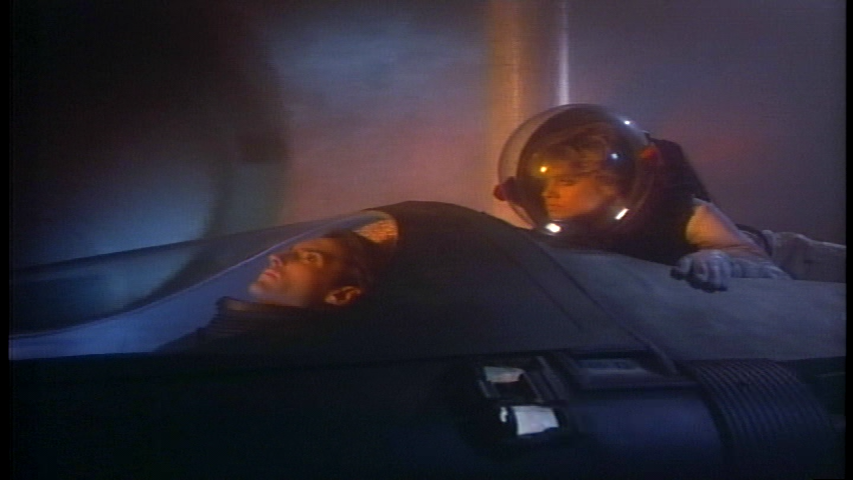
The visual effects of Nightflyers are certainly well done – a mix of model work and matte paintings – with a look that evokes Blade Runner (1982) – complete with a Vangelis-esque score – and Max Headroom with its smoke and shadows coupled with 1980s futuristic fashion (Stewart even rocks some awesome mirrorshades). The sets are detailed and expansive, conveying a vast ship for a decidedly small crew.

Jon’s telepathic scenes reek of ‘80s music video stank – Des Barres’ presence probably doesn’t help – but they do introduce a horror movie element into Nightflyers with a kinky twist as the ship’s artificial intelligence has a warped maternal complex, lashing out at the crew as it thinks they will take Royd away. It will do anything to prevent that from happening. In this respect, Nightflyers anticipates Event Horizon (1997) by several years and one wonders if it was influenced by this movie.

According to George R.R. Martin, Nightflyers came out of an experiment: “I was fooling around with the idea of hybrid stories that were both science fiction and horror, simultaneously.” In 1984, producer/writer Robert Jaffe saw a story by Martin in an issue of Omni magazine that he wanted the film rights to but had been optioned by someone else. Martin told Jaffe he had another story, which was Nightflyers.

Jaffe adapted the story that originally appeared in Analog magazine. It was not as long as the novella, which gave the secondary characters names and so he made up his own. Jaffe also changed the name (because it sounded liked “cough medicine” to something that people could pronounce) and race of the protagonist, casting Catherine Mary Stewart who was white and smaller than the character as written. He wrote eight drafts over three years, changing what he felt was a depressing ending.

Stewart took the role of Miranda as she had become frustrated at being typecast as a teenager and this part was “totally different than anything I’ve done and shows me in a completely different light – of authority, and intelligence.” She claimed that the filmmakers approached her because they could afford her salary and could benefit from her genre fanbase that would hopefully be drawn to the movie.

Prior to Nightflyers, Stewart had shot a movie on location mostly at night and was looking forward to shooting in a studio until filming began on a set filled with smoke while wearing thick spacesuits with helmets that had no ventilation. Actor Michael Praed was not thrilled working with all kinds of special effects or with Stewart who left to do another movie by the time it came to shoot his scenes with her character: “I was acting – literally – to a cross on the wall and some appalling continuity girl reading Stewart’s lines!”

Nightflyers received negative reviews from critics. In her review for The New York Times, Caryn James wrote, “But the whole film looks murky – the ship resembles a big blob of chocolate pudding – and the special effects are heavy on lasers; that is, they are ordinary.” The Washington Post’s Richard Harrington wrote, “Nightflyers moves with the speed and grace of a space buffalo. This is a movie that needs a jump start.” In his review for the Los Angeles Times, Michael Wilmington wrote, “Nightflyers, unfortunately, is too smart to be camp and too shallow to be good. It flounders along, drowned in its own cathedral lighting, its mission to discover intelligence in deep space exploding in its face.”
Three years after it was released, Martin was asked what he thought of the movie and he said, “I think it was about 75% faithful, but unfortunately the 25% that they changed had a kind of a ripple effect and made the 75% that wasn’t changed not make as much sense as it might have.”

With some movies their commercial failure is the result of lousy timing or studio meddling, or it was misunderstood and ahead of its time. Sometimes, like in the case of Nightflyers, it just isn’t very good. It’s not that the movie is particularly awful – it is very well shot, directed and acted – it just isn’t all that memorable. The main problem lies with the generic characters that we could care less whether they live or die and this robs the movie or any dramatic tension. Perhaps a T.V. series adaptation that will allow time to develop the characters and their relationships with each other will finally do justice to Martin’s original novella.


SOURCES

Alrey, Jean and Laurie Haldeman. “Michael Praed: Legends of the Hooded Man.” Starlog. January 1988.

Dedman, Stephen. “An Eidolon Interview with George R.R. Martin.” Eidolon. April 1990.

Dickholtz, David. “George R.R. Martin: Nightflyers High, Aces Wild.” Starlog. May 1987.

Lowry, Brian. “Catherine Mary Stewart: Spacebound Once Again.” Starlog. April 1987.


Shaprio, Marc. “Haunted Days, Starless Nights.” Starlog. November 1987.


Friday, August 31, 2012

Night of the Comet

Released in 1984, Thom Eberhardt’s film Night of the Comet took advantage of the valley girl phenomenon that tapped into the cultural zeitgeist in the early 1980s by making the two protagonists of his horror/science fiction hybrid materialistic mallrats. The film was part of a mini-trend during the decade that fused the teen film with science fiction as evident with the likes of My Science Project (1985) and Bill & Ted’s Excellent Adventure (1989). Night of the Comet was a smart, funny and even, at times, scary ride that proved to be a modest box office hit. It has since gone on to develop a small but loyal cult following, anchored by the performances of the film’s two lead actresses, Catherine Mary Stewart and Kelli Maroney, who play the aforementioned valley girls.


The Earth passes through the tail of a rogue comet, one that may have caused the extinction of the dinosaurs millions of years ago. Most people see this event as worthy of celebration and large crowds congregate all over the world to celebrate this rare event. We meet Regina “Reggie” Belmont (Catherine Mary Stewart), a movie theater usher more interested in getting the high score on the Tempest video game than doing her job (“They throw things at me…”). She’s particularly irked that someone with the initials “DMK” got sixth place on a high score list that is otherwise dominated by her.

Meanwhile, her younger sister Samantha (Kelli Maroney) is stuck at home dealing with her step-mother’s comet party. “Mom” (Sharon Farrell) is a real nasty piece of work, cheating on Sam’s dad and punching the young girl in the face after the teen slaps her during a heated argument. The next day, an eerie red haze blankets the sky and the city of Los Angeles is mysteriously devoid of life with only articles of discarded clothing sprinkled with little piles of red dust remaining.

Reggie wakes up in the projection booth having spent the night with Larry the projectionist (Michael Bowen). However, he’s quickly dispatched by a zombie when trying to leave the theater. She discovers the undead guy after getting locked out and narrowly escapes on a nearby motorcycle. This sequence is notable for demonstrating early on that Reggie is capable of taking care of herself as she fends off the zombie. She’s no damsel in distress and Catherine Mary Stewart doesn’t portray her as a bubble-headed teen either, but rather a resourceful young woman.

Reggie’s journey through the city is a slightly unsettling one as she drives by abandoned cars and clothes strewn all over the place with the red hazy sky omnipresent in every shot. Eberhardt inserts several eerily beautiful establishing shots of the deserted city bathed in a reddish hue. It’s disconcerting to see a bustling metropolis like L.A. so devoid of life. It’s as if someone dropped a reel of The Quiet Earth (1985) in the middle of Valley Girl (1983).

She returns home to find Sam who had spent the night hiding out in the backyard shed and is oblivious to what’s happened. They check out a local radio station that is still operating and meet Hector Gomez (Robert Beltran), a truck driver who survived a zombie attack. Our heroes eventually cross paths with members of a top secret government research facility located under the ground out in the desert. One of them (Mary Woronov) believes that they should stay isolated while another (Geoffrey Lewis) believes they should actively locate survivors.

Reggie gets instant cool points for not only being a skilled video game addict but also well-versed Superman lore as evident in the scene when Larry gets a reference wrong and she’s quick to correct him. This makes her a bonafide geek goddess to be worshipped. Reggie may have a tough exterior but Catherine Mary Stewart isn’t afraid to show her character’s vulnerable side in moments like the one where Reggie asks Hector not to go to San Diego but stay with her and Sam.

As the film progresses, Reggie and Sam are developed past their initial valley girl stereotypes. The two actresses have good chemistry together and are believable as sisters in the way they interact with each other, getting on the other’s nerves but always there for each other. They have a nice scene together where the siblings talk about Reggie’s romantic interest in Hector and Sam talks about a boy at school that she liked. It dawns on her that he and all her friends are probably dead. Sensing how upset her sister is, Reggie takes her mind off it with a spontaneous shopping spree delightfully scored to “Girls Just Want to Have Fun” by Cyndi Lauper that echoes a similar scene in George Romero’s Dawn of the Dead (1978) – materialistic joy after the end of the world.

Reggie and Sam are army brats, which is a nice way of explaining their fighting skills and familiarity with firearms, something that proves very helpful later on in a pretty tense action sequence that sees them attacked by a group of New Wave looters (including Repo Man’s Dick Rude and Platoon’s Chris Pedersen) in a department store. It’s a fun sequence that shows the deadlier side of consumerism as the ex-stock boys-turned-looters are miffed that Reggie and Sam are shoplifting, while their leader speaks in television slogan clichés.

Robert Beltran is quite good as Stewart’s potential love interest. However, Hector’s character disappears midway through the film only to show up in the final reel just in time for the exciting climax, which feels a tad contrived. It’s nice to see Beltran reunited with his Eating Raoul (1982) co-star Mary Woronov. They continue their fantastic on-screen chemistry in a memorable scene together. Geoffrey Lewis brings his trademark gravitas to a supporting role as a scientist with his heart in the right place but this soon changes when his character undergoes a frightening transformation.

Writer/director Thom Eberhardt had grown up watching late 1950s and early 1960s science fiction and horror films, fascinated by the good as well as the bad ones. In particular, he was intrigued by “the empty-city movies where everybody in the city has just disappeared. As a kid I was fascinated by that notion that everybody in the world can be gone and you’re left there in the shell of the city.” He went on to write and direct documentaries for public television and “After School” specials. It was on one of the latter that he got the idea for Night of the Comet. While on the set of one of these specials, Eberhardt had a conversation with two teenage-girl actresses about the end of the world and they described to him how they envisioned it. This gave him the idea to make an end of the world film from the perspective of teenagers. “If you buy into that, then the film makes sense in a screwy sort of way,” he remarked in an interview

He wrote the screenplay for Night of the Comet at the same time as Sole Survivor, but the latter became his feature film debut in 1983 when he couldn’t get anyone interested in the former. The Comet script was an unconventional hybrid of several genres and interested parties either wanted to make a straight-out horror film or a comedy without any of the scary stuff. He finally sold it to Atlantic Releasing Corporation and they assigned producers Wayne Crawford and Andrew Lane, who had success previously with Valley Girl (1983), to the project.

After making The Last Starfighter (1984), Catherine Mary Stewart acquired a reputation for being something of a bankable actress and auditioned for Night of the Comet. While filming Fast Times and Ridgemont High (1982), Kelli Maroney auditioned for Comet. She later learned that A Nightmare on Elm Street’s Heather Langenkamp was a contender for the role of Samantha but the producers felt that she didn’t look good with an Uzi! Despite auditioning separately, Stewart and Maroney found that they had great chemistry together and hung out on and off the set.

Night of the Comet was shot entirely on location in Los Angeles for approximately $700,000. As a result, the production worked on a tight schedule of six weeks with four nights spent in an actual department store in the Sherman Oaks Galleria for the exciting gunfight between Reggie and Sam and the New Wave ex-stock boys. For the look of the film, in particular, the deserted city streets, Eberhardt and his director of photography Arthur Albert drew inspiration from the 1954 B-sci-fi film Target Earth. To get that look on a small budget, they shot the city from unusual angles and early Christmas morning. The film’s producers did not like Eberhardt’s working methods. They wanted him to make a serious horror film while he was more interested in a tongue-in-cheek tone. To appease them, Eberhardt shot two different versions of every scene – a serious take and a more humorous one. According to the director, the producers had a replacement lined up if the production company fired him: “Luckily, nobody had any money for reshoots, so they were stuck with what I gave them.”

Night of the Comet received positive reviews from both genre-friendly magazines and the few mainstream critics who saw it. In his review for The New York Times, Vincent Canby felt it was “a good-natured, end-of- the-world B-movie,” by a “film maker whose sense of humor augments rather than upstages the mechanics of the melodrama.” Cinefantastique magazine’s David J. Hogan felt that “Comet’s greatest virtue, inarguably, is its treatment of Samantha and Regina. The girls are human, which means they are not merely amusing and pretty, but resourceful, occasionally petty, and capable of growth.” Yet-to-be legendary writer Neil Gaiman called it, “one of the most amusing, witty, imaginative, and thought-provoking films I’ve seen that was made with no budget and is also cheap exploitation.” Finally, the New Music Express’ Alex Pollak wrote, “maybe this movie is lightweight, but it’s still quite good.”

Night of the Comet’s legacy lives on as references to it can be found in films like 28 Days Later (2002), Planet Terror (2007) and the popular television show Lost. The film continues to enjoy a decent cult following with its stars Stewart and Maroney regulars on the convention circuit. It has become a memorable snapshot of the times in which it was made, playfully capitalizing on the hype that surrounded Halley’s Comet in 1984 and into 1985 as people anticipated the phenomenon of it being visible only every 75-76 years. In addition to being heavily steeped in the sci-fi genre, Night of the Comet trades pretty heavily in horror genre conventions, like Sam’s freaky nightmares where she’s attacked by undead motorcycle cops. The film also has something on its mind as its characters sift through the remnants of a consumer culture after the world ends. Like Romero’s Day of the Dead (1985), Night of the Comet has a healthy mistrust of the government and scientists as the research group have less than noble goals and are far more dangerous than the random zombies our heroes encounter. Reggie and Sam don’t have any kind of political agenda or master plan, they just want to survive and there is something refreshing about that. Eberthardt crafted a clever horror/science fiction hybrid that deserves a place among other offbeat fare like The Adventures of Buckaroo Banzai (1984) and Big Trouble in Little China (1986) that flew in the face of the conservative conventionality that dominated much of American cinema in the ‘80s.

NOTE: The production information in this article was sourced from THE definitive Night of the Comet website, located here.


SOURCES

Counts, Kyle. “Night of the Comet.” Cinefantastique. January 1985.


Everitt, David. “Night of the Comet.” Fangoria. December 1984.