"...the main purpose of criticism...is not to make its readers agree, nice as that is, but to make them, by whatever orthodox or unorthodox method, think." - John Simon

"The great enemy of clear language is insincerity." - George Orwell
Showing posts with label Hugh Grant. Show all posts

Friday, March 21, 2014

The Lair of the White Worm

The 1980s was a fantastic decade for feminist horror with countless movies featuring a combination of resilient female protagonists pitted against same sex antagonists. The former of which became known as the final girl because she was usually the sole survivor or the one that actually prevailed over the monster, killer, etc. In one way or another, many of these movies featured women driving the narrative, which included popular franchises like Friday the 13th and A Nightmare on Elm Street, as well as notable genre examples like The Hunger (1983), Hellraiser (1987), and Night of the Demons (1988) to name but only a few.

Arguably, the pinnacle of the feminist horror movie from this decade is The Lair of the White Worm (1988), a loose adaptation of Bram Stoker’s last novel, written and directed by British maverick filmmaker Ken Russell. He manages to have his cake and eat it too in the sense that the film is chock full of scantily-clad women, full-on female nudity, but balances this out by featuring two female protagonists, each with boyfriends that, by and large, act as arm candy, reacting to what the women do, as they go up against a powerful villainess. It makes for a wild, cinematic ride that saw the veteran provocateur still capable of skewering sacred taboos and has fun doing it.

Scottish archaeology student Angus Flint (Peter Capaldi) finds a fossil that he believes may have come from Roman times over a thousand years ago at an excavation site of an English convent. We are introduced to the young man celebrating his find with an off-kilter yell that is certainly an odd way to introduce his character and sets the tone for the rest of the film. He’s staying on site at a bed and breakfast run by the Trent sisters, Mary (Sammi Davis) and Eve (Catherine Oxenberg), who take him to a party later that night at a lavish mansion belonging to their landlord, James d’Ampton (Hugh Grant).
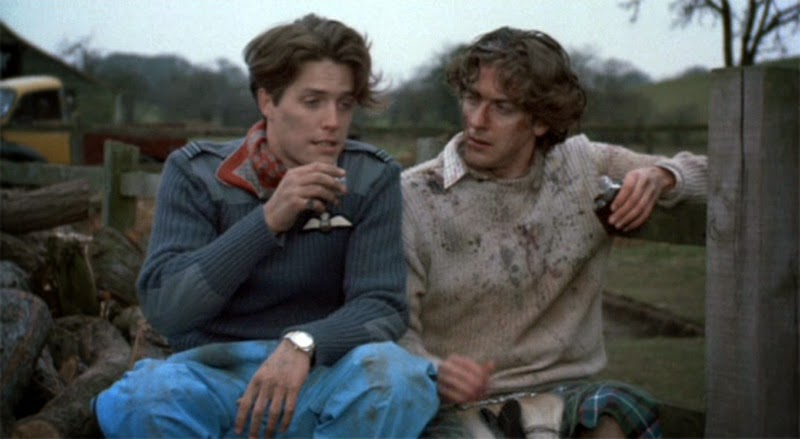

James theorizes that the fossil Angus unearthed is that of a large snake, the legendary d’Ampton “worm” that was slain in Stonerich Cavern by the former’s ancestor. Russell does a nice job of relating the snake legend through song by a local folk band whose stage show anticipates a similar strobe-lighted affair in a certain Canadian roadhouse in David Lynch’s Twin Peaks: Fire Walk With Me (1992).

Meanwhile, one of the local constables (Paul Brooke) checks out a disturbance over at Temple House, the stately abode of Lady Sylvia Marsh (Amanda Donohoe), who “saves” the man from snakebite. When she’s not casually bragging about changing cars as often as a snake sheds its skin, Lady Sylvia is not above hissing venom on a crucifix she encounters while skulking around the Trent B&B. In no time, she has stolen the fossil and later kidnaps Eve with plans to sacrifice the girl to her snake god Dionin. It’s up to Angus and Mary, with James’ help, to stop the evil snake lady from summoning her ancient god.

Cast as an immortal priestess, Amanda Donohoe steals every scene as the sexy Lady Sylvia, chewing deliciously on the campy dialogue and playing up her vampy seductress role as evident in the scene where she takes in a hapless hitchhiker and proceeds to paralyze him with a bite, but not before toying with the young lad by dancing to his somber harmonica playing all the while decked out in a sheer black negligee and thigh-high black leather boots. Donohoe exudes the cool confidence of an evil mastermind and looks like she’s having a lot of fun with the role.


The Lair of the White Worm was an early role for Hugh Grant that saw him in classic foppish Englishman mode and whose purpose is to convey expositional dialogue, which brings our heroes (and us) up to speed on the d’Ampton worm legend. Peter Capaldi has a little more to do as he finds the fossil that kicks off the story and swoops in at the film’s climax to save the day. Sammi Davis is the proactive female protagonist that is unfortunately reduced to a damsel distress at the aforementioned climax while Catherine Oxenberg doubles as eye candy and also as a catalyst in the sense that her abduction motivates our heroes to go after Lady Sylvia. This young cast gamely delivers all kinds of playful dialogue that include numerous snake references and a cheeky nod to Citizen Kane (1941).

In 1912, Bram Stoker wrote his last novel The Lair of the White Worm, which recalled English literature that depicted legends about giant serpents or “worms,” and fused that with folklore and traditional songs to create a story about a white worm so powerful it could transform itself into a beautiful woman that found victims to sacrifice. At the time, Stoker was suffering from a crippling illness and that affected his mind and, in turn, influenced his writing.

As a result, the novel was considered unfilmable until Ken Russell decided to adapt it. In doing so, he was candid about his views of Stoker’s book: “The Lair of the White Worm was written by someone who had a good idea in his head but didn’t have the capacity to properly put it on paper.” He found the book to be a narrative mess and took what he felt were the best parts and incorporated folk songs like “The D’Ampton Worm.” Tired of doing Victorian gothic films, Russell decided to set it in contemporary times. Filming began in February 1988 on location in Hertfordshire and Derbyshire counties in England and at Cannon Elstree Studios outside of London.


Surprisingly, The Lair of the White Worm received generally positive to mixed reviews. Roger Ebert gave the film two out of four stars and felt that it was not up to Russell’s standards: “This is the sort of exercise he could film with one hand tied behind his back, and it looks like that was indeed more or less his approach.” In her review for The New York Times, Janet Maslin wrote, “Miss Donohoe plays the role with a marvelously withering verbal understatement, which is not exactly matched by the film’s visual style.” The Los Angeles Times’ Kevin Thomas wrote, “While an abundant sense of humor cannot save the film from terminal silliness, it might make watching it bearable and even sometimes amusing.” In his review for the Washington Post, Richard Harrington wrote, “There’s so much going on (we’ve barely touched the surface here) that Lair may be better served on video, where, like Russell himself, it can be more easily analyzed. His mind boggles.” Finally, the Chicago Tribune’s Dave Kehr wrote, “There is enough gore and cheesecake to appease the marketplace, though this is a film that functions largely through the skill and swiftness of its storytelling.”

Russell has a bit of fun with the notion of feminist horror by snarkily poking fun at it in his trademark fashion. Early on, Eve has a bizarre, blasphemous vision of Jesus on the Cross being attacked by the d’Ampton worm while Roman legionnaires brutally rape several nuns. Lady Sylvia looks on in approval. In addition, there is a dream sequence in which James imagines Mary and Lady Sylvia as stewardesses fighting it out on an airplane while he, dressed as a pilot, is strapped to a seat, literally a captive audience to a sexy girl fight, which he finds quite arousing as symbolized by the erect pen he holds. Subtlety is not one of Russell’s virtues, but his sledgehammer obvious imagery is part of the film’s charm. While The Lair of the White Worm may never be ranked among his masterpieces, it is still my favorite film of Russell’s and the one I watch the most as I find it an endlessly entertaining experience.


SOURCES


The Lair of the White Worm Production Notes, 1988.


Further Reading:

Check out Sean Gill's fantastic take on the film over at his blog, Junta Juleil's Culture Shock. There's also a really excellent look at it over at The Film Connoisseur blog. And last, but not least, Kevin J. Olson took a look at the film over at his blog, Hugo Stiglitz Makes Movies blog.

Friday, December 21, 2012

Bridget Jones's Diary


Before Bridget Jones’s Diary (2001) was released in theaters, much was made of the casting of soft-spoken American (from Texas no less!), Renee Zellweger as the very British Bridget Jones. It was seen as almost heresy by fans of Helen Fielding’s very popular book of the same name. It was a pretty ballsy move on the part of producers Eric Fellner and Tim Bevan of Working Title Films, the British production company responsible for revitalizing (or destroying depending on your point-of-view) the romantic comedy with the massively successful one-two punch of Four Weddings and a Funeral (1994) and Notting Hill (1999).

Bridget Jones would be their most ambitious entry into the genre to date, adapting a wildly popular best-seller and attempting to quell the controversy of casting Zellweger by having her appear alongside Fellner and Bevan’s cinematic good luck charm, Hugh Grant (who had starred in both Four Weddings and Notting Hill) and Colin Firth, best known (at the time) for his role as Mr. Darcy on the British television miniseries adaptation of Pride and Prejudice (1995). To almost everyone’s surprise, Zellweger pulled it off with a credible British accent and a real commitment to the role (she even put on the weight required to play the character). Working Title scored another box office hit and continued their impressive reign as rom-com champs.

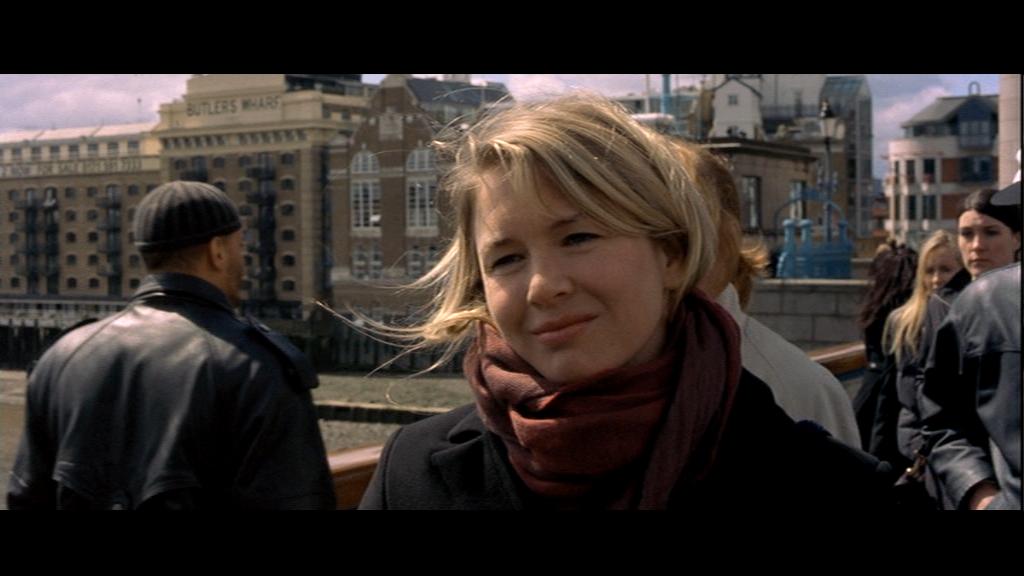
Bridget Jones (Renee Zellweger) is a sworn bachelorette. She has her family and friends but despite her defiantly single stance the biological clock is always ticking. She finds herself looking for Mr. Right. She does fancy her roguish boss, Daniel Cleaver (Hugh Grant), but also finds herself strangely drawn to the repressed and distant Mark Darcy (Colin Firth). The film follows Bridget as she must decide who she loves more while also getting her life in order.

Bridget is not some ultra-thin model (or “American stick insect” as she calls the glamorous New York City career girl that Daniel cheats on her with) type but a full-bodied woman who sometimes acts awkward in social situations, including showing up to a party dressed like some kind of Playboy bunny. Bridget is instantly relatable and immediately gets our sympathy. We care about what happens to her and become emotionally invested in her and her world.

Renee Zellweger is willing to put herself out there, successfully embodying this British phenomenon. She is also willing to look silly and poke fun at herself. However, the way she is lit and the warm colors that surround her, highlight Zellweger’s luminescent, beautiful pink skin. Director Sharon Maguire champions her voluptuous physique and doesn’t hide how she looks. There are lingering shots of Bridget getting dressed, which is refreshing in this day and age. Zellweger is Bridget Jones and looking back at the film after all this time, one would be hard pressed to think of anyone else in the role.

After being type cast as the meek nice guy in films like Four Weddings and a Funeral and Notting Hill, Hugh Grant is cast refreshingly against type as a raunchy cad. It gives the actor a chance to poke fun at his own image and it gave his career a much-needed shot in the arm, allowing him to branch out and play more flawed characters, like his wonderful turn in About a Boy (2002).

At the time, Colin Firth was period piece guy. He shot to success as the thinking women’s sex symbol in A&E’s production of Pride and Prejudice and Bridget Jones firmly established him on the contemporary pop culture map. At first, Mark seems like a stuck up, cold fish but over the course of the film his true feelings for Bridget become apparent. Firth has an uncanny ability of conveying repressed, unrequited feelings. It’s all in his eyes, which are very expressive.

The film’s screenplay, co-written by Fielding, Andrew Davies (Pride and Prejudice), and the always reliable Richard Curtis, offers all kinds of astute observations about single life and the pressure society and the media puts on us to find a mate and get married (“It is a truth universally acknowledged that when one part of your life starts going okay, another falls spectacularly to pieces.”). Not to mention, the film is insanely quotable with many, many memorable bits of dialogue (“My mum, a strange creature from the time when pickles on toothpicks were still the height of sophistication.”).

Bridget Jones’s Diary started as a satirical column by Helen Fielding in London’s The Independent newspaper in 1995, which was then compiled into a novel that was published in 1996. However, it wasn’t until word of mouth and the paperback edition being published the next year that sales really took off. It went on to sell four million copies worldwide, 1.5 million in the U.K. alone. Before sales went through the roof, Working Title Films quickly bought the film rights.

Producers Eric Fellner and Tim Bevan asked screenwriter Richard Curtis of Four Weddings and a Funeral and Notting Hill fame to work with Fielding (whom he was also good friends with) on adapting her book. Documentary filmmaker Sharon Maguire, a friend of Fielding’s and the inspiration for Bridget’s best friend Shazza, was hired to direct and connected with the material instantly. “I know this world because it’s mine. I understand first-hand who Bridget is and what it’s like to be in your 30s, successful in your career, and yet wondering why you’re still alone.”

Producers Eric Fellner and Tim Bevan spent two years looking for the right actress to play Bridget Jones and considered the likes of Emily Watson, Kate Winslet and Helena Bonham Carter before deciding on Renee Zellweger, impressed by her comedic abilities. In March 2000, she went to London where the actress lived for two months, working with dialogue expert Barbara Berkery who had previously worked with Gwyneth Paltrow on Sliding Doors (1998) and Shakespeare in Love (1998). Zellweger underwent daily dialogue exercises and spent a lot of time with Berkery going out shopping and sightseeing in London. She said in an interview, “I’m trying to familiarize myself with the culture. I feel a very strong responsibility to make sure she’s as truly British as I can make her.”

In addition, the actress worked at a publishing company (much like her character) and gained weight, putting on 20 lbs. for the role. To gain the weight, she was put on a regime of three meals a day, multiple snacks and no exercise. By the time of the film’s release, the actress had clearly tired of all the talk about her weight gain for the role: “It’s so sad when people focus on being fat because that is not the word I would use at all. I felt voluptuous for the first time in my life.”

Bridget Jones’s Diary received mostly positive reviews from critics with Zellweger often singled out for her performance. Roger Ebert gave the film three-and-a-half out of four stars and praised Zellweger for being, “fully herself and fully Bridget Jones, both at once. A story like this can't work unless we feel unconditional affection for the heroine, and casting Zellweger achieves that.” In his review for The New York Times, Stephen Holden wrote, “Don't expect Bridget Jones's Diary to deliver any searing revelations about the human condition. Even as a do's and don'ts resource about the dating life, the wisdom it dispenses is questionable. What it is is a delicious piece of candy whose amusing package is scrawled with bons mots distantly inspired by Jane Austen.” USA Today gave the film three out of four stars and Susan Wloszczyna also praised Zellweger: “But where the highly likable actress proves most valuable is in making us adore this insecure, clumsy, contradictory creature. She has us at hello, or at least from the opening credits, where she strikes a perfect picture of self-pity.” In his review for The New York Observer, Andrew Sarris felt that the film wasn’t as good as the book but singled out Zellweger: “Ms. Zellweger makes the most of what she’s given and manages to triumph time and again over her pratfalls and public rump displays. In a word, she’s terrific.” The Washington Post’s Stephen Hunter wrote, “Grant is casually fabulous and very amusing, but all power to Firth the actor. He's the compleat Darcy, and he never wavers. There's no sentimentality, no flirtation with the audience, no final moment of pandering to the niceness gods; he's a cold geek all the way through.”

Entertainment Weekly gave the film a “B” rating and Lisa Schwarzbaum wrote, “Hugh Grant is charming too, luxuriating in naughtiness, taking a holiday from his usual floppy, velvet romantic image as Bridget's caddish boss, Daniel Cleaver, with whom the employee embarks on a bound for disaster affair.” In his review for the Los Angeles Times, Kenneth Turan wrote, “There are flat patches, some situations verge on being overdone, you can see the plot twists coming, but with this spirited a performance in the title role, it's hard to protest too much. Bridget Jones' search for inner poise may be doomed, but her film is anything but.” However, in her review for the Village Voice, Amy Taubin wrote, “The film, like the novel, shies away from the uncomfortable truth that both Mr. Wrong and Mr. Right are attracted to Bridget not only for her cushiony body, but because her empty-headedness makes her seem vulnerable and unthreatening. Bridget gets her man, but you should think twice about whether that constitutes a happy ending.” The Guardian’s Peter Bradshaw wrote, “So Bridget has to be reimagined as a lovable, infantile clown – but once this leap has been made, Renée Zellweger's impersonation of Bridget is entertaining. She has an excellent English accent, the best since Gwyneth Paltrow's Emma. And her Jake La Motta-ish weight-gain is a thing of joy.”

With the commercial and critical success of Bridget Jones’s Diary, a sequel was inevitable. Fielding had written a follow-up but the problem became how to replicate the magic of the first film and yet make it different enough not to be just a retread of what came before? Everyone’s favorite curvy, clumsy British journalist returned in The Edge of Reason (2004).

Bridget and Mark are still a couple in a happy relationship. However, as she writes in her diary, “What happens after you walk off into the sunset?” It is this nagging question that will cloud her judgment. Daniel Cleaver is now a T.V. personality and as rudely funny as ever. On his show he describes the Sistine Chapel as the “First example in history of poof interior designer gone bonkers.” Trouble arises when working class Bridget feels out of place in Mark’s affluent, upper class world. To make matters worse, she starts to feel pangs of jealousy towards one of Mark’s beautiful co-workers, Rebecca (Jacinda Barrett). Her gorgeous looks and casual familiarity with Mark makes Bridget nervous and jealous. How can she compete with a thinner, smarter, more attractive woman? This leads to issues like marriage and children to raise their ugly heads and cause a rift and ultimately split-up Bridget and Mark.

The big problem with this film becomes apparent early on. In the first film, we were laughing with Bridget. In this one we are now laughing at her. For example, she skydives for her morning T.V. show and lands in a muddy pigpen. The segment ends with a gratuitous shot of her dirty behind. The Edge of Reason also recycles many jokes from the first film. Mark and Daniel get into another knock-down, drag-out fight. The film relies too much on physical humor. Bridget falls off the roof of Mark’s flat. Finally, she falls off a ski lift. See a pattern developing? The film takes a gag and proceeds to beat it into the ground until it isn’t funny anymore.

The chemistry between Zellweger and Firth is still strong. They make a great couple and clearly have a good rapport. Zellweger gamely puts on the pounds again and certainly has a knack for physical and verbal comedy. But the film places too much emphasis on the former and not enough on the latter. However, Hugh Grant is a breath of fresh, smarmy air as the roguish Cleaver. He openly leers at any good-looking woman and casually insults people with his scathing wit. The film only comes to life when he’s on-screen.

Bridget Jones’s Diary is much more than just the quintessential single woman’s survival guide. It is a funny and engaging romantic comedy that champions a more realistic image of women. Bridget Jones is the photo negative of The Sex and the City women. She is not like them, with their perfect shoes and witty repartee. Bridget would be watching that show and not be on it. And this is part of the appeal of the film to the average woman. The Edge of Reason, on the other hand, eventually settles into a comfortable groove, merely a pale imitation of the superior original.


SOURCES

Bowes, Peter. "U.S. Eager for Bridget Jones." BBC News. April 6, 2001.

“Bridget Jones Hits the Silver Screen.” BBC News. April 4, 2001.

"Bridget Jones Star Goes Undercover." BBC News. May 12, 2000.

Bridget Jones’s Diary Production Notes. 2001.

Brooks, Libby. "No, I'm Not Bridget Jones. Not Yet." The Guardian. April 12, 2001.

"How Renee Became Bridget." BBC News. April 4, 2001.

Kennedy, Dana. “A Character Actress Trapped in an Ingenue’s Body.” The New York Times. September 10, 2000.

Lyman, Rick. “Bridget Jones, Child of the 80’s.” The New York Times. April 13, 2001.

“Renee Wins Bridget Role.” BBC News. February 24, 2000.


Wood, Gaby. “A Bridget Just Far Enough.” The Observer. March 4, 2001.