"...the main purpose of criticism...is not to make its readers agree, nice as that is, but to make them, by whatever orthodox or unorthodox method, think." - John Simon

"The great enemy of clear language is insincerity." - George Orwell
Showing posts with label Willem Dafoe. Show all posts

Friday, January 17, 2020

Spider-Man


In 1997, Batman & Robin nearly killed off the comic book superhero movie. It was famously reviled by critics and underperformed at the box office. Blade (1998), however, came out the next year and proved that there was still interest in the genre. It wasn’t until the phenomenal success of X-Men (2000) and Spider-Man (2002), which managed to tap into the pop culture zeitgeist in a significant way, that the genre returned to prominence. Both movies were made by directors who grew up with these comic books and were fans. More importantly, they understood what made these iconic characters work and strongly identified with them.

Sam Raimi, in particular, was an inspired choice to direct Spider-Man. In many respects, his 1990 film Darkman was a comic book superhero movie not actually based on an existing title. It demonstrated that he had the innate storytelling instincts for the genre and the stylistic chops to transport the famous webslinger from page to screen. The end result was a loving homage to his humble beginnings at the hands of Stan Lee and Steve Ditko while still feeling contemporary.

Raimi immediately established Peter Parker (Tobey Maguire) as a pasty-faced dweeb that admires his high school crush Mary Jane Watson (Kirsten Dunst) from afar. It’s not like he’s invisible as the movie makes a point of having her stick up for him while others ridicule him. He is an outcast and is friends with another outsider, Harry Osborn (James Franco), a rich kid that flunked out of private school and is tired of living in the shadow of his brilliant scientist father, Norman Osborn (Willem Dafoe). David Koepp’s screenplay efficiently introduces all the significant people in Peter’s life and establishes the relationships between each other. Raimi has fun introducing the core supporting characters in Spider-Man’s world, like the Daily Bugle’s publisher J. Jonah Jameson played with perfect bluster by J.K. Simmons who captures the essence of the notoriously cheap yellow journalist while also taking an instant dislike to the webslinger.

The movie soon establishes a parallel between Peter and Norman as they undergo physical enhancement that also affects them mentally. With Peter it happened accidentally but Norman made the choice to do it, which drives him insane. Initially, Peter’s newfound powers make him cocky and selfish as he uses them for profit. It is only when this behavior results in the death of his beloved Uncle Ben (Cliff Robertson) that he learns to use his powers for the greater good.

Maguire has a memorable scene with Cliff Robertson when Uncle Ben has a heart-to-heart with Peter, telling him, “These are the years when a man changes into the man he’s gonna become for the rest of his life. Just be careful who you change into.” He then utters the movie’s most famous line, “With great power comes great responsibility.” Instead of listening, Peter foolishly chastises Ben for telling him what to do and to stop pretending to be his father, which visibly wounds the elder man. Robertson is excellent in this scene as he makes you care about him so that you feel bad when Peter dismisses him so callously. Maguire is quite strong in this scene as well, showing how Peter has become drunk with his newfound powers, believing that no one can relate to what he’s experiencing. He is also quite affecting in the aftermath of Ben’s death. Peter is in his room quietly crying, devastated by what happened and with the knowledge that it was his fault. He could have prevented it.

Kirsten Dunst brings a fresh-faced girl-next-door vibe to the role of M.J. She’s obviously beautiful but the actor isn’t afraid to act disarmingly goofy when posing for Peter’s pictures during their school field trip. She isn’t bored by the science stuff and actually looks interested in the tour guide’s spiel. The movie wisely has the relationship between her and Peter as its heart, establishing their friendship in scenes like when they tell each other their aspirations after they graduate from high school – she wants to be an actor and he wants to be a photographer, working his way through college. It a wonderful character building moment as Peter encourages M.J. to follow her dreams.

The two actors have fantastic chemistry together. We want to see Peter and M.J. get together yet it is always tantalizingly just out of reach. The scene where he saves her from would-be muggers as Spider-Man and she rewards him with a passionate kiss is a moment of intimacy that is missing from a lot of the current crop of comic book superhero movies, which are strangely asexual. What, superheroes don’t get to have love lives? The potential romance between Peter and M.J. is one of the best things about Spider-Man.

Willem Dafoe does a great job conveying Norman’s gradual transition to the dark side and the emergence of a split personality. It allows the actor to play two separate characters – Osborn, the victim, and the Green Goblin who wants to punish those that wronged him. The movie takes the time to show what motivated a decent man like Norman to go bad, transforming himself into the Goblin. He’s not a simple, world dominating baddie but a tortured soul driven mad by self-imposed pressures and corporate machinations. It was a quite a coup getting someone of Dafoe’s caliber to play the villain. He gives the role his own distinctive spin, like the Thanksgiving dinner he attends at Peter and Harry’s place. It looks like Norman but the way Dafoe plays it you can tell that the Goblin persona has taken over in the way he leers suggestively at M.J. and threateningly at Aunt May (Rosemary Harris) when she slaps his hand for touching the food before saying Grace.

As he demonstrated with Darkman, Raimi has a knack for kinetic camerawork and editing tailor-made for a comic book superhero movie, which he demonstrates during the Green Goblin’s attack on the Oscorp Unity Day Festival in downtown New York City. While trading blows with him, Spider-Man saves several innocent bystanders caught in the crossfire, most notably M.J. The CGI in this sequence is impressive, seamlessly showing off both combatants’ abilities. Technology had finally caught up to what the comic books had been doing all along and brought Spider-Man’s webslinging powers vividly to life.

At the end of Spider-Man, Peter sums up his lot in life best when he says, “No matter what I do no matter how hard I try, the ones I love will always be the ones that pay.” This movie shows the sacrifices a hero must make in order to keep the ones he loves safe. Spider-Man is about what it takes to become a hero and what it means to be one. All it takes is one fateful moment to change your life forever. For Peter it was refusing to stop and armed robber who goes on to kill Uncle Ben. At that moment Peter realizes that his actions have real consequences and that he must use his powers responsibly. Thus, Spider-Man is born. It is this moment that sets him on the path to becoming a superhero.

Friday, September 21, 2018

Born on the Fourth of July


“When people say if you don’t love America, then get the hell out. Well, I love America, but when it comes to the government, it stops right there.” – Ron Kovic

Oliver Stone’s filmic prescience is widely regarded by critics, students and the public at large. It hit is apex with 1989’s Born on the Fourth of July, a cinematic crystal ball, which anticipated the rise of Donald Trump’s divisive “Make America Great Again” nationalism. Stone’s biopic traces the life of Ron Kovic (Tom Cruise), from his beginnings as the quintessential all-American boy proud eager to serve the country he loves and respects in the Vietnam War, to being a disillusioned veteran, paralyzed in battle and how it led to his anti-war activism. This film asks particularly difficult questions about what it means to be American and has become even more relevant today than the year it was released to critical and commercial success.

Ron Kovic’s voiceover narration establishes a picturesque childhood, he and his best friends play soldiers with other neighborhood kids. He grows up in the Norman Rockwell-esque small town America of the 1950s. Born on the Fourth of July is propaganda – but all is not what it appears; Stone cleverly subverts it, showing us little cracks in the idyllic façade. As a child, Ron idolizes the soldiers he sees with his family in a parade early on in the film. This is tempered when one soldier visibly winces at the sound of firecrackers and another is shown, arms lost in battle, a grim look on his face.

Stone’s multi-layered patriotic imagery during the opening credits sequence is bathed in a sun-kissed glow, courtesy of Robert Richardson’s stunning cinematography. Ron’s mother (Caroline Kava) even calls him her “little Yankee Doodle Boy.” This is the land of 4th of July fireworks, parades populated by beautiful cheerleaders and where Ron is an exceptional athlete, hitting an in-the-park home run as a boy. He lives in suburbia with a family that embodies the American Dream.

As a teenager, he excels in wrestling, being pushed to his limits by a coach whom has all the zeal of an army drill sergeant. It is in these early scenes that we see the Tom Cruise we all know – the ambitious go-getter, but Stone tempers this by showing Ron lose an important match in front of his classmates, friends, and family. His anguished expression – as boos ring out around him –foreshadows more painful defeats to come.

Ron’s hero worship of the military continues when he attends a presentation (a.k.a. a recruitment pitch) by the United States Marines at his school. There is delicious irony as Ron looks adoringly at the Marine speaking (played by none other than Tom Berenger) as if the actor’s demonic soldier from Platoon (1986) somehow survived, returning stateside to recruit young men to fight in the Vietnam War.

Ron buys into it, eager to serve his country as his father (Raymond J. Barry) did before him in World War II. He wants to go and fight in Vietnam and is even willing to die there (“I want to go to Vietnam – and I’ll die there if I have to). His life is playing out like a stereotypical Hollywood movie. He even rushes to the prom, in the rain, to declare his love for girl-next-door-eseque Donna (Kyra Sedgwick) as “Moon River” plays over the gymnasium speakers.
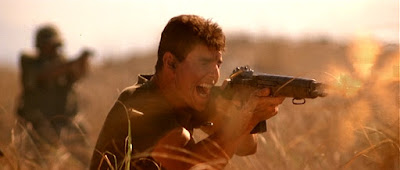
Ron’s idyllic youth comes to a violent end once we see him in ‘Nam, his platoon accidentally slaughtering an entire village. To make matters worse, he inadvertently shoots and kills one of his own soldiers. He tries to own up to it but his superior (John Getz) dismisses him. Where everything stateside was simple to understand – Ron always took for granted that he knew what was expected of him. Vietnam is chaotic and confusing, the enemy difficult to identify. As he did with Platoon, Stone immerses us in the sights and sounds of battle, albeit in a more stylized depiction. Here, he employs more slow-motion, filters, and skewed camera angles to show the disorienting effect of combat through Ron’s eyes.

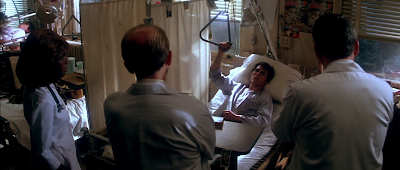
He is wounded in battle and is shipped back to the Bronx Veterans Hospital where he finds out that he’s been paralyzed from the chest down. Despite the absolutely appalling conditions (rats scurrying between beds, interns shooting up in closets and Ron starring at his own vomit for hours), he still believes in the American Dream and is critical of the anti-war protestors he sees on television. He aggressively attacks physical therapy, refusing to accept the doctor’s diagnosis that he’ll never regain the use of his legs.

Cruise is particularly effective in these scenes as he conveys Ron’s gradual disillusionment with the system. He is slowly becoming dehumanized by the system that cares little about him. Government cutbacks result in poor conditions and treatment that Stone depicts in unflinching detail. Is this how our country honors those that put everything on the line to serve their country?
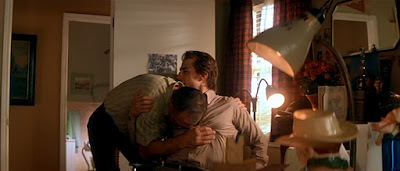
Ron’s homecoming is a heart-wrenchingly bittersweet one. On the surface, his family is happy to see him – the heartbreaking emotions swell under the surface, conveyed in his mother’s eyes when she embraces him, giving a brief, sad look that he is unable to see. While his father goes on about the changes he’s made to the bathroom to make it more accessible for his son, Ron only half-listens as he looks around his old bedroom, lingering on a photograph of himself during his wrestling days at high school. Stone shows Ron’s image reflected in the glass of the picture frame, visually giving us a before and after of this man’s life.

Ron quickly picks up on how differently people in the town look at him: “Sometimes I think people know you’re back from Vietnam and their face changes, their eyes, the voice, the way they look at you.” A family dinner breaks up when Ron’s brother (Josh Evans) leaves the table, unable to stomach his brother’s patriotic rant. He participates in a parade, much like the one he saw as a child and flinches at the sound of a firecracker, like the veterans he once saw, and this time is faced with angry protestors and other townsfolk; he begins to realize this is not his father’s war.

At the rally afterwards, Ron falters while making a patriotic speech as he experiences a flashback to ‘Nam. Confused, he is “rescued” by childhood friend and fellow veteran Timmy Burns (Frank Whaley). The relief that washes over him at the sight of a familiar face is palpable. The scene between the two men afterwards is quietly affecting as they share stories of their experiences on the battlefield. Timmy tells Ron about the headaches he has – “I don’t feel like me anymore” – and his frustration that the doctors don’t know how to help him. Cruise conveys incredible vulnerability as Ron regrets the mistakes he made in Vietnam, how he feels like a failure, and how badly he wants to regain the ability to walk. This scene features some particularly strong acting from both men, defining moments for both actors and the characters.

I like how Stone spends time showing the moments and events that happen to change Ron’s views of the war. It wasn’t just one incident but a series of them, most significantly an anti-war rally where we can see the change of his way of thinking play over his face. Without warning, cops move in and he watches, helplessly, as they beat protestors. At last, Ron breaks down in his parents’ home, getting into a shouting match with his mother as he finally lets out all of the anger and anguish built up inside him about the war. He’s approaching rock bottom and Cruise conveys Ron’s hurt in a raw and powerful way that is riveting to watch.

It isn’t until he goes to Mexico – in a dust-up with a group of veterans in a bordello – that Ron has an epiphany out in the desert with Charlie (Willem Dafoe), a fellow Vietnam vet. They get into a heated argument about how many babies they killed over there. Afterwards, exhausted, Ron says, “Do you remember things that made sense? Things you could count on before it all got so lost? What am I gonna do, Charlie?” This conversation, combined with visiting the graveside and confessing to the parents of the American soldier he accidentally killed (in a painful, gut-wrenching scene that Cruise gives everything he has), are the pivotal moments that transform him into being an anti-war activist.

When Ron emerges on the floor of the 1972 Republican National Convention in Miami Beach, speaking out against the war and President Nixon administration, Ron has a cathartic moment, finally finding a way to channel his anger and frustration. Once removed from the convention, he’s almost arrested and roughed up, the police giving no consideration for his physical condition. Undaunted, he uses his military training to organize the protestors and continue on in a battle of a different kind.

One month after Ron Kovic gave a speech at the 1976 Democratic Convention, his book about his experiences before, during and after the Vietnam War was reviewed in The New York Times. It drew the attention of movie producer Martin Bregman who bought the rights to the book. He quickly realized that it didn’t have good commercial prospects as the subjects of Vietnam and life as a paraplegic being its focal points. Kovic then served as a consultant on a film about the same subject – Hal Ashby’s Coming Home (1978), starring Jon Voight, who won the Academy Award for his performance. Universal Studios – who were going to finance Born on the Fourth of July – pulled their money and support. No other studio was interested and no one wanted to direct it. All Bregman had was a screenplay written by a young Oliver Stone, who clearly identified with Kovic’s experiences: “My story and that of other vets is subsumed in Ron’s. We experience one war over there then came home and slammed our heads into another war of indifference…and we all came to feel we had made a terrible mistake.”

Bregman found German investors willing to put up money for pre-production, hired Dan Petrie (A Raison in the Sun) to direct, cast Al Pacino as Kovic, with Orion Pictures distributing the film. A few weeks before rehearsals were to begin, the foreign financing fell through and the rights reverted back to Universal. Pacino had second thoughts and left to make …And Justice For All (1979), leaving Bregman $1 million in the hole and Stone depressed, his script without a home. The latter promised Kovic that one day they’d make this film together and became a filmmaker in his own right.

While Stone wrote the script for Wall Street (1987), Tom Pollock, then-president of Universal, took a look at the filmmaker’s script for Born on the Fourth of July and realized, “it was one of the great unmade screenplays of the past 15 years.” He told Stone that the studio would make it for $14 million and a major movie star as Kovic. After making Platoon, Stone considered rewriting a script from 1971 based loosely on his own experiences returning home from Vietnam but put it aside in favor of Kovic’s story, which he felt had broader appeal.

Stone and Kovic considered Sean Penn, Charlie Sheen, Nicolas Cage, and ultimately went with Tom Cruise. Stone met with him and told the actor he needed a movie star to play Kovic and had a small budget to make it. Cruise, who had wanted to work with Stone, accepted the challenge. He was drawn to the film as he felt it was a personal passion project for Stone: “I thought it was almost his life story, too, his Coming Home.”

The young actor identified with Kovic’s working class ethic and his drive to become the best: “I grew up hearing ‘no’s and can’ts’, but I pushed myself forward, always looking ahead so I wouldn’t get stuck.” Stone was drawn to Cruise’s all-American boy image: “I thought it was an interesting proposition: What would happen to Tom Cruise if something goes wrong?” Furthermore, “I sensed with Tom a crack in his background, some kind of unhappiness, that he had seen some kind of trouble. And I thought that trouble could be helpful to him in dealing with the second part of Ron’s life.”

Bregman felt that Cruise was a safe choice and not strong enough an actor for the tough material. Initially, Kovic agreed until he met Cruise: “I felt an instant rapport with him that I never experienced with Pacino.” The two men talked for hours and Kovic got very emotional. He remembered, “I felt like a burden was lifted, that I was passing all this on to Tom. I knew he was about to go to Vietnam, to the dark side, in his own way.” The actor remembers meeting the man he would play on film and how he “really opened up to me.” Cruise knew this would be a daunting role and felt ready after making The Color of Money (1986) with Martin Scorsese and Rain Man (1988) with Barry Levinson. “I made it work one day at a time. If I looked at the mountain, it was just too high.”
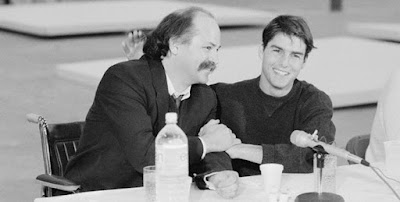
Stone wasn’t immediately convinced: “Tom was cocky, sure he could handle everything. But I wasn’t so sure…He was shaky at first, but we shot in continuity as much as possible to show how, step by step, he began to understand.” To prepare for the role, Kovic took Cruise to veterans’ hospitals where he spent days talking and working with paraplegics. He hung out with Kovic in a wheelchair until it became second nature. Cruise also read many books about the war, including Kovic’s diary. Stone brought in his trusted military adviser Dale Dye to work with Cruise and the cast on two separate week-long training missions. Dye remembered that he “treated him no differently than I treated anybody else…A big part of it was, of course, helping Tom Cruise get the mentality he needed for the film.” They had to dig their own foxholes and live in them as well as learn to handle a variety of weapons. Stone also brought in Abbie Hoffman to talk to the cast about the peace movement in the 1960s. The legendary activist even has a cameo in the film.

Principal photography was a grueling 65-day shoot with 15,000 extras and 160 speaking roles. Dallas doubled for both Long Island and Mexico. The production shot 10-12 hours a day in 100-degree heat. At one point, Cruise got sinusitis. Several crew members fainted in the extreme climate. At one point, Stone became quite sick. Focused on the film, he ignored the symptoms until they got in the way of his work. He went to a local hospital in Dallas, underwent a panel of tests and was given medicine. His condition, however, only worsened. The film’s production coordinator called a local physician who had treated other crew members. He recognized Stone’s symptoms as an allergic reaction to a particular kind of pollen common in Dallas at that time of year.

Stone challenged his crew to duplicate Long Island in Dallas on a small budget. Several blocks of houses were given new looks and landscaped to recreate Massapequa, 1957. Principal photography began in October 1988 with the successful transformation of a southeast section of the city into a Long Island neighborhood. Born on the Fourth of July also saw Stone, for the first time, experiment with several different kinds of film stocks: 16mm, Super 16 and 35mm. He combined footage shot for the film with grainy, archival footage that was originally shot for network news in ’72 to recreate the veterans demonstrating at the Republican National Convention in Miami Beach. This certainly wouldn’t be the last time as he continued to do so with The Doors (1991), JFK (1991), Natural Born Killers (1994), Nixon (1995), and U Turn (1997).
Filming went on hiatus for the Christmas holidays, giving Stone an opportunity to edit sections of the film. He realized that his vision for Born on the Fourth of July had expanded and he would need to shoot more footage than budgeted. Stone went to Pollock and told him he needed an additional $3.8 million. The studio executive was hesitant but after the director showed him some edited sequences, he was given the money and allowed to go ten minutes over the running time that was in his contract.

Cruise had a particularly tough time with the scene where a sexually impotent Kovic pays to be with a Mexican prostitute. Stone remembers the actor’s shyness:

“We just kept shooting, working up to the place where Tom cries, thinking about everything he’ll miss – certainly not from the joy of sex. On one take, something happened inside him. Those tears came from someplace in Tom.”

Cruise remembered, “I went to Oliver and I said, ‘I’m just not there. It’s just not working.’ I remember feeling a lot of anxiety actually.” Stone told him to just do the scene and not think about it. The actor did it and, in the process, learned to let go. The two men clashed occasionally: “Tom is macho, aggressive, male and he wants the best. Perfection is his goal and if he doesn’t achieve it, his frustration is high.” Stone also clashed with the studio, nervous about the film’s commercial prospects so he and Cruise gave up their salaries for a percentage of the profits – a gamble that paid off exponentially.

Kovic was so impressed by Cruise’s performance that on the last day of filming he gave the actor his Bronze Star that he won in Vietnam. For Stone, he wanted the film to “show America, and Tom, and through Tom, Ron being put in a wheelchair, losing their potency. We wanted to show America being forced to redefine its concept of heroism.”

More conflicts arose between Stone and the studio during post-production. When it came to editing the film, Stone felt that the ending needed to be reshot and he also wanted John Williams to score the film. Cruise and Pollock agreed about reshooting the ending but the executive did not want to spend the extra money required to get Williams. In addition, he wanted to move up the release date to Veterans Day instead of Christmas. This enraged Stone and he went to Mike Ovitz, then-head of Creative Artists Agency, who wielded great power in Hollywood, and got him involved. After a meeting with Pollock, Stone agreed to shoot a new ending and Pollock agreed to both keep the original release date and pay to have Williams create the score. Stone remembers, “It left a lot of bad blood. I didn’t continue to work with Universal.”

Born on the Fourth of July received mixed to positive reviews at the time. Roger Ebert gave the film four out of four stars and wrote, “It is not a movie about battle or wounds or recovery, but a movie about an American who changes his mind about the war…This is a film about ideology, played out in the personal experiences of a young man who paid dearly for what he learned.” Pauline Kael was much more dismissive: “Born on the Fourth of July is like one of those commemorative issues of Life – this one covers 1956 to 1976. Stone plays bumper cars with the camera and uses cutting to jam you into the action, and you can’t even enjoy his uncouthness, because it’s put at the service of sanctimony.” In his review for The New York Times, Vincent Canby wrote, “It’s the most ambitious non-documentary film yet made about the entire Vietnam experience. More effectively than Hal Ashby’s Coming Home and even Michael Cimino’s Deer Hunter, it connects the war of arms abroad with the war of conscience at home.”

Entertainment Weekly’s Owen Gleiberman gave the film a “C+” rating and wrote, “Tom Cruise tries hard, yet he’s fatally miscast: He simply doesn’t have the emotional range to play a character wallowing in grubby desperation.” In his review for the Washington Post, Hal Hinson wrote, “Born on the Fourth of July is nettlesome work. Stone has gifts as a filmmaker, but subtlety is not one of them. In essence, he’s a propagandist, and, as it turns out, the least effective representative for his point of view.” Finally, Rolling Stone’s Peter Travers wrote, “Stone has found in Cruise the ideal actor to anchor the movie with simplicity and strength. Together they do more than show what happened to Kovic. Their fervent, consistently gripping film shows why it still urgently matters.”

There are people that are patriotic and those that are nationalistic fused with fascism, twisted into something so ugly that it doesn’t resemble what would be called patriotism, to spawn the bastardization of what passes for democracy today. This film wrestles with the definition of patriotism. The power of constitutional rights – most pointedly, the right to assemble and freedom of speech – are both key to our understanding about what it means to be American. It is not un-American to be critical of the country when it has become an unjust place, when the landscape has become an inhospitable place no longer nurturing the ideals upon which it was founded.

Within the fabric of Born on the Fourth of July lies hope. We hope that Kovic is not representing the lone man but the everyman. Hopefully, we will all wake up to what is really happening, pick ourselves up and enact change. This film is a rallying cry that needs to be sounded again, repeatedly, unrelenting in its echo.


SOURCES

Chutkow, Paul. “The Private War of Tom Cruise.” The New York Times. December 17, 1989.

Dutka, Elaine. “The Latest Exorcism of Oliver Stone.” Los Angeles Times. December 17, 1989.

Gabriel, Trip. “Cruise at the Crossroads.” Rolling Stone. January 11, 1990.

O’Riordan, James. Stone: A Biography of Oliver Stone. Aurum Press. 1996.

Ressner, Jeffrey. “Breaking Conventions.” DGA Quarterly. Fall 2012.

Friday, April 10, 2015

Clear and Present Danger

No stranger to movie franchises, it came as no surprise when Harrison Ford replaced Alec Baldwin as Jack Ryan in the popular adaptations of Tom Clancy’s best-selling novels with Patriot Games (1992), the follow-up to The Hunt for Red October (1990). Ford slipped effortlessly into the role and made it his own. The result was a critical and commercial success despite Clancy’s disdain for how much the film diluted his novel. The actor reprised the role again two years later with Clear and Present Danger (1994), which was the most ambitious Ryan film at that time, expanding the scale and scope significantly while also immersing the character in morally murky waters as he became embroiled in the United States’ covert war on Colombian drug lords. The end result is an intriguing political thriller that takes a fascinatingly complex look at geopolitics while still including the slam-bang action heroics we’ve come to expect from these kinds of films.

When a close friend and his family of the President of the United States (Donald Moffat) is killed by drug traffickers because of his ties to a drug cartel, CIA analyst Jack Ryan (Harrison Ford) is assigned to investigate. The President, clearly frustrated by the rise of the cartels in Latin America, indirectly gives his National Security Advisor James Cutter (Harris Yulin) unofficial permission to kill the men responsible.

Meanwhile, Ernesto Escobedo (Miguel Sandoval), leader of the Cali cartel, and the man who ordered the hit on the President’s friend, is advised by his trusted counsel Felix Cortez (Joaquim de Almeida) to calm down and be careful as the U.S. might retaliate. I like that Escobedo is a shrewd drug lord ruled by his emotions but smart enough to surround himself with intelligent people like Cortez who knows when to speak up and say things his boss might not want to hear and when to keep quiet, but only when it serves his own agenda. Joaquim de Almeida plays him with a cunning intelligence and in several scenes you can see his character thinking – either processing something he has just seen or learned or contemplating a future action much like an excellent chess player.


After his superior, Vice Admiral Jim Greer (James Earl Jones), is diagnosed with pancreatic cancer, Ryan is appointed Deputy Director of Intelligence. This doesn’t sit well with Bob Ritter (Henry Czerny), CIA Director of Operations and Cutter’s enforcer. The two men view Ryan as a “boy scout” and decide to intentionally leave him out of the loop in regards to the covert actions they plan to take against the cartels. Harris Yulin and Henry Czerny are excellent in these early scenes, exuding icy menace as men orchestrating very secretive operations on a need-to-know basis and this does not include Ryan. Czerny, in particular, excels at a no-nonsense look, going toe-to-toe with and holding his own with Ford in a confrontation that crackles with intensity. Other filmmakers in Hollywood must’ve noticed Czerny’s considerable gravitas as he would go on to give Tom Cruise a hard time in Mission: Impossible (1996).

Ritter begins to put things in motion, assembling a black-operations team led by John Clark (Willem Dafoe) that inserts itself in Colombia on search-and-destroy missions. Ryan’s life becomes complicated when the President sends him to Bogota, Colombia to find a concrete connection between his friend and the drug cartels. At Greer’s suggestion, Ryan meets with Clark in a nice little scene as Willem Dafoe presents a smiling façade but it is clear that he’s feeling Ryan out, getting a sense of how much he knows (or doesn’t). He plays a rather enigmatic character initially – we’re not sure which side he’s on and this isn’t clear until the film’s last act. For fans of acting, there is a certain thrill seeing Ford and Dafoe team-up later on. They have very different acting styles and so it is interesting to see them play off each other as the fish-out-of-water Ryan is schooled by the veteran field op Clark. Watching Dafoe in this film it’s almost as if his sergeant character from Platoon (1986) somehow managed to survive certain death and become a black-op for the U.S. government as a way of dealing with his disillusionment over the Vietnam War.

Harrison Ford turns in another solid, dependable performance playing what appears to be the last honest man in Washington, D.C. His storyline is an engrossing whodunit only that we know the answer and the enjoyment comes from watching Ryan gradually figure things out. Once he does, Ryan finds himself stuck in a moral quagmire that puts his black and white view of right and wrong to the test. Once Ford lets his moral outrage flag fly free, he ups the intensity factor exponentially, starting with a fiery confrontation with Czerny’s smug bureaucrat and ending with an even more bombastic confrontation with the President. I remember at the time the film came out that only Ford could get away with chewing out the President and then a few years later he played him in Air Force One (1997).


As he did with Patriot Games, director Phillip Noyce shows a deft hand with the action sequences as evident in the way he gradually ramps up our anticipation of a motorcade ambush with Ryan and other U.S. government officials. Noyce masterfully orchestrates the build-up and then immerses us in the chaos of the attack as explosions surround Ryan’s vehicle forcing him to take charge. There is a real sense of danger and one feels Ryan’s life is in serious danger as people around him die, including a colleague close to him, which makes it personal.

Tom Clancy was never completely thrilled with the adaptations of his novels, conceding that with The Hunt for Red October, “they didn’t screw it up too much,” and badmouthing Patriot Games in the press, which included saying that Harrison Ford was too old to play Jack Ryan. While that film performed well at the box office, it didn’t do as well as Red October domestically. It did well enough, however, for Paramount Pictures to put Clear and Present Danger in production. After making Games, director Phillip Noyce vowed never to do another Ryan film, but relented after reading Clancy’s novel.

John Milius, a right-wing friend of Clancy’s, was brought in to write the screenplay while Games was being made. By his account, Clancy approved of his draft because “I was very faithful to his book,” and that was the problem. In the book, Ryan hardly appears in the first half of the story and spends most of his time in an office while a squad of soldiers takes care of most of the action.


In March 1992, Paramount hired Red October and Games co-screenwriter Donald Stewart to re-write Milius’ script so that Ryan was front and center. This convinced Ford to sign on to the project. Not surprisingly, Clancy was not happy with Stewart’s work, telling the Washington Post that he thought it was “really awful.” He then faxed a series of memos to the production team with major and minor criticisms. He wrote, “Clear and Present Danger was the No. 1 best-selling novel of the 1980s. One might conclude that the novel’s basic story line had some quality to it. Why, then, has nearly every aspect of the book been tossed away?” Ford countered, “You do things when you’re typing that you would never do if you had to fucking stand there and deliver [the lines].”

That being said, Ford and Noyce were still not satisfied with Stewart’s work and brought in Steven Zaillian, who co-wrote Games, to make the script more faithful to the book while giving Ryan more screen-time, which makes about as much sense as it sounds. Ford also wanted the final scene changed, making it less ambiguous than it was in the book. The actor said, “It’s hard to make an ambiguous ending to a two-hour movie. The audience is not normally satisfied [with that].” Clancy and Milius were not thrilled with this change. The latter, however, did make a special deal with the producers to advise the film’s action sequences, in particular, the ambush of Ryan’s convoy in Bogota.

Once principal photography began, the production ran into several problems. Initially, the CIA and the Pentagon refused the production access to their equipment, which was important to the story, citing issues with the script. The filmmakers made the necessary alterations, which resulted in the military and the Pentagon granting full cooperation. They also received cooperation from the DEA, the FBI and the State Department. Some of the Washington, D.C. footage that was sent back to Los Angeles was damaged in an earthquake. When the production moved to Mexico, they arrived days before rebels started a revolt in the southern state of Chiapas. As a result, the government was hesitant to issue permits for the guns an explosives needed until two days before filming started.


The ambush sequence took eight weeks to prepare and the filmmakers used a specially fabricated street that ran the length of two football fields. While Ford downplayed the amount of stunts he did in the film, during this sequence he actually drove the “escape vehicle” backwards at 100 mph. Scheduled for five days, the production went over when it took eight days. A persistent fog plagued the final shooting location causing delays all the while Ford and Noyce argued over various aspects of the script, which was being rewritten on a daily basis. On top of all that, Ford was still recovering from a knee injury he sustained while filming The Fugitive (1993), which pushed all of the action sequences to the end of the shoot when everyone was tired. Finally, the scripted finale that involved an elaborate chase on the town’s rooftops that ended with a fight between Cortez and Ryan on top of a church was truncated to a helicopter rescue because they were so over schedule. Noyce said, “Certainly compared with Patriot Games, it was more stressful. It was harder to reach agreement on things.”

Clear and Present Danger was well received by critics at the time. In her review for The New York Times, Janet Maslin praised Henry Czerny’s performance: “Fidgety, intense, loaded with menace, he becomes the worthiest and most sinister of Ryan’s many adversaries in this story.” The Washington Post’s Rita Kempley called it “absorbing, if overlong … More cerebral dilemma than an action-packed adventure, the film explodes from time to time, but mostly takes place in offices.” In his review for the San Francisco Chronicle, Mick LaSalle wrote, “the film is an examination of an America committed to power, not principle, and how that moral failing translates into individual failings at the very heights of government.” Entertainment Weekly, however, gave the film a “C+” rating and Lisa Schwarzbaum wrote, “In its way, the clear and present danger of this pop production is that we are given permission to feel good about feeling cynical about government, and we are so grateful for the sermon that we forget we don’t quite buy how this movie got to this punchline in the first place.”

The first third of Clear and Present Danger is a top-notch political thriller as Noyce expertly introduces all the major players while juggling the two significant storylines: Ritter’s black-op and Ryan’s investigation into the murder of the President’s friend. It is interesting to see how the complexity of a mainstream film like Clear and Present Danger compares to the ones made in recent years. Even the very well made Jason Bourne films are relatively straightforward in comparison.


Noyce’s film takes the time to flesh out the motivations of both the U.S. government and the drug cartel, showing how deception on each side undermines their respective goals. While Cutter and Ritter wage their own secret war, unbeknownst to Ryan, Cortez responds in kind, framing Escobedo without his knowledge and our protagonist is caught in the middle. This tricky juggling act is pulled off expertly by a powerhouse team of screenwriters that include Steve Zaillian, John Milius and Donald E. Stewart. Clear and Present Danger has just the right mix of political intrigue complete with double crosses and action sequences full of white-knuckle intensity. It’s a thinking person’s political thriller chock full of moral complexity – something that was largely absent from future Jack Ryan films and most mainstream Hollywood movies of this kind.


SOURCES

Fretts, Bruce. “Harrison Ford Takes on Tom Clancy…Again.” Entertainment Weekly. August 19, 1994.


Pfeiffer, Lee and Michael Lewis. The Films of Harrison Ford. Citadel Press. 2002.

Friday, February 20, 2015

Platoon

Oliver Stone’s Platoon (1986) was not the first film about the Vietnam War. It was, however, the first one to be made by a man who had served as a foot soldier (with the 25th Infantry Division) in the conflict. Before it was the rah-rah propaganda of The Green Berets (1968). The melancholic drama of The Deer Hunter (1978). The surrealism of Apocalypse Now (1979). Although, in good company with many outstanding films about one of the most combative periods in our country’s history, both stateside and overseas, they lacked the gritty realism of Platoon. Stone’s film not only captured the sights and sounds of what it was to be a soldier in those impenetrable jungles, but also got the little yet crucially important details – their lingo, the tight brotherhood in each squad and the way they carried themselves as well as how they carried their equipment. Through every vein of the film runs an authenticity that only a filmmaker like Stone could give it.

If the aforementioned films had been released too close to the war, Platoon came along at just the right moment when enough time had passed so that the American public was more receptive to revisiting a war that tore this country apart, from decorated officers coming home to college students who had never touched a gun in their lives. It struck a chord with people in a way that previous films had not. Stone’s film was a commercial and critical success, catapulting him and his young cast of up and coming actors into the spotlight while also kickstarting a cottage industry of Vietnam War-themed films (Full Metal Jacket; Hamburger Hill), television shows (China Beach; Tour of Duty), novels (Chickenhawk; Going After Cacciato), and even comic books (The ‘Nam).

Platoon focuses on the 25th Infantry, Bravo Company in September 1967 with new recruit Chris Taylor (Charlie Sheen) as the audience surrogate and our introduction to this world. We see the war through his eyes, from that first blast of bright light as he walks off the plane with other new recruits and they see a collection of body bags. They are then taunted by a group of battle-hardened veterans heading home. That will be them some day... if they live long enough.


Stone cuts to the jungle with a beautiful establishing shot from a helicopter to show how impenetrable it is before dropping us in the middle of dense foliage that makes it hard to see more than a few feet in front of you. Robert Richardson’s cinematography conveys the dense landscape and how difficult it must’ve been to navigate, especially for a new recruit like Chris whose inexperience is glaringly obvious as he brings too much gear, becomes dehydrated and is eaten alive by red ants.

Stone spends the first ten minutes immersing us in the jungle with the sounds of birds and other exotic animals and the oppressive heat that you can see on the sweaty, tired faces of the soldiers. We observe how they interact with each other adopting lingo that is a mixture of Vietnamese and military jargon before Chris’ voiceover narration kicks in and he gives us initial observations after a week of being there.

The film’s rich atmosphere is evident in the first set piece where the platoon sets up to ambush the enemy in the middle of night during the pouring rain. Stone ratchets up the tension as Chris wakes up after falling asleep to see the man who relieved him on watch now asleep and several silhouetted figures emerging from the shadows. Chris is frozen by fear and indecision – does he go for his rifle or the explosives that were set up for the ambush? Stone shows how hard it is to fight in the jungle with a night-time ambush that goes bad. Everything happens so fast and is so chaotic that it is hard to follow what is going on until it’s all over.


Thirty minutes in and Stone establishes a platoon divided into two factions: the “heads,” dope smoking guys who listen to rock ‘n’ roll music, just want to survive the war and go home, and the “juicers,” beer-drinking lifers that listen to country music and who actually like it there or, at the very least, believe that what they are doing is right. The leaders of these two groups, Sergeant Elias (Willem Dafoe) and Sergeant Barnes (Tom Berenger), are polar opposites that Chris gravitates towards and must ultimately choose between. Stone makes it pretty clear which side he prefers by having Chris initiated by the heads and bonds with them over Motown music and pot.

Stone shows how the deaths of three of their own angers and frustrates the platoon and they direct their wrath on a nearby village with Barnes focusing their rage through him. It is an ugly sequence as the soldiers kill animals and villagers, in particular, a harrowing scene where Kevin Dillon’s psycho redneck brutally kills a handicapped young man. Things go from bad to worse when Barnes interrogates the village chief and when he doesn’t get the answers he wants kills the man’s wife and then puts a gun to his young daughter’s head until Elias intervenes.

The village sequence is important in that it is the catalyst that causes a serious fracture within the platoon, one that has serious repercussions later on. It also symbolizes America’s might makes right mentality, underlining how out of control things got over there as the line between the enemy and innocent villagers became so blurred that for some there was no difference. This sequence also shows how the frustration and madness of the situation could get out of hand with horrible results.


Stone does a good job of getting the pulse of both sides of the platoon, letting us know where Barnes and Elias are coming from. For the former, he believes Elias is like the politicians in Washington, D.C., “trying to fight this war with one hand tied around their balls,” while the latter admits to Chris that he’s disillusioned with fighting this war, sagely predicting, “What happened today is just the beginning. We’re gonna lose this war. We’ve been kicking other people’s asses for so long I figure it’s time we got ours kicked.” It’s a nice, quiet moment between Chris and Elias that Willem Dafoe handles wonderfully with a world-weary subtlety much as Tom Berenger approaches his scene with a less-is-more attitude. His intense, thoughtful stare says it all and one rightly assumes that these moments are the calm before the storm.

At that point in his career, Willem Dafoe was known for playing bad guy roles in films like Streets of Fire (1984) and To Live and Die in L.A. (1985) and so casting him as a good guy in Platoon must’ve seemed like a gamble. Dafoe is excellent as a dedicated soldier who takes the time to teach Chris a few things in order for him to survive. It’s a very soulful performance as he acts as the platoon’s conscience. Elias cares about his men and wants to see them all go home alive.

In contrast, Tom Berenger had been known for playing lightweight, good guy roles but caught Stone’s eye with his layered performance in The Big Chill (1983). He gives an absolutely ferocious performance as an intense, imposing figure, a malevolent force of nature with a penetrating stare and a twisted scar down one side of his face. Barnes rules his men with an iron fist. He’s a tough man who leads by example, strict and unwavering in his beliefs. He is concerned only with maintaining his functioning war machine and when he spots a spanner in the works, as he does with Elias, he sees it as a malfunctioning part that must be removed and replaced.


Late in Platoon, Berenger delivers a fantastic monologue when Barnes confronts the heads, sharing his worldview with them. He even calls them out, telling them to kill him in almost pleading fashion that is unpredictable, only adding to the tension of the scene. It’s a speech that runs the gamut and the actor works the scene, moving around the space, and interacting with everyone around him in a way that is impressive to watch. Berenger hadn’t really done anything before this film to suggest such intensity and his performance was a revelation and is still his best to date.

Stone assembled an impressive cast of young actors that included Johnny Depp, Keith David, Kevin Dillon, Forest Whitaker, and John C. McGinley who appear with varying amounts of screen time. McGinley, for example, makes the most of his moments as the cocky sycophant O’Neill and Dillon is particularly memorable as a racist murderer while Depp and Whitaker hardly get any time to make an impact.

The battle scenes have a visceral, you-are-there feel to them as Stone wisely opts to eschew a manipulative score for the jarring sounds of battle as orders are barely understood amidst the sounds of explosions and gunfire. Soldiers are killed from inexperience and ineptitude as much as for being in the wrong place at the wrong time. The Deer Hunter and Apocalypse Now presented very stylized representations of combat in Vietnam while Platoon is much more realistic, presenting it as noisy and chaotic.


Platoon packs in a lot of stuff during its running time: botched ambushes, the destruction of a village, discovery of an underground bunker, and a climactic, large scale battle that probably wouldn’t have all gone down in such a limited time frame, but Stone isn’t interested in making a documentary. His film is a dramatization of a composite of several events that gives the audience some idea of what it was like there and what these guys went through. Chris’ voiceover narration gets a bit pretentious at times but that’s the point as he comes from an educated background of privilege, fancying himself a literary chronicler of his platoon’s exploits. The images of what he experiences are so powerful that they render his sometimes cliché musings ineffectual.

After dropping out of Yale University and a stint with the Merchant Marines, Oliver Stone enlisted the United States Army, arriving in Vietnam on September 15, 1967 as a member of the second platoon of Bravo Company, third battalion, 25th Infantry Division. He was wounded twice and awarded the Bronze Star for combat gallantry and a Purple Heart with Oak Leaf Cluster. He was later transferred to the First Calvary Division and finally returned to the U.S. after more than 15 months in 1968.

By mid-1976, Stone’s marriage had broken up, he was struggling financially and his screenwriting career had yet to take off. Ever since he had returned from Vietnam in November 1968, he had wanted to write about his experiences in the war: “I realized I had forgotten a lot in eight years. I thought, ‘If I don’t do it now, I’m gonna forget.’ It’s part of our history nobody understands—what it was like over there.” Stone decided that he would write about his experiences as truthfully as possible, making only slight adjustments, changing some names and combining a few characters. “It took me eight years to get to that screenplay, because I couldn’t deal with it before. I needed the distance.”


Stone finished the script in a few weeks, finding it challenging in getting the tone right and also the character of Elias, which he envisioned as a “free spirit, a Jim Morrison in the bush.” With only one B-horror movie (Seizure) to his credit, Stone couldn’t find anyone willing to buy his script until Sidney Lumet showed some interest and toyed with the idea of directing with Al Pacino starring. After the scripts for Midnight Express (1978) and Scarface (1983) were made into wildly successful films, filmmaker Michael Cimino, whom Stone co-wrote the script for his film Year of the Dragon (1985), encouraged him to get Platoon going again with him in a producer capacity. In 1984, Stone cast it and went to the Philippines to scout locations. Dino de Laurentiis, who agreed to back it, pulled out. He was willing to cover the $6 million budget but could not find a distributor willing to take a chance on the commercially risky project.

Stone took the project’s collapse hard and felt that his career was over. In addition, De Laurentiis refused to give Stone back his script until he paid for the cost of the Philippines location scout. This experience, and witnessing how his script for 8 Million Ways to Die (1985) was completely rewritten, made Stone wary of making Platoon for a Hollywood studio. In 1985, he successful wrestled the rights for his film away from De Laurentiis and gave the script to producer Gerald Green. He sent it to John Daly over at Hemdale, a small British independent production house. Both Daly and Green loved the script and wanted to make it with Stone as director and Orion Pictures as distributor. Producer Arnold Kopelson, a lawyer turned movie producer, read the script and felt it was a game changer. He contacted Green and told him that he would raise the money for Platoon.

After making Salvador (1986), Stone launched right into Platoon in February 1986, two weeks before the former was released in theaters. The filmmaker was locked into a tight nine-week shooting schedule and used the same crew that worked on his previous film. In addition, he hired retired Marine Corps captain and Vietnam War veteran Dale Dye as technical advisor. It would be the beginning of a long-standing collaboration between the two men over many films.


When it came to casting, Stone saw Tom Berenger in The Big Chill and was impressed by his performance: “I felt like there was a redneck side to Tom, an ugly side that could really be seething, and I used it.” When it came to Willem Dafoe, Stone saw him in films like Streets of Fire and To Live and Die in L.A., “playing ugly roles and I thought there was something spiritually heightened because of the ugliness. So I went the other way.” Dafoe had met Stone when he first tried to make Platoon and then he almost got John Savage’s role in Salvador. Charlie Sheen auditioned for the role of Chris in 1983, but Stone felt he was “gawky and underweight,” according to the actor, and offered the role to his brother Emilio Estevez with Michael Pare cast as Barnes (both Mickey Rourke and Kevin Costner were considered for the part). When the film was restarted, Stone considered Keanu Reeves, Kyle MacLachlan and Johnny Depp for Chris. Sheen had made a couple of films and auditioned again, this time Stone cast him in the part.

The cast was scheduled to arrive in the Philippines in February 1986 shortly after the presidential election, but when it went sour people died and revolution erupted into civil war! President Ferdinand Marcos fled on February 25 and Corazon Aquino took over. Dafoe had flown in early and went to sleep in a Manila hotel only to wake up to the sounds of tanks in the streets. The rest of the cast flew in nine days later. Stone contemplated moving the production to Thailand, but it would have been a logistical nightmare. He held out and made new deals with the new regime, including renting all the military equipment from the government. Stone said, “I remember the helicopters were pretty dangerous because they weren’t maintained well.”

Once the cast assembled in the Philippines, Dye proceeded to put them through a grueling 14-day boot camp in order to get them in the foot soldier mindset: “Oliver said, ‘I want you to take them to the bush, beat them up, make them understand what it was like for you and me in Vietnam.’” Used to staying in hotels and being pampered, the actors underwent culture shock as they were constantly in the bush with no beds, bathrooms, hot showers or any of the creature comforts they were used to. Dye had them dig their own foxholes to sleep in, set ambushes, learn how to use various weapons, and go on ten-mile patrols with full gear and weapons. As Sheen later remarked, “This was a cram course in an infantryman’s life. And it was rough.”


At dusk on the first night, Dye asked the special effects people to stage a mortar “attack” without the exhausted actors knowing what was going on, yelling at them to return fire. Dye said, “It was utter chaos and they were shaking by the time it was dark.” The actors learned military lingo, listened to period music and had to refer to each other by the character’s names. After two weeks of this, they bonded and were ready to start filming. The cast went from training straight into principal photography. Dye remembers, “They were just flat exhausted and that was exactly the look that Oliver wanted.”

The production was not without its problems as the cast and crew endured fights, injuries, a near-fatal viper bite, insects, monsoon rains, and the firing of 4-5 production people. There were also several close calls with the helicopters, including cinematographer Bob Richardson almost getting clipped by the rotor of one. In another incident, Dye, Richardson and Stone were in a helicopter that almost hit a ravine! Stone remembers, “We scraped it by that much. We were so low, and these Filipino pilots are good, but they’re crazy.” With the start of the rainy season looming rapidly and running out of money, Stone compromised the last few shots in order to make the deadline and did it with a day to spare.

Platoon received mostly positive reviews from critics at the time. Roger Ebert gave the film four out of four stars and wrote, “There are no false heroics in this movie, and no standard heroes; the narrator is quickly at the point of physical collapse, bedeviled by long marches, no sleep, ants, snakes, cuts, bruises and constant, gnawing fear.” In his review for The New York Times, Vincent Canby wrote of Stone’s direction: “He doesn’t telegraph emotions, nor does he stomp on them. The movie is a succession of found moments. It’s less like a work that’s been written than one that has been discovered … This one is a major piece of work, as full of passion as it is of redeeming, scary irony.”


The Los Angeles Times’ Sheila Benson wrote, “This is movie-making with a zealot’s fervor … [Stone] clearly wants us to understand what fighting in that war was like. He succeeds with an immediacy that is frightening. War movies of the past, even the greatest ones, seem like crane shots by comparison; Platoon is at ground zero.” In her review for the Washington Post, Rita Kempley praised Berenger and Dafoe’s performances: “They are explosive, mythic Titans in a terrible struggle for the soldier’s souls.” Finally, Gene Siskel gave it four out of four stars and wrote, “Platoon is filled with one fine performance after another, and one can only wish that every person who saw the cartoonish war fantasy that was Rambo would buy a ticket to Platoon and bear witness to something closer to the truth.”

Platoon presents the Vietnam War as a moral quagmire, an impossible situation that the United States had no chance of winning because they were so out of their depth. All the average soldier could hope to do was survive. Stone’s film shows what it was like for them to be there with startling detail and authenticity, from the camaraderie to the madness. For Stone and a lot of veterans I imagine the experience of making the film and seeing it was therapeutic. After years of being looked down on by an uncaring public that saw the war as an embarrassment, Platoon was an opportunity for veterans to get some much deserved and long overdue respect.


SOURCES

Nashawaty, Chris. “Oliver Stone Talks Platoon and Charlie Sheen on the Vietnam film’s 25th Anniversary.” Entertainment Weekly. May 24, 2011.

Norman, Michael. “Platoon Grapples with Vietnam.” The New York Times. December 21, 1986.

Riordan, James. Stone: A Biography of Oliver Stone. Hyperion. 1995.

Willistein, Paul. “Platoon: The Vietnam Odyssey of Oliver Stone.” The Morning Call. February 1, 1987.