"...the main purpose of criticism...is not to make its readers agree, nice as that is, but to make them, by whatever orthodox or unorthodox method, think." - John Simon

"The great enemy of clear language is insincerity." - George Orwell

Friday, January 24, 2014

The Fabulous Baker Boys

In 1989, up-and-coming screenwriter Steve Kloves wrote and directed The Fabulous Baker Boys, an engaging and insightful look at two piano-playing brothers working the lounge circuit. The film was a critical hit, but barely made back its modest budget. A few years later, he wrote and directed Flesh and Bone (1993), an under-appreciated neo-noir that also failed to connect with a mainstream audience. Its commercial failure must have hit Kloves hard as he wouldn’t have another screenplay made until Wonder Boys in 2000. Since then, he has been the go-to guy for the Harry Potter franchise, which hopefully has given him enough clout within the industry to write and direct again – it would be a shame if he squandered the promise showed on his first two films.

The first thing that strikes one about The Fabulous Baker Boys: it doesn’t seem like the directorial debut of someone who only had one screenwriting credit to their name. It helps that Kloves had some pretty fantastic veterans behind the camera helping him out, like cinematographer Michael Ballhaus (GoodFellas) and filmmaker Sydney Pollack (Three Days of the Condor) as executive producer. I like that Kloves uses the opening credits sequence to show Jack Baker (Jeff Bridges) making his way through the streets of Seattle’s downtown. It gives us a sense of place and shows us the character’s daily routine – all to the brooding jazz music of Dave Grusin, immersing us in this world.

We meet Jack after a typical one night stand (judging from his blasé behavior, it is assumed to be one of many) as he heads off to work – playing piano with his brother Frank (Beau Bridges), one half of a lounge act, playing the cheap hotel and bar circuit. The first exchange between the two immediately and expertly establishes their respective characters. Jack is the laid-back brother and Frank constantly frets and fusses. Frank cares about appearances and their act as typified early on in an amusing exchange where he asks Jack to spray his hair to create “a magical sheath that simulates a dazzling head of hair,” to which his brother deadpans, “Frank, this is paint.” The way they interact with each other, especially Frank, is amusing.


Frank and Jack have been playing together for 15 years and their act has clearly gotten old. Frank’s on-stage banter is riddled with tired clichés, so much so that it looks like Jack, or perhaps the audience, could fall asleep at any moment and still play his part. However, being the old pro that he is, Jack keeps it together, going through the motions for Frank – the responsible one that deals with the bookings while Jack shows up and plays. However, it becomes obvious that while Frank can play well, Jack is the real talent. He lacks any kind of ambition and is squandering his talent by playing lounges with his brother. Kloves provides us further insight into Jack by showing his private life, which mainly involves his friendship with a young girl (Ellie Raab) who lives above him and whom he is teaching to play piano.

In recent times, their act has reached a cul-de-sac of sorts as typified by a gig at a tiki lounge where there are more people following a basketball game on television than listening to their act. The bar’s owner actually pays them for the next night, not to play: “I love you guys. You’re class. But people today, they don’t know class if it walks up and grabs them by the balls.” So, Frank proposes that they add a singer to their act in an effort to mix things up as he tells Jack, “Two pianos isn’t enough anymore, Jack.” Cut to a funny montage of potential singers that audition for the Bakers. What makes this sequence so amusing is not just the wildly disparate styles of potential singers – Broadway, R&B, opera and just plain awful – but Jack’s reaction to them, all conveyed via facial expressions.

Of course, Kloves saves the best for last – arriving 90 minutes late and looking like a hot, disheveled mess is Susie Diamond (Michelle Pfeiffer) who is equally unimpressed with the Bakers (“This is show business?” she says sarcastically). She talks tough and has the attitude to back it up – that gets their attention, but she keeps it when singing “More Than You Know.” Her voice and the feeling she puts into the performance not only intrigues the Bakers, but us as well. The reaction shots of Frank and Jack give upon first hearing Susie sing are nicely understated and illustrate how the sound of her voice affects them, wakes them up from the musical funk they’ve been in for years. Who is this woman and where did she get the chops to breathe new life into this old standard? Needless to say Susie is hired and while her initial on-stage act is a little rough (she forgets to turn on the microphone and accidentally curses once it is), as soon as she starts singing the audience is enthralled (so is the hotel staff). The rest of the film plays out the new dynamic between the Bakers and Susie, including the growing attraction between her and Jack.


The casting of actual brothers to play cinematic siblings was a brilliant move on Kloves’ part. The shorthand between Jeff and Beau is believable because of their real-life relationship. For example, the scene where Frank proposes hiring a singer to enhance their act is so well-played because of the dynamic between them. Jack speaks very little. All he has to do is give Frank a look and that says it all. The facial expressions Jack gives tell us exactly what he is thinking. Sometimes an economy of acting can be an embarrassment of riches. They complement each other. Frank provides the regimented structure for Jack’s otherwise aimless lifestyle. If Frank’s life plays by sheet music, then Jack’s is by ear. On the creative side, Frank is a technically proficient musician, but he lacks the soul that is readily evident in Jack’s playing. It is a classic split that you see in the dynamic between brothers, but Kloves provides subtle shades to both Frank and Jack, like how they’re both romantics, only one is more open about it. For all his anal-retentiveness, Frank is a romantic at heart, getting all nostalgic when he hears “Moonglow” as it reminds him of his wife. Jack is the dark, brooding romantic, but keeps everything internalized while Frank is an open book.

While Jeff Bridges and Michelle Pfeiffer received the lion’s share of critical acclaim, Beau Bridges is quite good playing the thankless role of the practical brother. However, he is able to find nuances to the character with scenes that see him alternate between the nagging worry-wart, the giddy grown-up kid, and the hopeless romantic. He shows a real knack for comedy and drama, as evident in the scene where Frank and Jack finally have it out after years of tension simmering under the surface.

Jeff delivers a nicely understated performance playing a brother that keeps his emotions in check to the detriment of his relationships. The only people in his life that get past his defenses are Frank and the girl who lives above him. If Frank is a technically proficient musician, then Jack is that way when it comes to matters of the heart and Jeff is not afraid to play Jack as emotionally unavailable, not above cruelly crushing someone with words when he begins feeling something. Jack is afraid to show vulnerability to anyone. He does not know how to open up to people thanks to years of leading a transient lifestyle. Jack’s feelings are expressed through the heartfelt jazz he plays at a nearby club. It is what he’d rather be doing than playing hotels and bars 300 days out of the year. We are all ships and you can either have an anchor that keeps you moored to a home with a family or you stay adrift, which is Jack’s lifestyle. For example, his apartment reflects a nomadic existence with its sparse furnishings and lack of personal touch with the exception of a few affectations.


Michelle Pfeiffer was rightly praised for her breakout performance in this film, even doing all her own singing. She not only brings the requisite swagger and attitude as the street smart Susie, but also conveys the vulnerability that lurks under the surface. She is a headstrong character that seems to share Jack’s anti-romantic sentiments, but both do have intense feelings – only she is more in touch with them and not afraid to embrace them unlike Jack who is afraid to express his feelings because he is scared of them.

Steve Kloves had always been interested in what he called, “blue-collar entertainment – people who work in the arts in a kind of working class way.” When he grew up in the 1960s, Kloves used to watch Ferrante and Teicher, a piano team that had a string of easy-listening hits from 1950 to 1980, on The Ed Sullivan Show and thinking, “what a weird act this is, and what if you had a low-rent version of that working the Holiday Inns?" It stayed with him, as did a guy he saw playing piano in a retro malt shop in Disneyland years later. Kloves came up with an idea about brothers “with a dying piano act,” and he spent six months writing notes about the characters and their relationship before creating a narrative. He then wrote a first draft and followed that up by doing some research.


In the spring of 1984, he had his Racing with the Moon script made into a film and the next year sold a draft for The Fabulous Baker Boys, to producers Paula Weinstein and Gareth Wigan who made a deal with the president of Warner Bros. Mark Rosenberg to make it. However, Weinstein and Wigan’s production company disbanded and she became an executive consultant with MGM while Rosenberg left Warner Bros. to form Mirage Productions with producer-director Sydney Pollack. As a result, the project languished at the studio. Weinstein struck a deal with Mirage, but this fell through as well. MGM was briefly interested and then withdrew. Kloves remembered that he always thought of it as “a comedy on some level. But the studios thought it was too dark, too depressing.” By 1988, the project was finally green-lighted by Gladden Entertainment and 20th Century Fox.

Initially, it was thought that a more experienced filmmaker would direct, with George Roy Hill (Slap Shot) considered at one point, but over the three years of development, Kloves convinced the producers that he was right for the job. Over the years, he resisted the pressure to make a formulaic Hollywood movie: “This was a project where there was a feeling in town that it could be made with Chevy Chase and Bill Murray which would be a disastrous mistake.”


Originally, Kloves envisioned Jeff and Beau Bridges playing the Baker brothers. The filmmaker flew to meet with Jeff on his Montana ranch. After reading the script, Jeff gave it to his brother Beau. Initially, the studio was hesitant to have them play brothers in the film because there was the possibility of clashing egos or the casting would be seen as a gimmick. Beau wasn’t sure he wanted to do the film because he wanted to get the role on his own merits and not because of his brother. After reading the script, he aggressively pursued the role and met with Kloves over breakfast. Once the two men realized they were on the same page, Beau got the part.

Jeff and Beau had studied piano when they were young and ended up spending several months during pre-production learning how to play the songs in the film and how they would look playing them, continuing to practice during the entire shoot. Jazz pianist Dave Grusin dubbed Jeff’s piano playing while John F. Hammond dubbed for Beau. Kloves picked all the songs in the film, from the ones in the audition to the ones that the Bakers play. According to the filmmaker, they were chosen to reflect the characters and the places they play them in.

Initially, Kloves had a hard time getting a hold of Michelle Pfeiffer. When he finally was able to she read the script and liked it but was too busy. He met with her several times over the course of a week and eventually wore her down. Her initial apprehension came from not singing professionally since Grease 2 (1982). She spent four months strengthening her vocal chords in extensive daily practice sessions. Pfeiffer had to work on the phrasing for the various songs because she was used to popular music, which was different. In addition, she also researched a lot of lounge singers in the Los Angeles area.


Early on, Kloves sat down with the film’s cinematographer Michael Ballhaus and told him that the colors should be like an Edward Hopper painting: “The burnished red of the booths, a kind of dark crimson with amber light and a slightly threadbare quality, like the surroundings are all going to seed a bit.”

Principal photography began on December 5, 1988 in L.A. at the Ambassador Hotel, the home of the famous Coconut Grove nightclub. Even though the film’s story was set in Seattle, the producers chose to shoot most of it in L.A. so that they wouldn’t be at the mercy of the Pacific Northwest’s notoriously temperamental weather. The small crew ranged from 50-75 people with a quick shooting schedule that consisted of spending only one day shooting at each location. For the famous scene where her character sings on top of a piano, Pfeiffer rehearsed it wearing knee and elbow pads, but when it came to filming she went unprotected, claiming that it was “rough on my knees,” and that “the most difficult thing was climbing down at the end.” For the scene, she had only one choreography lesson that lasted three hours with choreographer Peggy Holmes.

Not only is Kloves an amazing screenwriter, but also an exceptional director, integrating all of the elements masterfully. He frames shots expertly with beautifully lit sets courtesy of Michael Ballhaus. Conversations take place on rain-slicked streets that reflect the neon signs of nearby stores or the dimly-lit atmosphere of lounges. It is interesting to note that The Fabulous Baker Boys takes place just as Seattle’s grunge music scene was taking its initial steps towards the mainstream and shows us a very different side of the city’s music scene – a bygone era that has all but disappeared. Kloves’ film takes an excellent look at the grind of working musicians that survive from gig to gig. The Bakers start off barely eking out an existence and with Susie’s addition enjoy a modicum of success that is fleeting.

The Fabulous Baker Boys received mostly positive reviews from critics. Roger Ebert gave the film three-and-a-half out of four stars and wrote, “This is one of the movies they will use as a document, years from now, when they begin to trace the steps by which Pfeiffer became a great star.” In her review for The New York Times, Janet Maslin wrote, “Versatile as he is, Jeff Bridges hasn’t played a character like Jack before. For an actor who usually conveys such can-do resilience, the defeated slouch and the bored, jaded cynicism required for this role are notably new.” The Washington Post’s Desson Howe called the film “a thoroughly enjoyable entertainment that should play just about everybody’s strings right. Kloves proves to be quite a plucker.”

Pauline Kael wrote, “The choice of songs, their placement, and the sound mix itself are extraordinary – so subtle they make fun of any fears of kitschy emotions. And there’s a thrill in watching the three actors, because they seem perfect at what they’re doing – newly minted icons.” In his review, Jonathan Rosenbaum wrote, “This pared-away comedy-drama, which concentrates exclusively on the three characters, has plenty of old-fashioned virtues: deft acting, a nice sense of scale that makes the drama agreeably life-size, a good use of Seattle locations, fluid camera work (by Michael Ballhaus), a kind of burnished romanticism about the music, and a genuine feeling for the characters and their various means of coping.” Finally, the Los Angeles Times’ Sheila Benson wrote, “For an ending to a picture this delicious, it’s like a crepe compared to triple-decker strawberry shortcake. You may just have to learn to love crepes.”


While the film didn’t set the world on fire, initially, it has gathered plenty of steam over the years thanks to home video. Kloves said, “enough people have seen it over the years that I feel justified … Baker Boys is probably the truest expression of my sensibility.”

What creates a classic film? The Fabulous Baker Boys is one of the films that I go to for the answer. Somewhere within the film are the answers to this question. Kloves makes it look so easy as he flawlessly integrates all the elements, putting us in a moment of time to watch the defining moments in the lives of these characters. It’s rare that one gets to see a satisfying arc for characters over the course of a film. Watching this film, one feels like they’ve been on a journey with these characters – that they’re at a different place from where they were at the beginning of the story. And yet Kloves leaves the ending tantalizingly open-ended so that we’re left wondering about these characters and what kind of adventures they might have in the future.


SOURCES

Crowther, Bruce. Michelle Pfeiffer: A Biography. Robert Hale Limited. 1994.

Eborall, Bob. “Building Bridges with The Fabulous Baker Boys.” Video Today. November 1990.

The Fabulous Baker Boys Press Kit. 20th Century Fox. 1989.

Griffin, Nancy. “Shot by Shot – The Fabulous Baker Boys.” Premiere. November 1989.


Hemphill, Jim. “’I’m Not Qualified for Anything Else.’: Writer/Director Steve Kloves on The Fabulous Baker Boys and Flesh and Bone.” Filmmaker. September 11, 2015.

Matthews, Tom. “Brothers in Tuxedos.” Box Office. November 1989.

Sragow, Michael. “A Wizard of Hollywood.” Salon.com. February 24, 2000.

Friday, January 17, 2014

The Asphalt Jungle

“If you want fresh air, don’t look for it in this town!”

As a connoisseur of heist films it just doesn’t get any better than The Asphalt Jungle (1950), which also happens to be one of my all-time favorite film noirs. Directed with stylish economy by John Huston, it features atmospheric black and white cinematography courtesy of Harold Rosson (The Wizard of Oz) that draws me into its shadowy world of cops and crooks every time. This is evident from the establishing shot of a police car on the prowl on a deserted city street in an unidentified Midwestern city. We are soon introduced to its target – a tall man dressed in a suit who carefully evades the squad car. Huston sets a fantastic mood early on as we see the man make his way through city streets littered with garbage and grimy back alleys strewn with rubble as Miklos Rozsa’s suspenseful music plays over the soundtrack.

The unidentified man reaches his destination – a small diner simply known as “Café.” Without a word, the man hands over his gun to the counterman who stashes it in his cash register just before two cops come in and bust the man for vagrancy. Down at the police station, the man is put in a line-up with two others where he’s finally introduced as Dix Handley (Sterling Hayden) and his rather impressive rap sheet is rattled off. It seems that a man whose place of business was held up the night before is asked by the police to identify the man responsible. He takes a hesitant look at Dix who stares threateningly at him, but in a subtle way (if that’s possible) that clearly intimidates the man. As a result, he refuses to finger Dix for the crime.

Lieutenant Ditrich (Barry Kelley) meets with the Police Commissioner (John McIntire) who chastises his subordinate for not doing his job properly and for allowing too much crime to go on in his precinct. To further add to the man’s woes, criminal mastermind “Doc” Riedenschneider (Sam Jaffe) was released from state prison and was spotted heading towards the city. The gruff Commissioner gives Ditrich one more chance to redeem himself.


Doc makes his way through the criminal underworld to a joint run by Cobby (Marc Lawrence), a bookie with all kinds of connections. Doc tells him about a job that he is thinking of putting together that will result in a $500,000 payday, but he needs $50,000 in startup money. Through his prison contacts, he heard that Alonzo Emmerich (Louis Calhern), a wealthy lawyer who reeks of smug condescension, could provide that kind of backing and also be able to fence the stolen jewelry. He has pretensions to being a cultured man, but in actuality he’s just as greedy and untrustworthy as any criminal. We soon find out that he’s bankrupt and only projects the illusion of being well-off. Emmerich needs this score as much as any of them.

With the start-up money secured, Doc hires three men to pull the job: Louis Ciavelli (Anthony Caruso), an expert safecracker, Gus Minissi (James Whitmore), a driver who helped Dix out at the diner, and, of course, Dix, the requisite muscle. As film noir expert Eddie Muller points out, Huston presents a criminal underworld of “struggling laborers, alienated loners, even honorable family men,” along with the usual assortment of low-lives and corrupt figures. None of them have lofty aspirations – they just want to carve out a better life for themselves. In a nice touch, Huston shows Doc and his crew plying their respective skills by depicting the actual job, which certainly adds to the film’s authenticity.

I love the little bits of business that provide intriguing insights into the various characters, like when Gus threatens to beat-up a truck driver for making disparaging remarks about cats. Even though he is a small guy with a hunchback, his stocky build and intimidating manner causes the driver to back down. In addition, the understated friendship between Gus and Dix is well-played by James Whitmore and Sterling Hayden. You get the feeling that they would do anything for each other, but it is never explicitly stated. Rather, it is conveyed in the way they act towards each other.


Sterling Hayden has the distinction of starring in two of the greatest heist films – The Killing (1956) and The Asphalt Jungle – playing no-nonsense tough guys. In John Huston’s film, we are privy to Dix’s motivation for going in on the heist. Not only does he owe money, thanks to a persistent gambling problem, but he also wants to make enough to buy back his family’s farm and raise horses just like his father (the story he tells about its decline is simultaneously tragic and unintentionally hilarious). This dream and his friendship with Doll (Jean Hagen), a showgirl, humanizes Dix so that he is more than just some goon. That being said, Hayden is one of those actors that exuded a natural toughness in the way he carried himself, which made him an ideal noir protagonist.

In addition, Marc Lawrence plays Cobby with just the right amount of sweaty desperation, which only increases when things inevitably go bad. Everything you need to know about Cobby can be gleaned from his perpetually nervous demeanor. Sam Jaffe is excellent as the wise criminal mastermind who seems to have all the angles covered, but is prone to bad luck, just like anybody else. The Asphalt Jungle is often remembered for featuring Marilyn Monroe in an early role where she plays Emmerich’s mistress. She isn’t in the film very much, but does make an impression with her considerable beauty and wide-eyed innocence.

The Asphalt Jungle is a quintessential film noir with most of the iconography we come to expect from the genre. It presents a shadowy world populated by tough guys, desperate criminals and a heist that goes bad. The black and white cinematography transforms the city into a shadowy underworld full of danger. The opening sequence that takes us through the dark recesses of the city sets up the metropolis as another character. It also adds to the doomed vibe that hangs over the characters as we know that most if not all of them will be punished for their transgressions. The most interesting part of the aftermath of the heist is how it plays out for Doc and Dix, both of whom meet oddly poignant ends – the former calmly accepts his fate, musing how it came down to a couple of minutes, and the latter fights to the bitter end to achieve his goal.


What’s interesting is that Doc and the crew he assembles are all very competent at their respective vocations, but are ultimately undone by several “blind accidents,” as he calls them. This leaves them open to the law who gradually close in. We spend enough time with Doc and Dix so that we want to see them get away, especially the latter because we’ve come to admire his direct approach to life and empathize with his reasons for going in on the heist. The tragedy of the film is that he gets so close to realizing his dream only for it to slip through his fingers. There is wry bit of irony at the end as Huston undercuts the Police Commissioner’s determined, “crime doesn’t pay”-type speech by having Dix, who has been described as the most dangerous criminal of the crew, escape police dragnets as he races back to his hometown.

Director John Huston was originally hired to co-write and direct Quo Vadis (1951), a Roman sword and sandals epic starring Gregory Peck and Elizabeth Taylor. Huston wasn’t crazy about the project and when Peck developed an eye infection, the project was put on hold. In the meantime, MGM’s executive in charge of production Dore Schary assigned Huston to The Asphalt Jungle, an adaptation of W.R. Burnett’s crime thriller of the same name. Huston had already adapted Burnett’s High Sierra (1940) and was right at home with the material. While Ben Maddow wrote the bulk of the screenplay, the filmmaker began by jettisoning the novel’s narrative structure, which told the story from the point-of-view of the police, in favor of Doc and his crew.

Huston cast several of the main roles himself, including his good friend Sam Jaffe and Marc Lawrence whom he had worked with on Key Largo (1948). Casting Sterling Hayden was a risk for Huston because the actor had a reputation for being difficult and was known mostly for doing pretty boy roles at the time. MGM even tried to dissuade Huston from casting Hayden, but the director stuck to his guns because he saw parallels between Dix and Hayden’s own life.


The Asphalt Jungle was well-received by critics of the time. The Hollywood Reporter called it “almost a classic of its type.” The New Yorker commented that “in the end one is tempted to regret that crime doesn’t pay, because the malefactors are depicted so sympathetically.” Variety felt that it was “hard-hitting in its expose of the underworld. Ironic realism is striven for and achieved in the writing, production and direction.” The New York Times wrote, “From the very first shot, in which the camera picks up a prowling thug … there is ruthless authority in this picture, the hardness and clarity of steel and remarkably subtle suggestion that conveys a whole involvement of distorted personality and inveterate crime.” However, not everyone was a fan. Then-MGM studio boss Louis B. Mayer, who preferred lightweight fare, said, “That ‘Asphalt Pavement’ thing is full of nasty, ugly people doing nasty, ugly things. I wouldn’t walk across the room to see a thing like that.” In 1951, he was replaced by Schary.

While The Asphalt Jungle certainly didn’t set the world on fire when it was first released, it has proved to be quite influential, spawning a television series of the same name, starring Jack Warden, and also helped kick start the sub-genre of caper films, inspiring the likes of Rififi (1955) and casting a long shadow that would be felt in efforts like Reservoir Dogs (1992) and The Usual Suspects (1995).


SOURCES

McGee, Scott, “The Asphalt Jungle.” Turner Classic Movies.


Muller, Eddie. Dark City: The Lost World of Film Noir. St. Martin’s Press. 1998.

Friday, January 10, 2014

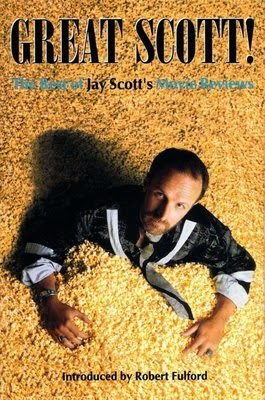
Film Critic Hall of Fame: Jay Scott

Growing up, I was an avid reader of movie reviews from two of Toronto’s most prominent newspapers, The Toronto Star and The Globe & Mail. The former had decent enough critics, but the latter had Jay Scott, a witty and passionate writer equally adept at championing films he loved as savaging ones he loathed. I always looked forward to reading his reviews every week regardless of whether I agreed with his opinion on a given film or not. His style of writing was so engaging and entertaining and I always knew how he felt about a film. Wishy-washy was not something you could ever accuse him of being.

Scott was born and raised in the United States where he studied acting and contributed to the arts section of the campus newspaper at the University of New Mexico. He got married and moved to Toronto, but was unable to become a Canadian citizen and returned to America where he wrote movie reviews for the Albuquerque Journal in 1972. He soon got a job as an arts journalist for a newspaper in Calgary, Alberta, undeterred that he had never been there before. A few months later, he won a prestigious National Newspaper Award (his first of three).

In 1977, he was hired by The Globe & Mail. As luck would have it, he arrived in the city in the early years of the Festival of Festivals, which would eventually go on to become not only one of the biggest film festivals in Canada, but also the world. Covering this annual event gave Scott an opportunity to review art house fare as well as international cinema. He also championed local talent, giving exposure to then up-and-coming Canadian filmmakers Denys Arcand and Atom Egoyan.

As Robert Fulford’s introduction to a collection of Scott’s reviews points out, his style of writing involved, “outlining a context, drawing a kind of cultural grid on which a film could be placed,” and utilized, “a brilliant mélange of far-reaching analogies, learned references and hip vernacular.” I’m sure I read reviews of his before the one he wrote for David Lynch’s Blue Velvet (1986), but that was the first one that really resonated with me (probably due to my affinity for Lynch): “Yet Blue Velvet represents for Lynch an evolution: rather than exulting in ugliness, he self-critically analyzes the desire to exult in it. Hidden things, he implies, become attractive things; that which is repressed becomes monstrous … The mystery Blue Velvet actually solves is the mystery of its hero’s identity: with an ear to the ground, so to speak, Jeffrey finds self-knowledge without which wisdom is powerless to begin.”

When Scott really was taken with a film, he let you know as he did with his review for Superman (1978): “The genius of Superman – and on a pop level, this is a work of genius – has been to eschew condescension while setting out to achieve both visual elegance – Geoffrey Unsworth’s cinematography effortlessly slides from the blanched, gauzy antiseptic brightness of Krypton to the heavy, boiling, pestilence-laden skies of America – and nostalgia at its most honorable, nostalgia for a common past, for a childish past when heroics weren’t corny and when death didn’t sting.”

Scott also had a knack for occasionally personalizing his reviews as he did with the one he wrote for The Deer Hunter (1979):

“As I watched the ‘God Bless America’ conclusion, feeling slightly sickened by Cimino’s avoidance of a moral statement, I remembered a high school friend who left home the same time I did. I went to college. He went to Vietnam. We were friends, but we had argued – I enthusiastically, he reluctantly – about the war. I came home at Christmas in a jet. He came home in a shoe box. Hank was serious in his support of what we called the U.S. involvement. He has been dead for ten years. Now, a movie is weeping for him and for the thousands like him. It weeps in a way he, and they, would understand. One does not have to agree with The Deer Hunter to sympathize. One does not have to like it to recognize its value.”

Scott did not like Cimino’s film, but the reasons why were complex and he did a fantastic job of explaining where he was coming from while also appreciating The Deer Hunter’s artistry.

Scott had a playful side that came out in films he wasn’t particularly crazy about, like the review he wrote for Bright Lights, Big City (1988), which was done in the second person style of the source material it was based on by Jay McInerney: “So you figure, what the hell, go with it and enjoy it for what it is, which is C-plus, but A-minus for effort and B-plus for honesty, and since you gave the book a D-minus, you decide you’re going to tell your friends to skip the book and see the movie. Then you’re left with only one nagging question as you walk out of the theatre into the bright lights of whatever big city you happen to be in: how is Pepsi going to feel about Michael J. Fox doing so much coke?”

Not surprisingly, I didn’t agree with him on every film, including his dismissal of Ridley Scott’s Legend (1985) as “something closer to Ladyhawke Meets The Goonies,” or his harsh takedown of Phantasm II (1988): “Coscarelli has said he resisted doing a Phantasm sequel because, ‘I didn’t want to be stereotyped as a horror film director.’ He need not have worried: he’s not apt to be stereotyped as a director of any type.” But when our tastes intersected, it thrilled me to no end, like his spot-on assessment of Bruce McDonald’s Roadkill (1989) as “a woman’s Easy Rider, also a doper’s remake of Margaret Atwood’s Surfacing, also a nod to Goin’ Down the Road.” You have to appreciate the pile-up of disparate pop cultural references in that one sentence alone!


Sadly, Scott died of AIDS in 1993 – he was only 43. He deserves a spot in the pantheon of film critic legends alongside the likes of Pauline Kael and Andrew Sarris. Like them, Scott had his own unique voice, able to convey a genuine love of cinema with knowledge of what makes a film work or fail. For me, at an early age, his ability to write like that was something for me to aspire to as was his abundant passion for the medium.


SOURCES

Scott, Jay. Great Scott! The Best of Jay Scott's Movie Reviews. McClelland and Stewart. 1994.


Check out Greg Woods' excellent article on Scott.

Friday, January 3, 2014

Southland Tales

The common trap independent filmmakers fall into comes after their low-budget debut garners them a certain amount of buzz from the media and does well enough financially to attract the attention of the studios. They try to parlay this newfound clout to get a significantly bigger budget in order to realize an ambitious passion project. Sometimes, they pull it off and the result is even more critical and commercial acclaim (see Pulp Fiction). Sometimes, they crash and burn spectacularly (see Mallrats). Richard Kelly’s second film, Southland Tales (2006), falls into the latter category. It’s an epic, sprawling mess of a film – an unholy union between the paranoid science fiction of Philip K. Dick and the paranoid noir that is Robert Aldrich’s Kiss Me Deadly (1955). Kelly said of his film, “It felt like this window of time in my life where I could do something big and bold and political and get it out of my system before it was too late, before I lost my nerve, or the window of opportunity had disappeared.”

A rough cut of Southland Tales was entered into the 2006 Cannes Film Festival where it received one of the worst receptions in the prestigious festival’s history. Most critics hated it and the film was barely given a theatrical release before it limped out onto home video by an indifferent studio. Most people either didn’t get it or simply didn’t care for Richard Kelly’s playful socio-political satire that took place in a near-future alternate history version of Earth. I’ve always felt that Southland Tales is a flawed masterpiece, ballsy epic that immerses you in its strange futureworld and expects you to be an active participant in the sense that you have to think about what you’re watching. Most people don’t want to work in order to understand a film, but for those that do, Kelly’s film can be a rewarding experience.

World War III begins to 2005 and three years later a German company known as Treer introduces an alternate fuel source called Fluid Karma – a hydroelectric energy field that is basically a wireless network of electric power running machines remotely. Of course, the United States government strikes a deal with the company. Most of this information is conveyed via voiceover narration by Private Pilot Abilene (Justin Timberlake), a battle-scarred Iraqi War veteran who sets things up for us and introduces the main characters.


There’s Boxer Santaros (Dwayne Johnson), an actor that suffers from amnesia. He has written a screenplay about the end of the world with Krysta Now (Sarah Michelle Gellar), a porn star turned political activist. She’s trying to go legit with a “topical discussion chat reality show,” and plans to diversify with a pop album, jewelry, clothing and perfume lines as well as an energy drink. Boxer is actually married and his mother-in-law is Nana Mae Frost (Miranda Richardson), deputy director of the NSA. She is looking for him because of what he knows. However, she’s at odds with Baron von Westphalen (Wallace Shawn), the ruthless head of Treer.

Digits for Democracy, a neo-Marxist fringe group that operates off the grid, are in conflict with the government. They are hoping to make the government look foolish during an election year. Officer Roland Taverner (Seann William Scott) is a very confused pawn of Digits for Democracy. He has been tasked to impersonate his twin brother Ronald (also a police officer) for their own terroristic ends. Over the course of the film, these various characters, and a whole slew of supporting ones, interact with each other in major and minor ways to form a complex tapestry of life in Los Angeles.

The first hint that Kelly is going for a satirical vibe is the casting of several Saturday Night Live alumni in significant roles – Nora Dunn, Jon Lovitz, Cheri Oteri, and Amy Poehler – and other comedic actors like Will Sasso and Seann William Scott. This probably didn’t help people take the film seriously. In a risky casting against type that pays off, Sarah Michelle Gellar, Dwayne Johnson, and Seann William Scott are particular stand-outs. It’s not just because they get a lot of screen-time, but that they also make the most of it. Freed from the shackles of pre-conceived notions about them – Gellar with Buffy the Vampire Slayer, Johnson as a professional wrestler and action star, and Scott as a comedian – they are given a chance to play radically different characters.


Gellar looks like she’s having a lot of fun playing a not-too smart reformed porn star with aspirations to respectability. Her talk show is a funny jab at programs like The View, but only if it was hosted on the beach with ditzy porn stars. Johnson has always struck me as a smart guy that was more talented then a lot of his film roles would suggest and in Southland Tales he not only gets to showcase his capacity for comedy, but also his willingness to try something different. Sadly, the commercial failure of this film has either scared him off taking more chances like this or discouraged other filmmakers from casting him against type. Known mostly for doing raunchy comedies like the American Pie movies, Scott gets a rare chance to play it straight as he portrays a confused man who provides a pivotal role in the drama that unfolds over the course of the film.

Southland Tales isn’t exactly a character-driven film and so it is easy to dismiss a lot of the performances as stunt casting. Most of the cast hardly has any time to make an impact with what screen-time they have. Let’s fact it, these actors are there to service the story that Kelly is trying to tell. And it is a helluva story – clearly inspired by the events of 9/11 as he comments on things like PATRIOT Act, the war in Iraq, Homeland Security, and domestic terrorism. Cinematically, Kelly’s film seems indebted to Kathryn Bigelow’s New Millennium cyberpunk thriller Strange Days (1995). Like with Bigelow’s film, the climax of Southland Tales is kickstarted by a video-recording of a racially-motivated murder, which throws downtown L.A. into chaos, but where Strange Days opted for a safe, stereotypical ending, Kelly goes gleefully over-the-top with a full-on armed riot in the streets and a dimensional rift in the space-time continuum that visually quotes a great L.A.-based social satire, Repo Man (1984) all orchestrated to a dance number involving Gellar, Johnson and Mandy Moore. And yet, for all of its cinematic influences, Southland Tales is steeped in literary references with Kelly citing the work of Raymond Chandler, Philip K. Dick and Kurt Vonnegut Jr. as influences. The film quotes the work of T.S. Eliot and Robert Frost while also referencing Karl Marx and The New Testament.

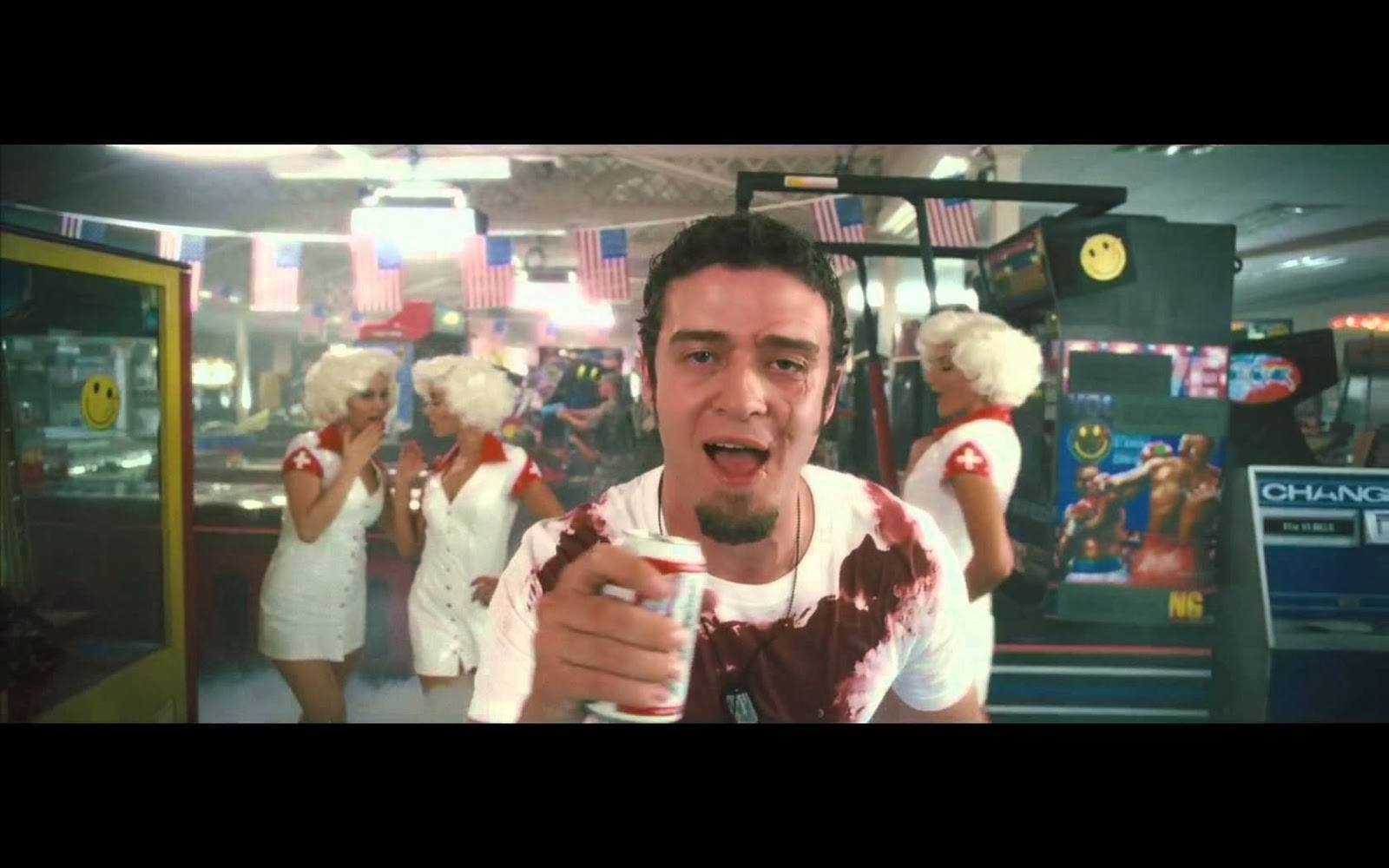
Southland Tales is chock full of deliciously satirical imagery, like the SUV television ad that features two vehicles having rather explicit sex, but it’s okay because that version will only air in Europe. There’s Krista Now’s Britney Spears-esque music video for her hit single, “Teenage Horniness Is Not A Crime.” As he demonstrated on several occasions in Donnie Darko (2001), Kelly has a real knack for marrying just the right piece of music with a scene and Southland Tales is no different as he has Boxer escape a double murder scene through a fog-enshrouded suburb to the strains of “Wave of Mutilation” by the Pixies. The showstopper of the film has to be Pilot Abilene’s song and dance routine in an arcade to “All These Things That I’ve Done” by The Killers with “I’ve got soul, but I’m not a soldier” being a key lyric that comments on the character. It is easily the best sequence in the film, really bringing it to life. It not only hints at the greatness that just eludes Kelly’s grasp, but also suggests that he is destined to make a musical.

There’s a lot to absorb in the first 20 minutes as Kelly works hard to set up this world and the characters that inhabit it. Perhaps the problem is that tonally Southland Tales is all over the map, shifting from satire to a serious meditation on the end of the world without warning. Kelly fell into the sophomore trap of making too ambitious a film and not having the filmmaking chops to match, but you have to give him an “A” for effort as there are all kinds of fascinating ideas and themes that he explores. However, because he is trying to tell such a complex narrative involving so many characters, he spends too much time explaining how things work and who everyone is instead of finding some way to show us. The theatrical version of Blade Runner (1982) ran into this problem and it is an issue with a lot of futuristic science fiction films. Filmmakers are afraid of confusing their audience thereby losing them and then relying too much on expositional dialogue or voiceover narration.


So, what is Kelly really trying to say with Southland Tales? He is obviously commenting on the dangers of too much governmental control and extremist fringe groups, but also on the proliferation of technology in our lives. He has created an instant cult film with mainstream actors. It was never going to be something palatable for mainstream consumption because it was just too weird. Southland Tales is a confused Sui generis film that ultimately collapses under its own lofty ambitions, but god bless Kelly for giving it the ol’ college try. It throws so many ideas and images against the wall to see what sticks and that is part of its charm. In the immortal words of Hunter S. Thompson, Kelly has created, “A high-powered mutant of some kind never even considered for mass production. Too weird to live, and too rare to die.”


SOURCES

Lim, Dennis. “Booed at Cannes, but Now the Real Test.” The New York Times. October 28, 2007.


Parson, Spencer. “The End of the World As He Knows It.” Austin Chronicle. November 16, 2007.


Further Reading:

An excellent Salon.com article that breaks down the plot of the film in detail.

An excellent retrospective article on the film.

An in-depth interview with Richard Kelly where he answers several questions about the film.