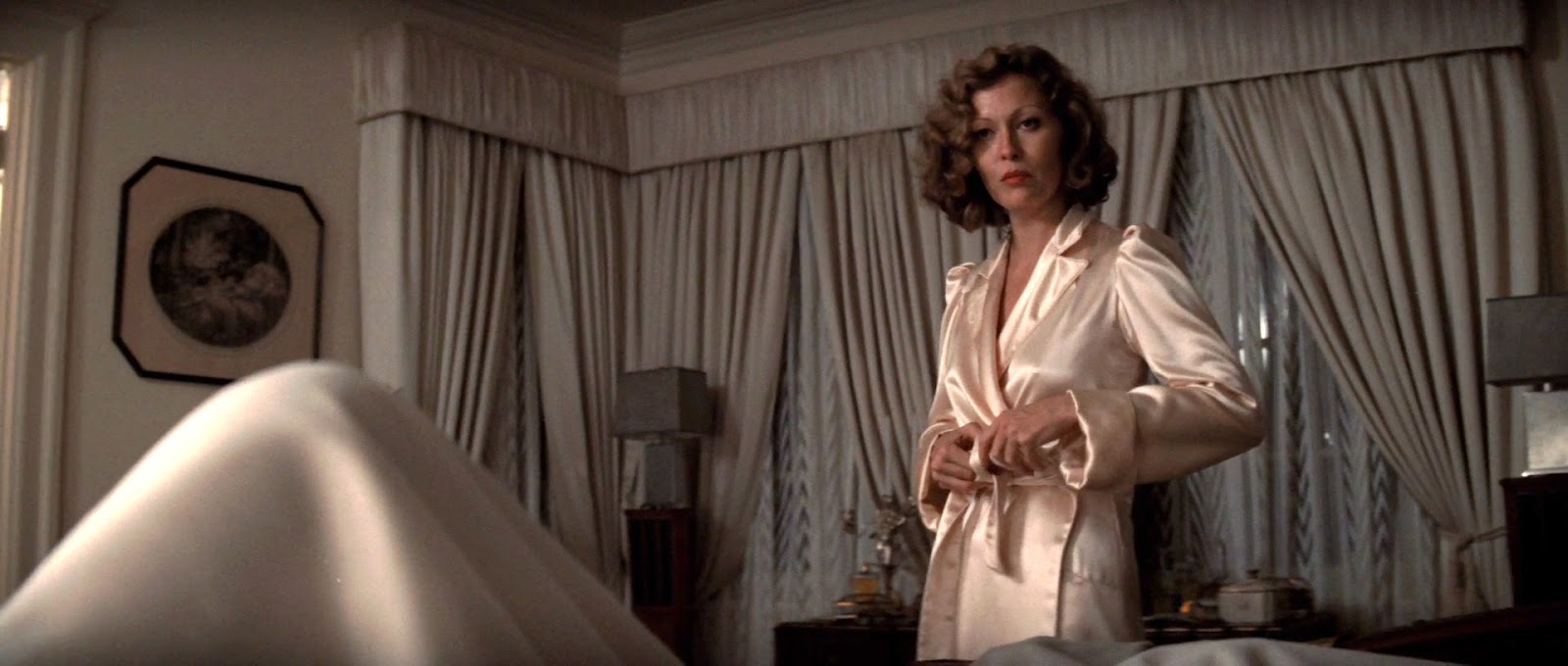
"...the main purpose of criticism...is not to make its readers agree, nice as that is, but to make them, by whatever orthodox or unorthodox method, think." - John Simon

"The great enemy of clear language is insincerity." - George Orwell
Showing posts with label John Huston. Show all posts

Friday, July 17, 2020

Reflections in a Golden Eye

In a career as vast as Elizabeth Taylor’s, you’re bound to find the occasional oddity or strange outlier that doesn’t get mentioned often or is given much attention but is just peculiar enough to invite rediscovery. Reflections in a Golden Eye (1967) is such a film. It started out as a way for Taylor to get her long-time friend and fellow actor Montgomery Clift an acting gig and boost his spirits after surviving a horrific car accident that shattered his good looks and confidence. It eventually became a twisted Southern gothic tale starring Marlon Brando opposite Taylor, directed by none other than John Huston who imposed its distinctive golden filter over every scene.

The film chronicles the dysfunctional marriage of Major Weldon Penderton (Brando) and his wife Leonora (Taylor) who likes riding horses and having an affair with Lieutenant Colonel Morris Langdon (Brian Keith), good friends with her husband. Private Williams (Robert Forster) is a young man that tends to Leonora’s horse and does yard work for the Penderton’s. He becomes obsessed with the couple and in particular Leonora, observing their most private moments from their yard at night.

We are introduced to the three main characters in a way that tells us something important about each one of them. Williams is a gentle soul that enjoys hanging around the stable, taking care of the horses. Weldon is a vain man obsessed with making himself look better as evident by the way he admires himself in a mirror after a workout, flexing his muscles. Leonora is all about what makes her happy, whether it’s making sure all the details for an impending party are just right or her affair with Morris.

Weldon and Leonora have a loveless relationship that borders on the contentious. She likes to have fun and he’s a humorless man, which begs the question, was it always like this? Were they ever happy together? Now, they have an antagonistic relationship as typified when he chastises her for walking around the house in bare feet. She responds by taking off all her clothes and walking around the house, which only infuriates him more. As she heads upstairs, Leonora simply turns, looks over her shoulder and says, “Son, have you ever been collared and dragged out into the street and thrashed by a naked woman?” While Brando seethes and chews up the scenery, Taylor wisely plays it low-key with simmering contempt. If Weldon is repressed then Leonora is the complete opposite, an exhibitionist who has no problem expressing how she feels at given moment.

This is a juicy role for Elizabeth Taylor to sink her teeth into as she vamps it up as a boozy, spoiled housewife with voracious appetites. She relishes her dialogue and delights in Leonora’s rebellious behavior towards Weldon and cheerfully condescends to Alison (Julie Harris). She is blissfully oblivious to everyone else’s problems, going on about her preparations for the party or casually dismissing Alison’s flamboyantly gay houseboy Anacleto’s (Zorro David) obvious disdain for her.

Marlon Brando is terrific playing a tragic figure trapped in a repressive prison and wanting so desperately to escape it. The scene where he is almost killed while riding a runaway horse is a powerful one as it culminates in a complete emotional breakdown. All of Weldon’s suppressed emotions come bubbling to the surface, erupting like a volcano in a powerfully acted moment by the actor. He can’t harm is wife directly so he punishes her in more insidious ways, such as taking out her beloved horse Firebird. When it nearly kills him after he provokes the animal, Weldon viciously whips it with a tree branch. He’s clearly venting his anger at Leonora out on this poor horse. Weldon is doing this as much to punish her as himself, lying to his wife about beating Firebird so that when she finds out and comes back understandably enraged, she begins striking him with a riding crop while he just stands there and takes it.
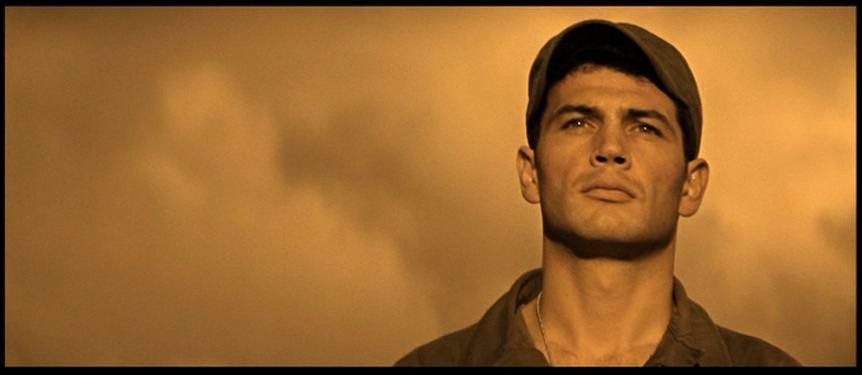
Williams is an enigmatic figure. Why is he so fascinated with these people? His obsession with them only grows as the film goes on. Robert Forster delivers an intriguing, largely wordless performance as a voyeuristic young man that spends most of his time observing the Penderton’s disintegrating marriage. Williams often stares impassively, his obsession guiding his actions as he increasingly takes more risks to spy on Leonora. He even goes so far as to breaking into their house, going into her bedroom and watching her as she sleeps.

Julie Harris plays Morris’ long-suffering wife, still dealing with the death of her child three years ago. The only comfort she finds is with Anacleto, a colorful character with a flair for the dramatic as he cuts loose while Morris looks on disdainfully. Zorro David delivers a wonderful monologue about a dream he had in such an odd way that anticipates similar showstopping moments in David Lynch films. His character would not be out of place in one of them. It's a shame David never made another film after this one as his onscreen presence is absolutely riveting.

Everyone in the cast is going for it, playing their respective roles to the hilt, be it Brando’s repressed major, Taylor’s lusty housewife, Forster’s stoic voyeur or Harris’ tragic wife.

Reflections in a Golden Eye is a beautiful shot film by Aldo Tonti with a golden filter that saturates the entire film with one object in a given scene naturally colored. This is in reference to Anacleto’s drawing of a golden peacock whose eye reflects the world. The film also features excellent use of shadows during night-time scenes where Williams spies on the Penderton’s, creeping around the outside of their house. There is another stand-out shot of a train, enshrouded in smoke, leaving the station at dawn.

After saving Montgomery Clift’s life in a horrendous nearly fatal automobile accident, Elizabeth Taylor had been trying to find a project for them work together on. The accident not only physically disfigured him but also had a huge psychological impact and his subsequent reliance on drugs and alcohol made him almost unemployable. In 1964, his agent suggested that they star in an adaptation of Carson McCuller’s novel, Reflections in a Golden Eye, a Southern gothic story about sexual repression. Clift was to play a latent homosexual army officer that becomes fixated on a young private. Taylor was to play opposite Clift as his wife and object of the private’s obsession.

Producer Ray Stark was understandably worried about insuring Clift and told the actor he’d have to put up his beloved brownstone as collateral. He was so desperate for work he considered but Taylor wouldn’t hear it and announced to the press that she and Clift were making the film together – their first since Suddenly, Last Summer (1959). When Stark asked her to reconsider, she offered to give up her salary to pay for his insurance.

Complications arose when Taylor told Clift that her husband Richard Burton wanted to co-star and direct the film. Not only did Clift not consider Burton a serious actor but also felt uncomfortable in the presence of the Welsh alpha male. Burton eventually decided not to do the film and John Huston was hired to direct. Unfortunately, Clift died in July 1966 and was subsequently replaced by Marlon Brando at the suggestion of Taylor.

Production on the film began in October 1966 in Rome where Burton and Taylor had been filming the play Doctor Faustus. It was a ten-week shoot with Brando often going out to dinner with Burton and Taylor. The film’s distinctive golden amber look was a result of extensive experimentation for a specific effect as Huston remarked, “This served to separate the audience somewhat from the characters, who were in various ways withdrawn from reality, and to make their story a bit more remote and erotic.”

An executive at Warner Brothers objected to the look of the film and Huston was able to convince the studio to release his version in select cities. Reflections in a Golden Eye received poor reviews and did not perform well at the box office. Variety said, “Brando struts about and mugs as the stuffy officer whose Dixie dialect is often incoherent.” Newsweek said that the film was “devoid of style and grace,” and called it “perverted.” The New York Times criticized the film’s “odd and pretentious use of color to convey the notion of reflections in a golden eye, I suppose that is, the suffusion of the whole thing in a fluctuating golden wash or monotone.” Finally, Pauline Kael gave it one of its more merciful reviews, stating, “Despite everything that is laboriously wrong with Reflections, the visual style – like paintings made from photographs – is interesting and the director, John Huston, and the actors are able to do some extraordinary things with Carson McCuller’s conceptions.” Technicolor prints had been struck at the same time as Huston’s version and replace them when the film was given a wider release.

The Penderton’s are a tragic couple that shouldn’t be married as he’s gay but unable to come out of the closet as a result of the repressed times and the environment in which he lives in. She, on the other hand, can’t empathize with other people as she’s so concerned with herself. Reflections in a Golden Eye is about damaged people, from the repressed Weldon to the selfish Leonora to the unhappy Alison to the obsessed Williams.

The film is also about perception – how people perceive others and themselves, from Weldon admiring himself in the mirror to Williams obsessively gazing at Leonora while she sleeps. It is an unhealthy, destructive gaze that Anacleto observes more succinctly when he shows Alison his watercolor of a peacock, explaining that in its eye are “reflections of something tiny, and tiny and…” upon struggling to find the right word, settles on “grotesque,” contorting his face. This film features grotesque caricatures of human beings doing horrible things to each other with often tragic results.


SOURCES

Kashner, Sam and Nancy Schoenberger. Furious Love: Elizabeth Taylor, Richard Burton and the Marriage of the Century. itbooks. 2011.

Phillips, Gene D. “Talking with John Huston.” Film Comment. May/June 1973.

Spoto, Donald. A Passion for Life: The Biography of Elizabeth Taylor. Harper Collins. 1995.

Friday, November 6, 2015

Chinatown

Chinatown (1974) is a rare example of a collection of artists at the height of their powers coming together to produce a masterpiece born out of conflict and strife. Fresh from his success on The Last Detail (1973), screenwriter Robert Towne wrote a mystery inspired by the California Water Wars that took place in Southern California at the beginning of the 20th century and involved a series of disputes over water with Los Angeles interests securing water rights in the Owens Valley. Studio chief and producer Robert Evans bankrolled the project and Towne wrote the screenplay with his good friend Jack Nicholson in mind. The actor was coming off the critically-acclaimed The Last Detail asked Roman Polanski to direct. The two men had been looking for a project to work together on and chose this one. The end result is a wonderfully complex and nuanced tale of greed and corruption whose deeper meanings and rich attention to detail reveal themselves upon subsequent viewings.

Jerry Goldsmith’s somber score, complete with mournful trumpet, sets a melancholic tone over the opening credits, evoking a bygone era. Polanski offsets this with the playful opening scene that sees private investigator J.J. Gittes (Nicholson) showing a client (Burt Young) photographs of his cheating wife. Looking visibly upset, Burt Young offsets this with exaggerated whimpers and distressed histrionics, which provokes Gittes to tell him, “Alright Curly, enough is enough. You can’t eat the venetian blinds. I just had ‘em installed on Wednesday.” Gittes dresses nice and has an expensive-looking office but he plies his trade in the seedy underbelly of society with a specialty in infidelity.

He meets a woman calling herself Evelyn Mulwray (Diane Ladd) and she hires him to uncover evidence that her husband Hollis Mulwray (Darrell Zwerling), the chief engineer of Water and Power for the city, is cheating on her. At a hearing that Gittes attends, Mulwray receives considerable flack from local farmers accusing him of stealing water that is ruining their livelihood, but refuses to approve the building of a dam because of the danger it poses. Gittes and his associates follow Mulwray around for a couple of days until they find him cheating on his wife, which naturally makes a big stink in the press.


The real Evelyn Mulwray (Faye Dunaway) shows up with her lawyer and threatens legal action, which prompts Gittes to dig deeper. Why would someone pose as Hollis Mulwray’s wife and set him up? To complicate matters, Hollis Mulwray winds up dead, found drowned in a dried waterbed. Evelyn hires Gittes to find out what happened, which sees him cross paths with the powerful Noah Cross (John Huston), her father and former business partner of her late husband.

By the time Jack Nicholson made Chinatown he was on quite the roll with films like Easy Rider (1969), Five Easy Pieces (1970), and the aforementioned The Last Detail, among others, under his belt. As a result, he brings a relaxed confidence to his performance, effortlessly inhabiting the role of J.J. Gittes. He starts off playing the character as a man comfortable with his lot in life and is good at what he does. Over the course of the film, this confidence gradually erodes as Gittes gets deeper into the Mulwray murder. I like how Towne’s script pokes holes in Gittes’ character, showing his flaws despite a desire to appear classy, like when he tells his office cohorts an off-color joke unaware that Evelyn Mulwray is listening to the whole thing behind him. Nicholson’s glee in telling the joke is palpable and then he brilliantly turns on a dime when Gittes realizes that Mulwray heard what he said. Nicholson does a fantastic job of maintaining a tricky balancing act of playing a man brimming with confidence only to have it chipped away, bit by bit, as he finds himself embroiled in affairs much larger than himself.

Faye Dunaway is well-cast as the icy femme fatale Evelyn Mulwray. The actress maintains a frosty exterior as she portrays a woman harboring a dark secret. Evelyn forms an uneasy alliance with Gittes and the scenes between Dunaway and Nicholson crackle with an intriguing tension, which apparently mirrored their off-screen relationship as well. As the film progresses, Gittes melts some of Evelyn’s icy exterior and yet Dunaway still manages to hint at further depths to her character that are eventually revealed towards the end.


Polanski sprinkles playful moments throughout the film to offset the pervasive pessimistic mood. This is evident in a scene where Gittes runs afoul of two henchmen, one whom is played by the director. Polanski’s first line is said off-camera – “Hey there, kitty cat,” and he proceeds to slice open Gittes’ nose with a switchblade. For a good portion of the film, Nicholson sports a large bandage on his face, which subversively messes with the leading man’s good looks. A move like that would never fly with studio executives today who are scared to death of messing with any formula that could cost them money and this is just one of the chances Chinatown takes.

Another fantastic scene is Gittes’ lunch with Noah Cross where we get to see the legendary John Huston play off against Nicholson. The former exudes the confidence of a powerful man like Cross and the actor is clearly having fun with the role, like how he repeatedly mispronounces Gittes’ name as a way of subtly exerting control over the private investigator. Cross expertly dances around Gittes’ questions but the latter doesn’t back down either. The scene is a fascinating battle of wills as Gittes begins to realize what he’s up against.

Polanski brings an assured touch to the direction, masterfully utilizing the widescreen aspect ratio with the help of cinematographer John A. Alonzo. They manage to simultaneously evoke classic Hollywood cinema with the retro-noir period trappings while also bringing a European sensibility, mostly through the psychological underpinnings of the story. These visuals and the atmosphere that is created is greatly enhanced by Jerry Goldsmith’s score, which not only evokes a more elegant time but also expertly services a given scene, like being suspenseful when necessary and so on.


Thanks to all the political assassinations that occurred in the 1960s and then the Watergate scandal in the 1970s, government corruption was very much on peoples’ minds at the time Chinatown was released and this is reflected in the story that sees Gittes mired in corruption. Like most private investigator/mystery stories, much of the pleasure comes from the colorful characters Gittes encounters and how he unravels the various layers of the complicated plot.

While walking in the foothills of the Santa Monica Mountains, screenwriter Robert Towne came up with the idea for a detective story about the corruption of the land by developers. While filming Drive, He Said (1971) in Eugene, Oregon in the spring of 1970, he checked out a book from the local library by Carey McWIlliams about the history of oil and water exploitation in Southern California. It inspired him to base one of the crucial characters on William Mulholland, a pioneering Los Angeles water-supply engineer.

For the retro-vibe that he wanted to evoke, Towne read a photo essay entitled “Raymond Chandler’s L.A.” in New West magazine and drove around the city while also looking at old postcards that reminded him of “the sights and sounds of childhood.” He also read plenty of hardboiled fiction by Chandler and Dashiell Hammett, especially the former for his descriptions of L.A.


Towne first worked on the characters of Noah Cross and the incestuous relationship with his daughter Evelyn Mulwray. Then, he switched his focus to the detective-hero, which he named J.J. Gittes after a mutual friend of his and Jack Nicholson’s, Harry Gittes. Towne and Nicholson had been good friends for some time and the former tailored the role of Gittes specifically for the latter. While writing the script, the scope and density of the script was daunting for Towne as he found himself trying “one way and another casually to reveal mountains of information about dams, orange groves, incest, elevator operators, etc.”

Initially, Towne envisioned himself directing, “figuring no matter how bad I was as a director, if I could tell a decent story they would watch it.” However, he was broke at the time and need money to finish the script. Paramount Studios executive and producer Robert Evans originally approached Towne to adapt F. Scott Fitzgerald’s novel The Great Gatsby for a sizable paycheck but he passed on the assignment to focus on Chinatown instead and made a deal that gave the studio a 30-day option on it.

Nicholson had wanted to work with film director Roman Polanski for some time. They were friends socially and Nicholson called and asked him to direct Chinatown. The director was happily living in Rome, recovering from making What? (1972) and was not keen on returning to the United States, a place where his wife Sharon Tate had been brutally murdered by members of the Manson Family in 1969. Originally, Evans wanted Peter Bogdanovich to direct but when he passed the producer persuaded Polanski to fly to L.A. and meet with Towne. Aside from the chance to work with the likes of Nicholson and Towne, Polanski was low on funds and his bills were accumulating. He needed money.


Polanski read Towne’s initial draft and felt it was “brimming with ideas, great dialogue, and masterful characterization,” but that it “suffered from an excessively convoluted plot that veered off in all directions.” Towne wasn’t thrilled with Polanski’s criticisms but was convinced by the powers that be to do some rewrites on the script. Polanski found the revised draft even more difficult to follow and didn’t like the ambiguity of the film’s title, insisting that at least one scene take place in that location. Towne had gotten the title from a Hungarian vice cop who told him he had worked vice in Chinatown in L.A. When the writer asked him what he did there, the cop replied, “As little as possible.”

Polanski felt that Towne was prone to procrastination and so he created a routine consisting of eight-hour work days and partying away the night. The writer remembers, “The mood at night was—it was the 1970s.  We had a good time.” The rewriting consisted of Towne re-sequencing scenes and clarifying the complicated plot while Polanski worked on the dialogue and changing the focus so that the entire film is from Gittes’ point-of-view. Within eight weeks they had created a shooting script. Towne has said that he fought with Polanski every day and Evans said the final product was the result of “a lot of arguments, fights. There was warfare throughout the picture, but that’s healthy.” After the dust settled, Polanski and Towne were no longer speaking to each other.

When it came to casting, Evans picked then-wife Ali MacGraw to play Evelyn Mulwray but when she ran off to marry actor Steve McQueen, he offered the part to Jane Fonda who turned it down. Polanski suggested Faye Dunaway who he knew socially and liked her “retro” look but Evans didn’t like the idea and considered the actress to be trouble.


Polanski’s approach to filming Chinatown was not as a classic black and white movie “but as a film about the Thirties seen through the camera eye of the Seventies.” He insisted on shooting in color and Panavision. He originally hired legendary cinematographer Stanley Cortez (The Magnificent Ambersons) but when he didn’t work out, Polanski skewed younger with John Alonzo (Harold and Maude) instead.

When filming began in the fall of 1973, Polanski and Dunaway did not get along. According to him, she fretted over her appearance, didn’t always know her lines, and bothered him to rewrite them. When he did she would then go back to the original dialogue. She would ask him for her character’s motivation and he screamed at her that the salary she was being paid was all the motivation she needed. It got so bad between them that Evans arranged a meeting with Dunaway, her agent and Polanski. Evans decided to keep Dunaway off the set for three weeks to let things cool down and when she returned the actress no longer spoke to Polanski and was all business when it came to direction. The actress recalled, “I thought Roman was thwarting me and not supporting me.”

Nicholson wasn’t crazy about Polanski’s habit for multiple takes and being given line readings – two things he hated as an actor. Nicholson recognized that Polanski was a brilliant filmmaker who liked to argue and adjusted accordingly. During filming, Polanski made two significant changes to Towne’s script with Evans’ approval, much to the writer’s chagrin and who subsequently felt betrayed. The most notable one was changing the ending, which he made much more nihilistic than Towne intended, prompting the writer to call it, “the literal and ghoulishly bleak climax.” Years later and with the benefit of hindsight, Towne agrees that Polanski was right to change the ending.


When it came to post-production, Polanski hired classical composer Philip Lambro to score Chinatown. Seven weeks before the film’s premiere it was previewed in San Luis Obispo. It was a disaster according to Evans who recalled, “By the time the lights came up, half the audience had walked out, scratching their heads.” He felt that Lambro’s “dissonant, weird, scratchy” music was to blame. Evans delayed the film’s premiere and brought in Jerry Goldsmith to create a new score, which he did in a staggering ten days! According to Evans, seeing the film with Goldsmith’s music was like seeing a completely different film.

Not surprisingly, Chinatown received mixed reviews from the major critics back in the day. Roger Ebert gave the film four out of four stars and praised Polanski’s work: “He’s made a perceptive, loving comment on a kind of movie and a time in the nation’s history that are both long past. Chinatown is almost a lesson on how to experience this kind of movie.” In his review for The New York Times, Vincent Canby wrote, “Mr. Polanski and Mr. Towne have attempted nothing so witty and entertaining, being content instead to make a competently stylish, more or less thirties-ish movie that continually made me wish I were back seeing The Maltese Falcon or The Big Sleep. Others may not be as finicky.” The New Yorker’s Pauline Kael wrote, “The film holds you, in a suffocating way. Polanski never lets the story tell itself. It’s all over-deliberate, mauve, nightmarish; everyone is yellow-lacquered, and evil runs rampant. You don’t care who is hurt, since everything is blighted. And yet the nastiness has a look, and a fascination.” Finally, in his review for the Village Voice, Andrew Sarris wrote, “It is Polanski’s decision alone to tilt Chinatown toward tragedy that ultimately redeems the enormous contributions of the others. Yet even Polanski’s intense feeling for tragedy could never have been realized without the vision of tragedy expressed in Nicholson’s star-crossed eyes.” Finally, in his review for the Village Voice, Andrew Sarris wrote, “It is Polanski’s decision alone to tilt Chinatown toward tragedy that ultimately redeems the enormous contributions of the others. Yet even Polanski’s intense feeling for tragedy could never have been realized without the vision of tragedy expressed in Nicholson’s star-crossed eyes.” Chinatown was nominated for 11 Academy Awards, including ones for Best Picture, Actor, Actress, Director, and Original Screenplay, winning for the latter.

Chinatown sheds light on one of the many dirty secrets of L.A. and shows how the expansion of the city didn’t come easily – a lot of wheels were greased in the process and lives were ruined because of all the money that was at stake. It was something that people in the ‘70s could relate to and this translated into commercial and critical success. Its legacy is an impressive one with flawed neo-noirs like Mulholland Falls (1996) and masterful ones like L.A. Confidential (1997) influenced by it. Towne and Nicholson even revisited the character of Gittes with The Two Jakes (1990) but without Polanski and it wasn’t as well-received, proving that the alchemy of Chinatown, with everything coming together like it did, was impossible to replicate. As of Gittes’ associates tells him at the end of the film, “Forget it Jake, it’s Chinatown.”


SOURCES

Dunaway, Faye with Betsy Sharkey. Looking for Gatsby: My Life. Simon & Schuster. 1995.

Evans, Robert. The Kid Stays in the Picture. Hachette Books. 1994.

Iorio, Paul. “Sleuthing Chinatown.” Los Angeles Times. July 8, 1999.

King, Susan. “A Vintage L.A. Story.” Los Angeles Times. November 15, 2004

McGilligan, Patrick. Jack’s Life: A Biography of Jack Nicholson. W.W. Norton & Company. 1995.

Meikle, Denis. Roman Polanski: Odd Man Out. Reynolds & Hearn Ltd. 2006.


Teachout, Terry. “The Perfect Film Score.” Wall Street Journal. July 10, 2009.

Friday, June 19, 2015

The Killers (1946)

Ernest Hemingway’s short story “The Killers” was first published in Scribner’s Magazine in 1927 and featured two hitmen sent to kill a man who makes no attempt to run or defend himself. Producer Mark Hellinger bought the screen rights for $36,750 and the screenplay was written by John Huston (uncredited), Anthony Veiller and Richard Brooks. The Killers was released in 1946 and featured Burt Lancaster in his film debut, pairing him up with a young Ava Gardner after five years of minor roles. The end result is a classic film noir featuring a doomed protagonist and an alluring femme fatale intertwined over a large sum of money.

Late one night, two hitmen – Max and Al (William Conrad and Charles McGraw) – arrive in a small New Jersey town looking for a boxer known as Ole “Swede” Andreson (Burt Lancaster). Director Robert Siodmak presents a place enshrouded in shadows with the local diner providing a welcome source of light. The two no-nonsense men enter the eatery and proceed to give the owner a hard time. They exchange some nice hard-boiled dialogue (they repeatedly call the owner “bright boy”) and tell him of their intent to kill Swede.

One of the customers – a man (Phil Brown) who works with Swede – manages to escape and get to his co-worker before the hitmen. He warns Swede who doesn’t seem particularly upset and already resigned to his fate. In fact, when we first see him, Swede is lying in bed, his head obscured in darkness and already looking like a corpse. The two men arrive and shoot Swede to death. Why didn’t he run? Why did he just let these men kill him? Insurance man Jim Reardon (Edmond O’Brien) tries to figure out the answers to these questions and decipher his last words, “Once I did something wrong.” The film proceeds to flashback to Swede’s last days and then further back as Reardon talks to those who knew him.


Burt Lancaster delivers a muscular performance, portraying a man with no desire to live and then, as his past is delved into, anguish over someone that drove him to attempt suicide. Even further back reveals a boxer from Philadelphia who turned to crime thanks to a bum right hand. The actor does a nice job of creating a doomed protagonist. It’s all in Lancaster’s haunted, defeated eyes. When told he can no longer fight because of his permanently damaged hand, Swede looks for a new direction in life. He doesn’t want to be a cop and so he turns to a life of crime.

Ava Gardner creates quite a first impression as Kitty Collins, an alluring woman that meets Swede at a party and immediately catches his attention. They soon become an item and it’s not hard to see how she so easily corrupts him. The actress looks stunning (she sure knows how to wear a sweater!) and Kitty knows exactly the emotional buttons to push in order to get Swede to do what she wants.

The Killers is filled with all kinds of memorable little touches, like Siodmak showing a heist being pulled visually with voiceover narration as if providing a commentary track over what went down instead of going the conventional route by having it play out in typical fashion – something that has been done countless times. There is also stand-out dialogue, like when a doctor says about one of Swede’s criminal associates, now on his deathbed, “He’s dead now except he’s breathing.”


For a film noir, The Killers spends a lot of time exploring the Swede’s motivations and examining why he was so willing to die. At the end, he had no reason to live. He drove away the people he loved, betrayed by the woman he loved, and was unable to continue as a boxer – his real passion. Swede’s fatal flaw is that he’s loyal to a fault, willing to go to the mat for Kitty, blinded by love to her conniving, manipulative ways. Like most noirs, the prime motivation for Swede is money and a dame – both of which prove to be his downfall.

Prior to The Killers, Ernest Hemingway had refused Hollywood’s advances to adapt his work but producer Mark Hellinger was an “old friend,” and he agreed to sign over the film rights to him. The first few minutes of the film are quite faithful to the source material but deviate significantly afterwards. Don Siegel was originally considered to direct but Hellinger went with Robert Siodmak. Siegel ended up making his own adaptation in 1964 with Lee Marvin, John Cassavetes and Ronald Reagan in a rare bad guy role.

Burt Lancaster was only 23-years-old when he made The Killers and was paid $20,000 for his work on it. Ava Gardner has been under contract with MGM since 1941 but had only appeared in minor, forgettable roles. Hellinger was impressed with her work in Whistle Stop (1946) and wanted her to play Kitty Collins. MGM agreed to loan her out to Universal.


The Killers was a box office hit, playing around-the-clock at New York’s Winter Garden theater, which had more than 120,000 moviegoers see it in the first two weeks. The film was well-received by critics, but more importantly Gardner, who became friends with Hemingway, said that the writer, “always considered The Killers the best of all the many films his work inspired.”

A man’s life is made up of many parts, much like a puzzle as Reardon finds out during the course of his investigation. He only gets the entire scope of Swede’s life by talking to several people in his life. Together, their testimonies provide a better understanding for why he did what he did and why it led to his sorry fate. It’s what makes The Killers a tragic tale.


SOURCES


Frankel, Mark. “The Killers (1946).” Turner Classic Movies.

Friday, January 17, 2014

The Asphalt Jungle

“If you want fresh air, don’t look for it in this town!”

As a connoisseur of heist films it just doesn’t get any better than The Asphalt Jungle (1950), which also happens to be one of my all-time favorite film noirs. Directed with stylish economy by John Huston, it features atmospheric black and white cinematography courtesy of Harold Rosson (The Wizard of Oz) that draws me into its shadowy world of cops and crooks every time. This is evident from the establishing shot of a police car on the prowl on a deserted city street in an unidentified Midwestern city. We are soon introduced to its target – a tall man dressed in a suit who carefully evades the squad car. Huston sets a fantastic mood early on as we see the man make his way through city streets littered with garbage and grimy back alleys strewn with rubble as Miklos Rozsa’s suspenseful music plays over the soundtrack.

The unidentified man reaches his destination – a small diner simply known as “Café.” Without a word, the man hands over his gun to the counterman who stashes it in his cash register just before two cops come in and bust the man for vagrancy. Down at the police station, the man is put in a line-up with two others where he’s finally introduced as Dix Handley (Sterling Hayden) and his rather impressive rap sheet is rattled off. It seems that a man whose place of business was held up the night before is asked by the police to identify the man responsible. He takes a hesitant look at Dix who stares threateningly at him, but in a subtle way (if that’s possible) that clearly intimidates the man. As a result, he refuses to finger Dix for the crime.

Lieutenant Ditrich (Barry Kelley) meets with the Police Commissioner (John McIntire) who chastises his subordinate for not doing his job properly and for allowing too much crime to go on in his precinct. To further add to the man’s woes, criminal mastermind “Doc” Riedenschneider (Sam Jaffe) was released from state prison and was spotted heading towards the city. The gruff Commissioner gives Ditrich one more chance to redeem himself.


Doc makes his way through the criminal underworld to a joint run by Cobby (Marc Lawrence), a bookie with all kinds of connections. Doc tells him about a job that he is thinking of putting together that will result in a $500,000 payday, but he needs $50,000 in startup money. Through his prison contacts, he heard that Alonzo Emmerich (Louis Calhern), a wealthy lawyer who reeks of smug condescension, could provide that kind of backing and also be able to fence the stolen jewelry. He has pretensions to being a cultured man, but in actuality he’s just as greedy and untrustworthy as any criminal. We soon find out that he’s bankrupt and only projects the illusion of being well-off. Emmerich needs this score as much as any of them.

With the start-up money secured, Doc hires three men to pull the job: Louis Ciavelli (Anthony Caruso), an expert safecracker, Gus Minissi (James Whitmore), a driver who helped Dix out at the diner, and, of course, Dix, the requisite muscle. As film noir expert Eddie Muller points out, Huston presents a criminal underworld of “struggling laborers, alienated loners, even honorable family men,” along with the usual assortment of low-lives and corrupt figures. None of them have lofty aspirations – they just want to carve out a better life for themselves. In a nice touch, Huston shows Doc and his crew plying their respective skills by depicting the actual job, which certainly adds to the film’s authenticity.

I love the little bits of business that provide intriguing insights into the various characters, like when Gus threatens to beat-up a truck driver for making disparaging remarks about cats. Even though he is a small guy with a hunchback, his stocky build and intimidating manner causes the driver to back down. In addition, the understated friendship between Gus and Dix is well-played by James Whitmore and Sterling Hayden. You get the feeling that they would do anything for each other, but it is never explicitly stated. Rather, it is conveyed in the way they act towards each other.


Sterling Hayden has the distinction of starring in two of the greatest heist films – The Killing (1956) and The Asphalt Jungle – playing no-nonsense tough guys. In John Huston’s film, we are privy to Dix’s motivation for going in on the heist. Not only does he owe money, thanks to a persistent gambling problem, but he also wants to make enough to buy back his family’s farm and raise horses just like his father (the story he tells about its decline is simultaneously tragic and unintentionally hilarious). This dream and his friendship with Doll (Jean Hagen), a showgirl, humanizes Dix so that he is more than just some goon. That being said, Hayden is one of those actors that exuded a natural toughness in the way he carried himself, which made him an ideal noir protagonist.

In addition, Marc Lawrence plays Cobby with just the right amount of sweaty desperation, which only increases when things inevitably go bad. Everything you need to know about Cobby can be gleaned from his perpetually nervous demeanor. Sam Jaffe is excellent as the wise criminal mastermind who seems to have all the angles covered, but is prone to bad luck, just like anybody else. The Asphalt Jungle is often remembered for featuring Marilyn Monroe in an early role where she plays Emmerich’s mistress. She isn’t in the film very much, but does make an impression with her considerable beauty and wide-eyed innocence.

The Asphalt Jungle is a quintessential film noir with most of the iconography we come to expect from the genre. It presents a shadowy world populated by tough guys, desperate criminals and a heist that goes bad. The black and white cinematography transforms the city into a shadowy underworld full of danger. The opening sequence that takes us through the dark recesses of the city sets up the metropolis as another character. It also adds to the doomed vibe that hangs over the characters as we know that most if not all of them will be punished for their transgressions. The most interesting part of the aftermath of the heist is how it plays out for Doc and Dix, both of whom meet oddly poignant ends – the former calmly accepts his fate, musing how it came down to a couple of minutes, and the latter fights to the bitter end to achieve his goal.


What’s interesting is that Doc and the crew he assembles are all very competent at their respective vocations, but are ultimately undone by several “blind accidents,” as he calls them. This leaves them open to the law who gradually close in. We spend enough time with Doc and Dix so that we want to see them get away, especially the latter because we’ve come to admire his direct approach to life and empathize with his reasons for going in on the heist. The tragedy of the film is that he gets so close to realizing his dream only for it to slip through his fingers. There is wry bit of irony at the end as Huston undercuts the Police Commissioner’s determined, “crime doesn’t pay”-type speech by having Dix, who has been described as the most dangerous criminal of the crew, escape police dragnets as he races back to his hometown.

Director John Huston was originally hired to co-write and direct Quo Vadis (1951), a Roman sword and sandals epic starring Gregory Peck and Elizabeth Taylor. Huston wasn’t crazy about the project and when Peck developed an eye infection, the project was put on hold. In the meantime, MGM’s executive in charge of production Dore Schary assigned Huston to The Asphalt Jungle, an adaptation of W.R. Burnett’s crime thriller of the same name. Huston had already adapted Burnett’s High Sierra (1940) and was right at home with the material. While Ben Maddow wrote the bulk of the screenplay, the filmmaker began by jettisoning the novel’s narrative structure, which told the story from the point-of-view of the police, in favor of Doc and his crew.

Huston cast several of the main roles himself, including his good friend Sam Jaffe and Marc Lawrence whom he had worked with on Key Largo (1948). Casting Sterling Hayden was a risk for Huston because the actor had a reputation for being difficult and was known mostly for doing pretty boy roles at the time. MGM even tried to dissuade Huston from casting Hayden, but the director stuck to his guns because he saw parallels between Dix and Hayden’s own life.


The Asphalt Jungle was well-received by critics of the time. The Hollywood Reporter called it “almost a classic of its type.” The New Yorker commented that “in the end one is tempted to regret that crime doesn’t pay, because the malefactors are depicted so sympathetically.” Variety felt that it was “hard-hitting in its expose of the underworld. Ironic realism is striven for and achieved in the writing, production and direction.” The New York Times wrote, “From the very first shot, in which the camera picks up a prowling thug … there is ruthless authority in this picture, the hardness and clarity of steel and remarkably subtle suggestion that conveys a whole involvement of distorted personality and inveterate crime.” However, not everyone was a fan. Then-MGM studio boss Louis B. Mayer, who preferred lightweight fare, said, “That ‘Asphalt Pavement’ thing is full of nasty, ugly people doing nasty, ugly things. I wouldn’t walk across the room to see a thing like that.” In 1951, he was replaced by Schary.

While The Asphalt Jungle certainly didn’t set the world on fire when it was first released, it has proved to be quite influential, spawning a television series of the same name, starring Jack Warden, and also helped kick start the sub-genre of caper films, inspiring the likes of Rififi (1955) and casting a long shadow that would be felt in efforts like Reservoir Dogs (1992) and The Usual Suspects (1995).


SOURCES

McGee, Scott, “The Asphalt Jungle.” Turner Classic Movies.


Muller, Eddie. Dark City: The Lost World of Film Noir. St. Martin’s Press. 1998.

Friday, December 23, 2011

White Hunter, Black Heart

From early on in his career, Clint Eastwood has been interested in taking the path less traveled when it came to his career, taking on roles and making films that often subverted his Hollywood icon image. In particular, the films he has directed explore the darker side of humanity with topics ranging from stalking (Play Misty for Me), drug addiction (Bird), violence (Unforgiven), and child abuse (Mystic River). White Hunter, Black Heart (1990) is no different. Based loosely on Peter Viertel’s experiences working with legendary film director John Huston on The African Queen (1951), Eastwood plays John Wilson, a filmmaker more interested in hunting down and killing a wild elephant then making his next motion picture. He becomes fixated on this quest and Eastwood uses this story as an opportunity to explore the notion of obsession and how it can consume someone at the expense of everything else in their life.


White Hunter, Black Heart played several prestigious film festivals around the world and was admired by many critics but was never a commercial hit with audiences perhaps expecting an exciting adventure. What they got instead was something more akin to an art film that saw Eastwood yet again subvert the Dirty Harry persona that has defined his career for many years. White Hunter has become something of a forgotten effort in his filmography and considered a minor work but I’ve always felt that it was one of his more interesting pictures.

From the get-go, it is easy to see what drew Eastwood to this film. The opening voiceover narration describes his character John Wilson as “a brilliant, screw-you-all type filmmaker who continually violated all the unwritten laws of the motion picture business yet had the magic, almost divine ability to always land on his feet.” These words could easily be describing Eastwood and his career – one that saw him frequently go against prevailing trends to make the kinds of films he wanted to do. Wilson is gearing up to make a film in Africa and enlists the help of his good friend and screenwriter Peter Verrill (Jeff Fahey) to give the screenplay a rewrite. Pete’s not so sure as he’s working on a book and Wilson tells him, “There are times when you can’t wonder whether it’s the right or wrong thing to do … You just gotta pack up and go.” While they are there making the film, Wilson wants to go on safari and bag an elephant.

Wilson and Pete meet with the film’s producer Paul Landers (George Dzundza) who implores the writer to come on board if only to keep Wilson focused on the task at hand. It’s an entertaining scene as we see Wilson’s open disdain for Landers and the money men, especially when one of them informs the director that they’ve talked about replacing him with someone else. Wilson knows that all Landers cares about is that the film makes money no matter how just so long as it does. As he tells the exasperated producer, “You’d sell your mother down the river to make a deal.” Pete observes it all with the bemused expression of someone who has seen Wilson act this way before and is just enjoying the ride. The director doesn’t care about the business side of filmmaking – dealing with nervous producers and studio executives and every person who pitches him a lame idea for a film.

The chemistry between Clint Eastwood and Jeff Fahey is excellent in these early scenes as we see how well they play off each other, Wilson trying to convince Pete to do this film with him and the writer not really needing much convincing. The two actors do a nice job of conveying two men who have been friends for years by the way they act towards each other. In a nice, self-flexive bit, Wilson lays out his filmmaking philosophy but it could easily be Eastwood as he tells Pete that there’s two ways to go about it: “One is you can crawl and kiss ass and write their happy endings, sign their long-term contracts and never take a chance on anything and never fly, never leave Hollywood. Save all your goddamn money, every cent of it … The other way is to let the chips fall where they may. Refuse to sign their contracts and tell off the guy who can cut your throat and flatter the little guy who’s hanging by a thread that you hold.” Wilson is the quintessential film maverick and on the surface he certainly seems like one of Eastwood’s usual anti-authority protagonists – the cynic with a heart of gold. Wilson talks a good game, like how much he hates the movie business, but Pete knows him well enough to know that the curmudgeonly director wouldn’t have it any other way because he enjoys and thrives on conflict. It stimulates his creativity.

Once Wilson and Pete arrive in Africa, Eastwood opens the film up visually with stunning shots of the wilderness courtesy of long-time collaborator Jack N. Green and this gives a real sense of place. It’s a sharp contrast to the stuffy opulence of Wilson’s English mansion. There are also gorgeous aerial shots of herds of wild animals running across the plains. Eastwood really shows the exotic locale in all of its diverse glory: large lakes, jungle and dense wooded areas.

Wilson and Pete encounter quite a bit of racism from their English hosts. For example, there is the man who curses out and chastises the local team of football players for easily beating his team of all whites, or the posh wealthy woman who criticizes the Jewish people that lived in Soho during the Blitz in World War II. Wilson is disgusted with both of their attitudes and gets into a fist fight with the former and tells off the latter by recounting a hilarious story that really puts her in her place. Eastwood does a fantastic job of delivering this monologue with a mischievous twinkle in his eye as Wilson stands up for his friend Pete (who is Jewish). With the fist fight scene, we get a glimpse of Wilson’s self-destructive tendencies. Drunk and clearly outmatched physically, Wilson gets in a few good shots before being beaten down by the larger, stronger man. However, he feels justified in doing what he did because he stood up and fought for what he believed in.

While Pete continues to fine tune the script, Wilson plans their safari with the occasional detours to pre-production on the film. The director is all about testing his own limits, whether it is challenging a large man to a fight or taking a rusted out old river boat through dangerous river rapids. For him, that is what life is all about – experiencing it to the fullest with no regrets, much like I imagine Eastwood’s own outlook on life. Wilson thinks that bagging one of those giant elephants is a life experience he’s meant to have and becomes obsessed with it. Pete lets him know that he doesn’t want to shoot one because they are beautiful animals, a rare link to life before humans, which deserve to exist. There is something pure about them and shooting one would destroy that nobility, which is a rarity in this world. Over the course of the film, Wilson and Pete’s friendship is put to the test as the writer tries to keep the director focused on making the film.

Some critics felt that Eastwood miscast himself as a John Huston-type filmmaker but I think that what he does in White Hunter, Black Heart is fuse parts of Huston’s sensibilities with his own. In some respects, the two men are very much alike: larger than life icons that continued to make films well into the twilight of their lives, constantly bucking expectations and latching onto projects that interested them whether they were commercial hits or not. Eastwood understands the nature of obsession and how it can lead to self-destructive behavior.

Jeff Fahey is well cast as the audience surrogate and voice of reason. Pete may be Wilson’s friend but he won’t blindly follow him on every grand adventure that the director wants to pursue. Fahey brings an intelligence to the role, playing a character that has his own strong convictions and just doesn’t follow his friend around without question. The actor was on the verge of becoming a breakout star in the 1990’s with this film and The Lawnmower Man (1992) but for whatever reason his career didn’t take off like it should have and he ended up making a lot of forgettable genre films and television shows until as of late when he landed significant roles in high profile projects like Lost and Planet Terror (2007). It’s good to see this underrated actor enjoying a resurgence of sorts.

To say that The African Queen had a checked production history is a massive understatement. Most of the film was shot in Uganda and the Belgian Congo. Producer Sam Spiegel mortgaged his home in London and borrowed the rest while Huston made him sweat right up to the moment of filming with his indecisive nature. Spiegel put the film’s stars Katharine Hepburn and Humphrey Bogart (along with his wife Lauren Bacall) in an expensive hotel with no way to pay their bills. The cast and crew flew to their first location only to find out that the rains had come, which delayed filming. Instead of preparing for the project, Huston got the urge to shoot an elephant and took off on safari. The river that the director decided to shoot the film on was infected with bilharzias, a parasitic disease, Spiegel was bitten by a tarantula and almost died, while Hepburn drank only water and was stricken with dysentery. Peter Viertel, a novelist and screenwriter, had been hired to work on James Agee’s screenplay. He witnessed, first hand, Huston’s behavior and two years later published a little-read novel that fictionalized what had gone down. Incredibly, Huston actually liked Viertel’s book, signed off on it and even recommended a more tragic ending.

Over the years, the rights to the novel passed from producer to producer with Burt Lancaster showing interest at one point. Several screenplays based on the story were commissioned but it wasn’t until Eastwood was given a copy of the novel by veteran film producer Ray Stark that there was an actual possibility it would get made into a film. He read it on the way back from Italy where he had been promoting the Charlie Parker biopic Bird (1988). In the past, filmmakers had stayed away from the project because Huston was still alive, the lead character wasn’t very likeable and it didn’t have a happy ending. This didn’t seem to bother Eastwood who used his clout with Warner Brothers to get it made. He was drawn to the story because he liked Huston’s attitude and his speeches about taking chances, not being afraid to try something different, and not caring what the audience thought. He also had an understanding of the Wilson character. “Now, I’ve never felt I wanted to kill wildlife,” Eastwood said in an interview with The Guardian, “or anything like that, but I think there’s a bit of him in my nature … You want to break out of what you’re doing and live differently sometimes. It’s something you have to prove to yourself.”

Early on in development, Eastwood restored the book’s unhappy ending because he felt that it was more faithful to the source material. Originally, he looked at shooting White Hunter, Black Heart in Kenya but the authorities there wanted input on the script and he had heard that there was real demand for bribes in order to do business. Zimbabwe was much more filmmaking friendly with the government being very accommodating to the production and so most of the film was shot there.

White Hunter, Black Heart divided mainstream critics. Roger Ebert gave the film three out of four stars and wrote, “In the early scenes of White Hunter, Black Heart, Eastwood fans are likely to be distracted to hear Huston's words and vocal mannerisms in Eastwood's mouth, and to see Huston's swagger and physical bravado. Then the performance takes over, and the movie turns into one of the more thoughtful films ever made about the conflicts inside an artist.” Time magazine’s Richard Schickel praised Eastwood’s performance: “Eastwood has dared to attempt a faithful impression of the director, his growling drawl, his loose-limbed stride, the arrogant tilt of his head. The result is a stretch for him as an actor, and fun for the audience.” In his review for the Globe and Mail, Jay Scott wrote, “White Hunter, Black Heart is a beautifully made elaboration of a thesis that has thankfully lost its antithesis to time.”

However, in her review for The New York Times, Janet Maslin wrote, “And none of it works as fully as Mr. Eastwood obviously wants it to, as a consequence of the sheer sweep and colorfulness of the man being portrayed. But even in this relatively stiff, sometimes awkward form, the John Wilson character is as compelling as Mr. Eastwood's desire to play him.” Entertainment Weekly gave it a “C+” rating and Owen Gleiberman wrote, “In the end, though, White Hunter, Black Heart emerges as little more than a plodding shadow of the great film it could have been. An actor making a stretch is one thing. As Huston, Eastwood is so out of his depth he seems to have lost his entertainer's instinct, not to mention his modesty.” The Toronto Star’s Peter Goddard found fault with Eastwood’s performance but not Jeff Fahey’s: “It is Fahey's Verrill who has the power of self-absorption that Eastwood's paper-thin Wilson lacks. Any question about Eastwood's insecurities should probably stop with this film because – as its director – he's given Fahey, a vividly handsome actor, every chance he can to steal scenes. And Fahey, aware of what he's been given, does just that.” USA Today gave the film two-and-a-half out of four stars and Mike Clark wrote, “Yet despite one of Eastwood's more respectable directing jobs, we never sense the method to his madness – or even if it is madness. Nor can Jeff Fahey lick his own character's novelistic origins: the first-person narrator (and Trader script doctor) who by himself isn't too compelling.” Finally, the Washington Post’s Rita Kempley felt that, “White Hunter, Black Heart is not about the making of The African Queen. It's Mondo Machismo, Hollywood on safari, a self-aggrandizing epic reeking of man scent.”

In the end, Wilson realizes that he’s not the rugged protagonist from one of his films but a film director who is sabotaging his own motion picture with this foolhardy quest. He finally acknowledges that nothing good can come of his obsession and that he must make a decision – continue to pursue it despite the consequences or let it go and focus on things that really matter. Unfortunately, he learns this at a painful cost and Eastwood doesn’t let Wilson off easy. His obsession has terrible consequences and the shameful expression on his face at the end of White Hunter, Black Heart suggests that it is something that will haunt him and that he will have to live with for the rest of his days.


SOURCES

Goddard, Peter. “Eastwood Explains Lure of the Rogue Director.” Toronto Star. May 13, 1990.

Gristwood, Sarah. “Two Drunks and A Black Mamba.” The Guardian. August 23, 1990.

Malcolm, Derek. “Huston’s Hexes.” The Guardian.

Perlez, Jane. “Clint Eastwood Directs Himself Portraying a Director.” The New York Times. September 16, 1990.

Perry, George. “Eastwood’s African Quest.” The Times. August 18, 1990.


Scott, Jay. “Elephantine Obsession a Departure for Eastwood.” Globe & Mail. May 12, 1990.

Also, check out Joe Valdez's excellent look at this film over at his blog, This Distracted Globe.