"...the main purpose of criticism...is not to make its readers agree, nice as that is, but to make them, by whatever orthodox or unorthodox method, think." - John Simon

"The great enemy of clear language is insincerity." - George Orwell
Showing posts with label Ben Affleck. Show all posts

Tuesday, March 30, 2021

Zack Snyder's Justice League


When Zack Snyder was hired to launch the DC Extended Universe with Man of Steel (2013), his mandate was clear: to create a fully-realized world that would eventually be populated by a roster of superheroes starting with their most famous, Superman (Henry Cavill). The filmmaker would provide the stylistic template for other directors to follow and with Batman v Superman: Dawn of Justice (2016), he introduced Batman (Ben Affleck) and Wonder Woman (Gal Gadot) (along with brief cameos by the Flash, Aquaman, and Cyborg) into the DCEU and one could sense he was building to something even bigger, not just a larger threat for our heroes to face but a bigger response.

Justice League (2017) would see Batman recruit the Flash (Ezra Miller), Cyborg (Ray Fisher), Aquaman (Jason Momoa), and Wonder Woman to stop an alien threat of unimaginable danger. Anticipation was high for the movie and then towards the end of production Snyder was confronted with terrible tragedy that forced him off the project. Without missing a beat, the studio brought in Joss Whedon to do significant work and complete it in time for its intended release date. This version pleased few and was savaged by critics, underperforming at the box office.

That should have been it. Rumors, however, persisted among Snyder’s dedicated fanbase that a cut of his version existed and support for it began to gradually gather traction over time until the studio finally took notice. They were launching a new streaming app and not only needed content but a big and splashy title that would garner a lot attention and, more importantly, subscribers. Negotiations began with Snyder and he was given enough time and money to complete his version of Justice League (2021), a massive, four-hour epic that concludes his DCEU trilogy.


The movie begins with an ending: Superman’s death that we saw at the climax of Batman v Superman only now seeing how the literal aftershocks of his demise are felt all over the world by other mighty beings such as himself. Fearing that Doomsday, the villain of that movie, was only the beginning, Bruce Wayne seeks out other powerful titans with little success, initially. People like Aquaman are content to protect their own pockets of the world until, that is, a portal appears in Themyscira, and hordes of aliens led by Steppenwolf (Ciaran Hinds) appear seeking the Mother Box, an “indestructible living machine,” as Wonder Woman later puts it, that when united with two others, can manipulate great power.

This is only the tip of the iceberg for if Steppenwolf can unite the Mother Boxes and summon his master, Darkseid (Ray Porter), this will unleash a destructive power that universe has never seen. Only when it becomes personal do the heroes feel compelled to band together and stop this overwhelming threat.

After the Frankenstein-like pastiche that was Justice League, this new version feels and looks much more consistent with Snyder’s other DCEU movies, in particular, Batman v Superman. Given the creative freedom he was reportedly given, he really cuts loose as evident in the sequence were Wonder Woman recounts a story about how Darkseid and his minions arrived on Earth thousands of years ago to conquer it only to be repelled by an alliance of Gods, Amazons, Atlanteans, humans, and a Green Lantern. This allows Snyder to do what he does best – show powerful beings smiting each other in slow motion only on a much grander scale than he has ever done before. Imagine the epic battle scenes from Peter Jackson’s The Lord of the Rings films with Snyder’s own 300 (2007). This battle is Zack Snyder at his most Zack Snyder-ist with almighty gods having it out with ancient aliens on a massive scale all to the strains of a vaguely operatic score.
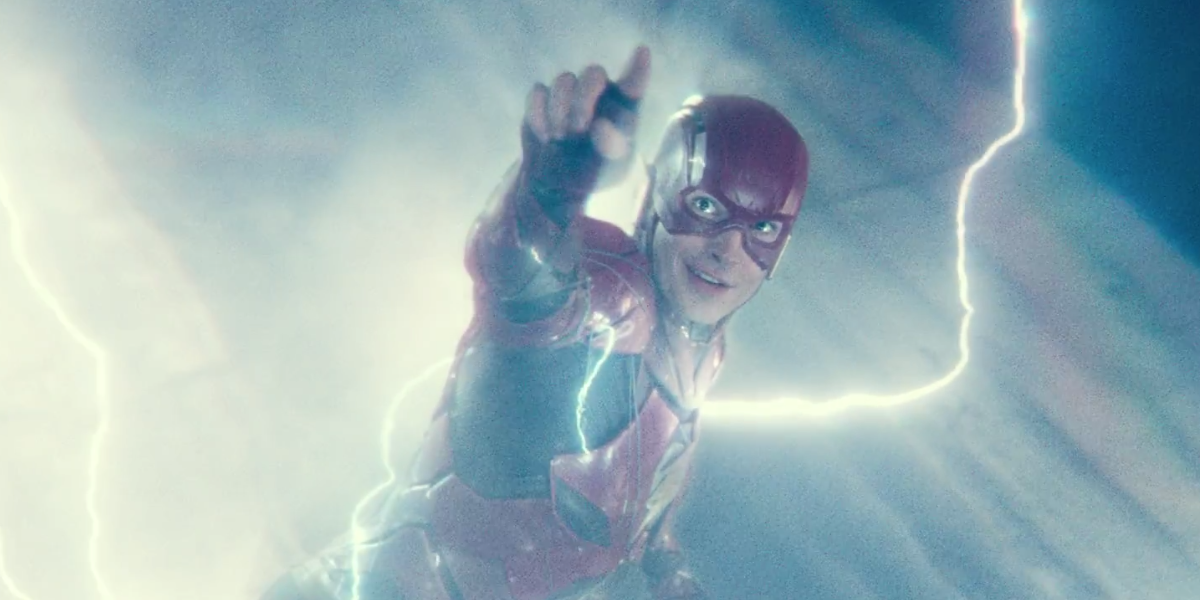


Snyder certainly has a knack for staging action set pieces and where his trademark slow motion/speed up technique is used most effectively is the introduction of Barry Allen a.k.a. the Flash when he applies for a job only to save a woman from a deadly car accident that he locked eyes with moments before all to the strains “Songs of the Siren” (hauntingly covered by Rose Betts) that is hypnotically and as visually arresting a sequence as anything in the filmmaker’s canon.

Of course, having this kind of creative freedom allows Snyder to indulge in his some of his more indulgent tendencies that feel a tad out of place in a movie like this, such as moments of ultraviolence when Wonder Woman takes out a group of terrorists in a museum in London, England. She doesn’t just dispatch the baddies, Snyder makes sure we hear them slam hard against walls with a sickening thud and accompanying blood splatters. Wonder Woman straight up murders these guys, literally exploding the ringleader at the end and then, without missing a beat, turning around to a little girl and giving her some aspirational pearl of wisdom. It’s not like she hasn’t killed people before in other movies but it is the way they are depicted in Justice League, which is so disturbing.

Like a lot of contemporary CGI villains, both Steppenwolf and Darkseid lack personality and whose motives are the same old tired clichés we’ve seen a million times before. Marvel broke the mold with Thanos in the Avengers movies, coming the closest to almost making us forget he was a completely digital creation. The baddies in Justice League look exactly like they are and, as a result, we don’t really feel that tangible threat or sense of danger as we know these are purely digital beings. That being said, they aren’t really that important to the story beyond being a catalyst to get the heroes together.


The most significant change from the theatrical version is how Snyder’s version acts as a backdoor origin story for Cyborg, placing him and his relationship with his father (Joe Morton) at the movie’s emotional core. In Whedon’s version, his character was relegated to almost an afterthought. In fact, he plays a pivotal role in the movie’s climactic moment.

Snyder is an impressive visual stylist and before Justice League his movies often felt hampered by miscasting in pivotal roles and uneven screenplays with clunky dialogue that sometimes failed to understand their source material. This obscured his distinctive directorial vision. The script for Justice League, written by Chris Terrio, is the first one since James Gunn’s work on the 2004 Dawn of the Dead remake, that matches Snyder’s visual prowess. With Justice League, he wanted to make something grandiose and mythic – after all he’s dealing with both ancient gods and contemporary beings with god-like powers – and with the help of Terrio’s script he successfully achieved that goal.

DC didn’t want to copy the look of Marvel Cinematic Universe movies and hiring Snyder made sense as he brought an epic, operatic feel to his entries in the DCEU. His movies are decidedly darker in tone and look, which divided comic book fans, especially those of Superman who felt that Snyder went too far in reinventing the character. Where the superheroes of the MCU are relatable to one degree or another, Snyder’s superheroes are god-like Übermensches wrestling with living among mortals and having to assume alter egos so that they aren’t persecuted by a public at large that either doesn’t understand or fears them.


The central thesis of Snyder’s DC movies has focused on the power that superheroes like Superman wield: how they choose to use it as opposed to how they use it to help the greatest number of people. In Justice League, Batman makes the decision to activate the remaining Mother Box, attempting to resurrect Superman thereby putting the entire planet at risk as it will bring Steppenwolf and his army to them. Fortunately, the gamble pays off but this strategy contains more than a whiff of Objectivism, Ayn Rand’s philosophical system where the most significant moral purpose of human life is to pursue happiness over everything else, even if it means disregarding the needs of others. Batman takes it upon himself to assume that he knows what is best for everyone and executes that plan consequences be damned.

If Batman v Superman posed the question, should these super-powered being be held accountable for their actions then Justice League was a resounding no. They are going to do whatever they think is right whether that aligns with the greater good or not. It certainly provides a fascinating spin on the superhero mythos and is one of the many things that makes Snyder’s DC movies stand out from others in the genre. If Justice League is to be his swan song for the studio and for the genre he certainly has done so in spectacular fashion.

Friday, April 1, 2016

Batman v Superman: Dawn of Justice

For years, DC Comics has struggled to successfully adapt its characters into movies. With the exception of Christopher Nolan’s Batman trilogy, they have had a spotty track record with ambitious, yet flawed efforts like V for Vendetta (2006) and Watchmen (2009), and outright commercial and critical failures like Jonah Hex (2010) and Green Lantern (2011). Meanwhile, DC’s rivals, Marvel Comics have been enjoying unprecedented success beginning with Iron Man (2008) and haven’t looked back since. In terms of franchises, they designed it so that all their movies exist in the same cinematic universe, which allowed characters from one movie to appear in a supporting role in another. This culminated with The Avengers (2012), which was a massive success.

Naturally, DC wanted to replicate this success and decided that Man of Steel (2013) would be the first installment in what has become known as the DC Extended Universe. Unlike previous Superman movies, it took on a decidedly darker tone to reflect the post-9/11 times in which we live in. While it made some fascinating tweaks to the Superman mythos, it courted controversy with its climactic showdown between Superman (Henry Cavill) and General Zod (Michael Shannon) that some felt was a betrayal of everything the superhero represents.

Man of Steel’s follow-up, the awkward-as-ass title, Batman v Superman: Dawn of Justice (2016), not only addresses the fallout of Superman’s actions but also ambitiously opens up the world by introducing Batman as well as several other superheroes (and villains) in what is seen as a lead-up to a Justice League movie, which will be DC’s version of The Avengers. This all rests on the financial success of Dawn of Justice and so a lot is resting on this movie, which may explain the all or nothing, go-for-broke scope and scale of the world it depicts.

I like that director Zack Snyder uses the movie’s opening credits to masterfully and succinctly sum up Batman’s origins. By now, most people know it and so it was a nice way of depicting it without holding up the narrative of the movie, much like how he did a great job of establishing the world of Watchmen in its opening credits. Bruce Wayne (Ben Affleck) witnesses first-hand the wide-scale destruction of Metropolis as Superman and Zod duke it out. All he can do is watch as a good chunk of his office building is destroyed killing or maiming many of his employees.

More than a year after the climax of Man of Steel and the world is still reeling from the aftershocks of what happened. A United States Senator named June Finch (Holly Hunter) feels that superheroes like Superman need to be regulated lest they unleash more carnage. She temporarily allies herself with Lex Luthor (Jesse Eisenberg), a genius billionaire that has found enough Kryptonite to weaponize it so that he can stop Superman.

Meanwhile, Wayne is pursuing a Russian arms dealer in the hopes of finding out the man behind him, which maybe the same person that Lois Lane (Amy Adams) is investigating when she travels to Africa and is nearly killed for her troubles. Meanwhile, Clark Kent is concerned with Batman’s vigilante tactics and keeps tabs on his activities. This all builds to an epic confrontation between Batman and Superman that draws inspiration from the classic showdown between the two in Frank Miller’s Batman: The Dark Knight Returns complete with the former donning an armored suit to give him half a chance against the latter. Their fantastically choreographed battle royale in Dawn of Justice is all that I hoped it would be – epic and visceral. This is merely an appetizer for an even bigger climax as Lex unleashes a destructive force so powerful that it takes Superman, Batman and Wonder Woman (Gal Gadot) to stop it in a glorious CGI-intensive slugfest that is on par with anything seen in both DC and Marvel movies.

Ben Affleck is well-cast as an older, more world-weary Bruce Wayne, obsessed with stopping Superman to the point of being tormented by nightmares of being unmasked and killed by him. For Wayne, it is deeply personal as the battle of Metropolis opens his eyes to a much bigger threat than the two-bit crooks he’s been combating for 20 years. He is afraid of Superman’s power and what will happen if it continues to go unchecked. Anybody can be in the Batman suit but it takes something else to play Wayne that few actors have done it well. Affleck does an excellent job of conveying Wayne’s obsessive drive that is crucial to the character – better than anybody since Michael Keaton in Tim Burton’s two Batman movies. He brings the right amount of gravitas required for the role, playing him as a tortured individual without overdoing it. The actor understands the anger that fuels Batman’s need to punish criminals and shows how this blinds him towards the bigger picture.

Henry Cavill continues his solid work as Superman, which tends to get lost in the larger than life portrayals of Batman and Lex Luthor. As the movie progresses, Clark beings to question why he should continue to help humanity when some don’t want it or want to regulate him. The actor continues to have nice chemistry with Amy Adams who returns as Lois Lane but this feels less like a second Superman movie than an exercise in cinematic world building as Snyder inserts visual references to future Justice Leaguers and, as a result, Superman feels marginalized to a certain degree. Maybe the numerous dream sequences (that visually echo Snyder’s Sucker Punch) could have been removed or limited in favor of more screen-time for Clark? Wonder Woman is peppered throughout a decent portion of the movie. Her enigmatic presence and Gal Gadot’s tantalizingly brief performance has me looking forward to her upcoming standalone movie.

I was pleasantly surprised by Jesse Eisenberg’s take on Lex Luthor. The trailers suggested a comedic manic performance that would be grating but instead he delivers a jittery, off-kilter performance, presenting a psychotic genius. Superficially, the actor channels his take on Mark Zuckerberg from The Social Network (2010) and does provide much welcome levity in this ultra-serious movie. He also brings a wonderfully unpredictable energy to every scene he’s in. For example, there’s a scene where Lex delivers a speech in front of many people and as it goes on he begins to trip over his own words as if his mind is racing faster than his mouth can utter the words and he eventually gives up. For all of his nervy, jovial nature, there is an ominous contempt Lex has for most people because he thinks he’s smarter and better than everyone else.

If you liked Man of Steel than welcome to more of the same but that being said, Snyder has toned down his energetic style by largely foregoing his speed-up/slow down action sequences in favor of a more kinetic approach that works much better, especially late in the movie when Batman cuts loose on a room full of henchmen that includes a snazzy visual homage to The Dark Knight Returns, which should please fans. Even though it repeats the CGI-intensive large-scale destruction of Man of Steel’s climax, whereas that felt excessive, in an odd way it feels earned in Dawn of Justice. It is also nice to see that the filmmakers make a point of having all this carnage take place in areas devoid of innocent life. At times, the movie feels a bit overstuffed and could have used some judicious trimming here and there, but it’s a minor quibble because there is plenty I liked about it.


Ultimately, Batman v Superman: Dawn of Justice is a refreshingly provocative movie that has had a polarizing effect on viewers with some upset at how much liberties Snyder and co. have taken with the Batman and Superman mythologies and others having no problem with the radical changes that have been made. I’m of two minds about this movie. On one hand, I am of the generation that feels protective of what came before and how the past mythology should be honored, and on the other hand, I admire how the filmmakers pushed the envelope with the representation of these two iconic characters to the point that their origins are faithful to the source material on only a basic level, used as a springboard to go off in different directions than what came before. Some would argue that as a result, the filmmakers don’t understand these characters, but on the contrary, I think that Dawn of Justice dares to stray that far from the comic books, utilizing their basic elements as a foundation to then go and reinvent Batman and Superman for a new generation in a way that pushes buttons, stirs things up. This is something that Marvel has yet to do (if they are even interested in doing so) and makes these new DC movies distinctive from their rivals. Love or hate Dawn of Justice, people are talking about it and arguing passionately about its merits or lack thereof. When can you say a big budget comic book movie provoked that kind of reaction?

Friday, February 19, 2016

To the Wonder

With The Tree of Life (2011), filmmaker Terrence Malick not only fully embraced non-linear storytelling but also made a semi-autobiographical film as it was partially inspired by his experiences growing up in Central Texas. The famously secretive filmmaker followed this film with To the Wonder (2012), which is loosely based on his second marriage to a Parisian whom he met in France during a lengthy self-imposed exile from filmmaking. She had a young daughter and soon the three of them moved to Austin, Texas. She tried to adapt to her new surroundings while he would leave them for long periods of time without explanation. This film uses these scant known autobiographical details as a loose structure for Malick to push the style he utilized so brilliantly in The Tree of Life to further extremes.

We meet the happy couple frolicking in Paris and very much in love. Neil (Ben Affleck) is an American traveling through Europe and Marina (Olga Kurylenko) is a Ukrainian divorcee with a ten-year-old daughter (Tatiana Chiline). Malick’s restless camera hovers close to the lovers conveying a believable intimacy between them while also marveling at the world around them – most impressively Mont St. Michel, the island abbey located off the coast of Normandy. It is a breathtaking combination of ancient architecture and expansive vistas of a beach at low tide that seems to go on forever.

At times it feels like we are intruding on these people’s most personal moments and privy to their innermost thoughts thanks to Marina’s voiceover musings. She shares her feelings for Neil: “I’ll go wherever you go,” and what she tells him: “If I left you because you didn’t want to marry me, it would mean I didn’t love you. I don’t expect anything. Just to go a little of our way together.” It is a refreshingly honest and candid expression of her feelings for him.


The couple is soon relocated to his hometown in Oklahoma and Malick manages to find visual splendor in suburbia. Olga Kurylenko is a revelation in these early scenes. Not only does Malick’s camera love her but she acts naturally in his very intimate and Expressionistic style. She also does a great job conveying Marina’s emotional fearlessness – a willingness to be honest with her feelings towards the man she loves. Marina is the kind of beautiful free spirit Malick loves to populate his films, from the childlike Holly in Badlands (1973) to Abby in Days of Heaven (1978).

Initially, Ben Affleck seems like an odd choice to star in a Malick film as his mannered style of acting would seem at odds with the filmmaker’s loose, improvisational approach. Early on, in the Europe scenes the actor comes off as a little stiff but there is definitely chemistry between him and Kurylenko, which only deepens when they go stateside. As the film progresses and Neil becomes more distant from Marina, it makes more sense why Malick cast Affleck. Like the equally mannered Richard Gere in Days of Heaven, Affleck portrays a man unable to fully embrace the little moments in life that most of us take for granted but that populate Malick’s films. Affleck is excellent at playing controlled, emotionally detached characters and so when Neil begins freezing Marina out, the actor is at his finest.

Javier Bardem appears as a Catholic priest struggling with his faith. Malick depicts him as a somber, solitary figure and this is conveyed in the poignant visual of the actor walking down a deserted tree-lined street with leaves strewn on the ground. This understated image tells us so much about the character and is further reinforced by his voiceover thoughts. Even when walking among the happy attendees of a wedding ceremony he just presided over, he looks lonely, unable to connect with anyone except on a surface level. He confesses, via voiceover, that he’s going through the motions.


Eventually, Neil and Marina drift apart and she and her child return to Europe. Some time passes and he reconnects with a childhood friend named Jane (Rachel McAdams) who is coming off a failed relationship of her own. They fall in love, sharing a similar temperament. As he did with Neil and Marina’s courtship, Malick captures the intimacy of Neil and Jane’s embryonic love affair, but he doesn’t forget Marina, checking in to see how the fallout of her relationship with Neil has affected her. Not surprisingly, she is still haunted by him.

Known mostly for mainstream Hollywood films like Mean Girls (2004) and Sherlock Holmes (2009), it is interesting to see Rachel McAdams cast in such an overtly artsy film like To the Wonder. She’s well-cast as an earthy woman trying to keep her horse ranch. Her character is a striking contrast to the more ethereal Marina. McAdams is a good fit for Malick’s cinematic world.

Malick takes more artistic risks than any other living American filmmaker, following his own unique thematic preoccupations and repeating visual motifs to the point of coming the closest to self-parody with To the Wonder than ever before, but his actors buy into his cinematic vision so completely that their commitment to it helps legitimize what he’s trying to do.


This film is an incredible exploration into the nature of relationships as Malick wrestles with the notion of how one can fail while another thrives. Why is that? Is it timing? Chemistry? To the Wonder seems to suggest that there is also a certain alchemy, an unquantifiable element that draws people to one another and also keeps them together. Some people can make it work and some can’t for any number of reasons. Relationships take hard work and Malick understands that and conveys it better than most filmmakers. It’s almost cliché to say that To the Wonder isn’t for everyone and at this point in his career it looks like Malick isn’t going to change his approach to storytelling any time soon. He is more interested in making cinematic tone poems rather than traditional linear narratives and it’s great to see someone putting themselves out there like he does with every film.

Friday, September 26, 2014

Pearl Harbor

“Like I see these people on the Internet saying, ‘Oh, it’s a travesty that Michael Bay is doing this story.’ ‘Oh, why’s he doing it?’ ‘Oh, he’s going to wreck it.’ It’s like shame on those people, you know? Shame on them!” – Michael Bay

I have this sick fascination with the Michael Bay movie Pearl Harbor (2001). It is just so awful, but kind of mesmerizing in its awfulness. The movie was his attempt to shift gears and show the world that he could do something other than mindless action movies. With this movie, Bay, armed with Randall Wallace’s subpar John Milius-esque screenplay, thought he could replicate the formula of James Cameron’s Titanic (1997) complete with Earth-shattering box returns. It was almost as if Bay expected the Academy to park a truck up to his front door and dump a bunch of awards on his doorstep because he was making an IMPORTANT MOVIE. One can almost imagine him thinking to himself, “This will be the movie they’ll remember me for,” with the same kind of hubris not seen since Charles Foster Kane thought he could make the news he was supposed to be covering.

Only that didn’t happen. Pearl Harbor didn’t make Titanic-sized numbers at the box office (although, $449 million worldwide ain’t bad), the critics hated it (let’s face it, by this point his movies had become critic-proof as the film’s producer Jerry Bruckheimer put it, “We made it for people, not critics.”) and it was nominated for more Golden Raspberry Awards than Academy Awards. Although, to be fair, it did win an Oscar for Best Sound Editing – hardly the dominance that Cameron’s movie demonstrated the year it walked away with 11 Oscars. The failure of Pearl Harbor was some kind of reality check for Bay and he retreated back to familiar turf with Bad Boys II (2003) and is now the caretaker of the Transformers franchise.

Bay lays it on thick right from the get-go as we watch two young boys play make believe they’re shooting down German planes in their father’s old biplane, the sequence awash in the golden hue of nostalgia as a crop duster flies overhead in slow motion while Hans Zimmer’s wistful score swells. It’s Tennessee 1923 and Bay then flashes forward to the best friends as aspiring hotshot fighter pilots in 1940, challenging each other like some sort of prototypical Top Gun (1986). One guy even says admiringly, “Those are some smooth aces,” and manages to do so with a straight face. This is only the first of many howlers courtesy of Wallace’s script.


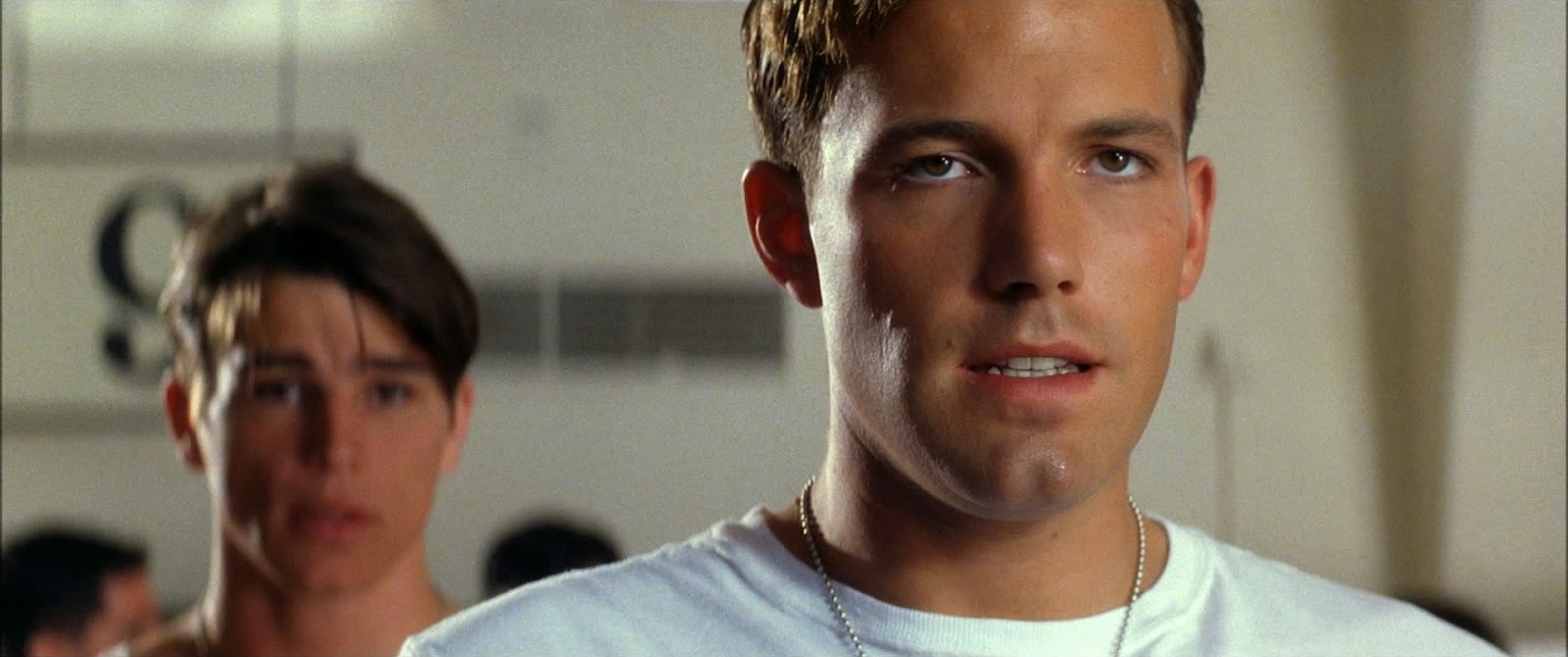
Cut to Rafe McCawley (Ben Affleck) being chewed out by his superior, Major Jimmy Doolittle (Alec Baldwin) for his screwball antics. Rafe is assigned to duty in England where World War II is raging, much to the dismay of his best friend Danny Walker (Josh Hartnett) who confronts him about it thus setting up the true romance of Pearl Harbor. No, it’s not the Hallmark Movie on steroids love affair between Ben Affleck and Kate Beckinsale, but Affleck and Josh Hartnett’s bromance. The scene depicting their tiff over Rafe leaving is the first indication that these guys were cast for their looks and not their acting, especially Hartnett who is borderline unwatchable at times. It’s not what he says per se, but how he says it – so wooden – that is so bad. The dialogue they’re forced to utter does them no favors.

The introduction of the beautiful nurses that Rafe and his fellow pilots are destined to meet reminds one that aside from choreographing explosions, Bay really knows how to photograph women, bathing the likes of Beckinsale, Jennifer Garner and Sara Rue, among others, in warm, inviting light as they gush about the hunky pilots they screened days ago. For whatever it’s worth they are all well cast and look like they came from that time period.

Rafe and Evelyn’s (Kate Beckinsale) meet-cute is largely played for laughs, both intentionally (he acts like a clumsy fool) and unintentionally (the dialogue is howlingly bad). As the scene dragged on I started to feel sorry for Affleck who not only has to try and sell this clunky dialogue, but do it with a bandage on his nose and acting like a child that needs to be taken care of, which is intended to be romantic, but comes across as laughable and insulting. And this is supposed to be the most romantic thing that has ever happened to Evelyn?! Dear Lord…


At first glance, the attention to period detail looks convincing, but a significant portion of the film’s Wikipedia page is spent pointing out the many historical inaccuracies, which is surprising with a production that had that kind of budget you’d think they’d have hired some decent technical advisors, but I can see Bay waving them aside in favor of his version of this time period, historical accuracy be damned! It’s Michael Bay’s version of the 1940s. Did he learn nothing from Steven Spielberg’s 1941 (1979), another notorious WWII big budget fiasco? At least Spielberg was trying to make a comedy; Bay has no such excuse with the unintentional hilarity that ensues between explosive action sequences.

Bay is on stronger ground with his depiction of the plane battles where Rafe engages with German planes over England. They are exciting and Bay does a nice job conveying the chaos of aerial battle as planes dive and roll amidst machine gun fire. However, things get complicated when Rafe apparently dies in battle and Danny and Evelyn wait months to get cozy as they console each other. Danny is a little less awkward in flirting with Evelyn than Rafe and Hartnett looks most comfortable in these scenes as he lets his hunky good looks do all the heavy lifting.

Big surprise, Rafe isn’t dead after all and shows up after Danny and Evelyn have consummated their relationship in typical Bay fashion – slow motion amidst virginal white parachutes. Awkward! Oh yeah, she’s pregnant with Danny’s baby. We have to endure this mind-numbingly dull soap opera for over an hour intercut with teases of the Japanese preparing for war while Dan Aykroyd’s Captain Thurman tries to convince the military brass that Pearl Harbor would be a probable target because it would devastate the Pacific fleet. Naturally, Danny and Rafe settle their differences by kickstarting a bar brawl. Fortunately, the Japanese sneak attack allows them to settle their differences fighting side-by-side.


“It’s like, people die all over the world in earthquakes, whatever, you know, in much huger numbers than at Pearl Harbor. But there was something; there’s something. You wonder, What is it? You think, Okay, only three thousand people died, but there’s something, you know?” – Michael Bay

About 86 minutes in and what we’ve been waiting to see, or, as Martin Lawrence puts it in Bad Boys II, “This shit just got real,” as Bay presents a chilling shot of low-flying Japanese fighter planes zooming by two boys standing on a grassy field. He intercuts tons of planes advancing while most of our heroes are asleep, blissfully unaware of what’s about to happen. Not surprisingly, the best part of Pearl Harbor is the actual attack on the place because it allows Bay to do what he does best – blow shit up. Bay tries to replicate the shock and awe of the first 25 minutes of Saving Private Ryan (1998) with a visceral depiction of the attack on Pearl Harbor. He’s able to use CGI to follow a Japanese bomb as it is launched from a plane and drops into a battleship, which ends up taking you out of the picture as you marvel at the stylish technique.

This sequence gives Bay a chance to indulge in explosive mayhem (or Bayhem) and man, does he ever cut loose. He makes sure we are thrown right into the middle of the action. There are some truly unsettling shots, like an ominous one of a Japanese torpedo traveling underwater and we can see the legs of countless men treading water above. That being said, it’s hard not get caught up in the carnage as we see scores of innocent sailors get blown and shot up. Not to mention, as badly as they are written, we care a little bit about what happens to Rafe and Evelyn and their friends. And yet, Bay can’t resist sticking blatant jingoistic images like the shot of American flag submerged underwater alongside men trying to stay alive.

He also can’t resist shooting the aftermath of the attack stylishly, smudging the lens with a Vaseline effect, distorting it so as to avoid an R rating with all the bloody casualties. There is the occasional odd shot, like a group of shambling burn victims framed like something out of George Romero zombie movie. Rafe and Danny help rescue men trapped in damaged ships and Bay frames Hartnett in a glamour shot, his hair stylishly mussed up, which feels sneakily exploitative and cheapens the pain and suffering around him.


Historical figures like President Roosevelt (Jon Voight) are reduced to caricatures and in what is meant to be a dramatic moment, but comes off as unintentionally ridiculous, he rises out of his wheelchair to make a point about the resilience of the human spirit. This gesture instead invokes a similar moment, although played for laughs, in Stanley Kubrick’s Dr. Strangelove or: How I Learned to Stop Worrying and Love the Bomb (1964). The last third of the movie features Alec Baldwin at his most Baldwin-iest as he barks out orders and makes inspirational speeches almost recalling his arrogant motivator of men from Glengarry Glen Ross (1992). The actor does his best to make his cliché-ridden, rah-rah dialogue sound half-decent through sheer force of will, but it isn’t easy.

Pearl Harbor might have been a passable movie if it had ended after the attack but no, we’ve got to end things on a feel-good high and so there is the tacked on Doolittle Raid, which transforms Pearl Harbor into a revenge movie. You can almost imagine Bay or Jerry Bruckheimer brainstorming ideas – how can we give Pearl Harbor a happy ending? The Doolittle Raid also seems to be included as a way to punish Danny for stepping out with Evelyn behind his best friend’s back. And so Danny gets to die a noble death while Rafe ends up with Evelyn to raise the dead man’s child.

Pearl Harbor attracted a large number of young actors into its vortex with the likes of Jennifer Garner, Sara Rue, Jaime King, and Michael Shannon who I’m sure their agents all told them to do the movie as it would be a big boost to their careers. There’s also a few dependable veteran character actors, most notably Tom Sizemore, who brings a much-needed gritty charisma that fresh-faced pretty boys like Affleck and Hartnett can’t.


When my wife and I saw Pearl Harbor in a theater – like many we are suckered by the rather solemn, impressive-looking trailers – three-quarters of the way through she felt a rat brush by her foot. We realized that maybe we weren’t the key demographic for this movie and the presence of rats was a sign. We beat a hasty retreat and upon leaving the theater demanded our money back. We met an usher on a butt break who asked us what we thought of the movie. We told him of our woes and asked him how it ended and he bemusedly recounted the Doolittle Raid and the fates of Rafe and Danny. He did a better job of telling the story than Bay!


Pearl Harbor may feature the most harrowing depiction of the battle on film, but surrounds it on both sides with instantly forgettable filler. It has an odd place in Bay’s wrongraphy. It is the director at his most restrained with some shots lasting at least a couple of seconds before an edit (that’s a snail’s pace for him). It’s not that Bay made a movie about Pearl Harbor, but that he did a bad one. Shame on him! Instead of becoming a chapter of history like Pearl Harbor or 9/11 that we will always remember, Bay’s movie belongs to a chapter of cinematic history we’d like to forget. One good thing came out of this recent experience of watching Pearl Harbor – it finally sated my curious, morbid fascination with it. I don’t feel the need to every watch it again.


SOURCES

Jones, Kent. "Bay Watch." Film Comment. July/August 2001.

Laskas, Jeanne Marie. "The Life of Michael Bay." Esquire. July 2001.

Thursday, April 7, 2011

Hollywoodland

On June 16, 1959, actor George Reeves died from a gunshot wound to the head. His death was ruled a suicide with the official police report stating that he had been depressed over his failed career. Reeves’ claim to fame had been portraying Superman on television during the 1950’s. It was a very popular show but by the time he turned 40, the actor wanted to move on with his career. However, he could not shake his association with the iconic role. His mother Helen Bessolo refused to believe her son took his own life and hired private investigator Jerry Geisler. Both died before they could prove anything.

Over the years, more and more people refused to believe that Reeves would commit suicide. Forensic evidence surfaced that cast doubts on the official cause of death. Was he killed by his fiancée Lenore Lemmon, or was he murdered by order of Toni Mannix, the wife of MGM general manager Eddie Mannix who allegedly had Mob connections? Reeves had an affair with Toni but spurned her for another woman. Or, did Eddie find out and have Reeves killed?

Hollywoodland (2006) dramatizes Reeves’ suspicious death and documents the events leading up to it. The film is structured as a detective story with a private detective investigating Reeves’ death. The film was seen as a comeback of sorts for Ben Affleck who hadn’t acted for two years after the critical and commercial flops of Gigli (2006) and Jersey Girl (2006). After headlining several high profile studio films, he had wisely laid-low and took a supporting role in this film. Affleck portrayed Reeves to critical acclaim and hasn’t looked back since.

Louis Simo (Adrien Brody) is a low-rent Jack Gittes-type private investigator that specializes in cases of infidelity. His “office” is a fleabag motel as all of his money goes to an ex-wife (Molly Parker) and young son (Zach Mills). He used to be a police detective and his ex-partner turns him onto the Reeves (Ben Affleck) case. Perhaps influenced by his son’s upset reaction over the death of his T.V. idol, Simo decides to talk to Reeves’ mother (Lois Smith) who believes that her son did not commit suicide. He investigates further, interviewing people that knew him and this triggers a series of flashbacks to the events leading up to Reeves’ death.

The flashbacks give us more insight into Reeves. For example, while trying to be seen at a swanky Hollywood hangout, he meets Toni Mannix (Diane Lane), a beautiful woman married to a very powerful man, Eddie Mannix (Bob Hoskins). Initially unaware that she’s married and to whom, Reeves has an affair with Toni – partly because he’s attracted to her and partly because he thinks she can help his career. Toni becomes his sugar mama, buying him a nice house in the suburbs for him and their trysts.

The scenes between Ben Affleck and Diane Lane are quite good. They have decent chemistry and do a good job of conveying what their characters got out of the relationship. Affleck is excellent in this meaty supporting role. The rise and fall of Reeves must’ve spoke volumes to the actor who had also experienced both. Affleck knew what it felt like to be on the top of the world one moment and then considered a joke after a couple of high profile flops. Anyone who is a student of Hollywood lore knows that it has a long history of tragic deaths. What makes Reeves’ story so interesting is that he played such a wholesome, upstanding character with Superman but had an unhappy personal life. Affleck fleshes out Reeves and digs deep, providing a nicely layered portrayal of the man. Reeves just wanted to be regarded as a serious actor but did such a good job playing Superman that he couldn’t disassociate himself from the role.

Adrien Brody delivers a decent enough performance but his invented character feels like just that and seems out of sorts with all the actual historical figures he interacts with and investigates. Simo’s backstory and motivation is just not as compelling as say Jack Gittes in Chinatown (1974), a film whose legacy casts a long shadow over Hollywoodland. Brody is supposed to be a jaded investigator who thinks he’s seen it all but the actor comes off as a little too aloof. As a result, his character feels like a tacked on afterthought.

Diane Lane doesn’t have a lot of screen time but she makes the most of it. Toni is a powerful woman who gets what she wants and Lane plays her as a charming individual so long as Reeves makes her happy. It’s when he no longer does this that her true nature reveals itself. Watching the actress in this film makes me wonder how she would have done in L.A. Confidential (1997) if she had been cast in Kim Basinger’s role. In some respects, Toni is not a typical femme fatale and Lane does her best to flesh out her character and shed some light on her motivations.

Producer Glenn Williamson, at the time head of production at USA Films, bought Paul Bernbaum’s screenplay, Truth, Justice and the American Way in 2001. Williamson was drawn to the way the script “guides the audience toward a conclusion, but there is no definitive answer.” The project moved to Miramax Films for a short time with filmmakers Mark and Michael Polish (Twin Falls Idaho) attached to direct. At one point, they screen-tested Kyle MacLachlan to play George Reeves. Williamson wanted the film to have a more mainstream appeal – something that the directors, known for their dark, atmospheric films, weren’t interested in and so they decided part ways.

The project moved to Focus Features where veteran T.V. director Allen Coulter signed on. When his agent gave him Bernbaum’s script he wanted to do it after reading the first five pages. The director was drawn to the “great Hollywood noir milieu” and the complexity of Reeves’ life. He heard that Ben Affleck was interested in the role and ended up casting him as Reeves. To resemble the actor, Affleck put on upwards of 28 lbs., changed the shape of his nose with a prosthetic, altered his hairline, and changed the color of his eyes. If that wasn’t enough, during filming, he listened to several clips of Reeves’ voice between takes and also watched every episode of the Superman T.V. show.

Hollywoodland shot for six weeks in Toronto and two in Los Angeles. At some point, Warner Brothers, which produced the Superman films, applied legal pressure to have the name changed from Truth, Justice and the American Way to the current title because they wanted to disassociate themselves from the sordid details of Reeves’ demise with their vested interest in rebooting the Superman franchise.

Hollywoodland received mixed to negative reviews as most praised Affleck’s performance but had problems with the way the script juggled the two storylines. In his review for The New York Observer, Andrew Sarris wrote, “Hollywoodland gets a few laughs from the show’s cheesy Ed Wood–like production effects, but the dignity and sobriety that Mr. Affleck projects as Reeves keeps the sheer ridiculousness of his limited career options from ever becoming too campy.” The New York Times’ Manohla Dargis also praised Affleck’s performance: “Later, as defeat takes its grinding toll, Mr. Affleck lets weariness creep into his face, pulling his features down until it becomes difficult smile.” Entertainment Weekly gave the film a “B+” rating and Lisa Schwarzbaum wrote, “There's something simultaneously heartfelt, wised-up, playful, and fierce about the way the onetime Daredevil acknowledges that he knows that we know that he knows that we're bound to read something of the actor's own skids with fame in his expiatory portrayal of a star who couldn't quite steer his own image.”

However, New York magazine’s David Edelstein wrote, “the back-and-forth cutting between past and present would be clunky even if it weren’t so arbitrary, and it doesn’t help that Adrien Brody—as the film’s ­other protagonist, a burnt-out gumshoe—is more actorish than the supposed actor.” USA Today gave the film two-and-a-half stars out of four and Claudia Puig wrote, “But then the narrative bogs down with a misbegotten subplot about Simo's personal life … Director Allen Coulter … missteps with this secondary story line. He flounders in his attempts to find parallels between Simo's life and Reeves' iconic place in Hollywood at that time.” In his review for the Washington Post, Stephen Hunter wrote, “For some reason, the director and the writer (Paul Bernbaum) have chosen an exceedingly awkward path into the material. They break the narrative into two strands, and play them off each other in cheap and easy ways for insubstantial effect.” The Los Angeles Times’ Kenneth Turan wrote, “For despite its virtues, Hollywoodland never fully succeeds due to the unfortunate air of artificiality that hangs over it. Caught in a netherworld between re-creation and reality, it only sporadically feels like it is actually happening.” Finally, in his review for the Village Voice, J. Hoberman wrote, “Coulter contrived a neat behavioral trick by inducing his star to play a comparably big-jawed bad actor. Surrounded as he is by canny professionals … it's an unexpectedly touching performance. In fact, Hollywoodland turns turgid whenever it switches to the gritty Louis Simo story.”

The attention to period detail is very good, from the vintage cars to the Coke bottle Simo drinks from in a scene. The filmmakers effortlessly transport us back to that time. Allen Coulter’s direction is solid but does little to differentiate it from other films of the genre. L.A. Confidential this is not. Maybe it’s just as well as the story is engrossing enough and Affleck’s performance keeps our interest. Ultimately, Hollywoodland lies somewhere between the ambitious but flawed Mulholland Falls (1996) and the masterful L.A Confidential. What it does do is paint a compelling and sympathetic portrait of George Reeves. His career serves as a sobering reminder of the dangers of being closely identified with an iconic film role and how it can affect the rest of your career. Some people embrace it while others spend the rest of their lives trying to get away from it.


SOURCES

Goodridge, Mike. “Ben’s Back in Business.” The Evening Standard. August 17, 2006.

Hansen, Liane. “Director Coulter Discusses Hollywoodland.” National Public Radio. September 3, 2006.

Portman, Jamie. “How Fame was Stolen from the Man of Steel.” Ottawa Citizen. September 7, 2006.

Stuever, Hank. “Truth, Justice and the HBO Way.” Washington Post. September 3, 2006.

Tapley, Kristopher. “The (Tinsel) Town That Ate Superman.” The New York Times. August 20, 2006.


Thomas, Bob. “Suicide or Murder?” Associated Press. September 5, 2006.