"...the main purpose of criticism...is not to make its readers agree, nice as that is, but to make them, by whatever orthodox or unorthodox method, think." - John Simon

"The great enemy of clear language is insincerity." - George Orwell
Showing posts with label Los Angeles. Show all posts

Friday, September 15, 2023

L.A. Takedown


It says something about the kind of juice Michael Mann had within the industry in 1989 that he was able to create – and get on television – a rough draft for a film he would make six years later. He wrote an early draft of what would become Heat in 1979 that was 180 pages and based on real people he knew both personally and by reputation in Chicago. Ten years later, he cut the screenplay down to 110 pages and raised the financing himself so that he owned the rights to the material. The result was a made-for-television movie entitled L.A. Takedown, a cat-and-mouse story between a career criminal and a dedicated police detective that aired on NBC on August 27, 1989 at 9 p.m.
 
The origins for the project were based in large part from the experiences of a police officer and an old friend of Mann's, Chuck Adamson, who had been chasing down a high-line thief named Neil McCauley in Chicago in 1963. Mann wrote another draft after making Thief (1981) with no intention of directing it himself. In the late 1980s, he tried to produce the film several times and offered it to his friend and fellow filmmaker Walter Hill but he turned it down. Mann was still not satisfied with the script, which had developed the character of McCauley but who still needed work. It also lacked an ending.
 
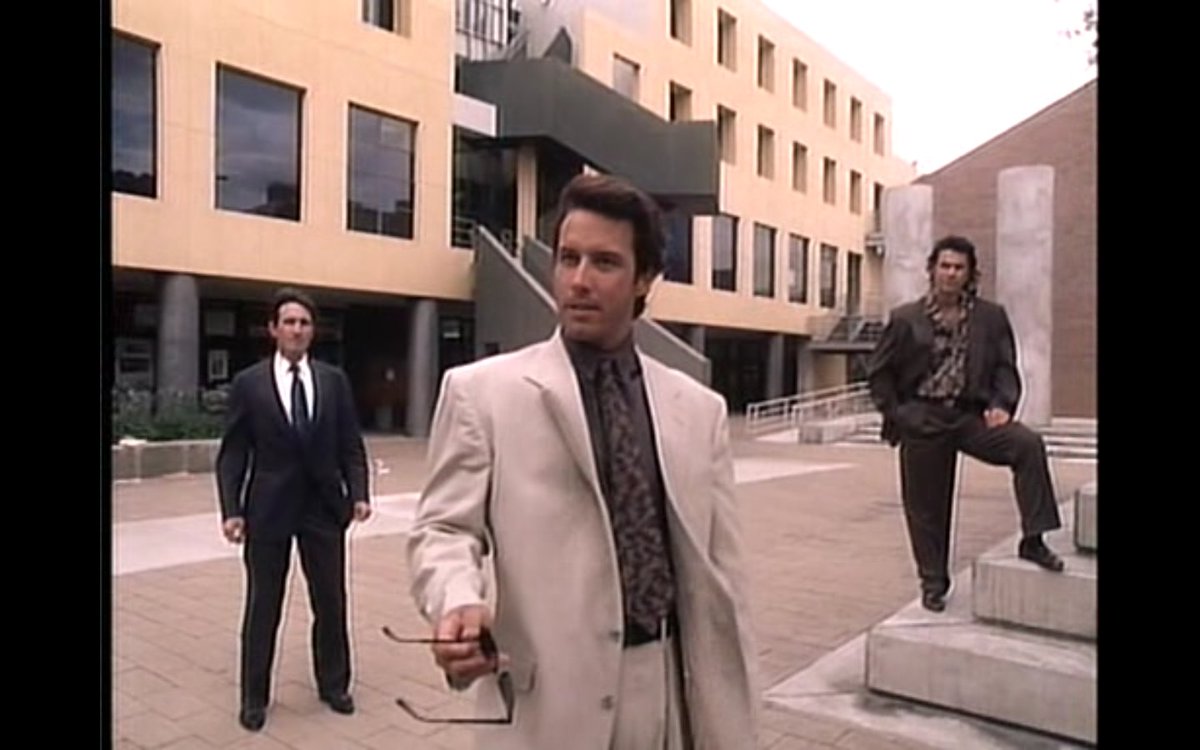
Early on, L.A. Takedown follows the plot to Heat beat-for-beat with Scott Plank playing Los Angeles Robbery-Homicide division cop Vincent Hanna and Alex McArthur as Patrick McLaren (Neil McCauley in Heat), the veteran thief. It is fascinating to see the different choices that Mann makes, such as the tweaks in dialogue or in the casting of certain characters. For example, Xander Berkley, a fantastic actor in his own right, is cast as Waingro, the loose cannon McLaren hires to help his crew knock over an armored truck. The actor plays him initially as a jittery psychopath, only to later settle on a drugged-out look, whereas in Heat, Kevin Gage brings a scary, simmering intensity to the role – a stone-cold serial killer and agent of chaos.

The most interesting casting in the movie is Hanna’s team, which includes Richard Chaves (Predator), Michael Rooker (Henry: Portrait of a Serial Killer), and Daniel Baldwin (John Carpenter’s Vampires). Unfortunately, they hardly get any screen time and therefore make little impact. Plank is okay as Hanna but lacks the confident swagger that Al Pacino brought to the role. That being said, he does have a nice moment with his estranged wife, Lillian (Ely Pouget), near the end, after McLaren is killed, where he admits that he loves her but isn’t going to change.
 
L.A. Takedown suffers most in the casting of McLaren and his crew. McArthur, eerily chilling in William Friedkin’s Rampage (1987) as a sadistic serial killer, lacks the gravitas of Robert De Niro. The same can be said for the barely seen Peter Dobson (The Frighteners) as Chris Sheherlis who comes off as a glorified extra in this incarnation, whereas the role was expanded significantly in Heat with Val Kilmer taking over the character. Vincent Guastaferro (NYPD Blue) plays Michael Cerrito and lacks the intensity that Tom Sizemore brought to the part. They are simply not convincing as a team of elite thieves but then, they aren’t given the screen-time.
 
The scene where Hanna and McLaren meet face-to-face is fine but it makes one realize just how much De Niro and Pacino brought to the table – nuance and subtlety –that is lacking from McArthur and Plank. There is stiffness to the line readings from both actors as they fail to bring Mann’s words to life, summing up what’s going on in this movie. The inflexible actors are cast in the lead roles and the actors you’d like to see cut loose, like Rooker, are wasted in nothing roles. The famous bank robbery shoot-out is still exciting to watch and one of the few times L.A. Takedown comes thrillingly to life. It lacks the visceral immediacy of Heat but does have some cool shots, such a McLaren and Sheherlis running back into the bank after Hanna and his team show-up, with them chasing the camera in a slick tracking shot.

There are some enjoyable bits of business, such as a montage of Hanna working the streets of L.A., asking around about McLaren and his crew. Mann gives us a brief slice of the city’s night life via quick, broad strokes. Perhaps what is most striking about L.A. Takedown is how it doesn’t feel or look like a Mann production. While Ron Garcia’s (Twin Peaks) cinematography is just fine, it lacks the widescreen mastery of Dante Spinotti’s work in Heat. The T.V. movie’s 1.33:1 aspect ratio certainly doesn’t do it any favors, giving it a boxed-in feel as opposed to Heat’s 2.39:1 aspect ratio, which opens everything up and gives the film more of an epic feel. The lack of Mann’s distinctive touch may also be due to the incredibly fast shoot – uncharacteristic for the methodical filmmaker – with only ten days of pre-production and 19 days of shooting. In comparison, Heat had a six-month pre-production period and a 107-day shooting schedule.
 
At the end of the day, L.A. Takedown is a fascinating curio, nothing more – a stripped down, rough draft. Gone is Shiherlis’ subplot, so is the bungled precious metals sting, the subplot involving Hanna's stepdaughter, and McLaren dies differently and less satisfyingly. Due to the short running time, everything feels condensed while Heat’s expanded running time allows the story to breathe and provide nuanced characterization, thereby shedding more light on the motivations for the characters’ actions. Heat shows how more time, millions of dollars and a talented, star-studded cast can make a difference. Afterwards, Mann had a much clearer idea of how he wanted Heat to be structured. More importantly, he also figured out the ending. In 1994, Mann showed producer Art Linson another draft of Heat over lunch and told him that he was thinking of updating it. The producer read it, loved it, and agreed to make the film, giving ‘90s cinema what would prove to be a timeless heist classic.


Saturday, March 19, 2022

Tequila Sunrise


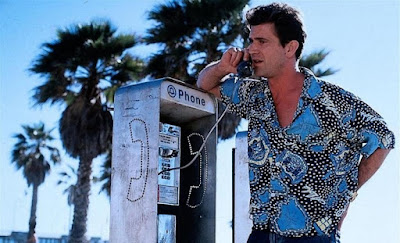
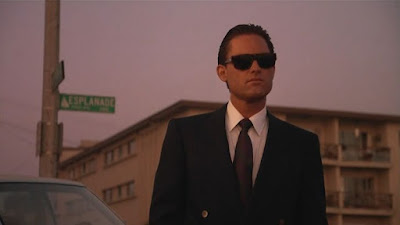
Robert Towne needed a box office hit. By 1987, the legendary Hollywood screenwriter, who rose to fame in the 1970s with the likes of The Last Detail (1973) and Chinatown (1974), was in director’s jail after his debut, Personal Best (1982), flopped at the box office and he went through a messy legal battle against studio executive David Geffen. He was trying to get his second directorial effort, Tequila Sunrise (1988), off the ground and knew he’d need bankable movie stars in the lead roles. He managed to secure Mel Gibson, Michelle Pfeiffer and Kurt Russell who were all coming off successful high-profile hits with Lethal Weapon (1987), The Witches of Eastwick (1987) and Overboard (1987), respectively. They jumped at the opportunity to work with someone such as Towne, drawn to his well-written screenplay. The end result is a gorgeously shot neo-noir with a love triangle that tests the friendship between two long-time friends on opposite sides of the law.
 
Dale “Mac” McKussic (Gibson) is a high-end drug dealer that is supposedly retired even though Nick Frescia (Russell), head of narcotics for Los Angeles County, runs into him at a drug deal. They are friends from way back and so Nick lets him go before the bust goes down, however, Mac knew it was coming and got rid of the drugs. One gets the feeling from the casual way they interact with each other that they’ve crossed paths many times before this incident. Mac escapes and just makes his late reservation at his favorite posh restaurant run by Jo Ann Vallenari (Pfeiffer), who catches the eye of both him and Nick. The rest of the film plays out a twisty cat and mouse game as Nick is torn between busting his friend and trying to save him while Mac is torn between doing one last drug deal and his love for Jo Ann – the person that puts their friendship to the test. As the film progresses, various characters’ true motivations come into focus and we see if Mac is smart enough to stay one step ahead of the Columbian drug cartel he works for, the DEA and hold on to Jo Ann.

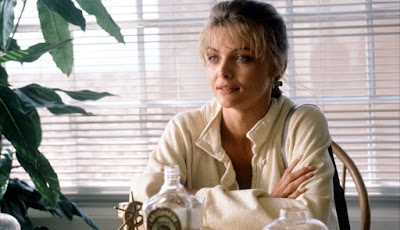
All three lead actors exude sex appeal like crazy and part of the thrill of watching Tequila Sunrise is how these three movie stars interact with one another, breathing life into Towne’s wonderful prose. Michelle Pfeiffer’s Jo Ann is no damsel in distress. She’s a strong woman who easily holds up to questioning early on from federal agents who grossly underestimate her fortitude as evident in a beautifully acted and written scene where Jo Ann expertly turns the tables on the Feds to Nick’s bemusement. She’s suave and knows how to deal with her classy clientele but isn’t snobby either. With her beautiful smile, Pfeiffer makes Jo Ann very charismatic and sexy. It is easy to see why Mac and Nick find her so alluring. In turn, she is drawn to Nick’s charisma and Mac’s vulnerability.

With his slick, Pat Riley hairdo and shark grin, Kurt Russell’s Nick is a super confident lawman that is great at his job as he is very perceptive and savvy, which comes from years of experience and knowing what goes on in his own backyard. The actor gives his character just the right amount of cockiness so that he doesn’t come across as arrogant. This plays well off J.T. Walsh’s humorless federal agent intent on busting Mac regardless of Nick’s friendship with him. Russell has a wonderful scene with Pfeiffer where Nick comes clean and explains why he got romantically involved with Jo Ann and the cocky façade comes down to reveal a brutally honest person not afraid to be vulnerable in front of her. He didn’t just get close to her to get close to Mac. He genuinely loves her and is willing to put all his cards on the table. Russell shows an impressive range in this scene but, like Jo Ann, you’re still not quite sure if he is 100% genuine and not playing an angle.
 
Mel Gibson’s laidback drug dealer is an excellent counterpoint to Russell’s gregarious lawman. Mac plays things close to the vest and Gibson gives little away which keeps us guessing as to how his character is going to evade the cops and not get killed by his South American counterparts. His performance may not be as flashy but it has a brooding intensity that is fascinating to watch. He can go back and forth between showing Mac’s day-to-day routine (work at his legit job and hang out with his son) and the aspects of his drug dealing trade and show how they inform his character.
 
The always reliable Arliss Howard is excellent as one of Mac’s drug contacts who is constantly trying to get him to do another drug buy but he’s savvy enough to know that this guy is bad news. Howard’s character comes across as amiable enough but it isn’t too hard to figure out his character is probably an informant trying to set up Mac. He’s a little too eager to do business and this ultimately tips his hand.

The great Raul Julia shows up partway through as the DEA’s Mexican counterpart but with a secret agenda of his own. The actor looks like he’s have all kinds of fun with his role, breaking out into song on two separate occasions for no reason at all, taking over the scene for a few seconds. He really gets to sink his teeth into the role once his character’s true identity is revealed.

Character actor extraordinaire, J.T. Walsh is excellent as a slimy DEA agent that immediately butts heads with Nick who is much smarter and has no problem rubbing the man’s nose in it. Walsh is a master of simmering rage, glowering constantly as his character is constantly outsmarted and proven wrong.
 
Tequila Sunrise is beautifully shot by the great cinematographer Conrad Hall (Butch Cassidy and the Sundance Kid) as evident from the stunning sunset featured in the background of a scene where Nick and Mac are captured in silhouette talking on the beach. It’s an excellent scene as the two men sniff each other out to figure out what the other knows and to tell each other to back off in so many words. We get a real indication of what’s at stake and it’s not just their friendship but potentially Mac’s life if he doesn’t play his cards exactly right as he’ll either get busted or killed.

Robert Towne based the Tequila Sunrise screenplay on the courtship of his wife. In the mid-1980s, he frequented chef Piero Selvaggio’s Valentino restaurant in Santa Monica. He would arrive late and talk with Selvaggio’s wife Luisa. She would end up leaving her husband for Towne. At one point, he moved to Paris to help Roman Polanski on the script for Frantic (1988) and met producer Thom Mount. He told him about his script for Tequila Sunrise and after reading it took it to Warner Bros. The studio agreed to do it if Mount could attract a movie star. Mount and Towne approached Harrison Ford while he was making Frantic with Polanski and he agreed to do it but as they got closer to principal photography he pulled out as he didn’t think he could play Mac.
 
Towne liked Mel Gibson in Lethal Weapon and approached him about playing Mac. He flew to Australia to meet with the actor who asked him, “How do you feel about actors watching dailies?” to which Towne replied, “Fine,” and he agreed to do it. Mac was based after “one fellow in particular who was in that line of work, and who was experiencing the same painful difficulty of extricating himself from it,” Towne recalled. He wrote the role of Nick with Kurt Russell in mind and on then-L.A. Lakers head coach, and close friend, Pat Riley, while also being inspired by a close friend who was an undercover narcotics cop for the L.A. County Sheriff’s Department. He initially wanted Riley to play the part because of the way he “very carefully holds himself together – his necktie tight, his hair slicked back – so that he looks like he’ll never come unglued, he never seems stressed.” Riley turned it down and Alec Baldwin was considered before Towne decided to go with Kurt Russell who he introduced to Riley and proceeded to adopt his look. Towne saw Michelle Pfeiffer in Alan Alda’s Sweet Liberty (1986) and liked the “disparity between public and private behavior” in the role and cast her as Jo Ann.
 
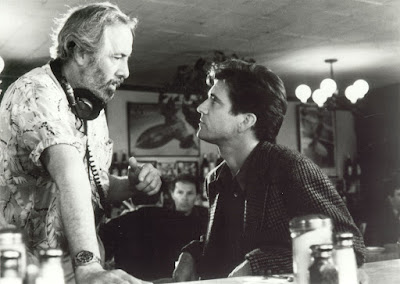
Tequila Sunrise was financed independently by Mount with a negative pick-up for Warner Bros. It was only Towne’s second directorial effort, the first being Personal Best, which was a notoriously difficult shoot that resulted in the filmmaker liberating the negative of the picture while David Geffen said he stole it. The studio had to step in and make peace between the two men. As a result, Mount wanted to surround Towne with seasoned crew members and hired Richard Sylbert to design Tequila Sunrise. He had worked with Towne previously on Chinatown and Shampoo (1975) and they were good friends. Sylbert had also worked as a studio executive and, according to Mount, “understood the process from top to bottom. So you were hiring, not a production designer, not even a co-producer, you were hiring like this Renaissance maniac who was your partner in the movie, in every way.”

To save money on the $38 million budget, Sylbert found a large, old empty warehouse, instead of a soundstage, in Santa Monica to house the production offices and build sets. For the look of the film, Sylbert chose the colors of the Tequila Sunrise drink and the Los Angeles sunset – gold, orange and red. According to Mount, “Richard understood that the drink was the color key from the very beginning.” Sylbert based Jo Ann’s restaurant on Valentino’s and Matteo’s, an Italian restaurant in West L.A. It was built in the warehouse over eight weeks. He also helped design the menu and chose the cuisine. Towne even brought in Giuseppe Pasqualato, a former chef at Valentino’s to cook on set, which also had a functioning bar.
 
Filming began in February 1988 in the South Bay section of L.A. and lasted 68 days. Ten days in, cinematographer Jost Vacano was fired as his gritty, realistic style was not the tone Towne was after – rather a more romantic vibe. He called Conrad Hall, his first choice that was nixed by the producer, and within 24 hours was on the set.
 
Tequila Sunrise received mixed to negative reviews from critics at the time. Roger Ebert gave the film two-and-a-half out of four stars and wrote, "Tequila Sunrise is an intriguing movie with interesting characters, but it might have worked better if it had found a cleaner narrative line from beginning to end. It’s hard to surrender yourself to a film that seems to be toying with you." In his review for The New York Times, Vincent Canby wrote, "Here the problem seems to be the fatal collaboration of a good writer with a director who wasn't strong or overbearing enough to pull him up short. The movie has the fuzzy focus of someone who has stared too long at a light bulb." The Los Angeles Times' Sheila Benson wrote, " It’s enough to send you out of the theater thirsty. Unfortunately, it sends you out hungry too, for a whole movie to offset this upscale grazing." In his review for the Washington Post's Hal Hinson wrote, "In Tequila, the divisions between business and pleasure, love and friendship break down, and the breakers...do it beautifully, with sweet talk, tough talk and hot kissing."

Tequila Sunrise was the box office success Towne needed but he didn’t direct another film for ten years – Without Limits (1998). He kept busy, though, thanks to a lucrative partnership with Tom Cruise, contributing several screenplays for the movie star in the 1990s, including Days of Thunder (1990), The Firm (1993), and Mission: Impossible (1996). Tequila Sunrise is a fascinating battle of wills. We have three highly intelligent people trying to figure out each other’s motives. It becomes complicated when mixed with emotions as a love triangle develops and clouds judgement. As one character says late in the film, “Friendship is all we have! We chose each other!” This is a film about friendship and loyalty. This is what motivates the three lead characters. Nick tries to save Mac from getting killed or busted as the drug dealer is his friend. Mac finds a way out of the drug dealing business as he loves Jo Ann. She loves Mac and doesn’t want him to get hurt. For a neo-noir it is lacking that fatalistic streak that runs through many of them. Towne is a little too enamored with the romantic aspects of his script to convey a convincing doomed protagonist that is a hallmark of the genre. Gibson’s Mac is a little too slick, a little too sure himself for anything really bad to happen to him and that is perhaps the film’s only glaring flaw in an otherwise wonderful, sun-drenched cinematic cocktail.
 
 
SOURCES
 
Lazar, Jerry. “Towne’s Country.” Chicago Tribune. December 4, 1988.
Mount, Thom. Audio Commentary. Tequila Sunrise DVD. 1988.
 
Sylbert, Richard & Sylvia Townsend. Designing Movies: Portrait of a Hollywood Artist. Frager. 2006
 
Turan, Kenneth. “Robert Towne’s Hollywood Without Heroes.” The New York Times. November 27, 1988.

Saturday, November 28, 2020

The Grifters


“They probably had grifter parents and grifter grandparents and someday they’ll each spawn little grifter kids.” – Miller’s Crossing (1990)


This quote always makes me think of The Grifters (1990), a film that presents a world of confidence artists – people who gain the trust of their targets only to then fleece them of something valuable. Essentially there are two kinds of people in this world: the grifters and the people they con. The film takes it one step further and has the grifters con each other but muddies the waters with notions of family and love. Who can you trust? The answer is simple and yet hard-earned: no one.
 
Roy Dillon (John Cusack) is a small-time operator working the short con, scamming bartenders and hapless patrons out of chump change. His estranged mother Lilly (Anjelica Huston) is a mid-level grifter, working for a powerful mobster (Pat Hingle) at race tracks, betting on certain horses to lower the odds. Roy’s girlfriend Myra (Annette Bening) is a high-end grifter who works the long con – ambitious schemes that swindle wealthy marks. All three have their established methods that work for them except when they don’t as evident when Roy tries to scam a savvy bartender who proceeds to hit him so hard with a club that he suffers serious internal injuries.

When Myra can’t get what she wants from a local jeweler (Steve Tobolowsky) she attempts to use her feminine wiles with no success. When Lilly fails to lower the odds more than she should have, her boss punishes her by stubbing out a lit cigar on her hand in an ugly display of power. Their lives all get complicated when Lilly decides to visit her son while on business in Los Angeles. There’s visible tension between them that goes way back. When Myra finds out that Lilly is a fellow grifter she sets her sights on the elder Dillon unbeknownst to Roy who is unaware that his girlfriend is in the game.
 

For years John Cusack had done a series of successful teen comedies and by 1988 was looking for more mature roles in films made by auteurs like Roland Joffe (Fat Man and Little Boy), John Sayles (Eight Men Out) and with The Grifters, British director Stephen Frears. Back then there was an innate likability to Cusack that audiences identified with but on this film, he dials it back in a much more controlled performance as a grifter that thinks he’s in control and can walk away from the life whenever he wants only to find out it’s not that easy.
 
Annette Bening plays Myra like a vivacious sex kitten who knows how to use her body to get what she wants but under the façade is a ruthless professional con artist. The flashback scene where we see her in action with her ex-partner (a superbly cast J.T. Walsh) as they play their target (Charles Napier) is a wonder to behold as they expertly massage their mark to pull off a sizable payday.
 
It is Anjelica Huston that is the film’s M.V.P. as the veteran grifter that has been in the game long enough to know her limitations. Lilly spots Myra right away and the scenes between Huston and Bening crackle with playful intensity as they trade verbal barbs. Huston also shows why Lilly has survived for this long, whether it’s how she deals with her ruthless boss or a creep hitting on her at a diner. Yet for all her cold logic, she shows a vulnerable side when it comes to Roy as her long-buried maternal instincts surface and she finds herself wanting to reconnect with him. Huston does an excellent job of showing both sides of Lilly and how, ultimately, she’ll do anything to survive.


Director Stephen Frears gives the film a timeless look. Even though it is set in 1990, it could easily be the 1940s as all three main characters do not wear any trendy clothing that would date them instantly. Even the dialogue treads the line between classic grifter lingo and contemporary speak courtesy of legendary crime writer Donald E. Westlake (The Hunter), who does a brilliant job of adapting Jim Thompson’s 1963 novel. He populates the film with snappy dialogue, such as Lilly and Myra’s first meeting when the latter says, “I’m Roy’s friend,” to which the former responds, “Yes, I imagine you’re lots of people’s friends.” He immediately establishes an antagonistic relationship between the two characters that starts off as playful verbal sparring but escalates when Myra finds out that Lilly is also a grifter.
 
The entire film has a low-key classic feel to it with wonderful bits of detail, like the old school switchboard in Ray’s building. This also applies to the minor yet colorful characters that are sprinkled throughout The Grifters, such as the annoying older man (Henry Jones) who works the front desk of Roy’s apartment building. Every time someone comes in we are subjected to his personal philosophy on women, how to properly fold a towel and so on. There’s also the scene where we get Roy’s backstory on how he became a con artist when he meets a veteran grifter (the wonderfully cast Eddie Jones) who teaches him the nuts and bolts of the business: “But to take another pro, even your partner, who knows you and has his eye on you, that’s a score.” This key line of dialogue could be the film’s thesis.
 
Filmmaker Martin Scorsese wanted to know what was the best crime novel that had not been made into a film and was told it was The Grifters by Jim Thompson. He and executive producer Barbara De Fina were given a spec screenplay by Robert A. Harris and another man. Scorsese was too busy and called British filmmaker Stephen Frears in 1987. He asked if he had heard of the novel. Scorsese was a fan of the latter’s My Beautiful Laundrette (1985) and felt that Frears was the right person to direct The Grifters as he felt that he had an affinity for unusual characters. Frears read the novel and agreed to direct.
 

The screenplay was initially developed at Disney where Scorsese had a deal and Donald E. Westlake went to work adapting the novel but the studio eventually decided not to back it. Originally, Westlake didn’t want the job but Frears told him the think about it terms of Lilly’s story as opposed to Roy’s and the writer agreed to do it. Cineplex Odeon agreed to finance the film but over the course of the production the budget gradually shrunk as the backers were going bankrupt.
 
Originally, Melanie Griffith was cast as Lilly, Geena Davis as Myra and Cusack as Roy, who had read the novel in 1985 and was so taken with it that he had wanted to make it into a film himself. Frears had also briefly considered Robert Downey Jr. and Tim Robbins for Roy but when Cusack heard that Scorsese and Frears were attached to the project, he active pursued the role and got it. Anjelica Huston was cast towards the end of pre-production, just beating out Sissy Spacek. She had been contacted by Frears in 1989 while making Crimes and Misdemeanors (1989) but after reading the script she was unsure about the part, shocked by the scene where Lilly is beaten by her boss. Ricky Jay was hired as a consultant and helped Cusack prepare for his role by arranging for the actor to meet actual con artists. Cusack saw Roy as “a wonderfully twisted role to dive into.”
 
The Grifters received glowing reviews from most mainstream critics. Roger Ebert gave the film four out four stars and wrote, "One of the strengths of The Grifters is how everything adds up, and it all points toward the conclusion of the film, when all secrets will be revealed and all debts collected." In his review for The New York Times, Vincent Canby praised Anjelica Huston's performance: "Miss Huston is again spectacular. Not since The Dead has she had a role of such eerie complexity, nor given a performance that was so haunting. Though Lily is a sly, unpleasant woman, out always for the main chance, Miss Huston discovers the sadness within that comes close to true tragedy." Entertainment Weekly's Owen Gleiberman gave it a "A" rating and wrote, "It’s Anjelica Huston who gives the film its emotional gravity. There’s almost nothing likable about Lilly. She’s callused over; she perseveres, period. But Huston, looking weirdly like a drag queen in her puffy, bleached-blond hair, plays her with such indomitable negative charisma that in the end the character doesn’t win your affection so much as your respect."
 
In his review for the Washington Post, Hal Hinson wrote, "The line Westlake and Frears walk skirts the edge of parody; it's the most puckish of film noirs. Their characters are scoundrels, but they have a hipster's arrogance; they play the sucker for nobody, and the sneaky thrill here comes from watching them work the angles for the upper hand." Finally, Newsweek's David Ansen wrote, "Huston dominates the film, but Bening, an effervescent sex kitten with the soul of a snake, and Cusack, with his brittle self-protectiveness, are spectacular in their own ways. These doomed grifters deserve instant admission into the film noir pantheon."
 

When The Grifters concludes, we are left with a world of con artists that aren’t all that attractive. It can be a brutal and ugly world where people go insane, get killed on a deal gone bad, or go on the run, always looking over their shoulder. There’s a reason why Lilly has survived for this long. Years of experience of making mistakes and learning from them has toughened her up as evident from the final scene where she accidentally (or was it?) causes the demise of another character that ends the film on a decidedly dark note. The Grifters isn’t a cute, we-all-got-away-with-it ending like Steven Soderbergh’s Ocean’s movies, just people surviving any way they can even if it means killing in order to do it.
 
 
SOURCES
 
“Seduction, Betrayal, Murder: The Making of The Grifters.” The Grifters Blu-Ray. 441 Films and 101 Films. May 21, 2018.
 
Sharkey, Betsy. “Anjelica Huston Seeks the Soul of a Con Artist.” The New York Times. December 2, 1990.
 
“The Making of The Grifters.” The Grifters DVD. Miramax. September 24, 2002.

Van Gelder, Lawrence. “At the Movies.” The New York Times. August 31, 1990.

Friday, February 21, 2020

American Gigolo


Many people look back at the 1980s through the soft focus lens of nostalgia. They think fondly of John Hughes’ teen movies or the music of The Police or television shows like Miami Vice or the novels of Stephen King. The people who grew up in that decade have attempted to pay tribute to that time in recent years with movies like the remake of It (2017), T.V. shows like Stranger Things and music by likes of Bruno Mars that invoke the era.

Nostalgia for the ‘80s has reached its saturation point and people tend to forget that there was a lot of awful stuff, too, like Reaganomics, the omnipresent threat of nuclear war, the explosion of Japanese fashion, T.V. shows like Alf, the proliferation of mindless synth pop, and the dominance of producer-driven Hollywood blockbusters.

One of the films that best encapsulated the superficial consumerism of the era was Paul Schrader’s American Gigolo (1980). With its icy Eurotrash score by Giorgo Moroder, its expensive clothes by Giorgio Armani and luxurious cars like Mercedes and BMW, it established the stylistic template for popular culture that would be cemented by the equally influential Miami Vice show a few years later for the rest of the decade. Schrader’s film is often dismissed as a shallow exercise in style while failing to realize that its style is its substance. It is all surface, reflecting its materialistic protagonist.
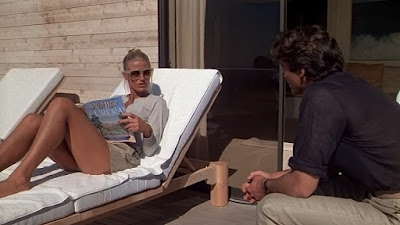
Julian Kay (Richard Gere) is a high-end male escort specializing in wealthy women. He wears only the best suits and drives expensive cars. Schrader immediately immerses us in his world with a montage of him buying suits, driving his Mercedes and dropping off one of his clients all to the strains of Blondie’s “Call Me” while giving us a tour of boutique shops, expensive beachfront condos and affluent hotels – the playground of California’s rich elite.

His world is turned upside down when he meets a mysterious and lonely woman named Michelle (Lauren Hutton), the wife of a California state senator. They meet by chance and she becomes obsessed with him and he finds himself falling in love with her. His life gets even more complicated when he finds out that a woman he had a kinky one-off gig with in Palm Springs has been murdered. Julian soon becomes the prime suspect and begins to lose control of his life that he works so hard to maintain. He must figure out who set him up and why.

Schrader takes us through Julian’s process on getting ready for a job. He lays out his suits, opens his drawer of ties, then dress shirts and so on. It’s a ritual he’s done countless times and Richard Gere skillfully sells it, showing how all these clothes inform his character. In this case, the clothes truly make the man. For Julian it’s all about control. He prides himself in knowing what women want, providing them with a fantasy that plays into their desires. They both get something out of their transactions. They feel wanted and desired and he gets paid.

The impossibly handsome Gere is perfectly cast as the narcissistic Julian. He pays close attention to how he looks and dresses as they are integral aspects of his job. He has to look good for his clients. The actor certainly knows how to wear an Armani suit and has an engaging smile that exudes charm. Julian has his whole act down cold – a tilt of the head, a sly smile, the way he looks at someone, and the silky smooth voice are all parts of his arsenal of seductive techniques.

Gere had a terrific run of films starting in the late 1970s with a small but memorable part in Looking for Mr. Goodbar (1977), Days of Heaven (1978), and then into the 1980s with American Gigolo and Breathless (1983), playing fascinating, complex characters that weren’t always likable but always interesting to watch thanks to his incredible charisma.

Lauren Hutton is excellent as the rather enigmatic woman that takes a shine to Julian. One imagines her being an unhappy trophy wife who is expected to accompany her husband to all kinds of political functions with an interested expression plastered on her face. The actor conveys an impressive vulnerability like when Michelle seeks out Julian and asks for a date with him. She is frank with what she wants and Hutton is very good in this scene.
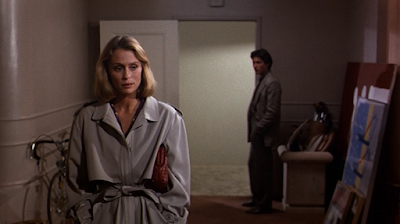
The intimacy between Julian and Michelle is more than just being physical with each other. It is the conversation they have after making love for the second time that is interesting as she tries to get him to reveal personal details. When she asks him where he’s from he says, “I’m not from anywhere…Anything worth knowing about me, you can learn by letting me make love to you.” Julian is a blank slate and this allows women to project their fantasies on him. He can be anything they want, which is why he’s so good at what he does. He does tell her why he only prefers older women, which is revealing in and of itself. He cares about pleasuring women. He puts their needs before his own, often to the detriment of his own pleasure.

It is also interesting how Schrader objectifies both men and women in American Gigolo. Initially, as we see Julian ply his trade as it were and it is the women that are shown naked but when he and Michelle make love the second time the camera lingers on their respective body parts equally and, in fact, afterwards we see more of his naked body than hers in one of the earliest examples of full frontal male nudity in a Hollywood film. As he demonstrated in this film and a few years later in Breathless, Gere is a fearless actor very comfortable with his own body.

This translates to the character as evident in a scene that occurs halfway through the film between Julian and Detective Sunday (Hector Elizondo) who is investigating the murder when the latter asks the former, “Doesn’t it ever bother you, Julian? What you do?” He replies, “Giving pleasure to women? I’m supposed to feel guilty about that?” When Sunday argues that what he does isn’t legal Julian says, “Legal is not always right.” He arrogantly says that some people are above the law and at this point he loses Sunday who sees things in simpler terms.
In 1977, Paul Schrader sold his screenplay for American Gigolo to Paramount Pictures. The next year John Travolta agreed to star and the filmmaker felt that the character of Julian Kay was a natural progression for the actor after his role in Saturday Night Fever (1977). Schrader had seen Travolta in a photo shoot for Variety where he was unshaven and in a white suit and felt that he was right for the part. The actor’s participation set the wheels in motion and the film was given a $10 million budget. The director auditioned four or five actors for the role of Michelle and liked Mia Farrow the best but when he tested her with Travolta, “she blew John off the screen. She made him look like an amateur, like a kid, not like the seducer.” As a result, he had to go with someone else and cast Lauren Hutton who had tested well with Travolta. Unfortunately, several things prompted the actor to drop out of the production: his mother had died, recent movie Moment by Moment (1978) was a commercial and critical failure, and he was anxious about the homosexual elements in the script. His departure left Schrader with two days to cast someone else.

After strong performances in high profile films that weren’t very profitable, Schrader wanted to cast Richard Gere in American Gigolo. Then head of Paramount Barry Diller didn’t want him, preferring Christopher Reeve instead. Schrader didn’t think Reeve was right for the part, as he was “too all-American, didn’t have that reptile mysteriousness.” Unbeknownst to the studio, Schrader offered the part to Gere on a Sunday, giving him only a few hours to decide. Once Gere agreed, Schrader left a note on Diller’s gate at his home. The executive was understandably upset as the director wasn’t authorized to do that. Schrader argued that Travolta was better for Urban Cowboy (1980), which the studio wanted to make and Diller allowed Gere to be American Gigolo.

Schrader said of Gere’s commitment to the role as opposed to Travolta: “In one day, Richard Gere asked all the questions that Travolta hadn’t asked in six months.” Gere was drawn to the project by Schrader’s approach to how it would be shot, “with very European techniques – the concept opened up: less a slice-of-life character study and something much more textured, stylistic.”

When Travolta dropped out, Schrader was tempted to go back to Farrow, however, he didn’t want to push his luck with the studio after they let him cast Gere but regrets not sticking with the actor: “Obviously I did everything I could and Lauren did everything she could to be as good as she could, but Mia just had stronger chops.”

When it came to putting Los Angeles on film, Schrader realized that it had been photographed countless times and wanted to bring a fresh perspective. He hired production designer Ferdinando Scarfiotti, who had worked on Bernardo Bertolucci’s The Conformist (1970), Giorgio Armani for the clothes, and Giorgio Moroder, who had scored Midnight Express (1978), to compose the film’s score. Scarfiotti, in particular, was an important collaborator as Schrader admired his visual style and the “idea that you can have a poetry of images rather than a poetry of words.” He put Scarfiotti in charge of the look of the film, which included production design, wardrobe, props, and cinematography.

Schrader picked Moroder to compose the film’s score as he liked the “alienated quality” of his music and “how propulsive it was, how sexual yet antiseptic. A sound for a new Los Angeles.” Moroder had originally wanted Steve Nick to sing the film’s theme song but she turned him down. He sent a demo to Blondie with the music and lyrics already written. Their album Parallel Lines was a massive hit but they had not been approached to contribute to a film. They admired both Moroder and Schrader’s work and agreed to do it. Debbie Harry didn’t like the lyrics and asked if she could write her own. She saw a rough cut of the film and the opening scene was in her mind along with Moroder’s music when the first lines came to her.
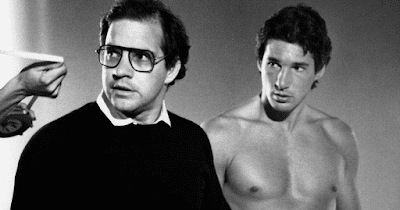
Clothes were also an important aspect of the production. According to Schrader, when it came to Julian, “the clothes and the character were one and the same. Remember, this is a guy who has to do a line of coke just so he can get dressed.” Armani had gotten involved at the suggestion of Travolta’s manager back when the actor was still attached to the project. The fashion designer was getting ready to go into an international non-couture line and the timing was right. When Gere came on board they kept all the clothes and tailored them for the actor.

To prepare for the role Schrader had Gere study actor Alain Delon in Purple Noon (1960), telling him, “Look at this guy, Alain Delon. He knows that the moment he enters a room, the room has become a better place.” According to the actor, the nudity wasn’t in the script, rather “it was just the natural process of making the movie.” He also didn’t know the character or his subculture very well: “I wanted to immerse myself in all of that and I had literally two weeks. So I just dove in.”

In retrospect, Schrader regrets that the homosexual aspects of the script were toned down to get studio backing: “At the time, we thought we were being brave, promoting this androgynous male entitlement. Now I look back, and we were being cowardly. It should’ve been much more gay. Then again, I probably got it made because Julian pretends not to be gay.”

At the time, American Gigolo received mostly negative reviews by several mainstream critics. In his review for The New York Times, Vincent Canby wrote, “Julian Kay is someone of absolutely no visible charm or interest, and though Mr. Gere is a handsome, able, low-key actor, he brings no charm or interest to the role. Then, too, the camera is not kind to him. It's not that he doesn't look fine, but that the camera seems unable to find any personality, like Dracula, whose image is unreflected by a mirror.” The Washington Post’s Gary Arnold wrote, “By the time it sputters to a fade out, Gigolo pays a heavy price for such sustained pretentiousness in tawdry circumstances. This movie invites a sort of sarcasm that destroyed Moment By Moment without ever generating as much naive entertainment value.” Roger Ebert, however, gave the film three-and-a-half out of four stars and wrote, “The whole movie has a winning sadness about it; take away the story's sensational aspects and what you have is a study in loneliness. Richard Gere's performance is central to that effect, and some of his scenes – reading the morning paper, rearranging some paintings, selecting a wardrobe – underline the emptiness of his life.”
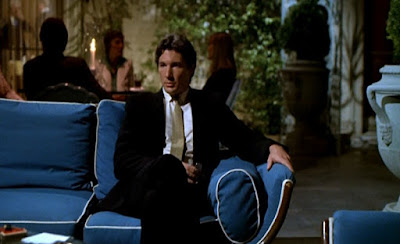
If the thriller genre elements don’t work as well as they should in American Gigolo it’s because the aspects of Julian’s profession and his developing relationship with Michelle are infinitely more interesting. It feels like Schrader was still trying things out and would be more successful at marrying these aspects in the film’s spiritual sequel The Walker (2007) decades later. American Gigolo is a fascinating fusion of the commercial sensibilities of slick movie producer Jerry Bruckheimer and Schrader’s art house inclinations (in particular, the films of Robert Bresson), establishing a stylistic template whose influence would be felt throughout the rest of the decade. Gone was the gritty, looseness of the 1970s, replaced by a slick sheen with style and spectacle over character development as epitomized by Bruckheimer produced blockbusters like Flashdance (1983) and Top Gun (1986). American Gigolo has aged better than many of these films thanks to Schrader’s thematic preoccupations, most significantly a self-destructive protagonist that finds redemption, and Gere’s strong performance that anchors the film. It may seem like a happy ending inconsistent with the rest of the film but Julian has survived at a great cost to his reputation. Everything he is has been torn down and now he must find some way to rebuild his life.


NOTES

Anolik, Lili. “Call Me!” Airmail News Weekly. February 8, 2020.

Jones, Chris. “Richard Gere: On Guard.” BBC News. December 27, 2002.

Krager, Dave. “Richard Gere on Gere.” Entertainment Weekly. August 31, 2012.

Perry, Kevin EG. “The Style of American Gigolo.” GQ. March 2012.

Segell, Michael. “Richard Gere: Heart-Breaker.” Rolling Stone. March 6, 1980.
Wednesday, July 31, 2019

Once Upon a Time in Hollywood


Ever since his directorial debut with Reservoir Dogs (1992), Quentin Tarantino has made a point of casting actors that were successful but whose marketability has waned over time only to be marginalized by Hollywood. Once leading men, they became character actors or starred in B-movies. He doesn’t care about what’s trendy and has sought out these forgotten actors with the belief that they can be great again if given the right material – think of John Travolta in Pulp Fiction (1994) or Robert Forster in Jackie Brown (1997) or David Carradine in the Kill Bill films. Once Upon a Time in Hollywood (2019) is the culmination of Tarantino’s fascination with these kinds of actors as its two protagonists are an actor and his stunt double who have been pushed to the margins with one trying to get back into Hollywood’s good graces while the other has made peace with his lot in life. The irony is that Tarantino has cast two of the biggest movie stars in the world in these roles – Leonardo DiCaprio and Brad Pitt. The relationship between these two characters lies at the heart of the film – a sprawling, yet intimate epic set in Los Angeles at the end of the 1960s with multiple storylines whose end result is a love letter to that time and place.

Rick Dalton (DiCaprio) is a journeyman actor at a crossroads. His agent (Al Pacino) lays it out for him. He can continue doing guest spots as the villain on television shows like The F.B.I. or he can go to Italy and make westerns where he’ll be the hero, just like he was on the popular T.V. western Bounty Law. Rick isn’t convinced and we follow him and his stunt double Cliff Booth (Pitt) over the course of two days (with a third day six months later) as he takes stock of his life and career. The film follows three tracks – Rick and Cliff, up-and-coming actress Sharon Tate (Margot Robbie), and, to a lesser degree, Charles Manson (Damon Herriman) follower Pussycat (Margaret Qualley) – as they occasionally intersect in all kinds of expected and unexpected ways. Once Upon a Time follows the trajectories of Rick, Cliff and Sharon with the former’s on the decline while the latter’s is taking off. All three are at crucial points in their respective lives and careers with the three days depicted in the film proving to be incredibly pivotal.

What I liked about this film is that you get to live with these characters. Like Jackie Brown, Tarantino’s best film up to this point, he takes the time to get know these characters by showing bits of business, like devoting a scene to Cliff feeding his dog (while the theme to the T.V. show Mannix plays in the background no less). Does it move the narrative forward? No, but it does provide us with insight into how he lives. This is a film rich in character behavior and it makes for a much more rewarding experience.

Leonardo DiCaprio turns in another fantastic performance as an actor with a fragile ego looking at the possible tail end of his career. Rick is created in the mold of Tab Hunter, Ty Hardin or Vince Edwards – actors that were heartthrobs in Classical Hollywood but were unable to adapt to the winds of change of the ‘60s when their kind of leading man changed to the likes of Peter Fonda and Michael Sarrazin. He must make a serious choice about what to do and fortunately for him Cliff is there to give him a boost when he needs it. The always-reliable stunt double acts as a cheerleader. DiCaprio brings his customary intensity but also shows a refreshing capacity for comedy, like when Rick has a meltdown in his trailer after he’s unable to remember lines in a scene, or surprising vulnerability, like when he breaks down in front of a child actor (Julia Butters) on the set of his latest T.V. guest spot.

Over the years, Brad Pitt has grown into his looks and has become increasingly comfortable in his own body and this has made him a better actor. He knows he has nothing to prove to anyone but himself and it is this assurance in his own abilities that results in one of his strongest performances to date. Cliff’s laconic self-confidence sets the tone for the entire film and provides a welcome counterpoint to Rick’s panicked uncertainty. This is Pitt’s most relaxed, confident performance since Killing Them Softly (2012) and one that allows to him inhabit a fully-realized character who certainly has his share of regrets but has made peace with his past.

We get to see Sharon Tate live and breathe again as she hobnobs with hip Hollywood elite like Steve McQueen (Damian Lewis) and popular musicians like Michelle Phillips (Rebecca Rittenhouse) and Mama Cass (Rachel Redleaf) at the Playboy Mansion in one scene. Margot Robbie delivers a vivid portrayal of the young actress and the best example of this is when, on a whim, Sharon goes into a theater showing The Wrecking Crew (1968) where she appeared along with Dean Martin and Elke Sommer. Tarantino stages a wonderful meta moment of Robbie playing Sharon watching the real Sharon on the big screen, basking in the audience’s enjoyment of the movie. While she may not have as much screen time as DiCaprio or Pitt (the film is ultimately about their characters), Tarantino weaves her in and out of the film for the entire running time so that there are echoes of her presence even when she isn’t on-screen.

For fans of esoteric pop culture, it is a real thrill to see Tarantino pay homage to ‘60s era T.V. by showing clips from Rick’s claim to fame, Bounty Law, which was patterned closely after Wanted Dead or Alive, however, unlike Steve McQueen breaking out from that show into high profile film roles, Rick continued playing characters on the small screen, missing out on that crucial part of a lifetime. Tarantino playfully intersects his characters with iconic historical figures, like Cliff’s amusing encounter with a cocky Bruce Lee (Mike Moh) on the set of The Green Hornet. For once, the filmmaker isn’t shamelessly ripping off other films and T.V. shows and passing them off as his own but instead referencing them directly or in the background of scenes.

Tarantino has made his first hang out movie. For the first half we are just following Rick and Cliff around as they drive through L.A. listening to music. Remember that? Ah, the simple days of driving around with your friends just enjoying each other’s company and listening to tunes on the radio or tape deck. Once Upon a Time captures that vibe beautifully. After the orchestral score for The Hateful Eight (2015), Tarantino returns to the mixed tape approach with 60 musical cues! What a soundtrack he has assembled for this film – perhaps his best – with local radio station KHJ acting as a Greek chorus of sorts with deep cuts from the likes of Paul Revere and the Raiders, Vanilla Fudge, and The Box Tops.

Tarantino and his production crew meticulously and lovingly recreate late ‘60s era L.A., immersing us in the sights and sounds of the downtown to the hills of the infamous Cielo Drive. Billboard advertisements on buildings and the sides of buses are on display prominently while also buried in the background of scenes. Long defunct movie palaces like the Pussycat Theater and the Aquarius Theatre are brought back to life, all of it adding to the rich tapestry of the film.

From its vintage Columbia Pictures logo to the KHJ Batman radio promo that bookend the film, Once Upon a Time in Hollywood is Tarantino’s loving tribute to Sharon Tate, to Los Angeles and to making movies with the friendship between Rick and Cliff at its center. They have a bit of Burt Reynolds-Hal Needham thing going on and their rapport gives the film its unexpected heart. Tarantino has crafted the most substantial relationship between two characters since Jackie and Max in Jackie Brown. As Rick edges towards obsolescence is the filmmaker using him as a mouthpiece to convey his own thoughts about impending retirement from filmmaking? Perhaps. I like to think that of the many things Once Upon a Time is about it’s a tribute to the forgotten actors from a bygone era – people like George Maharis and Edd Byrnes – that are only remembered by a select number of devoted film fans if they are remembered at all. Tarantino’s film argues that their stories are worth telling, too.

Friday, March 9, 2018

Point Blank


“The current cycle of crime films is a vicarious way to participate in the crime wave without committing a crime. That feeling is latent within each of us. Everybody wants to get even with somebody.” – Lee Marvin

Lee Marvin was a World War II veteran that utilized acting as a way of dealing with post-traumatic stress disorder. For him, it was a cathartic experience and this was particularly true with Point Blank (1967), a stylish crime film that bridged the gap between classic film noir and neo-noir. This adaptation of the 1962 Donald E. Westlake novel The Hunter also marked a close collaboration between Marvin and then-up-and-coming British filmmaker John Boorman, realizing that this film was a personal passion project for an actor whom used his clout within Hollywood to push this very experimental effort through the system.

The film begins jarringly with Walker (Marvin) shot and left for dead in Alcatraz Island, wondering how he got there. The rest of the film is an audacious collection of fragmented memories from the past mixed with the present as he exacts revenge on his partner-in-crime, Mal Reese (John Vernon) – and his duplicitous wife Lynne (Sharon Acker) – whom set him up. This is summed up beautifully in a visual metaphor early on of Walker viewed through a screen door that is initially out of focus, only to become clear. It’s all done in a way that suggests an extremely subjective view of what happened – that of Walker – as evident in odd, out of context scenes like a crowded party where Mal physically tackles and hysterically begs Walker to pull the ill-fated heist job.

Logically, how could Walker, shot twice at point blank range, survive the blood loss and swim back to civilization – a feat that was rarely achieved by perfectly healthy inmates? Logic dictates that he died on Alcatraz and the scenes set in the present only exist in his mind just before death. Point Blank isn’t necessarily concerned with logic but with inner workings of a dying man. To that end, we get a haunting image of Walker wounded, wandering the empty spaces of Alcatraz.

This is the only the beginning of the many bold, stylistic choices Boorman makes. There’s the establishing shot of Walker purposefully striding down a corridor, the sound of his footsteps continuing to play over a montage of his Lynne waking up, getting dressed and going about her day until he comes bursting through their front door, gun in hand, ready to kill Mal. It’s a New Wave aesthetic married to Marvin’s no-nonsense persona with exciting results.

As the film progresses, more of Walker’s backstory is fleshed out as he plays back in his mind. His friendship with Mal, courting Lynne and how they fell in love. This is all conveyed in a radical editing scheme that plays around with time. One moment, Walker is shoot up he and his wife’s empty bed. The next moment, he wakes up and Lynne is on the bed, dead from an overdose. Then, he wakes up again and the bed has been stripped, the body gone with only a white cat remaining. How long has he been asleep? How much time has passed? Boorman captures the unusual nature of time passing in one’s mind, It jumps around and isn’t always linear.

In a stylistic nod to Michelangelo Antonioni’s Blowup (1966), Walker goes looking for Mal in a nightclub, rife with psychedelic imagery, and an energetic rhythm and blues band playing in the background. Like, in Blowup with the Yardbirds, it is an audio-visual assault on the senses as we get close-ups of the singer, a patron enthusiastically enjoying the music, and Walker bathed in phantasmagoric lights. Even the fights are chaotic as he is attacked by two thugs in the nightclub. It is a knockdown, drag out fight complete with dirty shots done to put a man down and keep him down. By the end, Walker is a disheveled, triumphant mess.

For a film obsessed with death it isn’t relentlessly grim. There are amusing set pieces: Walker interrogates a car salesman with knowledge of Mal’s whereabouts by taking out one of his cars – and wrecking it while he’s in it – all the while one of his dealership’s commercials plays on the radio. This is an amusing, cheeky bit of humor that lightens things up briefly.

At the time, the presence of the Organization eschewed the traditional, family-based organized crime often depicted as the Mafia in many crime films for a corporate mentality. In Point Blank, there is no longer one figurehead controlling everything, rather a faceless collection of people – and Walker works his way up the corporate criminal ladder to get his money. Their solution to dealing with him? Pay him off. The amount he wants is chump change in the large scheme of things. For him – it is a matter of principal carried to an extreme. The Organization can’t understand why he only wants $93,000. What does he really want? For him it is personal; for them it is just another business transaction. His fight is man against system. For all of their so-called sophistication and fancy digs, they are still simple crooks obsessed with money.

John Vernon plays Mal with perfect, icy, reptilian charm. He’s an arrogant crook now that he’s advanced up the ladder in the Organization, only out for himself. Vernon oozes smug superiority, also used effectively in later films like Animal House (1978).

Angie Dickinson plays Walker’s beautiful sister-in-law Chris who helps him in his revenge mission. The actress has an excellent scene where, upset at her life needlessly put in danger, finally explodes on Walker, battering him with a barrage of slaps and punches, which he just stands there and takes until she finally runs out of energy. Dickinson gives everything she has in this scene and plays well off of Marvin’s remorseless crook.

Lee Marvin certainly has the steely-determination-of-a-man-bent-on-revenge look down cold – no one has done it better. There’s more to it, however, as he delivers a minimalist performance with a complexity in how he conveys so much through a look or through body language. There is the haunted, defeated look on Walker’s face after surviving being shot and left for dead by Mal, or his body language that conveys the same vibe. He’s a physically and emotionally wounded man, adrift in life. He is also able to convey the notion that there is more going on behind his eyes, that he is always thinking and planning what to do next. There are also significant stretches in scenes where Marvin says nothing, allowing the other actor to say everything. He’s a gracious performer and one with an economic style. There are no wasted looks or lines of dialogue in Point Blank – everything he says or does means something.

After the commercial failure of big budget movies like Cleopatra (1963) and The Fall of the Roman Empire (1964), Hollywood studios began entertaining the idea of cashing in on the popularity of modestly budgeted “art house” films from Europe. Hollywood producers started looking in London as there was a notion that younger European directors knew how to appeal to an audience. Producers Robert Chartoff and Irwin Winkler saw British director John Boorman’s first film Catch Us If You Can (1965), and set up a meeting between him and Lee Marvin while the actor was making The Dirty Dozen (1967), and pitched him the idea for Point Blank. The actor was interested. The two men stayed in contact, working out the details, including setting up a meeting between them, several film producers, the head of MGM, and Hollywood agent Meyer Mishkin. At the time, Marvin had enough clout in the industry to have final say over crew and cast selection, which he surprisingly gave to the director. Boorman remembered, “Making my first picture in Hollywood, I was fortunate enough to have the gift of freedom. And he backed me all the way with a belief and loyalty that was inspiring.” This was quite a leap of faith on the actor’s part as this was only the director’s second film and first one for a Hollywood studio starring a movie star.

David and Rafe Newhouse faithfully adapted the Donald Westlake novel but Boorman and Marvin found their screenplay to be mediocre and cliché-ridden, although liked the idea of the protagonist’s pointless quest for revenge. Boorman felt that Walker “had been emotionally and physically wounded to a point where he was no longer human [and] that this made him frightening, but also pure.” Marvin agreed and told Boorman that he’d only make the film if they tossed the script out the window and started over. The actor had a limited time of availability and to save time, had the screenwriting, production design, and casting occur simultaneously.

Boorman hired BBC colleague Arthur Jacobs to rewrite the script. In four weeks, he wrote it and then rewrote it completely. He and Boorman wanted to do “…something completely fresh. We wanted to make a film that was a half reel ahead of the audience, that was the whole idea.” Jacobs wrote a second version that was an amalgamation of phone conversations and letters between the two men. With each subsequent draft they cut out dialogue – the final draft was a lean 92 pages long.

Jacobs went to San Francisco for the first two weeks of shooting and wrote a completely new beginning and ending. At the end of the day, Boorman would consult with Marvin and found his responses were “always allusive, oblique. He leapt from metaphor to metaphor, and when he was drinking, the leaps got wider.” Marvin’s drinking was legendary and Boorman observed, “I would follow him as far as I could, and there was always wisdom there, deep dark thought that touched on our enterprise – but beyond a certain level of vodka, he sailed out on his own into deeper waters where no mortal could follow.”

During filming, Marvin managed to confine his drinking to weekends, starting in on Friday afternoons as he finished his last shot of the week. That being said, the actor knew when to use it for his own advantage. He looked out for Boorman during filming. One night, the director couldn’t figure out what the shot should be for one of the Alcatraz scenes. Sensing he was in trouble, Marvin faked a drunken outburst, which gave Boorman time to figure things out. “I went over and told Lee I was ready. He made an immediate and total recovery and we made the scene and the day.”

According to co-star Angie Dickinson, Boorman and Marvin “were constantly working on the script,” and found the production, “constantly challenging.” The director found his lead actor, “endlessly inventive, constantly devising ways to externalize what we wanted to express.” Despite being given complete creative control, the director was still worried that the studio would try to recut Point Blank and shot as little footage as possible so that it couldn’t be dramatically changed. He even stopped filming in the middle of a line of dialogue where he knew there would be a cut so there would be no other choice in post-production.

Several of the film’s scenes were drawn from Marvin’s own life, like Lynne’s suicide mirrored his live-in girlfriend Michele Triola’s suicide attempt. The scene where Mal tackles a drunken Walker and begs him to a pull heist job was based on an incident in a Malibu bar where a drunken Marvin was approached by a friend who demanded he loan him money. Looking back at the film years later, Marvin acknowledged how personal it was: “That was a troubled time for me, too, in my own personal relationship, so I used an awful lot of that while making the picture, even the suicide of my wife.” Boorman saw Marvin as a man wracked with guilt:

“The young Marvin, wounded and wounding, brave and fearful, was always with him. The guilt at surviving the ambush that wiped out his platoon hung to him all his days. He was fascinated by war and violence, yet the revulsion he felt for it was intense, physical, unendurable.”

After assembling a rough cut of the film, Boorman was advised to show it to Margaret Booth, head of the studio’s editing department and a legend that had started in the silent era as well as Louis B. Mayer’s editor of choice. She had a notorious reputation for re-editing films she felt weren’t good enough, but after screening Point Blank only offered a few minor suggestions. The film was then shown to chief executives who did not understand it and called for reshoots. Booth defended the film defiantly and it was released without any further edits.

Point Blank is one of the most fascinating cinematic laments of a crook’s troubled past ever put on film. It is full of visual echoes, with gestures that occur in the present, mirroring a past event, like the way Walker opens a curtain in a room or makes love to Chris like he did with her sister. These are echoes that exist in his mind. The film ends on a deliciously ambiguous note: does Walker get the money? Is he still alive? Did any of this really happen? The last we see of him is disappearing into the shadows of Alcatraz, which begs the question, did he ever leave?


SOURCES

Boorman, John. Adventures of Suburban Boy. Farrar, Straus and Giroux. 2004.

Epstein, Dwayne. Lee Marvin: Point Blank. Schaffner Press, Inc. 2013.

Farber, Stephen. “The Writer II: An Interview with Alexander Jacobs.” Film Quarterly. Winter 1968-1969.

Hoyle, Brian. The Cinema of John Boorman. Scarecrow Press. 2012.

“Playboy Interview: Lee Marvin.” Playboy. January 1969.