"...the main purpose of criticism...is not to make its readers agree, nice as that is, but to make them, by whatever orthodox or unorthodox method, think." - John Simon

"The great enemy of clear language is insincerity." - George Orwell
Showing posts with label Haskell Wexler. Show all posts

Sunday, April 7, 2024

Medium Cool


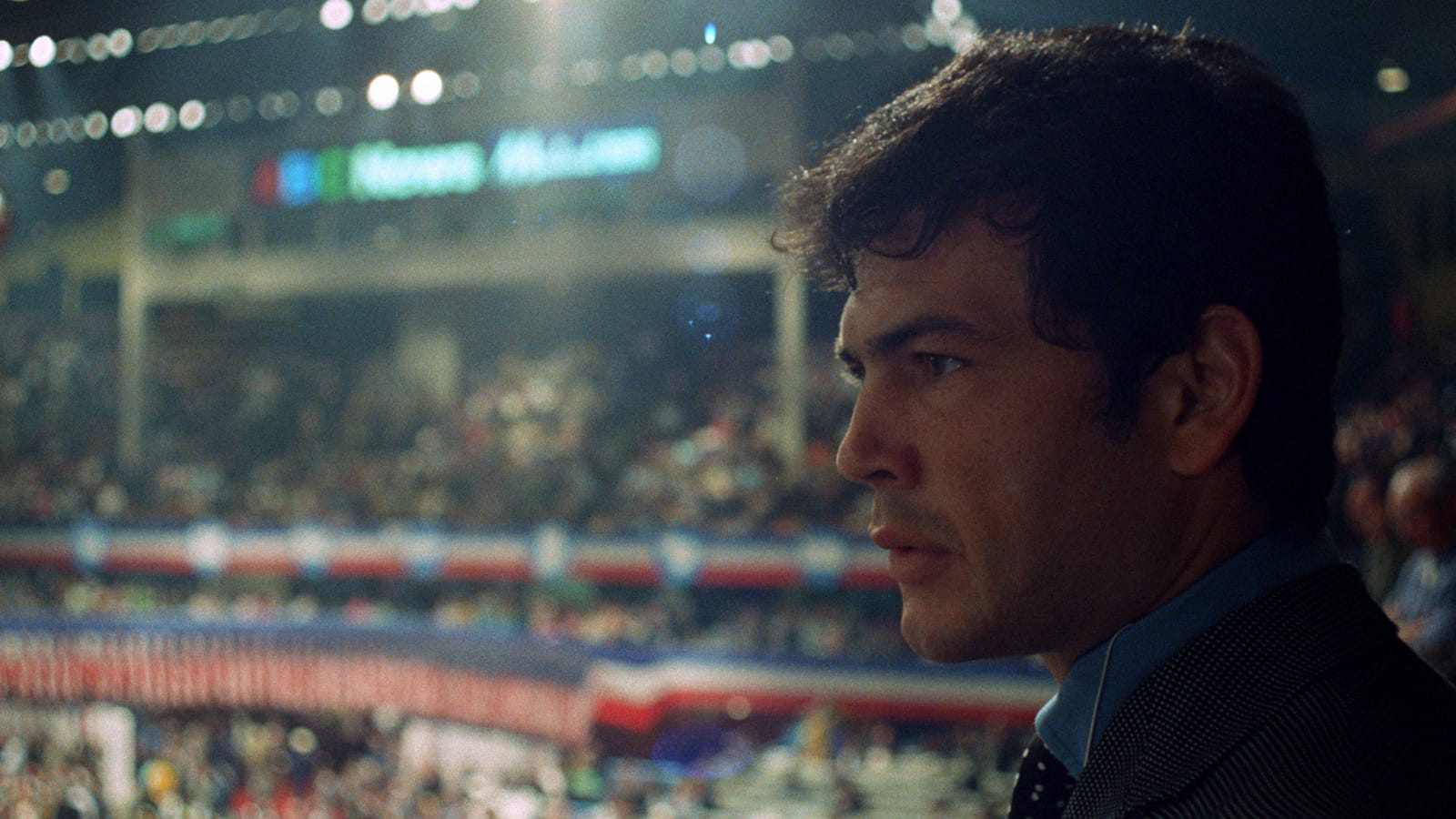
In 1968, the United States was in turmoil. The country was mired in the Vietnam War. President Lyndon Johnson announced his resignation. Both Martin Luther King, Jr. and Robert F. Kennedy – two beacons of hope for civil rights and an end to the war – were assassinated. Angry and frustrated, people took to the streets in protest, most significantly at the Democratic National Convention in Chicago. Cinematographer Haskell Wexler was there filming his directorial debut, Medium Cool (1969), a prime example of cinema verité with its brilliant fusion of documentary and narrative filmmaking creating an immediacy and authenticity, with a loosely-scripted narrative set in and among the chaos of the Convention.
 
Inspired by the socio-political chaos that was going on at the time, he shot the film in Chicago, hoping that something would transpire at the Convention. Incredibly, he was filming as protests turned violent when word got out that the Democrats failed to take a stand against the war. His cast and crew mixed it up with actual protestors and police. The result mirrored what Wexler was trying to say – what is real and what isn’t – by intentionally blurring the line between fact and fiction.
 
Medium Cool opens with an example of the famous journalism creed – if it bleeds, it leads – as John (Robert Forster) and his partner Gus (Peter Bonerz) film the aftermath of a car accident, an injured person still in the car, only to dispassionately call for an ambulance after they get the footage they need. They then drive off instead of helping or staying with the victim, immediately testing our instinct to empathize with these characters. The opening credits play over a motorcyclist carrying the accident footage through the streets of Chicago at dawn coupled with Mike Bloomfield’s twangy, western score, setting the tone and establishing the city as a character unto itself.

The next scene takes place at a swanky party as a group of people – that includes John and Gus – discuss journalistic ethics. One man says:
 
“I’ve made film on all kinds of social problems and the big bombs were the ones where we went into detail and showed why something happened. Nobody wants to take the time. They’d rather see 30 seconds of somebody getting his skull cracked, turn off the T.V., and say, ‘Let me have another beer.’”
 
These words are eerily prophetic as journalistic standards have lowered significantly since then, generation after generation having been weaned on sensationalistic new footage with very little substance.

Wexler adopts the hand-held camera style of Jean-Luc Godard, accompanying a raw, improvisational approach to acting reminiscent of John Cassavetes. This creates an air of authenticity, encouraging us to wonder what is real and what is staged. It feels real and immediate – be it a violent roller derby match that John and Gus attend, or the scene where two little kids free a pigeon on a subway platform and play on the train ride home, in what feels like an unguarded moment. Other times, he keeps the camera mostly stationary with very little movement, simply observing his subjects, such as the scene where we watch the daily activities of Eileen (Verna Bloom), a mother, and her son Harold (Harold Blankenship).
 
A young Robert Forster anchors the film as an amoral journalist that doesn’t seem to care about anything but his job. He refuses to get involved with the stories he covers, a good thing, objectively speaking, until it is a matter of life or death. The actor brings a rugged charisma to the role and is quite believable as a veteran cameraman. His humanity begins to develop when he gets fired from his job and meets Harold trying to steal his hubcaps, taking him back to Eileen where he befriends the two of them. We see John and Harold bond watching a bunch of birds released into the wild, shot like something out of a Terrence Malick film with its stunning sunset. It is a rare moment where Wexler uses conventional shooting methods.
 
Wexler does a fine job portraying the different classes in Chicago, using John as a conduit to the more affluent citizens who pontificate on things about which they have little to no actual knowledge. He shows us the rough, economically-depressed neighborhood where Eileen and her son live in abject poverty. John also takes us to a black neighborhood where he follows up on a story about a man who returned $10,000 and gets into it with some of his friends and family, who question his motives as one of them says:

“When you come and say you’ve come to do something of human interest it makes a person wonder whether you’re going to do something of interest to other humans or whether you consider the person human in whom you’re interested.”
 
His friends give the two journalists a hard time because they are fed up with their perspective being marginalized on T.V. and the media in general.
 
John eventually gets a gig filming the Democratic National Convention, setting the stage for the film’s climactic scene. Eileen is there, too, looking for Harold, who has run away. What transpires is several actors mingling with a myriad of actual protestors and police officers as things turn ugly and violent for real. Even if you didn’t know that what was unfolding was real, you have to marvel at how Wexler ratchets up the tension between the cops and the protestors. You can sense that a clash between the two sides is inevitable.

Sure enough, violence erupts and we hear the iconic line, “Look out Haskell, it’s real!” juxtaposed with the delegates in the Convention Center who are completely oblivious to what is happening. Wexler cuts back to a montage of shots of protestors injured and bleeding. The cops start randomly beating people and it is absolute chaos.
 
In 1967, Haskell Wexler started writing a screenplay after reading Division Street America by Studs Terkel. He had been moved by the trials and tribulations of the denizens of the Appalachian ghetto in Chicago. In 1968, Paramount Pictures hired him to adapt the novel, The Concrete Wilderness by Jack Couffer, which focused on a young boy who loves animals. He merged ideas from both novels with what was going on politically in the United States, “because I was engaged with what was happening in the country that was not being reported in the regular media.” He was an active member in the anti-war movement and knew that the Democratic National Convention was going to have concentrated protests so he “junked most of the book’s plot and wrote a script about a cameraman and his experiences in the city that summer.” He wrote scenes of protest in his script: “For my film I had planned to hire extras and dress them up as Chicago Policemen, but in the end Mayor Richard Daley provided us with all the extras we needed.”
 
Wexler decided to shoot the film in his hometown of Chicago, making a deal with the studio that he would fund the production, but they had to buy the finished film, even though it no longer resembled its source material. During pre-production, he had oral historian Studs Terkel work as a “fixer,” introducing the filmmaker to Appalachian transplants, artists and musicians who portrayed Black militants in one scene, and actual journalists that appear at a cocktail party, arguing about the ethics of showing violence on-screen. Wexler had been away from Chicago for several years and needed someone who knew the lay of the land. The two men were friends in high school, and when they were reunited back in Chicago, spent a lot of time together with Terkel taking Wexler “on an adventure into my own city that many Chicagoans didn’t see being insulated by communities and money and suburbs.”

When it came to casting, Wexler chose Harold Blankenship as the runaway boy that Forster’s character meets – the only vestige left from the novel – and was actually a child from the hill country. His best friend in the film was played by his real-life brother, Robert. The filmmaker felt that the Appalachian residents were “somewhat of a forgotten people” and wanted them represented in his film. While shooting documentaries in the South during the civil rights movement, he had worked with them in Monteagle, Tennessee. To this end, he shot in the Appalachian ghetto of Chicago’s upper north side where mountain people from Tennessee, Kentucky and West Virginia had settled.
 
With the assassinations of King and Kennedy, Wexler anticipated trouble at the Democratic Convention and that drew him to the city: “I knew there would be demonstrations and that the police would suppress them, but I didn’t build the story or the script around that. It just sort of unfolded before me.” Wexler talked to Mayor Daley who approved police officers on the first day of filming but Wexler quickly realized that with them present, “nobody in the street would come out and talk to us. From then on, I said, ‘Look, I don’t want cops around when I’m shooting.” Wexler came to regret that while filming the riots in Grant Park where he and his crew were tear-gassed for their troubles. The famous line uttered during this scene, “Look out, Haskell; it’s real!” was actually added in post-production. During filming they didn’t have a sound man present and his assistant, Jonathan Haze, said something resembling those words when the Nation Guard shot tear gas at Wexler.
 
Wexler sensed that there would be trouble at the Convention, thanks to a leaflet the police had put out a month prior that had a list of new crowd-control weapons.

Paramount had no idea what to do with the finished film, sitting on it for months, telling Wexler that he’d have to get releases from all the people in the park sequences. They also objected to the casual carnage and nudity. When Medium Cool was released, the MPAA gave it an “X” rating, which Wexler felt was politically motivated: What no one had the nerve to say was that it was a political ‘X’.”
 
Medium Cool ends as it began – with a car accident, only instead of John reporting on the incident, he is the incident. A car full of people pass by and much like what he did in the opening scene, they take a picture and drive on, leaving it for someone else to do something. He is treated with the same indifference he showed to the accident victim early in the film. This rather nihilistic, downbeat ending comes as a surprise and is Wexler’s most cinematic flourish, taking the ending of Easy Rider (1969) and giving it a meta spin when the camera turns on him filming footage of the end. He faces the camera as if to say, it’s only a movie.
 
 
SOURCES
 
Cronin, Paul. “Mid-Summer Mavericks.” Sight and Sound. September, 2001.
 
“Haskell Wexler on the Criterion Collection Release of Medium Cool.” Time Out. May 22, 2013.
 
French, Piper. “High Visibility: Reexamining Medium Cool on Its 50th Anniversary.” Los Angeles Review of Books. August 23, 2019.
 
Lightman, Herb A. “The Filming of Medium Cool.” American Cinematographer. January, 1970.

Friday, December 16, 2016

The Thomas Crown Affair

On paper, The Thomas Crown Affair (1968) must’ve looked like a sure-fire hit. Its stars – Steve McQueen and Faye Dunaway – were coming off highly regarded films – The Sand Pebbles (1966) and Bonnie and Clyde (1967) respectively. Behind the camera, director Norman Jewison had just completed In the Heat of the Night (1967) and brought cinematographer Haskell Wexler and editor Hal Ashby along for the ride, injecting dazzling style into the heist film antics of this new project, which included the much-lauded use of the split-screen process, giving key scenes more importance. The end result was a fun ride and a classy popcorn film.

Thomas Crown (McQueen) is a suave, very wealthy playboy that confidently makes and breaks deals every day. In his spare time, he orchestrates complex heists with a team of men that never know his identity. Jewison first employs the split-screen technique during this sequence so that we can see everyone in action simultaneously. He uses it judiciously, however, so that it doesn’t wear out its welcome. The team of four men are the epitome of professionalism, knowing exactly when the money will be available, how to neutralize the bank guards, and then how to make their getaway, ditching their disguises and disappearing into the busy Boston streets – all during the daytime!

It’s not like Crown needs the money – far from it. He gets off on the challenge of outwitting the law and the thrill of getting away it. For him, it is all a game and he meets his match in the form of independent insurance investigator Vicki Anderson (Dunaway) who is brought in to crack the case and recover the money. She is just as well-dressed, cultured and intelligent, exuding the same slick confidence. Naturally, these two beautiful people are attracted to each other and engage in a battle of wits that is fun to watch.

She teams up with police detective Eddie Malone (Paul Burke) and initially they don’t have much to go on. They put their brains together and try to figure out how it was done and who did it. The scene where they brainstorm ideas is a good one because it shows them trying to figure it out. Jewison also shows the legwork involved as they go over photographs and records, narrowing down the suspects.

Known for playing rough and ready, down-to-earth characters, McQueen is quite effective as a refined man so smart and wealthy that he creates elaborate schemes to steal money he doesn’t need simply to amuse himself. The actor plays Crown as an enigmatic character whose motivations are enticingly elusive and McQueen brings all of his considerable movie star charisma to the role.

Dunaway is his ideal foil as she plays a smart investigator that knows how to get Crown’s attention and engage him intellectually as evident in their first meeting where they flirt with each other while coyly probing to see what the other knows. Vicki is a beautiful and confident woman and the actress is clearly having fun in the role as evident in the mischievous smile that occasionally plays across her face. Both are willing to skirt the law to get what they want and she’s not afraid to admit that when Eddie calls the investigator on her questionable tactics.

The Thomas Crown Affair is a master class in editing as evident in the memorable scene where Jewison cuts between Crown and Vicki playing chess as we get close-ups of her mouth and his eyes mixed with shots of them playing as she uses all of her considerable charms to seduce him by coyly running her hand up her arm, running a finger slowly over her lips and suggestively stroking a chess piece. He fights off her advances for a little bit before succumbing. This is all done over Michel Legrand’s jazzy score, which epitomizes late 1960s cool. Jewison handles it all with a fantastic light touch as we watch these two beautiful people mess with each other and maybe even fall in love.

Boston lawyer Alan R.Trustman got the idea for The Thomas Crown Affair (originally entitled, The Crown Caper) one Sunday afternoon in 1966. He was bored and decided it would be fun to write a screenplay. He worked on it on Sundays and a few nights a week for two months until it was finished. He sent it to the William Morris Agency and got an agent. They, in turn, offered it to director Norman Jewison, fresh from The Russians Are Coming, The Russians Are Coming (1966) at the end of March 1966. Given very little time to decide, he agreed to direct almost immediately. According to Jewison, Trustman’s script was more of a legal brief than anything else. It was 30 pages and what got the director’s attention was the central storyline and the two principal characters. He then worked with Trustman on and off for 15 months, transforming the brief into a script. Immediately, he recognized that the movie would be a “matter of style over content,” but the bank robbery was “ingenious” and the characters were “charismatic.” He credited Trustman’s legal training and “clever imagination” with creating a flawless bank robbery. Together, they fleshed out the characters.

Steve McQueen wanted to play Thomas Crown very badly and begged Jewison to cast him but the director wanted Sean Connery for the part. Trustman even had the latter in mind when he wrote the script! Connery wanted to take some time off after making the latest James Bond movie and so Jewison considered other actors rather than McQueen whom he felt was wrong for the role. The actor was determined and met with the director. He was struck by the actor pleading his case in person and that it “wasn’t about money or the deal or stardom. It was about the role.” He was impressed by the actor’s passion for the project and gave him the part.

Having worked with him before, Jewison knew that McQueen was a man of few words and had Trustman turn Crown “into a more laconic character.” The writer wasn’t happy with the casting of the actor but ended up watching all of his movies to get an idea of the man’s sensibilities. Trustman then rewrote the script with the actor in mind. McQueen was drawn to the part because he had wanted to change his image for over a year and saw Crown as “a rebel, like me. Sure, a high society rebel, but he’s my kind of cat. It was just that his outer fur was different – so I got me some fur.” To get ready for the role, he learned how to play polo in three weeks. Jewison remembered, “He was so competitive that he got out on the polo field and played until his hands bled.”

For the role of Vicki, Jewison wanted a European actress to play the role and considered the likes of Julie Christie, Vanessa Redgrave, Anouk Aimee, and Samantha Egger until Brigitte Bardot, whom Jewison also contacted, suggested the role by played by an American without an accent. He agreed and considered Sharon Tate, Candace Bergen and Raquel Welch. By mid-1967 he still hadn’t found the right actress. He wanted a beautiful woman with charisma and acting chops that could hold her own with McQueen. He had seen Faye Dunaway in an off-Broadway play a couple of years before and thought that she was good. He met with Arthur Penn who was editing his film Bonnie and Clyde and saw some of her scenes. She looked great and held her own with co-star Warren Beatty and he cast her as Vicki. She was drawn to the character because she was “an audacious woman who stopped at nothing. A risk-taker she was, always one jump ahead of everyone else. She was smarter than any of the boys, classier than any of the girls.”

Principal photography was scheduled to start in June ‘67 and by April the script was ready. In search of style over content, Jewison took cinematographer Haskell Wexler and editor Hal Ashby to Expo 67 in Montreal in June where they saw a short documentary entitled, “A Place to Stand” by Chris Chapman that employed multi-image screen techniques that impressed Jewison. He thought, “We could use the same technique in our movie, not as a gimmick but as a legitimate editorial tool and stylistic storytelling device.”

Jewison shot the first robbery with concealed cameras known only to the crew, the bank guards and the tellers. “Our actors scared a lot of customers and pedestrians who thought they were seeing a real robbery. But oddly, no one tried to interfere. I think they were afraid to get involved.” They spent three days shooting the famous chess scene. The kiss itself took a full day to shoot because Jewison wanted to get the lighting just right for the moment. According to Wexler, there was genuine heat between the two actors but off-camera she kept McQueen at arm’s length. Dunaway said of the scene: “Every man I’ve ever met since then, if we talk long enough, has mentioned the chess scene to me. And every man I’ve known since then who has been in love with me has loved that movie.”

The Thomas Crown Affair was made for $4 million and grossed $14 million at the box office but critics weren’t crazy about it. Roger Ebert gave it two-and-a-half out for four stars and felt that it was “possibly the most under-plotted, underwritten, over-photographed film of the year.” In her review for The New York Times, Renata Adler said it was “just the movie to see if you want to see an ordinary, not wonderful, but highly enjoyable movie.” Pauline Kael provided one of the more perceptive reviews when she wrote, “If we don’t deny the pleasures to be had from certain kinds of trash and accept The Thomas Crown Affair as a pretty fair example of entertaining trash, then we may ask if a piece of trash like this has any relationship to art. And I think it does.”

The joy of watching The Thomas Crown Affair is seeing Crown and Vicki get the upper hand on one another over the course of the film as we try to figure out if he will get away with it or if she will catch him. We also wonder just how personally involved each of them are – when does it stop being a game and get real? For some cineastes, “light entertainment” is a dirty phrase that connotes compromise and complacency but stylish trifles have their place too. The Thomas Crown Affair isn’t particularly deep but it isn’t supposed to be. Jewison’s film is a well-acted, beautifully shot piece of entertainment featuring two attractive leads engaged in a playful game of cat and mouse. Sometimes that is enough.


SOURCES

Dunaway, Faye with Betsy Sharkey. Looking for Gatsby. Simon & Schuster. 1995.

Jewison, Norman. This Terrible Business Has Been Good to Me: An Autobiography. Thomas Dunne Books. 2005.


Terrill, Marshall. Steve McQueen: Portrait of an American Rebel. Plexus. 1993.