"...the main purpose of criticism...is not to make its readers agree, nice as that is, but to make them, by whatever orthodox or unorthodox method, think." - John Simon

"The great enemy of clear language is insincerity." - George Orwell
Showing posts with label crime. Show all posts

Friday, December 26, 2025

Mike's Murder


Debra Winger is a great actor that has had a good career when she should have had a much better one. While she has certainly worked with some impressive filmmakers over the years, such as Richard Attenborough, Bob Rafelson, Alan Rudolph, Costa-Gavras, Bernardo Bertolucci, and Jonathan Demme to name a few, most of them are considered minor works at best, and her reputation for being difficult while making movies, including clashing with her co-stars and directors as well as refusing to promote pictures she didn’t like making, may have also hurt her career. The director that understood her the best was James Bridges who directed her in Urban Cowboy (1980), her breakthrough film, and Mike’s Murder (1984). He wasn’t afraid to be challenged by her: “When you work with a nice person, what you get on screen is 'nice' and nothing more. When you work with fire, there's smoke on the screen.”
 
The latter film, in particular, features Winger’s best performance to date, a layered depiction of a woman who discovers that a man she had a brief but passionate affair with wasn’t the man he appeared to be, drawing her into the Los Angeles drug underworld. Bridges adopted a challenging narrative structure that test audiences rejected, which prompted him to recut into a more conventional film where it proceeded to tank at the box office. Mike’s Murder is a haunting character study about a specific time and place that transcends its conventional thriller trappings.
 
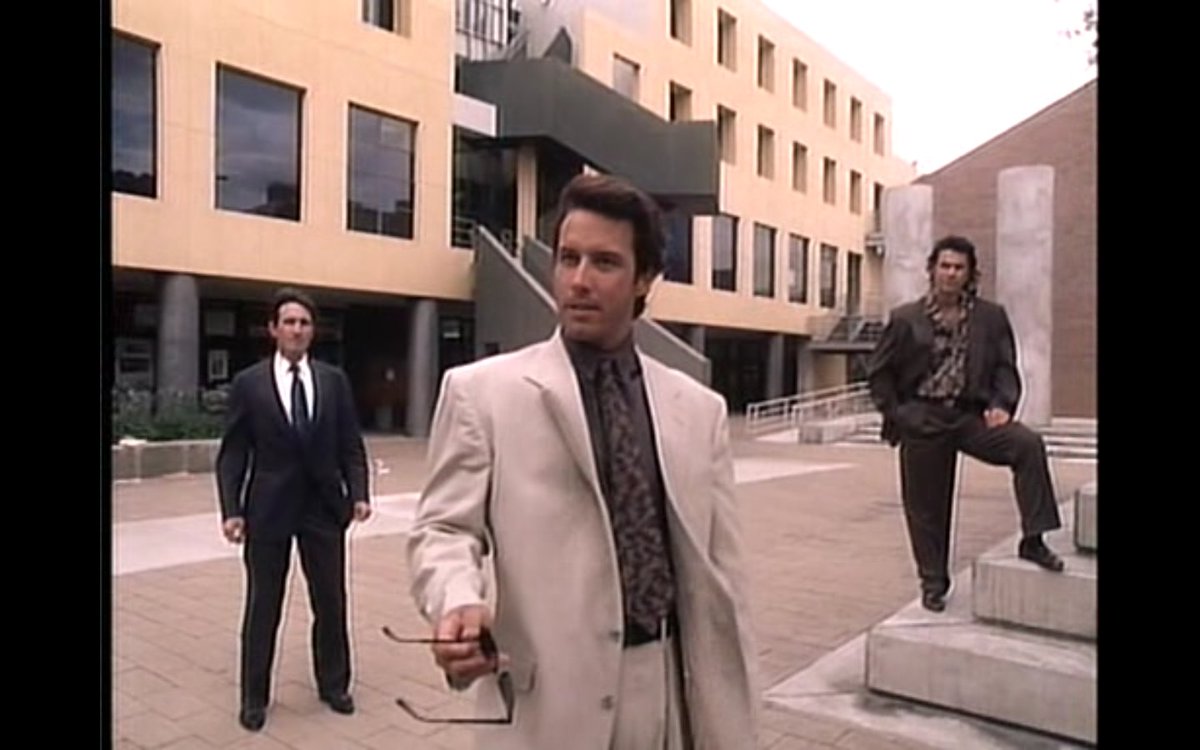
Betty Parrish (Winger) has a brief but intense relationship with Mike Chuhutsky (Mark Keyloun), a tennis instructor. Six months later, she runs into him and he admits to being in trouble as he has started dealing drugs to pay the rent. She talks to him again on the phone three months later. They cross paths a couple more times with him wanting to hook up again but each time flakes out. There is something about him that she can’t stop thinking about to the point that she zones out in the middle of conversations with family and friends. Once she learns of his death – from a drug deal gone bad – she speaks to some of his friends and associates to find out what happened and to learn more about him. In the process, she comes to terms with the conflicted feelings she has for Mike.
 

Bridges expertly juxtaposes the mundanity of Betty’s life – she works as a bank teller who takes tennis lessons on the weekend – with the increasingly dangerous life of Mike who rips off high-end drug dealers thereby putting himself in peril. The film starts off with a brief montage of Betty and Mike as we see them laugh and flirt while playing tennis and then cut to them making love in tender slow motion in the shadows that is very film noir-esque. After the opening credits, the tone of the film shifts as we see the Mike narrowly escape retribution for intruding on an established dealer’s turf.
 
The first enigmatic nine minutes of Mike’s Murder show us a lot without telling us much and in doing so pose all kinds of questions. Who are these two people that seem in love and why is one of them in so much trouble? The first question is answered rather quickly while the second question is gradually answered over the course of the film. The questions of why he was killed and who did it aren’t really what makes this film so interesting. It is Betty’s reaction and how she deals with it over time as she tries to figure out what Mike meant to her.
 
Debra Winger is a fascinating actor to watch and director Bridges must’ve thought so, too, building this entire film around her, spending many scenes focused on her character, like when Mike calls Betty up after disappearing for three months. While they are chatting, we see the entire conversation from her side as the camera observes her looking at herself in a mirror. It is an unguarded moment as she is by herself with Mike’s disembodied voice in her ear.
 

Winger delivers a powerful, yet understated, lived-in performance doing an excellent job playing a normal person – not a movie star or a larger-than-life character, but a regular person just getting by like most of us are, day by day. Betty doesn’t have much going on in her life: she has her job and occasionally goes out with one of her co-workers. The actor does an excellent job of conveying a range of emotions with only her face as we see Betty deal with Mike’s death in stages. We see these feelings play across her eyes and it is fascinating to watch. This is particularly evident in the scene where Betty goes to Mike’s apartment to see where he was murdered and the horror that plays over her face is palpable. Part of her didn’t want to know the grisly details but another part of her had to know to get closure. Betty manages to keep it together for most of the day until she gets home and finally breaks down, letting all those pent-up emotions out.
 
Admittedly, Mike’s drug dealing escapades is standard fare seen in countless other movies of its ilk but Bridges handles it well by using very little dialogue in the scene where Mike and his partner-in-crime Pete (Darrell Larson) decide to rip off a high-end dealer, creating an intense scene. Darrell Larson does a fantastic job showing how his character gradually unravels with paranoia thanks to the cocaine he regularly takes and constantly evading the drug dealers he helped rip off. His storyline dovetails with Betty’s in an intense scene where he shows up at her house at night trying to explain himself. Larson delivers his dialogue in an emotional monologue that is insistent and pathetic simultaneously, delivered with sweaty desperation. This frightening encounter gives Betty a taste of Mike’s secret life and the dangerous people that inhabited it.
 
Of the people Betty crosses paths with during her informal investigation, the most notable is Philip Green (Paul Winfield), a record producer who Mike did work for at his home. He’s stand off-ish, at first, only to be somewhat anguished when talking about Mike’s death and then reflective about how they met. It is a wonderfully layered performance by Paul Winfield who makes the most out of his brief screen time.


As the saying goes, truth is stranger than fiction and this certainly applies to the inspiration behind Mike’s Murder. Bridges and producer Jack Larson knew actor Paul Winfield as he had appeared in plays that both men had done. Through the actor they got to know a friend of his by the name of Mark Bernalack. The character of Mike was based heavily on Mark – both stayed with Winfield, were tennis pros, and ran afoul of local drug dealers resulting in their deaths. Larson said, “Jim was very haunted by it. It was because of how Mark was called a drug dealer in the newspapers. That was very sad to him. The papers portrayed Mark’s murder as if it was a good thing because he was a drug dealer.” It was a personal story for Bridges who had known people killed for dealing drugs in L.A. and it profoundly affected him. With this film he wanted to avoid the usual suspense thriller cliches and portray the city as “a disjointed society by using close-ups to imitate the view from a car.”
 
In early 1982, Bridges originally went to The Ladd Company to pitch another project – Jane Goodall in Africa – and while there he told Alan Ladd, Jr. about his idea for Mike’s Murder. The executive liked it and the title, agreeing to finance the project with a $5 million budget.
 
He wrote the film for Winger and insisted she do it. She remembers, “I had made one of my first left turns out of show business. He wrote this specifically for me to bring me back in and show me how this new ‘independent’ approach was the wave of the future.” She had moved to Cleveland and was in the process of giving up acting. Bridges recognized that it was a challenging role: “It wasn’t filled with a lot of things for an actress to grab on to. I needed someone who had that rare relationship with a camera that allows an audience to see her think.”


When it came to casting, Bridges and Larson had trouble finding the right actor to play Mike. They considered Kevin Costner but he was deemed “too old.” Larson’s agent told him about Mark Keyloun. He had done some television and theater work, but when they saw him in a film by long-time friend Paul Morrissey entitled, Forty Deuce (1982), and, after making sure he had chemistry with Winger, he was cast. To keep the costs down and preserve the production’s independence, the cast and crew took a 30% reduction in salary.
 
The Ladd Company liked the film but Warner Brothers not so much. They wanted another Urban Cowboy. The first test previews in Larkspur and Walnut Creek, California in February 1983 were disastrous as Larson remembers, “One guy in the audience stood up in the middle of the film and screamed, ‘This is the worst fucking movie I’ve ever seen!’ It was a wild and chaotic preview. People were very upset by the film, and it is an upsetting film.” Bridges recut the phone sex scene between Betty and Mike that originally showed the latter masturbating while talking to the former. Not surprisingly, this made test audiences uncomfortable and they reacted negatively to it.
 
According to Larson, Bridges re-edited “the ghastly murder sequence of Mike in the film and how Debra imagines that she sees them together in his apartment after he’s been murdered. Originally, Debra imagined them nude together in his apartment.” The film was restructured from the original version that was subjective in nature, focused on Betty’s point-of-view, to a more objective, chronological story. In addition, Bridges was allowed to film more scenes with Pete who was originally a “peripheral” character. In restructuring the film, Bridges removed singer-songwriter Joe Jackson’s score and replaced it with a more traditional one by John Barry. Some of Jackson’s songs are still in the film. The second preview in Seattle was much more successful with a stronger audience reaction.
 
Mike’s Murder had a brief theatrical run in March 1984 due to The Ladd Company and Warner Bros ending their partnership in April. What film critics that did see the film were mixed about it. Variety wrote, "As usual, Winger is wonderful to watch at all times, but her character is something of a cipher, and lack of any psychological angle holds down the film’s ultimate achievement." The New York Times’ Vincent Canby wrote, "Mr. Bridges, who gave Miss Winger her big break in Urban Cowboy, leaves her high and dry in this one. Though she receives top billing, she has no role to play." In his review, Roger Ebert wrote, "Winger’s magnificently responsive performance creating a character who’s ecstatic when reminded of her onetime lover, then melancholy and obsessed after his death." Finally, Pauline Kael praised Winger’s performance: “It’s a performance that suggests what Antonioni seemed to be trying to get from Jeanne Moreau in La Notte, only it really works with Winger—maybe because there’s nothing sullen or closed about her. We feel the play of the girl’s intelligence, and her openness and curiosity are part of her earthiness, her sanity.”


Mike’s Murder is part murder mystery and part character study with the latter being stronger and more interesting than the former. Bridges juxtaposes noir tropes with a thoughtful meditation on what it means to know someone and the brief time they are in our lives. While he was alive Mike’s allure had an initially strong gravitational pull on Betty, but over time his inconsistent, unreliable behavior took the bloom off their brief but intense romance. She didn’t realize how much he affected her until she started examining his life and in doing so examined her own. Like Mike’s untimely demise, fans of this film will always wonder what could have been with Bridges’ original version of the film. Can we let it go or be forever haunted by its brief existence?
 
 
SOURCES
 
BAM, April 20, 1984.
 
Bozung, Justin. “Producer Jack Larson on 1984 Warner Brothers’ Maudit, Mike’s Murder.” TV Store Online. February 23, 2021.
 
Farber, Stephen. “Where’s There’s Smoke, There’s a Fiery Actress Named Debra Winger.” The New York Times. July 6, 1986.
 
The Hollywood Reporter. May 4, 1982.
 
Kael, Pauline. Hooked. E.P. Dutton. 1989.
 
Tonguette, Peter. The Films of James Bridges. McFarland Press. 2011.

Friday, December 29, 2023

Bullitt


In the late 1960s, Hollywood was undergoing a significant change. The studios had lost touch with what moviegoing audiences wanted to see. By 1969 and the release of Easy Rider and its subsequent success signaled a seismic shift in cinema, making way for a myriad of unusual films that were pushed through the system throughout the following decade. Actor Steve McQueen was at the height of his powers during the transition period with a toe in each era. He had risen to prominence during the ‘60s with such films as The Magnificent Seven (1960) and The Great Escape (1963), which transformed him into a bonafide movie star but, at heart, he was a Method actor serious about his craft. He used his newfound clout within Hollywood to produce two films that catapulted him to the next level, The Thomas Crown Affair and Bullitt, both released in 1968.

Bullitt is a perfect example of the aforementioned transitional period that was going on in Hollywood. It is a studio movie, specifically a crime thriller that sees McQueen as a police detective, however, he cut a significant amount of his character’s dialogue to suit his particular style of acting. In addition, he had the production shoot on location in San Francisco (uncommon at the time) and adhere to strict authenticity when it came to police procedural details. One of the most important aspects of this shoot was the show-stopping car chase scene that eschewed traditional Hollywood techniques in favor of cars at actual high speeds on actual city streets. This not only added to the film’s realism - it gave the sequence a visceral thrill that hadn’t been done before.

The opening credits employ a fisheye lens, mixing black and white with color as Lalo Schifrin’s cool, jazzy score sets a stylish vibe. Initially we have no idea what is going on; the action that occurs during this sequence is without dialogue. Who is chasing whom and why? Even when dialogue is finally spoken, just before director Peter Yates’ credit, it is unclear exactly what happened.

Lt. Frank Bullitt (McQueen) is tasked by Senator Walter Chalmers (Robert Vaughn) with protecting the star witness – Albert "Johnny Ross" Renick (Felice Orlandi) – in a big trial against the Mob, known here simply as The Organization. He has to keep him safe for 40 hours. What seems like a routine assignment turns out to be much more complicated: the witness and the police detective guarding him are critically injured by two hitmen in a situation that reeks of a set-up. Why would the witness let these two men into the apartment? Frank’s boss (Simon Oakland) tells him to investigate further and do it by the book… but, of course, a maverick cop like Frank goes his own way, authority figures be damned. As he puts it, “You work your side of the street, and I’ll work mine.” It is a beautifully succinct line that sums up Frank’s ethos as a cop.
 
What is so fascinating about McQueen’s performance is his choice to emphasize facial expression and body language (or the lack thereof) over dialogue. When a fellow cop is injured in the line of duty, he says little to the man, except to ask the identity of the person who shot him. The rest of the scene shows Frank reacting to what happened, the grave concern that plays across his face. No trite words of comfort are needed – the expression on McQueen’s face says it all.
 
This technique is used again when Frank revisits the crime scene where Ross and the cop were shot. No dialogue, just him looking over the scene and thinking about what happened, trying to piece things together. Typically, a scene like that would have a voiceover or Frank would be talking to himself or someone there explaining what he’s doing. Instead, the filmmakers assume the audience is smart enough to figure it out.

This being McQueen, Frank is a hip guy. He dresses stylishly and takes his beautiful girlfriend (Jacqueline Bisset) to a snazzy jazz club for lunch. Even his introduction is as low-key as the man himself: his partner (Don Gordon) wakes him up after a long night (he went to bed at 5 a.m.). Frank isn’t much for small talk and that’s all we know about him; their relationship is all business. They aren’t friends that crack jokes together or are at odds with each other like buddy cop movies of later decades. It is an underwhelming introduction that gives no indication of what kind of cop Frank is – we find out over the course of the film. This is quite unusual for a mainstream studio film at the time, which traditionally spelled everything out – this is not the case as Bullitt adopts its leading man’s less-is-more aesthetic, extending to its very economic use of dialogue. When Frank goes to dinner with a group of friends, his girl by his side, we see them all talking but don’t hear their conversation as the jazz music drowns out their voices. What they’re saying isn’t important, only that we see what Frank does in his off-hours.
 
For the most part, Jacqueline Bisset is saddled with the thankless token girlfriend role. Late in the film, however, she gets a moment to showcase her acting chops when her character confronts Frank about his job, after seeing a crime scene where a woman was brutally strangled. She tells him, “Do you let anything reach you – I mean really reach you – or are you so used to it by now that nothing really touches you?” She continues, “How can you be part of it without becoming more and more callous?” referring to the violence and ugliness of his job. He has no answer for her. She cannot reconcile the vast difference between her world and his, asking, “What will happen to us in time?” to which he replies, “Time starts now.” If up until now he’s kept her at arm’s length about the harsh realities of his job, perhaps now that she has gotten a glimpse of it, she understands why he doesn’t share the ugly details with her. Bisset does a fantastic job in this scene and one wishes she was given more to do in the film.
 
Yates shows off the hilly streets of San Francisco beautifully. You get a real sense of place and the city becomes another character unto itself. We see the neighborhood convenience store where Frank gets his groceries and the grubby, hole-in-the-wall hotel room in which the witness is hidden away. Throughout Bullitt, the director demonstrates his considerable skill at visual storytelling. A key example of this takes place at the hospital, when Frank shows up to check on the condition of the witness with Dr. Willard (Georg Stanford Brown). In the foreground of the shot Frank is eating while Willard is nearby. In the background we see and hear Chalmers tell a nurse that he wants Willard replaced as Ross’ doctor because, “He’s too young and inexperienced,” and he would prefer his own surgeon to take care of the man.

Frank and Willard exchange a look that indicates they know the real reason: he’s black. It’s not spelled out and nothing is said between the two men but they know and we know it, too. It also reveals Chalmers’ unsavory side that had not been revealed up to this point. Frank was already unsure of him because he came off as a smug prick, but this clinches it: Chalmers has his own agenda and is not to be trusted.
 
The film rights to Mute Witness by Robert Pike had sold five times with McQueen’s Solar Productions being the last buyer. Initially, he didn’t want to play a cop as he felt it would hurt his counterculture/rebel reputation. Over time, he changed his mind, reasoning that an authentic performance might change people’s opinions of the police. He enlisted Alan Trustman, who wrote the screenplay for The Thomas Crown Affair, to write a treatment for Bullitt. McQueen wasn’t crazy about the complicated plot that the writer created.
 
While that was being worked on, he and producer Robert Relyea saw Robbery (1967), a heist film directed by Peter Yates, which contained a car chase sequence that impressed both men. Relyea said, “Yates had a car chase in that movie that involved cars moving along very fast, then cutting to these children at a crosswalk. It made you so nervous you couldn’t see straight.” The director was sent the script for Bullitt and thought it was “awful.” He was asked to re-read it and replied, “I’m not coming to America to make that kind of film!” He was eventually coaxed to fly to Los Angeles to tell McQueen and Relyea what he thought of the script and within hours signed on to direct the film.

While the script was being rewritten, McQueen was hands on with the casting, handpicking Robert Vaughn, Simon Oakland and others. Vaughn actually turned down the project three times and agreed to do it only after talking to McQueen, his agent and then Yates. For his partner in the film, McQueen cast long-time friend Don Gordon, whom he had known since the late 1950s when they were working in television. It was his first film role and gave his career a boost.
 
For the role of Frank’s girlfriend, McQueen cast Jacqueline Bisset because he was attracted to her, claiming that she was the most beautiful co-star he worked with up to that point in his career. He made excuses to his wife to keep her away from the shoot while he conducted an affair with Bisset during filming. He also thought she was an excellent co-star: “She catches good. She can throw it back to you with a great depth for a girl of that age.”
 
Yates thought it would be good for McQueen and Gordon if they researched their roles. They went on ride-alongs with San Francisco police officers. Yates said, “Steve and Don Gordon really had down their procedures. I thought it would be more exciting, and it was.” The two cops assigned to McQueen hazed him a bit to see if he was just another poseur actor and took him to a morgue. He was up to the challenge, showing up with an apple, eating it while being shown cadavers. Gordon, meanwhile, was taken out on a real drug bust and given a police I.D. card and carried a badge and a prop gun. He was even recognized by a suspect on a bust.

Up to this point, McQueen had a good relationship with the studio and its head, Jack Warner, who quickly agreed to make Bullitt and was hands off, trusting the actor. As production ramped up, Warner sold his stock and retired. Kenneth Hyman and Seven Arts took over and told McQueen that they wanted to be more hands-on. Relyea said, “We came in with one understanding and then found ourselves in another, it led to misunderstandings on both sides.” The studio told McQueen that his six-picture deal was now going to be a one and done deal.
 
Filming began in February 1968 and finished in May of the same year. The pressure of the new studio regime and his reduced deal weighed heavily on McQueen. He didn’t display the good humor he had on other sets as the pressure of carrying the film affected his day-to-day mood – but it did not deter him from fighting for what he wanted. The studio wanted Bullitt shot on the lot but McQueen pushed to have it shot entirely on location. Yates said, “My biggest concern was that if we were to make a picture totally on the lot, that it would look like a television series.” San Francisco’s mayor Joseph L. Alioto was very accommodating and the studio backed down. As a result, Bullitt was the first film to be shot on location with an all-Hollywood crew, a major feat unto itself.
 
Yates encouraged the actors to ad-lib and was not afraid to change a scene if it wasn’t working. For example, in the scene where Frank meets his girlfriend for dinner, McQueen didn’t feel comfortable with the dialogue as written. Yates told him and Bisset to act as if they were having a real dinner and filmed them from the outside.

During filming, the studio rode McQueen hard about the budget. Whenever a studio executive would show up on location, the actor would kick them off. The studio claimed that the production was going over budget while in actuality there was no real projected budget! In the end, the studio claimed that the budget went from four million dollars to six million when it actually only cost five million.
 
Some of the stunts that were performed during the production were quite dangerous and they didn’t always involve cars. In the scene where Frank pursues Johnny Ross on the airport runway and goes under a Boeing 707 passenger jet, the stunt involved 240-degree heat blasts from the engine with unpredictable cross winds. Stuntman Loren James talked to the FAA and pilots and was told that it couldn’t be done. Eventually, he found a pilot that was willing to do it and the stunt was done in one take. James was paid $5000 for the death-defying stunt.
 
The film’s famous car chase sequence was saved for the last two weeks of filming with the studio threatening to deny it if the production went over budget. Screenwriter Alan Trustman claims that the car chase was in the script but Yates has said that it was producer Phil D’Antoni that pushed for it. Yates had just done one in a previous film and didn’t want to do it. McQueen was prepping for the car racing drama Le Mans (1971) and didn’t want to do it either. Stunt driver Carey Lofton was brought in to coordinate the chase. He had known McQueen since the late ‘50s and they had a good relationship. The actor wanted to make the best car chase depicted on film and Lofton told him, “I knew a lot about camera angles and speeds to make it look fast. You can underground the camera so you can control everything in the scene.” Lofton told McQueen it would be expensive to do. The actor replied, “Money is no object here.”

McQueen wanted to do his own driving and Lofton spent four days trying to convince him otherwise. It wasn’t until he crashed into another car three times that Lofton asked McQueen’s friend Bud Elkins to double for him. Elkins said of his friend, “He took the corners too fast and he overshot them and crashed into cars.” The climactic explosion at a gas station was, not surprisingly, the most expensive aspect of filming and could be done only once. It was shot on the last day of filming. Even though the car overshot the gas pumps, clever editing covered this mistake.
 
The final showdown where Frank chases his suspect on a busy airport runway and beyond is more than a little reminiscent of the climactic showdown between Robert De Niro and Al Pacino in Michael Mann’s Heat (1995). This, coupled with the all-business Bullitt and the attention to procedural details, influenced filmmakers such as Walter Hill and the aforementioned Mann; both are fascinated by the machinations between cops and crooks.
 
Bullitt had its premiere on October 17, 1968 at Radio City Music Hall. Roger Ebert gave it four out of four stars and wrote, “The beautiful thing is that Yates and his writers keen everything straight. There's nothing worse than a complicated plot that loses track of itself.” In her review for The New York Times, Renata Adler wrote that it was a “terrific movie, just right for Steve McQueen: Fast, well acted, written the way people talk.” The Hollywood Reporter wrote, “Apart from specific business assigned, McQueen is able to convey the same depths of complexity in close-up reactions throughout the film’s action, which stresses brutal action no less efficiently than the political intimidation, and opportunistic legal maneuvers which are the cool menace of Vaughn’s tactics.” In his review for Artforum, Manny Farber wrote, “in a long, near-silent and very good stretch in U.C. Hospital, which is almost excessive in the way it sticks like plaster to the mundaneness of the place, the movie hits into about seventeen verities: faces looking out as though across the great divide of 20th-century lousiness.”
 
After watching this film, audiences questioned: what was the point? Was Chalmers in league with The Organization or merely an arrogant and inept politician? Robert Vaughn keeps his cards close to his vest, never giving us a clear indication of his character’s true motivations. He maintains a slick, impenetrable façade that the actor does a great job of maintaining throughout the film. Bullitt simply ends with Frank returning home, his girlfriend asleep in his bed. He washes his face and looks in the mirror, a grim expression looking back. One wonders if this befuddled audiences at the time. It certainly isn’t the happy ending most expected with this kind of a film and again, it is further proof of the winds of change going on in Hollywood where McQueen could push a film like this through the system. It isn’t as radical as something like Robert Altman’s The Long Goodbye (1973), but it is groping towards that kind of reinvention.
 
 
SOURCES
 
Terrill, Marshall. Steve McQueen: Portrait of An American Rebel. Plexus. 1993.

Friday, September 15, 2023

L.A. Takedown


It says something about the kind of juice Michael Mann had within the industry in 1989 that he was able to create – and get on television – a rough draft for a film he would make six years later. He wrote an early draft of what would become Heat in 1979 that was 180 pages and based on real people he knew both personally and by reputation in Chicago. Ten years later, he cut the screenplay down to 110 pages and raised the financing himself so that he owned the rights to the material. The result was a made-for-television movie entitled L.A. Takedown, a cat-and-mouse story between a career criminal and a dedicated police detective that aired on NBC on August 27, 1989 at 9 p.m.
 
The origins for the project were based in large part from the experiences of a police officer and an old friend of Mann's, Chuck Adamson, who had been chasing down a high-line thief named Neil McCauley in Chicago in 1963. Mann wrote another draft after making Thief (1981) with no intention of directing it himself. In the late 1980s, he tried to produce the film several times and offered it to his friend and fellow filmmaker Walter Hill but he turned it down. Mann was still not satisfied with the script, which had developed the character of McCauley but who still needed work. It also lacked an ending.
 
Early on, L.A. Takedown follows the plot to Heat beat-for-beat with Scott Plank playing Los Angeles Robbery-Homicide division cop Vincent Hanna and Alex McArthur as Patrick McLaren (Neil McCauley in Heat), the veteran thief. It is fascinating to see the different choices that Mann makes, such as the tweaks in dialogue or in the casting of certain characters. For example, Xander Berkley, a fantastic actor in his own right, is cast as Waingro, the loose cannon McLaren hires to help his crew knock over an armored truck. The actor plays him initially as a jittery psychopath, only to later settle on a drugged-out look, whereas in Heat, Kevin Gage brings a scary, simmering intensity to the role – a stone-cold serial killer and agent of chaos.

The most interesting casting in the movie is Hanna’s team, which includes Richard Chaves (Predator), Michael Rooker (Henry: Portrait of a Serial Killer), and Daniel Baldwin (John Carpenter’s Vampires). Unfortunately, they hardly get any screen time and therefore make little impact. Plank is okay as Hanna but lacks the confident swagger that Al Pacino brought to the role. That being said, he does have a nice moment with his estranged wife, Lillian (Ely Pouget), near the end, after McLaren is killed, where he admits that he loves her but isn’t going to change.
 
L.A. Takedown suffers most in the casting of McLaren and his crew. McArthur, eerily chilling in William Friedkin’s Rampage (1987) as a sadistic serial killer, lacks the gravitas of Robert De Niro. The same can be said for the barely seen Peter Dobson (The Frighteners) as Chris Sheherlis who comes off as a glorified extra in this incarnation, whereas the role was expanded significantly in Heat with Val Kilmer taking over the character. Vincent Guastaferro (NYPD Blue) plays Michael Cerrito and lacks the intensity that Tom Sizemore brought to the part. They are simply not convincing as a team of elite thieves but then, they aren’t given the screen-time.
 
The scene where Hanna and McLaren meet face-to-face is fine but it makes one realize just how much De Niro and Pacino brought to the table – nuance and subtlety –that is lacking from McArthur and Plank. There is stiffness to the line readings from both actors as they fail to bring Mann’s words to life, summing up what’s going on in this movie. The inflexible actors are cast in the lead roles and the actors you’d like to see cut loose, like Rooker, are wasted in nothing roles. The famous bank robbery shoot-out is still exciting to watch and one of the few times L.A. Takedown comes thrillingly to life. It lacks the visceral immediacy of Heat but does have some cool shots, such a McLaren and Sheherlis running back into the bank after Hanna and his team show-up, with them chasing the camera in a slick tracking shot.

There are some enjoyable bits of business, such as a montage of Hanna working the streets of L.A., asking around about McLaren and his crew. Mann gives us a brief slice of the city’s night life via quick, broad strokes. Perhaps what is most striking about L.A. Takedown is how it doesn’t feel or look like a Mann production. While Ron Garcia’s (Twin Peaks) cinematography is just fine, it lacks the widescreen mastery of Dante Spinotti’s work in Heat. The T.V. movie’s 1.33:1 aspect ratio certainly doesn’t do it any favors, giving it a boxed-in feel as opposed to Heat’s 2.39:1 aspect ratio, which opens everything up and gives the film more of an epic feel. The lack of Mann’s distinctive touch may also be due to the incredibly fast shoot – uncharacteristic for the methodical filmmaker – with only ten days of pre-production and 19 days of shooting. In comparison, Heat had a six-month pre-production period and a 107-day shooting schedule.
 
At the end of the day, L.A. Takedown is a fascinating curio, nothing more – a stripped down, rough draft. Gone is Shiherlis’ subplot, so is the bungled precious metals sting, the subplot involving Hanna's stepdaughter, and McLaren dies differently and less satisfyingly. Due to the short running time, everything feels condensed while Heat’s expanded running time allows the story to breathe and provide nuanced characterization, thereby shedding more light on the motivations for the characters’ actions. Heat shows how more time, millions of dollars and a talented, star-studded cast can make a difference. Afterwards, Mann had a much clearer idea of how he wanted Heat to be structured. More importantly, he also figured out the ending. In 1994, Mann showed producer Art Linson another draft of Heat over lunch and told him that he was thinking of updating it. The producer read it, loved it, and agreed to make the film, giving ‘90s cinema what would prove to be a timeless heist classic.


Friday, May 12, 2023

Miami Blues

 
"The Sunshine State is a paradise of scandals teeming with drifters, deadbeats, and misfits drawn here by some dark primordial calling like demented trout.” – Carl Hiaasen

 
Author Charles Willeford has been called “the progenitor of modern South Florida crime novel” with his last four novels chronicling Miami’s shift from vacation paradise destination for retirees to “the nation’s capital of glamor, drugs, and weird crime,” inspiring writers such as Carl Hiaasen and James W. Hall, and filmmakers like Quentin Tarantino. It was his 1984 novel Miami Blues that started it all, featuring the first appearance of grizzled police detective Hoke Moseley who would go on to appear in three subsequent novels. Their commercial success eventually roused interest in Hollywood and Miami Blues was adapted in 1990, part of a fantastic crop of neo-noirs that also included The Grifters, The Hot Spot, and After Dark, My Sweet. A passion project for both its writer/director George Armitage and producer/star Fred Ward, it sadly did not do well at the box office, was coolly received by critics, and has become largely forgotten, despite its profane dialogue and sudden, often violence that anticipated the films of Tarantino two years later.
 
Frederick J. Frenger Jr. a.k.a. Junior (Baldwin) is an ex-convict flying into Miami from California, armed with someone else’s driver’s license, and ready to wage a one-man crime spree on the city. He gets off to a roaring start right out of the gate – literally, when he tries to steal another passenger’s luggage but misses the opportunity. Undaunted, seconds later, he bribes a small child and makes off with another piece of unattended luggage and for an encore, breaks the finger of a Hari-Krishna follower who subsequently dies from shock.

We meet homicide detective Hoke Moseley (Ward) negotiating money with a blind informant, which is the kind of colorful introduction that tells us a lot about his character. He and his partner (Charles Napier) investigate the Krishna murder and the scene illustrates the short-hand between these two men who have obviously been partners for a long time, while showcasing the film’s black humor: “Your turn to notify next of kin,” Hoke says to his partner who replies, “No way! I did the fat lady that sat on a kid. That’s good for two.” It’s great fun to see these two veteran actors share a scene together, lobbing dialogue back and forth. One almost wishes a prequel had been done about these two characters.
 
Junior checks into a hotel and quickly arranges for a hooker and meets Susie (Jennifer Jason Leigh). He doesn’t want to have sex, but instead sells her clothes out of his stolen luggage. He takes an immediate shine to her. He hasn’t been with a woman in a long time – and initially it looks like he’s going to be rough with her – but instead is very tender.
 
Miami Blues is a battle of wills, fused with a cat-and-mouse game, as Hoke pursues Junior. He questions him early on at Susie’s over a dinner in a fantastic scene that’s crackling with subtle tension simmering under the surface, as the cop knows the crook is lying about the dead Hari Krishna, but puts on airs for Susie’s benefit. It is a wonderfully acted and staged scene as she is oblivious to what is going on while Hoke and Junior sniff each other out.

Junior is a career criminal who sees the world as a playground. If he wants something he takes it. Someone gets in his way he removes them. He is all about taking short cuts. The first third of the film mostly focuses on Junior’s exploits as we see him spotting a two-man pickpocket team and follows the guy with the loot into a public bathroom, beats him up, and takes the money. He’s a ballsy crook, buying a realistic looking water gun and then robbing a bunch of guys on the street. Baldwin looks like he’s having a blast playing Junior as a legend in his own mind as he sits in his hotel room at one point with a bunch of money, pretending he’s Al Pacino in Scarface (1983). He is excellent as a clever crook whose fault is that he never plans his crimes ahead of time. He’s spontaneous and this works for awhile but eventually catches up to him.
 
Jennifer Jason Leigh plays Susie as a naïve innocent who falls in love with Junior but is blind to his true nature. The actor conveys an earnest vulnerability. Susie sees Junior as a way to a better life – the house, the white picket fence, kids, and so on. Juniors taps into this when he tells her, “Let’s go straight to the ‘happily ever after’ part, okay?” She is the one ray of hope and optimism in his otherwise cynical world.
 
Ward’s Hoke is a broken-down detective on the outskirts of retirement but he’s smart and a student of human behavior, sussing Junior right away, correctly figuring out he’s an ex-con by the way he protects his food while eating dinner. He’s also pissed that Junior is running around with his badge impersonating him and makes it his mission to take the guy down. It’s a fantastic role that showcases Ward’s considerable talents and rare opportunity to headline a film. It’s a shame that Miami Blues wasn’t a bigger hit as it would’ve been great to see him reprise the role again in another adaptation.

Associate producer William Horberg gave Miami Blues to Fred Ward soon after it was published. After reading it, he thought it would make for a great film. “It has a certain irony about it, a certain dark comedy that I like. It’s a little absurd. There’s a random violence in it that I thought was very real,” Ward said in an interview. He optioned the book rights for a two-year deal with $4,000 that the actor paid out of his own picket. He brought it to friend and filmmaker Jonathan Demme, with whom he had worked with on Swing Shift (1984), in the hopes that he’d direct. Demme, just having shot Married to the Mob in Miami (1988), demurred but suggest another friend of Ward’s – George Armitage – to direct instead. Demme knew Armitage from when they were starting out, making films for Roger Corman. He read the book and loved it, going on to write a spec screenplay and agreed to helm it with Demme producing along with Gary Goetzman. Ward had pitched the project to Orion Pictures on two occasions and was turned down both times until he showed them Armitage’s script. They agreed but only if a young actor was cast in one of the lead roles.
 
Originally, Ward wanted to play Junior with Gene Hackman playing Hoke. The two men met and Hackman was interested but when Alec Baldwin came in to read for the part of Junior, he was so good they cast him in the role, and Ward decided to play Hoke. Early on, Leigh Taylor-Young (Jagged Edge) was originally cast as Susie but dropped out for unknown reasons. Jennifer Jason Leigh was later cast in the role and to prepare, she cut her hair short and isolated herself from the rest of the crew to replicate the loneliness of her character. She also went to Okeechobee, Florida, attended her first football game, and hung out with local high school girls to learn the dialect, their attitudes and aspirations.
 
Miami Blues received mixed reviews from critics. Roger Ebert gave it two out of four stars and wrote, “The movie wants to be an off-center comedy, a lopsided cops-and-robbers movie where everybody has a few screws loose. But so much love is devoted to creating the wacko loonies in the cast that we're left with a set of personality profiles, not characters.” In her review for The New York Times, Janet Maslin wrote, “Miami Blues is best appreciated for the performances of its stars and for the kinds of funny, scene-stealing peripheral touches that keep it lively even when it's less than fully convincing.” The Washington Post’s Rita Kempley wrote, “Armitage, a Demme pal, has been struggling to escape B-moviedom for the past decade. But Miami Blues, panicky and sleek as a fire engine, is more than a snappy comeback. It's a centered lament, a screwball thriller about making ends meet, about how even an armed robber can't afford the American Dream.”

In his review for Entertainment Weekly, Owen Gleiberman wrote, “By the time Miami Blues winds into its crushingly bloody, absurdist finale, the only question of any urgency is, Which actor has become harder to watch: Baldwin with his histrionics or Fred Ward flashing those naked gums?” The Los Angeles Times’ Peter Rainer wrote, “This is the problem with the action-filmmaker’s anything-for-a-jolt ethos: Whatever doesn’t jump-start the story is skimped. In fact, in Miami Blues, the story is all jump-starts. I realize that this may be all that most people require from a glorified programmer like Miami Blues, but the film has so much finesse, and its best moments are so freakishly dippy, that you regret the devaluation.”
 
Miami Blues presents a heightened reality of a city where danger lurks behind every corner, where a veteran police detective is assaulted in his own home, and where an opportunistic crook can wage a one-man crime wave posing as a cop. As Hiassen has said, the film presents “a paradise of scandals teeming with drifters, deadbeats, and misfits drawn here by some dark primordial calling like demented trout.”
 
 
SOURCES
 
Fisher, Marshal Jon. “The Unlikely Father of Miami Crime Fiction.” The Atlantic. May 2000.
 
Leung, Rebecca. “Florida: ‘A Paradise of Scandals’.” 60 Minutes. April 17, 2005.
 
Mitchell, Sean. “Exploring the Dark Side.” Los Angeles Times. April 15, 1990.

Pinkerton, Nick. “Interview: George Armitage.” Film Comment. April 28, 2015.

Van Gelder, Lawrence. “Miami Splice.” The New York Times. September 30, 1988.

Van Gelder, Lawrence. “Fred Ward’s Blues.” The New York Times. April 20, 1990.
 
Weinstein. Steve. “The Transformation of Jennifer Jason Leigh.” Los Angeles Times. April 29, 1990.

Monday, January 16, 2023

A Flash of Green


What is the price for one’s soul? Is it ever worth the price, to betray loved ones, those who matter most to you? This is the dilemma that newspaper reporter Jimmy Wing (Ed Harris) wrestles with in A Flash of Green (1984), Victor Nunez’s adaptation of John D. MacDonald’s 1962 novel of the same name. As with all of the filmmaker’s films, this one is, first and foremost, a fascinating character study with a conflicted protagonist at its center.
 
Jimmy is a reporter for a local Florida newspaper in 1961. Developers are trying to buy Grassy Bay, a body of water in the heart of Palm City. Their goal: fill it in so that they can build homes on it, making a lot of money in the process. Some of its residents, however, have formed a committee called Save Our Bay (S.O.B.) to stop it, citing egregious environmental damage if it goes through.
 
Jimmy meets with Elmo Bliss (Richard Jordan), a county commissioner, to get the skinny on the development. He is told that the plan is to create an island, populating it with homes; as he puts it, “We’re going to manufacture a paradise.” Elmo is tired of being a commissioner and is going to run for the governor’s mansion. He plans to use the money he makes from Grassy Bay to fund his campaign. He wants Jimmy to spy on the S.O.B.s and dig up dirt on them … for a price, of course. He lays it all out for the reporter when he tells him, “World needs folks like me. Folks with a raw need for power. Without us, wouldn’t anything ever get done.”

Initially, Jimmy stays neutral, giving Katherine Hobble (Blair Brown), one of leaders of the eco-group, a heads up and she begins to rally the locals to stop it. He checks in on her and her two children from time to time as her husband - his best friend -- died a year ago. The steady income from Elmo, however, sways Jimmy, who is adrift in life. Adding to the weight of this decision is his wife, Gloria (Tiel Rey), who suffers from a degenerative brain disorder that her doctors understand little about and from which, it appears, she will never recover. The rest of the film plays out his moral dilemma – help Elmo for the money and in doing so betray Kat, the woman he loves but is afraid to admit it, even to himself.
 
Ed Harris delivers a memorable turn as a man faced with a conflict, a crisis of conscience. The deeper Jimmy digs for dirt for Elmo, the more morally compromised he becomes. He passively watches as his friends are railroaded by local politicians. Why is Jimmy willing to do this? Has his wife’s medical condition left him so cynical that he doesn’t care about anything? Kat and her kids humanize him, give him something to care about – a life he’d like to have. Jimmy’s actions are ruining people’s lives … good, decent people he’s known for years. Even those closest to him, like Kat, are being harassed on the phone by religious zealots, surreptitiously employed by Elmo to scare of members of the S.O.B. Harris does an excellent job conveying the guilt that plays across Jimmy’ face when the S.O.B. fall apart, knowing that it is because of his actions.
 
Richard Jordan does an excellent job of expressing Elmo’s passion for the development deal. He’s honest with Jimmy about his ambitions but not about how far he will go to realize them. Jordan is a fascinating actor to watch as he so effortlessly disappears into his character, something he did often in such diverse films as The Friends of Eddie Coyle (1973), The Mean Season (1985), and The Hunt for Red October (1990). In A Flash of Green, Elmo is the obvious villain of the film, but Jordan resists the urge to play him that way, even when he obliquely admits to sending guys to beat-up Jimmy repeatedly in the hopes of ‘persuading’ him to leave town after he turns the tables on Elmo. It is hinted that these two men have known each other for many years, the only reason why Elmo doesn’t have Jimmy killed.

Blair Brown is also very good as a woman still struggling with the loss of her husband, raising two children, trying to protect the bay from greedy developers, and sorting out her feelings for Jimmy. She has a lot on her plate and Brown’s intelligent, layered performance results in a fascinating character. At times, it is painful to watch her and the other committee members struggle against more powerful forces that they have no hope of beating. Brown resists any urge to inflate Kat’s fight to heroic heights, as one would see in a Hollywood movie, and instead opts to have that be only one of many aspects of her rich character.
 
There are also memorable minor roles, such as George Coe as a fellow journalist who doesn’t have the stomach for the darker stories that he and Jimmy sometimes cover. His response is to get so drunk that Jimmy must take him to his wife who cares for him. Even his character has his own arc and finds a way to redeem himself as he does his own part in the unfolding drama.
 
Sam Gowan, who had worked on Victor Nunez’s first film, Gal Young ‘Un (1979), went on to work at the University of Florida Libraries as the assistant director for special resources. Part of his division was the John D. MacDonald repository. MacDonald was a successful crime author, both critically and commercially, with his series of Travis McGee novels, and 1957 novel The Executioners adapted into film twice, in 1962 and 1991. Gowan and his wife enjoyed the man’s novels and she suggested asking Nunez to adapt one of them. Warner Bros., however, owned long-term options on all the Travis McGee novels, save for a couple of the early ones, which were available. He contacted MacDonald’s agent in Los Angeles and worked out a deal that required a small payment up front and a loaded backend, whereby if the film did well financially, the author would be paid more.

The budget for A Flash of Green was $750,000, ten times larger than Gal Young ‘Un. Half of the budget came from a small group of local investors with PBS American Playhouse covering the rest, who had been impressed with Nunez’s first film. To keep costs down, the entire cast worked for Screen Actors Guild minimum.
 
At the time the film was cast, Ed Harris turned down a chance to extend his run on Sam Shepard’s off-Broadway success, A Fool for Love (for which he won an Obie Award), and an offer from Paul Newman to appear in Arthur Miller’s Death of a Salesman, to go to Florida and act in Nunez’s project. Harris said, “I loved Victor’s sensibility and his cinematic tastes, his knowledge and how he films.” The actor was also drawn to the character of Jimmy Wing:
 
“I really appreciated the subtle character study that this guy is. He goes through so many changes. He’s someone who gets caught up in events that sort of catch him and sweep him away and he really has to climb his way back. He was a character I could really explore.”
 
To this end, the actor worked with the filmmaker on the screenplay, and during rehearsals, he frequented local stores for his character’s outfits. Harris’ hands-on approach extended to other cast members. Richard Jordan helped get period-specific props for the film and remarked on the challenge: “That era is too recent for anyone to collect and a lot of what you’d want to use has wound up in garbage cans.”

Critics of the day gave A Flash of Green generally favorable reviews. Roger Ebert gave the film three out of four stars and wrote, "A Flash of Green is attentive to the compromises of daily life, and it understands how people can be complicated enough to hold two opposed ideas at the same time." In his review for The New York Times, Vincent Canby wrote, "A Flash of Green is not perfect, but it is provocative and nearly always intelligent." The Washington Post's Lloyd Grove wrote, "Nunez, who also worked the camera with an eye for faded beauty, has made Palm City a self-contained world where there can be no appeal to a higher authority. While sometimes he's a bit heavy on the symbolism -- having Wing, at one point, fiddle with a two-faced doll -- he usually handles the material with admirable subtlety, letting the story all but tell itself."
 
The worlds in Nunez’s films feel fully fleshed out and realized, populated by readily identifiable people with compelling dilemmas. In the case of A Flash of Green he also creates a real sense of place; the attention to period detail on a budget is fantastic, with vintage cars and clothes used sparingly and matter-of-factly. He achieves it with small details, such as the cluttered office that Jimmy works in or the Spartan wood interior of Elmo’s office. Nunez also has a great ear for dialogue, accurately capturing the way people talk, evident in the scene where Kat debates with her friends about the development of Grassy Bay, with one arguing that developing the land will help the depressed local economy. The film presents several different points-of-view and then shows them in conflict with one another.
 
Nunez does a deft juggling act of showing how parts of Florida are being ruined by greedy developers and the toll it is taking on the residents, without being preachy about it, and by focusing on the relationships between them. A Flash of Green might be the most low-key crusading journalist film ever made. There are no heroic, epic speeches, moustache-twirling villains, car chases or gun battles – just people trying to protect their own little piece of the world. Much like John Sayles, Nunez is interested in telling stories about everyday people trying to get by, finding that their personal dilemmas are just as worthy of telling as any epic tale. For the people in his films, what goes on in their small world means everything to them. Life is about the choices we make and having to live with them. Jimmy has to live with the choices he has made. They were tough decisions that took their toll on him physically and emotionally. Jimmy finds that it isn’t easy buying back even a part of his soul. It is a long, hard journey but by the film’s end, there is hope that he is on his way to redemption.
 

SOURCES
 
Crandell, Ben. “FLIFF Reunites Old Friends Ed Harris, Victor Nunez.” South Florida Sun Sentinel. November 17, 2015.

Fein, Esther B. “Shaking A Hero Image.” The New York Times. July 22, 1985.
 
Gowan, Sam. “My Life in Movies.” The Gainsville Sun. April 1, 2004.
 
Maslin, Janet. “At the Movies – Jordan Assembled Props.” The New York Times. June 28, 1985.