"...the main purpose of criticism...is not to make its readers agree, nice as that is, but to make them, by whatever orthodox or unorthodox method, think." - John Simon

"The great enemy of clear language is insincerity." - George Orwell
Showing posts with label Shelley Duvall. Show all posts

Friday, April 14, 2017

Brewster McCloud

After the critical and commercial success of M*A*S*H (1970), Robert Altman used the buzz garnered from it to push an experimental film called Brewster McCloud (1970) through the studio system. It is ostensibly about a young man constructing a pair of wings so he can fly while also weaving in a storyline about a series of murders involving victims that have been strangled to death. It is, at times, a film about dreamers that also slyly references the films of Federico Fellini, Bullitt (1968) and The Wizard of Oz (1939). The end result is a fiercely idiosyncratic film even by Altman’s standards, which may explain why it is not as widely championed like some of his other work.

Right from the get-go Altman eschews a traditional opening by having a lecturer (Rene Auberjonois) talking over the MGM logo as he addresses the audience about the relationships between birds and man’s desire to fly. Then, the opening credits play over a woman (Margaret Hamilton) singing the “Star Spangled-Banner” off-key in the Houston Astrodome with a marching band. She stops and chastises them for being in the wrong key. She makes them start over and so do the opening credits.

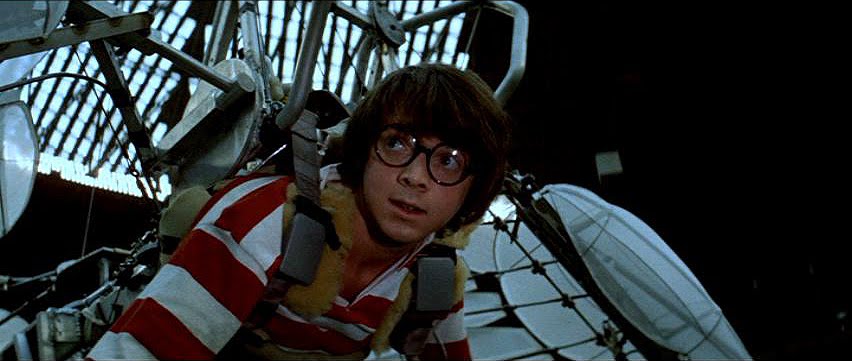
The reclusive Brewster McCloud (Bud Cort) lives under the stadium working on a pair of wings in the hopes that someday he may be able to take flight like a bird. During the day, he drives a cranky, wheelchair-bound old man (Stacy Keach), taking him on errands where he hurls verbal abuse at everyone he encounters. Meanwhile, Houston is plagued by a series of murders with each one of the victims strangled to death. Prominent citizen Haskell Weeks (William Windom) uses his clout to get the local police to bring in “legendary super cop” Frank Shaft (Michael Murphy) from San Francisco to investigate.

Brewster crosses paths and befriends Suzanne (Shelley Duvall), a Superdome tour guide, while trying to steal her car, which she doesn’t seem to concern her all that much. Watching protectively over Brewster is Louise (Sally Kellerman), a beautiful and mysterious guardian angel of sorts that takes care of him.

Having given Bud Cort is feature film debut in M*A*S*H, Altman cast this distinctive actor to play the enigmatic titular character and he makes his way through the film with his own agenda while only briefly interacting with others. Cort’s soft-spoken nature contrasts nicely with Shelley Duvall’s chirpy optimism. They both have unique acting styles and thrived under Altman’s direction. It is a lot of fun to watch their quirky acting styles bounce off each other, like the scene where Suzanne recounts how she acquired her muscle car. Duvall, with her large than life eyelashes, is absolutely adorable, especially when Suzanne good-naturedly tries to seduce Brewster in a sweet scene.

Decked out in a turtleneck sweater, slacks and shoulder holster, Shaft cheekily resembles Steve McQueen’s titular character from Bullitt with a voiceover reporter narrating solemnly, “If keeping your cool and being totally composed makes for a better detective then this Shaft is one whale of a cop.” There’s something amusing about seeing Murphy – normally known for playing square, authoritarian types – playing a cool, no-nonsense cop. It helps that he’s playing a subtle parody of Bullitt but does so with a straight face right down to his all-business attitude as he tells the beat cop (John Schuck) assigned to him, “Now there’s a killer loose in the city, Johnson. Are we gonna get him or are we going to go downtown and play politics?”

In typical Altman fashion, he juggles a large cast of characters and multiple storylines, effortlessly moving them in and out of the foreground without ever losing sight that the film is ultimately about Brewster and his desire to fly like a bird. This is captured beautifully in a sequence that sees him dreaming of flying above the clouds to the soulful song “White Feather Wings” sung by Merry Clayton.

The screenplay, originally entitled, Brewster McCloud’s (Sexy) Flying Machine, had been written by Doran William Cannon (who had written the script for Otto Preminger’s Skidoo) in 1967 and it was, according to its author, “probably the most famous unproduced script in the country.” It had also been optioned several times by Hollywood studios but never filmed because Cannon refused to sell the rights unless he was allowed to also direct.

Music producer Lou Adler wanted to start making movies and optioned Cannon’s script – who must’ve had a change of heart about directing – offering it to Robert Altman after M*A*S*H. The director moved fast, nixing MGM’s desire to shoot in New York, where the script had originally set the story in the TWA Terminal at JFK airport, for Houston, which he found more stimulating. He did, however, hit some roadblocks along the way – firing then-up-and-coming cinematographer Jordan Cronenweth for relative unknown Lamar Boren, and, during filming, being hospitalized with a hernia.

Altman also rewrote the script, revising it heavily without notifying Cannon, making it “very farcical and broad.” According to Adler, the original script was “much more of a sexcapade” with Brewster having sex with each of the three women in the film. Altman changed it so that Brewster only had sex with Shelley Duvall’s character. The role of Frank Shaft was created entirely by Altman for Michael Murphy simply because he was one of the director’s favorite actors. Altman also downplayed the violence so that all of the murders occurred off-screen.

Fresh from making M*A*S*H, Altman cast several actors from that production, including Bud Cort, Rene Auberjonois, and John Schuck. Cort had auditioned for and didn’t get a role in a play in New York and was thinking of doing some episodic television. Altman told him not to because he was a movie star. Cort remembers the filmmaker telling about his role in their next film together: “You’re going to play a mass murderer and it’s going to be a whole reaction to how sick society is right now.” Altman also cast new, raw talent. Assistant director Tommy Thompson and fellow crew member Brian McKay met Shelley Duvall at a party when she tried to sell them her boyfriend’s paintings and told Altman that he had to meet her. He thought she was putting on an act but when he did a screen-test with her, realized that she was an “untrained, truthful person. She was very raw in Brewster but quite magic.” Three days after he cast her, principal photography began.

Filming Brewster McCloud was the typical Altman experience – location shooting away from the studio, watching dailies at the end of the day with cast and crew, and parties with lots of marijuana, hashish, cocaine, and opium. Adler remembers that Altman “would stand up and make a speech, pretty much the same speech every night. ‘No one in this room knows what this movie is about except me.’ Then he would retire to his room and write the next day’s pages.”

In classic Altman fashion, entire scenes were created and improvised on the spot when something struck his fancy or he became fascinated by some of the Astrodome’s architecture. Other scenes were written by Altman at night and then presented to the actors the next day. For example, Shaft’s sudden suicide came up at dinner between the director and Murphy the night before. Cannon even showed up to the set for a visit and was given an icy reception. He was bitter at not having been consulted on the script changes while Altman said it was “a piece of crap.” That being said, Cannon had a clause in his contract that guaranteed sole screenwriting credit despite all the work Altman had done.

Not surprisingly, MGM did not understand Brewster McCloud and the new studio head did not like it or Altman (the feeling was mutual). They gave the film a perfunctory release and yanked it from theaters after it grossed less than $1 million prompting Adler to describe studio executives as “a bunch of bag salesmen who’ve been put in their jobs like a bunch of pawns.” Murphy said of the film: “I think it was kind of a look at the insanity of all that period in time, you know? Guys were really breaking loose and doing their ‘dream films’ and doing nutty stuff.”

To further illustrate how little the studio cared about the film, the premiere at the Astrodome (attended by a whopping 24,000 people) was plagued by technical problems regarding the sound so that, as one critic commented, it was “a bit like viewing a movie in the world’s largest drive-in while locked out of your car.”

Brewster McCloud received mixed to negative reviews although Roger Ebert gave it three-and-a-half out of four stars and wrote, “One of the things about MASH was that people wanted to see it a second time. That’s typical of the recent Robert Altman style, Brewster McCloud is just as densely packed with words and action, and you keep thinking you’re missing things. You probably are. It’s that quality that’s so attractive about these two Altman films.” In his review for The New York Times, Vincent Canby felt that the film attempted, “to be a kind of all-American, slapstick Orpheus Ascending, a timeless myth about innocence and corruption told in the sort of outrageous and vulgar terms that Brian De Palma and Robert Downey do much better.”

Altman twists genre conventions on their head, bending them to conform to his vision and so the strangulation murders are preceded by bird shit dropping on the victim’s face moments before they are killed. The crime scenes are chaos as a veteran police detective (G. Wood) clashes with Shaft and his superiors who all appear to have no idea who is committing these murders. The irony is that despite his reputation for being a skilled cop Shaft is ultimately ineffectual in catching the killer.

Even the climactic car chase – a staple of the thriller genre – is given an Altman twist as Suzanne leads the cops on a wild chase with some wonderful reaction shots of her clearly enjoying the evasive moves she pulls to foil her pursuers with Louise providing well-timed interventions along the way. At one point, Altman even employs easy-listening music during the chase. The filmmaker constantly subverts our expectations at every turn. Brewster isn’t the innocent dreamer he was first made out to be and it brings into question his desire to fly. Was it genuine or an act of hubris?

Brewster McCloud is not an easy film to love. It defies traditional narrative storytelling by irreverent thumbing its nose at the conventions. The protagonist is an enigma that we never get to know or identify with and this is all the way Altman wants it. It’s a film that I admire but don’t watch all that much, which is a matter of personal taste as opposed to one of quality. I prefer the laid-back, easygoing charms of films like The Long Goodbye (1973) and California Split (1974). That’s the beauty of Altman’s films – you can approach them on your own terms and I’m sure he wouldn’t have wanted it any other way.


SOURCES

McGilligan, Patrick. Robert Altman: Jumping Off the Cliff. St. Martin’s Press. 1989.

Reed, Rex. “Houston’s Not-So-Gala Premiere.” Chicago Tribune. December 20, 1970.

Thomson, David. Editor. Altman on Altman. Faber & Faber. 2005.


Zuckoff, Mitchell. Robert Altman: The Oral Biography. Alfred A. Knopf. 2009.

Friday, August 15, 2014

Popeye

Popeye (1980) is the film you get when the powers that be entrust a big budget, high-profile project to an idiosyncratic maverick like Robert Altman who proceeds to take the studio’s money and produces a fascinating cinematic oddity. Never one to play it safe, he enlisted fellow iconoclastic artists like musician Harry Nilsson to compose the score, acclaimed playwright Jules Feiffer to write the screenplay and cast comedian Robin Williams, in only his second film role and first starring one, as the titular character. Looking back at it now, it’s amazing that the film ever got made in the first place (it almost didn’t). It is also a powerful reminder of just how safe and formulaic these kinds of films have become over the years (one only has to look as far as Michael Bay’s Transformers movies). And this is due in large part to publicized commercial failures like Popeye, Martin Scorsese’s New York, New York (1977), and Francis Ford Coppola’s One from the Heart (1982), which resulted in Hollywood freezing out these darlings of 1970s American cinema in favor of successful producers like Joel Silver, Don Simpson and Jerry Bruckheimer who helped usher in a flashy style over substance that reflected the materialistic decade of the 1980s.

The film starts off on a dramatic note as we see Popeye (Robin Williams) arrive at the seaside town of Sweethaven on a rowboat during a dark and stormy night. As the opening credits end, night gives way to day and we are introduced to the town and its denizens. This also allows us a chance to marvel at the impressive production design as the entire shanty town of Sweethaven was built from scratch. It looks like a fully-functional, lived-in place much like the grungy, frontier town in Altman’s McCabe and Mrs. Miller (1971).

As soon as Popeye sets foot on the docks he’s greeted by the local taxman (Donald Moffat) and hit with a ridiculous number of taxes (docking tax, new-in-town tax, leaving-your-junk-around-the-warf tax, and so on). It also gives us the first indication of Robin Williams’ take on Popeye, which is muttering to others and mostly to himself. In this respect, his portrayal of the iconic sailor is reminiscent of Elliott Gould’s version of Philip Marlowe in Altman’s The Long Goodbye (1973). Popeye is on a journey to find his estranged father who left him when he was a baby. In a nice touch, he keeps an empty frame next to his bed with the words, “Me Poppa” scrawled where a picture should be.


The director applies his trademark layered audio tracks with a nicely orchestrated dinner sequence at the Oyl boarding house where Popeye. Olive (Shelley Duvall) and her family talk about Bluto (Paul L. Smith), her fiancĂ© and a large man who resides on a ship known as the Vile Body. He enforces the various town ordinances, in particular, the 9 p.m. curfew where all the town lights must be out. Popeye gets ready to eat only to realize by the end of the scene that dinner is over and everyone has left the table. He mutters bemusedly to no one in particular, “Never good to be too full, I guess.”

The film’s first action sequence takes place at a local diner when six ruffians (including a young Dennis Franz) make fun of Popeye’s pappy and provoke him into showcasing his formidable brawling skills. Altman employs gifted physical performers to give the fight a stylized look as innocent bystanders do all kinds of pratfalls trying to avoid getting pulled into the fracas. It is refreshing to see a pre-CGI comic book adaptation eschew expensive special effects in favor of the natural physical prowess of an actor. For someone not known for action/adventure, the action sequences, especially Popeye’s fight with a giant octopus, are inventively staged by Altman. He favors long shots so that you can see all the action and, in the case of the climactic battle between Bluto and Popeye, the actors do most of their own stunts.

Popeye was Williams’ first starring role in a film and he certainly picked an ambitious one, playing an iconic character first popularized in comic strip form in the 1930s. It was the Fleischer brothers cartoons from that era that most people remember and was the criteria which many critics used to criticize his performance. This is quite unfair as Altman and Feiffer were trying to evoke the Popeye of E.C. Segar’s original comic strip. The actor does his best to ground the character while adding an air of whimsy to most of the things he says. Popeye is content to take things in stride, but isn’t afraid to stand up for himself. Williams, ever the expressive performer, is ideally cast as Popeye. The comedian grimaces and mutters his way through the film in a way that must’ve freaked out the studio who fretted so much about whether audiences would understand anything he said or not, forcing him to re-record Popeye’s dialogue


If there was any actress that was born to play Olive Oyl it would be Shelley Duvall. With her tall, slender frame and large expressive eyes, she does a fantastic job of embodying the high-strung Olive. There’s an adorable dorkiness to Duvall’s take on the character that is quite endearing. It also helps that she has good chemistry with Williams. They have a nice scene together when Popeye and Olive argue over how best to parent Swee’Pea (Wesley Ivan Hurt), a baby they found abandoned in a basket the night before. There’s another scene with the kid where Popeye and Olive serenade each other under the guise of singing the baby to sleep that is charming in its sincerity. The highlight of their sweet romance (and of Duvall’s performance) is when Olive serenades Popeye by singing “He Needs Me,” which is one of the loveliest, most fanciful love songs. Duvall pulls it off as Olive pines for Popeye by singing and dancing her way into his heart. The song would be resurrected years later by Altman devotee Paul Thomas Anderson in his own quirky romantic comedy Punch-Drunk Love (2002).

Far from the cinematic trainwreck that critics of the time pronounced it to be, Popeye is an engaging, fun fairy tale of a film that doesn’t have a cynical or crass bone in its body. This sincerity extends to Harry Nilsson’s delightful songs full of innocence and romance that probably flew over a lot of kids’ heads at the time. I know it did with me and it took years for me to appreciate the artistry that went into them. The decision to include numerous musical numbers and have the actors sing was certainly a ballsy one and adds to the stylized feel of the entire film. Robin Williams and Shelley Duvall were not accomplished singers and so having them to try carry a tune wasn’t always pleasing to the ear, but in the case of “He Needs Me” there is a sweet simplicity that works. There is an unpolished yearning in Duvall’s voice that you wouldn’t get in the same way with a professional singer.
  
After seeing the Broadway musical adaptation of Annie in 1977, Hollywood producer Robert Evans was so taken with it that he pursued the film rights. However, he was outbid for them. He still had his heart set on adapting a comic strip as a movie musical. As luck would have it a Paramount Studio executive reminded him that they had the rights to Popeye. Evans decided he would produce it. He was good friends with actor Dustin Hoffman and contacted him about playing the titular character.


Executive producer Richard Sylbert suggested Evans contact screenwriter Jules Feiffer (Little Murders) to write the screenplay. He jumped at the opportunity because the writer hadn’t had a script produced into a film since the early 1970s and idolized the work of E.C. Segar who created Popeye. Feiffer agreed to do it if he could replicate the tone of the comic strip and not the animated Fleischer brothers short films from the late ‘30s and early 1940s. Evans agreed, but under the condition that the film appeal to both adults and kids. Feiffer started by reading a book about Segar’s career. He found himself drawn to how civil Popeye was “about the awfulness of everybody,” and “a genuine charm … a civility towards his view of the universe.” Feiffer decided to have the romance between Popeye and Olive Oyl as the heart of the film while also having the sailor search for his estranged father.

It was soon announced that Lily Tomlin would play Olive Oyl and Hal Ashby was hired to direct. To prepare for the role, Hoffman took tap-dancing lessons and worked with a choreographer. During the rewriting process, Feiffer and Hoffman began to drift apart for reasons that are still unclear. Feiffer said, “It ended up just very unfriendly, and I still don’t remember finding out a damn thing about what he felt about the movie.” Incredibly, Evans sided with Feiffer and not his good friend Hoffman who subsequently left the project. With the lack of a bankable movie star, the project fell apart with studio executives losing interest and Ashby and Tomlin moving on to other films.

Evans stuck with the project and claimed that the material was so strong anyone could play Popeye even up and coming comedian Robin Williams who was enjoying success on the Mork and Mindy television show. Paramount executives loved the idea of Williams as Popeye and the project picked up momentum with Gilda Radner being considered for Olive Oyl thanks to the success of Saturday Night Live. Evans still needed a director. Arthur Penn and Mike Nichols were considered, but Robert Altman received a copy of the script. He was interested, but only if he would have creative control. Evans met with Altman and was impressed with his take on the material. He offered the director the job much to the chagrin of the studio who wanted to go with a more commercially viable director. At the time, Altman was coming off successive box office failures. However, Evans stood by Altman with Williams supporting him as well. The studio relented and Evans said, “It’s got to be exciting to make it. I’d rather take a chance on falling on my ass but possibly hitting magic than just make something that’s predictable.”


While Evans went off to Texas, overseeing preparations for Urban Cowboy (1980), Altman began populating the cast and crew with his regulars, including the likes of Paul Dooley and Shelley Duvall as Olive Oyl, which didn’t sit well with studio executives that needed convincing. Most interestingly, Altman hired singer-songwriter Harry Nilsson to compose the score despite others warning him against it. Williams supported the decision early on and after meeting the man, Altman was convinced.

Feiffer had his reservations about Altman because he knew of the director’s reputation for straying from the script and encouraging improvisation from his actors. His initial meetings with the director did little to reassure him. Feiffer also didn’t like the lyrics Nilsson wrote for many of the songs as he felt they conflicted with his script. Altman wasn’t convinced that he would be able to work with Evans or Feiffer who didn’t think he could work with Altman or Nilsson. Altman and Feiffer got along during meetings about the script, but once filming began the latter was unhappy with Williams’ improvisations. He complained to Altman who in turn complained about Feiffer to Evans. Altman told Feiffer to speak with Williams privately and that smoothed things over.

Altman loved shooting on location and away from the intrusive presence of the studio. To this end, he picked the island of Malta for the film. The remote location had its setback, however, as the production was plagued by bad weather, special effects problems, and accidents and injuries during filming which resulted in the production going $20+ million over budget. The production ran into difficulties with the creation of Popeye’s iconic muscular forearms which didn’t look right. Williams remembered that they were like “wearing two long gloves that you use to clean the toilet.” After a few tests proved that they didn’t work, the makeup person was fired and an Italian makeup crew was brought in and they did a much better job. Meanwhile, Altman had to film around Williams for almost four weeks while the arms were redesigned.


Due to the isolated location and shooting frequently at night, a lot of alcohol and drugs were consumed by the cast and crew. Altman’s wife, Kathryn remembers, “Everybody was very loaded. A lot of tantrums and fights and tantrums.” Williams concurred: “When we were on Malta, we were on everything but skates. And then they sent the skates in and it got interesting. The open bar at dailies? I think anything, everything was going on.” In addition to the pressures of starring in his first lead role on a big studio film, Williams and wife were not getting along and got into shouting matches after a day of filming had ended.

A six-track studio was built on the island for Nilsson and his musicians. He wrote at least three songs for the film there. Partway through principal photography, Altman did not know the final sequence of songs in the film and this upset the mercurial Nilsson resulting in him leaving the island in a rage. Arranger and conductor Van Dyke Parks took over and completed the score. Most of the tracks that had been laid down were not rerecorded with more polish and Altman liked their raw quality.

Despite all the tension and mishaps during principal photography, Altman cultivated a real sense of community, encouraging the cast and crew to bring family and friends to the location. Movies were flown in for weekend double features. Talent shows were organized and everyone got together to watch dailies. There were also many after hours parties hosted by Altman and his wife.

Far from box office bomb, Popeye made a profit, but the not the kind of numbers the studio was hoping for and this resulted in the film being forever tagged as a commercial flop. Not surprisingly, Popeye received mixed reviews from critics. Roger Ebert gave the film three out of four stars and wrote, “Popeye then, is lots of fun. It suggests that it is possible to take the broad strokes of a comic strip and turn them into sophisticated entertainment.” In his review for The New York Times, Vincent Canby wrote, “You keep expecting the film to erupt with the kind of boisterousness that is only possible in a musical. It never does. The dances, like the music, are tentative and restrained.” Pauline Kael felt that the film didn’t “come together, though, and much of it is cluttered, squawky, and eerily unfunny … But there are lovely moments – especially when Olive is loping along or singing.” Newsweek magazine’s David Ansen wrote, “This is high-risk chemistry, and the results are bizarre … Popeye’s air of alienated whimsy makes for an odd ‘family movie’ indeed.”


At the time, there was a trend to resurrect iconic characters from a bygone era thanks to the success of Superman: The Movie (1978), which begat high-profile commercial and critical failures like Flash Gordon (1980), The Legend of the Lone Ranger (1981), Bo Derek’s Tarzan the Ape Man (1981). Unfortunately, Popeye gets lumped in there as well. It was Altman’s swan song with Hollywood and its highly publicized failure effectively relegated him to outsider status for the rest of the ‘80s until his triumphant return with The Player (1992).


SOURCES

McGilligan, Patrick. Robert Altman: Jumping Off the Cliff. St. Martin’s Press. 1989.


Zuckoff, Mitchell. Robert Altman: An Oral Biography. Alfred A. Knopf. 2009.