"...the main purpose of criticism...is not to make its readers agree, nice as that is, but to make them, by whatever orthodox or unorthodox method, think." - John Simon

"The great enemy of clear language is insincerity." - George Orwell
Showing posts with label Michael Murphy. Show all posts

Friday, April 14, 2017

Brewster McCloud

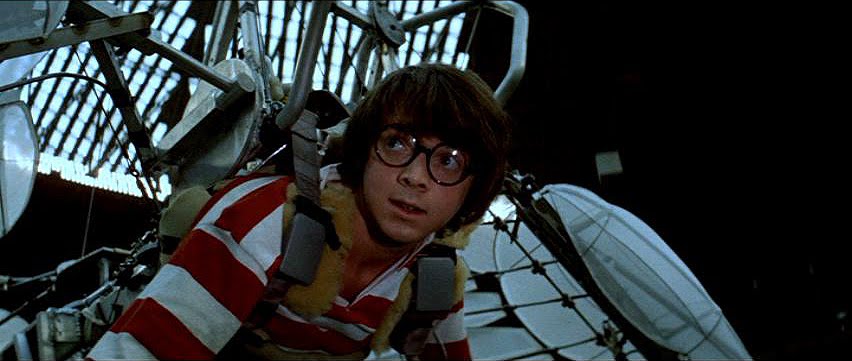
After the critical and commercial success of M*A*S*H (1970), Robert Altman used the buzz garnered from it to push an experimental film called Brewster McCloud (1970) through the studio system. It is ostensibly about a young man constructing a pair of wings so he can fly while also weaving in a storyline about a series of murders involving victims that have been strangled to death. It is, at times, a film about dreamers that also slyly references the films of Federico Fellini, Bullitt (1968) and The Wizard of Oz (1939). The end result is a fiercely idiosyncratic film even by Altman’s standards, which may explain why it is not as widely championed like some of his other work.

Right from the get-go Altman eschews a traditional opening by having a lecturer (Rene Auberjonois) talking over the MGM logo as he addresses the audience about the relationships between birds and man’s desire to fly. Then, the opening credits play over a woman (Margaret Hamilton) singing the “Star Spangled-Banner” off-key in the Houston Astrodome with a marching band. She stops and chastises them for being in the wrong key. She makes them start over and so do the opening credits.

The reclusive Brewster McCloud (Bud Cort) lives under the stadium working on a pair of wings in the hopes that someday he may be able to take flight like a bird. During the day, he drives a cranky, wheelchair-bound old man (Stacy Keach), taking him on errands where he hurls verbal abuse at everyone he encounters. Meanwhile, Houston is plagued by a series of murders with each one of the victims strangled to death. Prominent citizen Haskell Weeks (William Windom) uses his clout to get the local police to bring in “legendary super cop” Frank Shaft (Michael Murphy) from San Francisco to investigate.

Brewster crosses paths and befriends Suzanne (Shelley Duvall), a Superdome tour guide, while trying to steal her car, which she doesn’t seem to concern her all that much. Watching protectively over Brewster is Louise (Sally Kellerman), a beautiful and mysterious guardian angel of sorts that takes care of him.

Having given Bud Cort is feature film debut in M*A*S*H, Altman cast this distinctive actor to play the enigmatic titular character and he makes his way through the film with his own agenda while only briefly interacting with others. Cort’s soft-spoken nature contrasts nicely with Shelley Duvall’s chirpy optimism. They both have unique acting styles and thrived under Altman’s direction. It is a lot of fun to watch their quirky acting styles bounce off each other, like the scene where Suzanne recounts how she acquired her muscle car. Duvall, with her large than life eyelashes, is absolutely adorable, especially when Suzanne good-naturedly tries to seduce Brewster in a sweet scene.

Decked out in a turtleneck sweater, slacks and shoulder holster, Shaft cheekily resembles Steve McQueen’s titular character from Bullitt with a voiceover reporter narrating solemnly, “If keeping your cool and being totally composed makes for a better detective then this Shaft is one whale of a cop.” There’s something amusing about seeing Murphy – normally known for playing square, authoritarian types – playing a cool, no-nonsense cop. It helps that he’s playing a subtle parody of Bullitt but does so with a straight face right down to his all-business attitude as he tells the beat cop (John Schuck) assigned to him, “Now there’s a killer loose in the city, Johnson. Are we gonna get him or are we going to go downtown and play politics?”

In typical Altman fashion, he juggles a large cast of characters and multiple storylines, effortlessly moving them in and out of the foreground without ever losing sight that the film is ultimately about Brewster and his desire to fly like a bird. This is captured beautifully in a sequence that sees him dreaming of flying above the clouds to the soulful song “White Feather Wings” sung by Merry Clayton.

The screenplay, originally entitled, Brewster McCloud’s (Sexy) Flying Machine, had been written by Doran William Cannon (who had written the script for Otto Preminger’s Skidoo) in 1967 and it was, according to its author, “probably the most famous unproduced script in the country.” It had also been optioned several times by Hollywood studios but never filmed because Cannon refused to sell the rights unless he was allowed to also direct.

Music producer Lou Adler wanted to start making movies and optioned Cannon’s script – who must’ve had a change of heart about directing – offering it to Robert Altman after M*A*S*H. The director moved fast, nixing MGM’s desire to shoot in New York, where the script had originally set the story in the TWA Terminal at JFK airport, for Houston, which he found more stimulating. He did, however, hit some roadblocks along the way – firing then-up-and-coming cinematographer Jordan Cronenweth for relative unknown Lamar Boren, and, during filming, being hospitalized with a hernia.

Altman also rewrote the script, revising it heavily without notifying Cannon, making it “very farcical and broad.” According to Adler, the original script was “much more of a sexcapade” with Brewster having sex with each of the three women in the film. Altman changed it so that Brewster only had sex with Shelley Duvall’s character. The role of Frank Shaft was created entirely by Altman for Michael Murphy simply because he was one of the director’s favorite actors. Altman also downplayed the violence so that all of the murders occurred off-screen.

Fresh from making M*A*S*H, Altman cast several actors from that production, including Bud Cort, Rene Auberjonois, and John Schuck. Cort had auditioned for and didn’t get a role in a play in New York and was thinking of doing some episodic television. Altman told him not to because he was a movie star. Cort remembers the filmmaker telling about his role in their next film together: “You’re going to play a mass murderer and it’s going to be a whole reaction to how sick society is right now.” Altman also cast new, raw talent. Assistant director Tommy Thompson and fellow crew member Brian McKay met Shelley Duvall at a party when she tried to sell them her boyfriend’s paintings and told Altman that he had to meet her. He thought she was putting on an act but when he did a screen-test with her, realized that she was an “untrained, truthful person. She was very raw in Brewster but quite magic.” Three days after he cast her, principal photography began.

Filming Brewster McCloud was the typical Altman experience – location shooting away from the studio, watching dailies at the end of the day with cast and crew, and parties with lots of marijuana, hashish, cocaine, and opium. Adler remembers that Altman “would stand up and make a speech, pretty much the same speech every night. ‘No one in this room knows what this movie is about except me.’ Then he would retire to his room and write the next day’s pages.”

In classic Altman fashion, entire scenes were created and improvised on the spot when something struck his fancy or he became fascinated by some of the Astrodome’s architecture. Other scenes were written by Altman at night and then presented to the actors the next day. For example, Shaft’s sudden suicide came up at dinner between the director and Murphy the night before. Cannon even showed up to the set for a visit and was given an icy reception. He was bitter at not having been consulted on the script changes while Altman said it was “a piece of crap.” That being said, Cannon had a clause in his contract that guaranteed sole screenwriting credit despite all the work Altman had done.

Not surprisingly, MGM did not understand Brewster McCloud and the new studio head did not like it or Altman (the feeling was mutual). They gave the film a perfunctory release and yanked it from theaters after it grossed less than $1 million prompting Adler to describe studio executives as “a bunch of bag salesmen who’ve been put in their jobs like a bunch of pawns.” Murphy said of the film: “I think it was kind of a look at the insanity of all that period in time, you know? Guys were really breaking loose and doing their ‘dream films’ and doing nutty stuff.”

To further illustrate how little the studio cared about the film, the premiere at the Astrodome (attended by a whopping 24,000 people) was plagued by technical problems regarding the sound so that, as one critic commented, it was “a bit like viewing a movie in the world’s largest drive-in while locked out of your car.”

Brewster McCloud received mixed to negative reviews although Roger Ebert gave it three-and-a-half out of four stars and wrote, “One of the things about MASH was that people wanted to see it a second time. That’s typical of the recent Robert Altman style, Brewster McCloud is just as densely packed with words and action, and you keep thinking you’re missing things. You probably are. It’s that quality that’s so attractive about these two Altman films.” In his review for The New York Times, Vincent Canby felt that the film attempted, “to be a kind of all-American, slapstick Orpheus Ascending, a timeless myth about innocence and corruption told in the sort of outrageous and vulgar terms that Brian De Palma and Robert Downey do much better.”

Altman twists genre conventions on their head, bending them to conform to his vision and so the strangulation murders are preceded by bird shit dropping on the victim’s face moments before they are killed. The crime scenes are chaos as a veteran police detective (G. Wood) clashes with Shaft and his superiors who all appear to have no idea who is committing these murders. The irony is that despite his reputation for being a skilled cop Shaft is ultimately ineffectual in catching the killer.

Even the climactic car chase – a staple of the thriller genre – is given an Altman twist as Suzanne leads the cops on a wild chase with some wonderful reaction shots of her clearly enjoying the evasive moves she pulls to foil her pursuers with Louise providing well-timed interventions along the way. At one point, Altman even employs easy-listening music during the chase. The filmmaker constantly subverts our expectations at every turn. Brewster isn’t the innocent dreamer he was first made out to be and it brings into question his desire to fly. Was it genuine or an act of hubris?

Brewster McCloud is not an easy film to love. It defies traditional narrative storytelling by irreverent thumbing its nose at the conventions. The protagonist is an enigma that we never get to know or identify with and this is all the way Altman wants it. It’s a film that I admire but don’t watch all that much, which is a matter of personal taste as opposed to one of quality. I prefer the laid-back, easygoing charms of films like The Long Goodbye (1973) and California Split (1974). That’s the beauty of Altman’s films – you can approach them on your own terms and I’m sure he wouldn’t have wanted it any other way.


SOURCES

McGilligan, Patrick. Robert Altman: Jumping Off the Cliff. St. Martin’s Press. 1989.

Reed, Rex. “Houston’s Not-So-Gala Premiere.” Chicago Tribune. December 20, 1970.

Thomson, David. Editor. Altman on Altman. Faber & Faber. 2005.


Zuckoff, Mitchell. Robert Altman: The Oral Biography. Alfred A. Knopf. 2009.

Friday, November 27, 2015

Manhattan

After the phenomenal success of Annie Hall (1977), Woody Allen confounded the expectations of his critics and fans with Interiors (1978), which saw him doing his best Ingmar Bergman impression. It was his first dramatic film and while critical reaction was mostly positive, it hardly set the box office on fire. With Manhattan (1979), Allen returned to familiar material – the witty romantic comedy – with what many consider his masterpiece but a film that he famously felt was so bad that he offered to make another one for the studio for free if they agreed to not release it. Thankfully, they didn’t listen to him and the end result is one of the greatest cinematic love letters to New York City ever committed to film while also taking an entertaining and insightful look at the love lives of a handful of its inhabitants.

Allen establishes his ambitious intentions right from the start with a grandiose montage of the city scored to George Gershwin and photographed in gorgeous black and white by cinematographer Gordon Willis. The opening voiceover narration that plays over this footage works on several levels. On the surface, it is Isaac Davis (Allen) trying to start his novel but rejecting his multiple attempts because the tone is too corny, too preachy or too angry until he comes up with an introduction that makes him sound good and he ends it with the immortal words, “New York was his town and it always would be.” This opening monologue plays over and often comments on images of New York bustling with life from various neighborhoods and all kinds of people from all social strata. That last line would also be prophetic words as Allen’s name has become synonymous with the city he’s immortalized on film so many times.

This is the Big Apple as seen through Allen’s eyes as he presents his unique world populated by a rarefied social strata of well-educated, neurotic people entangled in messy relationships with each other. Still stinging from a bitter divorce, television comedy writer Isaac (Allen) is now dating Tracy (Mariel Hemingway), a 17-year-old girl (“I’m dating a girl who does homework.”). His best friend Yale (Michael Murphy), a college professor, is having an affair with a journalist named Mary (Diane Keaton). We meet Isaac and his narcissistic friends at Elaine’s, a then-trendy restaurant on the Upper East Side, which Allen uses to set-up their relationships.


Isaac and Yale’s lives are a mess with the former writing for a television show he loathes and the latter trying to finish a book and start up a magazine. The last thing they need is to complicate their romantic lives. Isaac realizes that Tracy is too young for him (“You should think of me as a detour on the highway of life.”) and gets involved with Mary after Yale introduces them. At first, Isaac and Mary can’t stand each other, arguing over an art exhibit and several artists she feels are overrated but he thinks are great (i.e. Lenny Bruce, Vincent Van Gogh, Ingmar Bergman, and so on). Mary is everything that Tracy is not – worldly and not afraid to speak her mind (at one point, he describes her way with words as “pithy yet degenerate.”). Isaac is instantly put-off by this because she isn’t easily controllable like Tracy. Mary is not afraid to challenge Isaac, which is what ultimately appeals to him.

He breaks up with Tracy and starts up with Mary. She is more his equal in every way and it makes sense that they get together. She is brutally honest in her assessment of his and her own shortcomings and he likes that. They connect while spending a night into early morning talking through the streets of the city, walking her dog and then getting food at a local diner to the dreamy strains of “Someone to Watch Over Me.” This wonderful scene culminates with the iconic shot of Isaac and Mary sitting on a bench in front of the Queensboro Bridge at dawn, which was also used in the film’s poster.

Woody Allen and Diane Keaton continue their undeniable on-screen chemistry as they play so well off each other. She is allowed to tone down the more exaggerated comedic gestures she used in Annie Hall to create a more nuanced character in Manhattan. Initially, Mary comes across as abrasive but once she’s alone with Isaac her tough exterior softens and we realize that they have a lot in common. He makes her laugh and we can see the attraction between them growing. This complicates things because it prompts Isaac to breakup with Tracy to be with Mary who breaks up with Yale, which puts a strain on his friendship with Isaac.


Keaton displays a wonderful level of vulnerability over the course of the film as Mary feels comfortable enough around Isaac to share her insecurities, admitting that she gets involved with dominating men. Keaton’s Mary is a wonderful mix of smarts, beauty and humor – it’s no wonder that both Isaac and Yale are in love with her. The actress is also good during the more serious scenes, like when Mary and Yale breakup and then later she talks to Isaac about it. Keaton convincingly conveys how upset her character is even if ultimately it is the best thing as it opens the door for her and Isaac to get together.

Woody Allen essentially plays himself, which sounds like a backhanded compliment when it actually isn’t as he bounces back and forth between witty one-liners and neurotic hand wringing. Allen is more than a neurotic joke machine as Isaac wrestles with his own moral dilemmas – his love for Tracy, even though he knows she’s too young for him, and his attraction to Mary who is much more compatible. It’s hard not to see Isaac’s relationship with the much younger Tracy eerily foreshadowing Allen’s real-life relationship with his young adopted daughter Soon-Yin Previn and this gives the on-screen relationship between the characters an added uncomfortable vibe at times – one that already exists with the vast age difference and Isaac initially making light of it.

Mariel Hemingway is excellent as Tracy, the young woman that adores Isaac and is able to hold her own with him and his pseudo-intellectual friends. Ironically, she is the most mature character in the film and also the one that is the nicest while also being the youngest. Perhaps she hasn’t lived long enough to become jaded and cynical like Isaac and his friends. There is still an innocence to her and perhaps this is what draws Isaac to Tracy. The actress displays an impressive range of emotions, culminating in the heartbreaking scene where Isaac breaks up with Tracy. The hurt her character feels in this scene is almost tangible and we really empathize with her.


While Manhattan features an abundance of Allen’s funny one-liners, the screenplay he co-wrote with Marshall Brickman tempers it somewhat with the characters’ messy personal lives, like the resentment Isaac feels towards his ex-wife (Meryl Streep) for leaving him for another woman, or Yale cheating on his perfectly lovely wife (Anne Byrne) with Mary. Allen expertly shifts gears from comedy to drama from scene to scene and sometimes even within the same scene.

Allen takes us through a guided tour through the city with key scenes taking place at famous establishments, like Elaine’s and the Russian Tea Room, or tourist spots like the Hayden Planetarium, in such a way that New York becomes a character unto itself. Willis’ gorgeously textured black and white cinematography not only evokes the classic Hollywood cinema that Allen loves so much but at the time of Manhattan’s release black and white film stock was rarely used in popular contemporary cinema. Whether they meant to or not, Allen and Willis were making a bold artistic statement with this choice, which elevated the film from being just another romantic comedy to something more. For example, there is a fantastic scene in the aforementioned Planetarium where Isaac and Mary walk through the exhibits, including a Lunar landscape and Saturn looming large in the background in another room while the two characters appear almost entirely in silhouette. Sadly, several of the places the characters frequent no longer exist making Manhattan a historical document of sorts.

Woody Allen first started talking about the origins of Manhattan over dinners with cinematographer Gordon Willis while they were filming Interiors. Allen wanted to make “an intimate romantic picture” in a widescreen aspect ratio and do it in black and white because “that had a Manhattan feel to it.” At the time, he was listening to recordings of Gershwin overtures and thought of setting a scene to that music.


Allen began working on a story with regular collaborator Marshall Brickman (Annie Hall). They would talk about potential ideas, like, “Wouldn’t it be funny if I liked this really young girl and if Keaton was this major pseudo-intellectual?” Brickman would envision a scene and ad-lib it. Allen would do the same and they’d go back and forth. The two men ran into a roadblock when neither of them could figure out the film’s climax until during filming Brickman’s wife told him they needed a scene where Isaac confronts Yale, which became the climactic scene in the latter’s classroom.

Originally, the opening montage scene was going to be scored to “I Can’t Get Started” by Bunny Berigan because that song played several times every night at Elaine’s on the jukebox. During post-production, editor Susan E. Morse suggested they use “Rhapsody in Blue” instead. Allen agreed and decided to use Gershwin music throughout. When Manhattan was finished, he was so disappointed with the film that he asked United Pictures not to release it: “I wanted to offer them to make one free movie, if they would just throw it away.” Fortunately, they declined Allen’s offer.

Manhattan received mostly positive reviews from mainstream critics at the time. Roger Ebert gave the film three-and-a-half out of four stars and wrote, “The relationships aren’t really the point of the movie: It’s more about what people say during relationships – or, to put it more bluntly, it’s about how people lie technically telling the truth.” In his review for The New York Times, Vincent Canby wrote, “The movie is full of moments that are uproariously funny and others that are sometimes shattering for the degree in which they evoke civilized desolation.” The Village Voice’s Andrew Sarris said of the film that it “materialized out of the void as the one truly great American films of the ‘70s.” In her review for The New Yorker, Pauline Kael wrote, “What man in his forties but Woody Allen could pass off a predilection for teenagers as a quest for true values?” The Washington Post’s Gary Arnold wrote, “There’s no opportunity to heap condescending abuse on the phonies and sellouts decorating the Hollywood landscape. The result appears to be a more authentic and magnanimous comic perception of human vanity and foolhardiness.” In recent years, critics like J. Hoberman offered their assessment of the film when he wrote, “What’s most authentic about Manhattan is its fantasy. The New York City that Woody so tediously defended in Annie Hall was in crisis. And so he imagined an improved version. More than that, he cast this shining city in the form of those movies that he might have seen as a child in Coney Island—freeing the visions that he sensed to be locked up in the silver screen.”


After the failure of Interiors, Manhattan could be seen as Allen’s return to the same formula that made Annie Hall a success. While there are similarities between the two films, Manhattan showed how much he had matured as a filmmaker by injecting more dramatic weight without upsetting the overall balance of the film. He wasn’t simply content to make an entertaining romantic comedy. Manhattan not only expressed his feelings for New York but also his views on relationships. It is arguably Allen’s most complete expression of his unique cinematic worldview – highly educated people with very little common sense when it comes to their personal lives, making bad decisions even when they realize it. But like the rest of us, they keep on trying, hoping that the next relationship is the one. He continues to explore it with numerous variations, such as locations, time periods, but they can be traced back to Annie Hall and Manhattan.

Ultimately, Manhattan is about figuring out what you want in life and going for it. Isaac doesn’t do this until late in the film during a classic scene where he lists the things that make life worth living for him and in doing so achieves an epiphany. The film ends on a bit of ambiguous note as we are left wondering that the woman he picked was the right one and if so, how long the relationship will last. In a way, it is cinematic litmus test for the viewer – if you’re an optimist, the ending is hopeful and if you’re a pessimist, it is bittersweet. In other words, this scene conveys the same uncertainty that goes with relationships that the rest of us experience. That being said, I think Tracy sums it up best when she tells Isaac, “You have to have a little faith in people.”


SOURCES

Bjorkman, Stig. Woody Allen on Woody Allen. Grove Press. 1993.


Lax, Eric. Conversations with Woody Allen. Alfred A. Knopf. 2007.

Tuesday, December 3, 2013

Blu-Ray Review of the Week: Nashville: Criterion Collection

At the time, Nashville (1975) was Robert Altman’s magnum opus, a sprawling tale featuring 24 characters over five days. Not only does he manage to juggle all of these storylines, but is able to seamlessly interconnect them in major or minor ways. The end result was an unflinching look at America through Altman’s eyes – a kaleidoscope approach that he helped pioneer and that flew in the face of conventional Hollywood filmmaking, but could only have been pushed through the system during the 1970s.

Altman’s playful, freewheeling style is evident right from the get-go as the cast is introduced via a faux television ad for a greatest hits record collection. Then, he proceeds to immerse us in the lives of several characters, presenting them in a non-judgmental way as if he was anthropologist of American culture. Nashville is a cross-section examination of the city’s country music scene, from its royalty, like elder statesman Haven Hamilton (Henry Gibson) and Barbara Jean (Ronee Blakley), to its aspiring up-and-comers, like Sueleen Gay. We also meet various sycophants that orbit these people, as well as musicians, like Tom Frank (Keith Carradine), that exist on the fringes.

The ubiquitous van blasting presidential hopeful Hal Phillip Walker’s political beliefs and Jeff Goldblum’s amateur magician riding around on a chopper provides the connecting tissue that binds all of these characters. As he’s so good at doing, Altman captures key private and public moments of these characters, which provides crucial insights in scene-sized chunks that require the viewer to pay close attention because there are so many people to keep track of. Many of these characters are so fascinating in their own right that they could easily star in their own film and, at times, it feels like certain scenes could be jumping off points for potential spin-off films.


It goes without saying that the cast is uniformly excellent with the likes of Keith Carradine playing a selfish folk singer, Lily Tomlin as a middle-class housewife with two deaf children, and Ronee Blakley as a famous country singer standing out in particular. Also of note are Jeff Goldblum and Shelley Duvall making quite an impression in minor roles as eccentric oddballs. It doesn’t hurt that these actors get to work from Joan Tewkesbury’s brilliant screenplay and are directed by actor-friendly Altman.

To the uninitiated, his mosaic approach may seem scattered and unfocused, but he’s juxtaposing intimate moments with big splashy scenes to provide fascinating slices of life. You don’t have to appreciate country music to enjoy Nashville. You just need to be drawn to interesting characters and human behavior of which this film has in abundance. Altman had a great run during the ‘70s and this definitely one of his best films from this period if not his entire career.

Special Features:

This new Blu-Ray transfer of Nashville looks fantastic. The folks at Criterion should be commended for the excellent work on this print, which has incredible detail while still retaining its filmic look.


Ported over from the Paramount DVD is an audio commentary by director Robert Altman. He points out that the cast wrote most of the songs for their respective characters. All of the songs were done in-house and when Nashville came out, local musicians hated them. He mentions the numerous collaborators he worked with in front of and behind the camera and explains what they contributed to the film. Altman talks about his approach to filmmaking on this engaging and informative track.

Also included is a fantastic theatrical trailer.

“The Making of Nashville” features various cast and crew members recounting their roles in this film and what they think of it now. They talk about getting involved in the project and their impressions of Altman. The likes of Keith Carradine, Lily Tomlin and Michael Murphy (among several others) tell fantastic filming anecdotes and address Altman’s famous habit of encouraging improvisation among the cast.

“Robert Altman’s Interviews” include one from 1975 when Nashville was released and he talks about the film’s origins and how hard it was to get made. There’s another from 2000 where he talks about various cast members and their characters. The third one is from 2002 and Altman points out how Nashville was the first big film where he had complete creative control.


There is “Behind the Scenes” footage of the opening traffic jam scene and the final one. It’s pretty grainy and has no sound, but does provide a glimpse into Altman’s working methods.

Finally, there is “Keith Carradine Demo.” Altman recorded three songs that the actor created fro the film in his office and you can listen to each one.

Friday, February 24, 2012

The Year of Living Dangerously

Based on Christopher Koch’s 1978 novel of the same name, The Year of Living Dangerously (1983) was among a small group of films that came out in the early 1980’s depicting the struggles of Western journalists to document the plight of Third World nations – Under Fire (1983) in Nicaragua; The Killing Fields (1984) was set in Cambodia; and a few years later Salvador (1986) came out with an unflinching portrayal of the volatile conditions in El Salvador. The Year of Living Dangerously is set in Indonesia during the attempted coup of President Sukarno by the 30 September Movement Communist party in 1965 and follows a group of foreign correspondents in Jakarta covering the increasing unrest.

The film’s title is a quote that refers to a famous Italian phrase used by Sukarno – vivere pericolosamente, meaning “living dangerously.” He borrowed the line for the title of his Indonesian Independence Day speech of 1964. Sukarno was a hero for leading his country’s independence from the Netherlands. He became the first President of Indonesia and during his reign he gave each year a name. In his 1964 speech he named the upcoming year “the year of living dangerously,” as if anticipating the increasing friction between two radical political forces: the Communists and the Muslims, both of whom were trying to overthrow his government. Sukarno also planned to cut his country’s ties with the West.

We meet Australian journalist Guy Hamilton (Mel Gibson) as he arrives in Jakarta on his first foreign correspondent assignment to find that his predecessor has already left without briefing him. He leaves the airport and we are immediately assaulted with the sights and sounds of the chaotic city – streets congested with cars, people and livestock – but he quickly moves through it to an air-conditioned hotel where all the western journalists hang out. It is there that he meets Billy Kwan (Linda Hunt), a freelance photographer that did a lot of work for Guy’s predecessor. He takes Guy on a guided tour of the slums of Jakarta to show him how most of the country lives and to gain his confidence. Billy also does this so that Guy doesn’t see the country like other journalists, namely Pete Curtis (Michael Murphy), a correspondent for the Washington Post.

The next day, Guy tries to get an interview with Sukarno and is easily rebuffed by the President’s staff. Later on, Billy proposes a deal: he’ll use his personal contacts to get Guy an interview with the leader of the Indonesian Communist Party if he can be his exclusive photographer. Guy’s interview with the Communist Party leader earns grudging respect from his fellow journalists and an initial flush of jealousy from Curtis who had been trying to get the same interview for months. The Post journalist doesn’t like the Indonesian people. They are there just for his amusement. Jakarta is just another assignment for him and Michael Murphy is not afraid to play up the unlikable aspects (of which there are many) of Curtis.

Director Peter Weir is careful to make the distinction between Guy and Curtis (and the other seasoned journalists) and how the former looks at the way the latter delights in the humiliation of the locals with disgust. Guy is young enough not be jaded like Curtis and Billy recognizes this, which is why he latches onto Guy. Billy believes that he can influence Guy to write articles that tell the real story of the Indonesian people and perhaps make a difference. For example, there’s an intensely visceral scene where Billy and Guy cover a protest outside the American embassy by the Communist Party. What starts off as a peaceful march quickly turns ugly as the protestors throw rocks with Billy and Guy stuck in the middle of the angry mob. Once their car gets surrounded, you really start to fear for their lives as the danger they’re in is palpable. Weir does a good job conveying their peril by showing the chaotic masses swirling around their car.

Billy introduces Guy to Jill Bryant (Sigourney Weaver), the assistant to the British military attaché, and who plans to leave for London in three weeks. Her introduction provides occasional moments of levity, like when she, Billy and Guy attend a house party and everyone dances to Jerry Lee Lewis’ “Whole Lotta Shakin’ Goin On.” We see the initial attraction between Jill and Guy emerges through the looks they occasionally give each other. The next day, she drops by his office looking for Billy and he offers to drive her to the photographer’s place and wait for him. Jill is very much Guy’s intellectual equal, good-naturedly criticizing one of his articles as being too melodramatic. She ends up accompanying him on an assignment and at one point they end up getting caught in the rain. He charms her with his willingness to look silly and make her laugh. They share a brief, meaningful look that shows how their attraction towards one another is growing. There is a loose, improvisational feel to this scene as it really seems like the actors are in the moment, which only enhances the chemistry between their characters.

Weir never lets the love story overshadow the political one as Guy finds out from Jill that the Communists are planning to overthrow Sukarno’s government and he tries to figure out how they’re going to get weapons into the country. She told him in confidence and he plans to use it in his article, which, of course, puts a strain on their relationship. Even though I know how the film ends, every time I watch it I still get caught up in the tension of Guy’s race to escape the country as it descends into chaos. Weir ratchets up the pressure so that it is almost tangible and you really fear for Guy’s life.

The carved images that appear over the film’s opening credits depict mythical Indonesian figures: Prince Arjuna, the hero who is “fickle and selfish”; the “noble and proud, yet headstrong” Princess Srikandi; and Semar, the dwarf who serves the prince. These figures nicely foreshadow the film’s three main characters: Guy is the fickle and selfish hero, Jill is the noble yet headstrong princess and Billy is the dwarf that serves the prince.

Made early on in his career, Mel Gibson is well-cast as Guy Hamilton, a young journalist on his first big assignment. The actor manages to portray someone who is smart but inexperienced – a basically decent guy that makes mistakes but tries to do the right thing. Over the course of the film we watch as Guy learns on the job and also falls in love with someone probably for the first time. Gibson wisely doesn’t play his character as a wide-eyed innocent – just someone who hasn’t seen much of the world. He isn’t afraid to play a flawed character and still find admirable qualities within him – perhaps even a hint of redemption.

Sigourney Weaver probably wouldn’t be your first choice to play a British woman but she quickly makes you forget that and focus on her behavior and how she carries herself. Weaver is one of those rare actresses that can convey intelligence while being an undeniable beauty. Jill knows that what she’s doing probably won’t last but is compelled by her emotions to get involved with Guy anyway. Weaver is also able to effortlessly convey a complex range of emotions simply through facial expressions, like when Jill wanders through a marketplace in the rain and it looks like she’s contemplating her relationship with Guy and we see how it impacts her, motivating what she does in the next scene. Jill has a complicated relationship with Guy that is brought together by political conflict and is also threatened by it.

The chemistry between Gibson and Weaver is incredible as they do a fantastic job of depicting a brief, yet intense love affair amidst a volatile situation. Weir develops Jill and Guy’s relationship gradually and realistically. They don’t automatically fall in love but get to know each other by hanging out. It’s a classic scenario of a doomed relationship that can’t last but they go for it anyway because the attraction between them is undeniable. You feel the want and desire between them in the way they look at each other and through their body language. The country’s volatility can create a kind of vulnerability between two people and this is the case with Jill and Guy. They are brought together by the volatility of the situation. The two of them know that they have very little time to be together but can’t deny their intense attraction to each other.

Linda Hunt is simply astonishing as Billy Kwan, the savvy photographer who cares deeply for his fellow countrymen. He believes in helping whomever he can, even if it is a toy for a sick child or a bit of money for someone who is starving. Through his voiceover narration, we find out that he is quite a good writer, documenting the plight of his people as well as Guy’s story. Hunt disappears completely into the role. She plays Billy as a tragic figure, a romantic who wears his heart on his sleeve. Perhaps he cares too much, or, rather not enough people around him care as passionately about making a difference as he does. The scene where Billy loses it after being betrayed by Guy is powerful and painful as we sense all the hurt and frustration bubbling up to the surface as the photographer commits a final, desperate act. Your heart really goes out to Billy and Hunt is so good at conveying her character’s last attempt to make a difference.

A friend of director Peter Weir’s recommended he read Christopher Koch’s novel The Year of Living Dangerously but its political content held no interest form him and he delayed reading it for months. Weir finally did read it and was so taken with what Koch had written that he immediately bought the film rights. Weir was particularly impressed with the character of Billy Kwan and felt that he was the heart of the novel, “the figure around whom the novel is constructed.” The director was already intrigued by Indonesia as his favorite vacation spot was Bali: “I had in my mind all the smells and sounds of an Indonesian street or market, the mysteries there had always appealed to me.”

Weir co-wrote the screenplay with Koch and David Williamson, an acclaimed Australian playwright who had worked with the director previously on Gallipoli (1981). While working on it, Weir began to appreciate the story’s politics for the first time: “I began to see how the political atmosphere is acting upon the characters, and how the larger politics and the politics of the personal are inextricably locked together.” He was also careful to achieve a balance and it took many drafts to achieve it. Weir admitted to having a “bumpy” relationship with Koch because he told the author he was going to “attempt to make this into a good film. He took that for doubt or uncertainty on my part, whereas it was really just being honest.”

The Year of Living Dangerously was in development when Weir got the offer to make Gallipoli and so the project was put aside while he did that one. While making Gallipoli with Mel Gibson, Weir knew that he wanted to cast him in his next film. After they made a deal for The Year of Living Dangerously, Mad Max (1979) came out and Gibson became an international movie star. After casting Sigourney Weaver, it took months for Weir to find someone to play the pivotal role of Billy Kwan.

Three weeks before principal photography was to begin, he had still not found the right actor. He was shown a photograph of Linda Hunt and was struck by her face which he thought looked like an “elf or a goblin.” Weir agreed to meet her and after doing a screen test of her in Eurasian makeup and men’s clothes, he decided to cast her in the role: “My feeling was that it was worth the gamble.” She was “scared to death” at the notion of playing a man but found herself drawn to the character and his relationship to the people of Indonesia and “to his passion about injustice.” Her initial worry was that she could not do it and no one would believe it. Hunt even admitted that during filming she was terrified 95% of the time. To transform herself into the role, her tropical shirts were padded slightly across the shoulders to give her a wider back and she always had something in the breast pocket.

Gibson and Weaver had very different working methods but they didn’t break the ice until the rain scene in the car. For the sequence, they were drenched by fire hoses with the car portion shot in Sydney on a very cold night. Gibson said about his romantic scenes with Weaver, “That kind of thing is always a touchy area with actors, I would think. Or maybe it’s just me. But I think we managed to get a few sparks going.” Weir was more worried about these scenes then the violent crowd scenes that employed thousands of extras. Gibson remembered, “We unloaded truckloads of rocks and things and told those young blokes, ‘Hurl these rocks through the windows. We’ll be down here with the cameras.’ You could yell, ‘Cut! Cut!’ but it didn’t stop the fight.”

Due to the controversial politics of the film, Weir did not consider filming in Indonesia and instead picked the Philippines. However, the production ran into trouble there. Four weeks into a scheduled six weeks of filming in the spring of 1982, the cast and crew began receiving written and telephoned death threats from Muslim extremists that feared the film would be anti-Muslim. Airing on the side of caution, the production left the country and finished filming in Sydney, Australia. At the time, Gibson downplayed these threats: "It wasn't really that bad. We got a lot of death threats to be sure, but I just assumed that when there are so many, it must mean nothing is really going to happen. I mean, if they meant to kill us, why send a note?"

The Year of Living Dangerously received mixed reviews from critics. Roger Ebert gave it four out of four stars and called it, “a wonderfully complex film about personalities more than events, and we really share the feeling of living in that place, at that time.” In his review for The New York Times, Vincent Canby praised Linda Hunt’s performance: “Not exactly dominating these performances, but providing the film with its dramatic center, is Miss Hunt's haunted Billy Kwan, who keeps detailed files on everyone he loves, weeps at the purity of the voice of Kiri Te Kanawa and, when the chips are down, is capable of the film's single grand gesture.” However, the Washington Post’s Gary Arnold wrote, “It's unlikely that anyone who sees The Year of Living Dangerously will ever forget Hunt's performance or Weir's orchestration of a foreboding atmosphere. Still, there's no particular reason why these marvelous aspects couldn't be coordinated with the story in an organic way, so that Billy's character, the characters of the lovers and the ominous intimations all paid off in coherent dramatic terms.” Newsweek found the film to be “an annoying failure because it fritters away so many rich opportunities.”

Along with The Road Warrior (1981), The Year of Living Dangerously helped launch Gibson’s international career and it wasn’t long before Hollywood came calling. It also showed that he had some serious dramatic acting chops and wasn’t just some hunky pretty boy. Weaver’s career also got a big boost and it was the beginning of a great run during the ‘80s that saw her move effortlessly from comedies like Ghostbusters (1984) to dramatic fare like Gorillas in the Mist (1988). The Year of Living Dangerously also helped launch Weir’s career and like Gibson he soon started making films in Hollywood but managed to make them on his own terms with thought-provoking efforts like The Mosquito Coast (1986) and Fearless (1993).

At one point in The Year of Living Dangerously, Billy says, “What then must we do?” This is also the question that the film asks not only of its protagonist but also of its audience. Don’t waste the rest of your life asking this question – do something. It’s all fine and good to become interested in important causes but will you step up and take an active role in something you believe in? Weir avoids delivering a preachy, statement-driven film by expertly balancing a love story with political unrest in a foreign land and how they become intertwined. He makes the politics personal by showing how they impact the characters. It all comes back to Billy’s rather poignant question – “What then must we do?”


SOURCES

Bennetts, Leslie. “East and West Meet Amid Mystery in Peter Weir’s New Film.” The New York Times. January 16, 1983.

Bennetts, Leslie. “Breakthrough Season Arrives for Linda Hunt.” The New York Times. February 12, 1983.

Hanrahan, John. Mel Gibson. Little Hills. 1986.

Moore, Peter S. "The Year of Living Dangerously." Moviegoer. February 1983.

Wadler, Joyce. “When Seeing is Believing.” Washington Post. February 18, 1983.