"...the main purpose of criticism...is not to make its readers agree, nice as that is, but to make them, by whatever orthodox or unorthodox method, think." - John Simon

"The great enemy of clear language is insincerity." - George Orwell
Showing posts with label adventure. Show all posts

Saturday, August 28, 2021

Lassiter


Tom Selleck has had one of the more intriguing what if film careers. If he had been able to get out of his contract for the television show Magnum, P.I. and done Raiders of the Lost Ark (1981) who knows how his career would’ve turned out? Instead, he ended up doing a string of entertaining but mostly forgettable fare such as High Road to China (1983), Lassiter (1984), and Runaway (1984) that all underperformed at the box office to one degree or another as people were by and large content to watch him every week on T.V. It wasn’t until the smash hit of Three Men and a Baby (1990) that he had a significant financial success. Of all the movies he did in the early to mid-1980s, Lassiter is the most interesting effort.
 
Set in 1939 London, Selleck plays a high-end jewel thief by the name of Nick Lassiter. The movie begins with the man plying his trade, expertly breaking into a luxurious mansion and stealing expensive jewelry. He almost gets away with it until the lady of the house catches him on the way out. Instead of calling out to her husband, whom she has been bickering with since they arrived home, she lets Lassiter go but not before he helps her get undressed for her bath and the surprising female nudity signals that this won’t be family-friendly PG fare but naughty R-rated fun.
 
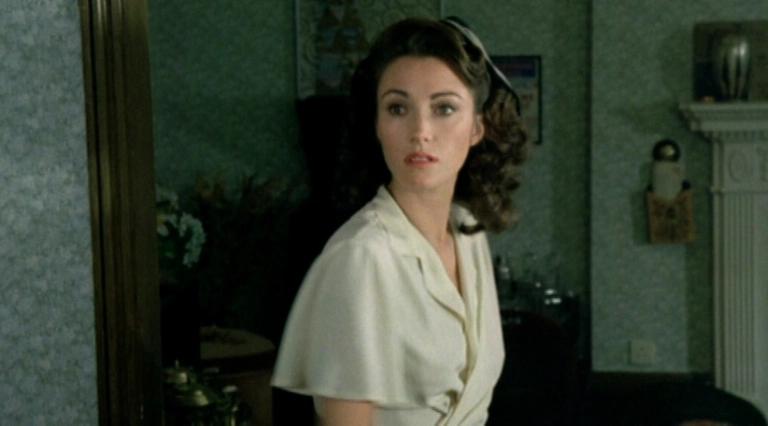
When he’s not robing the rich, he’s hobnobbing with them at a swanky nightclub with his beautiful wife Sarah (Jane Seymour) where they exchange unfortunately bland repartee, which is a damn shame as Selleck and Jane Seymour have lovely chemistry together. The next day, Lassiter is picked up by Inspector Becker (Bob Hoskins) and framed for a crime he didn’t commit but is given a chance to go free if he works with FBI agent Peter Breeze (Joe Regalbuto), helping steal $10 million worth of unset diamonds from the German embassy, slowing down their espionage efforts in South America.


To do so, Lassiter must get close to the courier, Kari Von Fursten (Lauren Hutton) and her Gestapo bodyguard Max Hofer (Warren Clarke). Breeze describes her as “pretty wild” and we quickly get an idea of just how wild when we see her kill one of her sexual conquests while they’re in bed together, evidently a perverse turn-on for her. Lauren Hutton looks like she’s having fun playing a woman with “unusual appetites,” as one character puts it, and she goes on to describe Shanghai as interesting for its diversions such as “women with animals, drugs, little boys, pleasure and pain.” She certainly looks the part of an elegant Nazi with some weird kinks.
 
Tom Selleck does an excellent job playing a suave jewel thief who is comfortable bantering playfully with a Nazi femme fatale in posh casinos as he is watching down ‘n’ dirty underground boxing matches. He’s also not afraid to get his hands dirty as evident in a scene where he and Max have it out in a bloody brawl at Lassiter’s apartment. This role allows Selleck to show off his leading man chops, demonstrating his capacity for romance with Seymour, action, his athletic prowess with the cat burglar sequence, and even a light comic touch in an amusing scene where he communicates with a Nazi guard only through facial expressions and gestures while wearing a frilly woman’s housecoat, trying not to wake Kari sleeping in the next room.

Jane Seymour is well cast as Selleck’s foil. Sarah enjoys their lifestyle but is not crazy about his current gig and doesn’t understand why they can’t just take off to Rome or parts elsewhere. He tells her, “Someone else dealt the cards, Sarah. I’m just playing them out,” to which she replies, “Well, you’re holding a losing hand now, Nick.” She is a strong-willed person that loves her husband but won’t have her life sent in a direction she doesn’t like and Seymour does a fine job conveying her character’s strength.


The always reliable Ed Lauter is cast refreshingly against type as Smoke, a prolific car thief and Lassiter’s best friend. Known mostly for playing cops and authority figures, he must’ve jumped at the opportunity to sink his teeth into a character on the opposite side of the law. He has an excellent scene with Selleck where Smoke and Lassiter reminisce about the good ol’ days when they bootlegged liquor during Prohibition.
 
Bob Hoskins plays Inspector Becker with his customary gusto. He’s a hard man that knows which pressure points to press with Lassiter but also keeps his personal life separate from his professional one when we see how he reacts to Lassiter paying a house call.
 
Lassiter features workman-like direction from veteran T.V. director Robert Young (Bitter Harvest) that could’ve been done with a little more pizzazz, a rather pedestrian script by David Taylor (Hanky Panky), and an unmemorable score by Ken Thorne (Superman II) that is low-key to the point of being non-existent, which prevents the movie from being something truly special. Instead, it is just pleasantly entertaining – certainly nothing wrong with that. What saves it from being forgettable is the cast who all play their roles admirably.


Comparing the diverging career paths that Harrison Ford and Tom Selleck respective careers took it isn’t hard to see why the former had a thriving career full of iconic roles in diverse films while the latter returned to T.V. with renewed success. It’s not just that Ford was the better actor but he also had a better instinct for movie roles. Part of it is being in the right place at the right time and part of it is knowing what works best for your talents and I think Selleck eventually realized that T.V. is where he belonged and the proof is in a show such a Blue Bloods, which he has starred in for 12 seasons and counting. Lassiter, in some respects, typifies his film career – entertaining and full of promise but just falling short of excellence.

Friday, September 20, 2019

Butch Cassidy and the Sundance Kid


In 1969, two important westerns came out examining the end of the Wild West in very different ways. Sam Peckinpah’s The Wild Bunch was a blood-soaked elegy to its aging protagonists who found themselves increasingly marginalized in a world that was passing them by. George Roy Hill’s Butch Cassidy and the Sundance Kid also featured bank robbers finding it increasingly harder to ply their trade albeit in a lighter vein, emphasizing the undeniable chemistry between its two lead actors, Paul Newman and Robert Redford. Screenwriter William Goldman and director Hill helped create a classic buddy action film that would shape and influence the genre for years to come.

Infamous outlaws Butch Cassidy (Newman) and the Sundance Kid (Redford) have spent their careers robbing banks with their Hole in the Wall Gang. Butch is the smart one who plans all the jobs they do while Sundance is the man of action. Sundance tells him, “You just keep thinking, Butch. That’s what you’re good at,” to which he responds, “Boy, I got vision and the rest of the world wears bifocals.” Times are changing, however, and it has become harder to be a criminal. Now that they are legends Butch and Sundance have become well known with the authorities. It is also getting tougher to rob banks as they now have more security.

Even one of the guys in their Hole in the Wall Gang challenges Butch’s leadership – a rather large, imposing man (Ted Cassidy). This scene sets the tone for the first half of the film and also tells us a lot about Butch and Sundance. The former keeps talking as a way of stalling until can figure out a way to beat his physically superior opponent. The latter simply stays quiet but his intense look implies that if Butch gets in any kind of real trouble he’ll step in as evident in the amusing exchange between them before the showdown. Butch tells Sundance, “Listen, I don’t mean to be a sore loser but, uh, when it’s done – if I’m dead – kill him,” to which Sundance replies, “Love to.” He then turns and gives Butch’s opponent a wave and flashes his iconic smile. It is this moment of levity before an action sequence that would be imitated most by subsequent buddy action movies.

After robbing the same train twice, Butch and Sundance are pursued by a posse of determined lawmen. Their introduction is a mythic one as we never get a clear, up-close view of these men but they are always in pursuit, killing off two of the Hole in the Wall gang members right away like an inhuman killing machine. Butch and Sundance are doggedly pursued over rugged terrain, desert, rivers, rocky ground and dangerous rapids, day and night for miles. It is downright spooky as we never lose sight of the posse. It is like they are in the background of every scene. They never stop and rest, even traveling at night with the aid of lanterns. Butch tries all kinds of ways to evade them but to no avail, which unnerves the unflappable outlaw. It is also unsettling for us because, up to this point in the film, we’ve see Butch and Sundance gleefully stick it to The Man but as this super posse continues their relentless pursuit, Butch actually looks worried. The posse are the literal embodiment of progress as the years of robbing banks has finally caught up to the film’s protagonists.

Chemistry is crucial in a film like this and Newman and Redford have it right from the get-go as evident when Butch tries to talk Sundance out of a showdown with a card player who accuses the latter of cheating. It looks like they are going to have it out with guns until Butch calls Sundance by name and the other man, realizing who they are, backs down. Newman and Redford’s comic timing is superb and they work so well together. They are believable as long-time friends in the way they banter and bicker with each other – courtesy of Goldman’s razor-sharp screenplay – like when they jump off a cliff into water to evade the posse. Sundance refuses as he can’t swim. Butch laughs and points out, “The fall’ll probably kill ya!” The comedic interplay between these two actors, coupled with the action-oriented misadventures they find themselves getting into would later become a very popular template for buddy action films in the 1980s and early 1990s.

The one jarring sequence that seems out of place in the film is when Butch and Sundance’s girlfriend Etta (Katharine Ross) ride around on a bicycle to “Raindrops Keep Fallin’ On My Head,” a contemporary song written by Hal David and Burt Bacharach and recorded by B.J. Thomas. This whimsical song feels out of place in the film. There are already many comedic moments all of which are much better than this one. It feels like the filmmakers needed more scenes with Etta in it and came up with this scene but it comes across as unnecessary and wouldn’t be missed if it was taken out.

In the mid-1960s, William Goldman was a novelist making ends meet teaching creative writing at Princeton University. He was in-between projects and decided to write a screenplay about legendary outlaws Butch Cassidy and the Sundance Kid, whom he had been interested in since the 1950s. He was taken with their adventures, the fact that Butch didn’t kill people and the rumor that the duo survived a shoot-out in Bolivia. What really crystallized things for him was the famous line from F. Scott Fitzgerald’s unfinished novel The Last Tycoon – “There are no second acts in American lives.” Goldman’s research proved otherwise when it came to Butch and Sundance. According to the writer, the two men “ran to South America and lived there for eight years and that thrilled me: They had a second act.”

Goldman shopped his script around Hollywood with little success. He worked on it further and in the meantime, wrote the screenplay for the Paul Newman detective film Harper (1966). He visited the actor on location in Arizona while he was filming Hombre (1967) and told him about Butch and Sundance. Weeks later, fellow actor and friend Steve McQueen called Newman up in November 1967 raving about the script for Butch Cassidy and the Sundance Kid and that they should make it together. Both men agreed to buy the script themselves but it had already been sold to 20th Century Fox. Newman figured that was it until studio chief Richard Zanuck asked him to star in it. The studio then hired George Roy Hill to direct. He was coming off the incredibly successful musical Thoroughly Modern Millie (1967).

When Newman first read Goldman’s screenplay he loved it and envisioned playing the role of Sundance. The writer had always imagined Jack Lemmon for the role of Butch but he was no longer a right fit for the film. Hill assumed Newman would play Butch but when they first met the actor went on about Sundance – his motives and changes to lines in the script. A confused Hill told Newman that he was to play Butch. The actor disagreed and then re-read the script that night and realized, “the parts are really equal and they’re both great parts. So I said, ‘Okay, I’ll be Butch.’”

Warren Beatty heard about the script and wanted to do the film but when he heard that Newman was going to play Butch he wanted to play the character. He even claimed he could get Marlon Brando to play Sundance but when he got the script the actor wanted to play Butch as well! McQueen still wanted to play Sundance. He liked the script but was unhappy that Newman, the bigger earner and more impressive filmography, would receive top billing. When told of McQueen’s issue with billing, Newman refused to relinquish first star billing.

This cleared the deck for Robert Redford, who, at the time, was a rising star thanks to guest spots on television shows like Alfred Hitchcock Presents and The Twilight Zone, and was coming off the critically and commercially successful Barefoot in the Park (1967). He was acting on Broadway when he got the script for Butch Cassidy and the Sundance Kid and was wary as he suspected that he was being used to lure a bigger co-star for Newman. Redford’s agent, Goldman and others kept after him to read the script and meet Newman, which he did. They talked about everything but the film and Redford said, “We didn’t really need to, because right away there seemed to be this understanding that I would make the picture.”

Redford, Newman, Katharine Ross, Goldman, and Hill got together for two weeks of rehearsals in September 1968, which Newman loved. “What George did from the rehearsals onward was allow us to run with the script, to just go nuts, then nurse the whole shebang in the direction he wanted, which was original and visionary.” Filming began on September 16 in Durango, Colorado. Right from the start there was a brotherly relationship between Newman and Redford with the former playing on the difference in experience between them to create memorable moments that weren’t in the script. Hill said, “I played off Newman’s history and Redford’s newness. Up till then, Paul was known as the hard rebel loner of Hud or Cool Hand Luke. Bob was a blank sheet of paper. For the movie we made them goofballs, and because that was so fresh in context of what we were doing, it won over the audience.” During filming in Mexico, Redford and Newman bonded over drinks and playing Ping-Pong. They also played practical jokes on each other and engaged in good-natured trash-talk.

When the production relocated to Los Angeles to film the bicycle-riding scene that Hill added at the last minute to create a love triangle between Butch, Sundance and Etta, the director hired a stuntman and they argued that the vintage bike wouldn’t withstand the trick riding. While they argued Newman rode by standing on the bicycle seat, his hands on the handlebars. The stuntman was fired and Newman did his own riding in the scene.

Butch Cassidy and the Sundance Kid did not fare well with critics of the day. The New York Times’ Vincent Canby said it had “gnawing emptiness,” while Pauline Kael complained that it left her “depressed…and rather offended.” Time magazine felt that Redford and Newman were "afflicted with cinematic schizophrenia. One moment they are sinewy, battered remnants of a discarded tradition. The next they are low comedians whose chaffing relationship—and dialogue—could have been lifted from a Batman and Robin episode.” Even Roger Ebert felt it was “slow and disappointing.” Regardless, it performed very well at the box office, grossing $102 million and was nominated for seven Academy Awards, winning four: Best Original Screenplay, Original Song, Original Score and Cinematography.

Butch Cassidy and the Sundance Kid came along at just the right time. 1969 was a year of change. People were still reeling from the assassinations of John F. Kennedy and Robert F. Kennedy as well as the Manson family murders during the summer of ’69 with Altamont just around the corner, all of which helped put an end to the Flower Power Generation and the idealism of the ‘60s. People wanted to feel good about something again and this film offered them a brief respite from what Hunter S. Thompson called, “the grim meat-hook realities” in his book, Fear and Loathing in Las Vegas.

Butch Cassidy and the Sundance Kid laments the loss of an era with the Wild West acting as a metaphor for the ’60s. In some respects, Butch Cassidy and the Sundance Kid is the brother film to Easy Rider (1969), which also signaled the end of an era where the two main characters meet a violent end. They were a product of and defined by the times in which they were made. Butch and Sundance’s refusal to go quietly spoke to audiences. Their end was a more palatable version of Easy Rider for mainstream audiences that weren’t ready for the radical nature of that film or their two lead actors. Redford and Newman, on the other hand, were clean-cut all-American actors that the public knew they’d be safe going to see as opposed to the “damn dirty hippies” that Dennis Hopper and Peter Fonda represented.

At one point, Butch says to Sundance, “Every day, you get older. Now that’s the law.”
They represent a dying breed: outlaw cowboys who find it increasingly harder to ply their trade. They are getting older and aren’t as fast and as tough as they used to be. And they are starting to feel it. Times are changing. Banks are getting harder to rob. Butch’s solution is to keep outrunning progress but eventually it catches it up to them at the end of the film. After the Summer of Love in ’67, the Hippies tried to hold on to it but time keeps moving on and you can’t stop it.


SOURCES

Feeney Callan, Michael. Robert Redford: The Biography. Vintage. 2012.

Levy, Shawn. Paul Newman: A Life. Three Rivers Press. 2009.

“The Making of a Movie Classic.” Life magazine. September 2019.

Friday, August 23, 2019

Tarzan, The Ape Man


“Audiences will come to see something that has been invented by Bo. She is a happening, not really an actress.” – John Derek

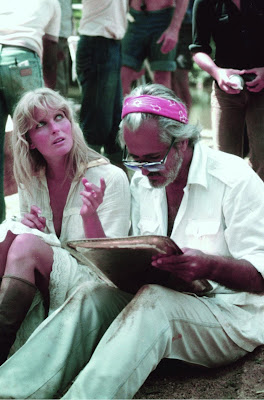
Sometimes the making of a movie is a more interesting story than the movie itself. There are legendary tales of runaway productions plagued by the clashing of egos, extravagant spending or unforeseen acts of nature. Such is the case with Tarzan, The Ape Man (1981), a vanity project directed by John Derek to promote the “talents” of his wife Bo Derek who, for a short time, was a sex symbol thanks to the critical and commercial success of 10 (1979). John managed to convince MGM to back his “vision” of the Tarzan story from Jane’s point-of-view. With Bo known more for her stunning looks than her acting chops, how could this go wrong? Plenty. The Dereks’ hubris knew no bounds as they managed to alienate the film crew, the Edgar Rice Burroughs estate, and the studio. Predictably, the movie was savaged by critics but people saw it anyway and it was a commercial success. The movie itself is incredibly inept on all levels. What is interesting is the story about how it got made with the Dereks exerting an unusual amount of control over the production.

The character of Tarzan was created by Edgar Rice Burroughs and first appeared in print in 1912. Son of a British lord and lady that were stranded on the east coast of Africa by mutineers, as an infant Tarzan was raise by an ape tribe. Once he became an adult, Tarzan crossed paths with Jane Porter, a young American woman who, along with her father and others, had been marooned on the same jungle area as Tarzan. The stories proved to be very popular and this led to adaptations in film, radio and television over the years. MGM bought the film rights in 1931 for the tidy sum of $100,000 and didn’t let it lapse for decades, much to the chagrin of the Burroughs family.

In 1980, actor-turned-director John Derek announced that he would remake the 1932 movie, Tarzan the Ape Man, promising a “sensual, erotic” update with his wife Bo starring (as Jane) and producing. Tired of being exploited by other filmmakers, she decided it was okay to be exploited by her husband and only make movies with him where she could do nudity on her own terms. For the Burroughs estate this was the last straw and they charged MGM with copyright infringement and sought unsuccessfully to block the release of the movie. They were upset that the Dereks’ project would steal the thunder from a long-delayed deal the estate had with Warner Brothers to make an officially-approved $15 million adaptation. The Burroughs family lost on both counts and filming went ahead as scheduled.
At the time, Bo said that their intention was to tell a story “that was bigger than life – something with the magic and fantasy that 10 had been. We wanted the story to be corny, romantic and more absurd than 10.” If the final product is any indication, they were successful in their goal. According to Bo, it was John that came up with the idea of telling the story from Jane’s perspective instead of Tarzan’s: “She has the perfect male who can’t talk, isn’t sophisticated enough to think he is superior to her and doesn’t have any credit cards.” John acted as his own hype man: “We are putting ourselves on the line in this one, arrogantly saying, ‘We know best and we can do it better.’”

After looking at the 1932 movie, famously starring former Olympic swimmer Johnny Weissmuller, the Dereks realized that “we didn’t need to change anything to suit our idea: it really had been Jane’s story all the time.” They set about writing the screenplay with Gary Goddard, known more for his work on theme parks, who wrote it in two weeks. In a controversial move, the resulting script reduced Tarzan’s dialogue to a few grunts (he gets even less than that in the finished movie). The Dereks went back to Burroughs’ stories for inspiration, claiming that no one could have possibly taught Tarzan to speak English with his parents dead and raised by great apes.

After the financial success of 10, MGM wanted to get in the Bo Derek business and agreed to finance John’s vision for a new Tarzan movie. Right from the get-go the Dereks asserted their authority when they refused the studio’s offer to shoot the movie in a Hollywood safari park. They told the studio that they “would not film in a jungle Disneyland.” In June 1980, the Dereks spent two weeks scouting locations up the Amazon but found it “too dark and too dense.” Kenya was not right either as they couldn’t get close enough to the animals. They finally decided to film in Sri Lanka for the jungle, and the Seychelles Islands, 1,868 miles away, for the sea, the beach and the high cliffs they wanted. Understandably, the studio balked at expensive location shooting but according to John, “’We’ll leave the country and shoot the movie in some faraway place and John will direct and everyone can shut up.’”
The Dereks flew out to Sri Lanka on January 12, 1981 with a film crew of 23, a lion named Dandi, an orangutan known as C.J., three chimpanzees, two Irish wolfhounds and an 18-foot python they recruited from Thailand. Lee Canalito, a 27-year-old boxer-turned-actor standing 6’4” tall and weighing 280 pounds, was cast as Tarzan. His claim to fame was appearing as Sylvester Stallone’s brother in the ill-fated Paradise Alley (1978).

Problems occurred right away when the Dereks foolishly decided to spend their first night in a tent in the jungle instead of the hotel with the crew in order to get in the spirit of the story. They were soon driven out by mosquitos. They should’ve taken this as an omen. For the shoot, the Dereks ordered 150 elephants and on the first morning they only needed two. The problem? No one had ordered the elephants and it would take a week for them to walk to the location.

By their own admission the Dereks berated their crew who weren’t impressed with Bo and John’s management skills. She said, “I knew some of them weren’t going to last very long – and they didn’t. So every day, as people goofed or didn’t do their jobs – I said, ‘Walk!’ And they did.” Bo was flexing her producer’s muscle. “It was the first time dealing with people twice my age who I had to fire. They had made dozens of films. I hadn’t. But getting rid of someone wasn’t really difficult.” In the first 15 days of principal photography, Bo fired 15 of the 23 crew members, including Tarzan himself. According to Bo, “Lee had a beautiful quality with a Michelangelo face but he wasn’t the proud lord of the jungle.” When he was cast, Canalito was overweight and the Dereks had sent him to the gym to get fit. In the end, “when we saw the rushes; we realized there just too much jiggling.” When MGM cabled the Dereks asking what replacements they needed, they replied, “None. We’ll do it all ourselves.” Again, how could this go wrong?
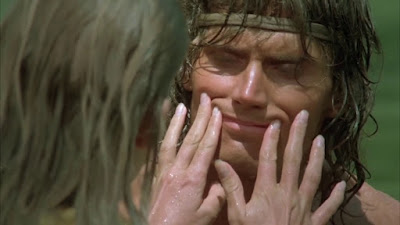
Sam Jones, who appeared in 10 as Bo’s husband, was briefly considered to be Tarzan. After auditioning by swinging from a tree on a rope at a local Hollywood park, 26-year-old Miles O’Keeffe was cast as Tarzan and flown out with 24-hours notice. The 6’3”, 200-pound man was a former football player and psychology major, which of course made him the perfect person to play Tarzan. He arrived in Sri Lanka, drove four hours through the jungle and started filming immediately.

In the wake of all the crew firings it became a family affair with Bo’s mother, who had come along as a hairdresser, put in charge of wardrobe and makeup. Bo’s sister Kerry helped as an assistant director. Even Bo’s best friend was given a job. The remaining professional film crew ended up taking on ten jobs each. According to the rookie producer everything was going well: “As people went we had more fun, the problems were easier and we were getting better things on film.” As anyone who has seen the final product, this comment is more than a little surprising and speaks volumes of the couple’s hubris.

If the Dereks had problems working with their crew, they didn’t have much luck working with animals either. The lion they brought over was the wrong one and he didn’t like working with chimps and the elephants. Apparently, he didn’t like working with humans either. During the scene where Tarzan tries to drag Jane out of the water and onto the beach, Dandi’s leash broke. The animal lashed out at Bo with his paw, hitting her on the left shoulder which sent her sprawling back into the water. He then hit her on the right hip but slipped before he could strike again. Fortunately, the trainer and the rest of the crew intervened and subdued the lion.
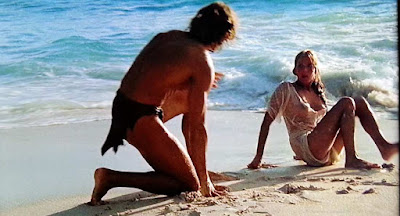
Bo did get along with the orangutan but he got jealous when Tarzan started making love with Jane. The same could not be said about the chimps. “They may look fun but they are pigs to work with,” John said. The elephants were also a handful. The younger ones wanted to play while the larger ones wanted to fight. During filming they had to be tied to large trees that couldn’t uproot. Initially, the python was afraid of Bo but as filming progressed it became friendly and even tightened himself around her body during a scene. “I didn’t much care for the wrestling with him in the water because then he would slide his body between my legs and thighs.”

Tired of being judged solely on her looks, Bo wanted to be taken seriously – hence taking on the producer mantle. She wore many hats during the production, claiming to have dealt with money problems, checking the number of packed lunches that were needed and even acted as script girl for a while. She also found out the local caterers were charging too much for lunch and fired them. They were replaced by a messenger boy who was cheaper. John said of his wife, “Audiences will come to see something that has been invented by Bo. She is a happening, not really an actress.” Half of that sentence is accurate.

The production incurred more headaches when moving from Sri Lanka to the Seychelles Islands. Lions need jumbo jets to travel in. The only plane available was a 707 so John put the animal on a 747 out of Seychelles via London – a round trip of 11,663 miles. Filming mercifully wrapped on March 11, 1981. Miraculously, the movie finished on schedule (48 days) and on budget ($6.6 million).
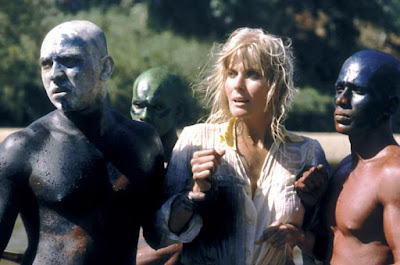
The controversy continued as the Burroughs estate took MGM to court claiming that “Tarzan is nothing more than a spear carrier,” and Jane, “in sexual matters she is now the aggressor in a sense…The walking by Jane topless for long stretches seems pervasive.” The estate also objected to the “suggestion of sexuality” between Jane and her father and the “rubbing of Jane’s breasts” that took place in a scene where she was “leaning on all fours” in preparation for being raped by the Ivory King (Steve Strong). The estate also objected to a moment where a chimp “actually kisses her breast” and a scene at the end of the movie in which Tarzan, Jane and an orangutan “are almost simulating sexual activity.” The Burroughs estate claimed that the original 1931 license meant that all Tarzan films were intended for family entertainment and MGM violated the deal by allowing extensive nudity in the Dereks’ movie.

The judge presiding over the case screened the 1932 film, a 1954 remake with Denny Miller and ordered cuts in four sequences. The Dereks refused to make them so MGM did and resubmitted the movie to the judge who demanded additional cuts. He was finally satisfied after three minutes and six seconds were removed. An outraged John proclaimed, “Tarzan should be so lucky as to be made by us.” He fumed about the cuts: “Ninety percent of Bo’s nudity will be cut out. If that’s not censorship, I don’t know what is.” In protest, Bo went on Los Angeles television to announce that she and John were giving up their 10% of the gross and promised to contribute the money to saving gorillas endangered by poachers in Zaire.

It is safe to say that film critics were not kind to Tarzan, The Ape Man. Roger Ebert gave the film two-and-a-half out of four stars and wrote, "The Tarzan-Jane scenes strike a blow for noble savages, for innocent lust, for animal magnetism, and, indeed, for soft-core porn, which is ever so much sexier than the hard-core variety." In his review for The New York Times, Vincent Canby wrote, "To describe the film as inept would be to miss the point, which is to present Mrs. Derek in as many different poses, nude and seminude, as there are days of the year, all in something less than two hours. She is a magnificent-looking creature...However, as an actress she displays the sort of fausse naivete that is less erotic than perfunctorily calculated, in the manner of an old-fashioned, pre-porn-era stripteaser who might have started her act dressed like Heidi." The Washington Post's Gary Arnold wrote of John Derek's direction: "His approach to the mating of Tarzan and Jane is so revoltingly coy and his filmmaking style so inertly picturesque, like an arthritic imitation of The Black Stallion, that the movie is no more titillating than two hours of patty-cake."

After all the dust had settled, a bitter John called Hollywood “a hellhole,” claimed MGM “failed me,” said that the Burroughs estate was “arrogant and sue-happy,” the judge “made the Constitution a joke,” and felt that the press was “out to get us.” He had to feel, however, somewhat vindicated by the box office results as Tarzan made $36.5 million off a $6.6 million budget, but the damage had been done within Hollywood. Effectively burning his bridges, he made Bolero (1984) for Cannon Films once again starring Bo, which, in addition to being mired in production problems, was a critical and commercial flop. They made one more film together – Ghosts Can’t Do It (1989), which effectively killed off his filmmaking career. Bo continues to act in movies and T.V. with her most significant role as Brian Dennehy’s trophy wife in the Chris Farley/David Spade comedy Tommy Boy (1995).
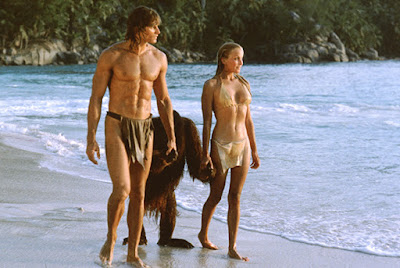
The Burroughs’ estate got their classier, more faithful Tarzan film three years later with the unwieldly titled, Greystoke: The Legend of Tarzan, Lord of the Apes (1984), starring then-unknowns Christopher Lambert and Andie MacDowell, which, despite its talent behind the camera (director Hugh Hudson, screenwriter Robert Towne & make-up effects artist Rick Baker), didn’t exactly set the box office on fire. Hollywood continues to try to adapt Edgar Rice Burroughs’ most famous creation with John and Bo Derek’s version serving as a cautionary tale of giving too much creative control to filmmakers that clearly can’t handle it.


SOURCES

Harmetz, Aljean. “Tarzan was the Star Once, And Not Bo Derek.” The New York Times. June 10, 1982.

Hawn, Jack. “Tarzan Publicity a Blessing for Some.” Los Angeles Times. July 25, 1981.

Kelly, Sue & David Wallace. “Too Wild?” People. July 27,1981.

Lewin, David. “Bo Derek Takes to the Jungle to Bring Tarzan Back Alive.” The New York Times. July 19, 1981.

Friday, February 24, 2017

20,000 Leagues Under the Sea

Jules Verne’s classic science fiction novel Twenty Thousand Leagues Under the Sea has captivated and intrigued filmmakers for decades, from George Melies’ silent short film in 1907 to the 1997 made-for-television movie starring Ben Cross. The most well-known cinematic adaptation is the 1954 Walt Disney action/adventure classic starring James Mason and Kirk Douglas. I distinctly remember watching this version as a child at a friend’s house and being absolutely terrified by the giant squid battle that occurs at the film’s exciting climax. The film has fascinated me ever since.

It is 1868 and tall tales circulate about a sea monster attacking ships in the Pacific Ocean, disrupting shipping lanes and creating fear and apprehension among sailors. Not so with Ned Land (Douglas), a brash harpooner with an interest in sea monsters. His introduction tells us all we need to know about the man as he walks through town with two beautiful women on each arm and scoffs at two men warning others about the sea monster. Ned gets into a fight with them and is dragged off to jail by the police.

Professor Pierre Aronnax (Paul Lukas) and his assistant Conseil (Peter Lorre) are trying to get to the Orient but their plans are scuttled by the threat of the sea monster until a representative from the United States government offers them transportation if they join an expedition hoping to find it and prove or disprove its existence. Intrigued, he agrees and Ned tags along, eager for adventure.

They search for three months and find nothing. As luck would have it, one night they encounter a ship wreck with no survivors, which fuels rumors of the sea monster among the crew. Sure enough, the “monster” surfaces, evades their cannon fire and proceeds to cripple the ship with ruthless efficiency. Ned, Aronnax and Conseil are thrown overboard and left to fend for themselves.

They happen upon the “sea monster,” which is actually a man-made iron-riveted submarine known as the Nautilus. They board it and find the ship deserted so they go exploring. The interior is a fascinating mix of dirty iron and rivets with Victorian opulence that has inspired countless Steampunk books and films. The sub’s crew returns after performing an underwater funeral service for one of their own and intercept our heroes before they can escape. They meet Captain Nemo (Mason), the cultured and quite mad captain of the vessel. The rest of the film plays out Aronnax, Conseil and Ned’s attempts to derail Nemo’s plans as neither guests nor prisoners.

Not surprisingly, the underwater sequences are among the highlights of 20,000 Leagues Under the Sea, like when the sub crew take Ned, Aronnax and Conseil out for a “hunting” expedition and the bottom of the ocean floor comes to life with all kinds of creatures big and small, adding to the wonder of this sequence. Aronnax sums it up best: “A strange twilight world opened up before me and I felt as the first man to set foot on another planet, an intruder in this mystic garden of the deep.” Nemo and his men farm the bottom of the ocean for their food. This sequence takes on a quasi-documentary feel as we observe Nemo and his men at work, living off the land.

The centerpiece of 20,000 Leagues Under the Sea is the legendary giant squid attack. After having narrowly survived an attack by a warship that saw the Nautilus take on water and nearly sink to uncharted depths, they are attacked by a giant squid. It’s all hands on deck – literally – as Nemo, his crew and Ned fight the sea creature during a violent storm at night. It is a harrowing sequence that director Richard Fleischer expertly squeezes every ounce of tension out of with white knuckle intensity.

James Mason plays Nemo as an erudite man that believes what he’s doing is right as most men of his kind do. He is as comfortable walking around his sub in a smoking jacket and cigar as he is in a deep diving suit harvesting the sea floor. He’s more than a mad genius but also an accomplished musician, playing the organ while the Nautilus travels silently along the ocean floor, which creates an ominous atmosphere. He doesn’t care for the chaos on land, full of people wanting to control one another, while he only feels truly safe on the ocean floor. There’s certainly a method to his madness as he uses the Nautilus to sink a ship with components that will be used for war and whose crew employ slaves to obtain it. As the film continues, Mason deftly shows Nemo gradually coming apart at the seams, consumed by his own desire for vengeance.

Kirk Douglas is well cast as Ned, the rascally rogue full of charm. He doesn’t have any set plan in life, content to go where the wind blows, much to Aronnax’s chagrin who tries to develop a plan to stop Nemo. Ned is a wild card, an unpredictable force of nature that confounds the professor and infuriates Nemo. Douglas delivers one of his trademark physical performances full of energy and passion.

Paul Lukas does a superb job of showing Aronnax’s initial admiration of Nemo, which turns to disgust when he sees first-hand what the man is capable of – murdering an entire boatload of sailors – and yet also feels compassion for the man after hearing about his tragic past. Lukas plays the professor as a conflicted man that believes he can reach Nemo but in the process becomes infected by the man’s mania.

Harper Goff was a designer that had worked as a sketch artist for Warner Bros. in the 1930s. By the late 1940s, he had become a freelancer, creating illustrations for various magazines. In 1952, he met Walt Disney while in London, England and he recruited the artist to help design a family park that would be called Disneyland. Not too long afterwards, Disney asked Goff to go to the marine lab at the California Institute of Technology to see footage of marine life that Dr. McGinnity had shot with the notion that it might be integrated into an undersea film for the True-Adventure series.

Goff had been a fan of Jules Verne’s Twenty Thousand Leagues Under the Sea since he was a child. While developing a storyboard for the McGinnity footage, he visualized a sequence for the film involving two divers on the ocean floor and made a series of sketches. Disney saw the sketches and told Goff that he also loved Verne’s classic novel and had contemplated making a film version. Unfortunately, MGM owned the rights at the time and Disney didn’t want to buy them. Later, he and Goff found out that the studio had sold the rights and this, along with Goff’s impressive storyboards, changed Disney’s mind and he acquired the rights.

Originally, 20,000 Leagues Under the Sea was envisioned as a full-length animated film with Goff placed in charge of production development. His first job was to design Captain Nemo’s submarine, the Nautilus. As per the source material, he had to design a vessel that looked like a sea monster and could be strong enough to ram ships at high speed and not take on too much damage itself. Disney didn’t like Goff’s initial design and felt that it should look sleek and futuristic. Goff argued that the Nautilus “was built hastily and roughly at Nemo’s secret base. The only available material was the rough iron that was salvaged from wrecks.” Goff eventually won the argument.

By late fall of 1952, Disney decided to abandon the animated format in favor of live-action because it would be cheaper and not take as long to make. In addition, his other live-action films were modestly budgeted and performed well at the box office. For 20,000 Leagues, a 60 x 125-foot indoor tank was built for $300,000. Many of the water effects scenes were shot there, like the famous giant squid battle.

To write the screenplay, Disney hired Earl Felton and Richard Fleischer, a duo that had success on a few B-movies over at RKO, but it was the Disney-esque comedy The Happy Time (1952), starring one of his contract actors Bobby Driscoll, that convinced Disney they were right for the job. The first challenge was creating a story out of a novel whose American translation didn’t have one, “only a series of incidents,” Fleischer said. The first thing he and Felton did was flesh out Nemo’s background and his philosophy on life, which would then drive the story. They obviously couldn’t include everything from the novel and picked what they felt was the most memorable incidents – the cannibal attack, the giant squid battle and so on. Disney reviewed their work and added moments of levity, like the pet seal, to alleviate the often dark and violent tone.

When it came to the casting of the pivotal role of Captain Nemo, Disney approached acclaimed actor James Mason who actually turned the studio down a couple of times because he was afraid it would be a children’s film with Nemo “being played down to a juvenile level.” He read the script and thought it quite good. He also felt that director Fleischer would provide an “adult point of view,” and decided to do it even if he wasn’t sure how to play the part. He found himself drawn to Nemo’s “cause and individuality…He wanted to build the world according to his own specifications, rather than the specifications of the current powers. This, I thought, would be interesting to deal with.”

In spite of having a newly built indoor tank, Disney felt, for reasons of realism, that the diving sequences should be shot on location with only one sequence completely filmed in the indoor tank. Fleischer and Goff scouted for a good underwater location in the Bahama Islands with its clear water and superior reefs. They found such a location and the production, consisting of 20 tons of equipment and a crew of 54 people, were transported there at considerable cost. Principal photography began on January 11, 1954.

After eight weeks of location filming, the main unit returned to Burbank, California for four months of principal lot photography. For the giant squid attack sequence, sculptor Chris Mueller (The Creature from the Black Lagoon) and mechanical effects expert Robert A. Mattey (King Kong) created the creature with the former designing its body and the latter bringing it to life. The sequence was originally shot at sunset and after a week of filming, Fleischer stopped because the footage looked too artificial with the effects of the squid being visible and the deck of the Nautilus looking like an obvious set. Second unit director James C. Havens took over and decided to shoot the sequenced in a rainstorm, which would solve their problems and be more exciting. It also cost Disney $200,000 and a six-week delay in shooting.

While Douglas and Mason were well-behaved on set (they both had a reputation for being mercurial performers), Paul Lukas clashed with Fleischer. Initially, they got along fine but according to the director, the actor “was going through some kind of crisis” and had trouble remembering his lines. He was good friends with co-star Peter Lorre but by the time principal photography had ended on June 19, 1954, they were no longer talking to each other. Lukas even threatened to sue Disney, Douglas and Fleischer!

In the past, Disney had his films released through RKO who had taken a large cut of their grosses at the box office. With 20,000 Leagues, he created Buena Vista, distribution subsidiary that would lower the costs and give total control to the promotion of his films. A preview was shown on December 9th to several hundred exhibitors in New York City. Everyone loved it, sensing it would be a hit. Two weeks later, it opened in 60 theaters across the United States to generally positive reviews and performing well at the box office but was also Disney’s most expensive film at that time - $9 million!

Ostensibly, 20,000 Leagues Under the Sea is a rousing action/adventure film. It also acts a warning of the dangers of man’s inclination for war and the futility of such pursuits. “There is hope for the future. And when the world is ready for a new, better life – all this will someday come to pass in God’s good time,” are Nemo’s sage words that he utters towards the end of the film and then again at the very end, resonating even more powerfully after everything that has happened.


SOURCES


Frazier, Joel and Harry Hawthorne. “20,000 Leagues Under the Sea.” Cinefantastique. May 1984.

Friday, December 18, 2015

King Kong

Considered to be one of the greatest movie monsters of all time, King Kong has enjoyed many cinematic incarnations, most recently Peter Jackson’s lavish love letter to the 1933 classic. There is something inherently and powerfully mythic about Kong that inspires filmmakers to revisit the monster time and time again but none have managed to best the original despite innovations in special effects technology. Why is that? At its heart, King Kong (1933) is a cautionary tale about the hubris of man and the dangers of interfering with the laws of nature.

Carl Denham (Robert Armstrong) is a fearless adventurer/filmmaker who travels all over the world looking for dangerous animals to capture on film. He represents said hubris and sums up his larger than life ambitions quite well early on when he tells his backers, “I’m going out and make the greatest picture in the world – something that nobody’s ever seen or heard of. They’ll have to think up a lot of new adjectives when I get back.” Denham was the James Cameron of his day.

This time around, however, he has to have a woman in his movie because the public wants romance. He finds his leading lady, Ann Darrow (Fay Wray), on the street, caught trying to steal a piece of fruit, and is struck by her beauty. She is just desperate enough to accept Denham’s vague yet persuasive pitch. Pretty soon, everyone is on board for a long cruise to a distant and exotic land. On this latest excursion, Denham has not disclosed to the crew of the Venture where they are going or for how long.


Once the ship reaches a certain point, Denham reveals his mission to the Captain (Frank Reicher) and the first mate, Jack Driscoll (Bruce Cabot): he plans to find an island not located on any map. Its denizens are far removed from civilization and worship a god known only as Kong, a mythic creature he hopes to find on the island and photograph. Denham describes him as “neither beast nor man. Something monstrous. All powerful. Still living, still holding that island in a grip of deadly fear.” It’s a tantalizing teaser that makes us want to know more.

The first 20 minutes of King Kong do an excellent job of establishing the main characters and their relationships with each other while creating an air of mystery about their destination. Denham remains elusive about his intentions until the Venture arrives at specific coordinates. They find the island and it is revealed in an atmospheric sequence that begins with a memorable shot of the ship enshrouded in fog. The closer they get, the faint sound of tribal drumming can be heard, which effectively creates a foreboding mood. The establishing shot of Skull Island is incredibly evocative and is an impressive sight to behold, capturing an eerie tone that is quite thrilling to behold.

Once Denham and his crew land on the island, they run afoul of the natives who offer Ann as a sacrifice to Kong, a giant ape. It is a fascinating snapshot of the times – the thinly-veiled xenophobia as Denham thinks he can fast talk his way through negotiations with the village chief, as if this place is just another location that is there for him to use. From this point, King Kong becomes a rousing action/adventure movie as Denham and company discover just how dangerous this island is as they encounter all sorts of lethal creatures that do a good job of thinning the away party’s numbers.


Peril lurks at every turn as Kong is forced to take out a Tyrannosaurus Rex in an exciting and fantastically-realized battle. The stop-motion animation is particularly impressive here – giving the knock-down, drag-out fight a visceral quality that is missing from Jackson’s movie with its heavy reliance on CGI re-imaging. There’s an almost tangible quality to the ’33 version that no amount of then-state-of-the-art motion capture work in Jackson’s incarnation can hope to replicate. The Kong effects still hold up after all these years and one marvels at how the big ape’s fur ripples in a given scene or how the filmmakers expertly cut back and forth from long shots of a stop-motion animated version to close-ups of his head crushing some hapless victim in his mouth or large hand or foot stomping someone that gets in his way. Conversely, the pained expression on his face when he realizes that he’s bleeding from machine gun fire during the film’s climactic battle is particularly heartbreaking.

Robert Armstrong plays Denham with the kind of can-do, might-makes-right, self-made man qualities that would be popular in many 1980s action movies. For example, once Ann is captured by Kong, Denham and Jack go rampaging through the jungle needlessly killing a dinosaur after they’ve already subdued it with gas grenades. Denham represents naked ambition – a man that will risk life and limb to get what he wants even if it means taking an impoverished woman off the street and convincing her to make a film on an exotic land far away. She’s starving and has nothing to lose, which makes her decision an easy one. He wants to capture the giant ape so badly that he even considers using Ann as bait. All he sees is dollar signs – fame and fortune no matter the cost.

Fay Wray is excellent as Ann, a woman drawn to Denham’s expedition as a way to escape her poor living conditions only to become a part of something that she hadn’t bargained for in her wildest dreams (or nightmares). Her screen test for Denham does a nice job of showcasing Wray’s acting chops as Ann has to react to her director’s instructions. The actress is so convincing that she has the ship’s crew invested in her performance. Right from her first on-screen appearance, we empathize with Ann and care about what happens to her, which is important when she arrives on the island and is immediately put in peril. Wray also has the challenge of acting opposite Kong and it is her reactions that help flesh out the creature and make him sympathetic.


Kong’s “inspection” of Ann is that of an adolescent discovering women for the first time – he’s inquisitive and tentative, intrigued by what she wears and even how she smells. It is a fascinating scene in large part because it gives Kong some depth – he’s not just some dumb monster rampaging through the jungle but rather a curious creature fiercely protective of Ann.

The movie was remade in 1976 and again in 2005 by Peter Jackson who re-imagined it as an epic, mega-budget, fanboy love letter to the original that inspired him to become a movie director in the first place. Clocking in at double the running time of the ’33 version, Jackson’s movie is an ambitious juggernaut that, like his The Lord of the Rings trilogy, is ambitious in scale and scope and yet still has that personal touch.

Ann Darrow (Naomi Watts) is a struggling Vaudevillian actress whose venue has been closed down due to poor attendance. The country is in the grips of the Great Depression and times are tough. Carl Denham (Jack Black) is a filmmaker working on an adventure film that is in danger of losing its funding. However, he has come into the possession of a map to a mysterious island that may save his film. Denham even tricks up-and-coming screenwriter Jack Driscoll (Adrien Brody) to stay on board so that he can finish the film’s screenplay. In desperation, Denham steals the existing cans of film and assembles a cast and crew (including Ann) and sets sail for the island on his map.


Jackson follows the story structure of the original quite faithfully but fleshes out each segment so that we spend more time in New York City/on the boat, Skull Island and back in the city. He takes the elements from these segments and amplifies them. For example, Kong doesn’t fight a Tyrannosaurus Rex, he fights three of them! Jackson also goes to great lengths to flesh out the main characters and show what motivates them, developing their relationships. By the time we get to the action sequences we know what makes them tick, what is at stake and what they have to lose thereby making the action sequences more compelling.

He still manages to think like an independent director by inserting whimsical interludes, like those early on in the film between Denham and his assistant (Colin Hanks). It is these details that are just as important as capturing Manhattan circa 1930s. Jackson thinks on a macro and micro level unlike Michael Bay who works on a grandiose level.

The attention to period detail is incredible. ‘30s era Manhattan is faithfully recreated with the extensive use of warm, golden lighting being quite inviting. There is a scene where Denham convinces Ann to join his expedition that takes place in a diner, which looks like something out of an Edward Hopper painting. Another example is the glowing, warm light that comes out of the portholes of the Venture in the background of a scene that suggests warm life and a more intimate feeling. There is a connection between the characters and all the elements in the scene.


Jackson is also a master at creating the kind of atmospheric worlds in his movies that immerse the viewer completely. The places the characters inhabit have that lived in look and an authenticity that gives this world texture. The lighting in this film is impressive with nods to Classic Hollywood cinema. For example, Naomi Watts looks absolutely radiant in the initial scenes on the boat as Jackson manages to top the visual splendor of James Cameron’s Titanic (1997). In sharp contrast is his depiction of Skull Island as a horrifying, foreboding place, a harsh environment filled with jagged rocks and inhabited by nightmarish natives. There is something very unnatural about them and it’s in their wild and crazed eyes.

The movie takes us deeper into the island as the rescue party sets out to find and bring back Ann from the clutches of Kong. This is an action-packed section that manages to top anything seen in the first three Jurassic Park movies. The Brontosaurus stampede, for example, is intense and exciting as is the Tyrannosaurus/Kong rumble in the jungle.

Jackson is able to create almost unbearable amounts of tension out of every exciting chase as the rescue party is picked off by Kong and other nasties on Skull Island. He also gently guides us into terror as we go from the whimsy of the Ann-Jack romance to the tension and an unease of the fog-enshrouded, uncharted waters of the island. Its first appearance, cued by ominous music and then the sight of the massive wall appearing out of the fog is impressively staged.


At the time, Kong was arguably the most realistically CGI rendered character ever put on film (even topping Jackson’s previous achievement with Gollum from the Rings films) and this is due in large part to Andy Serkis providing the basis for the ape’s movements and the realistic expressions on the animal’s face. For example, there is a scene where Darrow performs for him and we see his mood go from anger to bemusement and back to anger when she stops. We see all of these emotions play out on Kong’s face in completely believable fashion. It really is an astounding achievement as over the course of the movie we begin to empathize with Kong just like in the original.

I’m of two minds when it comes to this cinematic incarnation of Kong. On the one hand, I appreciate the skill and artistry that Jackson instills in every single frame of his movie, but on the other hand, it still feels like nothing more than a really expensive fan letter to the original with the mandate that bigger is better. That being said, it’s a really well-made fan letter to the original.

The ’33 King Kong version is ultimately a tragic monster movie as the poor ape is taken from his natural habitat and exploited for profit only to meet an untimely demise amidst the concrete jungle of New York City. The real villain is Denham whose lust for greed results in the deaths of many people during the course of Kong. The movie is certainly a stinging indictment against the hubris of American culture imposing itself on foreign civilizations. Denham and his landing party interrupt an important ritual thereby offending the natives and they don’t expect any kind of reprisals? And then they capture Kong and exploit him like some kind of freak show for the rich and privileged to gawk at in amazement. No wonder Kong gets mad, breaks free and trashes New York City in an attempt to be alone with Ann, the woman he has fallen in love with. By the end of the movie, Denham has a lot of blood on his hands and a lot to answer for.


What makes Kong such a compelling monster that still beats all the CGI creations of today is that his creators were able to impart a personality by giving him such an expressive face that is able to convey a wide range of emotions – anger, curiosity, pain and even love. It is really a shame that most people who were raised on CGI effects laden movies probably won’t appreciate the artistry that went into making Kong and laugh at the dated effects. For those of us who grew up in the pre-CGI days, weaned on glorious Ray Harryhausen classics like Jason and the Argonauts (1963), Kong still thrills. It is also one of the best action/adventure films ever made.