"...the main purpose of criticism...is not to make its readers agree, nice as that is, but to make them, by whatever orthodox or unorthodox method, think." - John Simon

"The great enemy of clear language is insincerity." - George Orwell
Showing posts with label drugs. Show all posts

Friday, May 27, 2016

Less Than Zero

In 1985, Bret Easton Ellis’ debut novel Less Than Zero was published when he was only 20 and still in college. Its debauched tale of bored and hedonistic Los Angeles rich kids became a hit with the novel selling millions of copies. The Village Voice included him as part of a new generation of writers labeled the “literary brat pack” along with Jay McInerney (Bright Lights, Big City) and Tama Janowitz (Slaves of New York). It didn’t take long for Hollywood to come calling and the 1987 film version proceeded to neuter the source material by imposing a strong anti-drug message and toning down the sexuality to the point that Ellis hated the film, insisting that the end result resembled his novel in name only. Over the years, the film has transcended its source material and works best as a snapshot of the times and the social milieu it depicts.

Six months after graduating from high school, Clay Easton (Andrew McCarthy) returns home from college to L.A. for Christmas and is reunited with his ex-girlfriend Blair (Jami Gertz) and his best friend Julian (Robert Downey Jr.). He arrives to the strains of “Hazy Shade of Winter” by the Bangles, which instantly transports us back to the mid-1980s. A lot has happened since graduation – Clay caught Blair and Julian having sex, which put an understandable strain on their friendship.

Clay attends a party that instantly transports one back to the ‘80s as he’s immediately greeted by a wall of televisions, neon, big hair, jackets with shoulder pads, and skinny ties. The first significant person he encounters is Rip (James Spader at his most James Spader-ish), a drug dealer Clay used to buy cocaine from. The film comes to life when James Spader first appears and exudes the kind of creepy charm that made him the go-to guy to play douchebag preppies in films like Pretty in Pink (1986) and The Rachel Papers (1989). He oozes insincere charisma and then as suddenly as he appears, Rip disappears back into the party.

Spader has another nice scene with Downey where Rip reminds Julian that he owes him $50,000, and the latter, the eternal hustler, gets some coke from the former and promises to pay him back only to take off. Once alone, Spader shows Rip thinking and then looking back at where Julian had been. At that moment, it isn’t hard to imagine that Rip is contemplating his next move, figuring out how to punish Julian. Spader plays this scene so well, keeping his emotions contained under an icy exterior. No one does calm, reptilian menace quite like Spader and it’s in the way he talks and walks as well as how he carries himself that is unsettling in an understated way.

Clay and Blair are reunited in a room that has been production designed to death (in a good way), resembling Antarctica, complete with fake icebergs and penguins. She is visibly upset and tells Clay that Julian is in trouble. She won’t give specifics except to say that he randomly disappears and is wasted all the time. Watching this scene reminds one that 1987 was the height of Jami Gertz’s hotness. She looks beautiful and also conveys the vacant jittery nature of her cokehead fashion model character. The actress gets her moments, like when she watches Clay dancing at a party and the camera gradually dollies in on her as she looks away, tears streaming down her face with an expression that seems to say, “How did I get here?” It’s a powerful bit of acting and a nice visual snapshot of her character.

Clay finally encounters Julian who is clearly coked to the gills, which Robert Downey Jr. conveys so well, instilling his character with a wide-eyed intensity and head-bobbing restlessness. Judging from the menacing look Rip gives Julian from across the room, he is in some kind of trouble with the drug dealer and director Marek Kanievska conveys it visually, focusing on the facial expressions of Downey and Spader to suggest the bad blood between them.
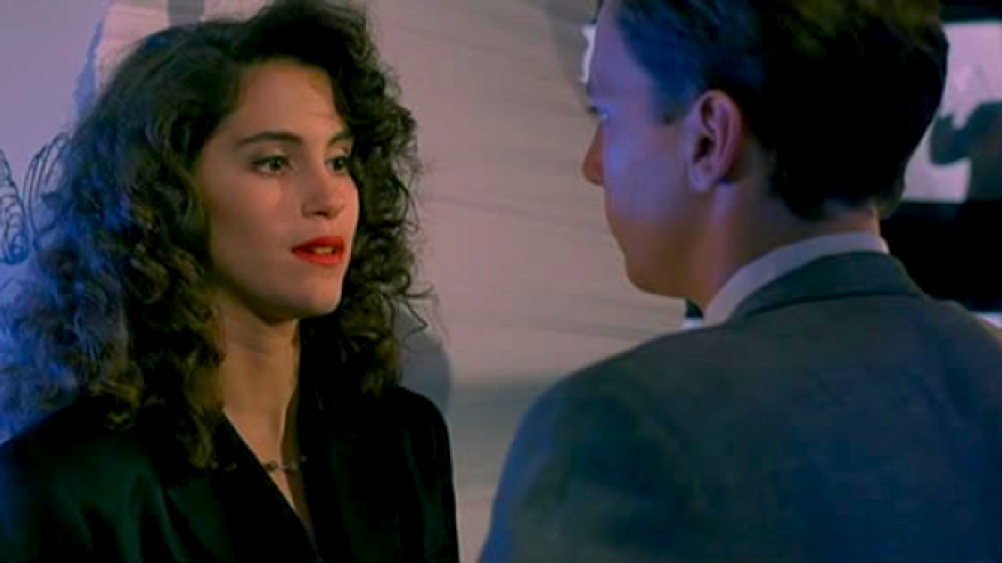
At one point Clay tells Blair, “Well, you fucked up, you look like shit but hey, no problem all you need’s a better cut of cocaine…Are we having fun? Is that what we’re doing? Let me know – it doesn’t feel that way.” And so begins the overly preachy, “Just Say No” segment of Less Than Zero as it becomes less interesting than what came before. Thank goodness Downey pops up to give it a much-needed jolt of reality as Julian hits rock bottom in a disturbing sequence that anticipates Requiem for a Dream (2000) by a few years and without all the flashy editing and cinematographic pyrotechnics.

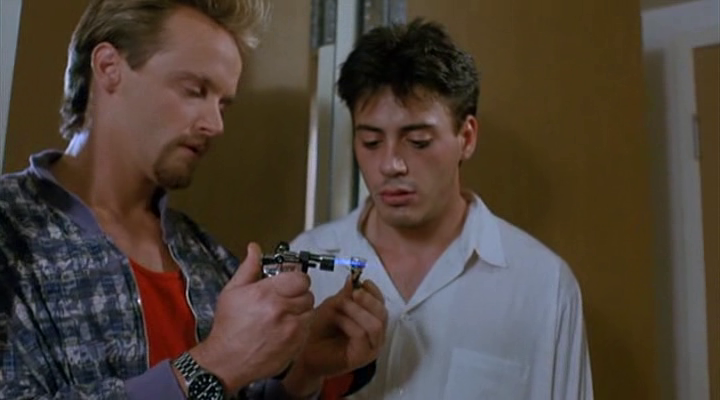
Robert Downey Jr. is a revelation as Julian in what was his first substantially serious role. He demonstrates the capacity for having no vanity as an actor, which is evident in a scene where we see Julian smoking crack and he’s a sweaty mess. There’s no dialogue but through body language and facial expressions, the actor conveys his character’s self-destructive downward spiral. Downey’s Juilan is in a clammy, bloodshot state with his rumpled designer clothes, unshaven look and pretty vacant eyes. The actor wisely doesn’t always play it with manic bravado and has quiet moments where one can see that Julian is aware of his mounting problems but is in so deep he’s unable to get out from under it. Downey nails the absolute desperate depths that his character is willing to go in order to feed his drug habit, which includes stealing Clay’s mother’s jewelry and allowing Rip to pimp him out in order to pay off his debt.

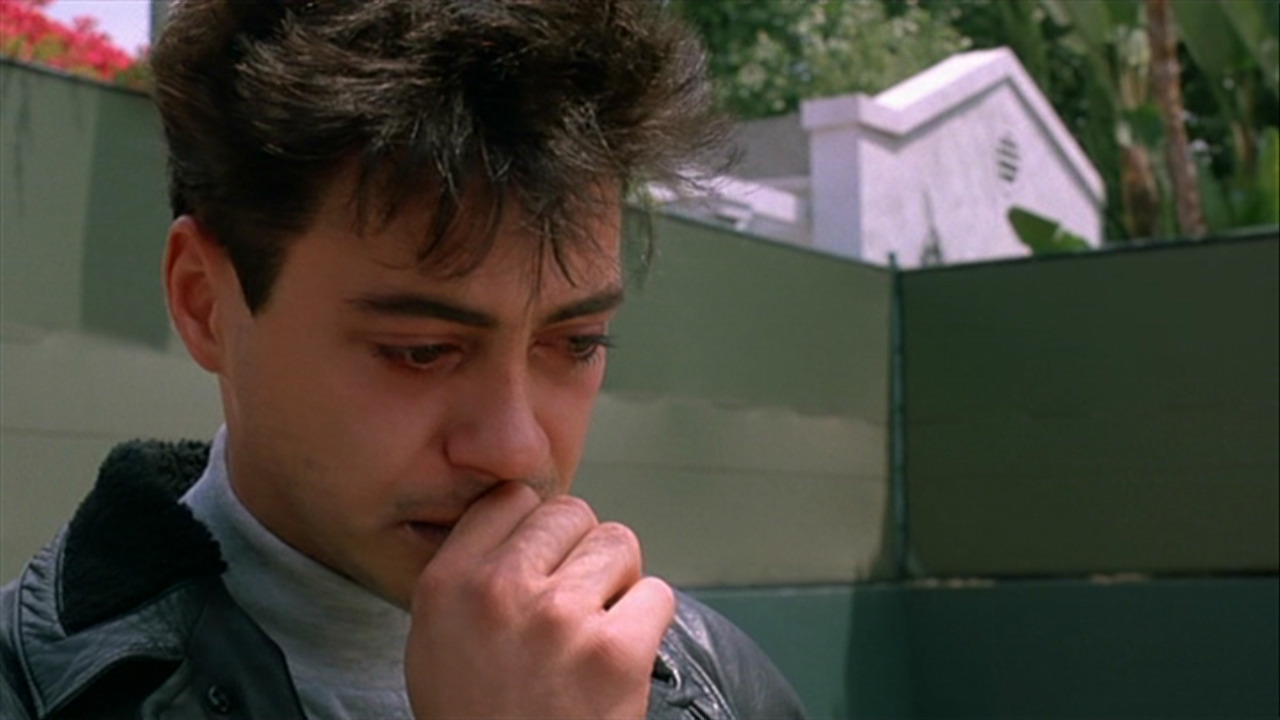
Less Than Zero was an important film for Downey in that it acted as a transition from silly teen comedies to more dramatic fare. For the first time, he showcased some formidable acting chops. This is evident in the last scene Julian has with his father (Nicholas Pryor) as the former makes one last plea to the latter, asking if he can come home. We get an idea of the damage he’s done to his family. Julian seems sincere but one gets the feeling that he’s done this before. His father finally agrees in an emotionally charged moment but it is ultimately too late. Julian has burned too many bridges and people like Rip who are coming to collect. It is a tough scene to watch because it feels so raw and real. Downey physically transforms himself into a pale, disheveled mess of a human being who is gradually self-destructing in front of our eyes. It is a harrowing performance that transcends this flawed film.

Andrew McCarthy is saddled with the thankless role of the straight-laced protagonist. Any of his character’s edges from the novel have been completely sanded down and the actor does the best he can with the material he’s given. Clay is the audience surrogate and our entry point into this exotic world. McCarthy plays it close to the vest and portrays Clay as someone who keeps his feelings in check – the epitome of west coast cool. The actor uses his expressive eyes to convey emotions that reside just under the surface, usually in the presence of Blair.

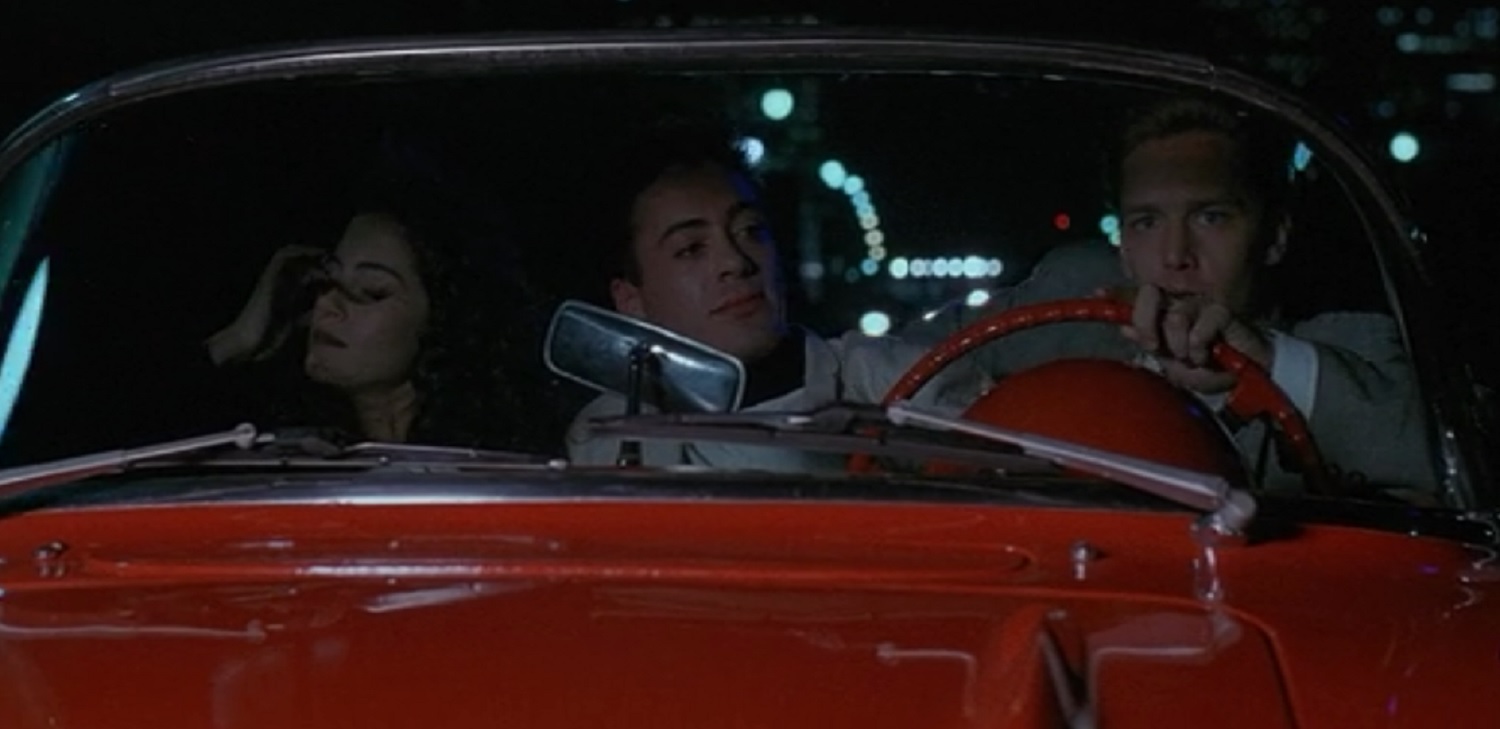
Less Than Zero portrays the parents of these kids in just as unflattering a light, whether it is Julian’s unforgiving father or Clay’s father (Tony Bill) who plays boring classical music on the piano while his perfectly coifed wife (Donna Mitchell) looks on approvingly. It’s all so elegant and boring – no wonder these kids are losing themselves in drugs. The glossy look of the film is complemented by stylish camerawork courtesy of Edward Lachman (The Limey) and so we have the camera gliding over a swimming pool at night as Julian curls up nearby, his sickly pallor looking even worse at night, reflected off the water.

Producer Marvin Worth bought the film rights to Bret Easton Ellis’ novel Less Than Zero for $7,500 before its publication in June 1985. It went on to become a bestseller. The purchase was sponsored by vice presidents of production for 20th Century Fox Scott Rudin and Larry Mark. Worth hired Michael Cristofer, Pulitzer Prize winning author of The Shadow Box, to write the screenplay. He stuck close to the tone of the novel, removed Clay’s bisexuality but kept his drug habit. Worth felt that the script was commercial but the studio disagreed and hired producer Jon Avnet, who had worked on Risky Business (1983), to take over the project.

Avnet thought that Cristofer’s script was “so depressing and so degrading” and proceeded to tone down the graphic nature of the novel so the film wouldn’t alienate audiences. Furthermore, he wanted to take Ellis’ novel and “tell a sentimental story about warmth, caring and tenderness, in an atmosphere that is hostile to those kinds of emotions.” Had he actually read the novel? How exactly to do this and by how much was a source of conflict between the producer and studio executives. To make matters worse, the project ran afoul of regime changes in the studio: Fox president Larry Gordon, who had approved the purchase of the book, was replaced by Alan Horn. He was, in turn, replaced by Leonard Goldberg who didn’t like the book. However, studio chairman Barry Diller wanted to make the film. The film’s cinematographer Ed Lachman thought that no one at the studio had read the book but “because it was popular and a bestseller, they optioned it. When they saw their own neighborhoods, kids, and lifestyles depicted, they got very reactionary about the project.” Ellis concurs and felt that when Goldberg, a family man with kids, took over at the studio, “it became a different beast.”

The producers wanted to have relatable characters and a compelling story. Harley Peyton was brought in to rewrite the script. He recognized the job was a daunting one because it was like “reading someone’s diary,” but felt it was “The Great Gatsby in 1984 with drugs.” Clay was no longer amoral and passive. In addition, he and his girlfriend Blair heroically try to get Julian off drugs. The project was still considered risky and so the budget was kept under $8 million. Marek Kanievska was hired because he had dealt with ambivalent sexuality and made unlikable characters relatable in Another Country (1984). The producers felt that he could bring an outsider’s perspective to L.A. culture. Kanievska was attracted to the “extreme” nature of the characters in the novel and felt that they didn’t “have to be nice, to be pleasant to each other in order to be accessible to an audience.”

When interviewing actors for the film, the producers met many kids that were similar to the ones in Ellis’ novel and “who were from broken families. It was like a nightmare listening to them talk about the problems they had had with drugs, and the fact that now, at age fifteen or sixteen or seventeen, they had been out of rehab for year. There’s something very wrong with the American dream.” At the time, Robert Downey Jr. found the role of Julian a challenging one: “I had to do all my homework before I started, as far as getting rid of any inhibitions I would have about the character. I had to not care what people would think about me for playing it.” He said rather prophetically, “It will probably be with me forever,” and added, “This one hit a little too close to home.” Clarifying, he said, “Not in relation to me being like the character – I’m really not. It’s more just the truthfulness of the piece.”
For the first three or four weekends of pre-production, Kanievska, art director Steven Rice and production designer Barbara Ling went to nightclubs where kids hung out between midnight and five a.m. so that they knew what they were like. They talked to a group of Beverly Hills kids and found out what they were doing. The production used several actual famous fashionable and former L.A. clubs with Ling creating themes and making environments just like they were doing only on a bigger scale. The film also featured “scratch” videos that combined art, satire, politics and music, appropriating images from T.V. and film and combining them with original footage, then synced or counterpointed with music. Ling wanted to contrast a real “glamourama” look at Beverly Hills with “a flip-side, an underbelly that’s covered up by the gorgeous beauty of the manicured lawns and vast estates.”

For the look of the film, Kanievska employed “lots of red, lots of greens, lots of blues. There’s a slightly trashy, Hollywood element of neon everywhere.” Lachman said that they attempted to invert day and night because the characters lived at night. To convey the “heightened reality” of the characters on cocaine and other drugs, he wanted to show how things look “when you’re high or coming down. And there was always tension in the frame: the camera was always moving in on these characters to be unsettling – the characters weren’t stabilized in their environment.”

The studio did research and found that teenage girls liked Andrew McCarthy and since Less Than Zero would be an R rated film they had to appeal to his fanbase without alienating a slightly older audience. An early test screening with an audience aged 15 to 24 revealed that they hated Downey’s character. Since the book had been published in 1985, young audiences wanted to live in a “great apartment, have a great boyfriend and wear great clothes,” according to Scott Rudin, then president of production. New scenes were filmed that made Blair and Julian more repentant including one where she throws a vial of coke down a bathroom sink.
Lachman claims that the studio took the film away from Kanievska during the editing process. According to the cinematographer, executives “believed when they saw the film that it was an attack on their own lifestyle and depravity.” He saw the director’s cut and it was very different from what was released. Kanievska had tried to take a “non-judgmental approach towards the subject matter, to show things as they were, without moralizing, the way the book did.”

Ellis was 23 years old when the film was being shot and admits that he was “lost in my own world, going to parties,” and wasn’t interested in it. Before it came out, he was contacted by Kanievska and met with him one afternoon for a drink. When Ellis got there, the director was drunk. He apologized to Ellis and told him, “The movie didn’t work out. I just want you to be prepared when you see it later tonight.” Not surprisingly, Ellis didn’t like it but has seen it in recent years and found that it has “aged well. I suppose that if there was no novel, we’d probably be even fonder of it, but there’s that novel that keeps messing everything up.”

Downey has said that Less Than Zero was a turning point for him: “Until that movie, I took my drugs after work and on the weekends. That changed on Less Than Zero. The role was like the ghost of Christmas Future. I became an exaggeration of the character.” Soon after finishing the film, he went into rehab. In recent years he has said of the film: “In some ways it was the most honest work I’ve ever done even though I was nowhere near the level of depravity of these characters.”
Less Than Zero received decidedly mixed reviews. Roger Ebert gave the film four out of four stars and wrote, “The movie’s three central performances are flawless: Gertz, as the frightened girl who witnesses the disintegration of her friend; McCarthy, as the quiet, almost cold witness from outside this group, and especially by Downey, whose acting here is so real, so subtle and so observant that it’s scary.” In her review for The New York Times, Janet Maslin wrote, “The persistent unnaturalness of the film’s look (only rarely interrupted, though it needn’t have been, by a naturally lighted outdoor scene to put the characters back in touch with some kind of reality) winds up being deeply disorienting, and very powerful.” However, the knives came out with the Los Angeles Times’ Michael Wilmington who wrote, “Instead of making this hopped up “Just Say No” parable, it’s a pity the film makers didn’t zero in on the novel’s true riches: its penetration into a scene and an attitude, its understated morality. Hooked on the drug of compromise, they’ve scraped Ellis’ world down to zero.” In her review for the Washington Post, Rita Kempley wrote, “Less Than Zero is noodle-headed and faint-hearted, a shallow swipe at a serious problem, with a happily-ever after ending yet.” Finally, the Chicago Reader’s Jonathan Rosenbaum described it as “Reefer Madness comes to Beverly Hills in the affluent 80s.”

In recent years, the film has begun to experience a critical re-evaluation with the Los Angeles Times voting it the 22nd best film set in the city in the last 25 years by a group of the paper’s writers and editors with Chris Lee writing, “With its neon-bathed shots of Melrose Avenue, decadent nightclub set-pieces and scenes plotted around the turquoise brilliance of swimming pools at night, Less Than Zero viscerally evokes the Big Empty – the hedonism, superficiality and laissez-faire nihilism – of ‘80s L.A.”

In retrospect, along with The Boost (1988) and Clean and Sober (1988), Less Than Zero is a powerful snapshot of the coke-fueled ‘80s and the casualties that were left in its wake. In some respects, it’s an empty film because it reflects the empty lives of the characters that inhabit it. If the ending feels a little after school special-ish it’s because the studio mandated it. Julian is punished for being an addict and then Clay and Blair have a scene where they tell each other what they’ve learned from this experience but thankfully it’s blasted away by Roy Orbison’s haunting ballad (penned by Glenn Danzig no less!) “Life Fades Away” that plays over the end credits. The film should have ended with Clay and Blair but jettison all their dialogue, started the song earlier and just had them look haunted. Yes, they survived but they’ll never be the same and leave it at that.

The toxic cinematic cocktail that is Less Than Zero must’ve come as quite a shock to fans who were expecting to see heartthrobs Downey, McCarthy and Spader in another reassuring John Hughes teen comedy and instead were subjected to Downey as an increasingly devastated junkie. Whenever I watch this film I can see a good one trying desperately to get out. One thing I know: no amount of behind-the-scenes tinkering was able to dilute Downey’s blistering performance, which has stood the test of time and provided a hint of the great performances that were to come in subsequent years.


SOURCES

Boucher, Geoff. “The 25 Best L.A. Films of the Last 25 Years.” Los Angeles Times. August 31, 2008.

Boucher, Geoff. “Robert Downey Jr. Revisits His Film Career.” Los Angeles Times. October 9, 2011.

“Bret Easton Ellis Takes New York.” Interview. June 23, 2010.

Buchanan, Kyle. “Bret Easton Ellis on Less Than Zero, Its Adaptation, and Its Sequel Imperial Ballrooms.” Movieline. May 17, 2010.

Geller, Lynn. “Ed Lachman.” Bomb. Summer 1990.

Harmetz, Aljean. “Sanitizing a Novel for the Screen.” The New York Times. November 18, 1987.

Less Than Zero Production Notes. 20th Century Fox. 1987.

Rea, Steven. “An Actor’s Brush with Reality – Robert Downey Jr. Is Uncomfortable with His New Role.” Philadelphia Inquirer. November 8, 1987.


Williams, Murphy. “Robert Downey Jr.: Return of the Hero.” The Telegraph. April 26, 2008.

Friday, September 4, 2015

Cheech and Chong's Up in Smoke / Next Movie

Along with The Blues Brothers (1980) and Stripes (1981), Cheech and Chong’s Up in Smoke (1978) and their follow-up, Next Movie (1980) were my earliest exposures to R-rated comedies. Where I grew up in Canada there was an independent television station that would show these comedies with very little censoring. Seeing them at a young age made quite an impression on me. Cheech and Chong’s first two movies, in particular, were a fascinating window into not only Latino culture, but also the stoner subculture. Their unique brand of crude humor was perfect for me at that young age because it is largely childish in nature. Watching these movies now I notice all kinds of subversive humor and adult references that went over my head as a kid.

As soon as the opening groove of “Low Rider” by War comes on the soundtrack in Up in Smoke, you are instantly transported back to the 1970s as Pedro (Cheech Marin) spruces up his beaten-up pimpmobile, appropriately nicknamed “Love Machine.” He’s driving along the freeway when he spots what appears to be a busty hitchhiker but it turns out to be Anthony (Tommy Chong), a musician who’s bailed from his high society home to kick start his career. They quickly bond over a monster joint of marijuana-laced Labrador dog shit. Pedro and Anthony soon run afoul of the cops and try to get a band together.

They end up looking for some pot while staying one step ahead of the cops. They hook up with a dealer named Strawberry (Tom Skerritt cast wonderful against type), a Vietnam War veteran who is still experiencing the war, and Anthony inadvertently gets a woman to snort Ajax cleaner (she assumes its cocaine). Her reaction is priceless. Stacy Keach plays the square, undercover cop (whose attire anticipates Herb Tarlek’s fashion sense on WKRP in Cincinnati) intent on busting Pedro and Anthony and their van made entirely out of pot.


Like any good counter-culture comedy, Up in Smoke continually thumbs its nose at authority figures and the establishment, be it narcs or nuns. The film also successfully took Cheech and Chong’s shtick from their stand-up and records and put it on the big screen, including a restaging of one of their classic bits, “Earache My Eye.” While tame by today’s gross-out movie standards, it is refreshing amiable and a fascinating snapshot of the times during which it was made.

After the commercial success of Up in Smoke, a sequel was inevitable but the comedy duo decided to use their clout to exert more creative control over their follow-up, Cheech and Chong’s Next Movie by not only writing the screenplay but having Chong direct as well. The end result was an even funnier, trippier experience. The guys are up to their usual hijinks as the movie begins with them stealing gasoline (putting it in a garbage can no less) and sloppily pouring it into the gas tank of their car. En route to Cheech’s work, Chong rolls a joint and lights up thereby igniting the gas fumes and creating a small explosion. Cheech visits a friend who works on a film crew (one of the aspiring actresses is played by a young Rita Wilson) and inadvertently disrupts it by telling a guy that looks like a red version of the T.V. show’s the Hulk (anticipating the comic book version by 28 years!), which wall he’s supposed to crash through.

We then get insight into Chong’s daily routine, which consists mainly of smoking pot (along with a bug), antagonizing his neighbors by revving his motorcycle so that obnoxious smoke kills flowers, and playing his guitar incredibly loud. So loud, in fact, that when Cheech comes home he has to fight through the wall of sound to turn off the amp. Some memorable bits from this first half of the movie include Cheech and Chong tricking out their van; having a hydraulics battle with another vehicle (with Chong getting a little too enthusiastic) and then insulting a Latino family all to “Tequila” by the Champs. Best of all, Chong pulls a prank on Cheech by tricking him into snorting from a bag of cocaine that is actually powdered soap, which causes him to panic and accidentally drink from a vase of urine that Chong was going to use for his drug test.


Next Movie follows the same rambling, lack of narrative approach from Up in Smoke by going from one comic situation to another and the fun comes from how each sequence is set-up for some kind of comedic pay-off. Not every set piece has a punchline per se, sometimes Cheech and Chong merely find themselves in a funny situation. Most set pieces involve Cheech and Chong making fun of uptight “straight” people, but they also show the chaotic horribleness of a local welfare office as low income people try to get money out of the government. This sequence also gives a pre-Police Academy (1984) Michael Winslow a showcase for his considerable sonic talents. Chong just lets it play out as Winslow does his thing while he looks like he’s genuinely laughing his ass off while in the background Cheech is trying to have sex with his girlfriend Donna (Evelyn Guerrero).

The story, such as it is, doesn’t really kick in until halfway through when Chong meets up with Cheech’s brother Red (also played by Cheech Marin) who has a big duffle bag full of weed at a hotel where they’re harassed by an obnoxious hotel clerk (played by to obnoxious perfection by Paul Reubens). In Next Movie, Cheech and Chong are in pursuit of simple pleasures with the former always trying to get laid and the latter just wanting to get (and stay) high. As with Up in Smoke, this movie revolves around the duo creating chaos in the process of achieving their respective goals as they upset the natural order of straight society, which includes uptight neighbors, hotel clerks, cops, and rich socialites. The second half of Next Movie loses a bit of its momentum when Cheech and Chong are split up. For all of his gregarious gusto, Red just isn’t as interesting a character as Cheech who is saddled with a thankless storyline that goes nowhere. That being said, it does end on a fantastic turn when Cheech and Red encounter a UFO, which leads to Chong giving Cheech some space coke with bizarre effects.

Richard “Cheech” Marin grew up in South Central Los Angeles and the San Fernando Valley. After college he got involved in the draft resistance movement, participating in demonstrations at draft centers and burning draft cards. As a result, and coupled with his student classification, he was reclassified and drafted for taking part in these demonstrations. In 1968, he went to Vancouver, Canada to avoid the Vietnam War and wrote articles for rock and roll magazines.


Thomas “Tommy” Chong grew up in Calgary, Canada. He played guitar as a youth and quit high school to play in a few R&B bands. He eventually quit them and ended up working at an improv club in Vancouver where he met Cheech in 1969. An editor for one of the magazines Cheech worked at knew Chong and introduced them. Cheech started writing for the improv troupe and when that fell apart he and Chong stayed together.

They formed a band and would perform sketches and engage in comic banter between songs. These would get better reactions than the music and they became a comedy act. After nine months, they moved to L.A., playing night clubs and strip clubs. According to Cheech, they were the only ones doing pothead humor at the time. They soon caught the attention of record producer Lou Adler. He had grown up among Chicano culture and understood Cheech and Chong’s brand of humor.

Four eight years they worked the club circuit and recorded four very successful comedy albums. Cheech said of this time, “We did thousands of miles in eight years of touring, just me and him telling our stories.” The next natural step was to make movies. In 1978, they made Up in Smoke for $2 million and it went on to gross $47.3 million, which led to Next Movie. In the first seven weeks it made more than $30 million. At the time, Cheech said, “Our movies show the state of the art of Middle America’s acceptance of dope.”


Before there was Bill and Ted, before Wayne and Garth, before The Dude, there were the original pothead slackers, Cheech and Chong. While they helped pioneer the stoner comedy, in their own way their brand of anarchic comedy carried on in the tradition of the Marx Brothers, which also used absurd humor to poke fun at the establishment. Cheech and Chong merely updated it to reflect the times in which they lived in – the late ‘70s and early 1980s. Their movies comment on class and race issues, suggesting that we’d all get along better if we chilled out and smoked more pot.


SOURCES

Buchalter, Gail. “Cheech and Chong’s Joint Career is a Smoke Screen: At Home They’re Not Potheads but Proud Papas.” People. September 22, 1980.

Patterson, John. “Back with a Bong.” The Guardian. December 2, 2004.


Reno, Jamie. “Cheech and Chong: Still Smokin’.” Newsweek. August 13, 2008.

Friday, March 9, 2012

Trainspotting

Trainspotting flew out of the gates in 1996 and took the world by storm, first causing a sensation in the United Kingdom, and then moving on to the United States bolstered by a soundtrack that mixed classic rockers (Lou Reed, Iggy Pop) with contemporary ones (Blur, Primal Scream). Audiences couldn’t get enough of this gritty, often funny, sometimes harrowing tale of Scottish heroin addicts. Based on Irvine Welsh’s edgy cult novel of the same name, Trainspotting was adapted by a trio of filmmakers – director Danny Boyle, screenwriter John Hodge and producer Andrew Macdonald – who had previously collaborated on the nasty suspense thriller Shallow Grave (1994). They chose just the right passages from the novel and proceeded to capture the spirit of what Welsh was trying to say without judging the characters. This resulted in the film getting into trouble as some critics felt it glorified drug addiction. The film takes an unflinching look at the lives of a group of drug addicts and shows why they do drugs — the highs are so unbelievably amazing. However, Trainspotting also shows the flip side: death, poverty and desperation, which lead to stealing, lying and cheating just to get more drugs. Regardless, the film was a commercial and critical success, spawning all sorts of imitators and influencing countless other U.K. filmmakers to go through the door that it kicked open.


The six-minute prologue does a brilliant job of introducing a group of Scottish drug addicts as seen through the eyes of one of them — Mark “Rent Boy” Renton (Ewan McGregor). His friends include a speed freak motormouth named Daniel “Spud” Murphy (Ewen Bremner), a suave ladies’ man, Simon “Sick Boy” Williamson (Jonny Lee Miller), straight-edged Tommy MacKenzie (Kevin McKidd) and sociopath Francis “Franco” Begbie (Robert Carlyle). Each one of them has their own distinct personality that each actor vividly brings to life. This prologue also sets the tone for the rest of the film as it starts literally on the run with Renton and Spud being chased by the cops to the pounding strains of “Lust for Life” by Iggy Pop (before it became overused thanks to countless commercials using it bizarrely out of context) as Renton’s voiceover narration talks about his “sincere and truthful junk habit.”

The energetic camerawork — fasting moving tracking shots (that recall Mean Streets) as Spud and Renton run from the police and the freeze frames (reminiscent of GoodFellas) with title cards identifying each character is an obvious stylistic homage to Martin Scorsese. Like many of his films, Trainspotting is bursting at the seams with energy and vitality that is very engaging. The prologue does its job by immediately grabbing our attention and drawing us into this world populated by colorful characters. After 30 minutes of showing the incredible highs of shooting heroin where we’re caught up in the euphoria of it with Renton and his friends, director Danny Boyle starts to show the ugly side, starting with the death of fellow junkie Allison’s baby due to neglect.

From there, Renton and Spud get arrested for stealing with the former going into a rehab program while the latter goes to jail but not before Renton takes one more hit and promptly overdoses in a surreal bit where he sinks into the floor and is taken to the hospital by taxi seen mostly from his zonked out point-of-view to the strains of “Perfect Day” by Lou Reed. However, Trainspotting’s heart of darkness is the sequence where Renton goes through the horrors of withdrawal and his reality becomes warped by hallucinations of Allison’s dead baby and his friends. Ewan McGregor really does a fantastic job of conveying Renton in the depths of a painful and terrifying withdrawal.

John Hodge’s screenplay masterfully distills Welsh’s novel to its essence and includes some of its most memorable dialogue. From Renton’s famous “Choose life” monologue (“Choose life ... But why would I want to do a thing like that? I chose not to choose life: I chose something else. And the reasons? There are no reasons. Who needs reasons when you've got heroin?”) to Sick Boy’s “Unifying Theory of Life” speech (“Well, at one time, you've got it, and then you lose it, and it's gone forever.”), Trainspotting has insanely quotable lines. This helped it develop a loyal cult following over the years that continues to champion the film even to this day. And yet what resonates most is its honesty. The film doesn’t sugarcoat its message and it isn’t preachy about it either. There is an ironic detachment that transforms it into a playful black comedy mixed with gritty drama and surreal sequences.

It doesn’t hurt that this excellent material is brought to life by a fantastic cast of then relative unknowns (especially to North American audiences). Ewan McGregor has the toughest role in the film playing an unrepentant junkie while also acting as the anchor that the audience identifies with and the character that the rest of the cast revolves around. It is a tricky balancing act because Renton does things that make him unlikable and yet we still root for him because of McGregor’s charisma. Fresh from his role as an American computer user in Hackers (1995), Jonny Lee Miller plays Sick Boy, Renton’s best mate but someone who lacks “moral fiber” despite his vast knowledge of Sean Connery. He ends up taking advantage of his friend in a dodgy scheme and Miller does a nice of showing how Sick Boy went from best mate to scheming con man.

Robert Carlyle is also great as the completely unhinged Begbie. The scene where he recounts a colorful story about playing pool (“I'm playing like Paul-Fuckin'-Newman by the way.”) and dealing with his cocky opponent (“You ken me, I'm not the type of cunt that goes looking for fuckin' bother, like, but at the end of the day I'm the cunt with a pool cue and he can get the fat end in his puss any time he fucking wanted like.”) perfectly captures the essence of his character. Begbie gets his kicks from starting up trouble. As Renton puts it, “Begbie didn't do drugs either. He just did people. That's what he got off on; his own sensory addiction.” Carlyle has a frightening intensity and an unpredictability that is unsettling and exciting to watch. Ewen Bremner completes the core group of characters as the not-too bright Spud. He has a good scene early on when, hopped up on speed, he goes to a job interview with the notion of sabotaging it without appearing to. It’s a tricky tightrope that Bremner handles expertly.

Trainspotting also features one of the best contemporary soundtracks with an eclectic mix of British music from the likes of Primal Scream, New Order, Blur and Underworld, and from America, Iggy Pop and Lou Reed. The music veers back and forth from the adrenaline-rush of Iggy Pop’s “Lust for Life” to the faux spy music by Primal Scream to the drugged-out mellow mood music of “Perfect Day” by Lou Reed. Taking a page out of Scorsese’s book, the filmmakers use the music as signposts by conveying the transition of guitar-driven rock in the 1980s to the acid house music scene in the 1990s.

Producer Andrew Macdonald first read Irvine Welsh’s novel Trainspotting on a plane in December 1993 and felt that it could be made into a film. He turned it on to his filmmaking partners, director Danny Boyle and screenwriter John Hodge in February 1994. Boyle was excited by its potential to be the “most energetic film you’ve ever seen – about something that ultimately ends up in purgatory or worse.” He convinced Welsh to let them option the rights to his book by writing a letter stating that Hodge and Macdonald were “the two most important Scotsmen since Kenny Dalglish and Alex Ferguson.” (legendary European football player and manager, respectively, from Scotland) Welsh remembered that most people interested in optioning his book, “wanted to make a po-faced piece of social realism like Christiane F or The Basketball Diaries.” He was impressed that Boyle and his partners wanted everyone to see the film and “not just the arthouse audience.” Welsh agreed to sell the rights to them.

In October 1994, Boyle, Hodge and Macdonald spent a lot of time discussing which chapters of the book would and would not translate onto film. Hodge adapted the novel, finishing a first draft by December, while Macdonald secured financing from Channel 4, a British television station known for funding independent films. According to the screenwriter, his goal was to “produce a screenplay which would seem to have a beginning, a middle and an end, would last 90 minutes and would convey at least some of the spirit and the content of the book.”

Pre-production on Trainspotting began in April 1995. When it came to casting the pivotal role of Mark Renton, Boyle wanted somebody who had the quality “Michael Caine’s got in Alfie and Malcolm McDowell’s got in A Clockwork Orange”: a repulsive character with charm “that makes you feel deeply ambiguous about what he’s doing.” Boyle and Macdonald were impressed with the performance Ewan McGregor had given in their previous film, Shallow Grave, and cast him in advance. Ewen Bremner had actually played Renton in the stage adaptation but agreed to play the role of Spud because he felt “that these characters were part of my heritage.” Boyle had heard about Jonny Lee Miller playing an American in Hackers and was impressed with him when he auditioned by doing a Sean Connery accent. For the role of Begbie, Boyle thought about casting Christopher Eccleston who had been in Shallow Grave but asked Robert Carlyle instead. The actor said, “I’ve met loads of Begbies in my time. Wander round Glasgow on Saturday night and you’ve a good chance of running into Begbie.”

Once cast, Ewan McGregor shaved his head and lost 26 pounds. To research the role, the actor actually considered taking heroin but the more he read and learned about it, the less he wanted to do it. Then, he went to Glasgow and met people from the Carlton Athletic Recovery Group, an organization of recovering heroin addicts. He (and several other cast members) took classes on how to cook up a shot of drugs using glucose powder.

With a budget of $2.5 million, Trainspotting was shot during the summer of 1995 over seven weeks. The cast and crew moved into an abandoned cigarette factory in Glasgow. Due to the rather small budget and limited shooting schedule, most scenes were shot in one take with the effects done practically. For example, when Renton sank into the floor after overdosing on heroin, the crew built a platform above a trap door and lowered actor McGregor down.

When Trainspotting was shown out-of-competition at the 1996 Cannes Film Festival, it received a standing ovation. Once Miramax Films picked it up for North America, Macdonald worked with them to sell the film as a British answer to Pulp Fiction (1994), flooding the market with postcards, posters, books, soundtrack albums, and a revamped music video for Iggy Pop’s’ “Lust for Life” directed by Boyle.

The critical reaction towards Trainspotting was generally very favorable. In the U.K., The Guardian’s Derek Malcolm wrote, “Even so, this is an extraordinary achievement and a breakthrough British film, shot by Brian Tufano with real resource, fashioned more imaginatively than Shallow Grave by Boyle, less determined to please, and acted out with a freedom of expression that's often astonishing.” In his review for Sight and Sound magazine, Philip Kemp wrote, “Following up a critically-acclaimed debut is difficult, but Danny Boyle and his colleagues have cleared that hurdle triumphantly. Trainspotting establishes them beyond any doubt as one of the most dynamic and exciting forces in British cinema.” Empire magazine gave the film five out of five stars and felt that it was, “Something Britain can be proud of and Hollywood must be afraid of. If we Brits can make movies this good about subjects this horrific, what chance does Tinseltown have?”

Stateside, critics also gave the film positive notices. Roger Ebert gave the film three out of four stars and wrote, “It uses a colorful vocabulary, it contains a lot of energy, it elevates its miserable heroes to the status of icons (in their own eyes, that is), and it does evoke the Edinburgh drug landscape with a conviction that seems born of close observation. But what else does it do? Does it lead anywhere? Say anything? Not really. That's the whole point.” The Los Angeles Times’ Kenneth Turan wrote, “And though some of the words get lost in either local slang or thick Scottish accents, the script's most memorable flights invariably go to Renton, devoid of regret or remorse, wised up to the nth degree. His delight in language nicely balances his ruthlessness, and in McGregor … the film has an actor whose magnetism monopolizes our attention no matter what.” Entertainment Weekly gave the film an “A” rating and Owen Gleiberman wrote, “Carlyle, whose mellow good looks make Begbie's short fuse seem all the more treacherous, gives the scariest barroom-psycho performance in years.” In her review for The New York Times, Janet Maslin wrote, “Mr. McGregor underplays Renton to dry perfection without letting viewers lose sight of the character's appeal. Comic timing is everything here, and Mr. Boyle elicits disarmingly droll performances all around.” The Washington Post’s Desson Howe felt it was “Without a doubt, this is the most provocative, enjoyable pop-cultural experience since Pulp Fiction.”

Trainspotting has aged surprisingly well considering it was one of those zeitgeist-defining movies of the ‘90s. It also set the tone and style of later British exports, opening the floodgates for films like the nasty crime drama Twin Town (1997), the hyperactive rave culture comedy Human Traffic (1999) and the films of Guy Ritchie. In an interview for The Guardian, Boyle said, “Has it dated? I can't tell you that. I am alarmed sometimes by how young the people are who say they've seen and loved Trainspotting, so it might have lost an edge it once had. Shallow Grave looks dated, fashion-wise, but Trainspotting has an abiding style.”


SOURCES

Gordinier, Jeff. "Stupor Heroes." Entertainment Weekly. August 2, 1996.

Grundy, Gareth. "Hey! Hey! We're the Junkies!" Neon. February 1998.

"Trainspotting." Empire. June 1999.