"...the main purpose of criticism...is not to make its readers agree, nice as that is, but to make them, by whatever orthodox or unorthodox method, think." - John Simon

"The great enemy of clear language is insincerity." - George Orwell
Showing posts with label television. Show all posts

Friday, June 11, 2021

Satan's Triangle


People have been fascinated with the enigma that is the Bermuda Triangle for decades. It is a region marked by the Florida coast and the islands of Bermuda and the Bahamas, a “danger zone that seems to swallow ships and planes,” as a vintage episode of the In Search Of… television show from the 1970s aptly described it. It is an area of 60,000 square miles where many planes and ships have mysteriously vanished over the years. Science has tried to explain the phenomenon but compelling anecdotal information endures and continues interest in it.
 
It has been fertile ground for genre movies and T.V., from Airport ’77 (1977) to The Triangle (2005) mini-series. One of the more interesting and unsettling efforts is Satan’s Triangle, a 1975 made-for-T.V. movie starring Kim Novak and Doug McClure and produced by famed entertainer Danny Thomas’ production company. Originally nothing more than a movie-of-the-week, Satan’s Triangle has developed a small cult following over the years of people who have fond memories of seeing it in the ‘70s.
 
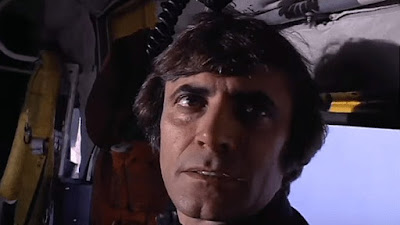
The United States Coast Guard receives a distress call from a schooner caught in a terrible storm at sea right in the center of the Bermuda Triangle. Lt. Haig (McClure) and Lt. Comdr. Pagnolini (Michael Conrad) investigate in a rescue helicopter. The two men briefly discuss the Bermuda Triangle with the former being a skeptic and the latter believing that the Devil plays a role. They come across the ship and find a man hanging upside down from the main mast and another man slumped on the forward hatch. The sails are shredded and it looks abandoned.
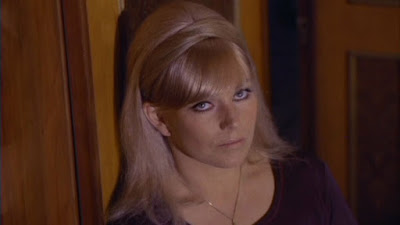

They try to radio the base but all they get is static. Haig decides to go down to the vessel and investigate. Once aboard, he confirms both men are dead and the one hanging ominously from the mast is priest (Alejandro Rey)! The suspenseful tone is quite effective here as the spooky atmospheric music by Johnny Pate and the wind whistling around the ship set a creepy vibe.
 
Initially, Haig doesn’t find anyone, which only ratchets up the tension including the incredible choppy sea that rocks the boat. When he ventures aft he finds another man, his body hanging in mid-air! He also finds a woman named Eva (Novak) in shock. Haig brings her on deck and they try to get back on the helicopter but the wire on the rescue basket snaps sending them tumbling into the sea. The chopper begins to inexplicably have technical difficulties forcing it to leave. Haig and Eva return to the boat. While waiting for help to return, she recounts the strange happenings on the boat that led to its current state. At this point Satan’s Triangle has sucked us in with this intriguing premise and engaging mystery. How did these men die and only Eva survive?
 
Even in the twilight of her career, Kim Novak casts an alluring presence and her sexy, husky voice warning Haig, “We’re going to die on this boat, you know,” doesn’t sound like the worst thing in the world. After all, who wouldn’t want to be stuck out at sea alone with her? Novak does her best to convey the dread of the situation as Eva stares off into space with a haunted look whenever she recounts what happened to all on board before Haig and his partner showed up. In the flashback sequences she gets to have fun playing the bored, spoiled trophy wife who receives massages from one of the crew members while her older, rich husband Hal (Jim Davis) gets to live out his Ernest Hemingway fantasy by trying to land a huge marlin.

His macho fantasy is interrupted by the ominous sight of a priest floating alone at sea on the wing of plane wreckage. The shot of him adrift at sea is a haunting one as he doesn’t look quite right. There is an air of malevolence about him as opposed to say trauma from surviving a plane crash. As soon as he is brought on board all hell breaks loose starting with a violent storm that engulfs the schooner and frightens the crew so badly that they abandon ship, leaving Hal, Eva and the ship’s captain (Ed Lauter) and the first mate (Titos Vandis) with the priest.
 
Alejandro Rey is eerily effective as the priest whose stoicism and dead eyes are an unsettling combination. Ed Lauter plays another no-nonsense authority figure that he excelled at throughout his career, playing the ship’s captain who is at odds with the rich man obsessed with catching an elusive marlin. Doug McClure is just fine as the male lead who provides a skeptical counterpoint to Eva’s traumatized believer. Initially, he comes off as something of a ladies man and has no problem “comforting” her while they wait for help to arrive but the movie’s dramatic plot twist late on turns his world upside down.
 
Naturally, Eva’s account of what happened leans heavily into the supernatural with a crew member suddenly disappearing without a trace and Hal’s inexplicable corpse hanging suspended in air as she wrestles with her faith in God in the presence of the Devil at the heart of the Bermuda Triangle. Haig, the man of reason, goes through her story and explains the unnatural occurrences in such a way that he has us convinced, lulling us into a sense of complacency and setting us up for the movie’s crazy climax that delivers a deliciously chilling twist with only a look.

Satan’s Triangle is a vintage made-for-T.V. movie with cheap yet well-delivered jolts as it mixes a fascination with the supernatural and the jaded cynicism of the decade that lost its idealism in the 1960s. Ultimately, it delivers the requisite scares in surprisingly effective fashion and is anchored by an engaging performance from Novak who showed that she still had it after all those years, delivering a hell of a gut-punch of an ending.
 
You can watch Satan’s Triangle for free on Youtube.

Tuesday, June 26, 2018

The Rockford Files (1974-1980)


-->

When I was a child my grandfather and I bonded over several things: Clint Eastwood films, James Bond and The Rockford Files. Some of my fondest memories I have of him are watching an episode of the latter whenever I would stay at my grandparents’ house. My grandfather loved the show. Even though he never verbalized it to me, I think he admired private investigator James Rockford (James Garner) as a stand-up kind of guy with the ability to talk his way out of almost any situation, often with a good sense of humor and played fair even when those that conspired against him did not. He was an honest man in a profession not known for it.

The show was created by producer Roy Huggins and writer Stephen J. Cannell, originally conceived of as being about a private investigator who only took on closed cases. Huggins assigned Cannell to write the script who then proceeded to tweak the clichés and conventions of the genre. Garner signed on to the project and NBC agreed to finance the pilot episode. The show ran the gamut of the crime genre as Rockford investigated murders, blackmail, missing persons, finding stolen money and so on.

Rockford is an ex-convict (wrongly convicted) turned private investigator who worked the Los Angeles area in his gold-colored Pontiac Firebird with his base of operations a mobile home located on the beach. He doesn’t even have a secretary – just an answering machine (immortalized in the opening credits) to take his messages. His father, Joe “Rocky” Rockford (Noah Beery) is a retired trucker who constantly gives his son grief over his profession. Detective Dennis Becker (Joe Santos) delights in giving him a hard time but helps out when he really needs it. Santos is an underappreciated character actor who was the ideal foil for Rockford as the street-smart cop. He is definitely set in the same mold as the frumpy Andy Sipowicz that Dennis Franz would later make popular on NYPD Blue.


“The Girl in the Bay City Boy’s Club,” showcases Rockford’s ability to recognize and deal with potential conflict as he sorts out someone doing a poor job of tailing him while also stopping at a nearby Jack in the Box for food. When it turns that the person following him is a potential client (Blair Brown), he confronts her. This episode features an early, memorable appearance by Evelyn “Angel” Martin (Stuart Margolin), a lovable ex-con cum con man that occasionally helps out Rockford when he’s not hitting him up for cash or getting him in trouble, much to his friend’s chagrin.

Like many shows, some of its most memorable episodes feature appearances by notable guest stars. Case in point: Isaac Hayes in “The Hammer of C Block.” He plays Gandy Fitch, an ex-convict and Rockford’s former cellmate. It seems that Fitch served 20 years for killing his wife but claims that he didn’t do it. Rockford owes him a favor and Gandy has come to collect, asking him to find the real killer. Hayes brings a gruff edginess to the role of a surly ex-con who keeps calling Jim, “Rockfish,” much to his chagrin. Hayes brings an authentic, tough guy swagger that plays well off of Garner’s laid-back nature.

Occasionally, Rockford would play hard to get if he felt a case could be solved by the police unless the money was right and the potential client made a compelling argument like in “The Real Easy Red Dog,” when a woman (Stefanie Powers) is convinced that her sister’s suicide is actually murder. Rockford would rather eat a sandwich he just prepared and watch a football game but she finally wears him down. The woman turns out to be a rival private investigator and her job offer is just a smoke screen. This puts him at odds with Lieutenant Diel (Tom Atkins), a gruff police officer with a thing for P.I.s, specifically Rockford. The playful banter between Rockford and his female counterpart is a joy to listen to with Garner and Powers looking like they’re having fun with it.


Garner brings a considerable amount of charm and leading man good looks to his role. He has a snarky sense of humor but knows when to play it serious when the situation warrants it. I like that Rockford solves cases through good ol’ fashion legwork – searching for clues, reading and questioning people and using his smarts to solve the case. The show is set up so that we figure things out along with him. We’re rooting for Rockford as we like him and that’s down to Garner’s amiable take on the private investigator. It’s easy to root for him as he’s the perpetual underdog, often at the mercy of dangerous and powerful crooks that have no qualms about hurting or punishing him, but he keeps plugging away, using common sense, intuition and his wits to survive.

The Rockford Files is also a fascinating snapshot of Los Angeles in the mid 1970s: drive-in diners on the beach, rotary style phones, big cars and so on. The show certainly wasn’t groundbreaking, adhering to the tried and true crime/mystery format but doing so in a very entertaining way with well-written scripts that are well-acted by the reliable cast. Watching an episode of The Rockford Files is the equivalent of reading a really good mystery novel, albeit condensed into one hour. It was a prime time hit with a strong six-year run, enjoying a cult following in the 1980s thanks to syndication and this led to a series of made-for-television movies from 1994-1999.

For me, there is something reassuring and almost comforting about watching The Rockford Files. It is like revisiting an old friend. There is a lot of enjoyment in watching Rockford’s noble pursuit of the truth over the course of a given episode with Garner’s genial take on the private investigator guiding us through his character’s various misadventures. Sometimes he won, sometime he didn’t but it was always enjoyable to see what kind of case he was mixed up in.

Thursday, May 31, 2018

The Prisoner (1967-1968)

What if James Bond tried to resign?

It is this intriguing premise that lies at the heart of influential British television series The Prisoner. Coming off the spy show Danger Man, actor Patrick McGoohan and writer George Markstein created a decidedly unconventional follow-up (some say sequel) that turned the espionage genre on its head. It was a show unafraid to defy expectations right down to the uncompromising final episode that so infuriated viewers back in the 1960s that McGoohan famously went into hiding. It’s legacy of messing with viewers’ minds lives on to this day in T.V. with the likes of The Sopranos, Mr. Robot and the recent revival of Twin Peaks, but no one did it better than The Prisoner.

The opening credits are a marvel of efficient visual storytelling by brilliantly establishing the premise in only a few, dialogue-free minutes. Top-secret government agent Number Six (McGoohan) resigns rather emphatically from his job. Unbeknownst to him, he’s followed home and as he packs to leave for somewhere else, smoke is piped into his place. He loses consciousness and so it begins….

He awakens in a quaint, remote seaside resort known as “the Village.” One almost might say it is an idyllic place except that he is forbidden to leave. The denizens act nice enough – maybe a little too nice – but in a way that feels slightly off. This is best encapsulated in the often-repeated phrase, “Be seeing you,” that the villagers say to one another and that quickly goes from provincially charming to downright creepy.

Each episode sees a different Village administrator, known only as Number Two, try to find dissimilar ways to get Number Six to reveal why he resigned while he devises ways to escape and figure out the identity of the mysterious Number One who supposedly rules over the Village. His captors don’t want Number Six running around in the world with the kind of knowledge and secrets that he knows. After all, information is power and they want to know what he knows. Naturally, Number Six resists (“My life is my own.”), and it is his resilience the Village will put to the test repeatedly, and therein lies the main source of conflict.

Patrick McGoohan brings his trademark intensity and intelligence to the role. In every episode we see Number Six thinking and scheming of ways to outwit his captors and escape. While the actor displays a wide range of emotions, he also plays the role enigmatically, never revealing too much as Number Six resists any kind of inquiries from the powers that be.

The actor famously turned down playing James Bond on two different occasions and “The Girl Who Was Death” sees the show at its most playful as the spy genre and detective shows are satirized, complete with overly complicated plots and an insane, power-hungry baddie with the requisite femme fatale. This episode certainly conveys McGoohan’s feelings about the spy genre and why he had no interest in playing Bond.

Watching several episodes back-to-back is like a experiencing an acid trip – the more you watch the more you lose touch with reality as you become deeper immersed in this strange world as the show goes from a spy fantasy story to a science fiction/horror hybrid fused with ‘60s era psychedelia and “pop art.” It as if artist Jim Steranko had decided to take a break from drawing Nick Fury: Agent of SHIELD and decided to go into art direction for The Prisoner.

The show’s overriding theme is free will as Number Six resists Number Two’s repeated attempts to get him to divulge his reason for resigning. The Village is a false utopia. In “Arrival,” Number Two claims that it has everything one could want. Everything that is, except for freedom – the commodity that Number Six values most. Number Two controls every aspect of the Village, including its inhabitants and anyone who steps out of line is dealt with in ruthless fashion as a big white malleable sphere known as a Rover emerges with a horrific sound and absorbs said troublemaker. There are hidden surveillance cameras everywhere, eerily foreshadowing the way we live today.

The Prisoner also explores the abuse of power. The government that Number Six used to work for thinks that they own the secrets in his head and do everything in their power to extract them. To this end, they have an entire Village under their control to aid in this endeavor. It is all about control – who has it and how they exert it. As the show begins, the Village administrators have all the power, but over time Number Six gradually wrests control and repeatedly resists their various methods to extract information from him.

“A. B. and C” is an excellent example of the lengths that Number Two will go to extract information out of Number Six – dream manipulation – while also serving as a showcase for the show’s style, employing rear screen projection right out of a Classic Hollywood movie, and skewed camera angles and quick cuts inspired by Orson Welles’ adaptation of Franz Kafka’s The Trial (1962), which only draws attention to the artifice of the dream.

While there is some dispute over who came up with what, McGoohan is often credited as the driving force behind The Prisoner, starring in every episode, and writing and directing several of them. This is a rare actor as auteur project – an accomplishment that has rarely been equaled on T.V. with the notable exception of Twin Peaks: The Return where David Lynch directed and co-wrote every episode and also appeared in many of them. The Prisoner was clearly a passion project for McGoohan and it shows in every detail, right down to the décor of Number Six’s home and the blazers everyone wears, that this was all thought out beforehand and with great care.

The Prisoner’s legacy is impressive. It has gone on to inspire comic book writers (Grant Morrison), musicians (The Beatles), films (The Matrix), and T.V. shows (Lost). The less said about the mediocre six-episode miniseries remake on AMC in 2009 the better but hopefully it motivated some to seek out the original, which continues to provoke and remains even more relevant today than when it first came out. We are even more prisoners of our own making, trying to control every aspect of our lives and that of others through technology. McGoohan was warning us of these dangers way back when but clearly his admonition was not heeded.

"We're so desperately concerned with saying 'We're free!' And I want to know, how free are we? I think we're being imprisoned and engulfed by a scientific and materialistic world. We're at the mercy of gadgetry and gimmicks” – Patrick McGoohan

Monday, October 30, 2017

Mindhunter

Why is popular culture so fascinated with serial killers? There are all kinds of reality television shows and their fictional counterparts dedicated to examining their perverse methodology. What compels these murderers to kill several people in all kinds of horrible ways? There are as many reasons why as there are serial killers as each one has their own unique motivation. Our fascination comes from the morbid speculation that one’s next-door neighbor may have a bunch of severed heads in their fridge. It’s rubbernecker syndrome – an interest in the gruesome details of the murders. It is also the relief in the knowledge that you’re still alive and safe and not the murder victim, that in some way you’ve cheated death.

In 1995, David Fincher directed Seven, one of the best films about serial killers. With the commercial and critical success of that film, he was careful not to get pigeonholed in the genre and didn’t return to it until Zodiac (2007), which was a very different take indeed. His fascination with serial killers continues with Mindhunter, a show created by Joe Penhall, based on the true crime book of the same name by John E. Douglas and Mark Olshaker, that he is executive producing and directed four episodes for Netflix.

Set in 1977, the show focuses on the FBI’s nascent Behavioral Science Unit with two agents – Holden Ford (Jonathan Groff) and Bill Tench (Holt McCallany) – fighting against internal resistance – their superior (Cotter Smith) thinks they’re wasting the Bureau’s time – and external ignorance – local law enforcement doesn’t understand what they’re doing. We meet Ford working as a hostage negotiator as he unsuccessfully tries to defuse a situation involving a man armed with a shotgun and holding a woman hostage.

After failing to calm the man down, which results in his death, Ford is ordered by his superior to continue teaching his hostage negotiator course at Quantico. It is here that we get the first inklings that Ford is different. He’d rather settle a hostage situation peacefully than through excessive force by reasoning with the criminal and the way to do this is figuring out what motivates them…but how?

After his latest class, Ford overhears a lecture in a nearby classroom. The instructor is talking about David Berkowitz (a.k.a. The Son of Sam) and offers up this observation: “You could say that the guy is crazy or that he’s pretending that he’s crazy but if we’re looking for a motive we can understand we suddenly find there is none. It’s a void. It’s a black hole.” He points out that in Hoover’s heyday, criminals like John Dillinger and Baby Face Nelson were easy to figure out because they did what they did for personal gain.

Someone like Berkowitz is completely different. “Where do we go when motive becomes elusive?” the instructor says. It is this line that hits Ford like a thunderbolt and serves as an epiphany. He and the instructor have a fascinating discussion that is really the show’s thesis: if the world no longer makes sense, then neither does crime. They both agree that they don’t know what to do about it, which Ford wonders, “But we’re supposed to, right?” to which the instructor replies, “Sure. But here’s the troubling thing – no one’s even asking the questions.” This is just one of many well-written, masterfully acted conversations depicted over the course of the ten episodes of Mindhunter. This scene also sets the tone: this is going to be a character-driven show that eschews traditional cop show heroics in favor of dialogue-heavy explorations into what motivates serial killers.

The first half of episode one focuses not just on Ford’s professional life but his personal one as he meets a witty, attractive woman named Debbie (Hannah Gross) at a rock concert that is just as smart as he is if not more so, much to his surprise. Their initial meet-cute turns into a first date where she takes him back to her place and gets him to take a bong hit in an effort to loosen him up. They even go see Dog Day Afternoon (1975), which he is so impressed with that he shows it to his class. Debbie isn’t afraid to call Ford on his bullshit and is willing to challenge his beliefs, which makes for an entertaining give and take between them in their scenes together. There’s a sexy and smart frisson between these two characters that is a lot of fun to watch. After sex one night, she playfully chastises his naïveté about sex, calling him a monk, chiding him, “How can you figure out the criminal mind if you can’t even figure out your girlfriend?” Good point.

Jonathan Groff plays an atypical FBI agent. He’s youthful and sensitive – hardly the Melvin Purvis type. He’s also very smart but lacks the street smarts to excel in the field as evident in the bungled hostage negotiation that kicks off the show. He needs more time in the field with an experienced veteran showing him the ropes. His boss arranges a meeting with Tench and the elder agent instantly reads the younger one. He asks Ford to tag along with him on the road, teaching FBI techniques to local law enforcement all over the country.

Initially, it appears that Fincher is treading on familiar turf with the Ford-Tench duo – the idealistic young agent butting heads with the older, more experienced agent. What Ford lacks in experience, he makes up for with intelligence and soon his enthusiasm for profiling serial killers is contagious enough to convince Tench and then their boss to interview them. Ford isn’t the brash, impulsive person that Mills was in Seven and Tench isn’t ready to give up on humanity like Somerset was in that earlier film.

Their first teaching gig does not go well. Ford gets too cerebral, his college training confuses most of the cops while Tench tries to keep things simple. Ford ends up pissing off a veteran detective who then asks them for advice on a grisly local murder case. They offer several theories but nothing concrete for the clearly frustrated detective, which only upsets him even more. And so it goes. Not every case can be solved but it is unusual for one of the protagonists to admit it so honestly. The episode ends with nothing resolved and tangible tension between Ford and Tench.

Setting Mindhunter in the late 1970s is an interesting choice. As Fincher has pointed out in interviews, it was the end of the J. Edgar Hoover era with the last vestiges of the stereotypical FBI agent idealized by Melvin Purvis and represented by Ford and Tench’s boss being replaced by people like Ford. Tench represents a bridge between the two eras. He still adheres to old school practices but is receptive to Ford’s new way of thinking and Holt McCallany does an excellent job of showing how his character deals with these contrasting schools of thought – the old vs. the new. Initially, Tench doesn’t reveal much about himself but over the course of the show he’s given moments, like a quiet scene in a bar with Ford in the fourth episode, where he reveals a very personal detail about his home life that is wonderfully conveyed by the actor who displays an impressive amount of vulnerability. A few minutes later, we are shown a glimpse of his home life in a heartbreakingly understated scene.

In order to understand the criminal mind better it makes sense that one should talk to criminals. Ford wants to interview Charles Manson but he’s unreachable – ever for the FBI – and so at one of their teaching gigs a cop says they should talk to Edmund Kemper (Cameron Britton) a.k.a. the Co-Ed Killer, a man that decapitated 16 teenage girls and had sex with the corpses. He’s a dream interview – he loves to talk about himself. Fincher films Ford walking through the prison, down the halls among the inmates with the sounds of them leering and yelling at him. The look on his face is one of palpable unease.

The meeting with Kemper is a brilliant sequence that begins on a comical note as the killer insists Ford has an egg salad sandwich as if he were entertaining him in his living room. The serial killer initially comes off as an affable man. He’s eloquent and honest (“People who hunt other people for a vocation all we want to talk about is what it’s like.”) and is able to become unsettlingly threatening on a dime. Kemper recounts his normal childhood and how it ran parallel to another, more depraved life. He fascinates Ford, while Tench is convinced that he’s manipulating his partner, telling him what he wants to hear. On the second visit, Ford is a little too chummy with Kemper in an amusing bit where they actually banter back and forth. They delve into the man’s past and what motivated him, which he tells in a chilling monologue. Cameron Britton does an excellent job playing Kemper. He moves little, letting his eyes convey his feelings. Kemper is someone that plays things close to the vest, reading Ford and then telling a story of how he killed his mother in a creepy, matter-of-fact monotone.

Not surprisingly, the most compelling parts of Mindhunter are the interviews with the killers. As Fincher has said, these scenes are like little one act plays as these guys tell their stories. The show wisely doesn’t resort to flashbacks, which would be the obvious thing to do, and instead lets the actors playing these killers flex their acting chops, holding our attention with their ability to tell their characters’ depraved stories and make it compelling.

Meeting Kemper convinces Tench that there is value in talking to serial killers in order to understand what motivates them and he decides to stick up for Ford when their boss chews them out for interviewing the murderer without telling him. They’re threatened with suspension and it is this confrontation that bonds Ford and Tench. By the end of the second episode they’ve finally gelled as a team. They are finally on the same page.

As Mindhunter continues, Ford and Tench begin to diverge on how the work they do affects them. The latter is increasingly repulsed by the repellent nature of the killers they talk to, while the former finds himself getting deeper into the mindset of these men, running the risk of becoming like them, treading the same line that Will Graham does in Manhunter (1986). Mindhunter shows how these cases take their toll on the men that investigate them, most significantly, Tench who doesn’t tell his wife anything about his work and this causes noticeable tension between them. This is explored in a scene where she confronts him about it. As their work continues, Ford becomes more analytical and detached while Tench is more empathetic, especially when they interact with the killers and the local cops.


Are serial killers born or are they formed? This is a question that Ford and Tench wrestle with over the course of the ten episodes. It is why they are interviewing these men in the first place. Mindhunter does a superb job balancing the procedural aspects of Ford and Tench’s work with the impact it has on their personal lives in a way that gradually makes them rich and compelling characters over time. This is thoughtful, absorbing procedural that takes the time to delve not just into the work that these men do but their personal lives as well in a deeper way that Fincher was trying to do in Zodiac but was constrained by the limitations of feature filmmaking. The medium of television has allowed him to go as deep as he wants and this results in some of his best work.

Thursday, September 14, 2017

Moonlighting


BLOGGER'S NOTE: This post originally appeared on the Wonders in the Dark blog for their Top 80 Greatest Television Shows.

In a landscape dominated by the likes of Dynasty and Hill St. Blues, Moonlighting was a breath of fresh air when it debuted on American television in 1985. It was a detective show that provided a funny, witty alternative and ambitiously took the screwball comedy popular in the 1930s and 1940s and gave it a contemporary spin that has never been duplicated as successfully on mainstream T.V. since.

Al Jarreau’s memorably soulful theme song plays over opening credits that include stills of iconic Los Angeles culture setting the perfect tone for the show. Moonlighting features a fascinating premise: what does an aging supermodel do once she’s past her prime and can no longer live the lavish lifestyle to which she’s accustomed? Maddie Hayes (Cybill Shepherd) is an ex-model who wakes up one morning to realize that her accountant has run off with all of her money. She scrambles to try and reclaim her fortune. As luck would have it, she invested in several companies and decides to sell off her shares. The last one on the list is the Blue Moon Detective Agency, run by the fast-talking, wisecracking David Addison (Bruce Willis). On the surface, he doesn’t seem like much of a detective but rather more of a hustler on the make.

Maddie tells him that she is closing down the agency. After all, on her first day the staff are playing cards, receptionist Miss DiPesto (Allyce Beasley) is reading a romance novel and David is watching the Family Feud. No phones are ringing and no clients are in the waiting room. Desperate to maintain his cushy gig, David tries his hardest to change her mind. In the process, they stumble across a mystery – or rather, have one thrust upon them. Even though she would never admit it in public, David has chipped away at her defenses and begins to charm her. She holds off on closing down the agency because she is having too much fun running it with David.

Bruce Willis is perfectly cast as the smart-ass David Addison. There is a loose, improvisational feel to his performances as he gleefully gives Maddie grief at every opportunity. Cybill Shepherd is his ideal foil as the cold, no-nonsense Maddie Hayes. The best moments are when these two contrasting personalities clash – the epitome of a love-hate relationship. He is full of smarm and charm while she is the straight man that tries to keep him in check and on point during a given case.

The writing on the show is excellent. The dialogue is crisp with a snap and pop to it. In “Next Stop Murder,” an homage to Agatha Christie murder mysteries, Blue Moon’s chipper, rhyming receptionist, Miss DiPesto wins a contest to participate in famous mystery writer J.B. Harland’s murder mystery train. David and Maddie drive her to the station and accidentally get stranded on the train with a real murder to solve. Here is a memorable exchange in the episode:

Maddie: “I was not born yesterday!”


David: “It’s true. I had lunch with her yesterday. If she’d been born I’d a noticed.”

It isn’t only the words but how Willis delivers them that makes what he says so funny. And yet, the show isn’t wall-to-wall comedy. There are sober moments of drama and, of course, romance. The show even addresses David’s lack of maturity in “My Fair David,” where Maddie bets him that he can’t act like a mature professional for a full week. This episode features some of the funniest bits between Shepherd and Willis in the show’s entire run.

For all of the hilarious banter and hijinks David and Maddie get into, the show has plenty of poignant moments as well, like the episode entitled, “Gunfight at the So-So Corral,” where an aging hitman (Pat Corley) hires David and Maddie to find an up-and-coming killer (Gary Graham) gunning for him under the pretense that he’s his son. There’s the inevitable showdown between the two assassins with the elder one getting the upper hand. In a rare moment of mercy, he lets the younger guy live and delivers a moving speech about what being a killer has done to him over the years.

In some respects, Moonlighting is a clever update of The Thin Man series of movies with screwball comedy pacing complete with rapid-fire exchanges of witty dialogue as the characters banter and bicker furiously like a couple straight out of a Howard Hawks screwball comedy. It is not easy to recreate the fast-paced banter of this genre. It takes a certain skill set to deliver dialogue like that and Willis and Shepherd make it look easy. David infuriates Maddie with his unprofessional behavior that she secretly finds exciting and fun. She comes from the fashion world and is a fish out of water that is shown the ropes of the detective biz by David, an experienced investigator (maybe?) and consummate bullshit artist.

By season two, the show’s creator, Glenn Gordon Caron, parlayed the show’s success into making more ambitious episodes and having characters break the fourth wall. “The Dream Sequence Always Rings Twice” was shot in black and white as an homage to classic Hollywood musicals and film noir. It was even introduced by Orson Welles, a week before he died.


Each episode had David and Maddie confronted with and eventually solving a different mystery while the playful sexual tension continued to build, which, at the time, had fans anticipating if and when they would become romantically involved. The eventual consummation of their relationship would ultimately ruin the show. The sexual tension was gone, replaced by uncomfortable tension as the delicate balance between comedy and drama was upset with things getting too serious. The show became consumed by its own meteoric success and the off-screen tension between Willis and Shepherd spilled over to the episodes and the show never recovered, becoming a cautionary tale for future shows of its ilk not to make the same mistakes.

Moonlighting set a new standard for the bickering, romantic comedy that has influenced so many T.V. shows that came afterwards (even something as squeaky clean as Lois & Clark: The New Adventures of Superman to the more recent Castle). In its prime, before things got too serious between David and Maddie, it was the funniest, smartest show on T.V. with the first two seasons in its purest form: sharp and focused. What made the show work so well was the chemistry between Willis and Shepherd, resurrecting her career and launching his (with the subsequent starring role in Die Hard making him a bonafide movie star). The show holds up remarkably well today (even with the dated clothes and hairstyles) and this is due large part to the writing and chemistry between the cast members.

Friday, July 28, 2017

The Larry Sanders Show


BLOGGERS NOTE: This post originally appeared on the Wonders in the Dark blog for their Top 80 Greatest Television Shows.

In the 1980s and 1990s, late night talk shows ruled the airwaves with the likes of Johnny Carson, David Letterman and Jay Leno making America laugh before bedtime. These shows would come on after the 11 o’clock news and start with the host delivering a monologue poking fun at the popular news topics of the day followed by a couple of celebrities pushing their movie or television show and ending with a musical act or a stand-up comedian. It’s a format that continues to this day as a new generation of talk show hosts vie for eyeballs in our increasingly fragmented popular culture.

The Larry Sanders Show took a look behind-the-scenes at a fictional late night talk show featuring its vain, neurotic eponymous host (Garry Shandling), his weasely sidekick Hank Kingsley (Jeffrey Tambor), the gruff, ass-kissing producer Arthur (Rip Torn), and the other long-suffering staff members that cater to his selfish needs as they try to get a show on the air. Larry lives in constant fear, either worrying about if he’s funny every night or if the show’s getting good enough ratings to justify its existence, and do almost anything to achieve both.

The show was notable for being one of the first sitcoms to push the envelope in terms of truly uncomfortable moments mixed with laughs. Of course, this practice is commonplace now with shows like Curb Your Enthusiasm and the short-lived Starved. These uncomfortable moments, like snide asides between Hank and guests in between commercial breaks, have a ring of honesty to them and make one wonder if that’s what it’s really like on these shows. Garry Shandling used to guest host for Johnny Carson, had appeared on all of the major late night talk shows, and must’ve had plenty of experiences to draw from and it shows as there is a real insider authenticity to how a show like this operates.

And there are certainly several classics, like “Everybody Loves Larry” where Larry is afraid that the network is going to replace him with Jon Stewart and fends off what he thinks is romantic advances from David Duchovny. This episode playfully toys with the notion of whether he is gay or not, which drives Larry crazy, of course. There is a funny bit where Larry asks Hank’s assistant (Scott Thompson) if he thinks Duchovny is gay. The final scene that they have together is priceless as Duchovny keeps poor Larry constantly guessing and on edge.

In “Another List,” network executives give Larry some ideas on how he could improve the show, like a more energetic opening like Jay Leno, a new part in his hair and a new theme song – all of which he duly ignores in favor of trying to date Winona Ryder. Of course, by the end of the episode, he has incorporated some of these ideas because at the end of the day, self-preservation is Larry’s strongest instinct.

“The Interview” starts off with Hank insulting guest star Vince Vaughn when he fails to pick up on the actor simply messing with him. This episode poses the question, how does a celebrity do damage control? Larry cries during an interview for Extra! and Artie tries to get the interviewer to edit it out with little success. This episode underlines the often-vain nature of celebrities. Their image lives or dies by how they are covered by the fickle media.

The Larry Sanders Show demonstrates what a fearless performer Garry Shandling was as he wasn’t afraid to play a thoroughly unlikable character. Larry is a vain coward that only loves himself and that’s on a good day. Shandling is also not afraid to use comedy to bring out the uncomfortable truths about Larry.

Jeffrey Tambor matches Shandling beat-for-beat with his portrayal of Hank, which is, at times, almost too painful to watch as he is such a pathetic, sad sack character. We never feel one iota of sympathy for him because he is his own worst enemy. He is obviously patterned after another famous show biz sidekick, Ed McMahon, swimming in Larry’s wake. Hank is petty and always trying to get out from under Larry’s shadow. During the course of the show, Tambor explores what it takes to play someone who is the sidekick. What kind of person is able to do that and how does it affect their personality over time?

Artie’s job is to build up Larry’s confidence. He’s an expert at catering to people’s egos, making them feel good about themselves. Larry and Artie have a funny, cantankerous relationship that sees the producer simultaneously appease and bust Larry’s balls. In many respects, Artie keeps Larry grounded and is one of the few people he can be honest with. They bicker like an old married couple but one senses that they truly are friends.

The Larry Sanders Show is a brilliant snapshot of what late night talk shows were like during the ‘80s and ‘90s when Leno and Letterman ruled the airwaves. It takes us behind the curtain to show that Larry is a selfish narcissist, Hank is a pathetic loser, and Artie has mastered the art of kissing ass while savaging people behind their backs.

The Larry Sanders Show was ahead of its time, pushing the envelope in mining comedy out of awkward and uncomfortable situations, anticipating shows like The Office by many years. It showed the messiness of life intruding on a bunch of show biz types trying to put on a T.V. show. It makes you wonder if this is what it actually takes to do one of these shows and if so it is amazing that new episodes air as often as they do.

Friday, May 19, 2017

On the Air

The late 1980s and early 1990s was a very prolific period for David Lynch, from the performance art of Industrial Symphony No. 1 in 1989 to the HBO mini-series Hotel Room in 1993, it seemed like he was everywhere. It was the surprise success of the Twin Peaks television show, however, that put the eccentric artist on the cover of every major magazine and guest on all the major late night talk shows. He and his creative partner Mark Frost parlayed the buzz from it into convincing ABC to broadcast a sitcom they created called On the Air.

The series followed the wacky misadventures of the fictional 1950s T.V. network Zoblotnick Broadcasting Company as they produce The Lester Guy Show, a variety program aired live. The humor of the show is often derived from the peculiar personalities that work in front of and behind the cameras as well as their disastrous attempts to put the show together every week.

Much like with Twin Peaks, Lynch directed and co-wrote the pilot episode thereby establishing the look and tone of the show that subsequent writers and directors would follow. Cool jazz music courtesy of regular Lynch collaborator Angelo Badalamenti plays over the opening credits, punctuated by a farting sound, which establishes the absurdist tone Lynch is going for right from the start.

We meet the people working for ZBC as they prepare for a live broadcast of The Lester Guy Show. There’s Valdja Gochktch (David L. Lander), the director of the show and the nephew of the owner. He’s from the “old country” and sports a thick European accent that nobody can understand except for Ruth Trueworthy (Nancye Ferguson), an optimistic production assistant. We meet producer Dwight McGonigle (Marvin Kaplan) who is suffering from pre-show anxiety as evident from two coffee mugs he holds in his shaking hands, creating quite the puddle around him.

They have their hands full wrangling the “talent,” which includes the adorable yet clueless Betty Hudson (Marla Rubinoff), an ingénue with zero acting experience and not too smart either. Her introduction, as she tries to understand Gochktch’s directions, is an amusing exchange as his thick accent comes up against her sweet, yet dense nature. She’s much easier to handle than Lester Guy (Ian Buchanan), a washed-up movie star that still demands to be treated as such thus annoying the hell out of everyone with his primadonna behavior.

If this wasn’t enough pressure to contend with, network president Bud Budwaller (Miguel Ferrer) shows up to make sure everything goes smoothly. He sets the tone by barking orders and insulting McGonigle (“Dink spine” and “gob of jelly” being two of the more memorable ones). His job is on the line and he commands through fear and intimidation. Not surprisingly, Miguel Ferrer gets some of the show’s best lines, like his assessment of Betty: “She’s no dim bulb, she’s a blown-out fuse.” The actor is playing a variation of his rude FBI agent from Twin Peaks complete with a shouty, overbearing approach and adopting an intimidating stance in the control room, wielding a large nightstick.

Things start off decently enough with Lester’s pretentious interpretative dance routine with moody jazz music until a prop he’s using falls over, taking him with it. It’s all hilariously downhill from there as music and sound effects cues are all wrong, a stagehand appears on camera, and Lester is knocked unconscious. Against all odds it is Betty who saves the show when she talks to the camera and sings “The Bird in the Tree,” a sweet song reminiscent of “In Heaven” from Eraserhead (1977), and that offers a short respite from the insanity as all hell breaks loose. Amazingly, the show is a hit! The rest of the short-lived series sees Budwaller and Lester conspiring to ruin Betty because they resent her success while she remains blissfully unaware.

The cast acquits themselves quite well, hamming it up for this cartoonish world that their characters inhabit – Ferrer plays a stereotypical blowhard studio executive, Ian Buchanan portrays a pompous movie star, Nancye Ferguson plays a His Girl Friday-type P.A. and so on. On the Air is less interesting when it spends time away from the studio, like in the second episode when Betty meets Mr. Zoblotnick (Sidney Lassik) for dinner, and works better when riffing on cultural touchstones of the time period, like the quiz show craze.

While working on the sound for an episode of Twin Peaks during its second season, Lynch came up with the idea for On the Air, which involved “people trying to do something successful and having it all go wrong.” He would go on to direct the pilot, co-write two episodes and supervise post-production.

The pilot episode tested so well with audiences that ABC ordered six more episodes. Even though it was ready to go in spring, the network put off airing it until summer. On the Air debuted on Saturday night at 9:30 with little promotional support, which many of the cast and crew felt was a message from the network about how little they cared about the show. Chief among them was Miguel Ferrer: “Why don’t they just put a bullet in its head? The support we’ve gotten from the network – or lack of support that’s perceived on my part – is enormously disappointing.” Lynch echoed these sentiments: “I’ve heard that summertime is pretty much the worst time you can be on, but we’re going on in summer. I’ve heard that Saturday night is the worst night of the week to be on, and we’re going on Saturday night…”

Not surprisingly, On the Air was not well received by critics when it aired. In his review for The New York Times, John J. O’Connor wrote, ”Different, certainly, even strange, but unfortunately about as funny as, well, an overworked foreign accent.” Variety’s Brian Lowry wrote, “Lynch and Frost still can’t seem to protect their initial vision once they pass the ball on to others, as the numbing flatness of the second episode—which involves a plot inspired by the ‘50s quiz-show scandals—painfully demonstrates.” In his review for the Los Angeles Times, Chris Willman wrote, “Though On the Air appears destined—between its unfortunate time slot and Lynch’s own odd sense of comedic timing—to be just a footnote in both his career and TV history, it’s one to tape for posterity, before it becomes Off the Air.” Finally, People magazine’s David Hiltbrand wrote, “The show’s comically choreographed mayhem is a difficult premise to sustain, like trying to stage a big bumper-car pileup again and again.”

If you ever wondered what a David Lynch sitcom would be like then On the Air is the short-lived answer. It’s a silly trifle of a show but also very sweet, much like Betty who embodies its heart and soul. While it is hardly a masterpiece, the show does have its moments. I love how it is bathed in ‘50s nostalgia and reflects Lynch’s particular brand of comedy that is usually kept in check but is allowed to run rampant for better or for worse.


SOURCES


Cerone, Daniel. “Television of the Absurd: Twin Peaks’ Co-Creators Try Again with On the Air.” Los Angeles Times. June 18, 1992.