"...the main purpose of criticism...is not to make its readers agree, nice as that is, but to make them, by whatever orthodox or unorthodox method, think." - John Simon

"The great enemy of clear language is insincerity." - George Orwell

Friday, July 20, 2012

Good Morning, Vietnam


I’ve always had a soft spot for Good Morning, Vietnam (1987). It isn’t Robin Williams’ best film or his best performance for that matter but it marked a pivotal moment in his career. Up to that point he had done several comedies built around his manic comedic sensibilities that were mostly commercial failures. Only The World According to Garp (1982) hinted at his capacity for mixing comedy and drama and it also scored both with critics and audiences. With Good Morning, Vietnam, Williams gave it another try, teaming up with director Barry Levinson, hot off the comedy Tin Men (1987) and who wisely surrounded the comedian with a rock solid cast of character actors. The result was a bonafide blockbuster (it was #1 at the box office for 9 weeks!) and a genuine crowd pleaser that received several accolades. For me, Good Morning, Vietnam is a fun, engaging film that lets Williams cut loose and do his thing while also attempting to impart a bittersweet romance and a sobering reminder of the war that the United States was losing.

It is 1965 and Airman Adrian Cronauer (Robin Williams) arrives in Saigon to work as disc jockey for the Armed Forces Radio Service. He’s greeted at the airport by Private First Class Edward Garlick (Forest Whitaker) and right from the get-go Levinson does a nice job of evoking a sense of place by immersing us in the sights and sounds of this exotic city and its inhabitants. Once Cronauer and Garlick arrive at the base we are introduced to a colorful assortment of characters, starting with the strict commanding officers, Lt. Hauk (Bruno Kirby) and Sgt. Major Dickerson (J.T. Walsh). The former considers himself something of a comedian (“Readers Digest is considering publishing two of my jokes.”) but is hopelessly square when it comes to anything remotely funny. The latter is the film’s humorless antagonist who lays down the law with Cronauer early on in the film, shutting up the usually unflappable D.J. through intimidation and actually making him sweat (or is that just the heat?).

Cronauer’s first radio show is a dynamic debut as Williams gets to unleash his crazed stand-up routines with him voicing characters both based on actual people, like Gomer Pyle and Walter Cronkite, and ones that he makes up on the fly. Levinson breaks up the comedian’s whirlwind onslaught with a fantastic collection of period rock music by the likes of the Beach Boys, James Brown, Them, The Supremes and many others that plays over footage of soldiers toiling around Saigon or hanging out at their bases. It is an unorthodox radio show to say the least as Cronauer mercilessly parodies the United States military and the government with biting political humor that does little to endear him with Dickerson and Hauk, the latter of which reprimands him afterwards.

Of course it wouldn’t be a Barry Levinson film without a few scenes of guys sitting around talking (see Diner and Tin Men) and in Good Morning, Vietnam the place is Jimmy Wah’s, a local G.I. bar (“It’s real homey in an opium kind of way,” Cronauer deadpans upon first entering.) where Cronauer and the other D.J.s hang out. It is rather memorably owned by a man that calls everybody “Earl” and who is obsessed with actor Walter Brennan.

Cronauer finds himself attracted to a young Vietnamese woman named Trinh (Chintara Sukapatana) and becomes a teacher at an English-as-a-second language school in order to get closer to her. The introduction of this setting gives us a little insight into the Vietnamese people as Cronauer begins to interact with Trinh and her family, in particular her brother, Tuan (Tung Thanh Tran). The scene where Cronauer introduces himself to the class is particularly memorable because we see Williams the comedian playing to the hardest room of his career – a group that does not understand English. At first, they are unimpressed and confused but he eventually is able to communicate with them on a basic level. There is a spontaneous feel to these scenes as if what the Vietnamese actors (non-actors?) are saying was unscripted and Williams is simply reacting to whatever they say, eliciting genuine surprise and laughter from the gifted comic. This scene also continues Cronauer’s unorthodox yet effective way of communicating with others as he eschews stuffy text book phrases for common, every day sayings and, of course, curse words.

Director Barry Levinson successfully harnesses the comedian’s wild, manic energy in this film. Williams’ radio monologues (famously adlibbed by the comedian) are the highlights as he cuts loose with his trademark rapid-fire humor (“What’s the difference between the Army and the Cub Scouts? Cub Scouts don’t have heavy artillery.”). He is an actor who needs a strong director to rein him in. His best films are the ones where he collaborated with a director who had their own distinctive vision (Peter Weir, Terry Gilliam and Gus Van Sant) and this one is no different.

Even though Good Morning, Vietnam is essentially a vehicle for Williams, Levinson wisely surrounds him with a strong supporting cast of character actors, like Robert Wuhl, Bruno Kirby and J.T. Walsh. Kirby is excellent as the terminally unfunny and unhip Lt. Hauk. The scene where he temporarily takes over Cronauer’s show with his own brand of comedy is almost painful to watch. There is also an amusing running gag about how no one ever salutes him despite his rank. This film would mark the start of a memorable run of supporting roles in popular comedies like When Harry Met Sally… (1989), The Freshman (1990), and City Slickers (1991).

Walsh proved to be a very credible antagonist to Williams with his sober intensity and gravitas that he brings to the role. Williams is such a force of nature and a larger than life personality that he needs someone who is just as forceful and Walsh does an excellent job as his vindictive superior. Fresh from Oliver Stone’s gritty Vietnam War film Platoon (1986), Forest Whitaker is cast against type as Cronauer’s meek, by-the-book assistant and displays some nice comedic chops in various ways, like the nervous, high-pitched giggle he repeatedly emits upon first meeting Cronauer, or the way he always turns the ignition key when first getting into a jeep with the engine already running.

The first half of Good Morning, Vietnam is the light, entertaining stuff of an anarchic anti-authoritarian comedy as we see Cronauer gleefully breaking all the rules and having fun doing it. He gets into a bit of trouble but nothing major. The second half of the film sees the comedic elements take a back seat in favor of an unrequited romance between Cronauer and Trinh as well as the growing insurgency in Saigon. The tone of the film noticeably darkens when Cronauer narrowly escapes a bomb exploding at Jimmy Wah’s and Levinson doesn’t shy away from depicting the carnage and the ensuing chaos with shots of bloodied victims, both American soldiers and locals, as well as shots of dead bodies lying in the street. It is a shock not only to Cronauer but to us because nothing that came before prepared us for this.

To make matters worse, Cronauer goes on the air and gives his account of what happened without it being approved. Williams does a nice job here, first, in the aftermath of the bombing as he tries to make sense of the carnage, and secondly, when he tries to put on a funny face afterwards on his radio show. His jokes fall flat as the shock of what he saw and experienced sinks in. His defeated facial expression says it all. Mitch Markowitz’s screenplay makes a smooth transition between the two halves of the film by doing it gradually with elements of comedy and drama blending together naturally so that neither one is entirely abandoned in favor of the other. Levinson also shifts the emphasis on locales over the course of the film with most of it set in the army base for the first half and then opening things up in the second half as we see more of Saigon and the surrounding area. The focus also shifts to that of the Vietnamese as we see how Trinh and Tuan live when they take Cronauer to their village. At this point in the film he has gotten tired with being censored and told what to say, what news to report, and what songs he can play. He finds himself spending more time with Tuan and is soon rejected by Trinh, coming to the sobering realization that they never really had a chance to become romantically involved in the first place.

Adrian Cronauer got his start as a radio broadcaster when he helped start the University of Pittsburgh’s campus radio station. By 1962, he was majoring in broadcasting at the American University in Washington, D.C. He found himself eligible for the draft and decided to volunteer for the Air Force with his first choice being flight training. However, he didn’t want to make the kind of time commitment necessary and entered training for broadcasting and media operations. He successfully completed it and was transferred to an Armed Forces Radio station in Greece. He had one year left of his enlistment and was given a change of assignment with the option of either going back home to the United States, where he would work on training films, or broadcast live to American soldiers in either South Korea or South Vietnam. He chose Vietnam.

In 1979, Adrian Cronauer and one of his old military buddies Ben Moses were discussing the success of television shows M*A*S*H and WKRP in Cincinnati. They thought about creating a sitcom that fused the two shows together – a comedy based on U.S. armed forces radio. They wrote a treatment and pitched it to the networks but none of them were interested because Vietnam wasn’t considered very funny at the time. So, they put the treatment away until years later when they decided to change it from a sitcom to a movie of the week and sent it to Robin Williams’ manager.

Williams read the script and loved it. He suggested they make it into a feature film. He said in an interview, “It’s closer to me than anything I’ve ever done. It’s very close to home.” However, he couldn’t find a director to make it into a film. At some point, he met Barry Levinson who read it and liked the challenge of showcasing Williams’ acting abilities with his comedic sensibilities.

To capture Williams’ wild improvisations during the radio sequences Levinson used three cameras running at the same time. The only things scripting for these sequences was a line about cappuccino, an impression of Walter Cronkite, and a line about the Vietnam War being brought to us by the same people who brought us the Korean War – the rest was Williams riffing. As Levinson pointed out in an interview, “It’s one thing to do improvisation, it’s another thing to do period improvisation.” The comedian had done his homework, reading about the country, watching documentaries about the war and talking to people who had been there.

Good Morning, Vietnam was based very loosely on Adrian Cronauer’s experiences in Vietnam. He was not as funny or as wild as Williams, he butted heads with military censors once, and rebelled against the military’s “Polka Hour” programming with Top 40 music like Frank Sinatra. Unlike Williams’ version of Cronauer, the real one’s tour was significantly longer.

Good Morning, Vietnam received mostly positive reviews from critics. Roger Ebert gave the film four out of four stars and wrote, “Good Morning, Vietnam works as straight comedy and as a Vietnam-era MASH, and even the movie's love story has its own bittersweet integrity.” In his review for The New York Times, Vincent Canby praised Williams’ performance: “Mr. Williams's performance, though it's full of uproarious comedy, is the work of an accomplished actor. Good Morning, Vietnam is one man's tour de force.” The Globe and Mail’s Jay Scott wrote, “The first comedy about that war, Good Morning, Vietnam manages to be uproariously funny without ignoring or trivializing the tragedy. It's awkwardly contrived here and there, especially during its recon patrols into Vietnamese life, but for the most part Mitch Markowitz's skeletal script is smart enough to dig in, hunker down and stay out of Robin Williams' line of fire.” However, in his review for the Washington Post, Hal Hinson felt that the film was “a peculiar hybrid – a Robin Williams concert movie welded clumsily onto the plot from an old Danny Kaye picture. And neither half works.”

The successful run Good Morning, Vietnam enjoyed and the accolades Williams received emboldened him to try several other comedy-drama hybrids, most notably Dead Poets Society (1989), The Fisher King (1991) and Good Will Hunting (1997), which resulted in an Academy Award. Often cited as the first Vietnam War comedy (soon followed by Air America in 1990), it is interesting to note that the film came out the same year as Stanley Kubrick’s nihilistic take on the conflict, Full Metal Jacket but the two films couldn’t be further apart in their approaches. Along with Oliver Stone’s Heaven and Earth (1993), Good Morning, Vietnam attempted to give a human dimension to the Vietnamese people. Unlike many other Vietnam War films of the 1980s, the Vietnamese are not portrayed as some anonymous enemy but real people with their own distinctive personalities. If anything, Levinson’s film personalizes the Vietnam War and questions, in its own way, what exactly the U.S. was doing there in the first place while delivering an entertaining story as well.


SOURCES

Hawthorn, Tom. “Voice of Vietnam Adjusted by Hollywood.” Globe and Mail. February 26, 1988.

Reese, Michael. “Radio was the Only Thing the GI’s Had.” Newsweek. January 4, 1988.

Scott, Jay. “Inventiveness That’s Boundless: Williams Finds Freedom in Vietnam.” Globe and Mail. December 12, 1987.


Zekas, Rita. “No Radio Work in Robin Williams’ Future.” Toronto Star. January 12, 1988.

Friday, July 13, 2012

A Better Tomorrow II


After the smash box office success of A Better Tomorrow (1986) in its native country of Hong Kong and other Asian territories, the film’s producer Tsui Hark convinced its director John Woo to quickly crank out a sequel imaginatively titled A Better Tomorrow II (1987). The two men had a contentious relationship during production and this spilled over during the editing phase where they argued over the length of the film. It got so bad that a mediator had to step in, allowing Hark and Woo to each edit a half of the film. The end result is a flawed yet fascinating mess of a film that divided Woo fans but helped popularize what became known as the Heroic bloodshed movie, a genre of Hong Kong cinema distinctive for its overtly stylized action sequences often involving excessive gunplay and melodramatic themes consisting of brotherhood, honor, duty, and ultimately redemption.

A few years have passed since the events depicted in A Better Tomorrow. Sung Tse Ho (Ti Lung) is recruited from prison to infiltrate and bust an international counterfeiting operation in Hong Kong. His target is Lung Si (Dean Shek), his former mentor. He’s asked to go undercover and investigate Lung but Ho refuses out of loyalty and the belief that his friend has retired from the business. So, his younger brother Sung Tse Kit (Leslie Cheung), now a police lieutenant, takes the job instead. He manages to impress Lung by helping his daughter in a dance contest.

When Kit’s wife Jackie (Emily Chu) visits Ho in prison upset and worried about her husband’s “secret mission,” he reconsiders the deal offered him. Ho is quickly reunited with Lung and finds out his mentor really has gone straight despite crippling debts and pressure from rival mob boss Mr. Wong (Ng Man-tat) to buy Lung’s shipyard. However, at a meeting with Mr. Wong, Lung is framed for the crime boss’ murder and so Ho puts his mentor on a boat to New York City. However, Lung’s beautiful young daughter is killed on orders from crime boss Ko Ying Pui (Shan Kwan), which, coupled with seeing the kindly priest that took him in and a little girl get killed by assassins, drives him off the deep end. Just how much more trauma can this guy take?

Before he’s about to be given electroshock therapy at a mental institution Lung is sprung by Ken “Gor” Lee (Chow Yun-fat), the twin brother of Mark who was killed in A Better Tomorrow. It takes approximately 20 minutes before we’re introduced to Ken in a ridiculously drawn out scene where he rants about a plate of rice that a customer doesn’t like. It is a shameless bit of overacting even by Hong Kong cinema standards and I suppose is intended to show that Ken is just as wild and unpredictable as his brother. However, the scene goes on and on into self-parody and one has to give Chow Yun-fat credit for fully committing – or something like that. The overacting continues as Ken tries to get Lung out of his catatonic state. Of course, just as Ken makes a breakthrough they are attacked by assassins. Only in a Woo film would a bloody shoot-out snap a character out of his catatonia. Having survived yet another attack, Ken and Lung go back home to Hong Kong, team up with Ho and Kit and exact unholy vengeance on Ko and his army of crooks in what proves to be one incredible action set piece after another.

In keeping with the tradition of Heroic bloodshed movies, A Better Tomorrow II is essentially a soap opera for guys, albeit a bullet-ridden one. It features incredibly heightened emotions (see the rice scene) as the main characters constantly make life or death decisions. Their lives are continually in danger, which creates an intense bond – the hallmark of many Woo films, especially his Hong Kong ones. Around the one-hour mark the slow motion mayhem really kicks into gear as the Chow Yun-fat action hero we all know and love manifests itself when a gang of bad guys tries to kill Ken and Lung at a flophouse they’re hiding out in. Among the beautifully orchestrated carnage we get a breathtaking shot of Ken sliding down a flight of stairs while dispatching an anonymous baddie with two guns – an iconic image that perhaps best encapsulates what the Heroic bloodshed genre is all about. This stunt was also a warm-up for a similar one that would be pulled off in Hard Boiled (1992), Woo’s Hong Kong swan song.

The rice rant aside, Chow Yun-fat demonstrates why he was such a super star in Hong Kong. He gives off an air of effortless cool as the unstoppable action hero and Woo’s cinematic alter ego. He has loads of charisma and the camera really picks up on it in a big way. Ti Lung is also quite good as the conflicted ex-con that risks his life by going undercover to protect his brother. Leslie Cheung plays the tragic cop with everything to lose. His character has a pregnant wife yet constantly risks his life in order to take down Ko. Finally, Dean Shek is excellent as the father figure of the group and shows considerable chops as Lung goes from honest businessman to catatonic victim to ruthless avenger.

After the financial success of A Better Tomorrow, the film’s producer Tsui Hark wanted to capitalize on it by quickly making a sequel. Originally, the film’s director John Woo agreed but only if it was a prequel set in Vietnam. To him, it didn’t make sense to make a sequel because Mark, A Better Tomorrow’s most popular character was dead. Woo came up with a story that depicted how the main characters in the first film became friends and got to where they were in life. This was ultimately rejected and he later used it in one of his most personal films Bullet in the Head (1990).

One of Woo’s good friends, actor Dean Shek was going through a rough patch in his career. He was no long popular with audiences and had gone to the United States with the intention of retiring. So, Hark and Woo met with Shek in America and convinced him to come back and make another film with them. This inspired Hark to come up with an idea for a sequel with Shek’s character Lung being coaxed back into action by his friends. Hark also came up with the idea of Mark’s twin brother Ken living in New York City. Woo wasn’t thrilled with these ideas because it ended any notion of his prequel idea but he wanted to help out Shek.

Problems arose during production when Woo came up with the idea of shifting the focus of the film to the two younger brothers – Ken and Kit – because he felt that they had a lot in common. The director shot several scenes with them working and talking together. However, when the film’s original cut ran almost three hours, Hark felt that the film was too long and that the focus should be on Lung. He wanted all of these additional scenes removed. Woo refused to make these cuts and so Hark secretly made edits only for Woo to then put the footage back in afterwards. A mediator stepped in and gave Hark and Woo one week to each edit a half of the film. The end result is a version of the film that neither men were happy with, especially Woo who considers it his least favorite of anything he’s done (Really? Has he seen Paycheck?).

Like many Woo films, A Better Tomorrow II examines themes of honor and loyalty. Ho goes to great extremes in protecting his mentor and his brother Kit as well. These guys are willing to face insurmountable odds and die for each other all in the name of friendship. But it is more than just friendship. When you’ve come so close to death as these guys have there is an unbreakable bond that connects them in a way that clearly fascinates Woo as he has explored it so many times in his films.

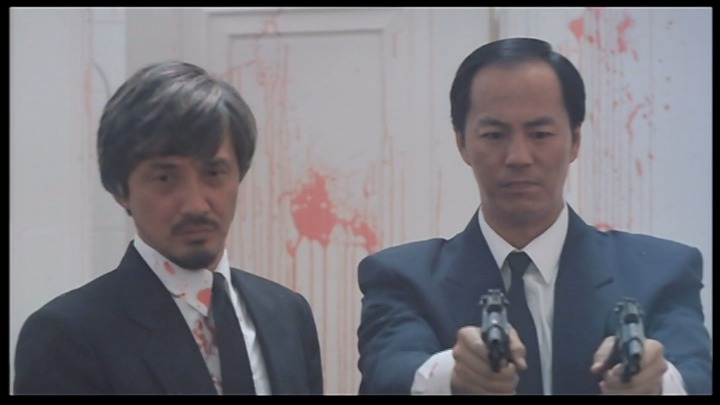
Sure, he lays the angst and melodrama on thick but in doing so raises the stakes in the action sequences. This was a pretty novel notion at the time. It makes the climactic showdown – where Ken, Lung and Ho are decked out in black suits (anticipating Reservoir Dogs by a few years) – that much more memorable because these guys have sacrificed so much that they’re due for some well-deserved payback and man, do they ever dish it out by staging a full-on assault on Ko’s compound with automatic weapons, grenades and, in one memorable bit, a samurai sword. But it is Woo’s trademark dual handgun action that is used the most and to greatest effect. A Better Tomorrow II takes the first film and ups the ante with more bloodshed and more melodrama for an installment that some prefer over the original. For a film that had such a troubled production, it is surprisingly coherent and in terms of its action sequences a classic of the genre. Woo would improve greatly on this template with The Killer (1989) and the aforementioned Hard Boiled before trying his luck in Hollywood with mixed results.

Friday, July 6, 2012

The Mean Season


The 1980s was quite a prolific decade for actor Kurt Russell. Sprinkled between the genre classics he made with director John Carpenter, the actor tried his hand at a wide variety of roles, from shifty used car salesman in the comedy Used Cars (1980) to a nuclear power plant worker in the docudrama Silkwood (1983) to a police detective in the neo-noir Tequila Sunrise (1988). Often forgotten during this busy decade is a nifty little thriller called The Mean Season (1985). Based on the bestselling 1982 novel In the Heat of the Summer by John Katzenbach, this well-executed film acts as the cinematic equivalent of an engrossing page turner.

Set in Miami during the hot, late summer months, the film opens with an urgent brassy score by the great Lalo Schifrin that plays over shots of stormy skies juxtaposed with the busy printing presses of the Miami Journal, foreshadowing how both will play a prominent role later on. Malcolm Anderson (Kurt Russell) is a veteran crime reporter that has just come back from hiatus/job hunting in Colorado. He’s burnt out, lacking both ambition and drive. He wants a change of pace and threatens to quite… again. But before he can bring it up, Bill Nolan (Richard Masur), his editor, assigns him to cover the murder of a young woman that has been shot in the head.

The crime scene sequence speaks volumes about Malcolm’s character. He’s covered the beat long enough to be on friendly terms with homicide detective Ray Martinez (Andy Garcia) but not his partner Phil Wilson (Richard Bradford). He also knows how to get the guy who found the body to open up and talk then has the decency not to use the man’s name in the article. Malcolm is also tactful and understanding with the mother of the murder victim, listening to the woman’s reminisces about her child while still getting what he needs for the article. This is in contrast to Andy Porter (Joe Pantoliano), the crime photographer who shadows Malcolm on his assignments and has no problem taking a picture of the grieving parent during a particularly vulnerable moment. This scene is important because it establishes that Malcolm is good at what he does and he is a decent person so we like and identify with him.

Malcolm finally confronts Bill about his desire to quit in a scene between veteran character actor Richard Masur and Russell. Bill tells Malcolm, “You haven’t been at this long enough to be as burned out as you like to think you are.” Malcolm feels like he’s seen and done it all but still hasn’t found his Watergate yet – the dream of all ambitious investigative reporters. Malcolm sums it up best when he tells Bill, “I don’t want to see my name in the paper next to pictures of dead bodies anymore.” The editor counters, “Now we’re not the manufacturer, we retail. News gets made somewhere else, we just sell it.” It’s a nice scene that is well-played by both actors as their characters touch on the nature of ethics in reporting the news. How far are they willing to go to get a story that makes their career? Malcolm is about to find out as he gets a phone call from the man (Richard Jordan) that killed the teenage girl. He admires Malcolm’s writing and wants the reporter to be his mouthpiece as he plans to kill again.

Bill is practically salivating at the possibilities while Malcolm’s ambition kicks in as he realizes that he’s found his Watergate. However, as the murders continue, Malcolm finds himself getting more involved in the story until he’s as much a part of it as the killer, which puts his life and that of his girlfriend (Mariel Hemingway) in danger.

While the set-up and plot of The Mean Season are nothing special – the reporter who gets in way over his head – both are executed well enough that you don’t mind and this is due in large part to the engaging performances of the talented cast that do their best to sell the material. Kurt Russell certainly comes across as a believable newsman. He’s got the lingo down and seems to know his way around the newsroom and the beat that Malcolm covers. The actor does a nice job of conveying his character’s transition from someone reporting on the news to the one making it. He also manages to get a chance to show off some of his action chops in an exciting bit where Malcolm races across town to find his girlfriend before the killer does. His frantic, desperate race is intense because the actor knows how to sell it, running full tilt over several blocks like a man possessed, and because we know more than he does. We know just how much danger his girlfriend is in.

Mariel Hemingway is good in the thankless girlfriend role. She and Russell have good chemistry together. They make a nice couple together and her character ends up acting as the voice of reason when Malcolm gets too involved. Hemingway does her best to avoid the damsel in distress stereotype but it is pretty easy to figure out how it’s all going to go down. She is part of a solid supporting cast that includes Andy Garcia as the dedicated cop that cares and Richard Bradford (The Untouchables) as his older, more experienced partner who thinks that Malcolm is a parasite. The aforementioned Richard Masur (The Thing) is also memorable as the opportunistic editor who just cares about selling papers. The great William Smith (Darker than Amber) has a memorable bit part as a pivotal witness that helps Malcolm and the cops track down the killer. He has only one scene with a decent amount of expositional dialogue to convey but he nails it.

Director Phillip Borsos (The Grey Fox) also does a nice job orchestrating the cat and mouse game between Malcolm and the killer thanks to the smartly written screenplay by Leon Piedmont. They manage to hit all the right notes and fulfill all the right conventions of the thriller genre – the grudgingly helpful cops, the ambitious reporter, the sociopathic killer, and so on – and stir it all up. Borsos employs no-nonsense direction like a seasoned studio pro, which lets the actors do their thing. I also like how he conveys a sense of place with the sweaty, summer weather, coupled with the impending hurricane that is almost tangible. It all comes to a head at the exciting and atmospheric climax when Malcolm confronts the killer in the Everglades.

John Katzenbach was a veteran crime reporter who based his debut novel In the Heat of the Summer on years of experiences and that of his colleagues. Producer David Foster, a journalism graduate, had been looking for a good screenplay about reporters for years. He came across the manuscript for Katzenbach’s novel and was impressed by it. He met with the author and they talked about how to accurately convey the life of a newspaper reporter on film.

In April 1984, Borsos and his crew arrived at the Miami Herald offices to study a typical day in the newsroom and on that day Christopher Bernard Wilder, suspected of kidnapping and murdering several young women, shot himself as the police closed in. The resulting flurry of activity at the Herald helped Borsos create a realistic newsroom atmosphere in his film. Katzenbach urged Kurt Russell to hang out with his fellow reporters in preparation for the film. To that end, Russell and Joe Pantoliano accompanied a reporter and a photographer from the newspaper to the scene of a grisly double murder in North Miami. Much like in the film, the actor found cameras were trained on him and later saw footage of himself on the evening news. In addition, Richard Masur spent days and night son the Herald’s city desk.

Borsos’ previous film The Grey Fox (1982) did not make a profit and so to pay off his debts he agreed to direct The Mean Season. Unfortunately, he had creative differences with Foster over the tone of the film. According to Borsos, he wanted the film to look “somewhat stylized and slightly unreal, more what you would call a 1950’s film-noir type of picture.” In contrast, Foster wanted a more realistic-looking film as Borsos said, “Mr. Foster’s vision was more of action-packed thriller instead of a character-thriller.” It also didn’t help that the director resented the producer’s constant presence on the set. The newsroom scenes were actually shot at the Miami Herald late at night with several staff members used as consultants and extras. Russell and two fellow actors used three real newsroom desks that were outfitted with authentic-looking notepads, books, dictionaries and computer printouts. In addition, Katzenbach was frequently present during filming and acted as a consultant.

When The Mean Season was released it received mixed reviews from critics. In her review for The New York Times, Janet Maslin felt that the film “has a brisk pace and a lot of momentum. It also has a few more surprises than the material needed, since Mr. Borsos, who for the most part works in a tense, streamlined style, likes red herrings.” The Washington Post’s Rita Kempley wrote, “Overall the film seems a little flat, a little stale … Director Philip Borsos' style is too dogged to transform Mean Season into a true thriller, though it serves well as a message movie on what news is fit to print.” The Globe and Mail’s Jay Scott felt that The Mean Season was two films in one: “Still, the two halves add up to a slickly effective and sometimes thought-provoking whole, a mystery that isn't quite Klute and that certainly isn't Witness, but that is swifter than nine-tenths of the contestants in the sparsely run race to entertain adults without insulting them.” Newsweek’s Jack Kroll wrote, “This movie has the weather of Body Heat, the moral stance of Absence of Malice and the perverse plot-angle of Tightrope. It's also not as good as any of these.” In his review for the Los Angeles Times, Kevin Thomas praised Russell’s performance: “The Mean Season depicts with conviction and economy how Russell is transformed by covering the serial killings. Russell, in turn, excels in retaining our sympathy as he becomes caught up in his assignment.”

The Mean Season is an entertaining film that falters a little bit at the end with a clichéd “twist” that sees Malcolm suddenly transform into an action hero but Russell does his best to make it work. At times, it feels like there are two kinds of films competing – the character-driven thriller that Borsos wanted to make and the action-packed thrill machine that Foster envisioned. The result is a sometimes uneven effort. Not every film has to try and reinvent the wheel by offering some novel take on the genre. There’s something to be said for a thriller that has nothing more on its mind then to entertain and tell a good story and that’s something The Mean Season delivers on both counts.


SOURCES

Gross, Jane. “An Actor Explores the Fourth Estate.” The New York Times. February 10, 1985.

Johnson, Brian D. “An Eye for Magic Realism.” Maclean’s. February 25, 1985.


Maslin, Janet. “At the Movies.” The New York Times. February 1, 1985.