"...the main purpose of criticism...is not to make its readers agree, nice as that is, but to make them, by whatever orthodox or unorthodox method, think." - John Simon

"The great enemy of clear language is insincerity." - George Orwell
Showing posts with label Alex Cox. Show all posts

Friday, May 23, 2014

Walker

“People don’t go to the movies to be enlightened. They go to the movies to have a good time. If some social enlightenment occurs as a result of seeing Walker, seeing the faces of Nicaraguans, seeing the country, getting a feeling for the country, that’s good. Then we’ve achieved something.” – Alex Cox

Walker (1987) is an unconventional biopic that effectively burned any remaining bridges Alex Cox had with Hollywood. He took a modest amount of studio money and made a film about William Walker, an opportunistic American who invaded Nicaragua and became its president from 1855 to 1857, instituting slavery, which didn’t go over too well with the locals, and he was eventually executed in 1860. Cox wasn’t interested in making a traditional biopic and, with screenwriter Rudolph Wurlitzer (Two-Lane Blacktop), decided to include the occasional modern anachronism (Walker appears on the covers of Newsweek and Time; a Mercedes drives past a horse-drawn carriage) to give the film a satirical howl of protest against the Reagan administration’s support of the Contra war against the democratically elected Sandinista government. This did not endear Cox to his studio backers.

Stylistically, Cox was influenced by the films of Sam Peckinpah as the opening slow-motion carnage so lovingly demonstrates (he even has the director’s name on a grave in a later scene). The film begins with Walker’s (Ed Harris) unsuccessful attempts to colonize the Mexican territories of Sonora and Baja. He is put on trial back in the United States and argues that he was only exercising his God-given right of Manifest Destiny. He believes that expansion of the U.S. is its future and he is merely a patriot doing his duty. His girlfriend, Ellen Martin (Marlee Matlin), sees through his posturing and argues that Manifest Destiny is just another way of condoning slavery.

However, powerful capitalist Cornelius Vanderbilt (Peter Boyle) asks Walker to invade Nicaragua and restore order to a country torn apart by civil war so that he can continue to exploit its transportation routes. At first, Walker turns him down, but after enduring a personal tragedy, he needs something to fill the void and accepts Vanderbilt’s proposal. Walker recruits 58 men that the press dubs, “Walker’s Immortals,” and heads for Central America. The film documents Walker’s gradual descent into madness as he becomes drunk on power, delusional, believing he is control, that what he is doing in right, even when, in reality, this is not the case.


Cox clearly equates the self-righteous Walker, who sometimes refers to himself in the third person, with politicians like Ronald Reagan who believe that it is their moral right to “liberate” other countries in order to “save them” when in actuality they are exploiting their resources and doing irreparable damage to its people. How little things have changed. Walker is as arrogant and blithely dimwitted as George W. Bush and his pointless mission to liberate Iraq, a country, like Nicaragua, at war with itself. In came the Americans to try and fix things, only to make it worse.

With its Latin American beats, Joe Strummer’s score plays over the film’s opening carnage as people fly through the air in slow-motion and Walker’s men are systematically picked off by overwhelming forces. Shooting on location in Nicaragua and the rather exotic score do a great job of transporting us back in time. The nightmarish minimalism of the music in the scene where Walker’s men are slaughtered while he advances unscathed is incredible and adds to the surreal nature of the scene as the American acts as if he’s merely out for a afternoon stroll while his men die bloody deaths all around him. The film’s show-stopping sequence is the burning of the town that is Walker’s headquarters with Strummer employing a poignant piano sound and a soulful guitar that contrasts the madness of Walker’s actions and the end of his regime. Simply put, what Strummer does on this soundtrack is miles away from anything he did with The Clash and makes one wish he had tried his hand at more film scores.

Cox sets an absurdist tone and never looks back. This is evident in Walker’s first battle in Nicaragua. As his men are gunned down in the street, he brazenly walks through seemingly oblivious to the carnage going on around him. He takes refuge in a building and plays the piano as bullets whiz around him. It’s a crazy scene, but it works because of Ed Harris’ conviction. He portrays Walker as a self-important, power-hungry madman with characteristic charismatic intensity. Cox does some really unusual things in this film, like having an entire scene between Walker and his deaf girlfriend conducted completely in sign language!


Liverpool-born Alex Cox first became interested in the country of Nicaragua when he became fascinated by how the media portrayed the revolution that took place there in the late 1970s. At first, the Sandinista rebels were portrayed favorably and then this changed dramatically. Cox visited Nicaragua in 1984 during the National Election campaign for which Daniel Ortega became president to see if conditions were as bad as the American media had reported. He discovered that this wasn’t the case. He was persuaded to return to the country by two wounded soldiers from the Sandinista Army.

While he was there, Cox saw a sign on the wall of a church in Granada that said it was burned down in the 1850s by the retreating army of William Walker. This intrigued Cox and when he returned home, read an article on United States foreign policy in Central America in Mother Jones magazine, and decided to bring the Walker’s story to the big screen. A history professor from the University of California leant Cox a library card so he could do more research and “the more I read about him the more bizarre this seemed.” Furthermore, Cox realized that “you couldn’t invent a character like Walker. He was much too incredible. He was a complete lunatic: a strong believer in chivalry, a murderer, a pathological liar, a criminal, totally fearless, full of heroic and noble qualities, and mad.”

Cox hired Rudy Wurlitzer to write the screenplay because, according to the director, “he understands American guys and the mad impulse that drives certain Americans to be great men.” He wasn’t interested in making a long, respectful historical drama a la Masterpiece Theatre because Walker “leads a disastrous misadventure. He’s a pretty bad guy. I didn’t think it was possible to approach it in this normal, historical, respectful style.”


Cox was given a budget of $6 million and decided to shoot most of the film in Granada. Amazingly, he got the cooperation of the Sandinista government and the Roman Catholic Church. One of the benefits of shooting in Nicaragua was that the dying economy received a significant boost by the presence of the production. 300 local carpenters were hired to build sets, 6,000 people were hired as extras and the army supplied security guards and a Soviet-built MI018 transport helicopter that was used in the film. One of the conditions of being allowed to film in Nicaragua was that the screenplay was edited by the country’s vice president Sergio Ramirez and the Minister of Culture Ernesto Cardenal, who were also a novelist and a poet respectively. Both men, along with the Minister of Education, the country’s Interior Minister, and a military commander would occasionally visit the set.

Electricity poles in the plaza were torn down, leaving homes without light. Some families were left temporarily without a telephone because the production needed their lines and the government couldn’t afford to install new ones. The central square was covered with several inches of dirt in order to recreate 1850s conditions. Unfortunately, two people were accidentally killed during production, both in separate vehicular-related incidents. For one of the deaths, the production paid for the funeral and compensated the family. The shooting conditions were difficult because of the many fires that were set by the locals, which made the air thick and hard to breath.

Cox cast Ed Harris as Walker. He was drawn to the challenge of playing someone “who has incredible moral convictions but turns into such an evil person in the name of spreading democracy.” He was also drawn to the script’s politics, claiming to be anti-Contra and anti-intervention in Nicaragua. He saw making a film there as a way to possibly stop the bloodshed. To get into character, Harris led the entire cast on a ten-mile forced march through the Nicaraguan countryside.


Even after filming had ended, Cox stayed in Granada, editing Walker. He said, “I think we have kind of a duty not to just be the rich gringos and come down here and spend eight weeks and then disappear.” To provide the film’s eclectic soundtrack, Cox brought on board his friend and frequent collaborator Joe Strummer. They had worked together previously on Sid and Nancy (1986) and Straight to Hell (1987), contributing songs to their respective soundtracks. The Clash frontman had wanted to compose an entire score to a film and Walker afforded him such an opportunity. After filming his small part in the film, Strummer would go back to his room and record bits of music onto a four-track cassette using an acoustic guitar and a little plastic synthesizer with guitarist Zander Schloss. Both men became influenced by local music played in bars, which was a mix of reggae, calypso and Brazilian music.

The original deal Cox made with Universal Pictures was to give Walker a traditional theatrical release and to that end felt that if he could make a satirical western a la Blazing Saddles (1974), it would appeal to a mainstream audience. At some point, the studio realized that they had a strange film on their hands and began treating it as an art house oddity, giving it a very limited release with little advertising. Walker received mostly negative to mixed reviews with Roger Ebert leading the charge. He gave the film a resounding thumbs down and felt that Cox didn’t “seem to have a clue about what he wants to do or even what he has done. Although the ads for Walker don’t even hint it, this movie is apparently intended as a comedy or a satire. I write ‘apparently’ because, if it is a comedy, it has no laughs, and if a satire, no target.” In his review for The New York Times, Vincent Canby wrote, “Walker is a witty, rather than laugh-out-loud funny. Without being solemn, it’s deadly serious … Walker is something very rare in American movies these days. It has some nerve.” Newsweek magazine’s David Ansen criticized Cox’s direction: “His scenes have no shape, his characters are stick figures, the wit is undergraduate, and his soggy set pieces of slow-motion carnage are third-rate Peckinpah imitations.” In his review for the Globe and Mail, Jay Scott wrote, “Cox exposes the limitations of historical drama in Walker with a calculated disregard of its conventions.” Finally, the Washington Post’s Rita Kempley found it to be as “gross as it is muddled as it is absurd.”

In some respects, Walker fuses the pastoral epic scope of Michael Cimino’s Heaven’s Gate (1980) with Cox’s own irreverent aesthetic. He actually had the chutzpah to make the film in Nicaragua with the approval of the Sandinista government, which demonstrates just how far he was willing to put his money (or rather the studio’s) where his mouth was. The filmmaker adopts a very playful attitude as he gleefully deconstructs the biopic (much as he shredded the spaghetti western and gangster film genres in Straight to Hell) in such an off-kilter way that had never been done before and rarely attempted since (perhaps Kevin Spacey’s take on Bobby Darin in Beyond the Sea or Tony Scott’s gonzo take on Domino Harvey in Domino). However, Walker remains a cinematic oddity as he applies the punk aesthetic to the biopic, making a political statement about the abuse of power that is eerily relevant today as it was in 1987.


SOURCES

Dafoe, Chris. “Hollywood Knocks on Strummer’s Door.” Globe and Mail. December 11, 1987.

Ford, Peter. “Desperado with a Mission.” Financial Times. August 22, 1987.

Grove, Lloyd. “Hollywood Invades Nicaragua.” Washington Post. August 20, 1987.

Lim, Dennis. “Alex Cox, Revolutionary.” Los Angeles Times. February 17, 2008.

Murray, Noel. “Alex Cox.” A.V. Club. March 13, 2008.

Van Gelder, Lawrence. “Cox to Show Walker Film in Nicaragua.” The New York Times. December 4, 1987.


Yakir, Dan. “For Harris, The Appeal was Political.” Globe and Mail. December 11, 1987.

Friday, April 13, 2012

Repo Man

Repo Man (1984) was part of a fascinating trend during the 1980s of foreign filmmakers seeing America through the eyes of an outsider and making films that identified with marginalized figures hanging out on the fringes of society. Some of these directors included German director Wim Wenders (Paris, Texas), Czech Ivan Passer (Cutter’s Way), the Franco-Swiss filmmaker Barbet Schroeder (Barfly), and Liverpool, England-born Alex Cox. Teaming up with legendary Dutch cinematographer Robby Muller, Cox offered a fresh perspective on Los Angeles, a sprawling metropolis that has been the setting for countless films and television shows, by picking locations that hadn’t been seen all that often – “dirty, dingy locations in East L.A. and downtown” with all sorts of abandoning buildings and vacant lots, as the Los Angeles Times observed, naming the film one of the best set in the city in the last 25 years.


Repo Man came out at the height of the Reagan era and was notable for how it proved to be a sharp contrast to the prevailing trend of rampant commercialism with its generic branding of food and drinks and a protagonist that openly rejected material items and a traditional job in search of something else. The film follows the misadventures of a white suburban punk named Otto (Emilio Estevez) who we meet stacking cans of food in a supermarket while co-worker Kevin (Zander Schloss, who’s look and demeanor anticipated Napoleon Dynamite by two decades) sings the jingle for 7-UP to pass the time. For Otto this is the last straw and he quits his job after being confronted by his boss for not properly spacing the cans. He’d much rather party with his punk rock buddies until he catches his best friend Duke (Dick Rude) having sex with a girl he was just about to get with himself before going to get her a beer. Not only rejecting his crappy job but also his punk rock friends, Otto ends up wandering the streets aimlessly until he meets Bud (Harry Dean Stanton), a veteran repossessor of cars, and who unwittingly gets the young man to help repossess his first car.

It’s Otto’s first introduction into a subculture he never thought about before and once he realizes what Bud is, rejects his offer to be a repo man. Otto soon finds out how true the old adage is that you can’t go home again when his perpetually stoned ex-hippie parents have given all of his European trip money to buy a place on Reverend Larry's Chariot's of Fire Honor Role to send Bibles to El Salvador. Otto starts working for Bud who takes the young man under his wing and shows him the ropes, telling him how to dress and how things work. Most importantly he tells Otto the Repo Code. The young man takes to the job instantly, getting off on the excitement of not just dealing with angry car owners but also the run-ins with other highly competitive repo men like the Rodriguez brothers – Napoleon (Eddie Velez) and Lagarto (Del Zamora). In some respects, the repossessing racket infuses a lot of the punk rock attitude as Bud famously tells Otto, “An ordinary person spends their life avoiding tense situations. Repo man spends his life getting into tense situations.”

"Not many people got a code to live by anymore," says Bud to Otto early on in Repo Man. This film is all about personal codes and philosophies. It seems that everyone has their own take on life, from Bud's Repo Code ("I shall not cause harm to any vehicle or the personal contents thereof, nor through inaction let that vehicle or the personal contents thereof come to harm.") to Lite (Sy Richardson), another repo man, who has his own code of conduct – he won’t ride with anybody unless they wear a seatbelt. However, Repo Man’s core belief, if you can call it that, comes from pseudo-guru/mechanic Miller's (Tracey Walter) Lattice of Coincidence philosophy. He views life as "a bunch of unconnected incidences," with a "lattice of coincidence that lays atop of everything." This is the structure that Cox imposes on Repo Man, creating several seemingly random events and characters that only occasionally interact with one another, but eventually all are linked together at the film's end.

Cox uses the initial scenes in the film as a springboard to introduce a variety of unusual characters and situations that contribute to the satirical commentary on everything from television evangelists to hippies to punk rock. Initially, he presents these situations as meaningless, random events: a Chevy Malibu driven by a lobotomized scientist with four dead aliens in the trunk that fry anyone who dares open it; three old friends from Otto’s punk days that rob various variety stores for kicks (“Let’s get sushi and not pay!”); a UFO cult dedicated to finding the dead aliens and exposing them to the world on Johnny Carson; and the FBI who is also in pursuit of the Chevy Malibu. Cox has all of these characters, and many more interact with one another throughout the film, keeping Otto and Bud as the focal point, illustrating that what seems like random, arbitrary events are really all connected. Lattice of coincidence indeed.

Emilio Estevez and Harry Dean Stanton are excellent as the student and teacher, playing well off each other with the former learning the ropes, and the latter doling out words of wisdom. Liberated from Brat Pack fare that he has been most closely identified with, Estevez is quite good as Otto, a directionless young man trying to find a purpose and thinks he’ll find it initially with the repo men but thanks to Miller discovers a higher purpose. Legendary character actor Stanton is in top form as veteran repo man Bud. His weather-beaten features and the laconic way he smokes a cigarette help convey Bud’s world-weariness. After seeing him in countless films as a supporting actor it’s great to see him in a substantial role. Repo Man only reinforced his considerable range as he plays a cranky guy who’s seen it all and has an opinion to go with it. This is in sharp contrast to his nearly mute and extremely vulnerable loner in Paris, Texas (1984).

The supporting cast is also excellent. Sy Richardson is one of the stand-out repo men, playing a cool guy with a badass attitude and a habit of self-mythologizing – he’s the John Shaft of the repossessing set. In one of the film’s reoccurring gags, he introduces Otto to a book that changed his life – a thinly-veiled jab at Dianetics entitled, Dioretix: The Science of Matter Over Mind by X. Rum-Bubba. Tracey Walter as space case Miller is also superb. In most films, Walter has been relegated to nothing roles, but here Cox gives him room to do his thing and he uses the time wisely presenting Miller as maybe the most intelligent guy in the film, or the most insane as he expounds his strange theories ("The more you drive, the less intelligent you are.") to anyone who will listen. He’s given an opportunity to deliver a fascinatingly wonky monologue about how UFOs are really time machines that comes across as a pisstake on New Age hokum but is ultimately embraced by Otto and proven true at the end of the film. According to Walter, this now famous speech was not in the script. Cox wrote it with no intention of using it but the actor told him, “Alex, you can’t be serious about not using that!”

Repo Man is chock full of hilarious bits pitch black humor, like when a highway patrolman asks a government agent what happened to his comrade who was vaporized in the film’s opening minutes to which she deadpans, “It happens sometimes, people just explode. Natural causes.” There are also all kinds recurring and throwaway gags, like the car with the dead aliens passing by the government truck pursuing it but the FBI agents fail to notice because they have engine trouble. Bud and Otto repeatedly and narrowly miss meeting the latter’s punk pals who have become inept criminals. There ‘s also punk rock band the Circle Jerks who make an appearance in the film as a cheesy lounge band (“I can’t believe I used to like these guys,” Otto says with disdain). One also has to pay attention to background dialogue to get a few funny gems, like the scene where Otto enters a hospital and over the intercom Dr. Benway is being paged for surgery. Benway was one of the main characters in William S. Burroughs’ surreal novel, Naked Lunch.

From the get-go, Cox also establishes a refreshingly uncompromising, bare bones approach and tone to the whole film that, unlike other supposedly anti-establishment films (Heathers and Pump Up The Volume), never lets up. This tone is established with a great punk rock soundtrack with the likes of Black Flag, Fear, and the Circle Jerks contributing songs and almost documentary-like photography from Robby Muller. Best of all, Cox isn't afraid to cast a critical eye on anyone, even poking fun at the film's own punk aesthetic in a scene where Otto's friend, Duke dies from a gunshot wound and leaves this touching soliloquy, "I know a life of crime led me to this sorry fate. And yet, I blame society. Society made me what I am." It's the old juvenile delinquent/punk cop out which Cox exposes so well as Otto replies, "That's bullshit. You're a white suburban punk, just like me." Repo Man is unforgivingly anti-materialistic, anti-commercialism, anti-consumerism, and anti-establishment – a welcome relief from the cultural wasteland that was the mid-1980s.

After graduating from the UCLA film studies department, Alex Cox met British film director Adrian Lyne who, at the time, had only directed Foxes (1980). He told Cox that his next film was going to be about the impending threat of nuclear war. Cox scouted locations in Seattle and Vancouver for Lyne while also writing a screenplay entitled, The Happy Hour. Lyne never made the film and Cox subsequently ran into two friends from UCLA – Jonathan Wacks and Peter McCarthy. They had formed a production company and each had made a film and were now making commercials and public service announcements.

Cox suggested that they produce feature films and that he should direct one of them. Wacks and McCarthy agreed and told him to write a script. So, he wrote The Hot Club, which he described as “a comedy about nuclear blast veterans and nerve gas thieves set in the early years of the 21st century.” It was budgeted but ultimately deemed too expensive and so Cox went off and wrote Repo Man based on his experiences living in L.A., working as a car repossessor and inspired by punk rock music and underground comic books that came out of San Francisco in the 1960s and 1970s by the likes of Robert Crumb and Gilbert Shelton. To entice potential investors, Cox drew four pages of a comic book based on his script with the notion of expanding it into an entire comic book but found it to be too much work and abandoned the idea.

Michael Nesmith, one of The Monkees and now a movie producer, read the script/comic book pages, liked it and showed it to then-head of Universal Studios Bob Rehme. Amazingly, he green-lighted Repo Man, offering Cox a $1.5 million budget on the condition that the film be delivered on time and resemble the original script. Repo Man was shot on location in L.A. over six weeks from late July to August 1983. The crew were asked to work for free for the final three days when the production went over budget and over schedule. For the most part the production was able to fly under the radar as the studio was focusing most of its attention on the big budget production of Streets of Fire (1984). Unfortunately, just as principal photography was being completed, Rehme was fired and the new studio head proceeded to marginalize anything his predecessor had been attached to, including Repo Man and Francis Ford Coppola’s Rumble Fish (1983).

Repo Man had its world premiere at the 1984 Berlin Film Festival. When the film made its North American debut, it only played major cities. In frustration, Cox and his producers took out an ad in Variety reprinting the good review they gave it as “a challenge” to Universal to give their film a proper theatrical release. Fortunately, an executive at the studio by the name of Kelly Neal championed Repo Man, prolonging its theatrical life somewhat. The film’s soundtrack, composed almost entirely of West Coast punk rock bands, became quite popular with fans of the music and through word of mouth Cox’s film began to develop a cult following.

Repo Man received positive reviews from mainstream critics at the time. Roger Ebert gave the film three out of four stars and wrote, “What's best about Repo Man is its sly sense of humor. There are a lot of running gags in the movie, and the best of them involves generic food labels, of all things.” In his review for The New York Times, Vincent Canby wrote, “Repo Man frequently seems to be as zonked as Mr. Stanton's cocaine-sniffing Bud. It's not a big- budget, Ghostbusters of a movie, but it's very entertaining, and though it's rude in an R-rated way, it has the good taste never to promise more than it can deliver.” The Globe and Mail’s Jay Scott called it, “a non-stop, shoestring trip with more adventures and a helluva lot more smarts than you'll find in most American movies. The ride in Repo Man may be bumpy and there may be a few wrong turns and a few false starts, but the scenery is always, well, scenic and, despite their nihilism, the travelling companions are enlivening and weirdly affirmative.” The New Yorker’s Pauline Kael wrote, “The movie gives you the feeling that you’ve gone past alienation into the land of detachment … A movie like this, with nothing positive in it, can make you feel good.” In his review for the Washington Post, Gary Arnold wrote, “Cox gives the denizens of Edge City wacky ways of expressing themselves whether they're principals, passers-by or disembodied voices.” Most memorably, notable author Harlan Ellison reviewed the film and wrote, “Unless you are one of those dismal unfortunates who thinks Jerry Lewis is funny, you are guaranteed a filmic experience that can only be compared, in terms of a good time, with watching Richard Nixon sweat on television.”

Repo Man is a clever social satire that attacks consumer culture on a small scale. Many of the characters have brand names like Miller, Bud, and Lite, while all the products in the film are labeled "Beer" and "Food." Cox twists the whole idea of consumerism on its ear, commenting on how we have all become commodities of one form or another to be bought and sold. On one level, the film is a bizarre comedy with memorable dialogue (hence its cult film status) and a killer soundtrack (the title song performed by Iggy Pop no less), but look a little harder and you will find much more going on under the surface. Many obscure films are often labeled a "cult film," but this one deserves the label with its eclectic cast, a take-no-prisoners attitude towards social commentary and an unconventional plot structure.

 
NOTE: The bulk of the production info was taken from Alex Cox's official site and from the liner notes of the special edition DVD tin by Anchor Bay.

Monday, March 29, 2010

Straight to Hell

In the 1980s, British filmmaker Alex Cox had a terrific run of idiosyncratic films that included the science fiction satire, Repo Man (1984), the skid row romance Sid and Nancy (1986), and the unconventional historical biopic Walker (1987). Often forgotten during this decade is the Gonzo spaghetti western, Straight to Hell (1987), a film that simultaneously pays homage to and parodies the genre. No one was ready for this kind of film during the ultra-conservative Reagan era and Cox’s film was a resounding commercial and critical failure.

If there was ever a film that deserved a cult following it was Straight to Hell, which has to have one of the most eclectic casts ever assembled – a motley crew of musicians (Joe Strummer, Elvis Costello), veteran actors (Dennis Hopper) and Cox regulars (Sy Richardson, Dick Rude). For good measure, Cox added an untrained actress (Courtney Love), a wildly eccentric one (Grace Jones) and a fellow filmmaker (Jim Jarmusch) into the mix, bouncing all of these people off one another and filming the results which were pretty interesting to say the least.

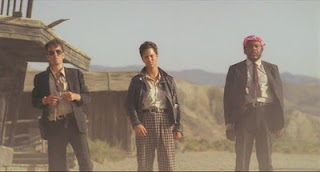
Sims (Joe Strummer), Willie (Dick Rude) and Norwood (Sy Richardson) rob a bank in Almeria, Spain and go on the lam with Norwood’s pregnant girlfriend Thelma (Courtney Love). They take refuge in a small, run-down village right out of one of Sergio Leone’s westerns. They cross paths with a rowdy gang of outlaws known as The McMahons (played mostly by Shane MacGowan and The Pogues ) and you just know that at some point a conflict will arise and it will all end in violence.

Some of the highlights of this very eclectic cast include Dick Rude playing a criminal variation of the dumbbell punk he played in Repo Man. Joe Strummer is the crook so cool that he combs his hair with a switchblade. Sy Richardson is the calm and collected leader. Courtney Love, before anyone knew who she was, seems to be channeling Nancy Spungen which makes sense considering she tried out for the role in Cox’s Sid and Nancy biopic. Then, there are the non-sequiteur cameos by the likes of Dennis Hopper and Grace Jones who show up more than halfway through to give our heroes a machine gun only to disappear like ghosts. What keeps things interesting is watching all of these musicians collide with actors in one odd scene after another.

While editing Sid and Nancy, Cox got involved in a concert in Brixton, England in support of the Sandinista National Liberation Front in Nicaragua. The likes of Elvis Costello, Joe Strummer and The Pogues played at the sold out benefit. Sid and Nancy producer Eric Fellner came up with the idea of getting the musicians that played at the concert to go on tour in Nicaragua. Fellner assumed that a video deal would pay for it and persuaded the musicians in question to sign-up for a month-long acoustic Nicaragua Solidarity Tour in August 1986. However, Cox and Fellner couldn’t find a video company to fund the tour because of the conservative climate in England with then prime minister Margaret Thatcher trying to criminalize the word, “Sandinista.”

With the tour a no-go and faced with the prospect of having all these musicians not recording or on tour, Fellner came up with the idea of making a film instead. Cox found that it was easier to raise a million dollars for a low-budget film than it was to get $75,000 to film musicians “playing a revolutionary nation in the middle of a war.” He also turned down the opportunity to direct Three Amigos (1986) to make Straight to Hell instead which just goes to show that he went with his gut instincts as opposed to his commercial sensibilities. Cox and Dick Rude wrote the roles for the actors and the director decided to shoot Straight to Hell in Spain where Lawrence of Arabia (1962) and The Good, The Bad and the Ugly (1966) had been made.

Straight to Hell’s premiere was as unconventional as the film itself, held at the Pickwick Drive-In in Burbank, California. Invitees were asked to come dressed in “post-apocalyptic fiesta garb,” and everyone who showed up was handed a water pistol. Not surprisingly, such an oddball film was not given a wide distribution and what critics saw it were not keen on it. Roger Ebert led the charge and wrote, “Watching the movie in a dreary reverie, while nameless characters shot at each other for no discernible reason, I asked myself what it was lacking. And the answer, I guess, is sort of old-fashioned: It needed some kind of coherent narrative.” In her review for The New York Times, Janet Maslin wrote, “the result is a mildly engrossing, instantly forgettable midnight movie.” The Washington Post’s Hal Hinson was a little more unforgiving in his review where he wrote, “the action is so gratuitous, and so indifferently presented, that it’s impossible to think that Cox ever truly intended it to be seen by anyone outside of the cast and crew and their immediate families.” In his review for the Boston Globe, Jay Carr wrote, “Try as he will, Cox just can't revive punk's defiant whoop here. One wonders if it would have been possible even if Straight to Hell had a script, which it doesn't. Mostly, it's Cox's friends hanging out, looking forlorn, as if they wished someone would tell them what to do.”

Watching Straight to Hell, it quickly becomes obvious that Quentin Tarantino must be a fan and was influenced by it. Both Norwood and Sims are gun-toting criminals dressed like the crooks in both Reservoir Dogs (1992) and Pulp Fiction (1994) but with the outlaw pedigree of the Gecko brothers in From Dusk Till Dawn (1996). Not to mention Sy Richardson’s no-nonsense criminal carries himself a helluva lot like Samuel L. Jackson’s character in Pulp. Straight to Hell’s humor is very broad and often surreal while the characters are intentionally cartoonish in nature with the actors often playing their roles wildly over-the-top. It’s all done in a playful way that is not meant to be taken seriously at all. Although, at times, it feels like the cast were probably having more fun making the film than it is to watch it with all kinds of in-jokes being exchanged and this only adds to the surreal tone.

In retrospect, Straight to Hell marked Cox’s break from conventional cinema in favor of a looser, more freewheeling approach. The film ambles along without any real purpose, much like its protagonists. There is no consistent tone or rhythm which could be interpreted as sloppy filmmaking but I think Cox knows exactly what he’s doing here. It seems like he was trying to make a cult film on purpose. In some respects, Straight to Hell feels like a warm-up for Cox’s next film, Walker, which would be an even more radical break from genre convention, only this time turning the biopic on its head.