"...the main purpose of criticism...is not to make its readers agree, nice as that is, but to make them, by whatever orthodox or unorthodox method, think." - John Simon

"The great enemy of clear language is insincerity." - George Orwell
Showing posts with label Ed Harris. Show all posts

Monday, January 16, 2023

A Flash of Green


What is the price for one’s soul? Is it ever worth the price, to betray loved ones, those who matter most to you? This is the dilemma that newspaper reporter Jimmy Wing (Ed Harris) wrestles with in A Flash of Green (1984), Victor Nunez’s adaptation of John D. MacDonald’s 1962 novel of the same name. As with all of the filmmaker’s films, this one is, first and foremost, a fascinating character study with a conflicted protagonist at its center.
 
Jimmy is a reporter for a local Florida newspaper in 1961. Developers are trying to buy Grassy Bay, a body of water in the heart of Palm City. Their goal: fill it in so that they can build homes on it, making a lot of money in the process. Some of its residents, however, have formed a committee called Save Our Bay (S.O.B.) to stop it, citing egregious environmental damage if it goes through.
 
Jimmy meets with Elmo Bliss (Richard Jordan), a county commissioner, to get the skinny on the development. He is told that the plan is to create an island, populating it with homes; as he puts it, “We’re going to manufacture a paradise.” Elmo is tired of being a commissioner and is going to run for the governor’s mansion. He plans to use the money he makes from Grassy Bay to fund his campaign. He wants Jimmy to spy on the S.O.B.s and dig up dirt on them … for a price, of course. He lays it all out for the reporter when he tells him, “World needs folks like me. Folks with a raw need for power. Without us, wouldn’t anything ever get done.”

Initially, Jimmy stays neutral, giving Katherine Hobble (Blair Brown), one of leaders of the eco-group, a heads up and she begins to rally the locals to stop it. He checks in on her and her two children from time to time as her husband - his best friend -- died a year ago. The steady income from Elmo, however, sways Jimmy, who is adrift in life. Adding to the weight of this decision is his wife, Gloria (Tiel Rey), who suffers from a degenerative brain disorder that her doctors understand little about and from which, it appears, she will never recover. The rest of the film plays out his moral dilemma – help Elmo for the money and in doing so betray Kat, the woman he loves but is afraid to admit it, even to himself.
 
Ed Harris delivers a memorable turn as a man faced with a conflict, a crisis of conscience. The deeper Jimmy digs for dirt for Elmo, the more morally compromised he becomes. He passively watches as his friends are railroaded by local politicians. Why is Jimmy willing to do this? Has his wife’s medical condition left him so cynical that he doesn’t care about anything? Kat and her kids humanize him, give him something to care about – a life he’d like to have. Jimmy’s actions are ruining people’s lives … good, decent people he’s known for years. Even those closest to him, like Kat, are being harassed on the phone by religious zealots, surreptitiously employed by Elmo to scare of members of the S.O.B. Harris does an excellent job conveying the guilt that plays across Jimmy’ face when the S.O.B. fall apart, knowing that it is because of his actions.
 
Richard Jordan does an excellent job of expressing Elmo’s passion for the development deal. He’s honest with Jimmy about his ambitions but not about how far he will go to realize them. Jordan is a fascinating actor to watch as he so effortlessly disappears into his character, something he did often in such diverse films as The Friends of Eddie Coyle (1973), The Mean Season (1985), and The Hunt for Red October (1990). In A Flash of Green, Elmo is the obvious villain of the film, but Jordan resists the urge to play him that way, even when he obliquely admits to sending guys to beat-up Jimmy repeatedly in the hopes of ‘persuading’ him to leave town after he turns the tables on Elmo. It is hinted that these two men have known each other for many years, the only reason why Elmo doesn’t have Jimmy killed.

Blair Brown is also very good as a woman still struggling with the loss of her husband, raising two children, trying to protect the bay from greedy developers, and sorting out her feelings for Jimmy. She has a lot on her plate and Brown’s intelligent, layered performance results in a fascinating character. At times, it is painful to watch her and the other committee members struggle against more powerful forces that they have no hope of beating. Brown resists any urge to inflate Kat’s fight to heroic heights, as one would see in a Hollywood movie, and instead opts to have that be only one of many aspects of her rich character.
 
There are also memorable minor roles, such as George Coe as a fellow journalist who doesn’t have the stomach for the darker stories that he and Jimmy sometimes cover. His response is to get so drunk that Jimmy must take him to his wife who cares for him. Even his character has his own arc and finds a way to redeem himself as he does his own part in the unfolding drama.
 
Sam Gowan, who had worked on Victor Nunez’s first film, Gal Young ‘Un (1979), went on to work at the University of Florida Libraries as the assistant director for special resources. Part of his division was the John D. MacDonald repository. MacDonald was a successful crime author, both critically and commercially, with his series of Travis McGee novels, and 1957 novel The Executioners adapted into film twice, in 1962 and 1991. Gowan and his wife enjoyed the man’s novels and she suggested asking Nunez to adapt one of them. Warner Bros., however, owned long-term options on all the Travis McGee novels, save for a couple of the early ones, which were available. He contacted MacDonald’s agent in Los Angeles and worked out a deal that required a small payment up front and a loaded backend, whereby if the film did well financially, the author would be paid more.

The budget for A Flash of Green was $750,000, ten times larger than Gal Young ‘Un. Half of the budget came from a small group of local investors with PBS American Playhouse covering the rest, who had been impressed with Nunez’s first film. To keep costs down, the entire cast worked for Screen Actors Guild minimum.
 
At the time the film was cast, Ed Harris turned down a chance to extend his run on Sam Shepard’s off-Broadway success, A Fool for Love (for which he won an Obie Award), and an offer from Paul Newman to appear in Arthur Miller’s Death of a Salesman, to go to Florida and act in Nunez’s project. Harris said, “I loved Victor’s sensibility and his cinematic tastes, his knowledge and how he films.” The actor was also drawn to the character of Jimmy Wing:
 
“I really appreciated the subtle character study that this guy is. He goes through so many changes. He’s someone who gets caught up in events that sort of catch him and sweep him away and he really has to climb his way back. He was a character I could really explore.”
 
To this end, the actor worked with the filmmaker on the screenplay, and during rehearsals, he frequented local stores for his character’s outfits. Harris’ hands-on approach extended to other cast members. Richard Jordan helped get period-specific props for the film and remarked on the challenge: “That era is too recent for anyone to collect and a lot of what you’d want to use has wound up in garbage cans.”

Critics of the day gave A Flash of Green generally favorable reviews. Roger Ebert gave the film three out of four stars and wrote, "A Flash of Green is attentive to the compromises of daily life, and it understands how people can be complicated enough to hold two opposed ideas at the same time." In his review for The New York Times, Vincent Canby wrote, "A Flash of Green is not perfect, but it is provocative and nearly always intelligent." The Washington Post's Lloyd Grove wrote, "Nunez, who also worked the camera with an eye for faded beauty, has made Palm City a self-contained world where there can be no appeal to a higher authority. While sometimes he's a bit heavy on the symbolism -- having Wing, at one point, fiddle with a two-faced doll -- he usually handles the material with admirable subtlety, letting the story all but tell itself."
 
The worlds in Nunez’s films feel fully fleshed out and realized, populated by readily identifiable people with compelling dilemmas. In the case of A Flash of Green he also creates a real sense of place; the attention to period detail on a budget is fantastic, with vintage cars and clothes used sparingly and matter-of-factly. He achieves it with small details, such as the cluttered office that Jimmy works in or the Spartan wood interior of Elmo’s office. Nunez also has a great ear for dialogue, accurately capturing the way people talk, evident in the scene where Kat debates with her friends about the development of Grassy Bay, with one arguing that developing the land will help the depressed local economy. The film presents several different points-of-view and then shows them in conflict with one another.
 
Nunez does a deft juggling act of showing how parts of Florida are being ruined by greedy developers and the toll it is taking on the residents, without being preachy about it, and by focusing on the relationships between them. A Flash of Green might be the most low-key crusading journalist film ever made. There are no heroic, epic speeches, moustache-twirling villains, car chases or gun battles – just people trying to protect their own little piece of the world. Much like John Sayles, Nunez is interested in telling stories about everyday people trying to get by, finding that their personal dilemmas are just as worthy of telling as any epic tale. For the people in his films, what goes on in their small world means everything to them. Life is about the choices we make and having to live with them. Jimmy has to live with the choices he has made. They were tough decisions that took their toll on him physically and emotionally. Jimmy finds that it isn’t easy buying back even a part of his soul. It is a long, hard journey but by the film’s end, there is hope that he is on his way to redemption.
 

SOURCES
 
Crandell, Ben. “FLIFF Reunites Old Friends Ed Harris, Victor Nunez.” South Florida Sun Sentinel. November 17, 2015.

Fein, Esther B. “Shaking A Hero Image.” The New York Times. July 22, 1985.
 
Gowan, Sam. “My Life in Movies.” The Gainsville Sun. April 1, 2004.
 
Maslin, Janet. “At the Movies – Jordan Assembled Props.” The New York Times. June 28, 1985.

Friday, April 24, 2015

Jacknife

By the mid-1980s, the American public was finally coming to terms with the effects of their involvement in the Vietnam War. Oliver Stone’s film Platoon (1986) opened the popular culture floodgates and soon a cottage industry of war-related material was everywhere, from Time-Life books to television shows to comic books. Hollywood also capitalized on the renewed fascination with the war and the people that fought in it by releasing films that were either set in Vietnam during the war or stateside in present time with returning soldiers still coping with the trauma of being over there. One of the best examples of the latter was a small, independent film entitled Jacknife (1989) starring Robert De Niro, Ed Harris and Kathy Baker. Adapted from the play Strange Snow by its playwright, Stephen Metcalfe, the film is a smartly-written, well-acted character study about people trying to put their lives back together while living with unresolved issues.

One day, Joseph “Megs” Megessey (Robert De Niro) shows up unannounced to take his friend Dave Flannigan (Ed Harris) out to the opening day of fishing. He lives with his sister Martha (Kathy Baker) who’s understandably surprised and upset to be woken up by a strange man pounding on her front door. Megs quickly disarms her with his easy-going charm and pretty soon they’re rousing Dave out of bed, much to his chagrin. He’s a raging alcoholic and has a typical antagonistic sibling relationship with Martha.

These early scenes are very well-played by the three actors as they tell us a lot about their respective characters and the dynamic between them. Robert De Niro plays Megs as an enthusiastic whirlwind of upbeat energy while in sharp contrast Harris’ portrays Dave as a bitter man who drinks to suppress deep-rooted anger and pain. Kathy Baker plays Martha as a somewhat reserved woman who is bemused by Megs’ gregarious nature.


Even though Dave claims that Megs is not his friend, they are bonded for life thanks to their experiences fighting together in the Vietnam War, which saw them both get wounded while their best friend Bobby (Tom Isbell) was killed – something that continues to haunt the two men. Dave drinks to forget and just wants to be left alone while Megs decides to try and reach him and in doing so maybe help himself in the process. Jacknife explores how Megs and Dave’s tenuous friendship is threatened by the former’s growing romantic interest in Martha.

Ed Harris has always been willing to disappear into the characters he plays with little concern for vanity and this film is no exception. We first meet Dave passed out in bed, sleeping off last night’s drinking binge. He’s a balding unshaven mess and the actor isn’t afraid to show his character’s flaws while also hinting at early on why Dave is such an unpleasant man. Harris suggests a deep reservoir of guilt and regrets that exists within Dave by the way he carries himself and acts towards Martha and Megs. With the former there is a long-standing antagonistic relationship common with siblings but she doesn’t understand his behavior because he refuses to talk to her about his experiences in Vietnam. With the latter, Dave shares a special bond that only comes with being in life and death situations with someone and they are able to talk about the war.

Robert De Niro played a Vietnam War veteran in The Deer Hunter (1978), but while that character was much more restrained, internalizing his feelings, Megs in Jacknife is the polar opposite. He is a chatty guy who is unfailingly polite and an optimist but De Niro’s performance suggests that this covers up a lot of pain. Unlike Dave, he’s trying to deal with it, but both men are wracked with survivor’s guilt, haunted by their experiences during the war. It is great to see two incredibly skilled actors like De Niro and Harris play off each other as Megs tries to reach Dave. This is done gradually over the course of the film in nice moments like when Megs encourages Dave to join in a game of basketball with fellow truck drivers.


Kathy Baker plays an intelligent, independent woman who has been taking care of her brother for so long that she has no life of her own and it takes Megs’ arrival to break her daily routine. Her role may not be as flashy as De Niro’s or Harris’ but she more than holds her own with them. Megs and Martha’s relationship has a refreshing reciprocal nature as he awakens feelings in her that have been dormant for some time and she helps him heal emotionally, providing something that is lacking from his life.

Jacknife received generally positive notices from critics. Roger Ebert gave the film three out of four stars and wrote, “Jacknife redeems it in the specifics of the performances. De Niro, Harris and Baker seem to be oblivious to the ‘message,’ and lose themselves in the personalities of their characters. And so the movie works.” The Los Angeles Times’ Kevin Thomas called it, “admirable,” and “affecting.” The Washington Post’s Desson Howe wrote, “But where Jacknife is patronizing, it’s also openhandedly compassionate; where it falls into trite, Baker, De Niro and Harris (doing what he can with a one-note role) pick it up and dust it off.” However, in her review for The New York Times, Janet Maslin wrote, “But the actors, good as they are, are becalmed by the film’s ponderous way of unwrapping layer after layer of Megs’s and Dave’s Vietnam experience until the expected catharsis has been achieved.”

Jacknife is a wonderfully understated slice-of-life character study about damaged people trying to heal wounds that run deep under the surface. David Jones’ direction is straightforward so that the focus is on the excellent performances and Metcalfe’s well-written screenplay. The only flaw is the score by Bruce Broughton, which is obvious and manipulative, often telling us how we should feel during a given scene. Fortunately, the rest of the film is so strong that this weak element doesn’t detract from everything else.


Jacknife is an important film in the sense that it shows the collateral damage created by war. Young men are sent off into battle and either come back dead or wounded – either emotionally, physically or both. It is the kind of damage that can take a lifetime to heal. Some try to outrun it or numb the pain with alcohol and drugs. This film suggests that only by confronting one’s demons can you have a chance at conquering them. The healing process is not easy and often it takes the support others to get through it. Jacknife is about the importance of human connection, being there for others during the best and worst of times. It’s an honest depiction of the shattered lives created by war that doesn’t resort to cheap sentimentality and for that it should be commended.

Friday, May 23, 2014

Walker

“People don’t go to the movies to be enlightened. They go to the movies to have a good time. If some social enlightenment occurs as a result of seeing Walker, seeing the faces of Nicaraguans, seeing the country, getting a feeling for the country, that’s good. Then we’ve achieved something.” – Alex Cox

Walker (1987) is an unconventional biopic that effectively burned any remaining bridges Alex Cox had with Hollywood. He took a modest amount of studio money and made a film about William Walker, an opportunistic American who invaded Nicaragua and became its president from 1855 to 1857, instituting slavery, which didn’t go over too well with the locals, and he was eventually executed in 1860. Cox wasn’t interested in making a traditional biopic and, with screenwriter Rudolph Wurlitzer (Two-Lane Blacktop), decided to include the occasional modern anachronism (Walker appears on the covers of Newsweek and Time; a Mercedes drives past a horse-drawn carriage) to give the film a satirical howl of protest against the Reagan administration’s support of the Contra war against the democratically elected Sandinista government. This did not endear Cox to his studio backers.

Stylistically, Cox was influenced by the films of Sam Peckinpah as the opening slow-motion carnage so lovingly demonstrates (he even has the director’s name on a grave in a later scene). The film begins with Walker’s (Ed Harris) unsuccessful attempts to colonize the Mexican territories of Sonora and Baja. He is put on trial back in the United States and argues that he was only exercising his God-given right of Manifest Destiny. He believes that expansion of the U.S. is its future and he is merely a patriot doing his duty. His girlfriend, Ellen Martin (Marlee Matlin), sees through his posturing and argues that Manifest Destiny is just another way of condoning slavery.

However, powerful capitalist Cornelius Vanderbilt (Peter Boyle) asks Walker to invade Nicaragua and restore order to a country torn apart by civil war so that he can continue to exploit its transportation routes. At first, Walker turns him down, but after enduring a personal tragedy, he needs something to fill the void and accepts Vanderbilt’s proposal. Walker recruits 58 men that the press dubs, “Walker’s Immortals,” and heads for Central America. The film documents Walker’s gradual descent into madness as he becomes drunk on power, delusional, believing he is control, that what he is doing in right, even when, in reality, this is not the case.


Cox clearly equates the self-righteous Walker, who sometimes refers to himself in the third person, with politicians like Ronald Reagan who believe that it is their moral right to “liberate” other countries in order to “save them” when in actuality they are exploiting their resources and doing irreparable damage to its people. How little things have changed. Walker is as arrogant and blithely dimwitted as George W. Bush and his pointless mission to liberate Iraq, a country, like Nicaragua, at war with itself. In came the Americans to try and fix things, only to make it worse.

With its Latin American beats, Joe Strummer’s score plays over the film’s opening carnage as people fly through the air in slow-motion and Walker’s men are systematically picked off by overwhelming forces. Shooting on location in Nicaragua and the rather exotic score do a great job of transporting us back in time. The nightmarish minimalism of the music in the scene where Walker’s men are slaughtered while he advances unscathed is incredible and adds to the surreal nature of the scene as the American acts as if he’s merely out for a afternoon stroll while his men die bloody deaths all around him. The film’s show-stopping sequence is the burning of the town that is Walker’s headquarters with Strummer employing a poignant piano sound and a soulful guitar that contrasts the madness of Walker’s actions and the end of his regime. Simply put, what Strummer does on this soundtrack is miles away from anything he did with The Clash and makes one wish he had tried his hand at more film scores.

Cox sets an absurdist tone and never looks back. This is evident in Walker’s first battle in Nicaragua. As his men are gunned down in the street, he brazenly walks through seemingly oblivious to the carnage going on around him. He takes refuge in a building and plays the piano as bullets whiz around him. It’s a crazy scene, but it works because of Ed Harris’ conviction. He portrays Walker as a self-important, power-hungry madman with characteristic charismatic intensity. Cox does some really unusual things in this film, like having an entire scene between Walker and his deaf girlfriend conducted completely in sign language!


Liverpool-born Alex Cox first became interested in the country of Nicaragua when he became fascinated by how the media portrayed the revolution that took place there in the late 1970s. At first, the Sandinista rebels were portrayed favorably and then this changed dramatically. Cox visited Nicaragua in 1984 during the National Election campaign for which Daniel Ortega became president to see if conditions were as bad as the American media had reported. He discovered that this wasn’t the case. He was persuaded to return to the country by two wounded soldiers from the Sandinista Army.

While he was there, Cox saw a sign on the wall of a church in Granada that said it was burned down in the 1850s by the retreating army of William Walker. This intrigued Cox and when he returned home, read an article on United States foreign policy in Central America in Mother Jones magazine, and decided to bring the Walker’s story to the big screen. A history professor from the University of California leant Cox a library card so he could do more research and “the more I read about him the more bizarre this seemed.” Furthermore, Cox realized that “you couldn’t invent a character like Walker. He was much too incredible. He was a complete lunatic: a strong believer in chivalry, a murderer, a pathological liar, a criminal, totally fearless, full of heroic and noble qualities, and mad.”

Cox hired Rudy Wurlitzer to write the screenplay because, according to the director, “he understands American guys and the mad impulse that drives certain Americans to be great men.” He wasn’t interested in making a long, respectful historical drama a la Masterpiece Theatre because Walker “leads a disastrous misadventure. He’s a pretty bad guy. I didn’t think it was possible to approach it in this normal, historical, respectful style.”


Cox was given a budget of $6 million and decided to shoot most of the film in Granada. Amazingly, he got the cooperation of the Sandinista government and the Roman Catholic Church. One of the benefits of shooting in Nicaragua was that the dying economy received a significant boost by the presence of the production. 300 local carpenters were hired to build sets, 6,000 people were hired as extras and the army supplied security guards and a Soviet-built MI018 transport helicopter that was used in the film. One of the conditions of being allowed to film in Nicaragua was that the screenplay was edited by the country’s vice president Sergio Ramirez and the Minister of Culture Ernesto Cardenal, who were also a novelist and a poet respectively. Both men, along with the Minister of Education, the country’s Interior Minister, and a military commander would occasionally visit the set.

Electricity poles in the plaza were torn down, leaving homes without light. Some families were left temporarily without a telephone because the production needed their lines and the government couldn’t afford to install new ones. The central square was covered with several inches of dirt in order to recreate 1850s conditions. Unfortunately, two people were accidentally killed during production, both in separate vehicular-related incidents. For one of the deaths, the production paid for the funeral and compensated the family. The shooting conditions were difficult because of the many fires that were set by the locals, which made the air thick and hard to breath.

Cox cast Ed Harris as Walker. He was drawn to the challenge of playing someone “who has incredible moral convictions but turns into such an evil person in the name of spreading democracy.” He was also drawn to the script’s politics, claiming to be anti-Contra and anti-intervention in Nicaragua. He saw making a film there as a way to possibly stop the bloodshed. To get into character, Harris led the entire cast on a ten-mile forced march through the Nicaraguan countryside.


Even after filming had ended, Cox stayed in Granada, editing Walker. He said, “I think we have kind of a duty not to just be the rich gringos and come down here and spend eight weeks and then disappear.” To provide the film’s eclectic soundtrack, Cox brought on board his friend and frequent collaborator Joe Strummer. They had worked together previously on Sid and Nancy (1986) and Straight to Hell (1987), contributing songs to their respective soundtracks. The Clash frontman had wanted to compose an entire score to a film and Walker afforded him such an opportunity. After filming his small part in the film, Strummer would go back to his room and record bits of music onto a four-track cassette using an acoustic guitar and a little plastic synthesizer with guitarist Zander Schloss. Both men became influenced by local music played in bars, which was a mix of reggae, calypso and Brazilian music.

The original deal Cox made with Universal Pictures was to give Walker a traditional theatrical release and to that end felt that if he could make a satirical western a la Blazing Saddles (1974), it would appeal to a mainstream audience. At some point, the studio realized that they had a strange film on their hands and began treating it as an art house oddity, giving it a very limited release with little advertising. Walker received mostly negative to mixed reviews with Roger Ebert leading the charge. He gave the film a resounding thumbs down and felt that Cox didn’t “seem to have a clue about what he wants to do or even what he has done. Although the ads for Walker don’t even hint it, this movie is apparently intended as a comedy or a satire. I write ‘apparently’ because, if it is a comedy, it has no laughs, and if a satire, no target.” In his review for The New York Times, Vincent Canby wrote, “Walker is a witty, rather than laugh-out-loud funny. Without being solemn, it’s deadly serious … Walker is something very rare in American movies these days. It has some nerve.” Newsweek magazine’s David Ansen criticized Cox’s direction: “His scenes have no shape, his characters are stick figures, the wit is undergraduate, and his soggy set pieces of slow-motion carnage are third-rate Peckinpah imitations.” In his review for the Globe and Mail, Jay Scott wrote, “Cox exposes the limitations of historical drama in Walker with a calculated disregard of its conventions.” Finally, the Washington Post’s Rita Kempley found it to be as “gross as it is muddled as it is absurd.”

In some respects, Walker fuses the pastoral epic scope of Michael Cimino’s Heaven’s Gate (1980) with Cox’s own irreverent aesthetic. He actually had the chutzpah to make the film in Nicaragua with the approval of the Sandinista government, which demonstrates just how far he was willing to put his money (or rather the studio’s) where his mouth was. The filmmaker adopts a very playful attitude as he gleefully deconstructs the biopic (much as he shredded the spaghetti western and gangster film genres in Straight to Hell) in such an off-kilter way that had never been done before and rarely attempted since (perhaps Kevin Spacey’s take on Bobby Darin in Beyond the Sea or Tony Scott’s gonzo take on Domino Harvey in Domino). However, Walker remains a cinematic oddity as he applies the punk aesthetic to the biopic, making a political statement about the abuse of power that is eerily relevant today as it was in 1987.


SOURCES

Dafoe, Chris. “Hollywood Knocks on Strummer’s Door.” Globe and Mail. December 11, 1987.

Ford, Peter. “Desperado with a Mission.” Financial Times. August 22, 1987.

Grove, Lloyd. “Hollywood Invades Nicaragua.” Washington Post. August 20, 1987.

Lim, Dennis. “Alex Cox, Revolutionary.” Los Angeles Times. February 17, 2008.

Murray, Noel. “Alex Cox.” A.V. Club. March 13, 2008.

Van Gelder, Lawrence. “Cox to Show Walker Film in Nicaragua.” The New York Times. December 4, 1987.


Yakir, Dan. “For Harris, The Appeal was Political.” Globe and Mail. December 11, 1987.

Friday, December 20, 2013

The Right Stuff

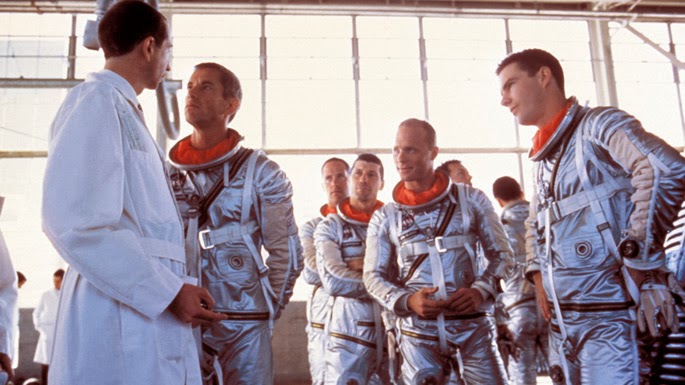
When The Right Stuff came out in 1983, pundits were anticipating it to make a big splash at the box office. Based on Tom Wolfe’s book of the same name, Philip Kaufman’s film depicted the space race between the United States and the Soviet Union with the focus on the Mercury 7 — seven astronauts who trained to become the first Americans in outer space. With this kind of patriotic subject matter how could the film not be a big hit? Despite scoring well with critics, The Right Stuff failed to get off the launch pad with audiences. At the time of its release, the studio backing it decided to market the film in tandem with Mercury 7 astronaut and Ohio Senator John Glenn’s run for the presidency. Mainstream audiences felt that Kaufman’s motion picture was going to be nothing more than an expensive campaign ad and stayed away. The film disappeared off of almost everyone’s radar for several years, only appearing semi-regularly on cable television. However, with anniversary releases on DVD and, more recently, on Blu-Ray, the film has been re-discovered and is generally regarded as an influential cinematic masterpiece.

The film begins with Chuck Yeager (Sam Shepard), a legendary test pilot who was the first man to break the Sound Barrier. He is the perfect embodiment of “the right stuff,” an intangible quality that few people possess. Yeager doesn’t break the Sound Barrier for fame or money. He does it for the challenge, to beat what the film’s narrator (Levon Helm) calls “the demon that lives in the thin air.” There is a scene where Kaufman depicts Yeager riding through the desert on horseback against a very Terrence Malick-esque sunset as if to suggest that the test pilot is akin to a laconic cowboy from a bygone era. Soon, Yeager comes across the rocket-powered Bell X-1, the plane that he will fly to break the Sound Barrier, complete with ominous music and ferocious jet engine sounds. The image of Yeager on horseback staring at a piece of technology that could result in his death sets up a man vs. machine theme that continues on throughout the film.

The give and take between Yeager and his wife Glennis, played wonderfully by Barbara Hershey, during these early scenes is so well done and could be its own short film as she and Sam Shepard convey the unique dynamic between these two people. As the Air Force pitches breaking the Sound Barrier to Yeager, Glennis doesn’t voice her disapproval or fears. She doesn’t have to as the look Hershey gives Shepard says it all. Glennis loves him, but isn’t some subservient housewife as she says later on, “They don’t spend a god-damned thing teaching you how to be the fearless wife of a fearless test pilot.” In many respects, she’s his equal, even challenging him to a race on horseback out in the desert.


The sequence where Yeager breaks the Sound Barrier is beautifully realized with old school visual effects and clever editing. What really helps sell it is the reaction shots of Shepard, even obscured behind a mask, that convey how difficult it must have been. So why does Kaufman spend so much time on Yeager, even having him return intermittently throughout the film as a sort of Greek chorus, commenting on the Mercury 7 astronauts? Clearly, he sees the legendary test pilot as the epitome of “the right stuff” and this is why he’s never made to look silly and always treated reverentially. In one of his early roles, playwright-turned actor, Sam Shepard is perfectly cast as Chuck Yeager. Physically he doesn’t resemble the man, but with his chiseled good looks and piercing stare, he even makes chewing gum an epic gesture. He doesn’t have much dialogue, but he doesn’t need it because he conveys so much with a look or a simple gesture. The Yeager section is The Right Stuff at its most romantic, photographed by Caleb Deschanel with a slight sepia tone to give the footage the feel of an old photograph.

We soon see a sharp contrast between Yeager and the next group of test pilots that show up to make a name for themselves. Even though he is never asked to train for the missions into outer space, all of the Mercury 7 astronauts live in his shadow and the film constantly compares them to his ideal. We are introduced to Gordon Cooper (Dennis Quaid sporting the best shit-eating grin ever) and Gus Grissom (Fred Ward), two cocky pilots who think pretty highly of themselves, but are quickly put in their place. From this point on, whenever the film veers too dangerously close to overt seriousness, Kaufman proceeds to deflate it with comedic moments, usually from Jeff Goldblum and Harry Shearer, two bumbling recruiters who, among many things, show then-Senator Lyndon Johnson (Donald Moffat) a reel of what they feel are ideal candidates to go into outer space: circus acrobats, divers, race car drivers, and so on.

The irony is that the NASA recruiters don’t pick the best pilot – Yeager – because he didn’t go to college, but the ones they do get are certainly among the very best. However, Kaufman constantly reminds us that they are not in Yeager’s league via a montage of arduous physical and mental tests where the potential astronauts are sometimes made to look silly, racist and sexist, but this is put in the context of the times and all of these alpha males competing against each other. The potential astronauts are put in humiliating situations that cut through the instantly iconic status that the government attempts place on them and shows them having human frailties just like everyone else. It’s a fascinating duality that gives these astronauts depth. It also doesn’t hurt that the charisma of the actors shines through and you admire these brave men. As Yeager puts it later on in the film, “You think a monkey knows he’s sittin’ on top of a rocket that might explode? These astronaut boys they know that, see? Well, I’ll tell you something, it takes a special kind of man to volunteer for a suicide mission, especially one that’s on T.V.” What’s interesting is that the film shows how the Mercury 7 were paraded around the press, including a major feature article for Life magazine. The U.S. was in competition with Russia and the government wanted to show that we had men just as capable of going up into outer space as they did.


Looking at The Right Stuff now, it is easy to forget how the now stellar cast was, at the time, relatively unknown. Ed Harris, Dennis Quaid, Fred Ward, Lance Henriksen, Scott Glenn, and Jeff Goldblum were all up-and-coming actors and this film helped put them on the map. The cast is uniformly excellent with Harris, Quaid and Ward as the standouts among the astronauts. It doesn’t hurt that they tend to get more screen-time than the others (poor Henriksen!), but they also make the most of it with Harris playing the all-American Boy Scout and yet managing to go deeper, past the rah-rah façade to show a man who deeply loves his wife as evident in the scene where he tells his harried spouse that if she doesn’t want the Vice-President to come to their house and watch the launch then he will stand by her decision (despite being pressured to do otherwise). Quaid plays the cocky hot shot (“Who’s the best pilot you ever saw?”), and Ward is the gruff one who infamously “screws the pooch,” and was unfairly maligned as the astronaut who made a mistake during his mission. Kaufman does tend to empathize with Grissom in the film and Ward manages to elicit sympathy in what is the lowest point in The Right Stuff as the man even has to defend his actions to his wife (Veronica Cartwright) who is disappointed that she never got to meet Jackie Kennedy like previous astronaut wives.

Speaking of which, I like that Kaufman gives ample screen-time to the wives, showing how they bonded and dealt with the stress of their husbands’ dangerous profession. It also shows their vulnerabilities, like Trudy Cooper’s (Pamela Reed) fear that her husband would die during a mission or Annie Glenn’s (Mary Jo Deschanel) stutter, which makes her so self-conscious that she rarely speaks, which the other wives misinterpret as snobby behavior.

For all of its humor and critique, The Right Stuff certainly doesn’t skimp on awe-inspiring imagery as evident in the wondrous sights on display when Yeager breaks the Sound Barrier or when John Glenn orbits the Earth. The impressive visual effects are as good as anything seen in Stanley Kubrick’s 2001: A Space Odyssey (1968), the benchmark that all other films of this type are measured against. In the latter sequence, Glenn sees all sorts of debris that looks like fireflies, which Kaufman juxtaposes with an aboriginal campfire at night. It is fascinating, almost abstract imagery, which he inserts into this epic, historical biopic.


In 1979, independent producers Robert Chartoff and Irwin Winkler outbid Universal Pictures for the movie rights to Tom Wolfe’s book, The Right Stuff. They hired legendary screenwriter William Goldman to adapt it into screenplay form and his version focused on the astronauts while entirely ignoring Chuck Yeager. United Artists agreed to finance the film and the producers were not satisfied with Goldman’s take on the book. He was unable to find a dramatically convincing way to contrast the experience and outlook of the test pilots and the astronauts, leaving the former out of his script. They approached Philip Kaufman to direct and he shared their dissatisfaction with the script. He was hired in 1980 and Goldman quit the project. Kaufman started off by penning a 35-page memo outlining his take on the material. The filmmaker cited films he admired – The Searchers (1956) and The Grand Illusion (1937) – and that he would emulate their “rambling, episodic quality,” in which “truth is found along the way.” When Wolfe showed no interest in adapting his own book, Kaufman wrote a draft in eight weeks. He restored Yeager to the story because “if you’re tracing how the future began, the future in space travel, it began really with Yeager and the world of the test pilot. The astronauts descended from them.”

After the financial failure of Heaven’s Gate (1980), United Artists put The Right Stuff in turnaround and The Ladd Company stepped in with an estimated $17 million for the budget. According to Alan Ladd Jr., the final budget was closer to $27 million. Kaufman spent a lot of time early on trying to figure out how to do the visual effects. Initially, he looked at what George Lucas was doing with the Star Wars films, but Kaufman found that what “worked in outer space for George didn’t work on Earth. They didn’t have the same reality that we were looking for.” And so, Kaufman wanted to keep with “the theme of the film that what if we started jerry-rigging these things.” To that end, he hired experimental filmmaker Jordan Belson, who was “exploring cosmic mysteries” in his short films, to create transitions from night to day and the background of the Earth as seen from high-flying planes or orbiting spacecraft. In lieu of creating a lot of expensive visual effects from scratch, Kaufman accumulated 300,000 feet of NASA stock footage.

According to special visual effects supervisor Gary Gutierrez, the first special effects were too clean looking and they wanted a “dirty, funky early NASA look.” Kaufman was so unhappy with the results that he shut down work on them and fired many of the effects crew. Gutierrez and his team started from scratch, employing unconventional techniques like going up a hill with model airplanes on wires and fog machines to create clouds, or shooting model F-104s from a crossbow device and capturing their flight with as many as four cameras. A Mercury spacecraft was built from the original NASA molds and an X-1 mockup was constructed from old parts while the only B-29 bomber still flying was used.


Most of the film was shot in and around San Francisco, Kaufman’s hometown, and he transformed Hamilton Air Force Base in Marin County into a studio. The desert sequences were shot near Edwards Air Force Base. Yeager was hired as a technical consultant on the film. He took several of the actors flying, studied the storyboards and special effects, pointing out errors. Barbara Hershey remembered that during filming, he would call her Glennis and his son would call her mom. However, Yeager and Sam Shepard were wary of each other, at first, but became friends. To prepare for their roles, Kaufman gave the actors playing the seven astronauts an extension collection of videotapes to study.

Kaufman gave his five editors a list of documentary images that the film required and they searched the country for film from NASA, the Air Force and Bell Aircraft vaults. They also discovered Russian stock footage that had not been seen by human eyes in 30 years. The director’s rather exacting methods met with resistance from The Ladd Company and he threatened to quit several times. To make matters worse, in December 1982, 8,000 feet of film portraying Glenn’s trip in orbit and return to Earth disappeared or was stolen from Kaufman’s editing facility in Berkeley, California. The missing footage was never found and had to be reconstructed from copies.

The world premiere for The Right Stuff took place on October 16, 1983 in Washington, D.C. The Washington Post’s Gary Arnold felt that the film was “obviously so solid and appealing that it’s bound to go through the roof commercially and keep on soaring for the next year or so.” In his review for The New York Times, Vincent Canby praised Shepard’s performance: “Both as the character he plays and as an iconic screen presence, Mr. Shepard gives the film much well-needed heft. He is the center of gravity.” Roger Ebert gave the film four out of four stars and wrote, “That writer-director, Philip Kaufman, is able to get so much into a little more than three hours is impressive. That he also has organized this material into one of the best recent American movies is astonishing.”


Yeager saw the film and liked “the way Sam played me. Sam is not a real flamboyant actor, and I’m not a real flamboyant-type individual … He played his role the way I fly airplanes.” Deke Slayton said after the screening, “none of it was all that accurate, but it was well done.” Walter Schirra said, “They insulted the lovely people who talked us through the program – the NASA engineers. They made them like bumbling Germans.” Scott Carpenter said, “It was a great movie in all regards.”

In retrospect, Kaufman and several cast members did not like how the film was marketed. The director said, “The publicity had to be exactly right to attract people, and I think it was presented in a way as sort of academic and a history of the space program.” Scott Glenn felt that it was “the most stupidly marketed film I’ve ever made … We made the film, a bunch of people saw it, and they thought it was so powerful, that it was worthy of a hard-news item: Will this movie be influential in the candidacy of John Glenn? People in the media got hold of it and made it hard news … All that influenced the marketing people into believing they had something ‘important’.” Finally, Fred Ward chimed in with his two cents: “My theory is that they seemed to be trying to sell it to the audience as The John Glenn Story. You know, the patriotic this and that. And it wasn’t.”

At once reverential and also irreverent towards its subject matter, The Right Stuff could have easily been tonally all over the place if it weren’t for Kaufman’s assured touch. One reason why the film may not have connected with audiences is the unusual take on the subject matter. Kaufman tends to go back and forth from a reverential look at these men to parodying them as well. Only Yeager is given a purely worshipful treatment because he represents the epitome of “the right stuff.” However, Kaufman isn’t afraid to show that the Mercury 7 astronauts had their flaws. They were cocky braggarts (Gordon Cooper), materialistic opportunists (Gus Grissom) and naively patriotic (John Glenn). Audiences of the day were probably expecting a straightforward historical biopic that put all of these men on pedestals. Kaufman was more interested in presenting these men as interesting, flawed human beings. They may have not been as iconic as Yeager, but, in the end, did have “the right stuff.”


SOURCES

Ansen, David and Katherine Ames. “A Movie with The Right Stuff.” Newsweek. October 3, 1983.

Bumiller, Elisabeth and Phil McCombs. “The Premiere: A Weekend Full of American Heroes and American Hype.” Washington Post. October 17, 1988.

Farber, Stephen. “Rocket’s Red Glare.” DGA Quarterly. Spring 2012.

“Fred Ward – It’s Hard to be a Hero.” Starlog. December 1985.

King, Susan. “Looking Back at a Film with The Right Stuff.” Los Angeles Times. June 7, 2003.

Morganthau, Tom and Richard Manning. “Glenn Meets the Dream Machine.” Newsweek. October 3, 1983.

Naha, Ed. “The Right Fx for The Right Stuff.” Starlog. July 1983.

O’Neill, Patrick Daniel. “Scott Glenn – The Fast-Gun Astronaut.” Starlog. August 1985.

Rushfield, Richard. “Director Philip Kaufman on What Makes The Right Stuff, 30 Years Later.” Yahoo Movies. November 15, 2003.

Schickel, Richard. “Saga of a Magnificent Seven.” Time. October 3, 1983.

Wilford, John Noble. “The Right Stuff: From Space to Screen.” The New York Times. October 16, 1983.


Williams, Christian. “A Story That Pledges Allegiance to Drama and Entertainment.” Washington Post. October 20, 1983.

Friday, October 4, 2013

Creepshow

Anticipation was high among horror fans when it was announced that three giants of the genre were going to collaborate together on a film. Author Stephen King, director George Romero and makeup effects wizard Tom Savini decided to pay tribute to the classic EC horror comic books from the 1950s with an anthology film called Creepshow (1982). Coming off the personally fulfilling, but commercial failure of Knightriders (1981), I’m sure Romero was eager to move on to something else and hooking up with King made sense. The two men had originally met over the possibility of collaborating on an adaptation of the author’s novel Salem’s Lot, but when the film rights were sold off to television, Romero moved on.

Making a horror anthology was a bit of a risky gamble at the time. They were all the rage in the 1970s with Hammer and Amicus cranking out films like The House That Dripped Blood (1971), Tales from the Crypt (1972), and From Beyond the Grave (1973), but by the end of the decade they had fallen out of favor. King and Romero wanted to bring these kinds of films back while also celebrating the horror comic books, like House of Mystery and The Vault of Horror that they grew up enjoying as kids. The project was given a decent budget and populated with a mix of up-and-coming movie stars and veteran character actors. While receiving only mixed reviews, it was a sleeper hit.

Creepshow is bookended by a boy (Joe King) being chastised by 1980s horror movie mainstay Tom Atkins for reading horror comic books. The overbearing patriarch throws his son’s issue of Creepshow in the trash and the rest of the film depicts various stories from its pages.


The first story is “Father’s Day” that sees a family of wealthy snobs waiting for their Aunt Bedelia Grantham (Viveca Lindfors), the rich matriarch who is rumored to have murdered her father, Nathan (Jon Lormer) on, what else, Father’s Day. Nathan was a real piece of work, angrily demanding his cake over and over until, out of frustration, Bedelia brains him with an ashtray. It’s Father’s Day again and Nathan (John Amplas) rises from the grave demanding his cake once more. The undead patriarch, of course, evokes Romero’s zombie films, but Tom Savini’s makeup isn’t a rehash of Dawn of the Dead (1979). The look of undead Nathan is in keeping with the exaggerated style of the old EC comic books.

Romero hits us right up front with all kinds of attention-grabbing style: skewed camera angles, garish Giallo lighting (saturating shots in red or blue lighting) and employing split-screen action like the panels in a comic book. He even evokes Night of the Living Dead (1968) ever so slightly when we see Bedelia visit her father’s grave; the cemetery initially bathed in warm, late afternoon light, soon becomes ominously atmospheric.

There is a nice mix of comedy and dread with the former coming from a fantastic moment where we get to see “serious actor” Ed Harris grooving out to some cheesy music with his wife (Elizabeth Regan). I can’t get enough of seeing him dancing so awesomely badly to a cheesy ‘80s song. With the exception of Harris, the rest of the Grantham clan are a bunch of vain, selfish, obnoxious bluebloods that deserve what’s coming to them, which makes their comeuppance at the hands of Nathan all the more satisfying.


“The Lonesome Death of Jordy Verrill” is easily the weakest story in Creepshow as Stephen King, in an act of unfortunate hubris, casts himself as the eponymous Jordy, a stereotypical dumb yokel who foolishly touches a fallen meteorite and begins sprouting a strange, green moss-like substance that mutates into wild vegetation all over his body. Before you can say Swamp Thing, Jordy and his place are overwhelmed with lush green vegetation. Where the other segments achieve the right mix of horror and humor, this one goes too far over to the comedy side and comes across as too cartoonish.

King’s “acting” is straight out of an Ed Wood movie – strictly amateur hour and not in a it’s-so-bad-it’s-good kind of way. This segment is essentially a one-man show and King just isn’t talented enough to pull it off. Romero does the best he can to keep things interesting visually (Jordy’s place is a marvel of set design), and Savini’s make-up job on King makes you wish that he had done the effects work on Wes Craven’s Swamp Thing (1982).


Fortunately, Creepshow bounces back with “Something to Tide You Over” as funnymen Ted Danson and Leslie Nielsen are cast against type as two men at odds with each other. Harry (Danson) has been sleeping with Richard’s (Nielsen) wife Becky (Gaylen Ross). Richard confronts Harry and takes him out to his privately owned beach and proceeds to bury him up to his head, waiting for the tide to come in, much like he did to his wife. It’s a pretty unorthodox kind of revenge as is the plot twist where we see what happens to Harry and Becky after Richard leaves them to die.

Again, Romero comes up with some fantastic imagery, chief among them the shot of an irate Harry submerged in water, which evokes the watery demise of Shelley Winters’ character in The Night of the Hunter (1955). Once Richard returns home, Romero ratchets up the tension as we soon realize that Harry and Becky are back for some vengeance of their own. Savini’s makeup effects on the waterlogged couple are quite extraordinary and their distorted, watery voices are unsettling. It’s great to see Leslie Nielsen shed all of his comedic shtick to play a fairly sadistic son-of-a-bitch and he seems to relish the change of pace. Few remember that he started off his career playing dramatic roles because he’s so closely identified to his iconic character in the Naked Gun movies.

For me, the best story in Creepshow is “The Crate,” which focuses on Henry Northup (Hal Holbrook), a reserved college professor, and his friend and colleague Dexter Stanley (Fritz Weaver). Henry is married to Wilma “Billie” Northup (Adrienne Barbeau), a boozy, overbearing shrew of a wife, who shows up to a faculty party drunk and belligerent. Dexter is called away when a janitor (Don Keefer) shows him a crate from an Arctic expedition dating back to 1834. It was stored away under a staircase in the bowels of a building.


Naturally, Dexter and the janitor decide to open the crate and they unleash a ferocious creature that kills the hapless custodian in gruesome fashion (although, restrained for Savini). Pretty soon, Henry and Billie run afoul of the nasty beast as Savini gets a chance to flex his impressive makeup muscles. I can still recall seeing pictures of the crate monster in Fangoria around the time Creepshow came out and being scared by it. At a young, impressionable age, it took me awhile to see the film all the way through, but at least I read the comic book adaptation.

What really sells the horror in this segment is the absolutely sweaty, wild-eyed terrified reactions of Dexter to the two deaths he witnesses. Fritz Weaver does a great job as Dexter, never amping up his character’s anxiety too much and knowing just when to reel things in. Holbrook is also very good at showing Henry’s transformation from mild-mannered professor to calculating husband who plots the demise of his domineering wife. Adrienne Barbeau is a hoot as Henry’s obnoxious wife and looks like she’s having a blast bouncing off of Holbrook’s doormat of a husband. It’s a juicy role that lets the veteran actress vamp it up as only she can.

Finally, the story “They’re Creeping Up On You!” features E.G. Marshall as Upson Pratt (perfect name for his character), an anal-retentive neat freak businessman who lives in a sterile apartment. He’s obsessed with eradicating his place of bugs. It’s an amusing spin on the equally reclusive and germ-obsessed Howard Hughes fused with Ebenezer Scrooge. All Pratt cares about is money and clearing up his “bug problem,” but soon enough the omnipresent cockroaches have their day in a rather fitting finale to this film.


Marshall is excellent as the curmudgeonly germaphobe sealed up in how sterile fortress. He’s a prisoner of his own obsessions. This segment shows what a truly skilled actor can do when he has to carry a segment on his own, unlike King in his story. For anyone creeped out by bugs this segment is particularly disconcerting.

George Romero first met Stephen King when he was approached by Warner Bros. to direct an adaptation of Salem’s Lot, a novel about a small town in Maine that is terrorized by vampires. The two men met in Maine for several days and even though the project fell through, they kept in touch. King and Romero wanted to work together on an adaptation of the author’s epic novel The Stand, but realized that it would require major Hollywood studio funding to get made. In order to retain full artistic control, they decided to make another inexpensive film first that would make enough money to give Romero more clout with the studios.

In the summer of 1979, Romero and his business partner and producer Richard Rubinstein met with King in Maine to come up with ideas for an original film because it would be cheaper to make. One idea was a series of horror “blackouts,” short sketches leading to a major scare. Romero wanted to create five stories in five completely different styles: one in black and white, one in color, one in 3D, and so on. However, they decided that this approach was too experimental.


It was King that came up with the comic book idea and the “Creepshow” title. He wrote and completed the 142-page screenplay in October 1979. The first story, “Father’s Day,” was described as a “deliberate EC pastiche,” according to King. “The Lonesome Death of Jordy Verrill” was an adaptation of “Weeds,” a short story King published in the May 1976 issue of Cavalier. In fact, “Weeds” was originally written as the first chapter of a novel, but as the story started to spread beyond Verrill’s world, King could not find any more to say. For the film, he decided to change the tragic tone to a more comedic one.

“Something to Tide You Over” was inspired by King’s memories of being buried up to his neck in sand as a child and also from a film about Bluebeard the pirate being left to die below the high tide line. “The Crate” was adapted from a short story published in the July 1979 issue of Gallery magazine. The story was inspired by a real crate found under the stairs in the chemistry building at the University of Maine. What stuck in King’s mind was that the crate had been under the stairs for a hundred years and he imagined “something really sinister in there.” The creature in the crate was inspired by the Looney Tunes cartoon character, the Tasmanian Devil. For the last story, King originally had a mixture of spiders, cockroaches, beetles, and bugs that did not even exist. However, budgetary constraints forced him to use cockroaches exclusively.

Initially, King was not interested in a framing story to link the five stories because he felt that ones in past horror film anthologies were “silly and contrived.” Romero suggested a comic book as the framing device and King agreed. The Spectre, featured in the prologue and linking segments, was a reworking of the “Old Witch”, “The Cryptkeeper” and other narrators from the EC comic books. Romero used King’s first draft, making some changes with the author’s approval and input during principal photography, which often involved rewriting dialogue.


With King’s script, a rough budget and poster art created by EC comic book veteran artist Jack Kamen, the filmmakers shopped the project around Hollywood. Money wasn’t an issue with studio executives, but rather the content. They wanted creative input, which King and Romero balked at. So, they went back to United Film Distributing, a subsidiary of the United Artists Theater Circuit, who had backed Knightriders. They ended up financing Creepshow’s $8 million budget.

Pre-production began in early 1981 and Romero called on frequent collaborators, like makeup effects artist Tom Savini and cinematographer Michael Gornick. The production set up offices in Penn Hall Academy, an abandoned Pittsburgh grammar school, transforming their gymnasium into a soundstage. Principal photography began in late July 1981. In order to give each segment its own distinct look, King and Romero decided to employ the vibrant color scheme from the EC comic books through heightened, saturated lighting and utilizing stylized backgrounds. With the significant budget, Romero had the freedom to shoot on location as well as on a soundstage. Filming lasted 17 weeks, ending in late November.

Post-production was quite extensive with four different editors working on the five stories, a large amount of optical work, and composing the film’s score. Originally, Romero planned to use music from the Capitol Library (which he also used in Night of the Living Dead). He felt that the music would work well with the film, but assistant director John Harrison noticed the varying degrees of quality in material from the various decades and ended up creating much of the music in the film on a synthesizer. Rick Catizone created the animated sequences that acted as segues between segments in the style of Kamen’s comic book pages drawn for the film.

Creepshow debuted at the 1982 Cannes Film Festival and was a rousing success with a distribution deal made with Warner Bros. – the first time a studio would distribute a Romero film. The film received mixed reviews from mainstream critics. Roger Ebert gave the film three out of four stars and wrote, “What they’ve done here is to recapture not only the look and the storylines of old horror comics, but also the peculiar feeling of poetic justice that permeated their pages.” In his review for The New York Times, Vincent Canby wrote, “The best things about Creepshow are its carefully simulated comic-book tackiness and the gusto with which some good actors assume silly positions. Horror film purists may object to the levity even though failed, as a lot of it is.” The Washington Post’s Rita Kempley wrote, “What one confronts in Creepshow is five consistently stale, derivative horror vignettes of various lengths and defects.” Newsweek magazine’s David Ansen wrote, “Creepshow is a faux naïf horror film: too arch to be truly scary, too elemental to succeed as satire.” Finally, in his review for the Globe and Mail, Jay Scott wrote, “The Romero-King collaboration has softened both the horror and the cynicism, but not by enough to betray the sources – Creepshow is almost as funny and as horrible as the filmmakers would clearly love it to be.”


If Romero was criticized for his rather non-descript directorial style prior to Creepshow, with this film the director showed that he could turn on the style with the best of them, cutting loose and having fun with the material. He pays homage to the classic EC comic books from the ‘50s by presenting a series of short stories populated by reprehensible protagonists that get their well-deserved retribution through supernatural means. Most horror anthologies are notoriously uneven in terms of quality and Creepshow is no different. Fortunately, there’s only one segment that isn’t very good and that was down to casting, while the rest of them are populated with familiar faces that seem to be having fun inhabiting their colorful characters, which translates into fun for the audience watching them.

Creepshow helped kick off a new wave of horror anthology films that included the likes of Nightmares (1983), Cat’s Eye (1985), Tales from the Darkside: The Movie (1990), and, more recently, Trick ‘r Treat (2007), which, with its mix of horror and comedy and use of garish, vibrant lighting, seems particularly indebted to Creepshow. While it certainly doesn’t contain the scathing social commentary of other Romero films, it is a fun, entertaining romp – a cleansing of the cinematic palette if you will, before he moved on to tackle the third installment of his Dead trilogy with Day of the Dead (1985).


SOURCES


Gagne, Paul R. “Creepshow: Masters of the Macabre.” Cinefantastique. September-October 1982.


Further reading: Check out Sean Gill's excellent take on Creepshow over at his blog.