"...the main purpose of criticism...is not to make its readers agree, nice as that is, but to make them, by whatever orthodox or unorthodox method, think." - John Simon

"The great enemy of clear language is insincerity." - George Orwell
Showing posts with label Glenne Headly. Show all posts

Friday, June 19, 2020

Pronto

Somewhere, there’s an alternate universe where James Le Gros is playing recurring Elmore Leonard character Deputy United States Marshal Raylan Givens in a series of television movies instead of Timothy Olyphant in a T.V. series. Watching Le Gros in Pronto (1997) is a study in contrast of styles to what Olyphant would do later in Justified. Airing two years after Get Shorty (1995) was released in theaters, and based on the 1993 novel of the same name, Pronto clearly tries to ape it in style and tone only with less money and star power in front of the camera.

Leonard fans will find themselves on familiar turf right from the get-go as we are introduced to Harry Arno (Peter Falk), a Miami Beach bookie who’s been skimming off the top from the mob for years. He has his regular customers and haunts – everything seems to be going swimmingly until he’s tipped off by police detective friend Buck Torres (Luis Guzman) that the Feds are tapping his phone and his boss, Jimmy “The Cap” Capotorto (Walter Olkewicz), has put a hit out on him.

Pretty soon someone tries to take Harry out (although, he certainly knows how to take care of himself) and Raylan shows up in the lobby of his building. Harry invites the lawman up and we get Le Gros’ take on Raylan. He saunters in wearing a suit and a big white cowboy hat that looks completely out of place in neon-drenched Miami. He spots Harry and gives him a big, corn-fed grin, which screams hayseed and when he opens his mouth out comes the equivalent of a southern Boy Scout.

He tries to convince Harry to testify against Jimmy and in return he will protect him. Not surprisingly, Harry’s not the testifying type and gives Raylan the slip, taking refuge in an Italian town that has special significance for him from World War II. The rest of the movie plays out seeing who will find him first – Raylan or sadistic mob tough guy Tommy “The Zip” Bucks (Sergio Castellitto), who wants to make sure Harry doesn’t testify.

Peter Falk plays his usual, easy-going self, breezing his way through the movie as only he can. Harry is a smart guy, a typical Leonard protagonist who is always one step ahead of everyone else, always thinking, especially when everyone is looking for him. Le Gros initially plays Raylan as a little too cartoonish but as the movie progresses one realizes that this is a conscious choice. Raylan has created a country bumpkin-ish façade so that his enemies underestimate him. As the stakes get higher and the situations get more serious, the façade falls away and the actor brings a wonderful intensity to the role revealing a deadly determined lawman.

Pronto is directed by Jim McBride but you’d hardly know it from the flat, functional lighting in many scenes and the predictable framing. Where is the visual flair of Breathless (1983)? Where is the playful, anarchic energy of Great Balls of Fire (1989)? With the exception of some nifty transitional wipes between scenes, the man that made those films is absent. I understand, sometimes you have to do jobs to pay the bills, but one would think based on past adaptations that his visual style would be perfect for Leonard’s material, which makes this feel like a missed opportunity.


Fortunately, screenwriter Michael Butler, who penned notable crime thrillers The Gauntlet (1977) and Flashpoint (1984), does an excellent job adapting Leonard’s book, preserving the snappy dialogue, and he’s aided by a talented cast that tries to give life to his script in the way we’ve come to expect in more successful adaptations, such as Jackie Brown (1997) and Out of Sight (1998), it’s missing the vivid style to compliment it. Still, Falk, Glenne Headly and especially Le Gros are good enough to keep one watching until the end. Ultimately, it is unfair to compare Le Gros’ take with Olyphant. The latter had six seasons and 78 episodes to flesh out Leonard’s character and bring him to life, Le Gros had a 100 minutes and did the best with what he had to work with, delivering an engaging performance that always makes me wonder what could have been?

Friday, February 22, 2013

Dick Tracy


After the massive commercial success of Batman (1989), rival Hollywood movie studios attempted to cash in by adapting other classic comic strips from the 1930s and 1940s with the likes of Dick Tracy (1990), The Shadow (1994), and The Phantom (1996) being released in the early to mid-1990s. With the exception of Dick Tracy, all of them were box office flops. Mainstream audiences were just not interested in retro action/adventure movies that paid tribute to classic Hollywood cinema. So, why did Dick Tracy succeed where these other movies failed?

Dick Tracy was an adaptation of the popular comic strip created by Chester Gould in the 1930s and featured the titular square-jawed police detective as he tangled with a colorful assortment of villains. He solved crimes using the latest gadgetry and advances in forensic sciences. Gould’s creation proved to be very popular and continues to be published to this day despite Gould’s retirement in 1977.

The film version was produced, directed and starred Warren Beatty in the title role, while also including his then-girlfriend Madonna, as well as Al Pacino, Dustin Hoffman, and James Caan among many other notable character actors. With that kind of star power, how could the film not garner advanced hype? It also helped that Touchstone Pictures took a page out of the marketing techniques employed on Batman and aggressively promoted Dick Tracy with a video game, a novelization and Madonna herself advertising it on her Blond Ambition World Tour.

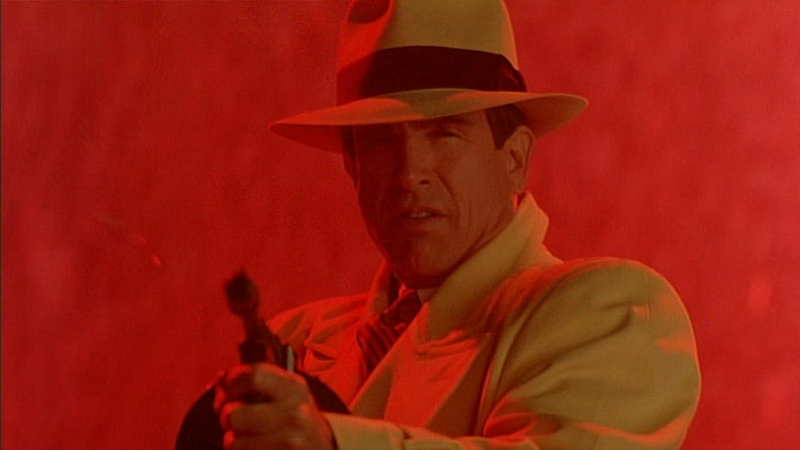
A lot was riding on this film, not just for the studio, who invested millions of dollars, but also Beatty, still stinging from the high-profile failure of Ishtar (1987) and who hadn’t directed a film since the highly acclaimed Reds (1981). The gamble paid off and Dick Tracy performed very well at the box office, but fell short of the kind of figures Batman registered. While the story was pretty standard stuff, Dick Tracy was visually stunning as Beatty and his cinematographer Vittorio Storaro (Apocalypse Now) adopted the source material’s primary color scheme, making it quite unlike any comic book adaptation before or since.

Dick Tracy (Warren Beatty) investigates a gangland slaying. He knows who’s behind it – mob boss “Big Boy” Caprice (Al Pacino) – but can’t prove it, much to his consternation. With the help of his right-hand man, the vicious Flattop (William Forsythe), Big Boy eliminates rival boss Lips Manlis (Paul Sorvino) and takes over his territory, which includes his girlfriend, nightclub singer Breathless Mahoney (Madonna).

Meanwhile, Tracy’s girlfriend Tess Trueheart (Glenne Headly) wants him to accept a desk job so that he’ll stay out of trouble – something that he’s not crazy about or do any time soon, at least not as long as Big Boy is at large. If that wasn’t enough, Tracy and Tess are temporary guardians of The Kid (Charlie Korsmo), a scrappy boy who witnessed the Manlis execution and is rescued from his abusive father by Tracy.

Warren Beatty does just fine as the upstanding Dick Tracy. He certainly looks the part and does his best to flesh out the character by developing a bit of a love triangle between Tess, Tracy and Breathless. The Kid also shows a slightly vulnerable side to Tracy and thankfully Beatty doesn’t fall into the trap of making the boy too cutesy or annoying. A lot of people criticized Madonna’s performance and when she’s paired up with the likes of veteran actors like Beatty and Al Pacino, she looks out of her depth. For two people romantically involved in real life, Beatty and Madonna have little chemistry together on film. Throughout, Breathless tries to seduce Tracy with sexual double entrendes and provocatively revealing outfits (including a see-through black negligee number that somehow got past the PG rating). Madonna makes up for these moments in the song and dance routines where, naturally, she is on more comfortable ground. Beatty does have slightly more chemistry with Glenne Headly who plays Tracy’s girlfriend – a thankless role that the talented actress does her best with, especially early on when Tess and Tracy take care of The Kid in a charming montage that humanizes the lawman a little bit.

Beatty must’ve pulled a lot of favors that he accumulated over the years as so many of his contemporaries and people he worked with back in the day play minor roles with most of them buried under all kinds of prosthetic make-up. Al Pacino barks out most of his dialogue in a scenery-chewing performance that would set the tone for many of his portrayals in the ‘90s but Big Boy actually requires him to play it over-the-top on purpose, which he does with typical gusto. The veteran actor looks like he’s having a blast in the scenes where Big Boy bosses around Breathless and her chorus line. One wonders if the little slaps he administers to the sultry singer were improvised. Hell, in one scene alone you get to see Pacino berate a room full of gangsters played by people like James Caan, Henry Silva and R.G. Armstrong among others. Meanwhile, one of Tracy’s deputies is played by Seymour Cassel and the police chief is portrayed by none other than the late great Charles Durning. Beatty even cast two of his Bonnie and Clyde (1967) castmates, Michael J. Pollard and Estelle Parsons in supporting roles.

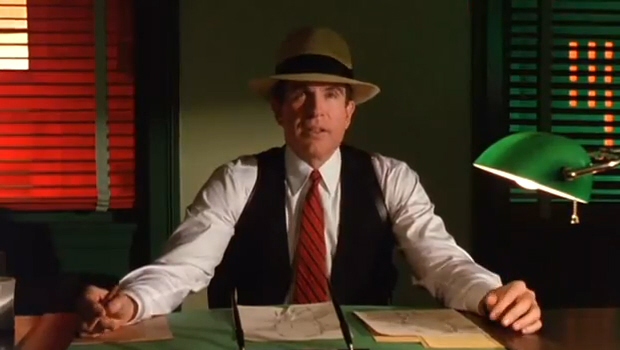
Beatty also stacked the deck behind the camera with the great Italian cinematographer Vittorio Storaro and award-winning production designer Richard Sylbert (Chinatown) contributing to the film’s distinctive look. Not since Streets of Fire (1984), had there been such a stylized self-contained retro-world where everything is heightened in a way that remained faithful to its source material. Even the outfits that characters wear are color-coded. For example, Tracy wears a yellow trenchcoat and hat while Tess wears a red outfit. This also extends to the setting of a given scene. In the diner that Tracy, Tess and the Kid frequent the seats are all red, the walls are all white and outside the windows are saturated with green light. The end result is a visual treat on the eyes and it’s all achieved through excellent cinematography, production design, art direction, and old school visual effects like matte paintings.

For the music, Beatty got Batman’s composer Danny Elfman to work his magic and he delivers a suitably robust score even if it sounds like he basically recreated the music he did for Tim Burton’s film. For the five period authentic songs that Breathless Mahoney sings, Beatty enlisted none other than the legendary songwriter Stephen Sondheim to write them and had Mandy Patinkin and Madonna bring them to life in the film.

A common complaint among critics was that Dick Tracy’s story was a little on the simple side, but the comic strip was never that complex to begin with and so keeping things simple stayed true to Gould’s creation. The one minor quibble I have in this area is the over-abundance of bad guys, but Beatty has said that he wanted to put as many of them in the film as possible in case he didn’t get a chance to do a sequel, which, as it turns out, was probably a wise move as another film seems highly unlikely.

Warren Beatty had contemplated making Dick Tracy as far back as 1975. He had fond memories of reading the popular comic strip as a child. Producer Michael Laughlin owned the rights at the time, but gave up his option when he couldn’t drum up any interest among Hollywood studios. In 1977, director Floyd Mutrux and producer Art Linson bought the rights and got Paramount Pictures involved. Over the years, many directors circled the project, including Martin Scorsese, John Landis, and Richard Benjamin. At one point, Clint Eastwood expressed an interest in playing Tracy, but Beatty had the right to accept or reject the role before anyone else. However, even he took convincing because the movie star didn’t think he looked like the character. Beatty eventually realized that “nobody did. When I realized that I thought, ‘Well, maybe I can play this as well as the next guy.’”

Initially, Beatty had difficulty finding a studio interested in bankrolling his project because they were concerned with its commercial appeal and the movie star’s reputation as a “control freak,” but he had gotten Chester Gould’s family’s blessing, which was a good start. He almost made Dick Tracy with Walter Hill when the director was in-demand during most of the 1980s, but they differed on the approach to the material – Hill wanted to go the gritty, realistic route, while Beatty envisioned a stylized look based on the comic strip. Beatty bought the rights himself in 1985 and was soon armed with a screenplay by Jim Cash and Jack Epps Jr. However, Beatty and Bo Goldman (One Flew Over the Cuckoo's Nest) rewrote much of the dialogue. In 1988, he got backing from Disney, but had to work with a $25 million budget.
  
Once Beatty got the go-ahead, he had to figure out how to adapt Gould’s two-dimensional comic strip into a live-action film. He felt that “it could be fun to go into another world – if that world were carefully planned and carefully created.” With Dick Tracy, Beatty wanted to “look at a picture through a child’s eyes, to get back to the feeling I had when I first read Dick Tracy as a kid.” By employing such a dazzling color scheme, Beatty figured that “If I could make Dick Tracy the centerpiece of a swirl of color and plot, then maybe I could keep him from being terminally dull, which a straightforward character like that is in danger of being.”

To this end, Beatty hired three key collaborators to help him create this world: cinematographer Vittorio Storaro, production designer Richard Sylbert and costume designer Milena Canonero (A Clockwork Orange) and they all met at Beatty’s home during the summer of ‘88. Storaro wanted to go with a standard aspect ratio in an attempt to mimic the comic strip panel. Beatty told Storaro that the look of the film would be influenced by the late 1930s when Gould started Dick Tracy and asked him to study the Bertolt Brecht opera, Rise and Fall of the City of Mahogonny. Storaro found that German expressionist artists like George Grosz and Otto Dix best defined the art of the ‘30s and inspired Gould’s drawings.

Sylbert drew inspiration from ‘30s era Chicago and adhered to the source material’s generic look with homes devoid of anything but permanent fixtures and costumes kept basic and repetitive. The idea was to reduce the sets to their most basic iconography. Such a stylized world required filming the entire picture on the Universal Studios back-lot where the filmmakers could create their world from scratch, hiring visual effects artists Michael Lloyd (The Lord of the Rings trilogy) and Harrison Ellenshaw (Tron) to create 57 matte paintings on glass that were then optically merged with the live-action.

Canonero was the one who proposed that the film stick to a primary color palette. Another important element was the make-up effects. To create the elaborate make-up of the various gangster Tracy battles in the film, the make-up artists created drawings of the characters and then hired sculptors to make models of each character. The actors portraying each one of these characters had a cast made of their face so that the right make-up and prosthetics could be created.

Dick Tracy enjoyed mostly positive reviews from mainstream critics. Roger Ebert gave it four out of four stars and felt it was “one of the most original and visionary fantasies I’ve seen on a screen.” In his review for The New York Times, Vincent Canby wrote, “Unlike Batman, though, Dick Tracy is more than imaginative decor and the sort of clever makeup that transforms ordinary actors into characters named Pruneface, Flattop, the Brow and Little Face. The movie is a gentle whirlwind of benign mayhem swirling about the staunch figure of Mr. Beatty's Tracy. As both the director and the star of the movie, Mr. Beatty is remarkably generous.” The Globe and Mail’s Jay Scott wrote, “Unlike the pretentious Batman, Dick Tracy doesn't attempt to find depth in the heroic machinations of a two-dimensional figure: it seeks simply to turn the famous cut-out into an iridescent icon.” USA Today gave it three-and-a-half out of four stars and Mike Clark wrote, “Beatty, though, has taken Dick Tracy to the next level: a Sunday strip. This means color, additional artifice, and the further suspension of disbelief. And even though Batman's Tim Burton is a better filmmaker than Beatty will ever be, Dick Tracy is the movie – of all screen attempts – that most convinces me I'm watching a live-action cartoon.”

However, Entertainment Weekly gave the film a “B-“ rating and Owen Gleiberman wrote, “Dick Tracy is an honest effort but finally a bit of a folly. It could have used a little less color and a little more flesh and blood.” In her review for the Washington Post, Rita Kempley wrote, “Dick Tracy is an ambitiously vainglorious effort, expensive, beautifully appointed, but at its core empty as a spent bullet. It asks us to read these comics without a grain of salt or a pinch of irony. Popping around in that floppy designer trench coat, Beatty looks more like the fashion police than a gangbuster. For that matter, he is the director as haberdasher in this color-coded clotheshorse of a movie.”

Along with Sin City (2005), Dick Tracy is one of the most visually stunning comic book adaptations ever committed to film and one that anticipated similarly hermetically-sealed cinematic fantasy worlds like the one the Wachowski brothers created for Speed Racer (2008). If the goal of movies, like this, is to take us away to a fantasy world, then Dick Tracy succeeds admirably. It has a look and atmosphere all its own. Sadly, a sequel has not happened as Beatty spent years in court with the company that own Gould’s strip who tried to wrest back the film rights. Beatty recently retained them and has expressed an interest in doing a sequel, but isn’t he too old to play Tracy now? Only time will tell.


SOURCES

Ansen, David. “Tracymania.” Newsweek. June 24, 1990.

Emerson, Jim. “Beatty Breaks the Rules in Dick Tracy.” Orange County Register. June 10, 1990. Pg. L08.

Guthmann, Edward. “Warren Beatty Speaks.” San Francisco Chronicle. June 10, 1990. Pg. P20.

Koltnow, Barry. “Back with a Simple Vision.” Orange County Register. June 10, 1990. Pg. L06.

Lowing, Rob. “Beatty’s Last Chance.” Sun Herald. June 3, 1990. Pg. 6.

Staff. “Strip Show: The Comic Book Look of Dick Tracy.” Entertainment Weekly. June 15, 1990.

Friday, February 1, 2013

Breakfast of Champions


Alan Rudolph’s 1999 adaptation of Kurt Vonnegut Jr.’s 1973 novel Breakfast of Champions is the cinematic equivalent of a stand-up comedian trying so hard to be funny only to bomb spectacularly on-stage. If it’s possible for a film to exude flop sweat then this one does. And yet, it is not some impersonal Hollywood film churned out by committee. It is a passion project decades in the making and funded by its leading man, Bruce Willis, out of his own pocket. The film was a brave attempt by the movie star to show that he had some range as an actor, but he took a book that was widely regarded as unfilmable and made something that alienated Vonnegut’s fans and confused everyone else. Breakfast of Champions played the film festival circuit only to be given a brief theatrical release on a few screens before being relegated to obscurity on home video. Perhaps this misguided mess of a film deserves this kind of fate but it is a fascinating trainwreck nonetheless.

In a nod to the crude illustrations that appear sporadically throughout the novel, the opening credits also feature them while Martin Denny’s exotic lounge music plays on the soundtrack. We meet successful car salesman Dwayne Hoover (Bruce Willis) with a gun in his mouth but he doesn’t pull the trigger because he’s called to breakfast. He talks briefly with his suicidal, television-obsessed wife Celia (Barbara Hershey) and heads off to work in Midland City. Dwayne is a man barely keeping it together. He suffers from an identity crisis but has to also deal with Hawaiian Week at his car dealership. As if he didn’t have enough problems to deal with, Dwayne is having an affair with Francine (Glenne Headly), a co-worker at the dealership. Harry Le Sabre (Nick Nolte) is the sales manager at Dwayne’s dealership and likes to wear women’s clothing. He is paranoid that his boss will find out about his kinky habit.

Meanwhile, Eliot Rosewater (Ken Campbell), of the Rosewater Foundation, writes a fan letter to obscure pulp fiction author Kilgore Trout (Albert Finney), who has written 200 novels and 2000 short stories for sleazy men magazines. He has been invited to the Midlands City Arts Festival with a $1000 check to cover expenses and the promise of becoming famous. Breakfast of Champions alternates between Dwayne’s unraveling mind and Trout’s ruminations on life and his writing as he travels to the Arts Festival.

Is it any wonder Dwayne has no idea who he is when he’s constantly surrounded by images of himself, be it the omnipresent car advertisements on T.V., or his employees that surprise him one morning at work all wearing Dwayne Hoover masks (which resembles a low-tech version of the multiple Malkovichs in Being John Malkovich). Bruce Willis does a good job playing a man rapidly coming apart at the seams, but we never get an idea of why. Very little motivation is provided and so one assumes that Dwayne simply woke up one day on the brink of sanity. He starts off trying to blow his own brains out and goes downhill from there. Eventually, he comes to the realization that the only way to get out of his existential funk is talking to someone from another planet. Enter: Kilgore Trout.

Nick Nolte is hilarious and easily the best thing about this film as the unhinged Harry Le Sabre. He’s almost as far gone as Dwayne and the film plays out like a race to see who’s going to snap their cap first. Nolte and Willis also seem to be locked into a battle of wills to see who can deliver the most fearless performance devoid of any kind of vanity. It’s close, but I give Nolte the win by a hair. If I took anything away from this film it was the unforgettable image of Nolte running across a car lot yelling, “Maui!” while wearing a red lingerie. The scenes between the two actors are the best parts of the film, especially the one where an increasingly nervous Harry tries to explain to Dwayne why he is a cross-dresser.

Albert Finney is largely wasted in this film as early on Trout carries on a meaningless conversation with his pet budgie named Bill. The veteran actor spends most of his screen-time playing the cantankerous Trout who rambles on endlessly in rather cryptic fashion. The rest of the cast doesn’t fair much better with their one-note supporting characters but they all gamely do their best with the material they’re given.

Filmmaker Alan Rudolph had been trying to make a film version of Breakfast of Champions shortly after it was published in 1973 and actually wrote a screenplay in 1975, but its unconventional satire of small-town American life was largely plotless and a hard sell to movie studios. After working with actor Nick Nolte on Afterglow (1997), Rudolph convinced him to sign on and then used his name to attract financing, but still couldn’t drum up any interest.

In 1993, Bruce Willis and Rudolph had tried to make the film together, but problems with scheduling, financing or scripting prevented it from going ahead. Finally, after making Mercury Rising (1998), Willis’ brother told him, “Every action sequence in that movie was derivative of at least three films you’ve already done.” The actor decided that he needed to “do some movies without a gun in my hand,” or, as he put it, a chance to “work a little acting into my career now and then.” His production company bought the rights to Vonnegut’s book and provided the reported $10-12 million budget. As Nolte said jokingly, “Knowing Bruce, he probably presold it in Europe first.”

Willis was drawn to playing Dwayne Hoover because the character did “the scariest thing that any human being could: take the hard look inside.” Getting the film self-financed afforded Rudolph complete creative freedom – something he would not have had with a studio. It also allowed Willis to own the negative to a film he starred in. Once the star-studded cast was in place, Touchstone Pictures agreed to distribute it. Filming took place over six weeks in Twin Falls, Idaho in February 1998.

During the editing stage, Rudolph felt that Breakfast of Champions had a chance at being a box office success, especially with the cast he had assembled. After announcing a spring 1999 release, the studio changed their mind and gave it a very limited release in the fall. In retrospect, Rudolph was glad that it took so long to get the film made “because what once was a dark satire has now become an honest reflection of American culture that’s accelerating into collective madness.”

Not surprisingly, the knives came out when critics review Breakfast of Champions. In his review for The New York Times, Stephen Holden wrote, “In many ways, Breakfast of Champions is an incoherent mess. But it never compromises its zany vision of the country as a demented junkyard wonderland in which we are all strangers groping for a hand to guide us through the looking glass into an unsullied tropical paradise of eternal bliss.” Entertainment Weekly, on the other hand, gave it an “F” rating and Owen Gleiberman wrote, “Rudolph, in an act of insane folly, seems to think that what matters is the story. The result could almost be his version of a Robert Altman disaster – a movie so unhinged it practically dares you not to hate it.” The Los Angeles Times’ Kevin Thomas wrote, “As it is, Breakfast of Champions is too in-your-face, too heavily satirical in its look, and its ideas not as fresh as they should be. For the film to have grabbed us from the start, Rudolph needed to make a sharper differentiation between the everyday world his people live in and the vivid world of their tormented imaginations.” In her review for the Village Voice, Amy Taubin felt that the film, “suffers from a saccharine ending, but that's hardly its worst problem. Another middle-aged male-crisis opus, it begins on a note of total migraine-inducing hysteria, which continues unabated throughout.”

Understandably bitter with the way Breakfast of Champions was received by critics and audiences, Rudolph chalked up his film’s commercial failure to American film critics “who still have the power to destroy a little movie, and who used that power to blast the hell out of Breakfast,” and also the way Disney, who owns Touchstone Pictures, released it: “In such a derisory fashion that no one knew it existed.”

With its heightened, stylized performances from a star-studded cast and a hallucinatory look, it makes one think that Rudolph saw Terry Gilliam’s adaptation of Fear and Loathing in Las Vegas (1998) – another book with an unfilmable reputation – and decided to apply the same aesthetic to Breakfast of Champions, but it just doesn’t work because the source material is so different. Rudolph employs all kinds of zany graphics in an attempt to give us a look inside of Dwayne’s mind. As with someone of his caliber of filmmaking, Breakfast of Champions looks great, complete with atmospheric cinematography and rich set design that helps immerse us in this very stylized world.

Maybe Rudolph was inspired by his mentor Robert Altman’s absurdist ode to flight, Brewster McCloud (1970), but the end result is more like the teen comedy misfire O.C. and Stiggs (1984). The main problem with Breakfast of Champions is that it makes no sense to anyone who hasn’t read Vonnegut’s novel. It is an impenetrable collection of highlights from the book and yet I find myself admiring Rudolph and company’s chutzpah for making such a blatantly uncommercial film. Not since Gus Van Sant’s failed adaptation of another unfilmable novel, Even Cowgirls Get the Blues (1993), has a film squandered such talent. Like the aforementioned film, Breakfast of Champions is populated with an impressive cast as big names like Willis and Nolte who are supported by Barbara Hershey, Buck Henry and Owen Wilson in small roles. One feels that this film was more fun to make then it is to watch. I can’t totally hate it though, because it does feel like everyone’s heart is in the right place. You have to give Rudolph and co. an A for effort, but that’s about all you can do. This is for fans of indecipherable adaptations of iconic novels. All others need not apply.


SOURCES

Leigh, Danny. “Bullets for Breakfast.The Guardian. July 6, 2000.

Lieberman, Paul. “Keeping it Fresh with a Vengeance.” Los Angeles Times. October 10, 1999.

Stein, Ruthe. “Nolte Charms at Renovated Film Center.” San Francisco Chronicle. April 19, 1999. Pg. C1.

Wallace, Amy. “A Die-Hard Dreamer.” Los Angeles Times. October 9, 1998.

Yakir, Dan. “After 20 years, Breakfast is Served.” BPI Entertainment News Wire. September 15, 1999.