"...the main purpose of criticism...is not to make its readers agree, nice as that is, but to make them, by whatever orthodox or unorthodox method, think." - John Simon

"The great enemy of clear language is insincerity." - George Orwell
Showing posts with label Gordon Willis. Show all posts

Friday, November 27, 2015

Manhattan

After the phenomenal success of Annie Hall (1977), Woody Allen confounded the expectations of his critics and fans with Interiors (1978), which saw him doing his best Ingmar Bergman impression. It was his first dramatic film and while critical reaction was mostly positive, it hardly set the box office on fire. With Manhattan (1979), Allen returned to familiar material – the witty romantic comedy – with what many consider his masterpiece but a film that he famously felt was so bad that he offered to make another one for the studio for free if they agreed to not release it. Thankfully, they didn’t listen to him and the end result is one of the greatest cinematic love letters to New York City ever committed to film while also taking an entertaining and insightful look at the love lives of a handful of its inhabitants.

Allen establishes his ambitious intentions right from the start with a grandiose montage of the city scored to George Gershwin and photographed in gorgeous black and white by cinematographer Gordon Willis. The opening voiceover narration that plays over this footage works on several levels. On the surface, it is Isaac Davis (Allen) trying to start his novel but rejecting his multiple attempts because the tone is too corny, too preachy or too angry until he comes up with an introduction that makes him sound good and he ends it with the immortal words, “New York was his town and it always would be.” This opening monologue plays over and often comments on images of New York bustling with life from various neighborhoods and all kinds of people from all social strata. That last line would also be prophetic words as Allen’s name has become synonymous with the city he’s immortalized on film so many times.

This is the Big Apple as seen through Allen’s eyes as he presents his unique world populated by a rarefied social strata of well-educated, neurotic people entangled in messy relationships with each other. Still stinging from a bitter divorce, television comedy writer Isaac (Allen) is now dating Tracy (Mariel Hemingway), a 17-year-old girl (“I’m dating a girl who does homework.”). His best friend Yale (Michael Murphy), a college professor, is having an affair with a journalist named Mary (Diane Keaton). We meet Isaac and his narcissistic friends at Elaine’s, a then-trendy restaurant on the Upper East Side, which Allen uses to set-up their relationships.


Isaac and Yale’s lives are a mess with the former writing for a television show he loathes and the latter trying to finish a book and start up a magazine. The last thing they need is to complicate their romantic lives. Isaac realizes that Tracy is too young for him (“You should think of me as a detour on the highway of life.”) and gets involved with Mary after Yale introduces them. At first, Isaac and Mary can’t stand each other, arguing over an art exhibit and several artists she feels are overrated but he thinks are great (i.e. Lenny Bruce, Vincent Van Gogh, Ingmar Bergman, and so on). Mary is everything that Tracy is not – worldly and not afraid to speak her mind (at one point, he describes her way with words as “pithy yet degenerate.”). Isaac is instantly put-off by this because she isn’t easily controllable like Tracy. Mary is not afraid to challenge Isaac, which is what ultimately appeals to him.

He breaks up with Tracy and starts up with Mary. She is more his equal in every way and it makes sense that they get together. She is brutally honest in her assessment of his and her own shortcomings and he likes that. They connect while spending a night into early morning talking through the streets of the city, walking her dog and then getting food at a local diner to the dreamy strains of “Someone to Watch Over Me.” This wonderful scene culminates with the iconic shot of Isaac and Mary sitting on a bench in front of the Queensboro Bridge at dawn, which was also used in the film’s poster.

Woody Allen and Diane Keaton continue their undeniable on-screen chemistry as they play so well off each other. She is allowed to tone down the more exaggerated comedic gestures she used in Annie Hall to create a more nuanced character in Manhattan. Initially, Mary comes across as abrasive but once she’s alone with Isaac her tough exterior softens and we realize that they have a lot in common. He makes her laugh and we can see the attraction between them growing. This complicates things because it prompts Isaac to breakup with Tracy to be with Mary who breaks up with Yale, which puts a strain on his friendship with Isaac.


Keaton displays a wonderful level of vulnerability over the course of the film as Mary feels comfortable enough around Isaac to share her insecurities, admitting that she gets involved with dominating men. Keaton’s Mary is a wonderful mix of smarts, beauty and humor – it’s no wonder that both Isaac and Yale are in love with her. The actress is also good during the more serious scenes, like when Mary and Yale breakup and then later she talks to Isaac about it. Keaton convincingly conveys how upset her character is even if ultimately it is the best thing as it opens the door for her and Isaac to get together.

Woody Allen essentially plays himself, which sounds like a backhanded compliment when it actually isn’t as he bounces back and forth between witty one-liners and neurotic hand wringing. Allen is more than a neurotic joke machine as Isaac wrestles with his own moral dilemmas – his love for Tracy, even though he knows she’s too young for him, and his attraction to Mary who is much more compatible. It’s hard not to see Isaac’s relationship with the much younger Tracy eerily foreshadowing Allen’s real-life relationship with his young adopted daughter Soon-Yin Previn and this gives the on-screen relationship between the characters an added uncomfortable vibe at times – one that already exists with the vast age difference and Isaac initially making light of it.

Mariel Hemingway is excellent as Tracy, the young woman that adores Isaac and is able to hold her own with him and his pseudo-intellectual friends. Ironically, she is the most mature character in the film and also the one that is the nicest while also being the youngest. Perhaps she hasn’t lived long enough to become jaded and cynical like Isaac and his friends. There is still an innocence to her and perhaps this is what draws Isaac to Tracy. The actress displays an impressive range of emotions, culminating in the heartbreaking scene where Isaac breaks up with Tracy. The hurt her character feels in this scene is almost tangible and we really empathize with her.


While Manhattan features an abundance of Allen’s funny one-liners, the screenplay he co-wrote with Marshall Brickman tempers it somewhat with the characters’ messy personal lives, like the resentment Isaac feels towards his ex-wife (Meryl Streep) for leaving him for another woman, or Yale cheating on his perfectly lovely wife (Anne Byrne) with Mary. Allen expertly shifts gears from comedy to drama from scene to scene and sometimes even within the same scene.

Allen takes us through a guided tour through the city with key scenes taking place at famous establishments, like Elaine’s and the Russian Tea Room, or tourist spots like the Hayden Planetarium, in such a way that New York becomes a character unto itself. Willis’ gorgeously textured black and white cinematography not only evokes the classic Hollywood cinema that Allen loves so much but at the time of Manhattan’s release black and white film stock was rarely used in popular contemporary cinema. Whether they meant to or not, Allen and Willis were making a bold artistic statement with this choice, which elevated the film from being just another romantic comedy to something more. For example, there is a fantastic scene in the aforementioned Planetarium where Isaac and Mary walk through the exhibits, including a Lunar landscape and Saturn looming large in the background in another room while the two characters appear almost entirely in silhouette. Sadly, several of the places the characters frequent no longer exist making Manhattan a historical document of sorts.

Woody Allen first started talking about the origins of Manhattan over dinners with cinematographer Gordon Willis while they were filming Interiors. Allen wanted to make “an intimate romantic picture” in a widescreen aspect ratio and do it in black and white because “that had a Manhattan feel to it.” At the time, he was listening to recordings of Gershwin overtures and thought of setting a scene to that music.


Allen began working on a story with regular collaborator Marshall Brickman (Annie Hall). They would talk about potential ideas, like, “Wouldn’t it be funny if I liked this really young girl and if Keaton was this major pseudo-intellectual?” Brickman would envision a scene and ad-lib it. Allen would do the same and they’d go back and forth. The two men ran into a roadblock when neither of them could figure out the film’s climax until during filming Brickman’s wife told him they needed a scene where Isaac confronts Yale, which became the climactic scene in the latter’s classroom.

Originally, the opening montage scene was going to be scored to “I Can’t Get Started” by Bunny Berigan because that song played several times every night at Elaine’s on the jukebox. During post-production, editor Susan E. Morse suggested they use “Rhapsody in Blue” instead. Allen agreed and decided to use Gershwin music throughout. When Manhattan was finished, he was so disappointed with the film that he asked United Pictures not to release it: “I wanted to offer them to make one free movie, if they would just throw it away.” Fortunately, they declined Allen’s offer.

Manhattan received mostly positive reviews from mainstream critics at the time. Roger Ebert gave the film three-and-a-half out of four stars and wrote, “The relationships aren’t really the point of the movie: It’s more about what people say during relationships – or, to put it more bluntly, it’s about how people lie technically telling the truth.” In his review for The New York Times, Vincent Canby wrote, “The movie is full of moments that are uproariously funny and others that are sometimes shattering for the degree in which they evoke civilized desolation.” The Village Voice’s Andrew Sarris said of the film that it “materialized out of the void as the one truly great American films of the ‘70s.” In her review for The New Yorker, Pauline Kael wrote, “What man in his forties but Woody Allen could pass off a predilection for teenagers as a quest for true values?” The Washington Post’s Gary Arnold wrote, “There’s no opportunity to heap condescending abuse on the phonies and sellouts decorating the Hollywood landscape. The result appears to be a more authentic and magnanimous comic perception of human vanity and foolhardiness.” In recent years, critics like J. Hoberman offered their assessment of the film when he wrote, “What’s most authentic about Manhattan is its fantasy. The New York City that Woody so tediously defended in Annie Hall was in crisis. And so he imagined an improved version. More than that, he cast this shining city in the form of those movies that he might have seen as a child in Coney Island—freeing the visions that he sensed to be locked up in the silver screen.”


After the failure of Interiors, Manhattan could be seen as Allen’s return to the same formula that made Annie Hall a success. While there are similarities between the two films, Manhattan showed how much he had matured as a filmmaker by injecting more dramatic weight without upsetting the overall balance of the film. He wasn’t simply content to make an entertaining romantic comedy. Manhattan not only expressed his feelings for New York but also his views on relationships. It is arguably Allen’s most complete expression of his unique cinematic worldview – highly educated people with very little common sense when it comes to their personal lives, making bad decisions even when they realize it. But like the rest of us, they keep on trying, hoping that the next relationship is the one. He continues to explore it with numerous variations, such as locations, time periods, but they can be traced back to Annie Hall and Manhattan.

Ultimately, Manhattan is about figuring out what you want in life and going for it. Isaac doesn’t do this until late in the film during a classic scene where he lists the things that make life worth living for him and in doing so achieves an epiphany. The film ends on a bit of ambiguous note as we are left wondering that the woman he picked was the right one and if so, how long the relationship will last. In a way, it is cinematic litmus test for the viewer – if you’re an optimist, the ending is hopeful and if you’re a pessimist, it is bittersweet. In other words, this scene conveys the same uncertainty that goes with relationships that the rest of us experience. That being said, I think Tracy sums it up best when she tells Isaac, “You have to have a little faith in people.”


SOURCES

Bjorkman, Stig. Woody Allen on Woody Allen. Grove Press. 1993.


Lax, Eric. Conversations with Woody Allen. Alfred A. Knopf. 2007.

Friday, April 20, 2012

The Parallax View

The 1970s was an era where disco tortured our eardrums and nihilistic cinema ruled an American landscape riddled with a deep distrust of the government brought about by the assassinations of John F. Kennedy, Martin Luther King Jr., Robert F. Kennedy, and Malcolm X, which were still fresh in people’s minds. When The Parallax View was released in 1974, America had just come out of a long and costly war in Vietnam and the Watergate scandal would soon leave the Richard Nixon presidency in tatters. It would be the second film in an unofficial trilogy of paranoid thrillers made by director Alan J. Pakula that included Klute (1971) and All the President’s Men (1976). With these films he was commenting on the times in which he lived – dark and rife with fear and loathing. And Pakula wasn’t alone. The ‘70s was an era that featured some of the best political thrillers ever made with the likes of The Conversation (1974), Three Days of the Condor (1975) and Winter Kills (1979). Arguably, The Parallax View is best of the bunch as it incorporated affectations of a surrealistic style with archetypal thriller conventions to produce a film where nothing is what it seems and good doesn’t always triumph over evil.


Senator Charles Carroll (William Joyce) is an ambitious independent politician rumored to be seeking the Presidential nomination in the coming year. It is July 4 and he’s doing a meet and greet at the Space Needle in Seattle when he’s shot and killed by two assassins dressed as waiters. One of them is killed trying to escape while the other (Bill McKinney) sneaks off in the ensuing chaos and confusion. After months of investigation, an unidentified government committee releases a report that states Carroll was killed by a lone assassin with no evidence of a conspiracy. At the time, this must have reminded people of the findings by the Warren Commission Report on the assassination of John F. Kennedy, which found Lee Harvey Oswald to be the only gunman acting alone.

Three years later, we meet muckraking journalist Joe Frady (Warren Beatty) as he disrupts a police bust in order to get the inside scoop on a story he’s been working on for weeks. His editor, Bill Rentels (Hume Cronyn), refuses to publish the article because, as he tells Joe, “We’re in the business of reporting the news not creating it.” Out of their discussion we learn that Joe had a drinking problem and it got him fired from his job at the newspaper. He appears to have gotten it under control and has since been rehired. Joe lives in a motel where he meets Lee Carter (Paula Prentiss), a television reporter that witnessed Carroll being assassinated. She claims that someone is trying to kill her.

Lee and Joe had been romantically involved in the past and have a long history as evident by the way they interact with one another. Initially, he doesn’t believe her despite claims that six people who witnessed the Carroll killing have since died. Lee seems genuinely upset but Joe remains unconvinced. That is, until Pakula cuts to the next scene and we see her dead body in a hospital, bathed in a sickly blue-green light. A doctor informs Joe that she died from a possible alcohol and drug overdose. However, to someone like him, it is too much of a coincidence and so the newspaperman does some digging, starting with Carroll’s former aide Austin Tucker (William Daniels) who Lee believed was living in the small town of Salmontail, the kind of place where a city slicker like Joe sticks out like a sore thumb with its honky tonks populated by cowboys and running afoul of a belligerent local deputy and the sheriff (Kelly Thorsden) who tries to kill him. Joe survives and uncovers a conspiracy that involves the Parallax Corporation, an enigmatic organization that recruits political assassins.

Throughout the film, Pakula obscures what we are seeing as he plays with the notion that things aren’t always what they seem. Early on, Lee is doing a story on Senator Carroll and a parade goes on in the foreground. When the senator is killed it occurs in the background behind a pane of glass. In another example, Joe observes a police bust behind patio doors. Later in the film, Joe is visited by a representative from the Parallax Corporation and during the scene Pakula frames the shot so that the man is obscuring our view of Joe. By doing this visually, Pakula forces us to question what we see much like Joe is forced to as he digs deeper into the Carroll assassination.

Warren Beatty had just come off a three-year break from acting when he appeared in The Parallax View. He had been working on George McGovern’s campaign for President. The actor is excellent as investigative journalist Joe Frady, a man who gets in way over his head with a story that has far sinister implications then he initially suspected. The actor plays a flawed character but one that we empathize with once people he knows start dying off while others are trying to kill him. Beatty conveys a shrewd intelligence that is quite believable. At first, Joe comes across as an arrogant journalist but as he gets involved in the Carroll assassination and the conspiracy that surrounds it, he becomes much more responsible because he realizes how much is at stake – not just his life but that of others.

He’s helped immeasurably by Lorenzo Semple Jr. and David Giler’s tightly-constructed screenplay, which presents a complex conspiracy that is never difficult to understand but rather becomes more fascinating and involving as Joe uncovers layers upon layers over the course of the film. Some of the best moments are the brief insights we get into the Parallax Corporation and how they select certain people to become assassins. Ironically, the script was never completed before filming and was largely a rushed patch job by Pakula and Beatty!

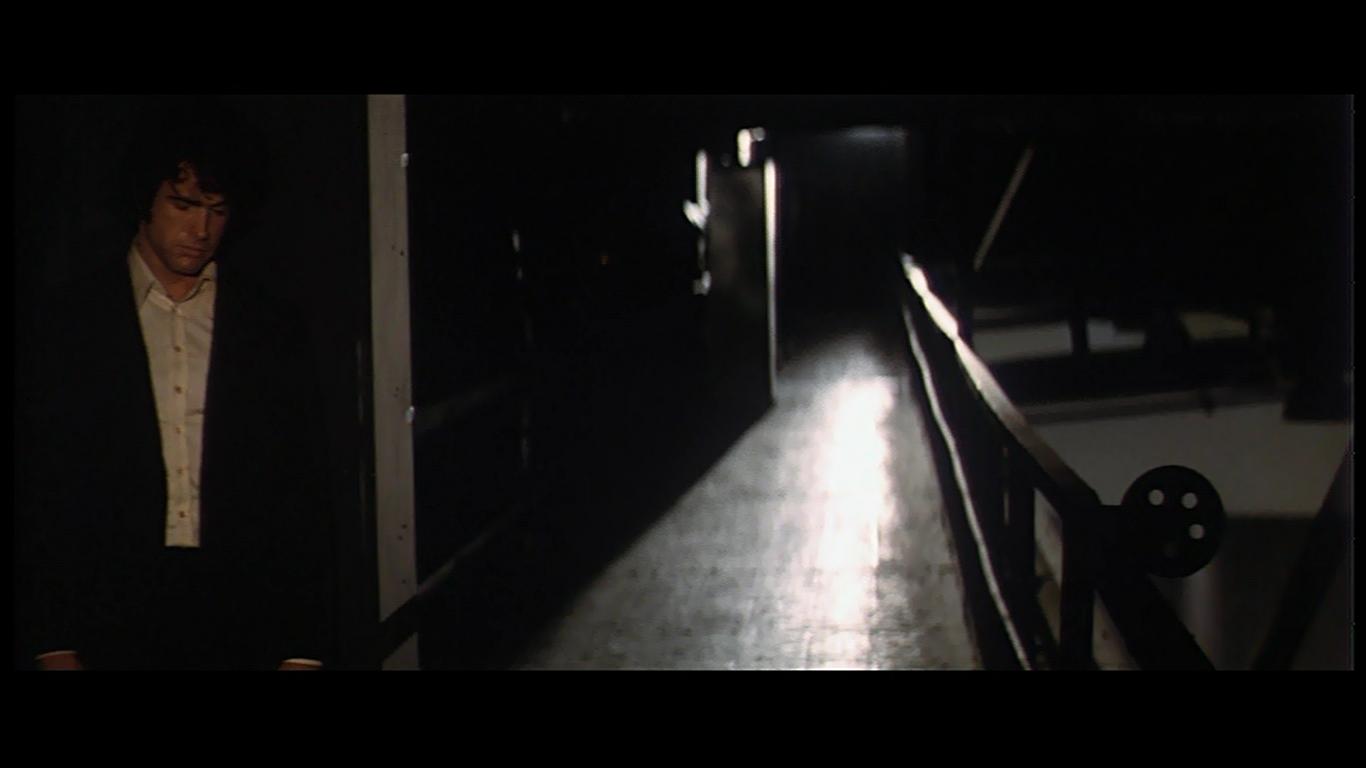
The Parallax View features some incredible cinematography by Gordon Willis who expertly uses the widescreen format, like in a scene where Joe searches the sheriff of Salmontail’s house and one of his deputies enters. On the left side we see Joe snooping around in one room and the deputy enter the house on the right side. The tension in this scene is accentuated by the fact that we can see both men in the same frame while only one of them is unaware of the other who is trying to escape undetected. This is also captured in one, uninterrupted take! It is also worth noting that Pakula refreshingly relies on very little music and instead uses ambient sounds in this scene and it only puts us more on edge because we don’t have a musical cue to tell us how to feel.

Lorenzo Semple Jr. (Papillion) adapted Loren Singer’s 1970 novel The Parallax View into a screenplay and gave it to executive producer Gabriel Katzka. He in turn gave the script to Warren Beatty and Alan J. Pakula, who liked its “bold sketches and almost expressionist quality.” The director was drawn to the project because he felt that America had “become a world in which heroes didn’t necessarily win … We live in a Kafka-like world where you never find the evil. It permeates the society.” He was also drawn to the film because it afforded him the opportunity to make an action film (a genre he had yet to tackle) while also incorporating elements of surrealism into the film’s style. He wanted to contrast this with realistic performances from his actors.

At some point, David Giler (Alien) was hired to work on the script but he was unable to finish the job because of a Screenwriters Guild strike. Pakula wanted to delay filming until the script was completed but Beatty’s salary was guaranteed regardless of whether the film was made or not and he was set to make Shampoo (1975) next. Feeling the pressure, Paramount Studios insisted Pakula begin principal photography in order to capitalize on the actor’s window of availability. He only had a few scripted sequences and was forced to work with Beatty on scenes in the morning and then use them during the afternoon’s filming.

This resulted in several departures from Semple’s original script. At Beatty’s request, Joe’s profession was changed from a police officer to a newspaper reporter. Originally, the Carroll assassination was not shown and instead it referenced the JFK killing but Pakula did not want to mix reality with the fiction of the film he was making. The role of Lee Carter was originally written as a tough, older woman but Pakula was impressed with the young Paula Prentiss’ vulnerability and cast her in the part.

The film’s centerpiece is a famous sequence in which Joe infiltrates the Parallax Corporation as a potential recruit and is subjected to an audio/visual slide show reminiscent of the one in A Clockwork Orange (1971) – albeit with very different intentions – in that the images start off pleasant enough, categorized in groupings entitled, FATHER, MOTHER, COUNTRY and ME, but get gradually more disturbing and provocative. In the original script, it was just a simple test and Pakula even shot a sequence where Joe was interviewed by a Parallax employee but the director wasn’t happy with the result. The actual five-minute montage was assembled in post-production over four months. Pakula asked his assistant to collect photographs for him that would provoke all kinds of emotional responses and once he had a decent collection the director spent a long time trying all kinds of sequences of images.

Pakula had previous worked with Gordon Willis on Klute and wanted to take his dark, shadowy cinematography even further in order to evoke the felling that “the unknown is indeed threatening, that there is something out there that you can’t see that could destroy you.” One gets this feeling in a scene where Joe encounters one of the Parallax representatives at his apartment and, at times, we only see the protagonist in silhouette. Pakula and Willis also decided to play with scale, showing Joe being dwarfed by his environment, like the scene where he narrowly escapes being drowned by a dam flooding or the climax in the convention center. This is done to symbolize just how much the film’s protagonist is at the mercy of his surroundings, which along with its inhabitants are out to destroy him at every turn.

The Parallax View received mixed reviews from critics. Roger Ebert gave the film three out of four stars and wrote, “It tries to entertain instead of staying behind to argue. And the ending has an inexorable logic to it.” In his review for The New York Times, Vincent Canby wrote, “The movie, which was directed by Alan J. Pakula, never rewards the attention we give it with anything more substantial than a few minor shocks.” Time magazine’s Richard Schickel wrote, "We would probably be better off rethinking—or better yet, not thinking about—the whole dismal business, if only to put an end to ugly and dramatically unsatisfying products like The Parallax View.” Even though the film divided critics at the time, it only took two years before it began to enjoy reappraisal, starting with Film Comment’s Richard T. Jameson who felt it was Pakula’s “most adventurous [film] in its exploration of the medium itself as an event.” Now, it has become regarded as an established classic with Entertainment Weekly calling it “a mother of a thriller. There are some kick-ass suspense set pieces, including one with a bomb on a plane that would make Hitchcock plotz.”

The Parallax View was not a commercial success. At the time, Beatty was busy making Shampoo and unable to promote the film. Paramount Studio head Bob Evans was more interested in promoting the film he had produced, Chinatown (1974), then Pakula’s. In retrospect, a film that featured such a nihilistic ending wasn’t going to appeal to a mainstream audience and so it really isn’t surprising that it failed to connect with audiences.

While The Parallax View was not a commercial hit one can see its influence in later films like The Star Chamber (1983), Arlington Road (1999), quoted to comic effect in Zoolander (2001), and, more recently, The International (2009) – all of which owe a debt to Pakula’s film. The notion of a shadowy corporation employing assassins to alter domestic and foreign policy was ahead of its time and seems prescient with scandals like Iran-Contra that came to light years after the film’s release. And yet, the events in it never seem unbelievable thanks to Pakula’s grounded direction and the well-written script. In keeping with the pessimism prevalent in a lot ‘70s American cinema, The Parallax View ends on a downbeat note as the conspiracy is not exposed and the system triumphs over the individual. The film’s ending reflected the prevailing mood in the United States at the time as many people felt betrayed by the government – that our best and brightest leaders were being killed for trying to change things. The film ends much as how it began with the same anonymous government committee stating that another political assassination was the result of a lone killer, the only difference being that we now know the truth because we’ve witnessed all the events leading up to it. It leaves one slightly depressed but also oddly empowered with knowledge.

 
NOTE: Most of the production information in this article comes from Jared Brown's excellent book, Alan J. Pakula: His Films and His Life.