"...the main purpose of criticism...is not to make its readers agree, nice as that is, but to make them, by whatever orthodox or unorthodox method, think." - John Simon

"The great enemy of clear language is insincerity." - George Orwell
Showing posts with label Jerry Goldsmith. Show all posts

Friday, April 29, 2016

The Shadow

With the massive commercial success of Tim Burton’s Batman (1989) every studio in Hollywood wanted to replicate it and this kickstarted a feeding frenzy for a pulp story/comic book property that would connect with the mainstream movie-going public. The result was a string of lavish adaptations of Dick Tracy (1990), The Rocketeer (1991), and The Phantom (1996). The Shadow (1994) also came out of this same period and like the aforementioned movies failed to perform at the box office at the same level as Batman. In fact, The Shadow barely made back its budget but has since gone on to develop a cult following.

The Shadow was based on the pulp fiction character of the same name created in 1931 by Walter B. Gibson. The character got his start on the radio as an enigmatic narrator and when he became popular enough was given an identity by Gibson who developed the character and his world in a series of pulp novels that was soon adapted into an even more popular radio series (voiced by none other than Orson Welles for a short time). Over the years, the durable character was adapted in comic books, movie serials and B-movies but it wasn’t until 1994 that The Shadow would get big budget treatment from Hollywood.

We meet Lamont Cranston (Alec Baldwin, sporting horrible looking long hair) in Tibet. It is after the First World War and he is indulging in his darker impulses, becoming a warlord and opium kingpin known as Ying-Ko. One day, he is kidnapped by the servants of Tulku (Brady Tsurutani), a holy man with mystical powers. He is forced to face his dark side and use this knowledge to defeat evil in all of its various guises. Tulku also teaches Cranston all of his abilities and sends him back to his home in New York City where becomes a crime fighter known as the Shadow.

We meet his colorful alter ego in an impressively staged sequence where he prevents three gangsters from throwing a man off the Brooklyn Bridge. The Shadow uses fear as a weapon, scaring the men with echo-y laughter and his voice that seems to come from everywhere and nowhere, tormenting the lead goon by revealing his past crimes. Initially, we only get vague glimpses of the Shadow as he appears and disappears with alarming speed. It is only until he dispatches the gangsters that we get a full reveal of the character and this is accompanied by Jerry Goldsmith’s rousing score.

Cranston switches back to himself and heads off to the Cobalt Club where he meets with police commissioner Wainwright Barth (Jonathan Winters) for dinner and proceeds to ignore him when he spots Margo Lane (Penelope Ann Miller), the beautiful daughter of a scientist (Ian McKellen) working for the War Department. We get a nice moment where Cranston uses his mental powers to cloud the commissioner’s mind to forget about creating a taskforce to stop the Shadow in a way that director Russell Mulcahy portrays as part film noir and part Jedi mind trick.

A silver sarcophagus arrives at the Museum of Natural History from Tibet housing Shiwan Khan (John Lone), a rogue protégé of Tulku and the last descendant of Genghis Khan. He possesses the same powers as Cranston but is obsessed with world domination. He plans on achieving this by kidnapping Margo’s father and use his work to build an atomic bomb. Cranston has to use all of the powers at his disposal in order to stop Khan.

Alec Baldwin impresses early on as the suave Cranston who not only uses his powers on his uncle but also to pick up Margo. They go on an impromptu date at a Chinese restaurant and he amazes her by ordering in Chinese. “You speak Chinese?” she asks him and without a missing a beat he replies, “Only Mandarin.” Baldwin exhibits good comic timing and his movie star looks are a great fit for the dashing millionaire. Watching him in The Shadow makes me realize what a good Bruce Wayne he would have been. The actor had the charisma, presence and a commanding voice that would have been so well-suited for the role.

With Awakenings (1990), Carlito’s Way (1993), and The Shadow, the early to mid-1990s saw Penelope Ann Miller at the height of her mainstream popularity. With her retro good looks she makes for a good Margo Lane and has nice chemistry with Baldwin. I was never a big fan of hers and so she doesn’t do much for me in the role but she certainly looks the part.

The always-reliable Ian McKellen has fun as the absent-minded professor too occupied with his work to notice that his daughter is being romanced by Cranston. Peter Boyle shows up as the Shadow’s most trusted ally and Jonathan Winters pops up in a mostly straight-faced role as the city’s clueless police commissioner and gets to criticize Cranston for his habitual tardiness. John Lone plays the movie’s ruthless, scenery-chewing villain and is suitably evil in the role, holding his own with Baldwin in their scenes together as they banter back and forth between getting down to serious issues.

Much like Batman and Dick Tracy, the world of The Shadow is created with a combination of soundstages and matte paintings, which gives it an intentionally stylized look – a 1930s inhabited by Art Deco nightclubs and sinister alleyways. The attention to period detail, down to the cars, clothing and advertisements that decorate buildings is fantastic. It is also great to see big city scenes populated by numerous living and breathing extras. Unlike the CGI worlds of today, the one in The Shadow feels tangible and real. It has depth and detail that we buy into and this is even more glaringly evident in the CGI-created Phurba, a mystical flying dagger, which is controlled by Khan. It looks awkward and out of place with the rest of the practical effects.

Journeyman director Russell Mulcahy provides the requisite stylistic flourishes without being too showy. He is savvy enough to know when to inject some style and orchestrates this big movie with skill but lacks the personal idiosyncrasies that Tim Burton brought to his Batman movies. As a result, there is a bit of generic complacency to The Shadow that was also evident in The Phantom.

After Batman everyone seemed content to ape Danny Elfman’s score (including himself) for their own comic book superhero movies and so it is refreshing to hear that Jerry Goldsmith avoids this with a score that has a classical feel while also a contemporary heroic vibe to it. His cues help propel the action and add atmosphere to the downtime between these sequences.

The Shadow has a nice streak of light-hearted humor that runs throughout and David Koepp’s screenplay picks the right moments to use it, like when Cranston and Khan meet for the first time and these two powerful men sniff each other out, even engaging in banter like the latter admiring the former’s tie before Khan reveals his true intentions:

Khan: In three days, the entire world will hear my roar, and willingly fall subject to the lost empire of Shiwan Khan. That is a lovely tie, by the way. May I ask where you acquired it?
Cranston: Brooks Brothers.
Khan: Is that mid-town?
Cranston: 45th and Madison. You are a barbarian. Khan: Thank you. We both are.

Remember when super hero movies didn’t take themselves too seriously? Obviously, they went too far by the end of the decade with Batman & Robin (1997), which is just out-and-out silly, but then with X-Men (2000) they got serious again and going darker with the genre has reached its apex with Batman v Superman: Dawn of Justice (2016). Watching The Shadow again, with all of this in mind, I was struck at how well it gets the mix of humor and dramatic heroics that is sorely missing from most comic book superhero movies today.

For years, movie producer Martin Bregman had been trying to get The Shadow made. He had gone through numerous screenwriters but none of them could figure out the material to his satisfaction until he approached David Koepp, who started working on it in 1989. According to Bregman, “Thematically the earlier drafts didn’t work…No one really could get this guy and it never had the size it should have.” The writer was a fan of the old radio show and for research read The Shadow Scrapbook, The Duende History of the Shadow Magazine and many of the pulp novels featuring the character. He incorporated elements from all of these various sources into his script. For example, he took characters and villains from the pulp novels and took the tone of the radio show and made up his own story.

When it came to casting, Roy Scheider had been considered as the Shadow at some point as did Jeremy Irons. Bregman approached Alec Baldwin to play the Shadow and the actor loved Koepp’s script and agreed to take on the role. One of the challenges he faced was looking and acting like the Shadow: “You have to learn how to move with all that stuff on. You want to be graceful. It’s something you have to learn how to integrate into the performance you’re going to give, because the minute you get all the makeup on, everything changes.”

At the wrap party for Carlito’s Way (1993), which he was also producing, Bregman asked Penelope Ann Miller to read the script for The Shadow. She saw the character of Margo Lane as “reminiscent to me of the great characters that Carole Lombard, Myrna Loy and Joan Crawford played.”

Director Russell Mulcahy knew about the project ten years prior but when he heard people like Robert Zemeckis were being considered he assumed there was no chance despite being interested. While working on the Bregman-produced The Real McCoy (1993) its star Kim Basinger was so impressed with Mulcahy that she recommended to her then-husband Baldwin that the director should helm The Shadow.

For the look of the movie, production designer Joe Nemec III created a world that was set in the 1936-38 range. Since most of the movie takes place in New York City, he consulted a period era map in order to get an idea of where everything was located, like Cranston’s mansion, which was around East 52nd Street. Creating the city was the responsibility of visual FX supervisor Alison Savitch who was hired just before principal photography started when the producers realized they needed someone in charge of the increasing number of visual effects. She ended up using a combination of models, matte paintings and CGI to recreate late ‘30s New York.

Principal photography began in the summer of 1993 on the Universal Studios lot in Hollywood on five of their soundstages over 14 weeks on a $40 million budget. Filming went relatively smoothly with only one week lost when an earthquake struck, destroying the Hall of Mirrors set.

For the most part, the movie was ripped to shreds by mainstream critics. In her review for The New York Times, Caryn James wrote, “Such dark-hearted, cartoonish crime fighters are awfully familiar on screen right now, and this movie is too meek to set itself apart.” Entertainment Weekly gave the movie a “D” rating and Owen Gleiberman wrote, “Baldwin, a good actor who needs to start playing characters with an edge, looks puffy and smug in this cockeyed-hero role. Like Batman, the Shadow is meant to be a good guy with a touch of evil, but Baldwin just acts like James Bond’s smart-ass brother.” In his review for the Los Angeles Times, Kenneth Turan wrote, “Baldwin, Lone and Penelope Ann Miller as the glamorous Margo Lane continually struggle for the right tone, while Tim Curry as a mad scientist gives up the fight and goes totally over the top. And what could have been a classic ends up yet another story of what might have been.” The Washington Post’s Desson Howe wrote, “But without a compelling story at the center, this is just a mediocre MTV-Wagnerian fantasy.”

However, Roger Ebert gave the movie three out of four stars and wrote, “The story itself may not be so mesmerizing, but who really cares? Style and tone are everything with a movie like this, which wants to bring to life a dark secret place in the lurid pulp imagination.” Finally, Jonathan Rosenbaum felt that the movie had “enough of the innocent exoticism and splendor of silent thrillers to suggest a continuity with the past missing from most other movies; all that’s required is a capacity to sit back and dream.”

Coming after Batman, The Shadow was accused of copying it when in fact Bob Kane’s creation is indebted to Gibson’s stories, which came first, but most moviegoers were unaware of this at the time and the movie did not perform well. No one has made another adaptation since with only Sam Raimi currently owning the movie rights but has so far done little with the property. The time is right for another take on this iconic character but whoever tackles it might want to contemporize it much like Howard Chaykin did with his controversial comic book adaptation in 1986 as audiences don’t seem to respond to retro pulp adventures (with a few notable exceptions, like The Mummy and Captain America: First Avenger).

While The Shadow may not be as visually dazzling as Dick Tracy, the characters are more fully realized than in Warren Beatty’s opus, which feels overstuffed. It is more successful translating its source material than The Phantom, but isn’t quite as satisfying or as distinctive as The Rocketeer, the best of the post-Batman crop of retro comic book adaptations. That being said, The Shadow is an entertaining and engaging effort that has a lot going for it, most notably an appealing performance by Baldwin, a terrific score by Goldsmith, and top notch production values.


SOURCES

Jones, Alan. “Me and My Shadow.” Starburst. November 1994.

Murray, Will. The Shadow: The Official Movie Magazine. 1994.


Peterson, Don E. “The Shadow Takes Shape.” Sci-Fi Entertainment. August 1994.

Friday, November 6, 2015

Chinatown

Chinatown (1974) is a rare example of a collection of artists at the height of their powers coming together to produce a masterpiece born out of conflict and strife. Fresh from his success on The Last Detail (1973), screenwriter Robert Towne wrote a mystery inspired by the California Water Wars that took place in Southern California at the beginning of the 20th century and involved a series of disputes over water with Los Angeles interests securing water rights in the Owens Valley. Studio chief and producer Robert Evans bankrolled the project and Towne wrote the screenplay with his good friend Jack Nicholson in mind. The actor was coming off the critically-acclaimed The Last Detail asked Roman Polanski to direct. The two men had been looking for a project to work together on and chose this one. The end result is a wonderfully complex and nuanced tale of greed and corruption whose deeper meanings and rich attention to detail reveal themselves upon subsequent viewings.

Jerry Goldsmith’s somber score, complete with mournful trumpet, sets a melancholic tone over the opening credits, evoking a bygone era. Polanski offsets this with the playful opening scene that sees private investigator J.J. Gittes (Nicholson) showing a client (Burt Young) photographs of his cheating wife. Looking visibly upset, Burt Young offsets this with exaggerated whimpers and distressed histrionics, which provokes Gittes to tell him, “Alright Curly, enough is enough. You can’t eat the venetian blinds. I just had ‘em installed on Wednesday.” Gittes dresses nice and has an expensive-looking office but he plies his trade in the seedy underbelly of society with a specialty in infidelity.

He meets a woman calling herself Evelyn Mulwray (Diane Ladd) and she hires him to uncover evidence that her husband Hollis Mulwray (Darrell Zwerling), the chief engineer of Water and Power for the city, is cheating on her. At a hearing that Gittes attends, Mulwray receives considerable flack from local farmers accusing him of stealing water that is ruining their livelihood, but refuses to approve the building of a dam because of the danger it poses. Gittes and his associates follow Mulwray around for a couple of days until they find him cheating on his wife, which naturally makes a big stink in the press.


The real Evelyn Mulwray (Faye Dunaway) shows up with her lawyer and threatens legal action, which prompts Gittes to dig deeper. Why would someone pose as Hollis Mulwray’s wife and set him up? To complicate matters, Hollis Mulwray winds up dead, found drowned in a dried waterbed. Evelyn hires Gittes to find out what happened, which sees him cross paths with the powerful Noah Cross (John Huston), her father and former business partner of her late husband.

By the time Jack Nicholson made Chinatown he was on quite the roll with films like Easy Rider (1969), Five Easy Pieces (1970), and the aforementioned The Last Detail, among others, under his belt. As a result, he brings a relaxed confidence to his performance, effortlessly inhabiting the role of J.J. Gittes. He starts off playing the character as a man comfortable with his lot in life and is good at what he does. Over the course of the film, this confidence gradually erodes as Gittes gets deeper into the Mulwray murder. I like how Towne’s script pokes holes in Gittes’ character, showing his flaws despite a desire to appear classy, like when he tells his office cohorts an off-color joke unaware that Evelyn Mulwray is listening to the whole thing behind him. Nicholson’s glee in telling the joke is palpable and then he brilliantly turns on a dime when Gittes realizes that Mulwray heard what he said. Nicholson does a fantastic job of maintaining a tricky balancing act of playing a man brimming with confidence only to have it chipped away, bit by bit, as he finds himself embroiled in affairs much larger than himself.

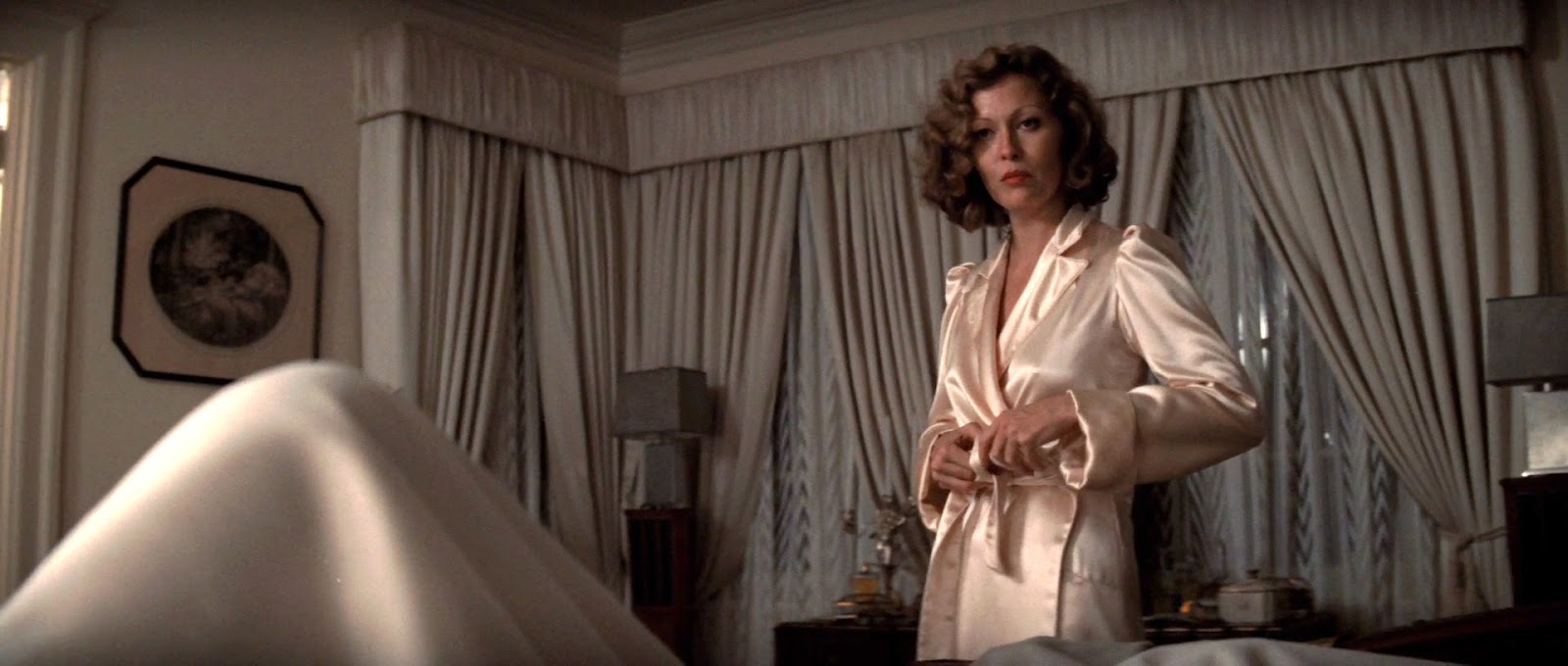
Faye Dunaway is well-cast as the icy femme fatale Evelyn Mulwray. The actress maintains a frosty exterior as she portrays a woman harboring a dark secret. Evelyn forms an uneasy alliance with Gittes and the scenes between Dunaway and Nicholson crackle with an intriguing tension, which apparently mirrored their off-screen relationship as well. As the film progresses, Gittes melts some of Evelyn’s icy exterior and yet Dunaway still manages to hint at further depths to her character that are eventually revealed towards the end.


Polanski sprinkles playful moments throughout the film to offset the pervasive pessimistic mood. This is evident in a scene where Gittes runs afoul of two henchmen, one whom is played by the director. Polanski’s first line is said off-camera – “Hey there, kitty cat,” and he proceeds to slice open Gittes’ nose with a switchblade. For a good portion of the film, Nicholson sports a large bandage on his face, which subversively messes with the leading man’s good looks. A move like that would never fly with studio executives today who are scared to death of messing with any formula that could cost them money and this is just one of the chances Chinatown takes.

Another fantastic scene is Gittes’ lunch with Noah Cross where we get to see the legendary John Huston play off against Nicholson. The former exudes the confidence of a powerful man like Cross and the actor is clearly having fun with the role, like how he repeatedly mispronounces Gittes’ name as a way of subtly exerting control over the private investigator. Cross expertly dances around Gittes’ questions but the latter doesn’t back down either. The scene is a fascinating battle of wills as Gittes begins to realize what he’s up against.

Polanski brings an assured touch to the direction, masterfully utilizing the widescreen aspect ratio with the help of cinematographer John A. Alonzo. They manage to simultaneously evoke classic Hollywood cinema with the retro-noir period trappings while also bringing a European sensibility, mostly through the psychological underpinnings of the story. These visuals and the atmosphere that is created is greatly enhanced by Jerry Goldsmith’s score, which not only evokes a more elegant time but also expertly services a given scene, like being suspenseful when necessary and so on.


Thanks to all the political assassinations that occurred in the 1960s and then the Watergate scandal in the 1970s, government corruption was very much on peoples’ minds at the time Chinatown was released and this is reflected in the story that sees Gittes mired in corruption. Like most private investigator/mystery stories, much of the pleasure comes from the colorful characters Gittes encounters and how he unravels the various layers of the complicated plot.

While walking in the foothills of the Santa Monica Mountains, screenwriter Robert Towne came up with the idea for a detective story about the corruption of the land by developers. While filming Drive, He Said (1971) in Eugene, Oregon in the spring of 1970, he checked out a book from the local library by Carey McWIlliams about the history of oil and water exploitation in Southern California. It inspired him to base one of the crucial characters on William Mulholland, a pioneering Los Angeles water-supply engineer.

For the retro-vibe that he wanted to evoke, Towne read a photo essay entitled “Raymond Chandler’s L.A.” in New West magazine and drove around the city while also looking at old postcards that reminded him of “the sights and sounds of childhood.” He also read plenty of hardboiled fiction by Chandler and Dashiell Hammett, especially the former for his descriptions of L.A.


Towne first worked on the characters of Noah Cross and the incestuous relationship with his daughter Evelyn Mulwray. Then, he switched his focus to the detective-hero, which he named J.J. Gittes after a mutual friend of his and Jack Nicholson’s, Harry Gittes. Towne and Nicholson had been good friends for some time and the former tailored the role of Gittes specifically for the latter. While writing the script, the scope and density of the script was daunting for Towne as he found himself trying “one way and another casually to reveal mountains of information about dams, orange groves, incest, elevator operators, etc.”

Initially, Towne envisioned himself directing, “figuring no matter how bad I was as a director, if I could tell a decent story they would watch it.” However, he was broke at the time and need money to finish the script. Paramount Studios executive and producer Robert Evans originally approached Towne to adapt F. Scott Fitzgerald’s novel The Great Gatsby for a sizable paycheck but he passed on the assignment to focus on Chinatown instead and made a deal that gave the studio a 30-day option on it.

Nicholson had wanted to work with film director Roman Polanski for some time. They were friends socially and Nicholson called and asked him to direct Chinatown. The director was happily living in Rome, recovering from making What? (1972) and was not keen on returning to the United States, a place where his wife Sharon Tate had been brutally murdered by members of the Manson Family in 1969. Originally, Evans wanted Peter Bogdanovich to direct but when he passed the producer persuaded Polanski to fly to L.A. and meet with Towne. Aside from the chance to work with the likes of Nicholson and Towne, Polanski was low on funds and his bills were accumulating. He needed money.


Polanski read Towne’s initial draft and felt it was “brimming with ideas, great dialogue, and masterful characterization,” but that it “suffered from an excessively convoluted plot that veered off in all directions.” Towne wasn’t thrilled with Polanski’s criticisms but was convinced by the powers that be to do some rewrites on the script. Polanski found the revised draft even more difficult to follow and didn’t like the ambiguity of the film’s title, insisting that at least one scene take place in that location. Towne had gotten the title from a Hungarian vice cop who told him he had worked vice in Chinatown in L.A. When the writer asked him what he did there, the cop replied, “As little as possible.”

Polanski felt that Towne was prone to procrastination and so he created a routine consisting of eight-hour work days and partying away the night. The writer remembers, “The mood at night was—it was the 1970s.  We had a good time.” The rewriting consisted of Towne re-sequencing scenes and clarifying the complicated plot while Polanski worked on the dialogue and changing the focus so that the entire film is from Gittes’ point-of-view. Within eight weeks they had created a shooting script. Towne has said that he fought with Polanski every day and Evans said the final product was the result of “a lot of arguments, fights. There was warfare throughout the picture, but that’s healthy.” After the dust settled, Polanski and Towne were no longer speaking to each other.

When it came to casting, Evans picked then-wife Ali MacGraw to play Evelyn Mulwray but when she ran off to marry actor Steve McQueen, he offered the part to Jane Fonda who turned it down. Polanski suggested Faye Dunaway who he knew socially and liked her “retro” look but Evans didn’t like the idea and considered the actress to be trouble.


Polanski’s approach to filming Chinatown was not as a classic black and white movie “but as a film about the Thirties seen through the camera eye of the Seventies.” He insisted on shooting in color and Panavision. He originally hired legendary cinematographer Stanley Cortez (The Magnificent Ambersons) but when he didn’t work out, Polanski skewed younger with John Alonzo (Harold and Maude) instead.

When filming began in the fall of 1973, Polanski and Dunaway did not get along. According to him, she fretted over her appearance, didn’t always know her lines, and bothered him to rewrite them. When he did she would then go back to the original dialogue. She would ask him for her character’s motivation and he screamed at her that the salary she was being paid was all the motivation she needed. It got so bad between them that Evans arranged a meeting with Dunaway, her agent and Polanski. Evans decided to keep Dunaway off the set for three weeks to let things cool down and when she returned the actress no longer spoke to Polanski and was all business when it came to direction. The actress recalled, “I thought Roman was thwarting me and not supporting me.”

Nicholson wasn’t crazy about Polanski’s habit for multiple takes and being given line readings – two things he hated as an actor. Nicholson recognized that Polanski was a brilliant filmmaker who liked to argue and adjusted accordingly. During filming, Polanski made two significant changes to Towne’s script with Evans’ approval, much to the writer’s chagrin and who subsequently felt betrayed. The most notable one was changing the ending, which he made much more nihilistic than Towne intended, prompting the writer to call it, “the literal and ghoulishly bleak climax.” Years later and with the benefit of hindsight, Towne agrees that Polanski was right to change the ending.


When it came to post-production, Polanski hired classical composer Philip Lambro to score Chinatown. Seven weeks before the film’s premiere it was previewed in San Luis Obispo. It was a disaster according to Evans who recalled, “By the time the lights came up, half the audience had walked out, scratching their heads.” He felt that Lambro’s “dissonant, weird, scratchy” music was to blame. Evans delayed the film’s premiere and brought in Jerry Goldsmith to create a new score, which he did in a staggering ten days! According to Evans, seeing the film with Goldsmith’s music was like seeing a completely different film.

Not surprisingly, Chinatown received mixed reviews from the major critics back in the day. Roger Ebert gave the film four out of four stars and praised Polanski’s work: “He’s made a perceptive, loving comment on a kind of movie and a time in the nation’s history that are both long past. Chinatown is almost a lesson on how to experience this kind of movie.” In his review for The New York Times, Vincent Canby wrote, “Mr. Polanski and Mr. Towne have attempted nothing so witty and entertaining, being content instead to make a competently stylish, more or less thirties-ish movie that continually made me wish I were back seeing The Maltese Falcon or The Big Sleep. Others may not be as finicky.” The New Yorker’s Pauline Kael wrote, “The film holds you, in a suffocating way. Polanski never lets the story tell itself. It’s all over-deliberate, mauve, nightmarish; everyone is yellow-lacquered, and evil runs rampant. You don’t care who is hurt, since everything is blighted. And yet the nastiness has a look, and a fascination.” Finally, in his review for the Village Voice, Andrew Sarris wrote, “It is Polanski’s decision alone to tilt Chinatown toward tragedy that ultimately redeems the enormous contributions of the others. Yet even Polanski’s intense feeling for tragedy could never have been realized without the vision of tragedy expressed in Nicholson’s star-crossed eyes.” Finally, in his review for the Village Voice, Andrew Sarris wrote, “It is Polanski’s decision alone to tilt Chinatown toward tragedy that ultimately redeems the enormous contributions of the others. Yet even Polanski’s intense feeling for tragedy could never have been realized without the vision of tragedy expressed in Nicholson’s star-crossed eyes.” Chinatown was nominated for 11 Academy Awards, including ones for Best Picture, Actor, Actress, Director, and Original Screenplay, winning for the latter.

Chinatown sheds light on one of the many dirty secrets of L.A. and shows how the expansion of the city didn’t come easily – a lot of wheels were greased in the process and lives were ruined because of all the money that was at stake. It was something that people in the ‘70s could relate to and this translated into commercial and critical success. Its legacy is an impressive one with flawed neo-noirs like Mulholland Falls (1996) and masterful ones like L.A. Confidential (1997) influenced by it. Towne and Nicholson even revisited the character of Gittes with The Two Jakes (1990) but without Polanski and it wasn’t as well-received, proving that the alchemy of Chinatown, with everything coming together like it did, was impossible to replicate. As of Gittes’ associates tells him at the end of the film, “Forget it Jake, it’s Chinatown.”


SOURCES

Dunaway, Faye with Betsy Sharkey. Looking for Gatsby: My Life. Simon & Schuster. 1995.

Evans, Robert. The Kid Stays in the Picture. Hachette Books. 1994.

Iorio, Paul. “Sleuthing Chinatown.” Los Angeles Times. July 8, 1999.

King, Susan. “A Vintage L.A. Story.” Los Angeles Times. November 15, 2004

McGilligan, Patrick. Jack’s Life: A Biography of Jack Nicholson. W.W. Norton & Company. 1995.

Meikle, Denis. Roman Polanski: Odd Man Out. Reynolds & Hearn Ltd. 2006.


Teachout, Terry. “The Perfect Film Score.” Wall Street Journal. July 10, 2009.