"...the main purpose of criticism...is not to make its readers agree, nice as that is, but to make them, by whatever orthodox or unorthodox method, think." - John Simon

"The great enemy of clear language is insincerity." - George Orwell
Showing posts with label Joe Pesci. Show all posts

Friday, December 17, 2021

JFK


There’s only one thing everyone can agree on regarding the assassination of American President John F. Kennedy: he was killed on November 22, 1963. Everything else around this watershed event in American history has been subject to intense debate and one that has provoked people to question their own beliefs and those of their government. Yet, for such a highly publicized affair there are still many uncertainties that surround the actual incident. Countless works of fiction and non-fiction have been created concerning the subject, but have done little in aiding our understanding of the assassination and the events surrounding it. Oliver Stone's film JFK (1991) depicts the events leading up to and after the assassination like a densely assembled puzzle complete with jump cuts and multiple perspectives. Stone’s film presents the assassination as a powerful event constructed by its conspirators to create confusion with its contradictory evidence, to then bury this evidence in the Warren Commission Report, which in turn manifests multiple interpretations of key figures like triggerman Lee Harvey Oswald. JFK offers a more structured examination of the conspiracy from one person's point of view where everything fits together to reveal a larger, more frightening picture implicating the most powerful people in the United States government.
 
Stone’s film filters an examination of two conspiracies, one to kill the President and one to cover it up, from one person's point of view — Jim Garrison (Kevin Costner) — the New Orleans District Attorney who then assembles all the evidence at his disposal to deliver a powerful and persuasive case for a conspiracy to kill Kennedy. Stone saw his film consisting of several separate films: Garrison in New Orleans against Clay Shaw (Tommy Lee Jones), a key figure in the assassination, Oswald’s (Gary Oldman) backstory, the recreation of Dealey Plaza, and the deep background in Washington, D.C. JFK is the mother of all paranoid conspiracy thrillers, the ultimate one man against the system film with Garrison taking on the establishment, attempting to uncover one of the most nefarious plots in history. It created such profound shockwaves in the real world that Stone was criticized and vilified in the press.
 
“God, I’m ashamed to be an American today,” says Garrison when he finds out that Kennedy has been shot and we see people in the bar he’s in applaud the man’s death. Stone and cinematographer Robert Richardson desaturate the colors in the 1963 scenes, which creates a somber tone as the country reacts to the Kennedy assassination.

Six years later, the color returns to the film as Garrison shares a plane ride with Senator Russell B. Long (Walter Matthau) who plants the first seeds of doubt in the District Attorney’s mind about the Kennedy assassination. He points out that Oswald was a lousy shot and couldn’t have made all those shots in that time with that kind of accuracy. He also scoffs at the “magic bullet” theory – that one bullet created seven wounds and came out in pristine condition. “I’d round up 100 of the world’s best riflemen. Find out which ones were in Dallas that day. You’ve been duck hunting. I think Oswald is a good old-fashioned decoy.”
 
This encounter provokes Garrison to go through all the volumes of the Warren Commission Report and find that, “Again and again credible testimony ignored, leads are never followed up, its conclusions selective, there’s no index. It’s one of the sloppiest, most disorganized investigations I’ve ever seen.” He concludes that this was by design: “But it’s all broken down and spread around and you read it and the point gets lost.” He continues to dig deeper and the testimony of Lee Bowers (Pruitt Taylor Vince), who hints at another shooter on the grassy knoll, is the final straw.
 
Garrison walks the streets of New Orleans with two of his investigators Lou Ivon (Jay O. Sanders) and Bill Broussard (Michael Rooker), recounting Oswald’s time in the city in a brilliantly written and performed monologue (one of many). He points out to them that Oswald, a supposed communist sympathizer, spent his time in the heart of the government’s intelligence community with the FBI, the CIA, the Secret Service and the Office of Naval Intelligence all within spitting distance of each other. As Garrison tells them, “Isn’t this seem to you a rather strange place for a communist to spend his spare time?” He tells them that they are going to reopen the investigation of the Kennedy assassination and this is where the film really begins to gather narrative momentum.
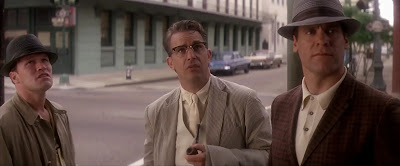
Garrison starts interviewing people that had some link to the conspirators, namely Clay Bertrand a.k.a. Clay Shaw, which gives Stone the opportunity to trot out a parade of name actors such as Jack Lemmon, John Candy and Kevin Bacon to portray a very colorful cavalcade of characters. The interviews paint a vivid picture of David Ferrie (Joe Pesci) and Shaw working with Oswald. Stone uses Bacon and Lemmon to detail the conspiracy on a local level, expounding a ton of expositional dialogue brilliantly, while Candy’s hipster lawyer conveys the danger Garrison faces digging into the murder of the President.

Stone presents a series of lengthy dialogue-driven scenes conveying an incredible amount of information in palatable fashion by having recognizable actors as his mouthpieces while dynamically shooting and editing them. He has a character spout a fact or theory and then cuts to a dramatic reenactment that depicts it in black and white and/or different film stock, often blurring the line between fact and fiction, which is the point. In a case as complex as this it is hard to discern which is which as witness testimony conflicts one another making it difficult to make sense of it all.
 
A great example of this is the sequence where Garrison and his team explain Oswald’s background leading up to the assassination with Stone cutting to staged footage, actual documentary footage and the famous Life magazine cover photograph that cemented Oswald’s guilt in the public’s mind but might be a doctored image. It is a bravura sequence that marries complex editing, pasting together all kinds of different formats, with past events being discussed in the present with many characters talking as the conspiracy deepens and the thriller elements take hold. It culminates with Broussard disbelievingly saying, “We are talking about our government!” to which Garrison replies, “No. We’re talking about a crime, Bill. Plain and simple…We’re through the looking glass, here, people. White is black and black is white.”
 
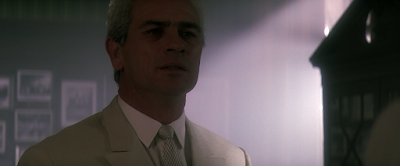
The scene where Garrison first meets Shaw is a fantastic clash between two characters as the former goes after the latter who defiantly deflects and denies any involvement in the assassination plot. During the conversation, Stone intercuts footage that shows he is lying or, at least, that is Garrison’s interpretation. Tommy Lee Jones is brilliant here as he changes tone on a dime, going from amused elegance to angrily indignant and back again all the while maintaining an air of cultured sophistication. Finally, Garrison tires of his act and accuses him of killing Kennedy. When Shaw finally leaves, he gives parting pleasantries but Jones gives Costner a lingering, threatening look. From this point on, the pressure on the D.A. and his team increases as the powers that be attempt to discredit him.

Stone’s portrayal of Garrison is reminiscent of Jimmy Stewart in Mr. Smith Goes to Washington (1939) – the last honest man in government – and he tries to temper this by showing the trouble he faces at home as his wife (Sissy Spacek) complains that he’s never around anymore and that he cares more about the Kennedy assassination than his own family. She is the film’s weakest character whose sole purpose, initially, is to provide strife on the home front. Stone then has her come around to her husband’s way of thinking after he tearfully tells her late one night that Robert Kennedy has been shot and killed. She admits he was right all along and they make love in a scene that is unnecessarily maudlin. These scenes feel shoehorned in and take away from the main thrust of the film. Stone is on more comfortable ground when he returns to more familiar turf as we see the press arriving in droves to Garrison’s office, making it impossible for he and his team to get any work done. Funding for his office has dried up and he is forced to use his own savings to keep the investigation going. We also see infighting among his staff and Ivon and Broussard butt heads as we see the latter scared off the case.
 
Another bit of tour-de-force acting comes from Joe Pesci in the scene where Ferrie rapidly unravels as he fears for his life based on what he knows about the plot to kill Kennedy. Ferrie gets increasingly manic as he rattles off the people and organizations involved, getting worked up until he utters the iconic line, “It’s a mystery wrapped in a riddle inside an enigma!” It’s hyperbolic and over-the-top to be sure but it does illustrate how complex the assassination plot is with fake Oswalds and conflicting eyewitness accounts. After the incredible outburst, Ferrie winds down as Pesci elicits sympathy for this terrible man who is under a lot pressure and is incredibly paranoid. This scene threatens to throw the film right off the rails as Pesci goes for it, acting his ass off, chewing up the scenery in breathtaking fashion.
 
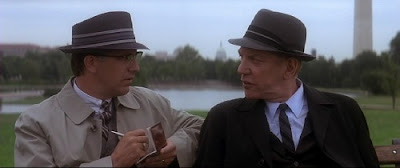
The centerpiece of the film is when Garrison travels to Washington, D.C. to meet with an ex-high-ranking CIA officer known only as Mr. X (Donald Sutherland). In this bravura sequence he lays out the motivation for killing Kennedy including how and why. It’s an incredible amount of dialogue and Stone wisely cast a skilled actor such as Donald Sutherland to convey it in a coherent and engaging way. X lays out the most important aspect of the assassination: why? “The how and who is just scenery for the public. Oswald, Ruby, Cuba, the Mafia – keeps ‘em guessing like some kind of parlor game preventing them from asking the most important question – why? Why was Kennedy killed? Who benefitted? Who has the power to cover it up?”

X posits that Kennedy was killed because he wanted to break up the CIA, make peace with Russia and end the Vietnam War, which not only pissed off a lot of powerful people but would cost a lot of money as he tells Garrison, “The organizing principle of any society, Mr. Garrison, is the war. The authority of the state over its people resides in its war powers.” He encourages Garrison to “come up with a case. Something. Anything. Make arrests. Stir the shitstorm. Hope to reach a critical mass that’ll start a chain reaction of people coming forward. Then the government’ll crack. Remember, fundamentally, people are suckers for the truth.” This is the film’s idealistic mission statement. Judging from the critical reaction towards the film, Stone certainly succeeded in stirring up the shitstorm and in the court of public opinion he helped reshape the perception of the Kennedy assassination.
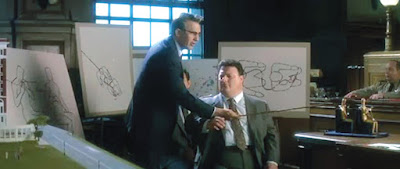
 
These increasingly dense and dynamic exposition scenes lead up to the mother of all courtroom scenes as Garrison goes in knowing he’s going to lose and goes for it anyway. It is Costner’s Mr. Smith Goes to Washington filibuster moment by way of Gary Cooper as Garrison debunks the Warren Commission Report’s account of Oswald by audaciously showing the real Zapruder film that depicted the Kennedy killing in real time. Stone edits in recreation footage with actual footage of the assassination as Garrison lays it all out. The filmmaker also recreates Kennedy’s controversial autopsy and shows actual photos of the man taken at the time.
 
This scene involves a massive amount of dialogue and information to convey and Costner handles it like a pro, making this exposition compelling, especially at the end when the actor performs his final speech without the aid of intercutting other footage. It’s Costner out there on his own, even getting emotional towards the end at the most powerful moment when Garrison address the jury, “Show this world that this is still a government of the people, for the people and by the people. Nothing as long as you live will ever be more important. It’s up to you.” And with that last line, Costner breaks the fourth wall. That line is meant for us and is one of the most moving parts of Garrison’s speech.

While attending the Latin American Film Festival in Havana, Cuba, Stone met Sheridan Square Press publisher Ellen Ray on an elevator. She had published Jim Garrison's book On the Trail of the Assassins. Ray had gone to New Orleans and worked with Garrison in 1967. She gave Stone a copy of Garrison's book and told him to read it. He did and quickly bought the film rights with his own money. The Kennedy Assassination had always had a profound effect on his life and he eventually met Garrison, grilling him with a variety of questions for three hours. The man stood up to Stone's questioning and then got up and left. His hubris impressed the director.
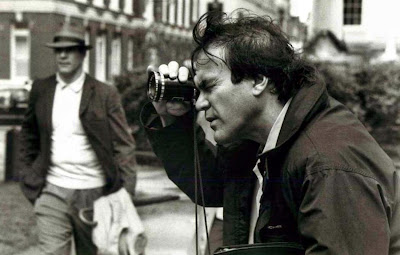
 
Stone was not interested in making a film about Garrison's life but rather the story behind the conspiracy to kill Kennedy. To this end, he also bought the film rights to Crossfire: The Plot That Killed Kennedy by Jim Marrs. When Stone set out to write the screenplay, he asked Columbia University’s Professor of Journalism Zachary Sklar to co-write it with him and distill the Garrison book, the Marrs book and all the research he and others conducted into a script that would resemble what he called "a great detective movie." Stone told Sklar his vision of the movie: "I see the models as Z (1969) and Rashomon (1950), I see the event in Dealey Plaza taking place in the first reel, and again in the eighth reel, and again later, and each time we're going to see it differently and with more illumination.”
 
Sklar worked on the Garrison side of the story while Stone added the Oswald story, the events at Dealey Plaza and the "Mr. X" character. To tell as much of the story as they could, Stone and Sklar used composite characters, a technique that would be criticized in the press, most notably the "Mr. X" character played by Donald Sutherland and who was a mix of several witnesses and retired Air Force Colonel L. Fletcher Prouty, an adviser on the film.

In 1989, Stone met with the three top Warner Bros. executives – Terry Semel, Bob Daly, and Bill Gerber – who had been interested in his work for some time. At the time, Stone was trying to make a film about Howard Hughes but Warren Beatty owned the rights. Stone then pitched JFK to them in 15-20 minutes: “I told them I wanted JFK to be a movie about the problem of covert parallel government in this country and deep political corruption.” Semel remembers Stone asking them, “’Are you concerned politically? Would it affect your company? Are there negative reasons why you wouldn’t do it?’ My immediate reaction was, ‘No, we should do it.’ If it’s entertaining and it’s intriguing, a great murder mystery about something we all cared about and grew up thinking about, why not?” A handshake deal was done and the studio agreed to a $20 million budget.
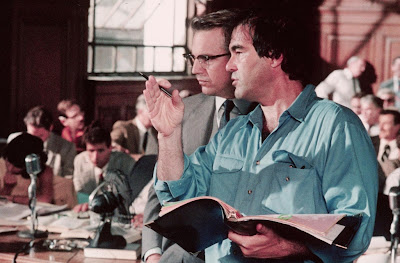
 
Stone could have shopped JFK around in the international market but chose WB because, “I knew the material was dangerous and I wanted on entity to finance the whole thing and the history of WB, given Terry Semel’s record of political films (All the President’s Men, The Parallax View and The Killing Fields), was my first choice.” Kevin Costner signed on to play Garrison in 1991, which pleased the studio who wanted a bankable movie star attached to the project. In addition, independent producer Arnon Milchan came on board as an executive producer and doubled the budget allowing Stone to cast a star-studded supporting cast around Costner.
 
Stone ambitiously wanted to recreate the Kennedy Assassination in Dealey Plaza and his producers had to pay the Dallas City Council a substantial amount of money to hire police to reroute traffic and close streets for three weeks. He only had ten days to shoot the footage. Getting permission to shoot in the Texas School Book Depository was more difficult. They had to pay $50,000 to put someone in the window that Lee Harvey Oswald was supposed to have shot Kennedy. They were allowed to film in that location only between certain hours with only five people on the floor at one time: the camera crew, an actor, and Stone. Co-producer Clayton Townsend has said that the hardest part was getting the permission to restore the building to the way it looked back in 1963. That took five months of negotiation.

Filming was going smoothly until several attacks on the film in the press surfaced in the mainstream media including the Chicago Tribune, published while the film was only in its first weeks of shooting. Five days later, the Washington Post ran a scathing article by national security correspondent George Lardner entitled, "On the Set: Dallas in Wonderland" that used the first draft of the JFK screenplay to blast it for "the absurdities and palpable untruths in Garrison's book and Stone's rendition of it.” The article pointed out that Garrison lost his case against Clay Shaw and claimed that he inflated his case by trying to use Shaw's homosexual relationships to prove guilt by association. Other attacks in the media soon followed. However, the Lardner Post piece stung the most as he had stolen a copy of the script. Stone recalls, "He had the first draft, and I went through probably six or seven drafts.”
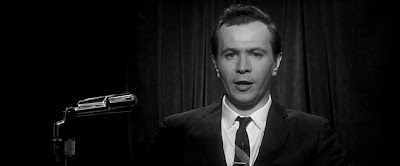
 
The film depicts the events leading up to and after the assassination as a densely constructed story complete with jump cuts, multiple perspectives, a variety of film stocks and the blending of actual archival footage with staged scenes dramatized by a stellar cast of actors. This blurring of reality and fiction by mixing real footage with staged footage makes it difficult to discern what really happened and what is merely speculation. Stone does this to create what he calls "a countermyth to the myth of the Warren Commission because a lot of the original facts were lost in a very shoddy investigation," and simulate the confusing quagmire of events as they are depicted in Warren Report. Stone creates different points of views or "layers" through the extensive use of flashbacks within flashbacks. Stone has said that he “wanted the film on two or three levels — sound and picture would take us back, and we’d go from one flashback to another, and then that flashback would go inside another flashback ... I wanted multiple layers because reading the Warren Commission Report is like drowning.” This technique conveys the notion of confusion and conflict within evidence
 
Kevin Costner acts as the perfect mouthpiece for Stone’s theories. The auteur’s infamously forceful directorial approach to his actors pays off here as he reins in the Costner’s usual tics and mannerisms. Stone was no dummy — he knew that by populating his film with many famous faces, he could make the potentially bitter pill that was his film that much more palatable to the mainstream movie-going public. The rest of the cast is phenomenal. Gary Oldman delivers an eerily authentic portrayal of the enigmatic Lee Harvey Oswald. Tommy Lee Jones is note-perfect as the refined, self-confident businessman, Clay Shaw. Even minor roles are filled by such name actors as Vincent D’Onofrio, Kevin Bacon, Jack Lemmon, and Walter Matthau.

The film throws many characters at us and it is easier to keep track of them by identifying them with the famous person that portrays them. Stone was evidently inspired by the casting model of a documentary epic he had admired as a child: “Darryl Zanuck's The Longest Day (1962) was one of my favorite films as a kid. It was realistic, but it had a lot of stars ... the supporting cast provides a map of the American psyche: familiar, comfortable faces that walk you through a winding path in the dark woods.” Future biopics with sprawling casts, like The Insider (1999), and Good Night, and Good Luck (2005), and The Good Shepherd (2006) would use this same approach.
 
Seeing JFK now, one is reminded that first and foremost, it is a top-notch thriller. There are so many fantastic scenes of sheer exposition that would normally come across as dry and boring but are transformed into riveting scenes in the hands of this talented cast. For example, the famous scene between Garrison and X (Sutherland) where the mysterious man lays out all the reasons why Kennedy was killed and how is not only a marvel of writing but also of acting as the veteran actor gets to deliver what is surely one of the best monologues ever committed to film.
 
Once the film was released in theaters, it polarized critics. The New York Times ran an article by Bernard Weinraub entitled, "Hollywood Wonders If Warner Brothers let JFK Go Too Far.” In it, he called for studio censorship and wrote, "At what point does a studio exercise its leverage and blunt the highly charged message of a film maker like Oliver Stone?" The newspaper also ran a review of the film by Vincent Canby who wrote, "Mr. Stone's hyperbolic style of film making is familiar: lots of short, often hysterical scenes tumbling one after another, backed by a soundtrack that is layered, strudel-like, with noises, dialogue, music, more noises, more dialogue.” However, Roger Ebert praised the film in his review for the Chicago Sun-Times, saying, "The achievement of the film is not that it answers the mystery of the Kennedy assassination, because it does not, or even that it vindicates Garrison, who is seen here as a man often whistling in the dark. Its achievement is that it tries to marshal the anger which ever since 1963 has been gnawing away on some dark shelf of the national psyche.”

Rita Kempley in the Washington Post wrote, "Quoting everyone from Shakespeare to Hitler to bolster their arguments, Stone and Sklar present a gripping alternative to the Warren Commission's conclusion. A marvelously paranoid thriller featuring a closetful of spies, moles, pro-commies and Cuban freedom-fighters, the whole thing might have been thought up by Robert Ludlum.” On Christmas Day, the Los Angeles Times ran an article entitled, "Suppression of the Facts Grants Stone a Broad Brush" attacking the film. New York Newsday followed suit the next day with two articles – "The Blurred Vision of JFK" and "The Many Theories of a Jolly Green Giant.” A few days later, the Chicago Sun-Times ran an article entitled, "Stone's Film Trashes Facts, Dishonors J.F.K." Stone even received death threats as he recalled in an interview, "I can't even remember all the threats, there were so many of them.” Time magazine ranked it the fourth best film of 1991. Roger Ebert went on to name Stone's movie as the best film of the year and one of the top ten films of the decade.
 
Stone paints his canvas with broad brushstrokes and powerful images. This isn’t a documentary or even a docudrama. It is a fever dream straight out of Stone's head. He’s a Baby Boomer upset that the death of Kennedy obliterated the idealism of the '60s and uses the film to vent about it. JFK is an important work in the sense that it accurately portrays the assassination of Kennedy as a complex public event surrounded by chaos and confusion. Stone’s film presents an intricate conspiracy at the source of the killing with one main protagonist who exposes the conspiracy to be an intricately constructed coup d'état. JFK takes a larger, confrontational stance by boldly implicating the government in the conspiracy and the mainstream media in conspiring to cover it up. Stone is using the persuasive power of film to reach the largest number of people he can to wake them up and to reveal how they have been deceived by higher powers. There is no mistaking the importance of the assassination of Kennedy in American culture. Based on the excitement that surrounded Stone's film, the American public was still greatly interested in the event with more and more people believing in a plot to kill the President. Kennedy's death continues to intrigue and interest people who are more open to the idea of a conspiracy that this film openly advocates. For better or for worse, it helped cultivate a conspiracy culture that has only grown larger and more unwieldy with the rise of social media. JFK continues to serve as a powerful piece of cinematic agitprop whose conspiracy theories can be questioned and criticized but its power as an engaging and moving thriller cannot.
 

SOURCES
 
Fisher, Bob. “The Whys and Hows of JFK.” American Cinematographer. February 1992.
 
Petras, James. “The Discrediting of The Fifth Estate: The Press Attacks on JFK.” Cineaste. May 1992.
 
Riordan, James. Stone: A Biography of Oliver Stone. Aurum Press. 1996.
 
Scheer, Robert. “Oliver Stone Builds His Own Myths.” Los Angeles Times. December 15, 1991.

Friday, April 16, 2021

THE PUBLIC EYE


In 1992 alone,
My Cousin Vinny, Lethal Weapon 3, and Home Alone 2: Lost in New York, featuring Joe Pesci in some capacity, were all released. Needless to say, it was a very good year for the actor. One film that was sadly overlooked during this blitzkrieg of Pesci cinema was The Public Eye, a modesty-budgeted homage to classic film noir that also acted as a tribute to famed New York Daily News photographer Arthur “Weegee” Fellig who worked in Manhattan’s Lower East Side during the 1930s and 1940s capturing the honest and sometimes tragic elements of life on the streets.
 
This is established over the opening credits with a montage of photographs, some of them Fellig’s, capturing people from all walks of life – in agony, bored, under arrest, and so on. We meet Leon “Bernzy” Bernstein (Pesci) taking photos at the scene of a crime before the police even show up and, more importantly, before his competition arrives. He will go to any lengths to get a shot – even if it means impersonating a priest to get a shot of a dead man with a meat cleaver stuck in his head. Bernzy even has a mobile dark room in the trunk of his car where he can develop his photos quickly.
 
He’s dedicated, always out there, wandering the streets in his car, listening to the police band radio, looking for the next photo opportunity. We see a few shots from his point-of-view and they are in black-and-white, suggesting that everyone is a potential photo for the man. He’s not married and doesn’t have time for anybody else as he is devoted to his work. That’s what makes him the best. It is an empty existence in a way as he is too busy capturing other people’s lives to have one of his own.

Bernzy hopes one day to have a book of his photos published and even has a meeting with an esteemed publisher (played with snooty relish by Del Close) who tells him, “This is, instead, a most admirable picture book about New York,” dismissing them as “too sensational” and “too vulgar,” which is kind of the point – they capture the beauty and the ugliness of life.
 
Like many film noirs, Bernzy is summoned to the lofty heights of high society by a beautiful woman – Kay Levitz (Barbara Hershey) who asks him for a favor. She wants him to check out a man claiming to be her recently deceased husband’s partner and now co-partner of his nightclub that she inherited. He agrees, of course, partly because it allows him a foot in rarefied atmosphere and he is attracted to Kay, a rich, beautiful woman who wouldn’t normally give him the time of day. He tracks down the mysterious man only to find him dead.
 
Naturally, doing a favor for Kay forces Bernzy to break his code of neutrality, complicating his life as he takes sides for the first time, not just with cops, but the FBI who lean on him hard, painting him as a Communist sympathizer, and crooks, entangling him in beef between rival mobsters Frank Farinelli (Richard Foronjy) and Spoleto (Dominic Chianese).

Around the time he made The Public Eye, Joe Pesci was delivering broad performances in movies like Lethal Weapon 3 and Home Alone 2. The Public Eye saw him dial it back and deliver a more nuanced performance as evident in a scene where Bernzy comforts Kay about not being forthcoming about the dead man’s ties to the mob. He’s understandably upset but when she’s apologetic and explains that she picked him because her husband believed in his book of photos, Bernzy softens and Pesci shows a vulnerable side to his character.
 
Pesci also does an excellent job of showing how Bernzy channels his inner pain, his loneliness into his art, like when Kay snubs him in her club for some high society type and when she realizes what she’s done chases after him only to find the shutterbug outside in the rain taking a photo of some rich slob passed out in an alley.
 
Barbara Hershey is an atypical femme fatale. Initially, it seems like she is simply using Bernzy to further her own goals – wrest control of her late husband’s nightclub from mobsters – but then we see her defend Bernzy when she’s alone with her cynical doorman (played to jaded perfection by Jared Harris) and it appears that she really does have affection for him. She is in cahoots, however, with Spoleto, a mob boss who controls the west side of Manhattan. Hershey has an expressive face and she gives Bernzy a look that we see but he doesn’t that suggests Kay is falling in love with him. She actually looks at his book of photos in a wonderful moment and not just a quick flip through but studies them, lingers over each one and is visibly moved.

The film is populated with a bevy of wonderful character actors that make an immediate impact with the limited screen time they are given. Richard Foronjy (Midnight Run) and Dominic Chianese (The Sopranos) play the rival mob bosses that force Bernzy to take sides. Jerry Adler (Manhattan Murder Mystery) plays a columnist turned playwright who is also Bernzy’s closest confidante. Stanley Tucci, however, makes the greatest impact as Sal, a pivotal figure in the mob war. Initially, his relationship with Bernzy is an antagonistic one but then he tells the shutterbug about the beef between the two warring mob families in a powerful scene that Tucci delivers so well.
 
Howard Franklin, who has unfortunately directed far too few films, does a great job immersing us in 1940s New York City, getting the period details just right, from the yellow cabs to the vintage watch Bernzy wears to the Art Deco nightclub Kay owns, but without overwhelming us with it. With the help of David Cronenberg’s long-time cinematographer Peter Suschitzky, he pays tribute to classic film noirs but doesn’t lay it on too thick, doing just enough to capture the vibe of that era. The two men shot the film in very high contrast: “we wanted a crisp look with an edge” that tried to capture Fellig’s photos and avoid a “nostalgic feeling,” Franklin said in an interview.
 
Franklin first became interested in photographer Arthur “Weegee” Fellig when he saw an exhibit of tabloid photographs in 1982 at the International Center for Photography in New York City. Fellig was born in Poland in 1899, the son of Jewish refugees that emigrated to the United States in 1909, settling in New York’s Lower East Side. Growing up, he held every lousy job imaginable before discovering photography in his twenties when he started working as a freelance news photographer. He got a jump on the competition by obtaining his own police radio, which allowed him to be the first on a crime scene. According to Franklin, “When I saw Weegee’s photographs at the ICP, I was really fascinated and immediately began thinking about his images in terms of a movie.”

He wrote a screenplay in 1982 about an artist that was autobiographical in nature and as he got older and worked on it more, “it evolved into a story about the sacrifices you have to make if you’re serious about your work.” He tried to sell the script but there was no interest. Several directors and actors tried to option it with no success and he finally decided to make it himself. Franklin knew he wanted Joe Pesci to play Bernzy as the character’s “style of photography is similar to Joe’s style of acting in that both are very naked – there’s nothing between the viewer and the image.”
 
Pesci knew nothing about Fellig before agreeing to do the film. He read all the books he could find about the man and learned how to use the vintage Speed Graphic camera that was the hallmark of 1940s news photographers. The actor also studied Fellig’s books of photos and “figured what he would be thinking when he took the pictures; how he felt. I tried to make myself feel like him and look like him and take pictures and learn how to do everything.”
Franklin wanted to shoot on location in New York but the film’s $15 million budget and the union situation there made it impossible. The 13-week shoot begin in Cincinnati’s “Over-the-Rhine” district which resembled ‘40s New York. The production then moved to Chicago for a few weeks before landing in Los Angeles to complete filming where they shot on a soundstage at Santa Clarita Studios.
 
The Public Eye received decidedly mixed reviews. Roger Ebert gave the film four out of four stars and wrote, "Writer-director Howard Franklin is subtle and touching in the way he modulates the key passages between Pesci and Hershey. There is a lot that goes unsaid between them." In his review for The New York Times, Vincent Canby wrote, "The Public Eye never quite takes off, either as romantic melodrama or as a consideration of one very eccentric man's means of self-expression. The facts are there, but they never add up to much. The psychology is rudimentary." The Washington Post's Desson Howe wrote, "Despite the usual quippy, perky performance from Pesci, as well as cinematographer Peter Suschitzky's moodily delineated images, the movie is superficial and unengaging. It's as if Life magazine decided to make an oldtime gangster movie."

In his review for the Los Angeles Times, Peter Rainer wrote, "And since the film’s production design is so arranged and studio-ish, with carefully placed shadows and spotlights, we seem to be wrenched into an anti-world every time we shift from Weegee’s caught-in-the-moment dramas to this movie’s studied blandness." Entertainment Weekly's Owen Gleiberman gave the film a "C-" rating and wrote, "Attempting to breathe life into this hopelessly naive vision of a sad-sack artist-saint, Pesci is forced to rein in just about everything that makes him likable: his manic energy, the leering delight he takes in his own shamelessness." Finally, in his review for Newsweek, David Ansen wrote, "Using all this artifice to illuminate the gritty world of a lonely shutterbug is an odd choice. Yet the tale's mournful B-movie romanticism-and Pesci's introspective, crablike performance-gets under your skin. In its moody, daffy way, The Public Eye gives off an authentic reek of artistic compulsion."

The Public Eye develops a fascinating character arc for Bernzy. For most of his career he chose not to take sides as it was good for business but finally he is faced with a dilemma that affects not only himself but people he cares about and this motivates him to take a side. He is tired of simply being an observer and is ready to get his hands dirty.
 
Having Robert Zemeckis as an executive producer I’m sure helped greatly in getting this film made but I wonder if Pesci used some of the juice from his Academy Award-winning turn in Goodfellas (1990) and his box office clout from Lethal Weapon 2 (1989) and Home Alone (1990) to help push this through the system. If so, I’m glad he did as this is the kind of off-kilter, personal passion project that is so excellently done.
 

SOURCES
 
Ebert, Roger. “Joe Pesci Moves Up from the Ranks of Supporting Players in Public Eye.” Rogerebert.com. October 11, 1992.
 
McKenna, Kristine. “Weegee’s Tabloid World: The very busy Joe Pesci finds a role he can’t refuse.” Los Angeles Times. December 8, 1991.

Monday, June 1, 2009

Goodfellas

"For as long as I can remember I always wanted to be a gangster." – Henry Hill

From his early days making Mean Streets (1973), Martin Scorsese was always fascinated by gangsters. As a child, he had grown up around them and was intrigued by their lifestyle. Goodfellas (1990) was his triumphant return to the subject and to his old neighborhood in New York City. The film would also reunite Scorsese with actors Joe Pesci and Robert De Niro – a combination that proved to be successful both commercially and critically. By all accounts, the film was a labor of love for the filmmaker and his cast and crew. This is abundantly evident in the incredible attention to detail and passion that is contained in every frame of this film. Goodfellas has all the trademarks of a master filmmaker at the top of his game, displaying an unwavering confidence while also telling an extremely entertaining and engaging story as well.

Goodfellas is a crime epic that spans three decades while following the dramatic rise and fall of three gangsters through the eyes of one them — Henry Hill (Ray Liotta). Early on, Jimmy Conway (Robert De Niro) tells Henry the two most important rules for a gangster to follow: “Never rat on your friends and always keep your mouth shut.” Of course, Henry will break both these rules by the end of the film. Goodfellas depicts their obsessive pursuit of the American Dream, how consuming it is, and how everything eventually turns sours and ultimately devours them. The film is also about addiction and how it not only draws the characters in but us as well. We become addicted to the power of the film's style and visuals, which shows the seductive allure of the gangster lifestyle: to be able to do anything. And yet, the film isn't afraid to show the flipside — the nightmarish lows that come with the dizzying highs – with unflinching honesty.

Scorsese first read a review of a book entitled Wiseguy written by New York crime reporter Nicholas Pileggi and Henry Hill while on the set of The Color of Money (1987). Scorsese never intended to make another mob film but was so intrigued by the review that he read the book and came away from the experience feeling that it was the most honest portrayal of gangsters he had ever read because it gave one “a sense of the day-to-day life, the tedium – how they work, how they take over certain nightclubs, and for what reasons. It shows how it's done." He thought that the book would "make a fascinating film if you just make it what it is – literally as close to the truth as a fiction film, a dramatization, could get.” Scorsese was clearly drawn to the documentary aspects of the book – something he had tried to depict in Mean Streets. And like with that film, Scorsese was drawn to a grittier, more realistic view of gangster life, as opposed to the epic grandeur of The Godfather films. Another thing the filmmaker took away from the experience of reading Wiseguy was the approach he wanted to take with the film version: "To begin Goodfellas like a gunshot and have it get faster from there, almost like a two-and-a-half-hour trailer. I think it's the only way you can really sense the exhilaration of the lifestyle, and to get a sense of why a lot of people are attracted to it.”

Scorsese called Pileggi and told him how much he admired the book and his desire to make it into a film with the two of them writing the screenplay. Pileggi replied, "To tell you the truth, I've been waiting for this phone call all my life. If you want to do it, you can do it.” As the two men began to write the screenplay they recognized similarities between themselves. Both Scorsese and Pileggi had grown up in Italian-American neighborhoods with similar experiences. As a result, the two men bonded and the process of writing the screenplay became a passionate, personal project as Scorsese and Pileggi wrote 12 drafts before they achieved an ideal shooting script. The director retained most of what was included in the book, "but the visual styling had to be completely redone in our writing sessions. So we decided to share the credit.” The two men decided which sections of the book they liked and put them together like building blocks. Scorsese persuaded Pileggi that a traditional narrative structure was not needed. The director did not want to deal with the gangster film episode by episode but start in the middle and move backwards and forwards. Scorsese would compact scenes and realized that if they were kept short, "the impact after about an hour and a half would be terrific.” He wanted to do the voiceover like the opening of Jules and Jim (1962) and use “all the basic tricks of the [French] New Wave from around 1961.”

Since the title of Pileggi's book had already been used for a television series and for Brian De Palma’s 1986 comedy, Scorsese and the writer decided to change the name of their film to Goodfellas. This film would be the first screenplay Scorsese had put his name on since Mean Streets – clearly this project was near and dear to the filmmaker's heart.

This level of commitment did not stop with Scorsese. Many of the cast and crew felt as passionately about the material. Once De Niro agreed to play Jimmy Conway, Scorsese was able to secure the money needed to make the film. The director cast Ray Liotta after De Niro saw him in Jonathan Demme’s Something Wild (1986) and Scorsese was surprised by "his explosive energy" in that film. The actor had read Pileggi's book when it first came out and found it fascinating. A couple of years afterwards, his agent told him that Scorsese was going to direct a film version. In 1988, Liotta met the director over a period of a couple of months and auditioned for the film.

To prepare for his role, De Niro consulted with Pileggi who had research material that had been discarded while writing the book. De Niro often called Henry Hill several times a day to ask how the real man he was portraying walked, held his cigarette, and so on. Driving to and from the set, Liotta listened to FBI audio cassette tapes of Hill, so he could practice speaking like his real-life counterpart. To research her role, Lorraine Bracco tried to get close to a Mob wife but was unable to because they exist in a very tight-knit community. She decided not to meet the real Karen because she "thought it would be better if the creation came from me. I used her life with her parents as an emotional guideline for the role." Conversely, Paul Sorvino had no problem finding the voice and walk of his character but found it challenging finding "that kernel of coldness and absolute hardness that is antithetical to my nature except when my family is threatened."

Goodfellas was shot during the spring and summer of 1989 with a budget of $25 million. Scorsese broke the film down into sequences and storyboarded everything because of the complicated style throughout. He claims that the film's style comes from the first two or three minutes of Jules and Jim: extensive narration, quick edits, freeze frames, and multiple locale switches. It was this rebellious attitude towards convention that mirrored the attitude of many of the gangsters in the film. Scorsese remarked, "So if you do the movie, you say, 'I don't care if there's too much narration. Too many quick cuts? - That's too bad.' It's that kind of really punk attitude we're trying to show." He adopted a frenetic style in order to almost overwhelm the audience with images and information. He also put a lot of detail in every frame because the gangster life is so rich.

Liotta was impressed at how dedicated Scorsese and his crew were to the material. "What's interesting is, as you're working with them, it's so loose and relaxed...they work with a wonderful, self-confident kind of ease.” The actors on the film reacted to this relaxed atmosphere and as a result Goodfellas contains some truly inspired performances. It is obvious that Scorsese loves working with his actors. Sorvino commented that the director "really likes actors and has respect for their creativity – he inspires, encourages, and develops it. He says, 'Okay, let's just try this. He doesn't give you a lot of verbiage, or an avalanche of meaningless facts and information." Because Scorsese has years of filmmaking experience, he is very well organized, storyboarding and planning out every shot before any filming begins. This allows a certain amount of leeway and improvisation with his actors and crew. The film's producer, Irwin Winkler equated the way Scorsese works with the rather improvisational nature of jazz:
"He knows what he wants, but he still has the freedom of improvising and trying new things. He knows how to seize the moment when an actor does something a little different or a little special. Knowing what he wants makes it easier for him to do these improvisations, because he has, at least, a standard by which to keep it under control. He's like a jazz musician. He doesn't know all the notes he's going to hit, but he knows the melody he's going to stick to."

According to actor Joe Pesci, improvisation and ad-libbing came out of rehearsals where Scorsese let the actors do and say whatever they wanted. He made transcripts of these sessions, took the lines that the actors came up with that he liked best, and put them into a revised script that the cast worked from during principal photography.

Scorsese’s movie has an incredible amount of voiceover narration — usually the kiss of death because it slows down the narrative flow of the film and the audience gets bored with so much exposition. However, in this case it is essential. For the first third of the movie Henry tells us how and why he became a gangster and how their world works. Once he meets his wife, Karen (Lorraine Bracco), she takes over some of the voiceover narration duties. However, it is Henry’s voice that is prevalent throughout — this is his story after all.

The soundtrack for the film is almost wall-to-wall with a diverse selection of music. The only rule he adhered to was only use music that could have been heard at that time. Musical cues were used to the let the audience know which decade the action is taking place: doo-wop for the 1950s, girl group pop music for the 1960s and Rolling Stones rock ‘n’ roll for the 1970s. He also uses music to give the audience an idea of what a character is thinking or feeling. For example, there is a scene where Jimmy is sitting at the counter in a bar. The camera slowly moves in on him as the opening strains of “Sunshine of Your Love” by Cream plays over the soundtrack. Coupled with the cold, amoral look on De Niro’s face, the audience instinctively knows that he is going to kill someone very soon. It is a brilliant bit of foreshadowing done with music. According to Scorsese, a lot of non-dialogue scenes were shot to playback. For example, he had "Layla" playing on the set while shooting the scene where the dead bodies are discovered in the car and the meat-truck. Sometimes, the lyrics of songs were put between lines of dialogue to comment on the action.

There are so many classic scenes in Goodfellas that have become a part of cinematic history. For example, there is the “Am I Funny?” scene between Henry and Tommy DeVito (Joe Pesci). Tommy is telling a story to a group of gangsters and everyone is laughing along. Then, Henry makes an offhanded comment that Tommy takes the wrong way and is offended. The tone of the scene shifts suddenly to one of tension as Tommy gets angrier and angrier. Is he going to hurt Henry? Is he going to kill him? Henry manages to talk his way out of it and the tone shifts back to a humorous one but the element of danger is always there, lurking under the surface because Tommy is such an unpredictable character. This famous scene was based on an actual event that happened to Pesci. It was worked on in rehearsals where he and Liotta improvised and Scorsese recorded four to five takes, rewrote their dialogue and inserted it into the script. This scene is indicative of the rhythm of the entire movie. There is an unpredictability that constantly keeps the audience off-guard in an exciting and entertaining way.

A great example of this technique is near the film's end when Henry Hill's life is rapidly unraveling due to a self-destructive drug habit. To mimic Henry's swift downward spiral Scorsese expertly orchestrates the whole film so that everything leads up to this terrifying last day when Henry finally becomes completely unglued and his world comes crashing down around him. The frenetic editing, not just visually but also musically, simulates Henry’s frenzied state of mind. Henry's last day as a wise guy was the hardest part of the film for Scorsese to shoot because he wanted to create the character's state of anxiety and the way the mind races when on drugs for people who had never been under the influence of cocaine and amphetamines. When preview audiences saw this scene they were "agitated" by it and Scorsese argued that that was the point of the scene. The director and the film's editor Thelma Schoonmaker actually made this sequence faster with more jump cuts to convey Henry's drug-addled point of view.

Another celebrated scene is the long tracking shot through the Copacabana nightclub, which came about because of a practical problem – the filmmakers could not get permission to go in the short way and this forced them to go round the back. Scorsese decided to do it in one shot in order to symbolize Henry's whole life is ahead of him and according to the director, "It's his seduction of her [Karen] and it's also the lifestyle seducing him.” This sequence was shot eight times.

Goodfellas had its world premiere at the 1990 Venice Film Festival where Scorsese received the Silver Lion award for Best Director. The film proved to be a favorite with critics and audiences alike. In his review for The New York Times, Vincent Canby wrote, "More than any earlier Scorsese film, Goodfellas is memorable for the ensemble nature of the performances ... The movie has been beautifully cast from the leading roles to the bits. There is flash also in some of Mr. Scorsese's directorial choices, including freeze frames, fast-cutting and the occasional long tracking shot. None of it is superfluous.” USA Today gave the film four out of four stars and called it, "great cinema – and also a whopping good time.” Newsweek magazine’s David Ansen wrote "Every crisp minute of this long, teeming movie vibrates with outlaw energy.” A rare, dissenting opinion came from The Independent’s Anthony Lane who wrote, "There is a short, needling comedy of violence and cowardice somewhere inside this stylish film, and it is worth watching more than once to prise it free. Scorsese himself chickened out, I think; perhaps the Mob got to him after all.” Pauline Kael was also not taken with the film: "Scorsese the arousal junkie makes you feel you'd like to hang out with him and listen to him tell how he brought off the effects; he's a master. But this picture doesn't have the juice and richness that come with major performances. It has no arc, and doesn't climax; it just comes to a stop."

William Fugazy, of the National Ethnic Coalition of Organizations, a watchdog group on ethnic injustice, which claims a membership of 10 million and consists of 76 of the largest heritage groups in the United States, called for a boycott of the film and wanted Warner Bros. to ban it: "It's the worst stereotyping, the worst portrayal of the Italian community I've ever seen. Far worse than The Godfather. One killing after another.” Scorsese responded to this criticism by saying, "As Nick Pileggi always points out, there are 18 to 20 million Italian-Americans. Out of that, there are only 4,000 alleged organised crime members. But, as Nick says, they cast a very long shadow.”

Goodfellas became one of Scorsese's most successful and famous films since Taxi Driver (1976). However, it was snubbed at that year's Oscars, losing to Kevin Costner's Dances with Wolves (1990) in most of the major categories except Best Supporting Actor, which was awarded to Joe Pesci. Regardless, Goodfellas has stood the test of time and its legacy paved the way for the likes of The Sopranos with what seems like half of its cast being alumni from Scorsese’s film. Goodfellas is just flat-out a great film, one that stands up to repeat viewings and has aged remarkably well. The words “classic” and “masterpiece” often get thrown around a lot but this is a film that truly deserves such monikers.


SOURCES

Arnold, Gary. "Real Fellas Talk about Mob Film." The Washington Times. September 25, 1990.

Clark, Mike. "GoodFellas step from his childhood." USA Today. September 19, 1990.

Gilbert, Matthew. "Scorsese Tackles the Mob." Boston Globe. September 16, 1990.

Goodwin, Richard. "The Making of Goodfellas." Hotdog.

Kelly, Mary Pat. Martin Scorsese: A Journey. Thunder Mouth Press. 2003.

Linfield, Susan. "Goodfellas Looks at the Banality of Mob Life." The New York Times. September 16, 1990.

Malcolm, Derek. "Made Men." Film Comment. September–October 1990.

Portman, Jamie. "Goodfellas Star Prefers Quiet Life." Toronto Star. October 1, 1990.

"The Making of Goodfellas." Empire Magazine. November 1990.

Thompson, David; Christie, Ian. Scorsese on Scorsese. Faber and Faber. 2004.

Van Gelder, Lawrence. "At the Movies." The New York Times. October 12, 1990.

Witchel, Alex. "A Mafia Wife Makes Lorraine Bracco a Princess." The New York Times. September 27, 1990.