"...the main purpose of criticism...is not to make its readers agree, nice as that is, but to make them, by whatever orthodox or unorthodox method, think." - John Simon

"The great enemy of clear language is insincerity." - George Orwell
Showing posts with label Tommy Lee Jones. Show all posts

Saturday, May 28, 2022

Gotham


Made during her bombshell period, Virginia Madsen is perfectly cast as an elusive femme fatale in Gotham (1988), a made-for-television movie for the Showtime Channel and that was part of a run of sexy roles in the late 1980s that also included Slam Dance (1987), and into 1990s with The Hot Spot (1990) and forgettable erotic thrillers such as Caroline at Midnight (1994) and Blue Tiger (1994). Fortunately, this one stars Tommy Lee Jones and whose angle is a neo-noir fused with a ghost story.

“You ever find yourself walking down a dark street, you think you hear footsteps coming up slowly, somebody just out of sight?” This question kickstarts the story as Charles Rand (Colin Bruce) asks down-on-his-luck private investigator Eddie Mallard (Jones) to find his wife Rachel (Madsen) and tell her to leave him alone. The only problem: she’s been dead for over ten years. Rand offers Mallard a lot of money to take the case, which he accepts even though, as he confesses to his friend Tim (Kevin Jarre) later on, he fears that he’s feeding into this man’s delusions.

Eddie humors his client and his odd ramblings about his wife (“She lusts for daylight. She wants power in the daylight.”). The man is truly haunted by her death and apparent resurrection and this intrigues Eddie – that and the hefty paycheck. One day, Charles spots Rachel across the street and asks Eddie to go over and talk to her. With her long white gloves, vintage hat tilted at just the right angle and retro black dress, Rachel looks like she stepped right out of a 1940s film noir. Of course, she denies knowing Charles and humors Eddie by going out for a drink with him where she explains that she is a woman of expensive tastes.

Rachel shows up at Eddie’s office and apologizes for coming on so strong the other day and takes him out for a bite to eat as a way of apologizing. She comes across as a slightly sad, lonely wealthy lady. He’s intrigued by her stunning looks and enigmatic past. Their paths cross again as she wanders out of the smoke on a deserted city street one night. The deeper he goes into the case the more he realizes it’s not as simple as it seems and like most noirs he finds himself drawn into an increasingly complex web with Rachel at its center. Is she really the deceased wife or is this merely the delusions of a crazy man?
 
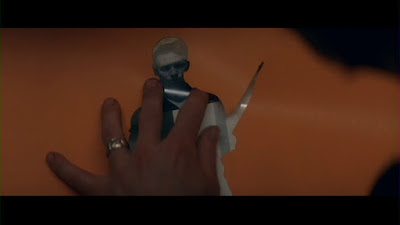
The movie has odd beats that occasionally disrupt its traditional narrative, such as a scene where Eddie and Rachel are serenaded in an alleyway by a dirty bum with an immaculate acoustic guitar and a beautiful voice. It’s a poignant moment as the camera stays on Madsen’s face as Rachel reacts to “Danny Boy,” her eyes gradually welling up and a tear runs down her face. With the help of his very talented crew that includes the likes of David Cronenberg’s longtime production designer Carol Spier, legendary cinematographer Michael Chapman (Raging Bull) and composer George S. Clinton (Austin Powers), writer/director Lloyd Fonvielle creates a suitable neo-noir mood and atmosphere with a touch of the supernatural, such as a spooky shot of Rachel submerged in murky water, a gloved hand reaching out to Eddie.
 
With her old school looks, Virginia Madsen could have been a Classic Hollywood movie star and is perfectly cast as an elusive femme fatale cum woman out of time. She does an excellent job of coming across as this sweet, alluring presence and then transforms into a vulgar, vengeful creature. The actor is more than believable as a woman that could seduce men into doing her bidding and destroying their lives in the process.

Tommy Lee Jones is well cast as a world-weary gumshoe who thinks he knows all the angles until he takes on this case and becomes entangled in Rachel’s web. Like Rachel, Eddie undergoes his own transformation and Jones does an excellent job of conveying a man who has seen it all to one obsessed with a woman that tears his life apart.
 
The critics of the time weren’t too kind to Gotham. The Washington Post's Tom Shales wrote, "Madsen is a sensuously spooky Rachel. She is also quite naked in two or three scenes, popping up, literally, in the bathtub, and falling out of a refrigerator. Madsen holds Jones and the camera captive. Maybe it doesn't matter that the whole thing is senseless." In her review for the Los Angeles Times, Lynne Heffley wrote, "What viewers fall victim to is a flawed vision. Suspense fizzles into steamy homage to Madsen’s beauty, clad and unclad; New York City locales are unbelievably underpopulated; a street bum sings “Danny Boy"-all of it-and Madsen’s exquisite lips are either framing romance novel banalities or a favorite obscenity." The New York Times’ Walter Goodman described it as “a lugubrious telling of a story that at its best is incomprehensible.”
 
“It may be a dream but it’s one of those dreams you can’t wake up from,” Eddie says at one point and it is the narrow line Gotham treads between what is real and what we perceive as real. And isn’t that all down to perception anyway? One person’s reality could be another’s dream. Since this movie is a neo-noir typically things don’t go well for the protagonist but Fonvielle twists this convention so that his main character is spared while another character is doomed. He does an excellent job of grounding the movie in its own reality so we’re never sure what is real and what is a dream except for little details that he uses as signposts along the way. It’s a tricky balancing acting between the ridiculous and the sublime but then again, isn’t all a matter of perception?


Friday, December 17, 2021

JFK


There’s only one thing everyone can agree on regarding the assassination of American President John F. Kennedy: he was killed on November 22, 1963. Everything else around this watershed event in American history has been subject to intense debate and one that has provoked people to question their own beliefs and those of their government. Yet, for such a highly publicized affair there are still many uncertainties that surround the actual incident. Countless works of fiction and non-fiction have been created concerning the subject, but have done little in aiding our understanding of the assassination and the events surrounding it. Oliver Stone's film JFK (1991) depicts the events leading up to and after the assassination like a densely assembled puzzle complete with jump cuts and multiple perspectives. Stone’s film presents the assassination as a powerful event constructed by its conspirators to create confusion with its contradictory evidence, to then bury this evidence in the Warren Commission Report, which in turn manifests multiple interpretations of key figures like triggerman Lee Harvey Oswald. JFK offers a more structured examination of the conspiracy from one person's point of view where everything fits together to reveal a larger, more frightening picture implicating the most powerful people in the United States government.
 
Stone’s film filters an examination of two conspiracies, one to kill the President and one to cover it up, from one person's point of view — Jim Garrison (Kevin Costner) — the New Orleans District Attorney who then assembles all the evidence at his disposal to deliver a powerful and persuasive case for a conspiracy to kill Kennedy. Stone saw his film consisting of several separate films: Garrison in New Orleans against Clay Shaw (Tommy Lee Jones), a key figure in the assassination, Oswald’s (Gary Oldman) backstory, the recreation of Dealey Plaza, and the deep background in Washington, D.C. JFK is the mother of all paranoid conspiracy thrillers, the ultimate one man against the system film with Garrison taking on the establishment, attempting to uncover one of the most nefarious plots in history. It created such profound shockwaves in the real world that Stone was criticized and vilified in the press.
 
“God, I’m ashamed to be an American today,” says Garrison when he finds out that Kennedy has been shot and we see people in the bar he’s in applaud the man’s death. Stone and cinematographer Robert Richardson desaturate the colors in the 1963 scenes, which creates a somber tone as the country reacts to the Kennedy assassination.

Six years later, the color returns to the film as Garrison shares a plane ride with Senator Russell B. Long (Walter Matthau) who plants the first seeds of doubt in the District Attorney’s mind about the Kennedy assassination. He points out that Oswald was a lousy shot and couldn’t have made all those shots in that time with that kind of accuracy. He also scoffs at the “magic bullet” theory – that one bullet created seven wounds and came out in pristine condition. “I’d round up 100 of the world’s best riflemen. Find out which ones were in Dallas that day. You’ve been duck hunting. I think Oswald is a good old-fashioned decoy.”
 
This encounter provokes Garrison to go through all the volumes of the Warren Commission Report and find that, “Again and again credible testimony ignored, leads are never followed up, its conclusions selective, there’s no index. It’s one of the sloppiest, most disorganized investigations I’ve ever seen.” He concludes that this was by design: “But it’s all broken down and spread around and you read it and the point gets lost.” He continues to dig deeper and the testimony of Lee Bowers (Pruitt Taylor Vince), who hints at another shooter on the grassy knoll, is the final straw.
 
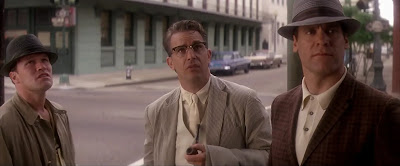
Garrison walks the streets of New Orleans with two of his investigators Lou Ivon (Jay O. Sanders) and Bill Broussard (Michael Rooker), recounting Oswald’s time in the city in a brilliantly written and performed monologue (one of many). He points out to them that Oswald, a supposed communist sympathizer, spent his time in the heart of the government’s intelligence community with the FBI, the CIA, the Secret Service and the Office of Naval Intelligence all within spitting distance of each other. As Garrison tells them, “Isn’t this seem to you a rather strange place for a communist to spend his spare time?” He tells them that they are going to reopen the investigation of the Kennedy assassination and this is where the film really begins to gather narrative momentum.

Garrison starts interviewing people that had some link to the conspirators, namely Clay Bertrand a.k.a. Clay Shaw, which gives Stone the opportunity to trot out a parade of name actors such as Jack Lemmon, John Candy and Kevin Bacon to portray a very colorful cavalcade of characters. The interviews paint a vivid picture of David Ferrie (Joe Pesci) and Shaw working with Oswald. Stone uses Bacon and Lemmon to detail the conspiracy on a local level, expounding a ton of expositional dialogue brilliantly, while Candy’s hipster lawyer conveys the danger Garrison faces digging into the murder of the President.

Stone presents a series of lengthy dialogue-driven scenes conveying an incredible amount of information in palatable fashion by having recognizable actors as his mouthpieces while dynamically shooting and editing them. He has a character spout a fact or theory and then cuts to a dramatic reenactment that depicts it in black and white and/or different film stock, often blurring the line between fact and fiction, which is the point. In a case as complex as this it is hard to discern which is which as witness testimony conflicts one another making it difficult to make sense of it all.
 
A great example of this is the sequence where Garrison and his team explain Oswald’s background leading up to the assassination with Stone cutting to staged footage, actual documentary footage and the famous Life magazine cover photograph that cemented Oswald’s guilt in the public’s mind but might be a doctored image. It is a bravura sequence that marries complex editing, pasting together all kinds of different formats, with past events being discussed in the present with many characters talking as the conspiracy deepens and the thriller elements take hold. It culminates with Broussard disbelievingly saying, “We are talking about our government!” to which Garrison replies, “No. We’re talking about a crime, Bill. Plain and simple…We’re through the looking glass, here, people. White is black and black is white.”
 
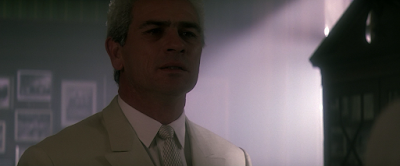
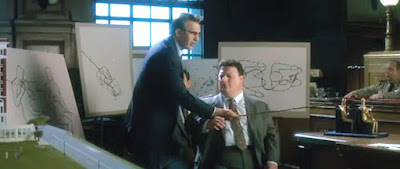
The scene where Garrison first meets Shaw is a fantastic clash between two characters as the former goes after the latter who defiantly deflects and denies any involvement in the assassination plot. During the conversation, Stone intercuts footage that shows he is lying or, at least, that is Garrison’s interpretation. Tommy Lee Jones is brilliant here as he changes tone on a dime, going from amused elegance to angrily indignant and back again all the while maintaining an air of cultured sophistication. Finally, Garrison tires of his act and accuses him of killing Kennedy. When Shaw finally leaves, he gives parting pleasantries but Jones gives Costner a lingering, threatening look. From this point on, the pressure on the D.A. and his team increases as the powers that be attempt to discredit him.

Stone’s portrayal of Garrison is reminiscent of Jimmy Stewart in Mr. Smith Goes to Washington (1939) – the last honest man in government – and he tries to temper this by showing the trouble he faces at home as his wife (Sissy Spacek) complains that he’s never around anymore and that he cares more about the Kennedy assassination than his own family. She is the film’s weakest character whose sole purpose, initially, is to provide strife on the home front. Stone then has her come around to her husband’s way of thinking after he tearfully tells her late one night that Robert Kennedy has been shot and killed. She admits he was right all along and they make love in a scene that is unnecessarily maudlin. These scenes feel shoehorned in and take away from the main thrust of the film. Stone is on more comfortable ground when he returns to more familiar turf as we see the press arriving in droves to Garrison’s office, making it impossible for he and his team to get any work done. Funding for his office has dried up and he is forced to use his own savings to keep the investigation going. We also see infighting among his staff and Ivon and Broussard butt heads as we see the latter scared off the case.
 
Another bit of tour-de-force acting comes from Joe Pesci in the scene where Ferrie rapidly unravels as he fears for his life based on what he knows about the plot to kill Kennedy. Ferrie gets increasingly manic as he rattles off the people and organizations involved, getting worked up until he utters the iconic line, “It’s a mystery wrapped in a riddle inside an enigma!” It’s hyperbolic and over-the-top to be sure but it does illustrate how complex the assassination plot is with fake Oswalds and conflicting eyewitness accounts. After the incredible outburst, Ferrie winds down as Pesci elicits sympathy for this terrible man who is under a lot pressure and is incredibly paranoid. This scene threatens to throw the film right off the rails as Pesci goes for it, acting his ass off, chewing up the scenery in breathtaking fashion.
 
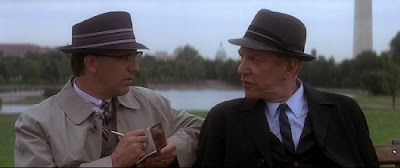
The centerpiece of the film is when Garrison travels to Washington, D.C. to meet with an ex-high-ranking CIA officer known only as Mr. X (Donald Sutherland). In this bravura sequence he lays out the motivation for killing Kennedy including how and why. It’s an incredible amount of dialogue and Stone wisely cast a skilled actor such as Donald Sutherland to convey it in a coherent and engaging way. X lays out the most important aspect of the assassination: why? “The how and who is just scenery for the public. Oswald, Ruby, Cuba, the Mafia – keeps ‘em guessing like some kind of parlor game preventing them from asking the most important question – why? Why was Kennedy killed? Who benefitted? Who has the power to cover it up?”

X posits that Kennedy was killed because he wanted to break up the CIA, make peace with Russia and end the Vietnam War, which not only pissed off a lot of powerful people but would cost a lot of money as he tells Garrison, “The organizing principle of any society, Mr. Garrison, is the war. The authority of the state over its people resides in its war powers.” He encourages Garrison to “come up with a case. Something. Anything. Make arrests. Stir the shitstorm. Hope to reach a critical mass that’ll start a chain reaction of people coming forward. Then the government’ll crack. Remember, fundamentally, people are suckers for the truth.” This is the film’s idealistic mission statement. Judging from the critical reaction towards the film, Stone certainly succeeded in stirring up the shitstorm and in the court of public opinion he helped reshape the perception of the Kennedy assassination.
 
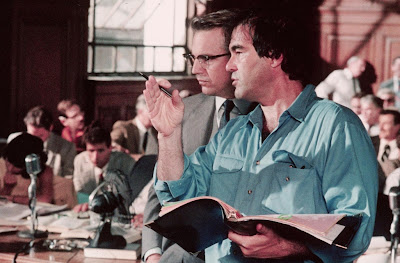
These increasingly dense and dynamic exposition scenes lead up to the mother of all courtroom scenes as Garrison goes in knowing he’s going to lose and goes for it anyway. It is Costner’s Mr. Smith Goes to Washington filibuster moment by way of Gary Cooper as Garrison debunks the Warren Commission Report’s account of Oswald by audaciously showing the real Zapruder film that depicted the Kennedy killing in real time. Stone edits in recreation footage with actual footage of the assassination as Garrison lays it all out. The filmmaker also recreates Kennedy’s controversial autopsy and shows actual photos of the man taken at the time.
 
This scene involves a massive amount of dialogue and information to convey and Costner handles it like a pro, making this exposition compelling, especially at the end when the actor performs his final speech without the aid of intercutting other footage. It’s Costner out there on his own, even getting emotional towards the end at the most powerful moment when Garrison address the jury, “Show this world that this is still a government of the people, for the people and by the people. Nothing as long as you live will ever be more important. It’s up to you.” And with that last line, Costner breaks the fourth wall. That line is meant for us and is one of the most moving parts of Garrison’s speech.

While attending the Latin American Film Festival in Havana, Cuba, Stone met Sheridan Square Press publisher Ellen Ray on an elevator. She had published Jim Garrison's book On the Trail of the Assassins. Ray had gone to New Orleans and worked with Garrison in 1967. She gave Stone a copy of Garrison's book and told him to read it. He did and quickly bought the film rights with his own money. The Kennedy Assassination had always had a profound effect on his life and he eventually met Garrison, grilling him with a variety of questions for three hours. The man stood up to Stone's questioning and then got up and left. His hubris impressed the director.
 
Stone was not interested in making a film about Garrison's life but rather the story behind the conspiracy to kill Kennedy. To this end, he also bought the film rights to Crossfire: The Plot That Killed Kennedy by Jim Marrs. When Stone set out to write the screenplay, he asked Columbia University’s Professor of Journalism Zachary Sklar to co-write it with him and distill the Garrison book, the Marrs book and all the research he and others conducted into a script that would resemble what he called "a great detective movie." Stone told Sklar his vision of the movie: "I see the models as Z (1969) and Rashomon (1950), I see the event in Dealey Plaza taking place in the first reel, and again in the eighth reel, and again later, and each time we're going to see it differently and with more illumination.”
 
Sklar worked on the Garrison side of the story while Stone added the Oswald story, the events at Dealey Plaza and the "Mr. X" character. To tell as much of the story as they could, Stone and Sklar used composite characters, a technique that would be criticized in the press, most notably the "Mr. X" character played by Donald Sutherland and who was a mix of several witnesses and retired Air Force Colonel L. Fletcher Prouty, an adviser on the film.

In 1989, Stone met with the three top Warner Bros. executives – Terry Semel, Bob Daly, and Bill Gerber – who had been interested in his work for some time. At the time, Stone was trying to make a film about Howard Hughes but Warren Beatty owned the rights. Stone then pitched JFK to them in 15-20 minutes: “I told them I wanted JFK to be a movie about the problem of covert parallel government in this country and deep political corruption.” Semel remembers Stone asking them, “’Are you concerned politically? Would it affect your company? Are there negative reasons why you wouldn’t do it?’ My immediate reaction was, ‘No, we should do it.’ If it’s entertaining and it’s intriguing, a great murder mystery about something we all cared about and grew up thinking about, why not?” A handshake deal was done and the studio agreed to a $20 million budget.
 
Stone could have shopped JFK around in the international market but chose WB because, “I knew the material was dangerous and I wanted on entity to finance the whole thing and the history of WB, given Terry Semel’s record of political films (All the President’s Men, The Parallax View and The Killing Fields), was my first choice.” Kevin Costner signed on to play Garrison in 1991, which pleased the studio who wanted a bankable movie star attached to the project. In addition, independent producer Arnon Milchan came on board as an executive producer and doubled the budget allowing Stone to cast a star-studded supporting cast around Costner.
 
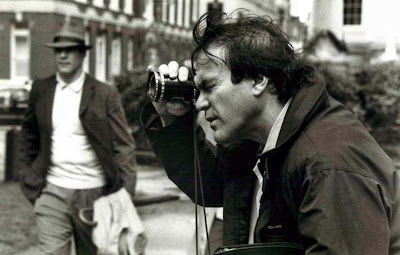
Stone ambitiously wanted to recreate the Kennedy Assassination in Dealey Plaza and his producers had to pay the Dallas City Council a substantial amount of money to hire police to reroute traffic and close streets for three weeks. He only had ten days to shoot the footage. Getting permission to shoot in the Texas School Book Depository was more difficult. They had to pay $50,000 to put someone in the window that Lee Harvey Oswald was supposed to have shot Kennedy. They were allowed to film in that location only between certain hours with only five people on the floor at one time: the camera crew, an actor, and Stone. Co-producer Clayton Townsend has said that the hardest part was getting the permission to restore the building to the way it looked back in 1963. That took five months of negotiation.

Filming was going smoothly until several attacks on the film in the press surfaced in the mainstream media including the Chicago Tribune, published while the film was only in its first weeks of shooting. Five days later, the Washington Post ran a scathing article by national security correspondent George Lardner entitled, "On the Set: Dallas in Wonderland" that used the first draft of the JFK screenplay to blast it for "the absurdities and palpable untruths in Garrison's book and Stone's rendition of it.” The article pointed out that Garrison lost his case against Clay Shaw and claimed that he inflated his case by trying to use Shaw's homosexual relationships to prove guilt by association. Other attacks in the media soon followed. However, the Lardner Post piece stung the most as he had stolen a copy of the script. Stone recalls, "He had the first draft, and I went through probably six or seven drafts.”
 
The film depicts the events leading up to and after the assassination as a densely constructed story complete with jump cuts, multiple perspectives, a variety of film stocks and the blending of actual archival footage with staged scenes dramatized by a stellar cast of actors. This blurring of reality and fiction by mixing real footage with staged footage makes it difficult to discern what really happened and what is merely speculation. Stone does this to create what he calls "a countermyth to the myth of the Warren Commission because a lot of the original facts were lost in a very shoddy investigation," and simulate the confusing quagmire of events as they are depicted in Warren Report. Stone creates different points of views or "layers" through the extensive use of flashbacks within flashbacks. Stone has said that he “wanted the film on two or three levels — sound and picture would take us back, and we’d go from one flashback to another, and then that flashback would go inside another flashback ... I wanted multiple layers because reading the Warren Commission Report is like drowning.” This technique conveys the notion of confusion and conflict within evidence
 
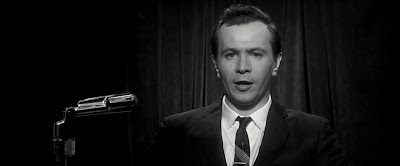
Kevin Costner acts as the perfect mouthpiece for Stone’s theories. The auteur’s infamously forceful directorial approach to his actors pays off here as he reins in the Costner’s usual tics and mannerisms. Stone was no dummy — he knew that by populating his film with many famous faces, he could make the potentially bitter pill that was his film that much more palatable to the mainstream movie-going public. The rest of the cast is phenomenal. Gary Oldman delivers an eerily authentic portrayal of the enigmatic Lee Harvey Oswald. Tommy Lee Jones is note-perfect as the refined, self-confident businessman, Clay Shaw. Even minor roles are filled by such name actors as Vincent D’Onofrio, Kevin Bacon, Jack Lemmon, and Walter Matthau.

The film throws many characters at us and it is easier to keep track of them by identifying them with the famous person that portrays them. Stone was evidently inspired by the casting model of a documentary epic he had admired as a child: “Darryl Zanuck's The Longest Day (1962) was one of my favorite films as a kid. It was realistic, but it had a lot of stars ... the supporting cast provides a map of the American psyche: familiar, comfortable faces that walk you through a winding path in the dark woods.” Future biopics with sprawling casts, like The Insider (1999), and Good Night, and Good Luck (2005), and The Good Shepherd (2006) would use this same approach.
 
Seeing JFK now, one is reminded that first and foremost, it is a top-notch thriller. There are so many fantastic scenes of sheer exposition that would normally come across as dry and boring but are transformed into riveting scenes in the hands of this talented cast. For example, the famous scene between Garrison and X (Sutherland) where the mysterious man lays out all the reasons why Kennedy was killed and how is not only a marvel of writing but also of acting as the veteran actor gets to deliver what is surely one of the best monologues ever committed to film.
 
Once the film was released in theaters, it polarized critics. The New York Times ran an article by Bernard Weinraub entitled, "Hollywood Wonders If Warner Brothers let JFK Go Too Far.” In it, he called for studio censorship and wrote, "At what point does a studio exercise its leverage and blunt the highly charged message of a film maker like Oliver Stone?" The newspaper also ran a review of the film by Vincent Canby who wrote, "Mr. Stone's hyperbolic style of film making is familiar: lots of short, often hysterical scenes tumbling one after another, backed by a soundtrack that is layered, strudel-like, with noises, dialogue, music, more noises, more dialogue.” However, Roger Ebert praised the film in his review for the Chicago Sun-Times, saying, "The achievement of the film is not that it answers the mystery of the Kennedy assassination, because it does not, or even that it vindicates Garrison, who is seen here as a man often whistling in the dark. Its achievement is that it tries to marshal the anger which ever since 1963 has been gnawing away on some dark shelf of the national psyche.”

Rita Kempley in the Washington Post wrote, "Quoting everyone from Shakespeare to Hitler to bolster their arguments, Stone and Sklar present a gripping alternative to the Warren Commission's conclusion. A marvelously paranoid thriller featuring a closetful of spies, moles, pro-commies and Cuban freedom-fighters, the whole thing might have been thought up by Robert Ludlum.” On Christmas Day, the Los Angeles Times ran an article entitled, "Suppression of the Facts Grants Stone a Broad Brush" attacking the film. New York Newsday followed suit the next day with two articles – "The Blurred Vision of JFK" and "The Many Theories of a Jolly Green Giant.” A few days later, the Chicago Sun-Times ran an article entitled, "Stone's Film Trashes Facts, Dishonors J.F.K." Stone even received death threats as he recalled in an interview, "I can't even remember all the threats, there were so many of them.” Time magazine ranked it the fourth best film of 1991. Roger Ebert went on to name Stone's movie as the best film of the year and one of the top ten films of the decade.
 
Stone paints his canvas with broad brushstrokes and powerful images. This isn’t a documentary or even a docudrama. It is a fever dream straight out of Stone's head. He’s a Baby Boomer upset that the death of Kennedy obliterated the idealism of the '60s and uses the film to vent about it. JFK is an important work in the sense that it accurately portrays the assassination of Kennedy as a complex public event surrounded by chaos and confusion. Stone’s film presents an intricate conspiracy at the source of the killing with one main protagonist who exposes the conspiracy to be an intricately constructed coup d'état. JFK takes a larger, confrontational stance by boldly implicating the government in the conspiracy and the mainstream media in conspiring to cover it up. Stone is using the persuasive power of film to reach the largest number of people he can to wake them up and to reveal how they have been deceived by higher powers. There is no mistaking the importance of the assassination of Kennedy in American culture. Based on the excitement that surrounded Stone's film, the American public was still greatly interested in the event with more and more people believing in a plot to kill the President. Kennedy's death continues to intrigue and interest people who are more open to the idea of a conspiracy that this film openly advocates. For better or for worse, it helped cultivate a conspiracy culture that has only grown larger and more unwieldy with the rise of social media. JFK continues to serve as a powerful piece of cinematic agitprop whose conspiracy theories can be questioned and criticized but its power as an engaging and moving thriller cannot.
 

SOURCES
 
Fisher, Bob. “The Whys and Hows of JFK.” American Cinematographer. February 1992.
 
Petras, James. “The Discrediting of The Fifth Estate: The Press Attacks on JFK.” Cineaste. May 1992.
 
Riordan, James. Stone: A Biography of Oliver Stone. Aurum Press. 1996.
 
Scheer, Robert. “Oliver Stone Builds His Own Myths.” Los Angeles Times. December 15, 1991.

Friday, November 29, 2019

Natural Born Killers


The 1990s was a time when hard news intersected with tabloid journalism pushing popular culture into new, salacious directions as nobodies like the Menendez brothers, John and Lorena Bobbitt, and Tonya Harding became instant celebrities via high profile violent cases while celebrities like O.J. Simpson became embroiled in the decade’s most notorious crime and subsequent court case that quickly turned into a media circus. This was aided and abetted by the rise of tabloid journalism with television magazine shows like A Current Affair and Hard Copy plying their trade in trashy celebrity gossip and true crime stories.

Back then, Oliver Stone had a knack for having his finger on the pulse of the pop culture zeitgeist as he proved with Platoon (1986) kick starting an interest in the Vietnam War, The Doors (1990) renewing interest in Jim Morrison and his band, and JFK (1991) launching a cottage industry of conspiracy theorists. Using the clout he had garnered from a run of successful films, he convinced Warner Bros. to help fund and distribute Natural Born Killers (1994), an experimental social satire under the guise of a lovers-on-the-run story that was popular at the time (see Wild at Heart, Kalifornia, True Romance, et al). He used a screenplay, written by then-up-and-coming Quentin Tarantino, as a foundation in which to lay his trademark socio-political beliefs only this time attacking the media, which, as one can imagine, did not endear the film to critics at the time.

Stone employed the flashy, multi-film stock blending of news footage with his own that he had done so effectively in JFK and deliberately pushed it to new extremes by also using front and rear-projection photography as well as cel animation to create “a vortex of the unreal," as one critic put it. Stone’s film adopts the style of the culture it parodies and attacks tabloid media and MTV culture by using the hyperkinetic editing tempo of music videos as well as the constantly changing points-of-view within the film to mirror our channel-surfing culture. The end result predictably courted controversy, divided critics, performed fairly well at the box office, and inspired several, real-life copycat killings.
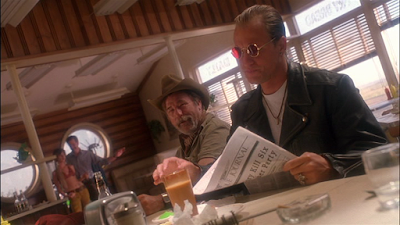
Right from the get-go, Stone establishes the absurdist tone of his satire with his introduction of Mickey (Woody Harrelson) and Mallory Knox (Juliette Lewis), two murderous lovers on the run, as they kill a trio of rednecks along with everyone else in a diner save one (so that they can tell the media what happened). The director also uses this opening scene to introduce the frenetic, chaotic collage of film techniques that immediately draws attention to itself as a film. For example, when Mickey shoots and kills the cook we see it from his point-of-view, the bullet from the gun stopping for a second in front of the terrified person before hitting them. Afterwards, the couple celebrates their love for each other by dancing with a song straight out of a classic Hollywood musical, the lights going down as a display of fireworks is projected on a screen behind them. This is an exaggerated, heightened reality with its own set of rules as Stone challenges the way we watch a film.

The opening credits push it even further as Stone assaults our senses with a cacophony of sights and sounds with layers of songs and sound effects playing over a montage of Mickey and Mallory driving through rear-projected imagery, including landscapes from the American southwest and nightmarish imagery, like Mallory’s father (Rodney Dangerfield) foreshadowing things to come. The director is commenting on the chaos that pop culture had become in 1994 with so much stimulus bombarding us all the time. The irony is that it has only gotten worse.

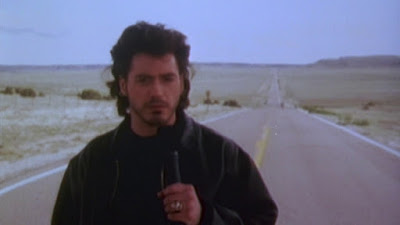
The story itself is quite simple. After killing her parents, Mickey and Mallory go on the road, initiating a killing spree that not only draws the attention of the authorities, led by “supercop” Jack Scagnetti (Tom Sizemore), but also tabloid television journalist Wayne Gale (Robert Downey, Jr.) who all want a piece of them – the former wants to kill Mickey and have sex with Mallory, while the latter wants to use them to further his career.
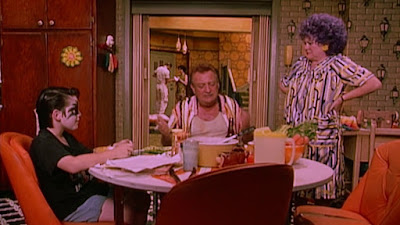
Mickey and Mallory grew up on T.V. and it is how they view life. This is particularly evident in the sequence that depicts how the two met and fell in love. Stone frames it as a sitcom by fusing the sensibilities of I Love Lucy and Married…With Children with comedian Rodney Dangerfield, in a brilliant bit of casting against type, as her monstrous father. Mallory belongs to a white trash family where spousal abuse, incest and sexual abuse are all referenced while a laugh track uncomfortably exposes how contrived sitcoms are, manipulating how the audience is supposed to feel at a given moment. It makes sense that Mickey and Mallory’s backstory is depicted in this way. They would process all of the bad things they experienced through the medium they were exposed to for most of their lives. It’s what they know. This sequence, along with Mickey’s escape from a chain gang, thanks to a well-timed tornado that we see him riding towards on a horse, are the couple self-mythologizing their lives, reinterpreting them in a way that empowers them instead of making them victims.

If the first part of the film is Mickey and Mallory seen through their eyes then the next part is seeing them through Gale’s eyes on his tabloid T.V. show American Maniacs, which allows him to perform his own self-mythologizing. The opening credits hilariously show him breaking down a criminal’s door and then getting spit on by another crook during an interview. We see one of his Mickey and Mallory segments and how he manipulates events through dramatic re-enactments to paint the cops as heroes and the murderous lovers as villains on very simple terms. Stone cuts to Gale’s team putting together the segment with one crewmember bemoaning the reusing of footage from a previous show. Gale scoffs, “You think those nitwits in zombieland remember anything? It’s junk food for the brains. Filler. Fodder. Whatever.” With his exaggerated Australian accent, Downey is hilarious here as the egotistical Gale. This segment also shows how Mickey and Mallory become a media sensation all over the world with one idiot saying, “If I was a mass murderer, I’d be Mickey and Mallory.” Stone is taking dead aim at the deification of murderers like Charles Manson, John Wayne Gacy and Ted Bundy who became infamous for killing people and glorified in film and T.V.

Stone makes a point of showing that Mickey and Mallory’s relationship is far from perfect as evident when they have an argument over him leering at their female hostage while having sex. She gets dressed and leaves only to go off and seduce a young mechanic (Balthazar Getty) in an attempt to feel wanted and desired but also to feel powerful as she initiates everything only to kill him when he recognizes her and tries to force himself on her. Her conflict with Mickey comes to a head when they run out of gas in the middle of the desert and happen upon a Native American Indian (Russell Means). He takes them in and his hospitality is rewarded when Mickey wakes from a particularly vivid nightmare about his abusive childhood and accidentally shoots the man. It is significant that it’s the one death they are remorseful about as Mallory angrily chastises him. To make matters worse, they are both bitten by rattlesnakes and manage to make their way to a drugstore saturated with garish green lighting where they are apprehended by Scagnetti in a scene that visually references the savage Rodney King beating and are sent to prison.

A year later, on the eve of the couple being transported to a mental hospital by Scagnetti after being declared insane, Gale arranges with Warden Dwight McClusky (a wonderfully unhinged Tommy Lee Jones) a live, one-on-one interview with Mickey that will air immediately after the Super Bowl. Downey is awesome in the scene where Gale hypes the interview in the hopes of convincing Mickey to do it: “This is Wallace and Noriega! This is Elton John confessing his bisexuality to Rolling Stone! This is the Maysles brothers at Altamont! This is the fuckin’ Nixon/Frost interviews!” Downey picks just the right words at just the right moments to exaggerate with his outrageous Australian accent that is a masterclass in scenery chewing. The actor manages to take it up another notch during the actual interview as Gale tries to make it all about him.

Known mostly for his genial goofball on Cheers, Woody Harrelson’s turn in NBK was a revelation at the time as he fearlessly shattered preconceived notions to play an unrepentant mass murderer. His finest moment is the prison interview scene as Mickey is introduced with a freshly shaven head and espouses his personal philosophy to Gale: “Everybody got the demon in here. The demon lives in here. It feeds on your hate. Cuts, kills, rapes. It uses your weakness, your fears. Only the vicious survive…You know, the only thing that kills a demon: love.” Amidst all the serial killer psychobabble this is the only bit that feels sincere and is arguably the film’s central thesis, which would explain why it ends the way it does.

The last 30 minutes of NBK are an insanely staged prison riot inspired by Mickey’s interview. He uses it to orchestrate a rescue of Mallory and then an escape with Gale, his film crew and two guards as hostages. This allows Stone to cut loose with all kinds of crazy imagery as prisoners fight it out with guards while Mickey and his group fight their way through the chaos. Amidst it all, Mickey and Mallory have a romantic moment when they are reunited before finishing off Scagnetti. Meanwhile, McClusky is losing his mind while losing control of the prison. Tommy Lee Jones is particularly inspired during this sequence as he delivers an increasingly hysterical performance with Downey matching him in the larger-than-life theatrical department. It’s as if the two actors had a running bet on who could chew up more scenery. Upon reflection, I think Downey wins as Gale goes from hostage to active participant, shooting and killing a guard trying to kill Mickey and Mallory. When the group lays low in a bathroom, Downey takes it up another notch as Gale, drenched in blood and grime, breaks up with his wife and is dumped by his mistress. He is then led out through a throng of guards with a shotgun taped to his head, talking to stay alive while McClusky rants and raves. It is a brilliantly sustained sequence set to a hysterical pitch.

Coming off making Heaven & Earth (1993), Oliver Stone’s marriage was on the rocks. He and his wife Elizabeth were having trouble communicating and she was upset that he continued to give into his wilder tendencies for women, drugs and alcohol. In 1993, Stone had dinner with producer Thom Mount and actor Sean Penn, whose film The Indian Runner (1991) he had produced. They had a screenplay written by then-up-and-coming filmmaker Quentin Tarantino entitled, Natural Born Killers, a contemporary Bonnie and Clyde story about a killer couple made famous by tabloid press and reality T.V. At the time, Stone didn’t know that Penn was going to direct it and that the rights were controlled by Don Murphy and Jane Hamsher, two novice movie producers that envisioned a low budget version.

Hamsher and Murphy were working out of her dining room at the time. They were looking to collaborate with young writers. At a party in April 1991, two people mentioned that Tarantino was going to direct Reservoir Dogs (1992) and his script for NBK was “near brilliant.” They met him and read the script, immediately wanting to make it into a film. It was, however, not easy to categorize and so they had a tough time finding someone willing to finance it. Next, they tried approaching filmmakers but that didn’t work either. They eventually met with Mount and he gave it to Penn.

Mount wanted Stone to produce the film under his company, however, after reading the script he wanted to direct. He said, “I felt attracted to it out of instinct…I know that starting to work on it has brought some turbulence up to the surface…there’s a demon in Natural Born Killers. There’s a demon that drives it. I can’t understand it exactly…but it captivates me.” Mount liked the idea of Stone directing and Penn was out, much to his chagrin. Stone also had to deal with Tarantino who was starting to get some clout in the industry after his debut film came out and wanted a say in the project. Stone remembers, “So I got an angry QT, an angry Sean Penn…There were a lot of legal hassles that we had to pay off to settle out people who might want to sue.”
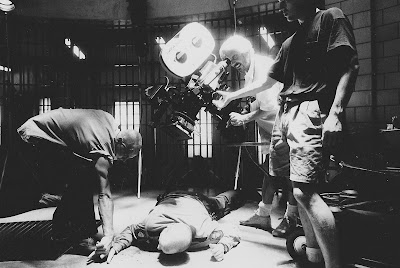
Stone had to move fast. The wrap party for Heaven & Earth was on January 30 and on February 1, he put Murphy and Hamsher to work on Natural Born Killers. While editing the former he began production on the latter. Stone did not want to shoot Tarantino’s script as it was: “There was a structure and I liked the ideas and there were some very funny scenes, but it was not a movie I wanted to do…I always knew there was another level I wanted to try for.” He wanted to flesh out the relationship between Mickey and Mallory but didn’t have much time so he enlisted the help of long-time collaborator Richard Rutowski and tasked Hamsher with getting “one of your wild and crazy friends” to help them with rewrites. He wasn’t offering much money so she found David Veloz, fresh out of film school with no luck selling any of his scripts and ready to quit the business, whom she felt could write “extreme material that still retained its humanity.” He worked closely with Stone and added scenes like the argument the couple have in a motel room with a female hostage tied up in the corner. Stone also added a new first act with them on the road and flashbacks showing their backgrounds like the “I Love Mallory” sequence.

Rutowski introduced the idea of Mickey and Mallory wrestling with their inner demons and expressing them externally. Stone took Tarantino’s script and went deeper and bigger in scale. He said, “I didn’t want to make a realistic movie about serial killers. That was well done in Henry, Portrait of a Serial Killer. I’m really onto something else. It’s a larger portion of American life that’s enamored of violence, enamored of crime, promotes it on television, and eventually lives and dies by it.”

When Stone’s long-time cinematographer Robert Richardson read the script he didn’t want to do it: “I simply didn’t have the level of respect that I’d had for the written material on, say, Born on the Fourth of July or JFK. Each of those aroused in me a great deal of historical respect and intellectual curiosity.” Stone admitted that he played the “friendship card” with Richardson as he was feeling very vulnerable with his divorce looming over him and felt abandoned. To counter Richardson’s dislike of the material, Stone argued, “As far as the morality of the story was concerned, I argued with him that it represented the culture we were in, and that the picture was a satire, which required us to exaggerate and distort in order to make our point.” Richardson agreed to do it out of loyalty to Stone but it was an unpleasant experience for the man: “The story brought up unpleasant memories from my own childhood, and those memories plagued me to such a degree that my nights were literally sleepless.”
Working on such dark material put additional strain on an already fractured marriage. Stone felt that counseling wasn’t working and turned to meditation and immersed himself in his work, using NBK as a way to deal with his own demons. The filmmaker originally envisioned it as a medium-budget film a la Talk Radio (1988) for $10-12 million but the more he worked on it, the bigger in scale it became. Arnon Milchan financed the film. It was their third collaboration together and as the budget increased they approached Warner Brothers in the hopes that they would not only distribute it but market it as well. Stone wanted to use their considerable resources but the subject matter scared them and so they used their leverage when it came to casting.

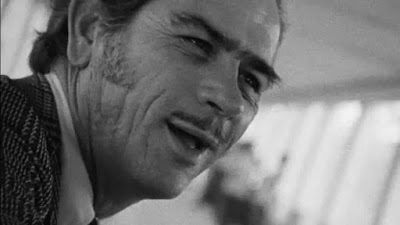
Originally, Stone wanted Michael Madsen, who he had worked with on The Doors (1991), to play Mickey Knox and Juliette Lewis to play Mallory Knox, who convinced the director that she was right for the part and that “only I could play somebody who could tear your throat out with her bare hands.” The studio felt that the former wasn’t a big enough movie star and suggested Woody Harrelson instead. Stone agreed and with Robert Downey, Jr. cast as Wayne Gale – someone that Stone had always wanted to work with – he made a deal with the studio. The casting of Harrelson surprised many as all he was really known for at that point was the dumb but sweet bartender on the T.V. sitcom Cheers. Stone had done his homework. At the time, Harrelson’s father was serving a double life sentence for the murder of a federal judge and it was rumored that he was one of the “three tramps” arrested in Dallas the day John F. Kennedy was assassinated. For the role of Warden McClusky, Stone had approached Jack Palance but once he read the script he turned down the part as he felt the film was too violent. On short notice, Stone asked Tommy Lee Jones, who had already worked with him on JFK (1991) and Heaven & Earth, and he agreed.

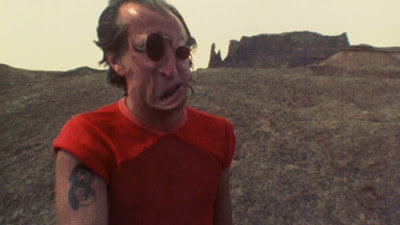
Rehearsals did not go well as Juliette Lewis showed up unprepared. She repeatedly missed kick-boxing lessons, shooting practice and workout sessions that were to develop her into a warrior character like Linda Hamilton in Terminator 2: Judgment Day (1991). Instead, she showed up to rehearsal one day and ordered room service, eating and smoking while Stone was trying to work. Meanwhile, Jones worked closely with hair stylist Cydney Cornell to achieve the distinctive look of McClusky: “I always thought those little pencil-thin toothbrush mustaches were really stupid. Huge Carl Perkins sideburns. They said, ‘What do you want your hair to look like?’ I said, ‘I think it ought to look like a ’57 Studebaker.’”
By 1993, Stone and his wife were separated and principal photography began on NBK in New Mexico. He set a blistering pace, shooting in several cities in a short period of time, which meant six and sometimes seven-day weeks with 16-17-hour days. By all accounts it was a wild shoot as on-set doctor Chris Renna remembers one night hearing a lot of noise coming from Lewis’ hotel room and four in the morning. He checked it out and found her and Tom Sizemore bouncing up and down on her bed with the Rolling Stones on the radio. Lewis then wanted to order cornflakes from room service even though Sizemore claimed he couldn’t eat them. She ordered eight boxes anyway and proceeded to feed him a bit of them. He spit the food all over her and the bed. He got mad and she apologized.

Stone shot the film on a wide variety formats: color and B&W 35mm, B&W 16mm, Super 8, Hi8, and Beta. According to Richardson, “We’re going for the grittiness you get from Super 8 or 16mm – a lot of the violence is being done with those formats.” Stone also used front and rear-projection techniques, computer graphics, bluescreen, and cel animation. In addition, he hired Paul Stojanovich, who had worked on the reality T.V. show Cops and the sensationalist talk show Geraldo, to design and direct the style of Wayne Gale’s American Maniacs tabloid show.

Stone devised a stylistic blueprint for specific parts of the film intended to simulate channel-surfing:

“At the beginning of the movie these two young people are really desensitized to violence. The concept is that the live in T.V. world and don’t realize the consequences of their actions…We incorporated those ideas into the movie by using rear-screen images. We wanted to give a sense of the schizophrenic madness of the century and to convey the feeling that the characters’ minds are hopped-up and speedy.”
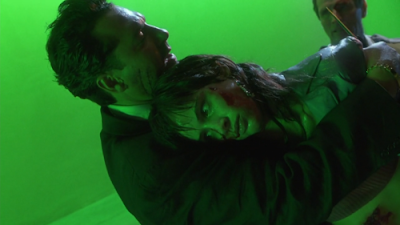
Stone then changed the look of the film after Mickey accidentally kills that Native American Indian and he and Mallory are bitten by rattlesnakes: “The whole mood of the lighting changes into a greenish, poisonous hue to reflect the idea that the fun has ended.” In addition, each significant character got their own distinctive look with Gale getting a “television magazine” style, Scagnetti, “a lurid, pseudo-Mickey style because Scagnetti wants to be Mickey and possess Mallory,” and for McClusky, Stone wanted to create “a scary, ominous prison that suggested punishment.” For the climactic prison riot, “the look is one of complete chaos – everything but the kitchen sink.”

After New Mexico, filming moved to Joliet, Illinois at a large prison known as Statesville. Of the 2300 inmates, 800 expressed an interest in being part of the film with only 342 cleared by the authorities to actually participate. It was a tough shoot as Richardson said, “I hated it there. Besides the difficult conditions, there is a real racial attitude in the prison because you’ve got thousands of mostly black men being incarcerated and ruled over by mostly white guards. A lot of them resent us being here.” The demands of shooting there increased the budget as did using rear-screen projection while also taking more time. In one day there were five injuries on set and on the next day during the scene where Scagnetti bursts into Mallory’s cell and tries to rape her, Lewis passed out between takes, tired from being up until five in the morning. A few takes later she achieved the energy levels Stone wanted and accidentally smashed Sizemore in the nose for real. He began bleeding and after it was decided that his nose wasn’t broken they finished the scene, using it for the shot.

Stone yelled at her and said later, “We’ve been having all these problems, and she wasn’t responding, I had a bunch of squibs going off, and she was missing her cues, her lines, her marks, and I said, ‘Look, people can get hurt. It’s a real serious thing, you can’t just take it that easy. You have to do it right.’” The prison scenes were the most expensive and difficult to shoot as they filmed in a real prison with real inmates and real weapons. There were limitations where they could shoot and for how long. He ran into problems with the prison authorities when he told them that he wanted to use prop guns during the riot scenes as they were worried that the weapons would be disassembled and used to make real weapons. Stone made a few calls to the right people and the prison authorities allowed it so long as real inmates weren’t near the filming area.
For six weeks the production split their time between shooting the prison riot scene on location and on a large film stage with technical consultant Dale A. Dye and stunt coordinator Phil Nelson staging the sequences. They studied case histories of prison riots and looked at what kind of weapons inmates would make, what from and where they would hide them. They also talked to corrections officers about homemade weapons. Dye said, “This is not a protest, but a riot. These guys aren’t going to hold signs that say, ‘You piss me off.’ They’re going to pop your eye out of its socket and skull-fuck you.” He remembered one take during the riot scene where someone started firing their gun before action was called: “The prisoners freaked out. They and I thought the guards were really firing. There was sheer panic and terror.”

In addition to producing, Hamsher was instrumental in picking songs for the film’s eclectic soundtrack. She wanted alternative rock music in the film and made mixed tapes for Stone of music she wanted to use: L7, Jane’s Addiction, the Velvet Underground, and Diamanda Galas among others. She wanted to challenge Stone and figured he would never go for it but much to her surprise he loved it and even played some of the music during filming to set the tone for a given scene.

Filming wrapped in July and the monumental task of editing all the footage that had been shot began. Stone kept asking Milchan if he could make NBK NC-17 and the mogul agreed but argued that it would limit the places to advertise and screen it. Milchan said, “What he was doing was testing how far he can go…My guess is that he will go for the most extreme version possible. He’ll test it. Push it as far as he can.” Sure enough, the film went to the rating board five times before it got an R rating.
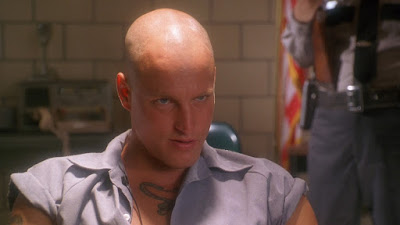
Stone saw his film “constructed via television and as a homage to T.V…There’s the aggression of the imagery, the channel-surfing philosophy of moving on.” He also felt that it was not “an easy movie to settle into, you can’t get a point of view, you have to surrender to the movie. If you resist the movie with conventional ethics, you’ll have a problem.” Not surprisingly, the studio and exhibitors were apprehensive about this ultraviolent film bound to be controversial. An unnamed studio executive admitted, at the time, that it was “a very difficult film to sell. How do you sell a film about two despicable people and the media turning them into heroes?” They opted to play up the social satire aspect rather than it being about vicious killers.

Predictably, Natural Born Killers polarized critics. In her review for The New York Times, Janet Maslin wrote, “Despite isolated moments of bleak, disturbing beauty, it is finally less an epiphany than an ordeal. Not for the first time, Mr. Stone assembles an arsenal of visual ideas and then fires away point-blank in his audience’s direction…While Natural Born Killers affects occasional disgust at the lurid world of Mickey and Mallory, it more often seems enamored of their exhilarating freedom.” The Rolling Stone’s Peter Travers wrote, “Stone calls this bile satire. But it’s not satire to skewer idiots. Satire respects the insidious power of its targets. Satire takes careful aim; Killers is crushingly scattershot. By putting virtuoso technique at the service of lazy thinking, Stone turns his film into the demon he wants to mock; cruelty as entertainment.” In his review for the Washington Post, Hal Hinson wrote, “The main problem with Killers, though, is that it degenerates into the very thing it criticizes…Killers is intended as a gonzo critique of the mass media and, by extension, of the bloodthirsty legions of couch potatoes whose prurient taste guarantees that the garbage rises to the top of the charts. But the film doesn’t make it as a piece of social criticism. Primarily this is because the movie’s jittery, psychedelic style is so obviously a kick for Stone to orchestrate.”

Not all critics hated the film. Roger Ebert gave the film four out of four stars and wrote, “Seeing this movie once is not enough. The first time is for the visceral experience, the second time is for the meaning. As we coast into a long autumn where the news will be dominated by the O.J. Simpson trial, Natural Born Killers is like a slap in the face, waking us up to what’s happening.” Newsweek magazine’s David Ansen wrote, “In Natural Born Killers something revelatory happens. The movie is enlightening, not because it transmits new information, but in the way that movies enlighten, through a synergy of images and rhythms that makes us sense the world in a new way…Stone’s flabbergasting movie cannot be dismissed; it must and will be fought over.”
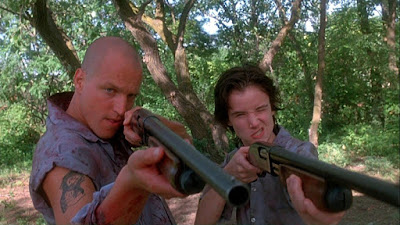
Natural Born Killers reflects the rise of sampling culture in the ‘90s with hip-hop and industrial music sampling clips from movies, T.V. and other music. Stone does this both audibly, with collages of songs and dialogue that plays over certain scenes, and visually as Mickey and Mallory watch clips of movies that Stone himself wrote – Midnight Express (1978) and Scarface (1983). It was a technique that he had started using in JFK and perfected with NBK to mimic the sensation of changing channels complete with a commercial. Exploitative T.V. shows like A Current Affair no longer exist as all news has become fear-mongering in nature. Take Inside Edition and replace it with Fox News or MSNBC where there is no absolute truth, which continues to make Stone’s film relevant. What NBK is trying to say is that you can’t trust any of these things. You have to trust yourself. You have digest all of this information, figure out what is misinformation and decide for yourself.


SOURCES

Pizzello, Stephen. “Natural Born Killers Blasts Big Screen with Both Barrels.” American Cinematographer. November 1994.

Riordan, James. Stone: A Biography of Oliver Stone. Hyperion. 1995.

Russo, Francine. “There’s A Riot Going On.” Village Voice. August 23, 1994.

Smith, Gavin. “The camera for me is an actor.” Film Comment. January-February 1994.

Smith, Gavin. “Somebody’s gonna give you money, you do your best to make ‘em a good hand.” Film Comment. January-February 1994.

Smith, Gavin. “Oliver Stone – Why Do I Have to Provoke?” Sight and Sound. December 1994.

Weinraub, Bernard. “How a Movie Satire Turned into Reality.” The New York Times. August 16, 1994.

Williams, David E. “Overkill.” Film Threat. October 1994.