
By J.D. Lafrance and Lady
Fitzsimmons
Fresh from the commercial
and critical success of phenom The
English Patient (1996), filmmaker Anthony Minghella dove back into the
literary world for his next film – The Talented Mr. Ripley (1999), based on the 1955 Patricia Highsmith novel of the same name. Adapted previously as Purple
Noon (1960) starring Alain Delon, Minghella cast Matt Damon, still hot property
from Good Will Hunting (1997) in the
title role, and surrounded him with a new class of actors in ascension: Jude Law, Gwyneth Paltrow, Cate Blanchett, and Philip Seymour Hoffman. The end
result was a lavish adaptation full of rich period detail and a fascinatingly
complex performance by Damon as a social-climbing sociopath.
“If I could just go back. If
I could rub everything out. Starting with myself. Starting with borrowing a
jacket.”
Thus begins our story with
voiceover narration by protagonist Tom Ripley (Damon). We meet him at a party
hosted by the Greenleaf family in 1950s New York City, where Tom makes quite
the impression on wealthy shipbuilder Herbert Greenleaf (James Rebhorn). After the soiree, Tom shed ‘his’ Princeton
blazer, revealing his for con of the film – posting as a Tiger for someone
else. It pays off; the next day Herbert asks him to go to Italy and persuade
his son Dickie (Law) to come back home for $1,000, which, by 1955 standards, is
a tidy sum. Herbert is not happy with his son’s behavior overseas – “That’s my
son’s talent,” he tells Tom, “spending his allowance.”
Tom, whose current employ is
playing a piano at a cocktail bar, jumps at the chance to make some serious
money – and rub elbows with the upper crust in Europe. Ever the astute social
chameleon, we see Tom studying up on popular jazz songs and artists because it
is a passion of Dickie’s and, more importantly, a way to immediately ingratiate
himself. With one foot barely off the boat, Tom is already changing identities,
telling fellow traveler Meredith Logue (Blanchett) that he is Dickie Greenleaf.

Tom orchestrates a chance
encounter between himself, Dickie, and his girlfriend Marge Sherwood (Paltrow)
on the beach in an amusing scene: Tom is all kinds of awkward as he sports lime
green bathing trunks, which “compliment” his pasty white skin. I love how
Dickie points this out (“Have you ever seen someone so white? Grey actually.”)
and how quickly Tom makes fun of himself (“It’s just an undercoat.”). Tom is
intensely serious in his plan to take on the character of a student on holiday,
the way a rich playboy takes on a lover.
The seduction begins.
Tom impresses Dickie with an
uncanny impression of his father and a mutual love of jazz. They become fast
friends and are soon singing jazz in broken Italian at a hipster nightclub that
Minghella captures in all of its dark, sweaty glory, masterfully capturing the
energy of the moment. Tom agrees to help Dickie perpetuate a ruse – they will
string his father along so that Dickie can continue to spend his money.
Tom is a student of human behavior,
observing people for only a short while before being able to do an impression
of them. For example, he studies the way Dickie signs his name and files it
away for later use. Minghella shows Tom rehearsing in front of a mirror like an
actor (where he creepily imitates a conversation between Marge and Dickie with
eerie exactness). Like many great thespians, Tom is a blank slate, which allows
him to become fully immersed in the “roles” he plays. During lunch he reveals his
talents to Dickie and Marge – “Forging signatures, telling lies, impersonating
practically anybody” – and his “purpose” for being there. Every single movement
– we realize now – has, from the beginning, been surgically planned and
impeccably executed, a black widow weaving the web or perhaps, more appropriately,
the funnel spider, launching the fatal attack from a place unexpected, at a
time unthinkable.

The web is completed a mere
24 minutes and 30 seconds into the film as we watch the spider plot his
“attack.” This section, this leg of Tom’s trip, is the film’s transition to a
psycho-drama; Tom is becoming Dickie, and Dickie is coming closer to the edge
of the cliff. It’s also worth mentioning the subtle homoerotic nuances of
Damon’s facial movements, the lingering looks fostered by the sensuality.
Matt Damon does a fantastic
job of presenting Tom as a socially awkward nerd, disarming Dickie and Marge
who “realize” that he’s not threat to them. This allows them to act both good-naturedly
and condescending towards him – they don’t see him as an equal. Dickie and
Marge are all about social niceties; these will end up being used against them.
Damon is all tentative gestures and aw shucks self-deprecation…but in private,
he offers glimmers of Tom’s true self – something that is gradually revealed
over the course of The Talented Mr.
Ripley. Taking this role was a shrewd move on Damon’s part. He capitalized
on the buzz from Good Will Hunting by
then taking a chance on a different and difficult role instead of taking the
easy route, and doing a romantic comedy or something safely within his
wheelhouse.
The mesmirizingly handsome
Jude Law is well-cast as spoiled playboy Dickie, a young man that spends most
of his time traveling all over Italy, spending his father’s money. Dickie is
the kind of person who’s into whatever is fashionable at the moment, like Charlie
Parker-era jazz, and befriends people like Tom until he loses interest in/becomes
bored with them. He’s a flake that thinks loving such things makes him a deep
person and Law conveys this extraordinarily well. Dickie’s short attention span
and spoiled-brat attitude of instant gratification anticipates the prevailing
attitude of what society has become today. Marge sums him up best when she
confides in Tom:

“The thing with Dickie … It
is like the sun shines on you and it’s glorious … and then he forgets you and
it’s very very cold,” to which he replies, “…so I’m learning…” She says, “When
you have his attention you feel like the only person in the world. That’s why
everybody loves him.”
Gwyneth Paltrow plays the
perfect WASP socialite, tired of the “whole Park Avenue crowd,” and fled to
Paris to work on her novel. She has problems of the idle rich and initially
appears to be Dickie’s superficial equal. It’s Marge, however, that is the
first person to suspect Tom’s real agenda but because she’s a woman – and it’s
the ‘50s – she’s dismissed as being distraught. Fresh from the phenomenal
success of Shakespeare in Love (1998),
Paltrow was at the height of her mainstream popularity; getting her was a real
casting coup for Minghella. She definitely looks the part and conveys an air of
entitlement. Ultimately, Marge is a sympathetic, even tragic character as
evidenced in a nice scene between her and Tom. She explains Dickie’s shifting
attention from him to Freddie, hinting that she is aware of her boyfriend’s
affairs with other women. Marge seems resigned to her lot in life with an air
of sadness that humanizes her.
Philip Seymour Hoffman plays
Dickie’s friend Freddie Miles and makes a dramatic entrance, befitting his
larger than life persona, arriving in a sporty convertible that sends scores of
pigeons scattering. He hops out and says with a mischievous grin, “I wish I
could fuck every woman just once.” Hoffman makes an immediate impression – a
high society accent and phony laugh intact – as he grabbily steals Dickie away
from Tom. Freddie is a bully that delights in putting Tom in his place by
reminding him of his lower-class status. It’s easy to see why Freddie and
Dickie are friends – they are nasty people that treat others badly with little or
no remorse for their actions. We don’t feel all that bad about their ultimate
destinations.

Tom loves Dickie so much
that he wants to be him. Throughout the first half of The Talented Mr. Ripley, Minghella offers several moments that show
Tom’s fixation on Dickie. He studies Dickie’s mannerisms because Tom wants to be him: eventually, he adopts the young
man’s identity. The second half of the film is a fascinating study of how Tom
attempts to maintain two identities without anyone catching on to his
deception. At times, it’s a tricky juggling act that Tom works hard to maintain
as he manages to narrowly avoid being discovered. Minghella gradually increases
the tension as Tom’s ruse gets harder to maintain, especially with the Italian
police breathing down his neck.
It would be easy to say that
Tom suffers from multiple personality disorder but he does not. He is one man,
with one mind, given to flights of fancy that lead to human degradation of the
basest kind. He daydreams, he kills. The first third of The Talented Mr. Ripley resembles a Technicolor classic Hollywood
movie like Roman Holiday (1953), then
shifts gears into a psychological thriller a la Roman Polanski, and finally
segues into a crime thriller as Tom tries to cover his tracks – and we wonder
if he’s going to get away with it. The film gets darker and darker as the
humanity is being drained from it every time Tom takes a life. It shows the
absolute depravity that someone is capable of as Tom paints himself into a
corner with the blood of his victims.
The look of The Talented Mr. Ripley mirrors its
protagonist. It starts off with warm, sun-kissed colors, courtesy of John Seale’s cinematography, and gradually darkens as Tom gets deeper and deeper in
trouble. The seaside color palette of the Italy in the film is worlds away from
the regular day-to-day color palette of the New York City where we first meet Tom.
However, when it comes to both clothing and architecture, vacationing by the
seaside, houses are generally not your everyday bricks and mortar – they are
light blue, coral and pink stucco. The same can be said about vacationing
wardrobes. Gone are the grey flannel suits and navy blazers of the Upper East
Side and in are shirttails out with white pants and Docksiders. Women’s hair is
in ponytails, worn with bathing suits and pleated shorts. Gone are reading
glasses, only to be replaced by designer sunglasses. It is the graceful ease of
seaside living, for the rich, that is. As we near the third act of the movie,
it is like summer vacation is over and we’re back to our mainland wardrobe –
darker hues and heavier materials – a prime example of this is Tom wandering
the decks of the ship wearing a poor boy’s black coat. Ripley is a visually gorgeous film…but beyond that, it is also rife
with rich symbolism. For example, there are several times throughout where
islands of rock are either passed in boats or in the background as part of the
landscape. They are reminders of the magnificent L’Avventura (1960), Michelangelo Antonioni’s haunting masterpiece
involving whimsical young adulthood, idyllic scenery, and dark philosophical
mystery.

Patricia Highsmith wrote The Talented Mr. Ripley in 1955 while
moving from Massachusetts to Santa Fe before going to Europe, where she lived
most of her adult life. A child of divorce, she made a living early on writing
for action comic books. Tom Ripley would become her favorite character and
after the first novel, she wrote four more featuring him. She said of Tom, “He
could be called psychotic but I would not call him insane because his actions
are rational … I consider him a rather civilized person who kills when he
absolutely has to.”
Producer William Horberg had
read Highsmith’s novel in the mid-1980s and was immediately intrigued by the
story. He left Paramount Pictures in 1992 to become a producer with Sydney Pollack’s company, Mirage Enterprises. He gave Pollack a first-edition
hardcover copy of The Talented Mr. Ripley
as a gift in the hopes that he’d be interested in making it into a film.
When Horberg made inquiries
about the film rights to Ripley, he
found that French producer Robert Hakim, who made the 1960 adaptation Purple Noon, still controlled the
property. Horberg said, “Over the years I had heard many stories about
filmmakers who pursued the property only to run into problems with him.”
Producer Tom Sternberg knew the Hakim family and was also an admirer of
Highsmith’s novel. After Robert died, his family asked Sternberg to set up Ripley as a film project in the United
States.
Through his lawyer,
Sternberg heard that Horberg and Pollack were also interested adapting the
book. As it turned out, Hakim’s widow was a big fan of The Firm (1993), which Pollack directed. She and her daughters met
with the filmmaker and agreed to sell the rights to his company. Paramount
agreed to finance the project and helped in its development.
Horberg and Pollack were big
fans of Anthony Minghella and sent him a copy of the book. He had first read
the novel in 1980 and felt an affinity for its protagonist but “not in terms of
what he did, but why he did it, and what he did that was at the heart of it, which
was a sort of self-loathing, a sense of inadequacy, of being an outsider, a
sense of yearning, to love and be loved.” He was the son of working class
Italian parents and grew up on the Isle of Wight, where he felt that “every
English person was a Dickie Greenleaf.” He was drawn to the material because he
felt it had “one extraordinary idea in it, which is the idea of a man who
commits murder but is never caught. I thought that was an audacious subject for
an American movie particularly, which is so used to moral closure.”
He was about to make The English Patient but had to wait
until his leading man – Ralph Fiennes – was finished his Broadway run of Hamlet. He finished the first draft of
the screenplay as The English Patient
started rehearsals in Rome and found the material so compelling that he wanted
to direct Ripley as well. He asked the studio to wait until he finished his
film and they did.

When it came to casting the
role of Tom Ripley, Minghella saw Good
Will Hunting and was impressed with Matt Damon’s performance, as well as
his turn in Courage Under Fire (1996).
The two men met and found that they were on the same page on how to depict Tom.
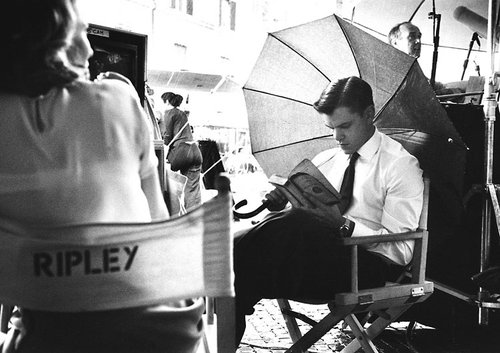
To prepare for the role, Damon lost 25 pounds in order to appear pale and
skinny, and spent a month learning how to play the piano, finding that his
playing posture informed the way Tom sat and walked.
For the role of Dickie
Greenleaf, Minghella met with many American actors but found that they couldn’t
evoke the character’s “class snobbery” and he thought of Jude Law for the role.
Initially, the actor was not keen on playing Dickie but Minghella won him over.
Law was drawn to the part due to being “fascinated by the challenge of trying
to make nasty characters likeable.” Minghella wrote the role of Marge Sherwood
with Gwyneth Paltrow in mind and she was the first person he cast. Initially,
she didn’t understand how interesting the character was but during the
rehearsal process, she discovered “how full and complicated the role is.”
To prepare for making Ripley, Minghella rewatched Alfred
Hitchcock’s Vertigo (1958) and I Vitelloni (1953), as well as reading
the memoirs of Paul Goodman and Paul Monette in order to get a handle on the
cultural touchstones of the young American characters in Ripley. He also read Calvin Trillin’s “Remembering Denny,” about
the writer’s Yale 1957 classmate Denny Hansen, a closeted gay varsity athlete
who went to Europe as a Rhodes scholar.

The Talented Mr. Ripley received mostly positive to mixed reviews. Roger
Ebert gave the film four out of four stars and wrote, “The movie is an
intelligent thriller as you’ll see this year.” In her review for The New York Times, Janet Maslin praised
Jude Law’s “star-making role for the preternaturally talented English actor
Jude Law. Beyond being devastatingly good-looking, Mr. Law gives Dickie the
manic, teasing powers of manipulation that make him ardently courted by every
man or woman he knows.” Entertainment
Weekly gave the film an “A-“ rating and Lisa Schwarzbaum wrote, “Damon is
at once an obvious choice for the part and a hard sell to audiences soothed by
his amiable boyishness … But the façade works surprisingly well when Damon
holds that gleaming smile just a few seconds too long, his Eagle Scout eyes
fixed just a blink more than the calm gaze of any non-murdering young man. And
in that opacity we see horror.”
The New York Observer’s Andrew Sarris wrote, “The Talented Mr. Ripley, as a case in point, is an often brilliant
but ultimately confused murder melodrama in which there is no mystery to be
solved, and no characters sympathetic enough to generate suspense about their
fate in the patented Hitchcock manner.” However, in her review for the Village Voice, Amy Taubin criticized
Minghella for turning, “The Talented Mr.
Ripley into a splashy tourist trap of a movie. The effect is rather like
reading The National Inquirer in a
café overlooking the Adriatic.” The
Guardian’s Peter Bradshaw wrote, “It ends up a dismayingly unthrilling
thriller and bafflingly unconvincing character study. Ripley says he’d rather
be a fake somebody than a real nobody – but a fake nobody is all we’re
offered…”
“I always thought it’s better
to be a fake somebody then a real nobody,” Tom says towards the closing of the
film. The last shot – his reflection in a closet mirror as he replays the
latest murder in his mind. Tom’s mirror image is a repeating motif throughout The Talented Mr. Ripley; one imagines
his life as a hall of mirrors. Which one is the real Tom Ripley? Are we seeing
the “real” Tom before the closet door closes into darkness and the film ends?
Its final shot brilliantly, visually sums up what Tom is: a sociopath unable to
truly love because when he gets too close to the object of his affection, his
impulse is to destroy, lest he reveal too much of his real self.

SOURCES
“Cinderella Minghella.” The
Guardian. February 16, 2000.
Luscombe, Belinda. “Matt
Damon Acts Out.” Time. March 6, 2000.
Rich, Frank. “American
Pseudo.” The New York Times. December 12, 1999.
Simon, Alex. “The Talented
Mr. Minghella.” Venice Magazine. February 2000.
“The Talented Mr. Ripley: Part 1. Empire.
“The Talented Mr. Ripley: Part 2. Empire.
The Talented Mr. Ripley Production Notes. Miramax Pictures. 1999.


